International Journal of Mathematics and Statistics Invention (IJMSI)
E-ISSN: 2321 – 4767 P-ISSN: 2321 - 4759
www.ijmsi.org Volume 5 Issue 1 || January. 2017 || PP-58-61
www.ijmsi.org 58 | Page
Enhancing the Mean Ratio Estimator for Estimating Population
Mean Using Conventional Parameters
T. A. Raja* Mir Subzar*
, S. Maqbool*, and Aijaz A. Hakak**
*Division of Agricultural Statistics, SKUAST-Kashmir.
**GDC(Boys) ,Anantnag-Kashmir.
ABSTRACT: Use of auxilliary information in survey sampling has its eminent role in estimating the
population parameters with greater precision. The present paper concentrates on estimating the finite
population mean by proposing the new generalised ratio type estimators in simple random sampling without
replacement using coefficient of variation and population deciles. The expressions for mean square error and
bias were calculated and compared with the classical and existing estimators. By this comparison it is
conformed that our proposed class of new estimators is a class of efficient estimators under percent relative
efficiency (PRE) criterion.
KEYWORDS: Coefficient of variation; deciles; ratio-type estimators; mean square error; bias; efficiency.
I. INTRODUCTION
The classical ratio type estimator was first given by Cochran (1940), for estimating population mean based on
some prior information of population of an auxiliary variable X. Rao (1991) introduced difference type ratio
estimator that outperforms conventional ratio and linear regression estimators. Upadhyaya & Singh (1999)
introduced modified ratio type estimators using coefficient of variation and coefficient of kurtosis of the
auxiliary variable. Singh & Tailor (2003) proposed a family of estimators using known values of some
parameters. Sisodia & Dwivedi (1981) and Singh et al. (2004) utilized coefficient of variation of the auxiliary
variable. Further improvements are achieved by introducing a large number of modified ratio estimators (see
Subramani and Kumarpandiyan, (2012 a, b and c)).
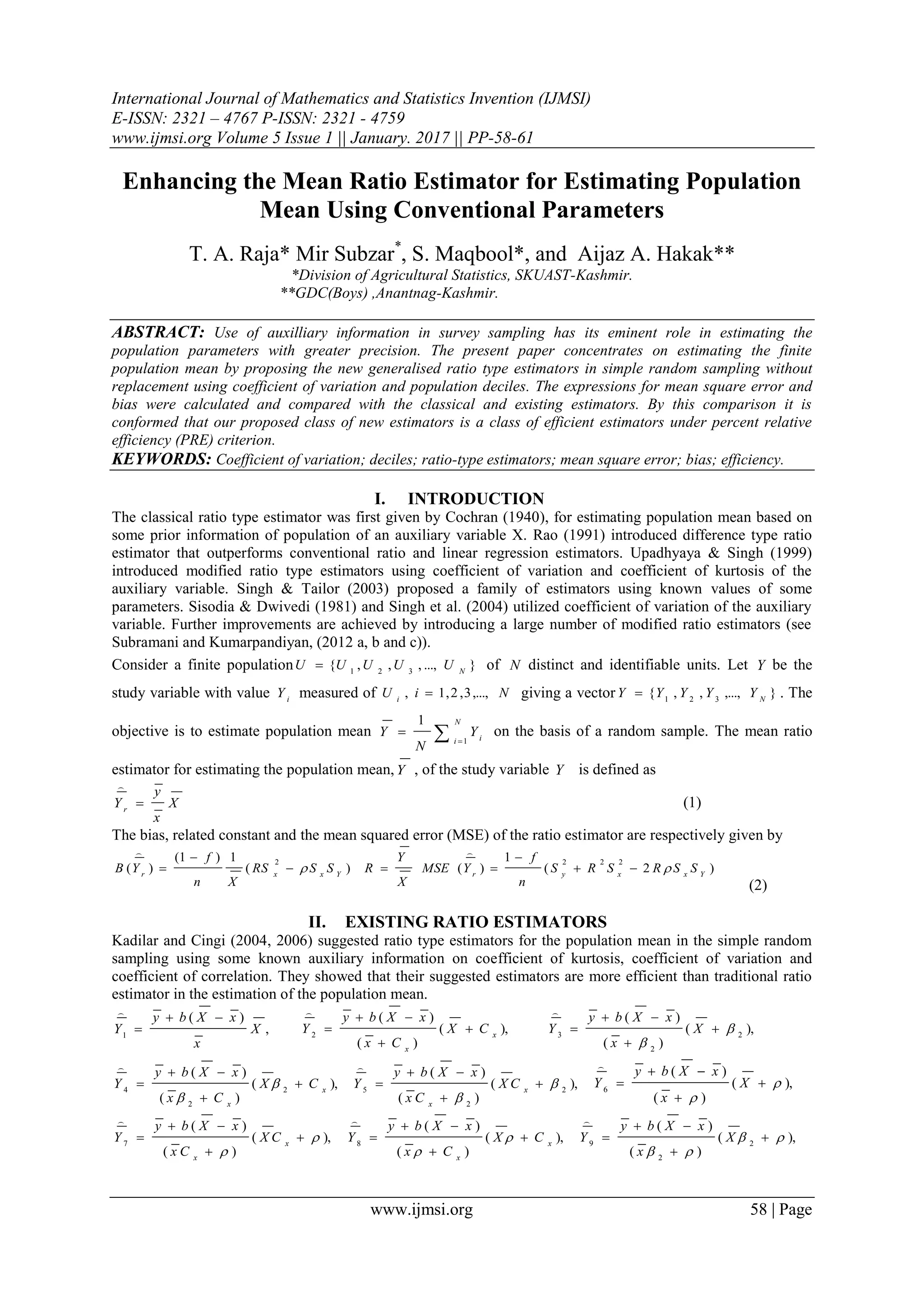
Consider a finite population }...,,,,{ 321 N
UUUUU  of N distinct and identifiable units. Let Y be the
study variable with value i
Y measured of NiU i
,...,3,2,1,  giving a vector },...,,,{ 321 N
YYYYY  . The
objective is to estimate population mean  

N
i i
Y
N
Y
1
1
on the basis of a random sample. The mean ratio
estimator for estimating the population mean,Y , of the study variable Y is defined as
X
x
y
Y r


(1)
The bias, related constant and the mean squared error (MSE) of the ratio estimator are respectively given by
)2(
1
)()(
1)1(
)(
2222
YxxyrYxxr
SSRSRS
n
f
YMSE
X
Y
RSSRS
Xn
f
YB  





(2)
II. EXISTING RATIO ESTIMATORS
Kadilar and Cingi (2004, 2006) suggested ratio type estimators for the population mean in the simple random
sampling using some known auxiliary information on coefficient of kurtosis, coefficient of variation and
coefficient of correlation. They showed that their suggested estimators are more efficient than traditional ratio
estimator in the estimation of the population mean.
,
)(
1
X
x
xXby
Y



),(
)(
)(
2 x
x
CX
Cx
xXby
Y 




),(
)(
)(
2
2
3





 X
x
xXby
Y

),(
)(
)(
2
2
4 x
x
CX
Cx
xXby
Y 


 


),(
)(
)(
2
2
5





 x
x
CX
Cx
xXby
Y

),(
)(
)(
6





 X
x
xXby
Y

),(
)(
)(
7





 x
x
CX
Cx
xXby
Y

),(
)(
)(
8 x
x
CX
Cx
xXby
Y 


 


),(
)(
)(
2
2
9





 X
x
xXby
Y

Enhancing The Mean Ratio Estimator For Estimating Population Mean Using Conventional...
www.ijmsi.org 59 | Page
).(
)(
)(
2
2
10





 X
x
xXby
Y

(3)
III. PROPOSED MODIFIED RATIO ESTIMATOR
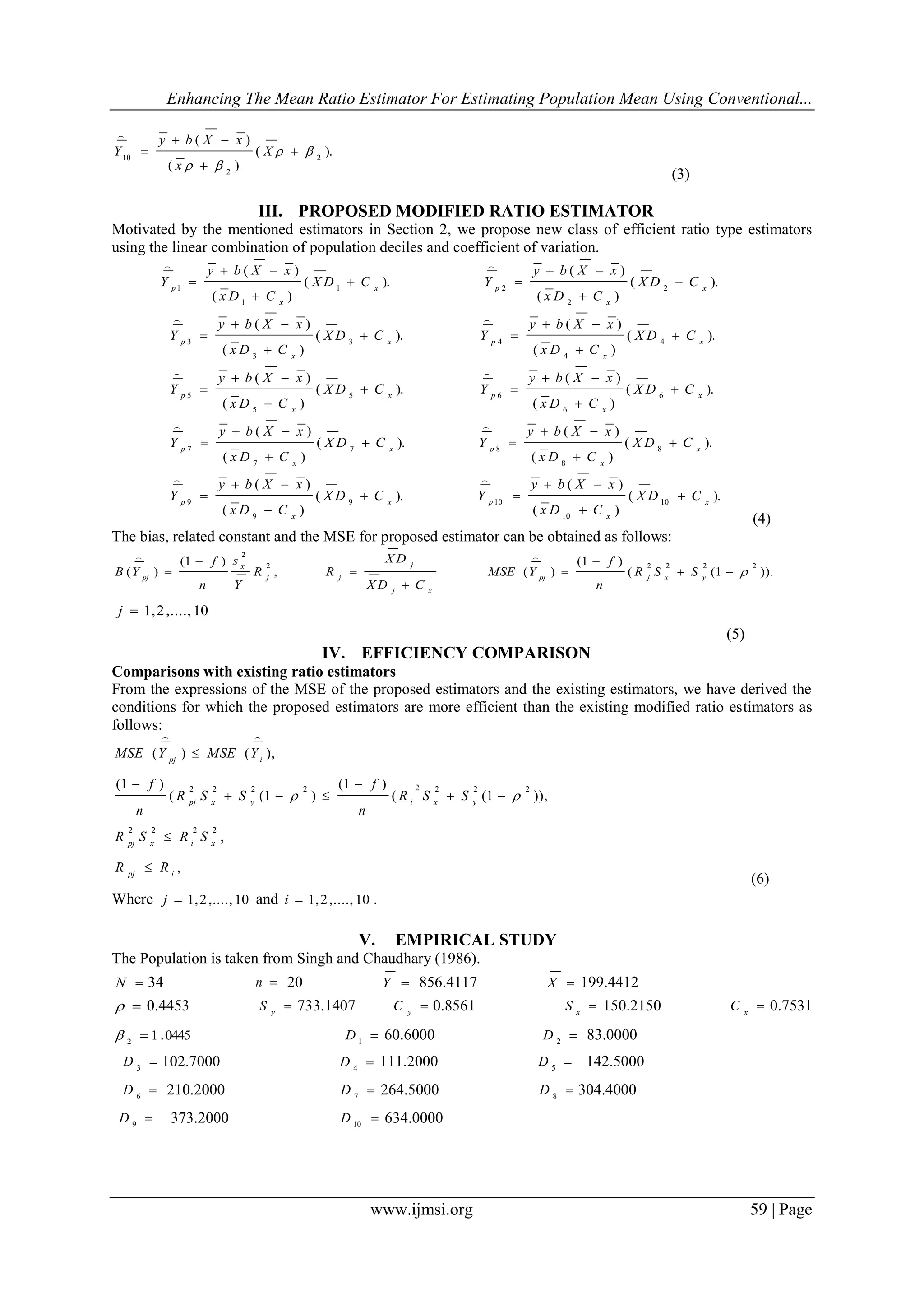
Motivated by the mentioned estimators in Section 2, we propose new class of efficient ratio type estimators
using the linear combination of population deciles and coefficient of variation.
).(
)(
)(
1
1
1 x
x
p
CDX
CDx
xXby
Y 




).(
)(
)(
2
2
2 x
x
p
CDX
CDx
xXby
Y 




).(
)(
)(
3
3
3 x
x
p
CDX
CDx
xXby
Y 




).(
)(
)(
4
4
4 x
x
p
CDX
CDx
xXby
Y 




).(
)(
)(
5
5
5 x
x
p
CDX
CDx
xXby
Y 




).(
)(
)(
6
6
6 x
x
p
CDX
CDx
xXby
Y 




).(
)(
)(
7
7
7 x
x
p
CDX
CDx
xXby
Y 




).(
)(
)(
8
8
8 x
x
p
CDX
CDx
xXby
Y 




).(
)(
)(
9
9
9 x
x
p
CDX
CDx
xXby
Y 




).(
)(
)(
10
10
10 x
x
p
CDX
CDx
xXby
Y 




(4)
The bias, related constant and the MSE for proposed estimator can be obtained as follows:
)).1((
)1(
)(,
)1(
)(
22222
2






 yxjpj
xj
j
jj
x
pj
SSR
n
f
YMSE
CDX
DX
RR
Y
s
n
f
YB

10,....,2,1j
(5)
IV. EFFICIENCY COMPARISON
Comparisons with existing ratio estimators
From the expressions of the MSE of the proposed estimators and the existing estimators, we have derived the
conditions for which the proposed estimators are more efficient than the existing modified ratio estimators as
follows:
,
,
)),1((
)1(
)1((
)1(
),()(
2222
22222222
ipj
xixpj
yxiyxpj
ipj
RR
SRSR
SSR
n
f
SSR
n
f
YMSEYMSE









(6)
Where 10,....,2,1j and .10,....,2,1i
V. EMPIRICAL STUDY
The Population is taken from Singh and Chaudhary (1986).
N 34 n 20 Y 856.4117 X 199.4412
 0.4453 y
S 733.1407 y
C 0.8561 x
S 150.2150 x
C 0.7531
0445.12
 1
D 60.6000 2
D 83.0000
3
D 102.7000 4
D 111.2000 5
D 142.5000
6
D 210.2000 7
D 264.5000 8
D 304.4000
9
D 373.2000 10
D 634.0000
Enhancing The Mean Ratio Estimator For Estimating Population Mean Using Conventional...
www.ijmsi.org 60 | Page
Estimators Constant Bias MSE
r
Y
 4.294 4.940 10960.76
1
Y
 4.294 10.002 17437.65
2
Y
 4.278 9.927 17373.31
3
Y
 4.272 9.898 17348.62
4
Y
 4.279 9.930 17376.04
5
Y
 4.264 9.865 17319.75
6
Y
 4.285 9.957 17399.52
7
Y
 4.281 9.943 17387.08
8
Y
 4.258 9.834 17294.19
9
Y
 4.285 9.960 17401.14
10
Y
 4.244 9.771 17239.66
1p
Y
 0.999937692 0.540062163 9296.257115
2p
Y
 0.999954507 0.540080327 9296.272671
3p
Y
 0.999963233 0.540089753 9296.280743
4p
Y
 0.999966043 0.540092788 9296.283343
5p
Y
 0.999973502 0.540100845 9296.290243
6p
Y
 0.999982036 0.540110064 9296.298138
7p
Y
 0.999985724 0.540114048 9296.301550
8p
Y
 0.999987595 0.540116069 9296.303281
9p
Y
 0.999989882 0.540118540 9296.305396
10p
Y
 0.999994044 0.540123036 9296.309247
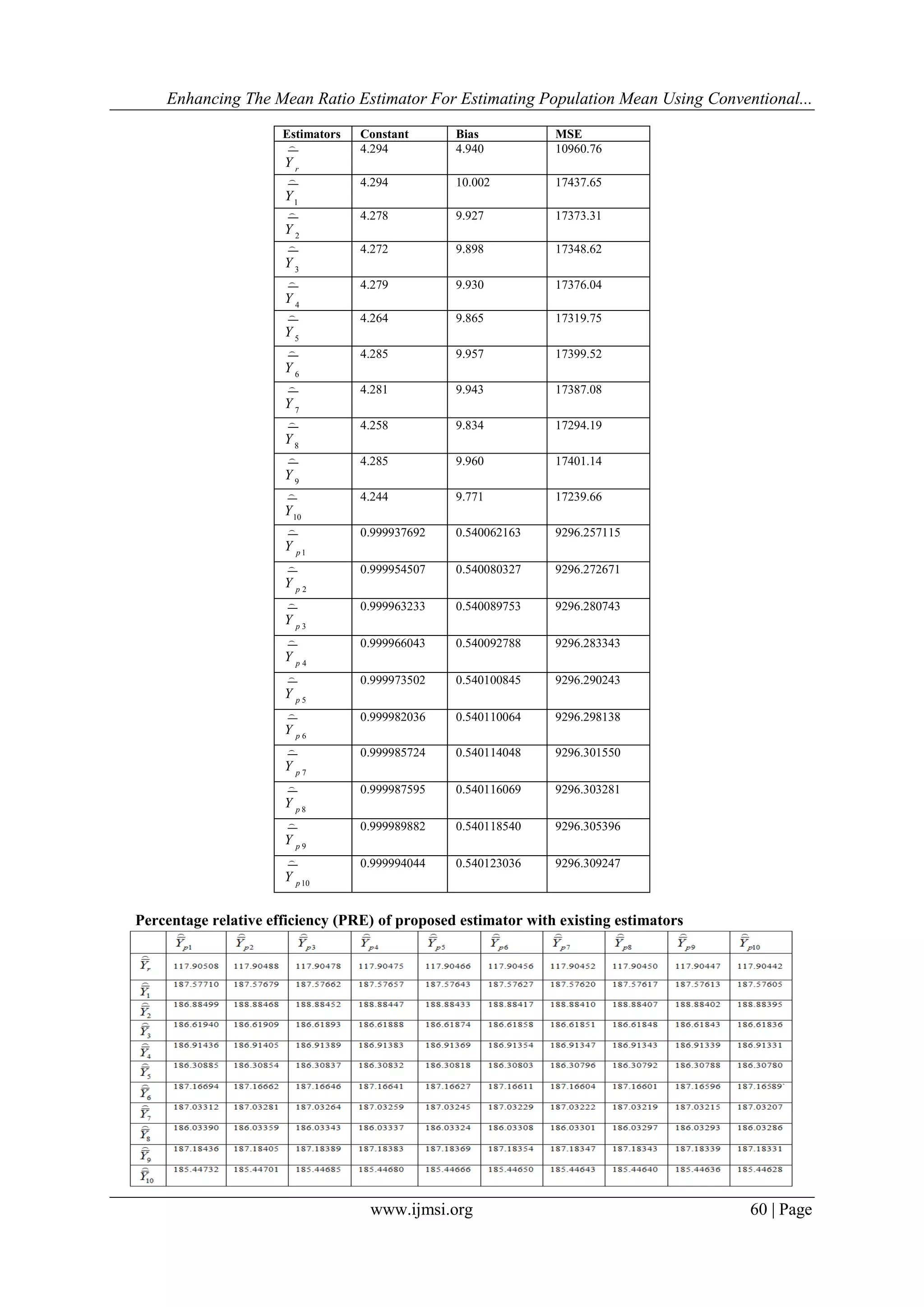
Percentage relative efficiency (PRE) of proposed estimator with existing estimators
Enhancing The Mean Ratio Estimator For Estimating Population Mean Using Conventional...
www.ijmsi.org 61 | Page
VI. CONCLUSION
From the above empirical study we found that our proposed estimators are more efficient than the classical and
existing estimators as their MSE and bias is lower than classical and existing estimators and also by percent
relative efficiency (PRE) criterion. Hence, can be preferred for practical application.
REFERENCES
[1]. W. G. Cochran , Sampling Techniques (3 edn, Wiley Eastern Limited, New York, 1940)
[2]. Kadilar, C. & Cingi, H. Ratio estimators in simple random sampling’, Applied Mathematics and Computation 151, (2004), 893–
902.
[3]. Kadilar, C. & Cingi, H. An improvement in estimating the population mean by using the correlation coefficient Hacettepe Journal
of Mathematics and Statistics 35(1), (2006), 103–109.
[4]. Rao, T. J. ‘On certain methods of improving ratio and regression estimators Communications in Statistics-Theory and Methods
20(10), (1991), 3325–3340.
[5]. Singh, D. & Chaudhary, F. S. Theory and Analysis of Sample Survey Designs (1edn, New Age International Publisher, India, 1986)
[6]. Singh, H. P. & Tailor, R. Use of known correlation coefficient in estimating the finite population means Statistics in Transition
6(4), (2003), 555–560.
[7]. Singh, H. P., Tailor, R., Tailor, R. & Kakran, M. An improved estimator of population mean using power transformation Journal of
the Indian Society of Agricultural Statistics 58(2), (2004), 223–230.
[8]. Sisodia, B. V. S. & Dwivedi, V. K. ‘A modified ratio estimator using coefficient of variation of auxiliary variable Journal of the
Indian Society of Agricultural Statistics 33(1), (1981), 13–18.
[9]. Subramani, J. & Kumarapandiyan, G. Estimation of population mean using co-efficient of variation and median of an auxiliary
variable International Journal of Probability and Statistics 1(4), (2012a),111–118.
[10]. Subramani, J. & Kumarapandiyan, G. Estimation of population mean using known median and co-efficient of skewness American
Journal of Mathematics and Statistics 2(5),(2012b) 101–107.
[11]. Subramani, J. & Kumarapandiyan, G. Modified ratio estimators using known median and co-efficient of kurtosis American Journal
of Mathematics and Statistics 2(4),(2012c) 95–100.
[12]. Upadhyaya, L. N. & Singh, H. Use of transformed auxiliary variable in estimating the finite population mean Biometrical Journal
41(5),(1999) 627–636.

Enhancing the Mean Ratio Estimator for Estimating Population Mean Using Conventional Parameters

  • 1.
    International Journal ofMathematics and Statistics Invention (IJMSI) E-ISSN: 2321 – 4767 P-ISSN: 2321 - 4759 www.ijmsi.org Volume 5 Issue 1 || January. 2017 || PP-58-61 www.ijmsi.org 58 | Page Enhancing the Mean Ratio Estimator for Estimating Population Mean Using Conventional Parameters T. A. Raja* Mir Subzar* , S. Maqbool*, and Aijaz A. Hakak** *Division of Agricultural Statistics, SKUAST-Kashmir. **GDC(Boys) ,Anantnag-Kashmir. ABSTRACT: Use of auxilliary information in survey sampling has its eminent role in estimating the population parameters with greater precision. The present paper concentrates on estimating the finite population mean by proposing the new generalised ratio type estimators in simple random sampling without replacement using coefficient of variation and population deciles. The expressions for mean square error and bias were calculated and compared with the classical and existing estimators. By this comparison it is conformed that our proposed class of new estimators is a class of efficient estimators under percent relative efficiency (PRE) criterion. KEYWORDS: Coefficient of variation; deciles; ratio-type estimators; mean square error; bias; efficiency. I. INTRODUCTION The classical ratio type estimator was first given by Cochran (1940), for estimating population mean based on some prior information of population of an auxiliary variable X. Rao (1991) introduced difference type ratio estimator that outperforms conventional ratio and linear regression estimators. Upadhyaya & Singh (1999) introduced modified ratio type estimators using coefficient of variation and coefficient of kurtosis of the auxiliary variable. Singh & Tailor (2003) proposed a family of estimators using known values of some parameters. Sisodia & Dwivedi (1981) and Singh et al. (2004) utilized coefficient of variation of the auxiliary variable. Further improvements are achieved by introducing a large number of modified ratio estimators (see Subramani and Kumarpandiyan, (2012 a, b and c)). Consider a finite population }...,,,,{ 321 N UUUUU  of N distinct and identifiable units. Let Y be the study variable with value i Y measured of NiU i ,...,3,2,1,  giving a vector },...,,,{ 321 N YYYYY  . The objective is to estimate population mean    N i i Y N Y 1 1 on the basis of a random sample. The mean ratio estimator for estimating the population mean,Y , of the study variable Y is defined as X x y Y r   (1) The bias, related constant and the mean squared error (MSE) of the ratio estimator are respectively given by )2( 1 )()( 1)1( )( 2222 YxxyrYxxr SSRSRS n f YMSE X Y RSSRS Xn f YB        (2) II. EXISTING RATIO ESTIMATORS Kadilar and Cingi (2004, 2006) suggested ratio type estimators for the population mean in the simple random sampling using some known auxiliary information on coefficient of kurtosis, coefficient of variation and coefficient of correlation. They showed that their suggested estimators are more efficient than traditional ratio estimator in the estimation of the population mean. , )( 1 X x xXby Y    ),( )( )( 2 x x CX Cx xXby Y      ),( )( )( 2 2 3       X x xXby Y  ),( )( )( 2 2 4 x x CX Cx xXby Y        ),( )( )( 2 2 5       x x CX Cx xXby Y  ),( )( )( 6       X x xXby Y  ),( )( )( 7       x x CX Cx xXby Y  ),( )( )( 8 x x CX Cx xXby Y        ),( )( )( 2 2 9       X x xXby Y 
  • 2.
    Enhancing The MeanRatio Estimator For Estimating Population Mean Using Conventional... www.ijmsi.org 59 | Page ).( )( )( 2 2 10       X x xXby Y  (3) III. PROPOSED MODIFIED RATIO ESTIMATOR Motivated by the mentioned estimators in Section 2, we propose new class of efficient ratio type estimators using the linear combination of population deciles and coefficient of variation. ).( )( )( 1 1 1 x x p CDX CDx xXby Y      ).( )( )( 2 2 2 x x p CDX CDx xXby Y      ).( )( )( 3 3 3 x x p CDX CDx xXby Y      ).( )( )( 4 4 4 x x p CDX CDx xXby Y      ).( )( )( 5 5 5 x x p CDX CDx xXby Y      ).( )( )( 6 6 6 x x p CDX CDx xXby Y      ).( )( )( 7 7 7 x x p CDX CDx xXby Y      ).( )( )( 8 8 8 x x p CDX CDx xXby Y      ).( )( )( 9 9 9 x x p CDX CDx xXby Y      ).( )( )( 10 10 10 x x p CDX CDx xXby Y      (4) The bias, related constant and the MSE for proposed estimator can be obtained as follows: )).1(( )1( )(, )1( )( 22222 2        yxjpj xj j jj x pj SSR n f YMSE CDX DX RR Y s n f YB  10,....,2,1j (5) IV. EFFICIENCY COMPARISON Comparisons with existing ratio estimators From the expressions of the MSE of the proposed estimators and the existing estimators, we have derived the conditions for which the proposed estimators are more efficient than the existing modified ratio estimators as follows: , , )),1(( )1( )1(( )1( ),()( 2222 22222222 ipj xixpj yxiyxpj ipj RR SRSR SSR n f SSR n f YMSEYMSE          (6) Where 10,....,2,1j and .10,....,2,1i V. EMPIRICAL STUDY The Population is taken from Singh and Chaudhary (1986). N 34 n 20 Y 856.4117 X 199.4412  0.4453 y S 733.1407 y C 0.8561 x S 150.2150 x C 0.7531 0445.12  1 D 60.6000 2 D 83.0000 3 D 102.7000 4 D 111.2000 5 D 142.5000 6 D 210.2000 7 D 264.5000 8 D 304.4000 9 D 373.2000 10 D 634.0000
  • 3.
    Enhancing The MeanRatio Estimator For Estimating Population Mean Using Conventional... www.ijmsi.org 60 | Page Estimators Constant Bias MSE r Y  4.294 4.940 10960.76 1 Y  4.294 10.002 17437.65 2 Y  4.278 9.927 17373.31 3 Y  4.272 9.898 17348.62 4 Y  4.279 9.930 17376.04 5 Y  4.264 9.865 17319.75 6 Y  4.285 9.957 17399.52 7 Y  4.281 9.943 17387.08 8 Y  4.258 9.834 17294.19 9 Y  4.285 9.960 17401.14 10 Y  4.244 9.771 17239.66 1p Y  0.999937692 0.540062163 9296.257115 2p Y  0.999954507 0.540080327 9296.272671 3p Y  0.999963233 0.540089753 9296.280743 4p Y  0.999966043 0.540092788 9296.283343 5p Y  0.999973502 0.540100845 9296.290243 6p Y  0.999982036 0.540110064 9296.298138 7p Y  0.999985724 0.540114048 9296.301550 8p Y  0.999987595 0.540116069 9296.303281 9p Y  0.999989882 0.540118540 9296.305396 10p Y  0.999994044 0.540123036 9296.309247 Percentage relative efficiency (PRE) of proposed estimator with existing estimators
  • 4.
    Enhancing The MeanRatio Estimator For Estimating Population Mean Using Conventional... www.ijmsi.org 61 | Page VI. CONCLUSION From the above empirical study we found that our proposed estimators are more efficient than the classical and existing estimators as their MSE and bias is lower than classical and existing estimators and also by percent relative efficiency (PRE) criterion. Hence, can be preferred for practical application. REFERENCES [1]. W. G. Cochran , Sampling Techniques (3 edn, Wiley Eastern Limited, New York, 1940) [2]. Kadilar, C. & Cingi, H. Ratio estimators in simple random sampling’, Applied Mathematics and Computation 151, (2004), 893– 902. [3]. Kadilar, C. & Cingi, H. An improvement in estimating the population mean by using the correlation coefficient Hacettepe Journal of Mathematics and Statistics 35(1), (2006), 103–109. [4]. Rao, T. J. ‘On certain methods of improving ratio and regression estimators Communications in Statistics-Theory and Methods 20(10), (1991), 3325–3340. [5]. Singh, D. & Chaudhary, F. S. Theory and Analysis of Sample Survey Designs (1edn, New Age International Publisher, India, 1986) [6]. Singh, H. P. & Tailor, R. Use of known correlation coefficient in estimating the finite population means Statistics in Transition 6(4), (2003), 555–560. [7]. Singh, H. P., Tailor, R., Tailor, R. & Kakran, M. An improved estimator of population mean using power transformation Journal of the Indian Society of Agricultural Statistics 58(2), (2004), 223–230. [8]. Sisodia, B. V. S. & Dwivedi, V. K. ‘A modified ratio estimator using coefficient of variation of auxiliary variable Journal of the Indian Society of Agricultural Statistics 33(1), (1981), 13–18. [9]. Subramani, J. & Kumarapandiyan, G. Estimation of population mean using co-efficient of variation and median of an auxiliary variable International Journal of Probability and Statistics 1(4), (2012a),111–118. [10]. Subramani, J. & Kumarapandiyan, G. Estimation of population mean using known median and co-efficient of skewness American Journal of Mathematics and Statistics 2(5),(2012b) 101–107. [11]. Subramani, J. & Kumarapandiyan, G. Modified ratio estimators using known median and co-efficient of kurtosis American Journal of Mathematics and Statistics 2(4),(2012c) 95–100. [12]. Upadhyaya, L. N. & Singh, H. Use of transformed auxiliary variable in estimating the finite population mean Biometrical Journal 41(5),(1999) 627–636.