Basic Concepts
Absolute Size
TheSuperposition Principle
Copyright – Michael D. Fayer, 2018
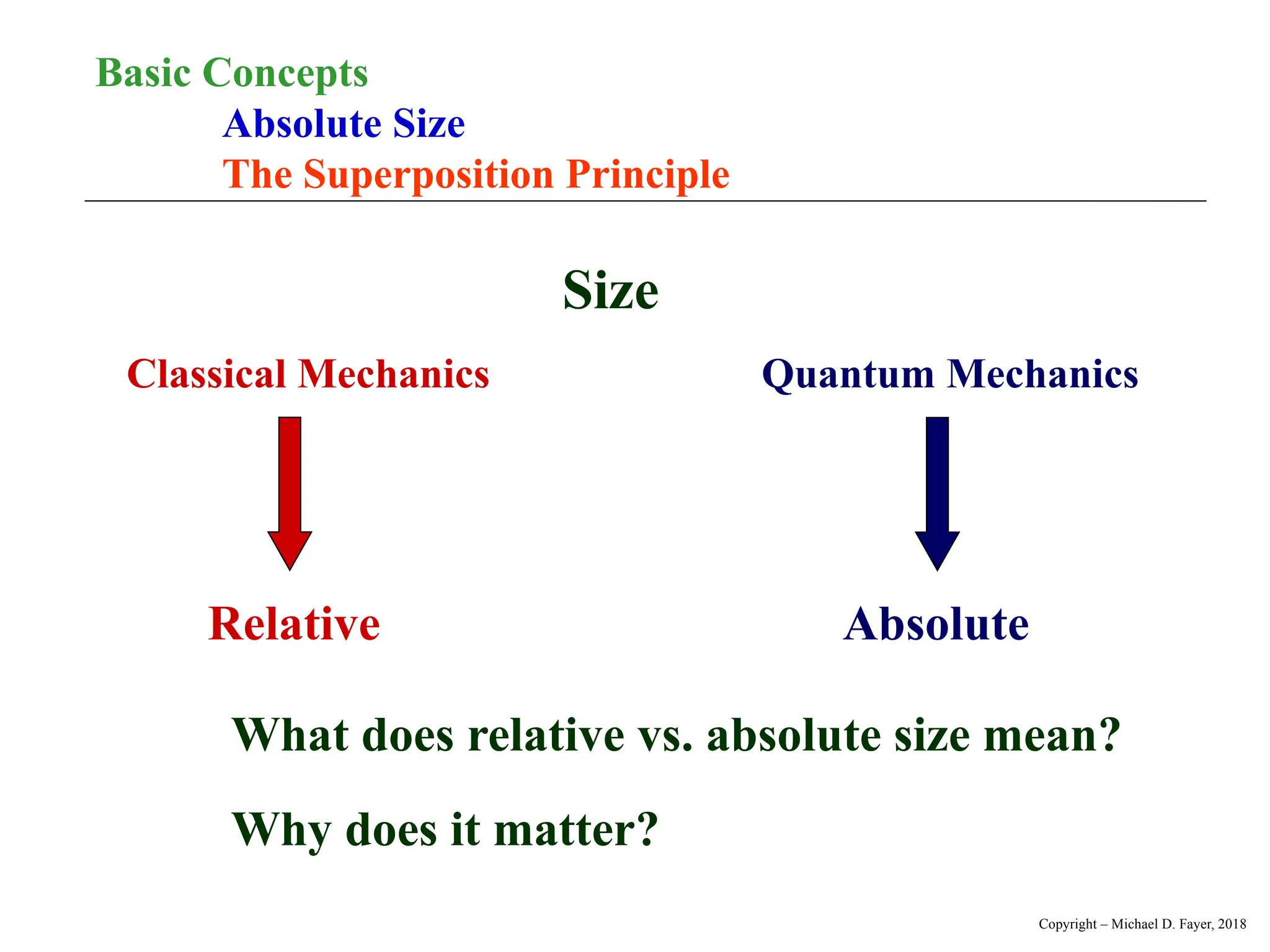
Size
Classical Mechanics Quantum Mechanics
Relative Absolute
What does relative vs. absolute size mean?
Why does it matter?
2.
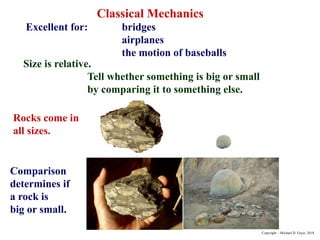
Classical Mechanics
Excellent for:bridges
airplanes
the motion of baseballs
Size is relative.
Tell whether something is big or small
by comparing it to something else.
Rocks come in
all sizes.
Comparison
determines if
a rock is
big or small.
Copyright – Michael D. Fayer, 2018
3.
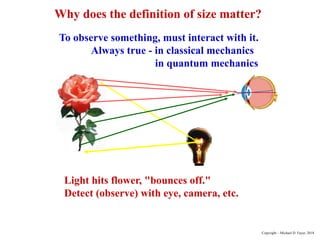
Why does thedefinition of size matter?
To observe something, must interact with it.
Always true - in classical mechanics
in quantum mechanics
Light hits flower, "bounces off."
Detect (observe) with eye, camera, etc.
Copyright – Michael D. Fayer, 2018
4.
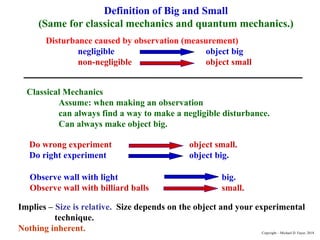
Definition of Bigand Small
(Same for classical mechanics and quantum mechanics.)
Disturbance caused by observation (measurement)
negligible object big
non-negligible object small
Classical Mechanics
Assume: when making an observation
can always find a way to make a negligible disturbance.
Can always make object big.
Do wrong experiment object small.
Do right experiment object big.
Observe wall with light big.
Observe wall with billiard balls small.
Implies – Size is relative. Size depends on the object and your experimental
technique.
Nothing inherent. Copyright – Michael D. Fayer, 2018
5.
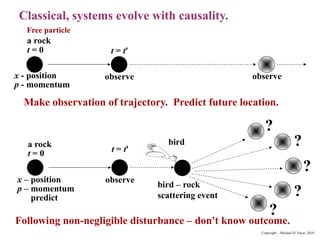
Classical, systems evolvewith causality.
?
?
?
?
?
Following non-negligible disturbance – don't know outcome.
bird
bird – rock
scattering event
t = t'
observe observe
t = t'
observe
x – position
p – momentum
predict
a rock
t = 0
Make observation of trajectory. Predict future location.
a rock
t = 0
x - position
p - momentum
Copyright – Michael D. Fayer, 2018
Free particle
6.
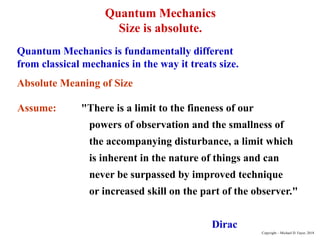
Quantum Mechanics
Size isabsolute.
Quantum Mechanics is fundamentally different
from classical mechanics in the way it treats size.
Absolute Meaning of Size
Assume: "There is a limit to the fineness of our
powers of observation and the smallness of
the accompanying disturbance, a limit which
is inherent in the nature of things and can
never be surpassed by improved technique
or increased skill on the part of the observer."
Dirac
Copyright – Michael D. Fayer, 2018
7.
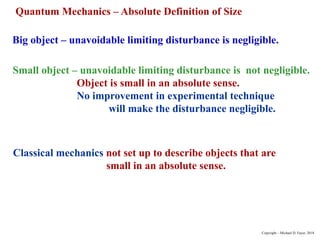
Big object –unavoidable limiting disturbance is negligible.
Small object – unavoidable limiting disturbance is not negligible.
Object is small in an absolute sense.
No improvement in experimental technique
will make the disturbance negligible.
Classical mechanics not set up to describe objects that are
small in an absolute sense.
Quantum Mechanics – Absolute Definition of Size
Copyright – Michael D. Fayer, 2018
8.
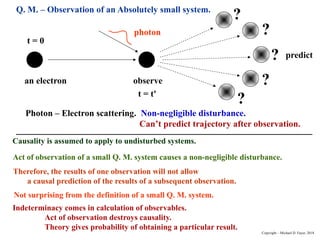
an electron
t =0
Q. M. – Observation of an Absolutely small system.
t = t'
observe
photon
predict
?
?
?
?
?
Photon – Electron scattering. Non-negligible disturbance.
Can’t predict trajectory after observation.
Indeterminacy comes in calculation of observables.
Act of observation destroys causality.
Theory gives probability of obtaining a particular result.
Causality is assumed to apply to undisturbed systems.
Act of observation of a small Q. M. system causes a non-negligible disturbance.
Therefore, the results of one observation will not allow
a causal prediction of the results of a subsequent observation.
Not surprising from the definition of a small Q. M. system.
Copyright – Michael D. Fayer, 2018
9.
The Superposition Principle
FundamentalLaw of Q. M. Inherently different from classical mechanics.
Pervades quantum theory.
Two examples to illustrate idea before formulating Superposition Principle.
Polarization of photons
Interference of photons
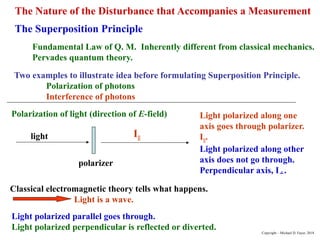
Polarization of light (direction of E-field)
polarizer
light I||
Light polarized along one
axis goes through polarizer.
I||.
Light polarized along other
axis does not go through.
Perpendicular axis, I.
Classical electromagnetic theory tells what happens.
Light is a wave.
Light polarized parallel goes through.
Light polarized perpendicular is reflected or diverted.
The Nature of the Disturbance that Accompanies a Measurement
Copyright – Michael D. Fayer, 2018
10.
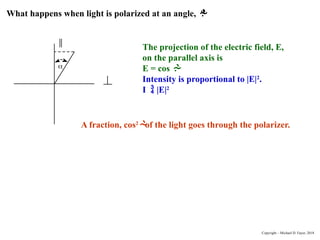
What happens whenlight is polarized at an angle,
?
The projection of the electric field, E,
on the parallel axis is
E = cos
.
Intensity is proportional to |E|2
.
I |E|2
A fraction, cos2
of the light goes through the polarizer.
Copyright – Michael D. Fayer, 2018
11.
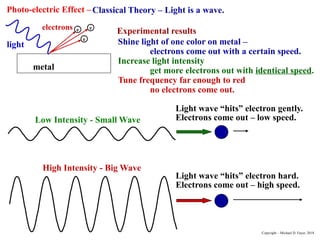
Photo-electric Effect –ClassicalTheory – Light is a wave.
Low Intensity - Small Wave
Light wave “hits” electron gently.
Electrons come out – low speed.
High Intensity - Big Wave
Light wave “hits” electron hard.
Electrons come out – high speed.
metal
light
electrons e e
e
Shine light of one color on metal –
electrons come out with a certain speed.
Increase light intensity
get more electrons out with identical speed.
Tune frequency far enough to red
no electrons come out.
Experimental results
Copyright – Michael D. Fayer, 2018
12.
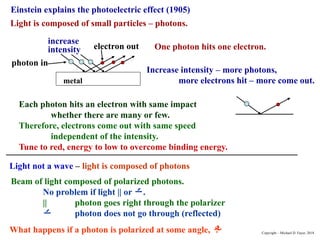
Einstein explains thephotoelectric effect (1905)
Light is composed of small particles – photons.
metal
photon in
electron out One photon hits one electron.
Increase intensity – more photons,
more electrons hit – more come out.
increase
intensity
Each photon hits an electron with same impact
whether there are many or few.
Therefore, electrons come out with same speed
independent of the intensity.
Tune to red, energy to low to overcome binding energy.
Light not a wave – light is composed of photons
Beam of light composed of polarized photons.
No problem if light || or .
|| photon goes right through the polarizer
photon does not go through (reflected)
What happens if a photon is polarized at some angle,
? Copyright – Michael D. Fayer, 2018
13.
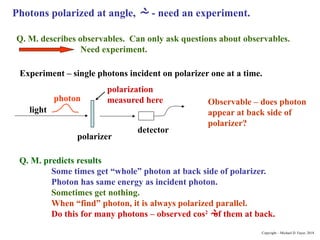
Photons polarized atangle, - need an experiment.
Q. M. describes observables. Can only ask questions about observables.
Need experiment.
Experiment – single photons incident on polarizer one at a time.
Q. M. predicts results
Some times get “whole” photon at back side of polarizer.
Photon has same energy as incident photon.
Sometimes get nothing.
When “find” photon, it is always polarized parallel.
Do this for many photons – observed cos2
of them at back.
polarizer
light
detector
photon Observable – does photon
appear at back side of
polarizer?
polarization
measured here
Copyright – Michael D. Fayer, 2018
14.
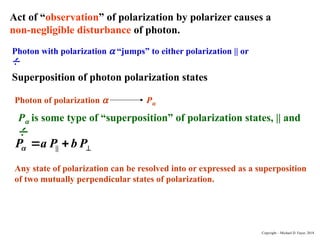
Act of “observation”of polarization by polarizer causes a
non-negligible disturbance of photon.
Photon with polarization a “jumps” to either polarization || or
.
Superposition of photon polarization states
Photon of polarization a Pa
Pa is some type of “superposition” of polarization states, || and
.
||
P a P b P
Any state of polarization can be resolved into or expressed as a superposition
of two mutually perpendicular states of polarization.
Copyright – Michael D. Fayer, 2018
15.
||
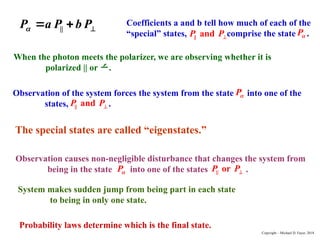
P a Pb P
Coefficients a and b tell how much of each of the
“special” states, comprise the state .
|| and
P P
P
Observation of the system forces the system from the state into one of the
states, .
|| and
P P
P
When the photon meets the polarizer, we are observing whether it is
polarized || or .
The special states are called “eigenstates.”
Observation causes non-negligible disturbance that changes the system from
being in the state into one of the states .
P || or
P P
System makes sudden jump from being part in each state
to being in only one state.
Probability laws determine which is the final state.
Copyright – Michael D. Fayer, 2018
16.
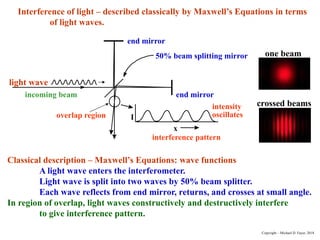
Interference of light– described classically by Maxwell’s Equations in terms
of light waves.
incoming beam
end mirror
50% beam splitting mirror
end mirror
light wave
Classical description – Maxwell’s Equations: wave functions
A light wave enters the interferometer.
Light wave is split into two waves by 50% beam splitter.
Each wave reflects from end mirror, returns, and crosses at small angle.
In region of overlap, light waves constructively and destructively interfere
to give interference pattern.
I
intensity
oscillates
interference pattern
x
overlap region
Copyright – Michael D. Fayer, 2018
one beam
crossed beams
17.
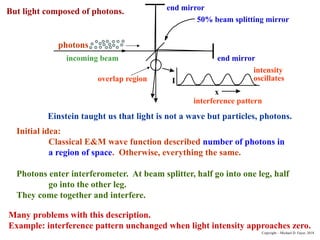
Initial idea:
Classical E&Mwave function described number of photons in
a region of space. Otherwise, everything the same.
Photons enter interferometer. At beam splitter, half go into one leg, half
go into the other leg.
They come together and interfere.
Many problems with this description.
Example: interference pattern unchanged when light intensity approaches zero.
I
incoming beam
end mirror
50% beam splitting mirror
end mirror
intensity
oscillates
interference pattern
x
overlap region
Einstein taught us that light is not a wave but particles, photons.
photons
Copyright – Michael D. Fayer, 2018
But light composed of photons.
18.
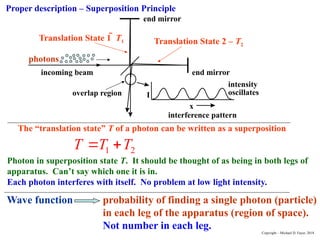
Photon in superpositionstate T. It should be thought of as being in both legs of
apparatus. Can’t say which one it is in.
Each photon interferes with itself. No problem at low light intensity.
Wave function probability of finding a single photon (particle)
in each leg of the apparatus (region of space).
Not number in each leg.
I
incoming beam
end mirror
end mirror
intensity
oscillates
interference pattern
x
overlap region
Proper description – Superposition Principle
Translation State 1 T1 Translation State 2 – T2
The “translation state” T of a photon can be written as a superposition
1 2
T T T
photons
Copyright – Michael D. Fayer, 2018
19.
Collection of bodieswith various properties
mass
moment of inertia
Bodies interact according to specific laws of force.
Certain motions consistent with bodies and laws.
Each such motion is a state of the system.
Definition: The state of a system is an
undisturbed motion that is restricted by as
many conditions as are theoretically possible
without contradiction.
State
State can be at a single time or time dependent.
Example – s, p, d states of H atom
Copyright – Michael D. Fayer, 2018
20.
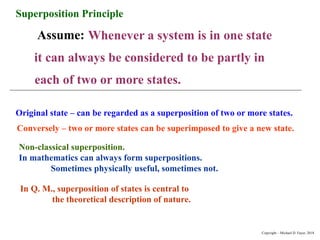
Superposition Principle
Assume: Whenevera system is in one state
it can always be considered to be partly in
each of two or more states.
Original state – can be regarded as a superposition of two or more states.
Conversely – two or more states can be superimposed to give a new state.
Non-classical superposition.
In mathematics can always form superpositions.
Sometimes physically useful, sometimes not.
In Q. M., superposition of states is central to
the theoretical description of nature.
Copyright – Michael D. Fayer, 2018
21.
Observables in Q.M.
Consider system with two states – A and B. [Correct notation will be introduced
shortly. This is still a qualitative
introduction.]
Observation of system in state A
result .
Observation on B
result .
Observation on a superposition of A and B
Gives either or .
Never gives anything else.
Probability of getting result or depends on
relative weights of A and B in the superposition.
Copyright – Michael D. Fayer, 2018
22.
"The intermediate characterof the state formed
by superposition thus expresses itself through
the probability of a particular result for an
observation being 'intermediate' between the
corresponding probabilities for the original
state, not through the result itself being
intermediate between the corresponding results
for the original states." Dirac
Copyright – Michael D. Fayer, 2018
23.
Absolute size andSuperposition Principle intimately related.
When making a series of observations on
identically prepared atomic systems,
the result from one observation to the next
in general will vary.
If you make enough observations,
you will get a probability distribution for the results.
Quantum mechanics calculates these probabilities.
Copyright – Michael D. Fayer, 2018

![Observables in Q. M.
Consider system with two states – A and B. [Correct notation will be introduced
shortly. This is still a qualitative
introduction.]
Observation of system in state A
result .
Observation on B
result .
Observation on a superposition of A and B
Gives either or .
Never gives anything else.
Probability of getting result or depends on
relative weights of A and B in the superposition.
Copyright – Michael D. Fayer, 2018](https://image.slidesharecdn.com/chapter1r19-250820153151-6f5b8a84/85/Quantum-Mechanics-with-basic-of-qauntumaechanics-21-320.jpg)