SECOND SC5 PILOT
IDENTIFYING THE
RELEASE LOCATIONRELEASE LOCATION
OF A SUBSTANCE
NCSR Demokritos20 December 2016
ContentContent
 Environment contamination
 The Chernobyl plumey p
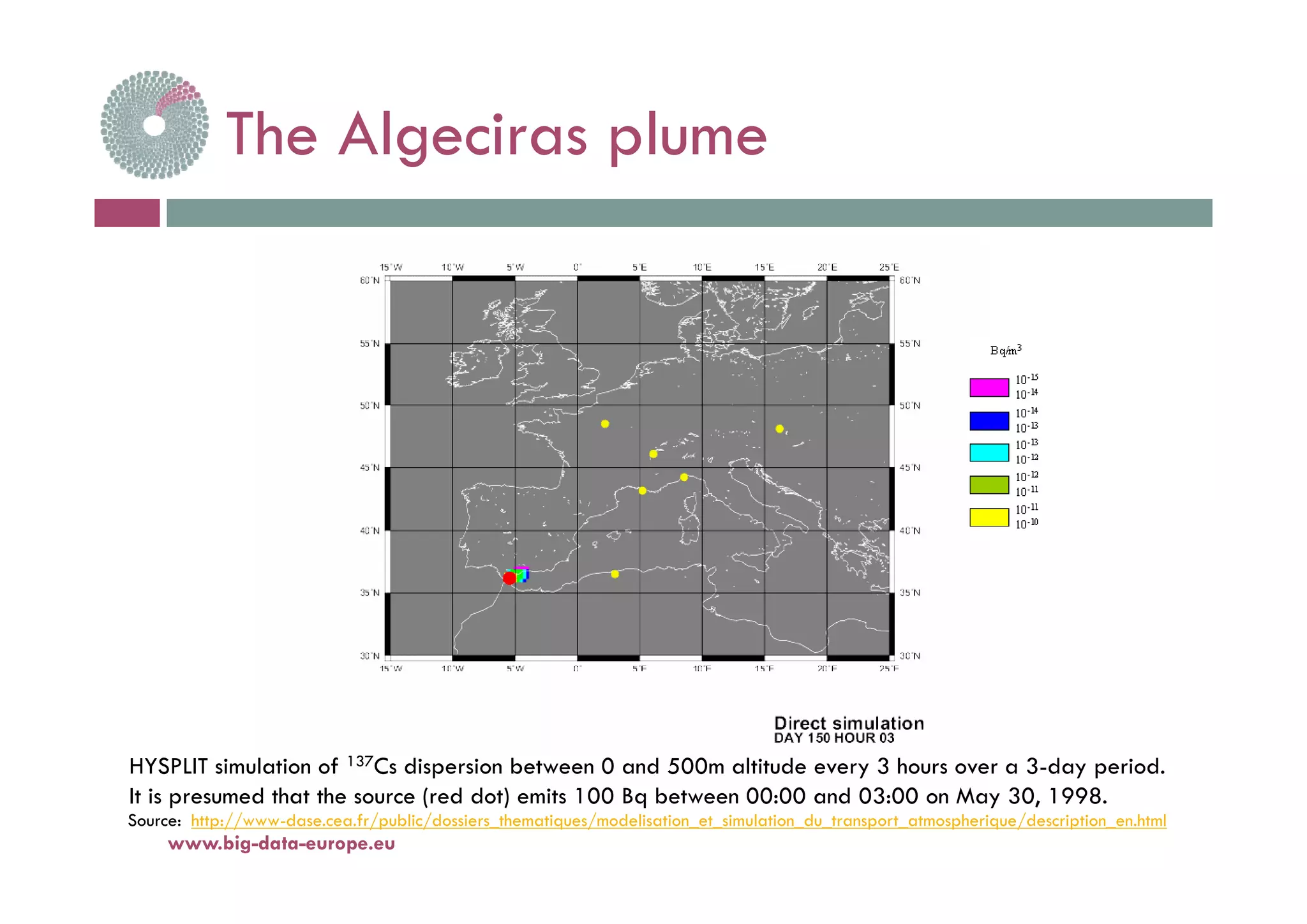
 The Algeciras plume
 Th F k hi l The Fukushima plume
 Problem definition
 Leveraging BDE
 Issues to be explored Issues to be explored
www.big-data-europe.eu
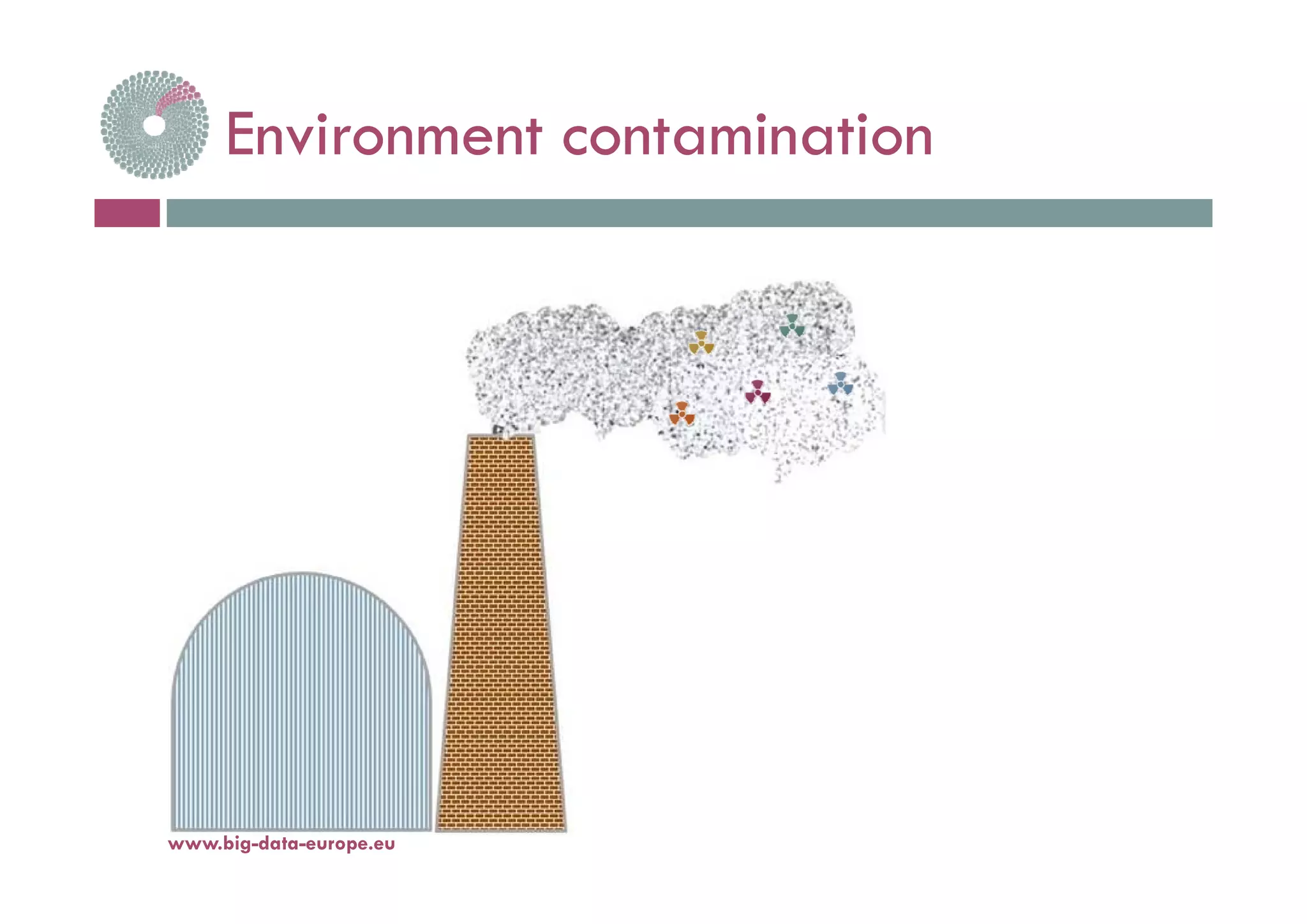
Environment contaminationEnvironment contamination
www.big-data-europe.eu
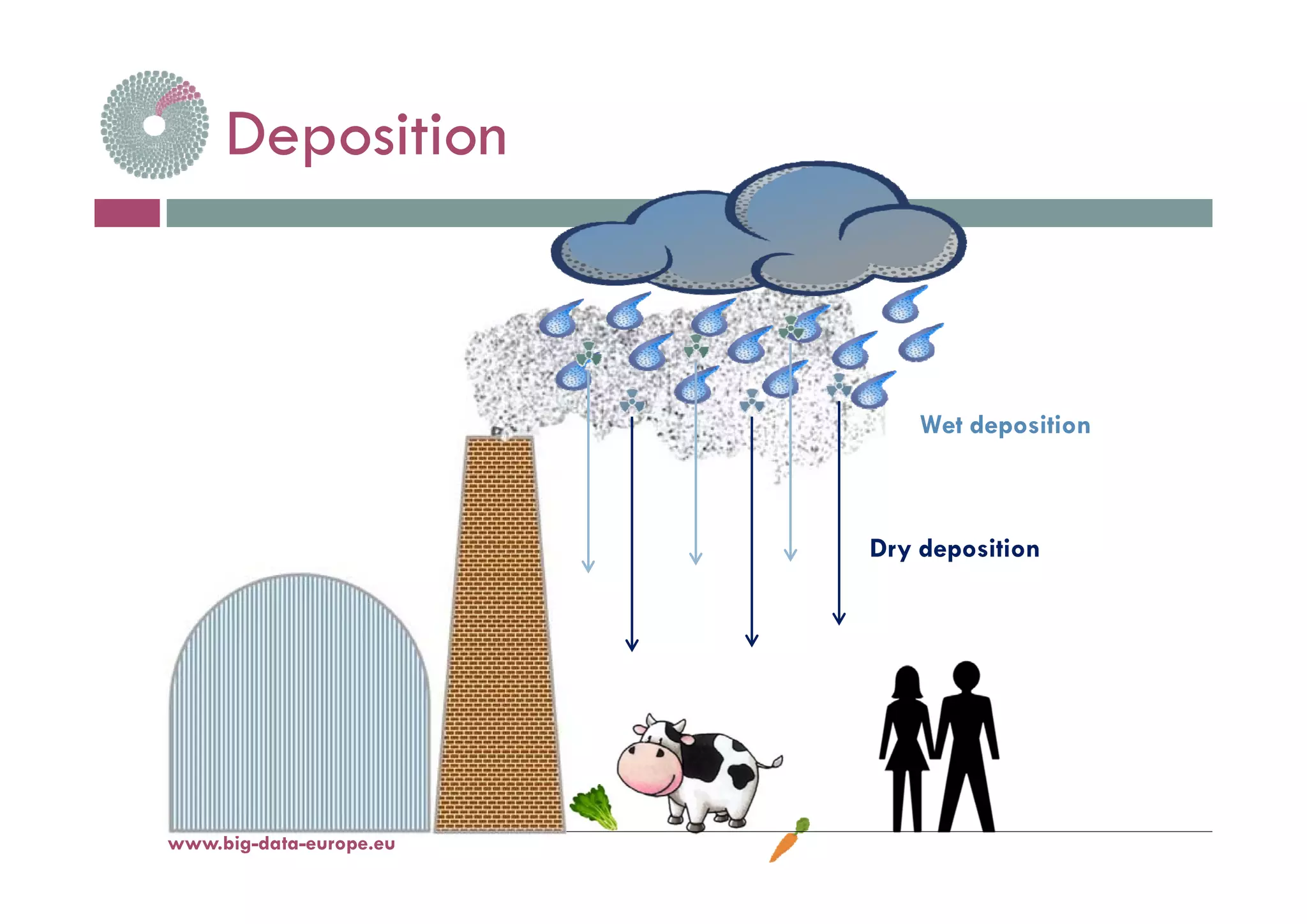
DepositionDeposition
Wet deposition
Dry deposition
www.big-data-europe.eu
FactorsFactors
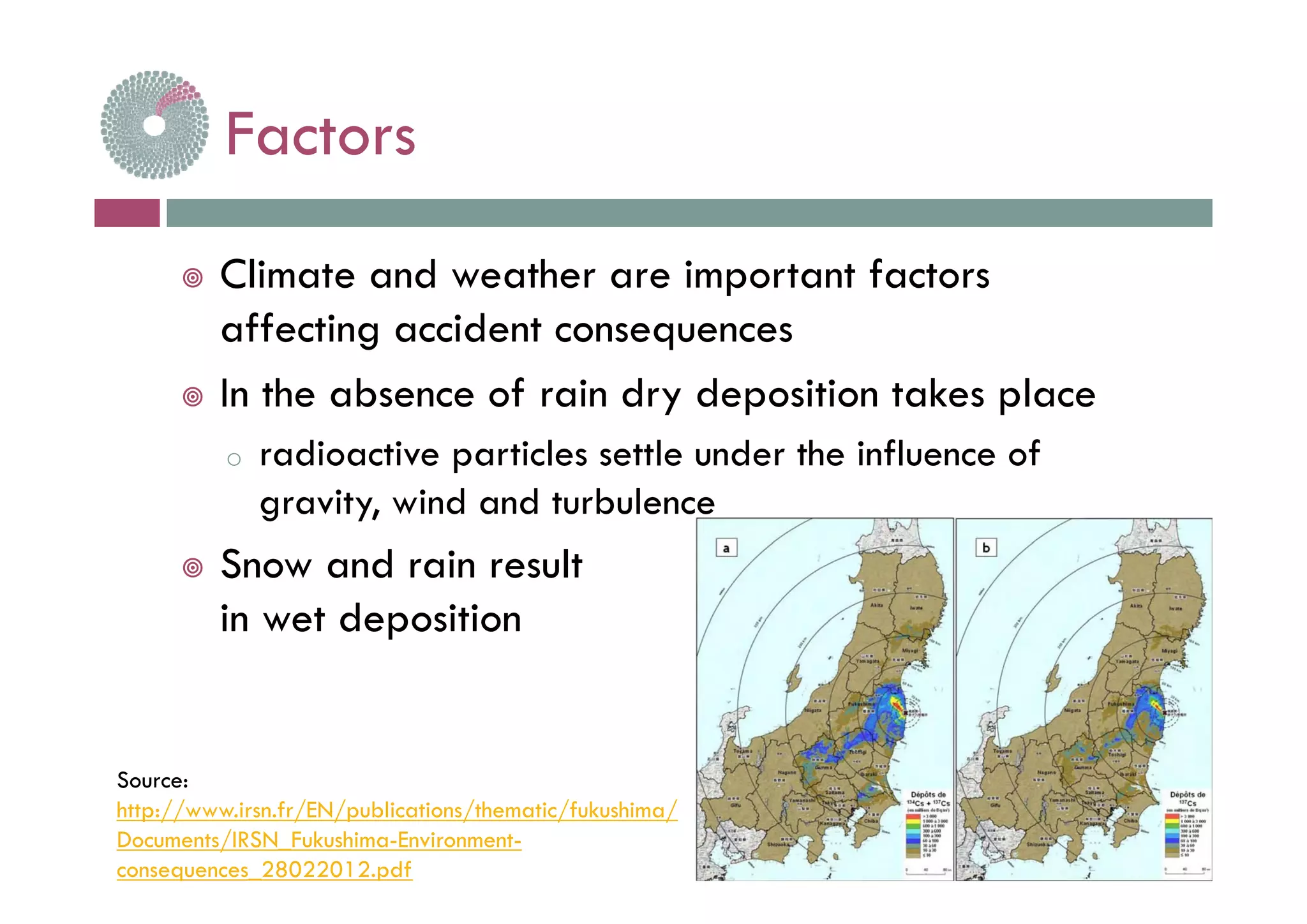
 Climate and weather are important factors
affecting accident consequences
 In the absence of rain dry deposition takes place
o radioactive particles settle under the influence ofo radioactive particles settle under the influence of
gravity, wind and turbulence
 Snow and rain result Snow and rain result
in wet deposition
SSource:
http://www.irsn.fr/EN/publications/thematic/fukushima/
Documents/IRSN_Fukushima-Environment-
consequences_28022012.pdf
The Chernobyl plumeThe Chernobyl plume
 At 01:23 on 26/4/1986 a severe accident took
place at Chernobyl-4 nuclear power plant
 Atmospheric dispersion models were applied to the
137Cs atmospheric releasep
o The meteorological conditions in Europe following the
accident were reconstructedacc de we e eco s uc ed
Source: http://www.irsn.fr/EN/publications/thematic-safety/chernobyl/Pages/The-Chernobyl-Plume.aspx
www.big-data-europe.eu
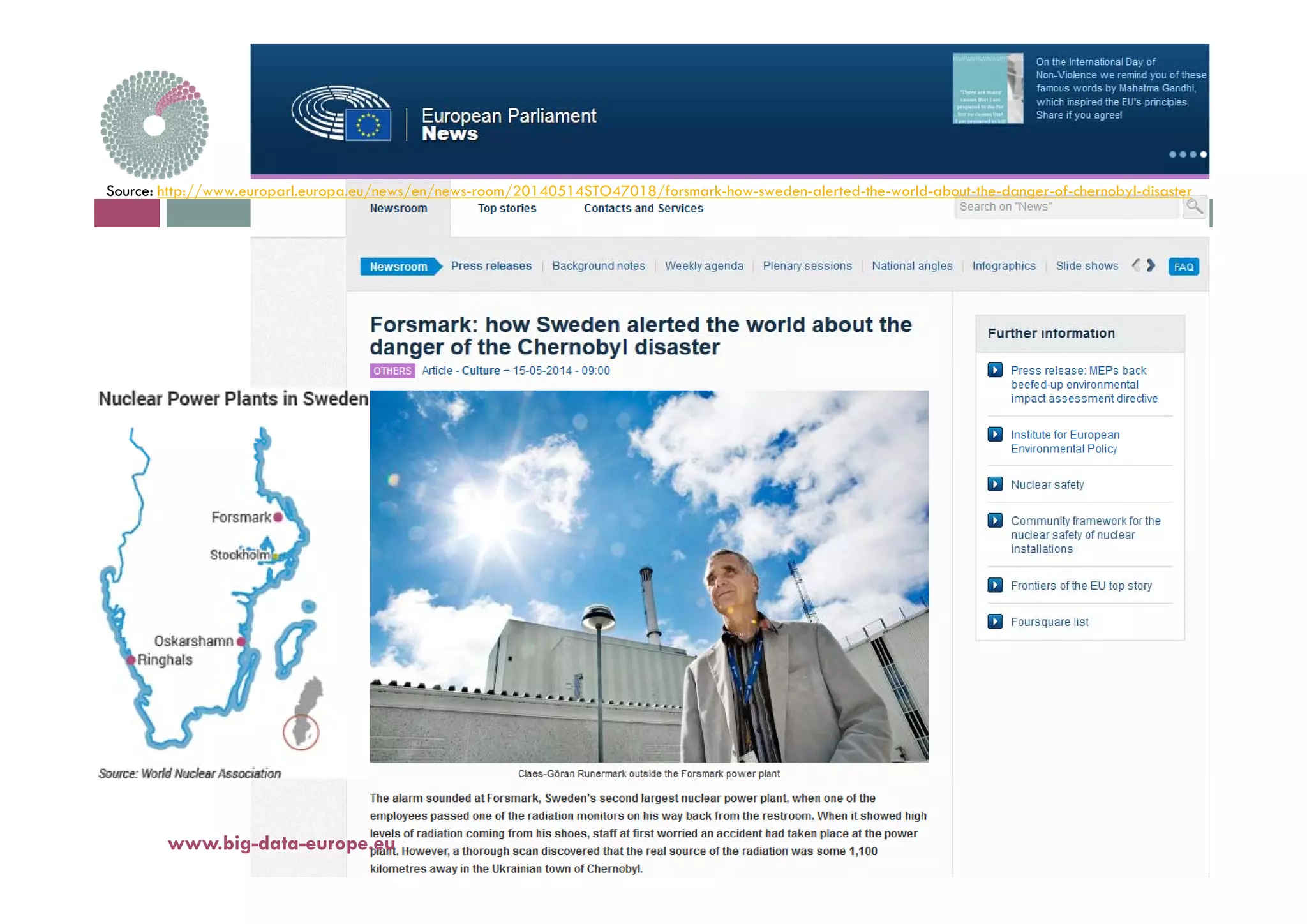
Source: http://www.europarl.europa.eu/news/en/news-room/20140514STO47018/forsmark-how-sweden-alerted-the-world-about-the-danger-of-chernobyl-disaster
www.big-data-europe.eu
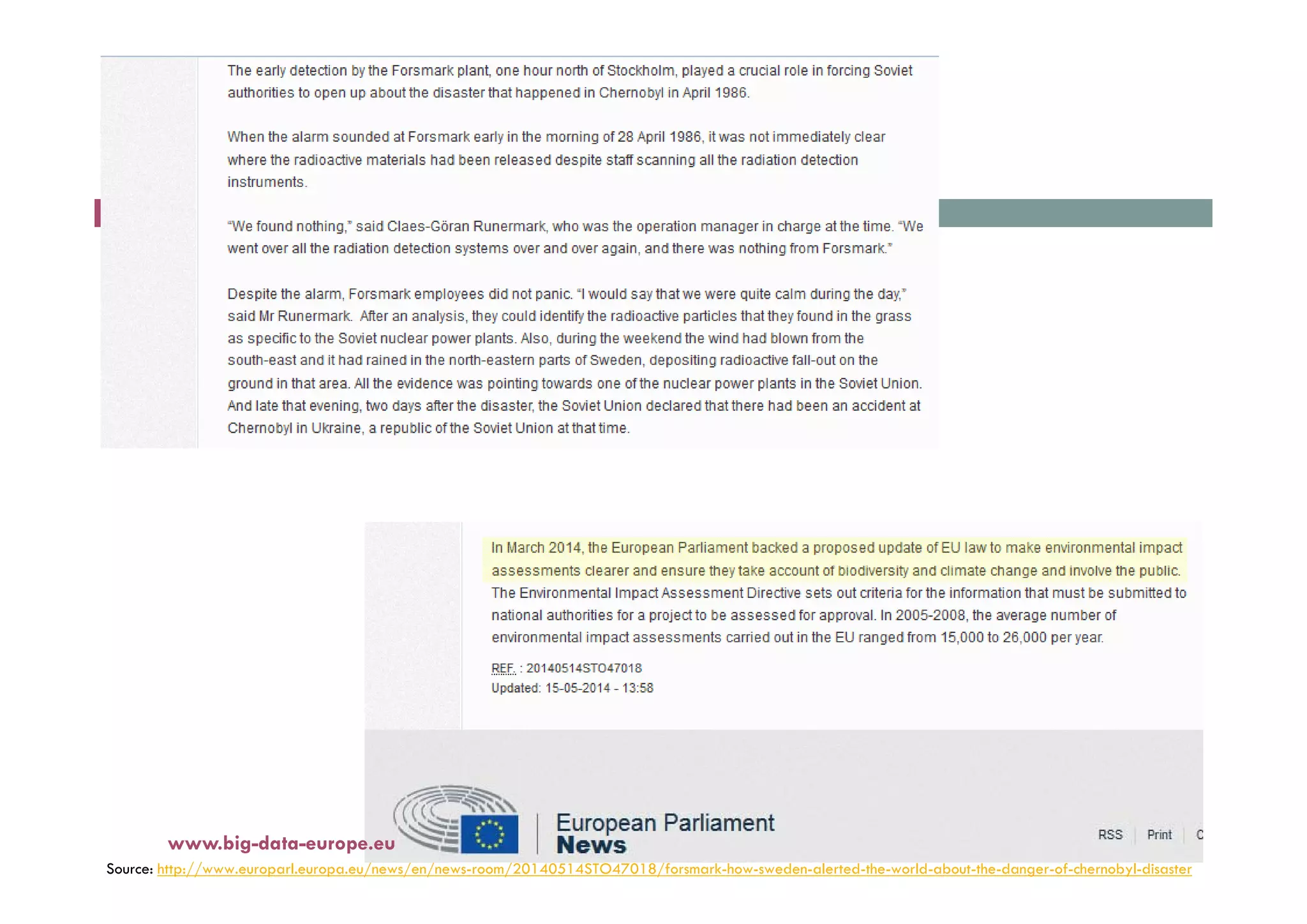
Source: http://www.europarl.europa.eu/news/en/news-room/20140514STO47018/forsmark-how-sweden-alerted-the-world-about-the-danger-of-chernobyl-disaster
www.big-data-europe.eu
The Algeciras plumeThe Algeciras plume
HYSPLIT simulation of 137Cs dispersion between 0 and 500m altitude every 3 hours over a 3-day period.
Source: http://www-dase.cea.fr/public/dossiers_thematiques/modelisation_et_simulation_du_transport_atmospherique/description_en.html
p y y p
It is presumed that the source (red dot) emits 100 Bq between 00:00 and 03:00 on May 30, 1998.
www.big-data-europe.eu
The Fukushima plumeThe Fukushima plume
 At 14:46 on 11/3/2011 the Tohoku-Chihou-
Taiheiyo-Oki earthquake rocked Fukushima Daiichi
nuclear power station
 An hour later a tsunami invaded the site
 Hydrogen explosions
E l ti di th F k hi D ii hi Explanations regarding the Fukushima Daiichi
accident consequences on the environment appear
h // i f /EN/ bli i / h iat: http://www.irsn.fr/EN/publications/thematic-
safety/fukushima/Pages/2-fukushima-
understanding-environment.aspx
www.big-data-europe.eu
Issue at handIssue at hand
 Release of a hazardous substance in the
atmosphere
 Support the decision making process for
countermeasure takingg
 Estimation of consequences on:
h manso humans
o environment
www.big-data-europe.eu
Problem statementProblem statement
 Identify the release location of a substance
 Available information:
o Measurements of the substance level at certain
locations
o Current weather conditions
o Past weather conditionso Past weather conditions
www.big-data-europe.eu
Current approachesCurrent approaches
 Computational approach:
o work backwards – inverse modelling – from the current
atmospheric conditions to estimate source location
 Long computation times required, especially forg p q , p y
complex cases
o complicated topographyo complicated topography
o weather conditions
www.big-data-europe.eu
Leveraging BDELeveraging BDE
 Use BDE to manage:
o A large number of pre-computed dispersion data
o Historical atmospheric conditions
 In this manner: In this manner:
o The computationally hardest part is pre-computed
M t hi t t h i diti t tho Matching current atmospheric conditions to the pre-
computed cases formulates a smaller problem
www.big-data-europe.eu
The computational essenceThe computational essence
 Match current weather against a database of
historical atmospheric conditions by:
o Building upon the NetCDF data management and
searching tools created during the first SC5 pilot
o Encoding weather patterns onto maps
 Weather similarity  map/image similarity
o Developing operators that search consecutive hourly
slices for similar weather
www.big-data-europe.eu
Open issuesOpen issues
 Open issues to be investigated during the pilot
implementation:
o What exactly does “similar enough weather” mean for
this pilot purposes?
o What volumes need to be pre-computed to always
have in the database “similar enough weather”?
o Are these volumes manageable and searchable?
www.big-data-europe.eu
Questions?Questions?
 BigDataEurope Web site:
https://www.big-data-europe.eu
 Thank you for your attention!
www.big-data-europe.eu

Second SC5 Pilot: Identifying the Release Location of a Substance

  • 1.
    SECOND SC5 PILOT IDENTIFYINGTHE RELEASE LOCATIONRELEASE LOCATION OF A SUBSTANCE NCSR Demokritos20 December 2016
  • 2.
    ContentContent  Environment contamination The Chernobyl plumey p  The Algeciras plume  Th F k hi l The Fukushima plume  Problem definition  Leveraging BDE  Issues to be explored Issues to be explored www.big-data-europe.eu
  • 3.
  • 4.
  • 5.
    FactorsFactors  Climate andweather are important factors affecting accident consequences  In the absence of rain dry deposition takes place o radioactive particles settle under the influence ofo radioactive particles settle under the influence of gravity, wind and turbulence  Snow and rain result Snow and rain result in wet deposition SSource: http://www.irsn.fr/EN/publications/thematic/fukushima/ Documents/IRSN_Fukushima-Environment- consequences_28022012.pdf
  • 6.
    The Chernobyl plumeTheChernobyl plume  At 01:23 on 26/4/1986 a severe accident took place at Chernobyl-4 nuclear power plant  Atmospheric dispersion models were applied to the 137Cs atmospheric releasep o The meteorological conditions in Europe following the accident were reconstructedacc de we e eco s uc ed Source: http://www.irsn.fr/EN/publications/thematic-safety/chernobyl/Pages/The-Chernobyl-Plume.aspx www.big-data-europe.eu
  • 7.
  • 8.
  • 9.
    The Algeciras plumeTheAlgeciras plume HYSPLIT simulation of 137Cs dispersion between 0 and 500m altitude every 3 hours over a 3-day period. Source: http://www-dase.cea.fr/public/dossiers_thematiques/modelisation_et_simulation_du_transport_atmospherique/description_en.html p y y p It is presumed that the source (red dot) emits 100 Bq between 00:00 and 03:00 on May 30, 1998. www.big-data-europe.eu
  • 10.
    The Fukushima plumeTheFukushima plume  At 14:46 on 11/3/2011 the Tohoku-Chihou- Taiheiyo-Oki earthquake rocked Fukushima Daiichi nuclear power station  An hour later a tsunami invaded the site  Hydrogen explosions E l ti di th F k hi D ii hi Explanations regarding the Fukushima Daiichi accident consequences on the environment appear h // i f /EN/ bli i / h iat: http://www.irsn.fr/EN/publications/thematic- safety/fukushima/Pages/2-fukushima- understanding-environment.aspx www.big-data-europe.eu
  • 11.
    Issue at handIssueat hand  Release of a hazardous substance in the atmosphere  Support the decision making process for countermeasure takingg  Estimation of consequences on: h manso humans o environment www.big-data-europe.eu
  • 12.
    Problem statementProblem statement Identify the release location of a substance  Available information: o Measurements of the substance level at certain locations o Current weather conditions o Past weather conditionso Past weather conditions www.big-data-europe.eu
  • 13.
    Current approachesCurrent approaches Computational approach: o work backwards – inverse modelling – from the current atmospheric conditions to estimate source location  Long computation times required, especially forg p q , p y complex cases o complicated topographyo complicated topography o weather conditions www.big-data-europe.eu
  • 14.
    Leveraging BDELeveraging BDE Use BDE to manage: o A large number of pre-computed dispersion data o Historical atmospheric conditions  In this manner: In this manner: o The computationally hardest part is pre-computed M t hi t t h i diti t tho Matching current atmospheric conditions to the pre- computed cases formulates a smaller problem www.big-data-europe.eu
  • 15.
    The computational essenceThecomputational essence  Match current weather against a database of historical atmospheric conditions by: o Building upon the NetCDF data management and searching tools created during the first SC5 pilot o Encoding weather patterns onto maps  Weather similarity  map/image similarity o Developing operators that search consecutive hourly slices for similar weather www.big-data-europe.eu
  • 16.
    Open issuesOpen issues Open issues to be investigated during the pilot implementation: o What exactly does “similar enough weather” mean for this pilot purposes? o What volumes need to be pre-computed to always have in the database “similar enough weather”? o Are these volumes manageable and searchable? www.big-data-europe.eu
  • 17.
    Questions?Questions?  BigDataEurope Website: https://www.big-data-europe.eu  Thank you for your attention! www.big-data-europe.eu