NANAK CHAND ANGLO SANSKRIT COLLEGE,
MEERUT.
Name - Rahul Singh
Topic –Macaulay’s Minutes.
BRITISH PARLIAMENT
Explanation of the Section 43, the charter
act,1813.
In every 20 years,British Parliament gave
1lakh money of East India Company to
spent it, on Indian Education.
In the same way;A charter came in 1813
to this company where 1lakh money
spent on Indian Education.
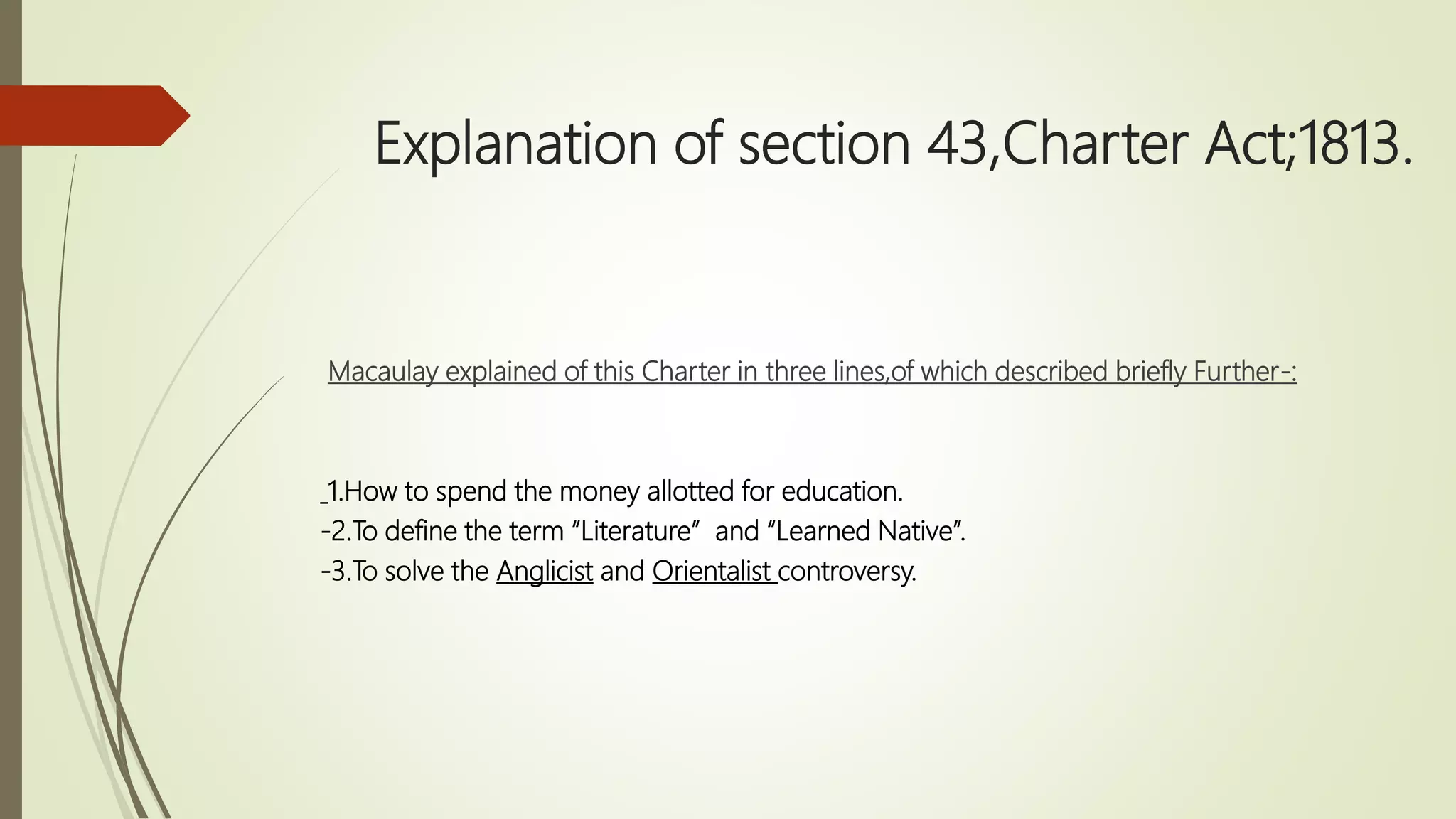
Explanation of section 43,Charter Act;1813.
Macaulay explained of this Charter in three lines,of which described briefly Further-:
1.How to spend the money allotted for education.
-2.To define the term “Literature” and “Learned Native”.
-3.To solve the Anglicist and Orientalist controversy.
Lord Macaulay’s Suggestions-
There are some more specific suggestions which has presented by Lord Macaulay;
these are given below👇.
*Education of Eastern knowledge and literature is worthless.
*Education of Western knowledge and literature is important.
*Making English as the medium of education is necessary.
*Indian cannot be educated in western knowledge and science through the Native
Language.
*The vocabulary of Eastern literature is limited.
Western language is as a language of international trade.
*Easy to learn English Language.
*Specially Educated Indians like,Raja Ram Mohan Roy are also of the opinion that
the knowledge of English and Western Science is necessary for progress and
development of India; therefore should be made the medium of Education.
*Downward Filtration Theory Suggested.
Merits of Lord Macaulay’s Minutes of
1835;
The following are the merits of Macaulay’s Minutes of 1835👇.
1.A clear-cut Policy of education.
2.Definite purpose of education.
3.Establishment of English Schools.
4.English as a medium of instruction.
5.The preposition of “Filtration Theory”.
Demerits of Lord Macaulay,s Minutes of
1835;
1. Other Indian languages were neglected.
2.Downward Filtration Theory was fully neglected.
3.Neglect of Mass Education.
4.Neglects of Vernaculars(Mother Tongue).
5.The opposition of Sanskrit and Arabic language.
6.The opposition of Indian religion.
Macaulay minuts.pptx

Macaulay minuts.pptx

  • 1.
    NANAK CHAND ANGLOSANSKRIT COLLEGE, MEERUT. Name - Rahul Singh Topic –Macaulay’s Minutes.
  • 3.
    BRITISH PARLIAMENT Explanation ofthe Section 43, the charter act,1813. In every 20 years,British Parliament gave 1lakh money of East India Company to spent it, on Indian Education. In the same way;A charter came in 1813 to this company where 1lakh money spent on Indian Education.
  • 7.
    Explanation of section43,Charter Act;1813. Macaulay explained of this Charter in three lines,of which described briefly Further-: 1.How to spend the money allotted for education. -2.To define the term “Literature” and “Learned Native”. -3.To solve the Anglicist and Orientalist controversy.
  • 11.
    Lord Macaulay’s Suggestions- Thereare some more specific suggestions which has presented by Lord Macaulay; these are given below👇. *Education of Eastern knowledge and literature is worthless. *Education of Western knowledge and literature is important. *Making English as the medium of education is necessary. *Indian cannot be educated in western knowledge and science through the Native Language. *The vocabulary of Eastern literature is limited. Western language is as a language of international trade. *Easy to learn English Language.
  • 12.
    *Specially Educated Indianslike,Raja Ram Mohan Roy are also of the opinion that the knowledge of English and Western Science is necessary for progress and development of India; therefore should be made the medium of Education. *Downward Filtration Theory Suggested.
  • 16.
    Merits of LordMacaulay’s Minutes of 1835; The following are the merits of Macaulay’s Minutes of 1835👇. 1.A clear-cut Policy of education. 2.Definite purpose of education. 3.Establishment of English Schools. 4.English as a medium of instruction. 5.The preposition of “Filtration Theory”.
  • 17.
    Demerits of LordMacaulay,s Minutes of 1835; 1. Other Indian languages were neglected. 2.Downward Filtration Theory was fully neglected. 3.Neglect of Mass Education. 4.Neglects of Vernaculars(Mother Tongue). 5.The opposition of Sanskrit and Arabic language. 6.The opposition of Indian religion.