Unit 2
Grammar Practice (Plus)
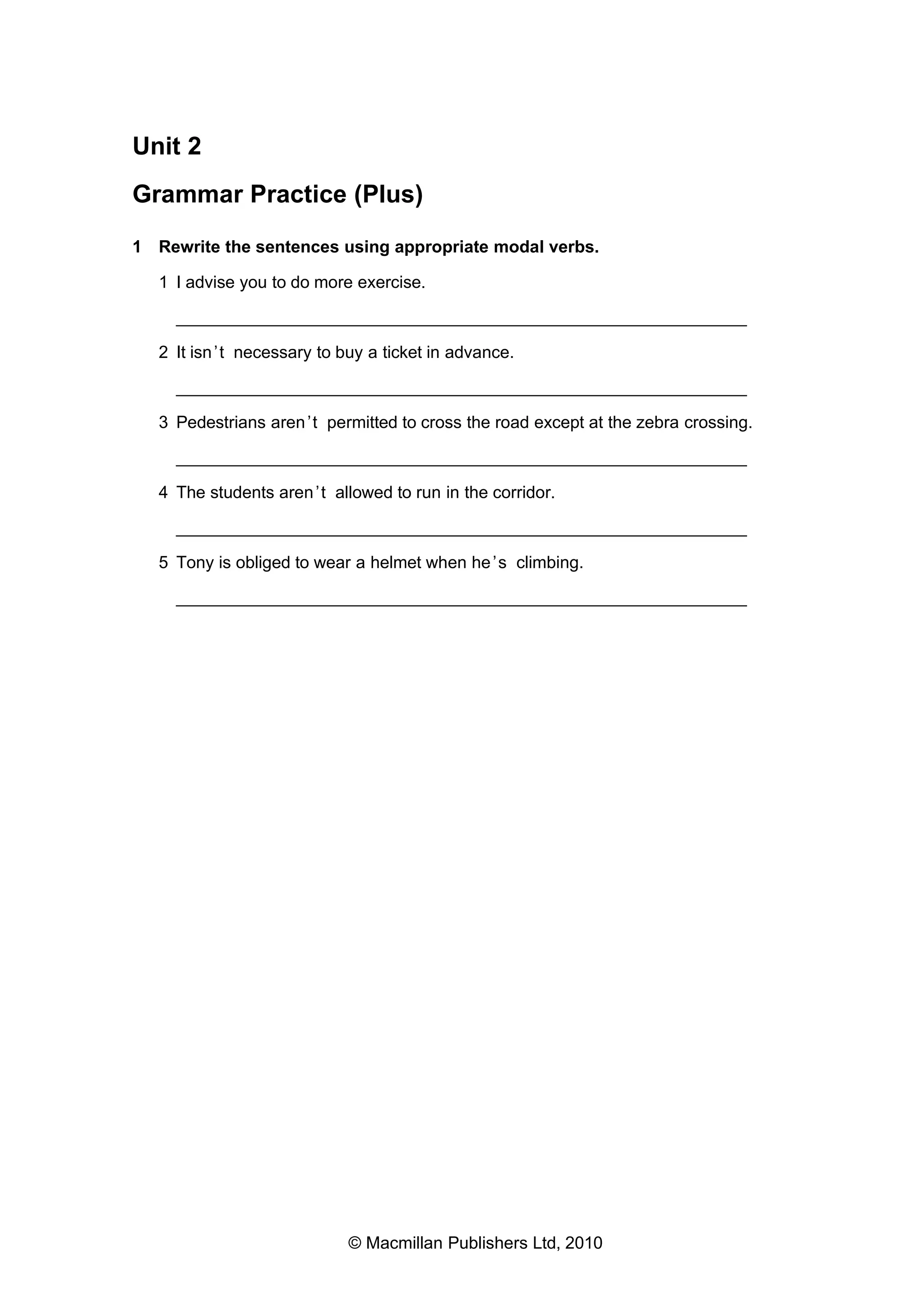
1 Rewrite the sentences using appropriate modal verbs.
1 I advise you to do more exercise.
___________________________________________________________
2 It isn’t necessary to buy a ticket in advance.
___________________________________________________________
3 Pedestrians aren’t permitted to cross the road except at the zebra crossing.
___________________________________________________________
4 The students aren’t allowed to run in the corridor.
___________________________________________________________
5 Tony is obliged to wear a helmet when he’s climbing.
___________________________________________________________
© Macmillan Publishers Ltd, 2010
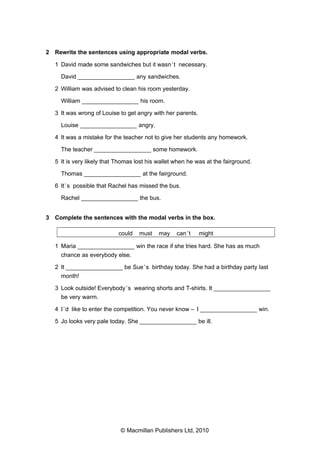
2 Rewrite the sentences using appropriate modal verbs.
1 David made some sandwiches but it wasn’t necessary.
David _________________ any sandwiches.
2 William was advised to clean his room yesterday.
William _________________ his room.
3 It was wrong of Louise to get angry with her parents.
Louise _________________ angry.
4 It was a mistake for the teacher not to give her students any homework.
The teacher _________________ some homework.
5 It is very likely that Thomas lost his wallet when he was at the fairground.
Thomas _________________ at the fairground.
6 It’s possible that Rachel has missed the bus.
Rachel _________________ the bus.
3 Complete the sentences with the modal verbs in the box.
could must may can’t might
1 Maria _________________ win the race if she tries hard. She has as much
chance as everybody else.
2 It _________________ be Sue’s birthday today. She had a birthday party last
month!
3 Look outside! Everybody’s wearing shorts and T-shirts. It _________________
be very warm.
4 I’d like to enter the competition. You never know – I _________________ win.
5 Jo looks very pale today. She _________________ be ill.
© Macmillan Publishers Ltd, 2010
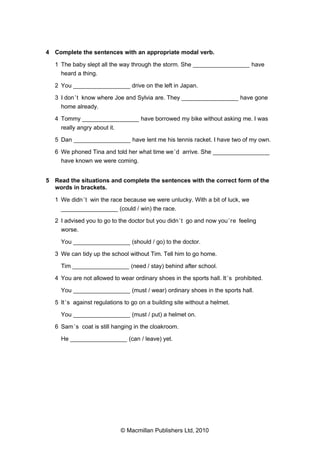
4 Complete the sentences with an appropriate modal verb.
1 The baby slept all the way through the storm. She _________________ have
heard a thing.
2 You _________________ drive on the left in Japan.
3 I don’t know where Joe and Sylvia are. They _________________ have gone
home already.
4 Tommy _________________ have borrowed my bike without asking me. I was
really angry about it.
5 Dan _________________ have lent me his tennis racket. I have two of my own.
6 We phoned Tina and told her what time we’d arrive. She _________________
have known we were coming.
5 Read the situations and complete the sentences with the correct form of the
words in brackets.
1 We didn’t win the race because we were unlucky. With a bit of luck, we
_________________ (could / win) the race.
2 I advised you to go to the doctor but you didn’t go and now you’re feeling
worse.
You _________________ (should / go) to the doctor.
3 We can tidy up the school without Tim. Tell him to go home.
Tim _________________ (need / stay) behind after school.
4 You are not allowed to wear ordinary shoes in the sports hall. It’s prohibited.
You _________________ (must / wear) ordinary shoes in the sports hall.
5 It’s against regulations to go on a building site without a helmet.
You _________________ (must / put) a helmet on.
6 Sam’s coat is still hanging in the cloakroom.
He _________________ (can / leave) yet.
© Macmillan Publishers Ltd, 2010
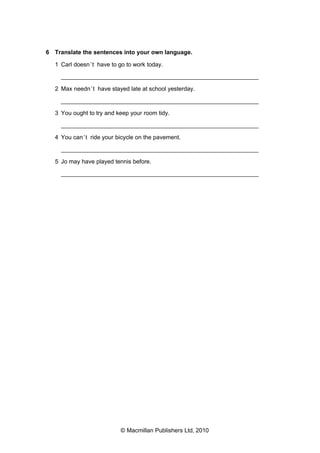
6 Translate the sentences into your own language.
1 Carl doesn’t have to go to work today.
___________________________________________________________
2 Max needn’t have stayed late at school yesterday.
___________________________________________________________
3 You ought to try and keep your room tidy.
___________________________________________________________
4 You can’t ride your bicycle on the pavement.
___________________________________________________________
5 Jo may have played tennis before.
___________________________________________________________
© Macmillan Publishers Ltd, 2010
Vocabulary Practice (Plus)
1 Write the correct crime verbs.
1 To _________________ is to take someone and ask for money.
2 To _________________ is to take something from someone in the street.
3 To _________________ is to take something from a bank.
4 To _________________ is to take things from a house.
5 To _________________ is to take things that don’t belong to you.
6 To _________________ is to kill someone.
2 Complete the sentences with the correct words.
1 Thomas worked as a _________________, organizing the proceedings and
calling on different people to appear.
2 Louise had _________________ an awful crime take place, and now had to
describe what she had seen in court.
3 The _________________ sat there wearing a white wig, occasionally asking
questions, and passing sentence at the end of the trial.
4 The police caught the _________________ in a small side street. He was still
holding the bag he had stolen.
5 The police have a _________________ in custody. They aren’t sure she
committed the crime.
6 Rick was the _________________ on trial in court. He knew he was innocent
but was worried that no one would believe him.
7 Gary is a _________________ in court today. He is sitting with 11 other people
and has to decide whether someone is guilty or not.
8 Mary was the _________________ of a mugging yesterday – someone stole her
handbag.
© Macmillan Publishers Ltd, 2010
3 Complete the sentences with the correct prepositions.
1 No-one is certain _________________ what was stolen from the shop.
2 You should be very polite _________________ the customers.
3 I’m jealous _________________ Grant because he has a new leather jacket.
4 Andrea was late _________________ work this morning.
5 Wayne was guilty _________________ stealing chocolate from the supermarket.
6 We’re excited _________________ going skiing tomorrow.
7 This DVD isn’t suitable _________________ young children.
8 I didn’t know he was capable _________________ getting so angry!
4 Complete the text with appropriate words.
By and large, criminal cases take place in a (1) _________________ under
the jurisdiction of a (2) _________________ who hears the case.
A (3) _________________ of 12 people has to decide on whether the
(4) _________________ – the person on trial – is guilty or not. Various
(5) _________________ who may have seen something are called to speak.
Sometimes, the (6) _________________ – the person who was mugged or
attacked – is questioned or makes a (7) _________________. If guilty, the person
in the dock is given a (8) _________________. This could be a time in prison if the
crime is serious or just a (9) _________________ of a few hundred euros if it is a
minor (10) _________________.
5 Write participles to make compound adjectives.
1 hard-_________________
2 single-_________________
3 cold-_________________
4 cool-_________________
5 plain-_________________
6 public-_________________
© Macmillan Publishers Ltd, 2010
6 Match the compound adjectives from 5 to the synonymous adjectives below.
1 ambitious, certain and driven _________________
2 calm, unstressed and reliable _________________
3 clear and unsubtle in what they say _________________
4 helpful, generous and caring _________________
5 emotionless and uncaring _________________
6 harsh and critical _________________
7 Complete the sentences with suitable words.
1 Tim has been accused _________________ stealing in the local shop.
2 A suspect has been charged _________________ the crime.
3 She has been found guilty and has to _________________ time in prison.
4 The police said the culprit wouldn’t get away _________________ the crime.
5 It was a minor misdemeanor, so she just _________________ a warning.
© Macmillan Publishers Ltd, 2010

Unit 2 plus

  • 1.
    Unit 2 Grammar Practice(Plus) 1 Rewrite the sentences using appropriate modal verbs. 1 I advise you to do more exercise. ___________________________________________________________ 2 It isn’t necessary to buy a ticket in advance. ___________________________________________________________ 3 Pedestrians aren’t permitted to cross the road except at the zebra crossing. ___________________________________________________________ 4 The students aren’t allowed to run in the corridor. ___________________________________________________________ 5 Tony is obliged to wear a helmet when he’s climbing. ___________________________________________________________ © Macmillan Publishers Ltd, 2010
  • 2.
    2 Rewrite thesentences using appropriate modal verbs. 1 David made some sandwiches but it wasn’t necessary. David _________________ any sandwiches. 2 William was advised to clean his room yesterday. William _________________ his room. 3 It was wrong of Louise to get angry with her parents. Louise _________________ angry. 4 It was a mistake for the teacher not to give her students any homework. The teacher _________________ some homework. 5 It is very likely that Thomas lost his wallet when he was at the fairground. Thomas _________________ at the fairground. 6 It’s possible that Rachel has missed the bus. Rachel _________________ the bus. 3 Complete the sentences with the modal verbs in the box. could must may can’t might 1 Maria _________________ win the race if she tries hard. She has as much chance as everybody else. 2 It _________________ be Sue’s birthday today. She had a birthday party last month! 3 Look outside! Everybody’s wearing shorts and T-shirts. It _________________ be very warm. 4 I’d like to enter the competition. You never know – I _________________ win. 5 Jo looks very pale today. She _________________ be ill. © Macmillan Publishers Ltd, 2010
  • 3.
    4 Complete thesentences with an appropriate modal verb. 1 The baby slept all the way through the storm. She _________________ have heard a thing. 2 You _________________ drive on the left in Japan. 3 I don’t know where Joe and Sylvia are. They _________________ have gone home already. 4 Tommy _________________ have borrowed my bike without asking me. I was really angry about it. 5 Dan _________________ have lent me his tennis racket. I have two of my own. 6 We phoned Tina and told her what time we’d arrive. She _________________ have known we were coming. 5 Read the situations and complete the sentences with the correct form of the words in brackets. 1 We didn’t win the race because we were unlucky. With a bit of luck, we _________________ (could / win) the race. 2 I advised you to go to the doctor but you didn’t go and now you’re feeling worse. You _________________ (should / go) to the doctor. 3 We can tidy up the school without Tim. Tell him to go home. Tim _________________ (need / stay) behind after school. 4 You are not allowed to wear ordinary shoes in the sports hall. It’s prohibited. You _________________ (must / wear) ordinary shoes in the sports hall. 5 It’s against regulations to go on a building site without a helmet. You _________________ (must / put) a helmet on. 6 Sam’s coat is still hanging in the cloakroom. He _________________ (can / leave) yet. © Macmillan Publishers Ltd, 2010
  • 4.
    6 Translate thesentences into your own language. 1 Carl doesn’t have to go to work today. ___________________________________________________________ 2 Max needn’t have stayed late at school yesterday. ___________________________________________________________ 3 You ought to try and keep your room tidy. ___________________________________________________________ 4 You can’t ride your bicycle on the pavement. ___________________________________________________________ 5 Jo may have played tennis before. ___________________________________________________________ © Macmillan Publishers Ltd, 2010
  • 5.
    Vocabulary Practice (Plus) 1Write the correct crime verbs. 1 To _________________ is to take someone and ask for money. 2 To _________________ is to take something from someone in the street. 3 To _________________ is to take something from a bank. 4 To _________________ is to take things from a house. 5 To _________________ is to take things that don’t belong to you. 6 To _________________ is to kill someone. 2 Complete the sentences with the correct words. 1 Thomas worked as a _________________, organizing the proceedings and calling on different people to appear. 2 Louise had _________________ an awful crime take place, and now had to describe what she had seen in court. 3 The _________________ sat there wearing a white wig, occasionally asking questions, and passing sentence at the end of the trial. 4 The police caught the _________________ in a small side street. He was still holding the bag he had stolen. 5 The police have a _________________ in custody. They aren’t sure she committed the crime. 6 Rick was the _________________ on trial in court. He knew he was innocent but was worried that no one would believe him. 7 Gary is a _________________ in court today. He is sitting with 11 other people and has to decide whether someone is guilty or not. 8 Mary was the _________________ of a mugging yesterday – someone stole her handbag. © Macmillan Publishers Ltd, 2010
  • 6.
    3 Complete thesentences with the correct prepositions. 1 No-one is certain _________________ what was stolen from the shop. 2 You should be very polite _________________ the customers. 3 I’m jealous _________________ Grant because he has a new leather jacket. 4 Andrea was late _________________ work this morning. 5 Wayne was guilty _________________ stealing chocolate from the supermarket. 6 We’re excited _________________ going skiing tomorrow. 7 This DVD isn’t suitable _________________ young children. 8 I didn’t know he was capable _________________ getting so angry! 4 Complete the text with appropriate words. By and large, criminal cases take place in a (1) _________________ under the jurisdiction of a (2) _________________ who hears the case. A (3) _________________ of 12 people has to decide on whether the (4) _________________ – the person on trial – is guilty or not. Various (5) _________________ who may have seen something are called to speak. Sometimes, the (6) _________________ – the person who was mugged or attacked – is questioned or makes a (7) _________________. If guilty, the person in the dock is given a (8) _________________. This could be a time in prison if the crime is serious or just a (9) _________________ of a few hundred euros if it is a minor (10) _________________. 5 Write participles to make compound adjectives. 1 hard-_________________ 2 single-_________________ 3 cold-_________________ 4 cool-_________________ 5 plain-_________________ 6 public-_________________ © Macmillan Publishers Ltd, 2010
  • 7.
    6 Match thecompound adjectives from 5 to the synonymous adjectives below. 1 ambitious, certain and driven _________________ 2 calm, unstressed and reliable _________________ 3 clear and unsubtle in what they say _________________ 4 helpful, generous and caring _________________ 5 emotionless and uncaring _________________ 6 harsh and critical _________________ 7 Complete the sentences with suitable words. 1 Tim has been accused _________________ stealing in the local shop. 2 A suspect has been charged _________________ the crime. 3 She has been found guilty and has to _________________ time in prison. 4 The police said the culprit wouldn’t get away _________________ the crime. 5 It was a minor misdemeanor, so she just _________________ a warning. © Macmillan Publishers Ltd, 2010