A 2.5-hour training course for teacher applicants
New Teacher Training
v
HOUSE RULES
v
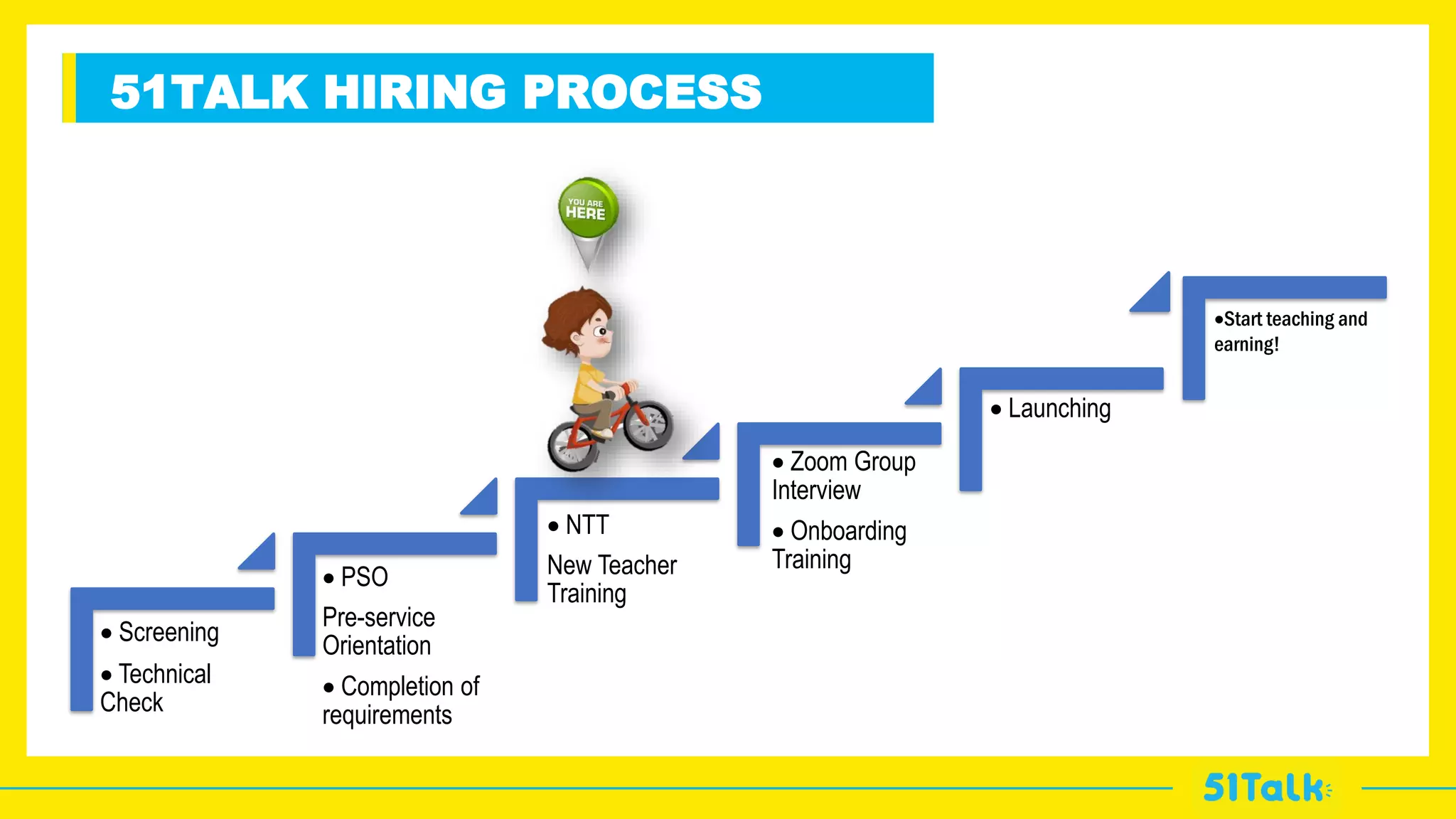
51TALK HIRING PROCESS
• Screening
• Technical
Check
• PSO
Pre-service
Orientation
• Completion of
requirements
• NTT
New Teacher
Training
• Zoom Group
Interview
• Onboarding
Training
• Launching
•Start teaching and
earning!
v
conduct FUN and MEANINGFUL
51Talk lessons
After completing and passing NTT, you should be able to:
OBJECTIVE
v
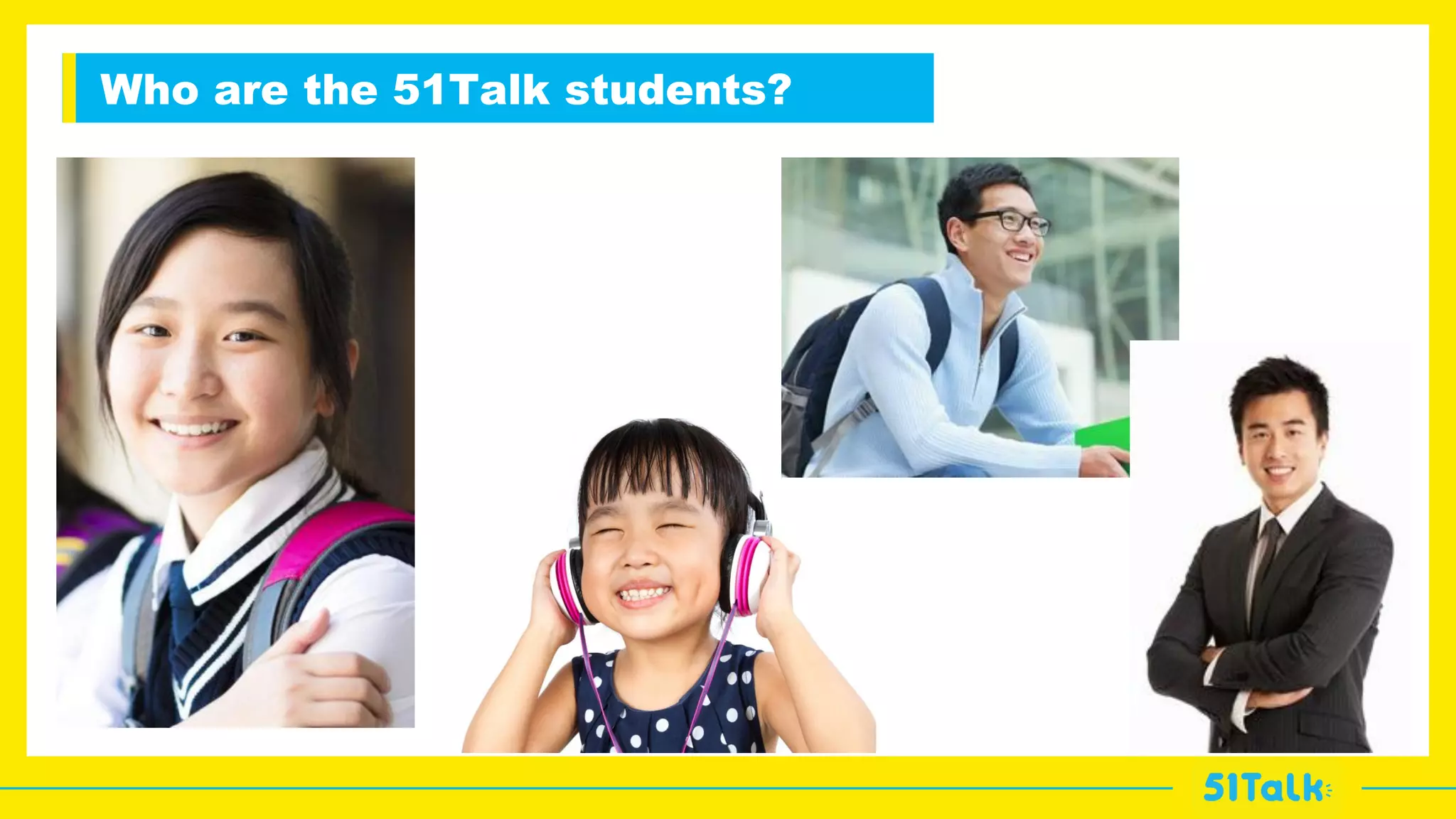
Who are the 51Talk students?
v
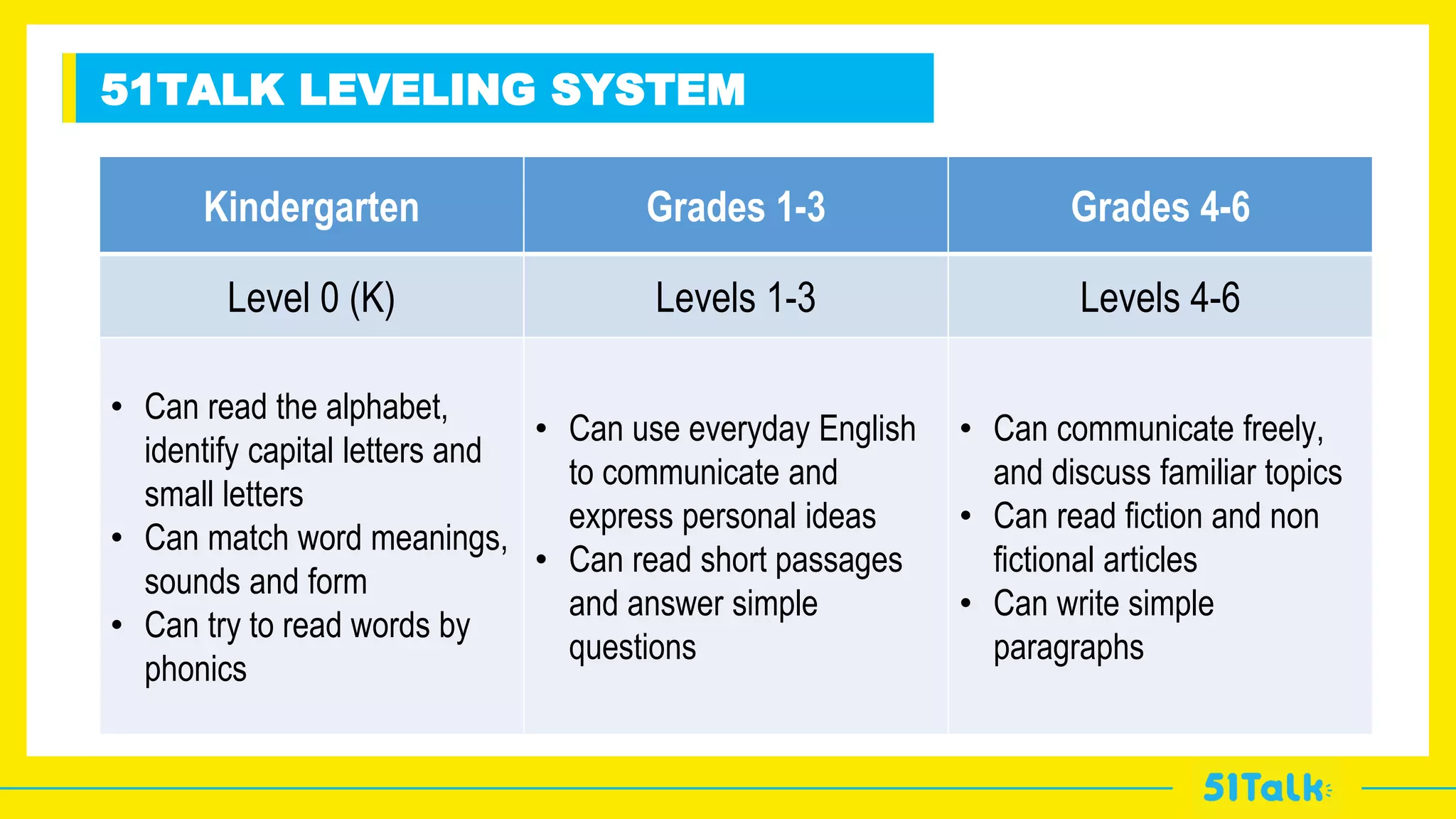
Kindergarten Grades 1-3 Grades 4-6
Level 0 (K) Levels 1-3 Levels 4-6
• Can read the alphabet,
identify capital letters and
small letters
• Can match word meanings,
sounds and form
• Can try to read words by
phonics
• Can use everyday English
to communicate and
express personal ideas
• Can read short passages
and answer simple
questions
• Can communicate freely,
and discuss familiar topics
• Can read fiction and non
fictional articles
• Can write simple
paragraphs
51TALK LEVELING SYSTEM
v
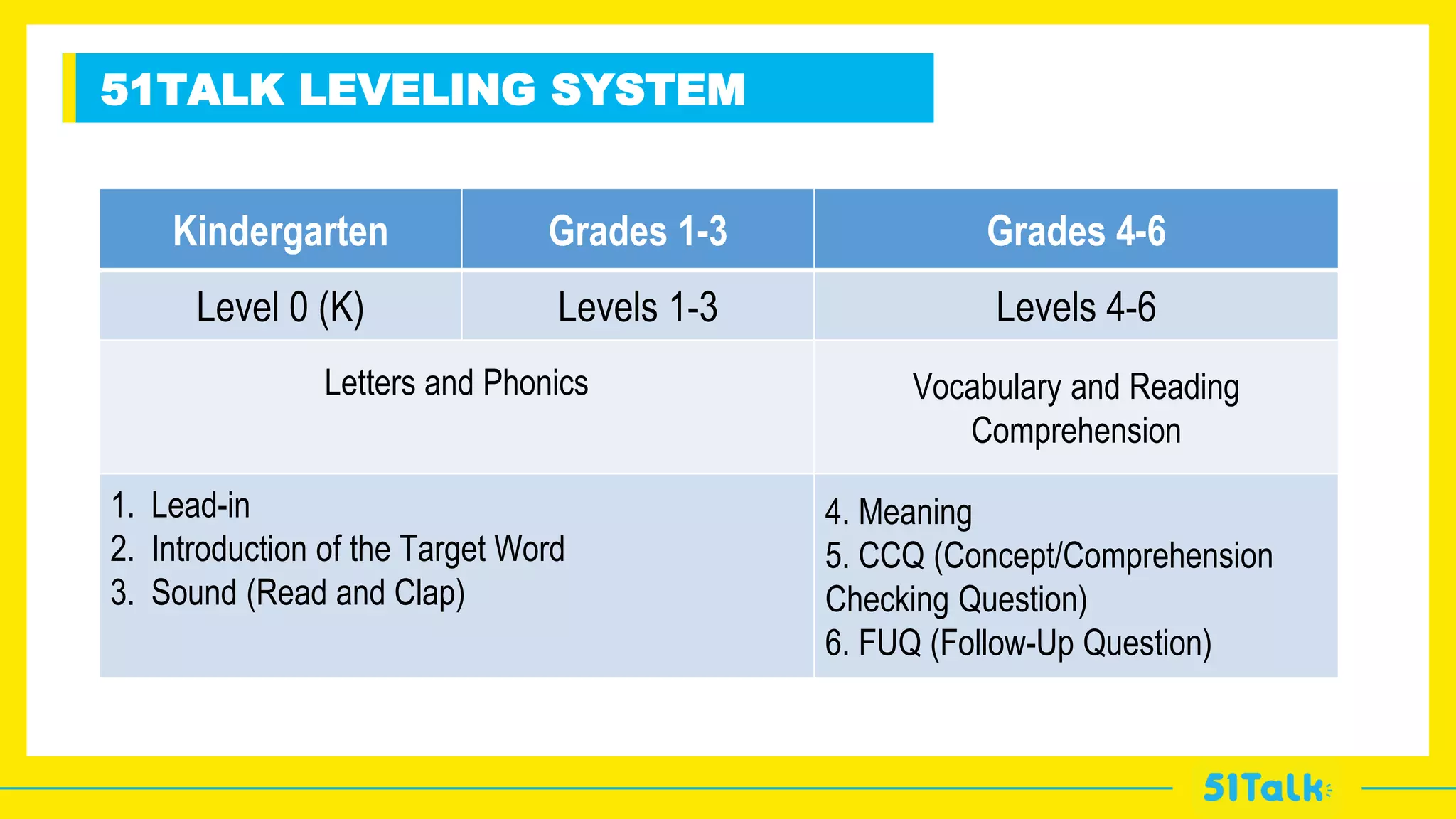
51TALK LEVELING SYSTEM
Kindergarten Grades 1-3 Grades 4-6
Level 0 (K) Levels 1-3 Levels 4-6
Letters and Phonics Vocabulary and Reading
Comprehension
1. Lead-in
2. Introduction of the Target Word
3. Sound (Read and Clap)
4. Meaning
5. CCQ (Concept/Comprehension
Checking Question)
6. FUQ (Follow-Up Question)
v
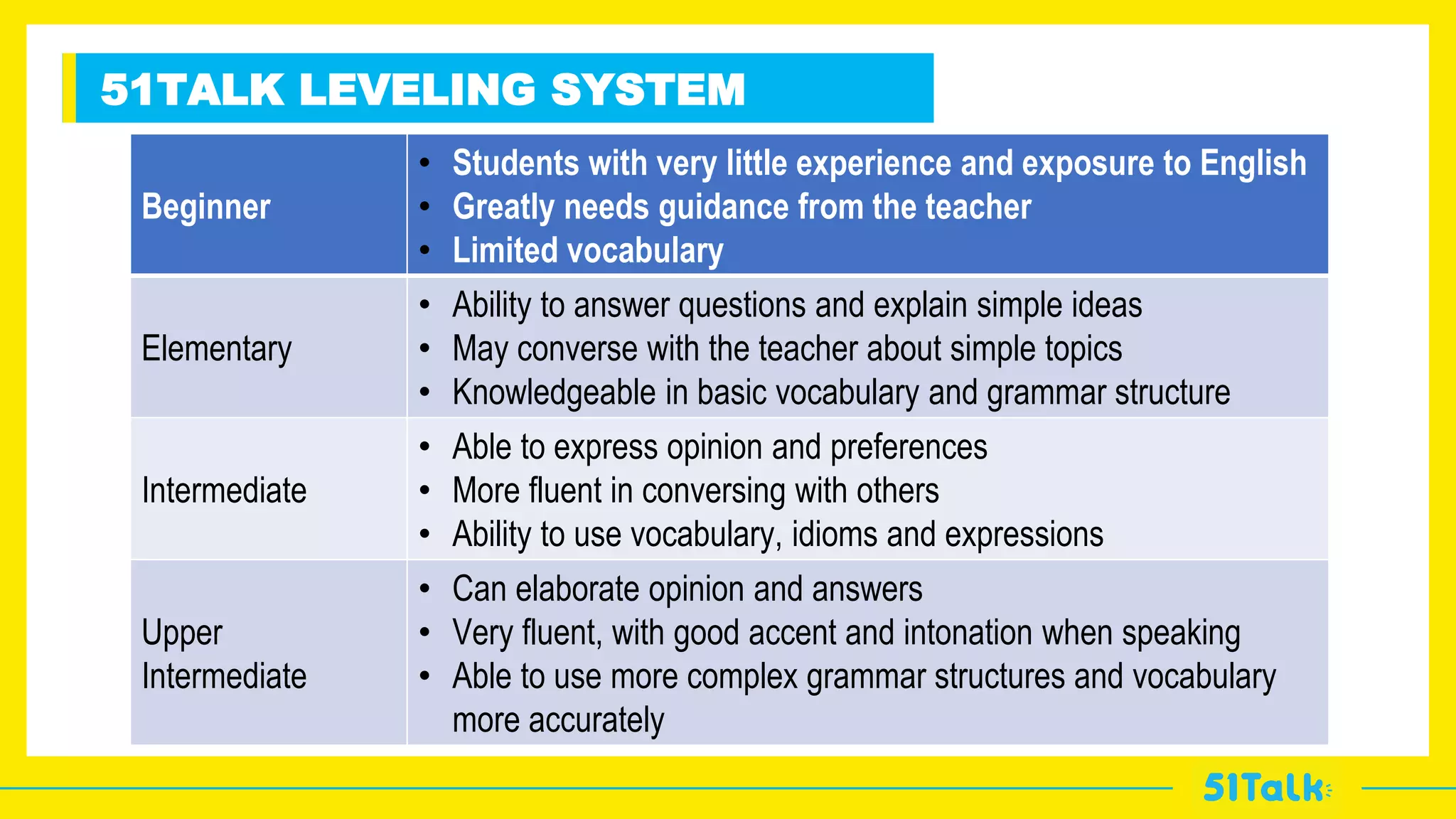
51TALK LEVELING SYSTEM
Beginner
• Students with very little experience and exposure to English
• Greatly needs guidance from the teacher
• Limited vocabulary
Elementary
• Ability to answer questions and explain simple ideas
• May converse with the teacher about simple topics
• Knowledgeable in basic vocabulary and grammar structure
Intermediate
• Able to express opinion and preferences
• More fluent in conversing with others
• Ability to use vocabulary, idioms and expressions
Upper
Intermediate
• Can elaborate opinion and answers
• Very fluent, with good accent and intonation when speaking
• Able to use more complex grammar structures and vocabulary
more accurately
What are the different
51Talk lessons?
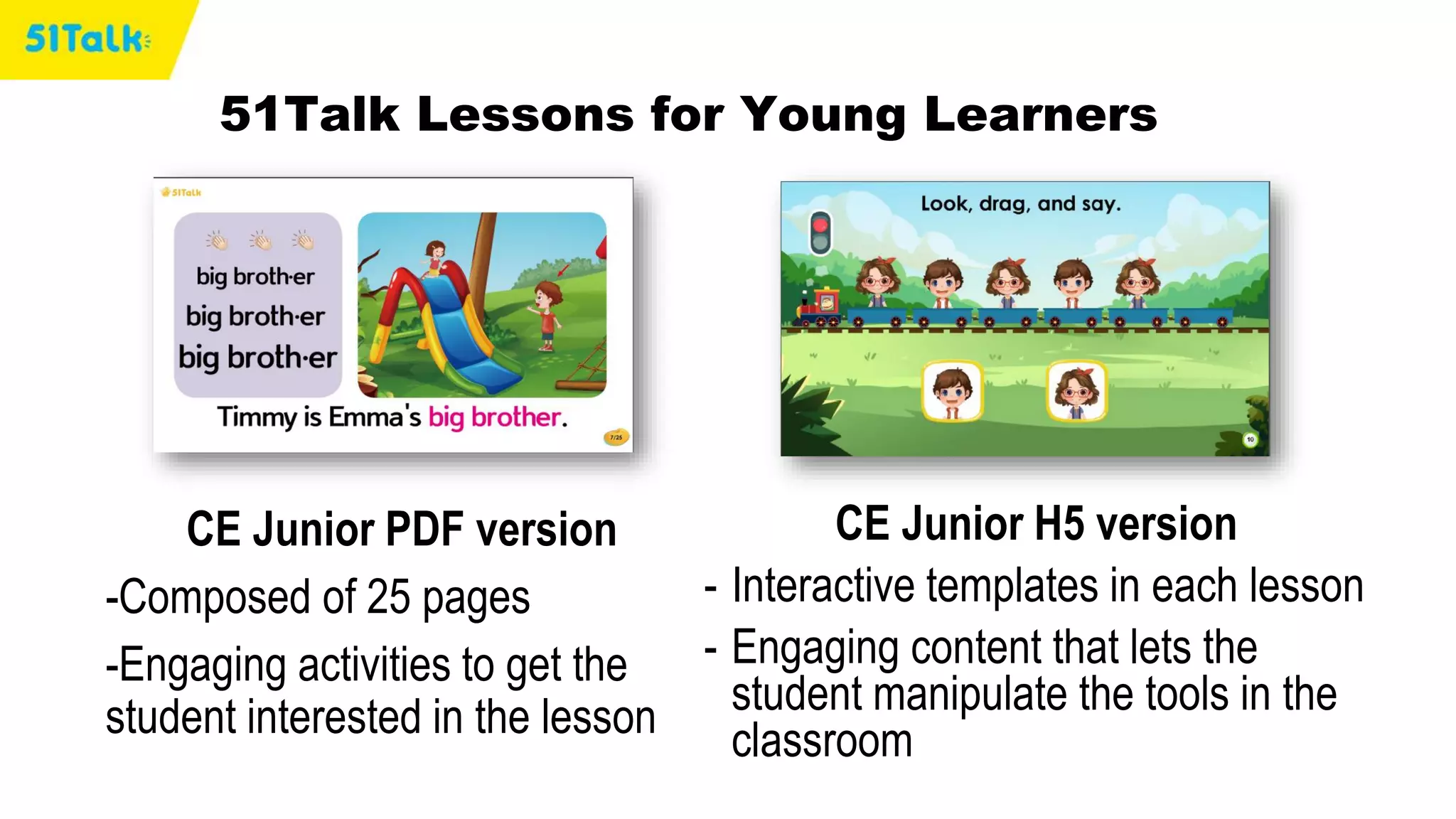
CE Junior H5 version
- Interactive templates in each lesson
- Engaging content that lets the
student manipulate the tools in the
classroom
51Talk Lessons for Young Learners
CE Junior PDF version
-Composed of 25 pages
-Engaging activities to get the
student interested in the lesson
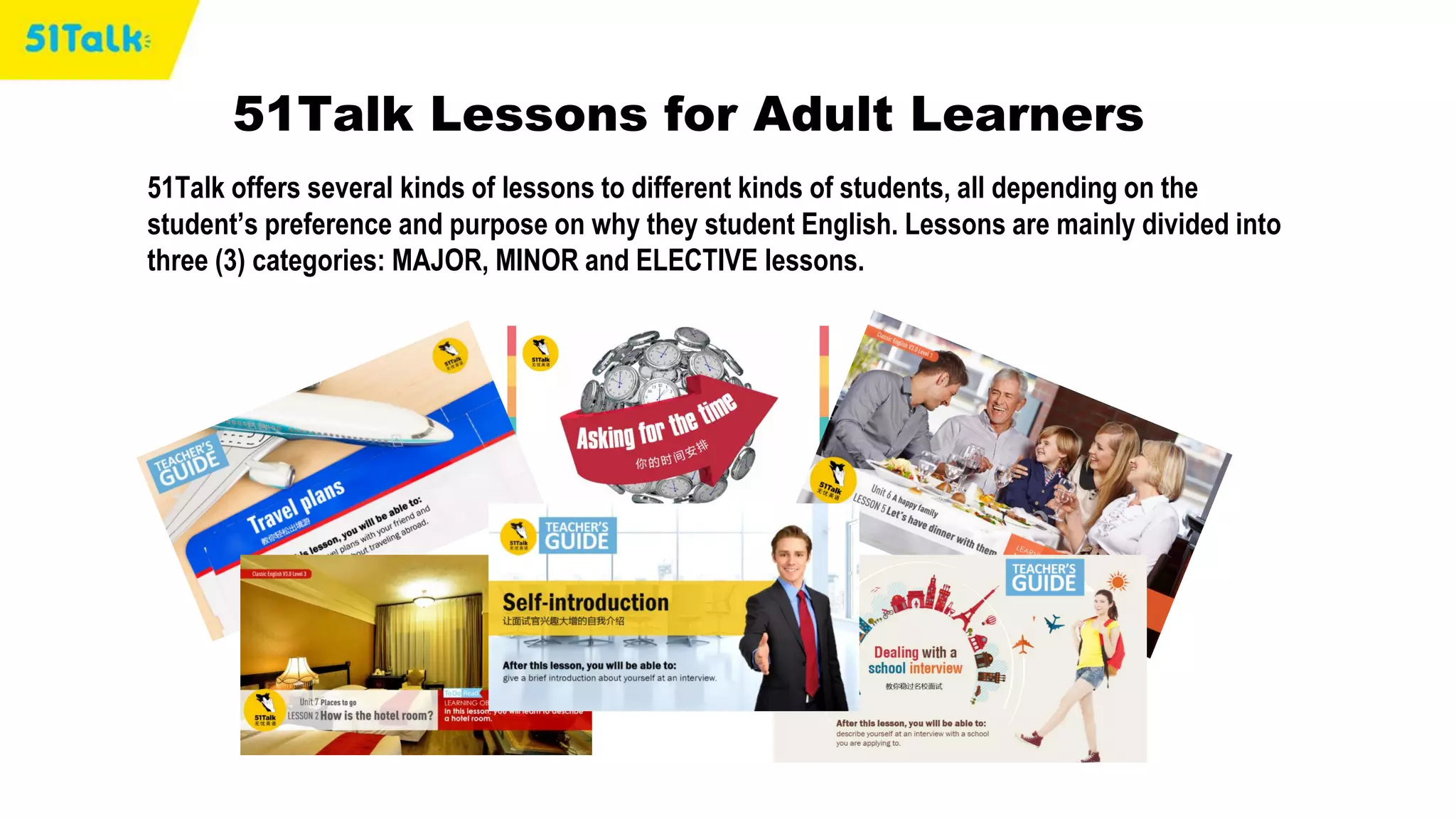
51Talk offers several kinds of lessons to different kinds of students, all depending on the
student’s preference and purpose on why they student English. Lessons are mainly divided into
three (3) categories: MAJOR, MINOR and ELECTIVE lessons.
51Talk Lessons for Adult Learners
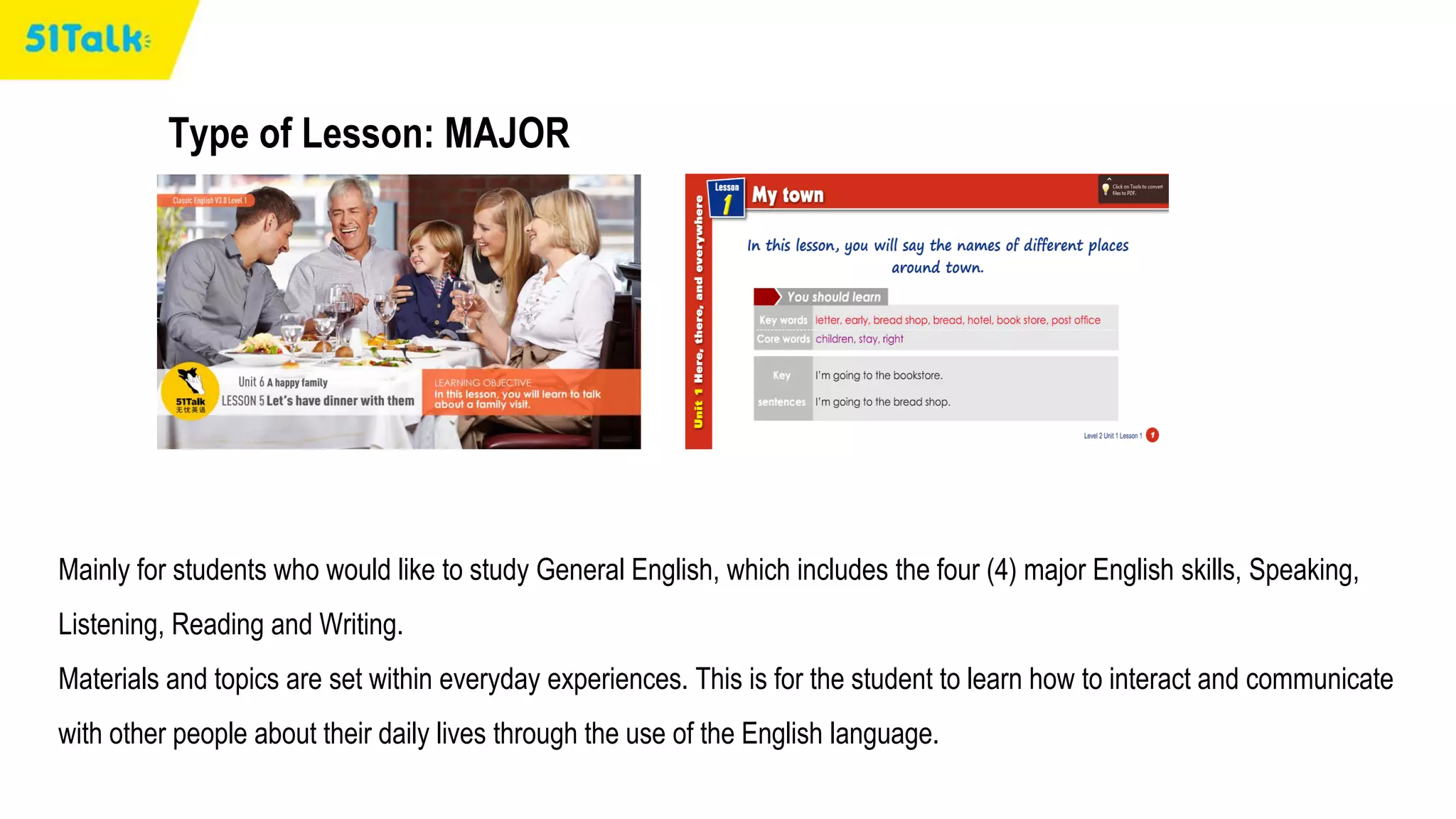
Type of Lesson: MAJOR
Mainly for students who would like to study General English, which includes the four (4) major English skills, Speaking,
Listening, Reading and Writing.
Materials and topics are set within everyday experiences. This is for the student to learn how to interact and communicate
with other people about their daily lives through the use of the English language.
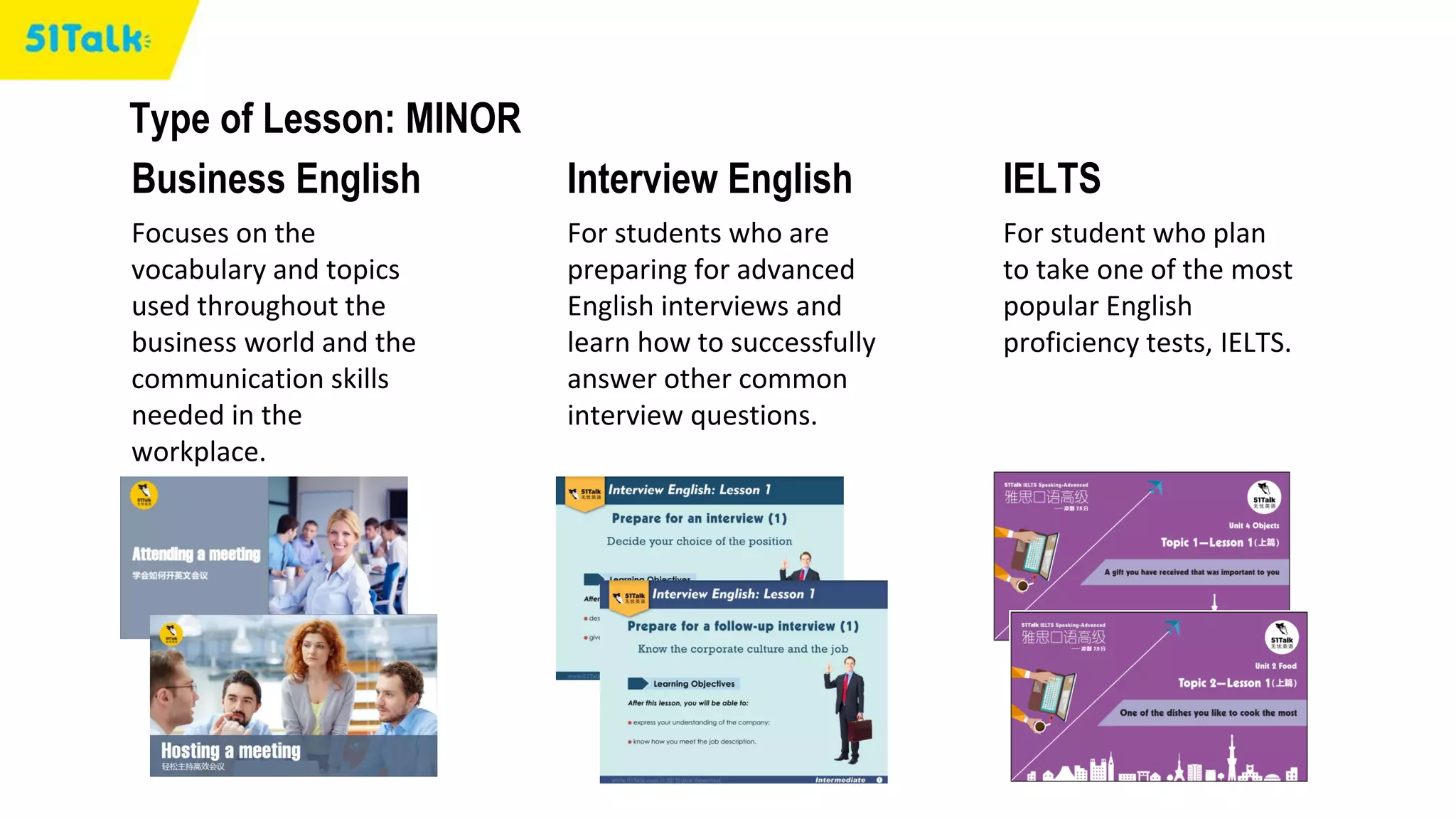
Type of Lesson: MINOR
Business English Interview English IELTS
Focuses on the
vocabulary and topics
used throughout the
business world and the
communication skills
needed in the
workplace.
For students who are
preparing for advanced
English interviews and
learn how to successfully
answer other common
interview questions.
For student who plan
to take one of the most
popular English
proficiency tests, IELTS.
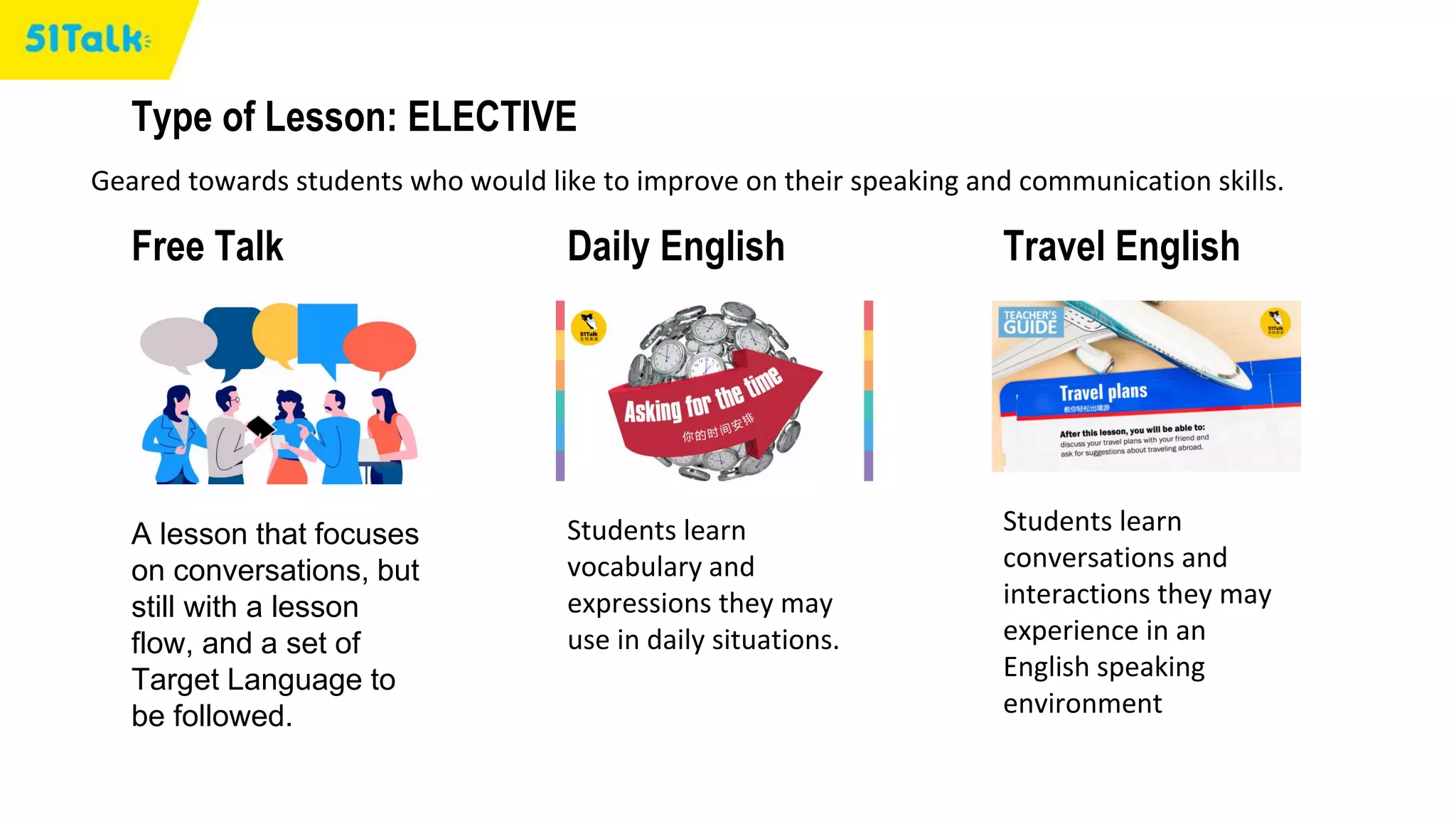
Type of Lesson: ELECTIVE
Free Talk Daily English Travel English
A lesson that focuses
on conversations, but
still with a lesson
flow, and a set of
Target Language to
be followed.
Students learn
vocabulary and
expressions they may
use in daily situations.
Students learn
conversations and
interactions they may
experience in an
English speaking
environment
Geared towards students who would like to improve on their speaking and communication skills.
How do we teach
51Talk lessons?
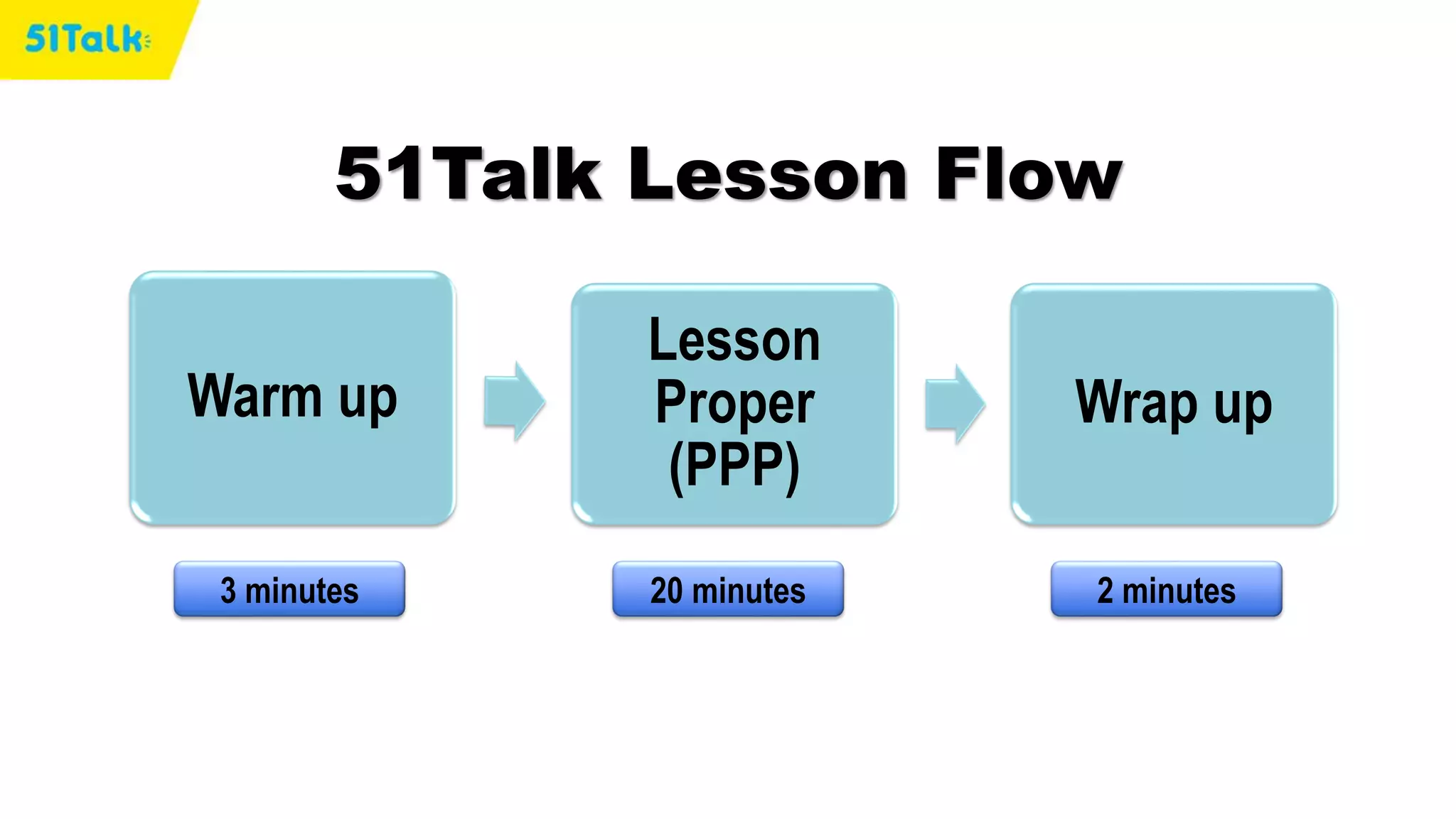
Warm up
Lesson
Proper
(PPP)
Wrap up
3 minutes 20 minutes 2 minutes
51Talk Lesson Flow
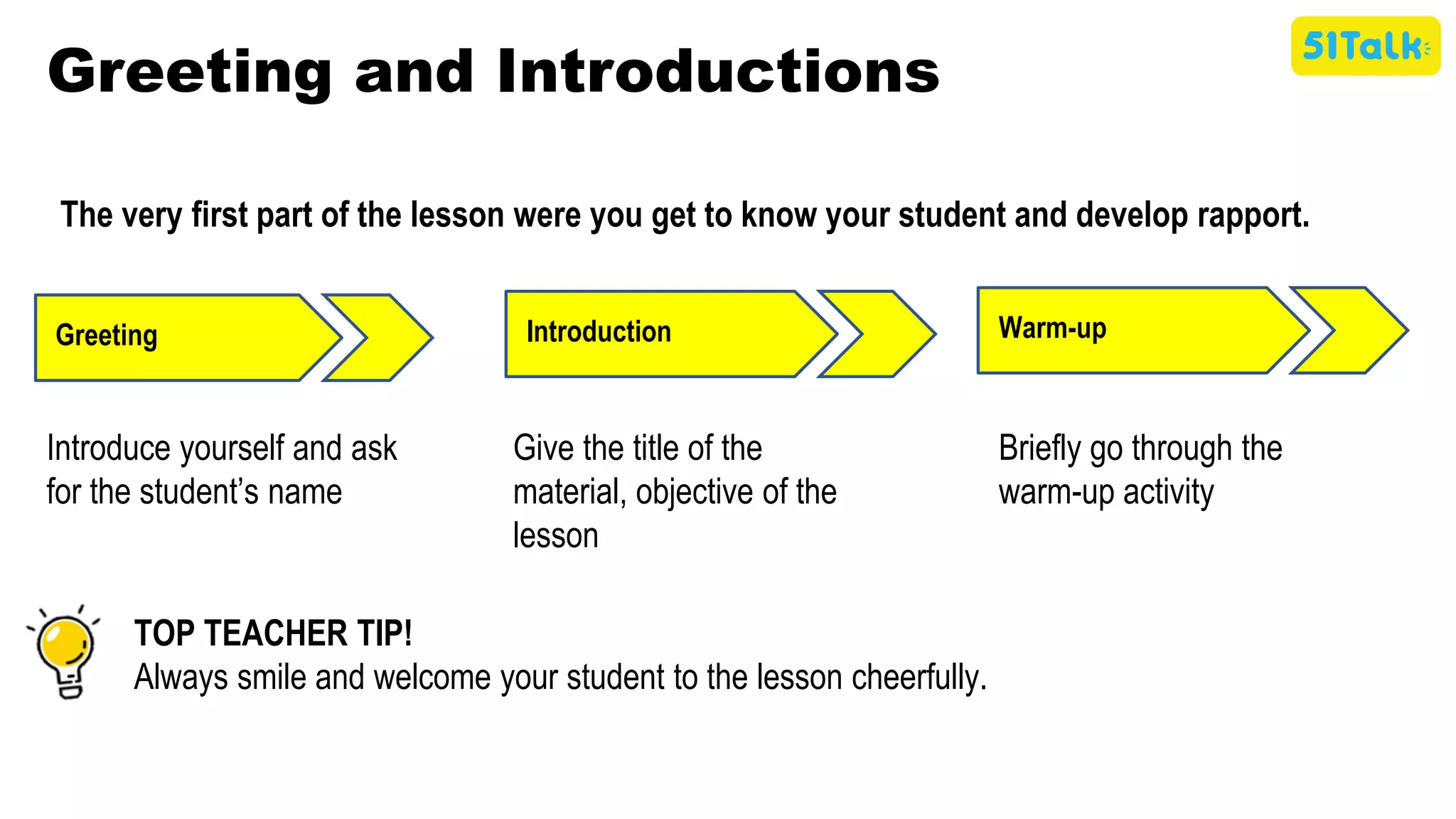
Greeting and Introductions
TOP TEACHER TIP!
Always smile and welcome your student to the lesson cheerfully.
Greeting Lead In
Introduce yourself and ask
for the student’s name
Introduction
Give the title of the
material, objective of the
lesson
Warm-up
Briefly go through the
warm-up activity
The very first part of the lesson were you get to know your student and develop rapport.
LET’S WATCH THIS!
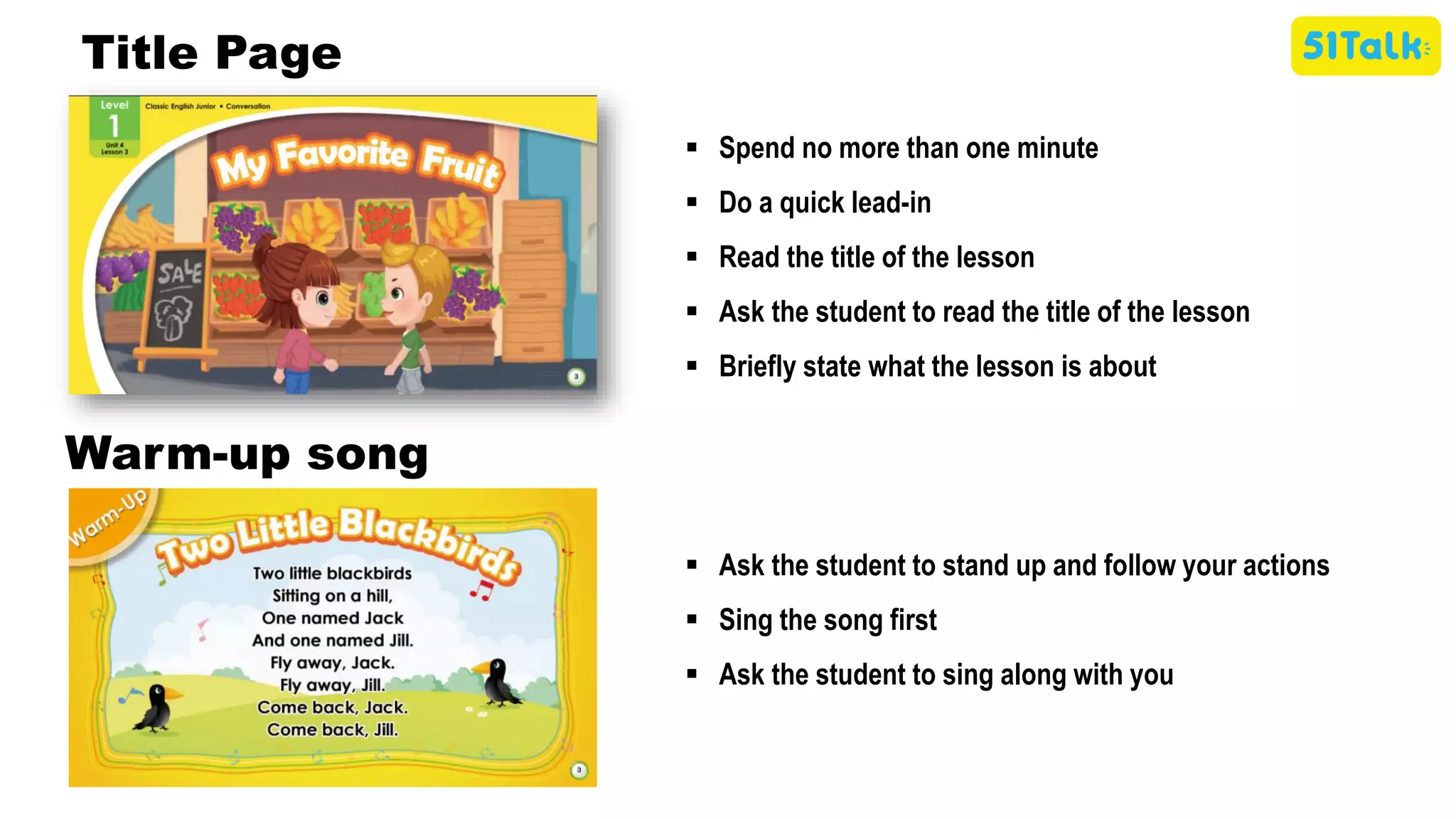
▪ Spend no more than one minute
▪ Do a quick lead-in
▪ Read the title of the lesson
▪ Ask the student to read the title of the lesson
▪ Briefly state what the lesson is about
Title Page
▪ Ask the student to stand up and follow your actions
▪ Sing the song first
▪ Ask the student to sing along with you
Warm-up song
LET’S WATCH THIS!
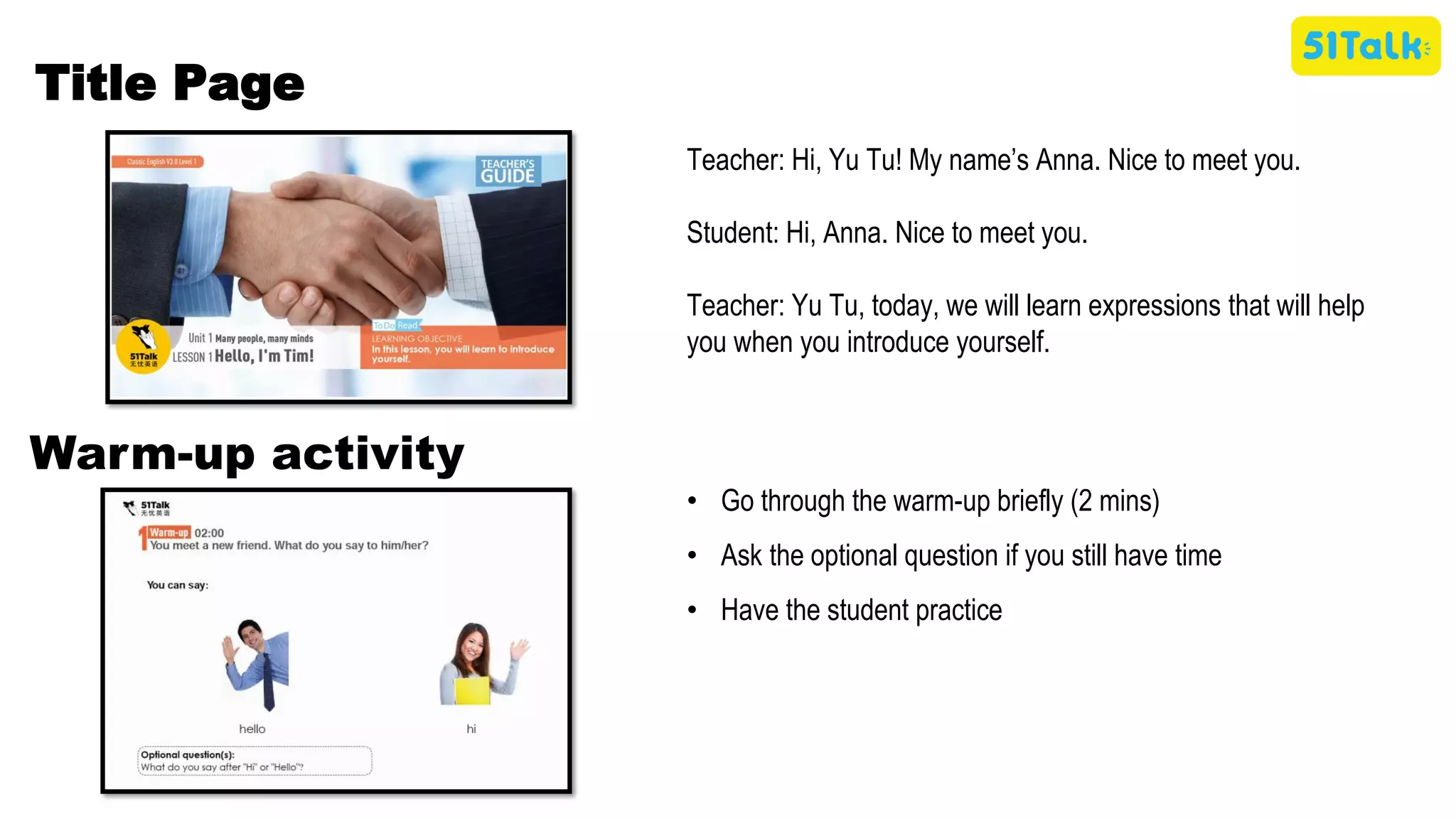
Teacher: Hi, Yu Tu! My name’s Anna. Nice to meet you.
Student: Hi, Anna. Nice to meet you.
Teacher: Yu Tu, today, we will learn expressions that will help
you when you introduce yourself.
Title Page
• Go through the warm-up briefly (2 mins)
• Ask the optional question if you still have time
• Have the student practice
Warm-up activity
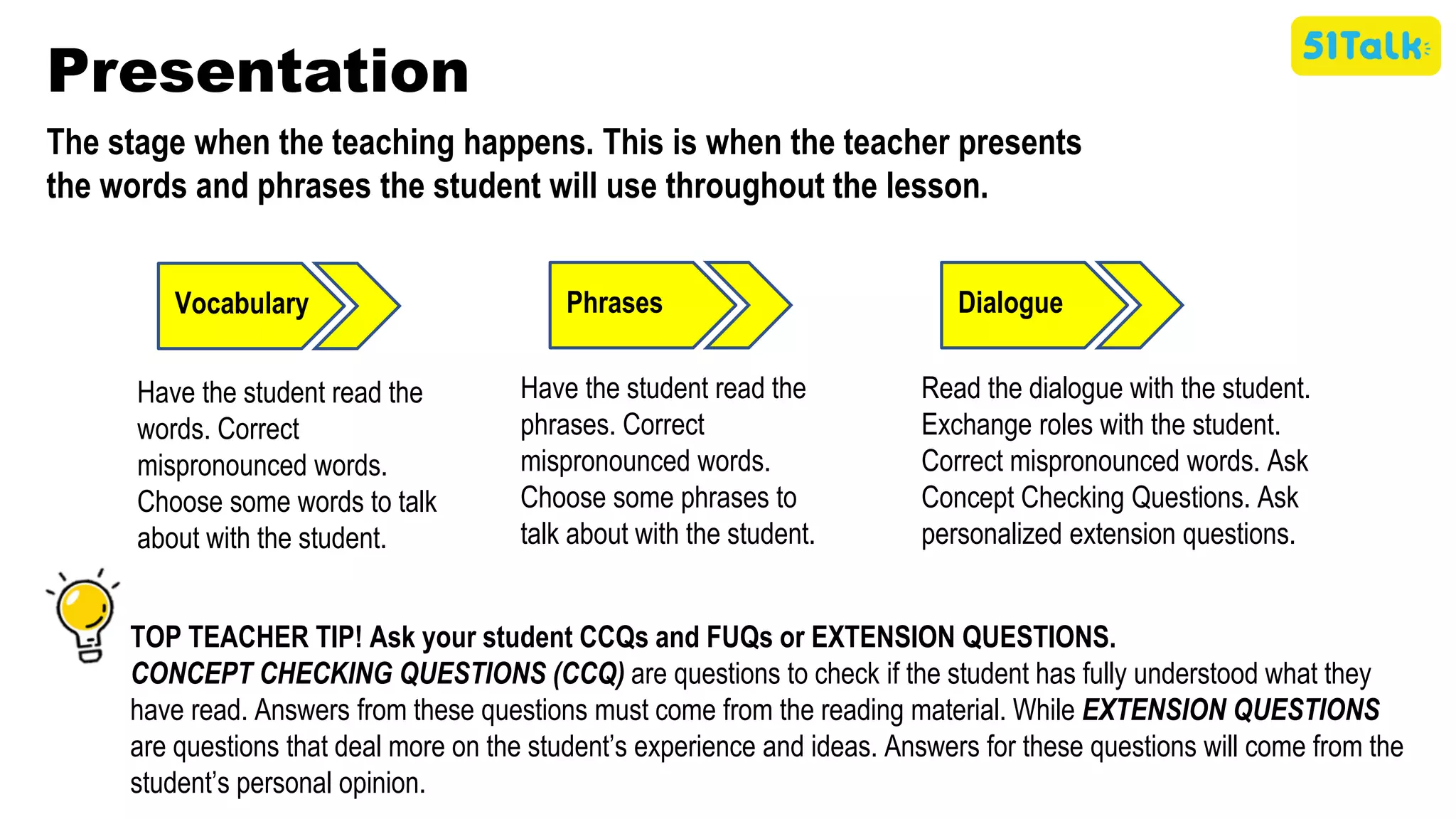
Presentation
The stage when the teaching happens. This is when the teacher presents
the words and phrases the student will use throughout the lesson.
Vocabulary Phrases
Have the student read the
words. Correct
mispronounced words.
Choose some words to talk
about with the student.
TOP TEACHER TIP! Ask your student CCQs and FUQs or EXTENSION QUESTIONS.
CONCEPT CHECKING QUESTIONS (CCQ) are questions to check if the student has fully understood what they
have read. Answers from these questions must come from the reading material. While EXTENSION QUESTIONS
are questions that deal more on the student’s experience and ideas. Answers for these questions will come from the
student’s personal opinion.

Dialogue
Have the student read the
phrases. Correct
mispronounced words.
Choose some phrases to
talk about with the student.
Read the dialogue with the student.
Exchange roles with the student.
Correct mispronounced words. Ask
Concept Checking Questions. Ask
personalized extension questions.
LET’S WATCH THIS!
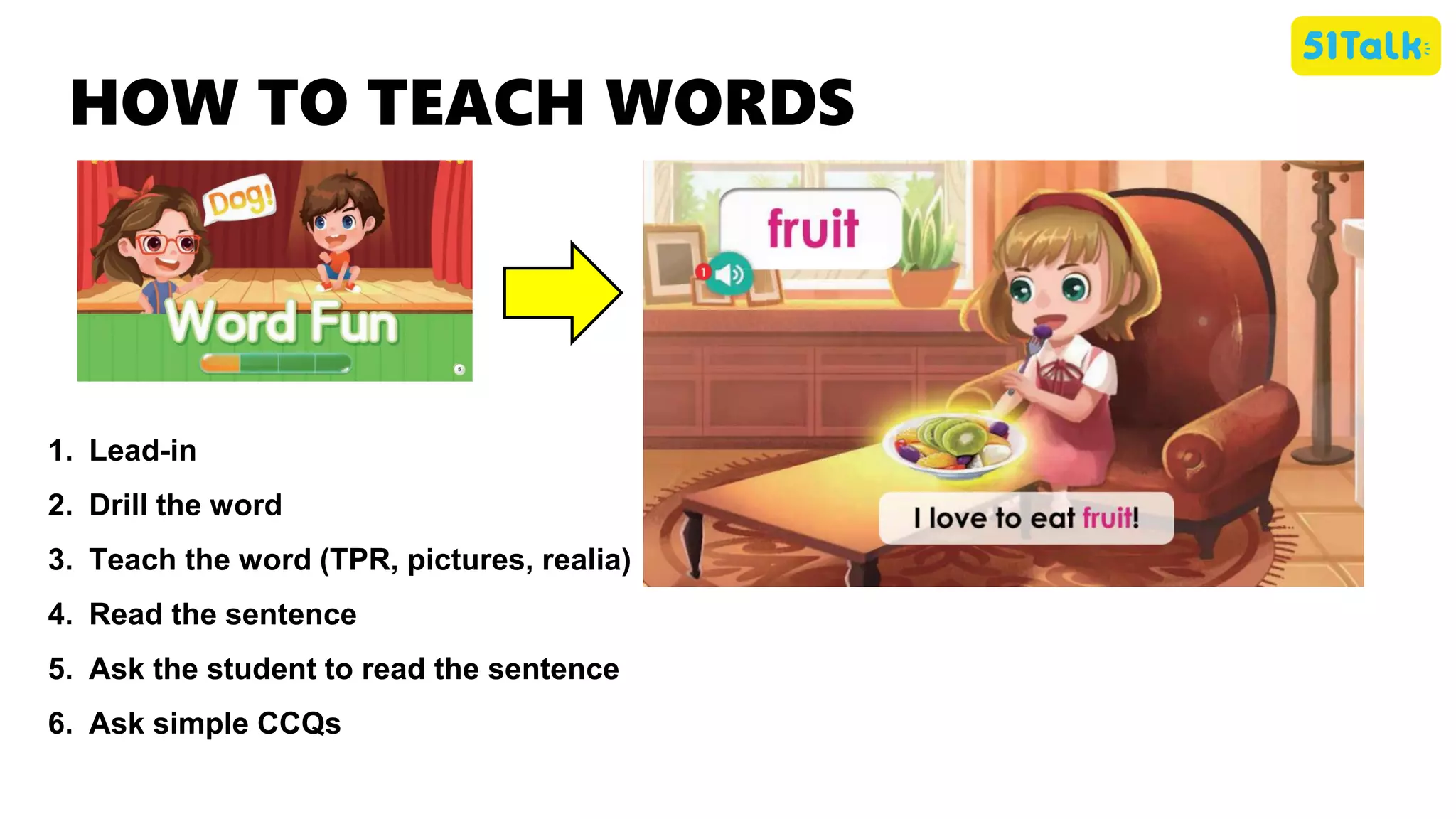
HOW TO TEACH WORDS
1. Lead-in
2. Drill the word
3. Teach the word (TPR, pictures, realia)
4. Read the sentence
5. Ask the student to read the sentence
6. Ask simple CCQs
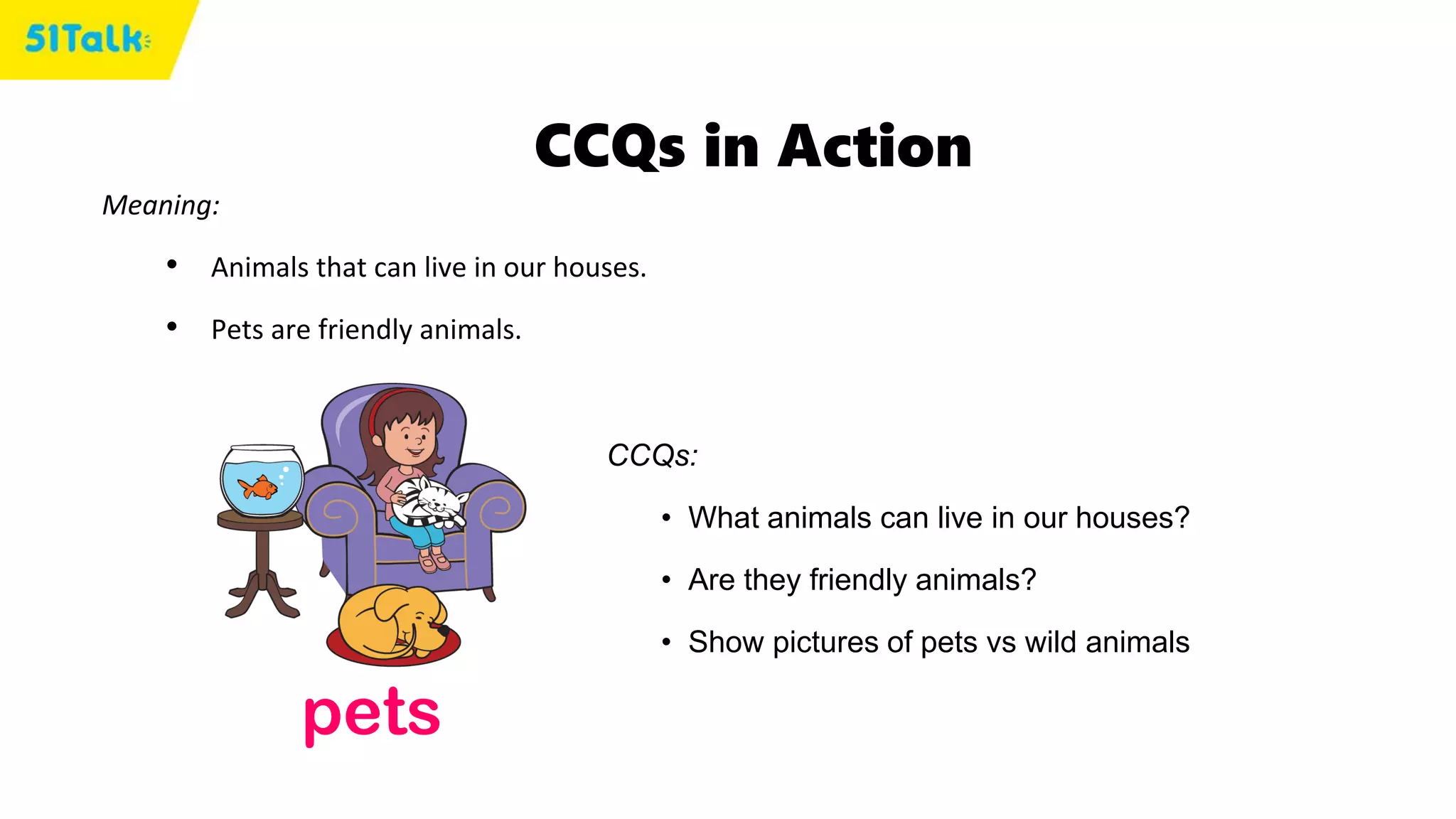
CCQs in Action
Meaning:
• Animals that can live in our houses.
• Pets are friendly animals.
pets
CCQs:
• What animals can live in our houses?
• Are they friendly animals?
• Show pictures of pets vs wild animals
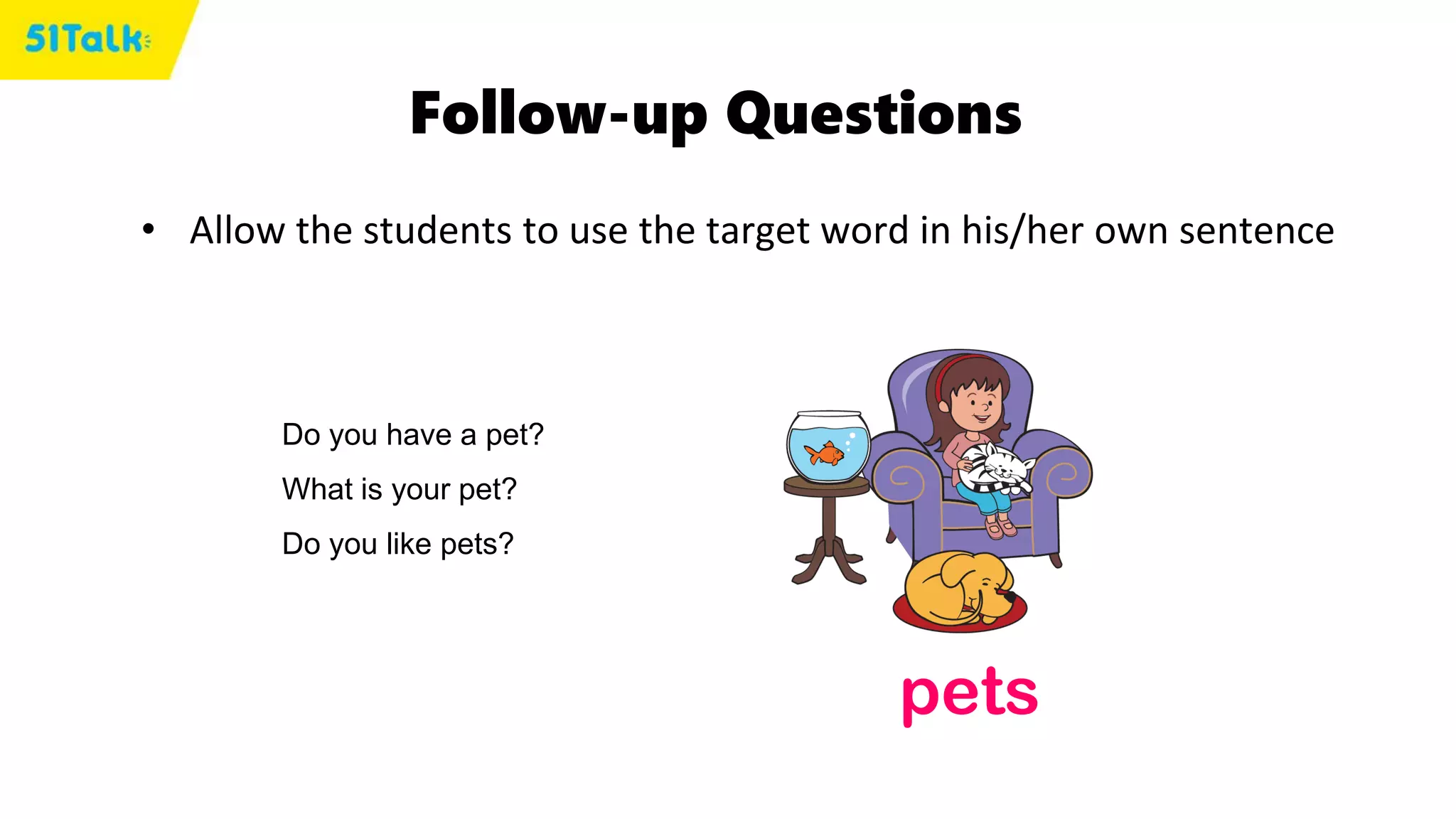
Follow-up Questions
• Allow the students to use the target word in his/her own sentence
pets
Do you have a pet?
What is your pet?
Do you like pets?
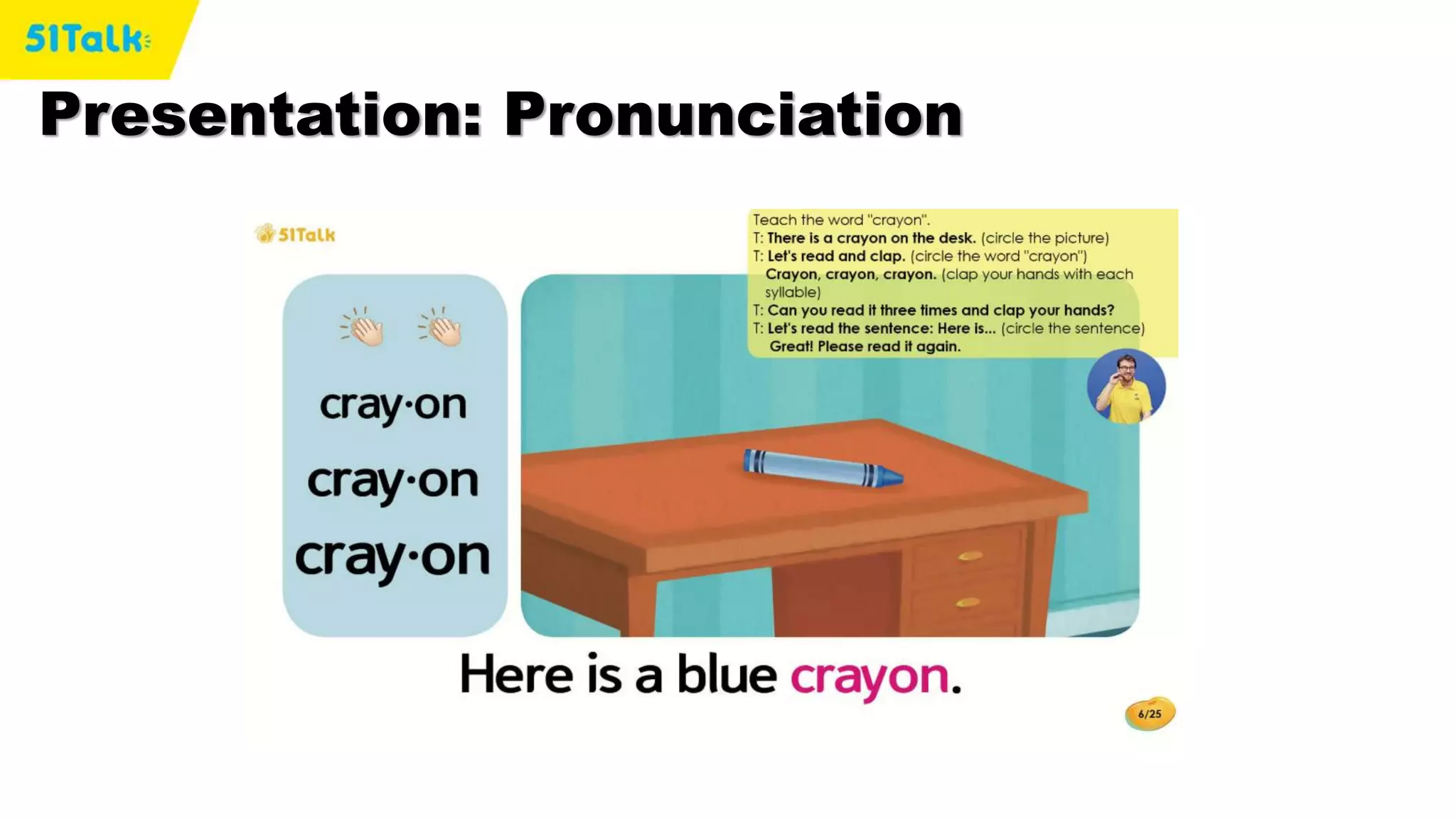
Presentation: Pronunciation
LET’S WATCH THIS!
Presentation: Pronunciation
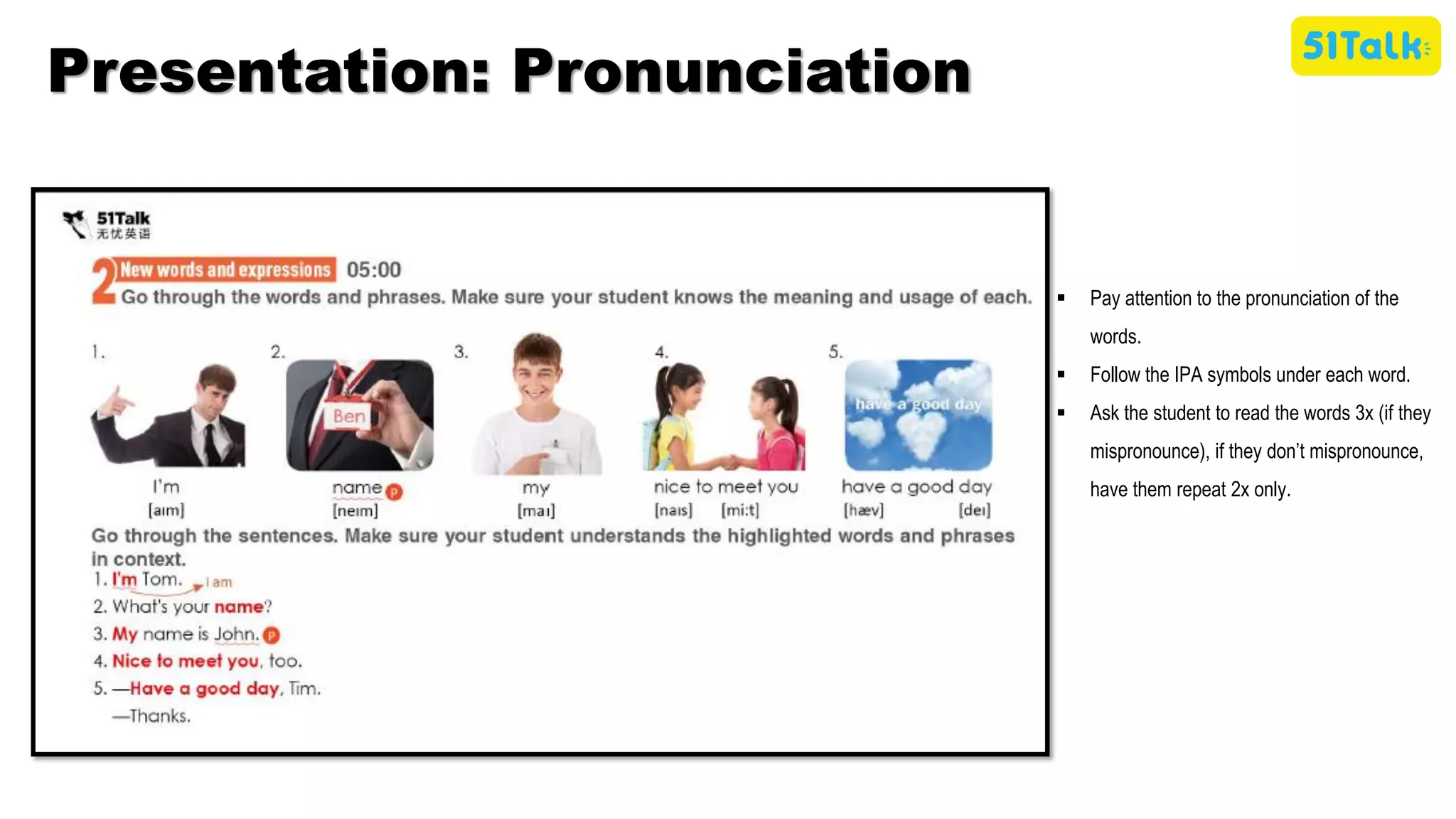
▪ Pay attention to the pronunciation of the
words.
▪ Follow the IPA symbols under each word.
▪ Ask the student to read the words 3x (if they
mispronounce), if they don’t mispronounce,
have them repeat 2x only.
Presentation: Pronunciation
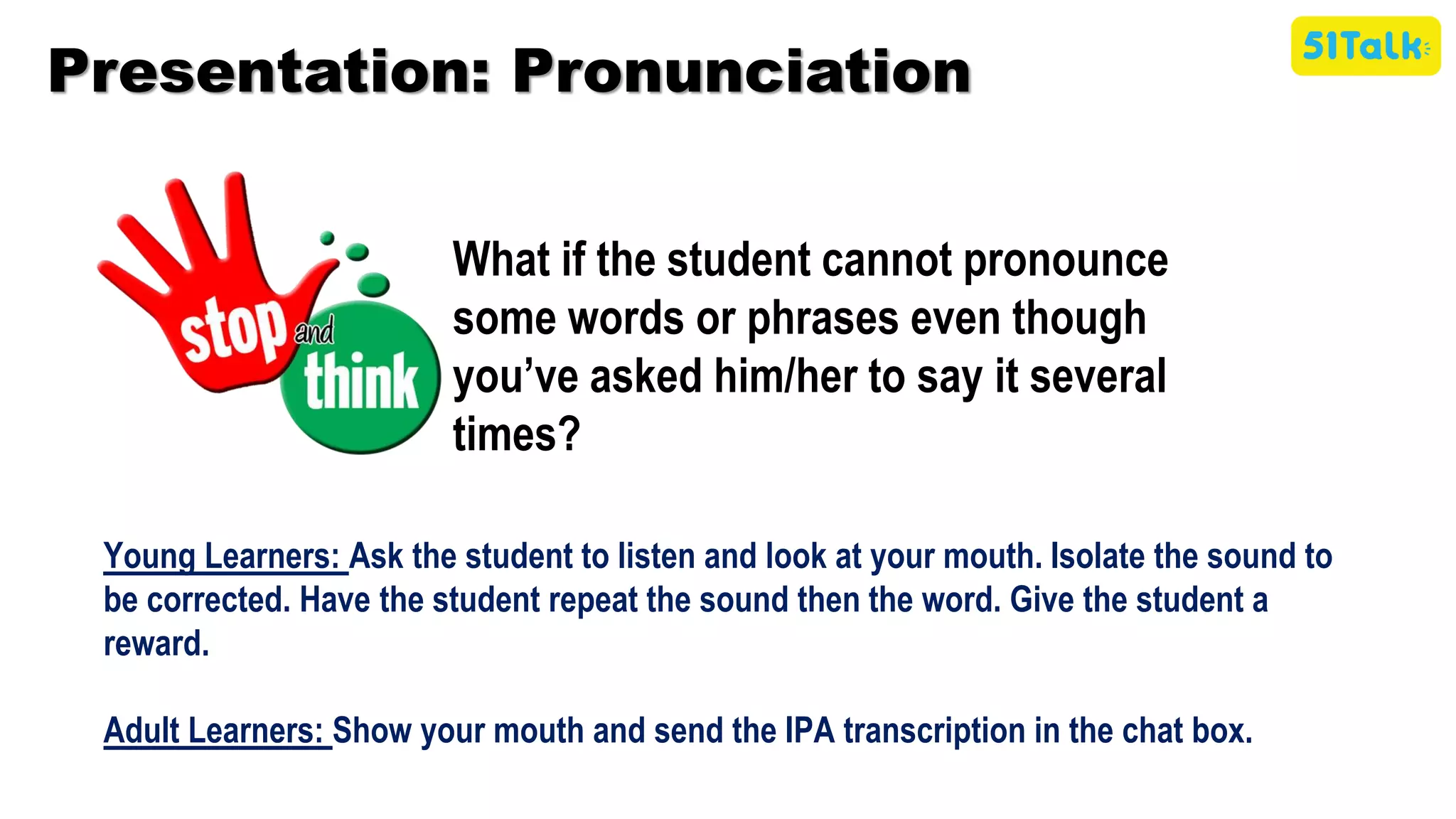
What if the student cannot pronounce
some words or phrases even though
you’ve asked him/her to say it several
times?
Young Learners: Ask the student to listen and look at your mouth. Isolate the sound to
be corrected. Have the student repeat the sound then the word. Give the student a
reward.
Adult Learners: Show your mouth and send the IPA transcription in the chat box.
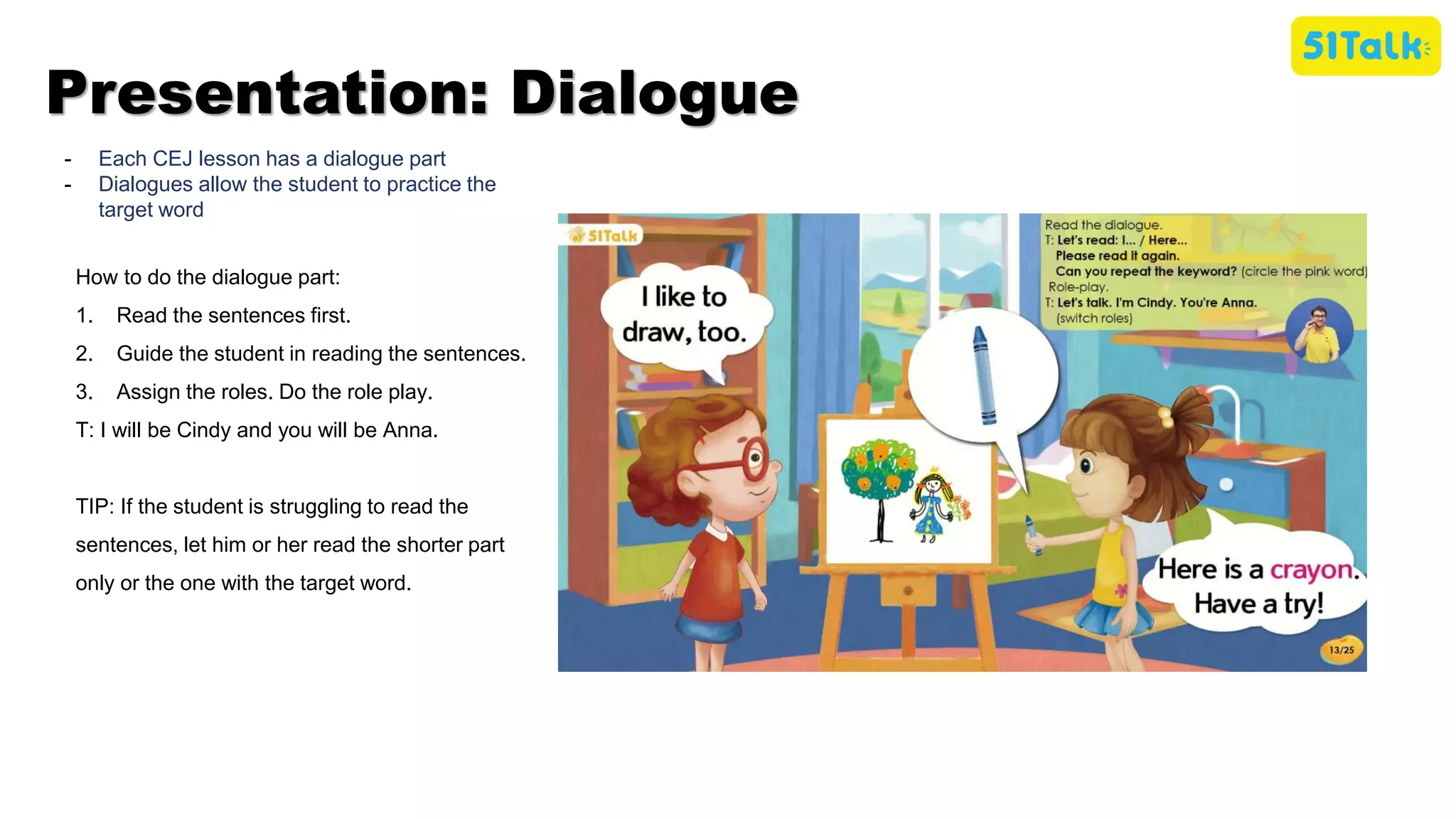
- Each CEJ lesson has a dialogue part
- Dialogues allow the student to practice the
target word
How to do the dialogue part:
1. Read the sentences first.
2. Guide the student in reading the sentences.
3. Assign the roles. Do the role play.
T: I will be Cindy and you will be Anna.
TIP: If the student is struggling to read the
sentences, let him or her read the shorter part
only or the one with the target word.
Presentation: Dialogue
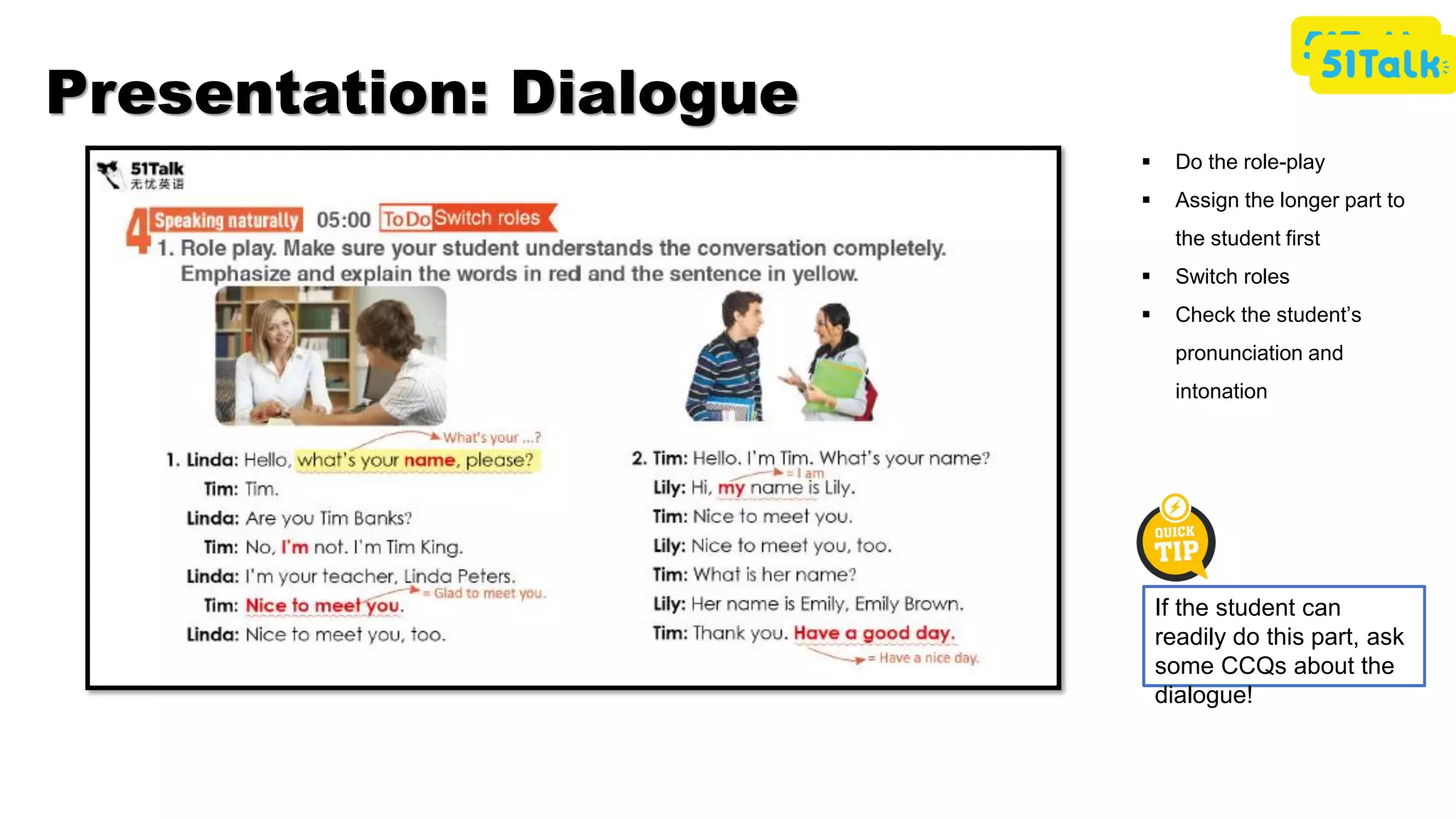
▪ Do the role-play
▪ Assign the longer part to
the student first
▪ Switch roles
▪ Check the student’s
pronunciation and
intonation
If the student can
readily do this part, ask
some CCQs about the
dialogue!
Presentation: Dialogue
Practice
These are activities, tasks or exercises to check if the student can put into
practice what they have learned from the Presentation stage.
Exercise
Go through the activity with the student. Always be ready to guide the student into getting the
correct answers. Remind the student to use the words and phrases he/she learned from the
previous stage.
NOTE: the number of activities may vary depending on the material. In this part of the lesson, the student is expected to
use the what he/she has learned, but still with the help of the teacher.
LET’S WATCH THIS!
Practice
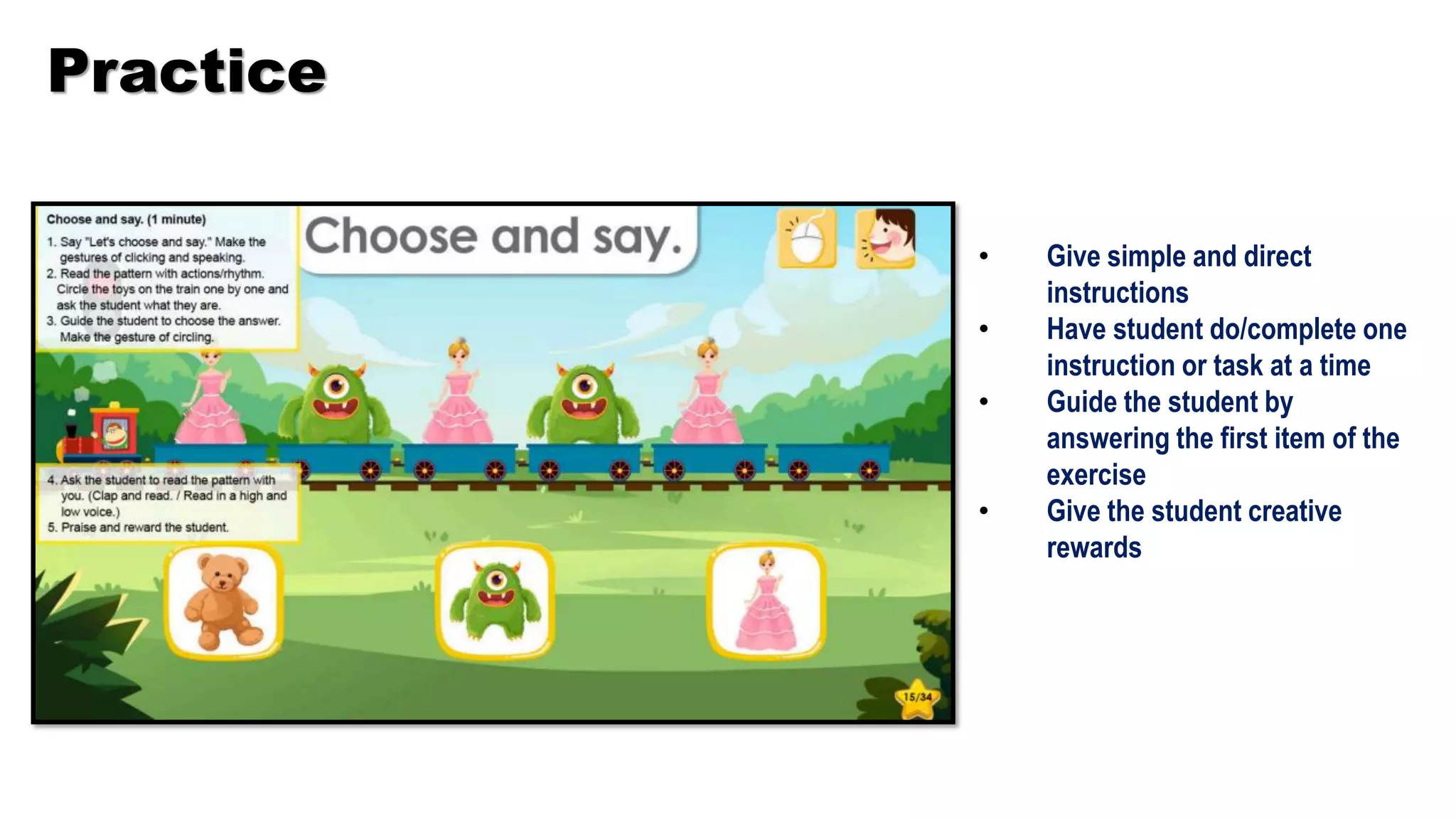
• Give simple and direct
instructions
• Have student do/complete one
instruction or task at a time
• Guide the student by
answering the first item of the
exercise
• Give the student creative
rewards
LET’S WATCH THIS!
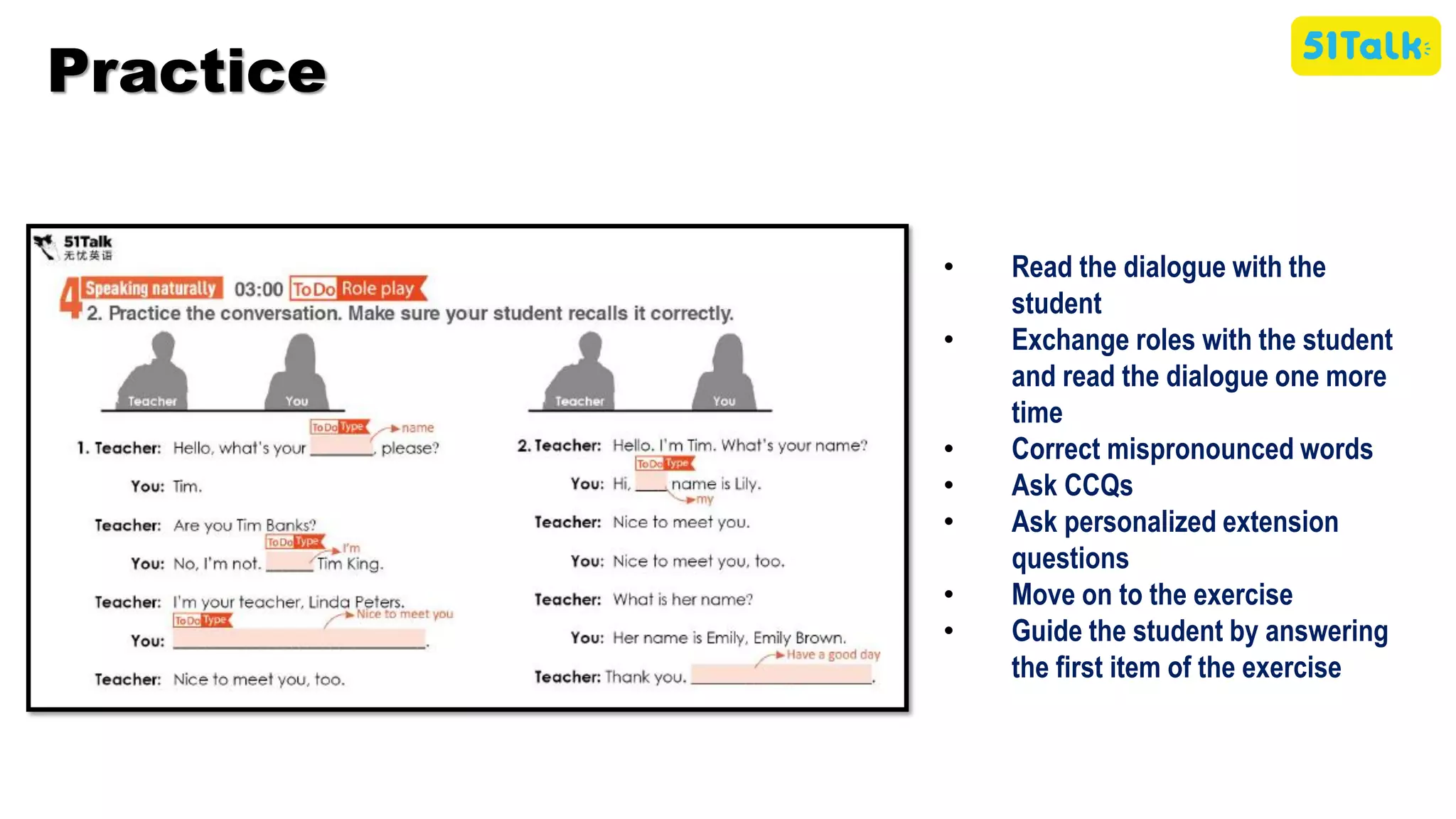
• Read the dialogue with the
student
• Exchange roles with the student
and read the dialogue one more
time
• Correct mispronounced words
• Ask CCQs
• Ask personalized extension
questions
• Move on to the exercise
• Guide the student by answering
the first item of the exercise
Practice
Production
This is the part of the lesson when the student is able to use everything
he/she has learned from the lesson.
Summary
Review the lesson with the student. Have the student pronounce the words, correct any
mispronounced words. Get the student to use the phrases and expressions he/she learned through a
conversation about the main topic of the lesson. If the student does not use the Target Language,
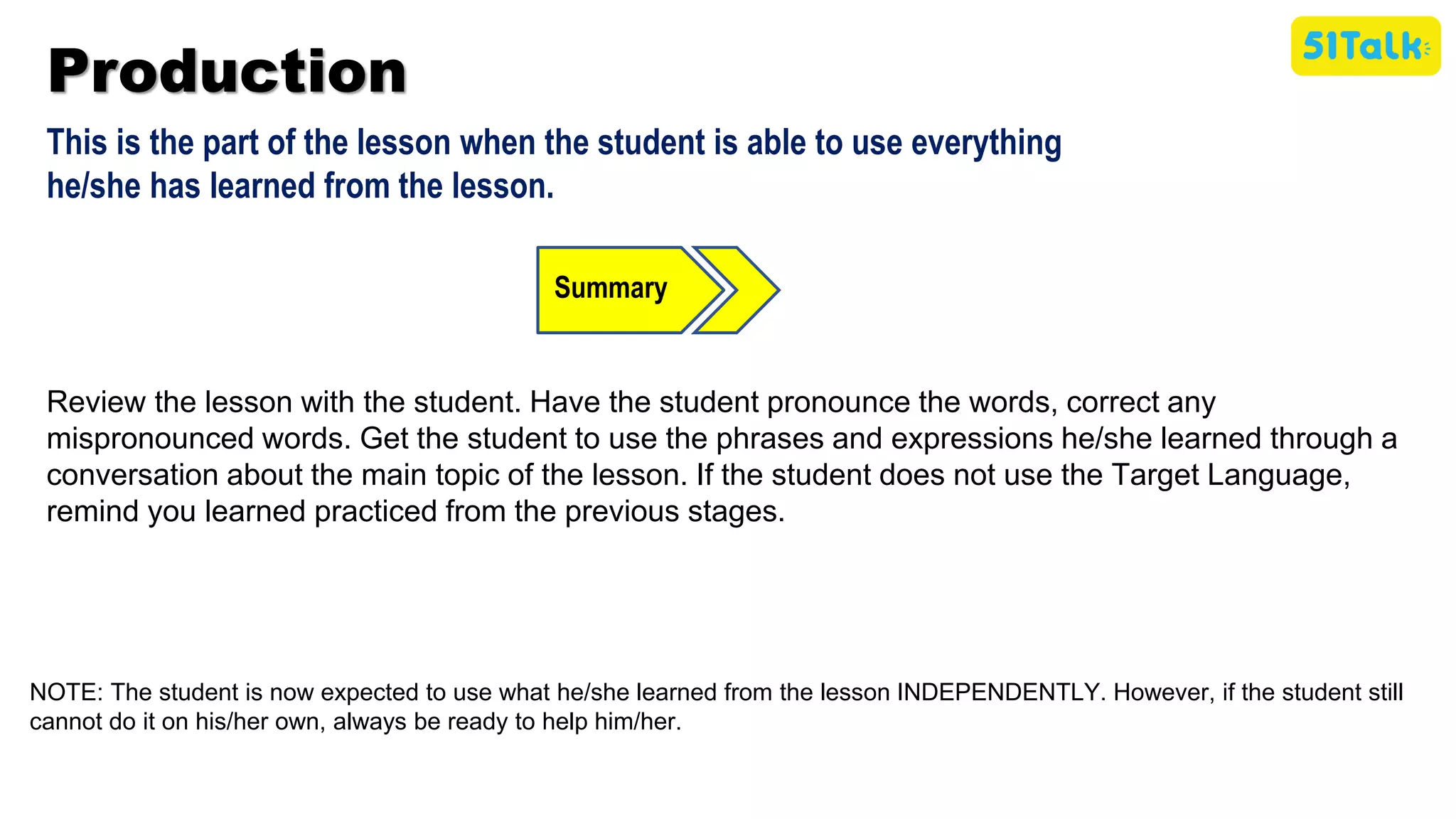
remind you learned practiced from the previous stages.
NOTE: The student is now expected to use what he/she learned from the lesson INDEPENDENTLY. However, if the student still
cannot do it on his/her own, always be ready to help him/her.
Wrap Up
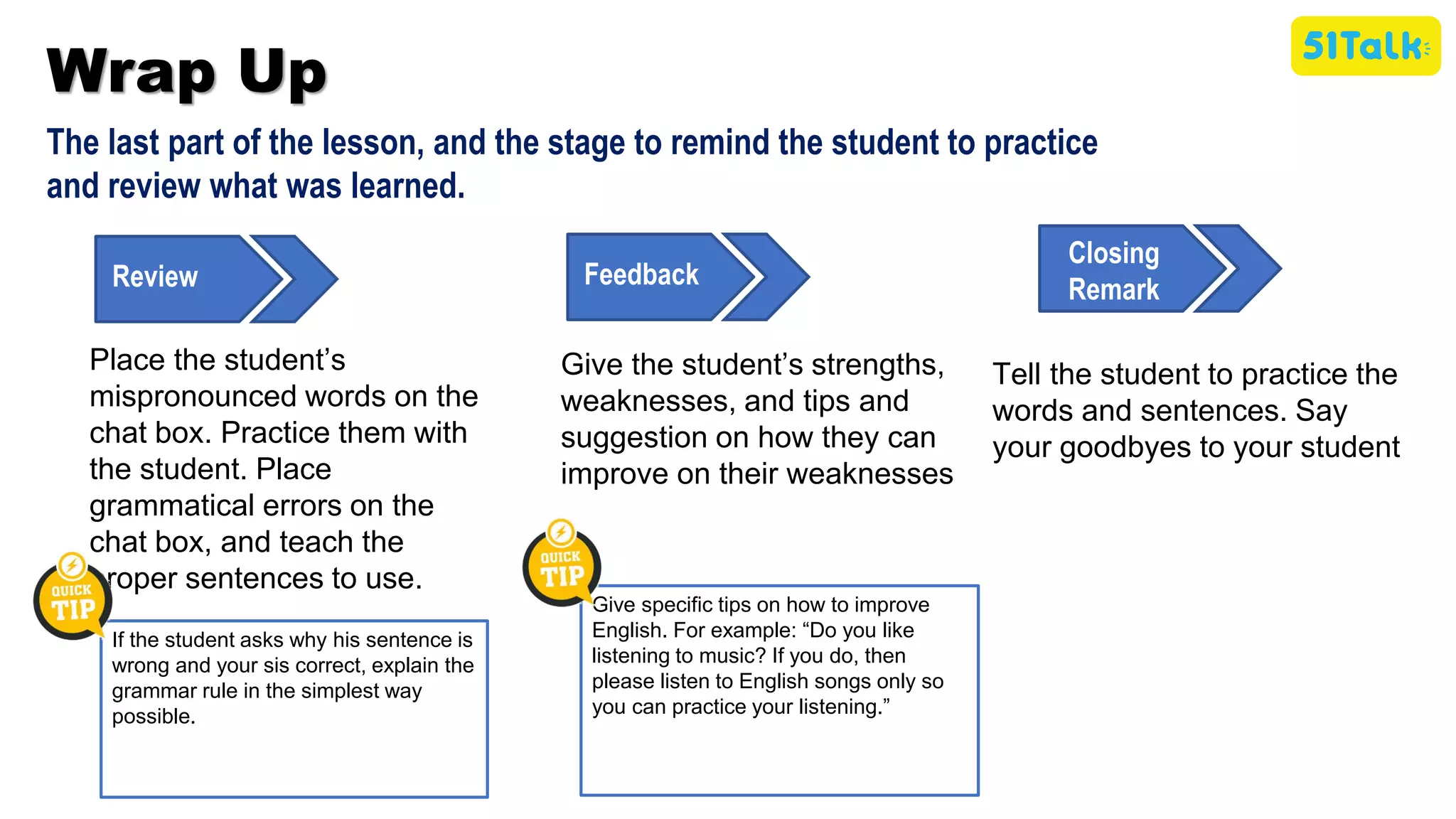
The last part of the lesson, and the stage to remind the student to practice
and review what was learned.
Review
Place the student’s
mispronounced words on the
chat box. Practice them with
the student. Place
grammatical errors on the
chat box, and teach the
proper sentences to use.
Closing
Remark
s
Tell the student to practice the
words and sentences. Say
your goodbyes to your student
Feedback
Give the student’s strengths,
weaknesses, and tips and
suggestion on how they can
improve on their weaknesses
Give specific tips on how to improve
English. For example: “Do you like
listening to music? If you do, then
please listen to English songs only so
you can practice your listening.”
If the student asks why his sentence is
wrong and your sis correct, explain the
grammar rule in the simplest way
possible.
LET’S WATCH THIS!
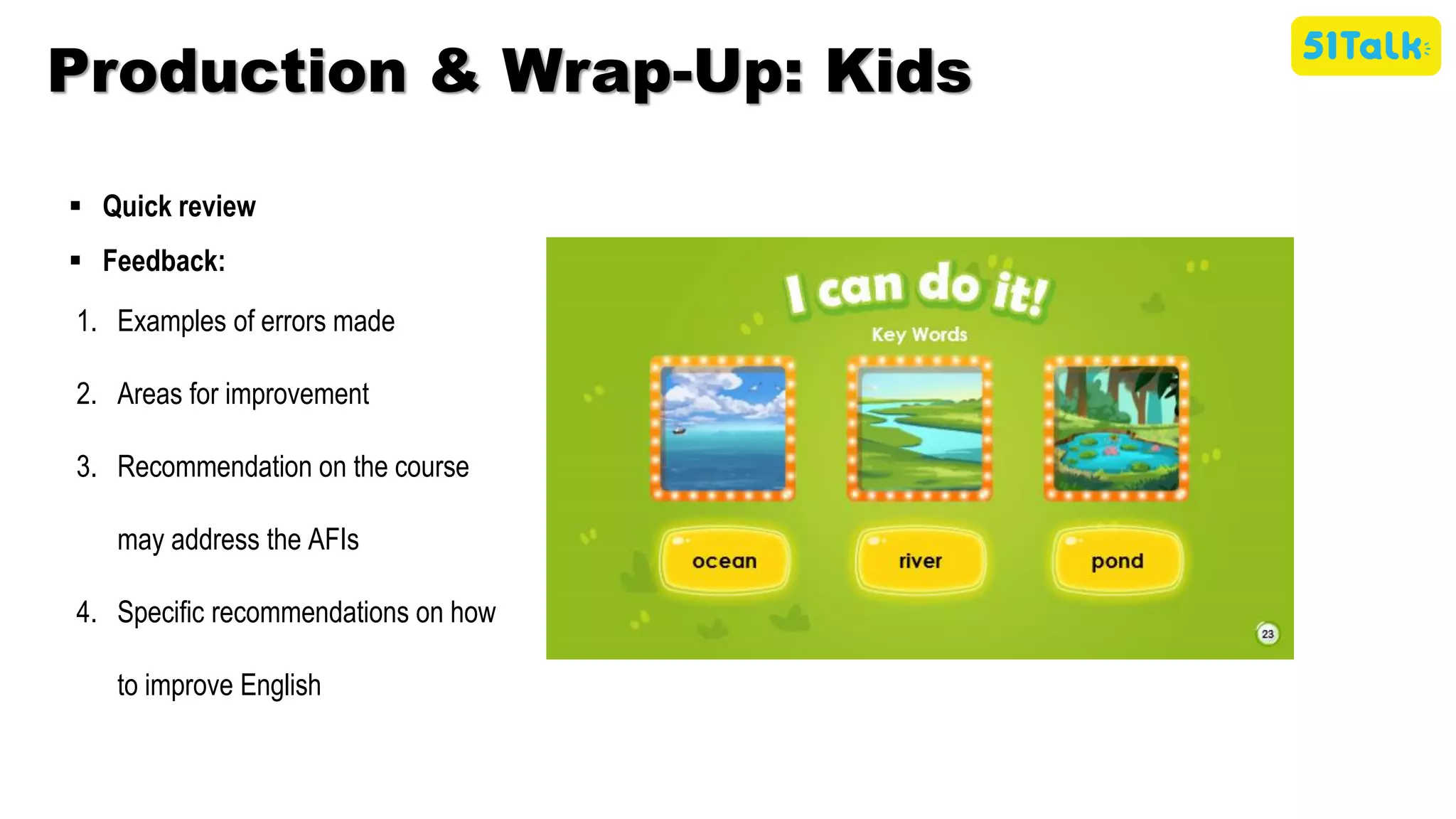
1. Examples of errors made
2. Areas for improvement
3. Recommendation on the course
may address the AFIs
4. Specific recommendations on how
to improve English
▪ Quick review
▪ Feedback:
Production & Wrap-Up: Kids
LET’S WATCH THIS!
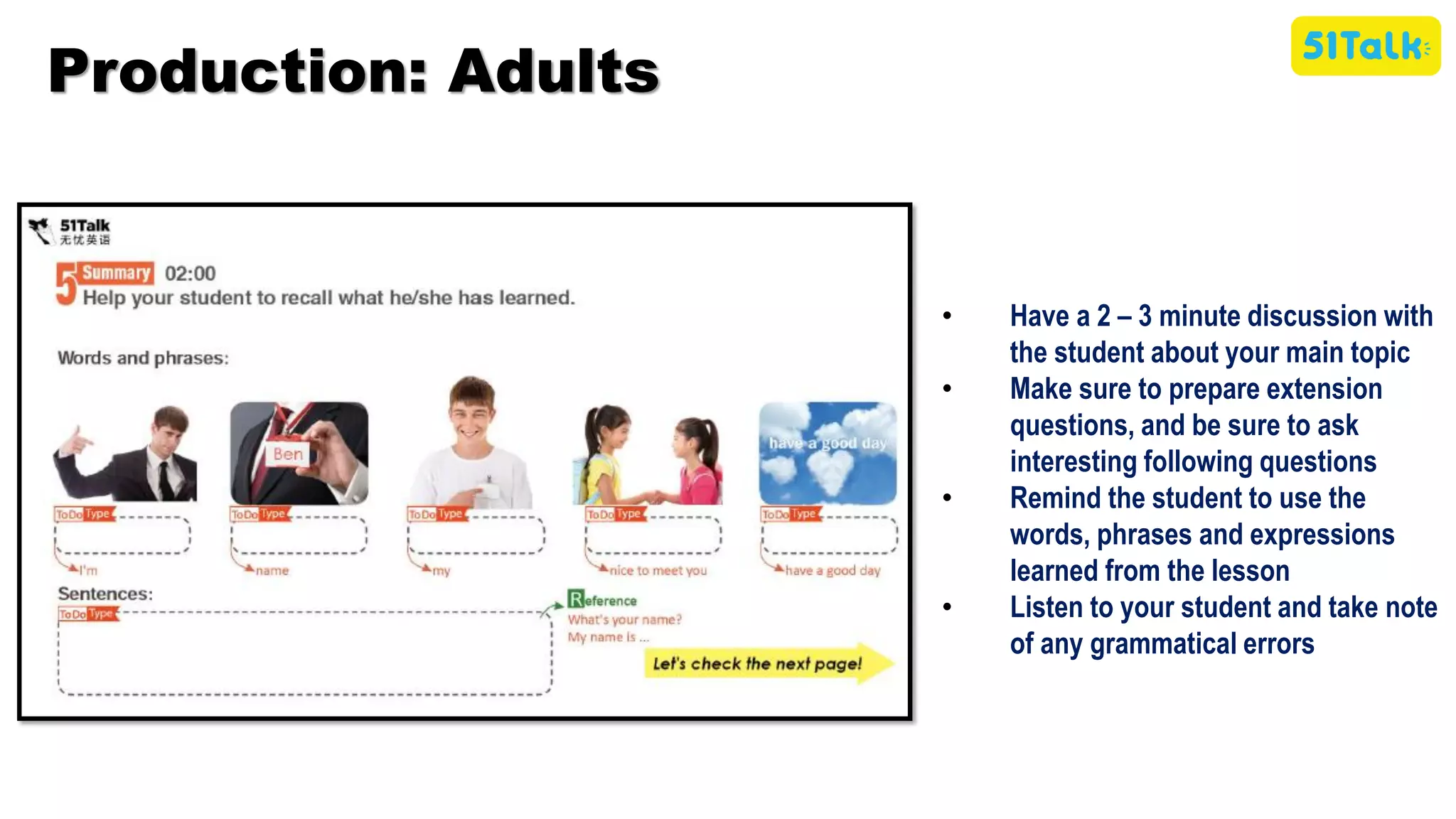
• Have a 2 – 3 minute discussion with
the student about your main topic
• Make sure to prepare extension
questions, and be sure to ask
interesting following questions
• Remind the student to use the
words, phrases and expressions
learned from the lesson
• Listen to your student and take note
of any grammatical errors
Production: Adults
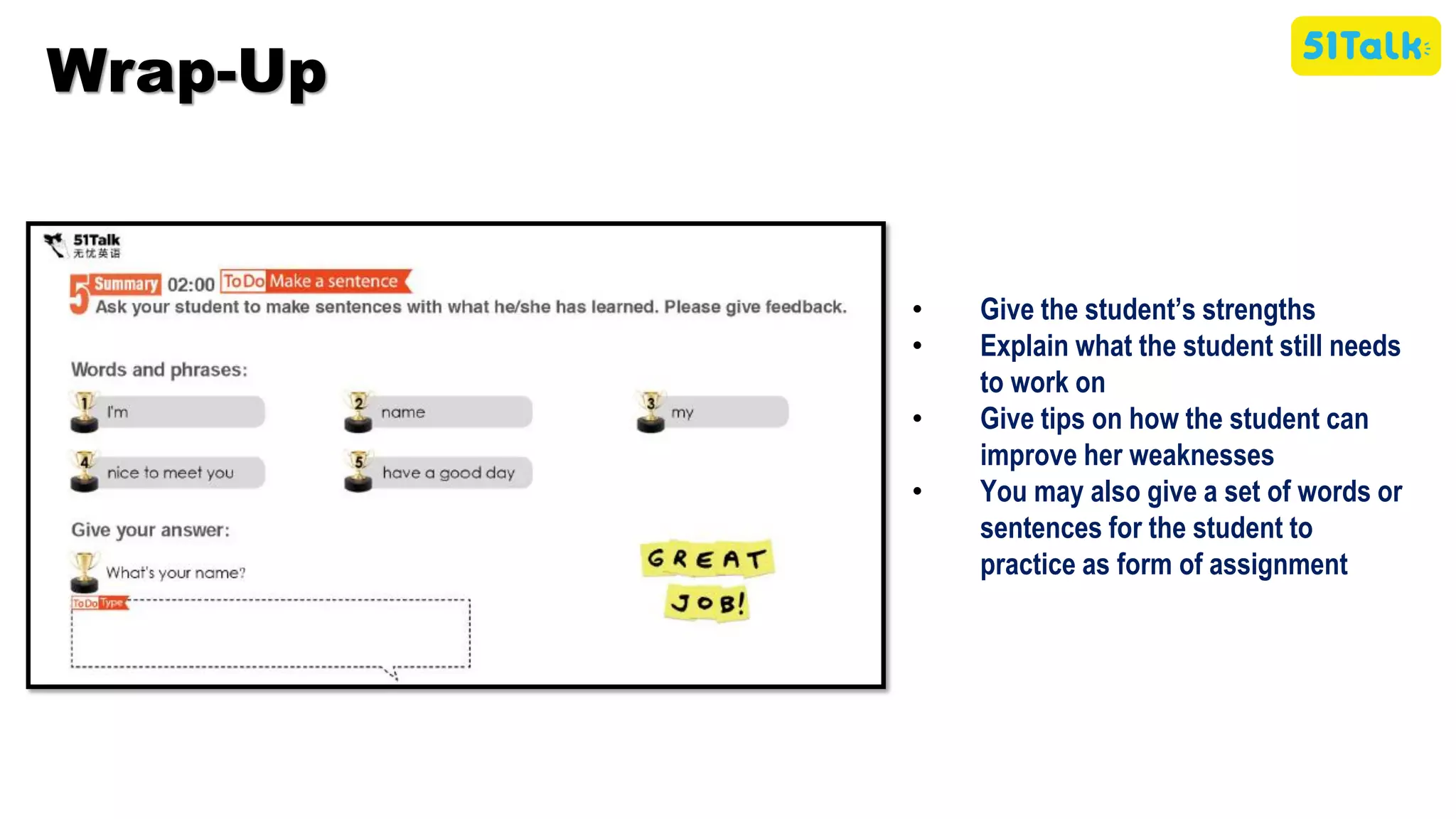
• Give the student’s strengths
• Explain what the student still needs
to work on
• Give tips on how the student can
improve her weaknesses
• You may also give a set of words or
sentences for the student to
practice as form of assignment
Wrap-Up
What makes an
excellent 51talk
lesson?
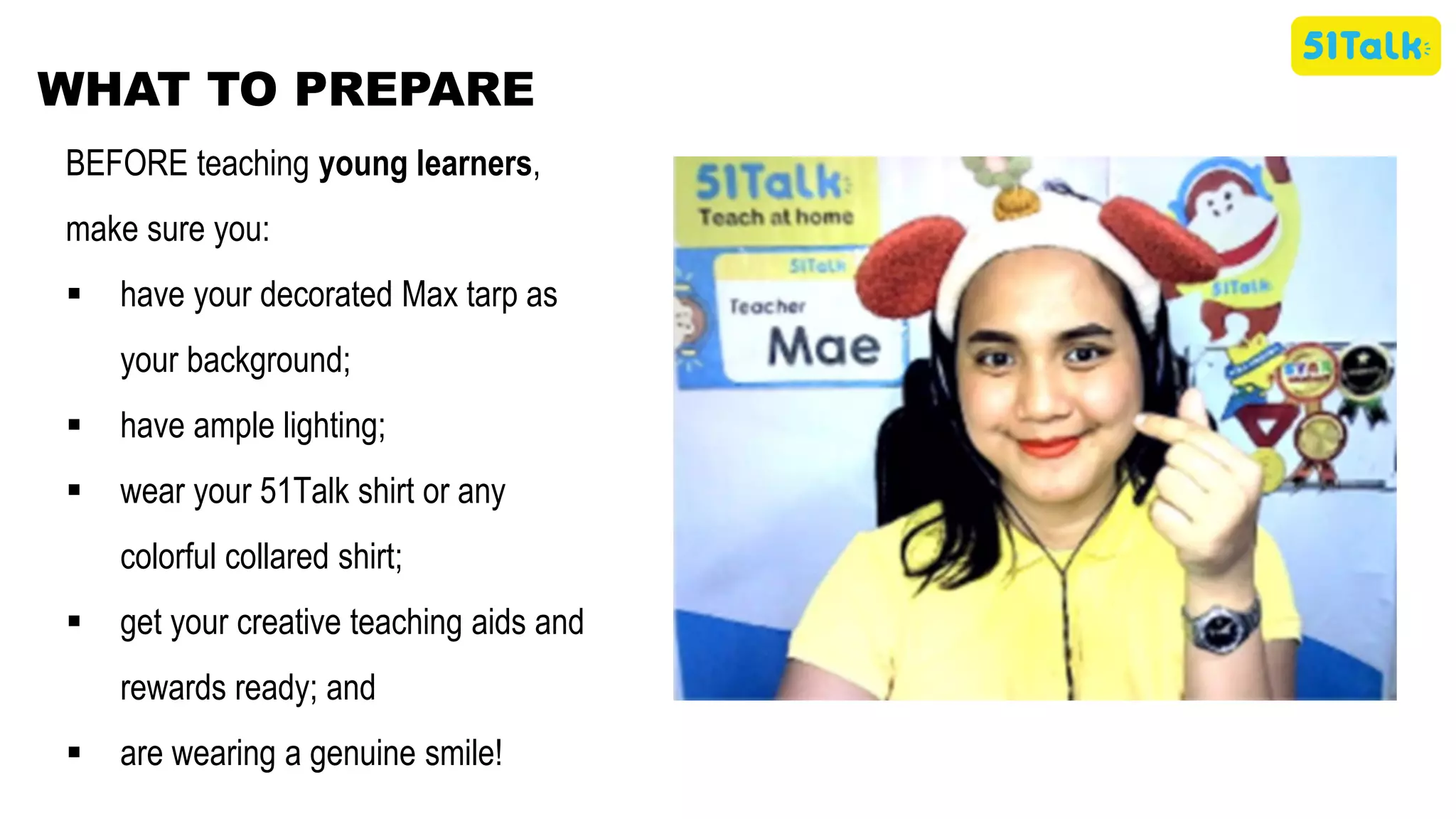
BEFORE teaching young learners,
make sure you:
▪ have your decorated Max tarp as
your background;
▪ have ample lighting;
▪ wear your 51Talk shirt or any
colorful collared shirt;
▪ get your creative teaching aids and
rewards ready; and
▪ are wearing a genuine smile!
WHAT TO PREPARE
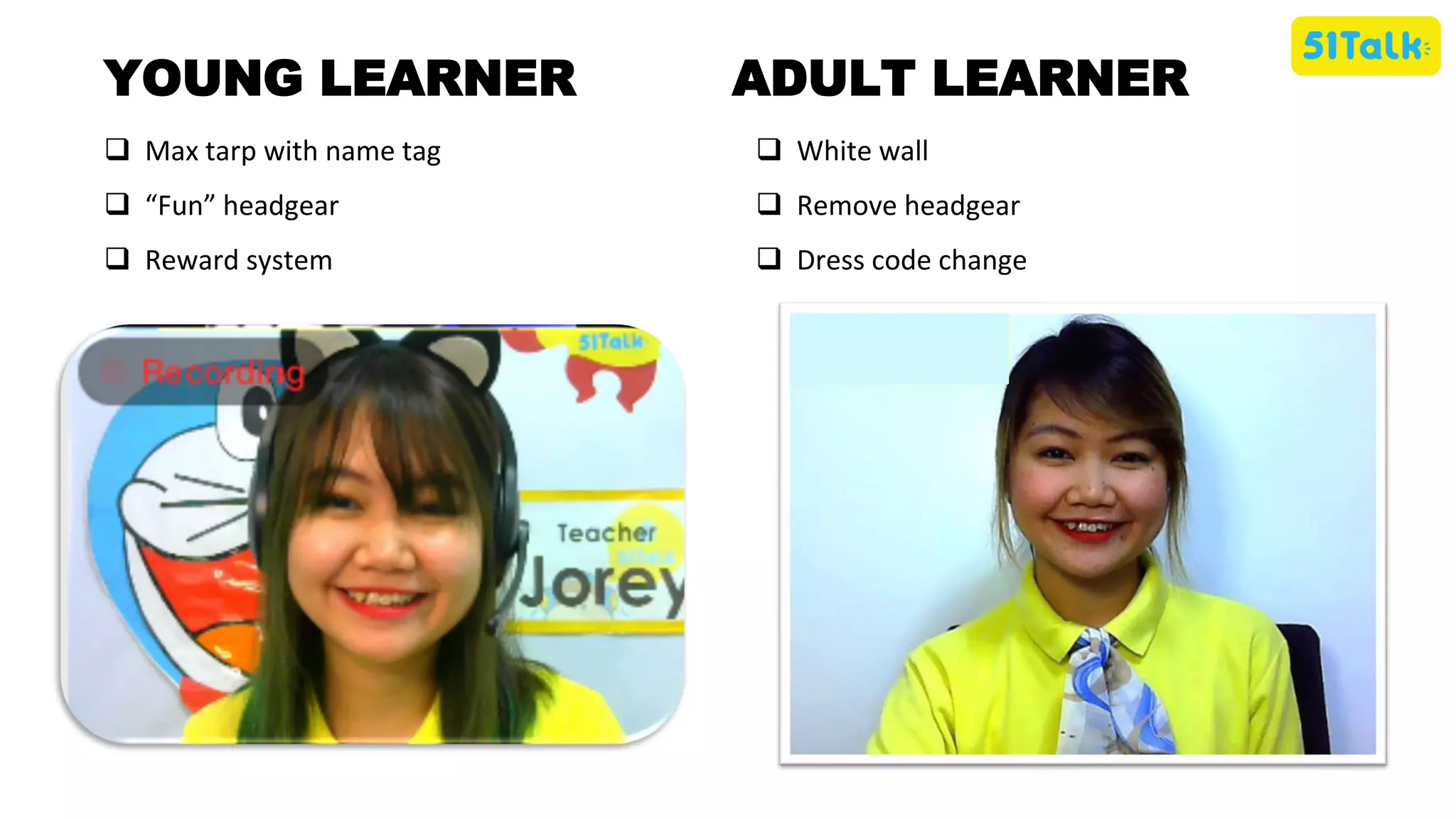
YOUNG LEARNER
❑ White wall
❑ Remove headgear
❑ Dress code change
ADULT LEARNER
❑ Max tarp with name tag
❑ “Fun” headgear
❑ Reward system
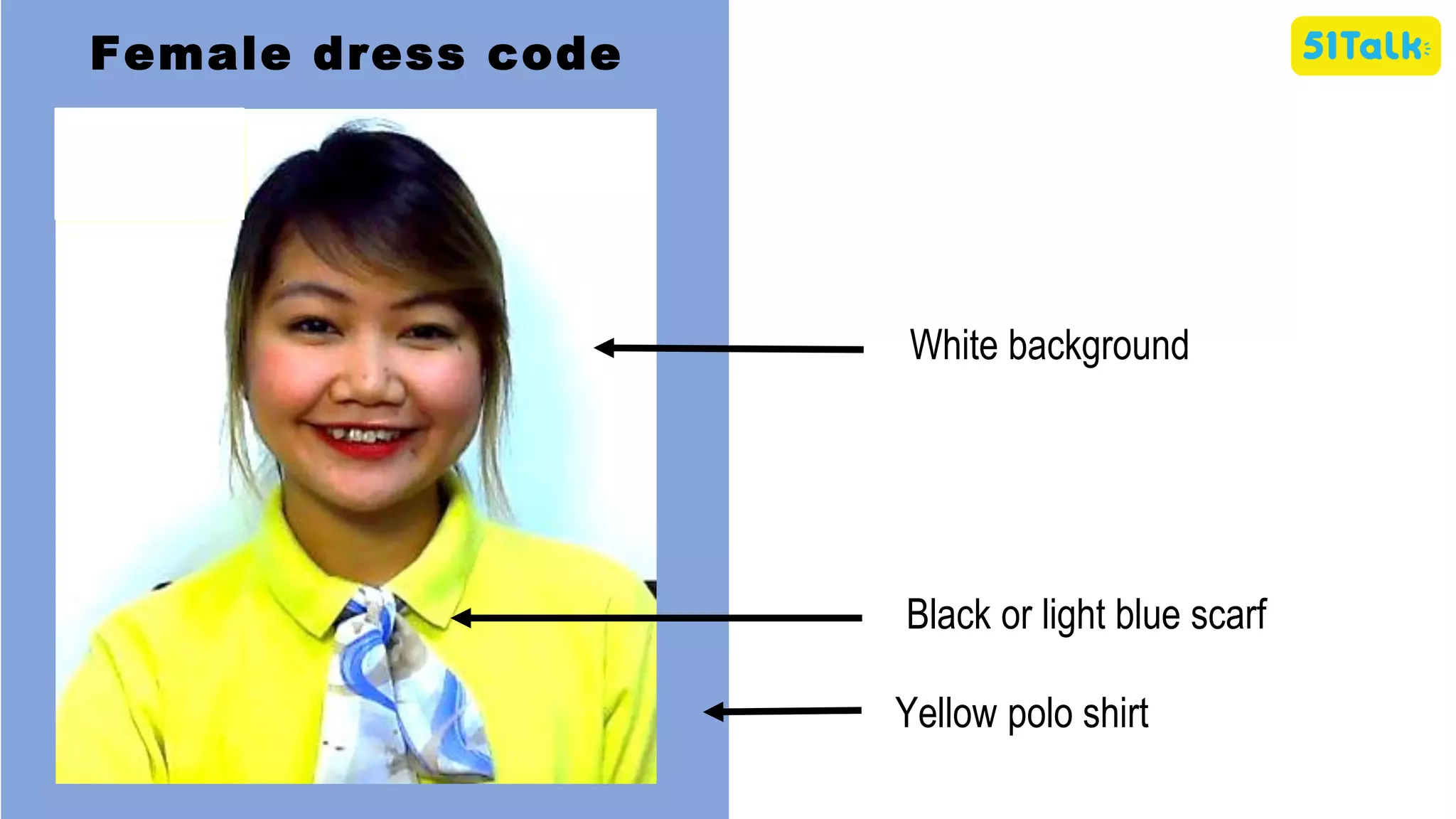
Female dress code
Black or light blue scarf
Yellow polo shirt
White background
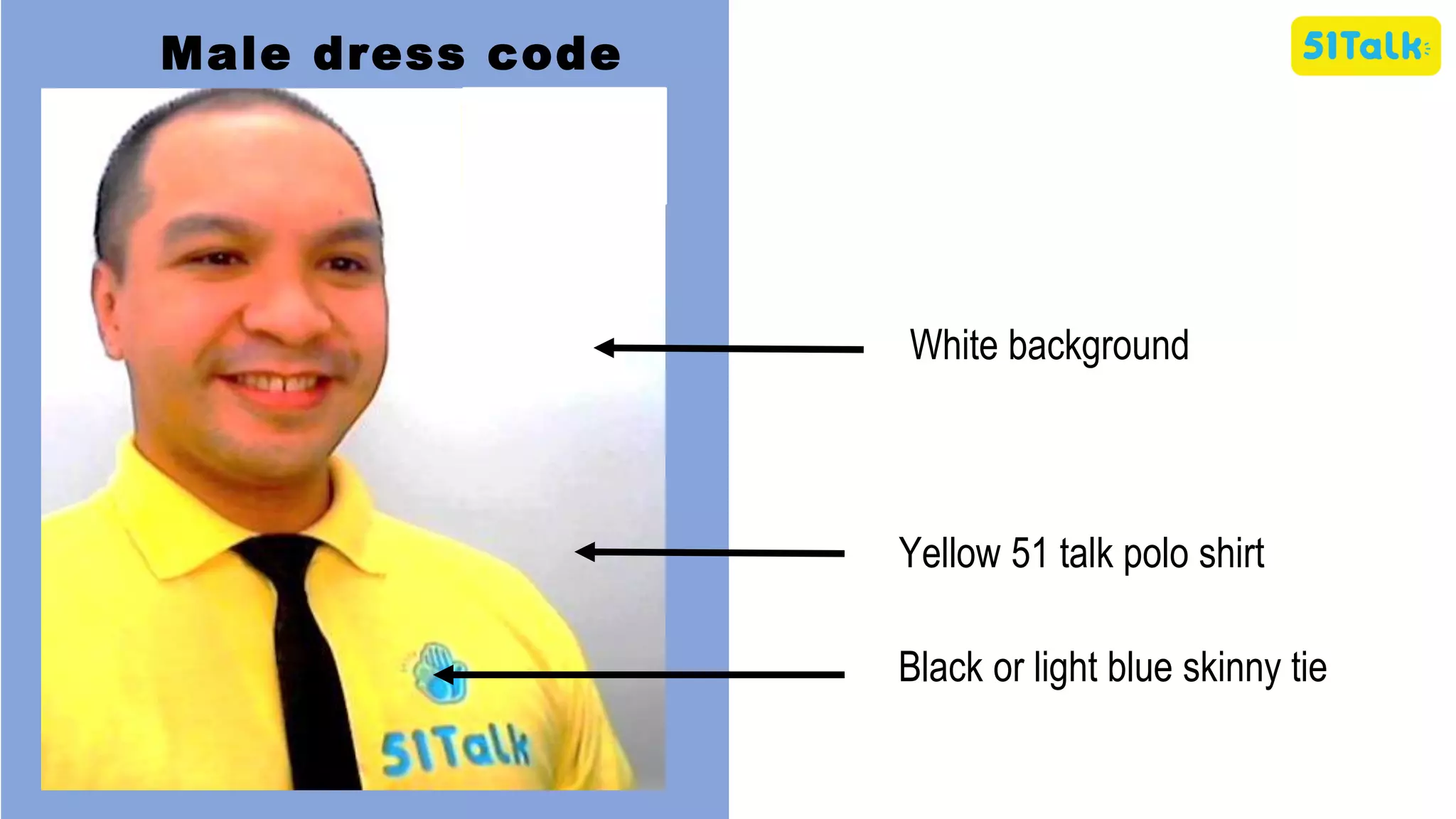
Yellow 51 talk polo shirt
Black or light blue skinny tie
Male dress code
White background
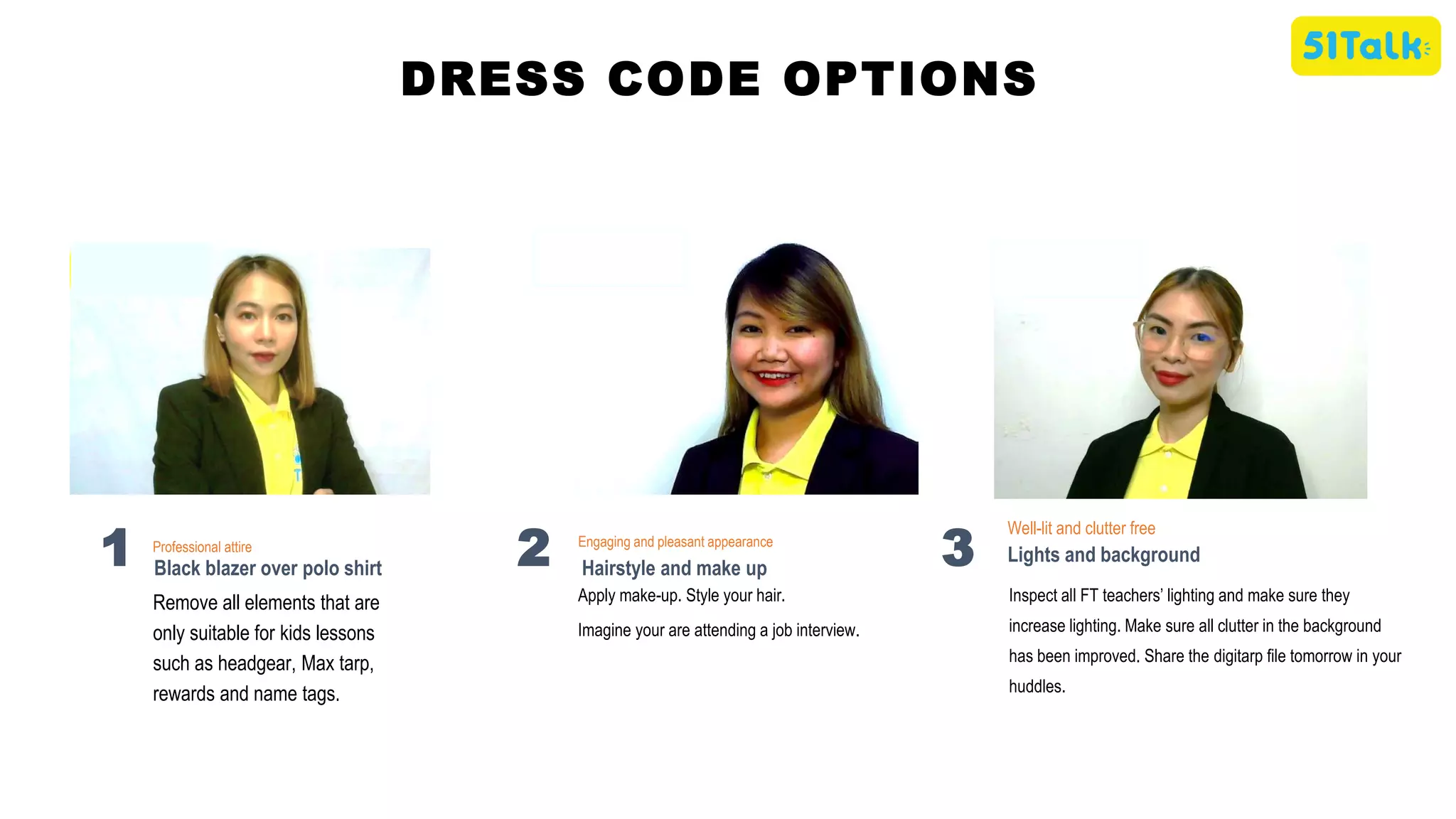
DRESS CODE OPTIONS
Apply make-up. Style your hair.
Imagine your are attending a job interview.
Engaging and pleasant appearance
Hairstyle and make up
2
Inspect all FT teachers’ lighting and make sure they
increase lighting. Make sure all clutter in the background
has been improved. Share the digitarp file tomorrow in your
huddles.
Well-lit and clutter free
Lights and background
3
Remove all elements that are
only suitable for kids lessons
such as headgear, Max tarp,
rewards and name tags.
Professional attire
Black blazer over polo shirt
1
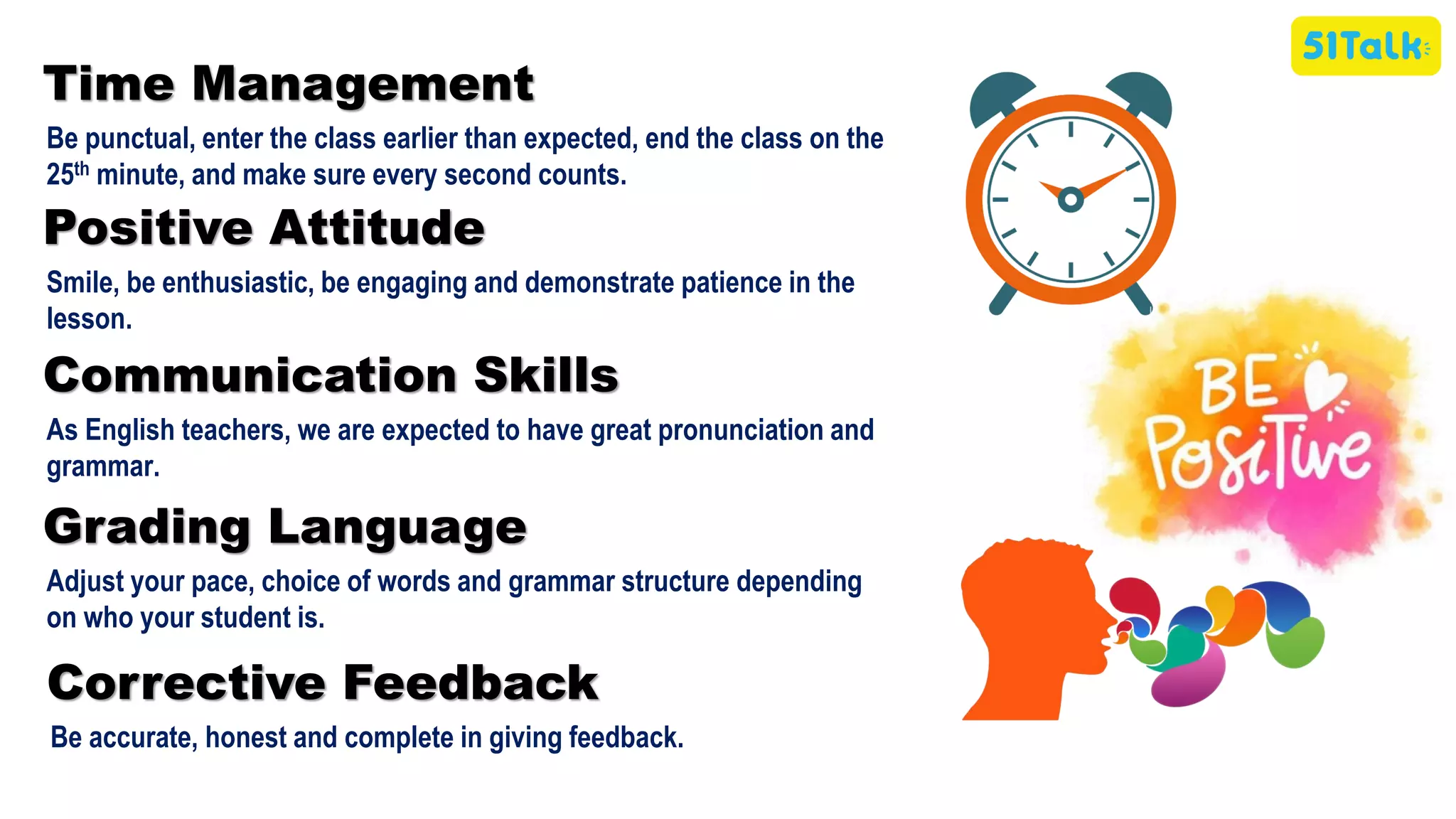
Time Management
Be punctual, enter the class earlier than expected, end the class on the
25th minute, and make sure every second counts.
Positive Attitude
Smile, be enthusiastic, be engaging and demonstrate patience in the
lesson.
Communication Skills
As English teachers, we are expected to have great pronunciation and
grammar.
Corrective Feedback
Be accurate, honest and complete in giving feedback.
Grading Language
Adjust your pace, choice of words and grammar structure depending
on who your student is.
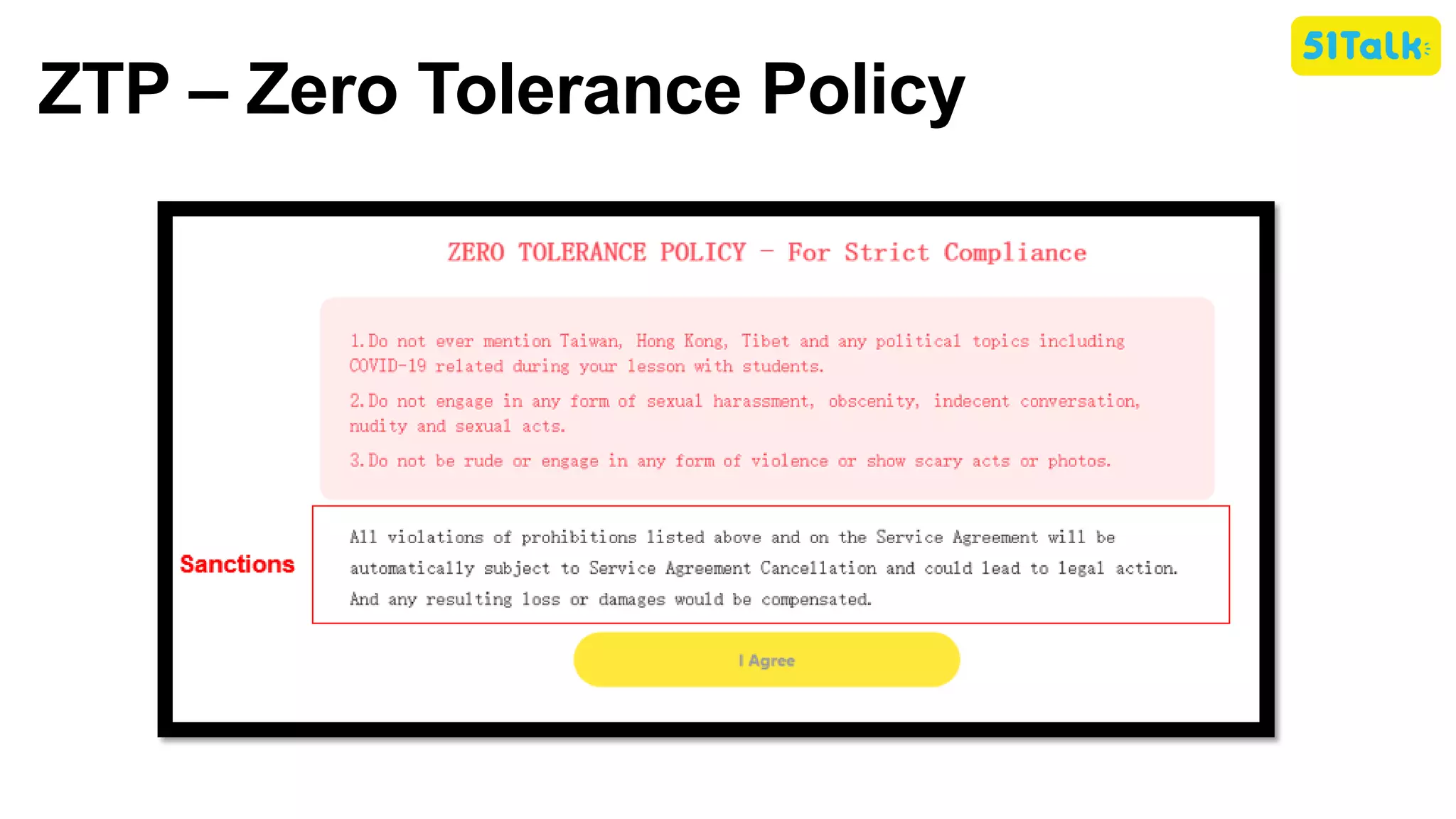
ZTP – Zero Tolerance Policy
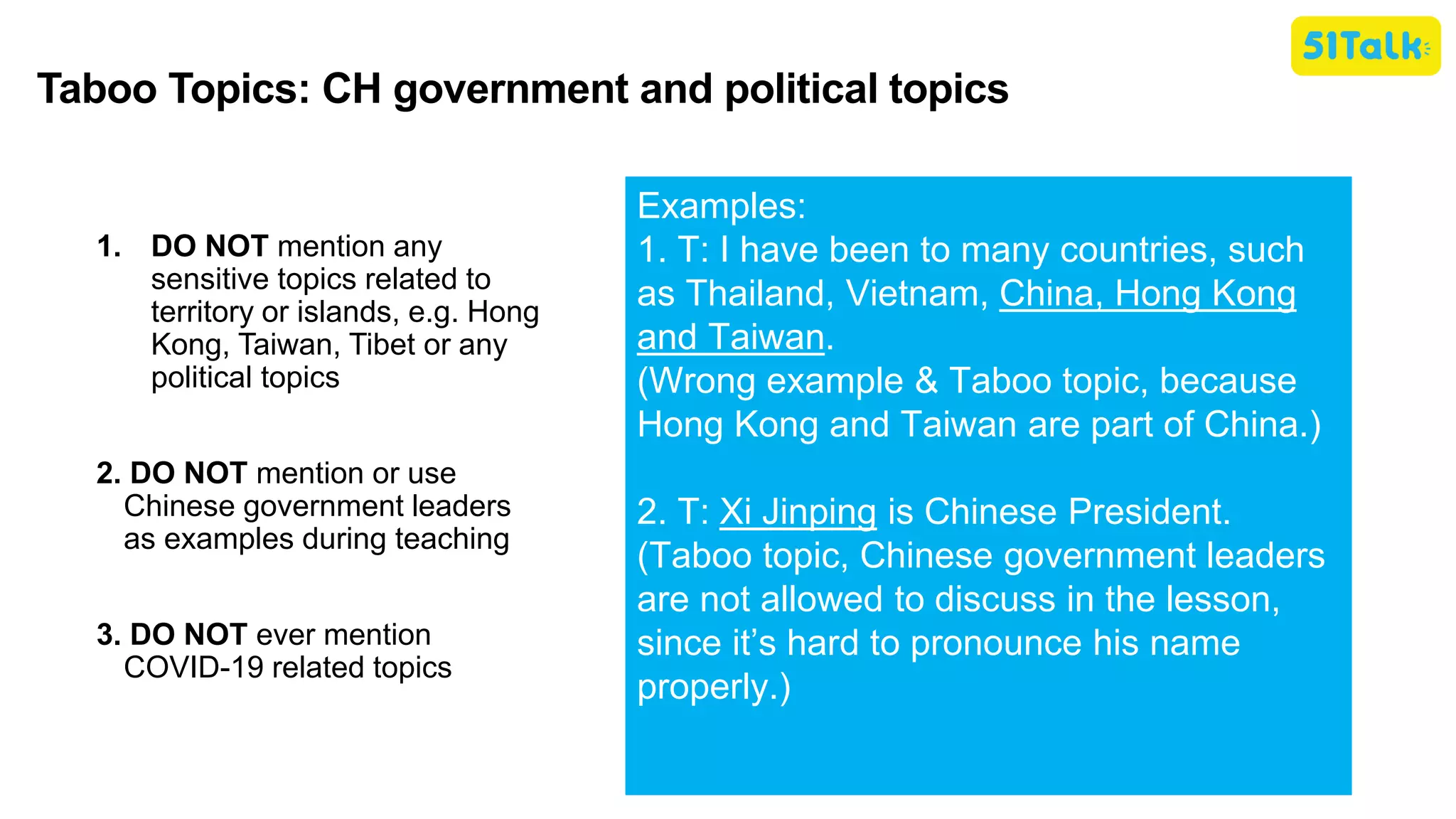
1. DO NOT mention any
sensitive topics related to
territory or islands, e.g. Hong
Kong, Taiwan, Tibet or any
political topics
2. DO NOT mention or use
Chinese government leaders
as examples during teaching
3. DO NOT ever mention
COVID-19 related topics
Examples:
1. T: I have been to many countries, such
as Thailand, Vietnam, China, Hong Kong
and Taiwan.
(Wrong example & Taboo topic, because
Hong Kong and Taiwan are part of China.)
2. T: Xi Jinping is Chinese President.
(Taboo topic, Chinese government leaders
are not allowed to discuss in the lesson,
since it’s hard to pronounce his name
properly.)
Taboo Topics: CH government and political topics
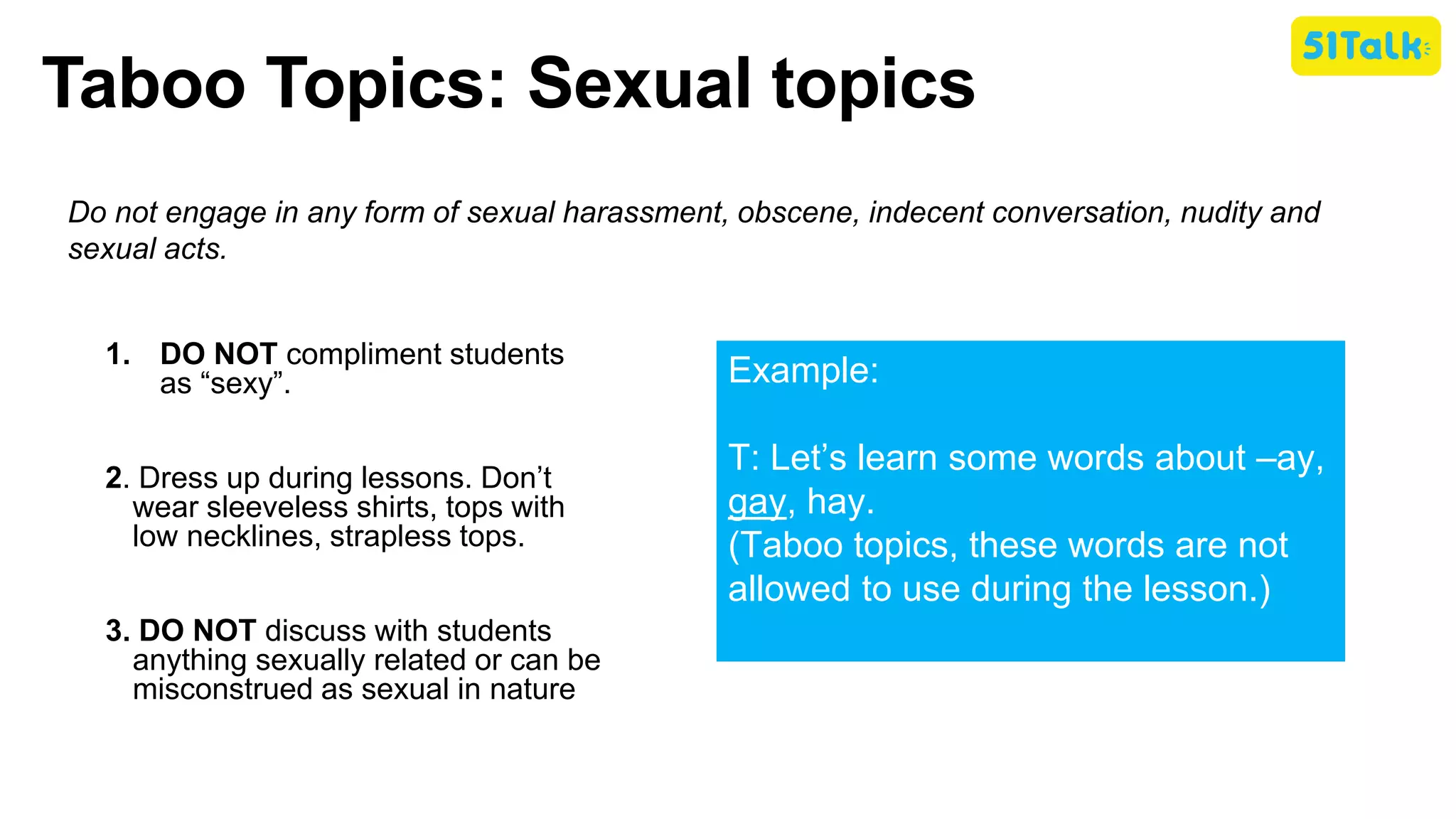
Taboo Topics: Sexual topics
Do not engage in any form of sexual harassment, obscene, indecent conversation, nudity and
sexual acts.
1. DO NOT compliment students
as “sexy”.
2. Dress up during lessons. Don’t
wear sleeveless shirts, tops with
low necklines, strapless tops.
3. DO NOT discuss with students
anything sexually related or can be
misconstrued as sexual in nature
Example:
T: Let’s learn some words about –ay,
gay, hay.
(Taboo topics, these words are not
allowed to use during the lesson.)
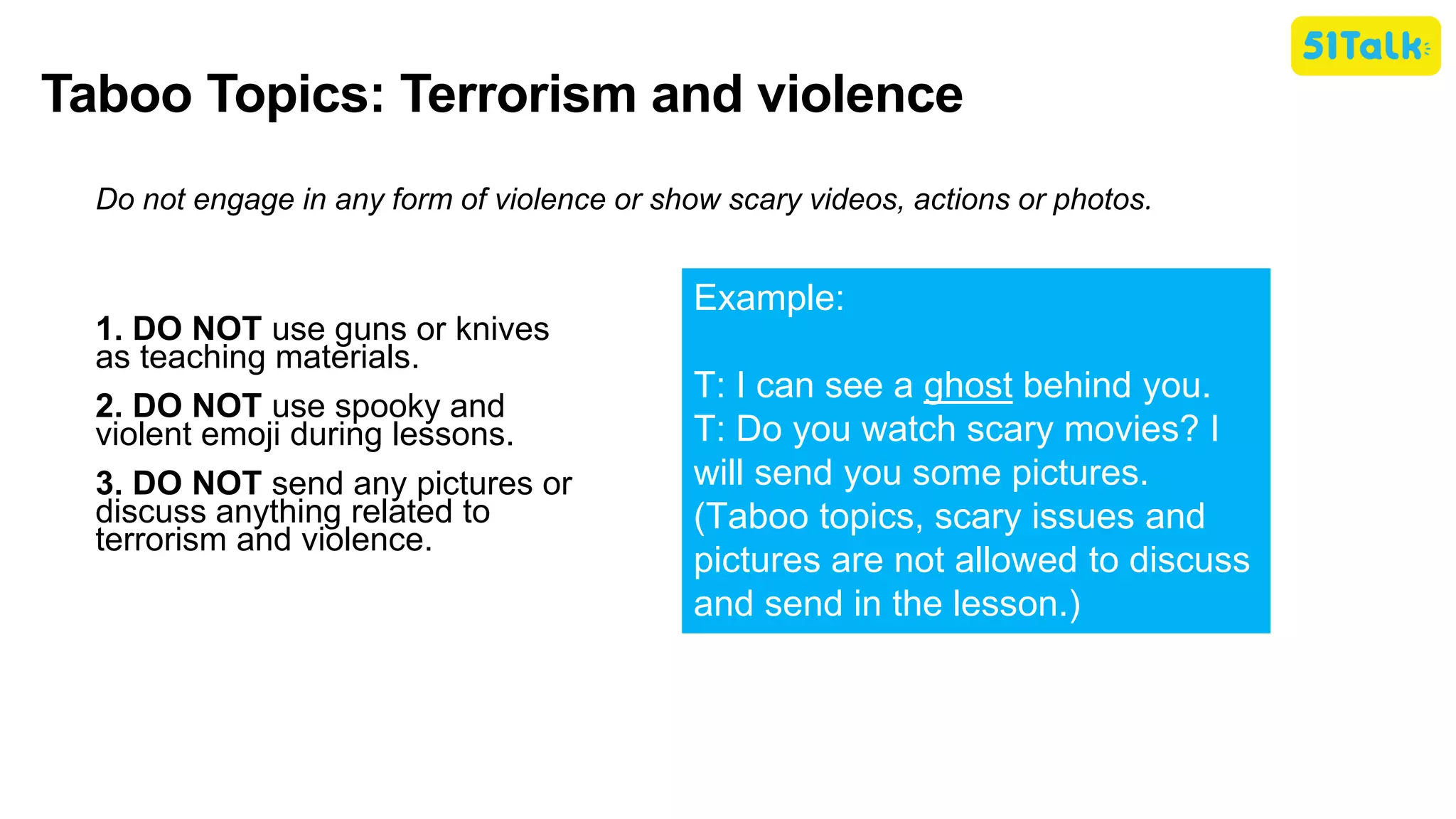
Taboo Topics: Terrorism and violence
Do not engage in any form of violence or show scary videos, actions or photos.
1. DO NOT use guns or knives
as teaching materials.
2. DO NOT use spooky and
violent emoji during lessons.
3. DO NOT send any pictures or
discuss anything related to
terrorism and violence.
Example:
T: I can see a ghost behind you.
T: Do you watch scary movies? I
will send you some pictures.
(Taboo topics, scary issues and
pictures are not allowed to discuss
and send in the lesson.)
THANK YOU!

NTT MODULE 922 (1).pdf

  • 1.
    A 2.5-hour trainingcourse for teacher applicants New Teacher Training
  • 2.
  • 3.
    v 51TALK HIRING PROCESS •Screening • Technical Check • PSO Pre-service Orientation • Completion of requirements • NTT New Teacher Training • Zoom Group Interview • Onboarding Training • Launching •Start teaching and earning!
  • 4.
    v conduct FUN andMEANINGFUL 51Talk lessons After completing and passing NTT, you should be able to: OBJECTIVE
  • 5.
    v Who are the51Talk students?
  • 6.
    v Kindergarten Grades 1-3Grades 4-6 Level 0 (K) Levels 1-3 Levels 4-6 • Can read the alphabet, identify capital letters and small letters • Can match word meanings, sounds and form • Can try to read words by phonics • Can use everyday English to communicate and express personal ideas • Can read short passages and answer simple questions • Can communicate freely, and discuss familiar topics • Can read fiction and non fictional articles • Can write simple paragraphs 51TALK LEVELING SYSTEM
  • 7.
    v 51TALK LEVELING SYSTEM KindergartenGrades 1-3 Grades 4-6 Level 0 (K) Levels 1-3 Levels 4-6 Letters and Phonics Vocabulary and Reading Comprehension 1. Lead-in 2. Introduction of the Target Word 3. Sound (Read and Clap) 4. Meaning 5. CCQ (Concept/Comprehension Checking Question) 6. FUQ (Follow-Up Question)
  • 8.
    v 51TALK LEVELING SYSTEM Beginner •Students with very little experience and exposure to English • Greatly needs guidance from the teacher • Limited vocabulary Elementary • Ability to answer questions and explain simple ideas • May converse with the teacher about simple topics • Knowledgeable in basic vocabulary and grammar structure Intermediate • Able to express opinion and preferences • More fluent in conversing with others • Ability to use vocabulary, idioms and expressions Upper Intermediate • Can elaborate opinion and answers • Very fluent, with good accent and intonation when speaking • Able to use more complex grammar structures and vocabulary more accurately
  • 9.
    What are thedifferent 51Talk lessons?
  • 10.
    CE Junior H5version - Interactive templates in each lesson - Engaging content that lets the student manipulate the tools in the classroom 51Talk Lessons for Young Learners CE Junior PDF version -Composed of 25 pages -Engaging activities to get the student interested in the lesson
  • 11.
    51Talk offers severalkinds of lessons to different kinds of students, all depending on the student’s preference and purpose on why they student English. Lessons are mainly divided into three (3) categories: MAJOR, MINOR and ELECTIVE lessons. 51Talk Lessons for Adult Learners
  • 12.
    Type of Lesson:MAJOR Mainly for students who would like to study General English, which includes the four (4) major English skills, Speaking, Listening, Reading and Writing. Materials and topics are set within everyday experiences. This is for the student to learn how to interact and communicate with other people about their daily lives through the use of the English language.
  • 13.
    Type of Lesson:MINOR Business English Interview English IELTS Focuses on the vocabulary and topics used throughout the business world and the communication skills needed in the workplace. For students who are preparing for advanced English interviews and learn how to successfully answer other common interview questions. For student who plan to take one of the most popular English proficiency tests, IELTS.
  • 14.
    Type of Lesson:ELECTIVE Free Talk Daily English Travel English A lesson that focuses on conversations, but still with a lesson flow, and a set of Target Language to be followed. Students learn vocabulary and expressions they may use in daily situations. Students learn conversations and interactions they may experience in an English speaking environment Geared towards students who would like to improve on their speaking and communication skills.
  • 15.
    How do weteach 51Talk lessons?
  • 16.
    Warm up Lesson Proper (PPP) Wrap up 3minutes 20 minutes 2 minutes 51Talk Lesson Flow
  • 17.
    Greeting and Introductions TOPTEACHER TIP! Always smile and welcome your student to the lesson cheerfully. Greeting Lead In Introduce yourself and ask for the student’s name Introduction Give the title of the material, objective of the lesson Warm-up Briefly go through the warm-up activity The very first part of the lesson were you get to know your student and develop rapport.
  • 18.
  • 19.
    ▪ Spend nomore than one minute ▪ Do a quick lead-in ▪ Read the title of the lesson ▪ Ask the student to read the title of the lesson ▪ Briefly state what the lesson is about Title Page ▪ Ask the student to stand up and follow your actions ▪ Sing the song first ▪ Ask the student to sing along with you Warm-up song
  • 20.
  • 21.
    Teacher: Hi, YuTu! My name’s Anna. Nice to meet you. Student: Hi, Anna. Nice to meet you. Teacher: Yu Tu, today, we will learn expressions that will help you when you introduce yourself. Title Page • Go through the warm-up briefly (2 mins) • Ask the optional question if you still have time • Have the student practice Warm-up activity
  • 22.
    Presentation The stage whenthe teaching happens. This is when the teacher presents the words and phrases the student will use throughout the lesson. Vocabulary Phrases Have the student read the words. Correct mispronounced words. Choose some words to talk about with the student. TOP TEACHER TIP! Ask your student CCQs and FUQs or EXTENSION QUESTIONS. CONCEPT CHECKING QUESTIONS (CCQ) are questions to check if the student has fully understood what they have read. Answers from these questions must come from the reading material. While EXTENSION QUESTIONS are questions that deal more on the student’s experience and ideas. Answers for these questions will come from the student’s personal opinion. Dialogue Have the student read the phrases. Correct mispronounced words. Choose some phrases to talk about with the student. Read the dialogue with the student. Exchange roles with the student. Correct mispronounced words. Ask Concept Checking Questions. Ask personalized extension questions.
  • 23.
  • 24.
    HOW TO TEACHWORDS 1. Lead-in 2. Drill the word 3. Teach the word (TPR, pictures, realia) 4. Read the sentence 5. Ask the student to read the sentence 6. Ask simple CCQs
  • 25.
    CCQs in Action Meaning: •Animals that can live in our houses. • Pets are friendly animals. pets CCQs: • What animals can live in our houses? • Are they friendly animals? • Show pictures of pets vs wild animals
  • 26.
    Follow-up Questions • Allowthe students to use the target word in his/her own sentence pets Do you have a pet? What is your pet? Do you like pets?
  • 27.
  • 28.
  • 29.
    Presentation: Pronunciation ▪ Payattention to the pronunciation of the words. ▪ Follow the IPA symbols under each word. ▪ Ask the student to read the words 3x (if they mispronounce), if they don’t mispronounce, have them repeat 2x only.
  • 30.
    Presentation: Pronunciation What ifthe student cannot pronounce some words or phrases even though you’ve asked him/her to say it several times? Young Learners: Ask the student to listen and look at your mouth. Isolate the sound to be corrected. Have the student repeat the sound then the word. Give the student a reward. Adult Learners: Show your mouth and send the IPA transcription in the chat box.
  • 31.
    - Each CEJlesson has a dialogue part - Dialogues allow the student to practice the target word How to do the dialogue part: 1. Read the sentences first. 2. Guide the student in reading the sentences. 3. Assign the roles. Do the role play. T: I will be Cindy and you will be Anna. TIP: If the student is struggling to read the sentences, let him or her read the shorter part only or the one with the target word. Presentation: Dialogue
  • 32.
    ▪ Do therole-play ▪ Assign the longer part to the student first ▪ Switch roles ▪ Check the student’s pronunciation and intonation If the student can readily do this part, ask some CCQs about the dialogue! Presentation: Dialogue
  • 33.
    Practice These are activities,tasks or exercises to check if the student can put into practice what they have learned from the Presentation stage. Exercise Go through the activity with the student. Always be ready to guide the student into getting the correct answers. Remind the student to use the words and phrases he/she learned from the previous stage. NOTE: the number of activities may vary depending on the material. In this part of the lesson, the student is expected to use the what he/she has learned, but still with the help of the teacher.
  • 34.
  • 35.
    Practice • Give simpleand direct instructions • Have student do/complete one instruction or task at a time • Guide the student by answering the first item of the exercise • Give the student creative rewards
  • 36.
  • 37.
    • Read thedialogue with the student • Exchange roles with the student and read the dialogue one more time • Correct mispronounced words • Ask CCQs • Ask personalized extension questions • Move on to the exercise • Guide the student by answering the first item of the exercise Practice
  • 38.
    Production This is thepart of the lesson when the student is able to use everything he/she has learned from the lesson. Summary Review the lesson with the student. Have the student pronounce the words, correct any mispronounced words. Get the student to use the phrases and expressions he/she learned through a conversation about the main topic of the lesson. If the student does not use the Target Language, remind you learned practiced from the previous stages. NOTE: The student is now expected to use what he/she learned from the lesson INDEPENDENTLY. However, if the student still cannot do it on his/her own, always be ready to help him/her.
  • 39.
    Wrap Up The lastpart of the lesson, and the stage to remind the student to practice and review what was learned. Review Place the student’s mispronounced words on the chat box. Practice them with the student. Place grammatical errors on the chat box, and teach the proper sentences to use. Closing Remark s Tell the student to practice the words and sentences. Say your goodbyes to your student Feedback Give the student’s strengths, weaknesses, and tips and suggestion on how they can improve on their weaknesses Give specific tips on how to improve English. For example: “Do you like listening to music? If you do, then please listen to English songs only so you can practice your listening.” If the student asks why his sentence is wrong and your sis correct, explain the grammar rule in the simplest way possible.
  • 40.
  • 41.
    1. Examples oferrors made 2. Areas for improvement 3. Recommendation on the course may address the AFIs 4. Specific recommendations on how to improve English ▪ Quick review ▪ Feedback: Production & Wrap-Up: Kids
  • 42.
  • 43.
    • Have a2 – 3 minute discussion with the student about your main topic • Make sure to prepare extension questions, and be sure to ask interesting following questions • Remind the student to use the words, phrases and expressions learned from the lesson • Listen to your student and take note of any grammatical errors Production: Adults
  • 44.
    • Give thestudent’s strengths • Explain what the student still needs to work on • Give tips on how the student can improve her weaknesses • You may also give a set of words or sentences for the student to practice as form of assignment Wrap-Up
  • 45.
  • 46.
    BEFORE teaching younglearners, make sure you: ▪ have your decorated Max tarp as your background; ▪ have ample lighting; ▪ wear your 51Talk shirt or any colorful collared shirt; ▪ get your creative teaching aids and rewards ready; and ▪ are wearing a genuine smile! WHAT TO PREPARE
  • 47.
    YOUNG LEARNER ❑ Whitewall ❑ Remove headgear ❑ Dress code change ADULT LEARNER ❑ Max tarp with name tag ❑ “Fun” headgear ❑ Reward system
  • 48.
    Female dress code Blackor light blue scarf Yellow polo shirt White background
  • 49.
    Yellow 51 talkpolo shirt Black or light blue skinny tie Male dress code White background
  • 50.
    DRESS CODE OPTIONS Applymake-up. Style your hair. Imagine your are attending a job interview. Engaging and pleasant appearance Hairstyle and make up 2 Inspect all FT teachers’ lighting and make sure they increase lighting. Make sure all clutter in the background has been improved. Share the digitarp file tomorrow in your huddles. Well-lit and clutter free Lights and background 3 Remove all elements that are only suitable for kids lessons such as headgear, Max tarp, rewards and name tags. Professional attire Black blazer over polo shirt 1
  • 51.
    Time Management Be punctual,enter the class earlier than expected, end the class on the 25th minute, and make sure every second counts. Positive Attitude Smile, be enthusiastic, be engaging and demonstrate patience in the lesson. Communication Skills As English teachers, we are expected to have great pronunciation and grammar. Corrective Feedback Be accurate, honest and complete in giving feedback. Grading Language Adjust your pace, choice of words and grammar structure depending on who your student is.
  • 52.
    ZTP – ZeroTolerance Policy
  • 53.
    1. DO NOTmention any sensitive topics related to territory or islands, e.g. Hong Kong, Taiwan, Tibet or any political topics 2. DO NOT mention or use Chinese government leaders as examples during teaching 3. DO NOT ever mention COVID-19 related topics Examples: 1. T: I have been to many countries, such as Thailand, Vietnam, China, Hong Kong and Taiwan. (Wrong example & Taboo topic, because Hong Kong and Taiwan are part of China.) 2. T: Xi Jinping is Chinese President. (Taboo topic, Chinese government leaders are not allowed to discuss in the lesson, since it’s hard to pronounce his name properly.) Taboo Topics: CH government and political topics
  • 54.
    Taboo Topics: Sexualtopics Do not engage in any form of sexual harassment, obscene, indecent conversation, nudity and sexual acts. 1. DO NOT compliment students as “sexy”. 2. Dress up during lessons. Don’t wear sleeveless shirts, tops with low necklines, strapless tops. 3. DO NOT discuss with students anything sexually related or can be misconstrued as sexual in nature Example: T: Let’s learn some words about –ay, gay, hay. (Taboo topics, these words are not allowed to use during the lesson.)
  • 55.
    Taboo Topics: Terrorismand violence Do not engage in any form of violence or show scary videos, actions or photos. 1. DO NOT use guns or knives as teaching materials. 2. DO NOT use spooky and violent emoji during lessons. 3. DO NOT send any pictures or discuss anything related to terrorism and violence. Example: T: I can see a ghost behind you. T: Do you watch scary movies? I will send you some pictures. (Taboo topics, scary issues and pictures are not allowed to discuss and send in the lesson.)
  • 56.