CLIL DEMO LESSON
ELEMENTARY LEVEL
Emi Fukasawa
Outline
1. My elementary course
2. Demonstration of one unit (topic:
niche marketing)
• Pick out some activities
• Experience some of them today
3. Conclusion
1. MY ELEMENTARY
COURSE
My Elementary Courses
• Problems related to teaching elementary
courses
• Low proficiency
• Less motivation
• Embarrassed by peer pressure
• Safe environment for learning
• Group works with different members
• Encourage all the students to speak up in every
class
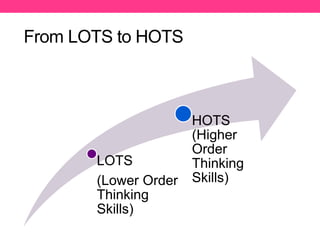
From LOTS to HOTS
LOTS
(Lower Order
Thinking
Skills)
HOTS
(Higher
Order
Thinking
Skills)
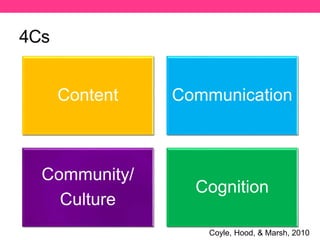
4Cs
Content Communication
Community/
Culture
Cognition
Coyle, Hood, & Marsh, 2010
Textbook
• Academic Connections 1 (Pearson
Longman)
• 4 skills integrated with scaffolding
• Variety of topics (8 units: Psychology,
Ecology, Literature, Chemistry, Art History,
Marketing, Communication)
• Unit 7 Marketing
2. DEMONSTRATION OF
UNIT 7 “NICHE MARKETING”
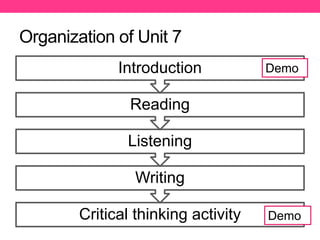
Organization of Unit 7
Critical thinking activity
Writing
Listening
Reading
Introduction Demo
Demo
Introduction
1. Introducing the word “niche market”
2. Introducing the word “target
customers”
3. Activity using websites from Japan
4. Activity using websites from the
Philippines
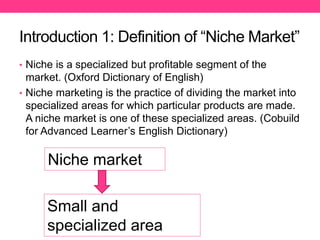
Introduction 1: Definition of “Niche Market”
• Niche is a specialized but profitable segment of the
market. (Oxford Dictionary of English)
• Niche marketing is the practice of dividing the market into
specialized areas for which particular products are made.
A niche market is one of these specialized areas. (Cobuild
for Advanced Learner’s English Dictionary)
Niche market
Small and
specialized area
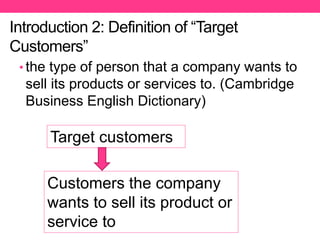
Introduction 2: Definition of “Target
Customers”
• the type of person that a company wants to
sell its products or services to. (Cambridge
Business English Dictionary)
Target customers
Customers the company
wants to sell its product or
service to
Introduction 3: Activity using websites
• Websites of products or services in niche
market
• Pair work: Discussion “Who are the target
customers?”
Introduction 3: Activity Using Websites
Who are the
target customers?
• Showed the website of a fitness gym
• Curves: http://www.curves.co.jp/
Introduction 3: Activity Using Websites
This is aimed at women.
Introduction 3: Activity Using Websites
Who are the target customers?
• Showed the websites of glasses
• Aigan for yu: http://www.aigan.co.jp/foryou/
Introduction 3: Activity Using Websites
The target customers of these
glasses are people who wear
glasses and want to read books
in the bath.
Introduction 4: Activity Using Websites
from the Philippines
•Introducing “Jollibee”
• Fast food restaurant chain in the
Philippines
• Website
• Discussion questions
• Who are the target customers?
• What are the unique characteristics of the fast
food restaurant?
Who are the target customers?
What are the unique characteristics of the fast
food restaurant?
• Showed the websites (pictures and menu)
• Jollibee: http://www.jollibee.com.ph/
Discussion Questions
• Who are the target customers of Jollibee?
• The target customers are children and their
family.
• What are the characteristics of Jollibee? Can you
find any differences between other worldwide fast
food chains such as McDonald’s or KFC?
• They have noodles and rice menus which are
traditional Philippine dishes that people eat at
their home.
• It is an example of niche marketing because they
are only aimed at people who like Philippine
cuisine.
Store Locations
• Showed the world map
• http://www.jollibee.com.ph/international/
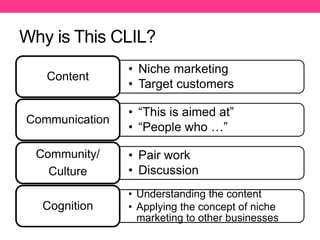
Why is This CLIL?
• Niche marketing
• Target customers
Content
• “This is aimed at”
• “People who …”
Communication
• Pair work
• Discussion
Community/
Culture
• Understanding the content
• Applying the concept of niche
marketing to other businesses
Cognition
Reading
• Read the materials from the textbook
• “Jollibee: A Niche Market Success Story”
• Understand target customers of Jollibee
and their marketing strategies from the
passage
Listening
• Listen to the material from the textbook
• Lecture “The Power of Niche Marketing”
• Answer comprehension questions
Writing
•Aim: to learn persuasive language
• “I am confident that my … business will
succeed here, because …”
• “I strongly believe that my business would
be a very profitable investment for you.”
•Comparison of good and bad
persuasive paragraphs
Critical Thinking Activity
•Based on the activity from the
textbook
•Added communicative and critical
thinking aspects
•“Looking for someone to invest in your
business”
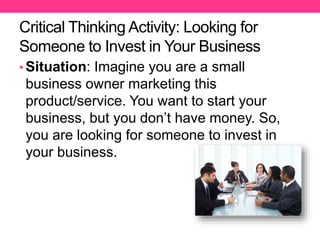
Critical Thinking Activity: Looking for
Someone to Invest in Your Business
• Situation: Imagine you are a small
business owner marketing this
product/service. You want to start your
business, but you don’t have money. So,
you are looking for someone to invest in
your business.
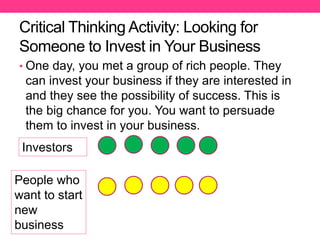
Critical Thinking Activity: Looking for
Someone to Invest in Your Business
• One day, you met a group of rich people. They
can invest your business if they are interested in
and they see the possibility of success. This is
the big chance for you. You want to persuade
them to invest in your business.
Investors
People who
want to start
new
business
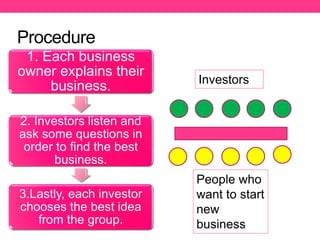
Procedure
1. Each business
owner explains their
business.
2. Investors listen and
ask some questions in
order to find the best
business.
3.Lastly, each investor
chooses the best idea
from the group.
Investors
People who
want to start
new
business
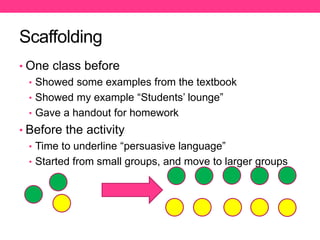
Scaffolding
• One class before
• Showed some examples from the textbook
• Showed my example “Students’ lounge”
• Gave a handout for homework
• Before the activity
• Time to underline “persuasive language”
• Started from small groups, and move to larger groups
Instructions on Handout
• “My name is _____________, and I am starting a
business. I have developed a strong plan to make
my business successful.”
• Then explain your business. Benefits, target
customers, etc.
• Also tell the investors how it will succeed. Use
persuasive language (p. 124). See paragraph B
on p. 132.
Let’s Try
•Now, you are going to prepare for the
meeting with investors.
Let’s Try
1
• Think about a product/service
you want to sell. Who are the
target customers?
2
• Share your idea with your
partner. Explain all benefits that
your product or service has.
What are your unique selling
points?
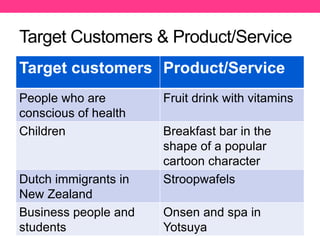
Target Customers & Product/Service
Target customers Product/Service
People who are
conscious of health
Fruit drink with vitamins
Children Breakfast bar in the
shape of a popular
cartoon character
Dutch immigrants in
New Zealand
Stroopwafels
Business people and
students
Onsen and spa in
Yotsuya
A Student’s Example 1
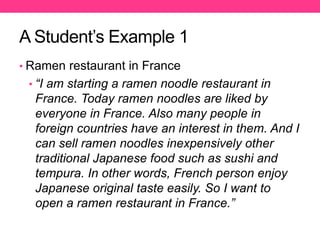
• Ramen restaurant in France
• “I am starting a ramen noodle restaurant in
France. Today ramen noodles are liked by
everyone in France. Also many people in
foreign countries have an interest in them. And I
can sell ramen noodles inexpensively other
traditional Japanese food such as sushi and
tempura. In other words, French person enjoy
Japanese original taste easily. So I want to
open a ramen restaurant in France.”
A Student’s Example 1
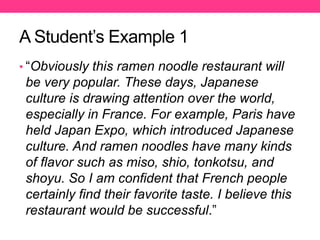
• “Obviously this ramen noodle restaurant will
be very popular. These days, Japanese
culture is drawing attention over the world,
especially in France. For example, Paris have
held Japan Expo, which introduced Japanese
culture. And ramen noodles have many kinds
of flavor such as miso, shio, tonkotsu, and
shoyu. So I am confident that French people
certainly find their favorite taste. I believe this
restaurant would be successful.”
A Student’s Example 2: Breakfast for
Students
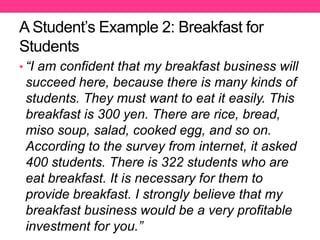
• “I am confident that my breakfast business will
succeed here, because there is many kinds of
students. They must want to eat it easily. This
breakfast is 300 yen. There are rice, bread,
miso soup, salad, cooked egg, and so on.
According to the survey from internet, it asked
400 students. There is 322 students who are
eat breakfast. It is necessary for them to
provide breakfast. I strongly believe that my
breakfast business would be a very profitable
investment for you.”
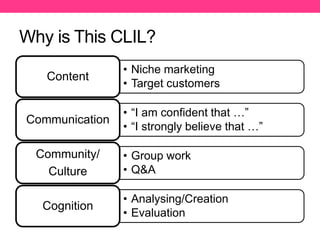
Why is This CLIL?
• Niche marketing
• Target customers
Content
• “I am confident that …”
• “I strongly believe that …”
Communication
• Group work
• Q&A
Community/
Culture
• Analysing/Creation
• Evaluation
Cognition
3. CONCLUSION
Reflection on the Class
• The textbook was exploited to make CLIL
activities.
• Authentic materials are used.
• Most students participated actively.
• More language aids were needed.

English demo

  • 1.
    CLIL DEMO LESSON ELEMENTARYLEVEL Emi Fukasawa
  • 2.
    Outline 1. My elementarycourse 2. Demonstration of one unit (topic: niche marketing) • Pick out some activities • Experience some of them today 3. Conclusion
  • 3.
  • 4.
    My Elementary Courses •Problems related to teaching elementary courses • Low proficiency • Less motivation • Embarrassed by peer pressure • Safe environment for learning • Group works with different members • Encourage all the students to speak up in every class
  • 5.
    From LOTS toHOTS LOTS (Lower Order Thinking Skills) HOTS (Higher Order Thinking Skills)
  • 6.
  • 7.
    Textbook • Academic Connections1 (Pearson Longman) • 4 skills integrated with scaffolding • Variety of topics (8 units: Psychology, Ecology, Literature, Chemistry, Art History, Marketing, Communication) • Unit 7 Marketing
  • 8.
    2. DEMONSTRATION OF UNIT7 “NICHE MARKETING”
  • 9.
    Organization of Unit7 Critical thinking activity Writing Listening Reading Introduction Demo Demo
  • 10.
    Introduction 1. Introducing theword “niche market” 2. Introducing the word “target customers” 3. Activity using websites from Japan 4. Activity using websites from the Philippines
  • 11.
    Introduction 1: Definitionof “Niche Market” • Niche is a specialized but profitable segment of the market. (Oxford Dictionary of English) • Niche marketing is the practice of dividing the market into specialized areas for which particular products are made. A niche market is one of these specialized areas. (Cobuild for Advanced Learner’s English Dictionary) Niche market Small and specialized area
  • 12.
    Introduction 2: Definitionof “Target Customers” • the type of person that a company wants to sell its products or services to. (Cambridge Business English Dictionary) Target customers Customers the company wants to sell its product or service to
  • 13.
    Introduction 3: Activityusing websites • Websites of products or services in niche market • Pair work: Discussion “Who are the target customers?”
  • 14.
    Introduction 3: ActivityUsing Websites Who are the target customers? • Showed the website of a fitness gym • Curves: http://www.curves.co.jp/
  • 15.
    Introduction 3: ActivityUsing Websites This is aimed at women.
  • 16.
    Introduction 3: ActivityUsing Websites Who are the target customers? • Showed the websites of glasses • Aigan for yu: http://www.aigan.co.jp/foryou/
  • 17.
    Introduction 3: ActivityUsing Websites The target customers of these glasses are people who wear glasses and want to read books in the bath.
  • 18.
    Introduction 4: ActivityUsing Websites from the Philippines •Introducing “Jollibee” • Fast food restaurant chain in the Philippines • Website • Discussion questions • Who are the target customers? • What are the unique characteristics of the fast food restaurant?
  • 19.
    Who are thetarget customers? What are the unique characteristics of the fast food restaurant? • Showed the websites (pictures and menu) • Jollibee: http://www.jollibee.com.ph/
  • 20.
    Discussion Questions • Whoare the target customers of Jollibee? • The target customers are children and their family. • What are the characteristics of Jollibee? Can you find any differences between other worldwide fast food chains such as McDonald’s or KFC? • They have noodles and rice menus which are traditional Philippine dishes that people eat at their home. • It is an example of niche marketing because they are only aimed at people who like Philippine cuisine.
  • 21.
    Store Locations • Showedthe world map • http://www.jollibee.com.ph/international/
  • 22.
    Why is ThisCLIL? • Niche marketing • Target customers Content • “This is aimed at” • “People who …” Communication • Pair work • Discussion Community/ Culture • Understanding the content • Applying the concept of niche marketing to other businesses Cognition
  • 23.
    Reading • Read thematerials from the textbook • “Jollibee: A Niche Market Success Story” • Understand target customers of Jollibee and their marketing strategies from the passage
  • 24.
    Listening • Listen tothe material from the textbook • Lecture “The Power of Niche Marketing” • Answer comprehension questions
  • 25.
    Writing •Aim: to learnpersuasive language • “I am confident that my … business will succeed here, because …” • “I strongly believe that my business would be a very profitable investment for you.” •Comparison of good and bad persuasive paragraphs
  • 26.
    Critical Thinking Activity •Basedon the activity from the textbook •Added communicative and critical thinking aspects •“Looking for someone to invest in your business”
  • 27.
    Critical Thinking Activity:Looking for Someone to Invest in Your Business • Situation: Imagine you are a small business owner marketing this product/service. You want to start your business, but you don’t have money. So, you are looking for someone to invest in your business.
  • 28.
    Critical Thinking Activity:Looking for Someone to Invest in Your Business • One day, you met a group of rich people. They can invest your business if they are interested in and they see the possibility of success. This is the big chance for you. You want to persuade them to invest in your business. Investors People who want to start new business
  • 29.
    Procedure 1. Each business ownerexplains their business. 2. Investors listen and ask some questions in order to find the best business. 3.Lastly, each investor chooses the best idea from the group. Investors People who want to start new business
  • 30.
    Scaffolding • One classbefore • Showed some examples from the textbook • Showed my example “Students’ lounge” • Gave a handout for homework • Before the activity • Time to underline “persuasive language” • Started from small groups, and move to larger groups
  • 31.
    Instructions on Handout •“My name is _____________, and I am starting a business. I have developed a strong plan to make my business successful.” • Then explain your business. Benefits, target customers, etc. • Also tell the investors how it will succeed. Use persuasive language (p. 124). See paragraph B on p. 132.
  • 32.
    Let’s Try •Now, youare going to prepare for the meeting with investors.
  • 33.
    Let’s Try 1 • Thinkabout a product/service you want to sell. Who are the target customers? 2 • Share your idea with your partner. Explain all benefits that your product or service has. What are your unique selling points?
  • 34.
    Target Customers &Product/Service Target customers Product/Service People who are conscious of health Fruit drink with vitamins Children Breakfast bar in the shape of a popular cartoon character Dutch immigrants in New Zealand Stroopwafels Business people and students Onsen and spa in Yotsuya
  • 35.
    A Student’s Example1 • Ramen restaurant in France • “I am starting a ramen noodle restaurant in France. Today ramen noodles are liked by everyone in France. Also many people in foreign countries have an interest in them. And I can sell ramen noodles inexpensively other traditional Japanese food such as sushi and tempura. In other words, French person enjoy Japanese original taste easily. So I want to open a ramen restaurant in France.”
  • 36.
    A Student’s Example1 • “Obviously this ramen noodle restaurant will be very popular. These days, Japanese culture is drawing attention over the world, especially in France. For example, Paris have held Japan Expo, which introduced Japanese culture. And ramen noodles have many kinds of flavor such as miso, shio, tonkotsu, and shoyu. So I am confident that French people certainly find their favorite taste. I believe this restaurant would be successful.”
  • 37.
    A Student’s Example2: Breakfast for Students • “I am confident that my breakfast business will succeed here, because there is many kinds of students. They must want to eat it easily. This breakfast is 300 yen. There are rice, bread, miso soup, salad, cooked egg, and so on. According to the survey from internet, it asked 400 students. There is 322 students who are eat breakfast. It is necessary for them to provide breakfast. I strongly believe that my breakfast business would be a very profitable investment for you.”
  • 38.
    Why is ThisCLIL? • Niche marketing • Target customers Content • “I am confident that …” • “I strongly believe that …” Communication • Group work • Q&A Community/ Culture • Analysing/Creation • Evaluation Cognition
  • 39.
  • 40.
    Reflection on theClass • The textbook was exploited to make CLIL activities. • Authentic materials are used. • Most students participated actively. • More language aids were needed.