Component
Parts
Of Automotive and Small
Engine Systems
A PowerPoint presentation by Group One
Introduction
Things we will tackle in this
presentation
Ignition
Starting
Charging
ECU
Components
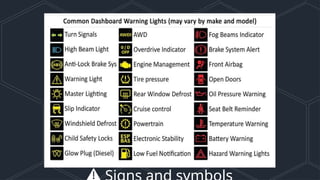
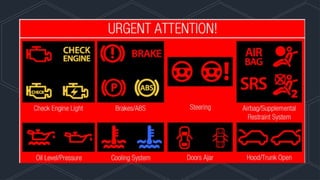
Signs & Symbols
Introduction
Things we will tackle in this
presentation
Ignition
Starting
Charging
ECU
Components
Signs & Symbols
So lets get into it!
Chapter 1: Ignition
In this chapter we will explain how
the ignition system ignites the air
and fuel mixture in the engine’s
cylinders.
Overview:
Component
Breakdown
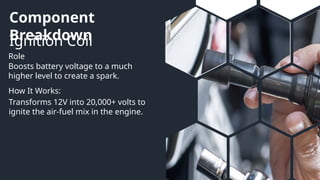
Ignition Coil
Role
How It Works:
Boosts battery voltage to a much
higher level to create a spark.
Transforms 12V into 20,000+ volts to
ignite the air-fuel mix in the engine.
Component
Breakdown
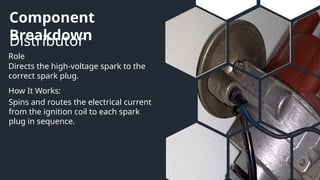
Distributor
Role
How It Works:
Directs the high-voltage spark to the
correct spark plug.
Spins and routes the electrical current
from the ignition coil to each spark
plug in sequence.
Component
Breakdown
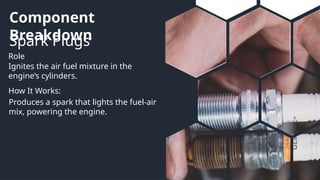
Spark Plugs
Role
How It Works:
Ignites the air fuel mixture in the
engine’s cylinders.
Produces a spark that lights the fuel-air
mix, powering the engine.
Component
Breakdown
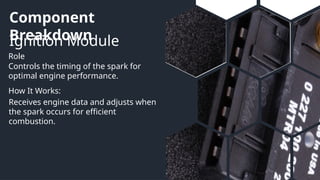
Ignition Module
Role
How It Works:
Controls the timing of the spark for
optimal engine performance.
Receives engine data and adjusts when
the spark occurs for efficient
combustion.
Component
Breakdown
How they work
together.
Generate Spark: Ignition coil produces a
high-voltage spark.
Distribute Spark: Distributor sends the
spark to the correct spark plug.
Ignite Fuel: Spark plugs ignite the air-
fuel mixture.
Start Engine: Engine cranks and starts
running.
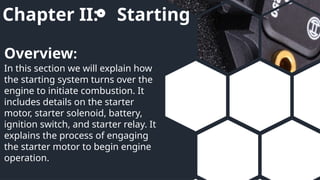
Chapter II: Starting
In this section we will explain how
the starting system turns over the
engine to initiate combustion. It
includes details on the starter
motor, starter solenoid, battery,
ignition switch, and starter relay. It
explains the process of engaging
the starter motor to begin engine
operation.
Overview:
Component
Breakdown
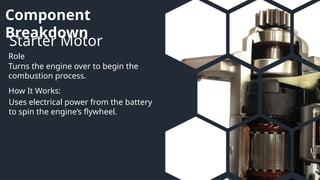
Starter Motor
Role
How It Works:
Turns the engine over to begin the
combustion process.
Uses electrical power from the battery
to spin the engine’s flywheel.
Component
Breakdown
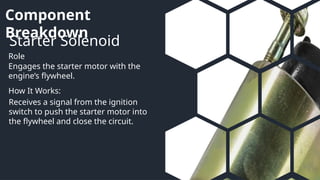
Starter Solenoid
Role
How It Works:
Engages the starter motor with the
engine’s flywheel.
Receives a signal from the ignition
switch to push the starter motor into
the flywheel and close the circuit.
Component
Breakdown
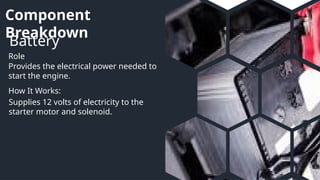
Battery
Role
How It Works:
Provides the electrical power needed to
start the engine.
Supplies 12 volts of electricity to the
starter motor and solenoid.
Component
Breakdown
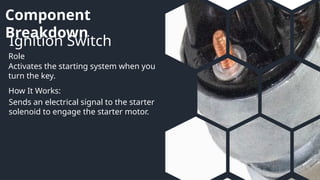
Ignition Switch
Role
How It Works:
Activates the starting system when you
turn the key.
Sends an electrical signal to the starter
solenoid to engage the starter motor.
Component
Breakdown
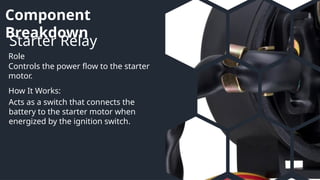
Starter Relay
Role
How It Works:
Controls the power flow to the starter
motor.
Acts as a switch that connects the
battery to the starter motor when
energized by the ignition switch.
Component
Breakdown
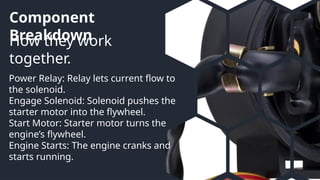
How they work
together.
Power Relay: Relay lets current flow to
the solenoid.
Engage Solenoid: Solenoid pushes the
starter motor into the flywheel.
Start Motor: Starter motor turns the
engine’s flywheel.
Engine Starts: The engine cranks and
starts running.
Chapter III: Charging
This chapter focuses on the
components responsible for
generating electrical power and
maintaining the battery’s charge
while the engine is running. It
covers the alternator, voltage
regulator, battery, and battery
cables, explaining how they work
together to provide a stable
electrical supply.
Overview:
electrical supply.
Component
Breakdown
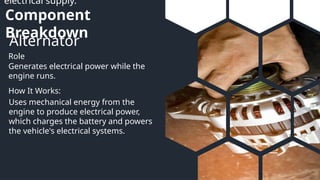
Alternator
Role
How It Works:
Generates electrical power while the
engine runs.
Uses mechanical energy from the
engine to produce electrical power,
which charges the battery and powers
the vehicle's electrical systems.
electrical supply.
Component
Breakdown
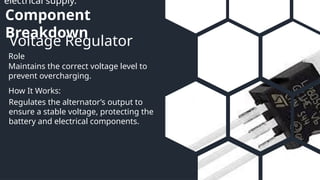
Voltage Regulator
Role
How It Works:
Maintains the correct voltage level to
prevent overcharging.
Regulates the alternator’s output to
ensure a stable voltage, protecting the
battery and electrical components.
electrical supply.
Component
Breakdown
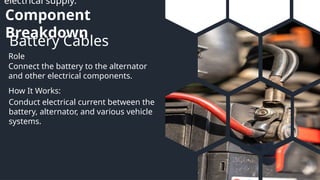
Battery Cables
Role
How It Works:
Connect the battery to the alternator
and other electrical components.
Conduct electrical current between the
battery, alternator, and various vehicle
systems.
electrical supply.
Component
Breakdown
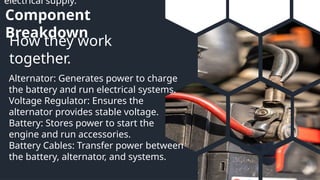
How they work
together.
Alternator: Generates power to charge
the battery and run electrical systems.
Voltage Regulator: Ensures the
alternator provides stable voltage.
Battery: Stores power to start the
engine and run accessories.
Battery Cables: Transfer power between
the battery, alternator, and systems.
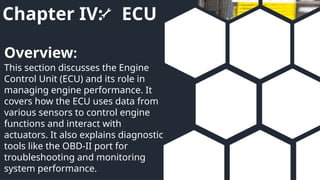
Chapter IV: ECU
This section discusses the Engine
Control Unit (ECU) and its role in
managing engine performance. It
covers how the ECU uses data from
various sensors to control engine
functions and interact with
actuators. It also explains diagnostic
tools like the OBD-II port for
troubleshooting and monitoring
system performance.
Overview:
Component
Breakdown
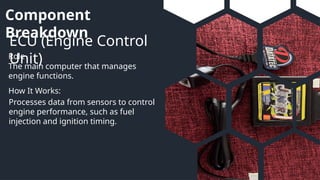
ECU (Engine Control
Unit)
Role
How It Works:
The main computer that manages
engine functions.
Processes data from sensors to control
engine performance, such as fuel
injection and ignition timing.
Component
Breakdown
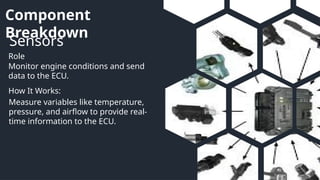
Sensors
Role
How It Works:
Monitor engine conditions and send
data to the ECU.
Measure variables like temperature,
pressure, and airflow to provide real-
time information to the ECU.
Component
Breakdown
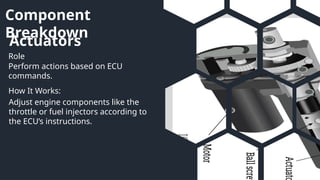
Actuators
Role
How It Works:
Perform actions based on ECU
commands.
Adjust engine components like the
throttle or fuel injectors according to
the ECU’s instructions.
Component
Breakdown
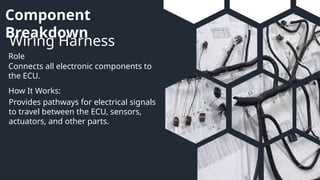
Wiring Harness
Role
How It Works:
Connects all electronic components to
the ECU.
Provides pathways for electrical signals
to travel between the ECU, sensors,
actuators, and other parts.
Component
Breakdown
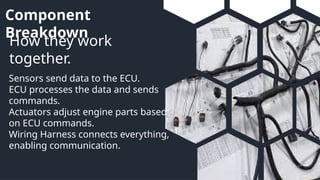
How they work
together.
Sensors send data to the ECU.
ECU processes the data and sends
commands.
Actuators adjust engine parts based
on ECU commands.
Wiring Harness connects everything,
enabling communication.
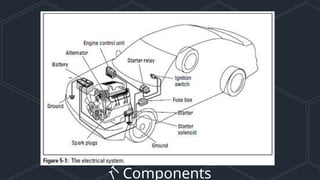
Diagrams
Of engine electrical systems
Components
enginesDGHANMA LEARNED NALESSONSSOB.pptx

enginesDGHANMA LEARNED NALESSONSSOB.pptx