   Automobile electrical system has gradually
    evolved over the years and today it assimilates
    automatic computer control of
    the automotive mechanics. In the early days,
    automobiles electrical system comprised of
    only basic wiring technologies that were used
    for distributing power to other parts of a
    vehicle. It had only switches, wires, relays and
    controlled motors as its key components but
    today’s electrical system includes sensors,
    actuators, alternators, battery, oxygen sensors,
    generator, startersolenoid, starter drive, high
    power electrical system and other devices.
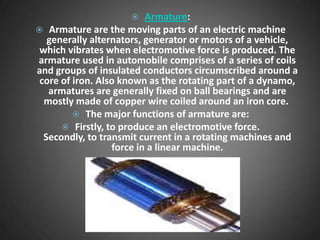
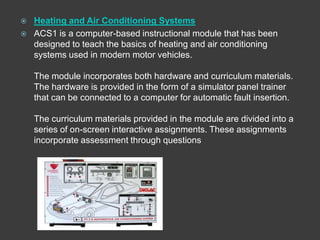
    Armature:
 Armature are the moving parts of an electric machine
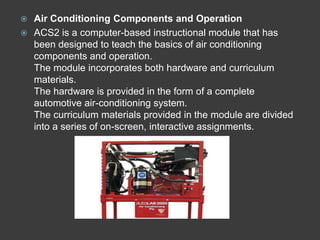
   generally alternators, generator or motors of a vehicle,
 which vibrates when electromotive force is produced. The
armature used in automobile comprises of a series of coils
and groups of insulated conductors circumscribed around a
 core of iron. Also known as the rotating part of a dynamo,
   armatures are generally fixed on ball bearings and are
  mostly made of copper wire coiled around an iron core.
          The major functions of armature are:
       Firstly, to produce an electromotive force.
  Secondly, to transmit current in a rotating machines and
                  force in a linear machine.
     View Supplier List
                                          


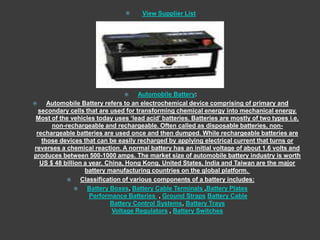
                                    Automobile Battery:
    Automobile Battery refers to an electrochemical device comprising of primary and
  secondary cells that are used for transforming chemical energy into mechanical energy.
 Most of the vehicles today uses ‘lead acid’ batteries. Batteries are mostly of two types i.e.
      non-rechargeable and rechargeable. Often called as disposable batteries, non-
 rechargeable batteries are used once and then dumped. While rechargeable batteries are
   those devices that can be easily recharged by applying electrical current that turns or
reverses a chemical reaction. A normal battery has an initial voltage of about 1.6 volts and
produces between 500-1000 amps. The market size of automobile battery industry is worth
  US $ 48 billion a year. China, Hong Kong, United States, India and Taiwan are the major
                  battery manufacturing countries on the global platform.
                Classification of various components of a battery includes:
                  Battery Boxes, Battery Cable Terminals ,Battery Plates
                    Performance Batteries , Ground Straps Battery Cable
                           Battery Control Systems, Battery Trays
                            Voltage Regulators , Battery Switches
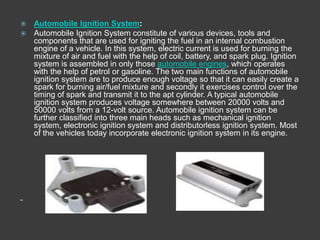
 Automobile Ignition System:
 Automobile Ignition System constitute of various devices, tools and
  components that are used for igniting the fuel in an internal combustion
  engine of a vehicle. In this system, electric current is used for burning the
  mixture of air and fuel with the help of coil, battery, and spark plug. Ignition
  system is assembled in only those automobile engines, which operates
  with the help of petrol or gasoline. The two main functions of automobile
  ignition system are to produce enough voltage so that it can easily create a
  spark for burning air/fuel mixture and secondly it exercises control over the
  timing of spark and transmit it to the apt cylinder. A typical automobile
  ignition system produces voltage somewhere between 20000 volts and
  50000 volts from a 12-volt source. Automobile ignition system can be
  further classified into three main heads such as mechanical ignition
  system, electronic ignition system and distributorless ignition system. Most
  of the vehicles today incorporate electronic ignition system in its engine.
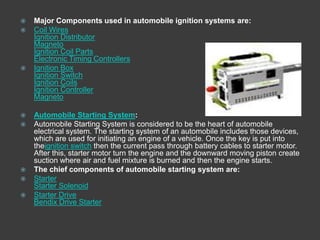
   Major Components used in automobile ignition systems are:
   Coil Wires
    Ignition Distributor
    Magneto
    Ignition Coil Parts
    Electronic Timing Controllers
   Ignition Box
    Ignition Switch
    Ignition Coils
    Ignition Controller
    Magneto

   Automobile Starting System:
   Automobile Starting System is considered to be the heart of automobile
    electrical system. The starting system of an automobile includes those devices,
    which are used for initiating an engine of a vehicle. Once the key is put into
    theignition switch then the current pass through battery cables to starter motor.
    After this, starter motor turn the engine and the downward moving piston create
    suction where air and fuel mixture is burned and then the engine starts.
   The chief components of automobile starting system are:
   Starter
    Starter Solenoid
   Starter Drive
    Bendix Drive Starter
   Automotive Computer Chips:
   Automotive Computer Chips also known as super
    chip, automotive computer chips are basically the
    integrated circuits made of semi conducting
    material that are used for storing a new engine
    management program in the electronic control unit
    of the vehicle. These chips stores the data used
    by engine control unit, for managing and controlling
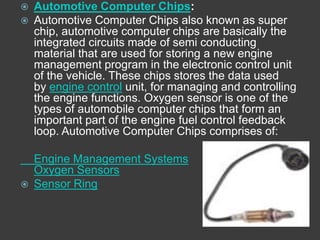
    the engine functions. Oxygen sensor is one of the
    types of automobile computer chips that form an
    important part of the engine fuel control feedback
    loop. Automotive Computer Chips comprises of:

    Engine Management Systems
    Oxygen Sensors
   Sensor Ring
Other automobile computer chips include:
 Power train control modules
  Tuners
  Speedometer calibrators
  Flip switches
 Performance monitors
  Performance chips
  Top speed eliminators
  Shift improvers
 Automotive Electrical Wiring:
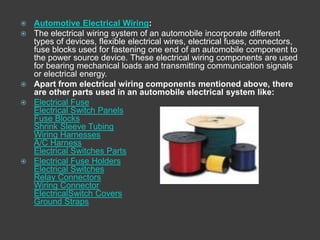
 The electrical wiring system of an automobile incorporate different
  types of devices, flexible electrical wires, electrical fuses, connectors,
  fuse blocks used for fastening one end of an automobile component to
  the power source device. These electrical wiring components are used
  for bearing mechanical loads and transmitting communication signals
  or electrical energy.
 Apart from electrical wiring components mentioned above, there
  are other parts used in an automobile electrical system like:
 Electrical Fuse
  Electrical Switch Panels
  Fuse Blocks
  Shrink Sleeve Tubing
  Wiring Harnesses
  A/C Harness
  Electrical Switches Parts
 Electrical Fuse Holders
  Electrical Switches
  Relay Connectors
  Wiring Connector
  ElectricalSwitch Covers
  Ground Straps
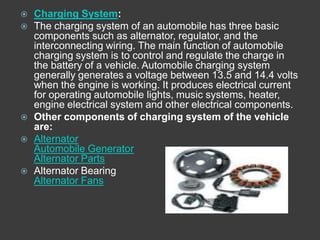
   Charging System:
   The charging system of an automobile has three basic
    components such as alternator, regulator, and the
    interconnecting wiring. The main function of automobile
    charging system is to control and regulate the charge in
    the battery of a vehicle. Automobile charging system
    generally generates a voltage between 13.5 and 14.4 volts
    when the engine is working. It produces electrical current
    for operating automobile lights, music systems, heater,
    engine electrical system and other electrical components.
   Other components of charging system of the vehicle
    are:
   Alternator
    Automobile Generator
    Alternator Parts
   Alternator Bearing
    Alternator Fans
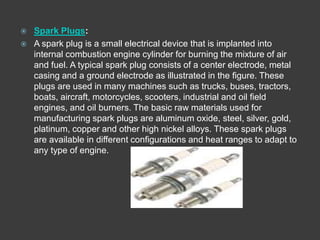
   Spark Plugs:
   A spark plug is a small electrical device that is implanted into
    internal combustion engine cylinder for burning the mixture of air
    and fuel. A typical spark plug consists of a center electrode, metal
    casing and a ground electrode as illustrated in the figure. These
    plugs are used in many machines such as trucks, buses, tractors,
    boats, aircraft, motorcycles, scooters, industrial and oil field
    engines, and oil burners. The basic raw materials used for
    manufacturing spark plugs are aluminum oxide, steel, silver, gold,
    platinum, copper and other high nickel alloys. These spark plugs
    are available in different configurations and heat ranges to adapt to
    any type of engine.
silver,
       gold, platinum, copper
 and other high nickel alloys.
 These spark plugs are
 available in different
 configurations and heat
 ranges to adapt to any type of
 engine.
 Auto Mechanical
 Autolab allows investigation into the mechanical
  systems found in modern vehicles. The modules
  are focused on developing knowledge and
  practical skills using simulator panels, real
  vehicle component trainers and/or vehicle-
  based workshop tasks.
 The computer-based curriculum includes high-
  quality graphics, animation and video to
  introduce the underpinning knowledge for
  systems and components. Each student activity
  can be tracked by a management system for
  ease of assessment.

   Heating and Air Conditioning Systems
   ACS1 is a computer-based instructional module that has been
    designed to teach the basics of heating and air conditioning
    systems used in modern motor vehicles.

    The module incorporates both hardware and curriculum materials.
    The hardware is provided in the form of a simulator panel trainer
    that can be connected to a computer for automatic fault insertion.

    The curriculum materials provided in the module are divided into a
    series of on-screen interactive assignments. These assignments
    incorporate assessment through questions
   ACS1 is a computer-based instructional module that has
    been designed to teach the basics of heating and air
    conditioning systems used in modern motor vehicles.

    The module incorporates both hardware and curriculum
    materials. The hardware is provided in the form of a
    simulator panel trainer that can be connected to a
    computer for automatic fault insertion.

    The curriculum materials provided in the module are
    divided into a series of on-screen interactive
    assignments. These assignments incorporate
    assessment through questions embedded within the
    learning materials. When used in conjunction with a
    ClassAct networked management system, this provides
    instant feedback of student performance.
 Air Conditioning Components and Operation
 ACS2 is a computer-based instructional module that has
  been designed to teach the basics of air conditioning
  components and operation.
  The module incorporates both hardware and curriculum
  materials.
  The hardware is provided in the form of a complete
  automotive air-conditioning system.
  The curriculum materials provided in the module are divided
  into a series of on-screen, interactive assignments.
   ACS2 is a computer-based instructional module
    that has been designed to teach the basics of
    air conditioning components and operation.

    The module incorporates both hardware and
    curriculum materials.

    The hardware is provided in the form of a
    complete automotive air-conditioning system.

    The curriculum materials provided in the module
    are divided into a series of on-screen,
    interactive assignments.
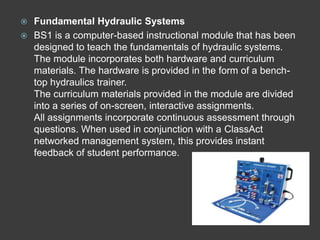
 Fundamental Hydraulic Systems
 BS1 is a computer-based instructional module that has been
  designed to teach the fundamentals of hydraulic systems.
  The module incorporates both hardware and curriculum
  materials. The hardware is provided in the form of a bench-
  top hydraulics trainer.
  The curriculum materials provided in the module are divided
  into a series of on-screen, interactive assignments.
  All assignments incorporate continuous assessment through
  questions. When used in conjunction with a ClassAct
  networked management system, this provides instant
  feedback of student performance.
   BS1 is a computer-based instructional module that
    has been designed to teach the fundamentals of
    hydraulic systems.
    The module incorporates both hardware and
    curriculum materials. The hardware is provided in
    the form of a bench-top hydraulics trainer.
    The curriculum materials provided in the module
    are divided into a series of on-screen, interactive
    assignments.
    All assignments incorporate continuous assessment
    through questions. When used in conjunction with a
    ClassAct networked management system, this
    provides instant feedback of student performance.
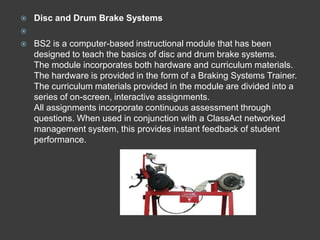
   Disc and Drum Brake Systems

   BS2 is a computer-based instructional module that has been
    designed to teach the basics of disc and drum brake systems.
    The module incorporates both hardware and curriculum materials.
    The hardware is provided in the form of a Braking Systems Trainer.
    The curriculum materials provided in the module are divided into a
    series of on-screen, interactive assignments.
    All assignments incorporate continuous assessment through
    questions. When used in conjunction with a ClassAct networked
    management system, this provides instant feedback of student
    performance.
   On-screen assignments may be theory-based
    or practical-based. Theory-based assignments
    provide essential knowledge of disc and drum
    brake systems. They are supported by standard
    automotive textbooks.
    Some practical-based assignments direct
    students to carry out tasks in the laboratory
    using the supplied hardware. Others require
    students to perform tasks in a workshop on real
    vehicle systems.
    Students are guided through their laboratory
    and workshop tasks by printable job sheets.

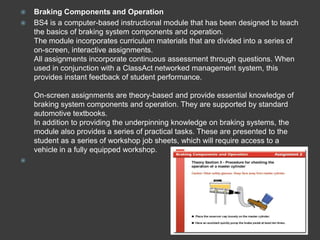
   Braking Components and Operation
   BS4 is a computer-based instructional module that has been designed to teach
    the basics of braking system components and operation.
    The module incorporates curriculum materials that are divided into a series of
    on-screen, interactive assignments.
    All assignments incorporate continuous assessment through questions. When
    used in conjunction with a ClassAct networked management system, this
    provides instant feedback of student performance.

    On-screen assignments are theory-based and provide essential knowledge of
    braking system components and operation. They are supported by standard
    automotive textbooks.
    In addition to providing the underpinning knowledge on braking systems, the
    module also provides a series of practical tasks. These are presented to the
    student as a series of workshop job sheets, which will require access to a
    vehicle in a fully equipped workshop.

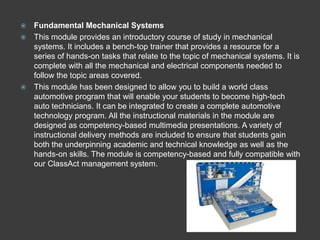
 Fundamental Mechanical Systems
 This module provides an introductory course of study in mechanical
  systems. It includes a bench-top trainer that provides a resource for a
  series of hands-on tasks that relate to the topic of mechanical systems. It is
  complete with all the mechanical and electrical components needed to
  follow the topic areas covered.
 This module has been designed to allow you to build a world class
  automotive program that will enable your students to become high-tech
  auto technicians. It can be integrated to create a complete automotive
  technology program. All the instructional materials in the module are
  designed as competency-based multimedia presentations. A variety of
  instructional delivery methods are included to ensure that students gain
  both the underpinning academic and technical knowledge as well as the
  hands-on skills. The module is competency-based and fully compatible with
  our ClassAct management system.
   This module provides an introductory course of study in
    mechanical systems. It includes a bench-top trainer that
    provides a resource for a series of hands-on tasks that
    relate to the topic of mechanical systems. It is complete
    with all the mechanical and electrical components needed
    to follow the topic areas covered.
   This module has been designed to allow you to build a
    world class automotive program that will enable your
    students to become high-tech auto technicians. It can be
    integrated to create a complete automotive technology
    program. All the instructional materials in the module are
    designed as competency-based multimedia presentations.
    A variety of instructional delivery methods are included to
    ensure that students gain both the underpinning academic
    and technical knowledge as well as the hands-on skills.
    The module is competency-based and fully compatible
    with our ClassAct management system.
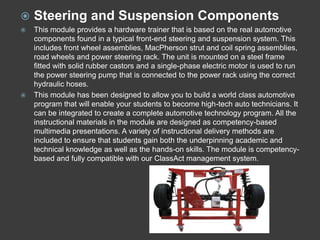
   Steering and Suspension Components
   This module provides a hardware trainer that is based on the real automotive
    components found in a typical front-end steering and suspension system. This
    includes front wheel assemblies, MacPherson strut and coil spring assemblies,
    road wheels and power steering rack. The unit is mounted on a steel frame
    fitted with solid rubber castors and a single-phase electric motor is used to run
    the power steering pump that is connected to the power rack using the correct
    hydraulic hoses.
   This module has been designed to allow you to build a world class automotive
    program that will enable your students to become high-tech auto technicians. It
    can be integrated to create a complete automotive technology program. All the
    instructional materials in the module are designed as competency-based
    multimedia presentations. A variety of instructional delivery methods are
    included to ensure that students gain both the underpinning academic and
    technical knowledge as well as the hands-on skills. The module is competency-
    based and fully compatible with our ClassAct management system.
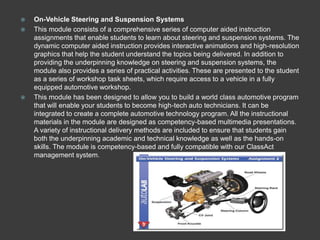
   On-Vehicle Steering and Suspension Systems
   This module consists of a comprehensive series of computer aided instruction
    assignments that enable students to learn about steering and suspension systems. The
    dynamic computer aided instruction provides interactive animations and high-resolution
    graphics that help the student understand the topics being delivered. In addition to
    providing the underpinning knowledge on steering and suspension systems, the
    module also provides a series of practical activities. These are presented to the student
    as a series of workshop task sheets, which require access to a vehicle in a fully
    equipped automotive workshop.
   This module has been designed to allow you to build a world class automotive program
    that will enable your students to become high-tech auto technicians. It can be
    integrated to create a complete automotive technology program. All the instructional
    materials in the module are designed as competency-based multimedia presentations.
    A variety of instructional delivery methods are included to ensure that students gain
    both the underpinning academic and technical knowledge as well as the hands-on
    skills. The module is competency-based and fully compatible with our ClassAct
    management system.
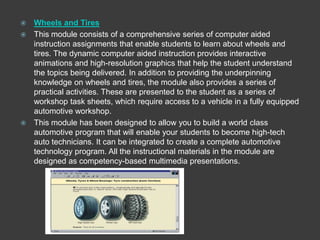
 Wheels and Tires
 This module consists of a comprehensive series of computer aided
  instruction assignments that enable students to learn about wheels and
  tires. The dynamic computer aided instruction provides interactive
  animations and high-resolution graphics that help the student understand
  the topics being delivered. In addition to providing the underpinning
  knowledge on wheels and tires, the module also provides a series of
  practical activities. These are presented to the student as a series of
  workshop task sheets, which require access to a vehicle in a fully equipped
  automotive workshop.
 This module has been designed to allow you to build a world class
  automotive program that will enable your students to become high-tech
  auto technicians. It can be integrated to create a complete automotive
  technology program. All the instructional materials in the module are
  designed as competency-based multimedia presentations.
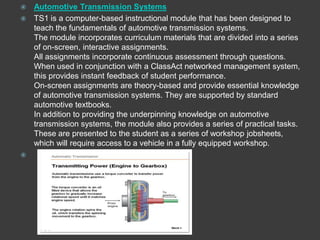
 Automotive Transmission Systems
 TS1 is a computer-based instructional module that has been designed to
  teach the fundamentals of automotive transmission systems.
  The module incorporates curriculum materials that are divided into a series
  of on-screen, interactive assignments.
  All assignments incorporate continuous assessment through questions.
  When used in conjunction with a ClassAct networked management system,
  this provides instant feedback of student performance.
  On-screen assignments are theory-based and provide essential knowledge
  of automotive transmission systems. They are supported by standard
  automotive textbooks.
  In addition to providing the underpinning knowledge on automotive
  transmission systems, the module also provides a series of practical tasks.
  These are presented to the student as a series of workshop jobsheets,
  which will require access to a vehicle in a fully equipped workshop.


Building utilities

  • 1.
    Automobile electrical system has gradually evolved over the years and today it assimilates automatic computer control of the automotive mechanics. In the early days, automobiles electrical system comprised of only basic wiring technologies that were used for distributing power to other parts of a vehicle. It had only switches, wires, relays and controlled motors as its key components but today’s electrical system includes sensors, actuators, alternators, battery, oxygen sensors, generator, startersolenoid, starter drive, high power electrical system and other devices.
  • 2.
    Armature:  Armature are the moving parts of an electric machine generally alternators, generator or motors of a vehicle, which vibrates when electromotive force is produced. The armature used in automobile comprises of a series of coils and groups of insulated conductors circumscribed around a core of iron. Also known as the rotating part of a dynamo, armatures are generally fixed on ball bearings and are mostly made of copper wire coiled around an iron core.  The major functions of armature are:  Firstly, to produce an electromotive force. Secondly, to transmit current in a rotating machines and force in a linear machine.
  • 3.
    View Supplier List   Automobile Battery:  Automobile Battery refers to an electrochemical device comprising of primary and secondary cells that are used for transforming chemical energy into mechanical energy. Most of the vehicles today uses ‘lead acid’ batteries. Batteries are mostly of two types i.e. non-rechargeable and rechargeable. Often called as disposable batteries, non- rechargeable batteries are used once and then dumped. While rechargeable batteries are those devices that can be easily recharged by applying electrical current that turns or reverses a chemical reaction. A normal battery has an initial voltage of about 1.6 volts and produces between 500-1000 amps. The market size of automobile battery industry is worth US $ 48 billion a year. China, Hong Kong, United States, India and Taiwan are the major battery manufacturing countries on the global platform.  Classification of various components of a battery includes:  Battery Boxes, Battery Cable Terminals ,Battery Plates Performance Batteries , Ground Straps Battery Cable Battery Control Systems, Battery Trays Voltage Regulators , Battery Switches
  • 4.
     Automobile IgnitionSystem:  Automobile Ignition System constitute of various devices, tools and components that are used for igniting the fuel in an internal combustion engine of a vehicle. In this system, electric current is used for burning the mixture of air and fuel with the help of coil, battery, and spark plug. Ignition system is assembled in only those automobile engines, which operates with the help of petrol or gasoline. The two main functions of automobile ignition system are to produce enough voltage so that it can easily create a spark for burning air/fuel mixture and secondly it exercises control over the timing of spark and transmit it to the apt cylinder. A typical automobile ignition system produces voltage somewhere between 20000 volts and 50000 volts from a 12-volt source. Automobile ignition system can be further classified into three main heads such as mechanical ignition system, electronic ignition system and distributorless ignition system. Most of the vehicles today incorporate electronic ignition system in its engine.
  • 5.
    Major Components used in automobile ignition systems are:  Coil Wires Ignition Distributor Magneto Ignition Coil Parts Electronic Timing Controllers  Ignition Box Ignition Switch Ignition Coils Ignition Controller Magneto  Automobile Starting System:  Automobile Starting System is considered to be the heart of automobile electrical system. The starting system of an automobile includes those devices, which are used for initiating an engine of a vehicle. Once the key is put into theignition switch then the current pass through battery cables to starter motor. After this, starter motor turn the engine and the downward moving piston create suction where air and fuel mixture is burned and then the engine starts.  The chief components of automobile starting system are:  Starter Starter Solenoid  Starter Drive Bendix Drive Starter
  • 6.
    Automotive Computer Chips:  Automotive Computer Chips also known as super chip, automotive computer chips are basically the integrated circuits made of semi conducting material that are used for storing a new engine management program in the electronic control unit of the vehicle. These chips stores the data used by engine control unit, for managing and controlling the engine functions. Oxygen sensor is one of the types of automobile computer chips that form an important part of the engine fuel control feedback loop. Automotive Computer Chips comprises of: Engine Management Systems Oxygen Sensors  Sensor Ring
  • 7.
    Other automobile computerchips include:  Power train control modules Tuners Speedometer calibrators Flip switches  Performance monitors Performance chips Top speed eliminators Shift improvers
  • 8.
     Automotive ElectricalWiring:  The electrical wiring system of an automobile incorporate different types of devices, flexible electrical wires, electrical fuses, connectors, fuse blocks used for fastening one end of an automobile component to the power source device. These electrical wiring components are used for bearing mechanical loads and transmitting communication signals or electrical energy.  Apart from electrical wiring components mentioned above, there are other parts used in an automobile electrical system like:  Electrical Fuse Electrical Switch Panels Fuse Blocks Shrink Sleeve Tubing Wiring Harnesses A/C Harness Electrical Switches Parts  Electrical Fuse Holders Electrical Switches Relay Connectors Wiring Connector ElectricalSwitch Covers Ground Straps
  • 9.
    Charging System:  The charging system of an automobile has three basic components such as alternator, regulator, and the interconnecting wiring. The main function of automobile charging system is to control and regulate the charge in the battery of a vehicle. Automobile charging system generally generates a voltage between 13.5 and 14.4 volts when the engine is working. It produces electrical current for operating automobile lights, music systems, heater, engine electrical system and other electrical components.  Other components of charging system of the vehicle are:  Alternator Automobile Generator Alternator Parts  Alternator Bearing Alternator Fans
  • 10.
    Spark Plugs:  A spark plug is a small electrical device that is implanted into internal combustion engine cylinder for burning the mixture of air and fuel. A typical spark plug consists of a center electrode, metal casing and a ground electrode as illustrated in the figure. These plugs are used in many machines such as trucks, buses, tractors, boats, aircraft, motorcycles, scooters, industrial and oil field engines, and oil burners. The basic raw materials used for manufacturing spark plugs are aluminum oxide, steel, silver, gold, platinum, copper and other high nickel alloys. These spark plugs are available in different configurations and heat ranges to adapt to any type of engine.
  • 11.
    silver, gold, platinum, copper and other high nickel alloys. These spark plugs are available in different configurations and heat ranges to adapt to any type of engine.
  • 12.
     Auto Mechanical Autolab allows investigation into the mechanical systems found in modern vehicles. The modules are focused on developing knowledge and practical skills using simulator panels, real vehicle component trainers and/or vehicle- based workshop tasks.  The computer-based curriculum includes high- quality graphics, animation and video to introduce the underpinning knowledge for systems and components. Each student activity can be tracked by a management system for ease of assessment. 
  • 13.
    Heating and Air Conditioning Systems  ACS1 is a computer-based instructional module that has been designed to teach the basics of heating and air conditioning systems used in modern motor vehicles. The module incorporates both hardware and curriculum materials. The hardware is provided in the form of a simulator panel trainer that can be connected to a computer for automatic fault insertion. The curriculum materials provided in the module are divided into a series of on-screen interactive assignments. These assignments incorporate assessment through questions
  • 14.
    ACS1 is a computer-based instructional module that has been designed to teach the basics of heating and air conditioning systems used in modern motor vehicles. The module incorporates both hardware and curriculum materials. The hardware is provided in the form of a simulator panel trainer that can be connected to a computer for automatic fault insertion. The curriculum materials provided in the module are divided into a series of on-screen interactive assignments. These assignments incorporate assessment through questions embedded within the learning materials. When used in conjunction with a ClassAct networked management system, this provides instant feedback of student performance.
  • 15.
     Air ConditioningComponents and Operation  ACS2 is a computer-based instructional module that has been designed to teach the basics of air conditioning components and operation. The module incorporates both hardware and curriculum materials. The hardware is provided in the form of a complete automotive air-conditioning system. The curriculum materials provided in the module are divided into a series of on-screen, interactive assignments.
  • 16.
    ACS2 is a computer-based instructional module that has been designed to teach the basics of air conditioning components and operation. The module incorporates both hardware and curriculum materials. The hardware is provided in the form of a complete automotive air-conditioning system. The curriculum materials provided in the module are divided into a series of on-screen, interactive assignments.
  • 17.
     Fundamental HydraulicSystems  BS1 is a computer-based instructional module that has been designed to teach the fundamentals of hydraulic systems. The module incorporates both hardware and curriculum materials. The hardware is provided in the form of a bench- top hydraulics trainer. The curriculum materials provided in the module are divided into a series of on-screen, interactive assignments. All assignments incorporate continuous assessment through questions. When used in conjunction with a ClassAct networked management system, this provides instant feedback of student performance.
  • 18.
    BS1 is a computer-based instructional module that has been designed to teach the fundamentals of hydraulic systems. The module incorporates both hardware and curriculum materials. The hardware is provided in the form of a bench-top hydraulics trainer. The curriculum materials provided in the module are divided into a series of on-screen, interactive assignments. All assignments incorporate continuous assessment through questions. When used in conjunction with a ClassAct networked management system, this provides instant feedback of student performance.
  • 19.
    Disc and Drum Brake Systems   BS2 is a computer-based instructional module that has been designed to teach the basics of disc and drum brake systems. The module incorporates both hardware and curriculum materials. The hardware is provided in the form of a Braking Systems Trainer. The curriculum materials provided in the module are divided into a series of on-screen, interactive assignments. All assignments incorporate continuous assessment through questions. When used in conjunction with a ClassAct networked management system, this provides instant feedback of student performance.
  • 20.
    On-screen assignments may be theory-based or practical-based. Theory-based assignments provide essential knowledge of disc and drum brake systems. They are supported by standard automotive textbooks. Some practical-based assignments direct students to carry out tasks in the laboratory using the supplied hardware. Others require students to perform tasks in a workshop on real vehicle systems. Students are guided through their laboratory and workshop tasks by printable job sheets. 
  • 21.
    Braking Components and Operation  BS4 is a computer-based instructional module that has been designed to teach the basics of braking system components and operation. The module incorporates curriculum materials that are divided into a series of on-screen, interactive assignments. All assignments incorporate continuous assessment through questions. When used in conjunction with a ClassAct networked management system, this provides instant feedback of student performance. On-screen assignments are theory-based and provide essential knowledge of braking system components and operation. They are supported by standard automotive textbooks. In addition to providing the underpinning knowledge on braking systems, the module also provides a series of practical tasks. These are presented to the student as a series of workshop job sheets, which will require access to a vehicle in a fully equipped workshop. 
  • 22.
     Fundamental MechanicalSystems  This module provides an introductory course of study in mechanical systems. It includes a bench-top trainer that provides a resource for a series of hands-on tasks that relate to the topic of mechanical systems. It is complete with all the mechanical and electrical components needed to follow the topic areas covered.  This module has been designed to allow you to build a world class automotive program that will enable your students to become high-tech auto technicians. It can be integrated to create a complete automotive technology program. All the instructional materials in the module are designed as competency-based multimedia presentations. A variety of instructional delivery methods are included to ensure that students gain both the underpinning academic and technical knowledge as well as the hands-on skills. The module is competency-based and fully compatible with our ClassAct management system.
  • 23.
    This module provides an introductory course of study in mechanical systems. It includes a bench-top trainer that provides a resource for a series of hands-on tasks that relate to the topic of mechanical systems. It is complete with all the mechanical and electrical components needed to follow the topic areas covered.  This module has been designed to allow you to build a world class automotive program that will enable your students to become high-tech auto technicians. It can be integrated to create a complete automotive technology program. All the instructional materials in the module are designed as competency-based multimedia presentations. A variety of instructional delivery methods are included to ensure that students gain both the underpinning academic and technical knowledge as well as the hands-on skills. The module is competency-based and fully compatible with our ClassAct management system.
  • 24.
    Steering and Suspension Components  This module provides a hardware trainer that is based on the real automotive components found in a typical front-end steering and suspension system. This includes front wheel assemblies, MacPherson strut and coil spring assemblies, road wheels and power steering rack. The unit is mounted on a steel frame fitted with solid rubber castors and a single-phase electric motor is used to run the power steering pump that is connected to the power rack using the correct hydraulic hoses.  This module has been designed to allow you to build a world class automotive program that will enable your students to become high-tech auto technicians. It can be integrated to create a complete automotive technology program. All the instructional materials in the module are designed as competency-based multimedia presentations. A variety of instructional delivery methods are included to ensure that students gain both the underpinning academic and technical knowledge as well as the hands-on skills. The module is competency- based and fully compatible with our ClassAct management system.
  • 25.
    On-Vehicle Steering and Suspension Systems  This module consists of a comprehensive series of computer aided instruction assignments that enable students to learn about steering and suspension systems. The dynamic computer aided instruction provides interactive animations and high-resolution graphics that help the student understand the topics being delivered. In addition to providing the underpinning knowledge on steering and suspension systems, the module also provides a series of practical activities. These are presented to the student as a series of workshop task sheets, which require access to a vehicle in a fully equipped automotive workshop.  This module has been designed to allow you to build a world class automotive program that will enable your students to become high-tech auto technicians. It can be integrated to create a complete automotive technology program. All the instructional materials in the module are designed as competency-based multimedia presentations. A variety of instructional delivery methods are included to ensure that students gain both the underpinning academic and technical knowledge as well as the hands-on skills. The module is competency-based and fully compatible with our ClassAct management system.
  • 26.
     Wheels andTires  This module consists of a comprehensive series of computer aided instruction assignments that enable students to learn about wheels and tires. The dynamic computer aided instruction provides interactive animations and high-resolution graphics that help the student understand the topics being delivered. In addition to providing the underpinning knowledge on wheels and tires, the module also provides a series of practical activities. These are presented to the student as a series of workshop task sheets, which require access to a vehicle in a fully equipped automotive workshop.  This module has been designed to allow you to build a world class automotive program that will enable your students to become high-tech auto technicians. It can be integrated to create a complete automotive technology program. All the instructional materials in the module are designed as competency-based multimedia presentations.
  • 27.
     Automotive TransmissionSystems  TS1 is a computer-based instructional module that has been designed to teach the fundamentals of automotive transmission systems. The module incorporates curriculum materials that are divided into a series of on-screen, interactive assignments. All assignments incorporate continuous assessment through questions. When used in conjunction with a ClassAct networked management system, this provides instant feedback of student performance. On-screen assignments are theory-based and provide essential knowledge of automotive transmission systems. They are supported by standard automotive textbooks. In addition to providing the underpinning knowledge on automotive transmission systems, the module also provides a series of practical tasks. These are presented to the student as a series of workshop jobsheets, which will require access to a vehicle in a fully equipped workshop. 