How to avoid confusing your audience Tricia Spayer 1
© 2012 Tricia Spayer 
By the end of this presentation, you will learn: 
 
What Technical Communication is 
 
How to avoid confusing your audience 
 
Tips for effective communication 2
© 2012 Tricia Spayer 
 
Good communication is important in any profession 
 
Papers, specs, articles, presentations 
 
Subject Matter Expert 3
© 2012 Tricia Spayer 
 
Software instructions, medical procedures, or environmental regulations 
 
Information distributed by web pages, help files, or social media sites 
 
Instructions about how to do something, regardless of how technical the task is 4
© 2012 Tricia Spayer 
 
Technical Writers & Editors 
 
Information Architects 
 
Instructional Designers 
 
Technical Illustrators 
 
Globalization & Localization Specialists 
 
Usability & Human Factors Professionals 
 
Web Designers & Developers 
 
Visual Designers 
 
Teachers & Researchers of Technical Communication 
 
Indexers 5
© 2012 Tricia Spayer 
 
Manuals – do you read them? 
 
Assembly instructions 
 
Help files 
 
Online videos 6
© 2012 Tricia Spayer 
 
Information is usable and accessible 
 
Software instructions help users to be successful on their own 
 
Functional specs help speed development cycles and sell more product 
 
Training programs make people more employable, efficient, and safe 
 
Web sites increase user traffic and satisfaction 
 
Illustrations clarify product parts or steps 7
© 2012 Tricia Spayer 
 
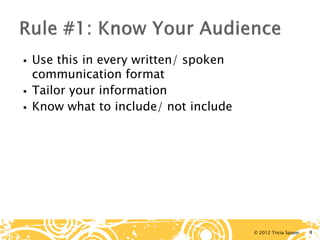
Use this in every written/ spoken communication format 
 
Tailor your information 
 
Know what to include/ not include 
8
© 2012 Tricia Spayer 
 
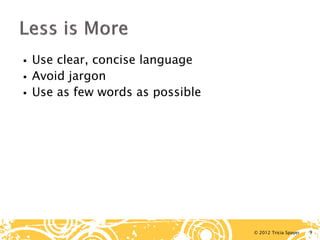
Use clear, concise language 
 
Avoid jargon 
 
Use as few words as possible 9
© 2012 Tricia Spayer 
 
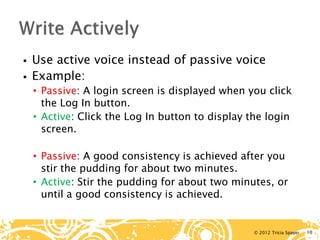
Use active voice instead of passive voice 
 
Example: 
• 
Passive: A login screen is displayed when you click the Log In button. 
• 
Active: Click the Log In button to display the login screen. 
• 
Passive: A good consistency is achieved after you stir the pudding for about two minutes. 
• 
Active: Stir the pudding for about two minutes, or until a good consistency is achieved. 10
© 2012 Tricia Spayer 
 
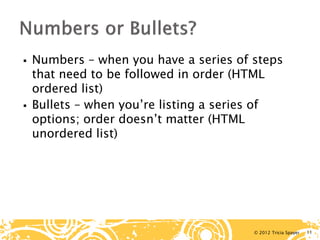
Numbers – when you have a series of steps that need to be followed in order (HTML ordered list) 
 
Bullets – when you’re listing a series of options; order doesn’t matter (HTML unordered list) 11
© 2012 Tricia Spayer 
 
Provide brief overview why they need to do this task 
 
Provide info about what they’ll need up front 
 
Use numbered steps instead of paragraphs 
 
Stick with 5-9 steps max (magical 7 +/-2) 
 
Break into separate tasks if more steps needed 12
© 2012 Tricia Spayer 
 
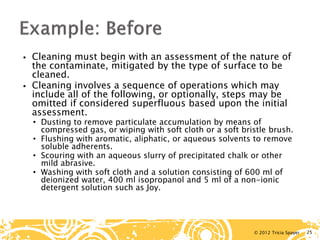
Cleaning must begin with an assessment of the nature of the contaminate, mitigated by the type of surface to be cleaned. 
 
Cleaning involves a sequence of operations which may include all of the following, or optionally, steps may be omitted if considered superfluous based upon the initial assessment. 
• 
Dusting to remove particulate accumulation by means of compressed gas, or wiping with soft cloth or a soft bristle brush. 
• 
Flushing with aromatic, aliphatic, or aqueous solvents to remove soluble adherents. 
• 
Scouring with an aqueous slurry of precipitated chalk or other mild abrasive. 
• 
Washing with soft cloth and a solution consisting of 600 ml of deionized water, 400 ml isopropanol and 5 ml of a non-ionic detergent solution such as Joy. 13
© 2012 Tricia Spayer 
 
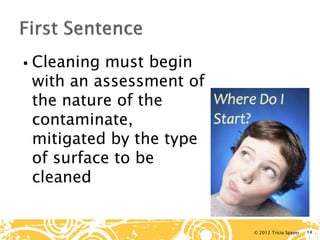
Cleaning must begin with an assessment of the nature of the contaminate, mitigated by the type of surface to be cleaned 14
© 2012 Tricia Spayer 
 
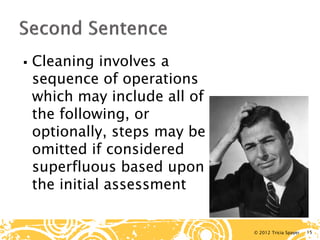
Cleaning involves a sequence of operations which may include all of the following, or optionally, steps may be omitted if considered superfluous based upon the initial assessment 15
© 2012 Tricia Spayer 
Cleaning involves a sequence of operations which may include all of the following, or optionally, steps may be omitted if considered superfluous based upon the initial assessment. 
Clean the surface using one of the following methods: 16
© 2012 Tricia Spayer 
 
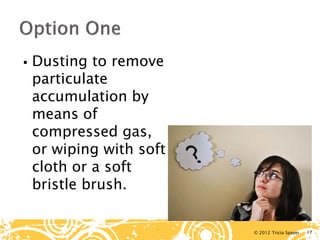
Dusting to remove particulate accumulation by means of compressed gas, or wiping with soft cloth or a soft bristle brush. 17
© 2012 Tricia Spayer 
Dusting to remove particulate accumulation by means of compressed gas, or wiping with soft cloth or a soft bristle brush. 
Dust the surface using compressed gas, or wipe using a soft cloth or soft brush 18
© 2012 Tricia Spayer 
 
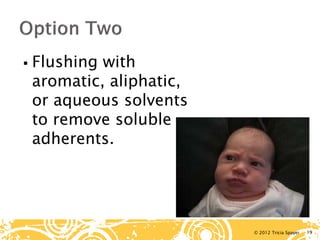
Flushing with aromatic, aliphatic, or aqueous solvents to remove soluble adherents. 19
© 2012 Tricia Spayer 
Flushing with aromatic, aliphatic, or aqueous solvents to remove soluble adherents. 
Flush the surface using isopropyl alcohol or distilled water. 20
© 2012 Tricia Spayer 
 
Scouring with an aqueous slurry of precipitated chalk or other mild abrasive. 21
© 2012 Tricia Spayer 
Scouring with an aqueous slurry of precipitated chalk or other mild abrasive. 
Scour the surface using a mild abrasive such as watered-down toothpaste. 22
© 2012 Tricia Spayer 
 
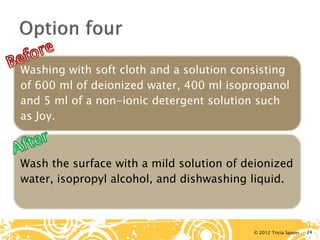
Washing with soft cloth and a solution consisting of 600 ml of deionized water, 400 ml isopropanol and 5 ml of a non-ionic detergent solution such as Joy. 23
© 2012 Tricia Spayer 
Washing with soft cloth and a solution consisting of 600 ml of deionized water, 400 ml isopropanol and 5 ml of a non-ionic detergent solution such as Joy. 
Wash the surface with a mild solution of deionized water, isopropyl alcohol, and dishwashing liquid. 24
© 2012 Tricia Spayer 
 
Cleaning must begin with an assessment of the nature of the contaminate, mitigated by the type of surface to be cleaned. 
 
Cleaning involves a sequence of operations which may include all of the following, or optionally, steps may be omitted if considered superfluous based upon the initial assessment. 
• 
Dusting to remove particulate accumulation by means of compressed gas, or wiping with soft cloth or a soft bristle brush. 
• 
Flushing with aromatic, aliphatic, or aqueous solvents to remove soluble adherents. 
• 
Scouring with an aqueous slurry of precipitated chalk or other mild abrasive. 
• 
Washing with soft cloth and a solution consisting of 600 ml of deionized water, 400 ml isopropanol and 5 ml of a non-ionic detergent solution such as Joy. 25
© 2012 Tricia Spayer 
 
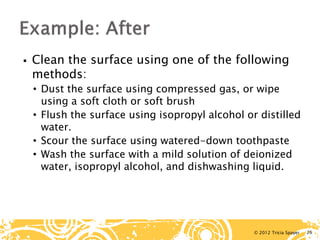
Clean the surface using one of the following methods: 
• 
Dust the surface using compressed gas, or wipe using a soft cloth or soft brush 
• 
Flush the surface using isopropyl alcohol or distilled water. 
• 
Scour the surface using watered-down toothpaste 
• 
Wash the surface with a mild solution of deionized water, isopropyl alcohol, and dishwashing liquid. 26
© 2012 Tricia Spayer 
 
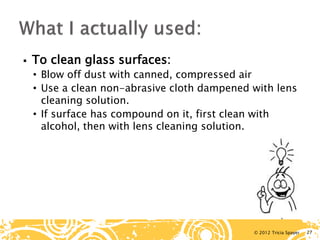
To clean glass surfaces: 
• 
Blow off dust with canned, compressed air 
• 
Use a clean non-abrasive cloth dampened with lens cleaning solution. 
• 
If surface has compound on it, first clean with alcohol, then with lens cleaning solution. 27
© 2012 Tricia Spayer 
 
Every discipline needs good technical communication 
 
Less is more 
 
You will write or present articles, papers, research, specs, instructions, web content 
 
You will be Subject Matter Expert 28
© 2012 Tricia Spayer 
 
Society for Technical Communication (STC) www.stc.org 
 
Northeast Ohio Chapter STC www.neostc.org 
 
“How to Communicate Technical Information: A Handbook of Software and Hardware Documentation” Jonathan Price, Henry Korman. 1993. ISBN 0-8053-6829-9 29

Technical writing for engineers by Tricia Spayer

  • 1.
    How to avoidconfusing your audience Tricia Spayer 1
  • 2.
    © 2012 TriciaSpayer By the end of this presentation, you will learn:  What Technical Communication is  How to avoid confusing your audience  Tips for effective communication 2
  • 3.
    © 2012 TriciaSpayer  Good communication is important in any profession  Papers, specs, articles, presentations  Subject Matter Expert 3
  • 4.
    © 2012 TriciaSpayer  Software instructions, medical procedures, or environmental regulations  Information distributed by web pages, help files, or social media sites  Instructions about how to do something, regardless of how technical the task is 4
  • 5.
    © 2012 TriciaSpayer  Technical Writers & Editors  Information Architects  Instructional Designers  Technical Illustrators  Globalization & Localization Specialists  Usability & Human Factors Professionals  Web Designers & Developers  Visual Designers  Teachers & Researchers of Technical Communication  Indexers 5
  • 6.
    © 2012 TriciaSpayer  Manuals – do you read them?  Assembly instructions  Help files  Online videos 6
  • 7.
    © 2012 TriciaSpayer  Information is usable and accessible  Software instructions help users to be successful on their own  Functional specs help speed development cycles and sell more product  Training programs make people more employable, efficient, and safe  Web sites increase user traffic and satisfaction  Illustrations clarify product parts or steps 7
  • 8.
    © 2012 TriciaSpayer  Use this in every written/ spoken communication format  Tailor your information  Know what to include/ not include 8
  • 9.
    © 2012 TriciaSpayer  Use clear, concise language  Avoid jargon  Use as few words as possible 9
  • 10.
    © 2012 TriciaSpayer  Use active voice instead of passive voice  Example: • Passive: A login screen is displayed when you click the Log In button. • Active: Click the Log In button to display the login screen. • Passive: A good consistency is achieved after you stir the pudding for about two minutes. • Active: Stir the pudding for about two minutes, or until a good consistency is achieved. 10
  • 11.
    © 2012 TriciaSpayer  Numbers – when you have a series of steps that need to be followed in order (HTML ordered list)  Bullets – when you’re listing a series of options; order doesn’t matter (HTML unordered list) 11
  • 12.
    © 2012 TriciaSpayer  Provide brief overview why they need to do this task  Provide info about what they’ll need up front  Use numbered steps instead of paragraphs  Stick with 5-9 steps max (magical 7 +/-2)  Break into separate tasks if more steps needed 12
  • 13.
    © 2012 TriciaSpayer  Cleaning must begin with an assessment of the nature of the contaminate, mitigated by the type of surface to be cleaned.  Cleaning involves a sequence of operations which may include all of the following, or optionally, steps may be omitted if considered superfluous based upon the initial assessment. • Dusting to remove particulate accumulation by means of compressed gas, or wiping with soft cloth or a soft bristle brush. • Flushing with aromatic, aliphatic, or aqueous solvents to remove soluble adherents. • Scouring with an aqueous slurry of precipitated chalk or other mild abrasive. • Washing with soft cloth and a solution consisting of 600 ml of deionized water, 400 ml isopropanol and 5 ml of a non-ionic detergent solution such as Joy. 13
  • 14.
    © 2012 TriciaSpayer  Cleaning must begin with an assessment of the nature of the contaminate, mitigated by the type of surface to be cleaned 14
  • 15.
    © 2012 TriciaSpayer  Cleaning involves a sequence of operations which may include all of the following, or optionally, steps may be omitted if considered superfluous based upon the initial assessment 15
  • 16.
    © 2012 TriciaSpayer Cleaning involves a sequence of operations which may include all of the following, or optionally, steps may be omitted if considered superfluous based upon the initial assessment. Clean the surface using one of the following methods: 16
  • 17.
    © 2012 TriciaSpayer  Dusting to remove particulate accumulation by means of compressed gas, or wiping with soft cloth or a soft bristle brush. 17
  • 18.
    © 2012 TriciaSpayer Dusting to remove particulate accumulation by means of compressed gas, or wiping with soft cloth or a soft bristle brush. Dust the surface using compressed gas, or wipe using a soft cloth or soft brush 18
  • 19.
    © 2012 TriciaSpayer  Flushing with aromatic, aliphatic, or aqueous solvents to remove soluble adherents. 19
  • 20.
    © 2012 TriciaSpayer Flushing with aromatic, aliphatic, or aqueous solvents to remove soluble adherents. Flush the surface using isopropyl alcohol or distilled water. 20
  • 21.
    © 2012 TriciaSpayer  Scouring with an aqueous slurry of precipitated chalk or other mild abrasive. 21
  • 22.
    © 2012 TriciaSpayer Scouring with an aqueous slurry of precipitated chalk or other mild abrasive. Scour the surface using a mild abrasive such as watered-down toothpaste. 22
  • 23.
    © 2012 TriciaSpayer  Washing with soft cloth and a solution consisting of 600 ml of deionized water, 400 ml isopropanol and 5 ml of a non-ionic detergent solution such as Joy. 23
  • 24.
    © 2012 TriciaSpayer Washing with soft cloth and a solution consisting of 600 ml of deionized water, 400 ml isopropanol and 5 ml of a non-ionic detergent solution such as Joy. Wash the surface with a mild solution of deionized water, isopropyl alcohol, and dishwashing liquid. 24
  • 25.
    © 2012 TriciaSpayer  Cleaning must begin with an assessment of the nature of the contaminate, mitigated by the type of surface to be cleaned.  Cleaning involves a sequence of operations which may include all of the following, or optionally, steps may be omitted if considered superfluous based upon the initial assessment. • Dusting to remove particulate accumulation by means of compressed gas, or wiping with soft cloth or a soft bristle brush. • Flushing with aromatic, aliphatic, or aqueous solvents to remove soluble adherents. • Scouring with an aqueous slurry of precipitated chalk or other mild abrasive. • Washing with soft cloth and a solution consisting of 600 ml of deionized water, 400 ml isopropanol and 5 ml of a non-ionic detergent solution such as Joy. 25
  • 26.
    © 2012 TriciaSpayer  Clean the surface using one of the following methods: • Dust the surface using compressed gas, or wipe using a soft cloth or soft brush • Flush the surface using isopropyl alcohol or distilled water. • Scour the surface using watered-down toothpaste • Wash the surface with a mild solution of deionized water, isopropyl alcohol, and dishwashing liquid. 26
  • 27.
    © 2012 TriciaSpayer  To clean glass surfaces: • Blow off dust with canned, compressed air • Use a clean non-abrasive cloth dampened with lens cleaning solution. • If surface has compound on it, first clean with alcohol, then with lens cleaning solution. 27
  • 28.
    © 2012 TriciaSpayer  Every discipline needs good technical communication  Less is more  You will write or present articles, papers, research, specs, instructions, web content  You will be Subject Matter Expert 28
  • 29.
    © 2012 TriciaSpayer  Society for Technical Communication (STC) www.stc.org  Northeast Ohio Chapter STC www.neostc.org  “How to Communicate Technical Information: A Handbook of Software and Hardware Documentation” Jonathan Price, Henry Korman. 1993. ISBN 0-8053-6829-9 29