1
Module-1: Introduction to engineering mechanics
Learning outcomes:
Describe what makes engineering different from science
course overview
Identify the systems of units used in the course
Classification of mechanics
Scalars and Vectors
Principles of engineering mechanics
2
“The scientist discover the world that exists.
The engineer creates what never was.”
An engineer uses scientific principles to design and operate
equipment, to move and interact materials
Scientist vs Engineer
3
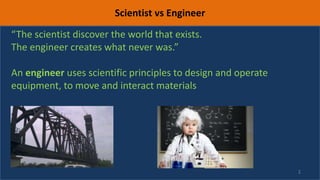
course overview
4
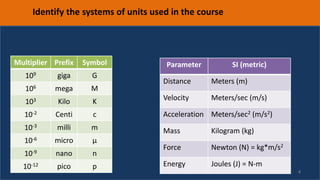
Identify the systems of units used in the course
Parameter SI (metric)
Distance Meters (m)
Velocity Meters/sec (m/s)
Acceleration Meters/sec2 (m/s2)
Mass Kilogram (kg)
Force Newton (N) = kg*m/s2
Energy Joules (J) = N-m
Multiplier Prefix Symbol
109 giga G
106 mega M
103 Kilo K
10-2 Centi c
10-3 milli m
10-6 micro μ
10-9 nano n
10-12 pico p
MEchanics
5
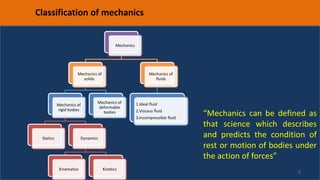
Classification of mechanics
Mechanics
Mechanics of
solids
Mechanics of
rigid bodies
Statics Dynamics
Kinematics Kinetics
Mechanics of
deformable
bodies
Mechanics of
fluids
1.Ideal fluid
2.Viscous fluid
3.Incompressible fluid
“Mechanics can be defined as
that science which describes
and predicts the condition of
rest or motion of bodies under
the action of forces”
6
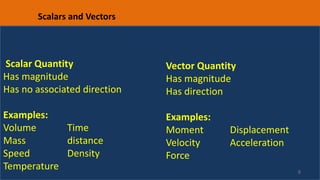
Scalars and Vectors
Scalar Quantity
Has magnitude
Has no associated direction
Examples:
Volume Time
Mass distance
Speed Density
Temperature
Vector Quantity
Has magnitude
Has direction
Examples:
Moment Displacement
Velocity Acceleration
Force
7
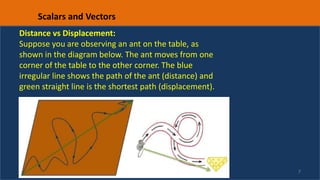
Distance vs Displacement:
Suppose you are observing an ant on the table, as
shown in the diagram below. The ant moves from one
corner of the table to the other corner. The blue
irregular line shows the path of the ant (distance) and
green straight line is the shortest path (displacement).
Scalars and Vectors
8
Principles of engineering mechanics
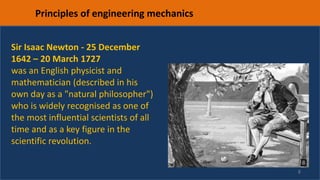
Sir Isaac Newton - 25 December
1642 – 20 March 1727
was an English physicist and
mathematician (described in his
own day as a "natural philosopher")
who is widely recognised as one of
the most influential scientists of all
time and as a key figure in the
scientific revolution.
9
Principles of engineering mechanics
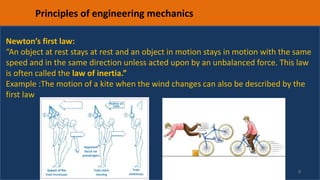
Newton’s first law:
“An object at rest stays at rest and an object in motion stays in motion with the same
speed and in the same direction unless acted upon by an unbalanced force. This law
is often called the law of inertia.”
Example :The motion of a kite when the wind changes can also be described by the
first law
10
Principles of engineering mechanics
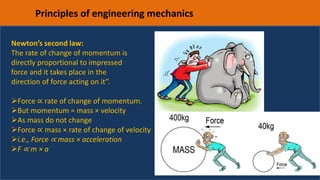
Newton’s second law:
The rate of change of momentum is
directly proportional to impressed
force and it takes place in the
direction of force acting on it”.
Force ∝ rate of change of momentum.
But momentum = mass × velocity
As mass do not change
Force ∝ mass × rate of change of velocity
i.e., Force ∝ mass × acceleration
F ∝ m × a
11
Principles of engineering mechanics
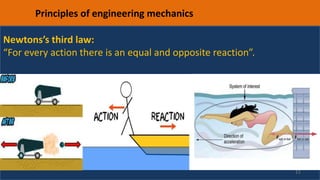
Newtons’s third law:
“For every action there is an equal and opposite reaction”.
12
Principles of engineering mechanics
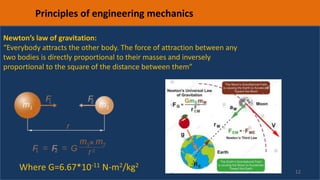
Newton’s law of gravitation:
“Everybody attracts the other body. The force of attraction between any
two bodies is directly proportional to their masses and inversely
proportional to the square of the distance between them”
Where G=6.67*10-11 N-m2/kg2
13
Principles of engineering mechanics
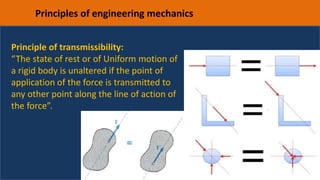
Principle of transmissibility:
“The state of rest or of Uniform motion of
a rigid body is unaltered if the point of
application of the force is transmitted to
any other point along the line of action of
the force”.
14

Engineering Mechanics diploma-Module-1.pptx

  • 1.
    1 Module-1: Introduction toengineering mechanics Learning outcomes: Describe what makes engineering different from science course overview Identify the systems of units used in the course Classification of mechanics Scalars and Vectors Principles of engineering mechanics
  • 2.
    2 “The scientist discoverthe world that exists. The engineer creates what never was.” An engineer uses scientific principles to design and operate equipment, to move and interact materials Scientist vs Engineer
  • 3.
  • 4.
    4 Identify the systemsof units used in the course Parameter SI (metric) Distance Meters (m) Velocity Meters/sec (m/s) Acceleration Meters/sec2 (m/s2) Mass Kilogram (kg) Force Newton (N) = kg*m/s2 Energy Joules (J) = N-m Multiplier Prefix Symbol 109 giga G 106 mega M 103 Kilo K 10-2 Centi c 10-3 milli m 10-6 micro μ 10-9 nano n 10-12 pico p
  • 5.
    MEchanics 5 Classification of mechanics Mechanics Mechanicsof solids Mechanics of rigid bodies Statics Dynamics Kinematics Kinetics Mechanics of deformable bodies Mechanics of fluids 1.Ideal fluid 2.Viscous fluid 3.Incompressible fluid “Mechanics can be defined as that science which describes and predicts the condition of rest or motion of bodies under the action of forces”
  • 6.
    6 Scalars and Vectors ScalarQuantity Has magnitude Has no associated direction Examples: Volume Time Mass distance Speed Density Temperature Vector Quantity Has magnitude Has direction Examples: Moment Displacement Velocity Acceleration Force
  • 7.
    7 Distance vs Displacement: Supposeyou are observing an ant on the table, as shown in the diagram below. The ant moves from one corner of the table to the other corner. The blue irregular line shows the path of the ant (distance) and green straight line is the shortest path (displacement). Scalars and Vectors
  • 8.
    8 Principles of engineeringmechanics Sir Isaac Newton - 25 December 1642 – 20 March 1727 was an English physicist and mathematician (described in his own day as a "natural philosopher") who is widely recognised as one of the most influential scientists of all time and as a key figure in the scientific revolution.
  • 9.
    9 Principles of engineeringmechanics Newton’s first law: “An object at rest stays at rest and an object in motion stays in motion with the same speed and in the same direction unless acted upon by an unbalanced force. This law is often called the law of inertia.” Example :The motion of a kite when the wind changes can also be described by the first law
  • 10.
    10 Principles of engineeringmechanics Newton’s second law: The rate of change of momentum is directly proportional to impressed force and it takes place in the direction of force acting on it”. Force ∝ rate of change of momentum. But momentum = mass × velocity As mass do not change Force ∝ mass × rate of change of velocity i.e., Force ∝ mass × acceleration F ∝ m × a
  • 11.
    11 Principles of engineeringmechanics Newtons’s third law: “For every action there is an equal and opposite reaction”.
  • 12.
    12 Principles of engineeringmechanics Newton’s law of gravitation: “Everybody attracts the other body. The force of attraction between any two bodies is directly proportional to their masses and inversely proportional to the square of the distance between them” Where G=6.67*10-11 N-m2/kg2
  • 13.
    13 Principles of engineeringmechanics Principle of transmissibility: “The state of rest or of Uniform motion of a rigid body is unaltered if the point of application of the force is transmitted to any other point along the line of action of the force”.
  • 14.