You are all part of something amazing 775   organisations  have applied to the Youth of Today for funding. We have now closed the Youth Leadership Fund….  … and you are the people we have chosen.
Reaching Out Round 1 A staggering   385   groups applied… Anne Frank Trust Campaign for National Parks Groundwork National Community Boating Association Praxis Community Project RADAR Streetgames and Football League
Scaling Up Round 1   107  different groups applied… Cumbria Youth Alliance Deafinitions Higher Rhythm Starlight Music Academy Theatre 503 Trustreet Dance
Scaling Up Round 2 98  different groups applied… Aston Athletics Basketball Eclectic Exposure Induction Markfield Off The Record Somerset Rural Youth Project The Source Tiber Community Building Warrington Wolves
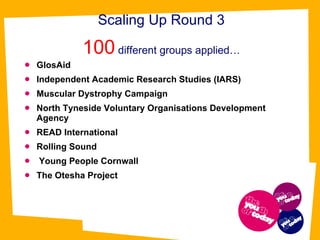
Scaling Up Round 3 100  different groups applied… GlosAid  Independent Academic Research Studies (IARS)  Muscular Dystrophy Campaign  North Tyneside Voluntary Organisations Development Agency  READ International  Rolling Sound Young People Cornwall   The Otesha Project
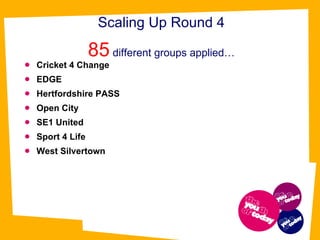
Scaling Up Round 4 85  different groups applied… Cricket 4 Change  EDGE   Hertfordshire PASS  Open City SE1 United  Sport 4 Life  West Silvertown
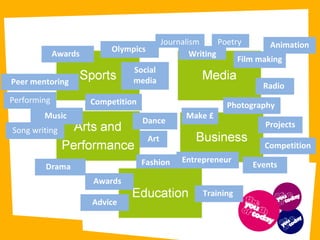
Drama   Music  Film making Art Training  Awards  Events Social media Advice Animation Fashion  Radio  Awards  Writing Peer mentoring Projects Entrepreneur  Olympics  Photography  Dance  Song writing Performing Poetry  Journalism Competition Make £ Competition
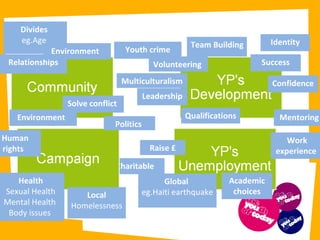
Charitable  Work experience = Divides  eg.Age  Relationships Environment  Mentoring Qualifications Politics  Global  eg.Haiti earthquake  Local Homelessness Youth crime Solve conflict  Raise £ Multiculturalism Identity Confidence Human rights  Academic choices Volunteering  Team Building Success Leadership Environment  Health Sexual Health Mental Health  Body issues
What can you all do together?
An introduction to the research
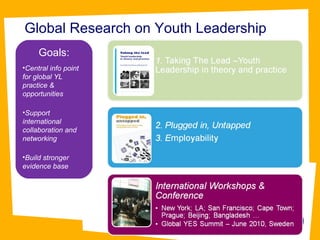
Global Research on Youth Leadership Goals: Central info point for global YL practice & opportunities  Support international collaboration and networking  Build stronger evidence base Faster adoption of effective models
What is youth leadership, and why does it matter? Leaders of the future will need to … Embrace complexity – requiring more collaborative and inter-dependent work  Lead through authenticity rather than authority  Leadership skills  The social and emotional skills and competencies that foster and build inter-personal relationships (c.f Grit)  Self- and social-awareness  Emotional intelligence  Emotional resilience  Empathy  Communication  Collaboration and teamwork  Innovation & Creativity  Flexibility  (Self-)discipline  Youth leadership matters: For  democracy  – to ensure representation and engagement of all citizens; address democratic deficit  For the  economy  – clear overlaps with entrepreneurialism; skills implicated in leadership demanded within workplaces and NB for employability  For  life success  - the  skills that enable effective leadership are important in preparing youth to take on formal leadership roles AND crucial in facilitating a successful transition to adulthood (more NB than IQ) For tackling pressing  social challenges  – young people critical to innovation and catalysing positive social change
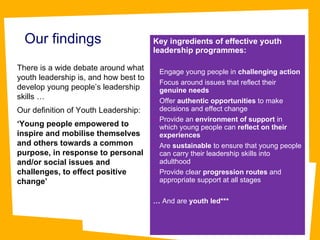
Our findings There is a wide debate around what youth leadership is, and how best to develop young people’s leadership skills … Our definition of Youth Leadership:  ‘ Young people empowered to inspire and mobilise themselves and others towards a common purpose, in response to personal and/or social issues and challenges, to effect positive change’ Key ingredients of effective youth leadership programmes: Engage young people in  challenging action   Focus around issues that reflect their  genuine needs  Offer  authentic opportunities  to make decisions and effect change Provide an  environment of support  in which young people can  reflect on their experiences Are  sustainable  to ensure that young people can carry their leadership skills into adulthood Provide clear  progression routes  and appropriate support at all stages …  And are  youth led***
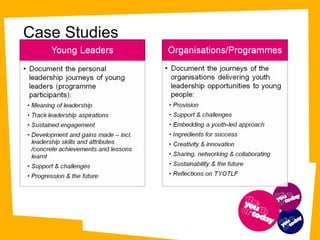
Case Studies
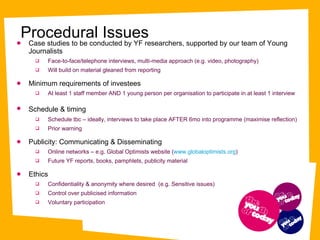
Case studies to be conducted by YF researchers, supported by our team of Young Journalists Face-to-face/telephone interviews, multi-media approach (e.g. video, photography) Will build on material gleaned from reporting  Minimum requirements of investees At least 1 staff member AND 1 young person per organisation to participate in at least 1 interview  Schedule & timing   Schedule tbc – ideally, interviews to take place AFTER 6mo into programme (maximise reflection) Prior warning  Publicity: Communicating & Disseminating  Online networks – e.g. Global Optimists website ( www.globaloptimists.org ) Future YF reports, books, pamphlets, publicity material  Ethics  Confidentiality & anonymity where desired  (e.g. Sensitive issues) Control over publicised information  Voluntary participation  Procedural Issues
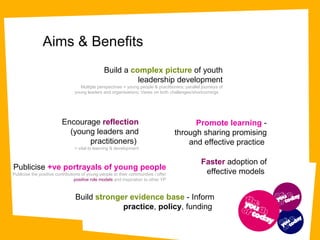
Encourage  reflection  (young leaders and practitioners)  = vital to learning & development Build a  complex picture  of youth leadership development Multiple perspectives = young people & practitioners; parallel journeys of young leaders and organisations; Views on both challenges/shortcomings  & successes Publicise  +ve portrayals of young people Publicise the positive contributions of young people to their communities / offer  positive role models  and inspiration to other YP Build  stronger evidence base  - Inform  practice ,  policy , funding  Promote learning  - through sharing promising and effective practice  Faster  adoption of effective models  Aims & Benefits
Our work on Youth Transitions  Young people hold  tremendous untapped potential  as entrepreneurs and leaders today, not as ‘citizens in waiting’ for tomorrow.  We believe in harnessing the power of ideas – unrestricted thinking – and the power of people – unrestricted potential – to deliver social growth.  1.Research and learning Sinking and Swimming  report  on Britain’s unmet needs, including investigation of young people’s needs Grit , examining the importance of resilience and “SEED” skills:  Social and emotional competencies Emotional Resilience Enterprise, innovation and creativity Discipline Ethnographic research on  teenage pregnancy  Turning the corner: Beyond incarceration and offending   looks at the challenges and potential solutions within the justice system 2. Public sector advisory The  Apprenticeships Pathfinder Project  in partnership with the LGA Our  Innovation, Justice and Youth  programme seeks to find sensible approaches to juvenile justice Emotional resilience pilot in Harrow  to tackle problematic relationships between police and at-risk youth
3. Piloting  and investment The Youth of Today Leadership Fund  , giving away £1m over 2 years in roughly 40 grants to innovative projects operating a National and local scale. This work devolved decision making to a team of Young Funders, who also developed the “I Do Ideas” project, which support young people at an individual level. The  Learning Launchpad Fund,  investing in 14early stage social ventures providing compelling alternatives to traditional educational models. Has supported Arrival Education, Enternships, Working Rite, Space Unlimited, and many others. Studio Schools : a new kind of school embracing project based learning Emotional resilience education  for 11-13 year olds through our Local Wellbeing project:  using the University of Pennsylvania “Penn Resiliency Programme” UpRising  , for 19-25 year olds, training next generation of public leaders representing diverse communities. Fastlaners , an intensive “finishing school” for unemployed graduates
Plugged in, Untapped  Sarah Hewes, Lauren Kahn and Mary Abdo Explores the role of digital technology in enabling young people to lead positive social change Looks at the benefits and limitations of digital technologies Provides recommendations for practitioners, policy-makers and teachers
Findings: Opportunities  Digital technologies can be powerful tools for creating positive social change, personal development and leadership in four key areas: Communication Collaboration Connection Action
Findings - Limitations But, certain factors limit the potential of digital technologies as tools for empowering young people as leaders: Digital divides and exclusion Shortcomings of online social capital and networks Challenges in teaching leadership skills online Youth participation and engagement contexts remain crucial
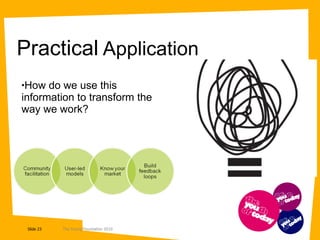
Practical  Application How do we use this information to transform the way we work?
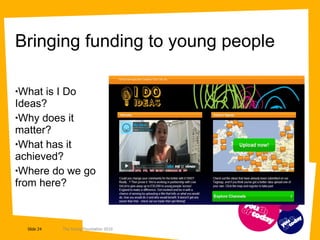
Bringing funding to young people What is I Do Ideas? Why does it matter? What has it achieved? Where do we go from here?
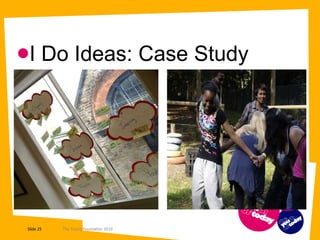
I Do Ideas: Case Study

Research case studies overview v3 in tyot format

  • 1.
  • 2.
    You are allpart of something amazing 775 organisations have applied to the Youth of Today for funding. We have now closed the Youth Leadership Fund…. … and you are the people we have chosen.
  • 3.
    Reaching Out Round1 A staggering 385 groups applied… Anne Frank Trust Campaign for National Parks Groundwork National Community Boating Association Praxis Community Project RADAR Streetgames and Football League
  • 4.
    Scaling Up Round1 107 different groups applied… Cumbria Youth Alliance Deafinitions Higher Rhythm Starlight Music Academy Theatre 503 Trustreet Dance
  • 5.
    Scaling Up Round2 98 different groups applied… Aston Athletics Basketball Eclectic Exposure Induction Markfield Off The Record Somerset Rural Youth Project The Source Tiber Community Building Warrington Wolves
  • 6.
    Scaling Up Round3 100 different groups applied… GlosAid Independent Academic Research Studies (IARS) Muscular Dystrophy Campaign North Tyneside Voluntary Organisations Development Agency READ International Rolling Sound Young People Cornwall The Otesha Project
  • 7.
    Scaling Up Round4 85 different groups applied… Cricket 4 Change EDGE Hertfordshire PASS Open City SE1 United Sport 4 Life West Silvertown
  • 8.
    Drama Music Film making Art Training Awards Events Social media Advice Animation Fashion Radio Awards Writing Peer mentoring Projects Entrepreneur Olympics Photography Dance Song writing Performing Poetry Journalism Competition Make £ Competition
  • 9.
    Charitable Workexperience = Divides eg.Age Relationships Environment Mentoring Qualifications Politics Global eg.Haiti earthquake Local Homelessness Youth crime Solve conflict Raise £ Multiculturalism Identity Confidence Human rights Academic choices Volunteering Team Building Success Leadership Environment Health Sexual Health Mental Health Body issues
  • 10.
    What can youall do together?
  • 11.
    An introduction tothe research
  • 12.
    Global Research onYouth Leadership Goals: Central info point for global YL practice & opportunities Support international collaboration and networking Build stronger evidence base Faster adoption of effective models
  • 13.
    What is youthleadership, and why does it matter? Leaders of the future will need to … Embrace complexity – requiring more collaborative and inter-dependent work Lead through authenticity rather than authority Leadership skills The social and emotional skills and competencies that foster and build inter-personal relationships (c.f Grit) Self- and social-awareness Emotional intelligence Emotional resilience Empathy Communication Collaboration and teamwork Innovation & Creativity Flexibility (Self-)discipline Youth leadership matters: For democracy – to ensure representation and engagement of all citizens; address democratic deficit For the economy – clear overlaps with entrepreneurialism; skills implicated in leadership demanded within workplaces and NB for employability For life success - the skills that enable effective leadership are important in preparing youth to take on formal leadership roles AND crucial in facilitating a successful transition to adulthood (more NB than IQ) For tackling pressing social challenges – young people critical to innovation and catalysing positive social change
  • 14.
    Our findings Thereis a wide debate around what youth leadership is, and how best to develop young people’s leadership skills … Our definition of Youth Leadership: ‘ Young people empowered to inspire and mobilise themselves and others towards a common purpose, in response to personal and/or social issues and challenges, to effect positive change’ Key ingredients of effective youth leadership programmes: Engage young people in challenging action Focus around issues that reflect their genuine needs Offer authentic opportunities to make decisions and effect change Provide an environment of support in which young people can reflect on their experiences Are sustainable to ensure that young people can carry their leadership skills into adulthood Provide clear progression routes and appropriate support at all stages … And are youth led***
  • 15.
  • 16.
    Case studies tobe conducted by YF researchers, supported by our team of Young Journalists Face-to-face/telephone interviews, multi-media approach (e.g. video, photography) Will build on material gleaned from reporting Minimum requirements of investees At least 1 staff member AND 1 young person per organisation to participate in at least 1 interview Schedule & timing Schedule tbc – ideally, interviews to take place AFTER 6mo into programme (maximise reflection) Prior warning Publicity: Communicating & Disseminating Online networks – e.g. Global Optimists website ( www.globaloptimists.org ) Future YF reports, books, pamphlets, publicity material Ethics Confidentiality & anonymity where desired (e.g. Sensitive issues) Control over publicised information Voluntary participation Procedural Issues
  • 17.
    Encourage reflection (young leaders and practitioners) = vital to learning & development Build a complex picture of youth leadership development Multiple perspectives = young people & practitioners; parallel journeys of young leaders and organisations; Views on both challenges/shortcomings & successes Publicise +ve portrayals of young people Publicise the positive contributions of young people to their communities / offer positive role models and inspiration to other YP Build stronger evidence base - Inform practice , policy , funding Promote learning - through sharing promising and effective practice Faster adoption of effective models Aims & Benefits
  • 18.
    Our work onYouth Transitions Young people hold tremendous untapped potential as entrepreneurs and leaders today, not as ‘citizens in waiting’ for tomorrow.  We believe in harnessing the power of ideas – unrestricted thinking – and the power of people – unrestricted potential – to deliver social growth. 1.Research and learning Sinking and Swimming report on Britain’s unmet needs, including investigation of young people’s needs Grit , examining the importance of resilience and “SEED” skills: Social and emotional competencies Emotional Resilience Enterprise, innovation and creativity Discipline Ethnographic research on teenage pregnancy Turning the corner: Beyond incarceration and offending looks at the challenges and potential solutions within the justice system 2. Public sector advisory The Apprenticeships Pathfinder Project in partnership with the LGA Our Innovation, Justice and Youth programme seeks to find sensible approaches to juvenile justice Emotional resilience pilot in Harrow to tackle problematic relationships between police and at-risk youth
  • 19.
    3. Piloting and investment The Youth of Today Leadership Fund , giving away £1m over 2 years in roughly 40 grants to innovative projects operating a National and local scale. This work devolved decision making to a team of Young Funders, who also developed the “I Do Ideas” project, which support young people at an individual level. The Learning Launchpad Fund, investing in 14early stage social ventures providing compelling alternatives to traditional educational models. Has supported Arrival Education, Enternships, Working Rite, Space Unlimited, and many others. Studio Schools : a new kind of school embracing project based learning Emotional resilience education for 11-13 year olds through our Local Wellbeing project: using the University of Pennsylvania “Penn Resiliency Programme” UpRising , for 19-25 year olds, training next generation of public leaders representing diverse communities. Fastlaners , an intensive “finishing school” for unemployed graduates
  • 20.
    Plugged in, Untapped Sarah Hewes, Lauren Kahn and Mary Abdo Explores the role of digital technology in enabling young people to lead positive social change Looks at the benefits and limitations of digital technologies Provides recommendations for practitioners, policy-makers and teachers
  • 21.
    Findings: Opportunities Digital technologies can be powerful tools for creating positive social change, personal development and leadership in four key areas: Communication Collaboration Connection Action
  • 22.
    Findings - LimitationsBut, certain factors limit the potential of digital technologies as tools for empowering young people as leaders: Digital divides and exclusion Shortcomings of online social capital and networks Challenges in teaching leadership skills online Youth participation and engagement contexts remain crucial
  • 23.
    Practical ApplicationHow do we use this information to transform the way we work?
  • 24.
    Bringing funding toyoung people What is I Do Ideas? Why does it matter? What has it achieved? Where do we go from here?
  • 25.
    I Do Ideas:Case Study