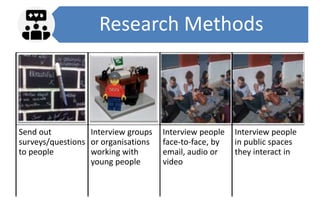
Send out
surveys/questions
to people
Interview groups
or organisations
working with
young people
Interview people
face-to-face, by
email, audio or
video
Interview people
in public spaces
they interact in
Research Methods
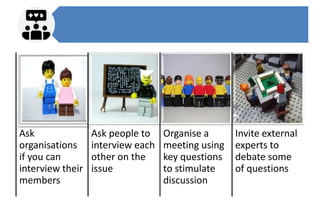
Ask
organisations
if you can
interview their
members
Ask people to
interview each
other on the
issue
Organise a
meeting using
key questions
to stimulate
discussion
Invite external
experts to
debate some
of questions
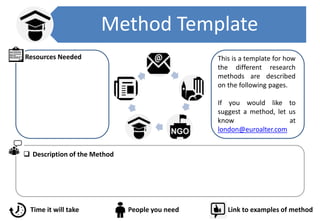
Method Template
 Description of the Method
Time it will take People you need Link to examples of method
Resources Needed This is a template for how
the different research
methods are described
on the following pages.
If you would like to
suggest a method, let us
know at
london@euroalter.com
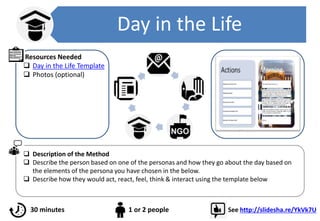
Day in the Life
 Description of the Method
 Describe the person based on one of the personas and how they go about the day based on
the elements of the persona you have chosen in the below.
 Describe how they would act, react, feel, think & interact using the template below
30 minutes 1 or 2 people See http://slidesha.re/YkVk7U
Resources Needed
 Day in the Life Template
 Photos (optional)
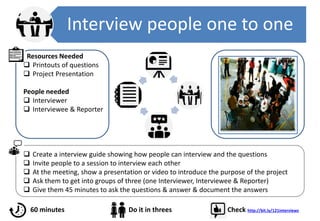
Interview people one to one
 Create a interview guide showing how people can interview and the questions
 Invite people to a session to interview each other
 At the meeting, show a presentation or video to introduce the purpose of the project
 Ask them to get into groups of three (one Interviewer, Interviewee & Reporter)
 Give them 45 minutes to ask the questions & answer & document the answers
Resources Needed
 Printouts of questions
 Project Presentation
People needed
 Interviewer
 Interviewee & Reporter
60 minutes Do it in threes Check http://bit.ly/121interviews
 Walk around the room to check everyone understands what to do
 Advise interviewers that if they haven’t finished asking all the questions
 If they’ve finished all the interview questions, before then, they can do a debriefing
 Ask the Reporter & Interviewer to write up the interview and send it back to you
Resources Needed
 Survey Questions
 Project Presentation
People needed
 Interviewer
 Interviewee & Reporter
60 minutes
60 minutes Do it in threes Check http://bit.ly/121interviews
Interview people where they interact
 Identify places where people meet or “hang out”
 Invite a person to accompany you to the place you have selected
 Decide between you who will be the Interviewer and who will be the Reporter
 Introduce yourself & purpose of the project to young people
 Use the Interview people one to one method
Resources Needed
 Survey Questions
 Project Issues
 Pen & Notebook
People Needed
 Interviewer
 Reporter
 Young people
60 minutes
60 minutes Do it in pairs Look at http://bit.ly/spaceinterview
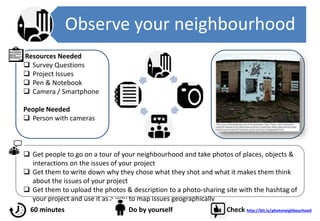
Observe your neighbourhood
 Get people to go on a tour of your neighbourhood and take photos of places, objects &
interactions on the issues of your project
 Get them to write down why they chose what they shot and what it makes them think
about the issues of your project
 Get them to upload the photos & description to a photo-sharing site with the hashtag of
your project and use it as a way to map issues geographically
60 minutes
60 minutes Do by yourself Check http://bit.ly/photoneighbourhood
Resources Needed
 Survey Questions
 Project Issues
 Pen & Notebook
 Camera / Smartphone
People Needed
 Person with cameras
Digital Ethnography
 Search online for groups in your neighbourhood
 Carry out secondary research into the neighbourhood (i.e. online forums, research, social media,
etc.) to see what people are saying about the issue your project is focusing on and map the
relationships between these (i.e. if your project is focused on safety, you could map what people
are saying about it and map how issues interrelate)
Resources Needed
 Questions
 Pen & Notebook
People Needed
 Interviewer
 Reporter
 Young people
60 minutes
60 minutes Do by yourself Look at http://bit.ly/spaceinterview
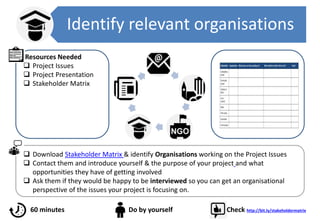
Identify relevant organisations
 Download Stakeholder Matrix & identify Organisations working on the Project Issues
 Contact them and introduce yourself & the purpose of your project and what
opportunities they have of getting involved
 Ask them if they would be happy to be interviewed so you can get an organisational
perspective of the issues your project is focusing on.
60 minutes Do by yourself Check http://bit.ly/stakeholdermatrix
Resources Needed
 Project Issues
 Project Presentation
 Stakeholder Matrix
Making sense of the insights
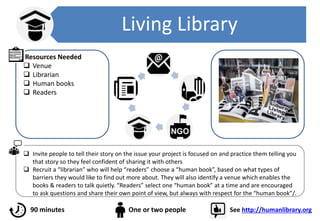
Living Library
 Invite people to tell their story on the issue your project is focused on and practice them telling you
that story so they feel confident of sharing it with others
 Recruit a “librarian” who will help “readers” choose a “human book”, based on what types of
barriers they would like to find out more about. They will also identify a venue which enables the
books & readers to talk quietly. “Readers” select one “human book” at a time and are encouraged
to ask questions and share their own point of view, but always with respect for the “human book”/.
90 minutes One or two people See http://humanlibrary.org
Resources Needed
 Venue
 Librarian
 Human books
 Readers
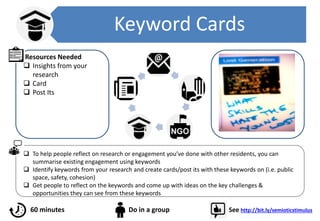
Keyword Cards
 To help people reflect on research or engagement you’ve done with other residents, you can
summarise existing engagement using keywords
 Identify keywords from your research and create cards/post its with these keywords on (i.e. public
space, safety, cohesion)
 Get people to reflect on the keywords and come up with ideas on the key challenges &
opportunities they can see from these keywords
60 minutes Do in a group See http://bit.ly/semioticstimulus
Resources Needed
 Insights from your
research
 Card
 Post Its
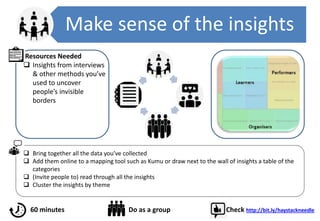
Make sense of the insights
 Bring together all the data you’ve collected
 Add them online to a mapping tool such as Kumu or draw next to the wall of insights a table of the
categories
 (Invite people to) read through all the insights
 Cluster the insights by theme
Resources Needed
 Insights from interviews
& other methods you’ve
used to uncover
people’s invisible
borders
60 minutes Do as a group Check http://bit.ly/haystackneedle
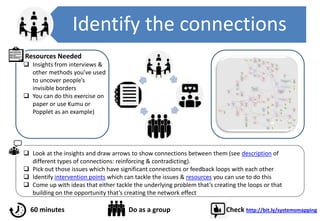
Identify the connections
 Look at the insights and draw arrows to show connections between them (see description of
different types of connections: reinforcing & contradicting).
 Pick out those issues which have significant connections or feedback loops with each other
 Identify intervention points which can tackle the issues & resources you can use to do this
 Come up with ideas that either tackle the underlying problem that’s creating the loops or that
building on the opportunity that’s creating the network effect
Resources Needed
 Insights from interviews &
other methods you’ve used
to uncover people’s
invisible borders
 You can do this exercise on
paper or use Kumu or
Popplet as an example)
60 minutes Do as a group Check http://bit.ly/systemsmapping
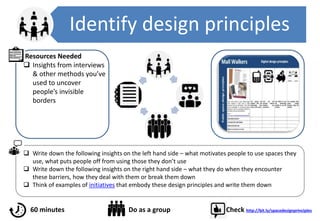
Identify design principles
 Write down the following insights on the left hand side – what motivates people to use spaces they
use, what puts people off from using those they don’t use
 Write down the following insights on the right hand side – what they do when they encounter
these barriers, how they deal with them or break them down
 Think of examples of initiatives that embody these design principles and write them down
Resources Needed
 Insights from interviews
& other methods you’ve
used to uncover
people’s invisible
borders
60 minutes Do as a group Check http://bit.ly/spacedesignprinciples
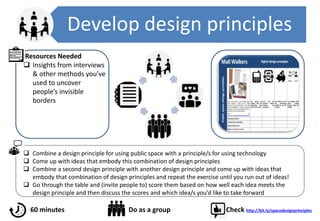
Develop design principles
 Combine a design principle for using public space with a principle/s for using technology
 Come up with ideas that embody this combination of design principles
 Combine a second design principle with another design principle and come up with ideas that
embody that combination of design principles and repeat the exercise until you run out of ideas!
 Go through the table and (invite people to) score them based on how well each idea meets the
design principle and then discuss the scores and which idea/s you’d like to take forward
Resources Needed
 Insights from interviews
& other methods you’ve
used to uncover
people’s invisible
borders
60 minutes Do as a group Check http://bit.ly/spacedesignprinciples
Prototype your ideas
 Start prototyping your concept using the design principles using materials available to you
 Identify what interactions people could engage with to break down the borders
 Work out how you want to get the users to test (i.e. show them a storyboard, mock-up website, 3D
model) and feedback on these (i.e. survey, mood board, etc.) and design an agenda for the session
 Focus on prototyping these specific interactions. Invite people to test these interactions and
provide feedback on how well it meets the need its designed to tackle and what could be improved
Resources Needed
 Ideas you’ve developed
to break down borders
60 minutes Do as a group Check http://bit.ly/how2prototype
Test our prototypes
 Iterate your prototype based on the feedback
 Invite people to test the interactions in the public space/s the prototype is planned to work in
 Iterate your prototype based on the feedback
 Invite people to test the prototype with all the interactions developed
 Finalise prototype ready for implementation
 Invite local residents to demonstrate the final prototype
Resources Needed
 Ideas you’ve developed
to break down borders
60 minutes Do as a group Check http://bit.ly/how2prototype

Engagement Methods

  • 1.
    Send out surveys/questions to people Interviewgroups or organisations working with young people Interview people face-to-face, by email, audio or video Interview people in public spaces they interact in Research Methods
  • 2.
    Ask organisations if you can interviewtheir members Ask people to interview each other on the issue Organise a meeting using key questions to stimulate discussion Invite external experts to debate some of questions
  • 3.
    Method Template  Descriptionof the Method Time it will take People you need Link to examples of method Resources Needed This is a template for how the different research methods are described on the following pages. If you would like to suggest a method, let us know at london@euroalter.com
  • 4.
    Day in theLife  Description of the Method  Describe the person based on one of the personas and how they go about the day based on the elements of the persona you have chosen in the below.  Describe how they would act, react, feel, think & interact using the template below 30 minutes 1 or 2 people See http://slidesha.re/YkVk7U Resources Needed  Day in the Life Template  Photos (optional)
  • 6.
    Interview people oneto one  Create a interview guide showing how people can interview and the questions  Invite people to a session to interview each other  At the meeting, show a presentation or video to introduce the purpose of the project  Ask them to get into groups of three (one Interviewer, Interviewee & Reporter)  Give them 45 minutes to ask the questions & answer & document the answers Resources Needed  Printouts of questions  Project Presentation People needed  Interviewer  Interviewee & Reporter 60 minutes Do it in threes Check http://bit.ly/121interviews
  • 7.
     Walk aroundthe room to check everyone understands what to do  Advise interviewers that if they haven’t finished asking all the questions  If they’ve finished all the interview questions, before then, they can do a debriefing  Ask the Reporter & Interviewer to write up the interview and send it back to you Resources Needed  Survey Questions  Project Presentation People needed  Interviewer  Interviewee & Reporter 60 minutes 60 minutes Do it in threes Check http://bit.ly/121interviews
  • 8.
    Interview people wherethey interact  Identify places where people meet or “hang out”  Invite a person to accompany you to the place you have selected  Decide between you who will be the Interviewer and who will be the Reporter  Introduce yourself & purpose of the project to young people  Use the Interview people one to one method Resources Needed  Survey Questions  Project Issues  Pen & Notebook People Needed  Interviewer  Reporter  Young people 60 minutes 60 minutes Do it in pairs Look at http://bit.ly/spaceinterview
  • 9.
    Observe your neighbourhood Get people to go on a tour of your neighbourhood and take photos of places, objects & interactions on the issues of your project  Get them to write down why they chose what they shot and what it makes them think about the issues of your project  Get them to upload the photos & description to a photo-sharing site with the hashtag of your project and use it as a way to map issues geographically 60 minutes 60 minutes Do by yourself Check http://bit.ly/photoneighbourhood Resources Needed  Survey Questions  Project Issues  Pen & Notebook  Camera / Smartphone People Needed  Person with cameras
  • 10.
    Digital Ethnography  Searchonline for groups in your neighbourhood  Carry out secondary research into the neighbourhood (i.e. online forums, research, social media, etc.) to see what people are saying about the issue your project is focusing on and map the relationships between these (i.e. if your project is focused on safety, you could map what people are saying about it and map how issues interrelate) Resources Needed  Questions  Pen & Notebook People Needed  Interviewer  Reporter  Young people 60 minutes 60 minutes Do by yourself Look at http://bit.ly/spaceinterview
  • 11.
    Identify relevant organisations Download Stakeholder Matrix & identify Organisations working on the Project Issues  Contact them and introduce yourself & the purpose of your project and what opportunities they have of getting involved  Ask them if they would be happy to be interviewed so you can get an organisational perspective of the issues your project is focusing on. 60 minutes Do by yourself Check http://bit.ly/stakeholdermatrix Resources Needed  Project Issues  Project Presentation  Stakeholder Matrix
  • 12.
    Making sense ofthe insights
  • 13.
    Living Library  Invitepeople to tell their story on the issue your project is focused on and practice them telling you that story so they feel confident of sharing it with others  Recruit a “librarian” who will help “readers” choose a “human book”, based on what types of barriers they would like to find out more about. They will also identify a venue which enables the books & readers to talk quietly. “Readers” select one “human book” at a time and are encouraged to ask questions and share their own point of view, but always with respect for the “human book”/. 90 minutes One or two people See http://humanlibrary.org Resources Needed  Venue  Librarian  Human books  Readers
  • 14.
    Keyword Cards  Tohelp people reflect on research or engagement you’ve done with other residents, you can summarise existing engagement using keywords  Identify keywords from your research and create cards/post its with these keywords on (i.e. public space, safety, cohesion)  Get people to reflect on the keywords and come up with ideas on the key challenges & opportunities they can see from these keywords 60 minutes Do in a group See http://bit.ly/semioticstimulus Resources Needed  Insights from your research  Card  Post Its
  • 15.
    Make sense ofthe insights  Bring together all the data you’ve collected  Add them online to a mapping tool such as Kumu or draw next to the wall of insights a table of the categories  (Invite people to) read through all the insights  Cluster the insights by theme Resources Needed  Insights from interviews & other methods you’ve used to uncover people’s invisible borders 60 minutes Do as a group Check http://bit.ly/haystackneedle
  • 16.
    Identify the connections Look at the insights and draw arrows to show connections between them (see description of different types of connections: reinforcing & contradicting).  Pick out those issues which have significant connections or feedback loops with each other  Identify intervention points which can tackle the issues & resources you can use to do this  Come up with ideas that either tackle the underlying problem that’s creating the loops or that building on the opportunity that’s creating the network effect Resources Needed  Insights from interviews & other methods you’ve used to uncover people’s invisible borders  You can do this exercise on paper or use Kumu or Popplet as an example) 60 minutes Do as a group Check http://bit.ly/systemsmapping
  • 17.
    Identify design principles Write down the following insights on the left hand side – what motivates people to use spaces they use, what puts people off from using those they don’t use  Write down the following insights on the right hand side – what they do when they encounter these barriers, how they deal with them or break them down  Think of examples of initiatives that embody these design principles and write them down Resources Needed  Insights from interviews & other methods you’ve used to uncover people’s invisible borders 60 minutes Do as a group Check http://bit.ly/spacedesignprinciples
  • 18.
    Develop design principles Combine a design principle for using public space with a principle/s for using technology  Come up with ideas that embody this combination of design principles  Combine a second design principle with another design principle and come up with ideas that embody that combination of design principles and repeat the exercise until you run out of ideas!  Go through the table and (invite people to) score them based on how well each idea meets the design principle and then discuss the scores and which idea/s you’d like to take forward Resources Needed  Insights from interviews & other methods you’ve used to uncover people’s invisible borders 60 minutes Do as a group Check http://bit.ly/spacedesignprinciples
  • 19.
    Prototype your ideas Start prototyping your concept using the design principles using materials available to you  Identify what interactions people could engage with to break down the borders  Work out how you want to get the users to test (i.e. show them a storyboard, mock-up website, 3D model) and feedback on these (i.e. survey, mood board, etc.) and design an agenda for the session  Focus on prototyping these specific interactions. Invite people to test these interactions and provide feedback on how well it meets the need its designed to tackle and what could be improved Resources Needed  Ideas you’ve developed to break down borders 60 minutes Do as a group Check http://bit.ly/how2prototype
  • 20.
    Test our prototypes Iterate your prototype based on the feedback  Invite people to test the interactions in the public space/s the prototype is planned to work in  Iterate your prototype based on the feedback  Invite people to test the prototype with all the interactions developed  Finalise prototype ready for implementation  Invite local residents to demonstrate the final prototype Resources Needed  Ideas you’ve developed to break down borders 60 minutes Do as a group Check http://bit.ly/how2prototype