English

Learner’s Material
Unit 3

This book belongs to:
Name: ____________________________________________________
Grade and Section: ___________________________________
School: ___________________________________________________

This instructional material was collaboratively developed
and reviewed by educators from public and private schools,
colleges, and/or universities. We encourage teachers and
other education stakeholders to email their feedback,
comments, and recommendations to the Department of
Education at action@deped.gov.ph.
We value your feedback and recommendations.

Department of Education
Republic of the Philippines

2
English – Grade 2
Learner’s Material
First Edition, 2013
ISBN: 978-971-9990-82-6

Republic Act 8293, section 176 indicates that: No copyright shall subsist in any work of
the Government of the Philippines. However, prior approval of the government agency
or office wherein the work is created shall be necessary for exploitation of such work
for profit. Such agency or office may, among other things, impose as a condition the
payment of royalties.

Borrowed materials (i.e., songs, stories, poems, pictures, photos, brand names,
trademarks, etc.) included in this book are owned by their respective copyright holders.
Every effort has been exerted to locate and seek permission to use these materials from
their respective copyright owners. The publisher and authors do not represent nor claim
ownership over them.
Published by the Department of Education and UnionBank of the Philippines

DepEd Secretary:
Br. Armin A. Luistro FSC
DepEd Undersecretary:
Yolanda S. Quijano, Ph.D.
DepEd Assistant Secretary:
Elena R. Ruiz

UnionBank Chairman/CEO:
Justo A. Ortiz
UnionBank President:
Victor B. Valdepeñas
UnionBank Executive Director:
Maria Gonzalez-Goolsby

Chairman: Luz S. Almeda, Ph.D.
Assistant Chairman: Rizalino Jose T. Rosales
Team Leader: Victoria R. Mayo
Writers: Myrna J. Hipolito, Magdalena S. Rosopa, Porfiria B. Santos, Marimel
Jane H. Polita, Elisa O. Cerveza, Rose Ann B. Pamintuan, Nerissa R. Lomeda, and
Amcy M. Esteban
Contributors: Leah N. Bautista, Ana Lou N. Caspi, Ivy M. Romano and Praxedes
F. Mendoza
Editors: Victoria R. Mayo and Violeta M. Gonzales
Consultant: Norma A. Adamos, Ph.D.
Encoders: Eduardo A. Abutal and Christianne C. Quemado
Illustrator: Jose Miguel T. Tejido
Layout Artist: Ernanie S. Gonzales
Developmental Team of the Learner’s Material

Printed in the Philippines

Department of Education–Instructional Materials Council Secretariat
(DepEd-IMCS)
Office Address:

Telefax:
E-mail Address:

2nd Floor Dorm G, PSC Complex
Meralco Avenue, Pasig City
Philippines 1600
(02) 634-1054 or 634-1072
imcsetd@yahoo.com
ii
The gift of learning is made possible only through the hard work, dedication,
and commitment of individuals who, over the last few years, have participated,
in one way or another, to create this worthwhile project.
The Department of Education and UnionBank of the Philippines extend their
heartfelt gratitude for their participation in this undertaking.
Conceived, Produced and Published by: Maria Gonzalez-Goolsby
UnionBank Learning System Credits

Written by:

Illustrations and Activity Pages by:
Layout by:
Copy Editing by:
Almario, Ani Rosa
Almeda, Luz S.
Arce, Joseling L.
Asprer, Merlie J.
Baltazar, Teresita D.
Barro, Mary Margaret M.
Batalla, Sally G.
Belena, John M.
Borgonia, Recaredo G.
Bragado, Rosebie J.
Dimaano, Marilyn D.
Domalanta, Teresita G.
Dulangon, Carmelita T.
Estigoy, Susana Teresa B.
Evaristo, Ma. Luz F.
Francisco S.J., Fr. Manoling
Hael, Elizabeth H.
Hidalgo, Fe A.
Hipolito, Myrna J.
Ilagan, Cesar G.
Lapus, Jesli A.
Lastimoza, Zeny B.
Lee, Marcy D.
Magtibay, Januel M.
Magtibay, Maria Elena A.
Mayo, Victoria R.
Muyot, Alberto T.
Ng, Therese
Niega, Josephine C.

Adalia D. Soriano

Jose Miguel T. Tejido
Ernanie S. Gonzales
Nancy Pe-Rodrigo

Acknowledgment

Novido, Dolores G.
Pado, Felicitas E.
Pilor, Socorro A.
Quemado, Christianne C.
Quijano, Yolanda S.
Reyes, Lourdes C.
Reyes, Neil
Rosales, Rizalino Jose T.
Ruivivar, Ilene R.
Ruiz, Elena R.
Ruiz, Jean Marie E.
Salvaña, Josefina Atienza
Santos, Daisy O.
Soto, Cornelia C.
Tang, Elizabeth C.
Tay, Dexter A.
Teves, Gerard Jude F.
Tirado, Kenneth C.
Tolentino, Maria Teresa A.
Torrevillas, Zonito
Valarao, Carlos V.
Valencia, Joven M.
Varela, Francisco M.
Vidanes, Hector A.
Villanueva, Roberto P.
Villanueva, Victor A.
Villaruel, Othello T.
Vispo, Marilou G.

iii
I

FOREWORD

n our quest to make a difference in our community, we are guided by Magis –
the relentless drive to look for something more in every opportunity with a
heroic attitude and to engage our ideas, talents, and energies on endeavors that
may at first seem undistinguished, but are in fact required. For us at UnionBank,
this means a corporate philanthropy and social responsibility agenda that can best
leverage our resources and capabilities to develop our nation and our people.
For us, this means taking the less travelled path of values formation.

It is thus that we have endeavored to focus on youth development and to align
our values formation efforts with the public school curriculum. Through the
UnionBank Learning System, we have succeeded in developing learning materials
that are designed to integrate values formation – in particular, the time-honored
values enshrined in the Philippine Constitution – with the crucial area of reading.
Knowing fully that reading is a survival skill – if you cannot read, you cannot learn
– our learning system endeavors to help produce independent readers among our
young.

Having launched the program in 2006, we have provided students’ workbooks to
over 2.5 million pupils and teachers’ guides to 13,000 Grade 2 teachers in 5,200
public schools throughout the country. Over the years, we have received various
awards and commendations for this philanthropic undertaking, as well as excellent
impact evaluations that show proof of its immense worth to Philippine education.
Now, through this partnership with the Department of Education, we are
embarking on the institutionalization of the program in the public school system,
with each and every Grade 2 pupil to be given a copy of this book – revised in
accordance with the new basic education curriculum – beginning school year
2013-2014!
For UnionBank, this marks the end of a long yet fruitful journey.

With hope and confidence in the future, it is our joy and privilege to give this book
– through this monumental partnership with the Department of Education – as a
gift to the Filipino child.

May it continue to serve as an effective learning tool, one that can help empower
each Filipino child with the capabilities required by the emerging global village.
And may it continue to inspire others to participate in the noble struggle for nation
building and, to be reminded that “besides the earth, man’s principal resource is
man himself,” for the transformation of each individual.
JUSTO A. ORTIZ
Chairman and CEO
UnionBank of the Philippines
iv
T

INTRODUCTION
THE JOURNEY

his book has been eight years in the making. As the culminating output of
the flagship program in Corporate Philanthropy and Social Responsibility
of UnionBank of the Philippines, the UnionBank Learning System (UBLS)
is the embodiment of the bank’s corporate creed – To Make a Difference in the
Community – realized through programs and projects that focus on the allimportant area of values formation, like the UBLS.
Launched on June 19, 2006, auspiciously the 145th birth anniversary of our
national hero, Dr. Jose Rizal, the UBLS is the brainchild of UnionBank Chairman
and CEO Justo A. Ortiz and UnionBank Corporate Philanthropy and Social
Responsibility (CPSR) Executive Director Maria Gonzalez-Goolsby.

Recognizing the importance of addressing the Millennium Development Goal
of achieving universal primary education (MDG 2), and responding to the call
for volunteerism and private sector participation in Philippine public education
through the Adopt-A-School Program, UnionBank embarked on a journey to help
Filipino children read, write, and speak English and, at the same time, learn to
become good and productive Filipino citizens.
The Foreword of the first UBLS book reads—

We want to give the Filipino child the solidarity of love, a guiding moral
compass, pride in our Filipino heritage, and the capability to participate in the
equalizing global village.

As pointed out by Ortiz, “At the end of the day, values formation becomes a very
important foundation for the future, and that’s why more investment should be
put into it.”
In 2006, UnionBank commissioned Marcy Dans-Lee to write and illustrate the
storybook As A Filipino, as conceptualized by Goolsby. Likewise, Dr. Felicitas
E. Pado of the University of the Philippines was commissioned to write a
self-instructional Teacher’s Handbook using the Four-Pronged Motivational
Approach and a corresponding Student’s Workbook based on the storybook,
while Ms. Lourdes Colina-Reyes, M.A., veteran teacher of De La Salle Zobel
and author of a values formation book, was commissioned to write the Values
Education component of the book series.
The UnionBank “As a Filipino” Learning System: Developmental Reading
Integrated with Values Education for Good Citizenship (As A Filipino) was born.
Compliance with the learning competencies set by the Department of Education
was a primary consideration in developing the entire UnionBank program.

The As a Filipino book introduced pupils to the 16 values enshrined in the
preamble of the Philippine Constitution – Faith in God, Unity, Patriotism, Work,
Respect for Life, Respect for Law and Government, Truth, Justice, Freedom, Love,
Equality, Peace, Promotion of the Common Good, Concern for Family and Future
Generations, Concern for the Environment, and Order.
In 2007, the program was launched in the National Capital Region (NCR), in
coordination with then DepEd NCR Director Teresita G. Domalanta, where it was
rolled out in all its public elementary schools that year. Recognizing the Filipino
teacher’s noble mission and dual roles as mentor and model of the Filipino child,
UnionBank paid tribute to all the 5,000 Grade 2 public schools teachers of NCR,
who were also the first to use the As a Filipino books, through a massive teacher
training event on October 24-25 at the Philippine International Convention
Center that preceded the region-wide rollout.

To validate the program’s effectiveness, UnionBank commissioned Dr. Cornelia
C. Soto of the Ateneo de Manila University’s Ateneo Teacher Center (ATC),
an acknowledged Assessment and Evaluation of Learning Expert, to conduct
the 2007-2008 census study “The Impact of the UnionBank Learning System:
Developmental Reading Integrated with Values Education for Good Citizenship As a
Filipino on Pupil Achievement in the National Capital Region (NCR).”

Based on the performance results of 200,000 Grade 2 pupils, the study concluded
that there was a 41.59% increase in Reading Achievement. In assessing Values
Knowledge and Feelings, a significant increase was also observed towards
Love for Reading (p.=.002) and Behavior Towards Family (p.=.015) and School
(p.=.008). It further stated that, in general, both quantitative and qualitative data
indicated that the UBLS was substantially successful as a cognitive instrumental
system. Its affective impact was also substantially beneficial to teachers and
pupils, with the Observational, Interview, and Survey results showing the
following: The principals (N=29) and teachers (N=168) selected from 450
schools felt that the UBLS’ goals and objectives of developing reading skills and
values integration were achieved. Both respondents gave the UBLS a high rating
(principals’ mean = 4.38, teachers’ mean = 4.32 on scale of 1-5). They believed
the UBLS was relevant, useful, and helpful to both teachers and pupils. They
found the content logical and well organized, with values properly integrated
and applicable to the pupils’ daily life at home and in school, and correlated with
other subjects such as Filipino, Makabayan, and Character Education.
Under the continuing conceptualization, direction, and management of
UnionBank CPSR head Goolsby, with CPSR officers Ilene R. Ruivivar and Mary
Margaret M. Barro, the program evolved in 2008 into the UnionBank Learning
vi
System: Development Reading Integrated with Values Education for Good
Citizenship, an integrated program for teaching Literacy, English Proficiency, and
Values Education for pupils in the primary grade level.
The five editions of the UBLS were written by Adalia D. Soriano, a highly
regarded Language Arts specialist with three masters degrees (General
Education, Elementary School Administration, and Language Teaching) and 35
years of teaching experience at the elementary level. Jose Miguel “Jomike” T.
Tejido, architect, artist, and author of children’s books, magazines, and comics,
enlivened the workbook with his illustrations and activity pages, engaging the
pupils and motivating them to interact with the text.

Composed of a Student’s WorkText for every pupil, a Teacher’s Edition of the
WorkText for every teacher, a Teacher Training Video, and the As a Filipino Audio
CD for every school, the UBLS Program was used 90 minutes daily for 32 weeks
in participating public elementary schools.
Since its launch in 2007, the UBLS has benefited over 2.5 million primary
public school pupils and 13,000 teachers in 5,200 public elementary schools
nationwide. Covering the main regions of NCR, Region VII (Central Visayas),
and Region XI (Davao), the Divisions of Sarangani, Tawi-Tawi, Isabela City and
Lamitan City, and the Districts of Maluso and Tipo-Tipo, Basilan and San Isidro,
Nueva Ecija, the UBLS was effectively a nationwide program.

Coverage expanded in school year 2008-2009 to the Visayas and Mindanao, and
ATC’s Soto did a study in these areas using the same evaluation protocol used
in 2007-2008. Despite difficult logistics that allowed complete data gathering
in only a few schools, the study showed encouraging results. In Metro Cebu, for
instance, the sample of 2 schools, 9 teachers, and 466 pupils indicated a 16.54%
increase in pupils’ reading achievement. In the Autonomous Region of Muslim
Mindanao, the sample of 29 schools, 36 teachers, and 1,786 pupils yielded an
increase of 34.03%.

In school year 2011-2012, then DepEd NCR Director Elena R. Ruiz initiated a
DepEd Impact Study, again independently conducted by the Ateneo Teacher
Center. This was administered by ATC’s Soto in collaboration with DepEd NCR
Education Supervisor Victoria R. Mayo. The study focused on the rich source
of data from Grade 2 NCR teachers (N=1592) evaluation of the UBLS Student’s
WorkText and Student’s WorkText Teacher’s Edition. The “Teacher Evaluation of
the UnionBank Learning System: Developmental Reading Integrated with Values
Education for Good Citizenship A Content Analysis” Study showed the value of the
UBLS to both pupils and teachers.
The teachers’ evaluation of the UBLS resource materials was overwhelmingly
positive in terms of general impact, characteristics, and content and that these
vii
materials were “useful and helpful because of their development of cognitive
competencies such as the integrated skills of reading, writing, listening,
and speaking, values education and integration, and their development of
psychomotor skills and the arts.”

Teachers felt that the focus on values education and integration was quite
significant since pupils were exposed to “poems, stories, and activities which
contain values and virtues that are essential for children to become good
persons, [and which are] essential in strengthening and fortifying their
character.” Teachers thought that the inclusion of non-language arts skills and
content such as art activities, puzzles, and games “challenged the pupils to
think, to question, and to be more creative and imaginative.” The activities “help
increase their motivation” and made them “more participative and attentive.”
The UBLS was given credit by teachers for the perceived change in attitude and
behavior of pupils: they were more attentive, participative, independent, critical,
imaginative, and creative. Similarly, teachers expressed that they learned new
strategies and techniques, by using the new instructional materials. They also
became more creative, resourceful, patient, and imaginative.
The Bureau of Elementary Education (BEE) under Director Marilyn D. Dimaano,
also conducted an evaluation of the UBLS in 2012, which showed that the UBLS
student’s workbook “designed to strengthen literacy skills and instill values, is a
complete package that will be of great help to both the teachers and the pupils.
Thus, it is highly recommended for use in Grade 2.”

It should be noted that the UBLS has earned several awards of distinction for
UnionBank, including the Anvil Award for Excellence in Education (2008), the
Anvil Award for Excellence in Responsible Citizenship (2008), the Management
Association of the Philippines (MAP) Special Award for Best in Education (2009),
and Finance Asia Top Ten Companies in Asia for CSR (2010).
With the onset of the new basic education curriculum, the Department of
Education saw the value of capitalizing on the strengths of the UBLS.

“The UnionBank Learning System has been a great help to all our pupils and
teachers for the past five years,” wrote DepEd-NCR Director Luz S. Almeda in her
October 23, 2012 request to UnionBank to allow the DepEd Learning Resource
Writing Team (LRWT) to use materials from the UBLS for the new DepEd
Learner’s Material (LM) and Teacher’s Guide (TG).

“This is an opportunity for the UBLS seeds to grow and bear more fruits as they will
be sown in all parts of the country,” Almeda added. “It is high time that [UnionBank’s]
advocacy on reading and good citizenship spread throughout the land.”
viii
Having been granted permission by UnionBank through CPSR head Goolsby,
Almeda requested clearance from Ruiz, who by then had been promoted
to the position of DepEd Assistant Secretary for Programs and Projects, to
use the UBLS in the development of the LM and TG for Grade 2 English. The
matter was eventually elevated to then DepEd Undersecretary for Programs
and Projects Yolanda S. Quijano, and after several meetings with UnionBank’s
Goolsby and other DepEd officials, among them Undersecretary for Finance and
Administration Francisco M. Varela, Undersecretary for Legal and Legislative
Affairs Alberto T. Muyot, Instructional Materials Council Secretariat Director
Socorro A. Pilor, Adopt-A-School Program Operations Manager Merlie J. Asprer,
BEE’s Dimaano, and NCR’s Almeda and Mayo (the latter serving as team leader of
the DepEd-NCR LRWT), the integration of the UBLS in DepEd’s Grade 2 English
LM and TG and its institutionalization in the public school curriculum was
assured.

At this point, the final chapter of UnionBank’s journey with the UBLS was already
near at hand.
With DepEd formally “acknowledging and recognizing the proven usefulness and
impact of the UBLS” in providing schools with literacy, English proficiency, and
Values Education for character formation, and having “examined, checked, and
cleared it for adoption and use” in the Grade 2 English LM and TG for all public
elementary schools in the country, selected materials from the UBLS were used
in combination with materials provided by DepEd, using the UBLS template, as
developed by the DepEd-NCR LRWT.
In completing its journey with the UBLS, UnionBank agreed to assign to DepEd
its rights and interests and allow its use and adoption in the public school
system.
Thus, on February 6, 2013 a Memorandum of Agreement was signed by
Education Secretary Br. Armin A. Luistro FSC and UnionBank Chairman/CEO
Justo A. Ortiz to formalize the turnover of the UBLS to the Department of
Education.

Under this agreement, UnionBank granted DepEd, at no cost, permission to
adopt, integrate, and use in the Grade 2 English LM and TG selected exercises
and materials from the UBLS. UnionBank also gave DepEd the right to use all
components of the learning system – Student’s WorkText, Student’s WorkText
Teacher’s Edition, Teacher Training Video, As a Filipino Audio CD, and Corporate
Philanthropy and Social Responsibility (CPSR) Audio-Visual Presentation – free
of charge.
These LMs will be disposable, on a 1:1 ratio for all Grade 2 public school pupils
nationwide, with every child entitled to bring home the LM at the end of the
ix
school year. The TG, however, will be reusable, on a 1:1 ratio, for Grade 2 English
public school teachers nationwide. The Grade 2 English LM will be printed by
DepEd in time for school year 2013-2014 and then every year thereafter.
Under this agreement, UnionBank and DepEd are copyright co-owners of the
Grade 2 English Learner’s Material.

According to Secretary Luistro, “The LM is like a student’s worktext which every
pupil can study, answer and write on, and bring home as their own.”
In the coming school year, it will be given to all 2.5 million Grade 2 pupils in
public elementary schools nationwide.

“This particular engagement comes at a very important segment in our journey
towards reforms,” Luistro explains. “We are thankful to UnionBank for the
learning system that will enable us to integrate and use the Learning Materials
and Teachers Guides in the context of K to 12.”
On behalf of UnionBank, Ortiz notes –

“We are happy to join DepEd in this historic, enabling, and noble project – a
book for every child – for the benefit of all the 2.5 million Grade 2 pupils and the
60,000 Grade 2 teachers nationwide. We share [DepEd’s] vision of creating a
better Philippines through the commitment of a better educational system.”
This is UnionBank’s Gift to the Filipino Child. And now, through this partnership
with the Department of Education and this book collaboration, it is for all
Filipino children to own, learn from, and enjoy.
CARLOS V. VALARAO
March 13, 2013
CONTENTS
Foreword
Introduction

  .............................................................................................................................................................................................................................................................................................................................................

iv
v  

  ................................................................................................................................................................................................................................................................................................................................

UNIT  3  –  School  Is  Fun

  ............................................................................................................................................................................................................................

Lesson  1:     Noting  Details  *
Lesson  2:     Things  Here  *
Lesson  3:     Things  There  *
Lesson  4:     Consonant  Clusters/Blends  *
Lesson  5:     A  Proud  Filipino  Boy  *
Lesson  6:     Which  Word?  *
Lesson  7:     Talented  Too  
Lesson  8:     Tell  Me  Who,  What,  Where,  When,  Why,  and  How  *
Lesson  9:     I  Love  My  Family  and  Everyone  in  School  *
Lesson  10:  Writing  a  Simple  Story  *
Lesson  11:  Real  or  Made-­‐up  *
Lesson  12:  Fiction  or  Non-­‐Fiction
Lesson  13:  Adjectives  *
Lesson  14:  What  Sound?  *
Lesson  15:  Writing  a  Simple  Story  Using  Adjectives  *
Lesson  16:  What  Do  You  Mean?  *
Lesson  17:  Good  Study  Habits
Lesson  18:  Let’s  Give  a  Clearer  Picture
Lesson  19:  Just  One  Sound
Lesson  20:  Memory  Game  *
Lesson  21:  I  Can  Follow  Directions  *
Lesson  22:  I  Can  Perform
Lesson  23:  I  Can  Obey
Lesson  24:  I  Can  Match  Letter  Patterns  *
Lesson  25:  I  Can  Shorten  Words  *
Lesson  26:  I  Can  Retell  Stories  *

  .............................................................................................................................................................................................................................

  
.........................................................................................................................................................................................................................................

  ..................................................................................................................................................................................................................................

  ................................................................................................................................................

  .......................................................................................................................................................................................

  .................................................................................................................................................................................................................................

  ..........................................................................................................................................................................................................................................

  ....................

  ...................................................................

  ............................................................................................................................................................................

................................................................................................................................................................................................................

  ........................................................................................................................................................................................

  ....................................................................................................................................................................................................................................................

...................................................................................................................................................................................................................................

  ..........................................................................

............................................................................................................................................................................................

  .............................................................................................................................................................................................................

  ............................................................................................................................................................
.

  ................................................................................................................................................................................................................................

  ..........................................................................................................................................................................................................................

  .........................................................................................................................................................................

  ........................................................................................................................................................................................................................................

  ..........................................................................................................................................................................................................................................................

  ................................................................................................................................................
.

  ........................................................................................................................................................................................

  ..................................................................................................................................................................................................

xi

241
242
247
250
252
256
260
265
266
269
271
274
278
279
282
285
287
291
292
294
296
299
306
308
310
313
315
Lesson  27:  I  Can  Respond  to  Situations
Lesson  28:  I  Can  Describe  Pictures
Lesson  29:  I  Can  Read  Graphs
Lesson  30:  I  Can  Connect  Sounds  *
Lesson  31:  I  Can  Perform  Simple  Instructions  *
Lesson  32:  I  Can  Do  Things  *
Lesson  33:  I  Can  Write  *
Lesson  34:  I  Can  Meet  Friends
Lesson  35:  I  Can  Tell  What  Is  Important
Lesson  36:  I  Can  Tell  the  Sound  *
Lesson  37:  I  Can  Tell  What  Is  Next  *
Lesson  38:  I  Can  Share  Things
Lesson  39:  I  Can  Use  a  Map

  .........................................................................................................................................................

  ..................................................................................................................................................................................

  ..............................................................................................................................................................................................................

  ..................................................................................................................................................................................

  ..........................................................................................................

  ....................................................................................................................................................................................................................

  ..............................................................................................................................................................................................................................................

............................................................................................................................................................................................................

  ....................................................................................................................................................

  ............................................................................................................................................................................................

  ............................................................................................................................................................................

  ............................................................................................................................................................................................................

  ............................................................................................................................................................................................................................

319
320
323
327
330
334
336
340
342
346
350
357
358  

*   Activities  and  Exercises  adopted  from  the  UnionBank  Learning  System  Student’s  
WorkText  (2012)  and  revised  by  DepEd  National  Capital  Region  –  Learning  
Resource  Writing  Team
xii
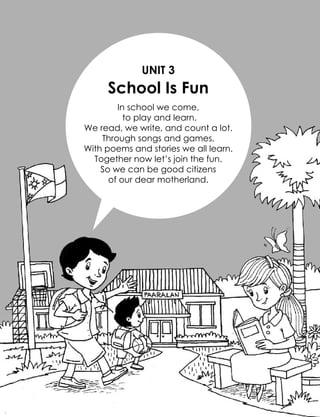
UNIT 3

School Is Fun
In school we come,
to play and learn.
We read, we write, and count a lot.
Through songs and games,
With poems and stories we all learn.
Together now let’s join the fun.
So we can be good citizens
of our dear motherland.
UNIT 3

School Is Fun
Lesson 1: Noting Details
Let’s Try
	

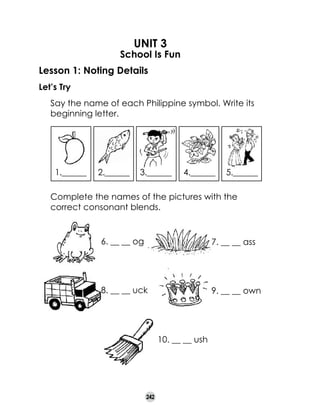
Say the name of each Philippine symbol. Write its
beginning letter.

1.______
	

2.______

3.______

4.______

5.______

Complete the names of the pictures with the
correct consonant blends.

6. __ __ og	

7. __ __ ass

8. __ __ uck	

9. __ __ own	

10. __ __ ush	

242
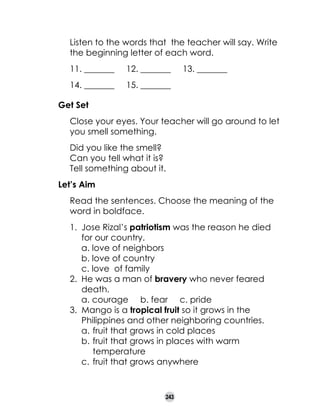
Listen to the words that the teacher will say. Write
the beginning letter of each word.
11. _______

12. _______

14. _______

13. _______

15. _______

Get Set
	

Close your eyes. Your teacher will go around to let
you smell something.


Did you like the smell?
Can you tell what it is?
Tell something about it.

Let’s Aim
	

Read the sentences. Choose the meaning of the
word in boldface.
1.	 Jose Rizal’s patriotism was the reason he died
for our country.
a. love of neighbors
b. love of country
c. love of family
2.	 He was a man of bravery who never feared
death.
a. courage b. fear c. pride
3.	 Mango is a tropical fruit so it grows in the
Philippines and other neighboring countries.
a.	fruit that grows in cold places
b.	fruit that grows in places with warm
temperature
c.	 fruit that grows anywhere

243
4.	 We should plant more trees to have more
lumber for making furniture.
a. wood b. metal c. house
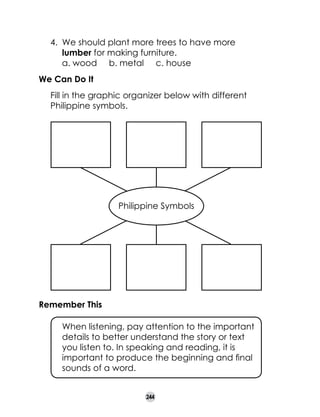
We Can Do It
	

Fill in the graphic organizer below with different
Philippine symbols.

Philippine Symbols

Remember This
	

When listening, pay attention to the important
details to better understand the story or text
you listen to. In speaking and reading, it is
important to produce the beginning and final
sounds of a word.
244
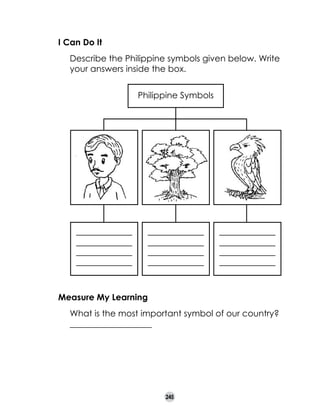
I Can Do It
	

Describe the Philippine symbols given below. Write
your answers inside the box.
Philippine Symbols

Measure My Learning
	

What is the most important symbol of our country?
___________________

245
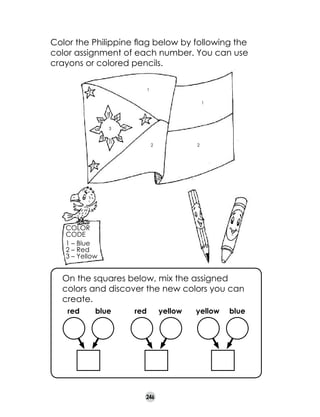
Color the Philippine flag below by following the
color assignment of each number. You can use
crayons or colored pencils.
1

3

1
3
3
2

2

3

Color
code
1 – Blue
2 – Red
3 – Yellow


On the squares below, mix the assigned
colors and discover the new colors you can
create.
red

blue

red

246

yellow

yellow

blue
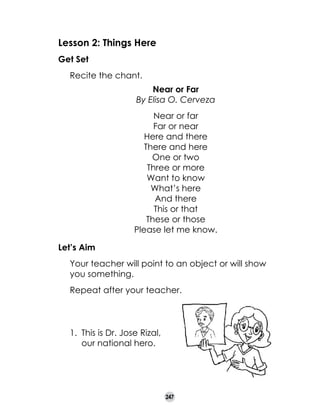
Lesson 2: Things Here
Get Set
	

Recite the chant.
Near or Far
By Elisa O. Cerveza

	
Let’s Aim

Near or far
Far or near
Here and there
There and here
One or two
Three or more
Want to know
What’s here
And there
This or that
These or those
Please let me know.


Your teacher will point to an object or will show
you something.


Repeat after your teacher.

1.	 This is Dr. Jose Rizal,
our national hero.

247
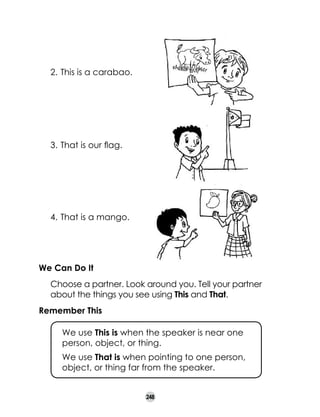
2.	 This is a carabao.


3.	 That is our flag.


4.	 That is a mango.

We Can Do It
	

Choose a partner. Look around you. Tell your partner
about the things you see using This and That.

Remember This
	

We use This is when the speaker is near one
person, object, or thing.


We use That is when pointing to one person,
object, or thing far from the speaker.
248
Measure My Learning
	

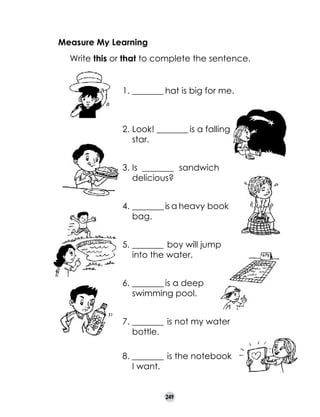
Write this or that to complete the sentence.
1.	________ hat is big for me.	

2.	Look! ________ is a falling
star.
3.	Is ________ sandwich
delicious?
4.	________ is a heavy book
bag.
5.	________ boy will jump
into the water.
6.	________ is a deep
swimming pool.
7.	________ is not my water
bottle.
8.	________ is the notebook
I want.
249
Lesson 3: Things There
Get Set
	

Recite the chant “Near or Far.”

Let’s Aim
	

Listen to your teacher and repeat what he/she says.

We Can Do It
	

Choose a partner. Go to the school ground or
garden or look outside. Talk about the things you
see using These are and Those are.

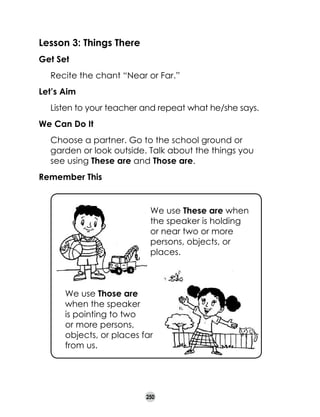
Remember This
We use These are when
the speaker is holding
or near two or more
persons, objects, or
places.

We use Those are
when the speaker
is pointing to two
or more persons,
objects, or places far
from us.

250
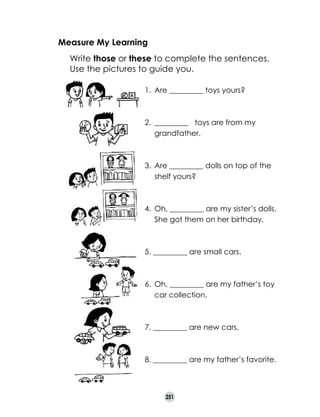
Measure My Learning
	

Write those or these to complete the sentences.
Use the pictures to guide you.
1. 	Are _________ toys yours?

2. 	_________ . toys are from my
grandfather.

3.	 Are _________ dolls on top of the
shelf yours?

4. 	Oh, _________ are my sister’s dolls.
She got them on her birthday.

5. _________ are small cars.

6. 	Oh, _________ are my father’s toy
car collection.

7. _________ are new cars.

8. _________ are my father’s favorite.

251
Lesson 4: Consonant Clusters/Blends

cr

br

gr

spr

tr

Get Set
	

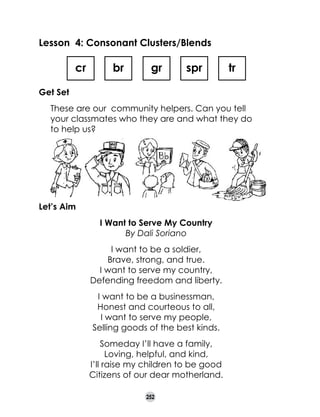
These are our community helpers. Can you tell
your classmates who they are and what they do
to help us?

Let’s Aim


I Want to Serve My Country
By Dali Soriano


I want to be a soldier,
Brave, strong, and true.
I want to serve my country,
Defending freedom and liberty.


I want to be a businessman,
Honest and courteous to all,
I want to serve my people,
Selling goods of the best kinds.


Someday I’ll have a family,
Loving, helpful, and kind,
I’ll raise my children to be good
Citizens of our dear motherland.
252
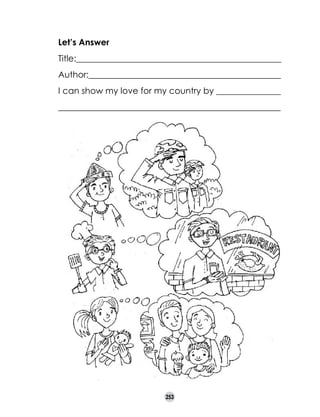
Let’s Answer
Title:________________________________________________
Author:_____________________________
________________
I can show my love for my country by _______________
____________________________________________________

253
We Can Do It
	

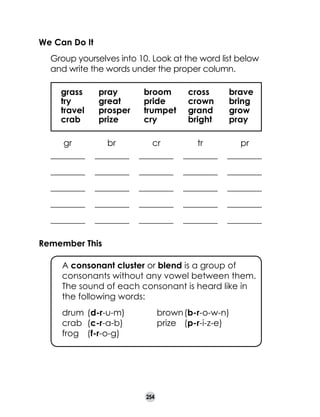
Group yourselves into 10. Look at the word list below
and write the words under the proper column.


grass	
try	
travel	
crab	

pray	
great	
prosper	
prize	

broom	
pride	
trumpet	
cry
	

cross	
crown	
grand	
bright	

brave
bring
grow 	
pray

gr
________

br
________

cr
________

tr
________

pr
________

________

________

________

________

________

________

________

________

________

________

________

________

________

________

________

________

________

________

________

________

Remember This
	

A consonant cluster or blend is a group of
consonants without any vowel between them.
The sound of each consonant is heard like in
the following words:


drum	 (d-r-u-m) 	
crab	 (c-r-a-b)	
frog	 (f-r-o-g)
brown	(b-r-o-w-n)
prize 	 (p-r-i-z-e)

254
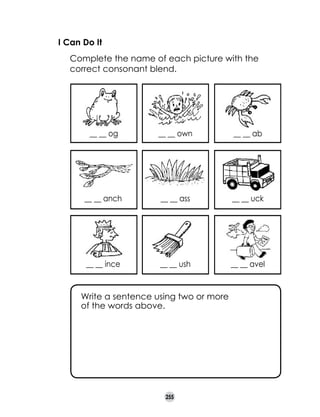
I Can Do It
	

Complete the name of each picture with the
correct consonant blend.

__ __ og

__ __ own

__ __ ab

__ __ anch

__ __ ass

__ __ uck

__ __ ince

__ __ ush

__ __ avel

Write a sentence using two or more
of the words above.

255
Lesson 5: A Proud Filipino Boy
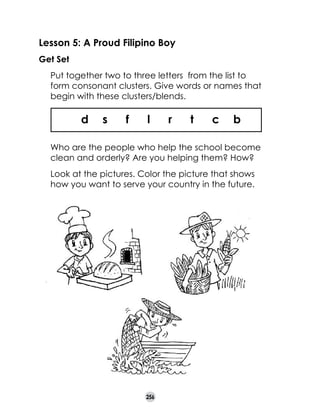
Get Set
	

Put together two to three letters from the list to
form consonant clusters. Give words or names that
begin with these clusters/blends.

d

s

f

l

r

t

c

b


Who are the people who help the school become
clean and orderly? Are you helping them? How?


Look at the pictures. Color the picture that shows
how you want to serve your country in the future.

256
Let’s Aim


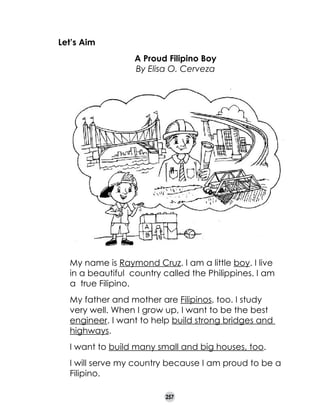
A Proud Filipino Boy
By Elisa O. Cerveza


My name is Raymond Cruz. I am a little boy. I live
in a beautiful country called the Philippines. I am
a true Filipino.


My father and mother are Filipinos, too. I study
very well. When I grow up, I want to be the best
engineer. I want to help build strong bridges and
highways.


I want to build many small and big houses, too.


I will serve my country because I am proud to be a
Filipino.
257
Let’s Answer
	

Comprehension Check-up
1. Who is Raymond Cruz?___________
______________
2. Where does he live?___________________________
3. What makes him a true Filipino?________________
4. What does he want to be when he grows up?
	 ______________________________________________
5. How does he want to serve his country?________
	 ______________________________________________
6. Are you a proud Filipino too? How can you
show that? ___________________________________
	 ______________________________________________
7. How will you serve your country?_______________
	 ______________________________________________

I Can Do It
	

Tell something about yourself as a proud
Filipino. Read the story again and substitute the
underlined words with details about yourself.

258
Measure My Learning
	

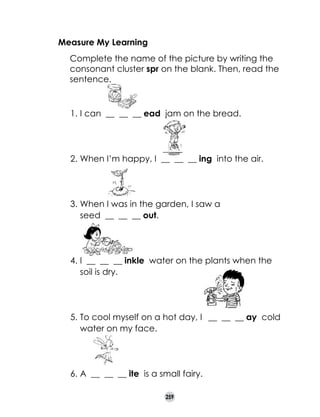
Complete the name of the picture by writing the
consonant cluster spr on the blank. Then, read the
sentence.

1.	I can __ __ __ ead jam on the bread.

2.	When I’m happy, I __ __ __ ing into the air.

3.	When I was in the garden, I saw a
seed __ __ __ out.

4.	I __ __ __ inkle water on the plants when the
soil is dry.

5.	To cool myself on a hot day, I __ __ __ ay cold
water on my face.

6.	A __ __ __ ite is a small fairy.
259
Lesson 6: Which Word?
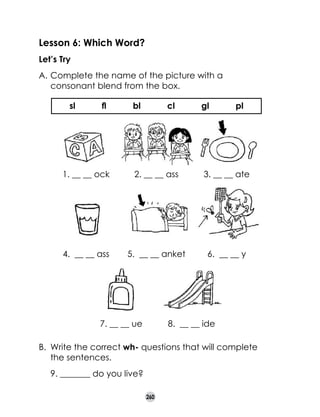
Let’s Try
A.	Complete the name of the picture with a
consonant blend from the box.
sl

fl

bl

cl

gl

pl

1. __ __ ock

2. __ __ ass

3. __ __ ate

4.  __ __ ass

5.  __ __ anket

6.  __ __ y

7. __ __ ue

8.  __ __ ide

B.	 Write the correct wh- questions that will complete
the sentences.
	

9. _______ do you live?
260
10. _______ is your favorite cartoon character?
11. _______ is your best friend?
12. _______ are you late?
13. _______ do you make a paper flower?
14. _______ will you pass your project?
15. _______ is the name of your English teacher?
C. Put a J on the blank if the sentence shows love
for the members of the family or people in school
and L if it does not.
________16.	 Sara helps her mother in doing the 	 	
	
household chores.
________17.	 Rafael does not ask permission from 	
	
his parents whenever he leaves the 		
	
house.
________18.	 Dennis always prays for the safety of 	
	
his family.
________19.	 Sheryl often gets things of her 	 	
	
	
classmates without asking permission.
________ 20.	Marie always greets her teachers 	 	
	
whenever she sees them.
Get Set
	

Today you will listen to the story of Wilma, a girl
who was crippled by polio when she was four
years old. Find out how she became a basketball
champion and Olympic winner in track and field.

261
Let’s Listen
Wilma’s Fight to Win
From Pat Nelson’s Magic Minutes:
Quick Read-Alouds for Every Day
Retold by Dali Soriano
Wilma Rudolph was an Olympic runner. When
she was born, everyone did not think she would
live. She was a very small baby of four and a half
pounds.
When she was four years old, Wilma was crippled
by polio. The doctor told her parents that she
would never walk again. The whole family, all
19 of them, didn’t believe it. Sixteen brothers
and sisters massaged and exercised her leg. Her
parents gave her heat and water treatments.
Everybody helped.
At eight years old, Wilma had a leg brace. Even
when she had a limp, she played basketball with
her brothers and sometimes, by herself. When she
was 11 years old, she played basketball on her
bare feet. Everyone was amazed. At 15 years old
she became a basketball champion.
Wilma was excellent in track and field. When
she joined the Olympics in Melbourne, Australia,
she got a bronze medal as a member of the US
Olympic relay team. In the Summer Olympics in
Rome, she won three gold medals in track and
field events. She was voted US Female Athlete of
the Year, “World’s Fastest Woman.” The little girl
whom doctors said would never be able to walk
262
got a bronze and three gold medals. Every athlete
that participated admired and respected her.
But more than that, a loving family transformed
Wilma into a real winner.
Let’s Answer
1.	 How did Wilma become crippled?
	 ______________________________________________
2	 What did Wilma’s family do to make her walk?
	 ______________________________________________
3.	 What made Wilma a real winner?
	 ______________________________________________
4.	 How did Wilma’s family show their love and
concern for her?
	 ______________________________________________
5.	 If you were Wilma, how would you feel about
yourself?
	 ______________________________________________
6.	 Is there any member of your family who is like
Wilma who needs your love and concern? How
do you show your love to  him or her?
	 ______________________________________________
7.	 In school, how do you show your love and
concern to your classmates? To your teacher?
	 ______________________________________________

263
We Can Do It
	

Put this graphic organizer on a manila paper and
present your work in front of the class.


Who is the main character in the story?


Describe her using the following timeline.
Newborn

At eight

At eleven

At fifteen

Beyond 	
fifteen
Track
and field
champion

I Can Do It
	

Retell the story by recalling the important events
using the completed timeline.
264
Lesson 7: Talented Too
We Can Do It
	

Match the picture of the important event with the
appropriate age level of Wilma.

Beyond 15
At fifteen
At eight
At four

A

B

C

D

I Can Do It
	

Retell the story using the  series of pictures 	
in We Can Do It.

265

E
Lesson 8:	Tell Me Who, What, Where,
	
When, Why, and How
Let’s Aim
	

Read the following statements and questions.
Underline the word or phrase in the sentence that
answers each question.
1.	 Wilma was crippled by polio.
	 (Who was crippled by polio?)
2. The doctor told her parents that she would never
walk again because she was crippled by polio.
	 (Why did the doctor say that she would never
walk again?)
3. 	Her parents gave her heat and water treatment.
	 (What did her parents give her?)
4. 	When she was 11 years old, she played basketball.
	 (When did she play basketball?)
5.	 She won three gold medals in the Summer
Olympics in Rome.	
(Where did she win the Summer Olympics gold
medals?)
6.	 She became a real winner through the love
and concern of her family.	
(How did she become a real winner?)

Let’s Answer
	

What words/ interrogatives are we going to use if
we want to ask about a person? A thing or idea?
Time? Place? Reason?

266
What specific details do we use to answer the
following questions?


Who?       ________________
What?      ________________
Where?    ________________
When?     ________________
Why?       ________________
How?       ________________

We Can Do It
	

Choose a partner. Get to know more about him or
her by asking and answering questions that begin
with who, what, where, when, why, and how.

Remember This


We use interrogatives in asking for information.
Who is used when asking about persons.	
What is used when asking about things, ideas, 	
or events.
Where is used when asking about places.
When is used when asking about time.
Why is used when asking about reasons or
causes.
How is used when asking about the way the
thing is done.

267
I Can Do It
1.	 Answer the following questions.


a.	 Who are you?	
(person)

Sample 	
Answers	

Your 	 	
Answers

Henry	

__________

b.	 Where are you?	 in school	
(place)

__________

c.	 When do you 	
come here?  	

every day	

__________

d.	 What is in your 	
hand? (thing)	

pencil	

__________

e.	 What are you	
	 thinking?	

winning medals	

f.	 Why?	


I want to be	
a champion
like Wilma.

__________

2.	 Write a story using your answers.
	

Example: I am Henry. I am in school. I have a
pencil. I am thinking of winning medals. I want to
be a champion like Wilma.


Your story:
_________________________________________________
_________________________________________________
_____________________________________________________
_____________________________________________________

3.	 Read your sentences aloud one at a time. Your
classmates should guess the question word for
each answer.
268
Lesson 9:	I Love My Family
	
and Everyone in School
Get Set
	

How do you show your love and concern for your
family and classmates?

Love

Let’s Aim
My Family, My Treasure
By Amcy M. Esteban


I truly love my family
For guiding and loving me.
They give me love and happiness,
Like a treasure chest filled with riches.

Let’s Answer
	

Use the poem to answer the following questions.
1. 	What is the author telling us about her family?
2. 	What kind of a person is she?
3. 	How can you show love and concern for your
family?
4. 	Do you also love your family? Your classmates?
Your teachers? How do you show it?
5. 	If you feel that your classmate does not like
you, would you still like him? Why? Why not?

269
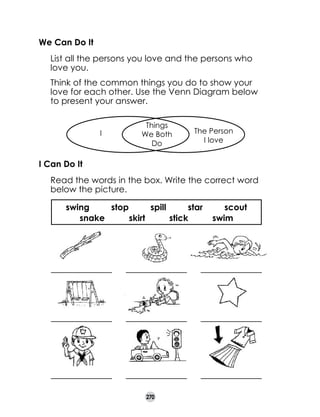
We Can Do It
	

List all the persons you love and the persons who
love you.


Think of the common things you do to show your
love for each other. Use the Venn Diagram below
to present your answer.
I

Things
We Both
Do

The Person
I love

I Can Do It
	

Read the words in the box. Write the correct word
below the picture.
swing
stop
spill
star
snake
skirt
stick

270

scout
swim
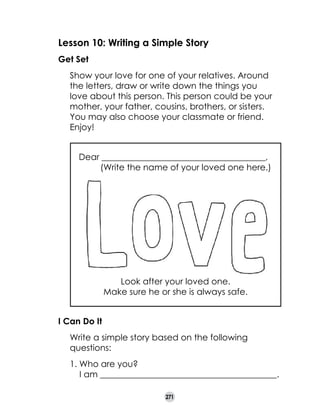
Lesson 10: Writing a Simple Story
Get Set
	

Show your love for one of your relatives. Around
the letters, draw or write down the things you
love about this person. This person could be your
mother, your father, cousins, brothers, or sisters.
You may also choose your classmate or friend.
Enjoy!
Dear ______________________________________,	
         (Write the name of your loved one here.)

Look after your loved one.
Make sure he or she is always safe.
I Can Do It
	

Write a simple story based on the following
questions:
1. Who are you?
    I am _________________________________________.
271
2. Who is your loved one?	
My loved one is_______________________________.
Or 	
My loved ones are _______________________ ____.
_
3. Why do you love her or him?	
I love him or her because _____________________.
4. How do you show your love for him or her?	
I show my love for him or her by_____________
___.
Remember This
	

Show your love for your parents by helping 	
in the household chores. Show also your
concern for your teacher and classmates 	
by helping clean your classroom.

Measure My Learning
	

Write a short story or paragraph about your family.
Use the previous activity in I Can Do It as your
guide. (10 pts.)
	

I am _____________________________. I love my


______________________ because _________
____


____________________________________________


I show my love to my _____________________
___


by _________________________________________.

272
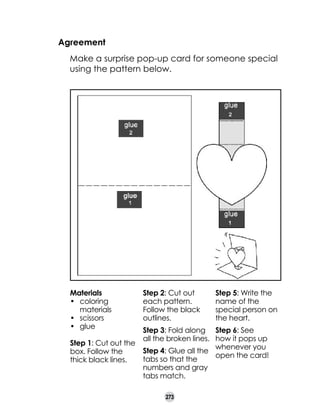
Agreement
	

Make a surprise pop-up card for someone special
using the pattern below.

Materials
•	 coloring
	 materials
•	 scissors
•	 glue

Step 2: Cut out
each pattern.
Follow the black
outlines.

Step 5: Write the
name of the
special person on
the heart.

Step 3: Fold along Step 6: See
all the broken lines. how it pops up
Step 1: Cut out the
whenever you
Step 4: Glue all the
box. Follow the
open the card!
tabs so that the
thick black lines.
numbers and gray
tabs match.
273
Lesson 11: Real or Made-up
Let’s Try
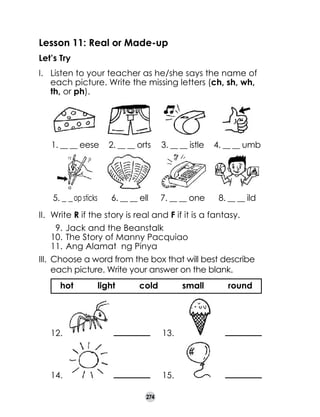
I. 	 Listen to your teacher as he/she says the name of
each picture. Write the missing letters (ch, sh, wh,
th, or ph).

1. __ __ eese

2. __ __ orts

3. __ __ istle

4. __ __ umb

5. _ _ op sticks

6. __ __ ell

7. __ __ one

8. __ __ ild

II. 	Write R if the story is real and F if it is a fantasy.
9.	Jack and the Beanstalk
10.	The Story of Manny Pacquiao
11.	Ang Alamat ng Pinya
III. 	Choose a word from the box that will best describe
each picture. Write your answer on the blank.
hot

light

cold

small

12.

13.

14.

15.
274

round
Let’s Listen
The Pixies and the Lazy Housewife
By Mary Calhoun
Retold by Dali Soriano
Long ago in England, people believed in pixies.
These invisible little people loved neatness. They
cleaned the house of people they liked. They
play tricks on lazy housewives. Bessy was a messy
housewife. She didn’t want to wash the dishes.
She never swept the floor of her cottage. Mice
made a nest behind her broom. It was strange
that the pixies did not punish her.
One summer, Bessy saw pixies in the field. Bessy
pretended to be sick. She groaned, saying, “Oh, I
am too sick to clean my house. Please help me.”
“What’s the matter?” said a pixie. Bessy said,
“Who is that?” A pixie replied, “It’s Willy. I’ll help
you.” “Thank you, please come home with me,”
Bessy said. Willy and the pixies jumped into Bessy’s
basket. When they got home, Bessy went straight
to bed. The pixies started cleaning. They washed
the dishes and the dirty clothes. They scrubbed
the floor and swept away the cobwebs.
The next day, Willy went to Bessy’s bed and asked,
“Can you get up today?” Bessy just groaned and
said, “I’m still too sick to get up.” So the pixies
cleaned the house again. When they left, Bessy
jumped and sang. “Tralalala. I have the pixies
to work for me. I can just stay in bed.” Bessy did
not know that the pixies were watching her. Willy
laughed, “Hahaha, playing a trick on us? Here,
275
take this.” Willy pinched Bessy’s nose. The other
pixies messed up the house. They ate all the food
and blew out the candles. Bessy ran out of the
house but the hill was misty. Bessy got lost. When
the mist cleared up, Bessy went home. When she
got home, Willy was in her house. “Get to work,
lazy Bessy, or I’ll pinch you,” commanded Willy.
When the house was clean, the pixies left. Bessy
always cleaned her house after that. Willy and the
other pixies might come back.
Comprehension Questions:
1. 	Why did Bessy pretend to be sick?
2. 	Would you like to live in Bessy’s house? Why?
3. 	What can you do to keep your house clean?
We Can Do It
	

Recall the important events and tell which of them
could happen in real life (real) and which are
made-up (fiction).


Write the fiction or made-up events in the circles
on the left. Write the “real” events in the circles on
the right.

Fantasy

Real

276
I Can Do It
	

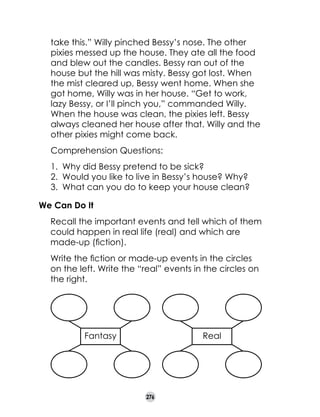
Look at the picture of the story “The Pixies and the
Lazy Housewife.”


Color all things which really exist with any color of
your choice except yellow.


Use yellow to color all the things that are not real.

277
Lesson 12: Fiction or Non-Fiction
Let’s Try
	

Tell whether the event is a fiction or non-fiction.
1.	 Bessy’s house was messy.
2.	 The pixies cleaned her house.
3.	 The pixies punished Bessy.
4.	 Bessy was a lazy wife.
5.	 The pixies love cleanliness.


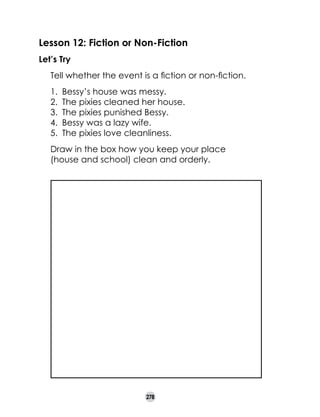
Draw in the box how you keep your place
(house and school) clean and orderly.

278
Lesson 13: Adjectives
We Can Do It
	

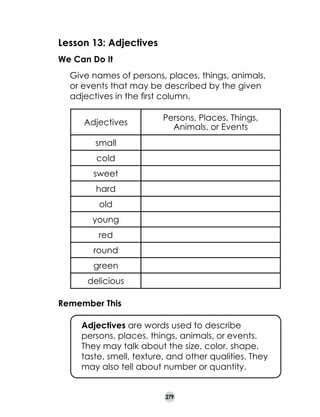
Give names of persons, places, things, animals,
or events that may be described by the given
adjectives in the first column.
Adjectives

Persons, Places, Things,
Animals, or Events

small
cold
sweet
hard
old
young
red
round
green
delicious
Remember This
	

Adjectives are words used to describe
persons, places, things, animals, or events.
They may talk about the size, color, shape,
taste, smell, texture, and other qualities. They
may also tell about number or quantity.
279
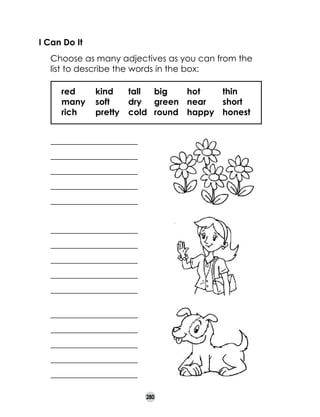
I Can Do It
	

Choose as many adjectives as you can from the
list to describe the words in the box:
	 red	
kind	 tall	 big	
hot	
thin
	 many	 soft	
dry	 green	 near	
short
	 rich	
pretty	 cold	 round	 happy	 honest
_____________________
_____________________
_____________________
_____________________
_____________________
_____________________
_____________________
_____________________
_____________________
_____________________
_____________________
_____________________
_____________________
_____________________
_____________________
280
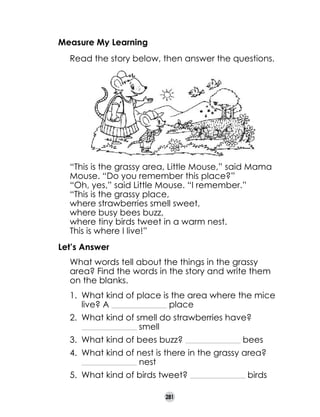
Measure My Learning
	

Read the story below, then answer the questions.


“This is the grassy area, Little Mouse,” said Mama
Mouse. “Do you remember this place?”
“Oh, yes,” said Little Mouse. “I remember.”
“This is the grassy place,
where strawberries smell sweet,
where busy bees buzz,
where tiny birds tweet in a warm nest.
This is where I live!”


Let’s Answer
	

What words tell about the things in the grassy
area? Find the words in the story and write them
on the blanks.
1.	 What kind of place is the area where the mice
live? A
place
______________________________________

2.	 What kind of smell do strawberries have?
smell
______________________________________

3.	 What kind of bees buzz?

______________________________________

bees

4. 	What kind of nest is there in the grassy area?
nest
______________________________________

5.	 What kind of birds tweet?
281

______________________________________

birds
Lesson 14: What Sound?
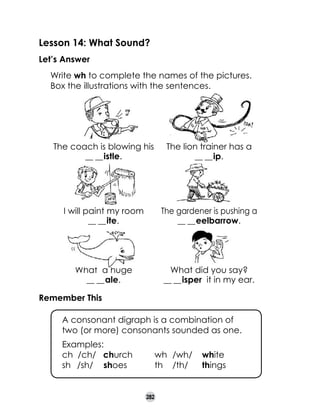
Let’s Answer


Write wh to complete the names of the pictures.
Box the illustrations with the sentences.

The coach is blowing his
__ __ istle.

The lion trainer has a
__ __ ip.

I will paint my room
__ __ ite.

The gardener is pushing a
__ __ eelbarrow.

What a huge
__ __ ale.

What did you say?
__ __ isper it in my ear.

Remember This
	

A consonant digraph is a combination of
two (or more) consonants sounded as one.


Examples:
ch /ch/ church	
sh	 /sh/	 shoes	

wh	 /wh/	 white
th	 /th/	 things

282
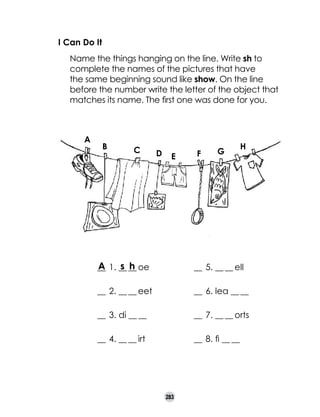
I Can Do It
	

Name the things hanging on the line. Write sh to
complete the names of the pictures that have
the same beginning sound like show. On the line
before the number write the letter of the object that
matches its name. The first one was done for you.

A

B

C

D

E

F

G

H

A
s h
__ 1. __ __ oe

__ 5. __ __ ell

__ 2. __ __ eet

__ 6. lea __ __

__ 3. di __ __

__ 7. __ __ orts

__ 4. __ __ irt

__ 8. fi __ __

283
Measure My Learning
	

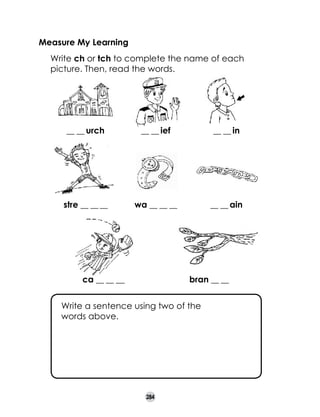
Write ch or tch to complete the name of each
picture. Then, read the words.

__ __ urch

__ __ ief

__ __ in

stre __ __ __

wa __ __ __

__ __ ain

ca __ __ __

bran __ __

Write a sentence using two of the
words above.

284
Lesson 15: 	 riting a Simple Story
W
	
Using Adjectives
Measure My Learning
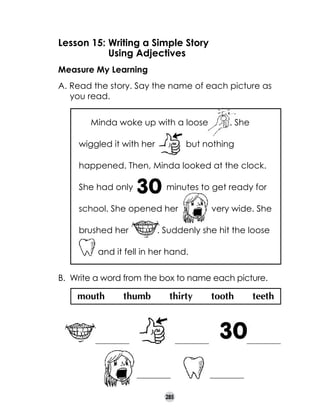
A. Read the story. Say the name of each picture as
you read.
Minda woke up with a loose
wiggled it with her

. She

but nothing

happened. Then, Minda looked at the clock.
She had only

minutes to get ready for

school. She opened her
brushed her

very wide. She

. Suddenly she hit the loose

and it fell in her hand.
B. 	Write a word from the box to name each picture.

mouth

thumb

thirty

___________

tooth

___________

___________
285

teeth

___________

___________
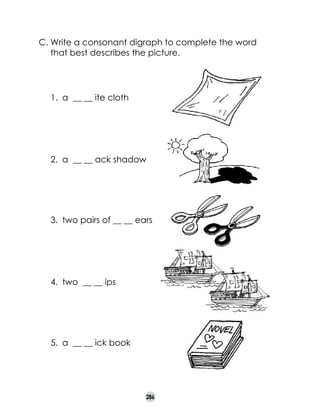
C.	Write a consonant digraph to complete the word
that best describes the picture.

1. 	a __ __ ite cloth

2. 	a __ __ ack shadow

3. 	two pairs of __ __ ears

4. 	two __ __ ips

5. 	a __ __ ick book

286
Lesson 16: What Do You Mean?
Let’s Try

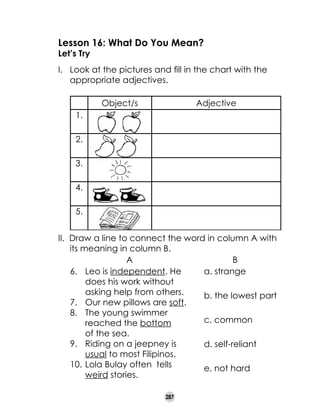
I.	 Look at the pictures and fill in the chart with the
appropriate adjectives.
Object/s

Adjective

1.
2.
3.
4.
5.
II.  Draw a line to connect the word in column A with
its meaning in column B.
A
B
6.	 Leo is independent. He
a. strange
does his work without
asking help from others.
b. the lowest part
7.	 Our new pillows are soft.
8. 	 The young swimmer
c. common
reached the bottom
of the sea.
9. 	 Riding on a jeepney is
d. self-reliant
usual to most Filipinos.
10.	Lola Bulay often  tells
e. not hard
weird stories.
287
III. 	Write the initial consonant digraph of the each
word below.
11. ___ ___ ine	

14. ___ ___ at

12. ___ ___ op	

15. ___ ___ arp

13. ___ ___ eel
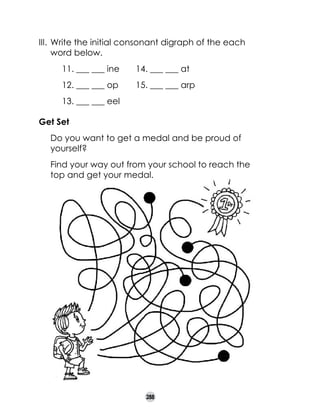
Get Set
	

Do you want to get a medal and be proud of
yourself?


Find your way out from your school to reach the
top and get your medal.

288
Let’s Listen
	

Listen as your teacher reads the story of Lot-Lot.
Find out what she does to be bright.

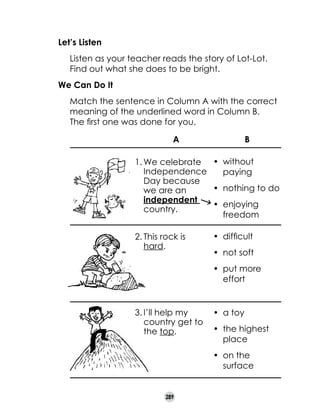
We Can Do It
	

Match the sentence in Column A with the correct
meaning of the underlined word in Column B.
The first one was done for you.
A

B

1.	We celebrate
Independence
Day because
we are an
independent
country.

•	 without 	
	 paying

2.	This rock is
hard.


•	 difficult

•	 nothing to do
•	 enjoying
	 freedom

•	 not soft
•	 put more 	 	
	 effort

3.	I’ll help my
country get to
the top.

•	 a toy
•	 the highest
	 place
•	 on the 		
	 surface

289
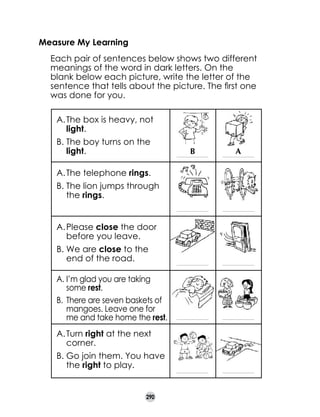
Measure My Learning
	

Each pair of sentences below shows two different
meanings of the word in dark letters. On the
blank below each picture, write the letter of the
sentence that tells about the picture. The first one
was done for you.
A.	The box is heavy, not
light.
B.	The boy turns on the
light.

B

A

__________________________

__________________________

__________________________

__________________________

__________________________

__________________________

__________________________

__________________________

__________________________

__________________________

A.	The telephone rings.
B.	The lion jumps through
the rings.
A.	Please close the door
before you leave.
B.	We are close to the
end of the road.
A.	I’m glad you are taking
some rest.
B.	 There are seven baskets of
mangoes. Leave one for
me and take home the rest.
A.	Turn right at the next
corner.
B.	Go join them. You have
the right to play.

290
Lesson 17: Good Study Habits
Let‘s Read
	

Read the short poem silently.


I Study Hard
By Amcy M. Esteban
I study hard in school every day.
I do my homework before I play.
I follow my teachers when they say,
“Just do your best and have a successful day.”

Let’s Answer
1.	 When does the child study hard?
	

______________________________________________

2.	 Do you finish your homework before you play?
Why or why not?
		 _______________________________________________
3.	 What does the teacher say in the poem?
		 _______________________________________________
4.	 Why do you need to follow your teacher?
	

______________________________________________

5.	 Why does a child need to study hard?
	

______________________________________________

291
Lesson 18: Let’s Give a Clearer Picture
Get Set


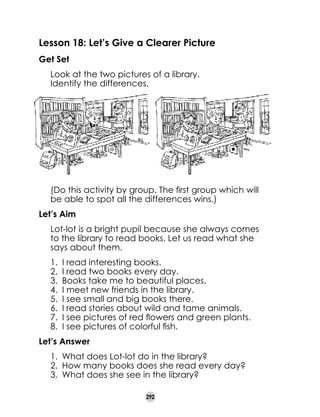
Look at the two pictures of a library.
Identify the differences.


(Do this activity by group. The first group which will
be able to spot all the differences wins.)

Let’s Aim
	

Lot-lot is a bright pupil because she always comes
to the library to read books. Let us read what she
says about them.
1.	 I read interesting books.
2.	 I read two books every day.
3.	 Books take me to beautiful places.
4.	 I meet new friends in the library.
5.	 I see small and big books there.
6.	 I read stories about wild and tame animals.
7.	 I see pictures of red flowers and green plants.
8.	 I see pictures of colorful fish.

Let’s Answer
1.	 What does Lot-lot do in the library?
2.	 How many books does she read every day?
3.	 What does she see in the library?
292
We Can Do It
	

Read each sentence again  and identify the
adjective used and the word it describes. Write
your answers in the proper column.
          Adjectives

Word Described

1.
2.
3.
4.
5.
6.
7.
8.
Remember This
	

Adjectives give us a clearer picture of a
person, place, thing,  animal, idea, or event.
It also tells us  the number or  quantity.

I Can Do It
	

Coming to school does not only make us learn. It
gives us fun, too. Choose and describe one from
the following that makes you excited in coming to
school.  Use appropriate adjectives.
1.	 important person in school who inspires you
(e.g., teacher, principal, classmate, librarian)
2.	 favorite place in school (classroom, library,
reading corner, canteen, computer room,
science laboratory, home economics room)
293
3.	 favorite school activity (experiment, reciting
poems, reading stories, group work, art
activities, P.E. activities, sports, Music, etc.)
4.	 your best friend

Lesson 19: Just One Sound
Get Set
	

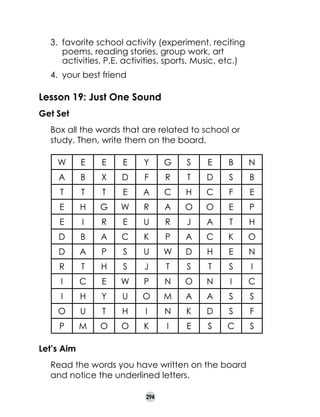
Box all the words that are related to school or
study. Then, write them on the board.
W

E

E

E

Y

G

S

E

B

N

A

B

X

D

F

R

T

D

S

B

T

T

T

E

A

C

H

C

F

E

E

H

G

W

R

A

O

O

E

P

E

I

R

E

U

R

J

A

T

H

D

B

A

C

K

P

A

C

K

O

D

A

P

S

U

W

D

H

E

N

R

T

H

S

J

T

S

T

S

I

I

C

E

W

P

N

O

N

I

C

I

H

Y

U

O

M

A

A

S

S

O

U

T

H

I

N

K

D

S

F

P

M

O

O

K

I

E

S

C

S

Let’s Aim
	

Read the words you have written on the board
and notice the underlined letters.
294
We Can Do It
	

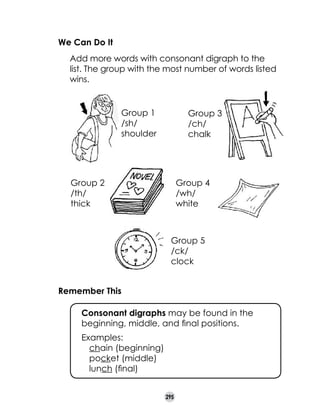
Add more words with consonant digraph to the
list. The group with the most number of words listed
wins.

Group 1
/sh/
shoulder

Group 3
/ch/
chalk

Group 4
/wh/
white

Group 2
/th/
thick

Group 5
/ck/
clock
Remember This


Consonant digraphs may be found in the
beginning, middle, and final positions.
Examples:
	 chain (beginning)
	 pocket (middle)
	 lunch (final)
295
I Can Do It
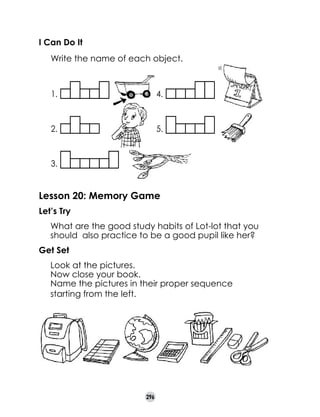
     Write the name of each object.

1.

4.

2.

5.

3.

Lesson 20: Memory Game
Let’s Try
	

What are the good study habits of Lot-lot that you
should  also practice to be a good pupil like her?

Get Set


Look at the pictures.
Now close your book.
Name the pictures in their proper sequence
starting from the left.

296
Let’s Aim
	

Studying well is a good habit to develop.
Memorizing important details is very helpful. Here
is a memory game to help you have fun while
memorizing things.

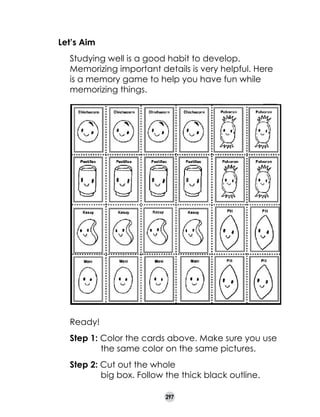
Ready!
Step 1: Color the cards above. Make sure you use 	
	
the same color on the same pictures.
Step 2: Cut out the whole
	
big box. Follow the thick black outline.
297
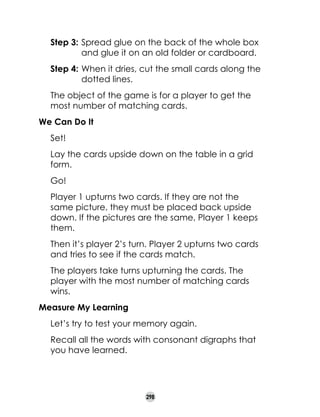
Step 3:	Spread glue on the back of the whole box 	
	
and glue it on an old folder or cardboard.
Step 4:	When it dries, cut the small cards along the 	
	
dotted lines.
	

The object of the game is for a player to get the
most number of matching cards.

We Can Do It
	

Set!


Lay the cards upside down on the table in a grid
form.


Go!


Player 1 upturns two cards. If they are not the
same picture, they must be placed back upside
down. If the pictures are the same, Player 1 keeps
them.


Then it’s player 2’s turn. Player 2 upturns two cards
and tries to see if the cards match.


The players take turns upturning the cards. The
player with the most number of matching cards
wins.

Measure My Learning
	

Let’s try to test your memory again.


Recall all the words with consonant digraphs that
you have learned.

298
Lesson 21: I Can Follow Directions
Let’s Try
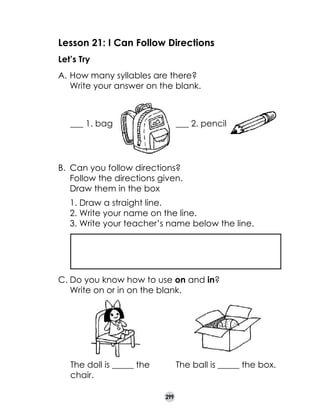
A.	How many syllables are there? 	
Write your answer on the blank.

___ 1. bag

___ 2. pencil

B.	 Can you follow directions?
Follow the directions given.
Draw them in the box
1. Draw a straight line.
2. Write your name on the line.
3. Write your teacher’s name below the line.

C.	Do you know how to use on and in?
	 Write on or in on the blank.

The doll is _____ the	
chair.

The ball is _____ the box.  

299
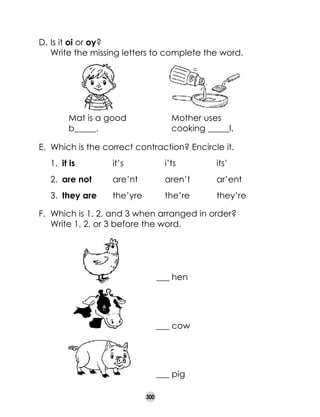
D.	Is it oi or oy?
	 Write the missing letters to complete the word.

Mother uses 	
cooking _____l.

Mat is a good
b_____.

E.	 Which is the correct contraction? Encircle it.
1.	 it is	

it’s	

i’ts	

its’

2. 	are not	

are’nt	

aren’t	

ar’ent

3.	 they are	

the’yre	

the’re	

they’re

F.	 Which is 1, 2, and 3 when arranged in order?
	 Write 1, 2, or 3 before the word.

Draw
hen

___ hen
Draw
cow

___ cow
Draw
pig

___ pig
300
Get Set
	

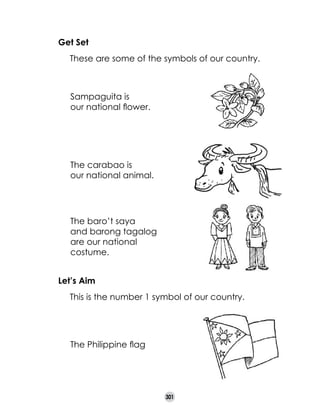
These are some of the symbols of our country.

Sampaguita is 	
our national flower.

The carabao is 	
our national animal.

The baro’t saya
and barong tagalog
are our national
costume.
Let’s Aim
	

This is the number 1 symbol of our country.

The Philippine flag

301
Let’s Aim


Do you respect the Philippine flag? How do 	
you show your respect for the Philippine Flag?
Let us read the story.
Lampin
By Filipina T. Villapando
Retold in English by Dali Soriano
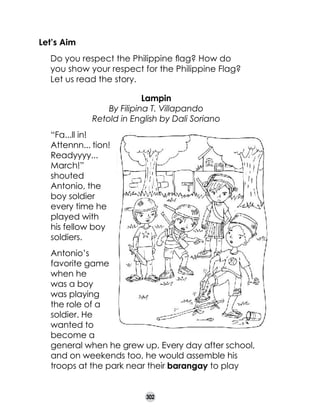
“Fa...ll in!
Attennn... tion!
Readyyyy...
March!”
shouted
Antonio, the
boy soldier
every time he
played with
his fellow boy
soldiers.
Antonio’s
favorite game
when he
was a boy
was playing
the role of a
soldier. He
wanted to
become a
general when he grew up. Every day after school,
and on weekends too, he would assemble his
troops at the park near their barangay to play
302
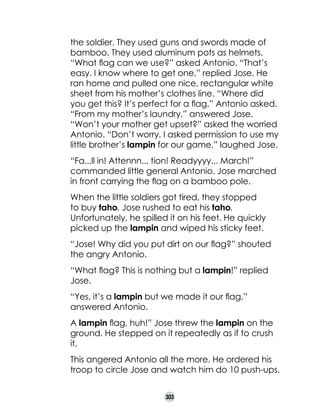
the soldier. They used guns and swords made of
bamboo. They used aluminum pots as helmets.
“What flag can we use?” asked Antonio. “That’s
easy. I know where to get one,” replied Jose. He
ran home and pulled one nice, rectangular white
sheet from his mother’s clothes line. “Where did
you get this? It’s perfect for a flag,” Antonio asked.
“From my mother’s laundry,” answered Jose.
“Won’t your mother get upset?” asked the worried
Antonio. “Don’t worry. I asked permission to use my
little brother’s lampin for our game,” laughed Jose.
“Fa...ll in! Attennn... tion! Readyyyy... March!”
commanded little general Antonio. Jose marched
in front carrying the flag on a bamboo pole.
When the little soldiers got tired, they stopped
to buy taho. Jose rushed to eat his taho.
Unfortunately, he spilled it on his feet. He quickly
picked up the lampin and wiped his sticky feet.
“Jose! Why did you put dirt on our flag?” shouted
the angry Antonio.
“What flag? This is nothing but a lampin!” replied
Jose.
“Yes, it’s a lampin but we made it our flag,”
answered Antonio.
A lampin flag, huh!” Jose threw the lampin on the
ground. He stepped on it repeatedly as if to crush
it.
This angered Antonio all the more. He ordered his
troop to circle Jose and watch him do 10 push-ups.
303
Jose shouted. His mother heard this and rushed to
see what happened. After listening to Antonio’s
story, Jose’s mother picked up the dirty lampin.
Looking Jose straight in the eyes, Jose’s mother
firmly said, “Learn to respect what the flag stands
for. Now do 10 more push-ups!” “I’m sorry,” was all
that Jose could say.
Comprehension Questions:
1. What did the lampin stand for?
2. How do you show respect for our flag?
Let’s Answer
	

Answer the questions correctly.
1.	 Did the boys show respect for the Philippine
flag?
2.	 Who played the role of the general?
3.	 As general, what did Antonio ask his troops to do?
4.	 Why did Antonio get angry?
5.	 If you were Antonio, would you also feel the
same?

Remember This
	

Be exact in following directions so that you 	
will not go wrong.

304
I Can Do It
A.	Do the following directions.
1.	 Draw a circle. Inside the circle, draw a star.
Write your name below the circle.
2.	 Draw a square. Inside the square, draw a
vertical line. Color or shade the left side.
3.	 Draw a letter Y. Put the letter Y inside a standing
rectangle. Draw 3 stars in each corner and a
sun in the middle. The sun should have 8 rays.
B.	 Write the letters of each word in reverse order. The
first one was done for you. The letters of “tar” in
reverse order is “rat.”
tar	
	

rat

pan

tap	

part	

spot	

peels	

on		

pot	

pit		

gut	

305
Lesson 22: I Can Perform
Let’s Aim
	

Read the short poem.


I Am Proud of My Country
By Rose Ann B. Pamintuan


“I am a Filipino,” my teacher said to me.
Wherever I may go, wherever I may be
I should tell others of my country’s beauty.


“I am a Filipino,” my teacher said to me.
Whoever I may meet, whoever I may see
Proud of the Philippines, I should always be.

Let’s Answer


Think of words that begin with each letter.
The words should make you think of our country.
Write the words in the box.
P–

H–

I–

L–

I–

P–

P–

I–

N–

E–

S–

306
We Can Do It


Let us do the action shown in the pictures.
I Am Proud of My Country
By Rose Ann B. Pamintuan
“I am a Filipino,” my teacher
said to me

Wherever I may go,	
wherever I may be

I should tell others of my
country’s beauty

“I am a Filipino,” my teacher
said to me	
	

Whoever I may meet,
whoever I may see	


Proud of the Philippines,
I should always be. 	

307
Lesson 23: I Can Obey
Let’s Aim
	

Read and study the sentences.
1.	 Jose threw the lampin 	
on the ground.	

2.	 Mother keeps the lampin 	
in the cabinet.	


Where did Jose throw the lampin?		
	
on the ground
Where does Mother keep the lampin?	 	
in the cabinet
What are the underlined words?	
on and in

Let’s Answer
	

Picture of lampin
in the cabinet

Draw what is asked.
1.	 The bat is on the bed.

308
2.	 The pencil is in the pencil case.

Remember This
	

On and in are prepositions. They show exactly
where an object is.

I Can Do It
	

Complete the sentences with on or in.

1.

The cat is _____ the mat.

2.

The ball is _____ the chair.

3.

The shoes are _____ the box.

309
4.

The vase is _____ the table.

5.

The bag is _____ the cabinet.

Lesson 24: I Can Match Letter Patterns
Let’s Aim
	

Read and study the sentences.


Antonio is a boy.
His favorite toy is a bamboo gun and sword.


What are the underlined letters?	
/oy/ is a diphthong.


A diphthong is a sound made when two vowel
sounds are put together.

Let’s Practice
A.	Let’s practice reading the following words with
/oi/ or  /oy/.
oil
boil
coil
soil
broil

spoil
joint
point
voice
choice

toy
joy
boy
coy
soy
310

ploy
enjoy
destroy
loyal
royal
B.	 Connect the picture with the /oy/ or /oi/.

oi

oy

oi

oy

Remember This


/oy/ is a diphthong.
A diphthong is a sound made when two 	
vowel sounds are put together.
311
I Can Do It
	

Complete the sentence with the word that has
the same vowel sound like toy.
1.	 The ___________ puts all the books 	
on the table.
boy, joy, toy
	 	     

2.	 Will you ___________ our team?
join, joy, coin
	 	    
          
3.	 Please ___________  to the sign.
oil, toil, point
	 	           

draw
point to the sign

4.	 Another name for dirt is ___________ . 	
coil, soil, oil
                                          

5.	 I hear a loud ___________ .
foil, boil, noise

6.	 Frank spoke in a loud ___________ .
joys, voice, noise
	 	                              
312
Measure My Learning
	

Write (ü) if you hear the diphthong /oy/.
1.	 __________ join	
2.	 __________ story	
3.	 __________ noisy	
4.	 __________ boy	
5.	 __________ floor	

6. __________ coin
7. __________ point
8. __________ train
9. __________ stick
10. _________ boil

Lesson 25: I Can Shorten Words
Let’s Aim
	

Read and study the sentences.


Don’t worry.	
Do not worry.	


That’s, don’t, it’s, and won’t are examples of
contractions.

It’s perfect for a flag.
It is perfect for a flag.	

Won’t your mother get upset?
Will not your mother get upset?

Let’s Answer
Let us practice writing contractions.
1.	 will not	
2.	 do not	
3.	 are not	
4.	 is not	
5.	 cannot	
6.  I am	
7.  did not	
8.	 was not	
9.	 they will	
10.  let us	

won’t 	
don’t	
aren’t	
isn’t	
can’t	
I’m	
didn’t	
wasn’t	
they’ll	
let’s	
313

__________________
__________________
__________________
__________________
__________________
__________________
__________________
__________________
__________________
__________________
Remember This
	

Contractions are the short form of two words. 	
We use an apostrophe (’) in place of the 	
letters we removed.

I Can Do It
	

On the blanks below each sentence, write the two
words that make up each contraction. The first
one was done for you.
1.	 I’m going to help my father in
the store tomorrow.	
I
am
________   ________
2.	 The teacher didn’t see Mario
come in.	
________   ________
3.	 The mango wasn’t good
enough to eat.	
________   ________
4.	 They’ll try to finish their work
this afternoon.	
________   ________
5.	 Let’s send our sick classmate 	
a get-well-soon card.	
________   ________
314
Lesson 26: I Can Retell Stories
Let’s Try
A.	Write under or over to complete the sentence.
1. The bus is passing _______ the
bridge.

2. The bus is passing _______ the
bridge.

3. The dog jumped ________ the
fence.

B.	 Is it ow or ou? Write ow or ou.

4.

c __ __

5.

h __ __ se

6.

bl __ __ se

7.

pl __ __

315
C.	Study the graph then answer the questions.
Grade 2 – Magalang Enrolment
10
8
6
4
2
Boys

Girls

8. How many are the boys?
9. How many are the girls?
10. What is the total number of pupils?
Let’s Aim
	

Let us read the story.
The Old Man and His Sons
From Pat Nelson’s Magic Minutes: 	
Quick Read Alouds for Every Day
Retold by Dali Soriano
Once there was an old man who had many sons.
They always quarrelled with one another. They
quarrelled over who should use the bathroom first.
At meal time, they would fight over who got to the
table first. The old man had often begged his sons
to live together in peace, but without success.
One day, he called them together. He showed
them a bundle of barbecue sticks. He asked
each one of them to break the bundle. Each one
316
tried with all his strength but the bundle did not
break. Then cutting the cord that bound the sticks
together, the old man gave his sons a stick each.
Then he told his sons to break it. This was done with
the greatest ease. The old man exclaimed, “See,
my sons, the power of unity! If you bind yourselves
together with brotherly love, you can win any
fight.”
“Divided you will fall, united you will stand.”
Let’s Answer
	

Answer the questions correctly.
1.	 What did the sons quarrel over always?
2.	 What happened when they fought?
3.	 What did the father tell them when they fought?
4.	 How do you show unity in your family?
5.	 How do you show unity in the classroom?
6.	 Is unity important in our country? Why or why not?

317
We Can Do It
	

Number the pictures 1 to 3. Write a sentence about
each picture.
_______________________
_______________________
_______________________
_______________________
_______________________

_______________________
_______________________
_______________________
_______________________
_______________________

_______________________
_______________________
_______________________
_______________________
_______________________

318
Lesson 27: I Can Respond to Situations
Let’s Read
	

Read the verse.
To Be Honest, To Be True
By Rose Ann B. Pamintuan
I promise to be honest; I promise to be true
I will not tell a lie; I hope you won’t, too.
I will say I am sorry if I do something wrong
To speak the truth always will be my heart’s song.
I will tell you the truth you can always trust me
It’s best to be honest, don’t you agree?

Let’s Answer
	

Study the situation, then act it out.
Ben and Ted are playing catch ball in the house.
Ben throws the ball so hard that Ted is not able
to catch it. The ball hits and breaks the favorite
vase of Nanay. When Nanay arrives home, what
do you think should Ben and Ted do?

We Can Do It
	

Study the situation, then act it out as a group.
Joel, Mark, Jane, Seth, and Dave are classmates.
They are also neighbors. That is why they go to
school together. One morning, on their way to
school, they decide to play in the playground.
They are having so much fun that they forget the
time. When their teacher asks them why they are
late, what should they say and do?
319
Lesson 28: I Can Describe Pictures
Get Set	
	

Study the sentences.
1.	 The blue car is passing over the bridge.
2.	 The red boat is passing under the bridge.

Where is the car passing?  	 over the bridge
Where is the boat passing? 	 under the bridge
Remember This
	

Over is a preposition which means on top of.
Under is a preposition which means below or
beneath.

I Can Do It


Study the pictures.
Complete the sentences by writing under or over.

The boy is __________ the bed.

320
The slippers are __________ 	
the chair.

The man is walking in the 	
__________ pass.

The cars are passing through
the __________ pass.

The helicopter is flying _________
the building.

Measure My Learning


Study the pictures.
Answer the questions using under or over.

1.

Where is the plane flying?
321
2.

Where is the boy sleeping?

3.

Where is the mouse hiding?

4.

Where are the shoes?

5.

Where is the submarine?

322
Lesson 29: I Can Read Graphs
Let’s Aim
	

Read the story. Then, study the graph below.


One day, my family and I visited the farm of Mang
Pedro. I saw lots of animals there. There were
cows, pigs, dogs, ducks, and cats. Mang Pedro
helped me count the animals.


Here is the number of animals in Mang Pedro’s farm.
Number of Mang Pedro’s Animals
5
4
3
2
1

1. 	What were the animals in Mang Pedro’s farm?
2. 	How many cows were there in Mang Pedro’s 	
farm?
3. 	How many pigs were there in Mang Pedro’s 	
farm?
4. 	How many dogs were there in Mang Pedro’s 	
farm?
5. 	How many ducks were there in Mang Pedro’s 	
farm?
6. 	How many cats were there in Mang Pedro’s 	
farm?

323
Let’s Answer
	

Read the story. Then study the graph.	


Beside Mang Pedro’s farm is the vegetable farm
of Mang Jose. Mang Jose sells his vegetables just
along the road.
Mang Jose’s Vegetable Stand

	
5 kilograms
4 kilograms
3 kilograms
2 kilograms
1 kilograms

1.	 How many kilograms of petsay are there in
Mang Juan’s vegetable stand?
2.	 How many kilograms of ampalaya are there in
Mang Juan’s vegetable stand?
3.	 How many kilograms of eggplant are there in
Mang Juan’s vegetable stand?
4.	 How many kilograms of tomatoes are there in
Mang Juan’s vegetable stand?
5.	 How many kilograms of onions are there in
Mang Juan’s vegetable stand?

324
I Can Do It
	

Read the story. Then study the graph.	


Across the street of Mang Pedro’s vegetable
stand is Mang Pablo’s fruit stand.
Mang Pablo’s Fruit Stand

	
5 baskets
4 baskets
3 baskets
2 baskets
1 basket

1.	 How many baskets of oranges are there in
Mang Pablo’s fruit stand?
2.	 How many baskets of pineapples are there in
Mang Pablo’s fruit stand?
3.	 How many baskets of mangoes are there in
Mang Pablo’s fruit stand?
4.	 How many baskets of watermelons are there in
Mang Pablo’s fruit stand?
5.	 How many baskets of apples are there in Mang
Pablo’s fruit stand?
Measure My Learning
	

Read the story. Then study the graph.


Aling Flora is the wife of Mang Pablo. While Mang
Pablo sells fruits, Aling Flora sells flowers.
325
Aling Flora’s Flower Shop
5 dozens
4 dozens
3 dozens
2 dozens
1 dozen

1.	 How many dozens are the roses?
	 There are __________ dozens of roses.
2.	 How many dozens are the sunflowers?
	 There are __________ dozens of sunflowers.
3.	 How many dozens are the mums?
	 There are __________ dozens of mums.
4.	 How many dozens are the daisies?
	 There are __________ dozens of daisies.
5.	 How many dozens are the carnations?
	 There are __________ dozens of carnations.

326
Lesson 30: I Can Connect Sounds
Let’s Aim
	

Recite the rhyme.


A doggie on the street 	
  I found.
It’s running crazily around.
Sniffing the grass and the 	
  ground;
And making loud barking sound.


	 Bow-wow-wow!
	 From such a small doggie I asked how
	 It can make a loud sound;
	 You’d think it’s a big cow.
	
Let’s Answer
	

Answer the following questions correctly.
1.	 What did I find on the street?
2.	 What was it sniffing and making?
3.	 Why would you think it’s a big cow?
4.	 What are the underlined letters?
5.	 What sound do they make together?

Let’s Practice
A.	Read the following words with diphthong /aw/.
bow
cow
how
now
down

wow
plow
owl
fowl
howl

foul
house
louse
mouse
stout
327

hour
flour
loud
shout
mouth
B.	 Match the drawing with ou or ow.

ou

ow
Drawing
owl

Drawing
mountain

Remember This
	

/aw/ is a diphthong.

I Can Do It
A.	Read the poem. Circle each word that has the
same vowel sound as house. Then write the words
where they belong. Can you think of other words?
Write them down, too.


The little brown doggie
I found down the street,
Would run around
And sniff the ground.
How he’d dance around
With a little barking sound—
My little doggie Brown.

328
Spelled like “cow”
_______________________
_______________________
_______________________
_______________________

Spelled like “house”
_______________________
_______________________
_______________________
_______________________

B. 	Complete the name of each picture. Write ou or
ow on the blanks.

cr __ __ n

m __ __ ntain

m __ __ se

st __ __ t

Measure My Learning


Check if you hear /aw/.  
Cross if you do not hear /aw/.
1.	 crown _____	

4. brown	 _____

2.	 road 	 _____	

5. home	 _____

3.	 flower	_____
329
Lesson 31: I Can Perform Simple Instructions
Let’s Try
I.	 Do the following inside the box.
1. 	Draw a circle.
2. 	Draw a star inside 	
the circle.
3. 	Write the first letter 	
of your name inside 	
the star.
II.	 Draw a line to connect the synonyms.
4.	 hot		
	
5.	 small	 	
6.	 happy	 	


• little
• warm
• glad

III.	 Match the drawing with the steps.
	

Write 1 to 4 in the box.


How to draw a star:
7.	 Draw an upside 	
down V. 	 	
8.	 Draw a straight line 	
upward to the left.	 	
9.	 Draw a straight line 	
across to the right.	 	
10.	Draw a straight line 	
downward to the right 	
to your starting point.
330
Let’s Aim


Let us read the story.
Museum Tour
By Rose Ann B. Pamintuan


It was a bright Friday morning. All the girls and
boys of Grade 2-Mabait were all excited. It was
the day they were going to the museum. It was
their first time.


At 7 o’clock, their teacher, Miss Nora, told them
to line up. “Fall in line by twos.” The girls and boys
lined up.


Miss Nora led them to the bus. “Watch your step,”
she said as each girl and boy climbed up the
steps of the bus.


Once inside the bus, the teacher reminded the
class, “Do not stand while the bus is moving. Do not
open the windows. Put your trash in the trash bag.”


At the museum, the girls and boys lined up again
at the entrance. Before entering, the museum
guide told them, “Do not touch the exhibit.”


Inside, the children saw many interesting things.
The museum guide told them what the exhibit
was about. The children asked questions and the
guide answered them patiently.


After their museum tour, the children went back
to the bus. They were again told by Miss Nora
to remain on their seats and not to open the
windows.


The children were tired but they enjoyed the
museum tour very much.
331
Let’s Answer
	

Answer the questions correctly.
1.	 Why were the girls and boys of 	
Grade 2-Mabait excited?
2.	 Why did Miss Nora ask them to line up?
3.	 What did Miss Nora remind the children 	
when they were inside the bus?
4.	 Were the reminders important? Why or 	
why not?
5.	 What did the museum guide tell the children
before they entered the museum?
6.	 Why do you think touching the exhibit was 	
not allowed?
7.	 How did the children feel about the 	
museum tour?
332
Agreement
	

One way of appreciating God’s gifts is to take
good care of nature. Wild animals must be set free
so that they will live happily. For example, owls
make great pets, but it is not right to keep an owl
in a cage. So let’s just make a paper owl toy.


You will need: the pattern below, coloring
materials, scissors, and glue or tape.
Step 1: Color the
pattern.
Step 2: Cut out
the pattern.
Follow the thick
black lines.
Step 3: Fold
along the broken
lines.
Step 4: Curl the
body part to form
a cylinder. (Fig. 1)
Step 5: Glue the
gray tab to keep
it in place.
Step 6: Curl the
top part and
glue to the main
body. (Fig. 2)
Step 7: Glue the
wings to the gray
circles L and R.
(Fig. 3)
Wait for it to dry and play with your new paper pet!

333
Lesson 32: I Can Do Things
Get Set


Let’s talk about the pictures.
They show some of your rights as a child.

Right to be alive

Right to a name

Right to be with parents

Right to choose religion

Right to choose friends

Right to basic needs

Right to quality education

Right to play and rest

334
Let’s Aim
	

One of the rights of a child is the right to play.
Create a pinwheel using the pattern. Enjoy!

MATERIALS
• 	scissors
•	 coloring materials
• 	1 thumb tack
• 	pencil with an
	 eraser at the end
Step1: Cut out
the square at
the right. Follow
the thick black
outline.

Step 2: Cut  along
the dotted lines to
make four slits.

Step 3: Using the tip
of a pencil, gently
punch a hole on the
areas of the square
marked with an
X. Don’t make the
holes too large.

Step 4: Gently bend
the paper so all
corners with holes
reach the center
hole.

Step 5: With the
corner flaps still bent

335

to the center, stick
a thumbtack into it
so it stays put, and
stick it to the pencil
eraser.

Step 6: Blow on
your pinwheel and
watch it spin!
Lesson 33: I Can Write
Let’s Recite
	

Let us recite the rap.
Different
By Rose Ann B. Pamintuan


You are you; I am me.
From the North or from the South;
Different color, can’t you see? From the West or from the East
You are you; I am me.
Boy or girl; young or old,
Different size, let me see.
We are diff’rent yet the same
You are you; I am me.
And there’s one thing I’ll tell you
Different shape, Oh! I see.
We are all Filipinos true.
Let’s Aim
	

Let us read the underlined words and their
synonyms.


Different color, can’t you see?	 unlike
Different size; Let me see.	
measure
Different shape, Oh! I see.	
form
Boy or girl;	
lad – miss
young or old,	
tender age – elderly
We are all Filipinos true.	
real


Let’s study more synonyms.
a.	 Lisa is a good friend. Lisa is a nice friend.
b.	 Lita is a beautiful girl. Lita is a pretty girl.
c.	 Don is a smart boy. Don is an intelligent boy.
d.	 Roy is quiet. Roy is silent.
e.	 The house of Amy is clean. The house of Amy 	
is neat.

Remember This
	

Synonyms are words with the same meaning.
336
We Can Do It


Let’s use the synonyms in your sentences.
Complete the sentence.
Write the name of your friends or classmates.

a.	 _____ is a good friend.	
	 _____ is a nice friend.

b.	 _____ is a beautiful girl.	
_____ is a pretty girl.

c.	 _____ is a smart boy.	
_____ is an intelligent boy.

d.	 _____ is quiet.	
_____ is silent.


e.	 The house of _____ is clean.	
The house of _____ is neat.

337
Measure My Learning
A.	From the box, choose a word that has the same
meaning as the word above the picture. Write that
word on the line. The first one was done for you.
dine huge halt build automobile picture
eat

photo

dine
______________

______________

car

make

______________

______________

large

stop

______________

______________
338
B.	 From the word in the box, find the synonym of the
underlined word in the sentence. Write it on the
line after the sentence.
angry

big

little

shouted

quiet

1.	We were in a large room.
	 __________

2.	Some children screamed.
	 __________

3.	Some were mad. __________

4.	The teacher asked the small
children to sit down. __________

5.	The children were  all silent.
	 _____________

339
Lesson 34: I Can Meet Friends
Let’s Aim


Let us read the story.
The Frowning Flower
By Rose Ann B. Pamintuan


There was a Flower
– a flower that had
a frown on its face. It
was frowning because
it was sad. It was sad
because it had no
friend.


It looked and looked
for a new friend. But it
could not find one.


The Flower with a frown sat down. It looked at the
clouds. The frowning Flower was surprised to see a
cloud with a smile on its face.


“Hello, Flower!” said the Cloud.	


“Oh! Hello, too, Cloud,” said the Flower.


The Cloud smiled brighter and said, “Can I be your
friend?”


“Of course!” said Flower. A smile slowly appeared
on her face.


So the Flower and the Cloud shook hands.  And
Flower said, “Now I have a new friend.”


From then on, the frowning Flower became the
smiling Flower.
340
Comprehension Check:
1.	 In our story, how was the flower feeling?
2.	 Why was the flower feeling that way?
3.	 What changed the frown into a smile?
4.	 What must you do so that you can have a friend?


Diphthong /ow/ or /ou/
flower     frown     down     cloud
What is the sound of the underlined letters?

Remember This
	

/ow/ or /ou/ is also a diphthong.

Let’s Practice
	

Let’s read more words with diphthongs /ow/ or /ou/.


cow	
bow	
how	
now	

wow	
plow	
fowl	
howl	

out	
shout	
house	
mouse	

found
hound
pound
round

I Can Do It
	

Write ow or ou to complete the words.
	

1. t __ __ el 	

6. br __ __ n	

11. c __ __ nt


2. v __ __ el	

7. cr __ __ n	

12. p __ __ er


3. h __ __ r	

8. cl __ __ n	

13. sh __ __ er


4. l __ __ d	

9. m __ __ th	

14. m __ __ ntain


5. __ __ ch	

10. t __ __ er	

15. th __ __ sand

341
Lesson 35: I Can Tell What Is Important
Let’s Try
A.	Read the paragraph. Answer the questions next.
	

Kids are often happy to see birds that they would like
to have one as a pet. The three kinds of birds that
are good for pets are the finches, parakeets, and
cockatiels. The finches make good pets because
they are beautiful and they make beautiful sound.
The parakeets are colorful, small, easy to care, and
can learn to talk. And the cockatiels can also learn
to talk, whistle, and do cute tricks.
1. 	Which birds are beautiful and can make
beautiful music?______________________________
2. Which birds can learn to talk and whistle?	
______________________________________________

B.	 Encircle the word with diphthong /ow/ in each
number.
3.	 brow	
4.	 flour	

clue	
flow	

blew
draw

C.	Connect the opposites.

5. day

night

6. sad

happy
342
D.	Read then check the box that tells what will
happen next.
7.	 Eve gets her notebooks and books.

She will study her lesson.

She will watch TV.

8.	 Pat gets her soap and towel.

She will take a bath.

She will clean the yard.

343
E.	 Study the graph, then answer the questions.
Dan’s Pet Shop

	
5
4
3
2
1

9. 		How many parakeets are there in Dan’s Pet 		
	Shop? ___________
10. How many cockatiels are there in Dan’s Pet 		
	Shop? ___________
Let’s Aim
	

Look for the answers in the paragraph.


Questions:
1.	 How long have farmers been making
scarecrows?
2.	 What is a scarecrow?
3.	 What is it shaped like?
4.	 Where is it placed?
5.	 What kinds of birds do scarecrows scare away?
6.	 Why is it a farmer’s best friend?

344
Scarecrow


Farmers have been making
scarecrows for more than three
thousand years. A scarecrow or
hay-man is a trap. It is shaped
like a human dressed in old
clothes and placed in fields
by farmers to scare away birds
such as crows or sparrows from
eating the seeds or crops. A
scarecrow is truly a farmer’s
best friend.

I Can Do It
	

Know the important details of the next paragraph
by answering the questions below.


Questions:
1.	 What is the color of the crows?
2.	 Where do they feed?
3.	 What do they eat?
4.	 When trained, what can they copy?
5.	 Up to what number can they count?


Crows
Crows are glossy black birds.
They feed mostly on the
ground, where they walk about
purposefully. They eat meat,
grain crops, insects, and eggs of
other birds. Crows are intelligent
birds. They can be trained to
copy their owner’s voice or to
count aloud up to seven.
345
Measure My Learning
	

Answer the questions to know the important
information about the paragraph.


Questions:
1.	 What is the size of sparrows?
2.	 What is the shape of their bill?
3.	 What do they eat?
4.	 What is their color?
5.	 Where are they found?
Sparrows


Sparrows are small birds with
bills shaped like cones. They
eat seeds and insects. Some
sparrows are brown. Some are
gray. They are found around
homes and on farms worldwide.

Lesson 36: I Can Tell the Sound
Get Set
	

Recite this rhyme.
Cock crows in the morn	
To tell us to rise,	
And he who lies late;	
Will never be wise	

346

For early to bed
And early to rise,
Is the way to be healthy
And wealthy and wise.
Let’s Aim
	

Let’s study the sentences.


The scarecrow is a bird trap.
Crows are black birds.
Sparrows are small birds.


What are the underlined letters?
What is the sound of the underlined letters?


Let’s read the words with the diphthong /ow/ 	
as in crow.


blow	
bow	
flow	
glow	

grow	
know	
low	
mow	

row	
show	
slow	
snow	

Remember This
	

/ow/ is also a diphthong.

347

stow
throw
tow
arrow
I Can Do It
	

Read the words in the box.  Use the words to
complete the sentences below.
grow

crow

know

blow

throw

slow

1.	 I will put out the candlelight;
	 I will __________ the flame out.

2.	 I am going to __________ the
ball to my teammate.

3.	 I __________ how to spin 	
the ball.

4.	 I eat a lot of vegetables 	
and drink milk. I am going 	
to __________ tall.

5.	 That black bird looks like 	
a __________.
6.	 This turtle is __________.

348
Measure My Learning
	

Read the words in the box. Complete each
sentence below with the correct word from the box.

show	
slow	
flow	
blow	

tomorrow
yellow
row
grow

My best friend sits in the last ____________.
Her favorite color is ____________.
Her  birthday is ____________.  She will
have some candles to ____________.
After her party, we will watch
a ____________ .
.

349
Lesson 37: I Can Tell What Is Next
Get Set
	

Read the story silently.


The King Kalapati (Dove King)
Adapted by Rose Ann B. Pamintuan


One day, the flock of doves flew low to look for
food led by King Kalapati. They found some rice
scattered beneath a tree. So all the doves landed
and began to eat.


(What do you think happened next?)


Without warning a huge net fell over them
and they were all trapped. They saw a hunter
approaching them carrying a cage.


(What do you think happened next?)


The doves wildly flapped their wings trying to get
out, but they could not. King Kalapati got an idea.
He told all the doves to fly up together. Each dove
picked up a part of the net and together they
flew off carrying the net with them.


(What do you think happened next?)


The hunter was surprised. He tried to follow them,
but they were flying high over the trees and over
the field. They flew to a nearby farm where there
lived a small mouse under a tree who was a
faithful friend of King Kalapati.
(What do you think happened next?)
350
When the mouse heard the loud flapping of wings,
he was afraid and went into hiding. King Kalapati
gently called out to him and then the mouse
was happy to see him. The dove king explained
that they were caught in a net and needed the
mouse’s help.


(What do you think happened next?)


The mouse chewed the net with his teeth and set
the doves free. They all thanked the mouse and
flew away together.
(What do you think happened next?)

Answer the following questions:
1.	 What kind of birds flew together?
2.	 Why did they fly together?
3.	 Who led the flock of doves?
4.	 How and where did they find their food?
5.	 What happened while the doves were eating?
6.	 What did they do when they were caught 	
in the net?
7.	 How did the birds escape the hunter?
8.	 How did the birds get out of the net?
351
Let’s Aim


Antonyms are words that have opposite meanings.
Let us study the sentences.
1. 	The building 	
is high.
2. 	The tree is low.

3. 	The elephant 	
is huge.
4.	 The mouse 	
is small.
5. 	The bird is flying
over the tree.
6. 	The mouse is
hiding under 	
the tree.
We Can Do It
	

Demonstrate the following antonyms:
1.	 up – down 	 	
2.	 near – far 	 	
3.	 loud – soft	
4.	 happy – sad 	
5.	 first – last


352

draw
mouse
I Can Do It
I. 	 Read each paragraph. Then answer the questions
in complete sentences.
1.	When school is over, we
do many things in the
playground. Roy brings out
his ball. He goes to the court
with his friends. One of the
boys checks the hoop.
	 What will the boys do?
	 ____________________________
	 ____________________________
2.	Joe stops at the library. He
comes out with a book. He
finds a bench under a big
tree. He sits down.
	 What will Joe do?
	 ____________________________
	 ____________________________
3.	Annie is digging a hole for
her flower seeds. She puts in
the seeds. She sees that the
soil is dry. She looks around
and finds a can of water.
	 What will Annie do?
	 ____________________________
	 ____________________________
353
II. 	Complete each sentence. Choose a word from
the box that means the opposite of the word
under the line.
found

small

happy

behind

1.	We feel very _______________.
sad

2.	We _______________ this picnic place.
lost

3.	It has a _______________, grassy lawn.
big

4.	It is_______________  a hill.
in front of

5.	We are sure to see	
_______________ things in this place.
a few
  

354

many
Measure My Learning
	

Read each sentence. Check the square beside
the best prediction. Then circle the picture that
matches your answer.
The boy put on his uniform.
	 He will go swimming.
	 He will go to school.
The woman wrote a letter 	
to a friend.
	

	 She will call her friend on 	
the phone.


	 She will drop the letter in 	
the mailbox.

A player asked for a glass 	
of water.
	 She will drink.
	 She will water the plants.
A boy turned on the
television.
	

	 He will watch a 	
television show.
	 He will  listen to music.

The students went 	
to the library.
	 They will read books.
	

	 They will have snacks 	 	
with their friends.

355
Agreement
	

Complete the sentence with a word that has
the opposite meaning of the underlined word.
Choose the correct answer from the words  below
the sentence.
1.	 The fish pond is __________.	
The fishes swimming in the
pond are small.
clean, large, deep
2.	 Robin looks short next to the	
__________ tree.
tall, fire, fruit
3.	 When I am happy, I _________.
When I am sad, I cry.
run, study, laugh
4.	 The turtle is slow, while the
rabbit is __________ .
big, fast, nice
.

5.	 I always bring an umbrella. 	
My brother __________ does.
can’t, never, sometimes

356
Lesson 38: I Can Share Things
Let’s Aim
	

Let us recite the prayer.
Prayer for Other Children


Dear God, I pray not only for myself but also for
other boys and girls.


As you give me the things that I need, may I learn 	
to share them with other children. If other children
have more toys than I, may I not feel bad about it.
And may I learn to think first of what others need
before I think about what I need. Amen.

We Can Do It
	

Study the cartoon.


Think and answer the following:
1.	 What do you understand about this picture?
	 __________________________________________
2.	 What does the man stand for?
	 __________________________________________
3.	 Why do you think he is hugging the big piggy
bank?
	 __________________________________________
357
Lesson 39: I Can Use a Map
Get Set
	

Draw a line to connect symbol with its meaning.
Hospital zone

Drinking station

Restrooms

Bicycle parking

Telephone station

358
Let’s Aim


Let’s help King Kalapati find the mouse’s house.
Use the symbols to guide King Kalapati.

1.	 Fly across the bridge.
2.	 Turn left towards the field.
3.	 Turn left towards the town.
4.	 Draw a mouse on the fourth house.
359
Let’s Answer
	

Let’s study the school map below.


Betty’s classroom is near the computer room. Her
next class is music. How will she get there? Let’s
guide Betty.

_________________________________________________
_________________________________________________
_________________________________________________
_________________________________________________
_________________________________________________

360
I Can Do It
	

Study the city map below and do the activity.

1.	 Color the map as follows:


Blue – water	
Orange – houses	
Green – park	
Purple – hospital	

Red – fire station
Yellow – school	
Pink – city hall
Brown – community center

2.	 Draw a green X at the intersection of Orosa
Street and 2nd Avenue.
3.	 Draw a black X where Rivera Street meets
Carlos Bridge.
4.	 Draw a blue X at the address 180 Rivera Street.
5.	 What city building is located along 1st Avenue?
	

______________________________________________
361
Measure My Learning
	

Study the city map, then do the activity.	

1.	 Which bridge is closest to the museum?
	

______________________________________________

2.	 What park is located in A2?
	

______________________________________________

3.	 When you look north, you see the river. 	
When you look east, you see the High School.
Where are you?
	

______________________________________________

4.	 What building is across the hospital?
	

______________________________________________

5.	 What is the park along Estrella Street?
	

______________________________________________
362

Eng.2 lm unit 3 v.1

  • 1.
    English Learner’s Material Unit 3 Thisbook belongs to: Name: ____________________________________________________ Grade and Section: ___________________________________ School: ___________________________________________________ This instructional material was collaboratively developed and reviewed by educators from public and private schools, colleges, and/or universities. We encourage teachers and other education stakeholders to email their feedback, comments, and recommendations to the Department of Education at action@deped.gov.ph. We value your feedback and recommendations. Department of Education Republic of the Philippines 2
  • 2.
    English – Grade2 Learner’s Material First Edition, 2013 ISBN: 978-971-9990-82-6 Republic Act 8293, section 176 indicates that: No copyright shall subsist in any work of the Government of the Philippines. However, prior approval of the government agency or office wherein the work is created shall be necessary for exploitation of such work for profit. Such agency or office may, among other things, impose as a condition the payment of royalties. Borrowed materials (i.e., songs, stories, poems, pictures, photos, brand names, trademarks, etc.) included in this book are owned by their respective copyright holders. Every effort has been exerted to locate and seek permission to use these materials from their respective copyright owners. The publisher and authors do not represent nor claim ownership over them. Published by the Department of Education and UnionBank of the Philippines DepEd Secretary: Br. Armin A. Luistro FSC DepEd Undersecretary: Yolanda S. Quijano, Ph.D. DepEd Assistant Secretary: Elena R. Ruiz UnionBank Chairman/CEO: Justo A. Ortiz UnionBank President: Victor B. Valdepeñas UnionBank Executive Director: Maria Gonzalez-Goolsby Chairman: Luz S. Almeda, Ph.D. Assistant Chairman: Rizalino Jose T. Rosales Team Leader: Victoria R. Mayo Writers: Myrna J. Hipolito, Magdalena S. Rosopa, Porfiria B. Santos, Marimel Jane H. Polita, Elisa O. Cerveza, Rose Ann B. Pamintuan, Nerissa R. Lomeda, and Amcy M. Esteban Contributors: Leah N. Bautista, Ana Lou N. Caspi, Ivy M. Romano and Praxedes F. Mendoza Editors: Victoria R. Mayo and Violeta M. Gonzales Consultant: Norma A. Adamos, Ph.D. Encoders: Eduardo A. Abutal and Christianne C. Quemado Illustrator: Jose Miguel T. Tejido Layout Artist: Ernanie S. Gonzales Developmental Team of the Learner’s Material Printed in the Philippines Department of Education–Instructional Materials Council Secretariat (DepEd-IMCS) Office Address: Telefax: E-mail Address: 2nd Floor Dorm G, PSC Complex Meralco Avenue, Pasig City Philippines 1600 (02) 634-1054 or 634-1072 imcsetd@yahoo.com ii
  • 3.
    The gift oflearning is made possible only through the hard work, dedication, and commitment of individuals who, over the last few years, have participated, in one way or another, to create this worthwhile project. The Department of Education and UnionBank of the Philippines extend their heartfelt gratitude for their participation in this undertaking. Conceived, Produced and Published by: Maria Gonzalez-Goolsby UnionBank Learning System Credits Written by: Illustrations and Activity Pages by: Layout by: Copy Editing by: Almario, Ani Rosa Almeda, Luz S. Arce, Joseling L. Asprer, Merlie J. Baltazar, Teresita D. Barro, Mary Margaret M. Batalla, Sally G. Belena, John M. Borgonia, Recaredo G. Bragado, Rosebie J. Dimaano, Marilyn D. Domalanta, Teresita G. Dulangon, Carmelita T. Estigoy, Susana Teresa B. Evaristo, Ma. Luz F. Francisco S.J., Fr. Manoling Hael, Elizabeth H. Hidalgo, Fe A. Hipolito, Myrna J. Ilagan, Cesar G. Lapus, Jesli A. Lastimoza, Zeny B. Lee, Marcy D. Magtibay, Januel M. Magtibay, Maria Elena A. Mayo, Victoria R. Muyot, Alberto T. Ng, Therese Niega, Josephine C. Adalia D. Soriano Jose Miguel T. Tejido Ernanie S. Gonzales Nancy Pe-Rodrigo Acknowledgment Novido, Dolores G. Pado, Felicitas E. Pilor, Socorro A. Quemado, Christianne C. Quijano, Yolanda S. Reyes, Lourdes C. Reyes, Neil Rosales, Rizalino Jose T. Ruivivar, Ilene R. Ruiz, Elena R. Ruiz, Jean Marie E. Salvaña, Josefina Atienza Santos, Daisy O. Soto, Cornelia C. Tang, Elizabeth C. Tay, Dexter A. Teves, Gerard Jude F. Tirado, Kenneth C. Tolentino, Maria Teresa A. Torrevillas, Zonito Valarao, Carlos V. Valencia, Joven M. Varela, Francisco M. Vidanes, Hector A. Villanueva, Roberto P. Villanueva, Victor A. Villaruel, Othello T. Vispo, Marilou G. iii
  • 4.
    I FOREWORD n our questto make a difference in our community, we are guided by Magis – the relentless drive to look for something more in every opportunity with a heroic attitude and to engage our ideas, talents, and energies on endeavors that may at first seem undistinguished, but are in fact required. For us at UnionBank, this means a corporate philanthropy and social responsibility agenda that can best leverage our resources and capabilities to develop our nation and our people. For us, this means taking the less travelled path of values formation. It is thus that we have endeavored to focus on youth development and to align our values formation efforts with the public school curriculum. Through the UnionBank Learning System, we have succeeded in developing learning materials that are designed to integrate values formation – in particular, the time-honored values enshrined in the Philippine Constitution – with the crucial area of reading. Knowing fully that reading is a survival skill – if you cannot read, you cannot learn – our learning system endeavors to help produce independent readers among our young. Having launched the program in 2006, we have provided students’ workbooks to over 2.5 million pupils and teachers’ guides to 13,000 Grade 2 teachers in 5,200 public schools throughout the country. Over the years, we have received various awards and commendations for this philanthropic undertaking, as well as excellent impact evaluations that show proof of its immense worth to Philippine education. Now, through this partnership with the Department of Education, we are embarking on the institutionalization of the program in the public school system, with each and every Grade 2 pupil to be given a copy of this book – revised in accordance with the new basic education curriculum – beginning school year 2013-2014! For UnionBank, this marks the end of a long yet fruitful journey. With hope and confidence in the future, it is our joy and privilege to give this book – through this monumental partnership with the Department of Education – as a gift to the Filipino child. May it continue to serve as an effective learning tool, one that can help empower each Filipino child with the capabilities required by the emerging global village. And may it continue to inspire others to participate in the noble struggle for nation building and, to be reminded that “besides the earth, man’s principal resource is man himself,” for the transformation of each individual. JUSTO A. ORTIZ Chairman and CEO UnionBank of the Philippines iv
  • 5.
    T INTRODUCTION THE JOURNEY his bookhas been eight years in the making. As the culminating output of the flagship program in Corporate Philanthropy and Social Responsibility of UnionBank of the Philippines, the UnionBank Learning System (UBLS) is the embodiment of the bank’s corporate creed – To Make a Difference in the Community – realized through programs and projects that focus on the allimportant area of values formation, like the UBLS. Launched on June 19, 2006, auspiciously the 145th birth anniversary of our national hero, Dr. Jose Rizal, the UBLS is the brainchild of UnionBank Chairman and CEO Justo A. Ortiz and UnionBank Corporate Philanthropy and Social Responsibility (CPSR) Executive Director Maria Gonzalez-Goolsby. Recognizing the importance of addressing the Millennium Development Goal of achieving universal primary education (MDG 2), and responding to the call for volunteerism and private sector participation in Philippine public education through the Adopt-A-School Program, UnionBank embarked on a journey to help Filipino children read, write, and speak English and, at the same time, learn to become good and productive Filipino citizens. The Foreword of the first UBLS book reads— We want to give the Filipino child the solidarity of love, a guiding moral compass, pride in our Filipino heritage, and the capability to participate in the equalizing global village. As pointed out by Ortiz, “At the end of the day, values formation becomes a very important foundation for the future, and that’s why more investment should be put into it.” In 2006, UnionBank commissioned Marcy Dans-Lee to write and illustrate the storybook As A Filipino, as conceptualized by Goolsby. Likewise, Dr. Felicitas E. Pado of the University of the Philippines was commissioned to write a self-instructional Teacher’s Handbook using the Four-Pronged Motivational Approach and a corresponding Student’s Workbook based on the storybook, while Ms. Lourdes Colina-Reyes, M.A., veteran teacher of De La Salle Zobel and author of a values formation book, was commissioned to write the Values Education component of the book series. The UnionBank “As a Filipino” Learning System: Developmental Reading Integrated with Values Education for Good Citizenship (As A Filipino) was born.
  • 6.
    Compliance with thelearning competencies set by the Department of Education was a primary consideration in developing the entire UnionBank program. The As a Filipino book introduced pupils to the 16 values enshrined in the preamble of the Philippine Constitution – Faith in God, Unity, Patriotism, Work, Respect for Life, Respect for Law and Government, Truth, Justice, Freedom, Love, Equality, Peace, Promotion of the Common Good, Concern for Family and Future Generations, Concern for the Environment, and Order. In 2007, the program was launched in the National Capital Region (NCR), in coordination with then DepEd NCR Director Teresita G. Domalanta, where it was rolled out in all its public elementary schools that year. Recognizing the Filipino teacher’s noble mission and dual roles as mentor and model of the Filipino child, UnionBank paid tribute to all the 5,000 Grade 2 public schools teachers of NCR, who were also the first to use the As a Filipino books, through a massive teacher training event on October 24-25 at the Philippine International Convention Center that preceded the region-wide rollout. To validate the program’s effectiveness, UnionBank commissioned Dr. Cornelia C. Soto of the Ateneo de Manila University’s Ateneo Teacher Center (ATC), an acknowledged Assessment and Evaluation of Learning Expert, to conduct the 2007-2008 census study “The Impact of the UnionBank Learning System: Developmental Reading Integrated with Values Education for Good Citizenship As a Filipino on Pupil Achievement in the National Capital Region (NCR).” Based on the performance results of 200,000 Grade 2 pupils, the study concluded that there was a 41.59% increase in Reading Achievement. In assessing Values Knowledge and Feelings, a significant increase was also observed towards Love for Reading (p.=.002) and Behavior Towards Family (p.=.015) and School (p.=.008). It further stated that, in general, both quantitative and qualitative data indicated that the UBLS was substantially successful as a cognitive instrumental system. Its affective impact was also substantially beneficial to teachers and pupils, with the Observational, Interview, and Survey results showing the following: The principals (N=29) and teachers (N=168) selected from 450 schools felt that the UBLS’ goals and objectives of developing reading skills and values integration were achieved. Both respondents gave the UBLS a high rating (principals’ mean = 4.38, teachers’ mean = 4.32 on scale of 1-5). They believed the UBLS was relevant, useful, and helpful to both teachers and pupils. They found the content logical and well organized, with values properly integrated and applicable to the pupils’ daily life at home and in school, and correlated with other subjects such as Filipino, Makabayan, and Character Education. Under the continuing conceptualization, direction, and management of UnionBank CPSR head Goolsby, with CPSR officers Ilene R. Ruivivar and Mary Margaret M. Barro, the program evolved in 2008 into the UnionBank Learning vi
  • 7.
    System: Development ReadingIntegrated with Values Education for Good Citizenship, an integrated program for teaching Literacy, English Proficiency, and Values Education for pupils in the primary grade level. The five editions of the UBLS were written by Adalia D. Soriano, a highly regarded Language Arts specialist with three masters degrees (General Education, Elementary School Administration, and Language Teaching) and 35 years of teaching experience at the elementary level. Jose Miguel “Jomike” T. Tejido, architect, artist, and author of children’s books, magazines, and comics, enlivened the workbook with his illustrations and activity pages, engaging the pupils and motivating them to interact with the text. Composed of a Student’s WorkText for every pupil, a Teacher’s Edition of the WorkText for every teacher, a Teacher Training Video, and the As a Filipino Audio CD for every school, the UBLS Program was used 90 minutes daily for 32 weeks in participating public elementary schools. Since its launch in 2007, the UBLS has benefited over 2.5 million primary public school pupils and 13,000 teachers in 5,200 public elementary schools nationwide. Covering the main regions of NCR, Region VII (Central Visayas), and Region XI (Davao), the Divisions of Sarangani, Tawi-Tawi, Isabela City and Lamitan City, and the Districts of Maluso and Tipo-Tipo, Basilan and San Isidro, Nueva Ecija, the UBLS was effectively a nationwide program. Coverage expanded in school year 2008-2009 to the Visayas and Mindanao, and ATC’s Soto did a study in these areas using the same evaluation protocol used in 2007-2008. Despite difficult logistics that allowed complete data gathering in only a few schools, the study showed encouraging results. In Metro Cebu, for instance, the sample of 2 schools, 9 teachers, and 466 pupils indicated a 16.54% increase in pupils’ reading achievement. In the Autonomous Region of Muslim Mindanao, the sample of 29 schools, 36 teachers, and 1,786 pupils yielded an increase of 34.03%. In school year 2011-2012, then DepEd NCR Director Elena R. Ruiz initiated a DepEd Impact Study, again independently conducted by the Ateneo Teacher Center. This was administered by ATC’s Soto in collaboration with DepEd NCR Education Supervisor Victoria R. Mayo. The study focused on the rich source of data from Grade 2 NCR teachers (N=1592) evaluation of the UBLS Student’s WorkText and Student’s WorkText Teacher’s Edition. The “Teacher Evaluation of the UnionBank Learning System: Developmental Reading Integrated with Values Education for Good Citizenship A Content Analysis” Study showed the value of the UBLS to both pupils and teachers. The teachers’ evaluation of the UBLS resource materials was overwhelmingly positive in terms of general impact, characteristics, and content and that these vii
  • 8.
    materials were “usefuland helpful because of their development of cognitive competencies such as the integrated skills of reading, writing, listening, and speaking, values education and integration, and their development of psychomotor skills and the arts.” Teachers felt that the focus on values education and integration was quite significant since pupils were exposed to “poems, stories, and activities which contain values and virtues that are essential for children to become good persons, [and which are] essential in strengthening and fortifying their character.” Teachers thought that the inclusion of non-language arts skills and content such as art activities, puzzles, and games “challenged the pupils to think, to question, and to be more creative and imaginative.” The activities “help increase their motivation” and made them “more participative and attentive.” The UBLS was given credit by teachers for the perceived change in attitude and behavior of pupils: they were more attentive, participative, independent, critical, imaginative, and creative. Similarly, teachers expressed that they learned new strategies and techniques, by using the new instructional materials. They also became more creative, resourceful, patient, and imaginative. The Bureau of Elementary Education (BEE) under Director Marilyn D. Dimaano, also conducted an evaluation of the UBLS in 2012, which showed that the UBLS student’s workbook “designed to strengthen literacy skills and instill values, is a complete package that will be of great help to both the teachers and the pupils. Thus, it is highly recommended for use in Grade 2.” It should be noted that the UBLS has earned several awards of distinction for UnionBank, including the Anvil Award for Excellence in Education (2008), the Anvil Award for Excellence in Responsible Citizenship (2008), the Management Association of the Philippines (MAP) Special Award for Best in Education (2009), and Finance Asia Top Ten Companies in Asia for CSR (2010). With the onset of the new basic education curriculum, the Department of Education saw the value of capitalizing on the strengths of the UBLS. “The UnionBank Learning System has been a great help to all our pupils and teachers for the past five years,” wrote DepEd-NCR Director Luz S. Almeda in her October 23, 2012 request to UnionBank to allow the DepEd Learning Resource Writing Team (LRWT) to use materials from the UBLS for the new DepEd Learner’s Material (LM) and Teacher’s Guide (TG). “This is an opportunity for the UBLS seeds to grow and bear more fruits as they will be sown in all parts of the country,” Almeda added. “It is high time that [UnionBank’s] advocacy on reading and good citizenship spread throughout the land.” viii
  • 9.
    Having been grantedpermission by UnionBank through CPSR head Goolsby, Almeda requested clearance from Ruiz, who by then had been promoted to the position of DepEd Assistant Secretary for Programs and Projects, to use the UBLS in the development of the LM and TG for Grade 2 English. The matter was eventually elevated to then DepEd Undersecretary for Programs and Projects Yolanda S. Quijano, and after several meetings with UnionBank’s Goolsby and other DepEd officials, among them Undersecretary for Finance and Administration Francisco M. Varela, Undersecretary for Legal and Legislative Affairs Alberto T. Muyot, Instructional Materials Council Secretariat Director Socorro A. Pilor, Adopt-A-School Program Operations Manager Merlie J. Asprer, BEE’s Dimaano, and NCR’s Almeda and Mayo (the latter serving as team leader of the DepEd-NCR LRWT), the integration of the UBLS in DepEd’s Grade 2 English LM and TG and its institutionalization in the public school curriculum was assured. At this point, the final chapter of UnionBank’s journey with the UBLS was already near at hand. With DepEd formally “acknowledging and recognizing the proven usefulness and impact of the UBLS” in providing schools with literacy, English proficiency, and Values Education for character formation, and having “examined, checked, and cleared it for adoption and use” in the Grade 2 English LM and TG for all public elementary schools in the country, selected materials from the UBLS were used in combination with materials provided by DepEd, using the UBLS template, as developed by the DepEd-NCR LRWT. In completing its journey with the UBLS, UnionBank agreed to assign to DepEd its rights and interests and allow its use and adoption in the public school system. Thus, on February 6, 2013 a Memorandum of Agreement was signed by Education Secretary Br. Armin A. Luistro FSC and UnionBank Chairman/CEO Justo A. Ortiz to formalize the turnover of the UBLS to the Department of Education. Under this agreement, UnionBank granted DepEd, at no cost, permission to adopt, integrate, and use in the Grade 2 English LM and TG selected exercises and materials from the UBLS. UnionBank also gave DepEd the right to use all components of the learning system – Student’s WorkText, Student’s WorkText Teacher’s Edition, Teacher Training Video, As a Filipino Audio CD, and Corporate Philanthropy and Social Responsibility (CPSR) Audio-Visual Presentation – free of charge. These LMs will be disposable, on a 1:1 ratio for all Grade 2 public school pupils nationwide, with every child entitled to bring home the LM at the end of the ix
  • 10.
    school year. TheTG, however, will be reusable, on a 1:1 ratio, for Grade 2 English public school teachers nationwide. The Grade 2 English LM will be printed by DepEd in time for school year 2013-2014 and then every year thereafter. Under this agreement, UnionBank and DepEd are copyright co-owners of the Grade 2 English Learner’s Material. According to Secretary Luistro, “The LM is like a student’s worktext which every pupil can study, answer and write on, and bring home as their own.” In the coming school year, it will be given to all 2.5 million Grade 2 pupils in public elementary schools nationwide. “This particular engagement comes at a very important segment in our journey towards reforms,” Luistro explains. “We are thankful to UnionBank for the learning system that will enable us to integrate and use the Learning Materials and Teachers Guides in the context of K to 12.” On behalf of UnionBank, Ortiz notes – “We are happy to join DepEd in this historic, enabling, and noble project – a book for every child – for the benefit of all the 2.5 million Grade 2 pupils and the 60,000 Grade 2 teachers nationwide. We share [DepEd’s] vision of creating a better Philippines through the commitment of a better educational system.” This is UnionBank’s Gift to the Filipino Child. And now, through this partnership with the Department of Education and this book collaboration, it is for all Filipino children to own, learn from, and enjoy. CARLOS V. VALARAO March 13, 2013
  • 11.
    CONTENTS Foreword Introduction  ............................................................................................................................................................................................................................................................................................................................................. iv v    ................................................................................................................................................................................................................................................................................................................................ UNIT  3  –  School  Is  Fun  ............................................................................................................................................................................................................................ Lesson  1:     Noting  Details  * Lesson  2:     Things  Here  * Lesson  3:     Things  There  * Lesson  4:     Consonant  Clusters/Blends  * Lesson  5:     A  Proud  Filipino  Boy  * Lesson  6:     Which  Word?  * Lesson  7:     Talented  Too   Lesson  8:     Tell  Me  Who,  What,  Where,  When,  Why,  and  How  * Lesson  9:     I  Love  My  Family  and  Everyone  in  School  * Lesson  10:  Writing  a  Simple  Story  * Lesson  11:  Real  or  Made-­‐up  * Lesson  12:  Fiction  or  Non-­‐Fiction Lesson  13:  Adjectives  * Lesson  14:  What  Sound?  * Lesson  15:  Writing  a  Simple  Story  Using  Adjectives  * Lesson  16:  What  Do  You  Mean?  * Lesson  17:  Good  Study  Habits Lesson  18:  Let’s  Give  a  Clearer  Picture Lesson  19:  Just  One  Sound Lesson  20:  Memory  Game  * Lesson  21:  I  Can  Follow  Directions  * Lesson  22:  I  Can  Perform Lesson  23:  I  Can  Obey Lesson  24:  I  Can  Match  Letter  Patterns  * Lesson  25:  I  Can  Shorten  Words  * Lesson  26:  I  Can  Retell  Stories  *  .............................................................................................................................................................................................................................   .........................................................................................................................................................................................................................................  ..................................................................................................................................................................................................................................  ................................................................................................................................................  .......................................................................................................................................................................................  .................................................................................................................................................................................................................................  ..........................................................................................................................................................................................................................................  ....................  ...................................................................  ............................................................................................................................................................................ ................................................................................................................................................................................................................  ........................................................................................................................................................................................  .................................................................................................................................................................................................................................................... ...................................................................................................................................................................................................................................  .......................................................................... ............................................................................................................................................................................................  .............................................................................................................................................................................................................  ............................................................................................................................................................ .  ................................................................................................................................................................................................................................  ..........................................................................................................................................................................................................................  .........................................................................................................................................................................  ........................................................................................................................................................................................................................................  ..........................................................................................................................................................................................................................................................  ................................................................................................................................................ .  ........................................................................................................................................................................................  .................................................................................................................................................................................................. xi 241 242 247 250 252 256 260 265 266 269 271 274 278 279 282 285 287 291 292 294 296 299 306 308 310 313 315
  • 12.
    Lesson  27:  I Can  Respond  to  Situations Lesson  28:  I  Can  Describe  Pictures Lesson  29:  I  Can  Read  Graphs Lesson  30:  I  Can  Connect  Sounds  * Lesson  31:  I  Can  Perform  Simple  Instructions  * Lesson  32:  I  Can  Do  Things  * Lesson  33:  I  Can  Write  * Lesson  34:  I  Can  Meet  Friends Lesson  35:  I  Can  Tell  What  Is  Important Lesson  36:  I  Can  Tell  the  Sound  * Lesson  37:  I  Can  Tell  What  Is  Next  * Lesson  38:  I  Can  Share  Things Lesson  39:  I  Can  Use  a  Map  .........................................................................................................................................................  ..................................................................................................................................................................................  ..............................................................................................................................................................................................................  ..................................................................................................................................................................................  ..........................................................................................................  ....................................................................................................................................................................................................................  .............................................................................................................................................................................................................................................. ............................................................................................................................................................................................................  ....................................................................................................................................................  ............................................................................................................................................................................................  ............................................................................................................................................................................  ............................................................................................................................................................................................................  ............................................................................................................................................................................................................................ 319 320 323 327 330 334 336 340 342 346 350 357 358   *   Activities  and  Exercises  adopted  from  the  UnionBank  Learning  System  Student’s   WorkText  (2012)  and  revised  by  DepEd  National  Capital  Region  –  Learning   Resource  Writing  Team xii
  • 13.
    UNIT 3 School IsFun In school we come, to play and learn. We read, we write, and count a lot. Through songs and games, With poems and stories we all learn. Together now let’s join the fun. So we can be good citizens of our dear motherland.
  • 14.
    UNIT 3 School IsFun Lesson 1: Noting Details Let’s Try Say the name of each Philippine symbol. Write its beginning letter. 1.______ 2.______ 3.______ 4.______ 5.______ Complete the names of the pictures with the correct consonant blends. 6. __ __ og 7. __ __ ass 8. __ __ uck 9. __ __ own 10. __ __ ush 242
  • 15.
    Listen to thewords that the teacher will say. Write the beginning letter of each word. 11. _______ 12. _______ 14. _______ 13. _______ 15. _______ Get Set Close your eyes. Your teacher will go around to let you smell something. Did you like the smell? Can you tell what it is? Tell something about it. Let’s Aim Read the sentences. Choose the meaning of the word in boldface. 1. Jose Rizal’s patriotism was the reason he died for our country. a. love of neighbors b. love of country c. love of family 2. He was a man of bravery who never feared death. a. courage b. fear c. pride 3. Mango is a tropical fruit so it grows in the Philippines and other neighboring countries. a. fruit that grows in cold places b. fruit that grows in places with warm temperature c. fruit that grows anywhere 243
  • 16.
    4. We shouldplant more trees to have more lumber for making furniture. a. wood b. metal c. house We Can Do It Fill in the graphic organizer below with different Philippine symbols. Philippine Symbols Remember This When listening, pay attention to the important details to better understand the story or text you listen to. In speaking and reading, it is important to produce the beginning and final sounds of a word. 244
  • 17.
    I Can DoIt Describe the Philippine symbols given below. Write your answers inside the box. Philippine Symbols Measure My Learning What is the most important symbol of our country? ___________________ 245
  • 18.
    Color the Philippineflag below by following the color assignment of each number. You can use crayons or colored pencils. 1 3 1 3 3 2 2 3 Color code 1 – Blue 2 – Red 3 – Yellow On the squares below, mix the assigned colors and discover the new colors you can create. red blue red 246 yellow yellow blue
  • 19.
    Lesson 2: ThingsHere Get Set Recite the chant. Near or Far By Elisa O. Cerveza Let’s Aim Near or far Far or near Here and there There and here One or two Three or more Want to know What’s here And there This or that These or those Please let me know. Your teacher will point to an object or will show you something. Repeat after your teacher. 1. This is Dr. Jose Rizal, our national hero. 247
  • 20.
    2. This isa carabao. 3. That is our flag. 4. That is a mango. We Can Do It Choose a partner. Look around you. Tell your partner about the things you see using This and That. Remember This We use This is when the speaker is near one person, object, or thing. We use That is when pointing to one person, object, or thing far from the speaker. 248
  • 21.
    Measure My Learning Writethis or that to complete the sentence. 1. ________ hat is big for me. 2. Look! ________ is a falling star. 3. Is ________ sandwich delicious? 4. ________ is a heavy book bag. 5. ________ boy will jump into the water. 6. ________ is a deep swimming pool. 7. ________ is not my water bottle. 8. ________ is the notebook I want. 249
  • 22.
    Lesson 3: ThingsThere Get Set Recite the chant “Near or Far.” Let’s Aim Listen to your teacher and repeat what he/she says. We Can Do It Choose a partner. Go to the school ground or garden or look outside. Talk about the things you see using These are and Those are. Remember This We use These are when the speaker is holding or near two or more persons, objects, or places. We use Those are when the speaker is pointing to two or more persons, objects, or places far from us. 250
  • 23.
    Measure My Learning Writethose or these to complete the sentences. Use the pictures to guide you. 1. Are _________ toys yours? 2. _________ . toys are from my grandfather. 3. Are _________ dolls on top of the shelf yours? 4. Oh, _________ are my sister’s dolls. She got them on her birthday. 5. _________ are small cars. 6. Oh, _________ are my father’s toy car collection. 7. _________ are new cars. 8. _________ are my father’s favorite. 251
  • 24.
    Lesson 4: ConsonantClusters/Blends cr br gr spr tr Get Set These are our community helpers. Can you tell your classmates who they are and what they do to help us? Let’s Aim I Want to Serve My Country By Dali Soriano I want to be a soldier, Brave, strong, and true. I want to serve my country, Defending freedom and liberty. I want to be a businessman, Honest and courteous to all, I want to serve my people, Selling goods of the best kinds. Someday I’ll have a family, Loving, helpful, and kind, I’ll raise my children to be good Citizens of our dear motherland. 252
  • 25.
    Let’s Answer Title:________________________________________________ Author:_____________________________ ________________ I canshow my love for my country by _______________ ____________________________________________________ 253
  • 26.
    We Can DoIt Group yourselves into 10. Look at the word list below and write the words under the proper column. grass try travel crab pray great prosper prize broom pride trumpet cry cross crown grand bright brave bring grow pray gr ________ br ________ cr ________ tr ________ pr ________ ________ ________ ________ ________ ________ ________ ________ ________ ________ ________ ________ ________ ________ ________ ________ ________ ________ ________ ________ ________ Remember This A consonant cluster or blend is a group of consonants without any vowel between them. The sound of each consonant is heard like in the following words: drum (d-r-u-m) crab (c-r-a-b) frog (f-r-o-g) brown (b-r-o-w-n) prize (p-r-i-z-e) 254
  • 27.
    I Can DoIt Complete the name of each picture with the correct consonant blend. __ __ og __ __ own __ __ ab __ __ anch __ __ ass __ __ uck __ __ ince __ __ ush __ __ avel Write a sentence using two or more of the words above. 255
  • 28.
    Lesson 5: AProud Filipino Boy Get Set Put together two to three letters from the list to form consonant clusters. Give words or names that begin with these clusters/blends. d s f l r t c b Who are the people who help the school become clean and orderly? Are you helping them? How? Look at the pictures. Color the picture that shows how you want to serve your country in the future. 256
  • 29.
    Let’s Aim A ProudFilipino Boy By Elisa O. Cerveza My name is Raymond Cruz. I am a little boy. I live in a beautiful country called the Philippines. I am a true Filipino. My father and mother are Filipinos, too. I study very well. When I grow up, I want to be the best engineer. I want to help build strong bridges and highways. I want to build many small and big houses, too. I will serve my country because I am proud to be a Filipino. 257
  • 30.
    Let’s Answer Comprehension Check-up 1.Who is Raymond Cruz?___________ ______________ 2. Where does he live?___________________________ 3. What makes him a true Filipino?________________ 4. What does he want to be when he grows up? ______________________________________________ 5. How does he want to serve his country?________ ______________________________________________ 6. Are you a proud Filipino too? How can you show that? ___________________________________ ______________________________________________ 7. How will you serve your country?_______________ ______________________________________________ I Can Do It Tell something about yourself as a proud Filipino. Read the story again and substitute the underlined words with details about yourself. 258
  • 31.
    Measure My Learning Completethe name of the picture by writing the consonant cluster spr on the blank. Then, read the sentence. 1. I can __ __ __ ead jam on the bread. 2. When I’m happy, I __ __ __ ing into the air. 3. When I was in the garden, I saw a seed __ __ __ out. 4. I __ __ __ inkle water on the plants when the soil is dry. 5. To cool myself on a hot day, I __ __ __ ay cold water on my face. 6. A __ __ __ ite is a small fairy. 259
  • 32.
    Lesson 6: WhichWord? Let’s Try A. Complete the name of the picture with a consonant blend from the box. sl fl bl cl gl pl 1. __ __ ock 2. __ __ ass 3. __ __ ate 4. __ __ ass 5. __ __ anket 6. __ __ y 7. __ __ ue 8. __ __ ide B. Write the correct wh- questions that will complete the sentences. 9. _______ do you live? 260
  • 33.
    10. _______ isyour favorite cartoon character? 11. _______ is your best friend? 12. _______ are you late? 13. _______ do you make a paper flower? 14. _______ will you pass your project? 15. _______ is the name of your English teacher? C. Put a J on the blank if the sentence shows love for the members of the family or people in school and L if it does not. ________16. Sara helps her mother in doing the household chores. ________17. Rafael does not ask permission from his parents whenever he leaves the house. ________18. Dennis always prays for the safety of his family. ________19. Sheryl often gets things of her classmates without asking permission. ________ 20. Marie always greets her teachers whenever she sees them. Get Set Today you will listen to the story of Wilma, a girl who was crippled by polio when she was four years old. Find out how she became a basketball champion and Olympic winner in track and field. 261
  • 34.
    Let’s Listen Wilma’s Fightto Win From Pat Nelson’s Magic Minutes: Quick Read-Alouds for Every Day Retold by Dali Soriano Wilma Rudolph was an Olympic runner. When she was born, everyone did not think she would live. She was a very small baby of four and a half pounds. When she was four years old, Wilma was crippled by polio. The doctor told her parents that she would never walk again. The whole family, all 19 of them, didn’t believe it. Sixteen brothers and sisters massaged and exercised her leg. Her parents gave her heat and water treatments. Everybody helped. At eight years old, Wilma had a leg brace. Even when she had a limp, she played basketball with her brothers and sometimes, by herself. When she was 11 years old, she played basketball on her bare feet. Everyone was amazed. At 15 years old she became a basketball champion. Wilma was excellent in track and field. When she joined the Olympics in Melbourne, Australia, she got a bronze medal as a member of the US Olympic relay team. In the Summer Olympics in Rome, she won three gold medals in track and field events. She was voted US Female Athlete of the Year, “World’s Fastest Woman.” The little girl whom doctors said would never be able to walk 262
  • 35.
    got a bronzeand three gold medals. Every athlete that participated admired and respected her. But more than that, a loving family transformed Wilma into a real winner. Let’s Answer 1. How did Wilma become crippled? ______________________________________________ 2 What did Wilma’s family do to make her walk? ______________________________________________ 3. What made Wilma a real winner? ______________________________________________ 4. How did Wilma’s family show their love and concern for her? ______________________________________________ 5. If you were Wilma, how would you feel about yourself? ______________________________________________ 6. Is there any member of your family who is like Wilma who needs your love and concern? How do you show your love to him or her? ______________________________________________ 7. In school, how do you show your love and concern to your classmates? To your teacher? ______________________________________________ 263
  • 36.
    We Can DoIt Put this graphic organizer on a manila paper and present your work in front of the class. Who is the main character in the story? Describe her using the following timeline. Newborn At eight At eleven At fifteen Beyond fifteen Track and field champion I Can Do It Retell the story by recalling the important events using the completed timeline. 264
  • 37.
    Lesson 7: TalentedToo We Can Do It Match the picture of the important event with the appropriate age level of Wilma. Beyond 15 At fifteen At eight At four A B C D I Can Do It Retell the story using the series of pictures in We Can Do It. 265 E
  • 38.
    Lesson 8: Tell MeWho, What, Where, When, Why, and How Let’s Aim Read the following statements and questions. Underline the word or phrase in the sentence that answers each question. 1. Wilma was crippled by polio. (Who was crippled by polio?) 2. The doctor told her parents that she would never walk again because she was crippled by polio. (Why did the doctor say that she would never walk again?) 3. Her parents gave her heat and water treatment. (What did her parents give her?) 4. When she was 11 years old, she played basketball. (When did she play basketball?) 5. She won three gold medals in the Summer Olympics in Rome. (Where did she win the Summer Olympics gold medals?) 6. She became a real winner through the love and concern of her family. (How did she become a real winner?) Let’s Answer What words/ interrogatives are we going to use if we want to ask about a person? A thing or idea? Time? Place? Reason? 266
  • 39.
    What specific detailsdo we use to answer the following questions? Who? ________________ What? ________________ Where? ________________ When? ________________ Why? ________________ How? ________________ We Can Do It Choose a partner. Get to know more about him or her by asking and answering questions that begin with who, what, where, when, why, and how. Remember This We use interrogatives in asking for information. Who is used when asking about persons. What is used when asking about things, ideas, or events. Where is used when asking about places. When is used when asking about time. Why is used when asking about reasons or causes. How is used when asking about the way the thing is done. 267
  • 40.
    I Can DoIt 1. Answer the following questions. a. Who are you? (person) Sample Answers Your Answers Henry __________ b. Where are you? in school (place) __________ c. When do you come here? every day __________ d. What is in your hand? (thing) pencil __________ e. What are you thinking? winning medals f. Why? I want to be a champion like Wilma. __________ 2. Write a story using your answers. Example: I am Henry. I am in school. I have a pencil. I am thinking of winning medals. I want to be a champion like Wilma. Your story: _________________________________________________ _________________________________________________ _____________________________________________________ _____________________________________________________ 3. Read your sentences aloud one at a time. Your classmates should guess the question word for each answer. 268
  • 41.
    Lesson 9: I LoveMy Family and Everyone in School Get Set How do you show your love and concern for your family and classmates? Love Let’s Aim My Family, My Treasure By Amcy M. Esteban I truly love my family For guiding and loving me. They give me love and happiness, Like a treasure chest filled with riches. Let’s Answer Use the poem to answer the following questions. 1. What is the author telling us about her family? 2. What kind of a person is she? 3. How can you show love and concern for your family? 4. Do you also love your family? Your classmates? Your teachers? How do you show it? 5. If you feel that your classmate does not like you, would you still like him? Why? Why not? 269
  • 42.
    We Can DoIt List all the persons you love and the persons who love you. Think of the common things you do to show your love for each other. Use the Venn Diagram below to present your answer. I Things We Both Do The Person I love I Can Do It Read the words in the box. Write the correct word below the picture. swing stop spill star snake skirt stick 270 scout swim
  • 43.
    Lesson 10: Writinga Simple Story Get Set Show your love for one of your relatives. Around the letters, draw or write down the things you love about this person. This person could be your mother, your father, cousins, brothers, or sisters. You may also choose your classmate or friend. Enjoy! Dear ______________________________________, (Write the name of your loved one here.) Look after your loved one. Make sure he or she is always safe. I Can Do It Write a simple story based on the following questions: 1. Who are you? I am _________________________________________. 271
  • 44.
    2. Who isyour loved one? My loved one is_______________________________. Or My loved ones are _______________________ ____. _ 3. Why do you love her or him? I love him or her because _____________________. 4. How do you show your love for him or her? I show my love for him or her by_____________ ___. Remember This Show your love for your parents by helping in the household chores. Show also your concern for your teacher and classmates by helping clean your classroom. Measure My Learning Write a short story or paragraph about your family. Use the previous activity in I Can Do It as your guide. (10 pts.) I am _____________________________. I love my ______________________ because _________ ____ ____________________________________________ I show my love to my _____________________ ___ by _________________________________________. 272
  • 45.
    Agreement Make a surprisepop-up card for someone special using the pattern below. Materials • coloring materials • scissors • glue Step 2: Cut out each pattern. Follow the black outlines. Step 5: Write the name of the special person on the heart. Step 3: Fold along Step 6: See all the broken lines. how it pops up Step 1: Cut out the whenever you Step 4: Glue all the box. Follow the open the card! tabs so that the thick black lines. numbers and gray tabs match. 273
  • 46.
    Lesson 11: Realor Made-up Let’s Try I. Listen to your teacher as he/she says the name of each picture. Write the missing letters (ch, sh, wh, th, or ph). 1. __ __ eese 2. __ __ orts 3. __ __ istle 4. __ __ umb 5. _ _ op sticks 6. __ __ ell 7. __ __ one 8. __ __ ild II. Write R if the story is real and F if it is a fantasy. 9. Jack and the Beanstalk 10. The Story of Manny Pacquiao 11. Ang Alamat ng Pinya III. Choose a word from the box that will best describe each picture. Write your answer on the blank. hot light cold small 12. 13. 14. 15. 274 round
  • 47.
    Let’s Listen The Pixiesand the Lazy Housewife By Mary Calhoun Retold by Dali Soriano Long ago in England, people believed in pixies. These invisible little people loved neatness. They cleaned the house of people they liked. They play tricks on lazy housewives. Bessy was a messy housewife. She didn’t want to wash the dishes. She never swept the floor of her cottage. Mice made a nest behind her broom. It was strange that the pixies did not punish her. One summer, Bessy saw pixies in the field. Bessy pretended to be sick. She groaned, saying, “Oh, I am too sick to clean my house. Please help me.” “What’s the matter?” said a pixie. Bessy said, “Who is that?” A pixie replied, “It’s Willy. I’ll help you.” “Thank you, please come home with me,” Bessy said. Willy and the pixies jumped into Bessy’s basket. When they got home, Bessy went straight to bed. The pixies started cleaning. They washed the dishes and the dirty clothes. They scrubbed the floor and swept away the cobwebs. The next day, Willy went to Bessy’s bed and asked, “Can you get up today?” Bessy just groaned and said, “I’m still too sick to get up.” So the pixies cleaned the house again. When they left, Bessy jumped and sang. “Tralalala. I have the pixies to work for me. I can just stay in bed.” Bessy did not know that the pixies were watching her. Willy laughed, “Hahaha, playing a trick on us? Here, 275
  • 48.
    take this.” Willypinched Bessy’s nose. The other pixies messed up the house. They ate all the food and blew out the candles. Bessy ran out of the house but the hill was misty. Bessy got lost. When the mist cleared up, Bessy went home. When she got home, Willy was in her house. “Get to work, lazy Bessy, or I’ll pinch you,” commanded Willy. When the house was clean, the pixies left. Bessy always cleaned her house after that. Willy and the other pixies might come back. Comprehension Questions: 1. Why did Bessy pretend to be sick? 2. Would you like to live in Bessy’s house? Why? 3. What can you do to keep your house clean? We Can Do It Recall the important events and tell which of them could happen in real life (real) and which are made-up (fiction). Write the fiction or made-up events in the circles on the left. Write the “real” events in the circles on the right. Fantasy Real 276
  • 49.
    I Can DoIt Look at the picture of the story “The Pixies and the Lazy Housewife.” Color all things which really exist with any color of your choice except yellow. Use yellow to color all the things that are not real. 277
  • 50.
    Lesson 12: Fictionor Non-Fiction Let’s Try Tell whether the event is a fiction or non-fiction. 1. Bessy’s house was messy. 2. The pixies cleaned her house. 3. The pixies punished Bessy. 4. Bessy was a lazy wife. 5. The pixies love cleanliness. Draw in the box how you keep your place (house and school) clean and orderly. 278
  • 51.
    Lesson 13: Adjectives WeCan Do It Give names of persons, places, things, animals, or events that may be described by the given adjectives in the first column. Adjectives Persons, Places, Things, Animals, or Events small cold sweet hard old young red round green delicious Remember This Adjectives are words used to describe persons, places, things, animals, or events. They may talk about the size, color, shape, taste, smell, texture, and other qualities. They may also tell about number or quantity. 279
  • 52.
    I Can DoIt Choose as many adjectives as you can from the list to describe the words in the box: red kind tall big hot thin many soft dry green near short rich pretty cold round happy honest _____________________ _____________________ _____________________ _____________________ _____________________ _____________________ _____________________ _____________________ _____________________ _____________________ _____________________ _____________________ _____________________ _____________________ _____________________ 280
  • 53.
    Measure My Learning Readthe story below, then answer the questions. “This is the grassy area, Little Mouse,” said Mama Mouse. “Do you remember this place?” “Oh, yes,” said Little Mouse. “I remember.” “This is the grassy place, where strawberries smell sweet, where busy bees buzz, where tiny birds tweet in a warm nest. This is where I live!” Let’s Answer What words tell about the things in the grassy area? Find the words in the story and write them on the blanks. 1. What kind of place is the area where the mice live? A place ______________________________________ 2. What kind of smell do strawberries have? smell ______________________________________ 3. What kind of bees buzz? ______________________________________ bees 4. What kind of nest is there in the grassy area? nest ______________________________________ 5. What kind of birds tweet? 281 ______________________________________ birds
  • 54.
    Lesson 14: WhatSound? Let’s Answer Write wh to complete the names of the pictures. Box the illustrations with the sentences. The coach is blowing his __ __ istle. The lion trainer has a __ __ ip. I will paint my room __ __ ite. The gardener is pushing a __ __ eelbarrow. What a huge __ __ ale. What did you say? __ __ isper it in my ear. Remember This A consonant digraph is a combination of two (or more) consonants sounded as one. Examples: ch /ch/ church sh /sh/ shoes wh /wh/ white th /th/ things 282
  • 55.
    I Can DoIt Name the things hanging on the line. Write sh to complete the names of the pictures that have the same beginning sound like show. On the line before the number write the letter of the object that matches its name. The first one was done for you. A B C D E F G H A s h __ 1. __ __ oe __ 5. __ __ ell __ 2. __ __ eet __ 6. lea __ __ __ 3. di __ __ __ 7. __ __ orts __ 4. __ __ irt __ 8. fi __ __ 283
  • 56.
    Measure My Learning Writech or tch to complete the name of each picture. Then, read the words. __ __ urch __ __ ief __ __ in stre __ __ __ wa __ __ __ __ __ ain ca __ __ __ bran __ __ Write a sentence using two of the words above. 284
  • 57.
    Lesson 15: riting a Simple Story W Using Adjectives Measure My Learning A. Read the story. Say the name of each picture as you read. Minda woke up with a loose wiggled it with her . She but nothing happened. Then, Minda looked at the clock. She had only minutes to get ready for school. She opened her brushed her very wide. She . Suddenly she hit the loose and it fell in her hand. B. Write a word from the box to name each picture. mouth thumb thirty ___________ tooth ___________ ___________ 285 teeth ___________ ___________
  • 58.
    C. Write a consonantdigraph to complete the word that best describes the picture. 1. a __ __ ite cloth 2. a __ __ ack shadow 3. two pairs of __ __ ears 4. two __ __ ips 5. a __ __ ick book 286
  • 59.
    Lesson 16: WhatDo You Mean? Let’s Try I. Look at the pictures and fill in the chart with the appropriate adjectives. Object/s Adjective 1. 2. 3. 4. 5. II. Draw a line to connect the word in column A with its meaning in column B. A B 6. Leo is independent. He a. strange does his work without asking help from others. b. the lowest part 7. Our new pillows are soft. 8. The young swimmer c. common reached the bottom of the sea. 9. Riding on a jeepney is d. self-reliant usual to most Filipinos. 10. Lola Bulay often tells e. not hard weird stories. 287
  • 60.
    III. Write theinitial consonant digraph of the each word below. 11. ___ ___ ine 14. ___ ___ at 12. ___ ___ op 15. ___ ___ arp 13. ___ ___ eel Get Set Do you want to get a medal and be proud of yourself? Find your way out from your school to reach the top and get your medal. 288
  • 61.
    Let’s Listen Listen asyour teacher reads the story of Lot-Lot. Find out what she does to be bright. We Can Do It Match the sentence in Column A with the correct meaning of the underlined word in Column B. The first one was done for you. A B 1. We celebrate Independence Day because we are an independent country. • without paying 2. This rock is hard. • difficult • nothing to do • enjoying freedom • not soft • put more effort 3. I’ll help my country get to the top. • a toy • the highest place • on the surface 289
  • 62.
    Measure My Learning Eachpair of sentences below shows two different meanings of the word in dark letters. On the blank below each picture, write the letter of the sentence that tells about the picture. The first one was done for you. A. The box is heavy, not light. B. The boy turns on the light. B A __________________________ __________________________ __________________________ __________________________ __________________________ __________________________ __________________________ __________________________ __________________________ __________________________ A. The telephone rings. B. The lion jumps through the rings. A. Please close the door before you leave. B. We are close to the end of the road. A. I’m glad you are taking some rest. B. There are seven baskets of mangoes. Leave one for me and take home the rest. A. Turn right at the next corner. B. Go join them. You have the right to play. 290
  • 63.
    Lesson 17: GoodStudy Habits Let‘s Read Read the short poem silently. I Study Hard By Amcy M. Esteban I study hard in school every day. I do my homework before I play. I follow my teachers when they say, “Just do your best and have a successful day.” Let’s Answer 1. When does the child study hard? ______________________________________________ 2. Do you finish your homework before you play? Why or why not? _______________________________________________ 3. What does the teacher say in the poem? _______________________________________________ 4. Why do you need to follow your teacher? ______________________________________________ 5. Why does a child need to study hard? ______________________________________________ 291
  • 64.
    Lesson 18: Let’sGive a Clearer Picture Get Set Look at the two pictures of a library. Identify the differences. (Do this activity by group. The first group which will be able to spot all the differences wins.) Let’s Aim Lot-lot is a bright pupil because she always comes to the library to read books. Let us read what she says about them. 1. I read interesting books. 2. I read two books every day. 3. Books take me to beautiful places. 4. I meet new friends in the library. 5. I see small and big books there. 6. I read stories about wild and tame animals. 7. I see pictures of red flowers and green plants. 8. I see pictures of colorful fish. Let’s Answer 1. What does Lot-lot do in the library? 2. How many books does she read every day? 3. What does she see in the library? 292
  • 65.
    We Can DoIt Read each sentence again and identify the adjective used and the word it describes. Write your answers in the proper column. Adjectives Word Described 1. 2. 3. 4. 5. 6. 7. 8. Remember This Adjectives give us a clearer picture of a person, place, thing, animal, idea, or event. It also tells us the number or quantity. I Can Do It Coming to school does not only make us learn. It gives us fun, too. Choose and describe one from the following that makes you excited in coming to school. Use appropriate adjectives. 1. important person in school who inspires you (e.g., teacher, principal, classmate, librarian) 2. favorite place in school (classroom, library, reading corner, canteen, computer room, science laboratory, home economics room) 293
  • 66.
    3. favorite schoolactivity (experiment, reciting poems, reading stories, group work, art activities, P.E. activities, sports, Music, etc.) 4. your best friend Lesson 19: Just One Sound Get Set Box all the words that are related to school or study. Then, write them on the board. W E E E Y G S E B N A B X D F R T D S B T T T E A C H C F E E H G W R A O O E P E I R E U R J A T H D B A C K P A C K O D A P S U W D H E N R T H S J T S T S I I C E W P N O N I C I H Y U O M A A S S O U T H I N K D S F P M O O K I E S C S Let’s Aim Read the words you have written on the board and notice the underlined letters. 294
  • 67.
    We Can DoIt Add more words with consonant digraph to the list. The group with the most number of words listed wins. Group 1 /sh/ shoulder Group 3 /ch/ chalk Group 4 /wh/ white Group 2 /th/ thick Group 5 /ck/ clock Remember This Consonant digraphs may be found in the beginning, middle, and final positions. Examples: chain (beginning) pocket (middle) lunch (final) 295
  • 68.
    I Can DoIt Write the name of each object. 1. 4. 2. 5. 3. Lesson 20: Memory Game Let’s Try What are the good study habits of Lot-lot that you should also practice to be a good pupil like her? Get Set Look at the pictures. Now close your book. Name the pictures in their proper sequence starting from the left. 296
  • 69.
    Let’s Aim Studying wellis a good habit to develop. Memorizing important details is very helpful. Here is a memory game to help you have fun while memorizing things. Ready! Step 1: Color the cards above. Make sure you use the same color on the same pictures. Step 2: Cut out the whole big box. Follow the thick black outline. 297
  • 70.
    Step 3: Spread glueon the back of the whole box and glue it on an old folder or cardboard. Step 4: When it dries, cut the small cards along the dotted lines. The object of the game is for a player to get the most number of matching cards. We Can Do It Set! Lay the cards upside down on the table in a grid form. Go! Player 1 upturns two cards. If they are not the same picture, they must be placed back upside down. If the pictures are the same, Player 1 keeps them. Then it’s player 2’s turn. Player 2 upturns two cards and tries to see if the cards match. The players take turns upturning the cards. The player with the most number of matching cards wins. Measure My Learning Let’s try to test your memory again. Recall all the words with consonant digraphs that you have learned. 298
  • 71.
    Lesson 21: ICan Follow Directions Let’s Try A. How many syllables are there? Write your answer on the blank. ___ 1. bag ___ 2. pencil B. Can you follow directions? Follow the directions given. Draw them in the box 1. Draw a straight line. 2. Write your name on the line. 3. Write your teacher’s name below the line. C. Do you know how to use on and in? Write on or in on the blank. The doll is _____ the chair. The ball is _____ the box. 299
  • 72.
    D. Is it oior oy? Write the missing letters to complete the word. Mother uses cooking _____l. Mat is a good b_____. E. Which is the correct contraction? Encircle it. 1. it is it’s i’ts its’ 2. are not are’nt aren’t ar’ent 3. they are the’yre the’re they’re F. Which is 1, 2, and 3 when arranged in order? Write 1, 2, or 3 before the word. Draw hen ___ hen Draw cow ___ cow Draw pig ___ pig 300
  • 73.
    Get Set These aresome of the symbols of our country. Sampaguita is our national flower. The carabao is our national animal. The baro’t saya and barong tagalog are our national costume. Let’s Aim This is the number 1 symbol of our country. The Philippine flag 301
  • 74.
    Let’s Aim Do yourespect the Philippine flag? How do you show your respect for the Philippine Flag? Let us read the story. Lampin By Filipina T. Villapando Retold in English by Dali Soriano “Fa...ll in! Attennn... tion! Readyyyy... March!” shouted Antonio, the boy soldier every time he played with his fellow boy soldiers. Antonio’s favorite game when he was a boy was playing the role of a soldier. He wanted to become a general when he grew up. Every day after school, and on weekends too, he would assemble his troops at the park near their barangay to play 302
  • 75.
    the soldier. Theyused guns and swords made of bamboo. They used aluminum pots as helmets. “What flag can we use?” asked Antonio. “That’s easy. I know where to get one,” replied Jose. He ran home and pulled one nice, rectangular white sheet from his mother’s clothes line. “Where did you get this? It’s perfect for a flag,” Antonio asked. “From my mother’s laundry,” answered Jose. “Won’t your mother get upset?” asked the worried Antonio. “Don’t worry. I asked permission to use my little brother’s lampin for our game,” laughed Jose. “Fa...ll in! Attennn... tion! Readyyyy... March!” commanded little general Antonio. Jose marched in front carrying the flag on a bamboo pole. When the little soldiers got tired, they stopped to buy taho. Jose rushed to eat his taho. Unfortunately, he spilled it on his feet. He quickly picked up the lampin and wiped his sticky feet. “Jose! Why did you put dirt on our flag?” shouted the angry Antonio. “What flag? This is nothing but a lampin!” replied Jose. “Yes, it’s a lampin but we made it our flag,” answered Antonio. A lampin flag, huh!” Jose threw the lampin on the ground. He stepped on it repeatedly as if to crush it. This angered Antonio all the more. He ordered his troop to circle Jose and watch him do 10 push-ups. 303
  • 76.
    Jose shouted. Hismother heard this and rushed to see what happened. After listening to Antonio’s story, Jose’s mother picked up the dirty lampin. Looking Jose straight in the eyes, Jose’s mother firmly said, “Learn to respect what the flag stands for. Now do 10 more push-ups!” “I’m sorry,” was all that Jose could say. Comprehension Questions: 1. What did the lampin stand for? 2. How do you show respect for our flag? Let’s Answer Answer the questions correctly. 1. Did the boys show respect for the Philippine flag? 2. Who played the role of the general? 3. As general, what did Antonio ask his troops to do? 4. Why did Antonio get angry? 5. If you were Antonio, would you also feel the same? Remember This Be exact in following directions so that you will not go wrong. 304
  • 77.
    I Can DoIt A. Do the following directions. 1. Draw a circle. Inside the circle, draw a star. Write your name below the circle. 2. Draw a square. Inside the square, draw a vertical line. Color or shade the left side. 3. Draw a letter Y. Put the letter Y inside a standing rectangle. Draw 3 stars in each corner and a sun in the middle. The sun should have 8 rays. B. Write the letters of each word in reverse order. The first one was done for you. The letters of “tar” in reverse order is “rat.” tar rat pan tap part spot peels on pot pit gut 305
  • 78.
    Lesson 22: ICan Perform Let’s Aim Read the short poem. I Am Proud of My Country By Rose Ann B. Pamintuan “I am a Filipino,” my teacher said to me. Wherever I may go, wherever I may be I should tell others of my country’s beauty. “I am a Filipino,” my teacher said to me. Whoever I may meet, whoever I may see Proud of the Philippines, I should always be. Let’s Answer Think of words that begin with each letter. The words should make you think of our country. Write the words in the box. P– H– I– L– I– P– P– I– N– E– S– 306
  • 79.
    We Can DoIt Let us do the action shown in the pictures. I Am Proud of My Country By Rose Ann B. Pamintuan “I am a Filipino,” my teacher said to me Wherever I may go, wherever I may be I should tell others of my country’s beauty “I am a Filipino,” my teacher said to me Whoever I may meet, whoever I may see Proud of the Philippines, I should always be. 307
  • 80.
    Lesson 23: ICan Obey Let’s Aim Read and study the sentences. 1. Jose threw the lampin on the ground. 2. Mother keeps the lampin in the cabinet. Where did Jose throw the lampin? on the ground Where does Mother keep the lampin? in the cabinet What are the underlined words? on and in Let’s Answer Picture of lampin in the cabinet Draw what is asked. 1. The bat is on the bed. 308
  • 81.
    2. The pencilis in the pencil case. Remember This On and in are prepositions. They show exactly where an object is. I Can Do It Complete the sentences with on or in. 1. The cat is _____ the mat. 2. The ball is _____ the chair. 3. The shoes are _____ the box. 309
  • 82.
    4. The vase is_____ the table. 5. The bag is _____ the cabinet. Lesson 24: I Can Match Letter Patterns Let’s Aim Read and study the sentences. Antonio is a boy. His favorite toy is a bamboo gun and sword. What are the underlined letters? /oy/ is a diphthong. A diphthong is a sound made when two vowel sounds are put together. Let’s Practice A. Let’s practice reading the following words with /oi/ or /oy/. oil boil coil soil broil spoil joint point voice choice toy joy boy coy soy 310 ploy enjoy destroy loyal royal
  • 83.
    B. Connect thepicture with the /oy/ or /oi/. oi oy oi oy Remember This /oy/ is a diphthong. A diphthong is a sound made when two vowel sounds are put together. 311
  • 84.
    I Can DoIt Complete the sentence with the word that has the same vowel sound like toy. 1. The ___________ puts all the books on the table. boy, joy, toy 2. Will you ___________ our team? join, joy, coin 3. Please ___________ to the sign. oil, toil, point draw point to the sign 4. Another name for dirt is ___________ . coil, soil, oil 5. I hear a loud ___________ . foil, boil, noise 6. Frank spoke in a loud ___________ . joys, voice, noise 312
  • 85.
    Measure My Learning Write(ü) if you hear the diphthong /oy/. 1. __________ join 2. __________ story 3. __________ noisy 4. __________ boy 5. __________ floor 6. __________ coin 7. __________ point 8. __________ train 9. __________ stick 10. _________ boil Lesson 25: I Can Shorten Words Let’s Aim Read and study the sentences. Don’t worry. Do not worry. That’s, don’t, it’s, and won’t are examples of contractions. It’s perfect for a flag. It is perfect for a flag. Won’t your mother get upset? Will not your mother get upset? Let’s Answer Let us practice writing contractions. 1. will not 2. do not 3. are not 4. is not 5. cannot 6. I am 7. did not 8. was not 9. they will 10. let us won’t don’t aren’t isn’t can’t I’m didn’t wasn’t they’ll let’s 313 __________________ __________________ __________________ __________________ __________________ __________________ __________________ __________________ __________________ __________________
  • 86.
    Remember This Contractions arethe short form of two words. We use an apostrophe (’) in place of the letters we removed. I Can Do It On the blanks below each sentence, write the two words that make up each contraction. The first one was done for you. 1. I’m going to help my father in the store tomorrow. I am ________ ________ 2. The teacher didn’t see Mario come in. ________ ________ 3. The mango wasn’t good enough to eat. ________ ________ 4. They’ll try to finish their work this afternoon. ________ ________ 5. Let’s send our sick classmate a get-well-soon card. ________ ________ 314
  • 87.
    Lesson 26: ICan Retell Stories Let’s Try A. Write under or over to complete the sentence. 1. The bus is passing _______ the bridge. 2. The bus is passing _______ the bridge. 3. The dog jumped ________ the fence. B. Is it ow or ou? Write ow or ou. 4. c __ __ 5. h __ __ se 6. bl __ __ se 7. pl __ __ 315
  • 88.
    C. Study the graphthen answer the questions. Grade 2 – Magalang Enrolment 10 8 6 4 2 Boys Girls 8. How many are the boys? 9. How many are the girls? 10. What is the total number of pupils? Let’s Aim Let us read the story. The Old Man and His Sons From Pat Nelson’s Magic Minutes: Quick Read Alouds for Every Day Retold by Dali Soriano Once there was an old man who had many sons. They always quarrelled with one another. They quarrelled over who should use the bathroom first. At meal time, they would fight over who got to the table first. The old man had often begged his sons to live together in peace, but without success. One day, he called them together. He showed them a bundle of barbecue sticks. He asked each one of them to break the bundle. Each one 316
  • 89.
    tried with allhis strength but the bundle did not break. Then cutting the cord that bound the sticks together, the old man gave his sons a stick each. Then he told his sons to break it. This was done with the greatest ease. The old man exclaimed, “See, my sons, the power of unity! If you bind yourselves together with brotherly love, you can win any fight.” “Divided you will fall, united you will stand.” Let’s Answer Answer the questions correctly. 1. What did the sons quarrel over always? 2. What happened when they fought? 3. What did the father tell them when they fought? 4. How do you show unity in your family? 5. How do you show unity in the classroom? 6. Is unity important in our country? Why or why not? 317
  • 90.
    We Can DoIt Number the pictures 1 to 3. Write a sentence about each picture. _______________________ _______________________ _______________________ _______________________ _______________________ _______________________ _______________________ _______________________ _______________________ _______________________ _______________________ _______________________ _______________________ _______________________ _______________________ 318
  • 91.
    Lesson 27: ICan Respond to Situations Let’s Read Read the verse. To Be Honest, To Be True By Rose Ann B. Pamintuan I promise to be honest; I promise to be true I will not tell a lie; I hope you won’t, too. I will say I am sorry if I do something wrong To speak the truth always will be my heart’s song. I will tell you the truth you can always trust me It’s best to be honest, don’t you agree? Let’s Answer Study the situation, then act it out. Ben and Ted are playing catch ball in the house. Ben throws the ball so hard that Ted is not able to catch it. The ball hits and breaks the favorite vase of Nanay. When Nanay arrives home, what do you think should Ben and Ted do? We Can Do It Study the situation, then act it out as a group. Joel, Mark, Jane, Seth, and Dave are classmates. They are also neighbors. That is why they go to school together. One morning, on their way to school, they decide to play in the playground. They are having so much fun that they forget the time. When their teacher asks them why they are late, what should they say and do? 319
  • 92.
    Lesson 28: ICan Describe Pictures Get Set Study the sentences. 1. The blue car is passing over the bridge. 2. The red boat is passing under the bridge. Where is the car passing? over the bridge Where is the boat passing? under the bridge Remember This Over is a preposition which means on top of. Under is a preposition which means below or beneath. I Can Do It Study the pictures. Complete the sentences by writing under or over. The boy is __________ the bed. 320
  • 93.
    The slippers are__________ the chair. The man is walking in the __________ pass. The cars are passing through the __________ pass. The helicopter is flying _________ the building. Measure My Learning Study the pictures. Answer the questions using under or over. 1. Where is the plane flying? 321
  • 94.
    2. Where is theboy sleeping? 3. Where is the mouse hiding? 4. Where are the shoes? 5. Where is the submarine? 322
  • 95.
    Lesson 29: ICan Read Graphs Let’s Aim Read the story. Then, study the graph below. One day, my family and I visited the farm of Mang Pedro. I saw lots of animals there. There were cows, pigs, dogs, ducks, and cats. Mang Pedro helped me count the animals. Here is the number of animals in Mang Pedro’s farm. Number of Mang Pedro’s Animals 5 4 3 2 1 1. What were the animals in Mang Pedro’s farm? 2. How many cows were there in Mang Pedro’s farm? 3. How many pigs were there in Mang Pedro’s farm? 4. How many dogs were there in Mang Pedro’s farm? 5. How many ducks were there in Mang Pedro’s farm? 6. How many cats were there in Mang Pedro’s farm? 323
  • 96.
    Let’s Answer Read thestory. Then study the graph. Beside Mang Pedro’s farm is the vegetable farm of Mang Jose. Mang Jose sells his vegetables just along the road. Mang Jose’s Vegetable Stand 5 kilograms 4 kilograms 3 kilograms 2 kilograms 1 kilograms 1. How many kilograms of petsay are there in Mang Juan’s vegetable stand? 2. How many kilograms of ampalaya are there in Mang Juan’s vegetable stand? 3. How many kilograms of eggplant are there in Mang Juan’s vegetable stand? 4. How many kilograms of tomatoes are there in Mang Juan’s vegetable stand? 5. How many kilograms of onions are there in Mang Juan’s vegetable stand? 324
  • 97.
    I Can DoIt Read the story. Then study the graph. Across the street of Mang Pedro’s vegetable stand is Mang Pablo’s fruit stand. Mang Pablo’s Fruit Stand 5 baskets 4 baskets 3 baskets 2 baskets 1 basket 1. How many baskets of oranges are there in Mang Pablo’s fruit stand? 2. How many baskets of pineapples are there in Mang Pablo’s fruit stand? 3. How many baskets of mangoes are there in Mang Pablo’s fruit stand? 4. How many baskets of watermelons are there in Mang Pablo’s fruit stand? 5. How many baskets of apples are there in Mang Pablo’s fruit stand? Measure My Learning Read the story. Then study the graph. Aling Flora is the wife of Mang Pablo. While Mang Pablo sells fruits, Aling Flora sells flowers. 325
  • 98.
    Aling Flora’s FlowerShop 5 dozens 4 dozens 3 dozens 2 dozens 1 dozen 1. How many dozens are the roses? There are __________ dozens of roses. 2. How many dozens are the sunflowers? There are __________ dozens of sunflowers. 3. How many dozens are the mums? There are __________ dozens of mums. 4. How many dozens are the daisies? There are __________ dozens of daisies. 5. How many dozens are the carnations? There are __________ dozens of carnations. 326
  • 99.
    Lesson 30: ICan Connect Sounds Let’s Aim Recite the rhyme. A doggie on the street I found. It’s running crazily around. Sniffing the grass and the ground; And making loud barking sound. Bow-wow-wow! From such a small doggie I asked how It can make a loud sound; You’d think it’s a big cow. Let’s Answer Answer the following questions correctly. 1. What did I find on the street? 2. What was it sniffing and making? 3. Why would you think it’s a big cow? 4. What are the underlined letters? 5. What sound do they make together? Let’s Practice A. Read the following words with diphthong /aw/. bow cow how now down wow plow owl fowl howl foul house louse mouse stout 327 hour flour loud shout mouth
  • 100.
    B. Match thedrawing with ou or ow. ou ow Drawing owl Drawing mountain Remember This /aw/ is a diphthong. I Can Do It A. Read the poem. Circle each word that has the same vowel sound as house. Then write the words where they belong. Can you think of other words? Write them down, too. The little brown doggie I found down the street, Would run around And sniff the ground. How he’d dance around With a little barking sound— My little doggie Brown. 328
  • 101.
    Spelled like “cow” _______________________ _______________________ _______________________ _______________________ Spelledlike “house” _______________________ _______________________ _______________________ _______________________ B. Complete the name of each picture. Write ou or ow on the blanks. cr __ __ n m __ __ ntain m __ __ se st __ __ t Measure My Learning Check if you hear /aw/. Cross if you do not hear /aw/. 1. crown _____ 4. brown _____ 2. road _____ 5. home _____ 3. flower _____ 329
  • 102.
    Lesson 31: ICan Perform Simple Instructions Let’s Try I. Do the following inside the box. 1. Draw a circle. 2. Draw a star inside the circle. 3. Write the first letter of your name inside the star. II. Draw a line to connect the synonyms. 4. hot 5. small 6. happy • little • warm • glad III. Match the drawing with the steps. Write 1 to 4 in the box. How to draw a star: 7. Draw an upside down V. 8. Draw a straight line upward to the left. 9. Draw a straight line across to the right. 10. Draw a straight line downward to the right to your starting point. 330
  • 103.
    Let’s Aim Let usread the story. Museum Tour By Rose Ann B. Pamintuan It was a bright Friday morning. All the girls and boys of Grade 2-Mabait were all excited. It was the day they were going to the museum. It was their first time. At 7 o’clock, their teacher, Miss Nora, told them to line up. “Fall in line by twos.” The girls and boys lined up. Miss Nora led them to the bus. “Watch your step,” she said as each girl and boy climbed up the steps of the bus. Once inside the bus, the teacher reminded the class, “Do not stand while the bus is moving. Do not open the windows. Put your trash in the trash bag.” At the museum, the girls and boys lined up again at the entrance. Before entering, the museum guide told them, “Do not touch the exhibit.” Inside, the children saw many interesting things. The museum guide told them what the exhibit was about. The children asked questions and the guide answered them patiently. After their museum tour, the children went back to the bus. They were again told by Miss Nora to remain on their seats and not to open the windows. The children were tired but they enjoyed the museum tour very much. 331
  • 104.
    Let’s Answer Answer thequestions correctly. 1. Why were the girls and boys of Grade 2-Mabait excited? 2. Why did Miss Nora ask them to line up? 3. What did Miss Nora remind the children when they were inside the bus? 4. Were the reminders important? Why or why not? 5. What did the museum guide tell the children before they entered the museum? 6. Why do you think touching the exhibit was not allowed? 7. How did the children feel about the museum tour? 332
  • 105.
    Agreement One way ofappreciating God’s gifts is to take good care of nature. Wild animals must be set free so that they will live happily. For example, owls make great pets, but it is not right to keep an owl in a cage. So let’s just make a paper owl toy. You will need: the pattern below, coloring materials, scissors, and glue or tape. Step 1: Color the pattern. Step 2: Cut out the pattern. Follow the thick black lines. Step 3: Fold along the broken lines. Step 4: Curl the body part to form a cylinder. (Fig. 1) Step 5: Glue the gray tab to keep it in place. Step 6: Curl the top part and glue to the main body. (Fig. 2) Step 7: Glue the wings to the gray circles L and R. (Fig. 3) Wait for it to dry and play with your new paper pet! 333
  • 106.
    Lesson 32: ICan Do Things Get Set Let’s talk about the pictures. They show some of your rights as a child. Right to be alive Right to a name Right to be with parents Right to choose religion Right to choose friends Right to basic needs Right to quality education Right to play and rest 334
  • 107.
    Let’s Aim One ofthe rights of a child is the right to play. Create a pinwheel using the pattern. Enjoy! MATERIALS • scissors • coloring materials • 1 thumb tack • pencil with an eraser at the end Step1: Cut out the square at the right. Follow the thick black outline. Step 2: Cut along the dotted lines to make four slits. Step 3: Using the tip of a pencil, gently punch a hole on the areas of the square marked with an X. Don’t make the holes too large. Step 4: Gently bend the paper so all corners with holes reach the center hole. Step 5: With the corner flaps still bent 335 to the center, stick a thumbtack into it so it stays put, and stick it to the pencil eraser. Step 6: Blow on your pinwheel and watch it spin!
  • 108.
    Lesson 33: ICan Write Let’s Recite Let us recite the rap. Different By Rose Ann B. Pamintuan You are you; I am me. From the North or from the South; Different color, can’t you see? From the West or from the East You are you; I am me. Boy or girl; young or old, Different size, let me see. We are diff’rent yet the same You are you; I am me. And there’s one thing I’ll tell you Different shape, Oh! I see. We are all Filipinos true. Let’s Aim Let us read the underlined words and their synonyms. Different color, can’t you see? unlike Different size; Let me see. measure Different shape, Oh! I see. form Boy or girl; lad – miss young or old, tender age – elderly We are all Filipinos true. real Let’s study more synonyms. a. Lisa is a good friend. Lisa is a nice friend. b. Lita is a beautiful girl. Lita is a pretty girl. c. Don is a smart boy. Don is an intelligent boy. d. Roy is quiet. Roy is silent. e. The house of Amy is clean. The house of Amy is neat. Remember This Synonyms are words with the same meaning. 336
  • 109.
    We Can DoIt Let’s use the synonyms in your sentences. Complete the sentence. Write the name of your friends or classmates. a. _____ is a good friend. _____ is a nice friend. b. _____ is a beautiful girl. _____ is a pretty girl. c. _____ is a smart boy. _____ is an intelligent boy. d. _____ is quiet. _____ is silent. e. The house of _____ is clean. The house of _____ is neat. 337
  • 110.
    Measure My Learning A. Fromthe box, choose a word that has the same meaning as the word above the picture. Write that word on the line. The first one was done for you. dine huge halt build automobile picture eat photo dine ______________ ______________ car make ______________ ______________ large stop ______________ ______________ 338
  • 111.
    B. From theword in the box, find the synonym of the underlined word in the sentence. Write it on the line after the sentence. angry big little shouted quiet 1. We were in a large room. __________ 2. Some children screamed. __________ 3. Some were mad. __________ 4. The teacher asked the small children to sit down. __________ 5. The children were all silent. _____________ 339
  • 112.
    Lesson 34: ICan Meet Friends Let’s Aim Let us read the story. The Frowning Flower By Rose Ann B. Pamintuan There was a Flower – a flower that had a frown on its face. It was frowning because it was sad. It was sad because it had no friend. It looked and looked for a new friend. But it could not find one. The Flower with a frown sat down. It looked at the clouds. The frowning Flower was surprised to see a cloud with a smile on its face. “Hello, Flower!” said the Cloud. “Oh! Hello, too, Cloud,” said the Flower. The Cloud smiled brighter and said, “Can I be your friend?” “Of course!” said Flower. A smile slowly appeared on her face. So the Flower and the Cloud shook hands. And Flower said, “Now I have a new friend.” From then on, the frowning Flower became the smiling Flower. 340
  • 113.
    Comprehension Check: 1. Inour story, how was the flower feeling? 2. Why was the flower feeling that way? 3. What changed the frown into a smile? 4. What must you do so that you can have a friend? Diphthong /ow/ or /ou/ flower frown down cloud What is the sound of the underlined letters? Remember This /ow/ or /ou/ is also a diphthong. Let’s Practice Let’s read more words with diphthongs /ow/ or /ou/. cow bow how now wow plow fowl howl out shout house mouse found hound pound round I Can Do It Write ow or ou to complete the words. 1. t __ __ el 6. br __ __ n 11. c __ __ nt 2. v __ __ el 7. cr __ __ n 12. p __ __ er 3. h __ __ r 8. cl __ __ n 13. sh __ __ er 4. l __ __ d 9. m __ __ th 14. m __ __ ntain 5. __ __ ch 10. t __ __ er 15. th __ __ sand 341
  • 114.
    Lesson 35: ICan Tell What Is Important Let’s Try A. Read the paragraph. Answer the questions next. Kids are often happy to see birds that they would like to have one as a pet. The three kinds of birds that are good for pets are the finches, parakeets, and cockatiels. The finches make good pets because they are beautiful and they make beautiful sound. The parakeets are colorful, small, easy to care, and can learn to talk. And the cockatiels can also learn to talk, whistle, and do cute tricks. 1. Which birds are beautiful and can make beautiful music?______________________________ 2. Which birds can learn to talk and whistle? ______________________________________________ B. Encircle the word with diphthong /ow/ in each number. 3. brow 4. flour clue flow blew draw C. Connect the opposites. 5. day night 6. sad happy 342
  • 115.
    D. Read then checkthe box that tells what will happen next. 7. Eve gets her notebooks and books. She will study her lesson. She will watch TV. 8. Pat gets her soap and towel. She will take a bath. She will clean the yard. 343
  • 116.
    E. Study thegraph, then answer the questions. Dan’s Pet Shop 5 4 3 2 1 9. How many parakeets are there in Dan’s Pet Shop? ___________ 10. How many cockatiels are there in Dan’s Pet Shop? ___________ Let’s Aim Look for the answers in the paragraph. Questions: 1. How long have farmers been making scarecrows? 2. What is a scarecrow? 3. What is it shaped like? 4. Where is it placed? 5. What kinds of birds do scarecrows scare away? 6. Why is it a farmer’s best friend? 344
  • 117.
    Scarecrow Farmers have beenmaking scarecrows for more than three thousand years. A scarecrow or hay-man is a trap. It is shaped like a human dressed in old clothes and placed in fields by farmers to scare away birds such as crows or sparrows from eating the seeds or crops. A scarecrow is truly a farmer’s best friend. I Can Do It Know the important details of the next paragraph by answering the questions below. Questions: 1. What is the color of the crows? 2. Where do they feed? 3. What do they eat? 4. When trained, what can they copy? 5. Up to what number can they count? Crows Crows are glossy black birds. They feed mostly on the ground, where they walk about purposefully. They eat meat, grain crops, insects, and eggs of other birds. Crows are intelligent birds. They can be trained to copy their owner’s voice or to count aloud up to seven. 345
  • 118.
    Measure My Learning Answerthe questions to know the important information about the paragraph. Questions: 1. What is the size of sparrows? 2. What is the shape of their bill? 3. What do they eat? 4. What is their color? 5. Where are they found? Sparrows Sparrows are small birds with bills shaped like cones. They eat seeds and insects. Some sparrows are brown. Some are gray. They are found around homes and on farms worldwide. Lesson 36: I Can Tell the Sound Get Set Recite this rhyme. Cock crows in the morn To tell us to rise, And he who lies late; Will never be wise 346 For early to bed And early to rise, Is the way to be healthy And wealthy and wise.
  • 119.
    Let’s Aim Let’s studythe sentences. The scarecrow is a bird trap. Crows are black birds. Sparrows are small birds. What are the underlined letters? What is the sound of the underlined letters? Let’s read the words with the diphthong /ow/ as in crow. blow bow flow glow grow know low mow row show slow snow Remember This /ow/ is also a diphthong. 347 stow throw tow arrow
  • 120.
    I Can DoIt Read the words in the box. Use the words to complete the sentences below. grow crow know blow throw slow 1. I will put out the candlelight; I will __________ the flame out. 2. I am going to __________ the ball to my teammate. 3. I __________ how to spin the ball. 4. I eat a lot of vegetables and drink milk. I am going to __________ tall. 5. That black bird looks like a __________. 6. This turtle is __________. 348
  • 121.
    Measure My Learning Readthe words in the box. Complete each sentence below with the correct word from the box. show slow flow blow tomorrow yellow row grow My best friend sits in the last ____________. Her favorite color is ____________. Her birthday is ____________. She will have some candles to ____________. After her party, we will watch a ____________ . . 349
  • 122.
    Lesson 37: ICan Tell What Is Next Get Set Read the story silently. The King Kalapati (Dove King) Adapted by Rose Ann B. Pamintuan One day, the flock of doves flew low to look for food led by King Kalapati. They found some rice scattered beneath a tree. So all the doves landed and began to eat. (What do you think happened next?) Without warning a huge net fell over them and they were all trapped. They saw a hunter approaching them carrying a cage. (What do you think happened next?) The doves wildly flapped their wings trying to get out, but they could not. King Kalapati got an idea. He told all the doves to fly up together. Each dove picked up a part of the net and together they flew off carrying the net with them. (What do you think happened next?) The hunter was surprised. He tried to follow them, but they were flying high over the trees and over the field. They flew to a nearby farm where there lived a small mouse under a tree who was a faithful friend of King Kalapati. (What do you think happened next?) 350
  • 123.
    When the mouseheard the loud flapping of wings, he was afraid and went into hiding. King Kalapati gently called out to him and then the mouse was happy to see him. The dove king explained that they were caught in a net and needed the mouse’s help. (What do you think happened next?) The mouse chewed the net with his teeth and set the doves free. They all thanked the mouse and flew away together. (What do you think happened next?) Answer the following questions: 1. What kind of birds flew together? 2. Why did they fly together? 3. Who led the flock of doves? 4. How and where did they find their food? 5. What happened while the doves were eating? 6. What did they do when they were caught in the net? 7. How did the birds escape the hunter? 8. How did the birds get out of the net? 351
  • 124.
    Let’s Aim Antonyms arewords that have opposite meanings. Let us study the sentences. 1. The building is high. 2. The tree is low. 3. The elephant is huge. 4. The mouse is small. 5. The bird is flying over the tree. 6. The mouse is hiding under the tree. We Can Do It Demonstrate the following antonyms: 1. up – down 2. near – far 3. loud – soft 4. happy – sad 5. first – last 352 draw mouse
  • 125.
    I Can DoIt I. Read each paragraph. Then answer the questions in complete sentences. 1. When school is over, we do many things in the playground. Roy brings out his ball. He goes to the court with his friends. One of the boys checks the hoop. What will the boys do? ____________________________ ____________________________ 2. Joe stops at the library. He comes out with a book. He finds a bench under a big tree. He sits down. What will Joe do? ____________________________ ____________________________ 3. Annie is digging a hole for her flower seeds. She puts in the seeds. She sees that the soil is dry. She looks around and finds a can of water. What will Annie do? ____________________________ ____________________________ 353
  • 126.
    II. Complete eachsentence. Choose a word from the box that means the opposite of the word under the line. found small happy behind 1. We feel very _______________. sad 2. We _______________ this picnic place. lost 3. It has a _______________, grassy lawn. big 4. It is_______________ a hill. in front of 5. We are sure to see _______________ things in this place. a few 354 many
  • 127.
    Measure My Learning Readeach sentence. Check the square beside the best prediction. Then circle the picture that matches your answer. The boy put on his uniform. He will go swimming. He will go to school. The woman wrote a letter to a friend. She will call her friend on the phone. She will drop the letter in the mailbox. A player asked for a glass of water. She will drink. She will water the plants. A boy turned on the television. He will watch a television show. He will listen to music. The students went to the library. They will read books. They will have snacks with their friends. 355
  • 128.
    Agreement Complete the sentencewith a word that has the opposite meaning of the underlined word. Choose the correct answer from the words below the sentence. 1. The fish pond is __________. The fishes swimming in the pond are small. clean, large, deep 2. Robin looks short next to the __________ tree. tall, fire, fruit 3. When I am happy, I _________. When I am sad, I cry. run, study, laugh 4. The turtle is slow, while the rabbit is __________ . big, fast, nice . 5. I always bring an umbrella. My brother __________ does. can’t, never, sometimes 356
  • 129.
    Lesson 38: ICan Share Things Let’s Aim Let us recite the prayer. Prayer for Other Children Dear God, I pray not only for myself but also for other boys and girls. As you give me the things that I need, may I learn to share them with other children. If other children have more toys than I, may I not feel bad about it. And may I learn to think first of what others need before I think about what I need. Amen. We Can Do It Study the cartoon. Think and answer the following: 1. What do you understand about this picture? __________________________________________ 2. What does the man stand for? __________________________________________ 3. Why do you think he is hugging the big piggy bank? __________________________________________ 357
  • 130.
    Lesson 39: ICan Use a Map Get Set Draw a line to connect symbol with its meaning. Hospital zone Drinking station Restrooms Bicycle parking Telephone station 358
  • 131.
    Let’s Aim Let’s helpKing Kalapati find the mouse’s house. Use the symbols to guide King Kalapati. 1. Fly across the bridge. 2. Turn left towards the field. 3. Turn left towards the town. 4. Draw a mouse on the fourth house. 359
  • 132.
    Let’s Answer Let’s studythe school map below. Betty’s classroom is near the computer room. Her next class is music. How will she get there? Let’s guide Betty. _________________________________________________ _________________________________________________ _________________________________________________ _________________________________________________ _________________________________________________ 360
  • 133.
    I Can DoIt Study the city map below and do the activity. 1. Color the map as follows: Blue – water Orange – houses Green – park Purple – hospital Red – fire station Yellow – school Pink – city hall Brown – community center 2. Draw a green X at the intersection of Orosa Street and 2nd Avenue. 3. Draw a black X where Rivera Street meets Carlos Bridge. 4. Draw a blue X at the address 180 Rivera Street. 5. What city building is located along 1st Avenue? ______________________________________________ 361
  • 134.
    Measure My Learning Studythe city map, then do the activity. 1. Which bridge is closest to the museum? ______________________________________________ 2. What park is located in A2? ______________________________________________ 3. When you look north, you see the river. When you look east, you see the High School. Where are you? ______________________________________________ 4. What building is across the hospital? ______________________________________________ 5. What is the park along Estrella Street? ______________________________________________ 362