English 4
week 6
Identifying
the letter
structure
and write an
example
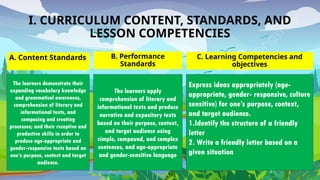
I. CURRICULUM CONTENT, STANDARDS, AND
LESSON COMPETENCIES
B. Performance
Standards
The learners demonstrate their
expanding vocabulary knowledge
and grammatical awareness,
comprehension of literary and
informational texts, and
composing and creating
processes; and their receptive and
productive skills in order to
produce age-appropriate and
gender-responsive texts based on
one’s purpose, context and target
audience.
A. Content Standards
The learners apply
comprehension of literary and
informational texts and produce
narrative and expository texts
based on their purpose, context,
and target audience using
simple, compound, and complex
sentences, and age-appropriate
and gender-sensitive language
C. Learning Competencies and
objectives
Express ideas appropriately (age-
appropriate, gender- responsive, culture
sensitive) for one’s purpose, context,
and target audience.
1.Identify the structure of a friendly
letter
2. Write a friendly letter based on a
given situation
D. Content
Structure of a friendly
letter and make a sample
E. Integration
Edukasyon sa
Pagpapakatao
II. LEARNING RESOURCES
https://www.usingenglish.com/resources/letter-writing.php
https://www.youtube.com/watch?v=3ClV82
III. TEACHING AND LEARNING
PROCEDURE
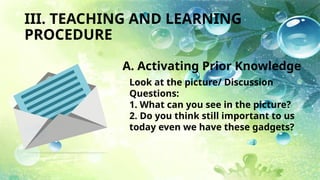
A. Activating Prior Knowledge
Look at the picture/ Discussion
Questions:
1. What can you see in the picture?
2. Do you think still important to us
today even we have these gadgets?
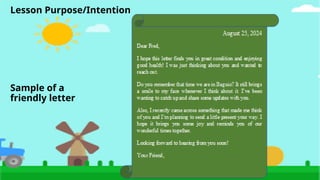
Lesson Purpose/Intention
Sample of a
friendly letter
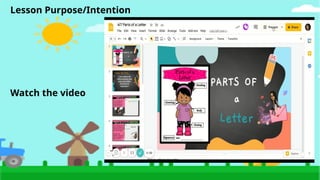
Lesson Purpose/Intention
Watch the video
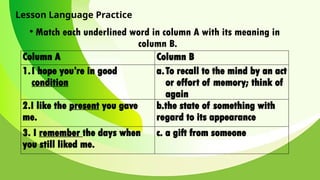
Lesson Language Practice
• Match each underlined word in column A with its meaning in
column B.
Column A Column B
1.I hope you’re in good
condition
a.To recall to the mind by an act
or effort of memory; think of
again
2.I like the present you gave
me.
b.the state of something with
regard to its appearance
3. I remember the days when
you still liked me.
c. a gift from someone
Developing Understanding of the Key Idea/Stem
Question for Discussion:
1. Do you have a friend?
2. Have you experience writing a
letter for a friend.
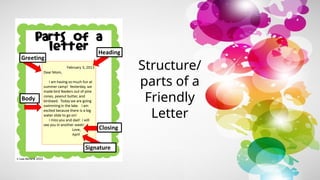
Structure/
parts of a
Friendly
Letter
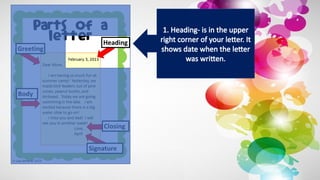
1. Heading- is in the upper
right corner of your letter. It
shows date when the letter
was written.
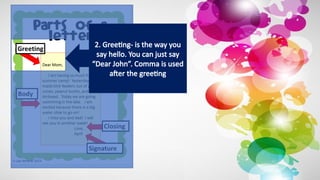
2. Greeting- is the way you
say hello. You can just say
“Dear John”. Comma is used
after the greeting
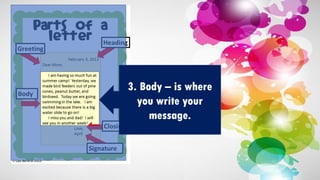
3. Body – is where
you write your
message.
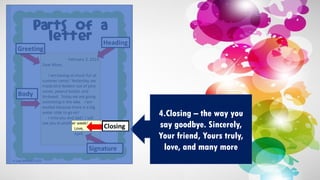
4.Closing – the way you
say goodbye. Sincerely,
Your friend, Yours truly,
love, and many more
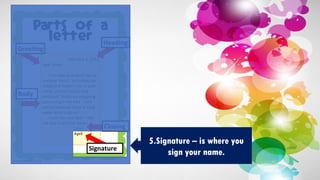
5.Signature – is where you
sign your name.
Deepening Understanding of Key Idea/Stem
Class Activity/individual
Make a simple friendly letter using the
structure of a letter we learned.
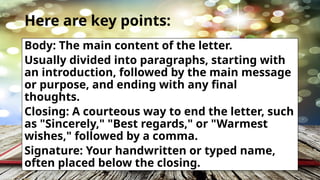
Here are key points:
We learned today about the structures or
parts of a letter and as a summary the...
Heading (or Letterhead): Includes the
sender's address and sometimes the
date.
Salutation (or Greeting): A polite
greeting to the recipient, such as "Dear
[Recipient’s Name],"
Here are key points:
Body: The main content of the letter.
Usually divided into paragraphs, starting with
an introduction, followed by the main message
or purpose, and ending with any final
thoughts.
Closing: A courteous way to end the letter, such
as "Sincerely," "Best regards," or "Warmest
wishes," followed by a comma.
Signature: Your handwritten or typed name,
often placed below the closing.
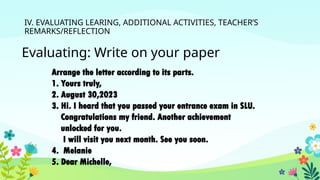
IV. EVALUATING LEARING, ADDITIONAL ACTIVITIES, TEACHER’S
REMARKS/REFLECTION
Evaluating: Write on your paper
Arrange the letter according to its parts.
1. Yours truly,
2. August 30,2023
3. Hi. I heard that you passed your entrance exam in SLU.
Congratulations my friend. Another achievement
unlocked for you.
I will visit you next month. See you soon.
4. Melanie
5. Dear Michelle,
Assignment (Optional
Send the letter you make during the activity and ask
your friend to answer your letter and be ready to read to
class on the meeting.
Thoughts for the Day
“What a lot we lost when we stopped
writing letters. You can’t reread a phone
call.”
Liz Carpenter
The End!

Eng 4 Wk 6- Identifying the letter structure and write an example.pptx

  • 2.
    English 4 week 6 Identifying theletter structure and write an example
  • 5.
    I. CURRICULUM CONTENT,STANDARDS, AND LESSON COMPETENCIES B. Performance Standards The learners demonstrate their expanding vocabulary knowledge and grammatical awareness, comprehension of literary and informational texts, and composing and creating processes; and their receptive and productive skills in order to produce age-appropriate and gender-responsive texts based on one’s purpose, context and target audience. A. Content Standards The learners apply comprehension of literary and informational texts and produce narrative and expository texts based on their purpose, context, and target audience using simple, compound, and complex sentences, and age-appropriate and gender-sensitive language C. Learning Competencies and objectives Express ideas appropriately (age- appropriate, gender- responsive, culture sensitive) for one’s purpose, context, and target audience. 1.Identify the structure of a friendly letter 2. Write a friendly letter based on a given situation
  • 6.
    D. Content Structure ofa friendly letter and make a sample
  • 7.
  • 8.
  • 9.
    III. TEACHING ANDLEARNING PROCEDURE A. Activating Prior Knowledge Look at the picture/ Discussion Questions: 1. What can you see in the picture? 2. Do you think still important to us today even we have these gadgets?
  • 10.
  • 11.
  • 12.
    Lesson Language Practice •Match each underlined word in column A with its meaning in column B. Column A Column B 1.I hope you’re in good condition a.To recall to the mind by an act or effort of memory; think of again 2.I like the present you gave me. b.the state of something with regard to its appearance 3. I remember the days when you still liked me. c. a gift from someone
  • 13.
    Developing Understanding ofthe Key Idea/Stem Question for Discussion: 1. Do you have a friend? 2. Have you experience writing a letter for a friend.
  • 14.
  • 15.
    1. Heading- isin the upper right corner of your letter. It shows date when the letter was written.
  • 16.
    2. Greeting- isthe way you say hello. You can just say “Dear John”. Comma is used after the greeting
  • 17.
    3. Body –is where you write your message.
  • 18.
    4.Closing – theway you say goodbye. Sincerely, Your friend, Yours truly, love, and many more
  • 19.
    5.Signature – iswhere you sign your name.
  • 20.
    Deepening Understanding ofKey Idea/Stem Class Activity/individual Make a simple friendly letter using the structure of a letter we learned.
  • 21.
    Here are keypoints: We learned today about the structures or parts of a letter and as a summary the... Heading (or Letterhead): Includes the sender's address and sometimes the date. Salutation (or Greeting): A polite greeting to the recipient, such as "Dear [Recipient’s Name],"
  • 22.
    Here are keypoints: Body: The main content of the letter. Usually divided into paragraphs, starting with an introduction, followed by the main message or purpose, and ending with any final thoughts. Closing: A courteous way to end the letter, such as "Sincerely," "Best regards," or "Warmest wishes," followed by a comma. Signature: Your handwritten or typed name, often placed below the closing.
  • 23.
    IV. EVALUATING LEARING,ADDITIONAL ACTIVITIES, TEACHER’S REMARKS/REFLECTION Evaluating: Write on your paper Arrange the letter according to its parts. 1. Yours truly, 2. August 30,2023 3. Hi. I heard that you passed your entrance exam in SLU. Congratulations my friend. Another achievement unlocked for you. I will visit you next month. See you soon. 4. Melanie 5. Dear Michelle,
  • 24.
    Assignment (Optional Send theletter you make during the activity and ask your friend to answer your letter and be ready to read to class on the meeting.
  • 25.
    Thoughts for theDay “What a lot we lost when we stopped writing letters. You can’t reread a phone call.” Liz Carpenter
  • 26.