Shale Oil and Gas Development: Ecological
Impacts in the Appalachians
Penn Future Conservation Summit
Boiling Springs, Pennsylvania June 12, 2014
Nels Johnson
Energy Infrastructure Development in the
Delaware Watershed
2nd Annual Delaware Watershed Forum
Bethlehem, Pennsylvania October 22, 2014
Nels Johnson
This Is Unlikely to Happen in The Delaware
Watershed
2nd Annual Delaware Watershed Forum - Bethlehem, PA
Photo: Martha Rial
This Is Happening in the Delaware Watershed
2nd Annual Delaware Watershed Forum - Bethlehem, PA
Nels Johnson - TNC
Well Pad Footprint (3 acres/well pad)
Water Storage (3- 15 acres/impoundment)Compressor Stations (5 acres/station)
Compressor Stations (5 acres/station)
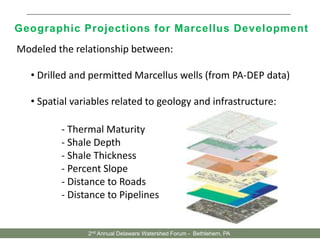
Modeled the relationship between:
• Drilled and permitted Marcellus wells (from PA-DEP data)
• Spatial variables related to geology and infrastructure:
- Thermal Maturity
- Shale Depth
- Shale Thickness
- Percent Slope
- Distance to Roads
- Distance to Pipelines
Geographic Projections for Marcellus Development
2nd Annual Delaware Watershed Forum - Bethlehem, PA
Well Pad Footprint (3 acres/well pad)
Water Storage (3- 15 acres/impoundment)Compressor Stations (5 acres/station)
Geographic Projections for Marcellus Development
Compressor Stations (5 acres/station)
2nd Annual Delaware Watershed Forum - Bethlehem, PA
Well Pad Footprint (3 acres/well pad)
Water Storage (3- 15 acres/impoundment)Compressor Stations (5 acres/station)
Geographic Projections for Marcellus Development
Compressor Stations (5 acres/station)
2nd Annual Delaware Watershed Forum - Bethlehem, PA
Appalachian Energy Projections – Forest Risk
2nd Annual Delaware Watershed Forum - Bethlehem, PA
Appalachian Energy Projections – Forest Risk
2nd Annual Delaware Watershed Forum - Bethlehem, PA
Scope and Scale of Transmission Impacts
Mark Godfrey - TNC George Gress - TNC
How Many New Gas Pipelines in U.S?
 298,000 miles of natural gas
transmission pipelines in U.S.
 160,000 miles of hazardous liquid
pipelines.
 At least 5,000 miles of large diameter
transmission pipelines are being built
annually.
Photo: Nels Johnson - TNC
FERC-Regulated Pipelines
Proposed Williams Atlantic Sunrise Pipeline
How Many New Gas Pipelines in PA?
 PA had 9,000 miles of large diameter
oil/gas pipelines in 2008
 Pipeline mileage in PA will at least
quadruple by 2030.
 The gathering pipeline footprint alone
is larger than the cumulative area
impacted by all other Marcellus gas
infrastructure combined.
Photo: Nels Johnson - TNC
How Many New Gas Pipelines in PA?
Photo: Nels Johnson - TNC
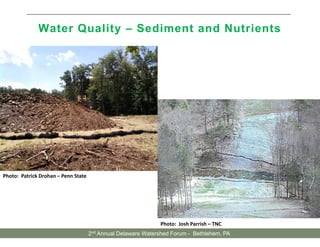
Water Quality – Sediment and Nutrients
Photo: Patrick Drohan – Penn State
Photo: Josh Parrish – TNC
2nd Annual Delaware Watershed Forum - Bethlehem, PA
Well Pad Footprint (3 acres/well pad)
Water Storage (3- 15 acres/impoundment)
Photo: Mark Godfrey - TNC
Land Use – Habitat Loss
Photo: Mark Godfrey - TNC
Compressor Stations (5 acres/station)
2nd Annual Delaware Watershed Forum - Bethlehem, PA
Well Pad Footprint (3 acres/well pad)
Water Storage (3- 15 acres/impoundment)
Photo: Mark Godfrey - TNC
Land Use – Habitat Fragmentation
Photo: Mark Godfrey - TNC
Oil/Gas Transmission Pipelines (19 acres/mile))
2nd Annual Delaware Watershed Forum - Bethlehem, PA
Nels Johnson – TNC
Edge Effects on Forest Interior Species
Photo: Josh Parrish – TNC
2nd Annual Delaware Watershed Forum - Bethlehem, PA
Increased light
Reduced humidity
Increased invasive species
Increased predation
Increased storm damage (trees)
Reduced mobility (animals)
Environmental Impacts of Transmission ROWs
Physical Impacts
Soil disturbance/erosion
Noise (electrostatic)
Noise (compressor
stations)
VOC and methane
emissions (natural gas)
Light (large electric lines)
Chemical use/spills
Mowing/cutting vegetation
Photo: George Gress
Photo: George Gress - TNC
Ecological Impacts of Transmission ROWs
Habitat fragmentation
Increased predation
Vectors for invasive species
Bird and bat fatalities (electric)
Animal travel corridors
Favorable sites for early
successional/grassland
species
Photo: Mark Godfrey - TNC
Minimizing Impacts of Transmission ROWs
Negotiate routing early and often
Work with other organizations to
promote preferred routes and
ROW maintenance
Advocate EIS through FERC
Specify desired vegetation
treatments ahead of time
Encourage hardscaping and
landscaping
Options
Photo: Tamara Gagnolet- TNC

Energy Infrastructure Development in the Delaware Watershed

  • 1.
    Shale Oil andGas Development: Ecological Impacts in the Appalachians Penn Future Conservation Summit Boiling Springs, Pennsylvania June 12, 2014 Nels Johnson Energy Infrastructure Development in the Delaware Watershed 2nd Annual Delaware Watershed Forum Bethlehem, Pennsylvania October 22, 2014 Nels Johnson
  • 2.
    This Is Unlikelyto Happen in The Delaware Watershed 2nd Annual Delaware Watershed Forum - Bethlehem, PA Photo: Martha Rial
  • 3.
    This Is Happeningin the Delaware Watershed 2nd Annual Delaware Watershed Forum - Bethlehem, PA Nels Johnson - TNC
  • 4.
    Well Pad Footprint(3 acres/well pad) Water Storage (3- 15 acres/impoundment)Compressor Stations (5 acres/station) Compressor Stations (5 acres/station) Modeled the relationship between: • Drilled and permitted Marcellus wells (from PA-DEP data) • Spatial variables related to geology and infrastructure: - Thermal Maturity - Shale Depth - Shale Thickness - Percent Slope - Distance to Roads - Distance to Pipelines Geographic Projections for Marcellus Development 2nd Annual Delaware Watershed Forum - Bethlehem, PA
  • 5.
    Well Pad Footprint(3 acres/well pad) Water Storage (3- 15 acres/impoundment)Compressor Stations (5 acres/station) Geographic Projections for Marcellus Development Compressor Stations (5 acres/station) 2nd Annual Delaware Watershed Forum - Bethlehem, PA
  • 6.
    Well Pad Footprint(3 acres/well pad) Water Storage (3- 15 acres/impoundment)Compressor Stations (5 acres/station) Geographic Projections for Marcellus Development Compressor Stations (5 acres/station) 2nd Annual Delaware Watershed Forum - Bethlehem, PA
  • 7.
    Appalachian Energy Projections– Forest Risk 2nd Annual Delaware Watershed Forum - Bethlehem, PA
  • 8.
    Appalachian Energy Projections– Forest Risk 2nd Annual Delaware Watershed Forum - Bethlehem, PA
  • 9.
    Scope and Scaleof Transmission Impacts Mark Godfrey - TNC George Gress - TNC
  • 10.
    How Many NewGas Pipelines in U.S?  298,000 miles of natural gas transmission pipelines in U.S.  160,000 miles of hazardous liquid pipelines.  At least 5,000 miles of large diameter transmission pipelines are being built annually. Photo: Nels Johnson - TNC Photo: Nels Johnson - TNC
  • 11.
  • 12.
    How Many NewGas Pipelines in PA?  PA had 9,000 miles of large diameter oil/gas pipelines in 2008  Pipeline mileage in PA will at least quadruple by 2030.  The gathering pipeline footprint alone is larger than the cumulative area impacted by all other Marcellus gas infrastructure combined. Photo: Nels Johnson - TNC
  • 13.
    How Many NewGas Pipelines in PA? Photo: Nels Johnson - TNC
  • 14.
    Water Quality –Sediment and Nutrients Photo: Patrick Drohan – Penn State Photo: Josh Parrish – TNC 2nd Annual Delaware Watershed Forum - Bethlehem, PA
  • 15.
    Well Pad Footprint(3 acres/well pad) Water Storage (3- 15 acres/impoundment) Photo: Mark Godfrey - TNC Land Use – Habitat Loss Photo: Mark Godfrey - TNC Compressor Stations (5 acres/station) 2nd Annual Delaware Watershed Forum - Bethlehem, PA
  • 16.
    Well Pad Footprint(3 acres/well pad) Water Storage (3- 15 acres/impoundment) Photo: Mark Godfrey - TNC Land Use – Habitat Fragmentation Photo: Mark Godfrey - TNC Oil/Gas Transmission Pipelines (19 acres/mile)) 2nd Annual Delaware Watershed Forum - Bethlehem, PA Nels Johnson – TNC
  • 17.
    Edge Effects onForest Interior Species Photo: Josh Parrish – TNC 2nd Annual Delaware Watershed Forum - Bethlehem, PA Increased light Reduced humidity Increased invasive species Increased predation Increased storm damage (trees) Reduced mobility (animals)
  • 18.
    Environmental Impacts ofTransmission ROWs Physical Impacts Soil disturbance/erosion Noise (electrostatic) Noise (compressor stations) VOC and methane emissions (natural gas) Light (large electric lines) Chemical use/spills Mowing/cutting vegetation Photo: George Gress Photo: George Gress - TNC
  • 19.
    Ecological Impacts ofTransmission ROWs Habitat fragmentation Increased predation Vectors for invasive species Bird and bat fatalities (electric) Animal travel corridors Favorable sites for early successional/grassland species Photo: Mark Godfrey - TNC
  • 20.
    Minimizing Impacts ofTransmission ROWs Negotiate routing early and often Work with other organizations to promote preferred routes and ROW maintenance Advocate EIS through FERC Specify desired vegetation treatments ahead of time Encourage hardscaping and landscaping Options Photo: Tamara Gagnolet- TNC

Editor's Notes

  • #11 Pennsylvania’s existing network of large diameter natural gas pipelines will at least double, and possibly even quadruple, over the next two decades. This expansion is largely due to a five- to twelve-fold increase in gathering pipeline mileage associated with Marcellus development. The pipeline footprint alone is larger than the cumulative area impacted by all other Marcellus gas infrastructure combined. Although pipelines are buried, their construction and maintenance require retaining open rights‐of‐way that often create significant and permanent fragmenting features through natural habitats. Natural gas pipeline construction could have a terrestrial footprint larger than the cumulative footprint of all other Marcellus gas infrastructure combined (e.g., well pads, roads, water containment, and staging/storage areas). While habitat loss and fragmentation from pipeline development may be widespread, we see opportunities to reduce their impact on Pennsylvania’s natural habitats.
  • #13 Pennsylvania’s existing network of large diameter natural gas pipelines will at least double, and possibly even quadruple, over the next two decades. This expansion is largely due to a five- to twelve-fold increase in gathering pipeline mileage associated with Marcellus development. The pipeline footprint alone is larger than the cumulative area impacted by all other Marcellus gas infrastructure combined. Although pipelines are buried, their construction and maintenance require retaining open rights‐of‐way that often create significant and permanent fragmenting features through natural habitats. Natural gas pipeline construction could have a terrestrial footprint larger than the cumulative footprint of all other Marcellus gas infrastructure combined (e.g., well pads, roads, water containment, and staging/storage areas). While habitat loss and fragmentation from pipeline development may be widespread, we see opportunities to reduce their impact on Pennsylvania’s natural habitats.
  • #14 Pennsylvania’s existing network of large diameter natural gas pipelines will at least double, and possibly even quadruple, over the next two decades. This expansion is largely due to a five- to twelve-fold increase in gathering pipeline mileage associated with Marcellus development. The pipeline footprint alone is larger than the cumulative area impacted by all other Marcellus gas infrastructure combined. Although pipelines are buried, their construction and maintenance require retaining open rights‐of‐way that often create significant and permanent fragmenting features through natural habitats. Natural gas pipeline construction could have a terrestrial footprint larger than the cumulative footprint of all other Marcellus gas infrastructure combined (e.g., well pads, roads, water containment, and staging/storage areas). While habitat loss and fragmentation from pipeline development may be widespread, we see opportunities to reduce their impact on Pennsylvania’s natural habitats.