Delaware River Basin Commission
Upstream-
Downstream
Delaware River Watershed
Forum – October 22, 2014
Pamela M. Bush, J.D., M.R.P.
pamela.bush@drbc.state.nj.us
Delaware River
Watershed Facts
• Entire 330 mile mainstem fr. Hancock
NY to the mouth of Delaware Bay
forms an interstate boundary
• Over 15 million people (5% of the U.S.
population) rely on basin waters
• Drains 13,539 sq. miles, or 0.4 of 1% of
the total continental U.S.
• Longest undammed river east of the
Mississippi
• 216 tributary streams
• 4 states (PA, NJ, NY, DE) and less
than 10 sq. miles in MD
• 42 counties
• 838 municipalities
60% Forested
24% Agricultural
9% Urban & Residential
7% Surface Water & Other
80% of the population lives
in 40% of total area
Appalachian Plateaus
> 33% of land area
< 3% of population
85% forested
Land Use and Population
Hawk’s Nest Overlook
Photos Courtesy NYC DEP
Reservoir releases have
created a world-class trout
fishery in the Upper
Delaware River and
tributaries.
Of 3.5 million miles of rivers in the U.S,
< ¼ of 1% (11,434 mi.) are part of the
National Wild and Scenic Rivers System.
Three-quarters of the non-tidal
Delaware – approx. 150 miles – have
been included in the National Wild and
Scenic Rivers System.
• Upper Delaware Scenic &
Recreational River - 73 miles
• Middle Delaware – Water Gap
National Recreation Area – 40
miles, 67,000 acres in PA & NJ
• Lower Delaware – 67 miles
“Outstandingly remarkable values”
include extremely high water quality.
Wild & Scenic Rivers
Marcelus
Shale and
Special
Protection
Waters
36% (4,937 mi2)
of the DRB is
underlain by
Marcellus Shale
Special Protection
Waters
• Upper and Middle Delaware
River designated SPW in 1992
(point discharges only)
• Non-point source requirements
were added in 1994
• Lower Delaware was
permanently designated in July
2008
It is the policy of the Commission
that there be no measurable
change in existing water quality
except towards natural conditions
in waters considered by the
Commission to have exceptionally
high scenic, recreational, ecological,
and/or water supply values.
SPW Requirements
Point Sources:
1. No-discharge alternatives to a direct discharge
2. Natural treatment alternatives
3. Best Demonstrable Technology (BDT) minimum
for direct discharges
4. No Measurable Change (NMC) at water quality control
points
5. No mixing zone for direct discharges to OBW
6. Emergency power, alarms, EMP
Non-Point Sources:
Non-Point Source Pollution Control Plan – applies to
wastewater discharge and water withdrawal service areas
Delaware River Port Complex – One of World’s Largest Fresh Water Ports
photo © kbc119 (GoogleEarth)
Walt Whitman Bridge – RM 96.8
10/16/14
RM 84
Montague
Trenton
DRB Reservoirs
• New York City Delaware
Basin Reservoirs drive the
Basinwide Operating Plan
‒ Cannonsville
‒ Pepacton
‒ Neversink
• Merrill Creek
• Two USACE Reservoirs
drive Lower Basin
Operating Plan
− Beltzville
− Blue Marsh
DRB Reservoir
Operations
 NYC diversions – 800 MGD
 New Jersey diversions – 100
MGD
 Montague flow target – 1750 cfs
 Trenton flow target – 3000 cfs
 Salt Line Location – 250 mg/l
chlorides @ River Mile 69 (avg)
 Diversions and releases are
adjusted during droughts
Oyster Restoration Project –
Planting Shell
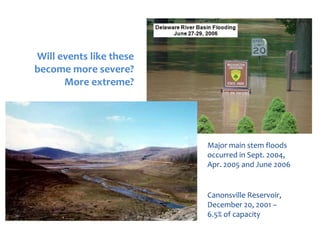
Canonsville Reservoir,
December 20, 2001 –
6.5% of capacity
Major main stem floods
occurred in Sept. 2004,
Apr. 2005 and June 2006
Will events like these
become more severe?
More extreme?
Challenges
How do we
 preserve Water Quality in the
non-tidal river?
 maintain freshwater flows
through the Estuary sufficient to
protect habitat and urban
drinking water supplies?
 control flooding?
 Maintain adequate flows during
droughts
In the face of
 growing development pressure
in the Upper Basin?
 prospect of a new drought of
record?
 salt migration with sea level rise
Questions
Do lower basin residents have a
financial interest/stake in:
 preserving forested riparian
buffers
 forested headwater areas
for the ecosystem services they
provide?
 clean water
 flood control
 scenic beauty
 outdoor recreation – health and
well-being
 wildlife habitat
 tourism
If so, how should we capture and
apply that interest?
Thank You.
Pamela M. Bush
Delaware River Basin Commission

Upstream -Downstream Delaware River Watershed

  • 1.
    Delaware River BasinCommission Upstream- Downstream Delaware River Watershed Forum – October 22, 2014 Pamela M. Bush, J.D., M.R.P. pamela.bush@drbc.state.nj.us
  • 2.
    Delaware River Watershed Facts •Entire 330 mile mainstem fr. Hancock NY to the mouth of Delaware Bay forms an interstate boundary • Over 15 million people (5% of the U.S. population) rely on basin waters • Drains 13,539 sq. miles, or 0.4 of 1% of the total continental U.S. • Longest undammed river east of the Mississippi • 216 tributary streams • 4 states (PA, NJ, NY, DE) and less than 10 sq. miles in MD • 42 counties • 838 municipalities
  • 3.
    60% Forested 24% Agricultural 9%Urban & Residential 7% Surface Water & Other 80% of the population lives in 40% of total area Appalachian Plateaus > 33% of land area < 3% of population 85% forested Land Use and Population
  • 4.
  • 5.
  • 6.
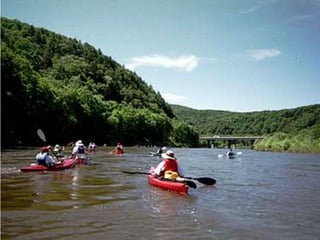
    Reservoir releases have createda world-class trout fishery in the Upper Delaware River and tributaries.
  • 7.
    Of 3.5 millionmiles of rivers in the U.S, < ¼ of 1% (11,434 mi.) are part of the National Wild and Scenic Rivers System. Three-quarters of the non-tidal Delaware – approx. 150 miles – have been included in the National Wild and Scenic Rivers System. • Upper Delaware Scenic & Recreational River - 73 miles • Middle Delaware – Water Gap National Recreation Area – 40 miles, 67,000 acres in PA & NJ • Lower Delaware – 67 miles “Outstandingly remarkable values” include extremely high water quality. Wild & Scenic Rivers
  • 8.
    Marcelus Shale and Special Protection Waters 36% (4,937mi2) of the DRB is underlain by Marcellus Shale
  • 10.
    Special Protection Waters • Upperand Middle Delaware River designated SPW in 1992 (point discharges only) • Non-point source requirements were added in 1994 • Lower Delaware was permanently designated in July 2008 It is the policy of the Commission that there be no measurable change in existing water quality except towards natural conditions in waters considered by the Commission to have exceptionally high scenic, recreational, ecological, and/or water supply values.
  • 11.
    SPW Requirements Point Sources: 1.No-discharge alternatives to a direct discharge 2. Natural treatment alternatives 3. Best Demonstrable Technology (BDT) minimum for direct discharges 4. No Measurable Change (NMC) at water quality control points 5. No mixing zone for direct discharges to OBW 6. Emergency power, alarms, EMP Non-Point Sources: Non-Point Source Pollution Control Plan – applies to wastewater discharge and water withdrawal service areas
  • 12.
    Delaware River PortComplex – One of World’s Largest Fresh Water Ports
  • 13.
    photo © kbc119(GoogleEarth) Walt Whitman Bridge – RM 96.8
  • 14.
  • 15.
    Montague Trenton DRB Reservoirs • NewYork City Delaware Basin Reservoirs drive the Basinwide Operating Plan ‒ Cannonsville ‒ Pepacton ‒ Neversink • Merrill Creek • Two USACE Reservoirs drive Lower Basin Operating Plan − Beltzville − Blue Marsh
  • 16.
    DRB Reservoir Operations  NYCdiversions – 800 MGD  New Jersey diversions – 100 MGD  Montague flow target – 1750 cfs  Trenton flow target – 3000 cfs  Salt Line Location – 250 mg/l chlorides @ River Mile 69 (avg)  Diversions and releases are adjusted during droughts
  • 18.
    Oyster Restoration Project– Planting Shell
  • 19.
    Canonsville Reservoir, December 20,2001 – 6.5% of capacity Major main stem floods occurred in Sept. 2004, Apr. 2005 and June 2006 Will events like these become more severe? More extreme?
  • 20.
    Challenges How do we preserve Water Quality in the non-tidal river?  maintain freshwater flows through the Estuary sufficient to protect habitat and urban drinking water supplies?  control flooding?  Maintain adequate flows during droughts In the face of  growing development pressure in the Upper Basin?  prospect of a new drought of record?  salt migration with sea level rise Questions Do lower basin residents have a financial interest/stake in:  preserving forested riparian buffers  forested headwater areas for the ecosystem services they provide?  clean water  flood control  scenic beauty  outdoor recreation – health and well-being  wildlife habitat  tourism If so, how should we capture and apply that interest?
  • 21.
    Thank You. Pamela M.Bush Delaware River Basin Commission