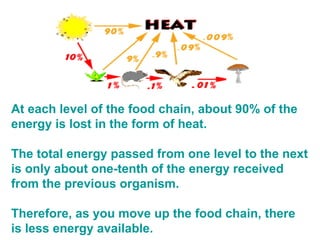
At each level of the food chain, about 90% of the energy is lost in the form of heat.   The total energy passed from one level to the next is only about one-tenth of the energy received from the previous organism. Therefore, as you move up the food chain, there is less energy available.
The sun has one liter of rootbeer (energy) to give.  2. Of that, the plant gets one-tenth or 100 milliliters.  3. The mouse gets 10 milliliters from the plant.  4. The hawk gets 1 milliliter from the mouse.  5. When the hawk dies and is decomposed by the mushroom, the mushroom gets only one-tenth of a milliliter!  Rootbeer Activity
Sun has 1 liter (1000 ml) Plant receives -100 ml Plant has 100 ml Mouse receives 10 ml Mouse has 10 ml Hawk Receives 1 ml Hawk dies has 1 ml Decomposers receive  . 1 ml
Energy Pyramids  show the flow  of energy  through an ecosystem Ecologists  study  energy  pyramids
3 rd  level  consumers mostly carnivores & some omnivores 2 nd  level consumer carnivores & omnivores 1 st  level consumer herbivores Producers: green plants  make their   own energy from sunlight 10,000 Kcal 1000 Kcal 100 Kcal 10 Kcal 1 Kcal An energy pyramid from the Andrews
10,000 Kcal 1000 Kcal 100 Kcal 10 Kcal 0.1% 1% 10% 100%  1 Kcal 0.01% When an owl eats a flying   squirrel it uses about 90%   of the calories to live— move, digest, produce body    heat, reproduce and    escape from predators.    When a frog eats a cricket    or a cricket eats a plant, they   use 90% of those calories    to move, digest, produce    body heat, reproduce and    escape from predators.

Energy flow presentation

  • 1.
    At each levelof the food chain, about 90% of the energy is lost in the form of heat. The total energy passed from one level to the next is only about one-tenth of the energy received from the previous organism. Therefore, as you move up the food chain, there is less energy available.
  • 2.
    The sun hasone liter of rootbeer (energy) to give. 2. Of that, the plant gets one-tenth or 100 milliliters. 3. The mouse gets 10 milliliters from the plant. 4. The hawk gets 1 milliliter from the mouse. 5. When the hawk dies and is decomposed by the mushroom, the mushroom gets only one-tenth of a milliliter! Rootbeer Activity
  • 3.
    Sun has 1liter (1000 ml) Plant receives -100 ml Plant has 100 ml Mouse receives 10 ml Mouse has 10 ml Hawk Receives 1 ml Hawk dies has 1 ml Decomposers receive . 1 ml
  • 4.
    Energy Pyramids show the flow of energy through an ecosystem Ecologists study energy pyramids
  • 5.
    3 rd level consumers mostly carnivores & some omnivores 2 nd level consumer carnivores & omnivores 1 st level consumer herbivores Producers: green plants make their own energy from sunlight 10,000 Kcal 1000 Kcal 100 Kcal 10 Kcal 1 Kcal An energy pyramid from the Andrews
  • 6.
    10,000 Kcal 1000Kcal 100 Kcal 10 Kcal 0.1% 1% 10% 100% 1 Kcal 0.01% When an owl eats a flying squirrel it uses about 90% of the calories to live— move, digest, produce body heat, reproduce and escape from predators. When a frog eats a cricket or a cricket eats a plant, they use 90% of those calories to move, digest, produce body heat, reproduce and escape from predators.

Editor's Notes

  • #7 When a cricket eats a plant it uses about 90% of the calories from that plant to move, digest, produce body heat, reproduce and escape from predators. When a snake eats a cricket or a chipmunk, it uses about 90% of those calories to move, digest, produce body heat, reproduce and escape from predators. When a top predator like a cougar, bear or spotted owl eats a flying squirrel, frog or salmon, it uses about 90% of those calories to move, digest, produce body heat and reproduce.