ASSIGNMENT
TOPIC NAME:
ENERGY
SUBMITTED TO:
SIR EHTISHAM UL HAQ
GROUP MEMBERS:
MEHAK NOOR (ROLL NO 10)
ALIZA MOHSAN (ROLL NO 13)
HARAM FATIMA (ROLL NO 15)
BISSAM (LEADER) (ROLL NO 25)
NADIA RIAZ (ROLL NO 30)
INSTITUTE OF EDUCATION
UNIVERSITY OF SARGODHA
STUDENT LEARNING OUTCOMES
After reading this chapter you will be able to understand and learn following topics.
 What is Work and Energy?
 Explain Different Forms of Energy?
 Elaborate Demand of Energy?
 Explain Production of Electrical Energy?
 Discuss Measurement of Energy?
 Explain Energy and Environment?
 Discuss Degradation of Environment?
Work
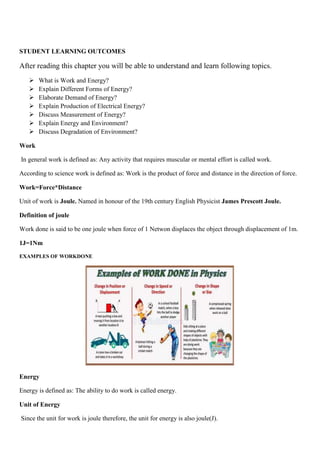
In general work is defined as: Any activity that requires muscular or mental effort is called work.
According to science work is defined as: Work is the product of force and distance in the direction of force.
Work=Force*Distance
Unit of work is Joule. Named in honour of the 19th century English Physicist James Prescott Joule.
Definition of joule
Work done is said to be one joule when force of 1 Netwon displaces the object through displacement of 1m.
1J=1Nm
EXAMPLES OF WORKDONE
Energy
Energy is defined as: The ability to do work is called energy.
Unit of Energy
Since the unit for work is joule therefore, the unit for energy is also joule(J).
Different forms of energy
Following are the different forms of energy:
 Kinetic Energy
 Potential Energy
 Elastic Potential Energy
 Chemical Energy
 Heat Energy
 Light Energy
 Electrical Energy
 Nuclear Energy
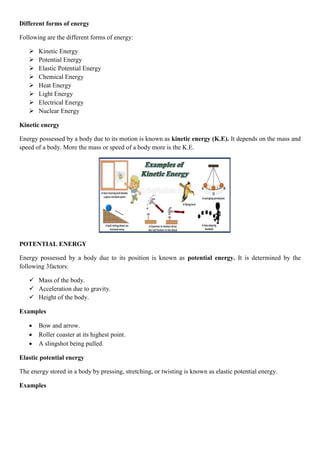
Kinetic energy
Energy possessed by a body due to its motion is known as kinetic energy (K.E). It depends on the mass and
speed of a body. More the mass or speed of a body more is the K.E.
POTENTIAL ENERGY
Energy possessed by a body due to its position is known as potential energy. It is determined by the
following 3factors:
 Mass of the body.
 Acceleration due to gravity.
 Height of the body.
Examples
 Bow and arrow.
 Roller coaster at its highest point.
 A slingshot being pulled.
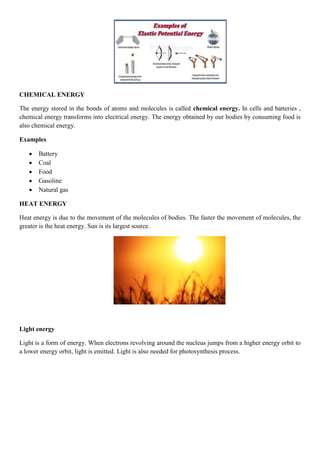
Elastic potential energy
The energy stored in a body by pressing, stretching, or twisting is known as elastic potential energy.
Examples
CHEMICAL ENERGY
The energy stored in the bonds of atoms and molecules is called chemical energy. In cells and batteries ,
chemical energy transforms into electrical energy. The energy obtained by our bodies by consuming food is
also chemical energy.
Examples
 Battery
 Coal
 Food
 Gasoline
 Natural gas
HEAT ENERGY
Heat energy is due to the movement of the molecules of bodies. The faster the movement of molecules, the
greater is the heat energy. Sun is its largest source.
Light energy
Light is a form of energy. When electrons revolving around the nucleus jumps from a higher energy orbit to
a lower energy orbit, light is emitted. Light is also needed for photosynthesis process.
Electrical energy
It is the energy of moving charges. Electrical energy can be transformed into different forms of energy.
Examples
 Light bulb
 Television
 Battery
 Toaster
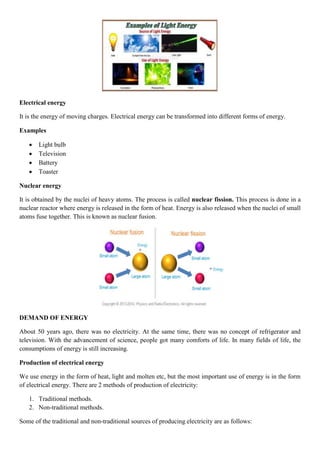
Nuclear energy
It is obtained by the nuclei of heavy atoms. The process is called nuclear fission. This process is done in a
nuclear reactor where energy is released in the form of heat. Energy is also released when the nuclei of small
atoms fuse together. This is known as nuclear fusion.
DEMAND OF ENERGY
About 50 years ago, there was no electricity. At the same time, there was no concept of refrigerator and
television. With the advancement of science, people got many comforts of life. In many fields of life, the
consumptions of energy is still increasing.
Production of electrical energy
We use energy in the form of heat, light and molten etc, but the most important use of energy is in the form
of electrical energy. There are 2 methods of production of electricity:
1. Traditional methods.
2. Non-traditional methods.
Some of the traditional and non-traditional sources of producing electricity are as follows:
Traditional methods of production of electricity
Hydroelectric power
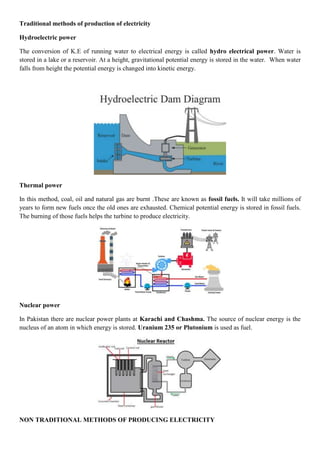
The conversion of K.E of running water to electrical energy is called hydro electrical power. Water is
stored in a lake or a reservoir. At a height, gravitational potential energy is stored in the water. When water
falls from height the potential energy is changed into kinetic energy.
Thermal power
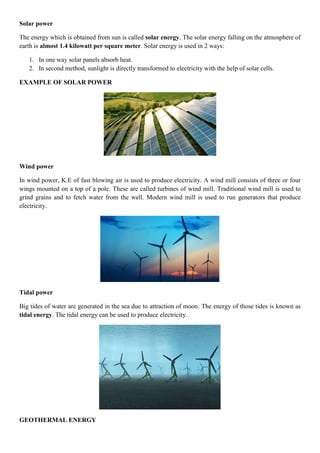
In this method, coal, oil and natural gas are burnt .These are known as fossil fuels. It will take millions of
years to form new fuels once the old ones are exhausted. Chemical potential energy is stored in fossil fuels.
The burning of those fuels helps the turbine to produce electricity.
Nuclear power
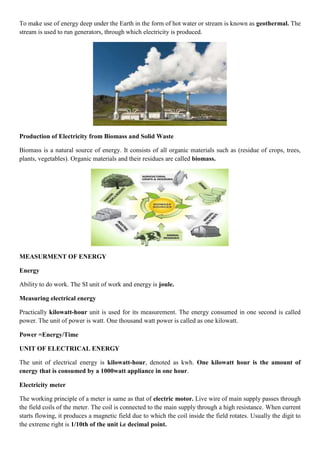
In Pakistan there are nuclear power plants at Karachi and Chashma. The source of nuclear energy is the
nucleus of an atom in which energy is stored. Uranium 235 or Plutonium is used as fuel.
NON TRADITIONAL METHODS OF PRODUCING ELECTRICITY
Solar power
The energy which is obtained from sun is called solar energy. The solar energy falling on the atmosphere of
earth is almost 1.4 kilowatt per square meter. Solar energy is used in 2 ways:
1. In one way solar panels absorb heat.
2. In second method, sunlight is directly transformed to electricity with the help of solar cells.
EXAMPLE OF SOLAR POWER
Wind power
In wind power, K.E of fast blowing air is used to produce electricity. A wind mill consists of three or four
wings mounted on a top of a pole. These are called turbines of wind mill. Traditional wind mill is used to
grind grains and to fetch water from the well. Modern wind mill is used to run generators that produce
electricity.
Tidal power
Big tides of water are generated in the sea due to attraction of moon. The energy of those tides is known as
tidal energy. The tidal energy can be used to produce electricity.
GEOTHERMAL ENERGY
To make use of energy deep under the Earth in the form of hot water or stream is known as geothermal. The
stream is used to run generators, through which electricity is produced.
Production of Electricity from Biomass and Solid Waste
Biomass is a natural source of energy. It consists of all organic materials such as (residue of crops, trees,
plants, vegetables). Organic materials and their residues are called biomass.
MEASURMENT OF ENERGY
Energy
Ability to do work. The SI unit of work and energy is joule.
Measuring electrical energy
Practically kilowatt-hour unit is used for its measurement. The energy consumed in one second is called
power. The unit of power is watt. One thousand watt power is called as one kilowatt.
Power =Energy/Time
UNIT OF ELECTRICAL ENERGY
The unit of electrical energy is kilowatt-hour, denoted as kwh. One kilowatt hour is the amount of
energy that is consumed by a 1000watt appliance in one hour.
Electricity meter
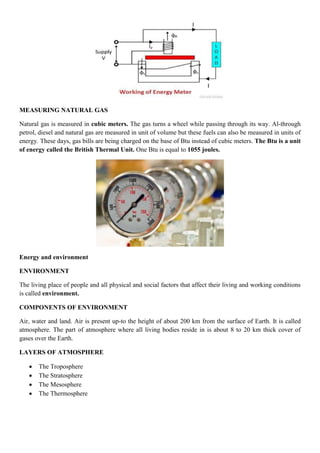
The working principle of a meter is same as that of electric motor. Live wire of main supply passes through
the field coils of the meter. The coil is connected to the main supply through a high resistance. When current
starts flowing, it produces a magnetic field due to which the coil inside the field rotates. Usually the digit to
the extreme right is 1/10th of the unit i.e decimal point.
MEASURING NATURAL GAS
Natural gas is measured in cubic meters. The gas turns a wheel while passing through its way. Al-through
petrol, diesel and natural gas are measured in unit of volume but these fuels can also be measured in units of
energy. These days, gas bills are being charged on the base of Btu instead of cubic meters. The Btu is a unit
of energy called the British Thermal Unit. One Btu is equal to 1055 joules.
Energy and environment
ENVIRONMENT
The living place of people and all physical and social factors that affect their living and working conditions
is called environment.
COMPONENTS OF ENVIRONMENT
Air, water and land. Air is present up-to the height of about 200 km from the surface of Earth. It is called
atmosphere. The part of atmosphere where all living bodies reside in is about 8 to 20 km thick cover of
gases over the Earth.
LAYERS OF ATMOSPHERE
 The Troposphere
 The Stratosphere
 The Mesosphere
 The Thermosphere
THERMAL POLLUTION
The pollution caused in the environment by heat, smoke and harmful gases is called thermal pollution.
Heat is very essential for plants, animals and human beings.
FACTORS of THERMAL POLLUTION:
There are many factors that cause thermal pollution:
1. Carbon dioxide, Carbon monoxide, Sulphur dioxide, lead compounds and other harmful gases in
addition.
2. Fossil fuels are burnt in transport.
3. Nuclear energy used for producing electricity.
Degradation of environment
Natural thermal pollution does not affect the environment badly. When pollution more than a certain limit
is added to the environment, it is known as degradation of environment. Industries consume almost
20% of energy resources. Such energy sources should be promoted, which produce less pollution e.g ,
electrical energy, solar energy, wind energy, tidal energy.

ENERGY Chapter - 7 General Science 9th 10th

  • 1.
    ASSIGNMENT TOPIC NAME: ENERGY SUBMITTED TO: SIREHTISHAM UL HAQ GROUP MEMBERS: MEHAK NOOR (ROLL NO 10) ALIZA MOHSAN (ROLL NO 13) HARAM FATIMA (ROLL NO 15) BISSAM (LEADER) (ROLL NO 25) NADIA RIAZ (ROLL NO 30) INSTITUTE OF EDUCATION UNIVERSITY OF SARGODHA
  • 2.
    STUDENT LEARNING OUTCOMES Afterreading this chapter you will be able to understand and learn following topics.  What is Work and Energy?  Explain Different Forms of Energy?  Elaborate Demand of Energy?  Explain Production of Electrical Energy?  Discuss Measurement of Energy?  Explain Energy and Environment?  Discuss Degradation of Environment? Work In general work is defined as: Any activity that requires muscular or mental effort is called work. According to science work is defined as: Work is the product of force and distance in the direction of force. Work=Force*Distance Unit of work is Joule. Named in honour of the 19th century English Physicist James Prescott Joule. Definition of joule Work done is said to be one joule when force of 1 Netwon displaces the object through displacement of 1m. 1J=1Nm EXAMPLES OF WORKDONE Energy Energy is defined as: The ability to do work is called energy. Unit of Energy Since the unit for work is joule therefore, the unit for energy is also joule(J).
  • 3.
    Different forms ofenergy Following are the different forms of energy:  Kinetic Energy  Potential Energy  Elastic Potential Energy  Chemical Energy  Heat Energy  Light Energy  Electrical Energy  Nuclear Energy Kinetic energy Energy possessed by a body due to its motion is known as kinetic energy (K.E). It depends on the mass and speed of a body. More the mass or speed of a body more is the K.E. POTENTIAL ENERGY Energy possessed by a body due to its position is known as potential energy. It is determined by the following 3factors:  Mass of the body.  Acceleration due to gravity.  Height of the body. Examples  Bow and arrow.  Roller coaster at its highest point.  A slingshot being pulled. Elastic potential energy The energy stored in a body by pressing, stretching, or twisting is known as elastic potential energy. Examples
  • 4.
    CHEMICAL ENERGY The energystored in the bonds of atoms and molecules is called chemical energy. In cells and batteries , chemical energy transforms into electrical energy. The energy obtained by our bodies by consuming food is also chemical energy. Examples  Battery  Coal  Food  Gasoline  Natural gas HEAT ENERGY Heat energy is due to the movement of the molecules of bodies. The faster the movement of molecules, the greater is the heat energy. Sun is its largest source. Light energy Light is a form of energy. When electrons revolving around the nucleus jumps from a higher energy orbit to a lower energy orbit, light is emitted. Light is also needed for photosynthesis process.
  • 5.
    Electrical energy It isthe energy of moving charges. Electrical energy can be transformed into different forms of energy. Examples  Light bulb  Television  Battery  Toaster Nuclear energy It is obtained by the nuclei of heavy atoms. The process is called nuclear fission. This process is done in a nuclear reactor where energy is released in the form of heat. Energy is also released when the nuclei of small atoms fuse together. This is known as nuclear fusion. DEMAND OF ENERGY About 50 years ago, there was no electricity. At the same time, there was no concept of refrigerator and television. With the advancement of science, people got many comforts of life. In many fields of life, the consumptions of energy is still increasing. Production of electrical energy We use energy in the form of heat, light and molten etc, but the most important use of energy is in the form of electrical energy. There are 2 methods of production of electricity: 1. Traditional methods. 2. Non-traditional methods. Some of the traditional and non-traditional sources of producing electricity are as follows:
  • 6.
    Traditional methods ofproduction of electricity Hydroelectric power The conversion of K.E of running water to electrical energy is called hydro electrical power. Water is stored in a lake or a reservoir. At a height, gravitational potential energy is stored in the water. When water falls from height the potential energy is changed into kinetic energy. Thermal power In this method, coal, oil and natural gas are burnt .These are known as fossil fuels. It will take millions of years to form new fuels once the old ones are exhausted. Chemical potential energy is stored in fossil fuels. The burning of those fuels helps the turbine to produce electricity. Nuclear power In Pakistan there are nuclear power plants at Karachi and Chashma. The source of nuclear energy is the nucleus of an atom in which energy is stored. Uranium 235 or Plutonium is used as fuel. NON TRADITIONAL METHODS OF PRODUCING ELECTRICITY
  • 7.
    Solar power The energywhich is obtained from sun is called solar energy. The solar energy falling on the atmosphere of earth is almost 1.4 kilowatt per square meter. Solar energy is used in 2 ways: 1. In one way solar panels absorb heat. 2. In second method, sunlight is directly transformed to electricity with the help of solar cells. EXAMPLE OF SOLAR POWER Wind power In wind power, K.E of fast blowing air is used to produce electricity. A wind mill consists of three or four wings mounted on a top of a pole. These are called turbines of wind mill. Traditional wind mill is used to grind grains and to fetch water from the well. Modern wind mill is used to run generators that produce electricity. Tidal power Big tides of water are generated in the sea due to attraction of moon. The energy of those tides is known as tidal energy. The tidal energy can be used to produce electricity. GEOTHERMAL ENERGY
  • 8.
    To make useof energy deep under the Earth in the form of hot water or stream is known as geothermal. The stream is used to run generators, through which electricity is produced. Production of Electricity from Biomass and Solid Waste Biomass is a natural source of energy. It consists of all organic materials such as (residue of crops, trees, plants, vegetables). Organic materials and their residues are called biomass. MEASURMENT OF ENERGY Energy Ability to do work. The SI unit of work and energy is joule. Measuring electrical energy Practically kilowatt-hour unit is used for its measurement. The energy consumed in one second is called power. The unit of power is watt. One thousand watt power is called as one kilowatt. Power =Energy/Time UNIT OF ELECTRICAL ENERGY The unit of electrical energy is kilowatt-hour, denoted as kwh. One kilowatt hour is the amount of energy that is consumed by a 1000watt appliance in one hour. Electricity meter The working principle of a meter is same as that of electric motor. Live wire of main supply passes through the field coils of the meter. The coil is connected to the main supply through a high resistance. When current starts flowing, it produces a magnetic field due to which the coil inside the field rotates. Usually the digit to the extreme right is 1/10th of the unit i.e decimal point.
  • 9.
    MEASURING NATURAL GAS Naturalgas is measured in cubic meters. The gas turns a wheel while passing through its way. Al-through petrol, diesel and natural gas are measured in unit of volume but these fuels can also be measured in units of energy. These days, gas bills are being charged on the base of Btu instead of cubic meters. The Btu is a unit of energy called the British Thermal Unit. One Btu is equal to 1055 joules. Energy and environment ENVIRONMENT The living place of people and all physical and social factors that affect their living and working conditions is called environment. COMPONENTS OF ENVIRONMENT Air, water and land. Air is present up-to the height of about 200 km from the surface of Earth. It is called atmosphere. The part of atmosphere where all living bodies reside in is about 8 to 20 km thick cover of gases over the Earth. LAYERS OF ATMOSPHERE  The Troposphere  The Stratosphere  The Mesosphere  The Thermosphere
  • 10.
    THERMAL POLLUTION The pollutioncaused in the environment by heat, smoke and harmful gases is called thermal pollution. Heat is very essential for plants, animals and human beings. FACTORS of THERMAL POLLUTION: There are many factors that cause thermal pollution: 1. Carbon dioxide, Carbon monoxide, Sulphur dioxide, lead compounds and other harmful gases in addition. 2. Fossil fuels are burnt in transport. 3. Nuclear energy used for producing electricity. Degradation of environment Natural thermal pollution does not affect the environment badly. When pollution more than a certain limit is added to the environment, it is known as degradation of environment. Industries consume almost 20% of energy resources. Such energy sources should be promoted, which produce less pollution e.g , electrical energy, solar energy, wind energy, tidal energy.