GPD231
Energy Technology
Dr Albert Awopone
Energy - What’s the problem
Learning Goals
By the end of the course, students should be able to:
1. Understand the basic principles of energy production, conversion,
and consumption.
2. Explain different types of energy sources, including renewable and
non-renewable options.
3. Identify energy efficiency measures and conservation techniques in
daily applications.
4. Analyse the impact of energy use on the environment and society.
5. Explore emerging technologies in sustainable energy
Syllabus Description
• Introduction to Energy Technology (Week 1-2)
• Energy Sources and Conversion (Week 3-4)
• Energy Efficiency and Conservation (Week 5-6)
• Environmental and Social Impact of Energy Use (Week 7-9)
• Future Trends in Energy Technology (Week 10-11)
• Case Studies and Practical Applications (Week 12)
What is the Energy?
Energy is involved in all life cycles, and it is essential in Engineering as much
as in all other productive activities.
An elementary food chain already shows the need for energy:
crops need energy from solar radiation to grow,
harvesting needs energy from the human body in work,
cooking needs energy from biomass in a fire.
The food, in its turn, provides the human body with energy.
In order to support any industrial operation, equipment and tools are used,
the production of which also requires energy.
Energy lights our cites, power our vehicles, runs machinery in factories,
Energy warms and cools our homes, cooks our food, plays our music, ….
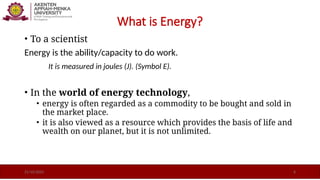
What is Energy?
• To a scientist
Energy is the ability/capacity to do work.
It is measured in joules (J). (Symbol E).
• In the world of energy technology,
• energy is often regarded as a commodity to be bought and sold in
the market place.
• it is also viewed as a resource which provides the basis of life and
wealth on our planet, but it is not unlimited.
21/10/2025 6
Definition of Energy
• Energy is the capacity to do work or produce change.
• It exists in different forms and can be converted from one form to
another.
• Energy is essential for all physical and chemical processes.
Importance of Energy
• Economic Development: Energy is essential for industrialization,
manufacturing, and economic growth.
• Daily Activities: Lighting, cooking, transportation, and communication
rely on energy.
• Health and Well-being: Hospitals, water supply systems, and
sanitation depend on energy for operation.
• Technological Advancements: Innovations in information technology,
automation, and artificial intelligence require energy to function.
• Agriculture and Food Production: Energy is needed for irrigation,
food processing, and preservation
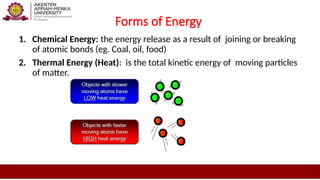
Forms of Energy
1. Chemical Energy: the energy release as a result of joining or breaking
of atomic bonds (eg. Coal, oil, food)
2. Thermal Energy (Heat): is the total kinetic energy of moving particles
of matter.
Forms of Energy
3. Electrical Energy: Is resulting from the motion of electrical charge
between two positions, which is referred to the potential difference of
these two positions. Electrical generator and electric storage battery
fed the required potential difference causing electrical energy.
4. Mechanical Energy: Is the energy gained-by or exerted-on an object
to do work.
It is the sum of kinetic and potential energy in an object
i. Potential energy is the energy a body possess due to its height or position
ii. Kinetic energy is the energy a body possess due to its motion
Forms of Energy
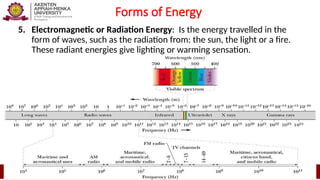
5. Electromagnetic or Radiation Energy: Is the energy travelled in the
form of waves, such as the radiation from: the sun, the light or a fire.
These radiant energies give lighting or warming sensation.
Forms of Energy
6. Nuclear Energy: is stored in the nucleus of an atom, and when
nucleus splits or fused nuclear energy is released in the form of heat
and light energies.
Physics proved that, the sun’s energy is produced from a nuclear fusion
reaction in which hydrogen nuclei fuse to form helium nuclei.
SOURCES OF ENERGY
• Sun
• Wind (wind mill)
• Moving water (hydro electric projects)
• Fuels (Wood/coal/oil/natural gas)
• Nuclear fuels
• Electricity
• Geothermal energy.
Classification of Energy Sources
Energy can be classified in several ways including the following:
• Base of nature of availability
• Primary and Secondary energy
• Base on market value
• Commercial and Non commercial energy
• Base on long term availability
• Renewable and Non-Renewable energy
• Base on traditionnel use
• Conventional and Non-conventional energy
21/10/2025 14
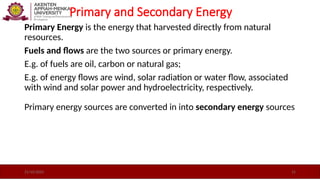
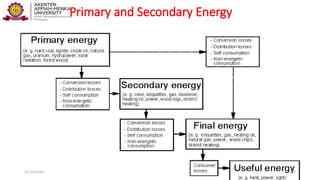
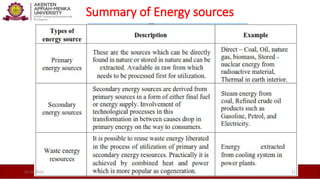
Primary and Secondary Energy
Primary Energy is the energy that harvested directly from natural
resources.
Fuels and flows are the two sources or primary energy.
E.g. of fuels are oil, carbon or natural gas;
E.g. of energy flows are wind, solar radiation or water flow, associated
with wind and solar power and hydroelectricity, respectively.
Primary energy sources are converted in into secondary energy sources
21/10/2025 15
Primary and Secondary Energy
21/10/2025 16
Commercial Energy and Non Commercial Energy
• Commercial energy is energy which is available to the users at some
price.
• electricity,
• coal
• refined petroleum products
Use industrial, agricultural, transport and domestic
• Non-commercial energy is energy which is available free of cost to
the users
• Firewood
• agro waste in rural areas
• solar energy
21/10/2025 17
Renewable and Non-Renewable Energy
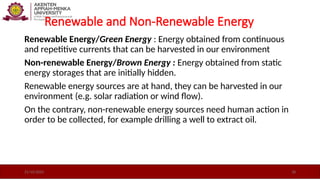
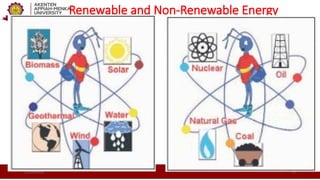
Renewable Energy/Green Energy : Energy obtained from continuous
and repetitive currents that can be harvested in our environment
Non-renewable Energy/Brown Energy : Energy obtained from static
energy storages that are initially hidden.
Renewable energy sources are at hand, they can be harvested in our
environment (e.g. solar radiation or wind flow).
On the contrary, non-renewable energy sources need human action in
order to be collected, for example drilling a well to extract oil.
21/10/2025 18
Renewable and Non-Renewable Energy
21/10/2025 19
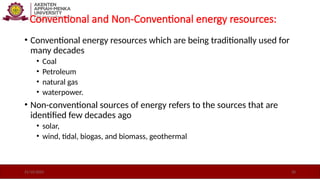
Conventional and Non-Conventional energy resources:
• Conventional energy resources which are being traditionally used for
many decades
• Coal
• Petroleum
• natural gas
• waterpower.
• Non-conventional sources of energy refers to the sources that are
identified few decades ago
• solar,
• wind, tidal, biogas, and biomass, geothermal
21/10/2025 20
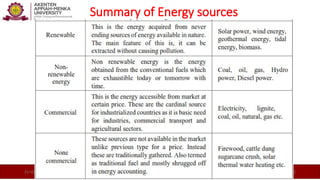
Summary of Energy sources
21/10/2025 21
Summary of Energy sources
21/10/2025 22
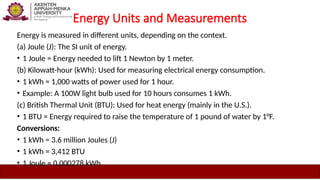
Energy Units and Measurements
Energy is measured in different units, depending on the context.
(a) Joule (J): The SI unit of energy.
• 1 Joule = Energy needed to lift 1 Newton by 1 meter.
(b) Kilowatt-hour (kWh): Used for measuring electrical energy consumption.
• 1 kWh = 1,000 watts of power used for 1 hour.
• Example: A 100W light bulb used for 10 hours consumes 1 kWh.
(c) British Thermal Unit (BTU): Used for heat energy (mainly in the U.S.).
• 1 BTU = Energy required to raise the temperature of 1 pound of water by 1°F.
Conversions:
• 1 kWh = 3.6 million Joules (J)
• 1 kWh = 3,412 BTU
• 1 Joule = 0.000278 kWh
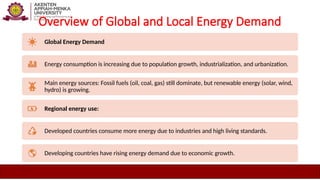
Overview of Global and Local Energy Demand
Global Energy Demand
Energy consumption is increasing due to population growth, industrialization, and urbanization.
Main energy sources: Fossil fuels (oil, coal, gas) still dominate, but renewable energy (solar, wind,
hydro) is growing.
Regional energy use:
Developed countries consume more energy due to industries and high living standards.
Developing countries have rising energy demand due to economic growth.
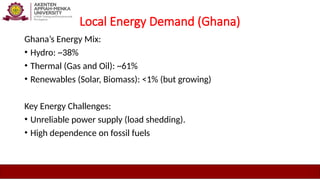
Local Energy Demand (Ghana)
Ghana’s Energy Mix:
• Hydro: ~38%
• Thermal (Gas and Oil): ~61%
• Renewables (Solar, Biomass): <1% (but growing)
Key Energy Challenges:
• Unreliable power supply (load shedding).
• High dependence on fossil fuels
Next Lecture
Introduction to Solar energy
21/10/2025 26

Introduction to energy technology and efficiency

  • 1.
  • 2.
    Energy - What’sthe problem
  • 3.
    Learning Goals By theend of the course, students should be able to: 1. Understand the basic principles of energy production, conversion, and consumption. 2. Explain different types of energy sources, including renewable and non-renewable options. 3. Identify energy efficiency measures and conservation techniques in daily applications. 4. Analyse the impact of energy use on the environment and society. 5. Explore emerging technologies in sustainable energy
  • 4.
    Syllabus Description • Introductionto Energy Technology (Week 1-2) • Energy Sources and Conversion (Week 3-4) • Energy Efficiency and Conservation (Week 5-6) • Environmental and Social Impact of Energy Use (Week 7-9) • Future Trends in Energy Technology (Week 10-11) • Case Studies and Practical Applications (Week 12)
  • 5.
    What is theEnergy? Energy is involved in all life cycles, and it is essential in Engineering as much as in all other productive activities. An elementary food chain already shows the need for energy: crops need energy from solar radiation to grow, harvesting needs energy from the human body in work, cooking needs energy from biomass in a fire. The food, in its turn, provides the human body with energy. In order to support any industrial operation, equipment and tools are used, the production of which also requires energy. Energy lights our cites, power our vehicles, runs machinery in factories, Energy warms and cools our homes, cooks our food, plays our music, ….
  • 6.
    What is Energy? •To a scientist Energy is the ability/capacity to do work. It is measured in joules (J). (Symbol E). • In the world of energy technology, • energy is often regarded as a commodity to be bought and sold in the market place. • it is also viewed as a resource which provides the basis of life and wealth on our planet, but it is not unlimited. 21/10/2025 6
  • 7.
    Definition of Energy •Energy is the capacity to do work or produce change. • It exists in different forms and can be converted from one form to another. • Energy is essential for all physical and chemical processes.
  • 8.
    Importance of Energy •Economic Development: Energy is essential for industrialization, manufacturing, and economic growth. • Daily Activities: Lighting, cooking, transportation, and communication rely on energy. • Health and Well-being: Hospitals, water supply systems, and sanitation depend on energy for operation. • Technological Advancements: Innovations in information technology, automation, and artificial intelligence require energy to function. • Agriculture and Food Production: Energy is needed for irrigation, food processing, and preservation
  • 9.
    Forms of Energy 1.Chemical Energy: the energy release as a result of joining or breaking of atomic bonds (eg. Coal, oil, food) 2. Thermal Energy (Heat): is the total kinetic energy of moving particles of matter.
  • 10.
    Forms of Energy 3.Electrical Energy: Is resulting from the motion of electrical charge between two positions, which is referred to the potential difference of these two positions. Electrical generator and electric storage battery fed the required potential difference causing electrical energy. 4. Mechanical Energy: Is the energy gained-by or exerted-on an object to do work. It is the sum of kinetic and potential energy in an object i. Potential energy is the energy a body possess due to its height or position ii. Kinetic energy is the energy a body possess due to its motion
  • 11.
    Forms of Energy 5.Electromagnetic or Radiation Energy: Is the energy travelled in the form of waves, such as the radiation from: the sun, the light or a fire. These radiant energies give lighting or warming sensation.
  • 12.
    Forms of Energy 6.Nuclear Energy: is stored in the nucleus of an atom, and when nucleus splits or fused nuclear energy is released in the form of heat and light energies. Physics proved that, the sun’s energy is produced from a nuclear fusion reaction in which hydrogen nuclei fuse to form helium nuclei.
  • 13.
    SOURCES OF ENERGY •Sun • Wind (wind mill) • Moving water (hydro electric projects) • Fuels (Wood/coal/oil/natural gas) • Nuclear fuels • Electricity • Geothermal energy.
  • 14.
    Classification of EnergySources Energy can be classified in several ways including the following: • Base of nature of availability • Primary and Secondary energy • Base on market value • Commercial and Non commercial energy • Base on long term availability • Renewable and Non-Renewable energy • Base on traditionnel use • Conventional and Non-conventional energy 21/10/2025 14
  • 15.
    Primary and SecondaryEnergy Primary Energy is the energy that harvested directly from natural resources. Fuels and flows are the two sources or primary energy. E.g. of fuels are oil, carbon or natural gas; E.g. of energy flows are wind, solar radiation or water flow, associated with wind and solar power and hydroelectricity, respectively. Primary energy sources are converted in into secondary energy sources 21/10/2025 15
  • 16.
    Primary and SecondaryEnergy 21/10/2025 16
  • 17.
    Commercial Energy andNon Commercial Energy • Commercial energy is energy which is available to the users at some price. • electricity, • coal • refined petroleum products Use industrial, agricultural, transport and domestic • Non-commercial energy is energy which is available free of cost to the users • Firewood • agro waste in rural areas • solar energy 21/10/2025 17
  • 18.
    Renewable and Non-RenewableEnergy Renewable Energy/Green Energy : Energy obtained from continuous and repetitive currents that can be harvested in our environment Non-renewable Energy/Brown Energy : Energy obtained from static energy storages that are initially hidden. Renewable energy sources are at hand, they can be harvested in our environment (e.g. solar radiation or wind flow). On the contrary, non-renewable energy sources need human action in order to be collected, for example drilling a well to extract oil. 21/10/2025 18
  • 19.
    Renewable and Non-RenewableEnergy 21/10/2025 19
  • 20.
    Conventional and Non-Conventionalenergy resources: • Conventional energy resources which are being traditionally used for many decades • Coal • Petroleum • natural gas • waterpower. • Non-conventional sources of energy refers to the sources that are identified few decades ago • solar, • wind, tidal, biogas, and biomass, geothermal 21/10/2025 20
  • 21.
    Summary of Energysources 21/10/2025 21
  • 22.
    Summary of Energysources 21/10/2025 22
  • 23.
    Energy Units andMeasurements Energy is measured in different units, depending on the context. (a) Joule (J): The SI unit of energy. • 1 Joule = Energy needed to lift 1 Newton by 1 meter. (b) Kilowatt-hour (kWh): Used for measuring electrical energy consumption. • 1 kWh = 1,000 watts of power used for 1 hour. • Example: A 100W light bulb used for 10 hours consumes 1 kWh. (c) British Thermal Unit (BTU): Used for heat energy (mainly in the U.S.). • 1 BTU = Energy required to raise the temperature of 1 pound of water by 1°F. Conversions: • 1 kWh = 3.6 million Joules (J) • 1 kWh = 3,412 BTU • 1 Joule = 0.000278 kWh
  • 24.
    Overview of Globaland Local Energy Demand Global Energy Demand Energy consumption is increasing due to population growth, industrialization, and urbanization. Main energy sources: Fossil fuels (oil, coal, gas) still dominate, but renewable energy (solar, wind, hydro) is growing. Regional energy use: Developed countries consume more energy due to industries and high living standards. Developing countries have rising energy demand due to economic growth.
  • 25.
    Local Energy Demand(Ghana) Ghana’s Energy Mix: • Hydro: ~38% • Thermal (Gas and Oil): ~61% • Renewables (Solar, Biomass): <1% (but growing) Key Energy Challenges: • Unreliable power supply (load shedding). • High dependence on fossil fuels
  • 26.
    Next Lecture Introduction toSolar energy 21/10/2025 26