Endowment Investing
Managing the KU Endowment
James G. Clarke
Senior Vice President, Investments & Treasurer
September 2020
Goals
• What is an endowment? Why does it matter?
• Understand the three methods to generate returns
• Understand the historical importance of favoring
equities in generating returns
• Gain familiarity with various asset classes,
particularly alternatives
2
KU Endowment
• Founded 1891
• Independent, fundraising and asset management
arm of KU
– Provides >6,500 scholarships a year
– Supports major capital projects – like Capitol Federal Hall
and ~2/3 of buildings on campus
• $1.6 billion in long-term investments + >$400 million
in ‘short-term’ portfolio
3
What is an endowment?
• Very long-term focus – perpetual
• No shareholders (investors)
• University endowments have a higher purpose, can
generate loyal support
• Long-time horizon is nearly unique in the investment
world
4
What is an endowment?
• Very long-term focus – perpetual
• No shareholders (investors)
• University endowments have a higher purpose, can
generate loyal support
• Long-time horizon is nearly unique in the investment
world
• Endowments support ~8% of university operating
costs
5
Investment Objectives
• Investment objectives should:
– Reflect the financial policy objectives of the institution
– Be clearly quantified
– Incorporate specific time horizons
– Be specified in real (inflation-adjusted) terms
• KU Endowment’s primary investment objective calls
for annual real total returns that at least equal total
spending (generally 5.5%), net of fees, over long time
periods (i.e. rolling 10-year periods)
6
Principles of Endowment Investing
• Invest in equities, because it is better to be an owner rather
than a lender.
• Hold a diversified portfolio, avoid market timing, and fine-
tune allocations at extreme valuations.
• Invest in private markets (“alternatives”) that have
incomplete information and illiquidity to increase long-term
incremental returns.
• Use outside managers except for all but the most routine or
indexed investments.
• Allocate capital to investment firms owned and managed by
the people actually doing the investing to reduce conflicts of
interest.
Source: Swensen, David. Pioneering Portfolio Management, 2000. 7
Sources of Return
• Three ways to make money
– Security Selection
– Market Timing
– Asset Allocation
8
Security Selection
9
Source: CNBC
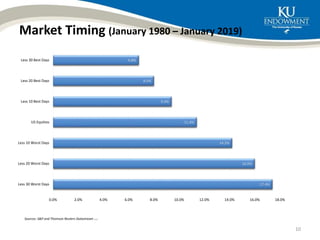
Market Timing (January 1980 – January 2019)
10
17.4%
16.0%
14.2%
11.4%
9.4%
8.0%
6.8%
0.0% 2.0% 4.0% 6.0% 8.0% 10.0% 12.0% 14.0% 16.0% 18.0%
Less 30 Worst Days
Less 20 Worst Days
Less 10 Worst Days
US Equities
Less 10 Best Days
Less 20 Best Days
Less 30 Best Days
Sources: S&P and Thomson Reuters Dotastream (137x)
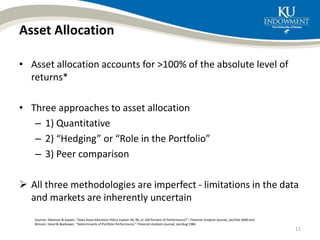
Asset Allocation
• Asset allocation accounts for >100% of the absolute level of
returns*
• Three approaches to asset allocation
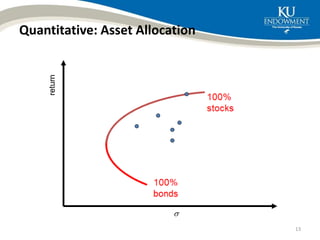
– 1) Quantitative
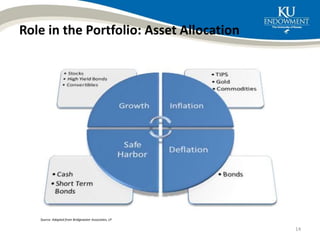
– 2) “Hedging” or “Role in the Portfolio”
– 3) Peer comparison
 All three methodologies are imperfect - limitations in the data
and markets are inherently uncertain
11
Sources: Ibbotson & Kaplan, “Does Asset Allocation Policy Explain 40, 90, or 100 Percent of Performance?”, Financial Analysts Journal, Jan/Feb 2000 and
Brinson, Hood & Beebower, “Determinants of Portfolio Performance,” Financial Analysts Journal, Jan/Aug 1986
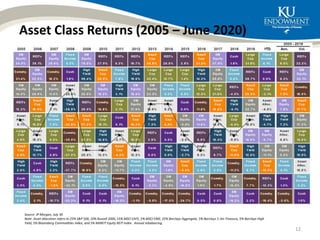
Asset Class Returns (2005 – June 2020)
12
Source: JP Morgan, July 30
Note: Asset allocation refers to 25% S&P 500, 10% Russell 2000, 15% MSCI EAFE, 5% MSCI EME, 25% Barclays Aggregate, 5% Barclays 1-3m Treasury, 5% Barclays High
Yield, 5% Bloomberg Commodities Index, and 5% NAREIT Equity REIT Index. Annual rebalancing.
Quantitative: Asset Allocation
13
return

Role in the Portfolio: Asset Allocation
14
Source: Adapted from Bridgewater Associates, LP
Peer Comparisons: Asset Allocation
15
Institution Equities Bonds
Private Equity/
Venture Capital Other
1
Bowdoin College 26.1 0.9 37.0 36.0
Yale University 18.6 4.9 46.5 30.0
Massachusetts Institute of Technology 35.0 6.0 34.0 25.0
University of Virginia 22.5 9.0 25.4 43.1
Princeton University 23.3 3.5 42.3 31.0
Dartmouth College 32.4 11.1 20.9 35.6
Williams College 24.0 8.2 24.7 43.1
University of Notre Dame 27.5 5.0 34.9 32.6
Duke University 34.0 3.0 27.0 36.0
Columbia University 26.3 2.8 26.4 44.5
Carnegie Mellon University 32.6 10.5 34.2 22.7
Rice University 31.4 6.6 25.6 36.5
Baylor College of Medicine 59.1 11.4 24.5 5.1
University of Pennsylvania 41.4 5.7 17.0 35.9
University of Tulsa 35.7 18.1 16.0 30.2
University of Minnesota Endowment 32.6 17.2 28.1 22.1
Stanford University 26.5 5.3 33.0 35.2
Middlebury College 28.0 8.0 24.0 40.0
Smith College 33.0 6.0 32.0 29.0
University of Richmond 30.2 4.4 20.1 45.3
Average (equal-weighted allocations) 31.0 7.4 28.7 32.9
Median 30.8 6.0 26.7 35.4
University of Kansas / KU Endowment 52.0 10.4 9.7 27.9
All Endowments >$1 billion
NACUBO (equal-weighted)2
35.9 8.3 19.4 36.3
NACUBO (dollar-weighted)2
32.0 7.0 26.0 35.0
Sources: NACUBO-Commonfund Study of Endowments, Standard & Poor's Money Market Directory, KU Endowment
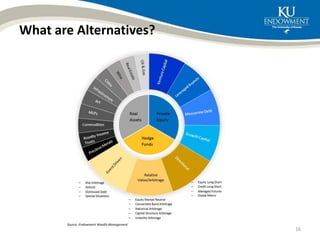
What are Alternatives?
16
Source: Endowment Wealth Management
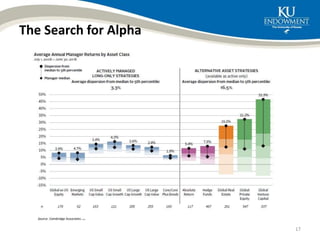
The Search for Alpha
17
Source: Cambridge Associates (593a)
Principles of Endowment Investing
• Invest in equities, because it is better to be an owner rather
than a lender.
• Hold a diversified portfolio, avoid market timing, and fine-
tune allocations at extreme valuations.
• Invest in private markets (“alternatives”) that have
incomplete information and illiquidity to increase long-term
incremental returns.
• Use outside managers except for all but the most routine or
indexed investments.
• Allocate capital to investment firms owned and managed by
the people actually doing the investing to reduce conflicts of
interest.
Source: Swensen, David. Pioneering Portfolio Management, 2000. 18

Endowment investing (sept 2020)

  • 1.
    Endowment Investing Managing theKU Endowment James G. Clarke Senior Vice President, Investments & Treasurer September 2020
  • 2.
    Goals • What isan endowment? Why does it matter? • Understand the three methods to generate returns • Understand the historical importance of favoring equities in generating returns • Gain familiarity with various asset classes, particularly alternatives 2
  • 3.
    KU Endowment • Founded1891 • Independent, fundraising and asset management arm of KU – Provides >6,500 scholarships a year – Supports major capital projects – like Capitol Federal Hall and ~2/3 of buildings on campus • $1.6 billion in long-term investments + >$400 million in ‘short-term’ portfolio 3
  • 4.
    What is anendowment? • Very long-term focus – perpetual • No shareholders (investors) • University endowments have a higher purpose, can generate loyal support • Long-time horizon is nearly unique in the investment world 4
  • 5.
    What is anendowment? • Very long-term focus – perpetual • No shareholders (investors) • University endowments have a higher purpose, can generate loyal support • Long-time horizon is nearly unique in the investment world • Endowments support ~8% of university operating costs 5
  • 6.
    Investment Objectives • Investmentobjectives should: – Reflect the financial policy objectives of the institution – Be clearly quantified – Incorporate specific time horizons – Be specified in real (inflation-adjusted) terms • KU Endowment’s primary investment objective calls for annual real total returns that at least equal total spending (generally 5.5%), net of fees, over long time periods (i.e. rolling 10-year periods) 6
  • 7.
    Principles of EndowmentInvesting • Invest in equities, because it is better to be an owner rather than a lender. • Hold a diversified portfolio, avoid market timing, and fine- tune allocations at extreme valuations. • Invest in private markets (“alternatives”) that have incomplete information and illiquidity to increase long-term incremental returns. • Use outside managers except for all but the most routine or indexed investments. • Allocate capital to investment firms owned and managed by the people actually doing the investing to reduce conflicts of interest. Source: Swensen, David. Pioneering Portfolio Management, 2000. 7
  • 8.
    Sources of Return •Three ways to make money – Security Selection – Market Timing – Asset Allocation 8
  • 9.
  • 10.
    Market Timing (January1980 – January 2019) 10 17.4% 16.0% 14.2% 11.4% 9.4% 8.0% 6.8% 0.0% 2.0% 4.0% 6.0% 8.0% 10.0% 12.0% 14.0% 16.0% 18.0% Less 30 Worst Days Less 20 Worst Days Less 10 Worst Days US Equities Less 10 Best Days Less 20 Best Days Less 30 Best Days Sources: S&P and Thomson Reuters Dotastream (137x)
  • 11.
    Asset Allocation • Assetallocation accounts for >100% of the absolute level of returns* • Three approaches to asset allocation – 1) Quantitative – 2) “Hedging” or “Role in the Portfolio” – 3) Peer comparison  All three methodologies are imperfect - limitations in the data and markets are inherently uncertain 11 Sources: Ibbotson & Kaplan, “Does Asset Allocation Policy Explain 40, 90, or 100 Percent of Performance?”, Financial Analysts Journal, Jan/Feb 2000 and Brinson, Hood & Beebower, “Determinants of Portfolio Performance,” Financial Analysts Journal, Jan/Aug 1986
  • 12.
    Asset Class Returns(2005 – June 2020) 12 Source: JP Morgan, July 30 Note: Asset allocation refers to 25% S&P 500, 10% Russell 2000, 15% MSCI EAFE, 5% MSCI EME, 25% Barclays Aggregate, 5% Barclays 1-3m Treasury, 5% Barclays High Yield, 5% Bloomberg Commodities Index, and 5% NAREIT Equity REIT Index. Annual rebalancing.
  • 13.
  • 14.
    Role in thePortfolio: Asset Allocation 14 Source: Adapted from Bridgewater Associates, LP
  • 15.
    Peer Comparisons: AssetAllocation 15 Institution Equities Bonds Private Equity/ Venture Capital Other 1 Bowdoin College 26.1 0.9 37.0 36.0 Yale University 18.6 4.9 46.5 30.0 Massachusetts Institute of Technology 35.0 6.0 34.0 25.0 University of Virginia 22.5 9.0 25.4 43.1 Princeton University 23.3 3.5 42.3 31.0 Dartmouth College 32.4 11.1 20.9 35.6 Williams College 24.0 8.2 24.7 43.1 University of Notre Dame 27.5 5.0 34.9 32.6 Duke University 34.0 3.0 27.0 36.0 Columbia University 26.3 2.8 26.4 44.5 Carnegie Mellon University 32.6 10.5 34.2 22.7 Rice University 31.4 6.6 25.6 36.5 Baylor College of Medicine 59.1 11.4 24.5 5.1 University of Pennsylvania 41.4 5.7 17.0 35.9 University of Tulsa 35.7 18.1 16.0 30.2 University of Minnesota Endowment 32.6 17.2 28.1 22.1 Stanford University 26.5 5.3 33.0 35.2 Middlebury College 28.0 8.0 24.0 40.0 Smith College 33.0 6.0 32.0 29.0 University of Richmond 30.2 4.4 20.1 45.3 Average (equal-weighted allocations) 31.0 7.4 28.7 32.9 Median 30.8 6.0 26.7 35.4 University of Kansas / KU Endowment 52.0 10.4 9.7 27.9 All Endowments >$1 billion NACUBO (equal-weighted)2 35.9 8.3 19.4 36.3 NACUBO (dollar-weighted)2 32.0 7.0 26.0 35.0 Sources: NACUBO-Commonfund Study of Endowments, Standard & Poor's Money Market Directory, KU Endowment
  • 16.
    What are Alternatives? 16 Source:Endowment Wealth Management
  • 17.
    The Search forAlpha 17 Source: Cambridge Associates (593a)
  • 18.
    Principles of EndowmentInvesting • Invest in equities, because it is better to be an owner rather than a lender. • Hold a diversified portfolio, avoid market timing, and fine- tune allocations at extreme valuations. • Invest in private markets (“alternatives”) that have incomplete information and illiquidity to increase long-term incremental returns. • Use outside managers except for all but the most routine or indexed investments. • Allocate capital to investment firms owned and managed by the people actually doing the investing to reduce conflicts of interest. Source: Swensen, David. Pioneering Portfolio Management, 2000. 18

Editor's Notes

  • #9 Three independent factors Security Selection is secondary Market timing is secondary Asset allocation is everything