Isolation in
Endodontics
Dr. Hadil Abdallah Altilbani
BDS Santiago de Compostela University Spain.
MSc. University of Valencia Spain.
Department of Endodontics University of Palestine .
Correct diagnosis
Complete obturation Cleaning and Debridement
SUCCESFULL
RCT
The goal of endodontic therapy is the prevention
and/or elimination of pathosis of endodontic origin
The Goal of conventional root
canal treatment is to properly clean,
shape and obturate the root canal
system.
One of the main challenges during
endodontic treatment is the
elimination of bacteria from within
the root canal system.
This is accomplished by repetitive
irrigation of the canal and
enlargement of the main canals so
that irrigant solution can reach all
aspects of the root canal system.
The Oral Cavity contains
literally hundreds of
different strains of
bacteria which can
infect and populate the
root canal system.
Furthermore,
the endodontic specialty is full of
small instruments and devices
which can be easily aspirated or
swallowed.
These are the two main reasons why isolation
in endodontics is mandatory. When considering the importance
of isolation
during endodontics the following statement applies:
“Endodontic procedures can not be expressed properly unless the
moisture in the mouth is properly controlled”
1. The goals of isolation:
A.Moisture control: Moisture control involves the
limitation of moisture from contaminating the operatory
field. (i.e. Moisture contamination during obturation which
could negatively effect the sealer strength)
Moisture control refers to
excluding sulcular fluid ,
saliva and gingival
bleeding from the
operating field.
B. Retraction: Retraction
of the lips, cheek and tongue as
well as displacement of the
gingival tissues surrounding the
isolated teeth.
C. Harm prevention: Prevention of harm to the patient in the
form of proper soft tissue retraction, prevention of toxic materials
from spilling into the oral cavity (i.e. NaoCL) as well as the
prevention of accidental aspiration or ingestion of sharp
instruments (i.e. endodontic files)
2. What needs to be
controlled during endodontic
treatment?
a. Saliva
b. Tongue
c. Mandible
d. Lips & cheek
e.Gingival tissue
f. Buccal & lingual vestibule
g. Floor of the mouth
h. Adjacent teeth and restoration
i. Respiratory moisture
3. Advantages of isolation during endodontic treatment
a. Patient related advantages:
i. It can provide comfort to the patient during endodontic treatment
because the patient feels safe, protected and isolated from the
procedures being undertaken.
ii. Protect patients from swallowing or aspirating foreign bodies like
endodontic instruments and materials.
iii.Protect patients soft tissues by retracting them as well as from
caustic materials used during endodontic procedures
b.Operator related advantages:
i. A dry clean field
ii. Infection control by reducing the amount of spatter and spray.
iii. Increased accessibility to the operatory field by offering maximum retraction
of soft tissues. This allows for comfort during the endodontic procedures as well
as less dependency of auxiliary retraction and isolation.
iv. Improved properties of materials being used due to elimination of the
possibility of moisture contamination during the enododontic procedures.
v. Improved visibility & less fogging of mirror due to elimination of respiratory
moisture and maximum soft tissue retraction allowing for more light and less
shadow in the operatory field.
vi. Prevents contamination of root canal system with oral bacteria.
4. Methods used to obtain isolation:
a. Moisture isolation can be accomplished directly or
indirectly:
i. Direct Methods:
(1)Rubber dam
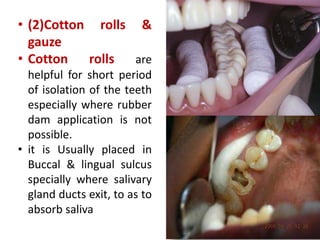
(2)Cotton rolls & gauze
(3)Absorbent cellulose wafers
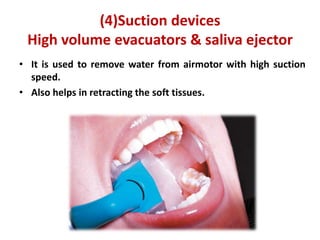
(4)Suction devices
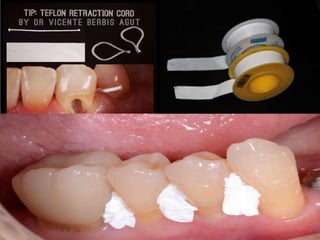
(5)Gingival retraction cord
• (2)Cotton rolls &
gauze
• Cotton rolls are
helpful for short period
of isolation of the teeth
especially where rubber
dam application is not
possible.
• it is Usually placed in
Buccal & lingual sulcus
specially where salivary
gland ducts exit, to as to
absorb saliva
(4)Suction devices
High volume evacuators & saliva ejector
• It is used to remove water from airmotor with high suction
speed.
• Also helps in retracting the soft tissues.
(5)Gingival retraction cord
• They are readymade cotton or
synthetic fibers woven in the form of
cords.
• Various types of cords e.g. braided,
non-braided ,plain or impregnated are
available in different size .
• Gingival retraction cord is used when
the use of rubber dam is not practical
or appropriate .
• Provides improved access and
visibility .
• It protects gingiva from abrasion
during cavity preparation .
• It restricts excess restorative material
from pushing into the sulcus.
ii. Indirect Methods:
(1)Comfortable patient position &
relaxed surroundings which will result in
reduced salivation and patient agitation
(2)Local anesthesia which will reduce
pain and concomitantly affect the
amount of salivation and patient
agitation.
(3)Drugs like atropin and barbiturates
to reduce patient salivation and agitation.
Local anesthesia: Local
anesthetics play a role in eliminating the
discomfort of dental treatment and
controlling moisture.
• Use of these agents reduce
salivation, apparently because the
patient is more comfortable ,less
anxious and less sensitive to oral
stimuli reducing salivary flow.
• Local anesthetics incorporating a
vasoconstrictor also reduce blood
flow, helping to control hemorrhage
at the opening site .
4. Methods used to obtain isolation:
a. Moisture isolation can be
accomplished directly or indirectly.
b. b. Soft tissue isolation of the lips
cheek and tongue and the gingiva:
i. Retraction of the lips, cheek and
tongue
(1)Rubber dam
(2)Cotton rolls
(3)Tongue guards
(4)Throat Shield
(5)Tongue depressor
(6)Cheek and lip retractors
(7)Mouth mirrors
(8)Mouth props
ii. Retraction of the gingiva
(1)Physico-mechanical means:
1.Rubber dam
2.Retraction cord
3. Teflon tape
(2)Chemical means:
Using astringent materials to shrink
gingiva and reduce vascularity, i.e.
Alum
(3)Electrochemical means:
1. Electrocautery
2. Laser
(4)Surgical means
5.What is a rubber dam?
It is a flat thin sheet of Latex/Non-latex hat is
held by a Clamp And A Frame, that is preferred to allow the tooth to teeth to
protrude through the perforations, while all other teeth are covered.
It was first introduced in 1864, S.C.Barnum, a New York city.
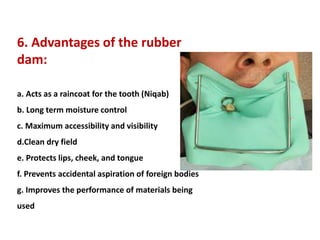
6. Advantages of the rubber
dam:
a. Acts as a raincoat for the tooth (Niqab)
b. Long term moisture control
c. Maximum accessibility and visibility
d.Clean dry field
e. Protects lips, cheek, and tongue
f. Prevents accidental aspiration of foreign bodies
g. Improves the performance of materials being
used
7.Disadvantages of the rubber
dam:
a. Takes Time to be applied, this is not true once a
dentist is trained on rubber dam application it
takes less than one minute to apply it properly.
b. Communication with the patient is impaired
c. Insecure clamps maybe Swallowed, precautions
should should be taken to prevent this from
happening. By trying a piece of floss to the bow of the
clamp during the procedures.
8. Possible
contraindications of rubber
dam isolation:
a. Asthmatic patients
b. Latex allergy, non-latex rubber
dam maybe used as a substitute.
c. Severely malposed and tilted
teeth i.e wisdom teeth
d. Mouth breathers
9.Components of the rubber dam (Armamentarium):
a.Rubber dam sheet
b.Rubber dam clamps
c. Rubber dam forceps
d.Rubber dam frame
e.Rubber dam punch
f. Rubber dam template
g. Scissors
Accessories
h. Lubricant
i. Dental floss
j. Rubber dam napkin
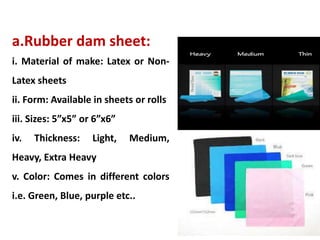
a.Rubber dam sheet:
i. Material of make: Latex or Non-
Latex sheets
ii. Form: Available in sheets or rolls
iii. Sizes: 5”x5” or 6”x6”
iv. Thickness: Light, Medium,
Heavy, Extra Heavy
v. Color: Comes in different colors
i.e. Green, Blue, purple etc..
b.Rubber dam clamps:
i. Functions:
(1)Secures the dam to the teeth
(2)Retract the gingiva
ii. Types:
(1)Winged clamps
(2)Wingless clamps
iii.Parts of the clamp:
(1)Central wing: Present on winged clamps. The rubber dam is
attached to it prior to application of the clamp to the tooth.
(2)Jaws:
(3)Beaks
(4)Anterior wing: Present on winged clamps. Gives more retraction.
(5)Perforation or Hole
c. Rubber dam frame:
i. Functions:
(a)Maintains the border of
the dam in position
(b)Supports the edges of the
rubber dam
(c)Retracts the soft tissues
ii. Types:
(a)Plastic
(b)Metal
d.Rubber dam forceps: Used to place and remove the
clamp on the tooth to be isolated.
e.Rubber dam Punch:
i. Functions: Makes holes in the sheet through which the teeth can be isolated.
ii. Parts:
(a)Rotating disc with different sized holes or Bow or Hole
(b)Sharp pointed plunger
f. Rubber dam template or stamp: Marks the correct position of the
tooth to be isolated on the rubber dam. The holes should be punched in the
proper position to allow for proper placement of the rubber dam.
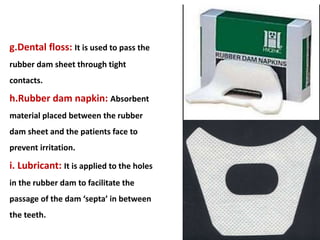
g.Dental floss: It is used to pass the
rubber dam sheet through tight
contacts.
h.Rubber dam napkin: Absorbent
material placed between the rubber
dam sheet and the patients face to
prevent irritation.
i. Lubricant: It is applied to the holes
in the rubber dam to facilitate the
passage of the dam ‘septa’ in between
the teeth.
endodontic isolation.pptx

endodontic isolation.pptx

  • 1.
    Isolation in Endodontics Dr. HadilAbdallah Altilbani BDS Santiago de Compostela University Spain. MSc. University of Valencia Spain. Department of Endodontics University of Palestine .
  • 2.
    Correct diagnosis Complete obturationCleaning and Debridement SUCCESFULL RCT The goal of endodontic therapy is the prevention and/or elimination of pathosis of endodontic origin
  • 3.
    The Goal ofconventional root canal treatment is to properly clean, shape and obturate the root canal system. One of the main challenges during endodontic treatment is the elimination of bacteria from within the root canal system. This is accomplished by repetitive irrigation of the canal and enlargement of the main canals so that irrigant solution can reach all aspects of the root canal system.
  • 6.
    The Oral Cavitycontains literally hundreds of different strains of bacteria which can infect and populate the root canal system.
  • 7.
    Furthermore, the endodontic specialtyis full of small instruments and devices which can be easily aspirated or swallowed.
  • 9.
    These are thetwo main reasons why isolation in endodontics is mandatory. When considering the importance of isolation during endodontics the following statement applies: “Endodontic procedures can not be expressed properly unless the moisture in the mouth is properly controlled”
  • 10.
    1. The goalsof isolation: A.Moisture control: Moisture control involves the limitation of moisture from contaminating the operatory field. (i.e. Moisture contamination during obturation which could negatively effect the sealer strength)
  • 11.
    Moisture control refersto excluding sulcular fluid , saliva and gingival bleeding from the operating field.
  • 12.
    B. Retraction: Retraction ofthe lips, cheek and tongue as well as displacement of the gingival tissues surrounding the isolated teeth.
  • 13.
    C. Harm prevention:Prevention of harm to the patient in the form of proper soft tissue retraction, prevention of toxic materials from spilling into the oral cavity (i.e. NaoCL) as well as the prevention of accidental aspiration or ingestion of sharp instruments (i.e. endodontic files)
  • 14.
    2. What needsto be controlled during endodontic treatment? a. Saliva b. Tongue c. Mandible d. Lips & cheek e.Gingival tissue f. Buccal & lingual vestibule g. Floor of the mouth h. Adjacent teeth and restoration i. Respiratory moisture
  • 15.
    3. Advantages ofisolation during endodontic treatment a. Patient related advantages: i. It can provide comfort to the patient during endodontic treatment because the patient feels safe, protected and isolated from the procedures being undertaken. ii. Protect patients from swallowing or aspirating foreign bodies like endodontic instruments and materials. iii.Protect patients soft tissues by retracting them as well as from caustic materials used during endodontic procedures
  • 16.
    b.Operator related advantages: i.A dry clean field ii. Infection control by reducing the amount of spatter and spray. iii. Increased accessibility to the operatory field by offering maximum retraction of soft tissues. This allows for comfort during the endodontic procedures as well as less dependency of auxiliary retraction and isolation. iv. Improved properties of materials being used due to elimination of the possibility of moisture contamination during the enododontic procedures. v. Improved visibility & less fogging of mirror due to elimination of respiratory moisture and maximum soft tissue retraction allowing for more light and less shadow in the operatory field. vi. Prevents contamination of root canal system with oral bacteria.
  • 17.
    4. Methods usedto obtain isolation: a. Moisture isolation can be accomplished directly or indirectly: i. Direct Methods: (1)Rubber dam (2)Cotton rolls & gauze (3)Absorbent cellulose wafers (4)Suction devices (5)Gingival retraction cord
  • 18.
    • (2)Cotton rolls& gauze • Cotton rolls are helpful for short period of isolation of the teeth especially where rubber dam application is not possible. • it is Usually placed in Buccal & lingual sulcus specially where salivary gland ducts exit, to as to absorb saliva
  • 19.
    (4)Suction devices High volumeevacuators & saliva ejector • It is used to remove water from airmotor with high suction speed. • Also helps in retracting the soft tissues.
  • 20.
    (5)Gingival retraction cord •They are readymade cotton or synthetic fibers woven in the form of cords. • Various types of cords e.g. braided, non-braided ,plain or impregnated are available in different size . • Gingival retraction cord is used when the use of rubber dam is not practical or appropriate . • Provides improved access and visibility . • It protects gingiva from abrasion during cavity preparation . • It restricts excess restorative material from pushing into the sulcus.
  • 21.
    ii. Indirect Methods: (1)Comfortablepatient position & relaxed surroundings which will result in reduced salivation and patient agitation (2)Local anesthesia which will reduce pain and concomitantly affect the amount of salivation and patient agitation. (3)Drugs like atropin and barbiturates to reduce patient salivation and agitation.
  • 22.
    Local anesthesia: Local anestheticsplay a role in eliminating the discomfort of dental treatment and controlling moisture. • Use of these agents reduce salivation, apparently because the patient is more comfortable ,less anxious and less sensitive to oral stimuli reducing salivary flow. • Local anesthetics incorporating a vasoconstrictor also reduce blood flow, helping to control hemorrhage at the opening site .
  • 23.
    4. Methods usedto obtain isolation: a. Moisture isolation can be accomplished directly or indirectly. b. b. Soft tissue isolation of the lips cheek and tongue and the gingiva: i. Retraction of the lips, cheek and tongue (1)Rubber dam (2)Cotton rolls (3)Tongue guards (4)Throat Shield (5)Tongue depressor (6)Cheek and lip retractors (7)Mouth mirrors (8)Mouth props
  • 24.
    ii. Retraction ofthe gingiva (1)Physico-mechanical means: 1.Rubber dam 2.Retraction cord 3. Teflon tape (2)Chemical means: Using astringent materials to shrink gingiva and reduce vascularity, i.e. Alum (3)Electrochemical means: 1. Electrocautery 2. Laser (4)Surgical means
  • 26.
    5.What is arubber dam? It is a flat thin sheet of Latex/Non-latex hat is held by a Clamp And A Frame, that is preferred to allow the tooth to teeth to protrude through the perforations, while all other teeth are covered. It was first introduced in 1864, S.C.Barnum, a New York city.
  • 29.
    6. Advantages ofthe rubber dam: a. Acts as a raincoat for the tooth (Niqab) b. Long term moisture control c. Maximum accessibility and visibility d.Clean dry field e. Protects lips, cheek, and tongue f. Prevents accidental aspiration of foreign bodies g. Improves the performance of materials being used
  • 30.
    7.Disadvantages of therubber dam: a. Takes Time to be applied, this is not true once a dentist is trained on rubber dam application it takes less than one minute to apply it properly. b. Communication with the patient is impaired c. Insecure clamps maybe Swallowed, precautions should should be taken to prevent this from happening. By trying a piece of floss to the bow of the clamp during the procedures.
  • 31.
    8. Possible contraindications ofrubber dam isolation: a. Asthmatic patients b. Latex allergy, non-latex rubber dam maybe used as a substitute. c. Severely malposed and tilted teeth i.e wisdom teeth d. Mouth breathers
  • 32.
    9.Components of therubber dam (Armamentarium): a.Rubber dam sheet b.Rubber dam clamps c. Rubber dam forceps d.Rubber dam frame e.Rubber dam punch f. Rubber dam template g. Scissors Accessories h. Lubricant i. Dental floss j. Rubber dam napkin
  • 34.
    a.Rubber dam sheet: i.Material of make: Latex or Non- Latex sheets ii. Form: Available in sheets or rolls iii. Sizes: 5”x5” or 6”x6” iv. Thickness: Light, Medium, Heavy, Extra Heavy v. Color: Comes in different colors i.e. Green, Blue, purple etc..
  • 35.
    b.Rubber dam clamps: i.Functions: (1)Secures the dam to the teeth (2)Retract the gingiva ii. Types: (1)Winged clamps (2)Wingless clamps iii.Parts of the clamp: (1)Central wing: Present on winged clamps. The rubber dam is attached to it prior to application of the clamp to the tooth. (2)Jaws: (3)Beaks (4)Anterior wing: Present on winged clamps. Gives more retraction. (5)Perforation or Hole
  • 37.
    c. Rubber damframe: i. Functions: (a)Maintains the border of the dam in position (b)Supports the edges of the rubber dam (c)Retracts the soft tissues ii. Types: (a)Plastic (b)Metal
  • 39.
    d.Rubber dam forceps:Used to place and remove the clamp on the tooth to be isolated.
  • 40.
    e.Rubber dam Punch: i.Functions: Makes holes in the sheet through which the teeth can be isolated. ii. Parts: (a)Rotating disc with different sized holes or Bow or Hole (b)Sharp pointed plunger
  • 42.
    f. Rubber damtemplate or stamp: Marks the correct position of the tooth to be isolated on the rubber dam. The holes should be punched in the proper position to allow for proper placement of the rubber dam.
  • 44.
    g.Dental floss: Itis used to pass the rubber dam sheet through tight contacts. h.Rubber dam napkin: Absorbent material placed between the rubber dam sheet and the patients face to prevent irritation. i. Lubricant: It is applied to the holes in the rubber dam to facilitate the passage of the dam ‘septa’ in between the teeth.