Proceedings of the 33rd
ECOWAS iSTEAMS Emerging Technologies Multidisciplinary Conference
184
Society for Multidisciplinary & Advanced Research Techniques (SMART)
Trinity University, Lagos, Nigeria
SMART Scientific Projects & Research Consortium (SMART SPaRC)
Harmarth Global Educational Services
ICT University Foundations USA
IEEE Computer Society Nigeria Chapter
33rd ECOWAS iSTEAMS ETech Multidisciplinary Conference (ECOWAS-ETech)
Encryption of Text in Image Over a Network
Stephen Hasford
School of Technology
Ghana Institute of Management & Public Administration
GreenHills, Accra, Ghana
E-mail: stephen.hasford@st.gimpa.edu.gh
ABSTRACT
Several recent attacks have arisen during electronic information transmission between a sender
and a recipient over an unencrypted network. This has made threat actors eavesdrop and
capture sensitive information being transmitted over the network since the information is in
cleartext. Introducing an encryption protocol will protect data in transition from being
eavesdropped on by threat actors, but only the recipient will be able to decipher and read the
information. This term paper demonstrates a method of encrypting plaintext information data
into an image to be sent over a network to the intended recipient.
Keywords: Encryption, Network, Image steganography
Proceedings Citation Format
Stephen Hasford (2022): Encryption of Text in Image Over a Network. Proceedings of the 33rd ECOWAS iSTEAMS Emerging
Technologies, Scientific, Business, Social Innovations & Cyber Space Ecosystem Multidisciplinary Conference. University of
Ghana/Academic City University College, Ghana. 29th Sept – 1st Oct, 2022.
Pp 184-188. www.isteams.net/ghanabespoke2022. dx.doi.org/10.22624/AIMS-/ECOWASETECH2022P36
INTRODUCTION
Threat actors can capture or eavesdrop on information transmitted over a network which is sent
in plaintext and is not encrypted. This attack is called a man-in-the-middle attack when the threat
actors intercept the information; they are sold on the dark web or used to attack the sender. It
is important to add an additional layer of security using steganography or cryptography
techniques. These techniques are used to hide information data in digital media. According to
Amin et al. (2003), steganography hides the existence of the message from others while
cryptography scrambles the message so you know it is there but cannot access it without a
key. Cryptography and steganography are well-known and widely used techniques that
manipulate information to hide its existence. Cryptography scrambles a message so it cannot
be understood. It involves converting a message into an unreadable cipher. Abikoye et al.
(2012) state A large number of cryptography algorithms have been created to date with the
primary objective of converting information into unreadable ciphers.
Proceedings of the 33rd
ECOWAS iSTEAMS Emerging Technologies Multidisciplinary Conference
185
2. LITERATURE REVIEW
Kapur and Baregar (2013) developed security using image processing to increase the security
of transmitted data on the internet to a much-needed higher level by using the AES algorithm to
encrypt the text message and embed it in a part of the image, thus making the text message
challenging to find. Due to the rise in cybercrime activities over a network, implementing only
network security won’t be sufficient, but adding the image steganography technique will benefit
transmitting confidential information.
The design of encryption of text in the image over a network
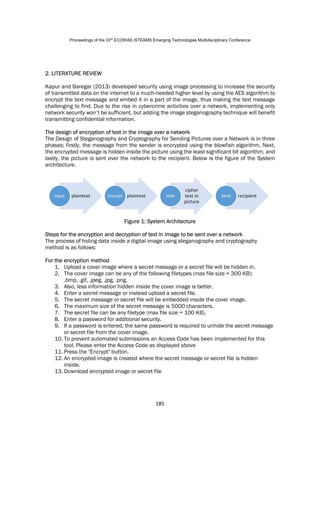
The Design of Steganography and Cryptography for Sending Pictures over a Network is in three
phases; firstly, the message from the sender is encrypted using the blowfish algorithm. Next,
the encrypted message is hidden inside the picture using the least significant bit algorithm, and
lastly, the picture is sent over the network to the recipient. Below is the figure of the System
architecture.
Figure 1: System Architecture
Steps for the encryption and decryption of text in image to be sent over a network
The process of hiding data inside a digital image using steganography and cryptography
method is as follows:
For the encryption method
1. Upload a cover image where a secret message or a secret file will be hidden in.
2. The cover image can be any of the following filetypes (max file size = 300 KB):
.bmp, .gif, .jpeg, .jpg, .png.
3. Also, less information hidden inside the cover image is better.
4. Enter a secret message or instead upload a secret file.
5. The secret message or secret file will be embedded inside the cover image.
6. The maximum size of the secret message is 5000 characters.
7. The secret file can be any filetype (max file size = 100 KB).
8. Enter a password for additional security.
9. If a password is entered, the same password is required to unhide the secret message
or secret file from the cover image.
10. To prevent automated submissions an Access Code has been implemented for this
tool. Please enter the Access Code as displayed above
11. Press the "Encrypt" button.
12. An encrypted image is created where the secret message or secret file is hidden
inside.
13. Download encrypted image or secret file
Proceedings of the 33rd
ECOWAS iSTEAMS Emerging Technologies Multidisciplinary Conference
186
For the decryption method
1. Upload an encrypted image where the secret message or the secret file is hidden
inside.
2. If a password is specified during the encryption process, the same password is
required here.
3. To prevent automated submissions an Access Code has been implemented for this
tool. Please enter the Access Code as displayed above
4. Press the "Decrypt" button.
5. If a secret message is found it will be displayed in the text area.
If a secret file is found it can be downloaded.
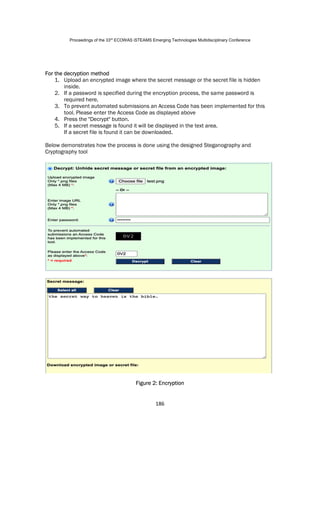
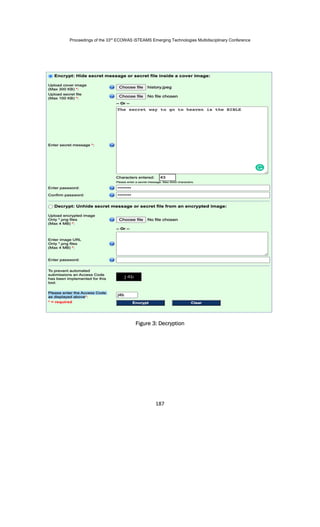
Below demonstrates how the process is done using the designed Steganography and
Cryptography tool
Figure 2: Encryption
Proceedings of the 33rd
ECOWAS iSTEAMS Emerging Technologies Multidisciplinary Conference
187
Figure 3: Decryption
Proceedings of the 33rd
ECOWAS iSTEAMS Emerging Technologies Multidisciplinary Conference
188
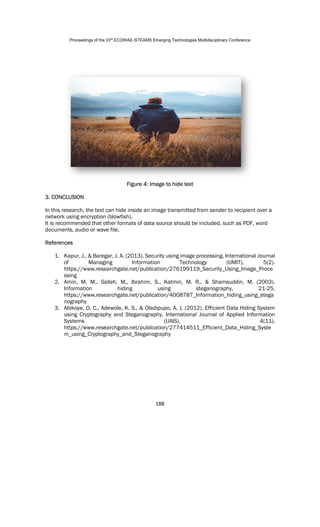
Figure 4: Image to hide text
3. CONCLUSION
In this research, the text can hide inside an image transmitted from sender to recipient over a
network using encryption (blowfish).
It is recommended that other formats of data source should be included, such as PDF, word
documents, audio or wave file.
References
1. Kapur, J., & Baregar, J. A. (2013). Security using image processing. International Journal
of Managing Information Technology (IJMIT), 5(2).
https://www.researchgate.net/publication/276199119_Security_Using_Image_Proce
ssing
2. Amin, M. M., Salleh, M., Ibrahim, S., Katmin, M. R., & Shamsuddin, M. (2003).
Information hiding using steganography, 21-25.
https://www.researchgate.net/publication/4008787_Information_hiding_using_stega
nography
3. Abikoye, O. C., Adewole, K. S., & Oladipupo, A. J. (2012). Efficient Data Hiding System
using Cryptography and Steganography. International Journal of Applied Information
Systems (IJAIS), 4(11).
https://www.researchgate.net/publication/277414511_Efficient_Data_Hiding_Syste
m_using_Cryptography_and_Steganography

Encryption of Text in Image Over a Network

  • 1.
    Proceedings of the33rd ECOWAS iSTEAMS Emerging Technologies Multidisciplinary Conference 184 Society for Multidisciplinary & Advanced Research Techniques (SMART) Trinity University, Lagos, Nigeria SMART Scientific Projects & Research Consortium (SMART SPaRC) Harmarth Global Educational Services ICT University Foundations USA IEEE Computer Society Nigeria Chapter 33rd ECOWAS iSTEAMS ETech Multidisciplinary Conference (ECOWAS-ETech) Encryption of Text in Image Over a Network Stephen Hasford School of Technology Ghana Institute of Management & Public Administration GreenHills, Accra, Ghana E-mail: stephen.hasford@st.gimpa.edu.gh ABSTRACT Several recent attacks have arisen during electronic information transmission between a sender and a recipient over an unencrypted network. This has made threat actors eavesdrop and capture sensitive information being transmitted over the network since the information is in cleartext. Introducing an encryption protocol will protect data in transition from being eavesdropped on by threat actors, but only the recipient will be able to decipher and read the information. This term paper demonstrates a method of encrypting plaintext information data into an image to be sent over a network to the intended recipient. Keywords: Encryption, Network, Image steganography Proceedings Citation Format Stephen Hasford (2022): Encryption of Text in Image Over a Network. Proceedings of the 33rd ECOWAS iSTEAMS Emerging Technologies, Scientific, Business, Social Innovations & Cyber Space Ecosystem Multidisciplinary Conference. University of Ghana/Academic City University College, Ghana. 29th Sept – 1st Oct, 2022. Pp 184-188. www.isteams.net/ghanabespoke2022. dx.doi.org/10.22624/AIMS-/ECOWASETECH2022P36 INTRODUCTION Threat actors can capture or eavesdrop on information transmitted over a network which is sent in plaintext and is not encrypted. This attack is called a man-in-the-middle attack when the threat actors intercept the information; they are sold on the dark web or used to attack the sender. It is important to add an additional layer of security using steganography or cryptography techniques. These techniques are used to hide information data in digital media. According to Amin et al. (2003), steganography hides the existence of the message from others while cryptography scrambles the message so you know it is there but cannot access it without a key. Cryptography and steganography are well-known and widely used techniques that manipulate information to hide its existence. Cryptography scrambles a message so it cannot be understood. It involves converting a message into an unreadable cipher. Abikoye et al. (2012) state A large number of cryptography algorithms have been created to date with the primary objective of converting information into unreadable ciphers.
  • 2.
    Proceedings of the33rd ECOWAS iSTEAMS Emerging Technologies Multidisciplinary Conference 185 2. LITERATURE REVIEW Kapur and Baregar (2013) developed security using image processing to increase the security of transmitted data on the internet to a much-needed higher level by using the AES algorithm to encrypt the text message and embed it in a part of the image, thus making the text message challenging to find. Due to the rise in cybercrime activities over a network, implementing only network security won’t be sufficient, but adding the image steganography technique will benefit transmitting confidential information. The design of encryption of text in the image over a network The Design of Steganography and Cryptography for Sending Pictures over a Network is in three phases; firstly, the message from the sender is encrypted using the blowfish algorithm. Next, the encrypted message is hidden inside the picture using the least significant bit algorithm, and lastly, the picture is sent over the network to the recipient. Below is the figure of the System architecture. Figure 1: System Architecture Steps for the encryption and decryption of text in image to be sent over a network The process of hiding data inside a digital image using steganography and cryptography method is as follows: For the encryption method 1. Upload a cover image where a secret message or a secret file will be hidden in. 2. The cover image can be any of the following filetypes (max file size = 300 KB): .bmp, .gif, .jpeg, .jpg, .png. 3. Also, less information hidden inside the cover image is better. 4. Enter a secret message or instead upload a secret file. 5. The secret message or secret file will be embedded inside the cover image. 6. The maximum size of the secret message is 5000 characters. 7. The secret file can be any filetype (max file size = 100 KB). 8. Enter a password for additional security. 9. If a password is entered, the same password is required to unhide the secret message or secret file from the cover image. 10. To prevent automated submissions an Access Code has been implemented for this tool. Please enter the Access Code as displayed above 11. Press the "Encrypt" button. 12. An encrypted image is created where the secret message or secret file is hidden inside. 13. Download encrypted image or secret file
  • 3.
    Proceedings of the33rd ECOWAS iSTEAMS Emerging Technologies Multidisciplinary Conference 186 For the decryption method 1. Upload an encrypted image where the secret message or the secret file is hidden inside. 2. If a password is specified during the encryption process, the same password is required here. 3. To prevent automated submissions an Access Code has been implemented for this tool. Please enter the Access Code as displayed above 4. Press the "Decrypt" button. 5. If a secret message is found it will be displayed in the text area. If a secret file is found it can be downloaded. Below demonstrates how the process is done using the designed Steganography and Cryptography tool Figure 2: Encryption
  • 4.
    Proceedings of the33rd ECOWAS iSTEAMS Emerging Technologies Multidisciplinary Conference 187 Figure 3: Decryption
  • 5.
    Proceedings of the33rd ECOWAS iSTEAMS Emerging Technologies Multidisciplinary Conference 188 Figure 4: Image to hide text 3. CONCLUSION In this research, the text can hide inside an image transmitted from sender to recipient over a network using encryption (blowfish). It is recommended that other formats of data source should be included, such as PDF, word documents, audio or wave file. References 1. Kapur, J., & Baregar, J. A. (2013). Security using image processing. International Journal of Managing Information Technology (IJMIT), 5(2). https://www.researchgate.net/publication/276199119_Security_Using_Image_Proce ssing 2. Amin, M. M., Salleh, M., Ibrahim, S., Katmin, M. R., & Shamsuddin, M. (2003). Information hiding using steganography, 21-25. https://www.researchgate.net/publication/4008787_Information_hiding_using_stega nography 3. Abikoye, O. C., Adewole, K. S., & Oladipupo, A. J. (2012). Efficient Data Hiding System using Cryptography and Steganography. International Journal of Applied Information Systems (IJAIS), 4(11). https://www.researchgate.net/publication/277414511_Efficient_Data_Hiding_Syste m_using_Cryptography_and_Steganography