Place-Based Curriculum Approaches Dr Affrica Taylor Diverse Curriculum Approaches PG May 2010
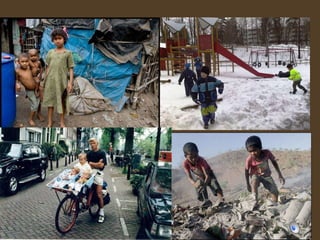
Children’s lives are shaped by the places they inhabit
 
 
Place has pedagogical significance  (Greunewald 2003)
Children form attachments to ‘special places’  (Sobel 1993) Children’s ‘sense of place’ can facilitate stewardship  (Wilson 1997)
Place-based education Origins in rural US contexts  Theobald (1997)  Teaching the Commons: Place, Pride, and the Renewal of Community Place-base education movement  http://www.promiseofplace.org/   Linked to  environmental education nature-based learning ‘ new localism’ civics and citizenship education Australian postcolonial place pedagogies (Sommerville 2003)
Features of Place-Based Pedagogy Pays attention to social, cultural, built and natural environments Links curriculum to children’s lived experiences Connects children in meaningful ways to their local communities –crosses school/community boundaries Builds affiliations to promote social and environmental stewardship and active citizenship Can be used to promote Reconciliation
Features of place-based learning cont. No generic curriculum - adapted to unique characteristics of particular places and children’s immediate concerns Learning in the local through expeditionary learning, problem-based learning, contextual learning, project-based learning, hands on learning, eco-literacy (Orr  2004), critical place-based social literacy, reinhabitation (Gruenewald 2003). Parochialism avoided by studying relationship between places  (eg mapping a food chain; comparing local Indigenous cultures and knowledges)
Three Sisters Project Place-based Indigenous education project Linking early childhood centres in 3 very different places Wiradjuri Early Childood Centre and Preschool, University of Canberra ACT Redfern SDN Children’s Centre, Redfern NSW Atitjere Creche, Harts Range via Alice Springs NT
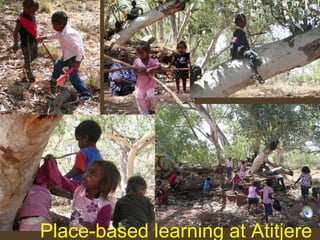
Three Sisters project cont. Explored how Indigenous education is place-specific  Some project questions …. What kinds of relationships do the children in these centres have with their local environments and communities? How might place affect the way we incorporate Indigenous education into our curriculum?
Atitjere Creche
Place-based learning at Atitjere
Place based learning in Redfern
Wiradjuri Centre
What we found … Great pedagogical significance in focusing on ‘where we are’ Indigenous education looks radically different in different contexts, but there are still common features: Local Indigenous communities are primary and central curriculum resource. Start there.  To recognise and include local Indigenous history and cultural heritage is to practise reinhabitation (Gruenewald 2003) and Reconciliation. All Australian places have Indigenous histories. People are curious about the differences and learn from sharing local knowledges and histories. Move from local to ‘bigger picture’ Indigenous and non-indigenous early childhood educators and children have so much to learn from each other.
Some references Greunewald, D. (2003).  The  Best  of  Both  Worlds:  A  Critical  Pedagogy  of  Place.  Educational   Researcher,  32(4),  3-­‐11.  Orr, D. (2004)  Earth in Mind: On Education, Environment and the Human Prospect, Washington, London: Island Press Sobel,  D.  (1993).  Children's  Special  Places:  Exploring  the  role  of  forts,  dens,  and  bush  houses  in  middle   childhood:  Zephyr  Press.  Sobel, D. (2005) Place-based Education: Connecting Classrooms and Communities, Great Barrington, MA: Orion Society. Sommerville, M. (2009) Becoming frog: A primary school place pedagogy.  Retrieved from: www.aare.edu.au/07pap/som07443.pdf  Theobald (1997) Teaching the Commons: Place, Pride, and the Renewal of Community Wilson,  R.  (1997).  A  Sense  of  Place.  Early  Childhood  Education  Journal,  24(3),  191‐194.

Place Based Pedagogies

  • 1.
    Place-Based Curriculum ApproachesDr Affrica Taylor Diverse Curriculum Approaches PG May 2010
  • 2.
    Children’s lives areshaped by the places they inhabit
  • 3.
  • 4.
  • 5.
    Place has pedagogicalsignificance (Greunewald 2003)
  • 6.
    Children form attachmentsto ‘special places’ (Sobel 1993) Children’s ‘sense of place’ can facilitate stewardship (Wilson 1997)
  • 7.
    Place-based education Originsin rural US contexts Theobald (1997) Teaching the Commons: Place, Pride, and the Renewal of Community Place-base education movement http://www.promiseofplace.org/ Linked to environmental education nature-based learning ‘ new localism’ civics and citizenship education Australian postcolonial place pedagogies (Sommerville 2003)
  • 8.
    Features of Place-BasedPedagogy Pays attention to social, cultural, built and natural environments Links curriculum to children’s lived experiences Connects children in meaningful ways to their local communities –crosses school/community boundaries Builds affiliations to promote social and environmental stewardship and active citizenship Can be used to promote Reconciliation
  • 9.
    Features of place-basedlearning cont. No generic curriculum - adapted to unique characteristics of particular places and children’s immediate concerns Learning in the local through expeditionary learning, problem-based learning, contextual learning, project-based learning, hands on learning, eco-literacy (Orr 2004), critical place-based social literacy, reinhabitation (Gruenewald 2003). Parochialism avoided by studying relationship between places (eg mapping a food chain; comparing local Indigenous cultures and knowledges)
  • 10.
    Three Sisters ProjectPlace-based Indigenous education project Linking early childhood centres in 3 very different places Wiradjuri Early Childood Centre and Preschool, University of Canberra ACT Redfern SDN Children’s Centre, Redfern NSW Atitjere Creche, Harts Range via Alice Springs NT
  • 11.
    Three Sisters projectcont. Explored how Indigenous education is place-specific Some project questions …. What kinds of relationships do the children in these centres have with their local environments and communities? How might place affect the way we incorporate Indigenous education into our curriculum?
  • 12.
  • 13.
  • 14.
  • 15.
  • 16.
    What we found… Great pedagogical significance in focusing on ‘where we are’ Indigenous education looks radically different in different contexts, but there are still common features: Local Indigenous communities are primary and central curriculum resource. Start there. To recognise and include local Indigenous history and cultural heritage is to practise reinhabitation (Gruenewald 2003) and Reconciliation. All Australian places have Indigenous histories. People are curious about the differences and learn from sharing local knowledges and histories. Move from local to ‘bigger picture’ Indigenous and non-indigenous early childhood educators and children have so much to learn from each other.
  • 17.
    Some references Greunewald,D. (2003).  The  Best  of  Both  Worlds:  A  Critical  Pedagogy  of  Place.  Educational   Researcher,  32(4),  3-­‐11. Orr, D. (2004) Earth in Mind: On Education, Environment and the Human Prospect, Washington, London: Island Press Sobel,  D.  (1993).  Children's  Special  Places:  Exploring  the  role  of  forts,  dens,  and  bush  houses  in  middle   childhood:  Zephyr  Press. Sobel, D. (2005) Place-based Education: Connecting Classrooms and Communities, Great Barrington, MA: Orion Society. Sommerville, M. (2009) Becoming frog: A primary school place pedagogy. Retrieved from: www.aare.edu.au/07pap/som07443.pdf Theobald (1997) Teaching the Commons: Place, Pride, and the Renewal of Community Wilson,  R.  (1997).  A  Sense  of  Place.  Early  Childhood  Education  Journal,  24(3),  191‐194.

Editor's Notes

  • #7 Educators are starting to pay attention the fact that children form attachments to places. This is an important observation when coupled with an understanding of the pedagogical significance of place. Early childhood educators know that some places are very special to children. There are some places that children chose to visit or play on a regular basis. Most children love to construct their own spaces: cubbies to hide in, vehicles out of cardboard boxes, cities out of blocks, rock garden in sandpits. Some places and spaces clearly stimulate children’s imaginations and offer them solace and security as well as excitement. This indicates that children have a well tuned ‘sense of place’. As Wilson discusses in the reading for this module, this sense of place is indicative of an potential emotional relationship. If it is a positive one, if it is a ‘special place’ that children feel a sense of connection to, it holds great pedagogical potential for educators. For it is children’s own sense of place and attachment to place that can form the basis of an education that fosters stewardship. Teachers can encourage children to take care of their special places, to feel a sense of responsibility for them, if they foster and encourage children’s attachments to these places.