E – INVOICE SYSTEM
E-Invoicing System
Invoice is
registered
Submit
invoice
details to
IRP
Basic
validations
done
IRP
Returns
Acknowledgement
number
Unique Invoice Reference
Number
Digitally Signed QR Code
Digitally Signed Invoice
Process of Invoice Registration
Generating E-invoices means uploading Invoice Details as per a standard invoice
format called INV-01 to IRP (E-Invoice Portal)
GST REGISTRANT UNDER E-INVOICING
SYSTEM
GST
PORTAL
SUPPLIER HAS TO MAKE DATA
ENTRIES RELATING TO INVOICE
DETAILS FOR FILING GST R – 1
RETURN AND E-WAY BILL
INVOICE DETAILS TRANSFERRED FROM IRP TO GST
PORTAL – ELIMINATES THE NEED FOR ENTERING
MOST OF THE DATA ENTRY TO FILE GSTR-1 AND E-
WAY BILL
GST REGISTRANT NOT UNDER E-INVOICING
SYSTEM
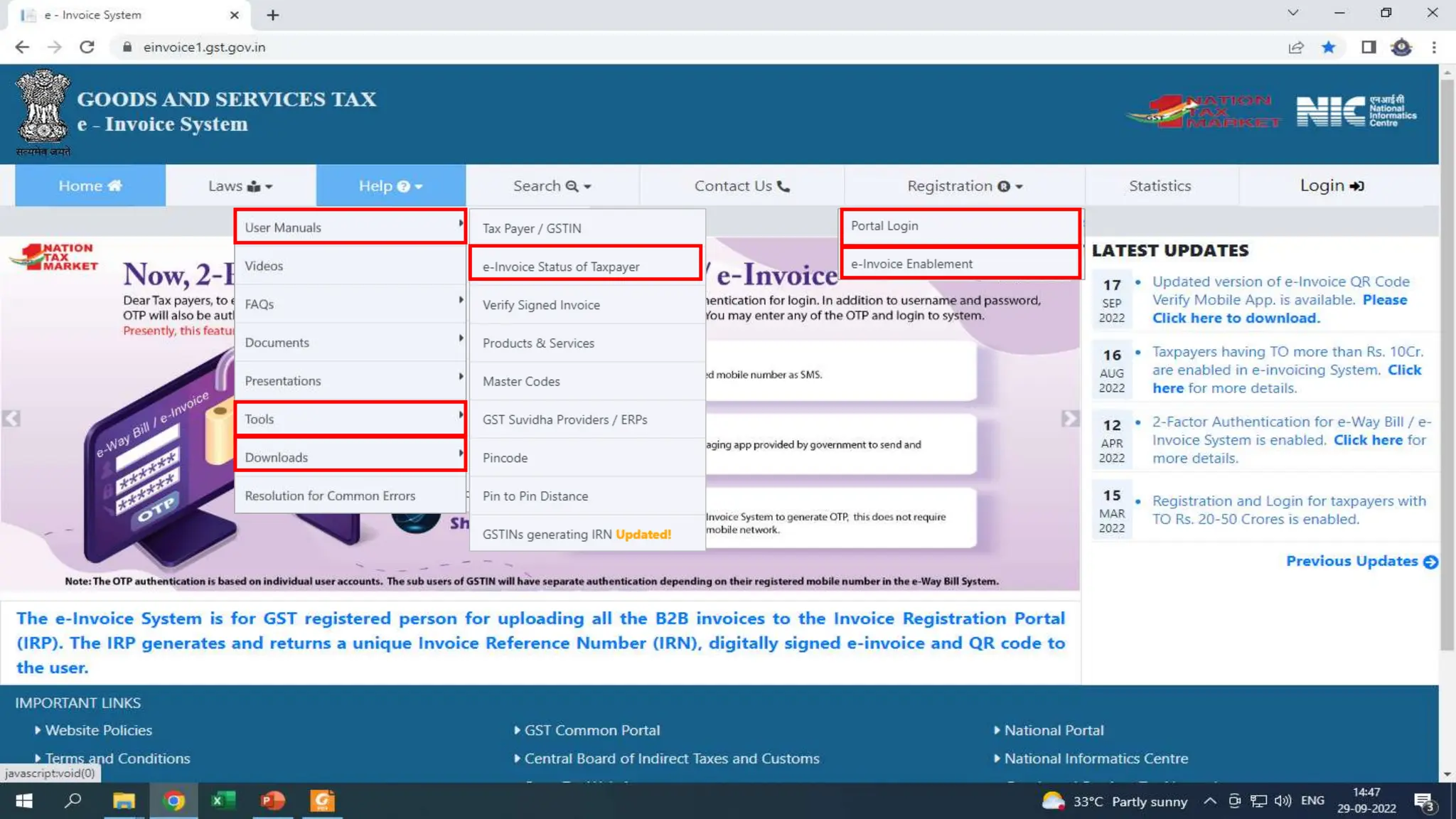
Check eligibility of e-invoicing
• Taxpayer can check the eligibility for invoice registration on e-Invoice portal
• Visit https://einvoice1.gst.gov.in and go to “Search” -> “e-Invoice Status of
taxpayer”
In case of discrepancies shown in eligibility
 GSTIN is actually eligible but portal shows as ineligible
Taxpayer can declare the turnover for the respective financial year and get
enabled through self enablement option in the portal. Visit
https://einvoice1.gst.gov.in and go to “Registration”->”e-Invoice Enablement”.
 GSTIN is actually ineligible but portal shows as eligible
Reach out to GST through self help portal of GST Common Portal
(https://selfservice.gstsystem.in/)
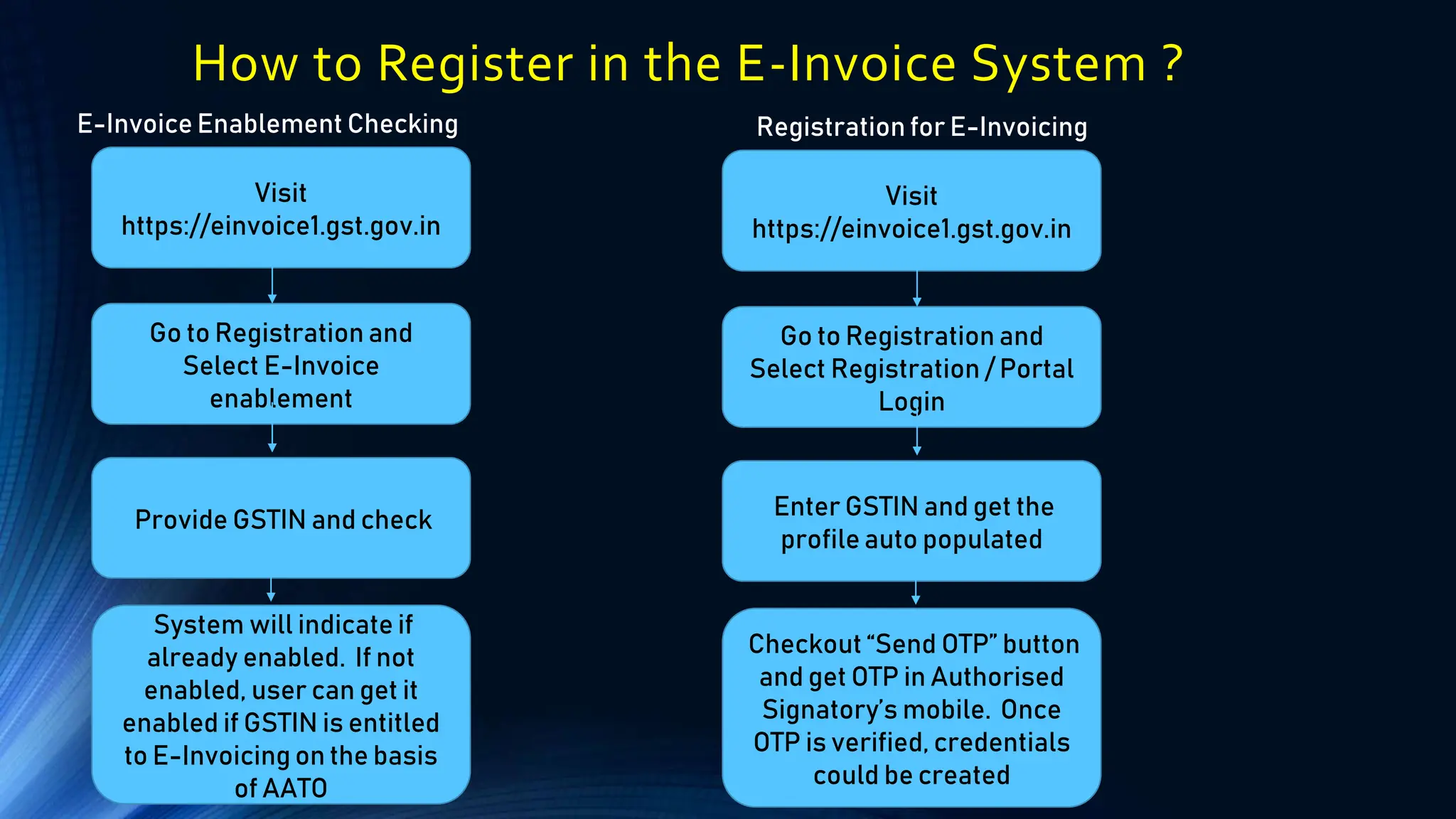
How to Register in the E-Invoice System ?
Visit
https://einvoice1.gst.gov.in
Go to Registration and
Select E-Invoice
enablement
E-Invoice Enablement Checking
Provide GSTIN and check
System will indicate if
already enabled. If not
enabled, user can get it
enabled if GSTIN is entitled
to E-Invoicing on the basis
of AATO
Registration for E-Invoicing
Visit
https://einvoice1.gst.gov.in
Go to Registration and
Select Registration / Portal
Login
Enter GSTIN and get the
profile auto populated
Checkout “Send OTP” button
and get OTP in Authorised
Signatory’s mobile. Once
OTP is verified, credentials
could be created
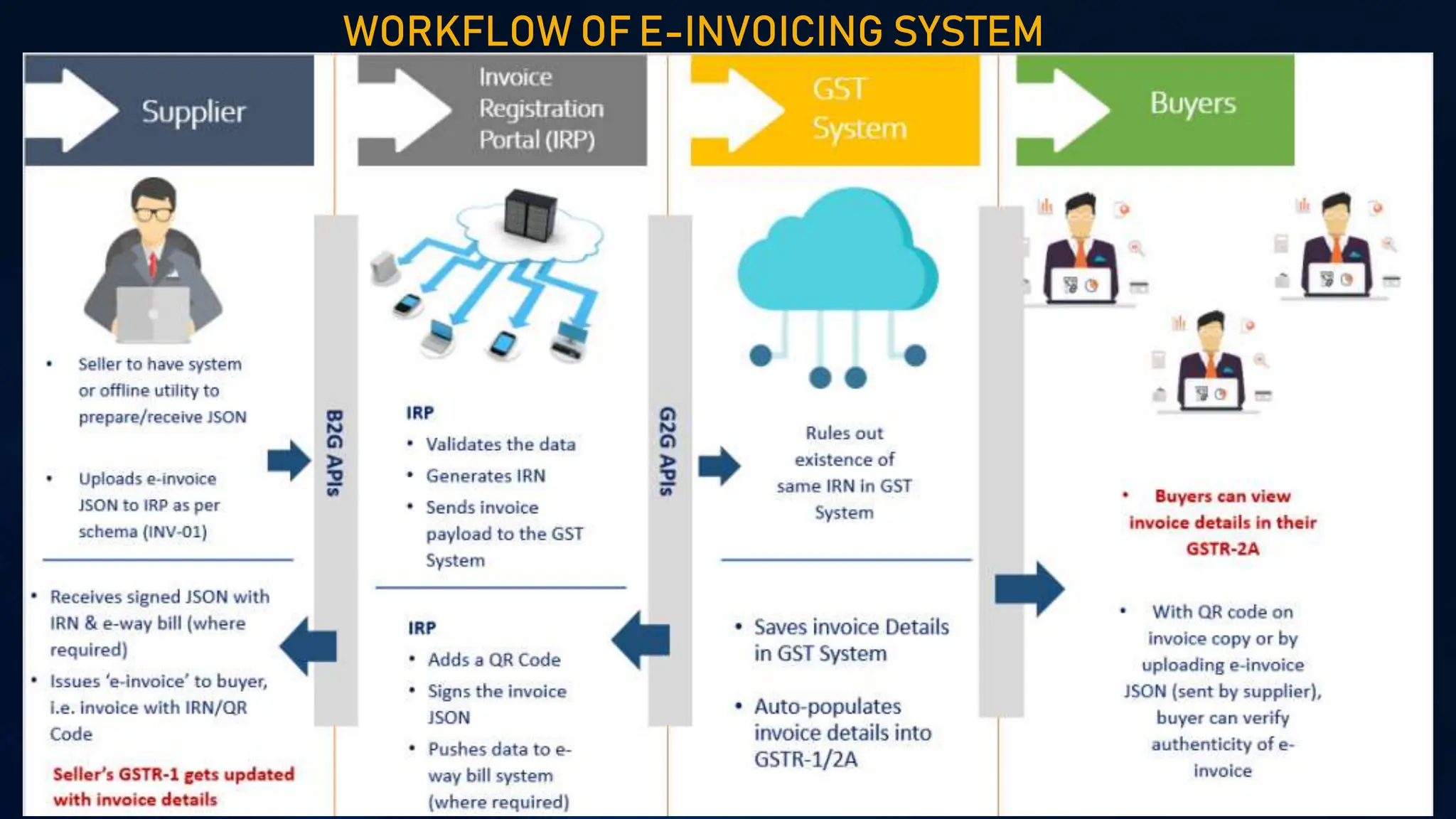
WORKFLOW OF E-INVOICING SYSTEM
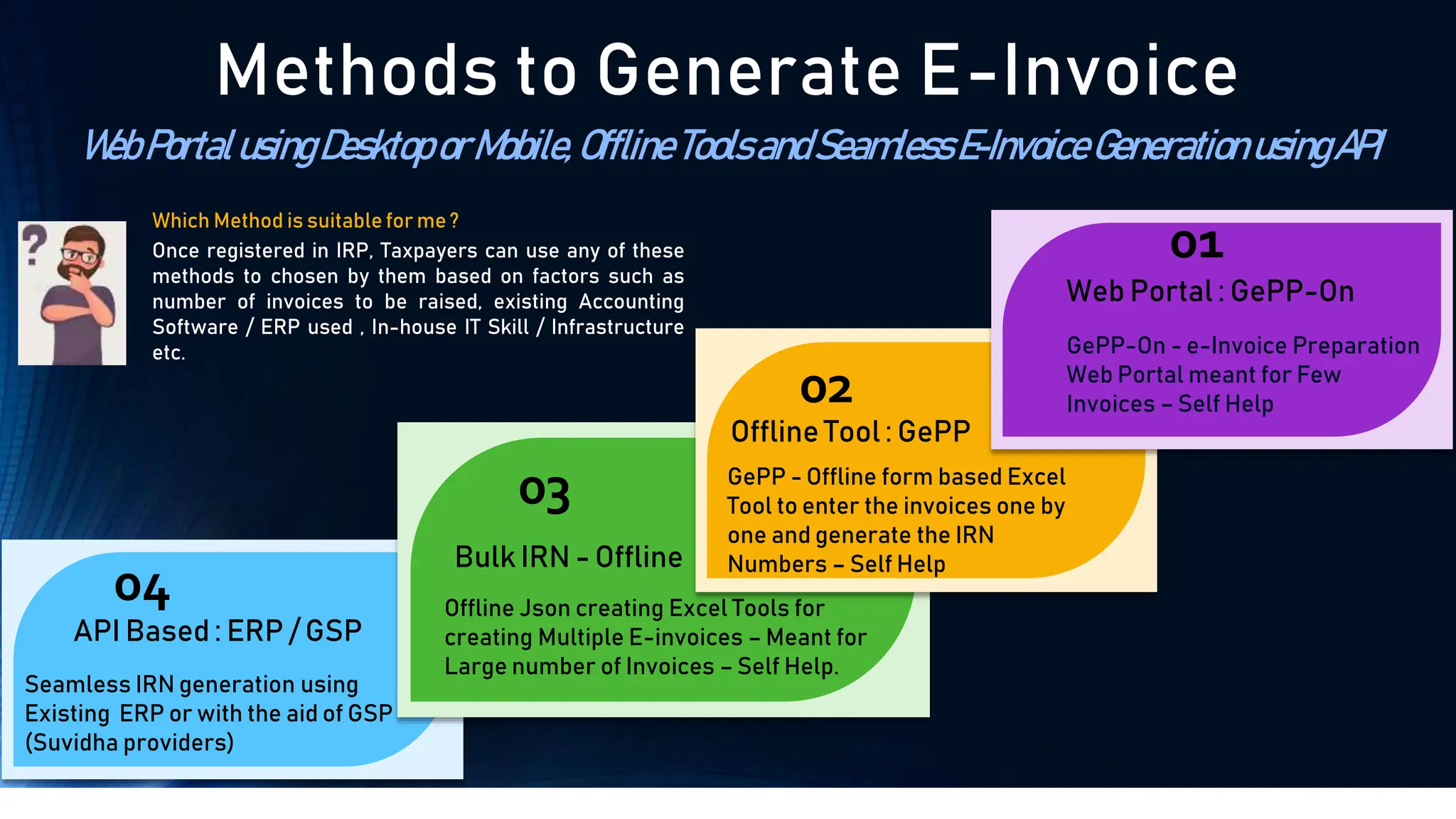
Methods to Generate E-Invoice
WebPortalusingDesktoporMobile,OfflineToolsandSeamless E-InvoiceGenerationusingAPI
01
02
03
04
Seamless IRN generation using
Existing ERP or with the aid of GSP
(Suvidha providers)
API Based : ERP / GSP
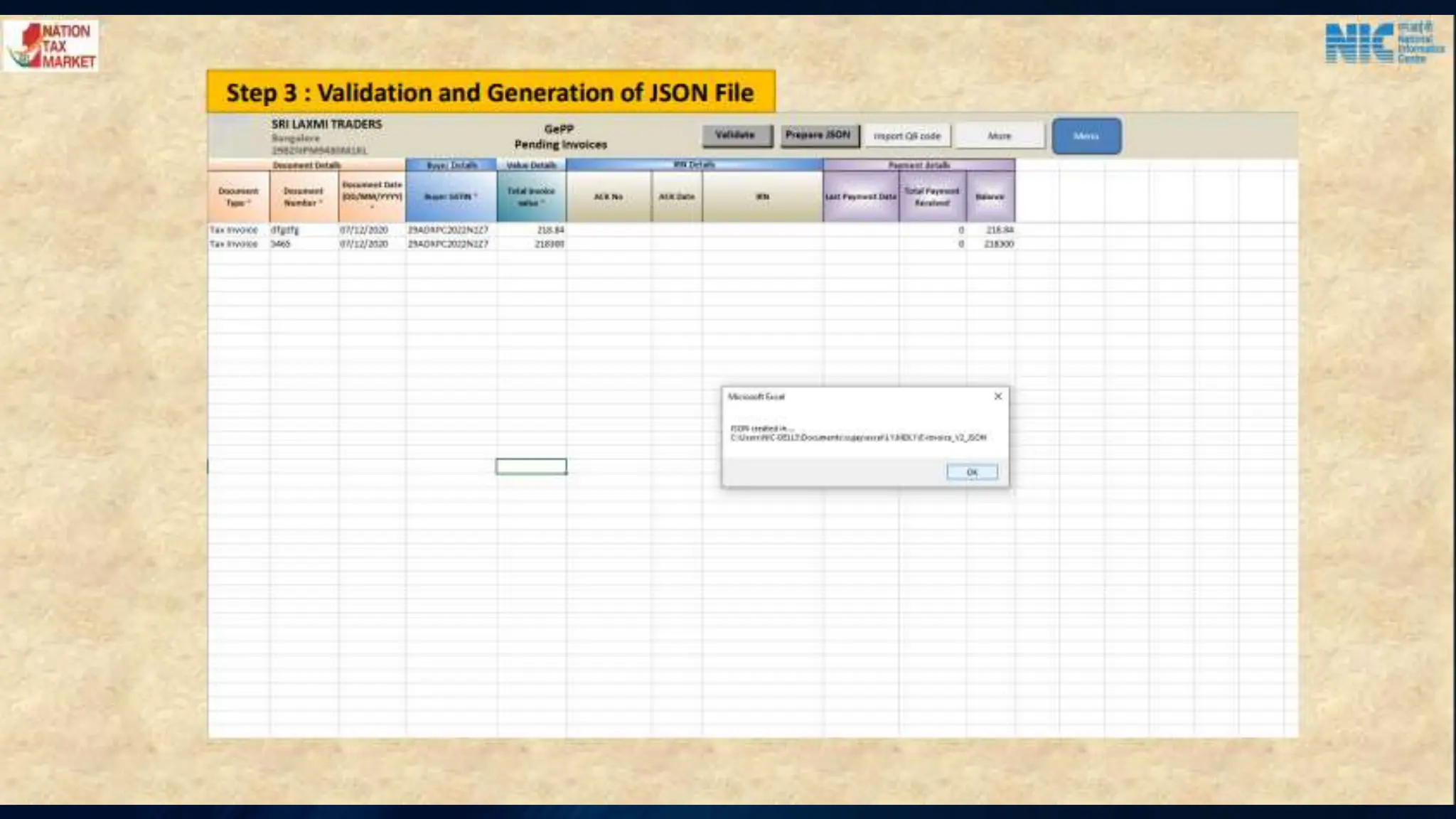
Offline Json creating Excel Tools for
creating Multiple E-invoices – Meant for
Large number of Invoices – Self Help.
Bulk IRN - Offline
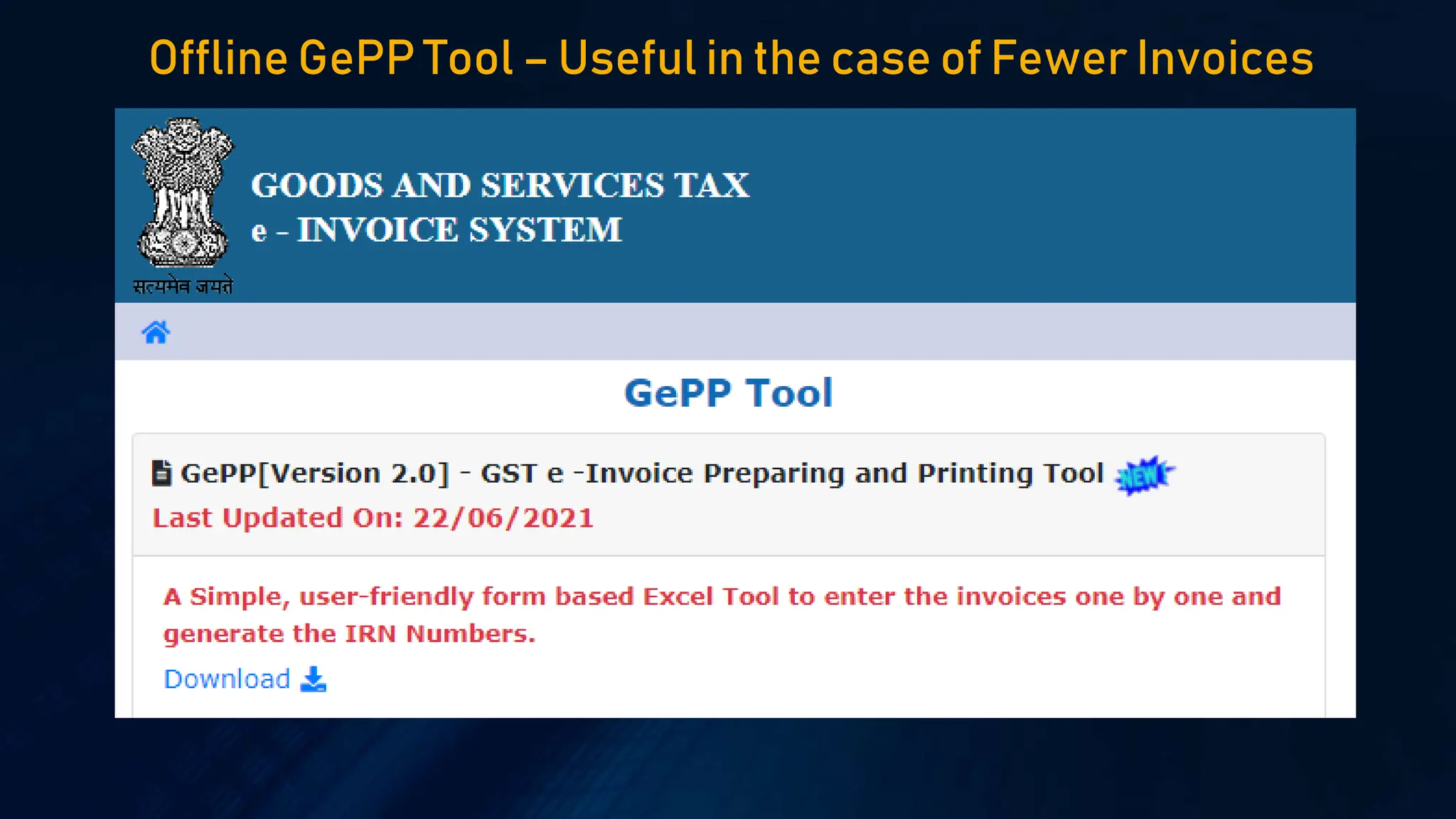
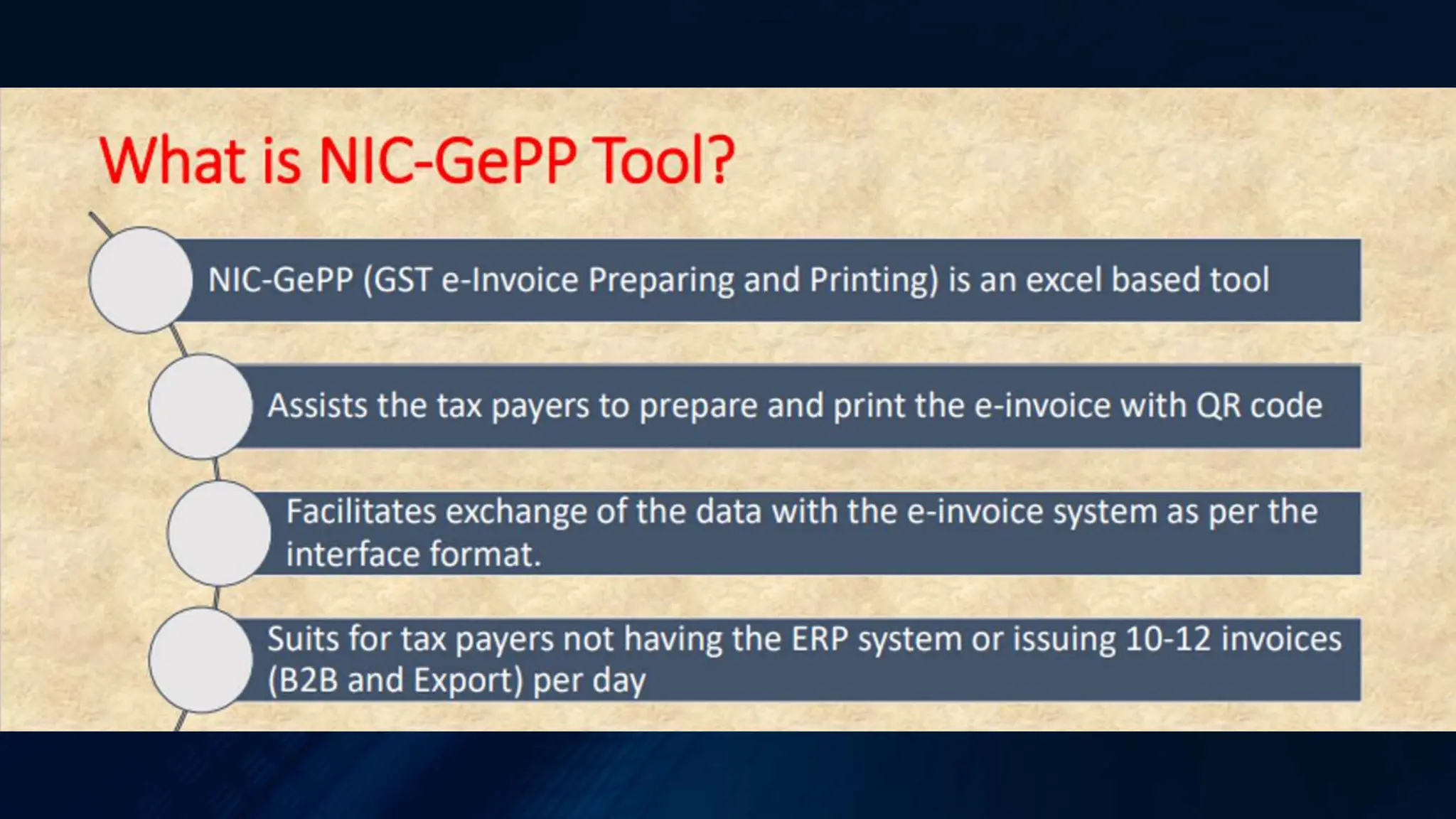
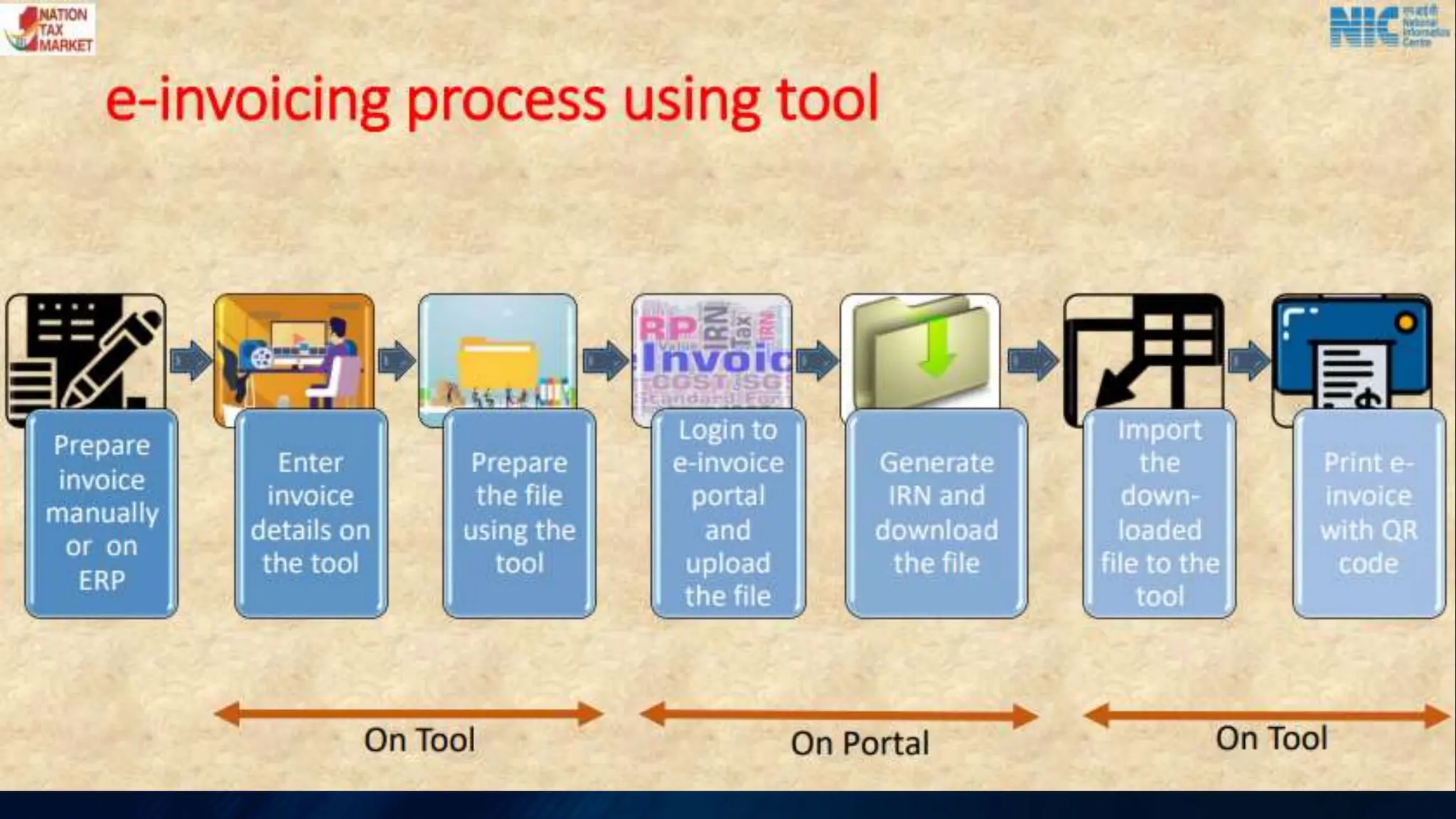
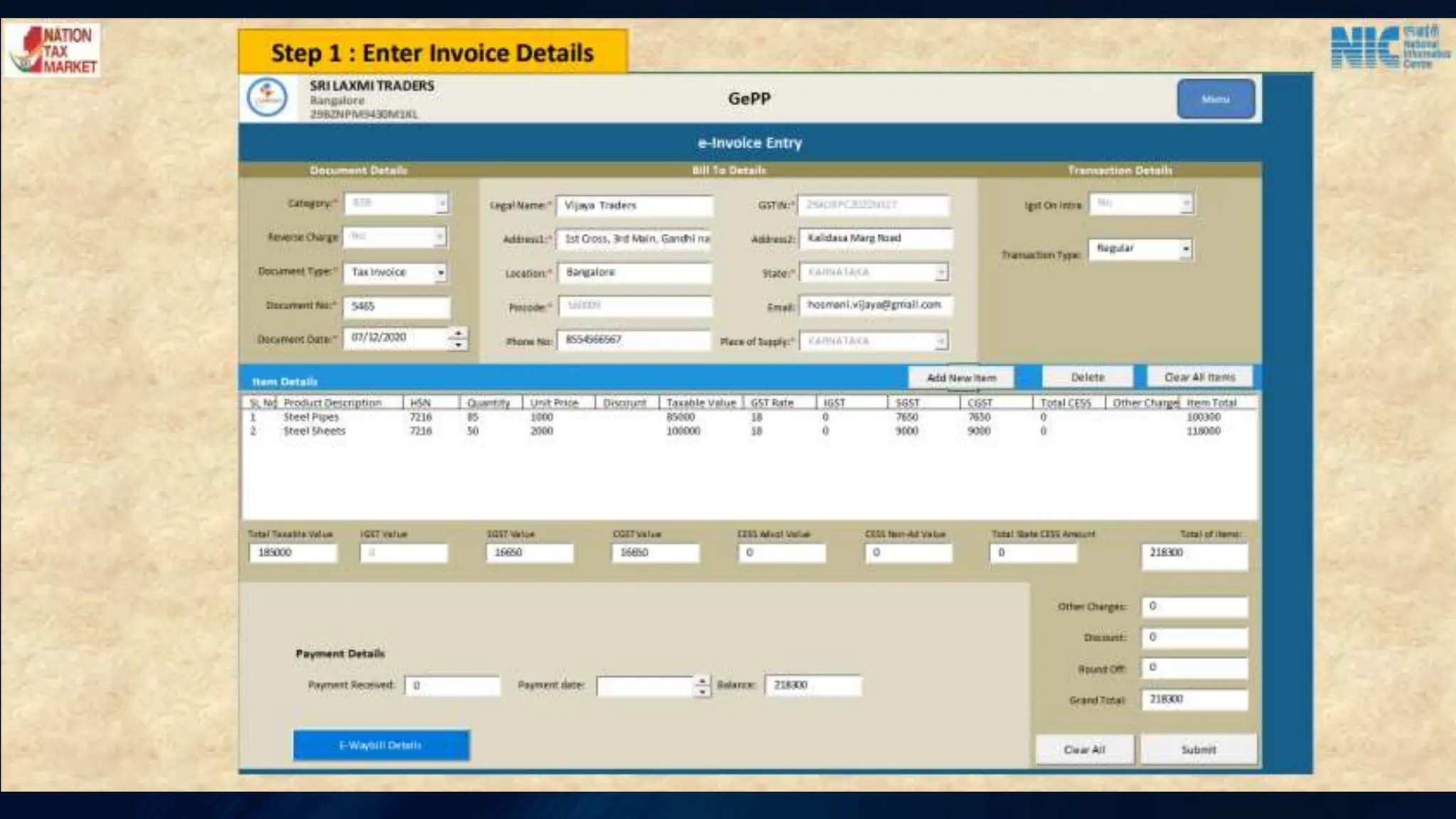
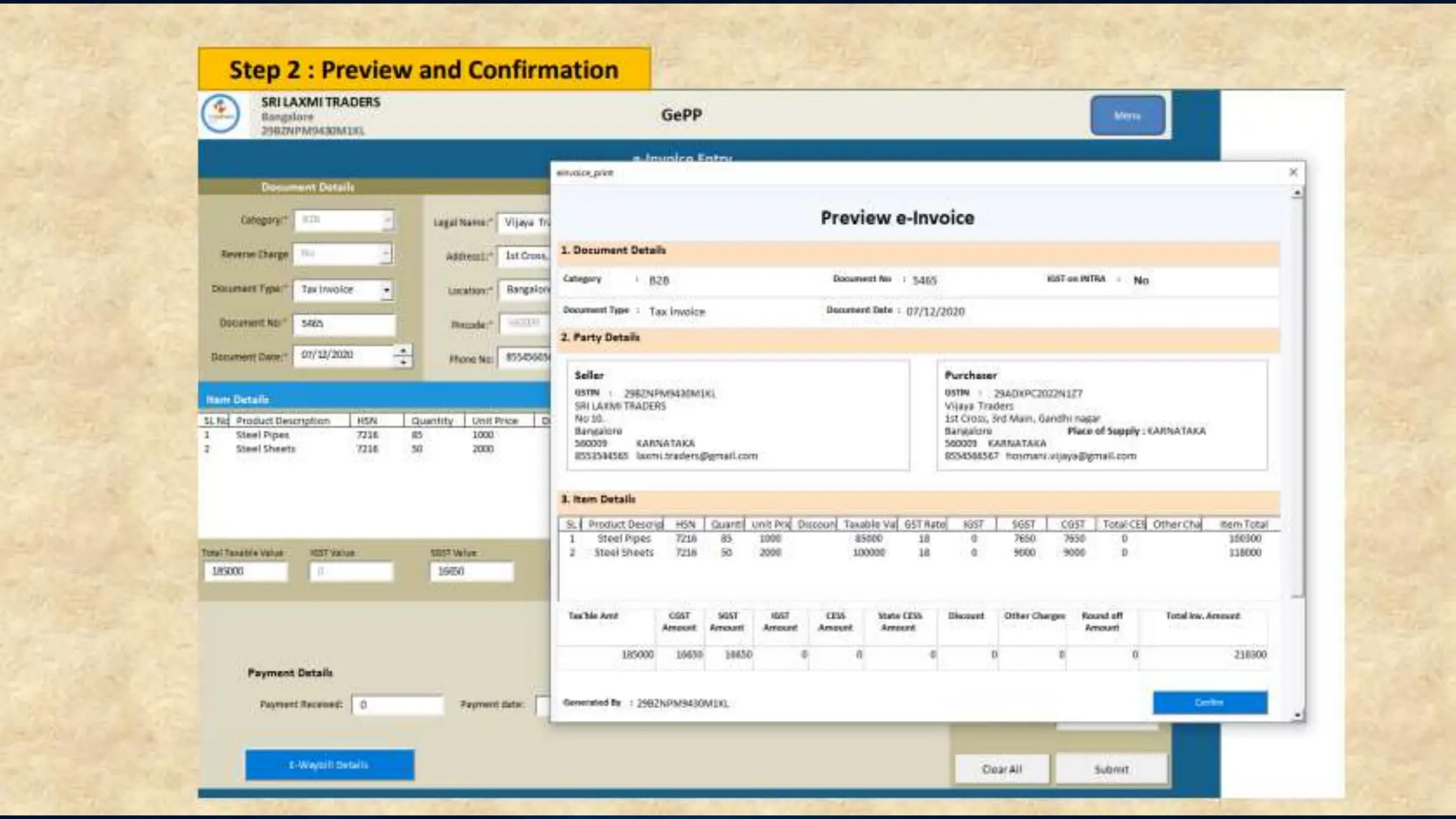
GePP - Offline form based Excel
Tool to enter the invoices one by
one and generate the IRN
Numbers – Self Help
Offline Tool : GePP
GePP-On - e-Invoice Preparation
Web Portal meant for Few
Invoices – Self Help
Web Portal : GePP-On
Which Method is suitable for me ?
Once registered in IRP, Taxpayers can use any of these
methods to chosen by them based on factors such as
number of invoices to be raised, existing Accounting
Software / ERP used , In-house IT Skill / Infrastructure
etc.
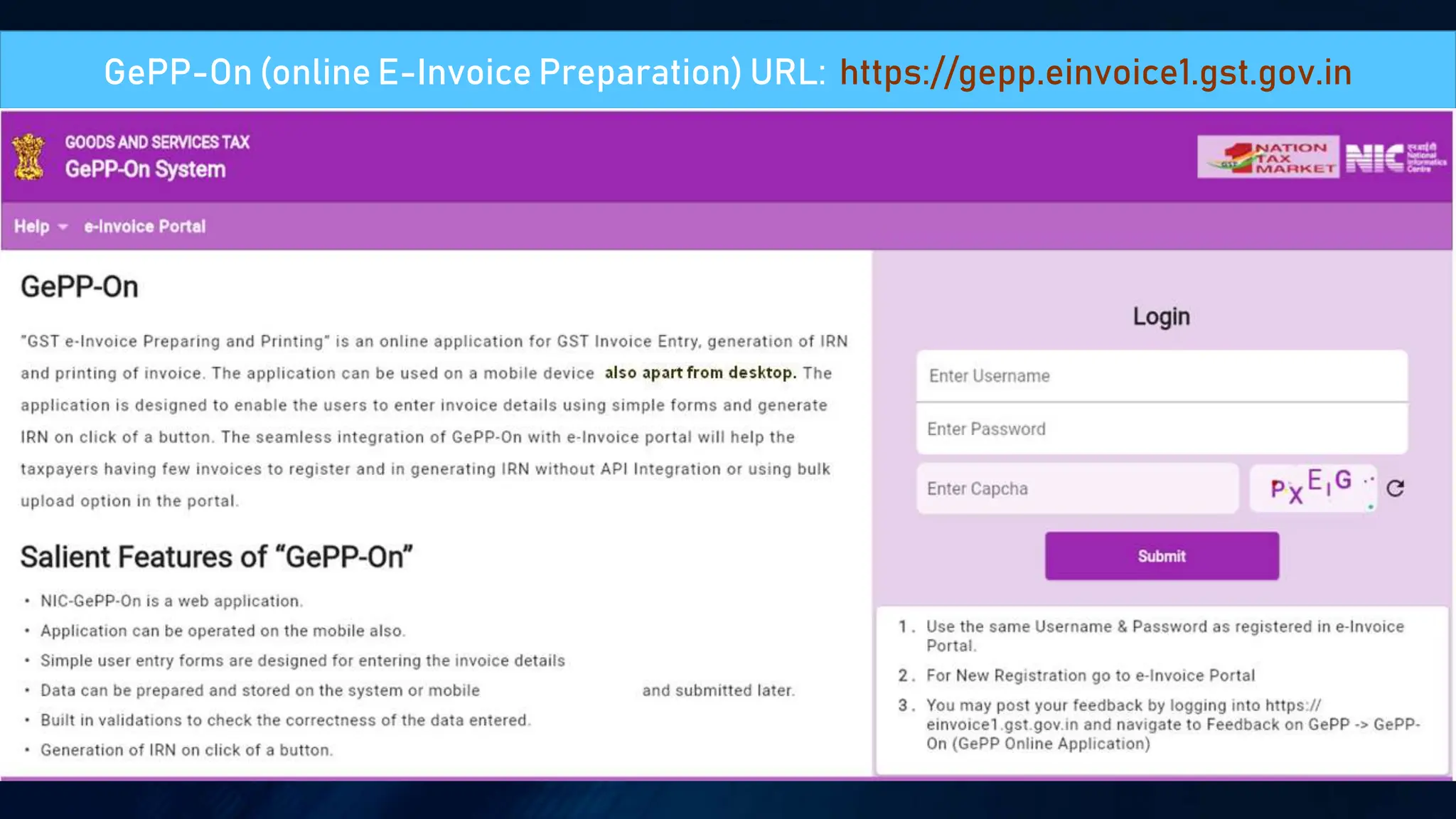
GePP-On (online E-Invoice Preparation) URL: https://gepp.einvoice1.gst.gov.in
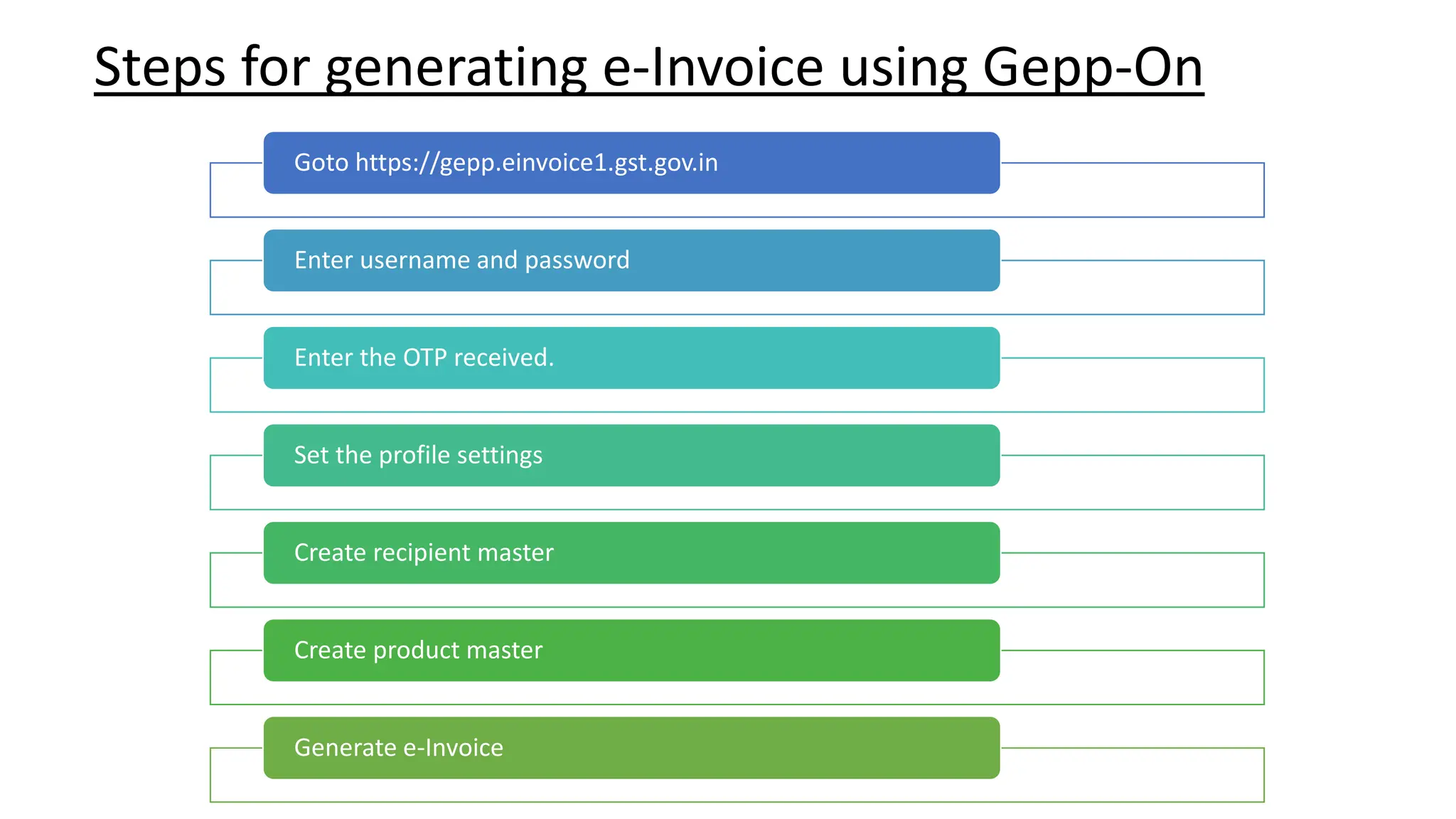
Steps for generating e-Invoice using Gepp-On
Goto https://gepp.einvoice1.gst.gov.in
Enter username and password
Enter the OTP received.
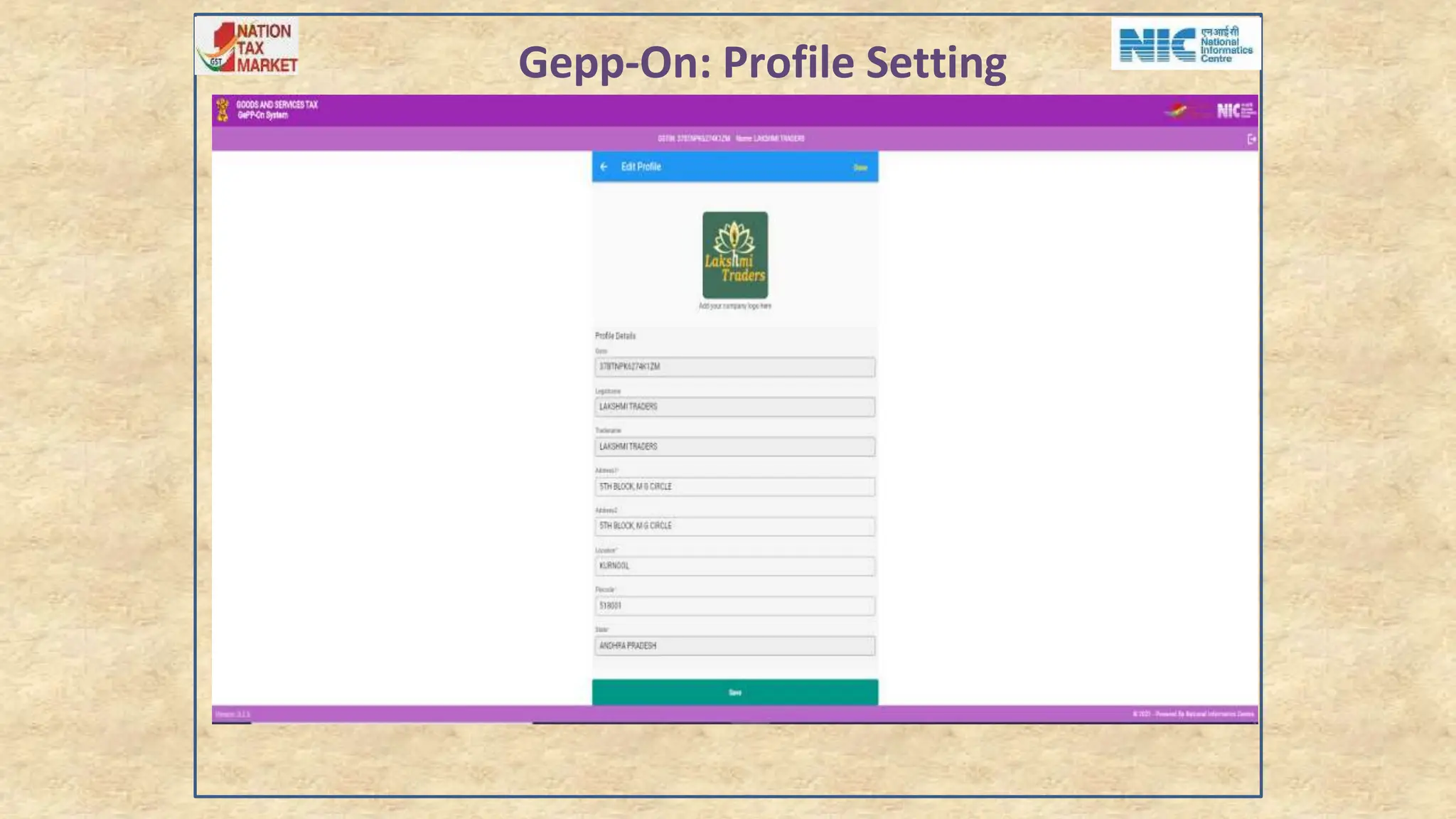
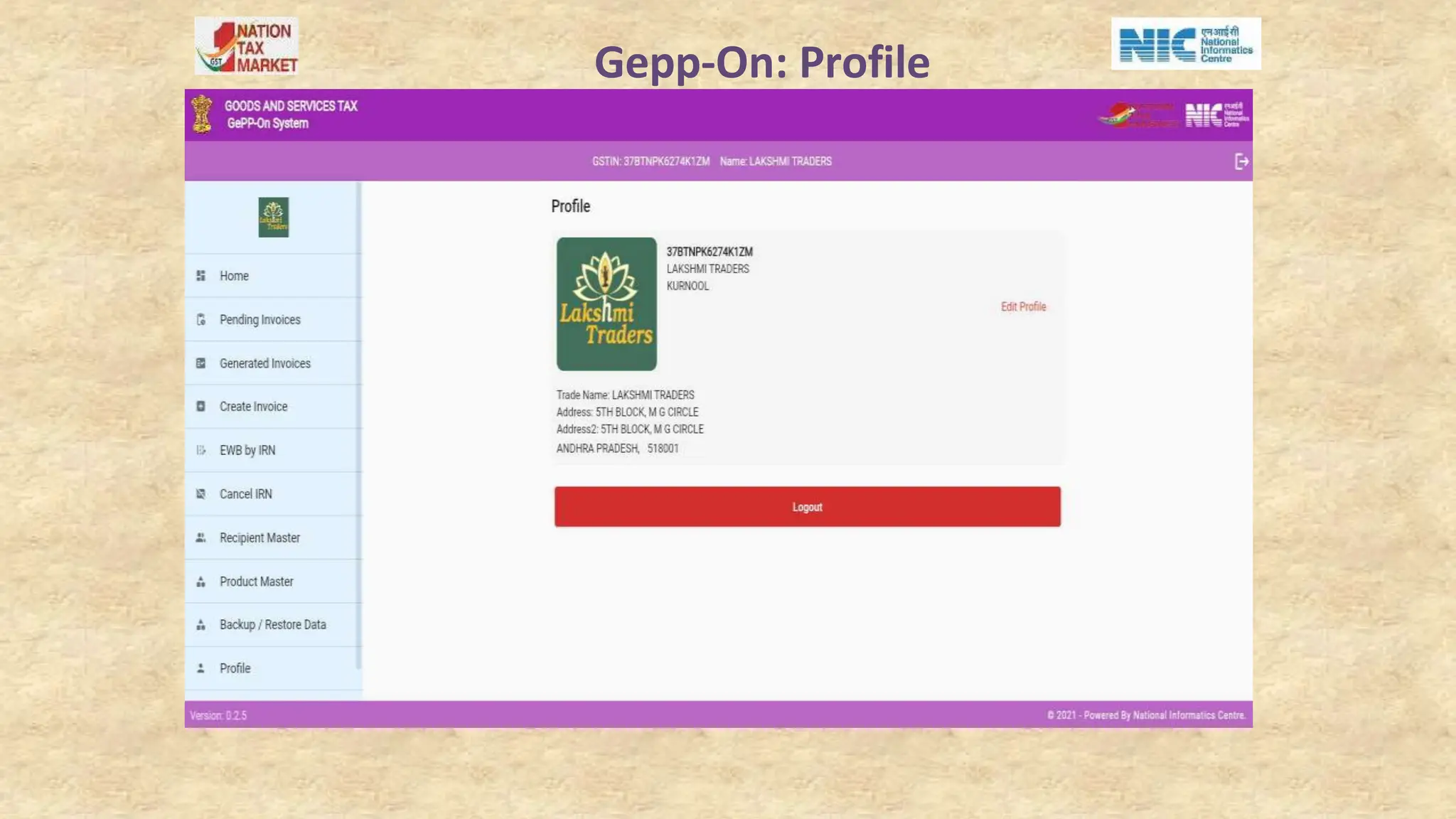
Set the profile settings
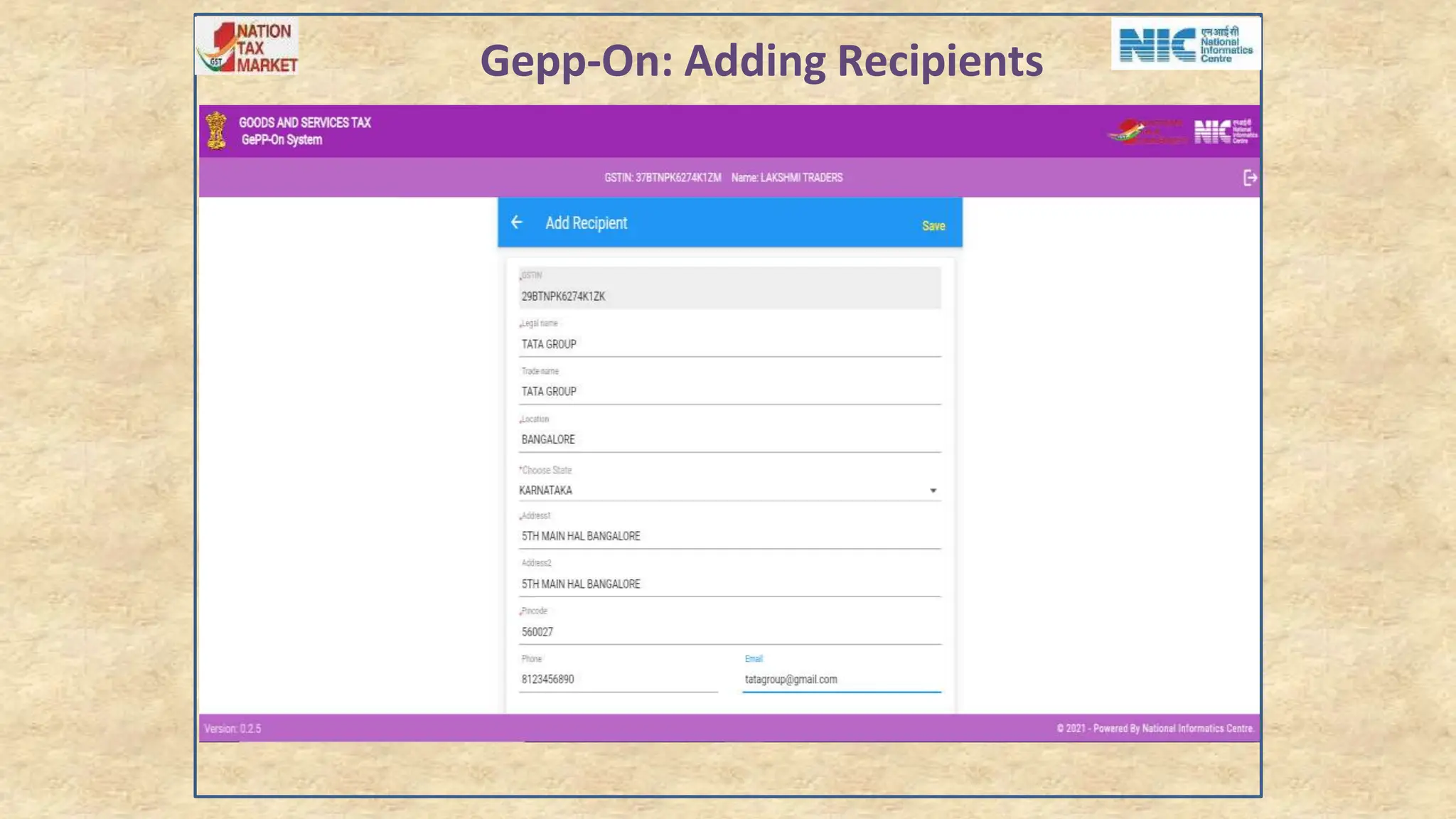
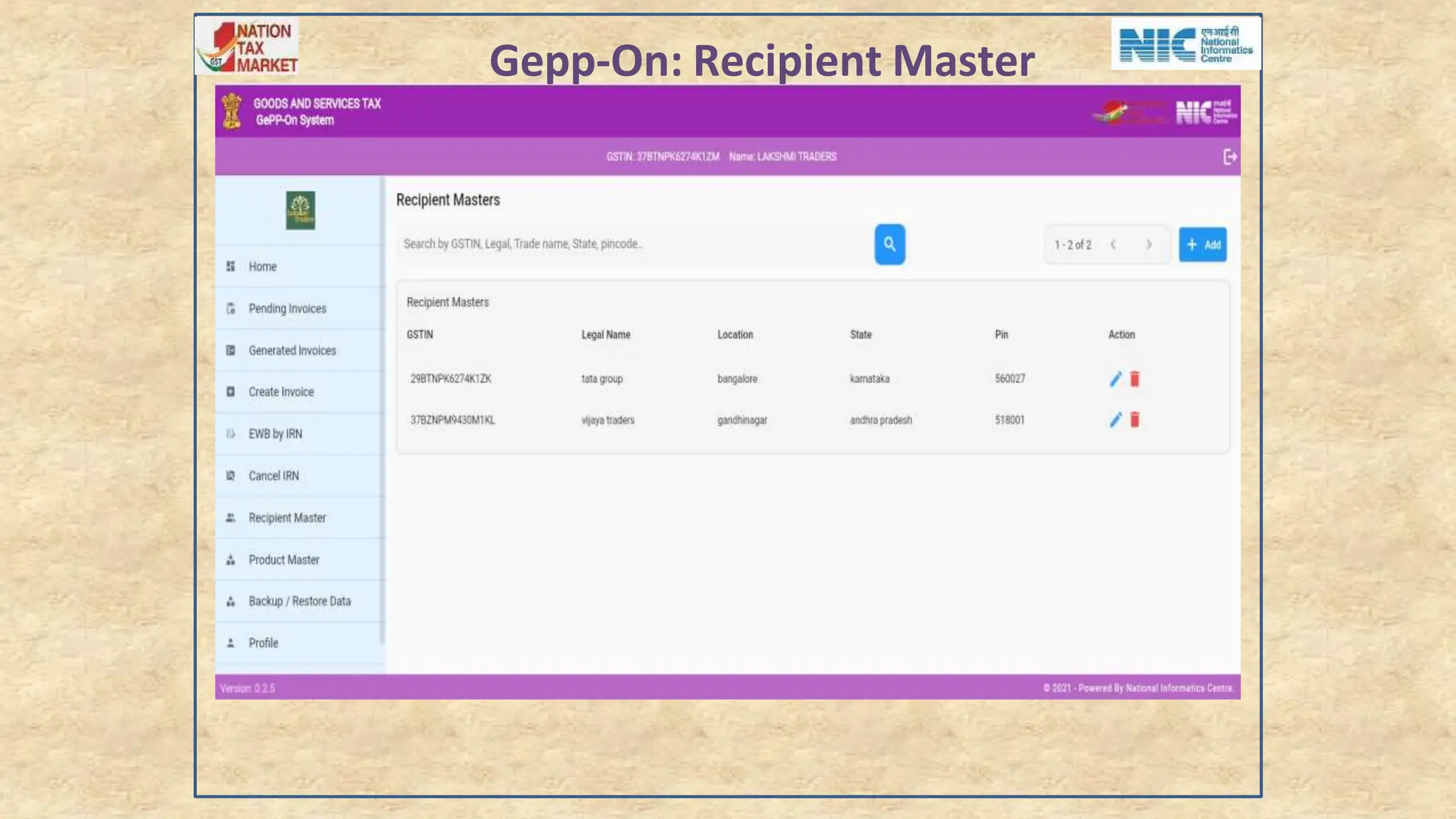
Create recipient master
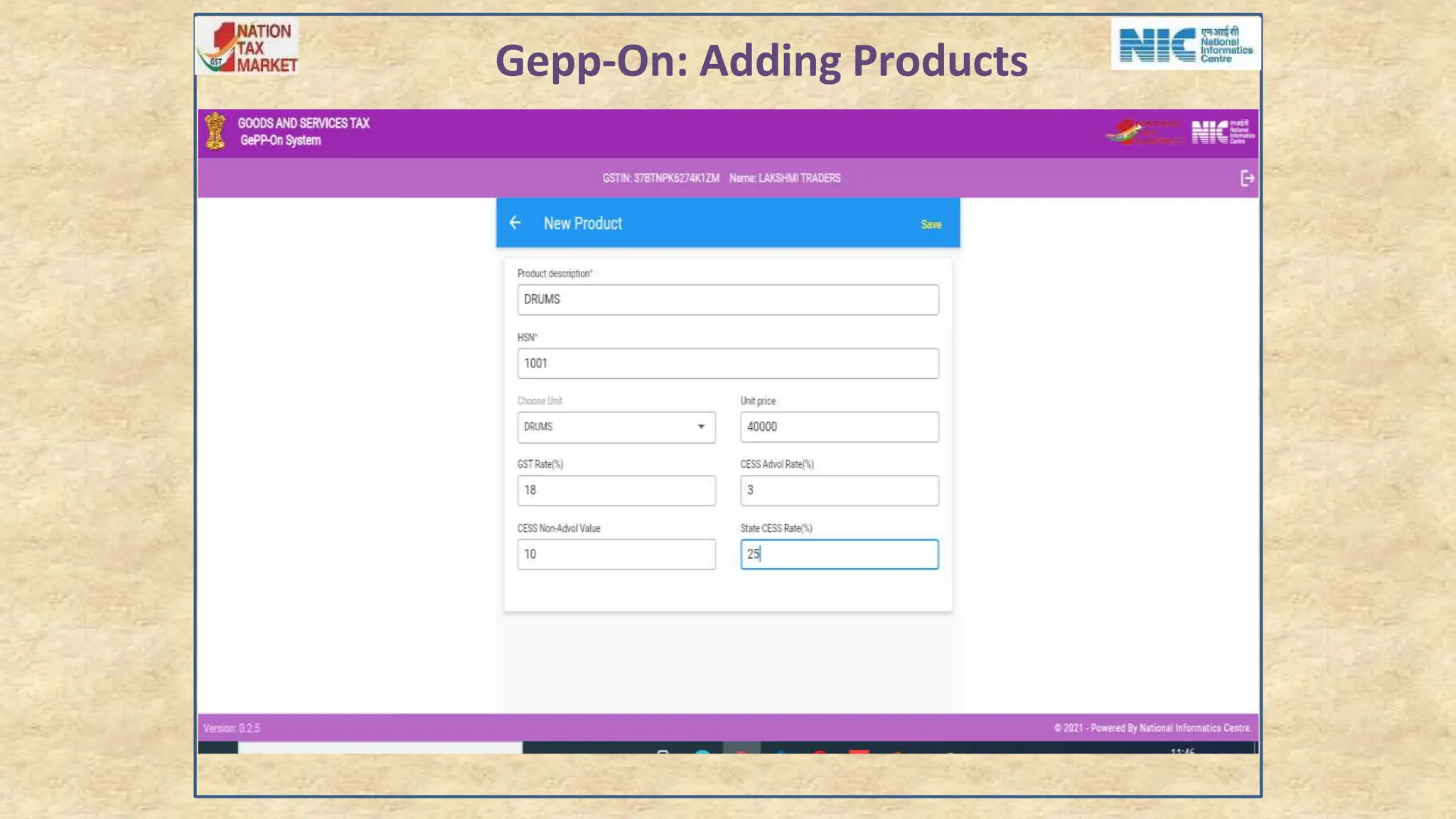
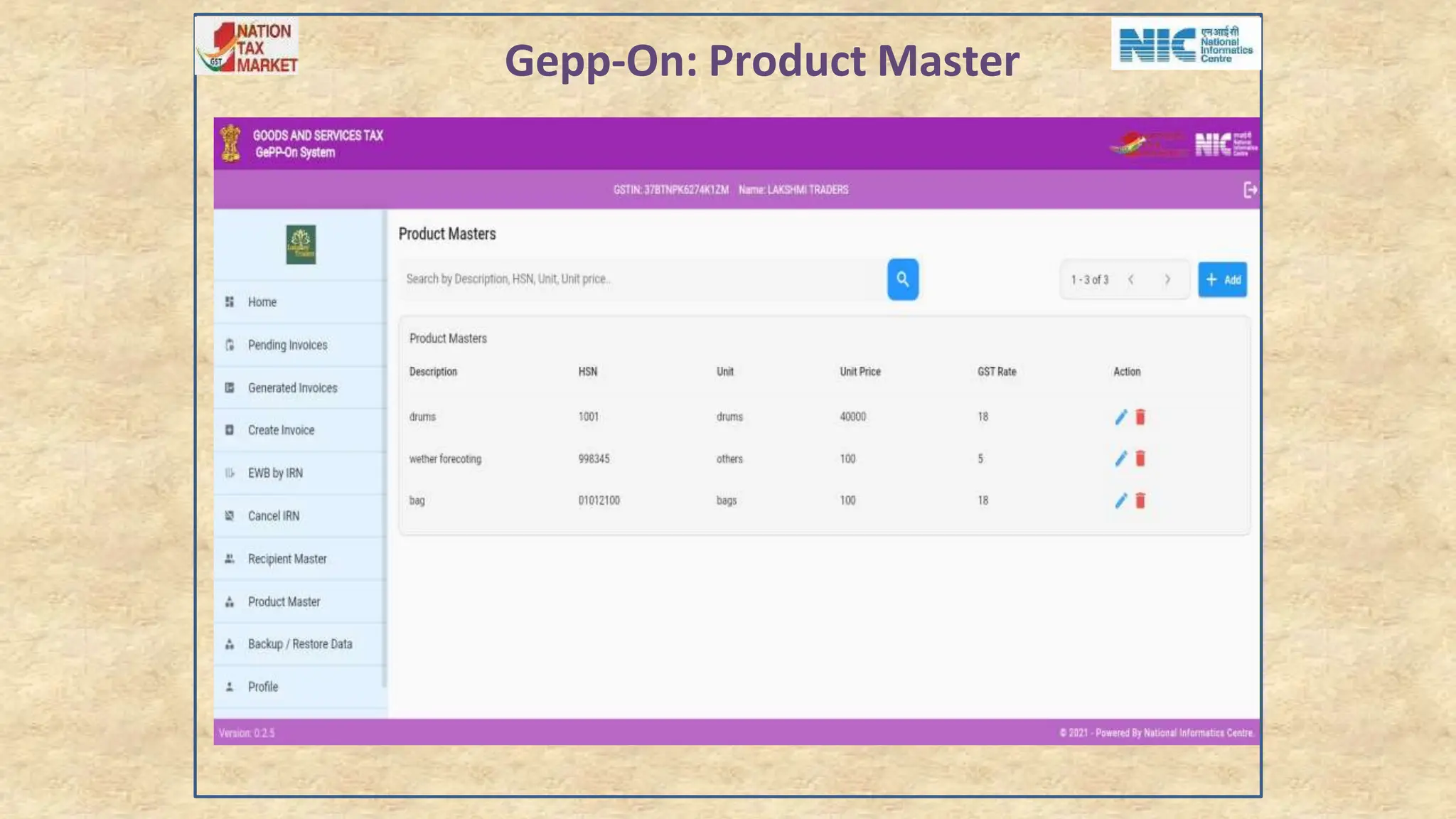
Create product master
Generate e-Invoice
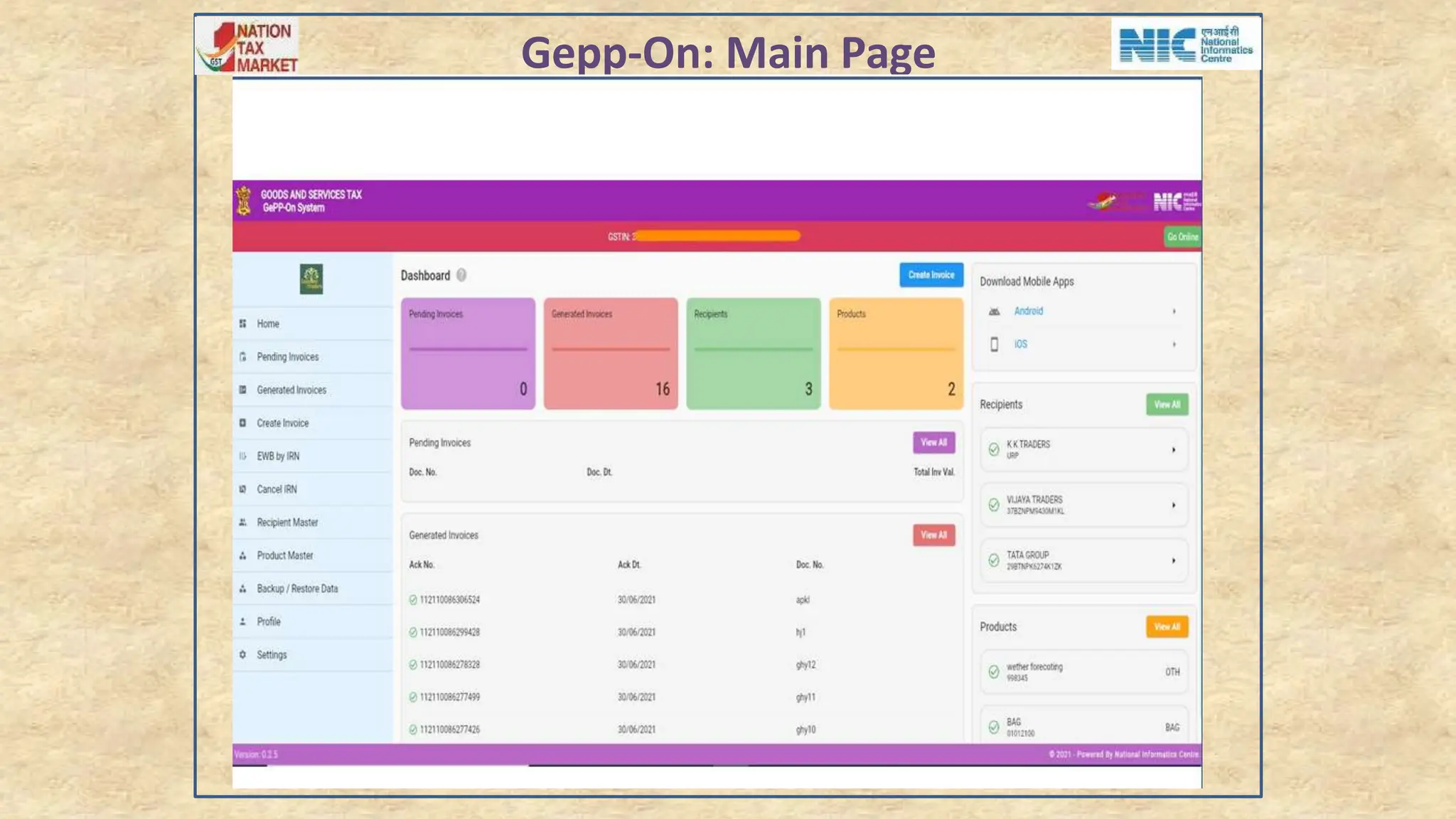
Gepp-On: Main Page
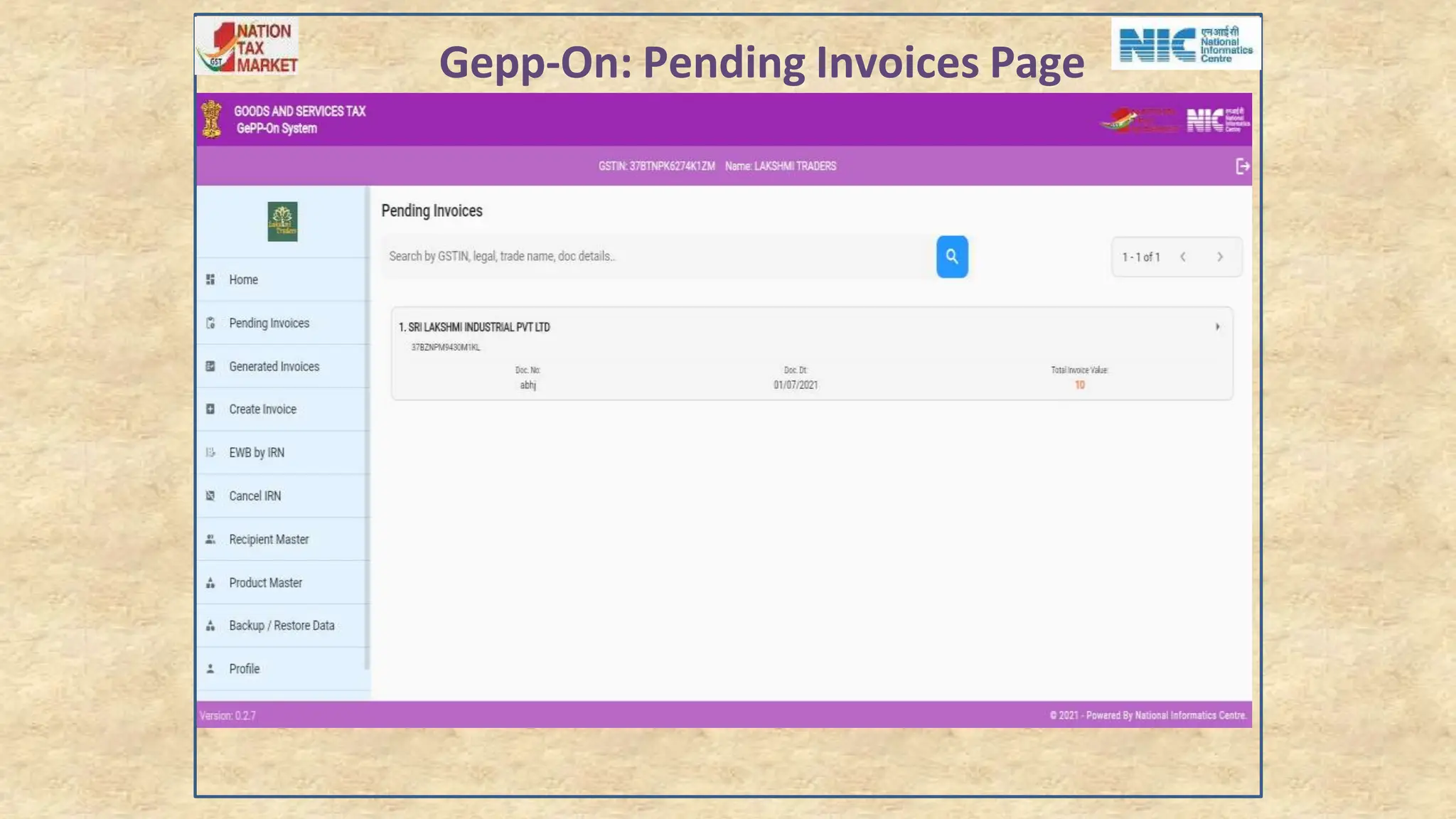
Gepp-On: Pending Invoices Page
Gepp-On: Profile Setting
Gepp-On: Profile
Gepp-On: Adding Recipients
Gepp-On: Recipient Master
Gepp-On: Adding Products
Gepp-On: Product Master
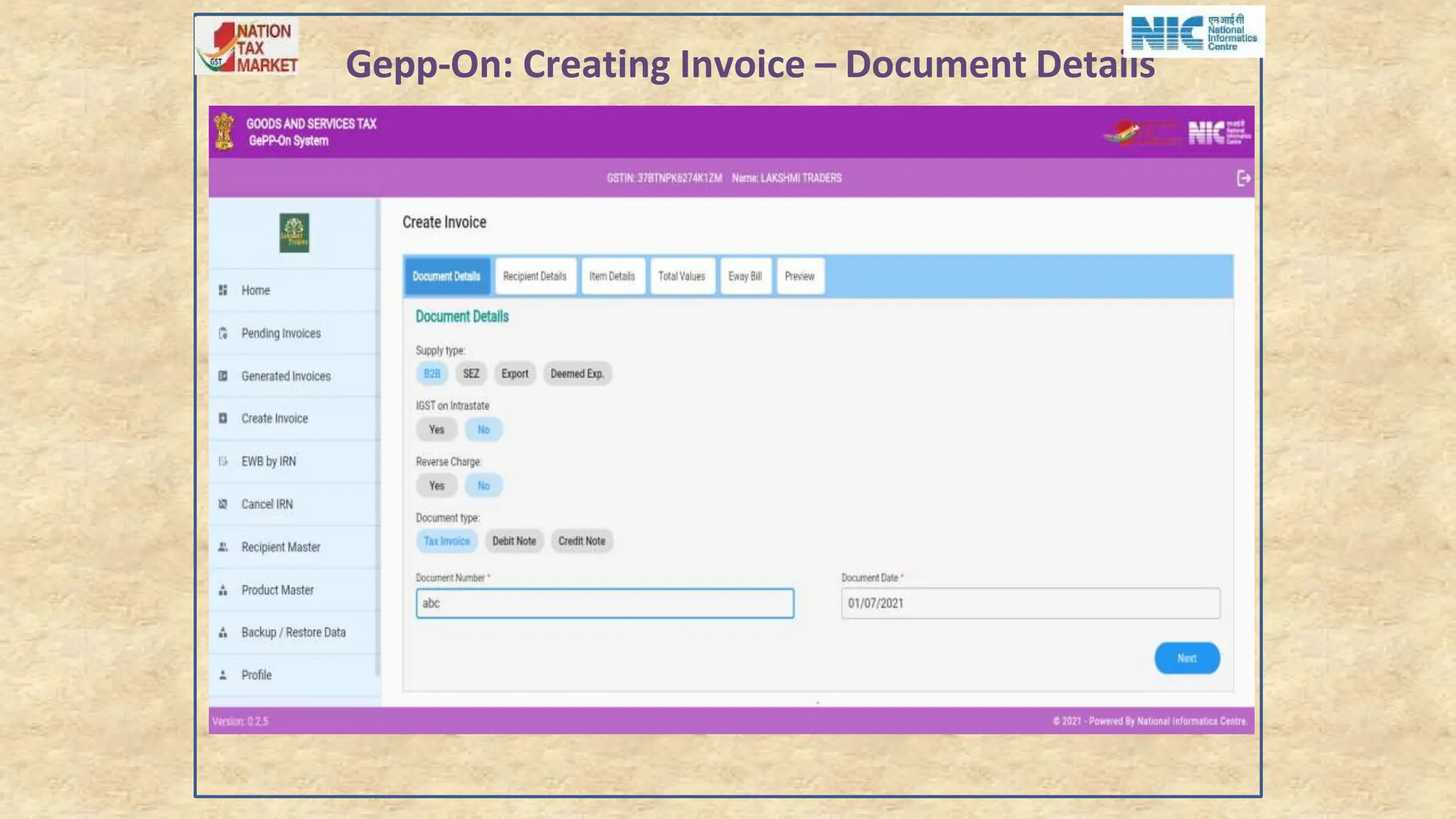
Gepp-On: Creating Invoice – Document Details
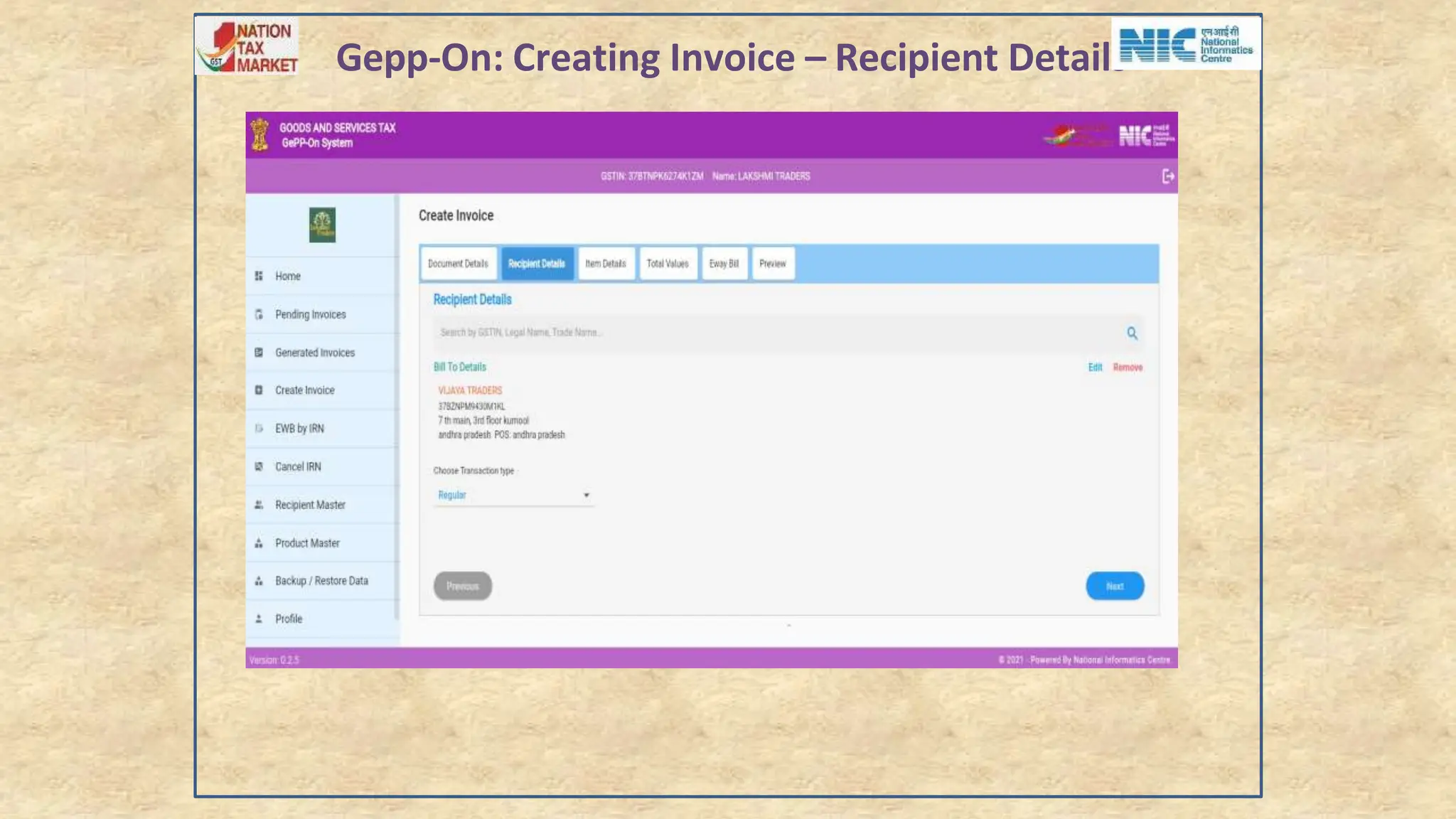
Gepp-On: Creating Invoice – Recipient Details
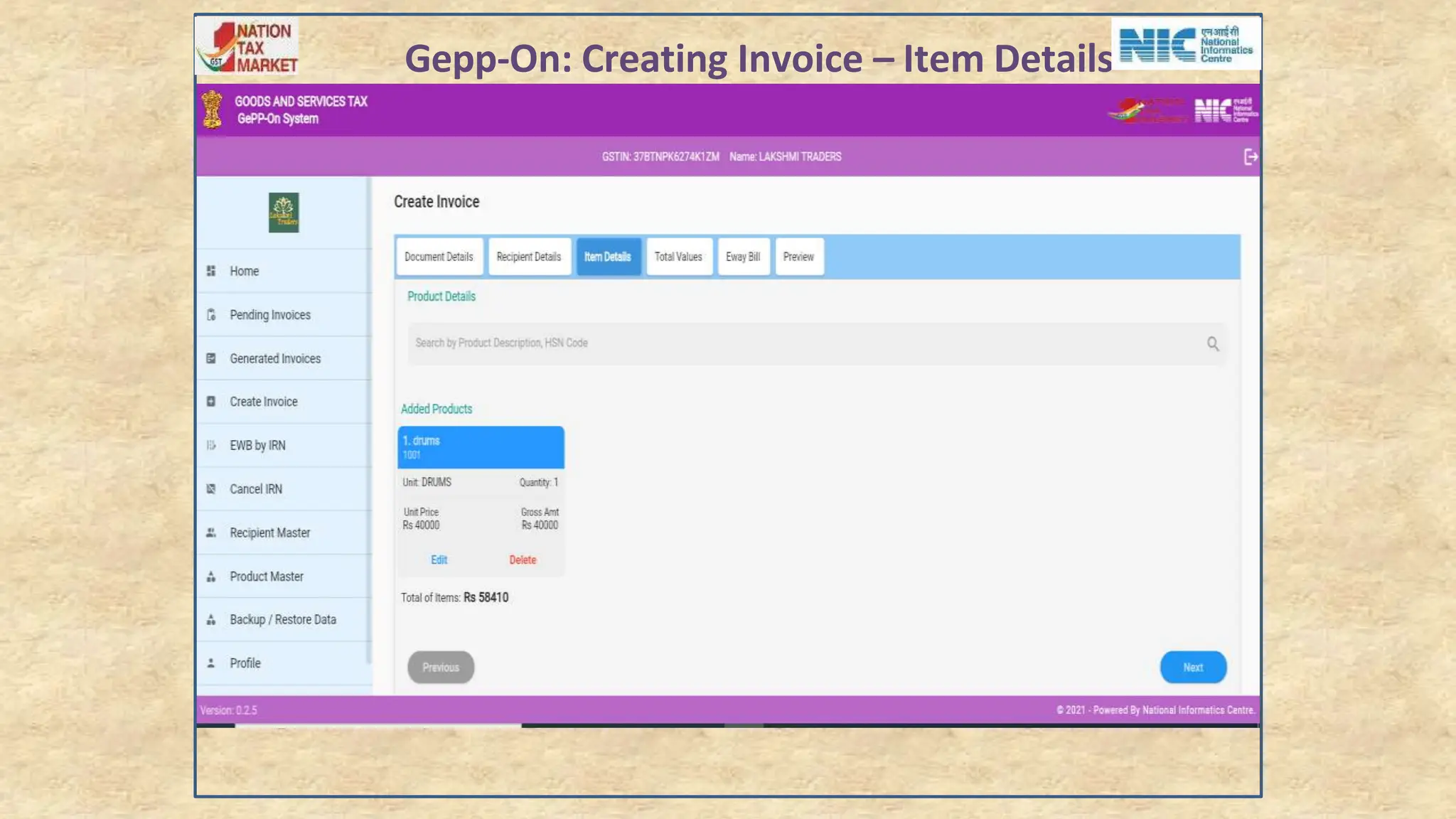
Gepp-On: Creating Invoice – Item Details
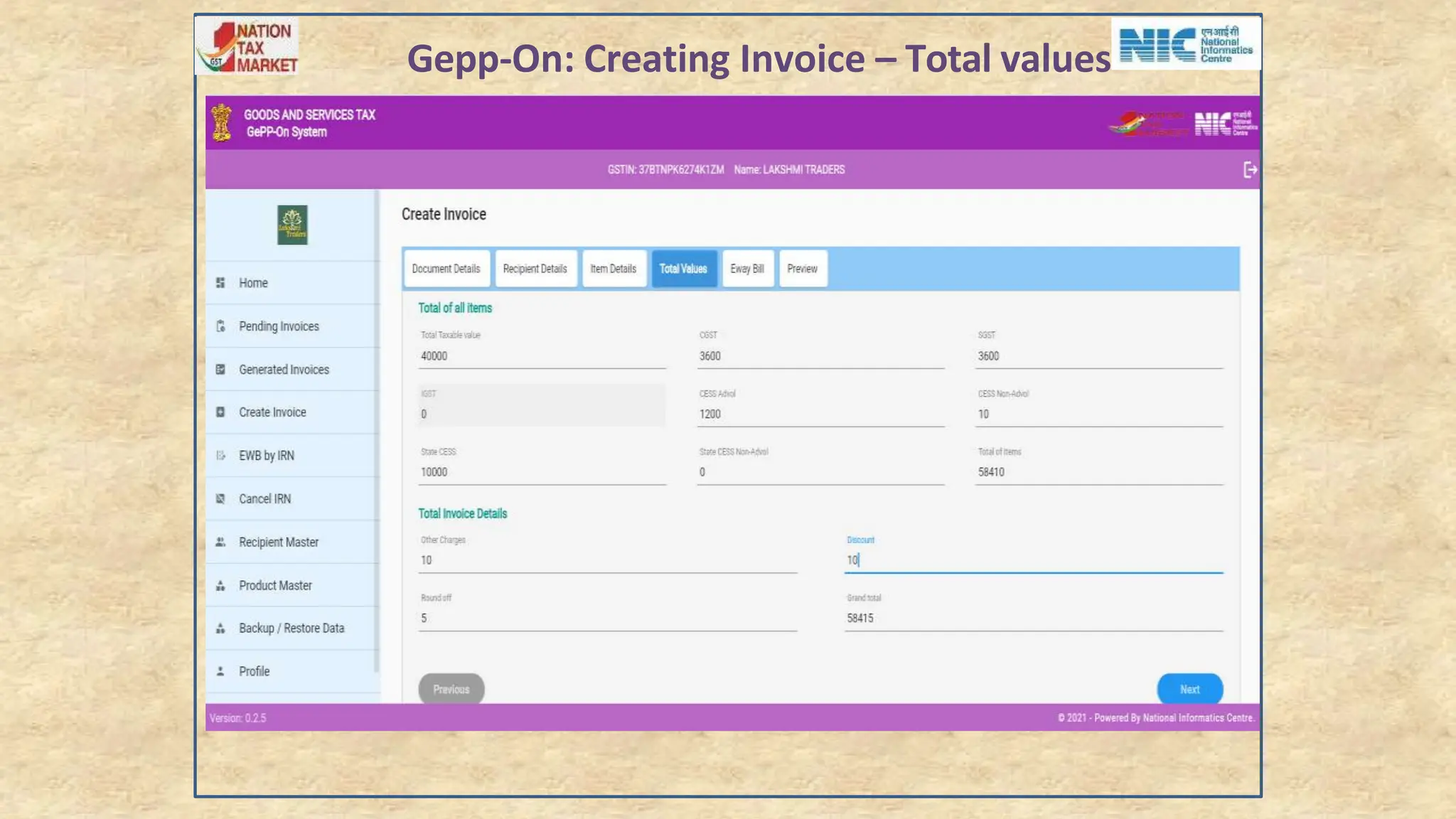
Gepp-On: Creating Invoice – Total values
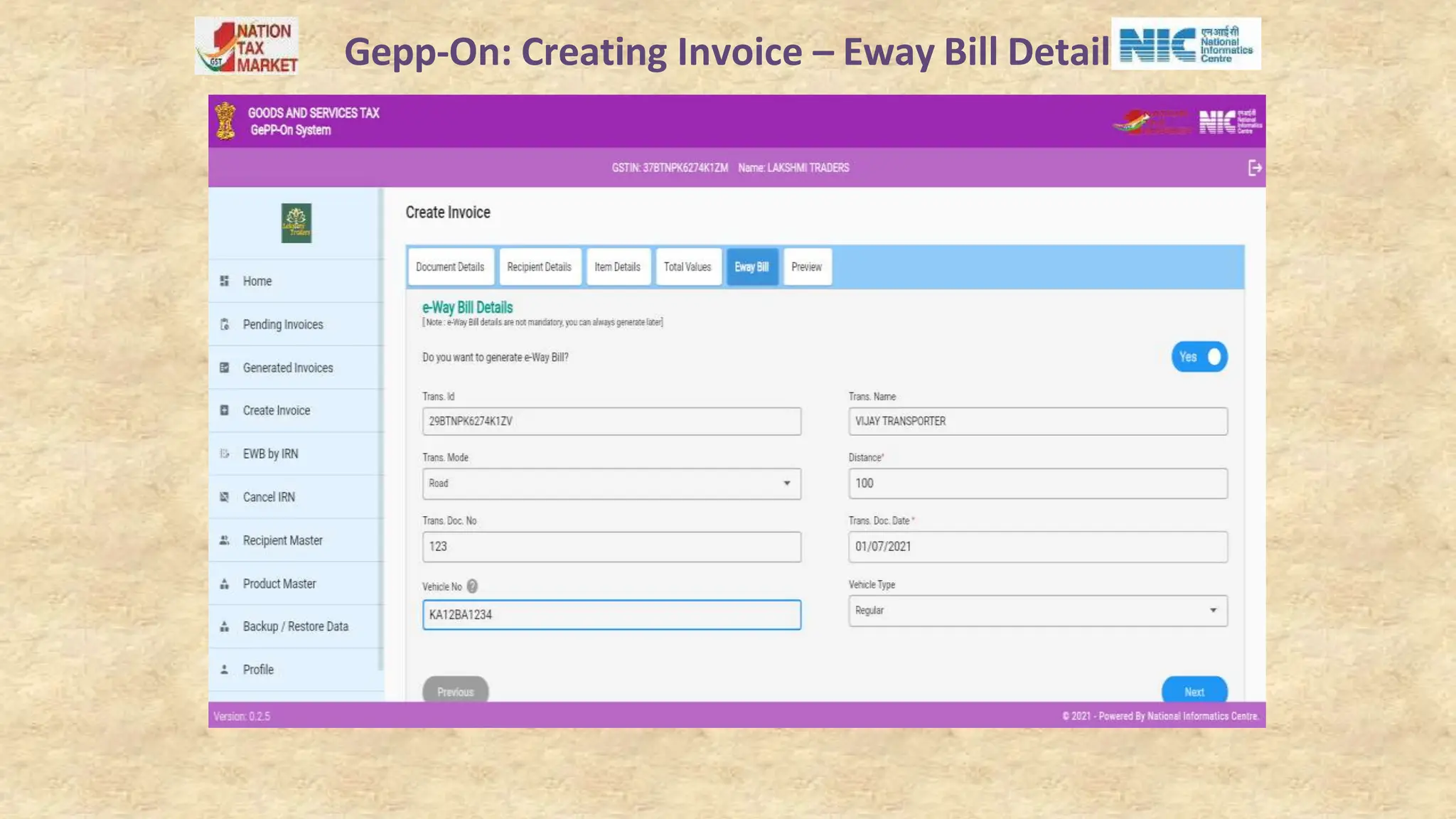
Gepp-On: Creating Invoice – Eway Bill Details
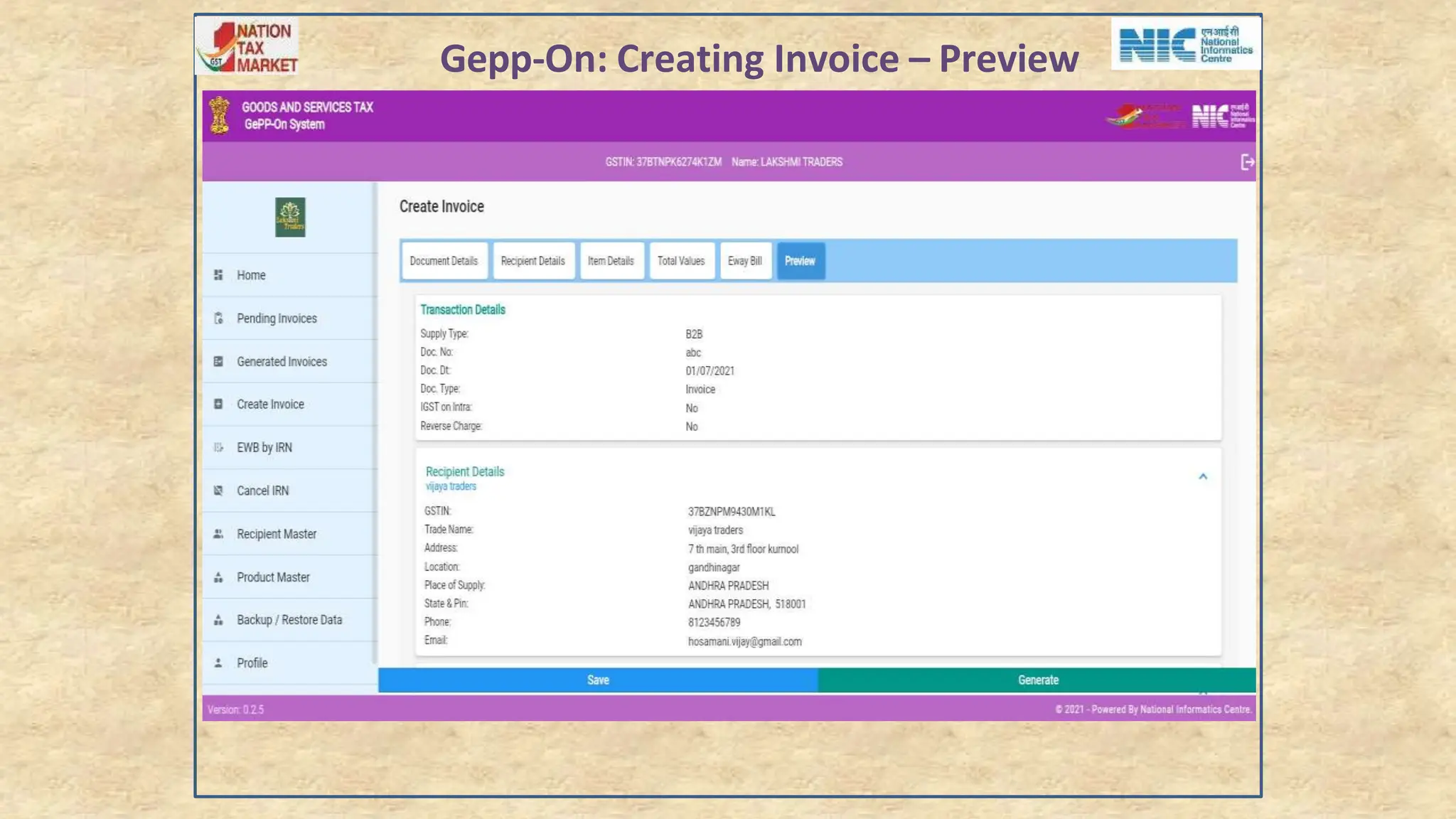
Gepp-On: Creating Invoice – Preview
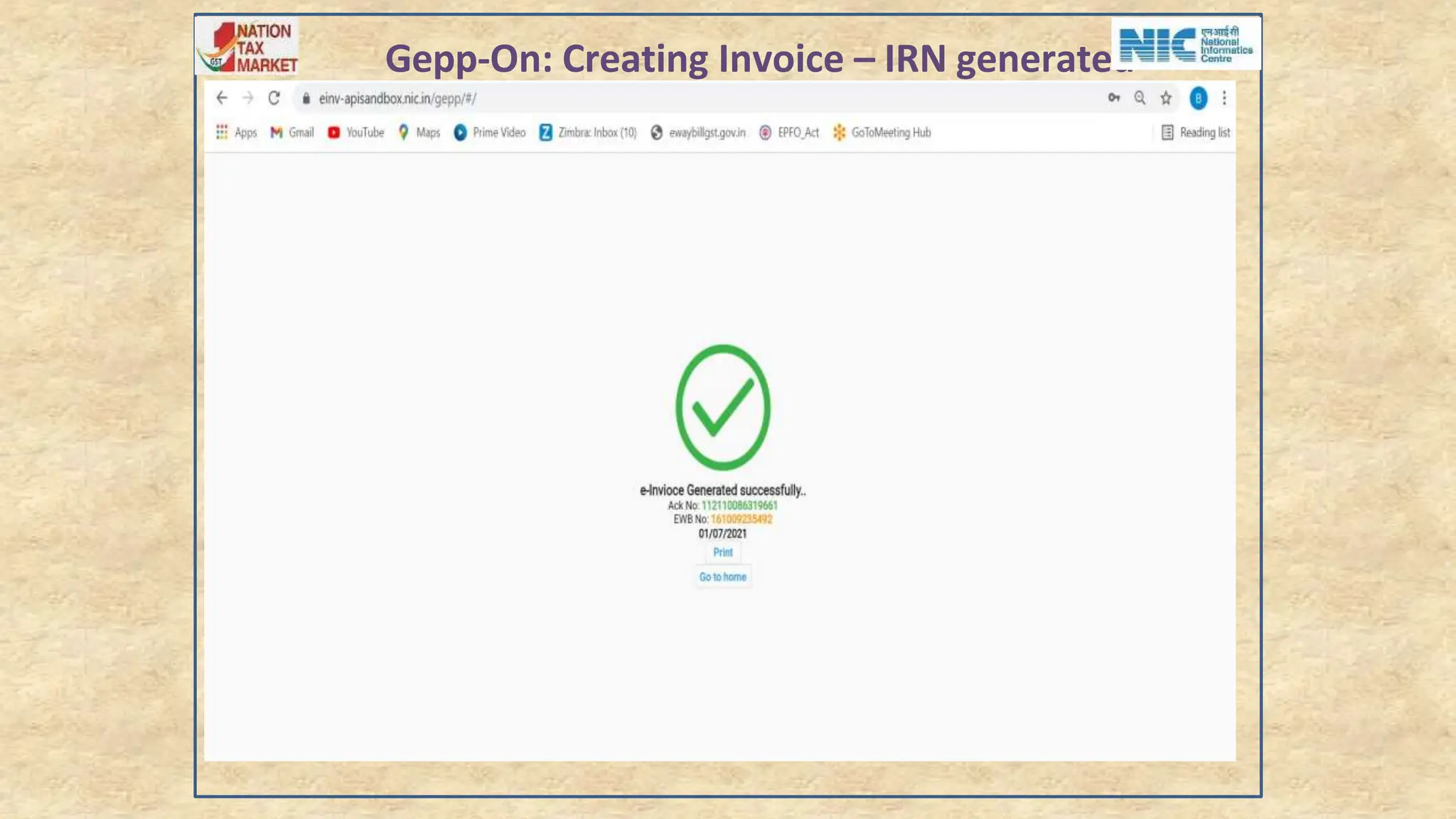
Gepp-On: Creating Invoice – IRN generated
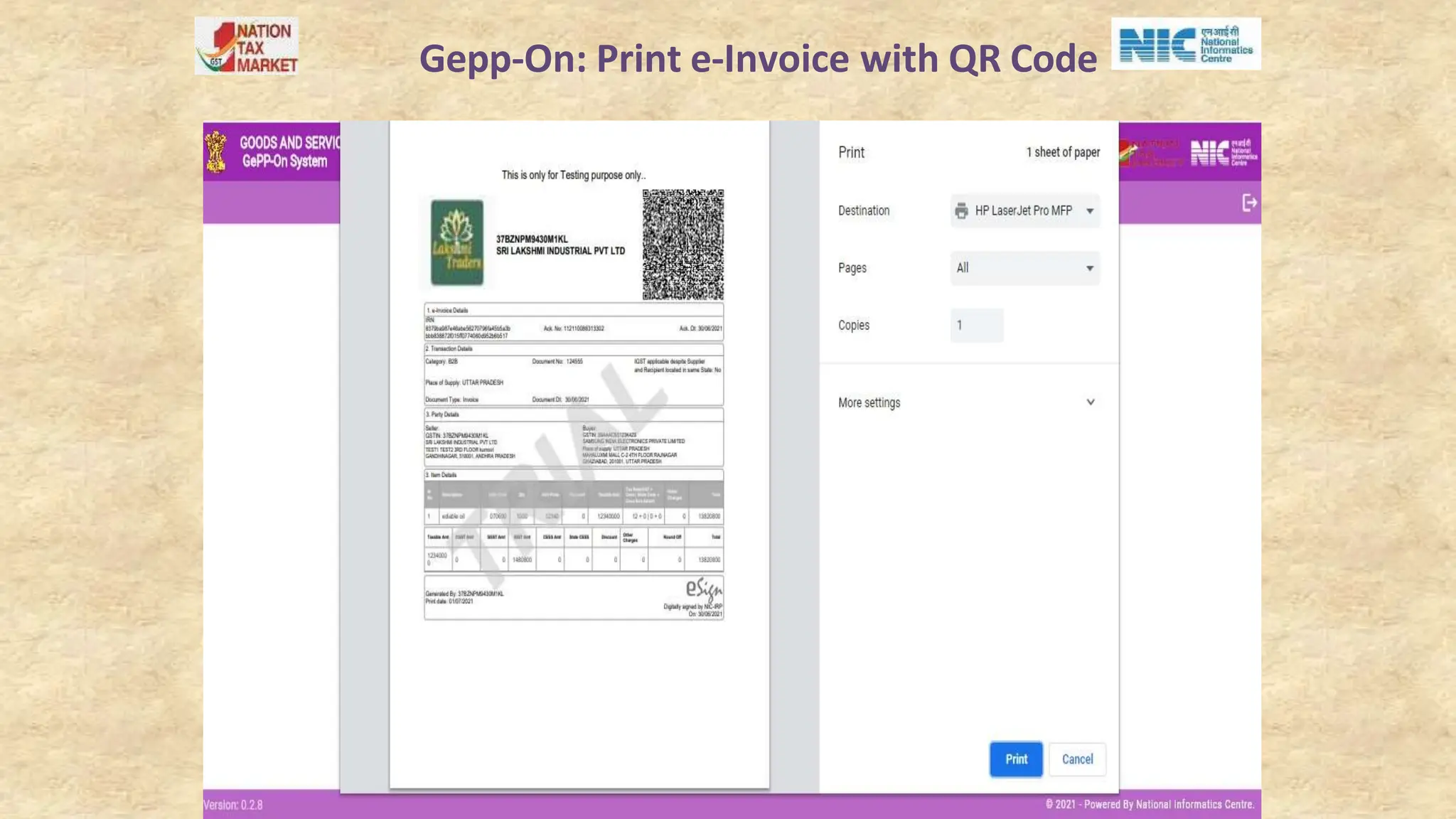
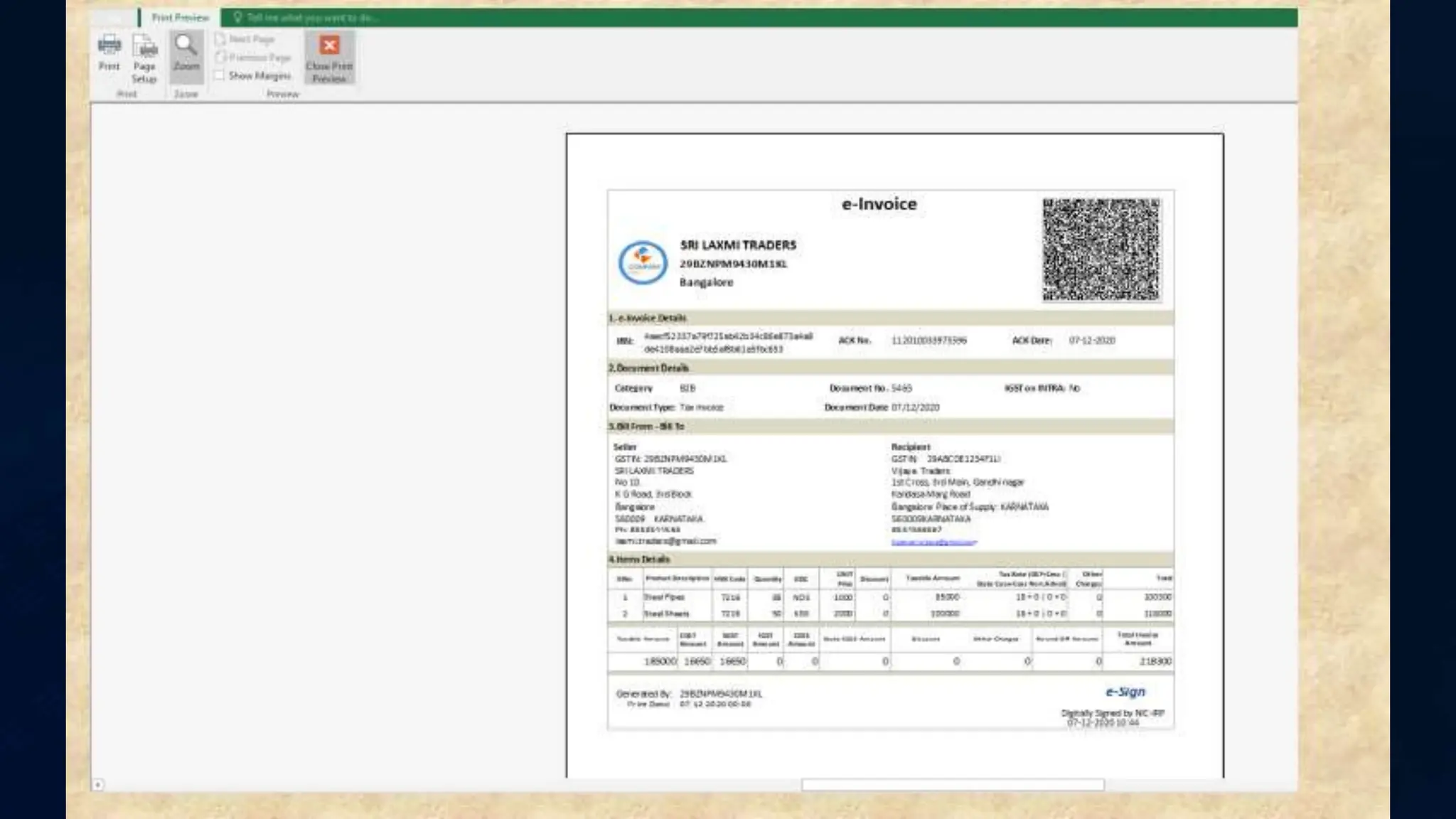
Gepp-On: Print e-Invoice with QR Code
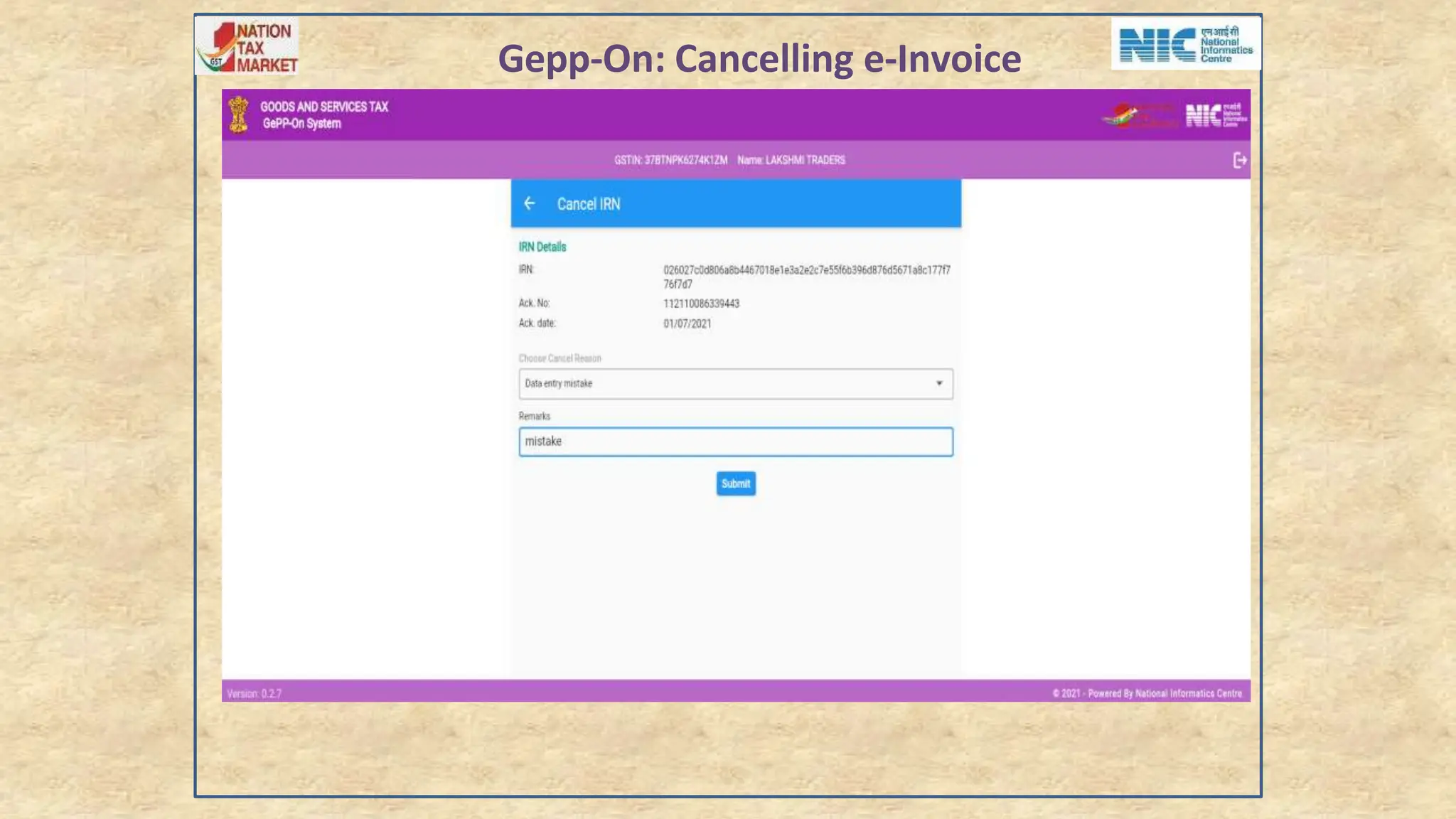
Gepp-On: Cancelling e-Invoice
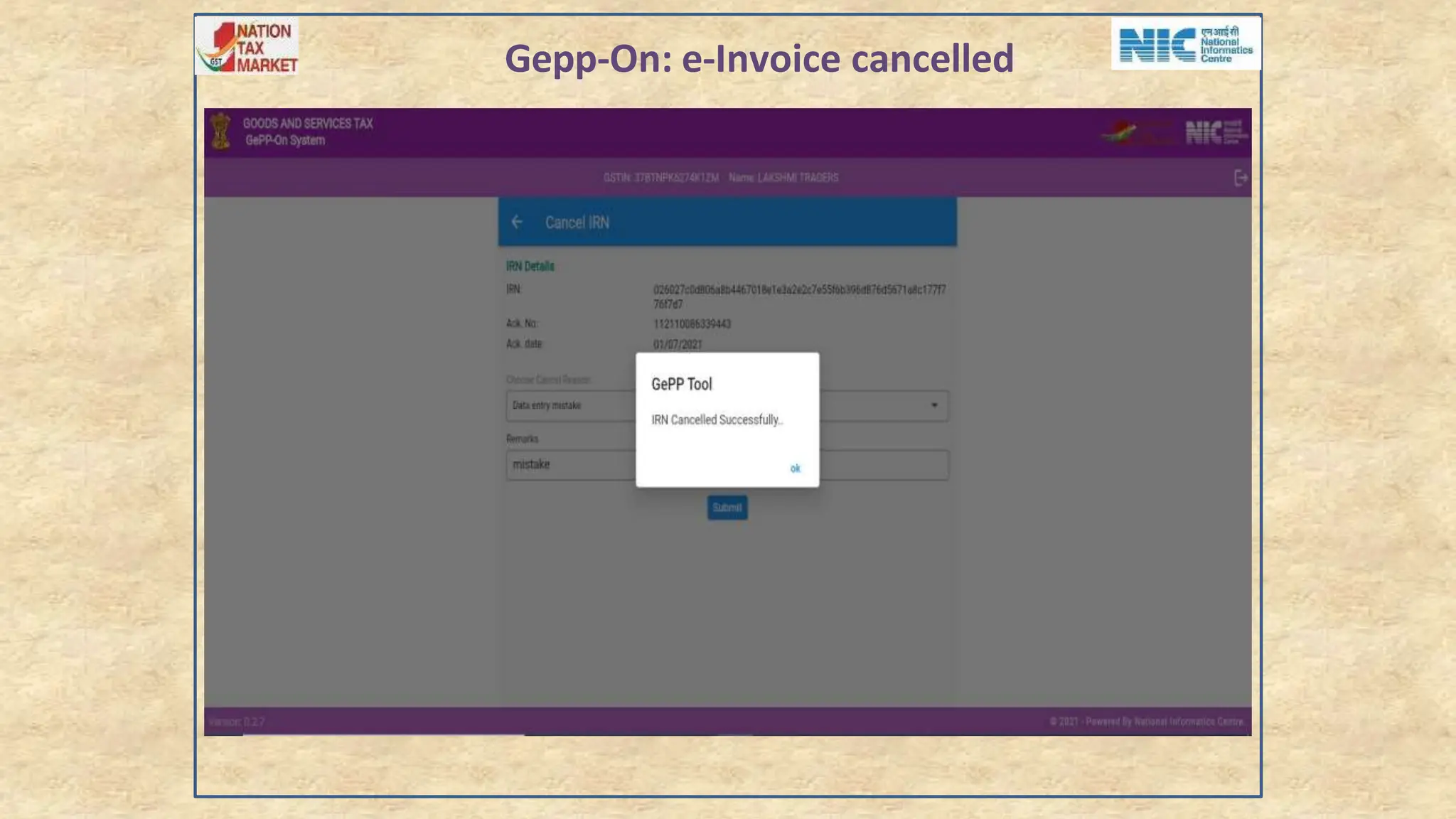
Gepp-On: e-Invoice cancelled
Offline GePP Tool – Useful in the case of Fewer Invoices
Bulk Uploading E-invoices using Offline Tool
What is Bulk Uploading in E-invoicing?
Bulk generation is a facility that is available on the IRP where invoices in bulk can be uploaded at
once. It is an offline tool using which a taxpayer can bulk upload the JSON format of e-invoices.
The Objective of Bulk Uploading E-invoices using Offline Tool
The objective of this offline tool is to simplify the bulk uploading process for taxpayers. All the
formats of bulk offline tools provided by NIC are MS-Excel based applications which could be used
by taxpayers who intend to not opt for API based E-Invoice Generation through GSP
Benefits of Bulk Uploading E-invoices using Offline Tool
1.Reduces time to generate multiple Invoice Reference Number (IRN) in one go.
2.Avoids duplicity when multiple invoices are to be prepared.
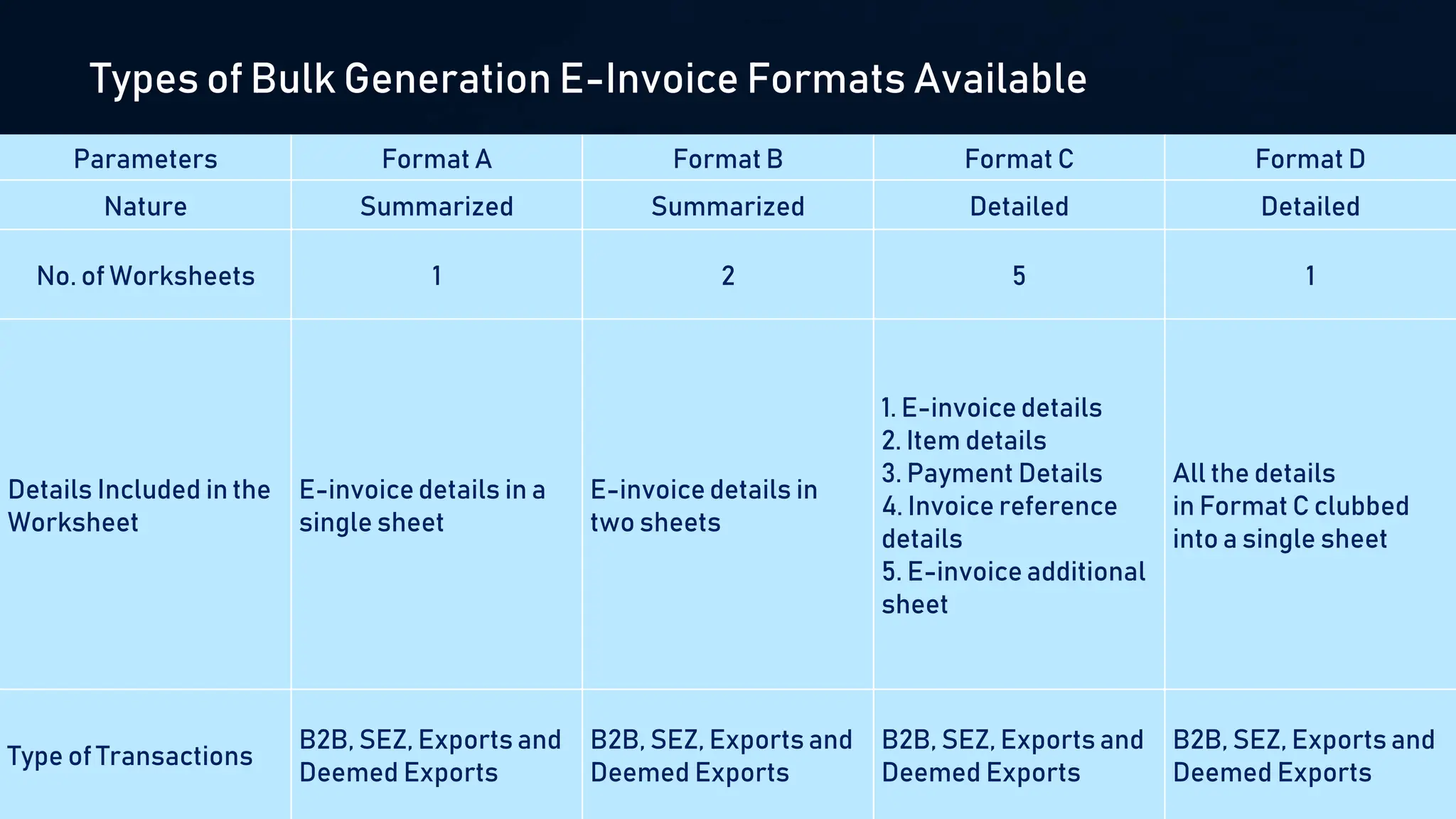
Types of Bulk Generation E-Invoice Formats Available
Parameters Format A Format B Format C Format D
Nature Summarized Summarized Detailed Detailed
No. of Worksheets 1 2 5 1
Details Included in the
Worksheet
E-invoice details in a
single sheet
E-invoice details in
two sheets
1. E-invoice details
2. Item details
3. Payment Details
4. Invoice reference
details
5. E-invoice additional
sheet
All the details
in Format C clubbed
into a single sheet
Type of Transactions
B2B, SEZ, Exports and
Deemed Exports
B2B, SEZ, Exports and
Deemed Exports
B2B, SEZ, Exports and
Deemed Exports
B2B, SEZ, Exports and
Deemed Exports
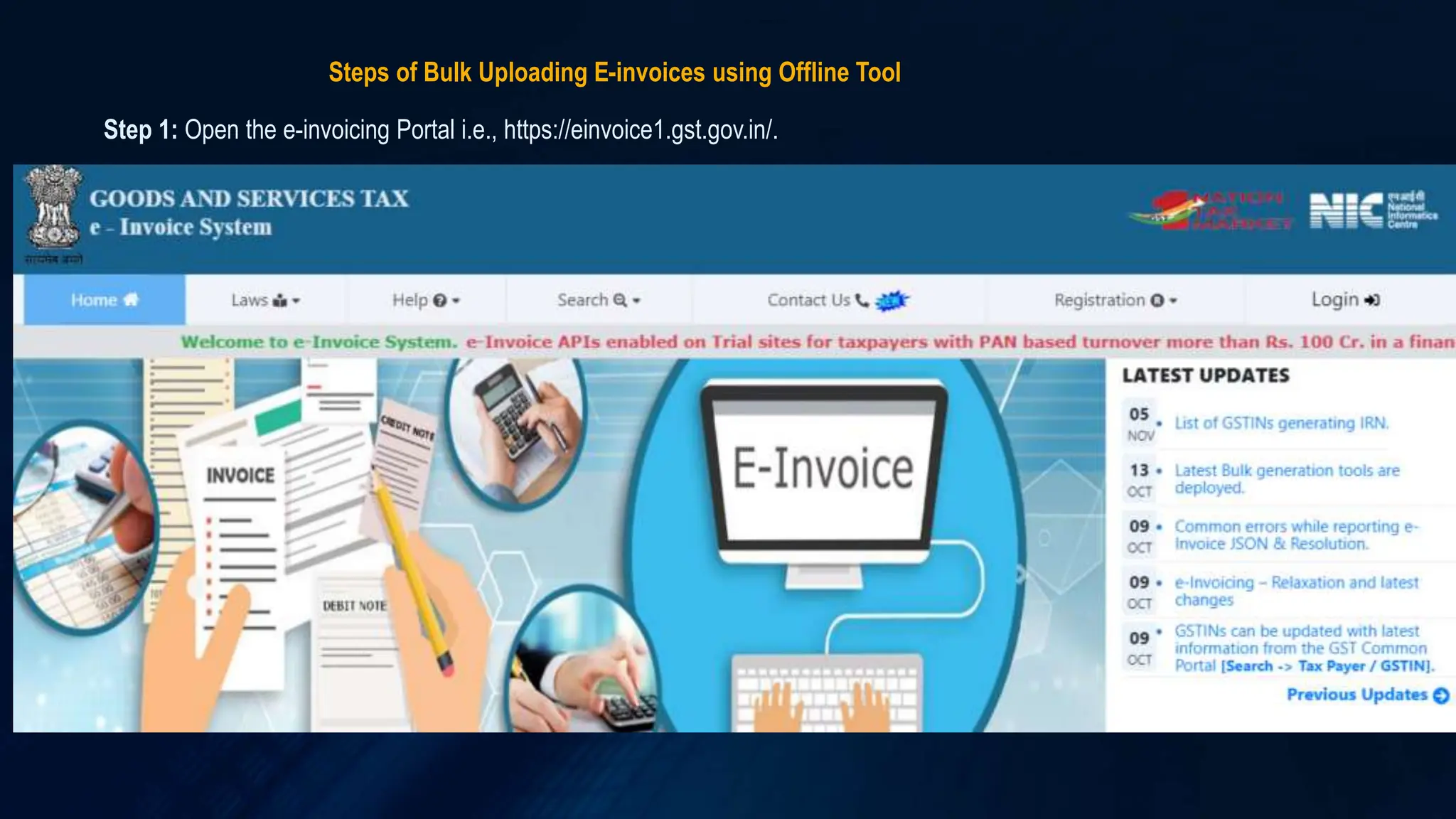
Steps of Bulk Uploading E-invoices using Offline Tool
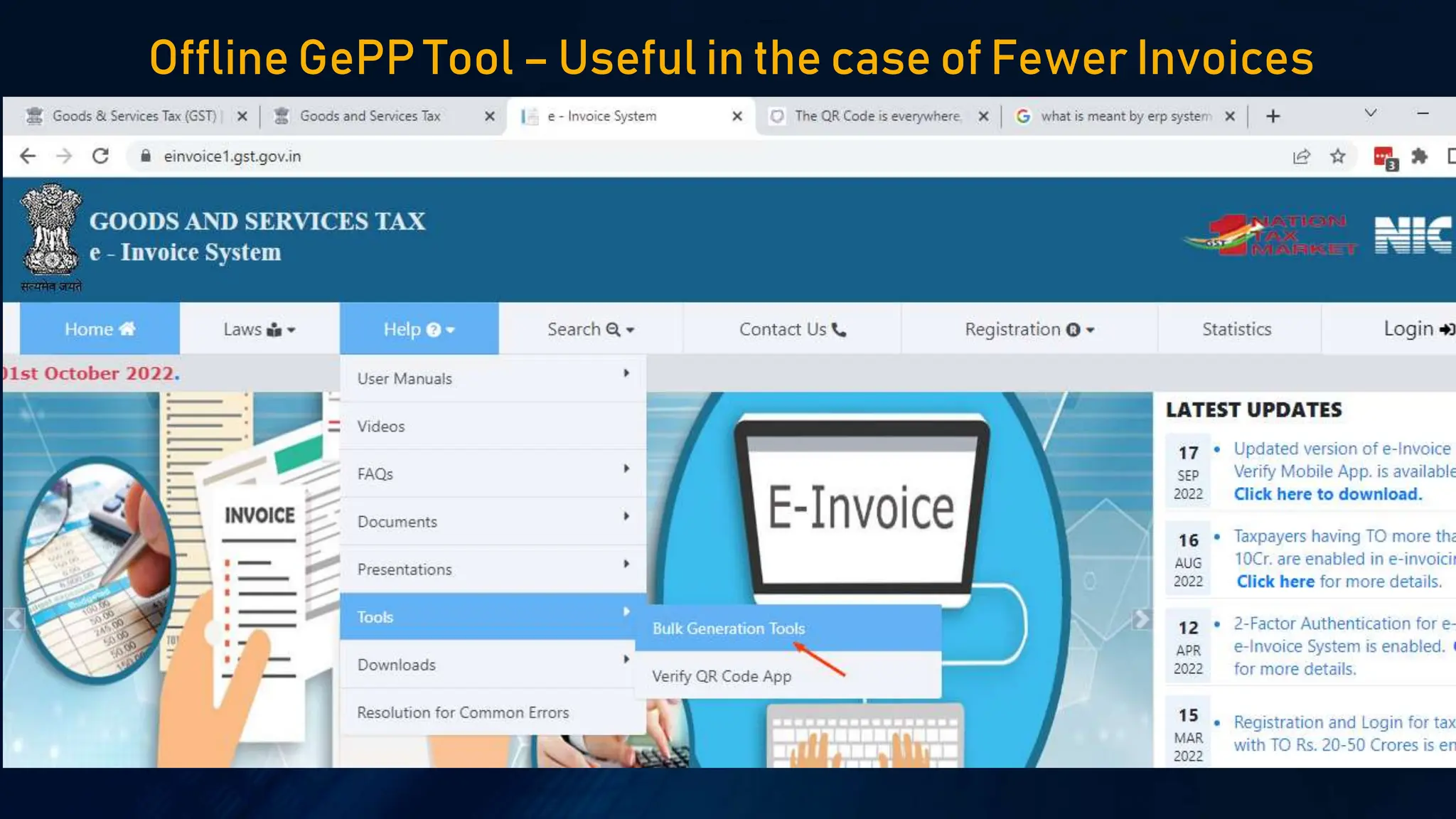
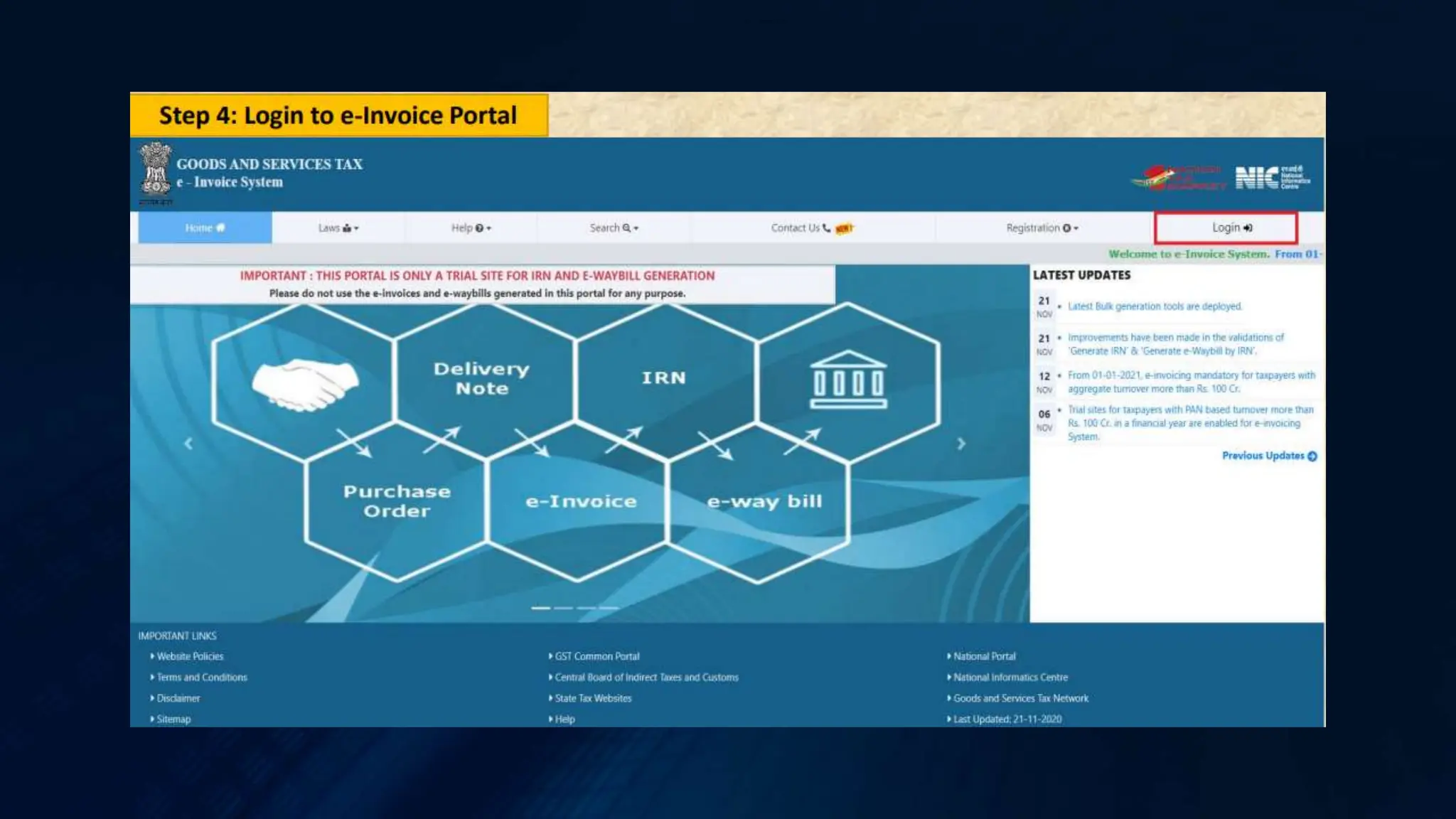
Step 1: Open the e-invoicing Portal i.e., https://einvoice1.gst.gov.in/.
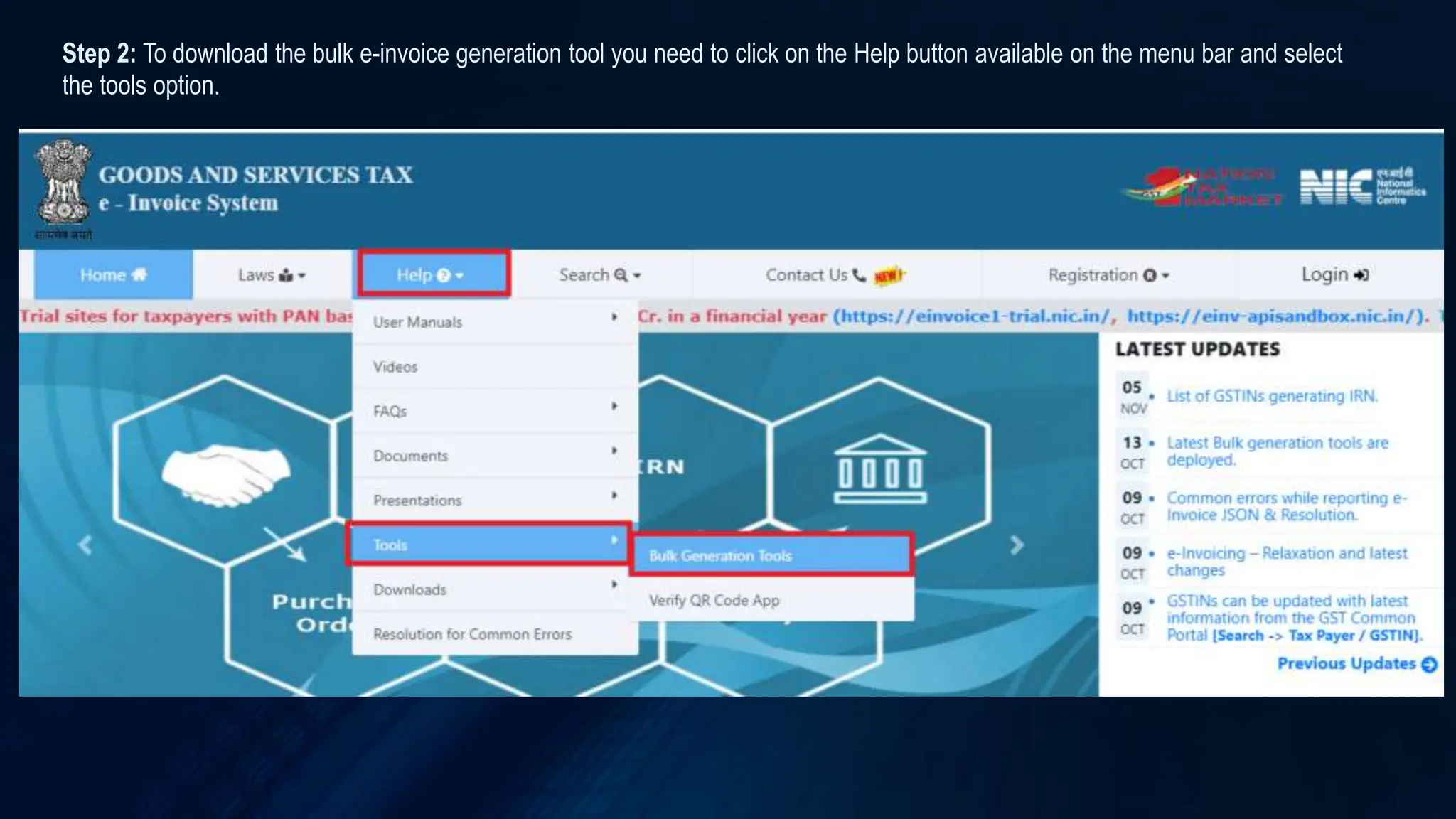
Step 2: To download the bulk e-invoice generation tool you need to click on the Help button available on the menu bar and select
the tools option.
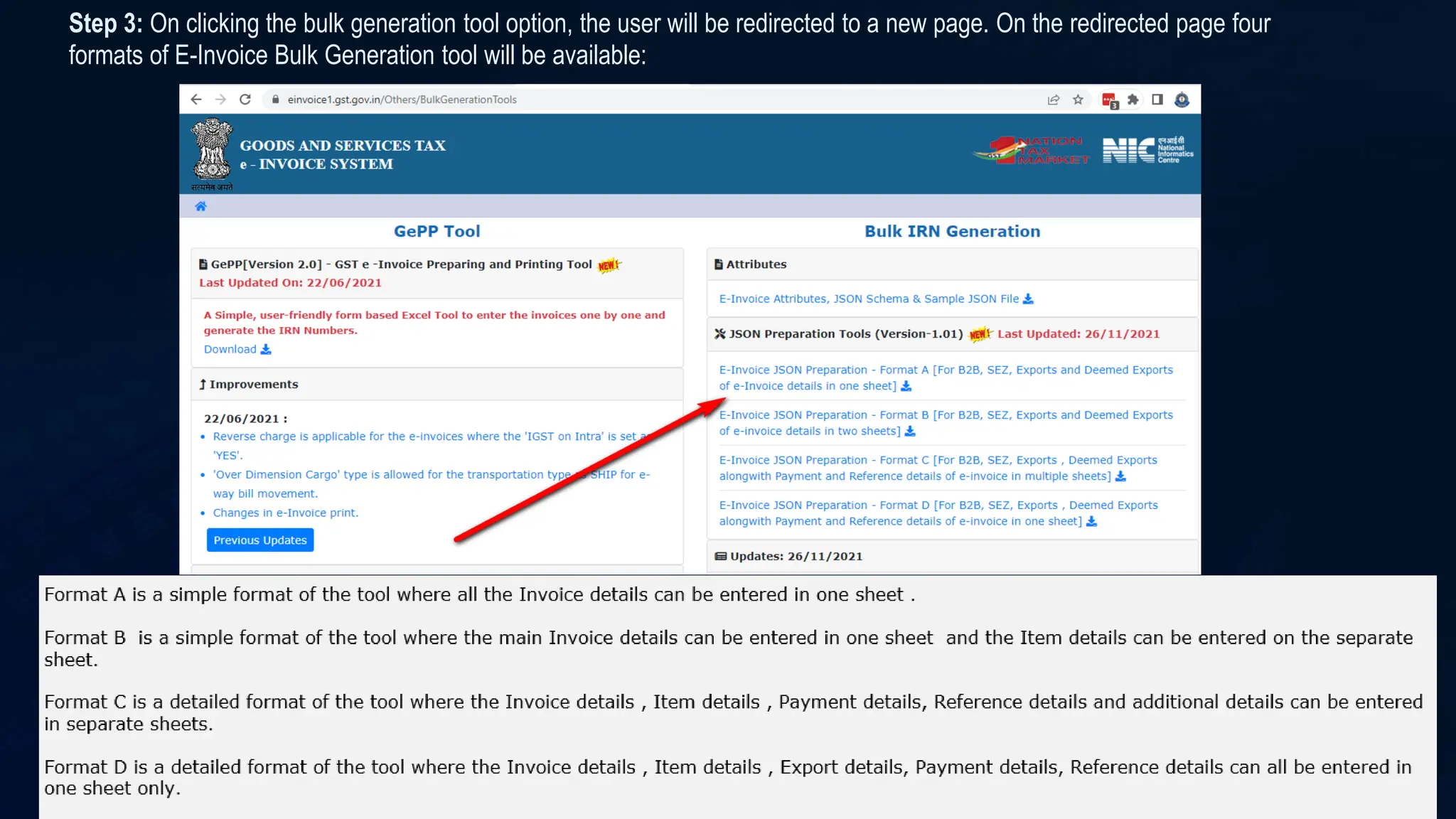
Step 3: On clicking the bulk generation tool option, the user will be redirected to a new page. On the redirected page four
formats of E-Invoice Bulk Generation tool will be available:
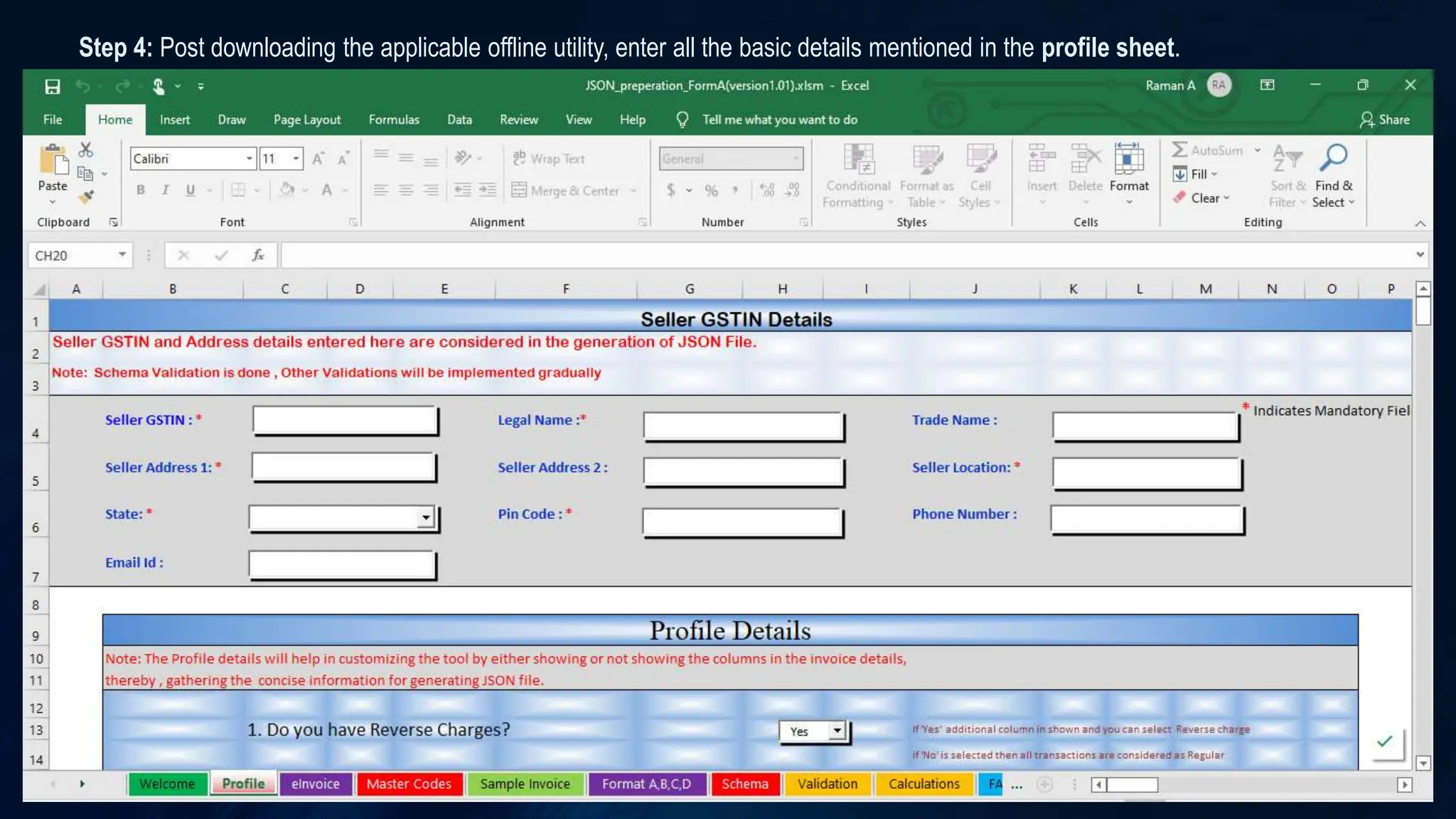
Step 4: Post downloading the applicable offline utility, enter all the basic details mentioned in the profile sheet.
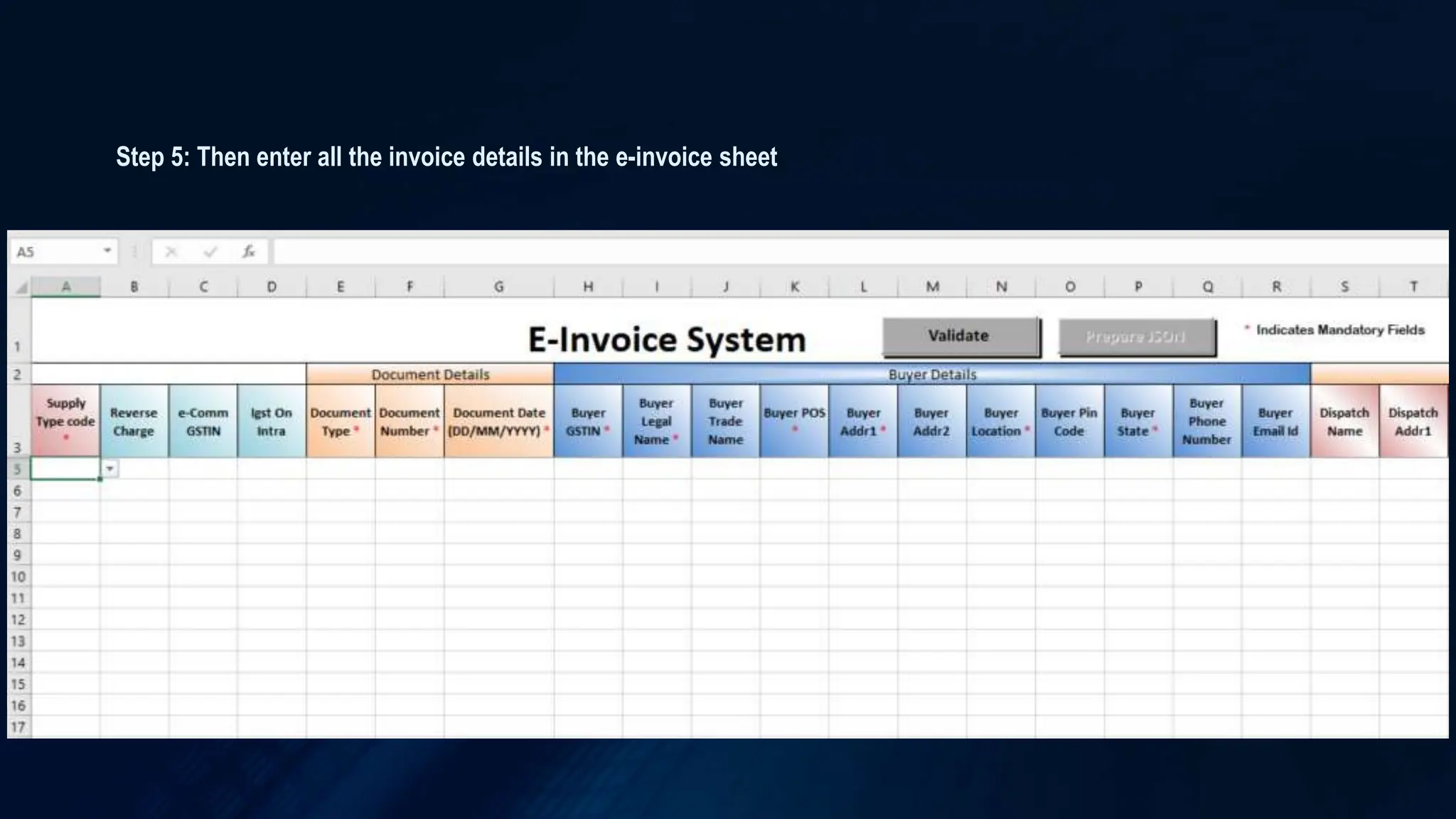
Step 5: Then enter all the invoice details in the e-invoice sheet
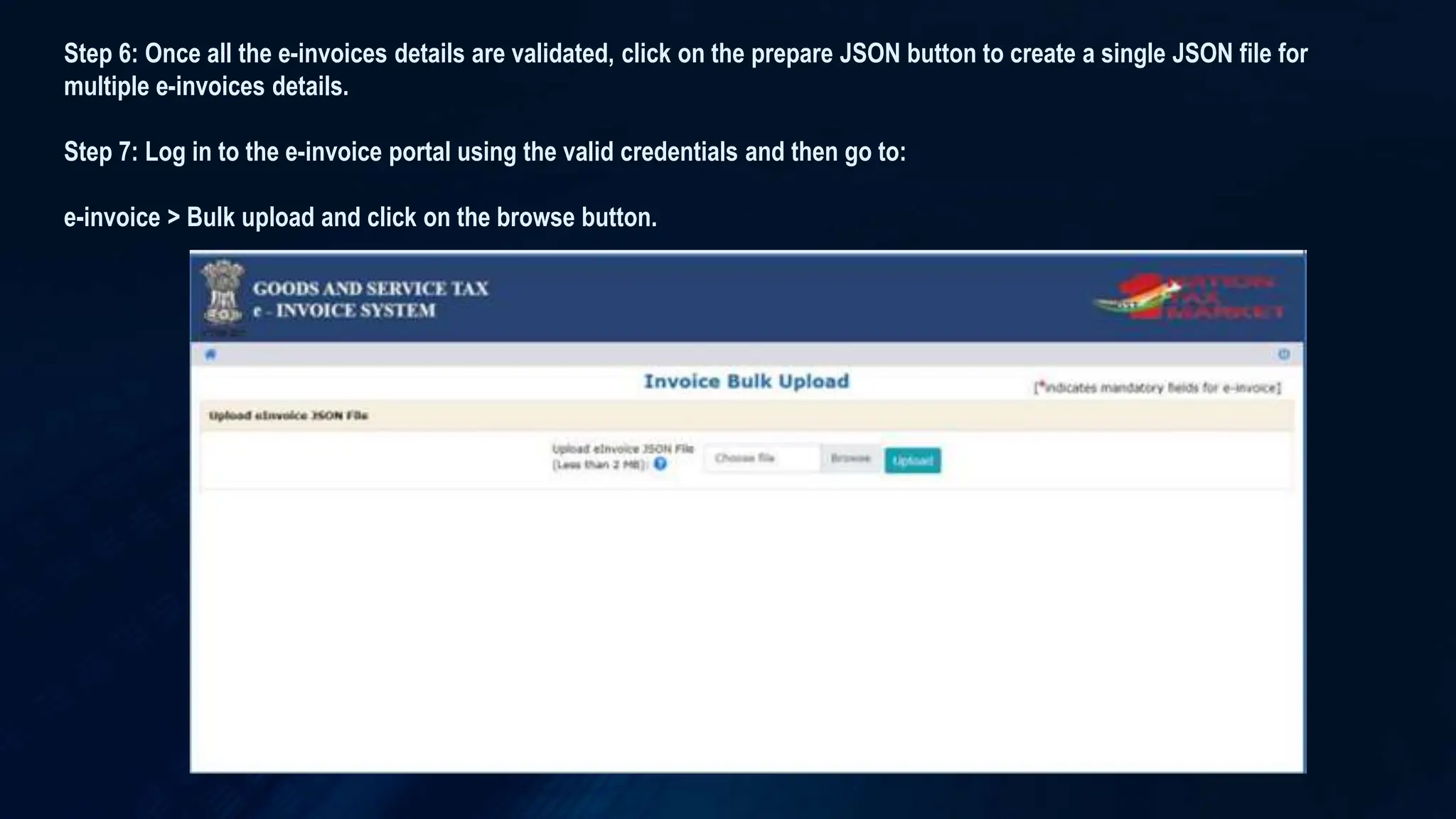
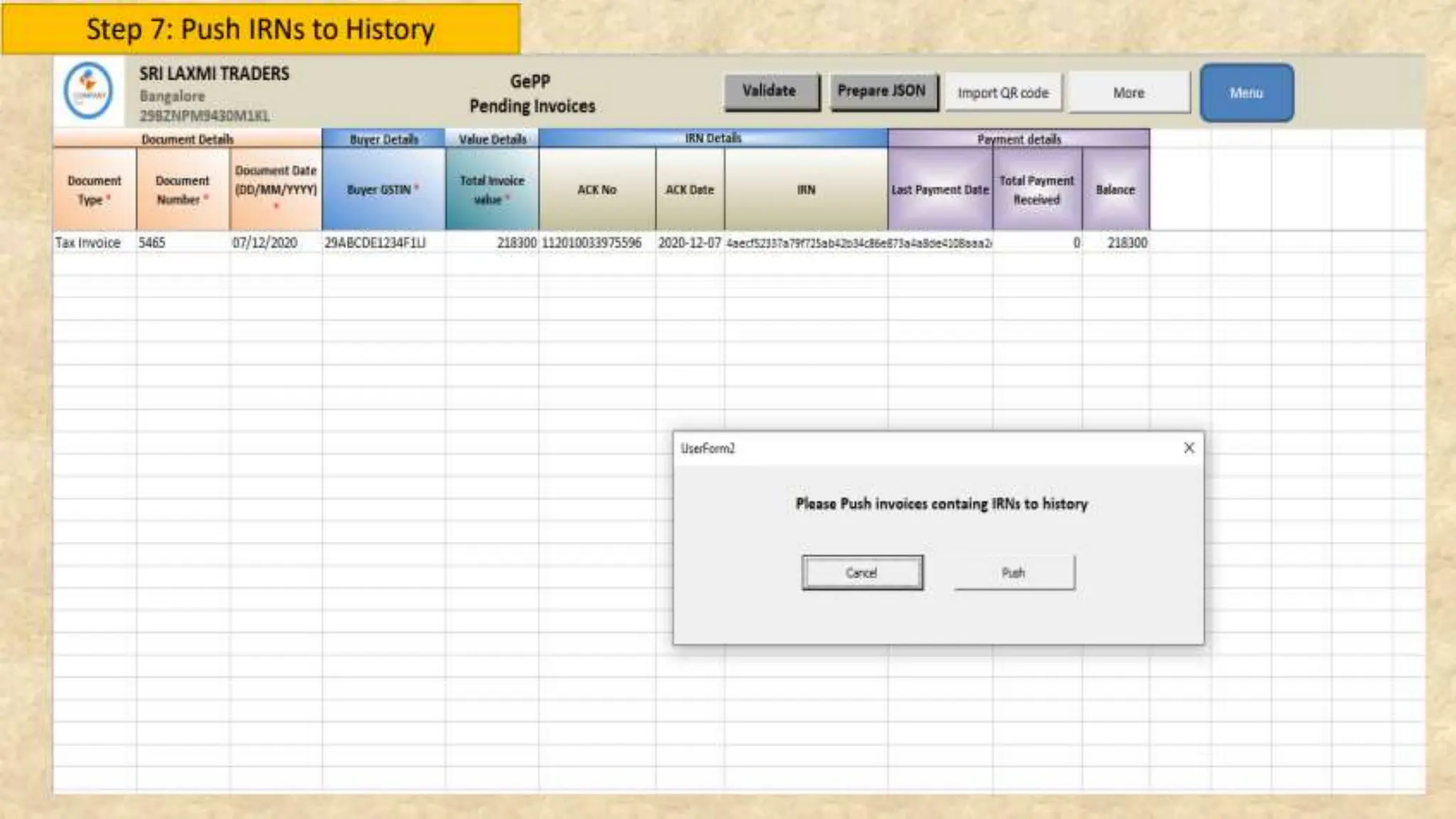
Step 6: Once all the e-invoices details are validated, click on the prepare JSON button to create a single JSON file for
multiple e-invoices details.
Step 7: Log in to the e-invoice portal using the valid credentials and then go to:
e-invoice > Bulk upload and click on the browse button.
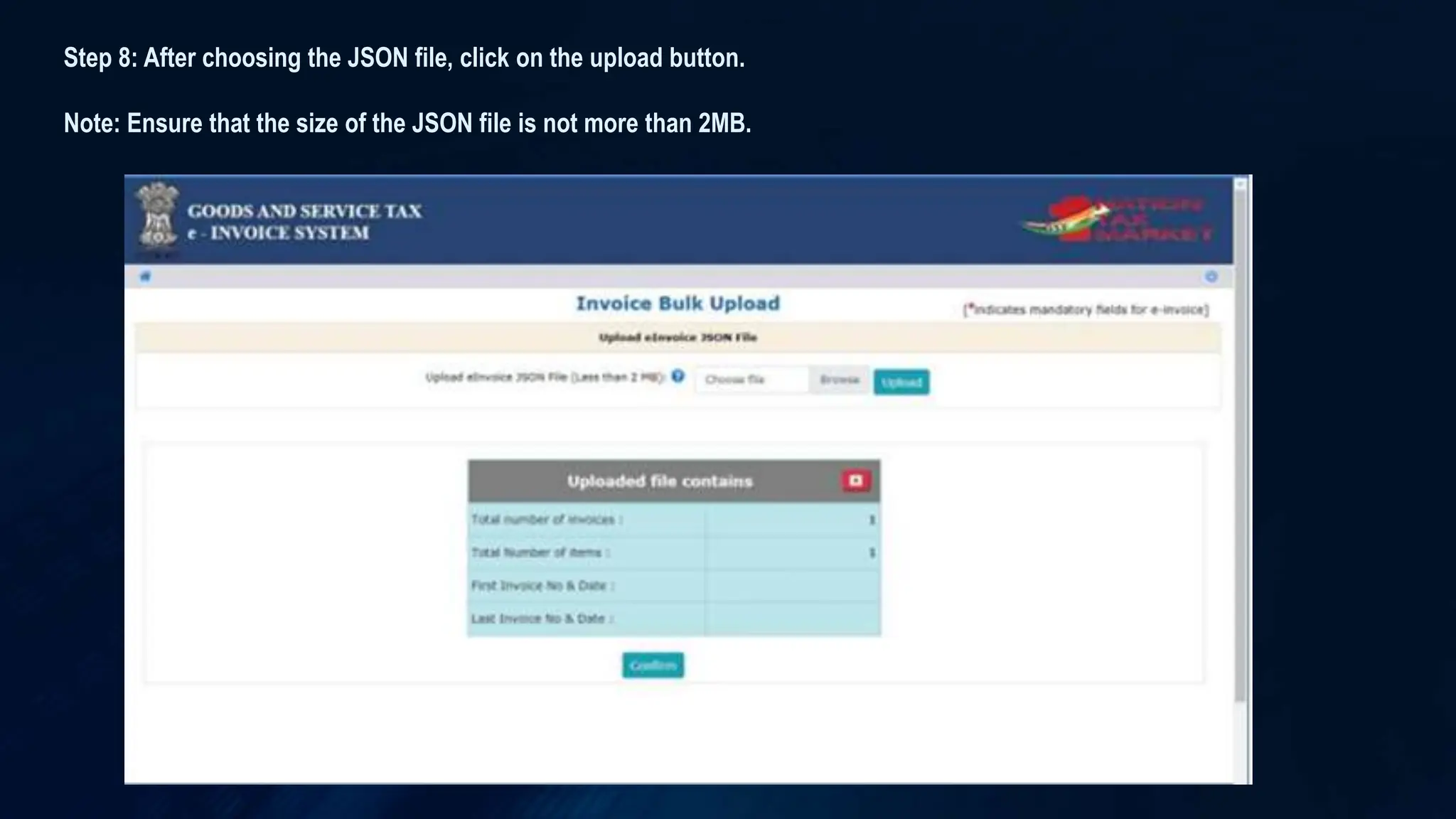
Step 8: After choosing the JSON file, click on the upload button.
Note: Ensure that the size of the JSON file is not more than 2MB.
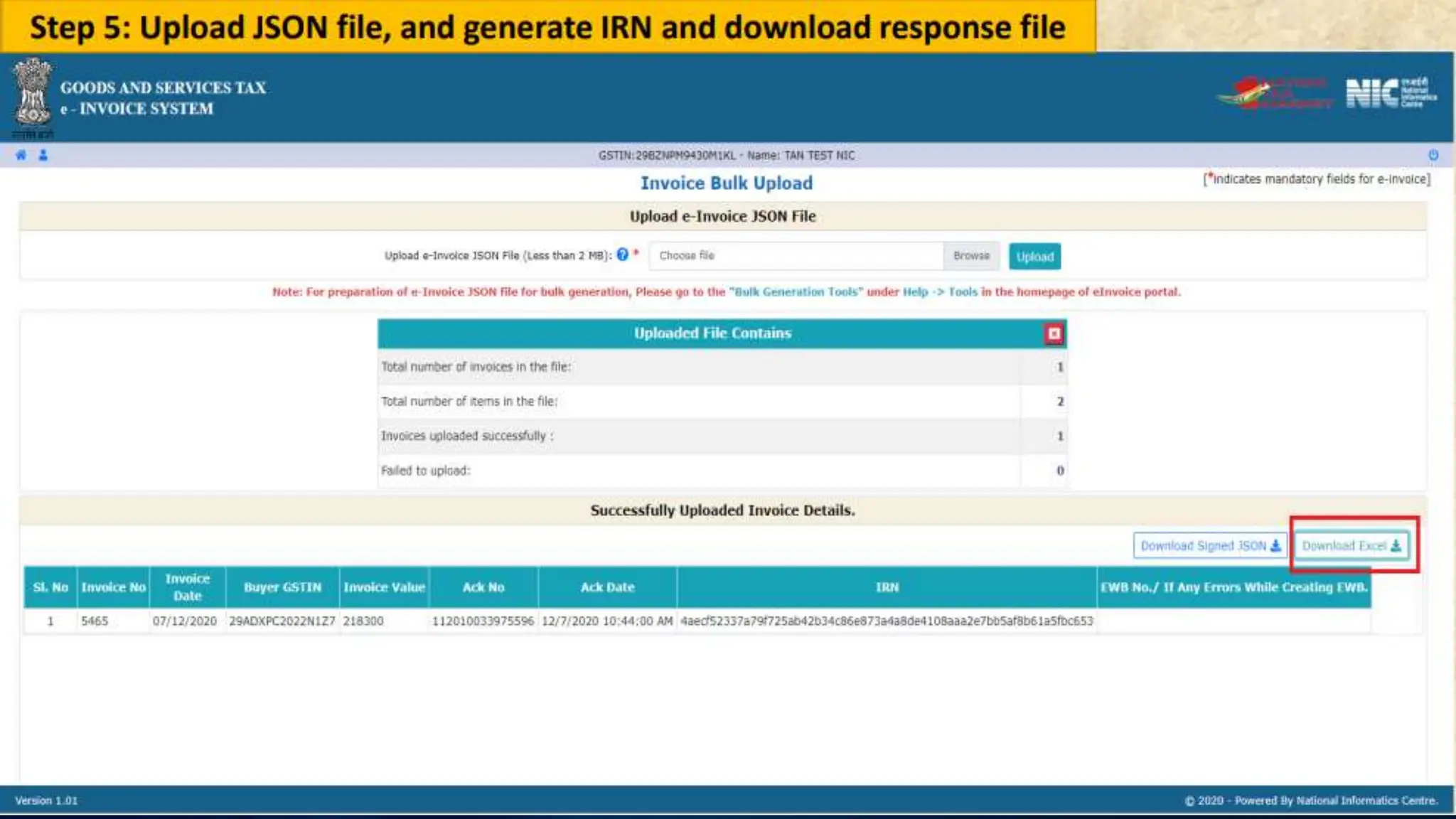
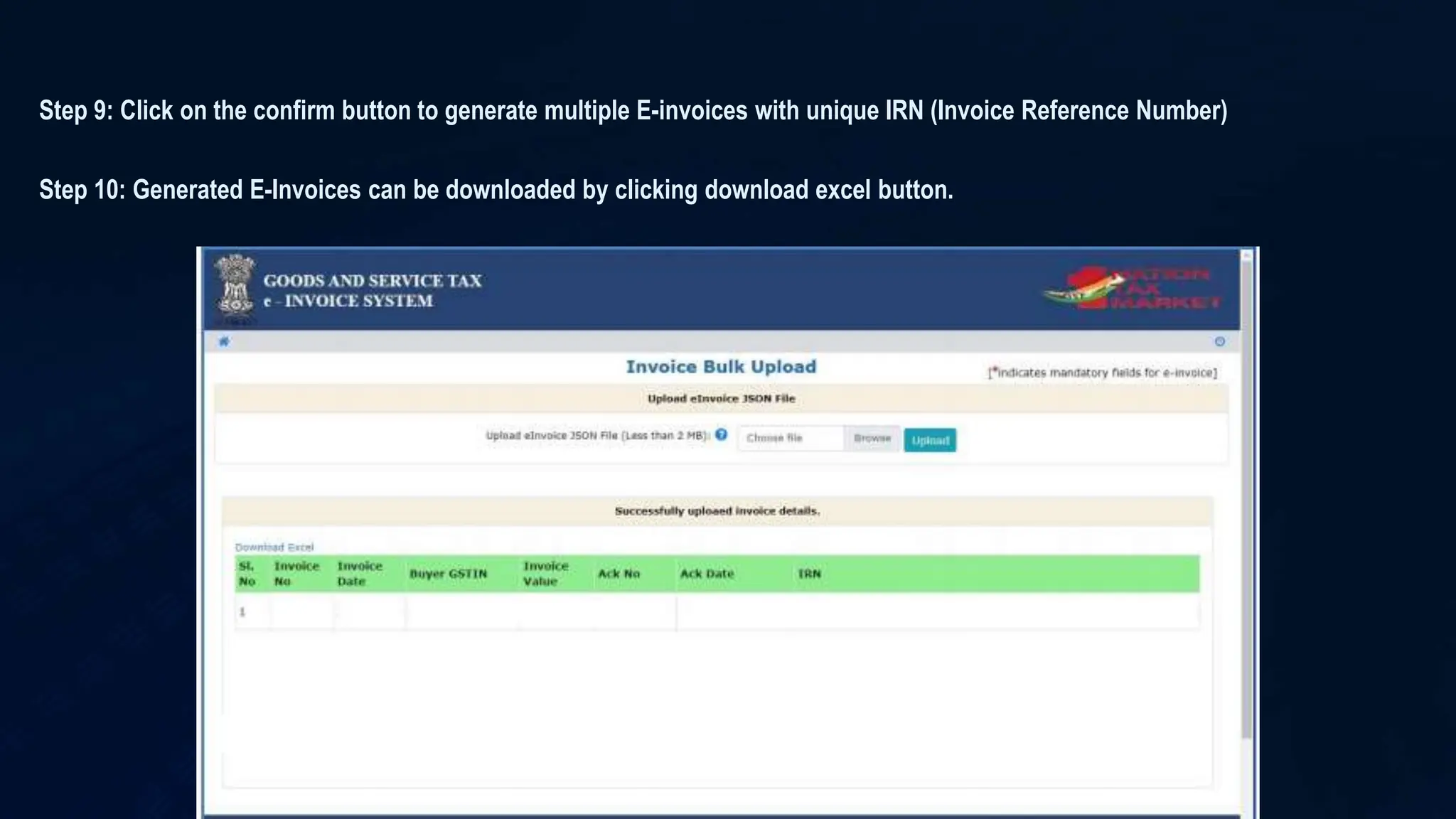
Step 9: Click on the confirm button to generate multiple E-invoices with unique IRN (Invoice Reference Number)
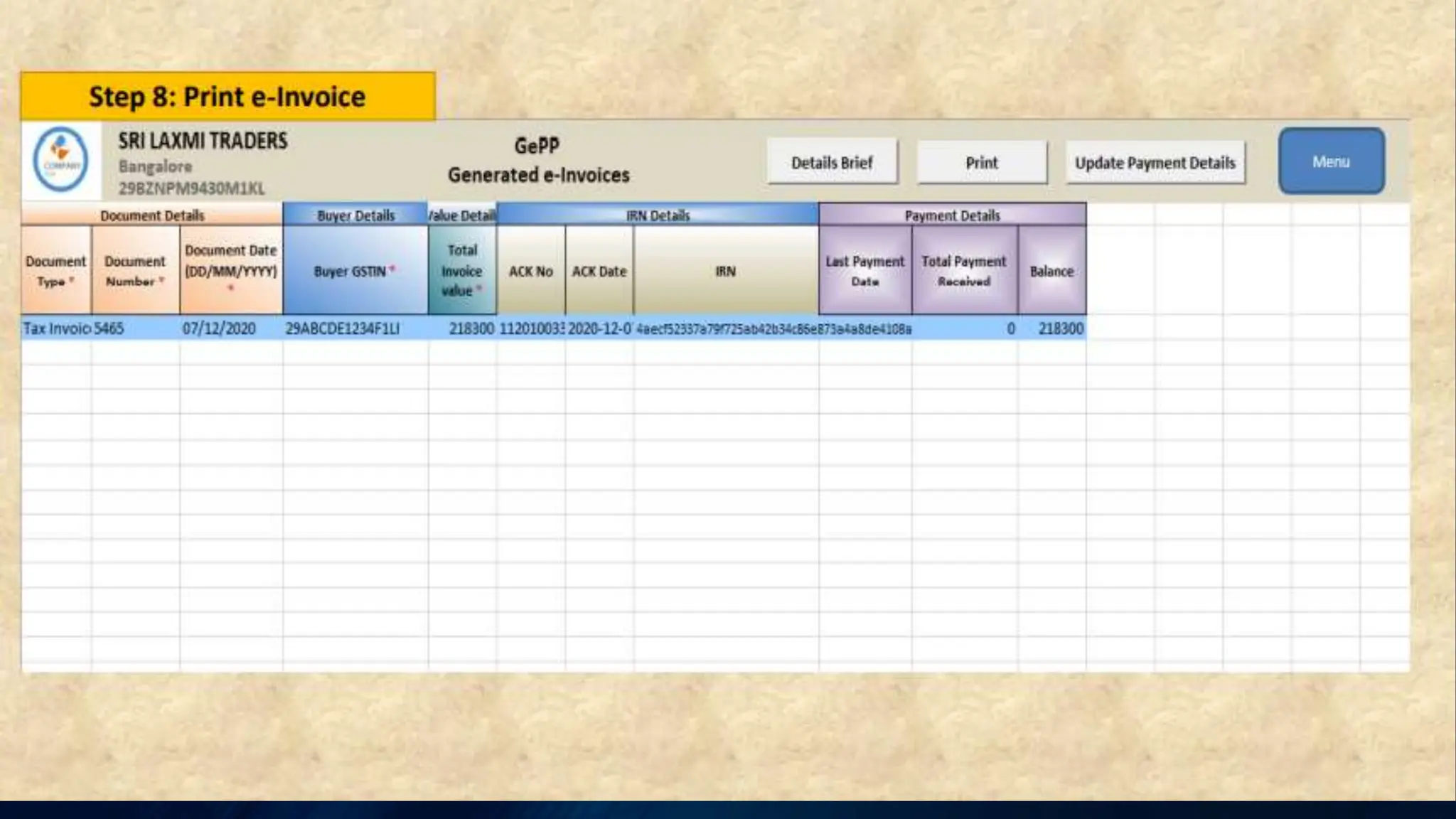
Step 10: Generated E-Invoices can be downloaded by clicking download excel button.
Direct API Integration and API Integration through GSP
 APIs function as a communication channel between the following two entities: Taxpayers & IRP
 APIs work as a bridge between taxpayers and the e-Invoicingsystem to facilitate data exchange
between the taxpayers and the IRP portal.
 For other taxpayers e-InvoicingAPI has to be obtainedfrom a government-appointed GST
Suvidha Provider
 The GST Network (GSTN) allows eligible taxpayers (businesses with an annual turnoverof more
than Rs 100 crores) to use APIs to integrate with the Invoice RegistrationPortal (IRP) directly.
API Stands for Application Programming Interface
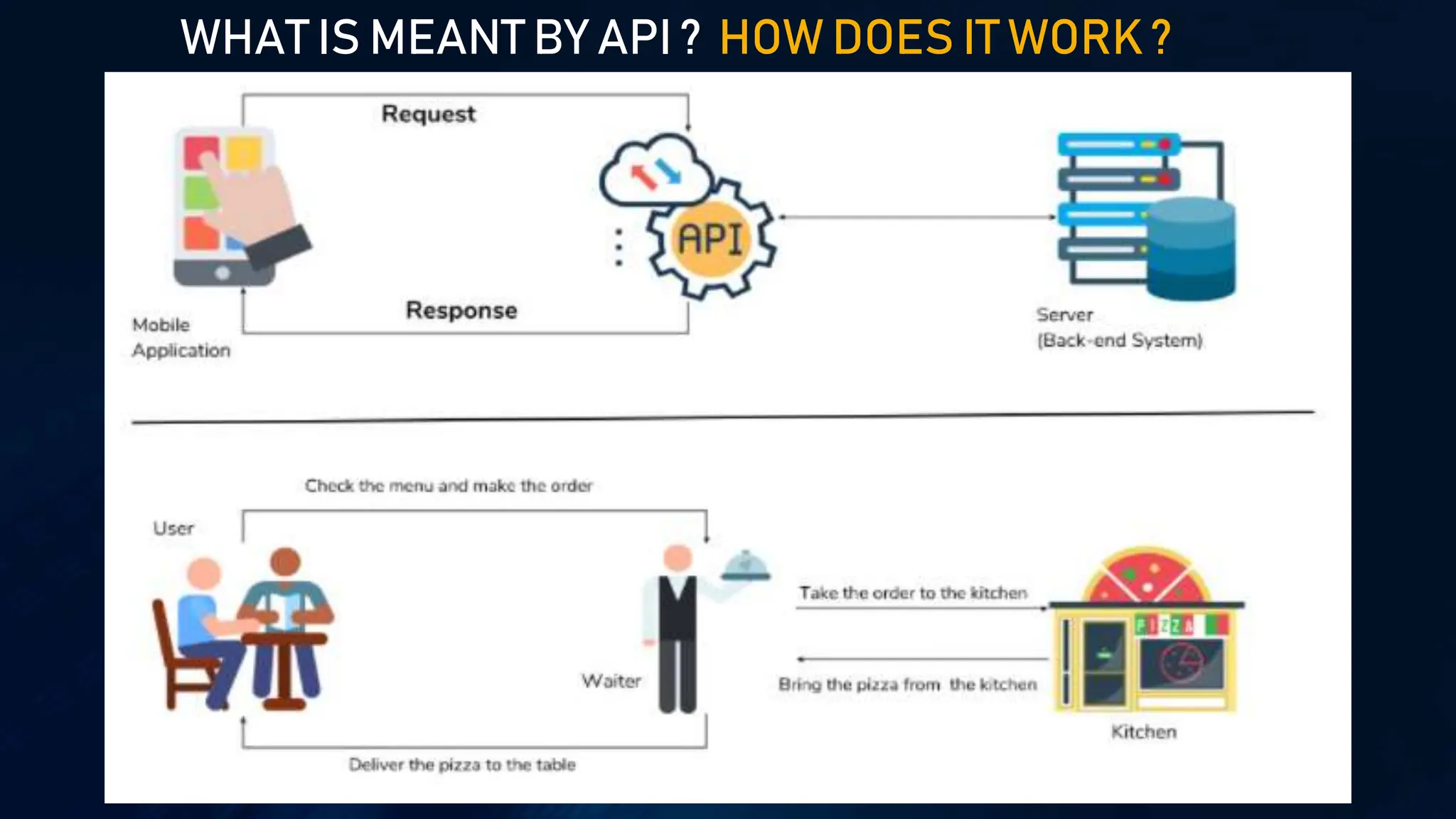
WHAT IS MEANT BY API ? HOW DOES IT WORK ?
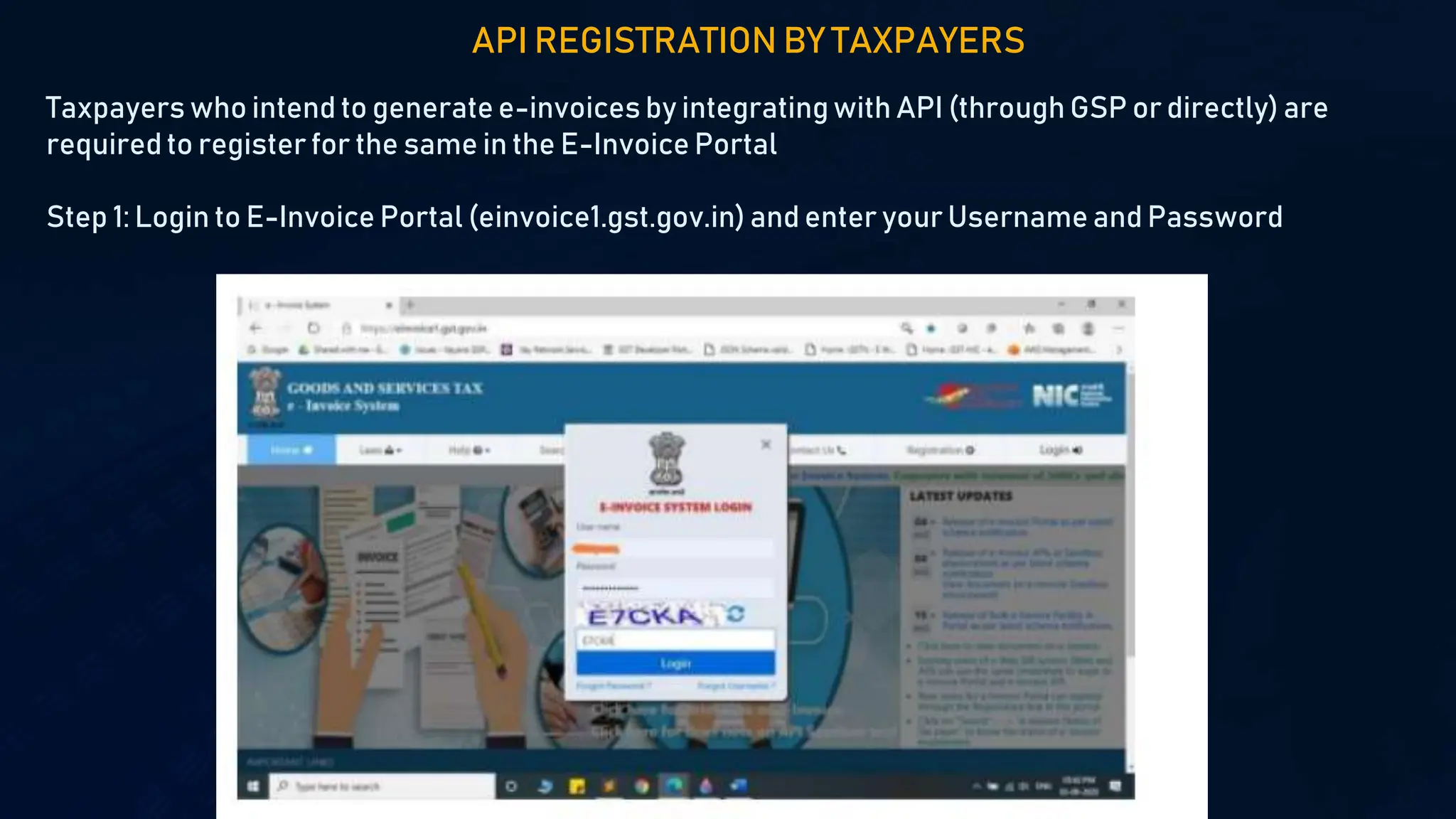
API REGISTRATION BY TAXPAYERS
Taxpayers who intend to generate e-invoices by integratingwith API (through GSP or directly) are
requiredto register for the same in the E-Invoice Portal
Step 1: Login to E-Invoice Portal (einvoice1.gst.gov.in) and enter your Username and Password
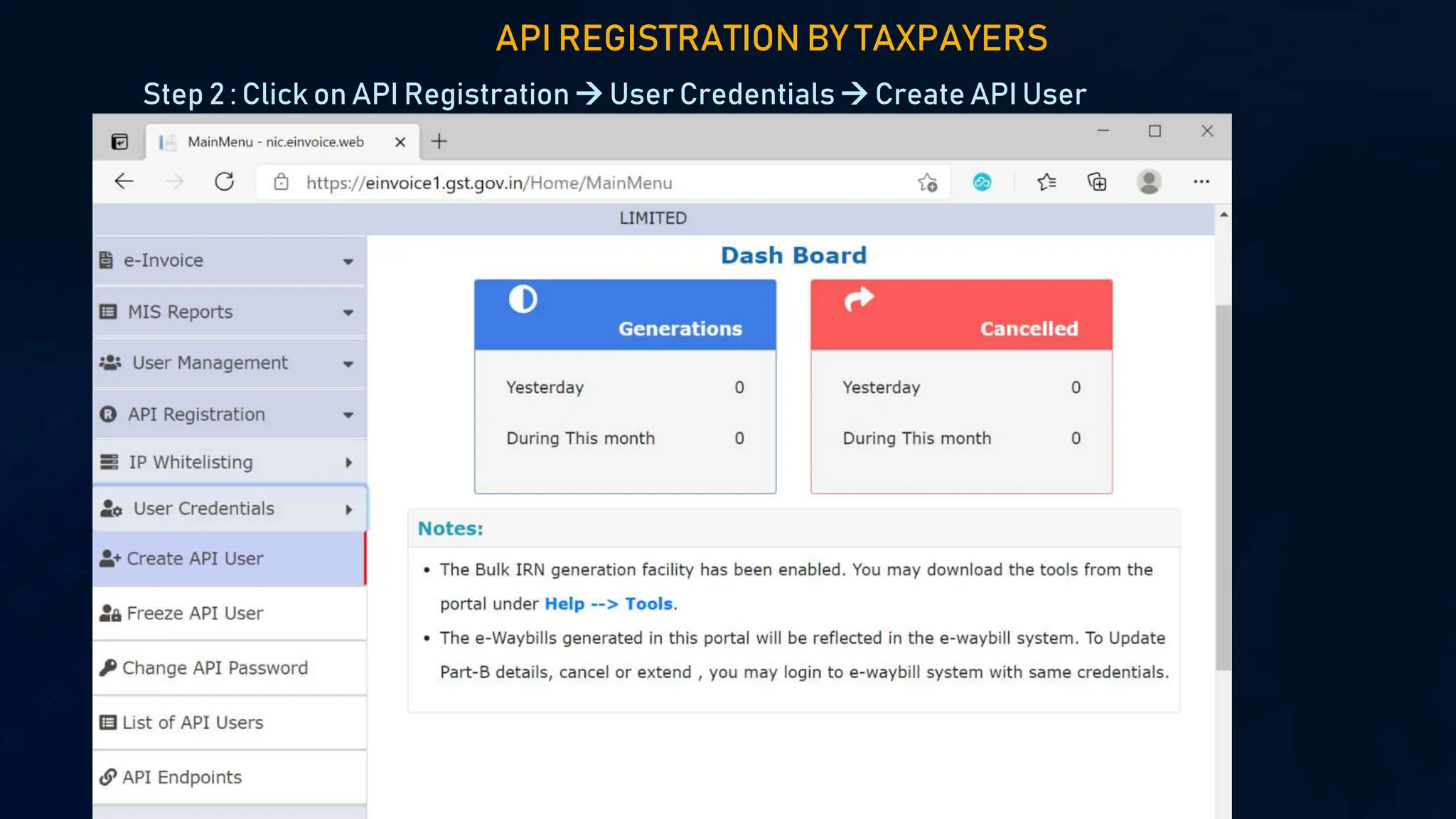
Step 2 : Click on API Registration User Credentials  Create API User
API REGISTRATION BY TAXPAYERS
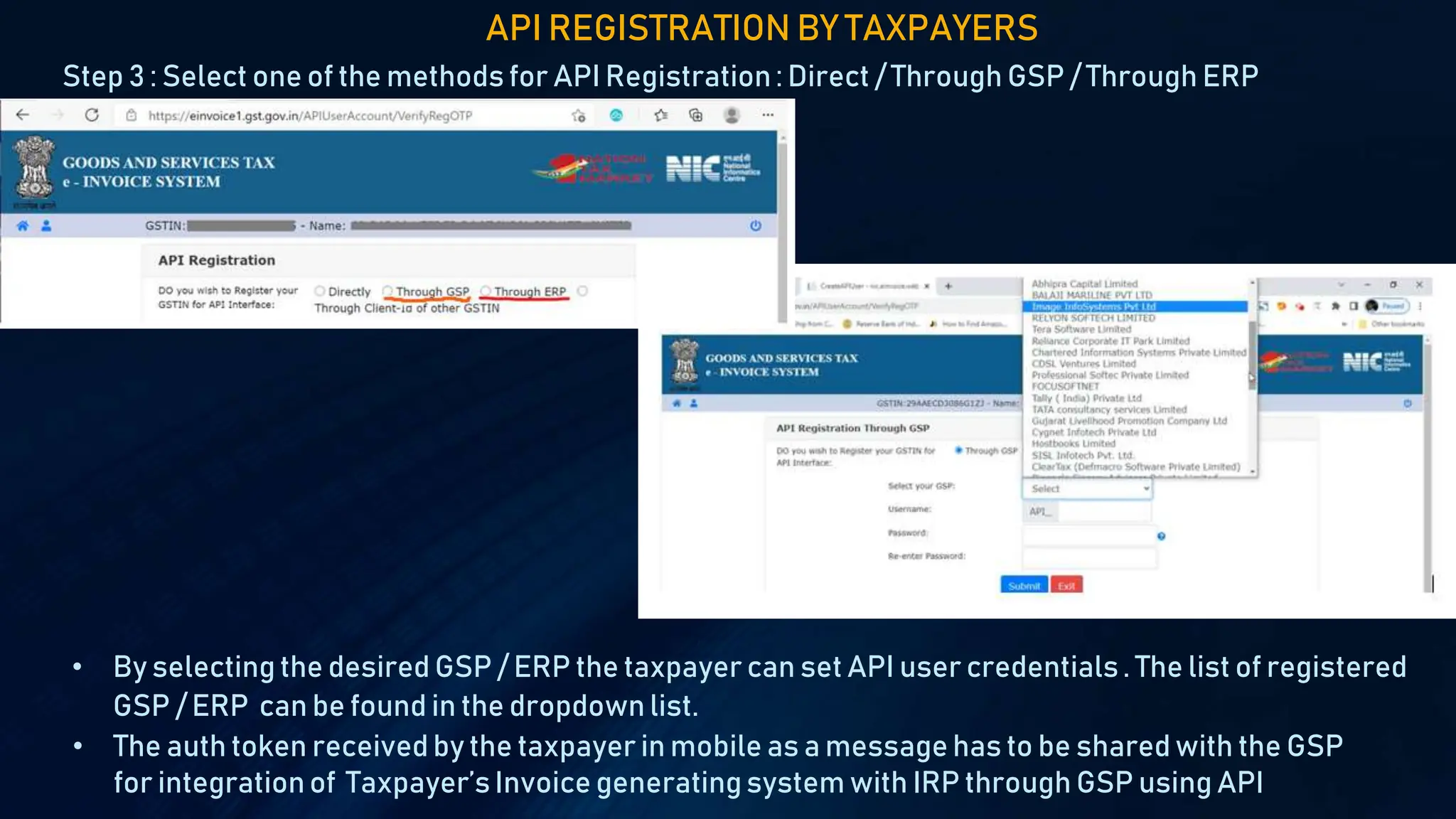
Step 3 : Select one of the methods for API Registration: Direct / Through GSP / Through ERP
API REGISTRATION BY TAXPAYERS
• By selecting the desired GSP / ERP the taxpayer can set API user credentials. The list of registered
GSP / ERP can be found in the dropdown list.
• The auth token received by the taxpayer in mobile as a message has to be shared with the GSP
for integrationof Taxpayer’s Invoice generatingsystem with IRP through GSP using API
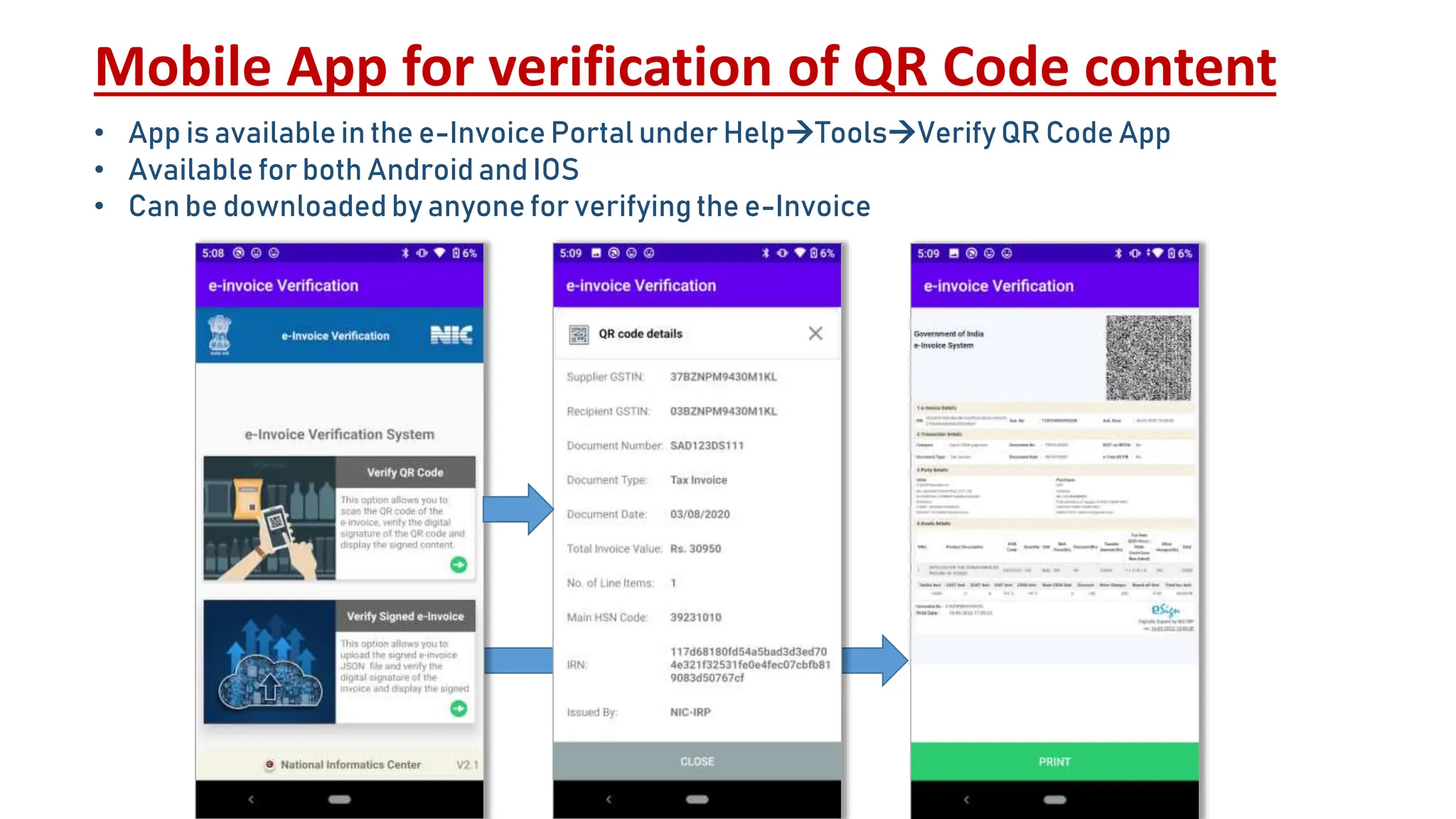
Mobile App for verification of QR Code content
• App is available in the e-Invoice Portal under HelpToolsVerify QR Code App
• Available for both Android and IOS
• Can be downloadedby anyone for verifyingthe e-Invoice
THANK YOU

E-Invoice under GST - How to enroll and use various tools to generate E-invoice

  • 1.
  • 2.
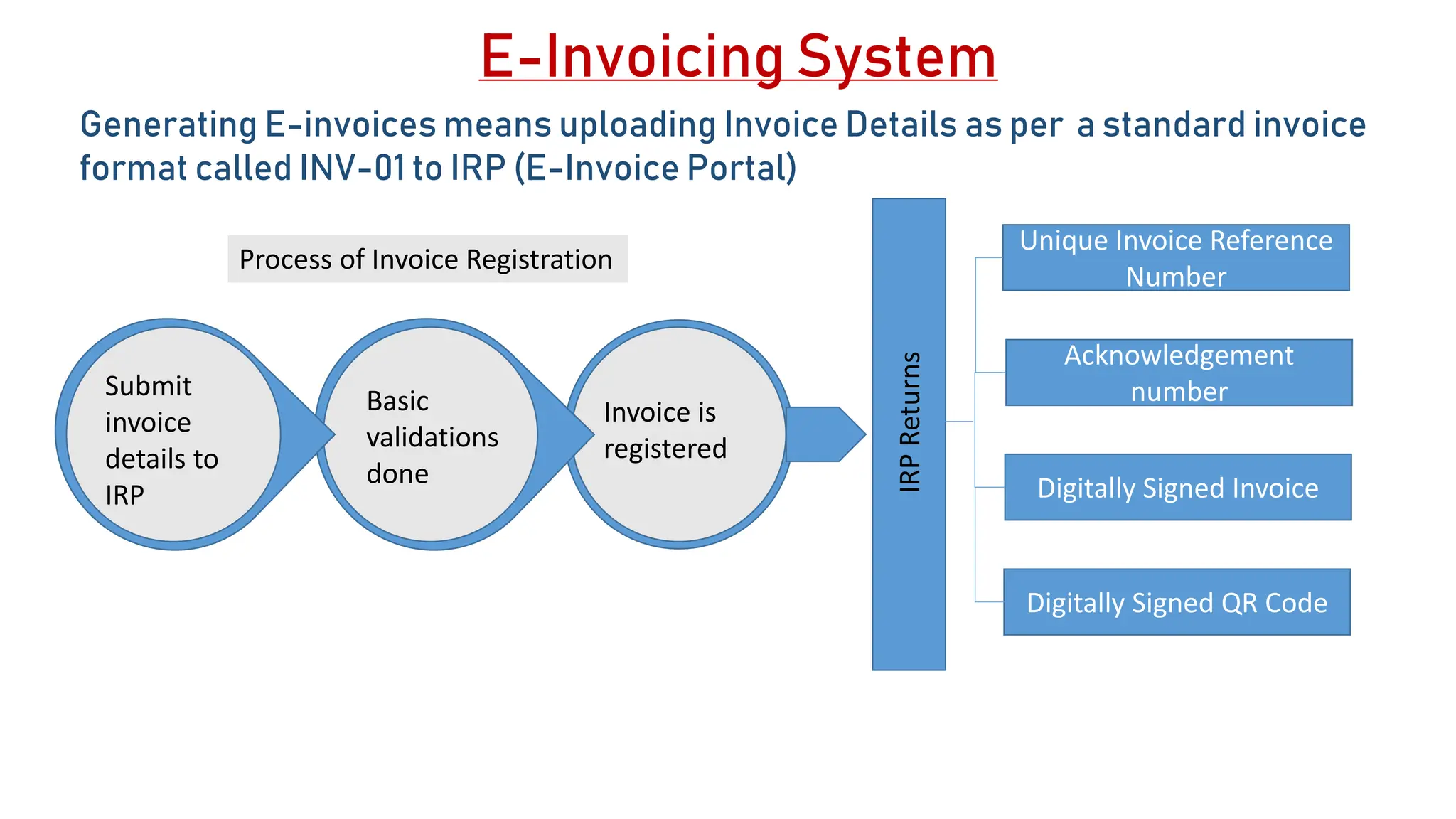
    E-Invoicing System Invoice is registered Submit invoice detailsto IRP Basic validations done IRP Returns Acknowledgement number Unique Invoice Reference Number Digitally Signed QR Code Digitally Signed Invoice Process of Invoice Registration Generating E-invoices means uploading Invoice Details as per a standard invoice format called INV-01 to IRP (E-Invoice Portal)
  • 3.
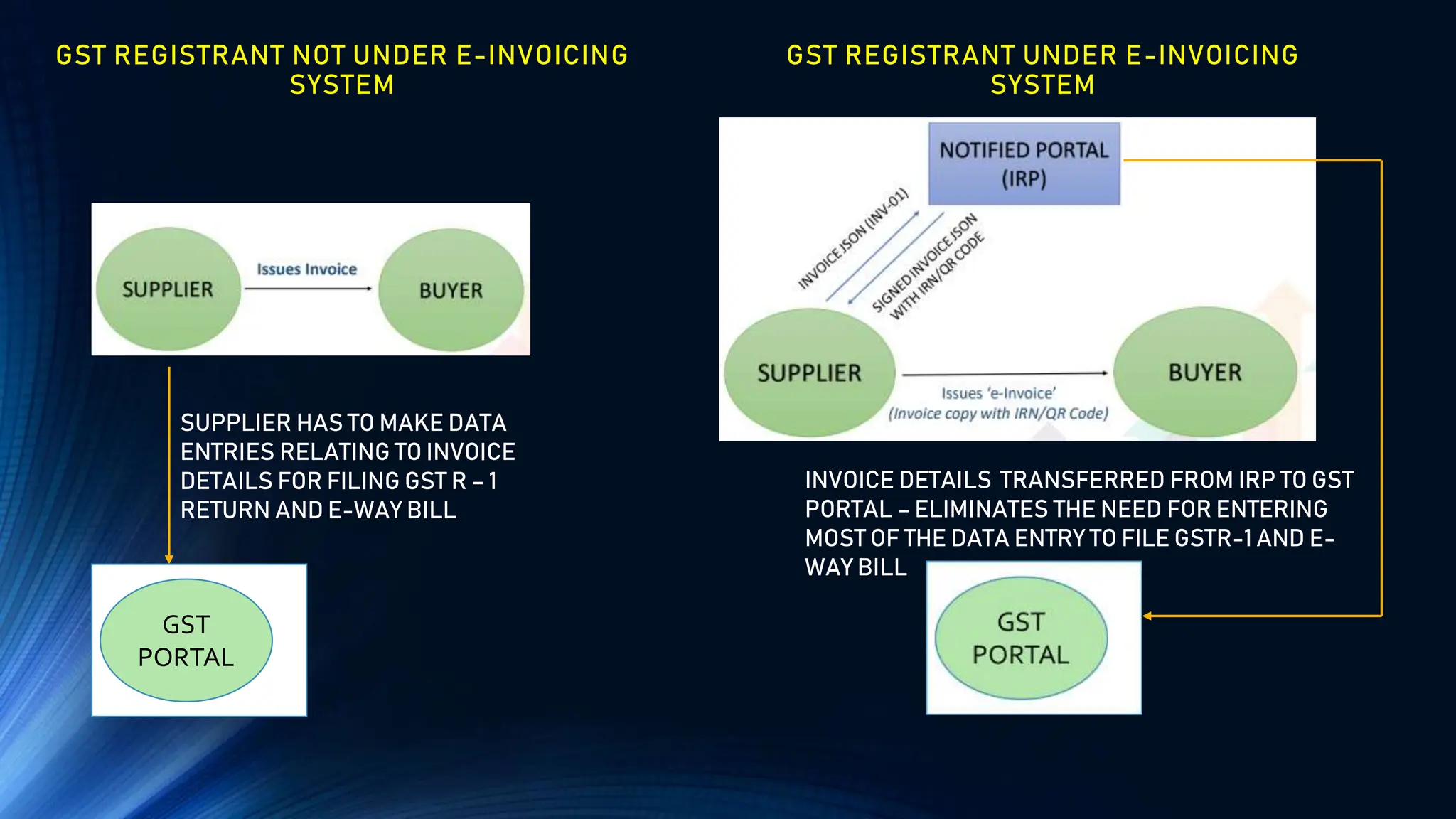
    GST REGISTRANT UNDERE-INVOICING SYSTEM GST PORTAL SUPPLIER HAS TO MAKE DATA ENTRIES RELATING TO INVOICE DETAILS FOR FILING GST R – 1 RETURN AND E-WAY BILL INVOICE DETAILS TRANSFERRED FROM IRP TO GST PORTAL – ELIMINATES THE NEED FOR ENTERING MOST OF THE DATA ENTRY TO FILE GSTR-1 AND E- WAY BILL GST REGISTRANT NOT UNDER E-INVOICING SYSTEM
  • 4.
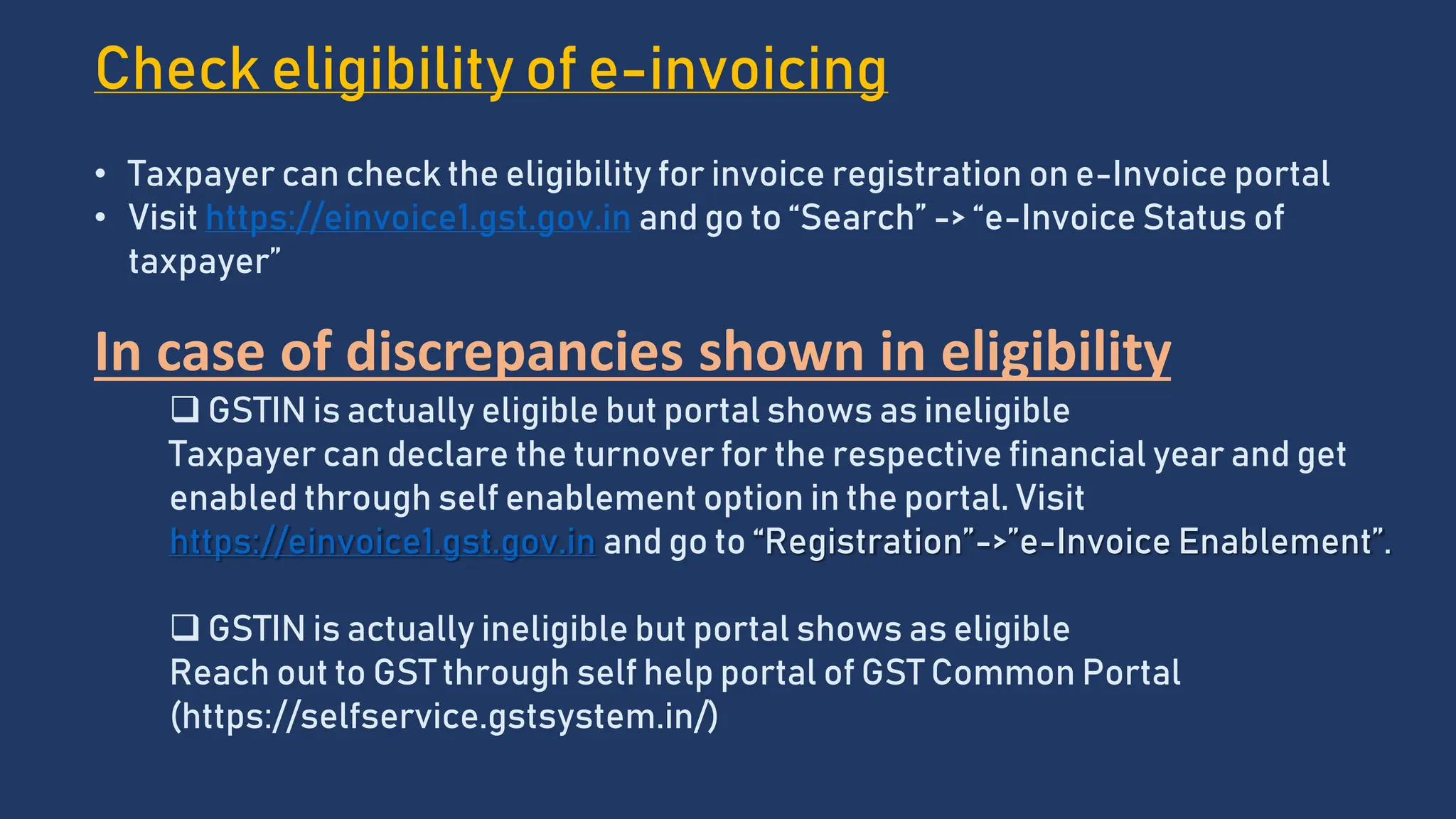
    Check eligibility ofe-invoicing • Taxpayer can check the eligibility for invoice registration on e-Invoice portal • Visit https://einvoice1.gst.gov.in and go to “Search” -> “e-Invoice Status of taxpayer” In case of discrepancies shown in eligibility  GSTIN is actually eligible but portal shows as ineligible Taxpayer can declare the turnover for the respective financial year and get enabled through self enablement option in the portal. Visit https://einvoice1.gst.gov.in and go to “Registration”->”e-Invoice Enablement”.  GSTIN is actually ineligible but portal shows as eligible Reach out to GST through self help portal of GST Common Portal (https://selfservice.gstsystem.in/)
  • 6.
    How to Registerin the E-Invoice System ? Visit https://einvoice1.gst.gov.in Go to Registration and Select E-Invoice enablement E-Invoice Enablement Checking Provide GSTIN and check System will indicate if already enabled. If not enabled, user can get it enabled if GSTIN is entitled to E-Invoicing on the basis of AATO Registration for E-Invoicing Visit https://einvoice1.gst.gov.in Go to Registration and Select Registration / Portal Login Enter GSTIN and get the profile auto populated Checkout “Send OTP” button and get OTP in Authorised Signatory’s mobile. Once OTP is verified, credentials could be created
  • 7.
  • 8.
    Methods to GenerateE-Invoice WebPortalusingDesktoporMobile,OfflineToolsandSeamless E-InvoiceGenerationusingAPI 01 02 03 04 Seamless IRN generation using Existing ERP or with the aid of GSP (Suvidha providers) API Based : ERP / GSP Offline Json creating Excel Tools for creating Multiple E-invoices – Meant for Large number of Invoices – Self Help. Bulk IRN - Offline GePP - Offline form based Excel Tool to enter the invoices one by one and generate the IRN Numbers – Self Help Offline Tool : GePP GePP-On - e-Invoice Preparation Web Portal meant for Few Invoices – Self Help Web Portal : GePP-On Which Method is suitable for me ? Once registered in IRP, Taxpayers can use any of these methods to chosen by them based on factors such as number of invoices to be raised, existing Accounting Software / ERP used , In-house IT Skill / Infrastructure etc.
  • 9.
    GePP-On (online E-InvoicePreparation) URL: https://gepp.einvoice1.gst.gov.in
  • 10.
    Steps for generatinge-Invoice using Gepp-On Goto https://gepp.einvoice1.gst.gov.in Enter username and password Enter the OTP received. Set the profile settings Create recipient master Create product master Generate e-Invoice
  • 11.
  • 12.
  • 13.
  • 14.
  • 15.
  • 16.
  • 17.
  • 18.
  • 19.
    Gepp-On: Creating Invoice– Document Details
  • 20.
    Gepp-On: Creating Invoice– Recipient Details
  • 21.
    Gepp-On: Creating Invoice– Item Details
  • 22.
    Gepp-On: Creating Invoice– Total values
  • 23.
    Gepp-On: Creating Invoice– Eway Bill Details
  • 24.
  • 25.
    Gepp-On: Creating Invoice– IRN generated
  • 26.
  • 27.
  • 28.
  • 29.
    Offline GePP Tool– Useful in the case of Fewer Invoices
  • 30.
    Offline GePP Tool– Useful in the case of Fewer Invoices
  • 42.
    Bulk Uploading E-invoicesusing Offline Tool What is Bulk Uploading in E-invoicing? Bulk generation is a facility that is available on the IRP where invoices in bulk can be uploaded at once. It is an offline tool using which a taxpayer can bulk upload the JSON format of e-invoices. The Objective of Bulk Uploading E-invoices using Offline Tool The objective of this offline tool is to simplify the bulk uploading process for taxpayers. All the formats of bulk offline tools provided by NIC are MS-Excel based applications which could be used by taxpayers who intend to not opt for API based E-Invoice Generation through GSP Benefits of Bulk Uploading E-invoices using Offline Tool 1.Reduces time to generate multiple Invoice Reference Number (IRN) in one go. 2.Avoids duplicity when multiple invoices are to be prepared.
  • 43.
    Types of BulkGeneration E-Invoice Formats Available Parameters Format A Format B Format C Format D Nature Summarized Summarized Detailed Detailed No. of Worksheets 1 2 5 1 Details Included in the Worksheet E-invoice details in a single sheet E-invoice details in two sheets 1. E-invoice details 2. Item details 3. Payment Details 4. Invoice reference details 5. E-invoice additional sheet All the details in Format C clubbed into a single sheet Type of Transactions B2B, SEZ, Exports and Deemed Exports B2B, SEZ, Exports and Deemed Exports B2B, SEZ, Exports and Deemed Exports B2B, SEZ, Exports and Deemed Exports
  • 44.
    Steps of BulkUploading E-invoices using Offline Tool Step 1: Open the e-invoicing Portal i.e., https://einvoice1.gst.gov.in/.
  • 45.
    Step 2: Todownload the bulk e-invoice generation tool you need to click on the Help button available on the menu bar and select the tools option.
  • 46.
    Step 3: Onclicking the bulk generation tool option, the user will be redirected to a new page. On the redirected page four formats of E-Invoice Bulk Generation tool will be available:
  • 47.
    Step 4: Postdownloading the applicable offline utility, enter all the basic details mentioned in the profile sheet.
  • 48.
    Step 5: Thenenter all the invoice details in the e-invoice sheet
  • 49.
    Step 6: Onceall the e-invoices details are validated, click on the prepare JSON button to create a single JSON file for multiple e-invoices details. Step 7: Log in to the e-invoice portal using the valid credentials and then go to: e-invoice > Bulk upload and click on the browse button.
  • 50.
    Step 8: Afterchoosing the JSON file, click on the upload button. Note: Ensure that the size of the JSON file is not more than 2MB.
  • 51.
    Step 9: Clickon the confirm button to generate multiple E-invoices with unique IRN (Invoice Reference Number) Step 10: Generated E-Invoices can be downloaded by clicking download excel button.
  • 52.
    Direct API Integrationand API Integration through GSP  APIs function as a communication channel between the following two entities: Taxpayers & IRP  APIs work as a bridge between taxpayers and the e-Invoicingsystem to facilitate data exchange between the taxpayers and the IRP portal.  For other taxpayers e-InvoicingAPI has to be obtainedfrom a government-appointed GST Suvidha Provider  The GST Network (GSTN) allows eligible taxpayers (businesses with an annual turnoverof more than Rs 100 crores) to use APIs to integrate with the Invoice RegistrationPortal (IRP) directly. API Stands for Application Programming Interface
  • 53.
    WHAT IS MEANTBY API ? HOW DOES IT WORK ?
  • 54.
    API REGISTRATION BYTAXPAYERS Taxpayers who intend to generate e-invoices by integratingwith API (through GSP or directly) are requiredto register for the same in the E-Invoice Portal Step 1: Login to E-Invoice Portal (einvoice1.gst.gov.in) and enter your Username and Password
  • 55.
    Step 2 :Click on API Registration User Credentials  Create API User API REGISTRATION BY TAXPAYERS
  • 56.
    Step 3 :Select one of the methods for API Registration: Direct / Through GSP / Through ERP API REGISTRATION BY TAXPAYERS • By selecting the desired GSP / ERP the taxpayer can set API user credentials. The list of registered GSP / ERP can be found in the dropdown list. • The auth token received by the taxpayer in mobile as a message has to be shared with the GSP for integrationof Taxpayer’s Invoice generatingsystem with IRP through GSP using API
  • 57.
    Mobile App forverification of QR Code content • App is available in the e-Invoice Portal under HelpToolsVerify QR Code App • Available for both Android and IOS • Can be downloadedby anyone for verifyingthe e-Invoice
  • 58.