UNIT III -NON
METALLIC MATERIALS
POLYMERS (Plastics, Rubbers and Adhesives)
CERAMICS AND COMPOSITES
INTRODUCTION - polymers
• Polymers are widely used in number of
applications ---- including
• toys,
• home appliances,
• structural and decorative items,
• coatings, paints, adhesives,
• automobile tyres
• Foams and packings
Meaning
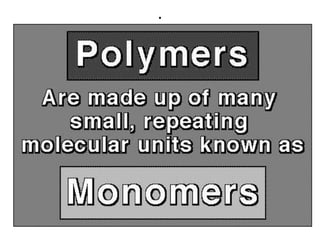
• POLYMER
• POLY – MULTI
• MER – PARTS or UNITS
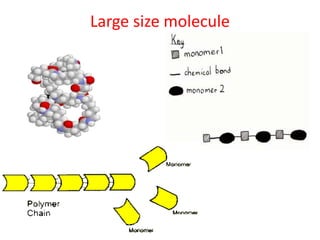
• Its contain large number of repeating units of
small molecules called Monomers
Large size molecule
.
.
POLYMERISATION
• Its reaction of joining of small molecules to
form molecule having higher weight called
polymer.
• Types of Polymers:
– Natural polymers
– Other Natural polymers
Terminology used in polymers
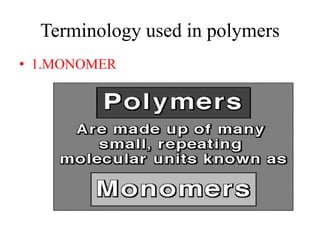
• 1.MONOMER
TERMINOLOGY
• 2. POLYMER
• It is a macro molecule formed by repeated
linking of many monomers
• 3. POLYMERIZATION
It’s a process of forming a polymer
TERMINOLOGY
• 4. HOMOPOLYMER
Homopolymers - consist of chains with identical
bonding linkages to each monomer unit. This
usually implies that the polymer is made from all
identical monomer molecules.
These may be represented as : -[A-A-A-A-A-A]-
TERMINOLOGY
• 5. COPOLYMER
Copolymers - consist of chains with two or
more linkages usually implying two or more
different types of monomer units.
These may be represented as : -[A-B-A-B-
A-B]-
TERMINOLOGY
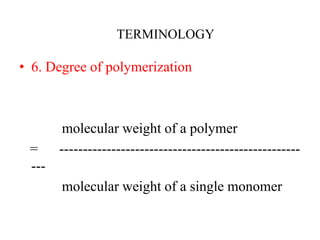
• 6. Degree of polymerization
molecular weight of a polymer
= ---------------------------------------------------
---
molecular weight of a single monomer
TERMINOLOGY
• 7. HIGH POLYMER
Solid polymer which have very high
molecular weights ( 10000 to 1000000
g/mol)
TERMINOLOGY
• 8. OLIGO POLYMER
They are liquid / gas polymers with very
short chains ( having the molecular weight on
the order of 100 g/mol)
TERMINOLOGY
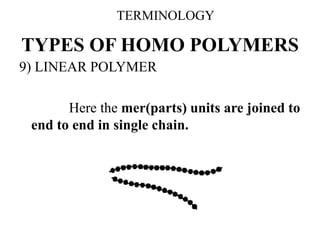
TYPES OF HOMO POLYMERS
9) LINEAR POLYMER
Here the mer(parts) units are joined to
end to end in single chain.
TERMINOLOGY
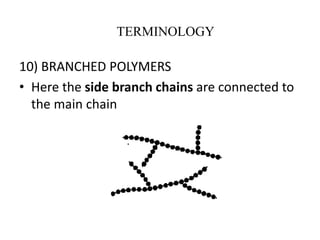
10) BRANCHED POLYMERS
• Here the side branch chains are connected to
the main chain
TERMINOLOGY
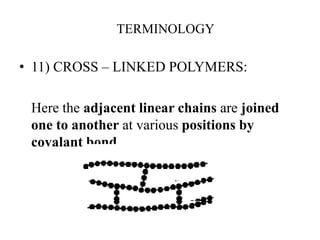
• 11) CROSS – LINKED POLYMERS:
Here the adjacent linear chains are joined
one to another at various positions by
covalant bond
TERMINOLOGY
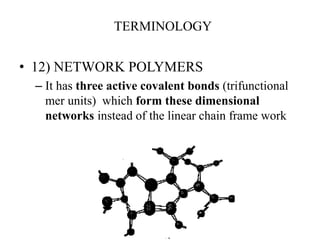
• 12) NETWORK POLYMERS
– It has three active covalent bonds (trifunctional
mer units) which form these dimensional
networks instead of the linear chain frame work
TERMINOLOGY
Types of copolymers
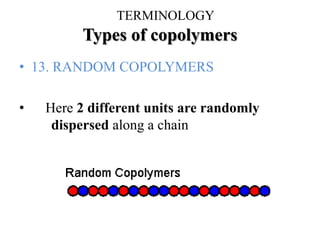
• 13. RANDOM COPOLYMERS
• Here 2 different units are randomly
dispersed along a chain
TERMINOLOGY
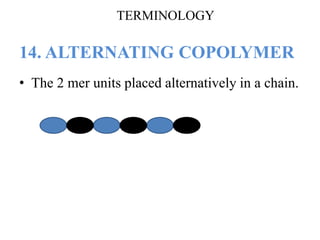
14. ALTERNATING COPOLYMER
• The 2 mer units placed alternatively in a chain.
TERMINOLOGY
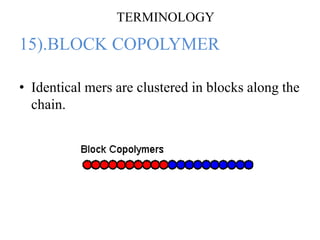
15).BLOCK COPOLYMER
• Identical mers are clustered in blocks along the
chain.
TERMINOLOGY
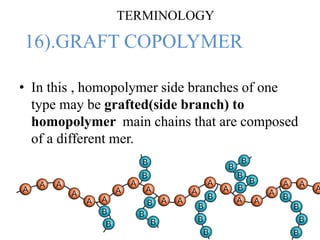
16).GRAFT COPOLYMER
• In this , homopolymer side branches of one
type may be grafted(side branch) to
homopolymer main chains that are composed
of a different mer.
TERMINOLOGY
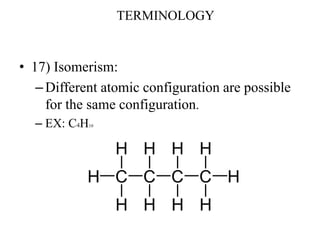
• 17) Isomerism:
–Different atomic configuration are possible
for the same configuration.
– EX: C4H10
TERMINOLOGY
POLYMERIZATION
• Polymerization may be defined as the process of growing
large molecules from small ones. Polymerization links
together monomers.
• Monomers are molecules which combined end to end to
form large molecules known as polymer. They are three
general methods (or) mechanism of polymerization.
• Addition of polymerization
• Condensation of polymerization
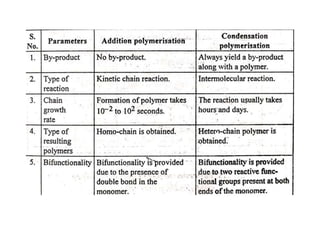
ADDITION POLYMERISATION
• Definition: It is known as chain reaction
polymerisation.
–Two or more chemically similar monomers are
polymerized to form a long chain molecules.
–Double covalent bonds are broken in to single
bonds.
• Three Stages Of Addition Polymerisation:
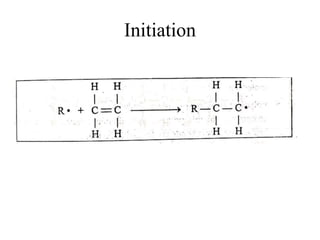
–Initiation
–Propagation
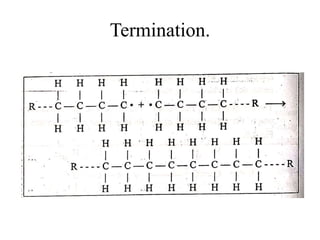
–Termination.
Initiation
Propagation
Termination.
CONDENSATION POLYMERISATION
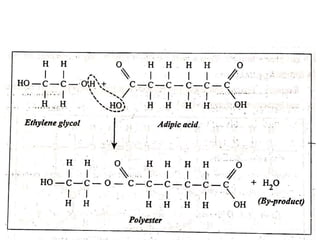
• It is otherwise called as STEP-GROWTH
POLYMERISATION
• It involve at least TWO DIFFERENT
MONOMERS.
• It gives some by product.
EM-UNIT III - non metallic materials  --- polymers

EM-UNIT III - non metallic materials --- polymers

  • 1.
    UNIT III -NON METALLICMATERIALS POLYMERS (Plastics, Rubbers and Adhesives) CERAMICS AND COMPOSITES
  • 2.
    INTRODUCTION - polymers •Polymers are widely used in number of applications ---- including • toys, • home appliances, • structural and decorative items, • coatings, paints, adhesives, • automobile tyres • Foams and packings
  • 3.
    Meaning • POLYMER • POLY– MULTI • MER – PARTS or UNITS • Its contain large number of repeating units of small molecules called Monomers
  • 4.
  • 5.
  • 6.
  • 7.
    POLYMERISATION • Its reactionof joining of small molecules to form molecule having higher weight called polymer. • Types of Polymers: – Natural polymers – Other Natural polymers
  • 8.
    Terminology used inpolymers • 1.MONOMER
  • 9.
    TERMINOLOGY • 2. POLYMER •It is a macro molecule formed by repeated linking of many monomers
  • 10.
    • 3. POLYMERIZATION It’sa process of forming a polymer TERMINOLOGY
  • 11.
    • 4. HOMOPOLYMER Homopolymers- consist of chains with identical bonding linkages to each monomer unit. This usually implies that the polymer is made from all identical monomer molecules. These may be represented as : -[A-A-A-A-A-A]- TERMINOLOGY
  • 12.
    • 5. COPOLYMER Copolymers- consist of chains with two or more linkages usually implying two or more different types of monomer units. These may be represented as : -[A-B-A-B- A-B]- TERMINOLOGY
  • 13.
    • 6. Degreeof polymerization molecular weight of a polymer = --------------------------------------------------- --- molecular weight of a single monomer TERMINOLOGY
  • 14.
    • 7. HIGHPOLYMER Solid polymer which have very high molecular weights ( 10000 to 1000000 g/mol) TERMINOLOGY
  • 15.
    • 8. OLIGOPOLYMER They are liquid / gas polymers with very short chains ( having the molecular weight on the order of 100 g/mol) TERMINOLOGY
  • 16.
    TYPES OF HOMOPOLYMERS 9) LINEAR POLYMER Here the mer(parts) units are joined to end to end in single chain. TERMINOLOGY
  • 17.
    10) BRANCHED POLYMERS •Here the side branch chains are connected to the main chain TERMINOLOGY
  • 18.
    • 11) CROSS– LINKED POLYMERS: Here the adjacent linear chains are joined one to another at various positions by covalant bond TERMINOLOGY
  • 19.
    • 12) NETWORKPOLYMERS – It has three active covalent bonds (trifunctional mer units) which form these dimensional networks instead of the linear chain frame work TERMINOLOGY
  • 20.
    Types of copolymers •13. RANDOM COPOLYMERS • Here 2 different units are randomly dispersed along a chain TERMINOLOGY
  • 21.
    14. ALTERNATING COPOLYMER •The 2 mer units placed alternatively in a chain. TERMINOLOGY
  • 22.
    15).BLOCK COPOLYMER • Identicalmers are clustered in blocks along the chain. TERMINOLOGY
  • 23.
    16).GRAFT COPOLYMER • Inthis , homopolymer side branches of one type may be grafted(side branch) to homopolymer main chains that are composed of a different mer. TERMINOLOGY
  • 24.
    • 17) Isomerism: –Differentatomic configuration are possible for the same configuration. – EX: C4H10 TERMINOLOGY
  • 25.
    POLYMERIZATION • Polymerization maybe defined as the process of growing large molecules from small ones. Polymerization links together monomers. • Monomers are molecules which combined end to end to form large molecules known as polymer. They are three general methods (or) mechanism of polymerization. • Addition of polymerization • Condensation of polymerization
  • 26.
    ADDITION POLYMERISATION • Definition:It is known as chain reaction polymerisation. –Two or more chemically similar monomers are polymerized to form a long chain molecules. –Double covalent bonds are broken in to single bonds. • Three Stages Of Addition Polymerisation: –Initiation –Propagation –Termination.
  • 27.
  • 28.
  • 29.
  • 30.
    CONDENSATION POLYMERISATION • Itis otherwise called as STEP-GROWTH POLYMERISATION • It involve at least TWO DIFFERENT MONOMERS. • It gives some by product.