Reasons Why Health Data is Poorly 
Integrated Today and What We Can 
Do About It 
3rd Annual OSEHRA Summit 
Shahid N. Shah 
Chairman of OSEHRA Advisory Board
This and many of my other presentations are available at 
www.SpeakerDeck.com/shah 
@ShahidNShah 
shahid@shah.org 
www.ShahidShah.com 
www.netspective.com 2
NETSPECTIVE 
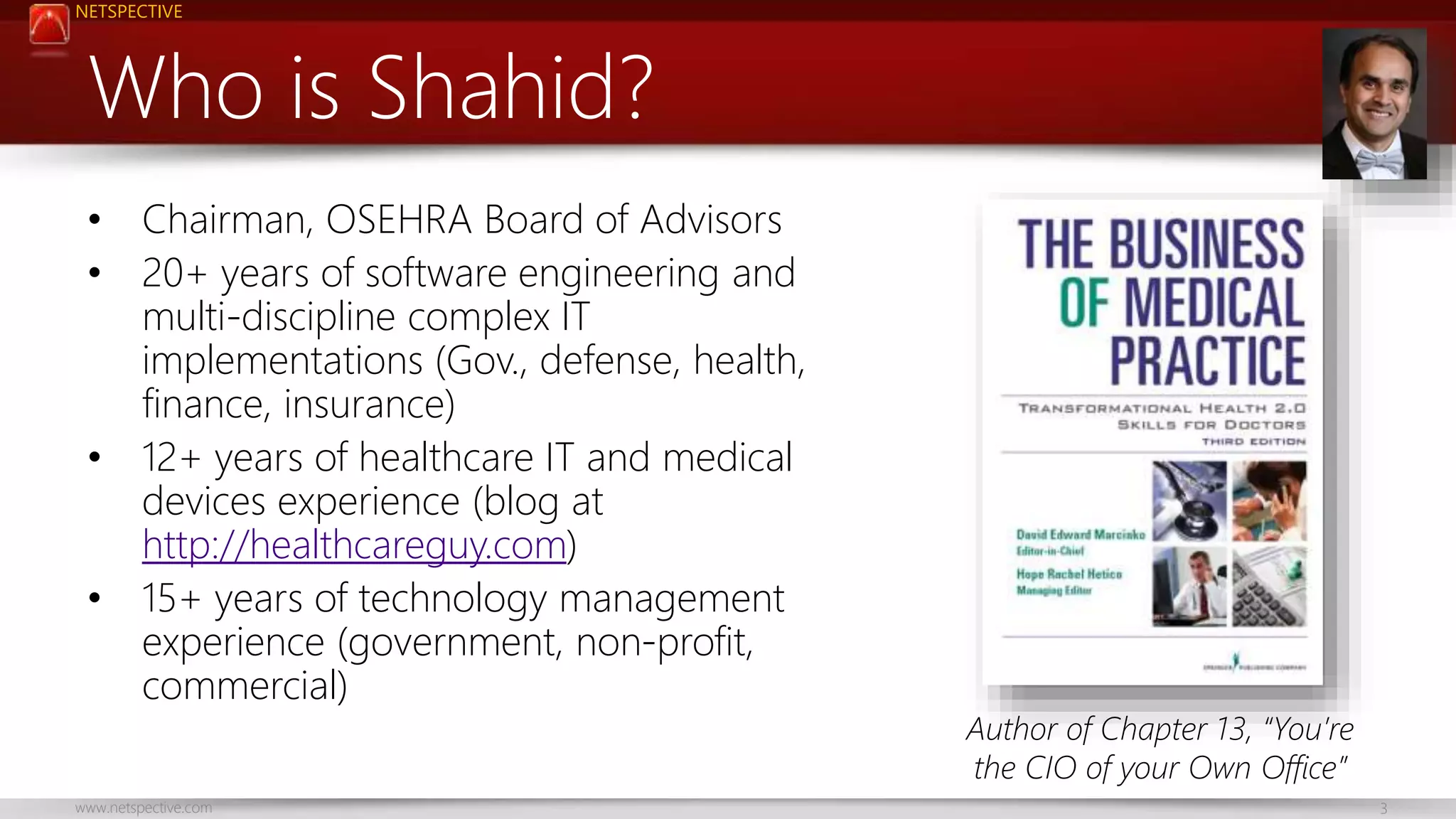
Who is Shahid? 
• Chairman, OSEHRA Board of Advisors 
• 20+ years of software engineering and 
multi-discipline complex IT 
implementations (Gov., defense, health, 
finance, insurance) 
• 12+ years of healthcare IT and medical 
devices experience (blog at 
http://healthcareguy.com) 
• 15+ years of technology management 
experience (government, non-profit, 
commercial) 
Author of Chapter 13, “You’re 
the CIO of your Own Office” 
www.netspective.com 3
NETSPECTIVE 
What’s this talk about? 
Background 
• Many enterprise apps are being built 
these days, most are designed to 
work as a stand alone system similar 
to consumer apps 
• Healthcare-specific software 
engineering and integration tools 
are going to do more harm than 
good (industry-neutral is better). 
Key takeaways 
• Any enterprise app which acts like 
a consumer app that doesn’t 
integrate well into hospital or 
ambulatory systems and workflows 
is doomed 
• There’s nothing unique about health 
IT data that justifies complex, 
expensive, or special technology. 
• There’s a lot unique about 
healthcare workflows that require 
common technologies to be 
adapted properly. 
www.netspective.com 4
NETSPECTIVE 
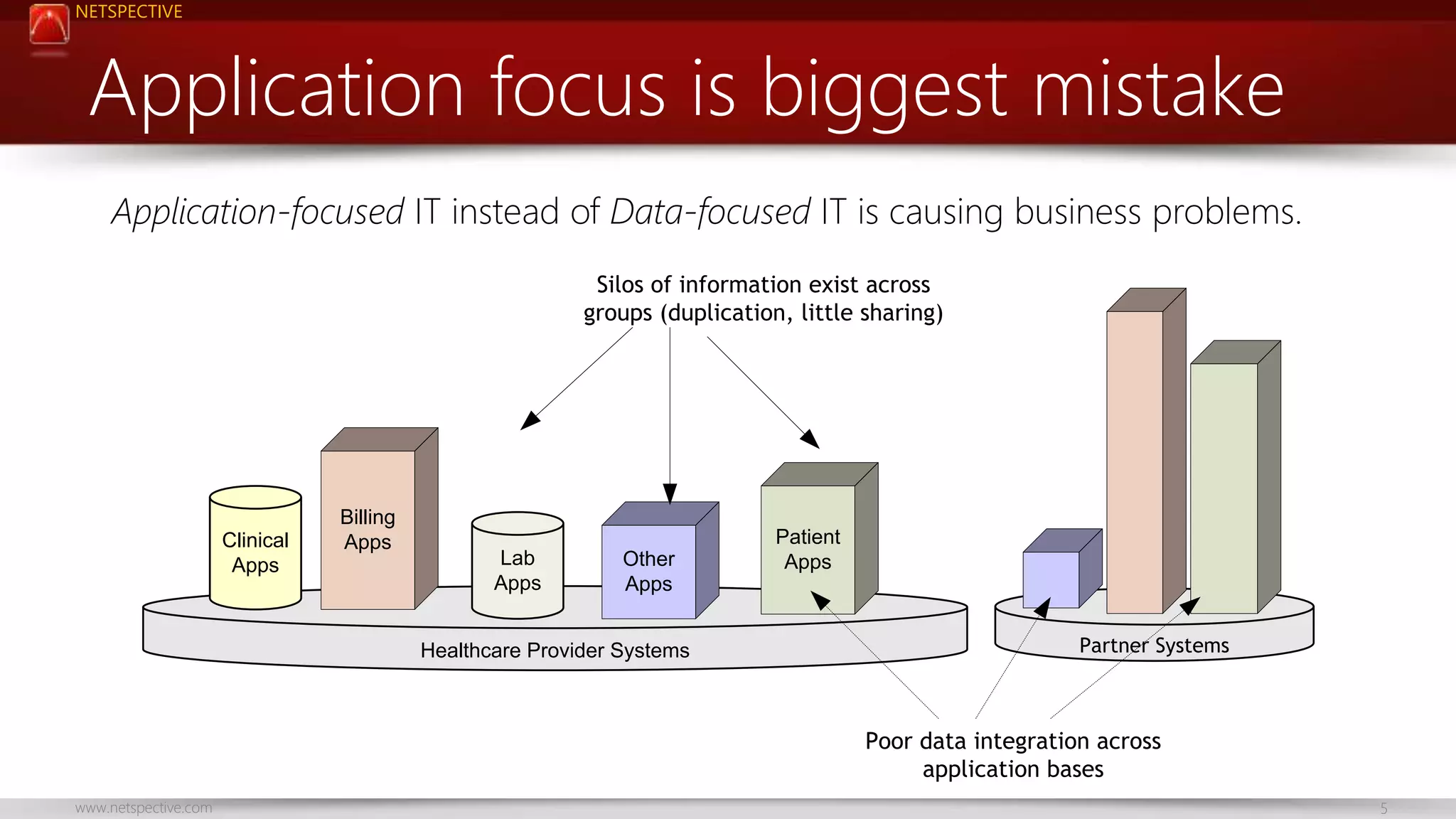
Application focus is biggest mistake 
Application-focused IT instead of Data-focused IT is causing business problems. 
Lab 
Apps 
Silos of information exist across 
groups (duplication, little sharing) 
Other 
Apps 
Healthcare Provider Systems 
Clinical 
Apps 
Patient 
Apps 
Billing 
Apps 
Partner Systems 
Poor data integration across 
application bases 
www.netspective.com 5
NETSPECTIVE 
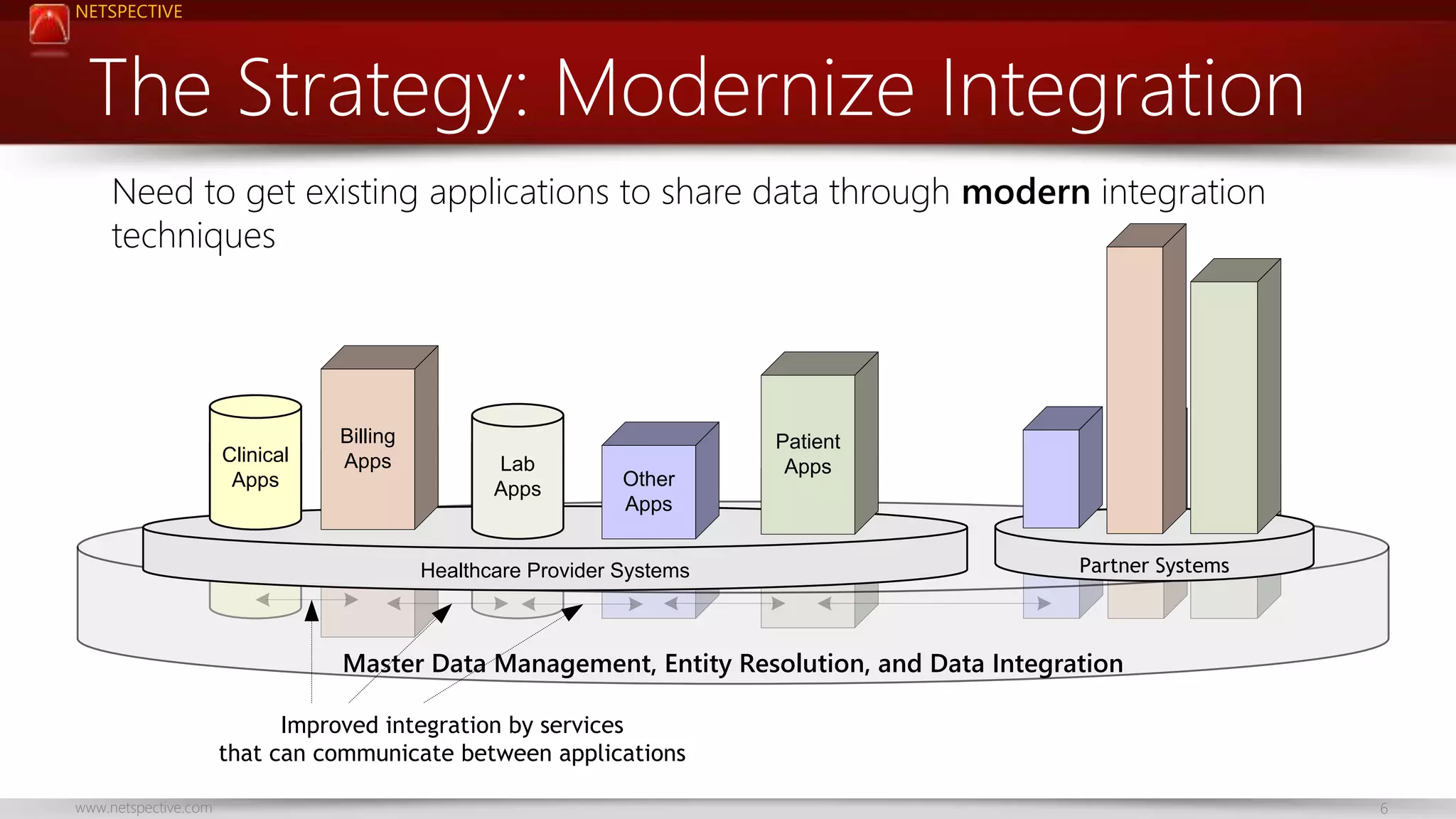
The Strategy: Modernize Integration 
Need to get existing applications to share data through modern integration 
techniques 
Clinical 
Apps 
NCI 
App 
Patient 
Apps 
Billing 
Apps Lab 
Apps 
Other 
Apps 
NEI 
App NHLBI 
App 
Healthcare Provider Systems 
Partner Systems 
Master Data Management, Entity Resolution, and Data Integration 
Improved integration by services 
that can communicate between applications 
www.netspective.com 6
Why do health IT systems 
integrate poorly? 
www.netspective.com 7
Because customers don’t know how 
to effectively punish vendors that 
don’t integrate well. 
But, that’s changing. Slowly. 
www.netspective.com 8
Because apps developers don’t have 
a systems engineering culture where 
we think of data integration as a 
discipline our customers will buy. 
But, that’s changing. Slowly. 
www.netspective.com 9
Because we want to wait for others 
to create a new standard or magical 
API that makes integration 
problems disappear. 
But, that’s changing. Slowly. 
www.netspective.com 10
NETSPECTIVE 
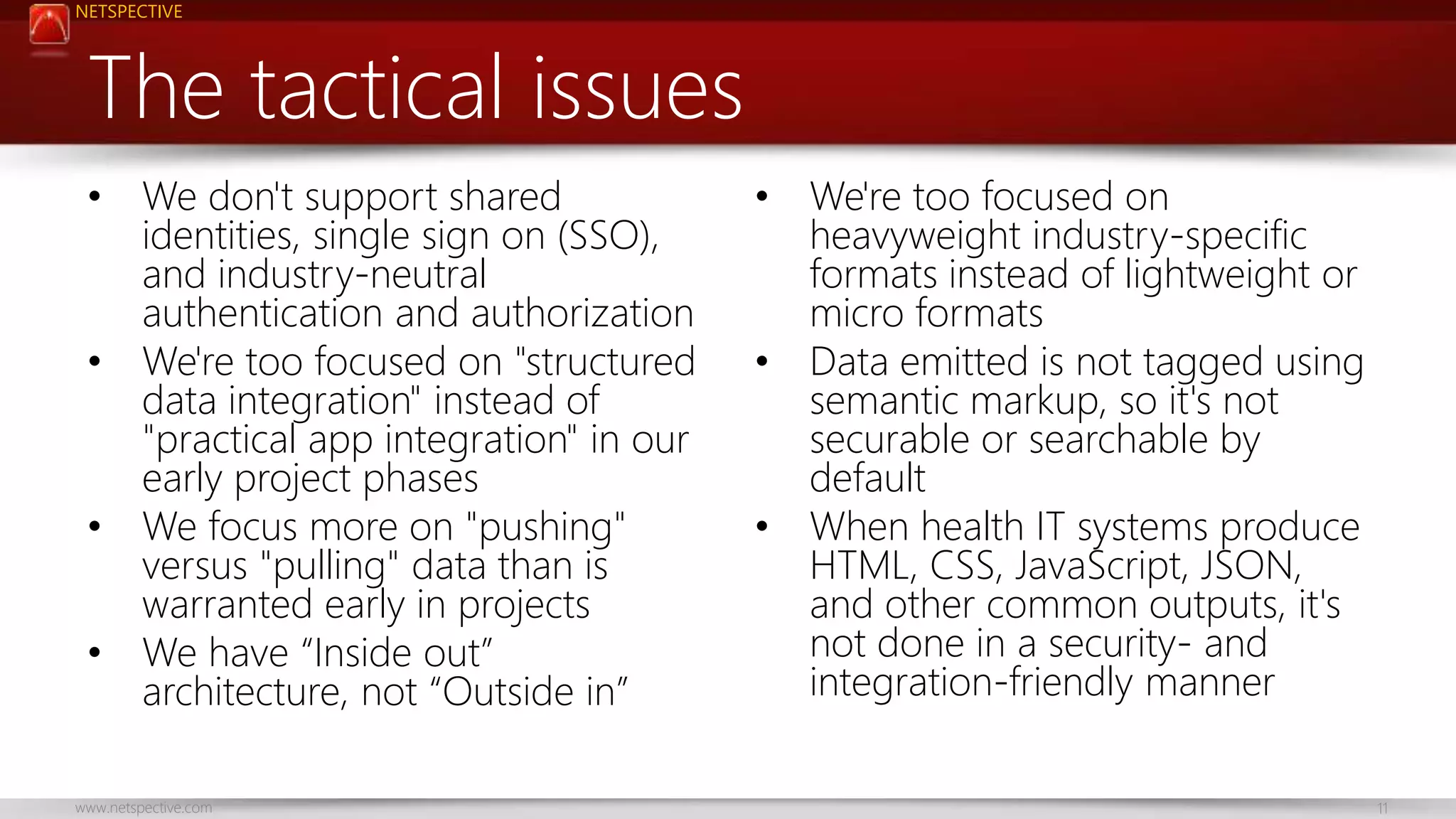
The tactical issues 
• We don't support shared 
identities, single sign on (SSO), 
and industry-neutral 
authentication and authorization 
• We're too focused on "structured 
data integration" instead of 
"practical app integration" in our 
early project phases 
• We focus more on "pushing" 
versus "pulling" data than is 
warranted early in projects 
• We have “Inside out” 
architecture, not “Outside in” 
• We're too focused on 
heavyweight industry-specific 
formats instead of lightweight or 
micro formats 
• Data emitted is not tagged using 
semantic markup, so it's not 
securable or searchable by 
default 
• When health IT systems produce 
HTML, CSS, JavaScript, JSON, 
and other common outputs, it's 
not done in a security- and 
integration-friendly manner 
www.netspective.com 11
And now… 
So what do we do?
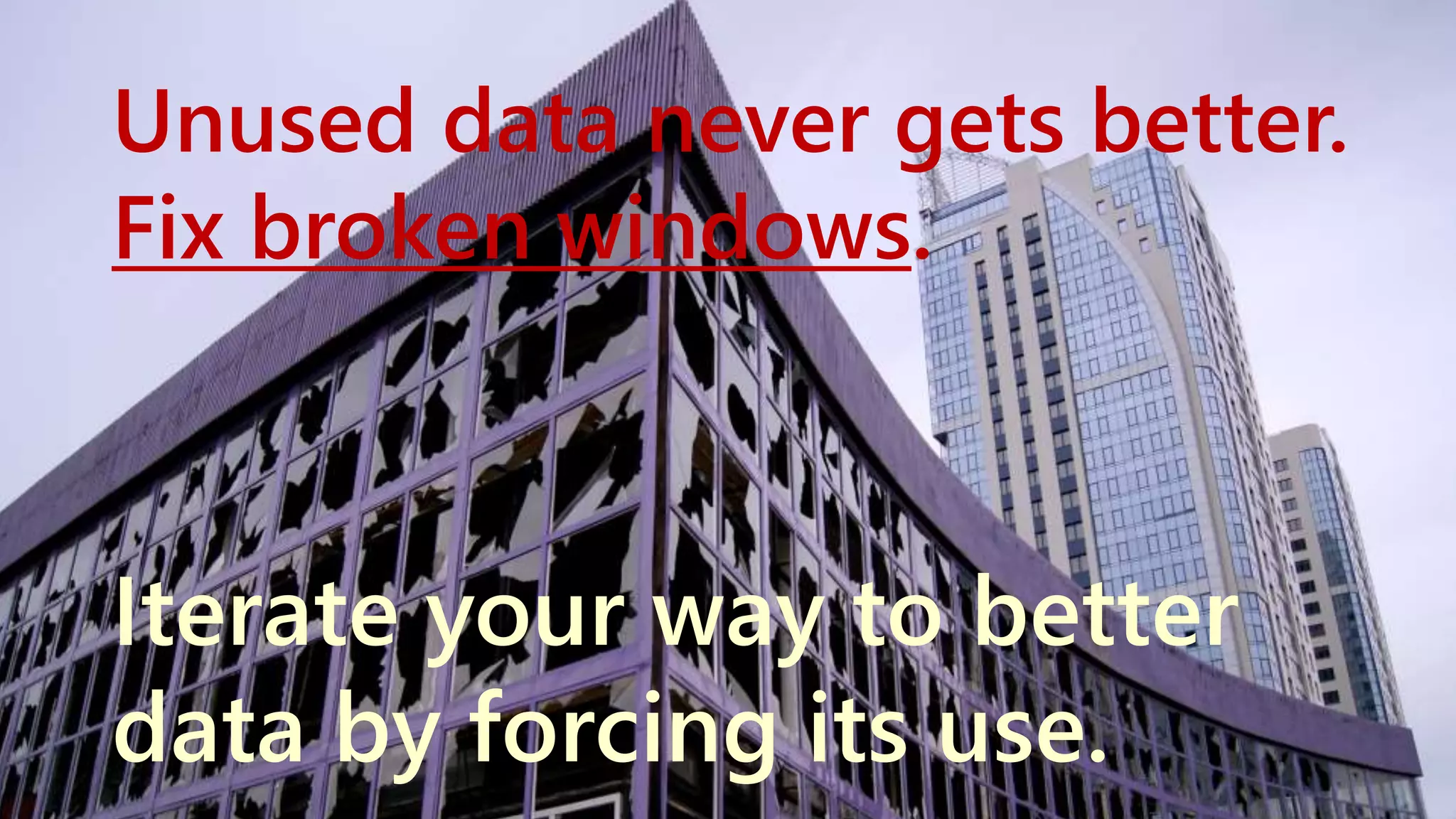
Unused data never gets better. 
Fix broken windows. 
Iterate your way to better 
data by forcing its use. 
www.netspective.com 13
NETSPECTIVE 
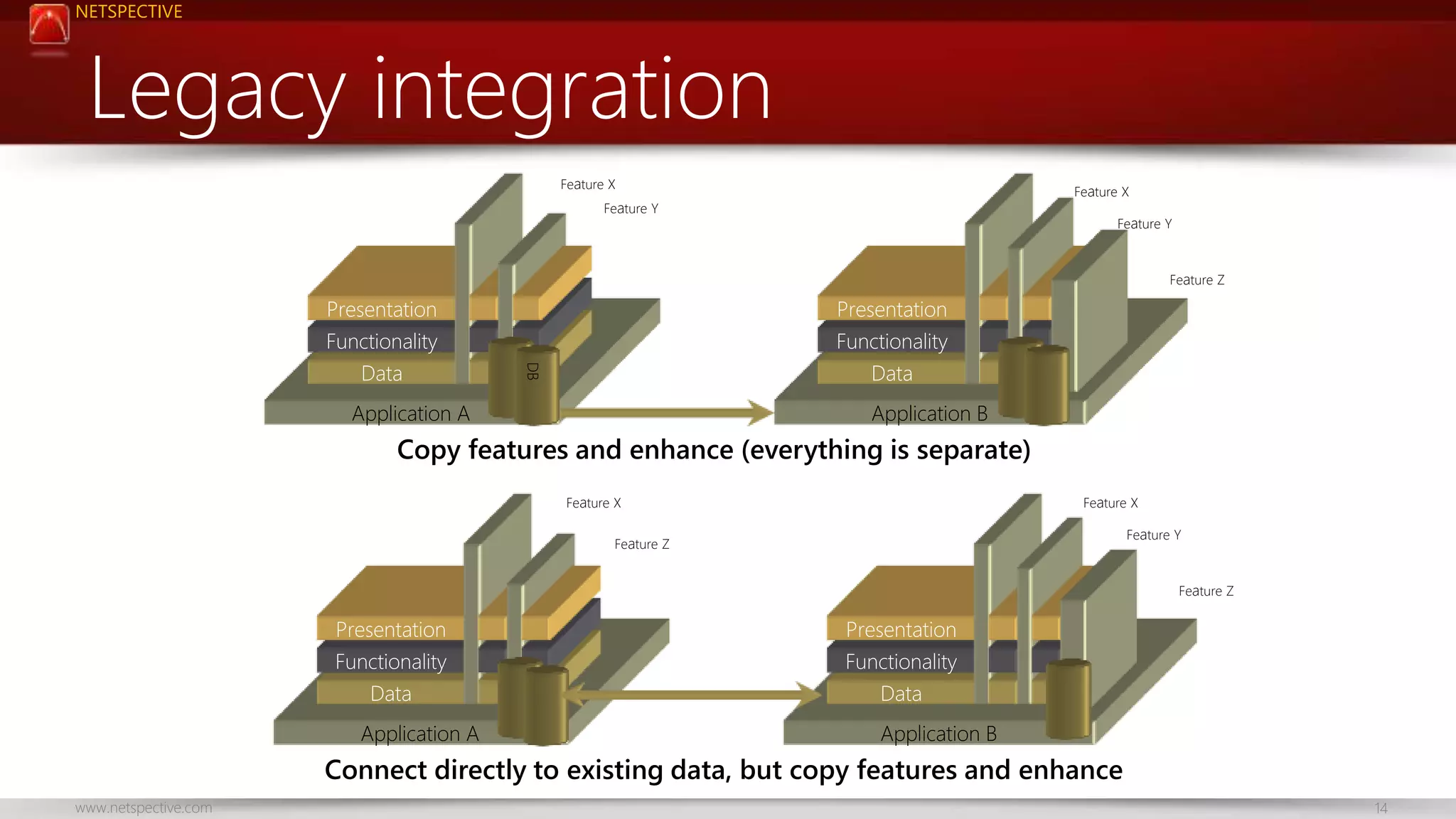
Legacy integration 
Presentation 
Functionality 
Data 
Application A 
Feature X 
Feature Y 
Presentation 
Functionality 
Data 
Application B 
Feature X 
Feature Y 
Feature Z 
Copy features and enhance (everything is separate) 
Presentation 
Functionality 
Data 
Application A 
Feature X 
Feature Z 
Presentation 
Functionality 
Data 
Application B 
Feature X 
Feature Y 
Feature Z 
Connect directly to existing data, but copy features and enhance 
www.netspective.com 14
NETSPECTIVE 
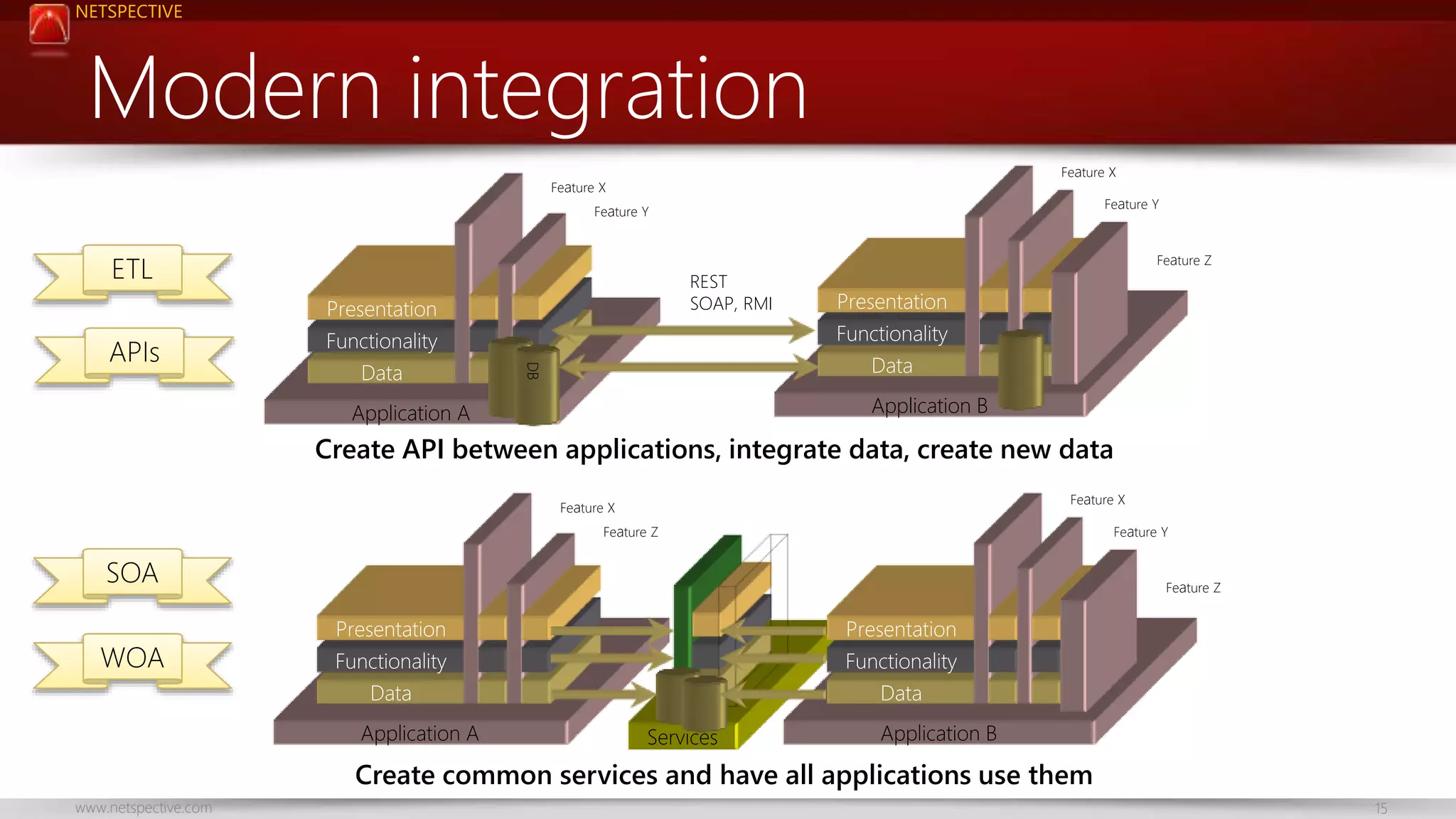
Modern integration 
Feature X 
Feature Y 
REST 
SOAP, RMI 
Create API between applications, integrate data, create new data 
Feature X 
Feature Z 
Services 
Presentation 
Functionality 
Data 
Application A 
Presentation 
Functionality 
Data 
Application B 
Feature X 
Feature Y 
Feature Z 
Presentation 
Functionality 
Data 
Application A 
Presentation 
Functionality 
Data 
Application B 
Feature X 
Feature Y 
Feature Z 
Create common services and have all applications use them 
ETL 
APIs 
SOA 
WOA 
www.netspective.com 15
Create a formal Enterprise 
Integration Group (EIG) 
Even get a cool logo and team mascot. 
www.netspective.com 16
Start cataloging and 
formalizing use of enterprise 
integration patterns. 
You’re not the first (or second) to see these problems. 
www.netspective.com 17
Learn about ESB, ETL, and BPM – 
grab open source or commercial 
implementations and build around 
them. 
Don’t hand code things. 
www.netspective.com 18
Create a technical profile 
questionnaire and 
checklist 
Don’t hand code things. 
www.netspective.com 19
Lets see what all of this 
looks like in practice. 
You can do this in less than 40 man-hours of work. 
www.netspective.com 20
NETSPECTIVE 
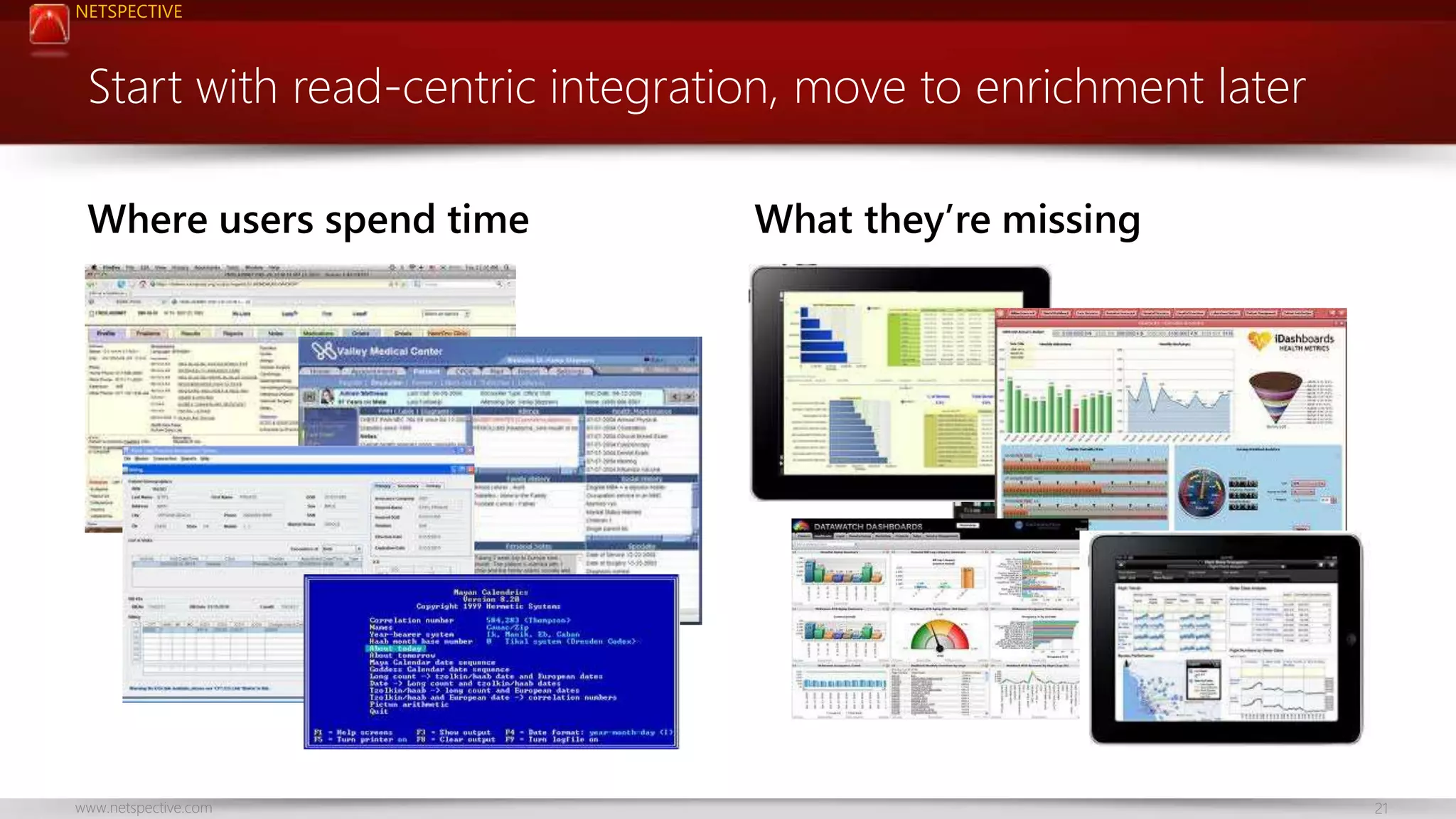
Start with read-centric integration, move to enrichment later 
Where users spend time What they’re missing 
www.netspective.com 21
NETSPECTIVE 
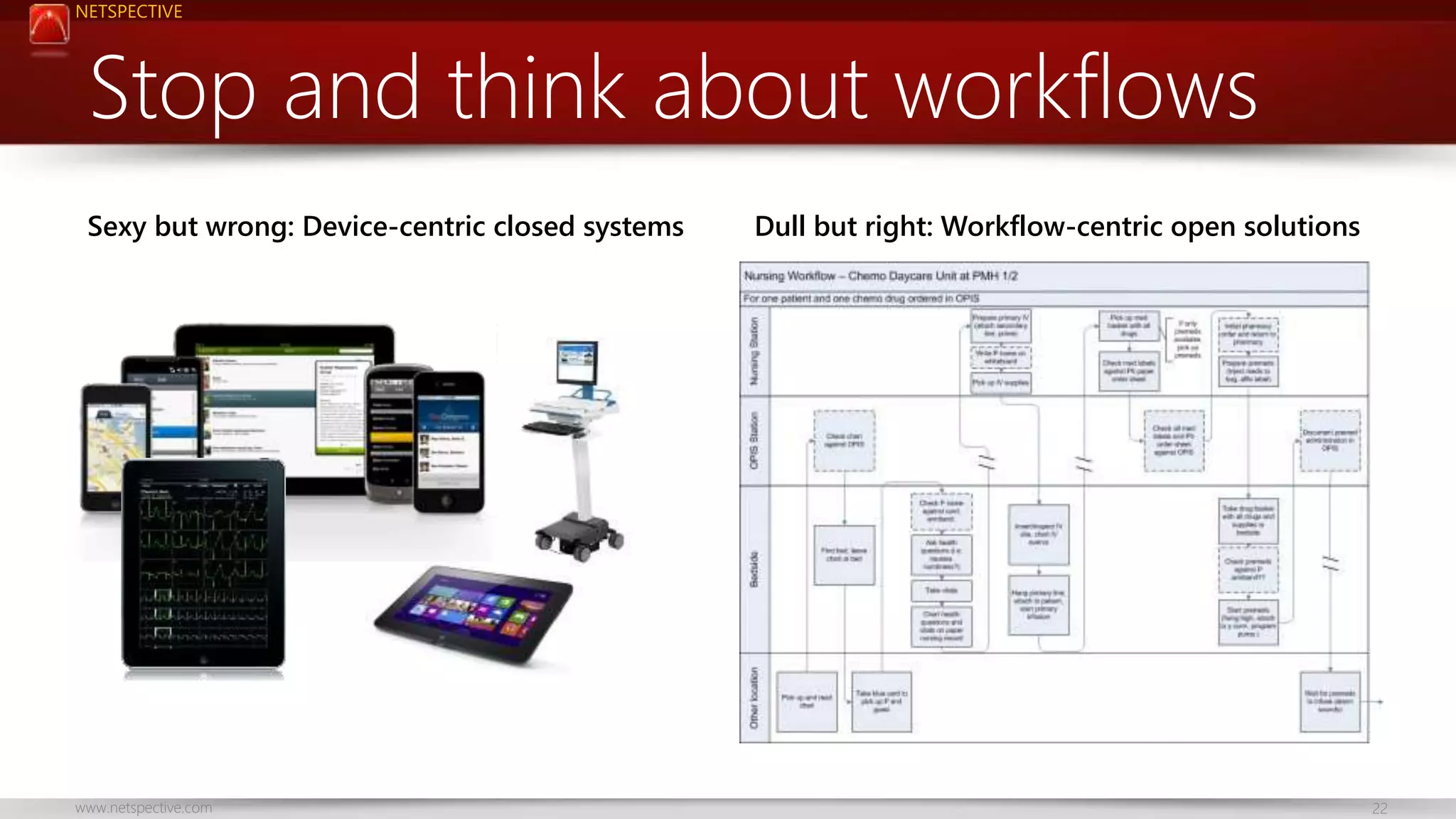
Stop and think about workflows 
Sexy but wrong: Device-centric closed systems Dull but right: Workflow-centric open solutions 
www.netspective.com 22
NETSPECTIVE 
Promote “Outside-in” architecture 
Think about clinical and 
hospital operations and 
processes as a collection 
of business capabilities or 
services that can be 
delivered across 
organizations. 
www.netspective.com 23
NETSPECTIVE 
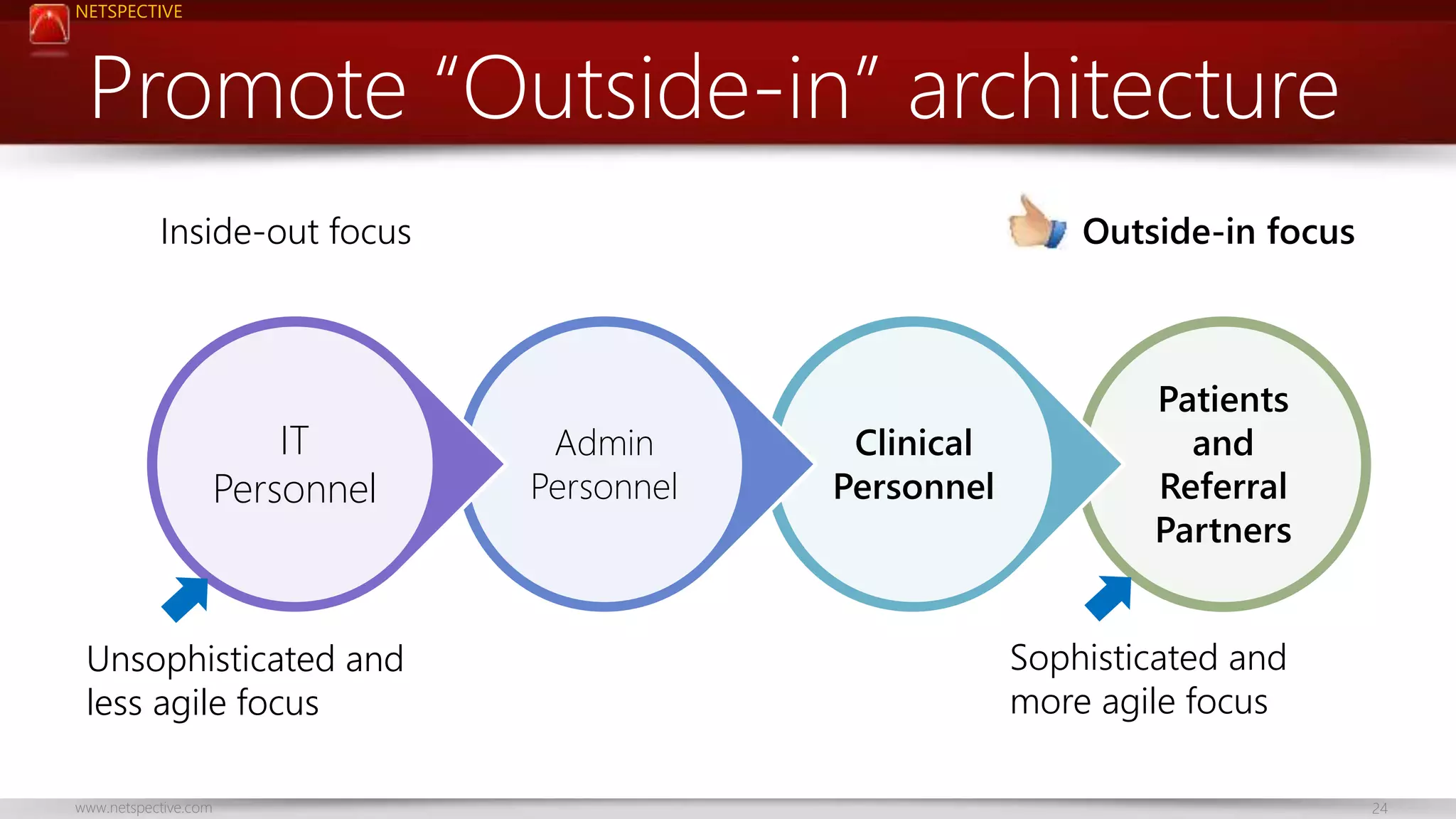
Promote “Outside-in” architecture 
Inside-out focus Outside-in focus 
Patients 
and 
Referral 
Partners 
Clinical 
Personnel 
Admin 
Personnel 
IT 
Personnel 
Unsophisticated and 
less agile focus 
Sophisticated and 
more agile focus 
www.netspective.com 24
NETSPECTIVE 
Implement industry-neutral ICAM 
Implement shared identities, single sign on (SSO), neutral authentication and authorization 
Proprietary identity is hurting us 
• Most health IT systems create their own 
custom identity, credentialing, and access 
management (ICAM) in an opaque part of 
a proprietary database. 
• We’re waiting for solutions from health IT 
vendors but free or commercial industry-neutral 
solutions are much better and 
future proof. 
Identity exchange is possible 
• Follow National Strategy for Trusted Identities 
in Cyberspace (NSTIC) 
• Use open identity exchange protocols such as 
SAML, OpenID, and Oauth 
• Use open roles and permissions-management 
protocols, such as XACML 
• Consider open source tools such as OpenAM, 
Apache Directory, OpenLDAP, Shibboleth, or 
commercial vendors. 
• Externalize attribute-based access control 
(ABAC) and role-based access control (RBAC) 
from clinical systems into enterprise systems 
like Active Directory or LDAP. 
www.netspective.com 25
NETSPECTIVE 
App-focused integration is better than nothing 
Structured data dogma gets in the way of faster decision support real solutions 
Dogma is preventing integration 
Many think that we shouldn’t integrate 
until structured data at detailed machine-computable 
levels is available. 
The thinking is that because mistakes can 
be made with semi-structured or hard to 
map data, we should rely on paper, make 
users live with missing data, or just make 
educated guesses instead. 
App-centric sharing is possible 
Instead of waiting for HL7 or other structured 
data about patients, we can use simple 
techniques like HTML widgets to share 
"snippets" of our apps. 
• Allow applications immediate access to 
portions of data they don't already manage. 
• Widgets are portions of apps that can be 
embedded or "mashed up" in other apps 
without tight coupling. 
• Blue Button has demonstrated the power of 
app integration versus structured data 
integration. It provides immediate benefit to 
users while the data geeks figure out what 
they need for analytics, computations, etc. 
www.netspective.com 26
NETSPECTIVE 
Pushing data is more expensive than pulling it 
We focus more on "pushing" versus "pulling" data than is warranted early in projects 
Old way to architect: 
“What data can you send me?” (push) 
The "push" model, where the system that 
contains the data is responsible for sending the 
data to all those that are interested (or to some 
central provider, such as a health information 
exchange or HL7 router) shouldn’t be the only 
model used for data integration. 
Better way to architect: 
“What data can I publish safely?” (pull) 
• Implement syndicated Atom-like feeds (which 
could contain HL7 or other formats). 
• Data holders should allow secure 
authenticated subscriptions to their data and 
not worry about direct coupling with other 
apps. 
• Consider the Open Data Protocol (oData). 
• Enable auditing of protected health 
information by logging data transfers through 
use of syslog and other reliable methods. 
• Enable proper access control rules expressed 
in standards like XACML. 
www.netspective.com 27
NETSPECTIVE 
Industry-specific formats aren’t always necessary 
Reliance on heavyweight industry-specific formats instead of lightweight micro formats is bad 
HL7 and X.12 aren’t the only formats 
The general assumption is that 
formats like HL7, CCD, and X.12 are 
the only ways to do data integration 
in healthcare but of course that’s 
not quite true. 
Consider industry-neutral protocols 
• Consider identity exchange 
protocols like SAML for integration 
of user profile data and even for 
exchange of patient demographics 
and related profile information. 
• Consider iCalendar/ICS publishing 
and subscribing for schedule data. 
• Consider microformats like FOAF 
and similar formats from 
schema.org. 
• Consider semantic data formats 
like RDF, RDFa, and related family. 
www.netspective.com 28
NETSPECTIVE 
Tag all app data using semantic markup 
When data is not tagged using semantic markup, it's not securable or shareable by default 
Legacy systems trap valuable data 
In many existing contracts, the 
vendors of systems that house the 
data also ‘own’ the data and it can’t 
be easily liberated because the 
vendors of the systems actively 
prevent it from being shared or are 
just too busy to liberate the data. 
Semantic markup and tagging is easy 
• One easy way to create semantically 
meaningful and easier to share and 
secure patient data is to have all 
HTML tags be generated with 
companion RDFa or HTML5 Data 
Attributes using industry-neutral 
schemas and microformats similar to 
the ones defined at Schema.org. 
• Google's recent implementation of 
its Knowledge Graph is a great 
example of the utility of this 
semantic mapping approach. 
www.netspective.com 29
NETSPECTIVE 
Produce data in search-friendly manner 
Produce HTML, JavaScript and other data in a security- and integration-friendly approach 
Proprietary data formats limit findability 
• Legacy applications only present 
through text or windowed 
interfaces that can be “scraped”. 
• Web-based applications present 
HTML, JavaScript, images, and 
other assets but aren’t search 
engine friendly. 
Search engines are great integrators 
• Most users need access to 
information trapped in existing 
applications but sometimes they 
don’t need must more than access 
that a search engine could easily 
provide. 
• Assume that all pages in an 
application, especial web 
applications, will be “ingested” by 
a securable, protectable, search 
engine that can act as the first 
method of integration. 
www.netspective.com 30
NETSPECTIVE 
Rely first on open source, then proprietary 
“Free” is not as important as open source, you should pay for software but require openness 
Healthcare fears open source 
• Only the government spends more per 
user on antiquated software than we do 
in healthcare. 
• There is a general fear that open source 
means unsupported software or lower 
quality solutions or unwanted security 
breaches. 
Open source can save health IT 
• Other industries save billions by using 
open source. 
• Commercial vendors give better pricing, 
service, and support when they know 
they are competing with open source. 
• Open source is sometimes more secure, 
higher quality, and better supported 
than commercial equivalents. 
• Don’t dismiss open source, consider it 
the default choice and select commercial 
alternatives when they are known to be 
better. 
www.netspective.com 31
Visit 
http://www.netspective.com 
http://www.healthcareguy.com 
E-mail shahid.shah@netspective.com 
Follow @ShahidNShah 
Call 202-713-5409 
Thank You

Reasons Why Health Data is Poorly Integrated Today and What We Can Do About It

  • 1.
    Reasons Why HealthData is Poorly Integrated Today and What We Can Do About It 3rd Annual OSEHRA Summit Shahid N. Shah Chairman of OSEHRA Advisory Board
  • 2.
    This and manyof my other presentations are available at www.SpeakerDeck.com/shah @ShahidNShah shahid@shah.org www.ShahidShah.com www.netspective.com 2
  • 3.
    NETSPECTIVE Who isShahid? • Chairman, OSEHRA Board of Advisors • 20+ years of software engineering and multi-discipline complex IT implementations (Gov., defense, health, finance, insurance) • 12+ years of healthcare IT and medical devices experience (blog at http://healthcareguy.com) • 15+ years of technology management experience (government, non-profit, commercial) Author of Chapter 13, “You’re the CIO of your Own Office” www.netspective.com 3
  • 4.
    NETSPECTIVE What’s thistalk about? Background • Many enterprise apps are being built these days, most are designed to work as a stand alone system similar to consumer apps • Healthcare-specific software engineering and integration tools are going to do more harm than good (industry-neutral is better). Key takeaways • Any enterprise app which acts like a consumer app that doesn’t integrate well into hospital or ambulatory systems and workflows is doomed • There’s nothing unique about health IT data that justifies complex, expensive, or special technology. • There’s a lot unique about healthcare workflows that require common technologies to be adapted properly. www.netspective.com 4
  • 5.
    NETSPECTIVE Application focusis biggest mistake Application-focused IT instead of Data-focused IT is causing business problems. Lab Apps Silos of information exist across groups (duplication, little sharing) Other Apps Healthcare Provider Systems Clinical Apps Patient Apps Billing Apps Partner Systems Poor data integration across application bases www.netspective.com 5
  • 6.
    NETSPECTIVE The Strategy:Modernize Integration Need to get existing applications to share data through modern integration techniques Clinical Apps NCI App Patient Apps Billing Apps Lab Apps Other Apps NEI App NHLBI App Healthcare Provider Systems Partner Systems Master Data Management, Entity Resolution, and Data Integration Improved integration by services that can communicate between applications www.netspective.com 6
  • 7.
    Why do healthIT systems integrate poorly? www.netspective.com 7
  • 8.
    Because customers don’tknow how to effectively punish vendors that don’t integrate well. But, that’s changing. Slowly. www.netspective.com 8
  • 9.
    Because apps developersdon’t have a systems engineering culture where we think of data integration as a discipline our customers will buy. But, that’s changing. Slowly. www.netspective.com 9
  • 10.
    Because we wantto wait for others to create a new standard or magical API that makes integration problems disappear. But, that’s changing. Slowly. www.netspective.com 10
  • 11.
    NETSPECTIVE The tacticalissues • We don't support shared identities, single sign on (SSO), and industry-neutral authentication and authorization • We're too focused on "structured data integration" instead of "practical app integration" in our early project phases • We focus more on "pushing" versus "pulling" data than is warranted early in projects • We have “Inside out” architecture, not “Outside in” • We're too focused on heavyweight industry-specific formats instead of lightweight or micro formats • Data emitted is not tagged using semantic markup, so it's not securable or searchable by default • When health IT systems produce HTML, CSS, JavaScript, JSON, and other common outputs, it's not done in a security- and integration-friendly manner www.netspective.com 11
  • 12.
    And now… Sowhat do we do?
  • 13.
    Unused data nevergets better. Fix broken windows. Iterate your way to better data by forcing its use. www.netspective.com 13
  • 14.
    NETSPECTIVE Legacy integration Presentation Functionality Data Application A Feature X Feature Y Presentation Functionality Data Application B Feature X Feature Y Feature Z Copy features and enhance (everything is separate) Presentation Functionality Data Application A Feature X Feature Z Presentation Functionality Data Application B Feature X Feature Y Feature Z Connect directly to existing data, but copy features and enhance www.netspective.com 14
  • 15.
    NETSPECTIVE Modern integration Feature X Feature Y REST SOAP, RMI Create API between applications, integrate data, create new data Feature X Feature Z Services Presentation Functionality Data Application A Presentation Functionality Data Application B Feature X Feature Y Feature Z Presentation Functionality Data Application A Presentation Functionality Data Application B Feature X Feature Y Feature Z Create common services and have all applications use them ETL APIs SOA WOA www.netspective.com 15
  • 16.
    Create a formalEnterprise Integration Group (EIG) Even get a cool logo and team mascot. www.netspective.com 16
  • 17.
    Start cataloging and formalizing use of enterprise integration patterns. You’re not the first (or second) to see these problems. www.netspective.com 17
  • 18.
    Learn about ESB,ETL, and BPM – grab open source or commercial implementations and build around them. Don’t hand code things. www.netspective.com 18
  • 19.
    Create a technicalprofile questionnaire and checklist Don’t hand code things. www.netspective.com 19
  • 20.
    Lets see whatall of this looks like in practice. You can do this in less than 40 man-hours of work. www.netspective.com 20
  • 21.
    NETSPECTIVE Start withread-centric integration, move to enrichment later Where users spend time What they’re missing www.netspective.com 21
  • 22.
    NETSPECTIVE Stop andthink about workflows Sexy but wrong: Device-centric closed systems Dull but right: Workflow-centric open solutions www.netspective.com 22
  • 23.
    NETSPECTIVE Promote “Outside-in”architecture Think about clinical and hospital operations and processes as a collection of business capabilities or services that can be delivered across organizations. www.netspective.com 23
  • 24.
    NETSPECTIVE Promote “Outside-in”architecture Inside-out focus Outside-in focus Patients and Referral Partners Clinical Personnel Admin Personnel IT Personnel Unsophisticated and less agile focus Sophisticated and more agile focus www.netspective.com 24
  • 25.
    NETSPECTIVE Implement industry-neutralICAM Implement shared identities, single sign on (SSO), neutral authentication and authorization Proprietary identity is hurting us • Most health IT systems create their own custom identity, credentialing, and access management (ICAM) in an opaque part of a proprietary database. • We’re waiting for solutions from health IT vendors but free or commercial industry-neutral solutions are much better and future proof. Identity exchange is possible • Follow National Strategy for Trusted Identities in Cyberspace (NSTIC) • Use open identity exchange protocols such as SAML, OpenID, and Oauth • Use open roles and permissions-management protocols, such as XACML • Consider open source tools such as OpenAM, Apache Directory, OpenLDAP, Shibboleth, or commercial vendors. • Externalize attribute-based access control (ABAC) and role-based access control (RBAC) from clinical systems into enterprise systems like Active Directory or LDAP. www.netspective.com 25
  • 26.
    NETSPECTIVE App-focused integrationis better than nothing Structured data dogma gets in the way of faster decision support real solutions Dogma is preventing integration Many think that we shouldn’t integrate until structured data at detailed machine-computable levels is available. The thinking is that because mistakes can be made with semi-structured or hard to map data, we should rely on paper, make users live with missing data, or just make educated guesses instead. App-centric sharing is possible Instead of waiting for HL7 or other structured data about patients, we can use simple techniques like HTML widgets to share "snippets" of our apps. • Allow applications immediate access to portions of data they don't already manage. • Widgets are portions of apps that can be embedded or "mashed up" in other apps without tight coupling. • Blue Button has demonstrated the power of app integration versus structured data integration. It provides immediate benefit to users while the data geeks figure out what they need for analytics, computations, etc. www.netspective.com 26
  • 27.
    NETSPECTIVE Pushing datais more expensive than pulling it We focus more on "pushing" versus "pulling" data than is warranted early in projects Old way to architect: “What data can you send me?” (push) The "push" model, where the system that contains the data is responsible for sending the data to all those that are interested (or to some central provider, such as a health information exchange or HL7 router) shouldn’t be the only model used for data integration. Better way to architect: “What data can I publish safely?” (pull) • Implement syndicated Atom-like feeds (which could contain HL7 or other formats). • Data holders should allow secure authenticated subscriptions to their data and not worry about direct coupling with other apps. • Consider the Open Data Protocol (oData). • Enable auditing of protected health information by logging data transfers through use of syslog and other reliable methods. • Enable proper access control rules expressed in standards like XACML. www.netspective.com 27
  • 28.
    NETSPECTIVE Industry-specific formatsaren’t always necessary Reliance on heavyweight industry-specific formats instead of lightweight micro formats is bad HL7 and X.12 aren’t the only formats The general assumption is that formats like HL7, CCD, and X.12 are the only ways to do data integration in healthcare but of course that’s not quite true. Consider industry-neutral protocols • Consider identity exchange protocols like SAML for integration of user profile data and even for exchange of patient demographics and related profile information. • Consider iCalendar/ICS publishing and subscribing for schedule data. • Consider microformats like FOAF and similar formats from schema.org. • Consider semantic data formats like RDF, RDFa, and related family. www.netspective.com 28
  • 29.
    NETSPECTIVE Tag allapp data using semantic markup When data is not tagged using semantic markup, it's not securable or shareable by default Legacy systems trap valuable data In many existing contracts, the vendors of systems that house the data also ‘own’ the data and it can’t be easily liberated because the vendors of the systems actively prevent it from being shared or are just too busy to liberate the data. Semantic markup and tagging is easy • One easy way to create semantically meaningful and easier to share and secure patient data is to have all HTML tags be generated with companion RDFa or HTML5 Data Attributes using industry-neutral schemas and microformats similar to the ones defined at Schema.org. • Google's recent implementation of its Knowledge Graph is a great example of the utility of this semantic mapping approach. www.netspective.com 29
  • 30.
    NETSPECTIVE Produce datain search-friendly manner Produce HTML, JavaScript and other data in a security- and integration-friendly approach Proprietary data formats limit findability • Legacy applications only present through text or windowed interfaces that can be “scraped”. • Web-based applications present HTML, JavaScript, images, and other assets but aren’t search engine friendly. Search engines are great integrators • Most users need access to information trapped in existing applications but sometimes they don’t need must more than access that a search engine could easily provide. • Assume that all pages in an application, especial web applications, will be “ingested” by a securable, protectable, search engine that can act as the first method of integration. www.netspective.com 30
  • 31.
    NETSPECTIVE Rely firston open source, then proprietary “Free” is not as important as open source, you should pay for software but require openness Healthcare fears open source • Only the government spends more per user on antiquated software than we do in healthcare. • There is a general fear that open source means unsupported software or lower quality solutions or unwanted security breaches. Open source can save health IT • Other industries save billions by using open source. • Commercial vendors give better pricing, service, and support when they know they are competing with open source. • Open source is sometimes more secure, higher quality, and better supported than commercial equivalents. • Don’t dismiss open source, consider it the default choice and select commercial alternatives when they are known to be better. www.netspective.com 31
  • 32.
    Visit http://www.netspective.com http://www.healthcareguy.com E-mail shahid.shah@netspective.com Follow @ShahidNShah Call 202-713-5409 Thank You

Editor's Notes

  • #25 Examples will be provided during talk