#ASPEevents
Essential Skills for Business
Analysts in the Healthcare
Domain
Essential Skills for Business
Analysts in the Healthcare
Domain
Presented By
Mary C. Zarba, MBA
Vail, Colorado
Welcome!!
One hour webinar
45 minute PowerPoint slide presentation
15 minute Q&A to follow
Webinar Agenda
- Healthcare domain labor statistics
- Essential business analysis training
- Essential healthcare domain training
- Healthcare areas of knowledge for employment
- Healthcare domain resources
- Healthcare employment resources
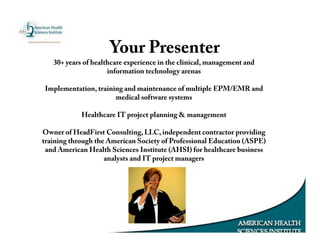
Your Presenter
30+ years of healthcare experience in the clinical, management and
information technology arenas
Implementation, training and maintenance of multiple EPM/EMR and
medical software systems
Healthcare IT project planning & management
Owner of HeadFirst Consulting, LLC, independent contractor providing
training through the American Society of Professional Education (ASPE)
and American Health Sciences Institute (AHSI) for healthcare business
analysts and IT project managers
Healthcare Labor Statistics
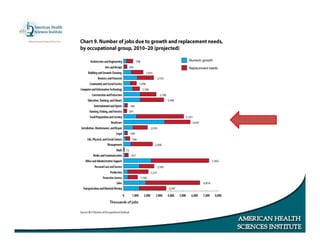
* Over 32,800 new healthcare positions were added in the
U.S. in May 2012
* More than 340,000 new positions were added the first
half of 2012
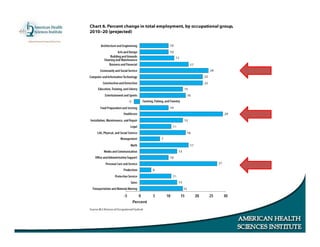
* Healthcare jobs have increased at twice the rate as the
general economy
* Creation of more than 4.2 million new healthcare jobs
in the U.S. by 2020
* One in nine U.S. jobs will be in healthcare by 2020
Center for Healthcare Workforce Studies, University of Albany
Why are new U.S. healthcare positions
skyrocketing?
•Increasing age of Baby Boomers
•More illness as we age
•Baby Boomers retiring from healthcare
•New treatment options becoming available
•Numerous new government regulations and security guidelines
(HIT Initiative, Meaningful Use, HITECH Act, HIPAA)
•Affordable Care Act (ObamaCare)
Bureau of Labor Statistics
Healthcare is one of the least automated industries in the USA
Other industries at the bottom of the list are retail, education and
construction
Healthcare IT is at least twenty years behind most other U.S. industries
Majority of healthcare organizations are using 25-30% of their
Electronic Health Records (EHR) functionality
30% of EHR implementations are considered a failure by practice or
hospital stakeholders
Electronic Health Records : Perspectives from the Adapters MGMA
Additional Healthcare IT Statistics
The American Recovery & Reinvestment Act of 2009
* Signed into law February 17, 2009 by Pres. Obama
* $790 billion total
* $30 billion dedicated to healthcare (HITECH Act)
- Healthcare IT
- Training of primary care providers
- Research on chronic diseases
- Community health centres (urban and
underserviced areas)
- “Comparative Effectiveness” (what works in real
life)
Federal HIT Initiative
HITECH Act
-$17 billion earmarked as provider incentives distributed by
Medicare & Medicaid starting in 2011
-$2 billion to be used by the national health IT coordinator
- $ going to individual states
- Interoperability issues
- Regional HIT centres (RHIO)
- Telemedicine issues
-Goal of the HITECH Act
- HIT interoperability
- Establish CCHIT standards
- Government savings of $12 billion
- Strengthen federal privacy and security laws/regulations
HITECH Act
HITECH Act includes tightening of HIPAA guidelines
- Clear definition of “breach”
- Imposes restrictions and disclosures
- Requires accounting of disclosures
- Increased civil penalties for violations
- State attorneys can enforce HIPAA
HITECH Act
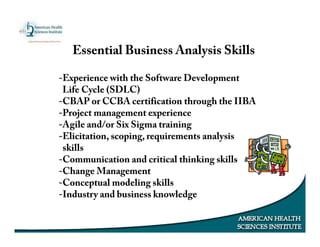
Essential Business Analysis Skills
-Experience with the Software Development
Life Cycle (SDLC)
-CBAP or CCBA certification through the IIBA
-Project management experience
-Agile and/or Six Sigma training
-Elicitation, scoping, requirements analysis
skills
-Communication and critical thinking skills
-Change Management
-Conceptual modeling skills
-Industry and business knowledge
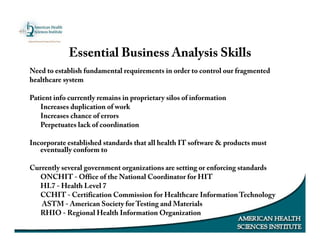
Essential Business Analysis Skills
Need to establish fundamental requirements in order to control our fragmented
healthcare system
Patient info currently remains in proprietary silos of information
Increases duplication of work
Increases chance of errors
Perpetuates lack of coordination
Incorporate established standards that all health IT software & products must
eventually conform to
Currently several government organizations are setting or enforcing standards
ONCHIT - Office of the National Coordinator for HIT
HL7 - Health Level 7
CCHIT - Certification Commission for Healthcare Information Technology
ASTM - American Society for Testing and Materials
RHIO - Regional Health Information Organization
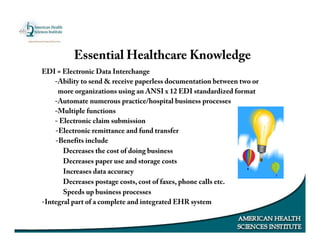
Essential Healthcare Knowledge
EDI = Electronic Data Interchange
-Ability to send & receive paperless documentation between two or
more organizations using an ANSI x 12 EDI standardized format
-Automate numerous practice/hospital business processes
-Multiple functions
- Electronic claim submission
-Electronic remittance and fund transfer
-Benefits include
Decreases the cost of doing business
Decreases paper use and storage costs
Increases data accuracy
Decreases postage costs, cost of faxes, phone calls etc.
Speeds up business processes
-Integral part of a complete and integrated EHR system
-Security Teams
Access controls
Disaster guidelines
Audit and access controls and reporting
HIPAA and state regulations
-“Need to know” basis (CRUD Matrix)
-Audit controls & reporting
-HIPAA and state regulations
-Restricted visit types
HIV, mental health, drug abuse
Employees
VIP’s
Healthcare IT Vulnerabilities
-Remote access (home & hospital)
-Internet use by staff
-Backup systems
-Printed documentation, research data
-Exam rooms, printers, scanners, fax machines
-Biometrics, proximity badges, secure computer
screens
-Encryption
-EKG , PAC and Echo systems
Business Analysis Opportunities
In Healthcare
-Interoperability between multiple organizations and systems
-Third party interfaces
- EDI (Electronic Data Interchange)
- IT Security/Liability from both internal and external sources
- Disaster Recovery
- Wireless capabilities (HIPAA)
-Support and maintenance of numerous new healthcare IT systems
-Implementations aligning with numerous new security guidelines
and Meaningful Use requirements
Essential Healthcare Knowledge
-ICD-9 and ICD-10
-Health insurance and claims process/pricing
-DRG’s
-Healthcare reform & recent government
regulations
-EDI/Clearinghouses
-4010 vs. 5010 compliance
-Content Management Systems
-PAC Systems
-Prescription systems/regulations
-Healthcare data mining
-Document management
-Healthcare and medical terminology
-CMS Medicare, FEP and Medicaid
-Medical software (EMR/EPM etc.)
-NHIN (National Health Information Network (RHIO)
Essential Healthcare Knowledge
Healthcare Experience – How Do I Get Started?
-BA experience/skills
-CBAP/CCBA certification helpful
-Healthcare industry knowledge
-Knowledge of the inner workings of hospitals, medical
practices, labs and/or healthcare R&D
-Training in latest healthcare federal guidelines
-Understanding of electronic medical billing processes
-Get involved in blogs, discussion groups, LinkedIn,
HIMSS etc.
Healthcare Experience – How Do I Get Started??
-Involvement in your local IIBA chapter
-Network with other healthcare BA’s through
your state IIBA
-Training classes in medical terminology,
healthcare IT
-Prep for interviewing for healthcare IT jobs
-Explore the numerous healthcare
employment resources
-Membership in HIMSS, MGMA etc.
CPEHR – Certified Professional in Electronic Health Records
CISSP – Certified Information System Security Professional
CPHIT – Certified Professional in Health Information Technology
CHISM – Certified Healthcare Informatics Manager
CHP – Certified HIPAA Professional
CHSS – Certified HIPAA Security Specialist
CHA – Certified HIPAA Administrator
Certifications
Business Analysis Resources
International Institute for Business Analysis (IIBA)
www.theiiba@com
State IIBA Chapters www.theiiba.org
St. Louis University, St. Louis, Missouri
American Society for Professional Education (ASPE)
American Health Sciences Institute (AHSI)
http://www.himss.org/StateDashboard/
‐Grant Information – Contains information on grants awarded to
communities, hospitals, providers and healthcare systems with
information on funding, hiring and grant specifics.
‐Regional Health Information Organization (RHIO) Specifics –
Information on RHIOs and their current status.
‐State Legislation Tracking – Descriptions and summaries of pending
legislation and HIMSS positions on legislation.
‐Davies Award Winners (HIMSS) – recognizes excellence in the
implementation and use of HIT
‐HIMSS Chapter Information – Locations of HIMSS Chapters.
State HIT Resources
Healthcare Resources
HIMSS (Health Information Management Systems Society)
http://www.himss.org/ASP/index.asp
MGMA (Medical Group Management Association)
http://www.mgma.com/
Office of the National Coordinator for Health Information Technology
Health IT http://healthit.hhs.gov/
Center for Medicare & Medicaid Services http://www.cms.gov/
Fierce Healthcare IT http://www.fiercehealthit.com/
Government Healthcare IT http://www.govhealthit.com/
Healthcare IT News (iPad app) http://www.healthcareitnews.com/
American Association of Healthcare Administrative Management
http://www.aaham.org/
LinkedIn (Numerous healthcare IT discussion groups)
Q & A
How to Claim Your PDU
• Go to aspe‐sdlc.com/pdu/ for instructions on
submitting your PDU.
• You can submit your PDU by mail or
electronically.
• The Activity code for today’s presentation is
WS100912 and ASPE’s REP number is 2161.
• The seminars are Category A for one PDU

Essential_Skills_for_Business_Analysts_i.pdf

  • 1.
  • 2.
    Essential Skills forBusiness Analysts in the Healthcare Domain
  • 3.
    Essential Skills forBusiness Analysts in the Healthcare Domain Presented By Mary C. Zarba, MBA Vail, Colorado
  • 4.
    Welcome!! One hour webinar 45minute PowerPoint slide presentation 15 minute Q&A to follow
  • 5.
    Webinar Agenda - Healthcaredomain labor statistics - Essential business analysis training - Essential healthcare domain training - Healthcare areas of knowledge for employment - Healthcare domain resources - Healthcare employment resources
  • 6.
    Your Presenter 30+ yearsof healthcare experience in the clinical, management and information technology arenas Implementation, training and maintenance of multiple EPM/EMR and medical software systems Healthcare IT project planning & management Owner of HeadFirst Consulting, LLC, independent contractor providing training through the American Society of Professional Education (ASPE) and American Health Sciences Institute (AHSI) for healthcare business analysts and IT project managers
  • 7.
    Healthcare Labor Statistics *Over 32,800 new healthcare positions were added in the U.S. in May 2012 * More than 340,000 new positions were added the first half of 2012 * Healthcare jobs have increased at twice the rate as the general economy * Creation of more than 4.2 million new healthcare jobs in the U.S. by 2020 * One in nine U.S. jobs will be in healthcare by 2020 Center for Healthcare Workforce Studies, University of Albany
  • 8.
    Why are newU.S. healthcare positions skyrocketing? •Increasing age of Baby Boomers •More illness as we age •Baby Boomers retiring from healthcare •New treatment options becoming available •Numerous new government regulations and security guidelines (HIT Initiative, Meaningful Use, HITECH Act, HIPAA) •Affordable Care Act (ObamaCare) Bureau of Labor Statistics
  • 9.
    Healthcare is oneof the least automated industries in the USA Other industries at the bottom of the list are retail, education and construction Healthcare IT is at least twenty years behind most other U.S. industries Majority of healthcare organizations are using 25-30% of their Electronic Health Records (EHR) functionality 30% of EHR implementations are considered a failure by practice or hospital stakeholders Electronic Health Records : Perspectives from the Adapters MGMA Additional Healthcare IT Statistics
  • 13.
    The American Recovery& Reinvestment Act of 2009 * Signed into law February 17, 2009 by Pres. Obama * $790 billion total * $30 billion dedicated to healthcare (HITECH Act) - Healthcare IT - Training of primary care providers - Research on chronic diseases - Community health centres (urban and underserviced areas) - “Comparative Effectiveness” (what works in real life) Federal HIT Initiative
  • 14.
    HITECH Act -$17 billionearmarked as provider incentives distributed by Medicare & Medicaid starting in 2011 -$2 billion to be used by the national health IT coordinator - $ going to individual states - Interoperability issues - Regional HIT centres (RHIO) - Telemedicine issues -Goal of the HITECH Act - HIT interoperability - Establish CCHIT standards - Government savings of $12 billion - Strengthen federal privacy and security laws/regulations HITECH Act
  • 15.
    HITECH Act includestightening of HIPAA guidelines - Clear definition of “breach” - Imposes restrictions and disclosures - Requires accounting of disclosures - Increased civil penalties for violations - State attorneys can enforce HIPAA HITECH Act
  • 16.
    Essential Business AnalysisSkills -Experience with the Software Development Life Cycle (SDLC) -CBAP or CCBA certification through the IIBA -Project management experience -Agile and/or Six Sigma training -Elicitation, scoping, requirements analysis skills -Communication and critical thinking skills -Change Management -Conceptual modeling skills -Industry and business knowledge
  • 17.
    Essential Business AnalysisSkills Need to establish fundamental requirements in order to control our fragmented healthcare system Patient info currently remains in proprietary silos of information Increases duplication of work Increases chance of errors Perpetuates lack of coordination Incorporate established standards that all health IT software & products must eventually conform to Currently several government organizations are setting or enforcing standards ONCHIT - Office of the National Coordinator for HIT HL7 - Health Level 7 CCHIT - Certification Commission for Healthcare Information Technology ASTM - American Society for Testing and Materials RHIO - Regional Health Information Organization
  • 18.
    Essential Healthcare Knowledge EDI= Electronic Data Interchange -Ability to send & receive paperless documentation between two or more organizations using an ANSI x 12 EDI standardized format -Automate numerous practice/hospital business processes -Multiple functions - Electronic claim submission -Electronic remittance and fund transfer -Benefits include Decreases the cost of doing business Decreases paper use and storage costs Increases data accuracy Decreases postage costs, cost of faxes, phone calls etc. Speeds up business processes -Integral part of a complete and integrated EHR system
  • 19.
    -Security Teams Access controls Disasterguidelines Audit and access controls and reporting HIPAA and state regulations -“Need to know” basis (CRUD Matrix) -Audit controls & reporting -HIPAA and state regulations -Restricted visit types HIV, mental health, drug abuse Employees VIP’s Healthcare IT Vulnerabilities
  • 20.
    Healthcare IT Vulnerabilities -Remoteaccess (home & hospital) -Internet use by staff -Backup systems -Printed documentation, research data -Exam rooms, printers, scanners, fax machines -Biometrics, proximity badges, secure computer screens -Encryption -EKG , PAC and Echo systems
  • 21.
    Business Analysis Opportunities InHealthcare -Interoperability between multiple organizations and systems -Third party interfaces - EDI (Electronic Data Interchange) - IT Security/Liability from both internal and external sources - Disaster Recovery - Wireless capabilities (HIPAA) -Support and maintenance of numerous new healthcare IT systems -Implementations aligning with numerous new security guidelines and Meaningful Use requirements
  • 22.
    Essential Healthcare Knowledge -ICD-9and ICD-10 -Health insurance and claims process/pricing -DRG’s -Healthcare reform & recent government regulations -EDI/Clearinghouses -4010 vs. 5010 compliance -Content Management Systems -PAC Systems
  • 23.
    -Prescription systems/regulations -Healthcare datamining -Document management -Healthcare and medical terminology -CMS Medicare, FEP and Medicaid -Medical software (EMR/EPM etc.) -NHIN (National Health Information Network (RHIO) Essential Healthcare Knowledge
  • 24.
    Healthcare Experience –How Do I Get Started? -BA experience/skills -CBAP/CCBA certification helpful -Healthcare industry knowledge -Knowledge of the inner workings of hospitals, medical practices, labs and/or healthcare R&D -Training in latest healthcare federal guidelines -Understanding of electronic medical billing processes -Get involved in blogs, discussion groups, LinkedIn, HIMSS etc.
  • 25.
    Healthcare Experience –How Do I Get Started?? -Involvement in your local IIBA chapter -Network with other healthcare BA’s through your state IIBA -Training classes in medical terminology, healthcare IT -Prep for interviewing for healthcare IT jobs -Explore the numerous healthcare employment resources -Membership in HIMSS, MGMA etc.
  • 26.
    CPEHR – CertifiedProfessional in Electronic Health Records CISSP – Certified Information System Security Professional CPHIT – Certified Professional in Health Information Technology CHISM – Certified Healthcare Informatics Manager CHP – Certified HIPAA Professional CHSS – Certified HIPAA Security Specialist CHA – Certified HIPAA Administrator Certifications
  • 27.
    Business Analysis Resources InternationalInstitute for Business Analysis (IIBA) www.theiiba@com State IIBA Chapters www.theiiba.org St. Louis University, St. Louis, Missouri American Society for Professional Education (ASPE) American Health Sciences Institute (AHSI)
  • 28.
    http://www.himss.org/StateDashboard/ ‐Grant Information –Contains information on grants awarded to communities, hospitals, providers and healthcare systems with information on funding, hiring and grant specifics. ‐Regional Health Information Organization (RHIO) Specifics – Information on RHIOs and their current status. ‐State Legislation Tracking – Descriptions and summaries of pending legislation and HIMSS positions on legislation. ‐Davies Award Winners (HIMSS) – recognizes excellence in the implementation and use of HIT ‐HIMSS Chapter Information – Locations of HIMSS Chapters. State HIT Resources
  • 29.
    Healthcare Resources HIMSS (HealthInformation Management Systems Society) http://www.himss.org/ASP/index.asp MGMA (Medical Group Management Association) http://www.mgma.com/ Office of the National Coordinator for Health Information Technology Health IT http://healthit.hhs.gov/ Center for Medicare & Medicaid Services http://www.cms.gov/ Fierce Healthcare IT http://www.fiercehealthit.com/ Government Healthcare IT http://www.govhealthit.com/ Healthcare IT News (iPad app) http://www.healthcareitnews.com/ American Association of Healthcare Administrative Management http://www.aaham.org/ LinkedIn (Numerous healthcare IT discussion groups)
  • 30.
  • 31.
    How to ClaimYour PDU • Go to aspe‐sdlc.com/pdu/ for instructions on submitting your PDU. • You can submit your PDU by mail or electronically. • The Activity code for today’s presentation is WS100912 and ASPE’s REP number is 2161. • The seminars are Category A for one PDU