
Empowered Lenses Geeta Ravi 309E52 MBA (M&S) – Class of 2011
Sneak a Peek What are Contact Lenses  History Behind Contact Lenses Usefulness of Contact Lenses Types of Contact Lenses How to Use Contact Lenses What are Empowered Lenses How do They Work? Empowerment??? Available @ All Optical Stores It Cannot Get Cheaper! Buy Now!
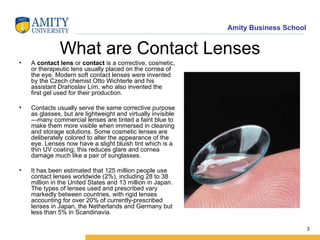
What are Contact Lenses A  contact lens  or  contact  is a corrective, cosmetic, or therapeutic lens usually placed on the cornea of the eye. Modern soft contact lenses were invented by the Czech chemist Otto Wichterle and his assistant Drahoslav Lím, who also invented the first gel used for their production. Contacts usually serve the same corrective purpose as glasses, but are lightweight and virtually invisible—many commercial lenses are tinted a faint blue to make them more visible when immersed in cleaning and storage solutions. Some cosmetic lenses are deliberately colored to alter the appearance of the eye. Lenses now have a slight bluish tint which is a thin UV coating; this reduces glare and cornea damage much like a pair of sunglasses. It has been estimated that 125 million people use contact lenses worldwide (2%), including 28 to 38 million in the United States and 13 million in Japan. The types of lenses used and prescribed vary markedly between countries, with rigid lenses accounting for over 20% of currently-prescribed lenses in Japan, the Netherlands and Germany but less than 5% in Scandinavia.
History Behind Contact Lenses In 1887, Louis J. Girard invented a scleral form of contact lens. In 1936, optometrist William Feinbloom introduced plastic lenses, making them lighter and more convenient. These lenses were a combination of glass and plastic. In 1949, the first "corneal" lenses were developed. These were much smaller than the original scleral lenses, as they sat only on the cornea rather than across all of the visible ocular surface, and could be worn up to sixteen hours per day. The principal breakthrough in soft lenses was made by the Czech chemists Otto Wichterle and Drahoslav Lim who published their work "Hydrophilic gels for biological use" in the journal Nature  in 1959. This led to the launch of the first soft (hydrogel) lenses in some countries in the 1960s and the first approval of the "Soflens" material by the United States Food and Drug Administration (FDA) in 1971. In 1999, an important development was the launch of the first silicone hydrogels onto the market. These new materials encapsulated the benefits of silicone—which has extremely high oxygen permeability. These lenses were initially advocated primarily for extended (overnight) wear. Second-generation silicone hydrogels, such as galyfilcon A (Acuvue Advance, Vistakon) and senofilcon A (Acuvue Oasys, Vistakon), use the Tanaka monomer. Comfilcon A (Biofinity, CooperVision) was the first third-generation polymer. The material uses two siloxy macromers of different sizes that, when used in combination, produce very high oxygen permeability (for a given water content). Enfilcon A (Avaira, CooperVision) is another third-generation material that's naturally wettable.
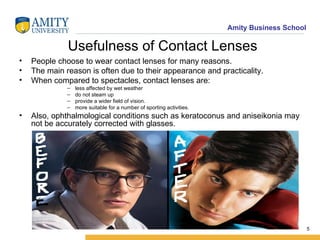
Usefulness of Contact Lenses People choose to wear contact lenses for many reasons. The main reason is often due to their appearance and practicality. When compared to spectacles, contact lenses are: less affected by wet weather do not steam up provide a wider field of vision.  more suitable for a number of sporting activities.  Also, ophthalmological conditions such as keratoconus and aniseikonia may not be accurately corrected with glasses.
Types of Contact Lenses Corrective contact lenses:  A corrective contact lens is designed to improve vision. In many people, there is a mismatch between the refractive power of the eye and the length of the eye, leading to a refraction error. A contact lens neutralizes this mismatch and allows for correct focusing of light onto the retina. Cosmetic contact lenses:  A cosmetic contact lens is designed to change the appearance of the eye. These lenses may also correct the vision, but some blurring or obstruction of vision may occur as a result of the color or design. Spherical   contact lenses:  A spherical contact lens is one in which both the inner and outer optical surfaces are portions of a sphere.
How to Use Contact Lenses Insertion:  Contact lenses are typically inserted into the eye by placing them on the index finger with the concave side upward and raising them to touch the cornea. The other hand may be employed to keep the eye open. Removal:  A soft lens may be removed by holding the eyelids open and grasping the lens with opposing digits. If the lens is pushed off the cornea (by touching the lens with your forefinger and looking towards your nose, moving the lens) it will buckle up (due to the difference in curvature), making it easier to grasp. Watch Out For The Problems: Problems may arise particularly with disposable soft lenses; if the surface tension between the lens and the finger is too great the lens may turn itself inside out; alternatively it may fold itself in half. When the lens first contacts the eye, a brief period of irritation may ensue as the eye acclimatizes to the lens and also (if a multi-use lens is not correctly cleansed) as dirt on the lens irritates the eye. Determine the Right Side:  You can determine the lens's correct position before hand by holding the lens on the tip of your finger and squeezing the bottom of it with two fingers from your other hand, you will know you have it the correct way if the edges of the lens curve inward like a taco. If they curve out you need to flip the lens.
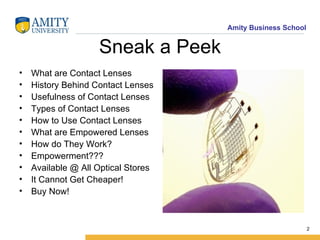
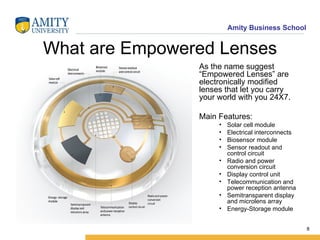
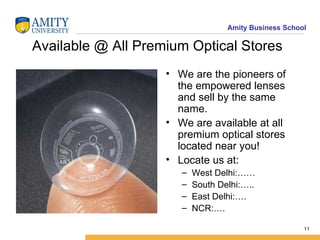
What are Empowered Lenses As the name suggest “Empowered Lenses” are electronically modified lenses that let you carry your world with you 24X7. Main Features: Solar cell module Electrical interconnects Biosensor module Sensor readout and control circuit Radio and power conversion circuit Display control unit Telecommunication and power reception antenna Semitransparent display and microlens array Energy-Storage module
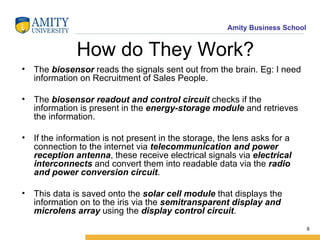
How do They Work? The  biosensor  reads the signals sent out from the brain. Eg: I need information on Recruitment of Sales People. The  biosensor readout and control circuit  checks if the information is present in the  energy-storage module  and retrieves the information. If the information is not present in the storage, the lens asks for a connection to the internet via  telecommunication and power reception antenna , these receive electrical signals via  electrical interconnects  and convert them into readable data via the  radio and power conversion circuit . This data is saved onto the  solar cell module  that displays the information on to the iris via the  semitransparent display and microlens array  using the  display control circuit .
Empowerment??? The best part about Empowered lenses is knowledge at your disposal. You don’t have to learn those facts and figures, you need not remember the long presentations, you won’t even forget the birthdates and anniversaries anymore! They will never get stolen as they are specially designed for your eyes only. They do not work on any other eye. They can be used as regular lenses as well. But there are certain limitations: The power house of Empowered lenses is upto 2 GB, if you need more information, you need to connect to the internet, hence if you do not have internet access around, you will fall short of information required on the go! As there are a lot of electrical activities going on inside while retrieval of information, their contact with eyes should not exceed 8 hours.
Available @ All Premium Optical Stores We are the pioneers of the empowered lenses and sell by the same name. We are available at all premium optical stores located near you! Locate us at: West Delhi:…… South Delhi:….. East Delhi:…. NCR:….
It Cannot Get Cheaper! This is a new product and we are trying to establish our brand name and image. We are currently targeting only the Delhi and NCR region. The product is priced at Rs 1000/- for the monthly disposable pair. The regular lenses available in the market also cost 300 – 500/-, but do not have the added advantages that our empowered lenses have. As we are a new enterant into the market, we are currently launching only the monthly disposable pair. We will soon be introducing the yearly disposable pair at a cost of only 4000/-. That makes a saving of 8000/- a year!
Buy Now! To ensure that you really appreciate and want the product, we offer you a free one-day trial sample. If you buy the one-month trial pack within the next two days, we give you a discount of 50%. This brings down the cost to that of the regular lenses. If you buy the one-month trial pack within the next seven days, we give you a discount of 25%. If you buy the one-month trial pack within the next fifteen days, we give you a discount of 10%. What are you waiting for… Buy now!!!
Thank You!

Empowered Lens

  • 1.
    Empowered Lenses GeetaRavi 309E52 MBA (M&S) – Class of 2011
  • 2.
    Sneak a PeekWhat are Contact Lenses History Behind Contact Lenses Usefulness of Contact Lenses Types of Contact Lenses How to Use Contact Lenses What are Empowered Lenses How do They Work? Empowerment??? Available @ All Optical Stores It Cannot Get Cheaper! Buy Now!
  • 3.
    What are ContactLenses A  contact lens  or  contact is a corrective, cosmetic, or therapeutic lens usually placed on the cornea of the eye. Modern soft contact lenses were invented by the Czech chemist Otto Wichterle and his assistant Drahoslav Lím, who also invented the first gel used for their production. Contacts usually serve the same corrective purpose as glasses, but are lightweight and virtually invisible—many commercial lenses are tinted a faint blue to make them more visible when immersed in cleaning and storage solutions. Some cosmetic lenses are deliberately colored to alter the appearance of the eye. Lenses now have a slight bluish tint which is a thin UV coating; this reduces glare and cornea damage much like a pair of sunglasses. It has been estimated that 125 million people use contact lenses worldwide (2%), including 28 to 38 million in the United States and 13 million in Japan. The types of lenses used and prescribed vary markedly between countries, with rigid lenses accounting for over 20% of currently-prescribed lenses in Japan, the Netherlands and Germany but less than 5% in Scandinavia.
  • 4.
    History Behind ContactLenses In 1887, Louis J. Girard invented a scleral form of contact lens. In 1936, optometrist William Feinbloom introduced plastic lenses, making them lighter and more convenient. These lenses were a combination of glass and plastic. In 1949, the first "corneal" lenses were developed. These were much smaller than the original scleral lenses, as they sat only on the cornea rather than across all of the visible ocular surface, and could be worn up to sixteen hours per day. The principal breakthrough in soft lenses was made by the Czech chemists Otto Wichterle and Drahoslav Lim who published their work "Hydrophilic gels for biological use" in the journal Nature  in 1959. This led to the launch of the first soft (hydrogel) lenses in some countries in the 1960s and the first approval of the "Soflens" material by the United States Food and Drug Administration (FDA) in 1971. In 1999, an important development was the launch of the first silicone hydrogels onto the market. These new materials encapsulated the benefits of silicone—which has extremely high oxygen permeability. These lenses were initially advocated primarily for extended (overnight) wear. Second-generation silicone hydrogels, such as galyfilcon A (Acuvue Advance, Vistakon) and senofilcon A (Acuvue Oasys, Vistakon), use the Tanaka monomer. Comfilcon A (Biofinity, CooperVision) was the first third-generation polymer. The material uses two siloxy macromers of different sizes that, when used in combination, produce very high oxygen permeability (for a given water content). Enfilcon A (Avaira, CooperVision) is another third-generation material that's naturally wettable.
  • 5.
    Usefulness of ContactLenses People choose to wear contact lenses for many reasons. The main reason is often due to their appearance and practicality. When compared to spectacles, contact lenses are: less affected by wet weather do not steam up provide a wider field of vision. more suitable for a number of sporting activities. Also, ophthalmological conditions such as keratoconus and aniseikonia may not be accurately corrected with glasses.
  • 6.
    Types of ContactLenses Corrective contact lenses: A corrective contact lens is designed to improve vision. In many people, there is a mismatch between the refractive power of the eye and the length of the eye, leading to a refraction error. A contact lens neutralizes this mismatch and allows for correct focusing of light onto the retina. Cosmetic contact lenses: A cosmetic contact lens is designed to change the appearance of the eye. These lenses may also correct the vision, but some blurring or obstruction of vision may occur as a result of the color or design. Spherical   contact lenses: A spherical contact lens is one in which both the inner and outer optical surfaces are portions of a sphere.
  • 7.
    How to UseContact Lenses Insertion: Contact lenses are typically inserted into the eye by placing them on the index finger with the concave side upward and raising them to touch the cornea. The other hand may be employed to keep the eye open. Removal: A soft lens may be removed by holding the eyelids open and grasping the lens with opposing digits. If the lens is pushed off the cornea (by touching the lens with your forefinger and looking towards your nose, moving the lens) it will buckle up (due to the difference in curvature), making it easier to grasp. Watch Out For The Problems: Problems may arise particularly with disposable soft lenses; if the surface tension between the lens and the finger is too great the lens may turn itself inside out; alternatively it may fold itself in half. When the lens first contacts the eye, a brief period of irritation may ensue as the eye acclimatizes to the lens and also (if a multi-use lens is not correctly cleansed) as dirt on the lens irritates the eye. Determine the Right Side: You can determine the lens's correct position before hand by holding the lens on the tip of your finger and squeezing the bottom of it with two fingers from your other hand, you will know you have it the correct way if the edges of the lens curve inward like a taco. If they curve out you need to flip the lens.
  • 8.
    What are EmpoweredLenses As the name suggest “Empowered Lenses” are electronically modified lenses that let you carry your world with you 24X7. Main Features: Solar cell module Electrical interconnects Biosensor module Sensor readout and control circuit Radio and power conversion circuit Display control unit Telecommunication and power reception antenna Semitransparent display and microlens array Energy-Storage module
  • 9.
    How do TheyWork? The biosensor reads the signals sent out from the brain. Eg: I need information on Recruitment of Sales People. The biosensor readout and control circuit checks if the information is present in the energy-storage module and retrieves the information. If the information is not present in the storage, the lens asks for a connection to the internet via telecommunication and power reception antenna , these receive electrical signals via electrical interconnects and convert them into readable data via the radio and power conversion circuit . This data is saved onto the solar cell module that displays the information on to the iris via the semitransparent display and microlens array using the display control circuit .
  • 10.
    Empowerment??? The bestpart about Empowered lenses is knowledge at your disposal. You don’t have to learn those facts and figures, you need not remember the long presentations, you won’t even forget the birthdates and anniversaries anymore! They will never get stolen as they are specially designed for your eyes only. They do not work on any other eye. They can be used as regular lenses as well. But there are certain limitations: The power house of Empowered lenses is upto 2 GB, if you need more information, you need to connect to the internet, hence if you do not have internet access around, you will fall short of information required on the go! As there are a lot of electrical activities going on inside while retrieval of information, their contact with eyes should not exceed 8 hours.
  • 11.
    Available @ AllPremium Optical Stores We are the pioneers of the empowered lenses and sell by the same name. We are available at all premium optical stores located near you! Locate us at: West Delhi:…… South Delhi:….. East Delhi:…. NCR:….
  • 12.
    It Cannot GetCheaper! This is a new product and we are trying to establish our brand name and image. We are currently targeting only the Delhi and NCR region. The product is priced at Rs 1000/- for the monthly disposable pair. The regular lenses available in the market also cost 300 – 500/-, but do not have the added advantages that our empowered lenses have. As we are a new enterant into the market, we are currently launching only the monthly disposable pair. We will soon be introducing the yearly disposable pair at a cost of only 4000/-. That makes a saving of 8000/- a year!
  • 13.
    Buy Now! Toensure that you really appreciate and want the product, we offer you a free one-day trial sample. If you buy the one-month trial pack within the next two days, we give you a discount of 50%. This brings down the cost to that of the regular lenses. If you buy the one-month trial pack within the next seven days, we give you a discount of 25%. If you buy the one-month trial pack within the next fifteen days, we give you a discount of 10%. What are you waiting for… Buy now!!!
  • 14.