
Copyright © 2009 by The McGraw-Hill Companies, Inc. All rights reserved.McGraw-Hill/Irwin
Employee Motivation: Foundations and
Practices
5-2
Motivation Defined
The forces within a person that affect the
direction, intensity, and persistence of voluntary
behavior
Exerting particular effort level (intensity), for a
certain amount of time (persistence), toward a
particular goal (direction).
5-3
Drives and Needs
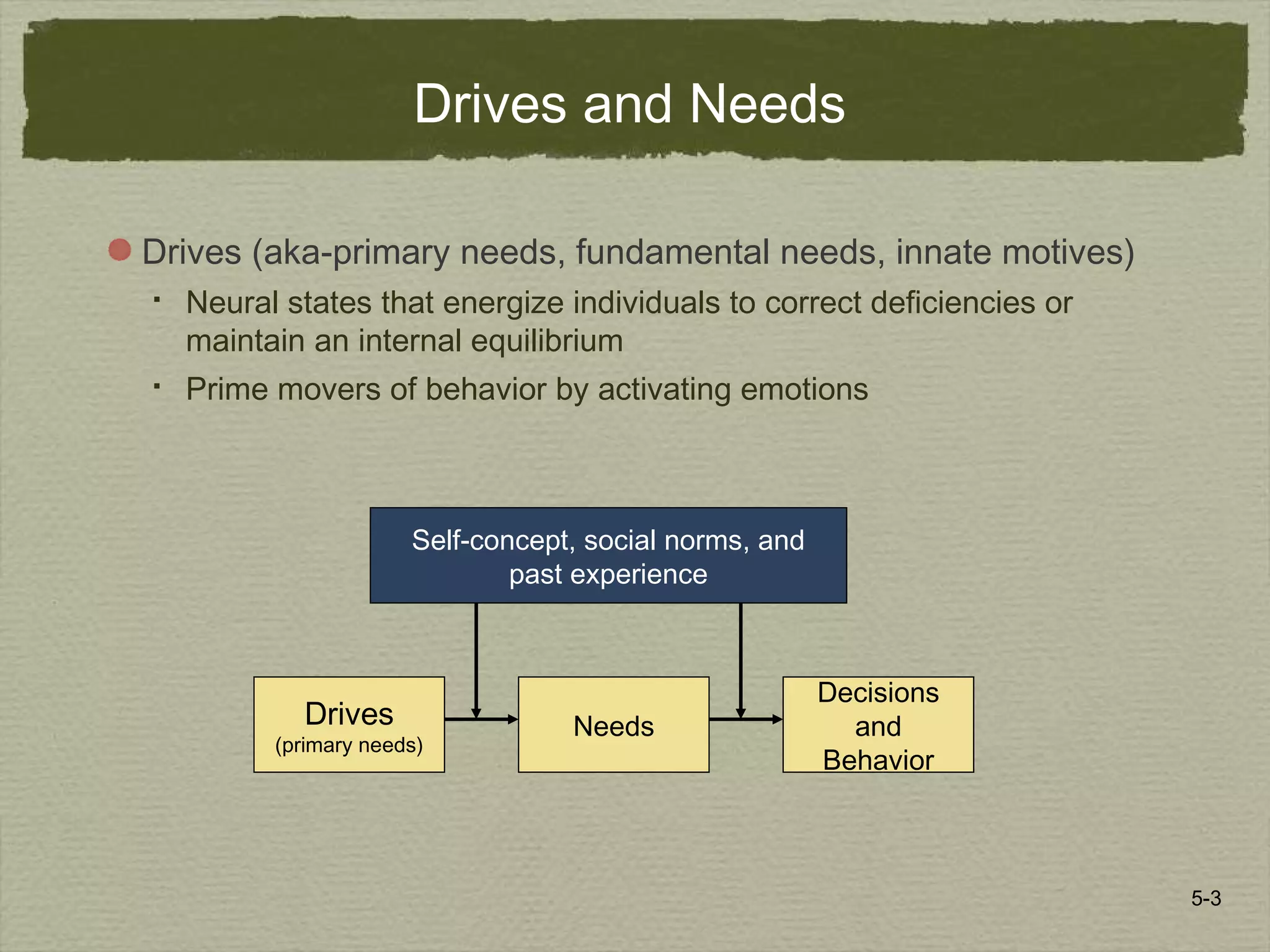
Drives (aka-primary needs, fundamental needs, innate motives)
 Neural states that energize individuals to correct deficiencies or
maintain an internal equilibrium
 Prime movers of behavior by activating emotions
Self-concept, social norms, and
past experience
Drives
(primary needs)
Needs
Decisions
and
Behavior
5-4
Drives and Needs
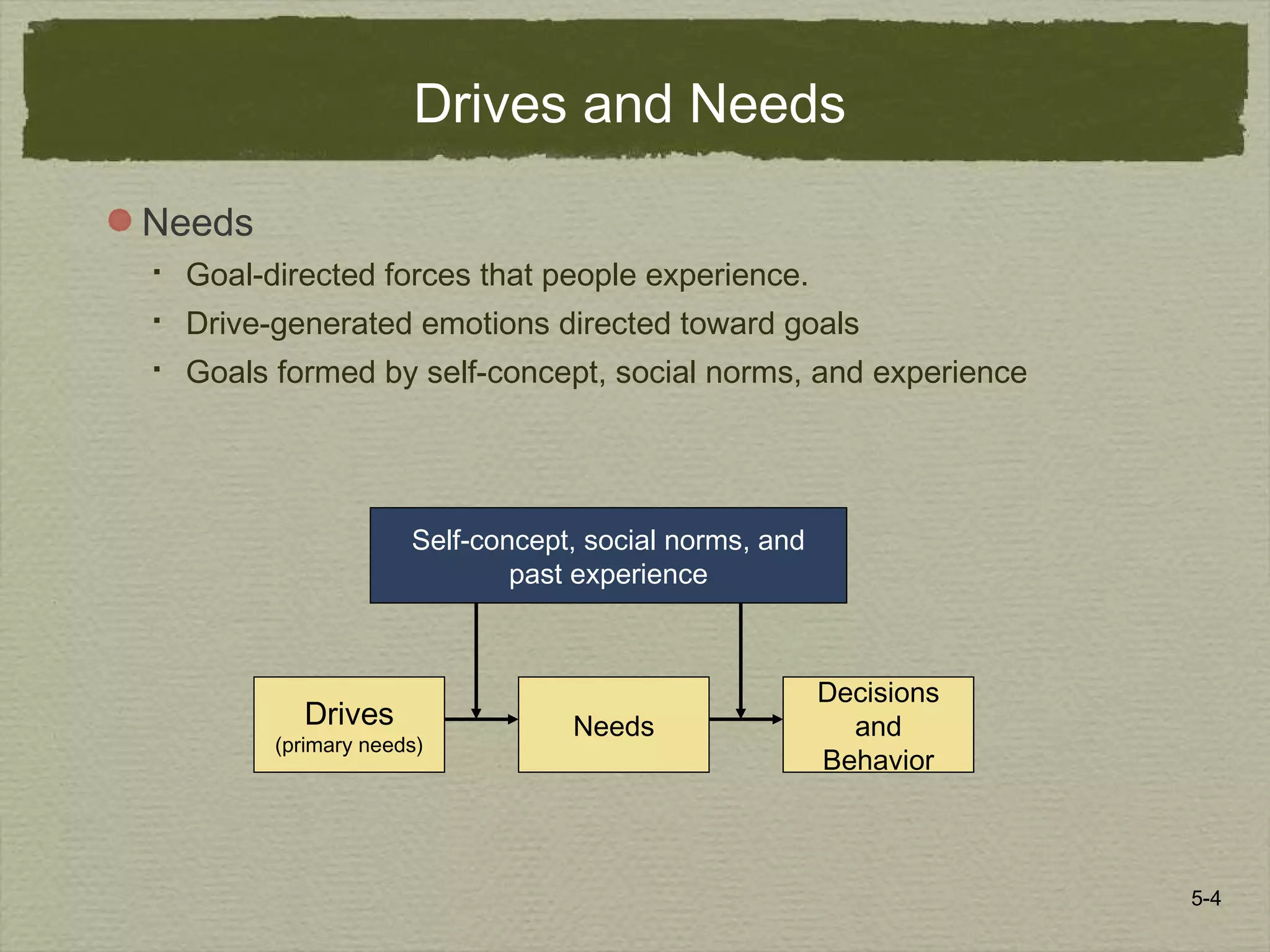
Needs
 Goal-directed forces that people experience.
 Drive-generated emotions directed toward goals
 Goals formed by self-concept, social norms, and experience
Self-concept, social norms, and
past experience
Drives
(primary needs)
Needs
Decisions
and
Behavior
5-5
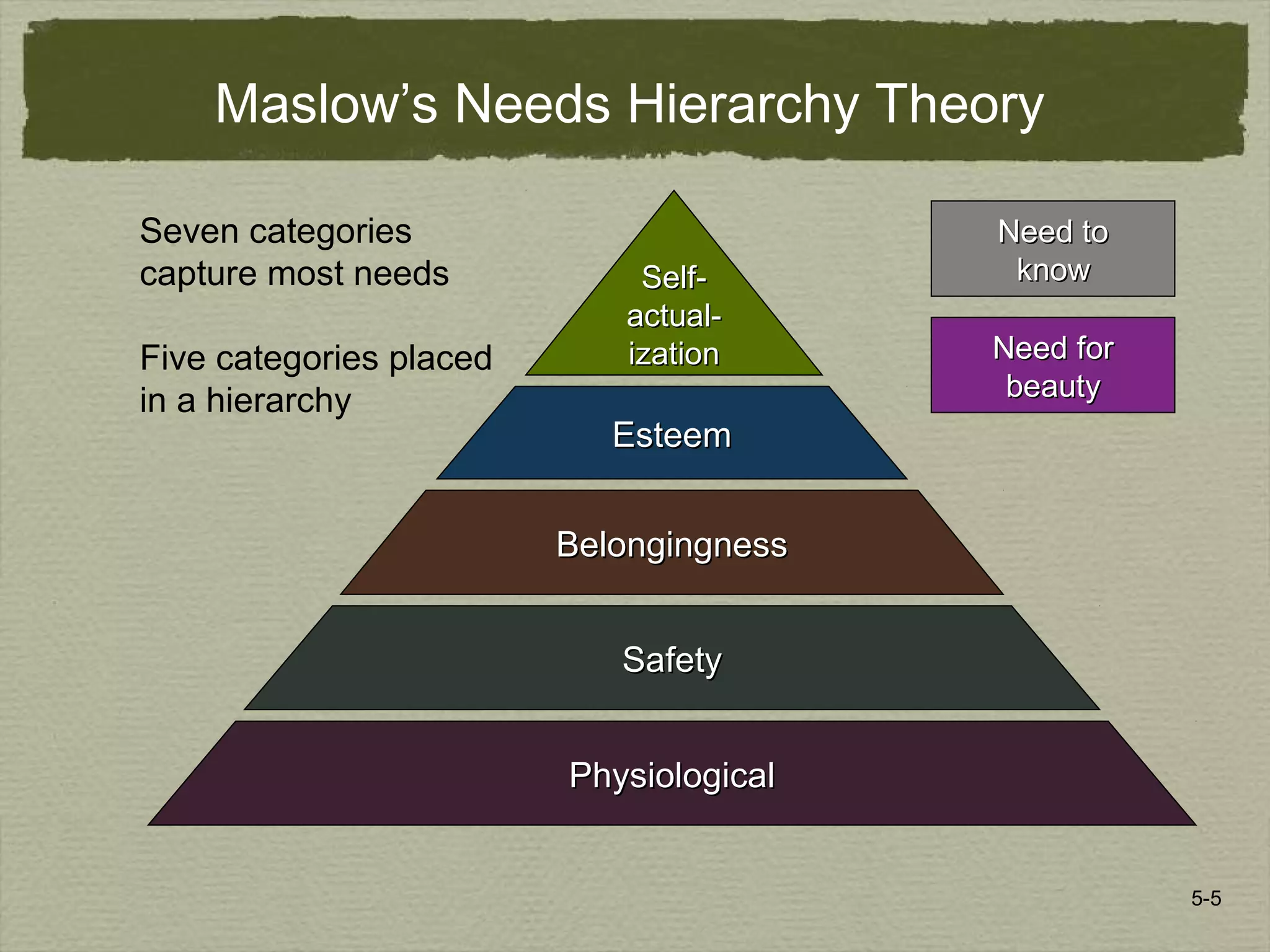
Self-Self-
actual-actual-
izationization
PhysiologicalPhysiological
SafetySafety
BelongingnessBelongingness
EsteemEsteem
Seven categories
capture most needs
Five categories placed
in a hierarchy
Need toNeed to
knowknow
Need forNeed for
beautybeauty
Maslow’s Needs Hierarchy Theory
5-6
Maslow’s Needs Hierarchy Theory
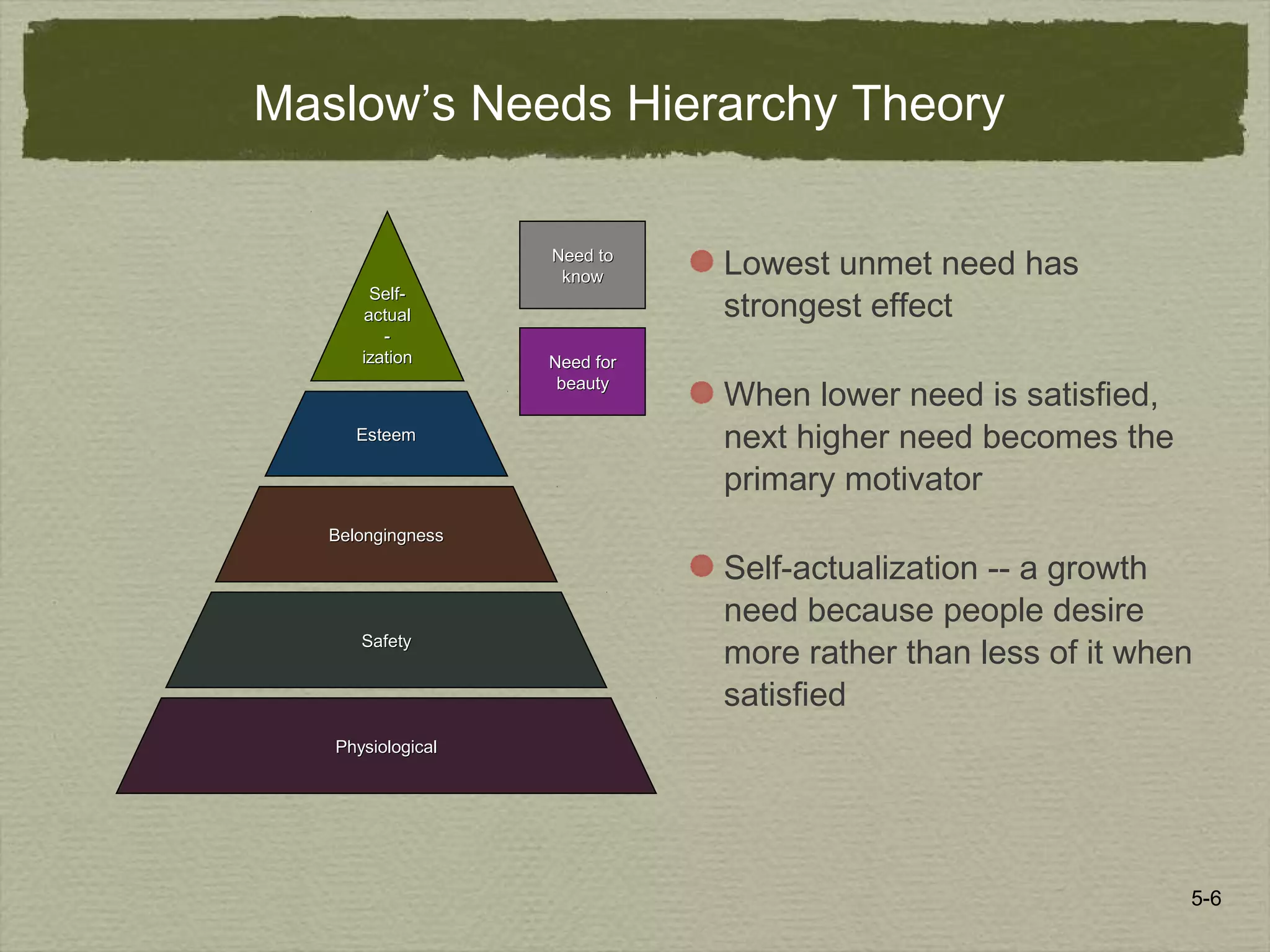
Lowest unmet need has
strongest effect
When lower need is satisfied,
next higher need becomes the
primary motivator
Self-actualization -- a growth
need because people desire
more rather than less of it when
satisfied
Self-Self-
actualactual
--
izationization
PhysiologicalPhysiological
SafetySafety
BelongingnessBelongingness
EsteemEsteem
Need toNeed to
knowknow
Need forNeed for
beautybeauty
5-7
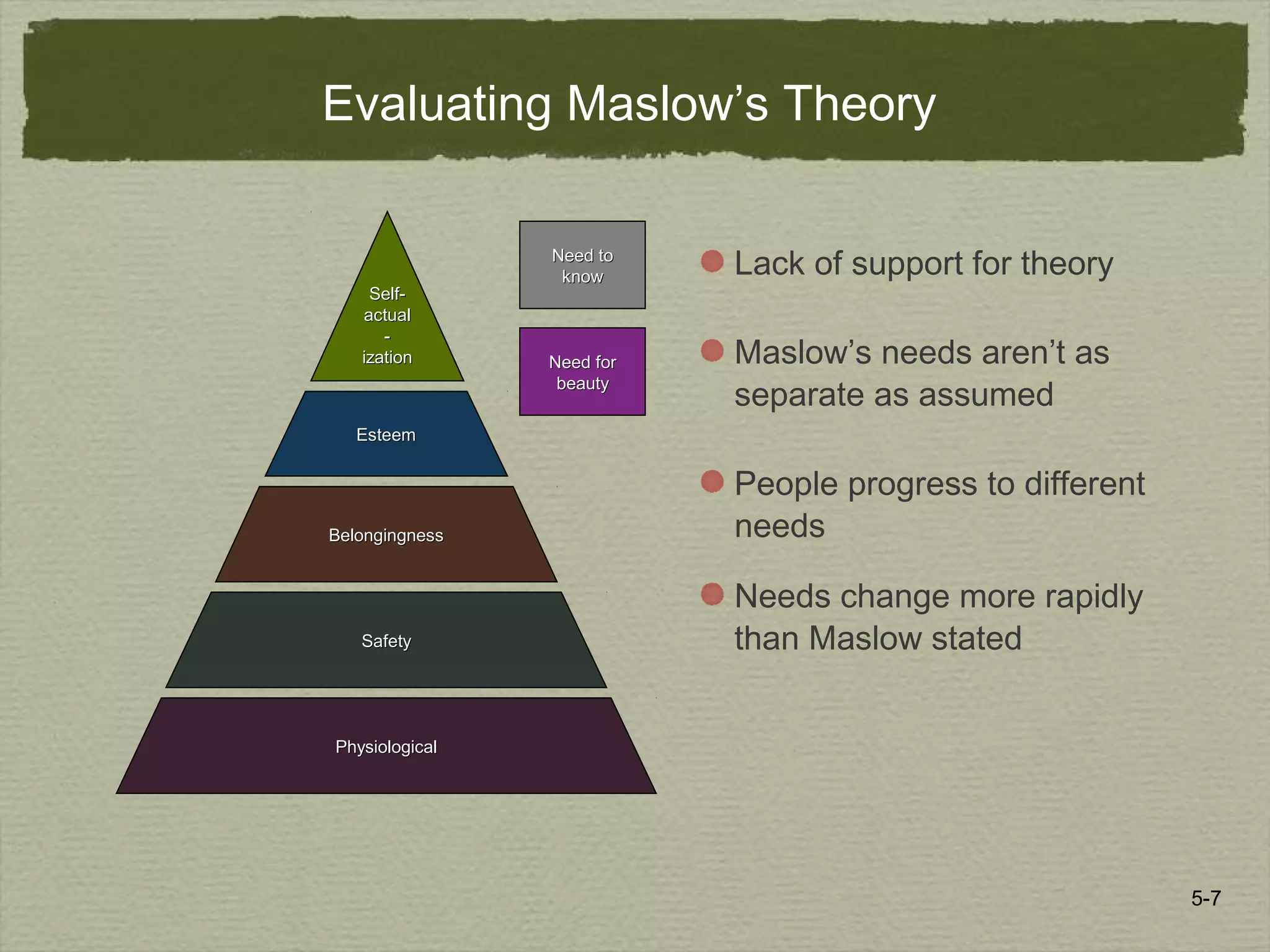
Evaluating Maslow’s Theory
Lack of support for theory
Maslow’s needs aren’t as
separate as assumed
People progress to different
needs
Needs change more rapidly
than Maslow stated
Self-Self-
actualactual
--
izationization
PhysiologicalPhysiological
SafetySafety
BelongingnessBelongingness
EsteemEsteem
Need toNeed to
knowknow
Need forNeed for
beautybeauty
5-8
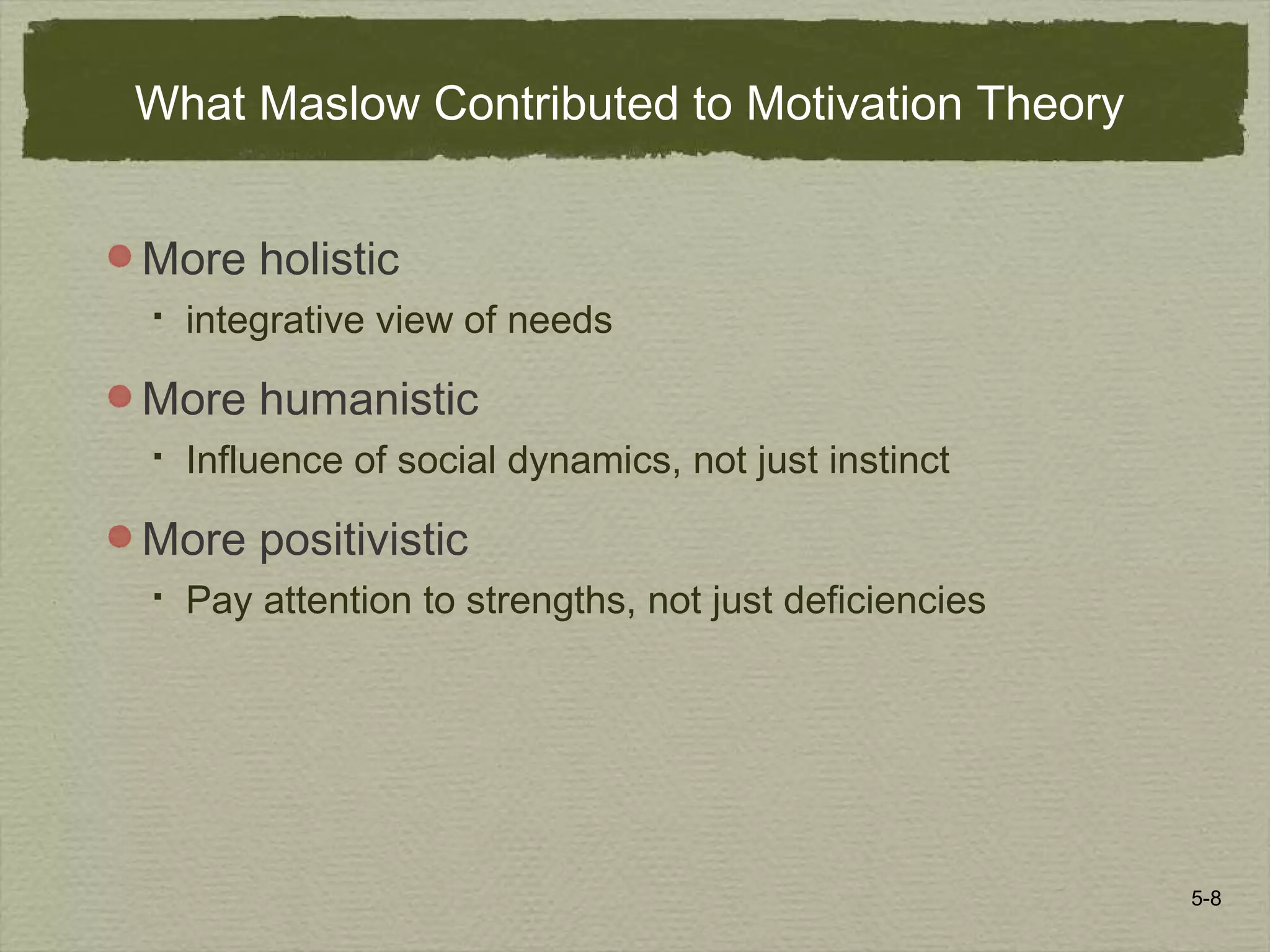
What Maslow Contributed to Motivation Theory
More holistic
 integrative view of needs
More humanistic
 Influence of social dynamics, not just instinct
More positivistic
 Pay attention to strengths, not just deficiencies
5-9
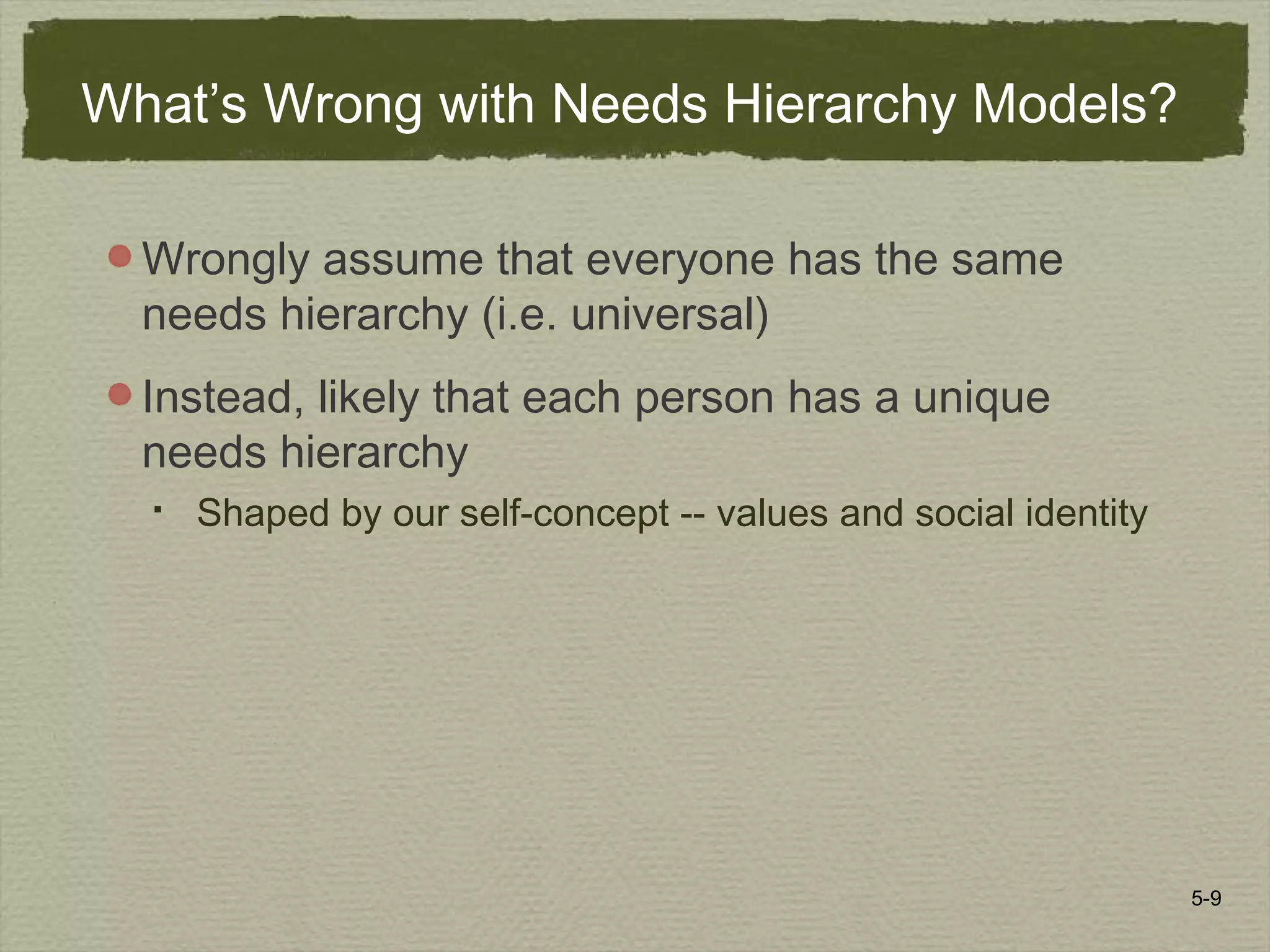
What’s Wrong with Needs Hierarchy Models?
Wrongly assume that everyone has the same
needs hierarchy (i.e. universal)
Instead, likely that each person has a unique
needs hierarchy
 Shaped by our self-concept -- values and social identity
5-10
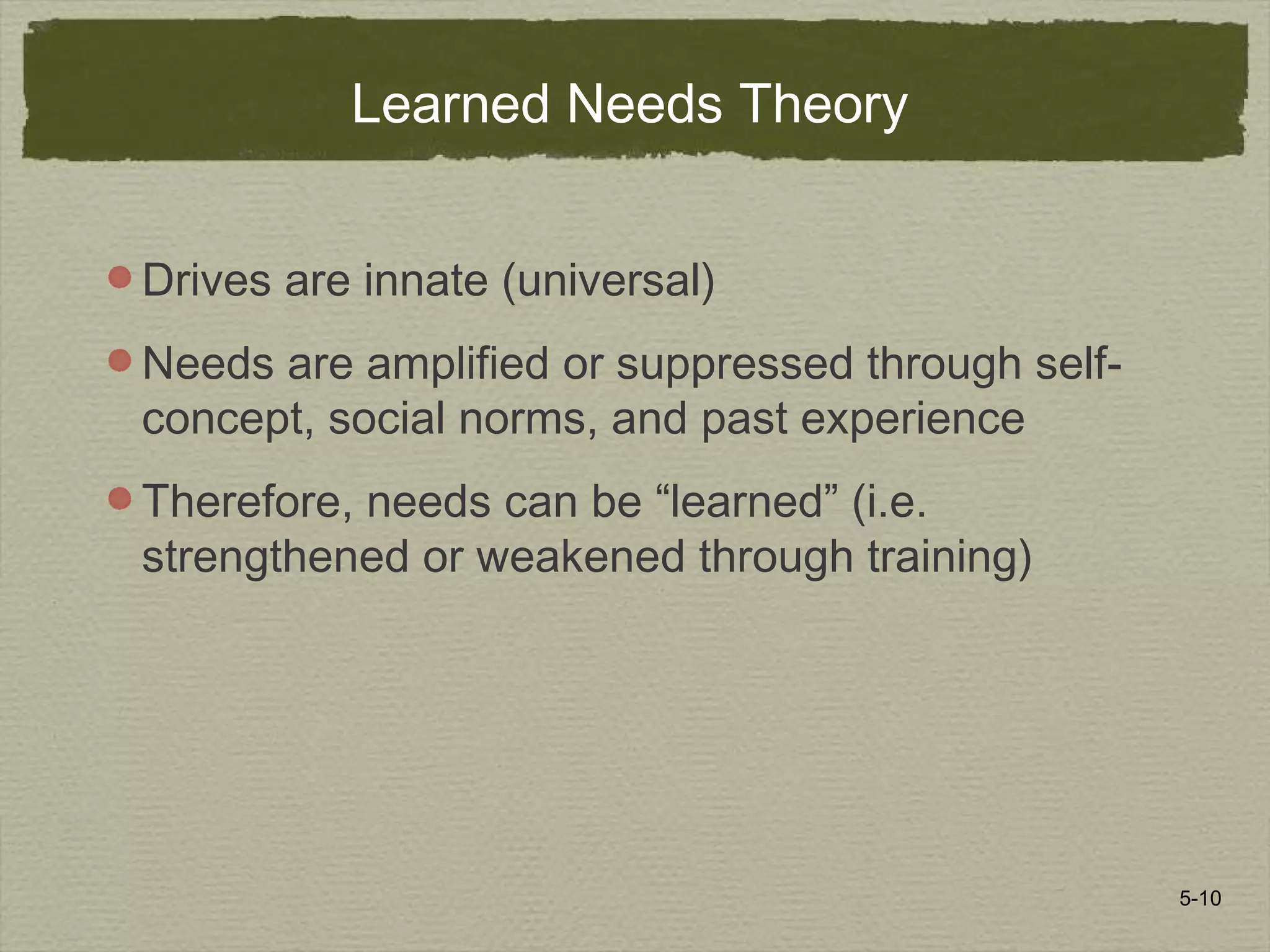
Learned Needs Theory
Drives are innate (universal)
Needs are amplified or suppressed through self-
concept, social norms, and past experience
Therefore, needs can be “learned” (i.e.
strengthened or weakened through training)
5-11
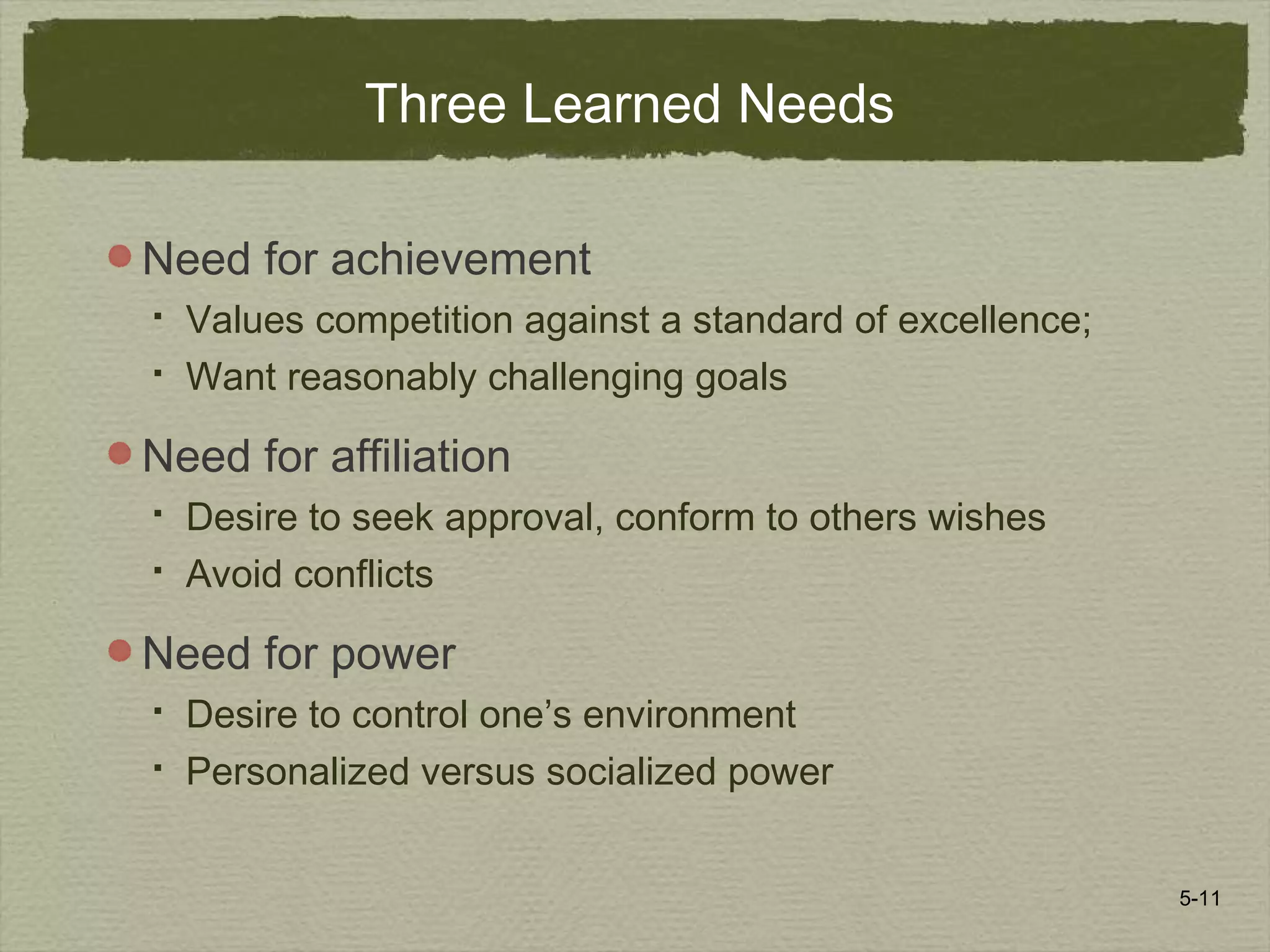
Three Learned Needs
Need for achievement
 Values competition against a standard of excellence;
 Want reasonably challenging goals
Need for affiliation
 Desire to seek approval, conform to others wishes
 Avoid conflicts
Need for power
 Desire to control one’s environment
 Personalized versus socialized power
5-12
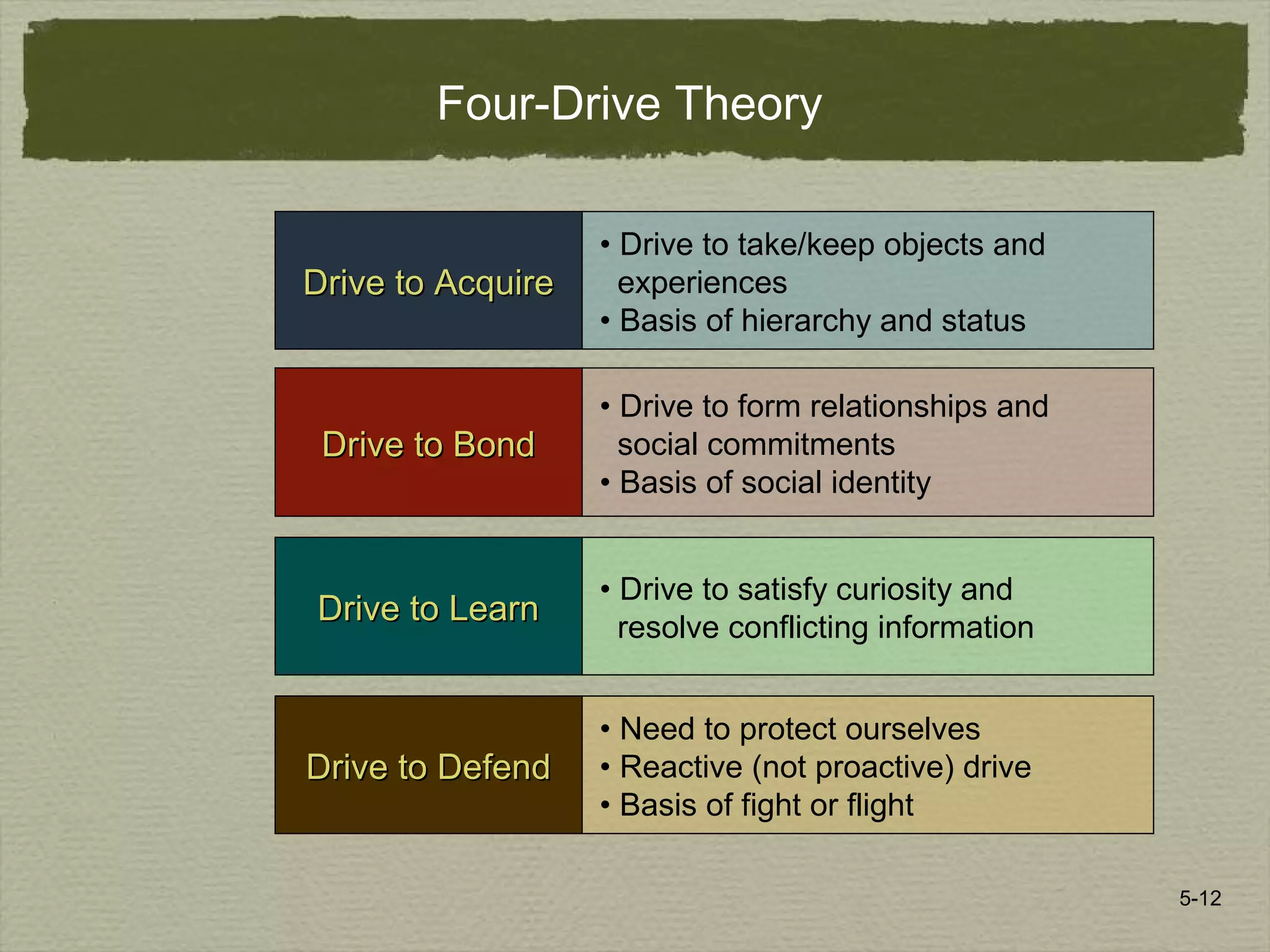
Four-Drive Theory
Drive to BondDrive to Bond
Drive to LearnDrive to Learn
• Drive to form relationships and
social commitments
• Basis of social identity
• Drive to satisfy curiosity and
resolve conflicting information
Drive to DefendDrive to Defend
• Need to protect ourselves
• Reactive (not proactive) drive
• Basis of fight or flight
Drive to AcquireDrive to Acquire
• Drive to take/keep objects and
experiences
• Basis of hierarchy and status
5-13
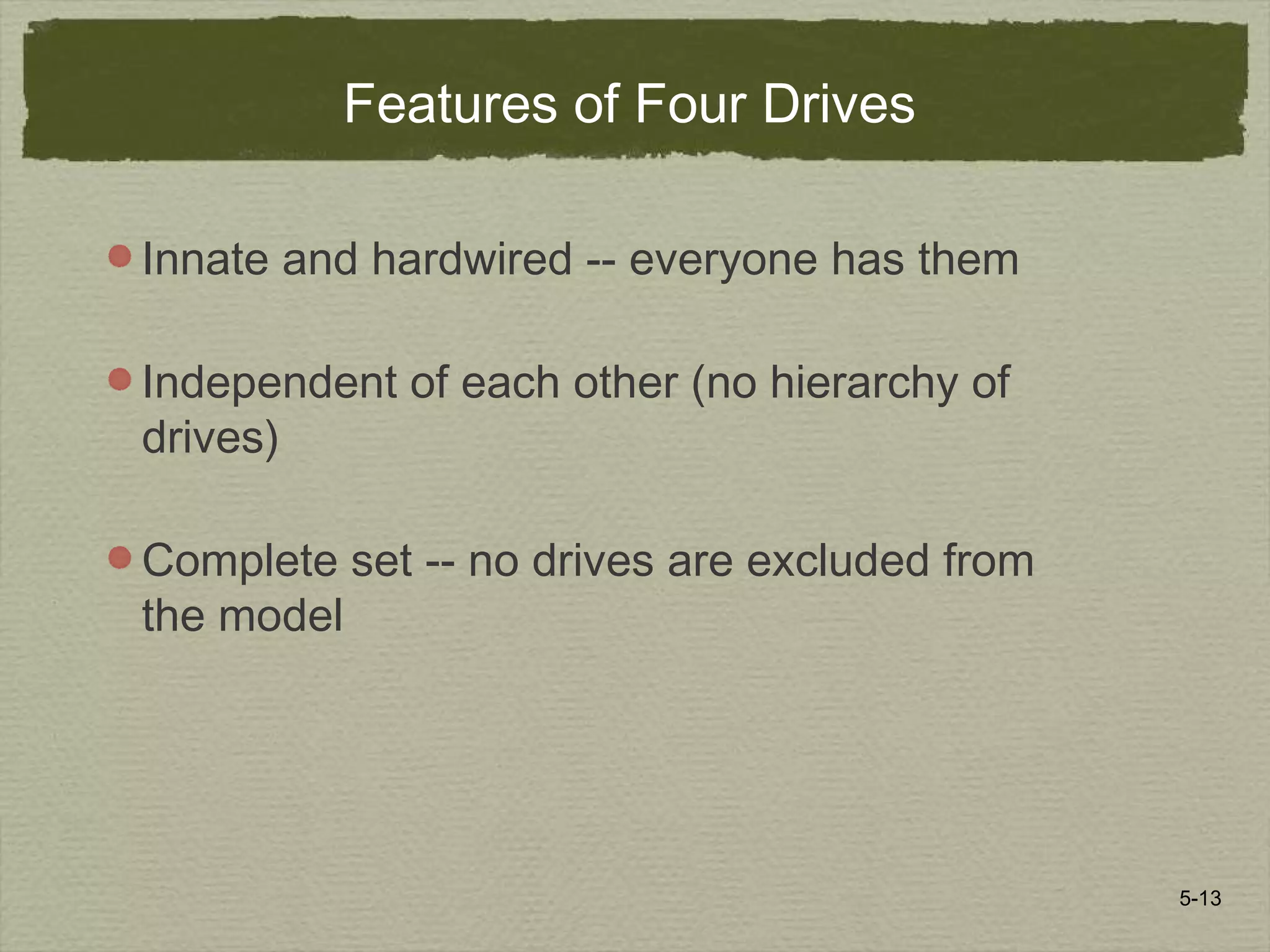
Features of Four Drives
Innate and hardwired -- everyone has them
Independent of each other (no hierarchy of
drives)
Complete set -- no drives are excluded from
the model
5-14
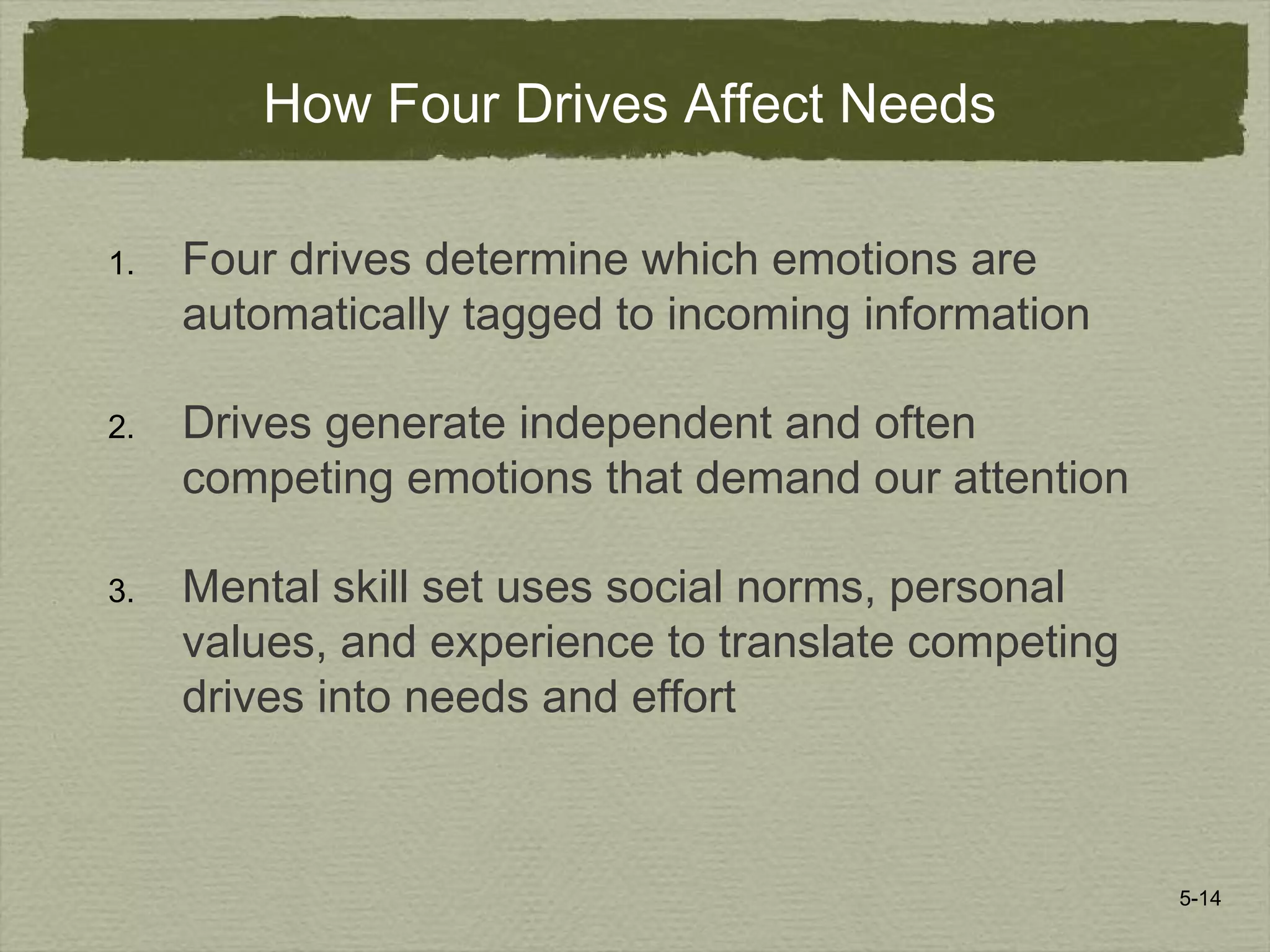
How Four Drives Affect Needs
1. Four drives determine which emotions are
automatically tagged to incoming information
2. Drives generate independent and often
competing emotions that demand our attention
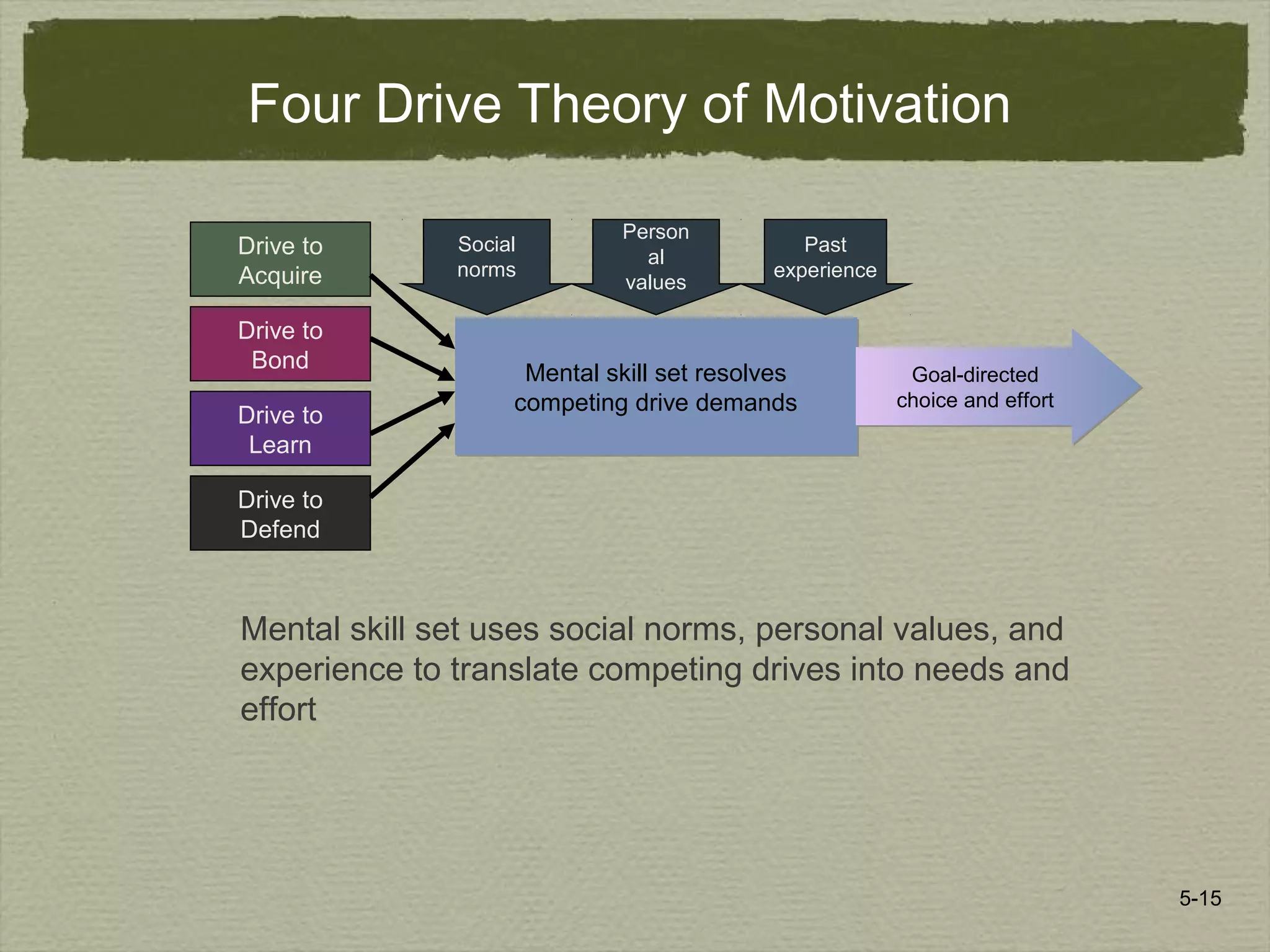
3. Mental skill set uses social norms, personal
values, and experience to translate competing
drives into needs and effort
5-15
Four Drive Theory of Motivation
Mental skill set uses social norms, personal values, and
experience to translate competing drives into needs and
effort
Drive to
Acquire
Social
norms
Drive to
Bond
Drive to
Learn
Drive to
Defend
Person
al
values
Past
experience
Mental skill set resolves
competing drive demands
Mental skill set resolves
competing drive demands
Goal-directed
choice and effort
Goal-directed
choice and effort
5-16
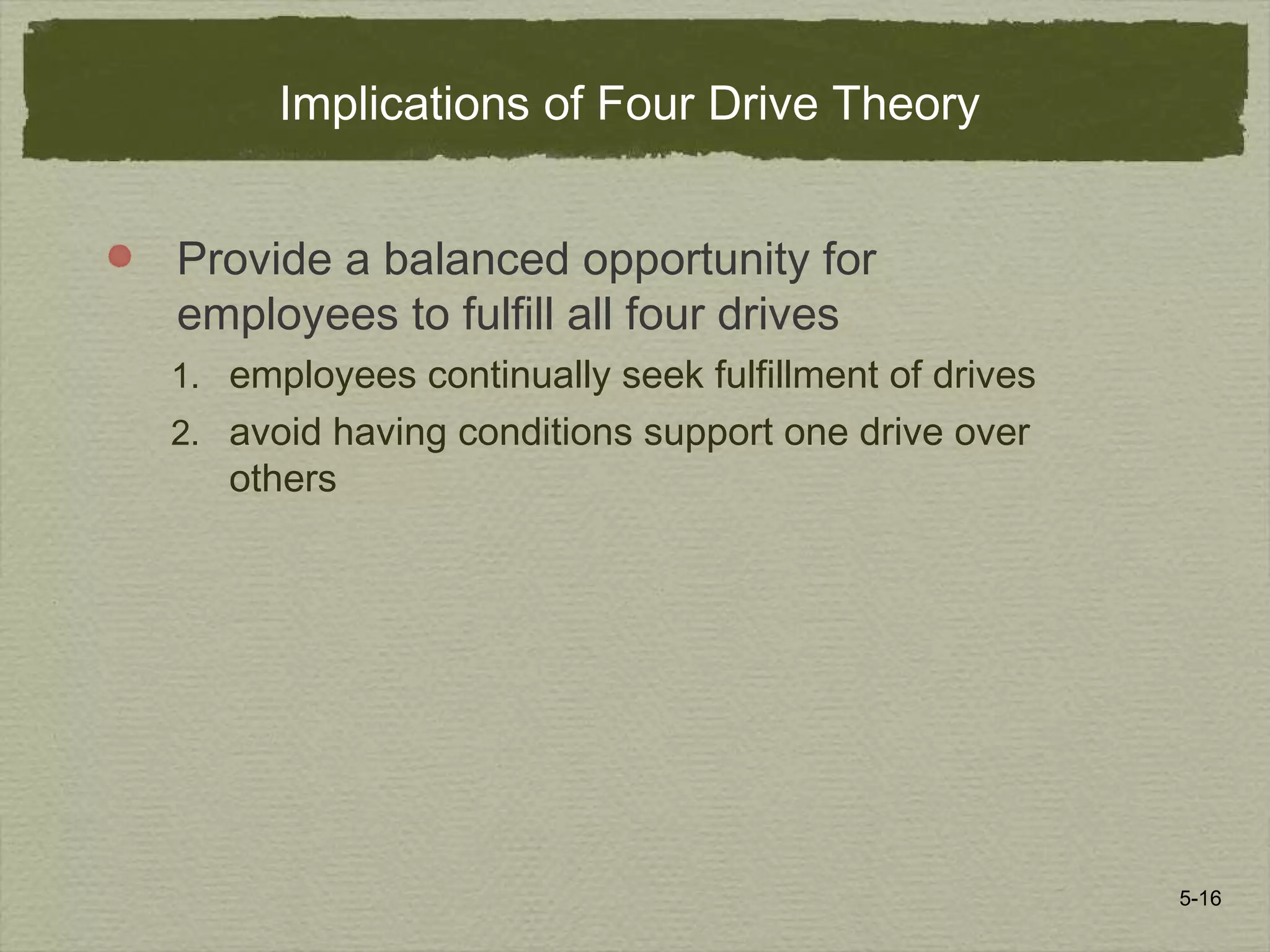
Implications of Four Drive Theory
Provide a balanced opportunity for
employees to fulfill all four drives
1. employees continually seek fulfillment of drives
2. avoid having conditions support one drive over
others
Copyright © 2009 by The McGraw-Hill Companies, Inc. All rights reserved.McGraw-Hill/Irwin
Expectancy Theory
of Motivation
Employee Motivation:
Foundations and Practices
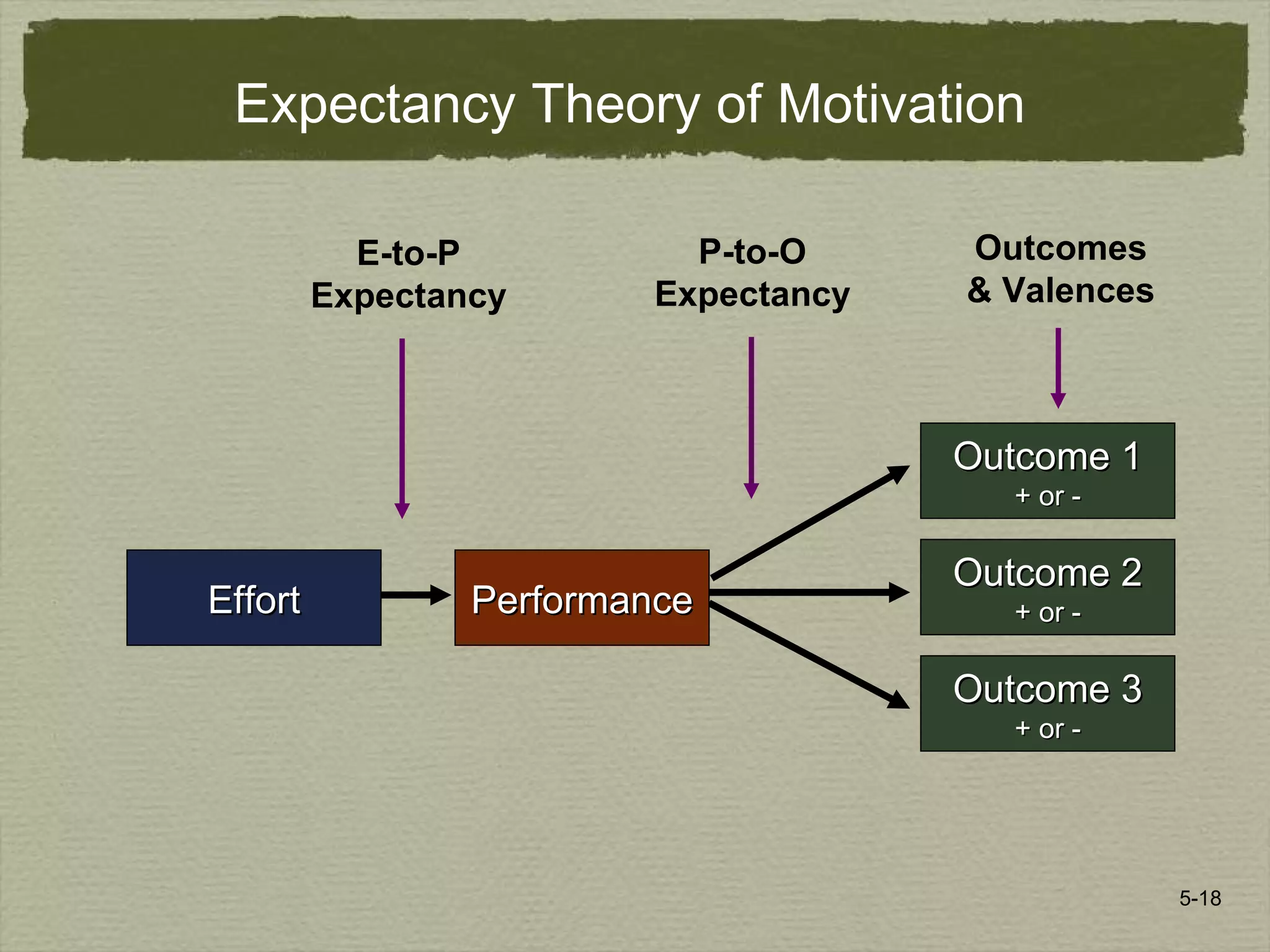
5-18
E-to-P
Expectancy
P-to-O
Expectancy
Outcomes
& Valences
Outcome 1Outcome 1
+ or -+ or -
EffortEffort PerformancePerformance
Outcome 3Outcome 3
+ or -+ or -
Outcome 2Outcome 2
+ or -+ or -
Expectancy Theory of Motivation
5-19
Increasing E-to-P-to-O Expectancies
Increasing E-to-P Expectancies
 Assuring employees they have competencies
 Person-job matching
 Provide role clarification and sufficient resources
 Behavioral modeling
Increading P-to-O Expectancies
 Measure performance accurately
 More rewards for good performance
 Explain how rewards are linked to performance
5-20
Increasing Outcome Valences
Ensure that rewards are valued
Individualize rewards
Minimize countervalent outcomes
Copyright © 2009 by The McGraw-Hill Companies, Inc. All rights reserved.McGraw-Hill/Irwin
Goal Setting and
Feedback
Employee Motivation:
Foundations and Practices
5-22
Effective Goal Setting
The process of motivating employees and
clarifying their role perceptions by establishing
performance objectives
Effective goals are:
 Specific
 Relevant
 Challenging
 Commitment
 Participation (sometimes)
 Feedback
5-23
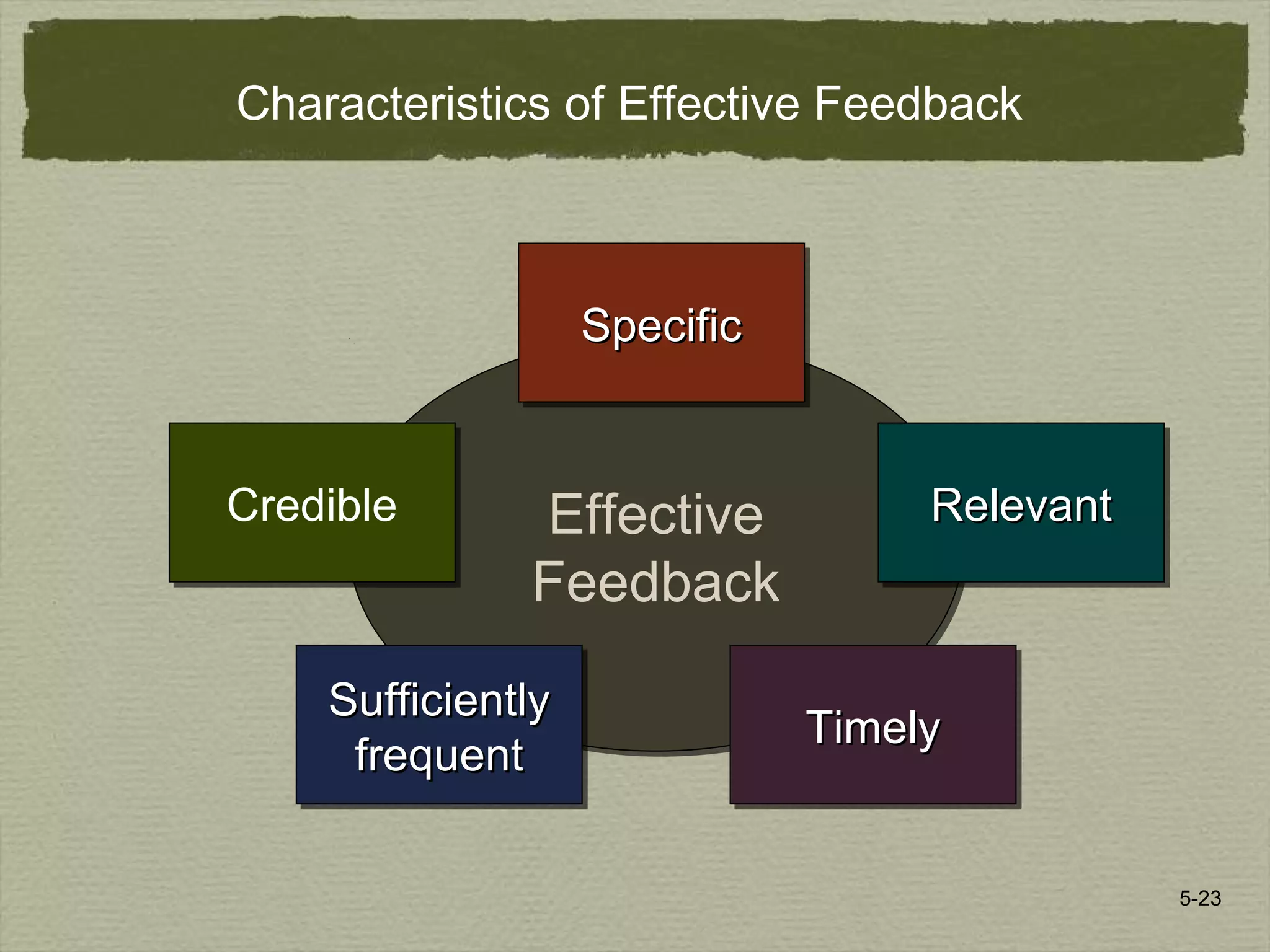
Characteristics of Effective Feedback
Effective
Feedback
Effective
Feedback
SpecificSpecificSpecificSpecific
RelevantRelevantRelevantRelevant
TimelyTimelyTimelyTimely
CredibleCredible
SufficientlySufficiently
frequentfrequent
SufficientlySufficiently
frequentfrequent
5-24
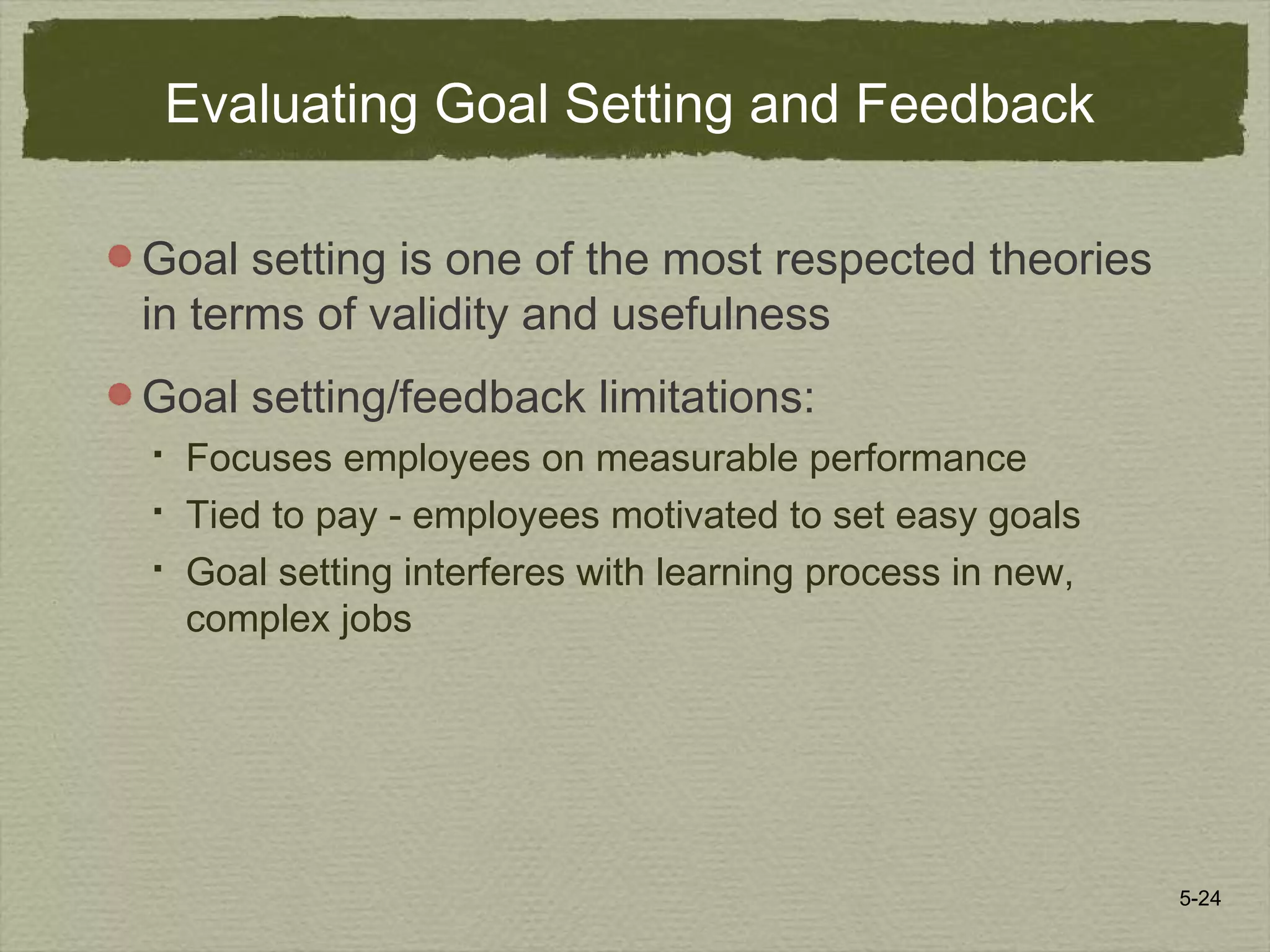
Evaluating Goal Setting and Feedback
Goal setting is one of the most respected theories
in terms of validity and usefulness
Goal setting/feedback limitations:
 Focuses employees on measurable performance
 Tied to pay - employees motivated to set easy goals
 Goal setting interferes with learning process in new,
complex jobs
Copyright © 2009 by The McGraw-Hill Companies, Inc. All rights reserved.McGraw-Hill/Irwin
Organizational
Justice
Employee Motivation:
Foundations and Practices
5-26
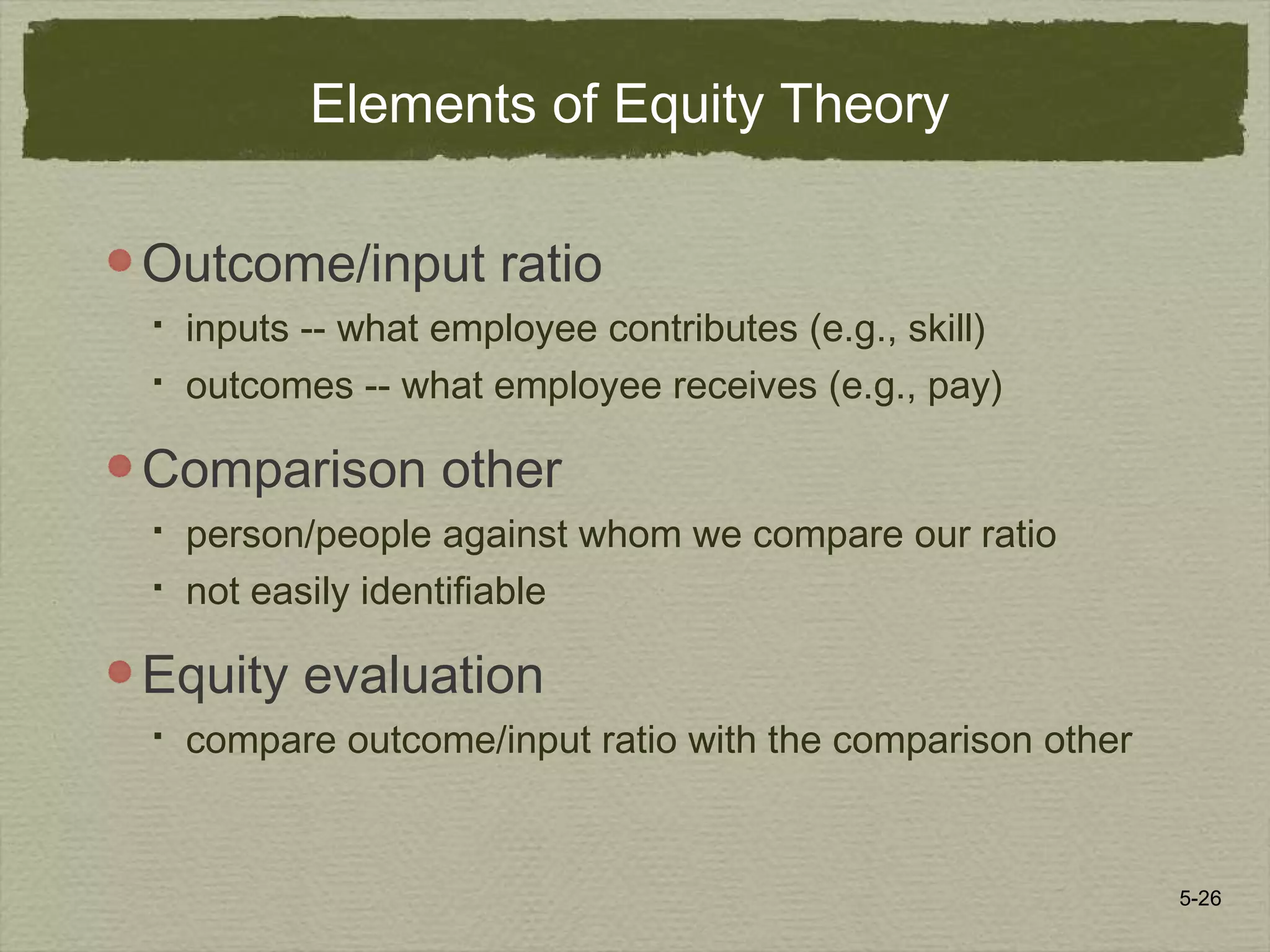
Elements of Equity Theory
Outcome/input ratio
 inputs -- what employee contributes (e.g., skill)
 outcomes -- what employee receives (e.g., pay)
Comparison other
 person/people against whom we compare our ratio
 not easily identifiable
Equity evaluation
 compare outcome/input ratio with the comparison other
5-27
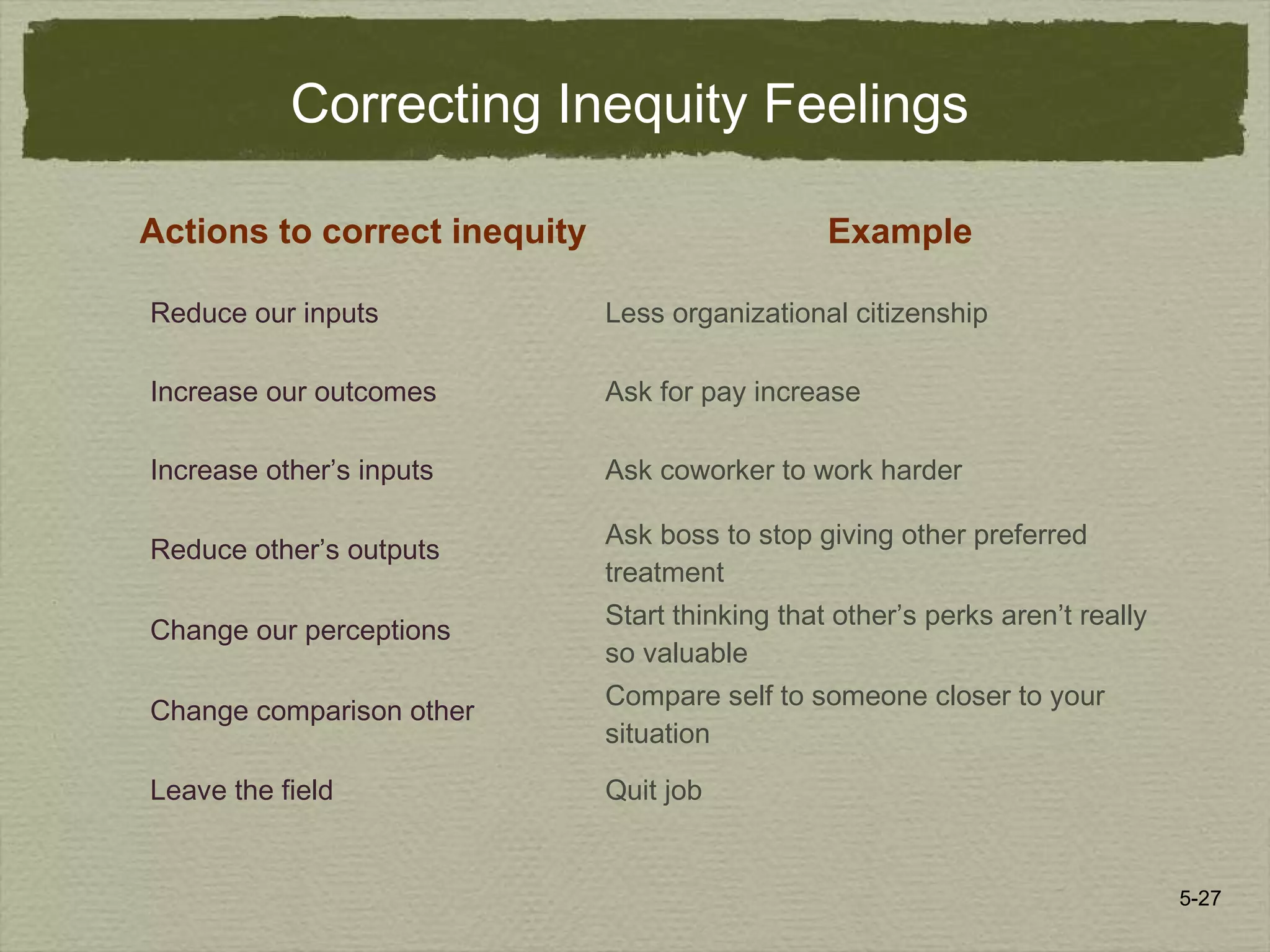
Correcting Inequity Feelings
Reduce our inputs Less organizational citizenship
Increase our outcomes Ask for pay increase
Increase other’s inputs Ask coworker to work harder
Reduce other’s outputs
Ask boss to stop giving other preferred
treatment
Change our perceptions
Start thinking that other’s perks aren’t really
so valuable
Change comparison other
Compare self to someone closer to your
situation
Leave the field Quit job
Actions to correct inequity Example
5-28
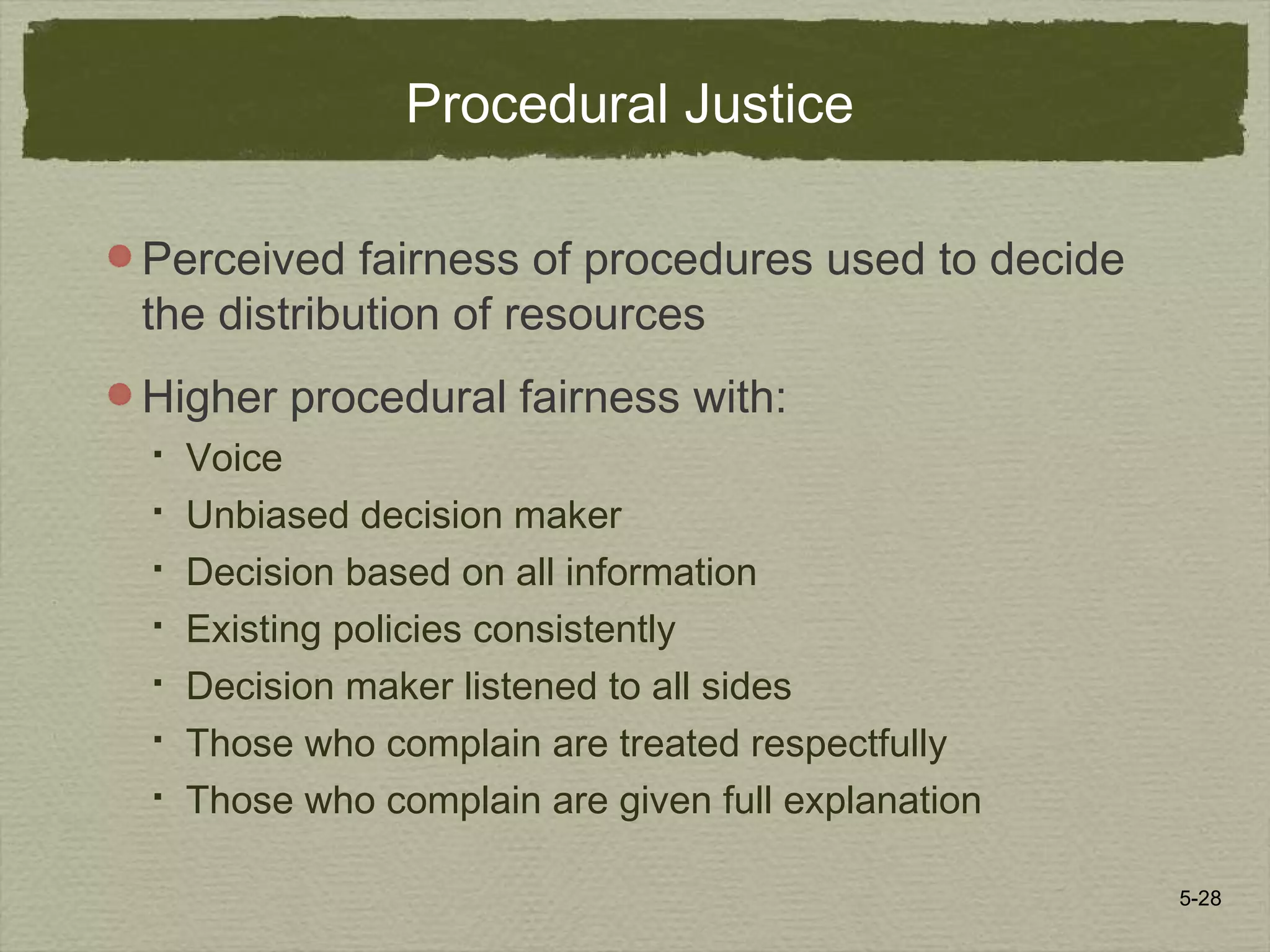
Procedural Justice
Perceived fairness of procedures used to decide
the distribution of resources
Higher procedural fairness with:
 Voice
 Unbiased decision maker
 Decision based on all information
 Existing policies consistently
 Decision maker listened to all sides
 Those who complain are treated respectfully
 Those who complain are given full explanation
Copyright © 2009 by The McGraw-Hill Companies, Inc. All rights reserved.McGraw-Hill/Irwin
Job Design and
Empowerment
Employee Motivation:
Foundations and Practices
5-30
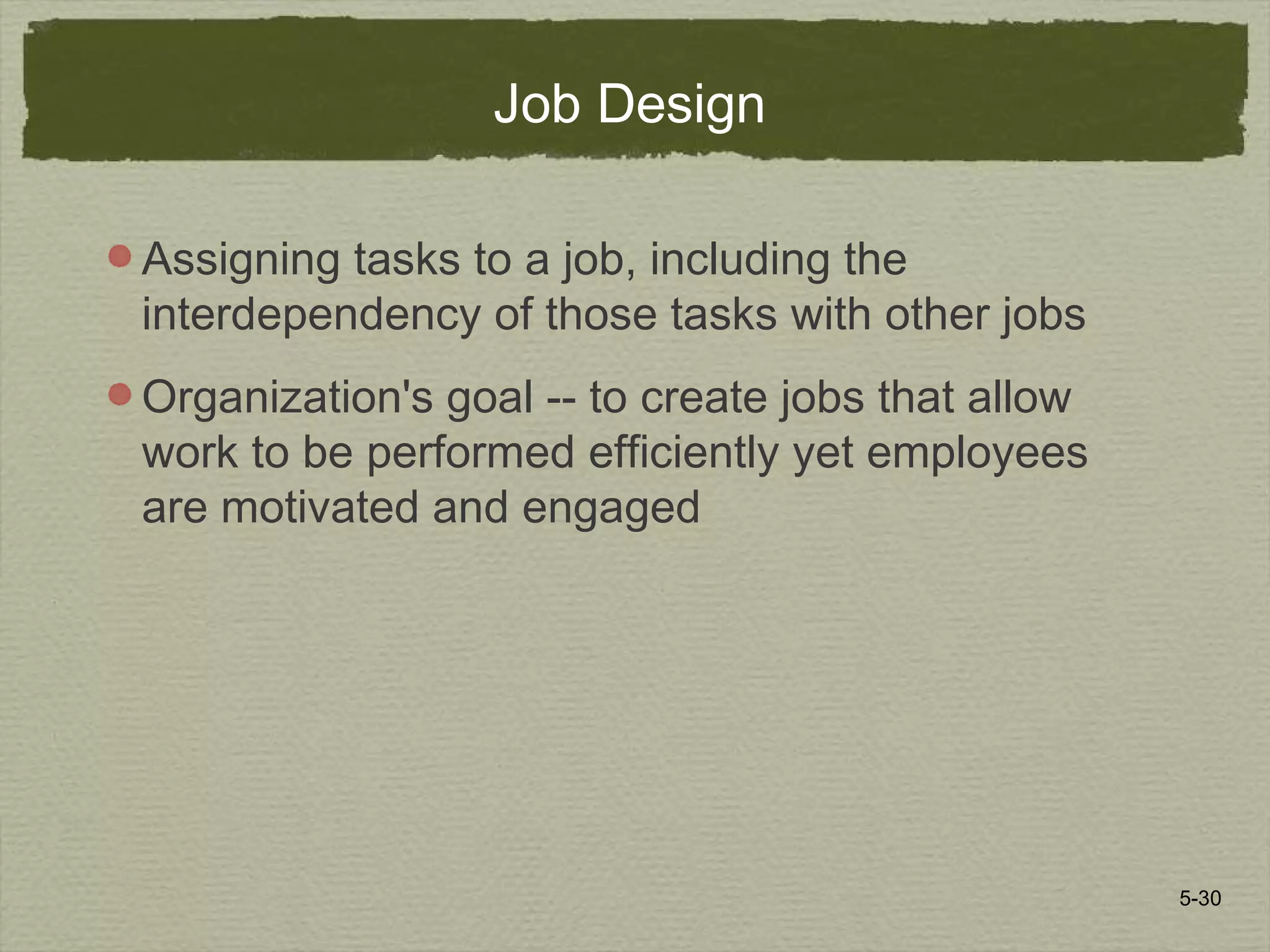
Job Design
Assigning tasks to a job, including the
interdependency of those tasks with other jobs
Organization's goal -- to create jobs that allow
work to be performed efficiently yet employees
are motivated and engaged
5-31
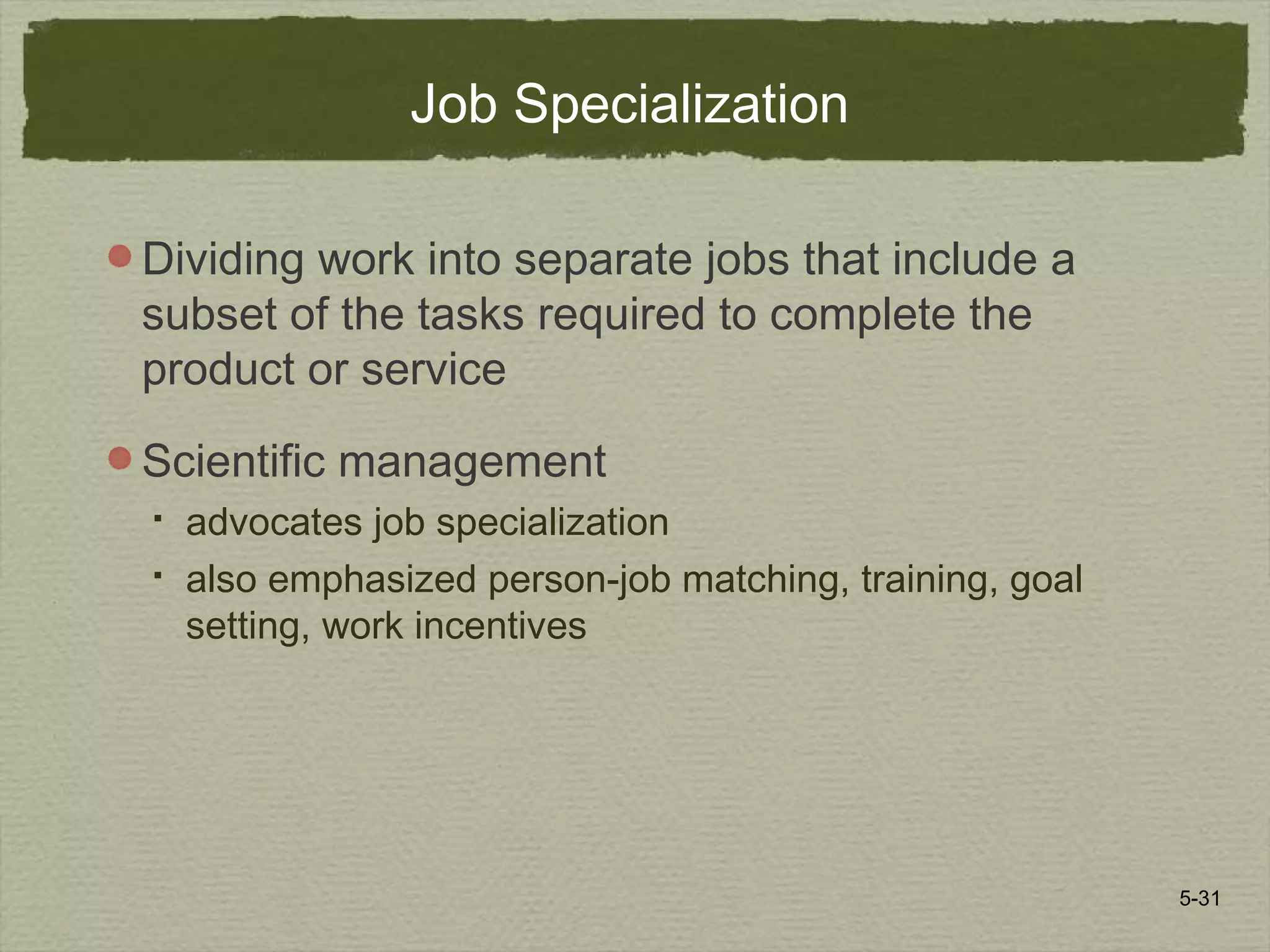
Job Specialization
Dividing work into separate jobs that include a
subset of the tasks required to complete the
product or service
Scientific management
 advocates job specialization
 also emphasized person-job matching, training, goal
setting, work incentives
5-32
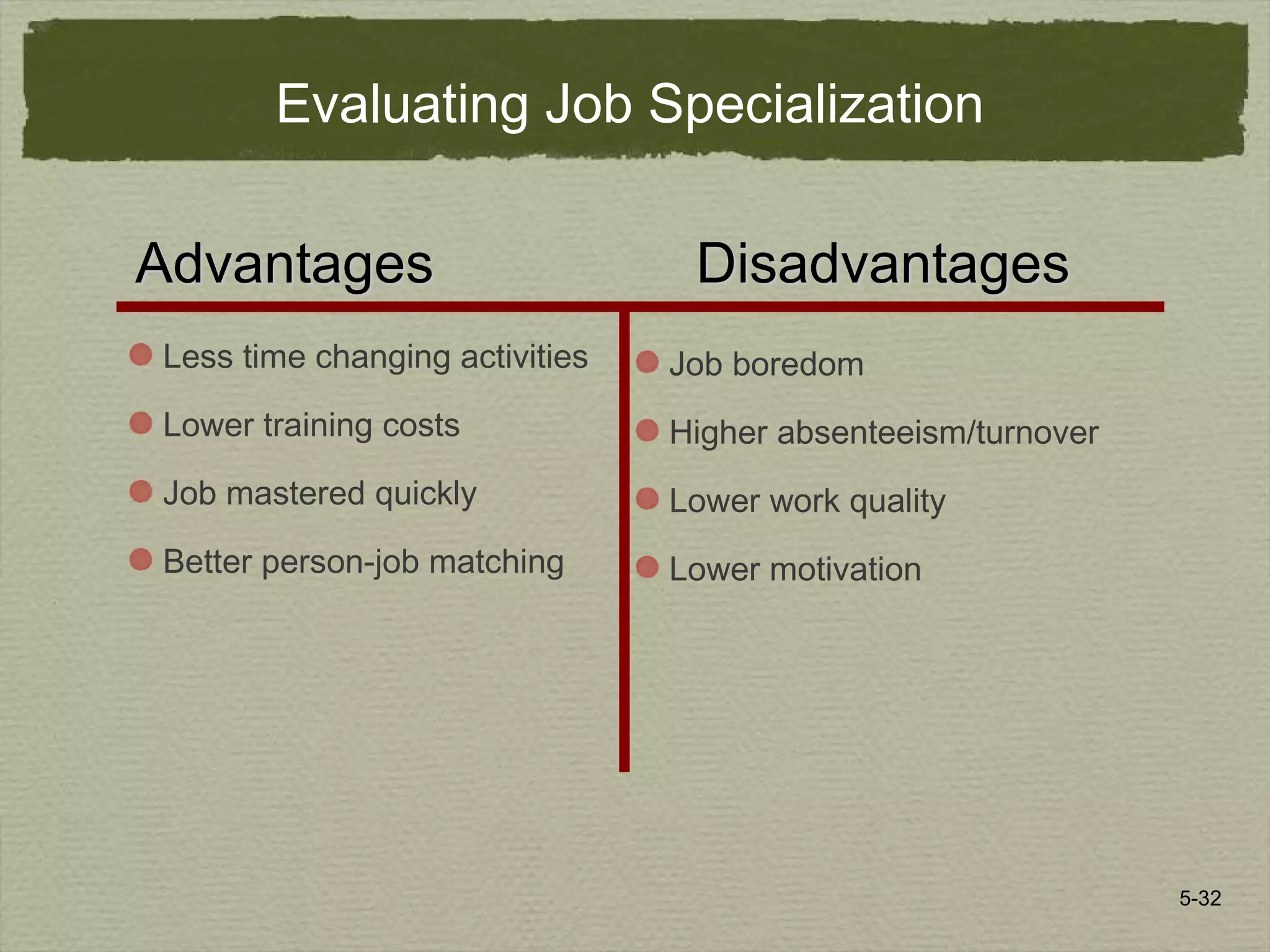
AdvantagesAdvantages DisadvantagesDisadvantages
Evaluating Job Specialization
Less time changing activities
Lower training costs
Job mastered quickly
Better person-job matching
Job boredom
Higher absenteeism/turnover
Lower work quality
Lower motivation
5-33
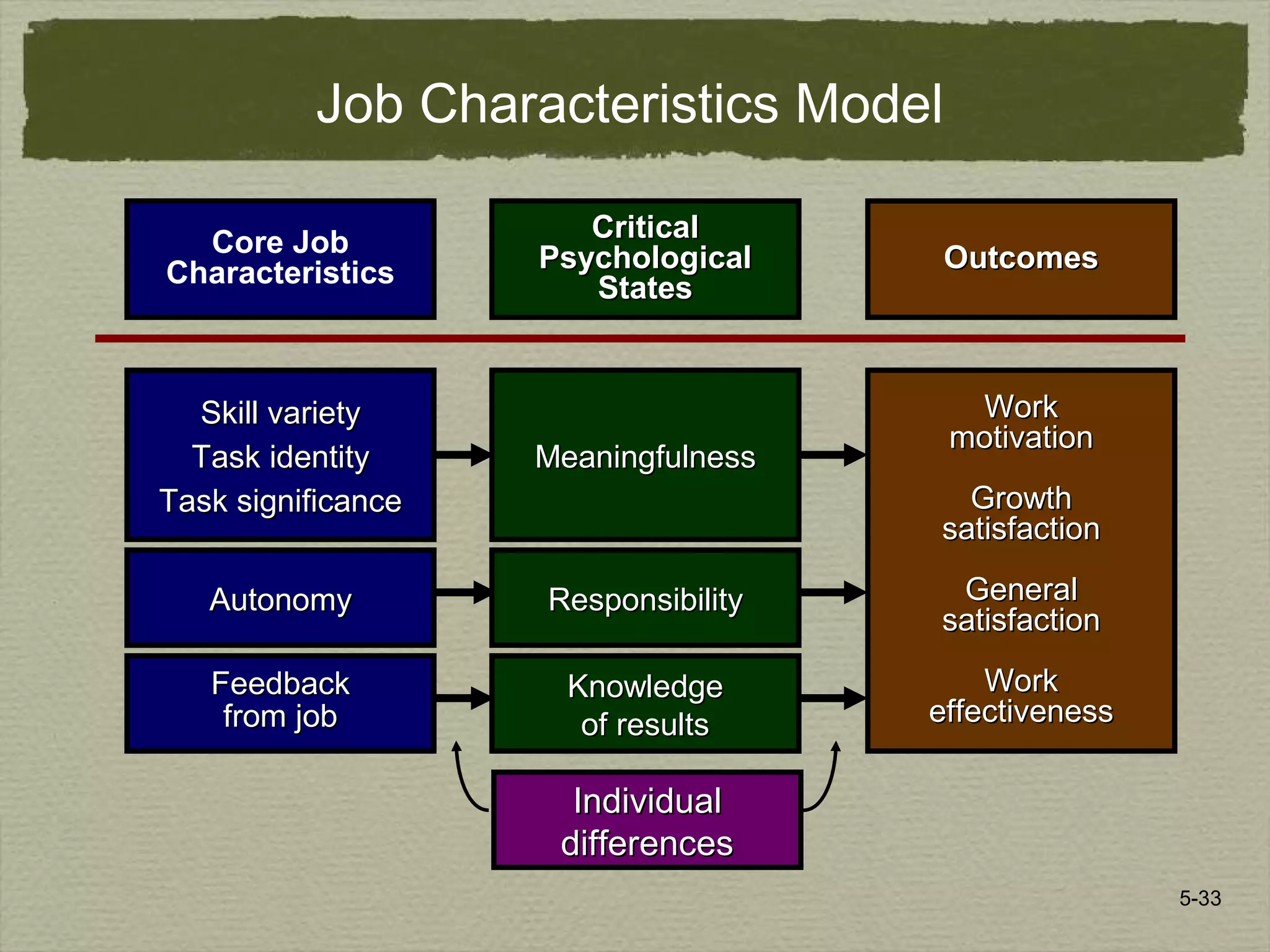
WorkWork
motivationmotivation
GrowthGrowth
satisfactionsatisfaction
GeneralGeneral
satisfactionsatisfaction
WorkWork
effectivenesseffectiveness
Job Characteristics Model
FeedbackFeedback
from jobfrom job
KnowledgeKnowledge
of resultsof results
Skill varietySkill variety
Task identityTask identity
Task significanceTask significance
MeaningfulnessMeaningfulness
AutonomyAutonomy ResponsibilityResponsibility
IndividualIndividual
differencesdifferences
CriticalCritical
PsychologicalPsychological
StatesStates
Core Job
Characteristics OutcomesOutcomes
5-34
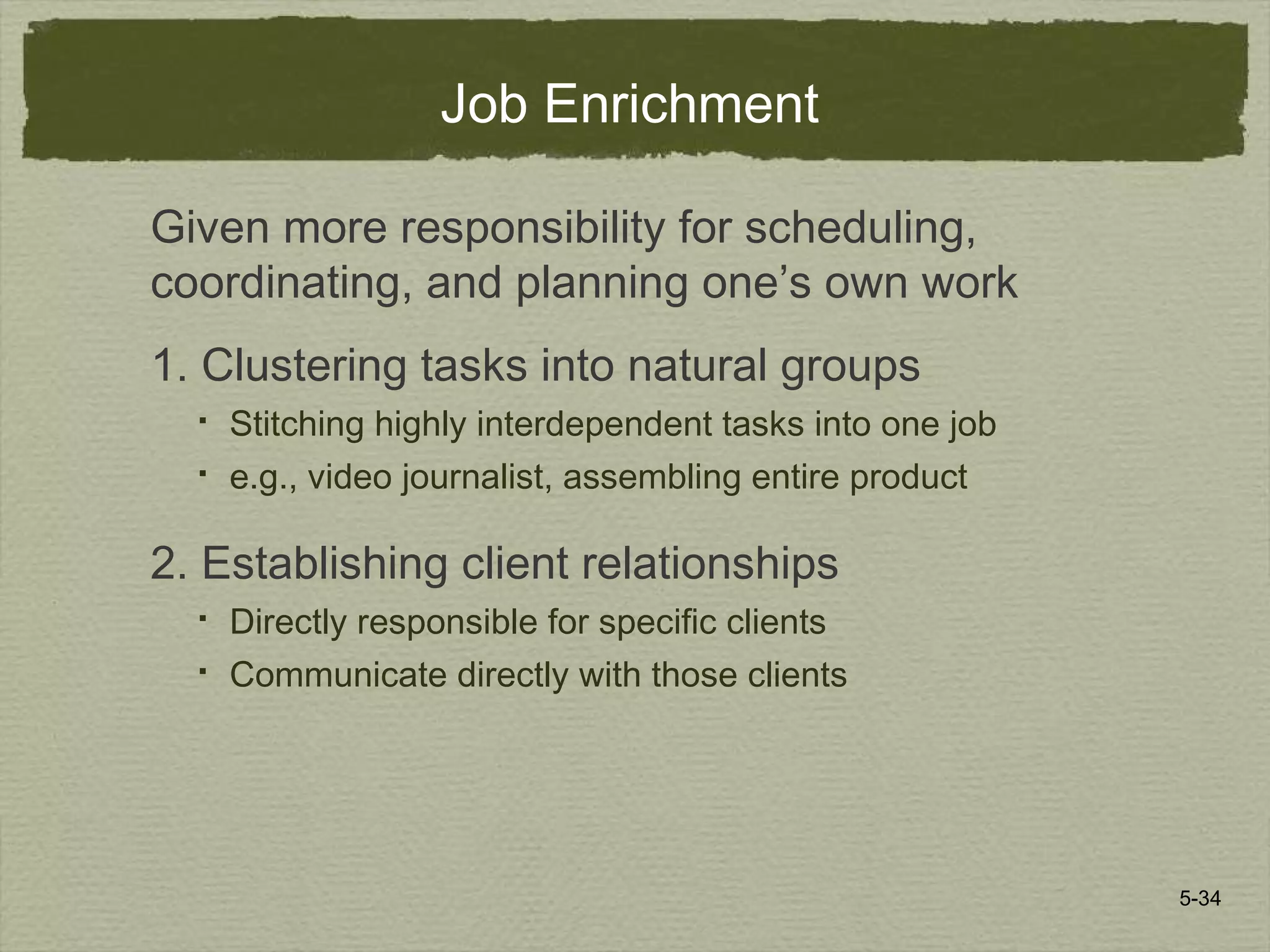
Job Enrichment
Given more responsibility for scheduling,
coordinating, and planning one’s own work
1. Clustering tasks into natural groups
 Stitching highly interdependent tasks into one job
 e.g., video journalist, assembling entire product
2. Establishing client relationships
 Directly responsible for specific clients
 Communicate directly with those clients
5-35
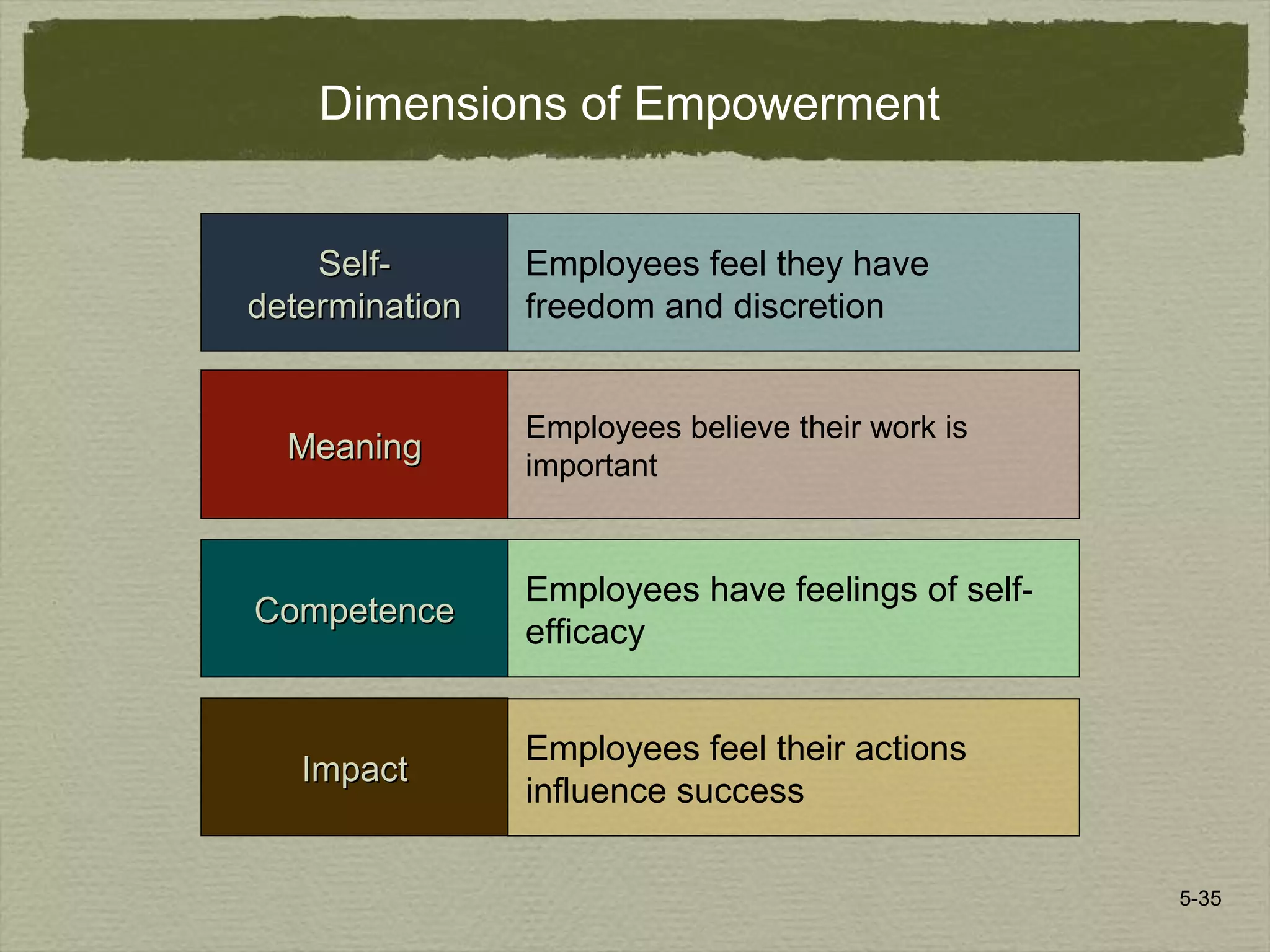
Dimensions of Empowerment
MeaningMeaning
CompetenceCompetence
Employees believe their work is
important
Employees have feelings of self-
efficacy
ImpactImpact
Employees feel their actions
influence success
Self-Self-
determinationdetermination
Employees feel they have
freedom and discretion
5-36
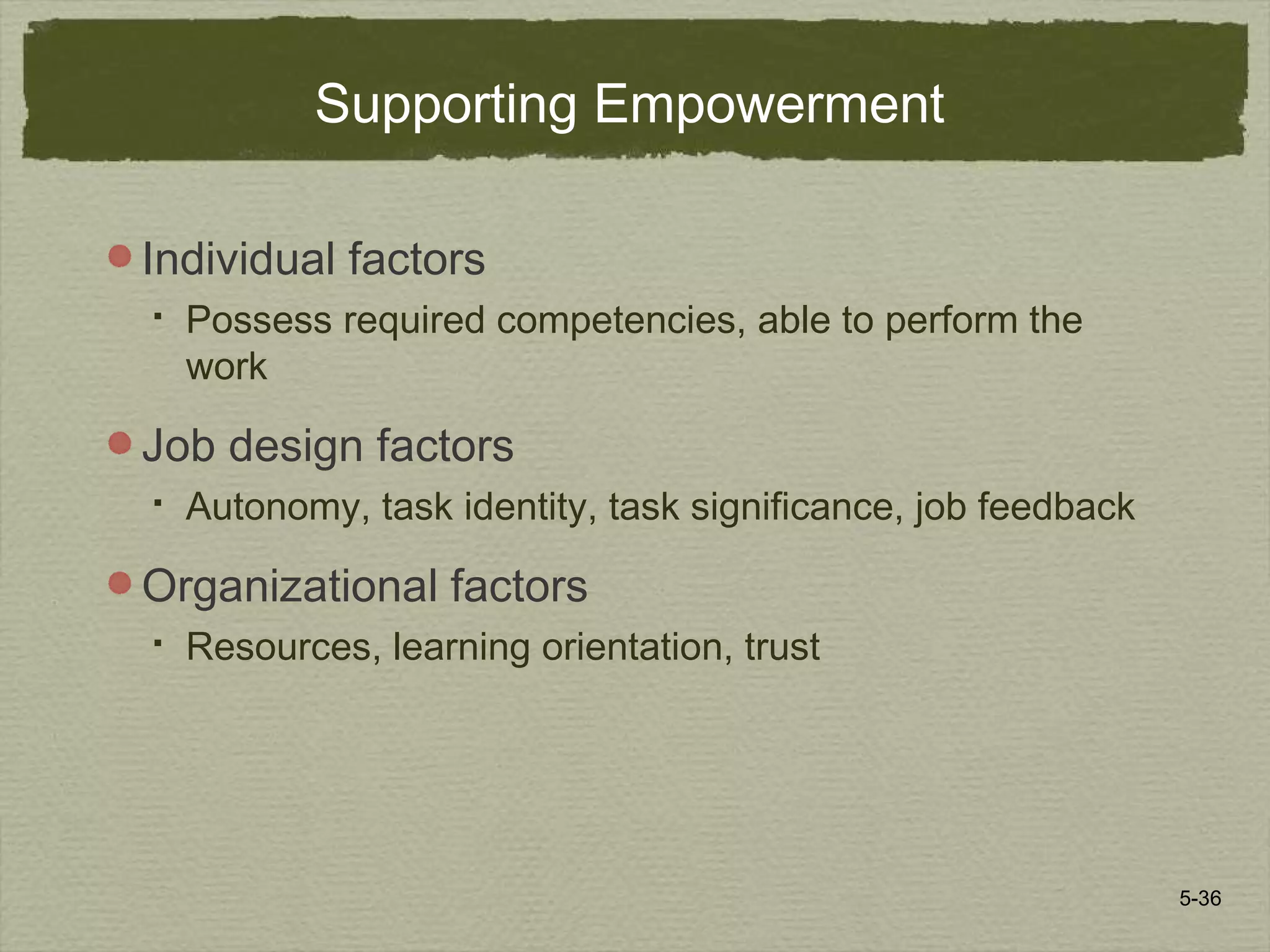
Supporting Empowerment
Individual factors
 Possess required competencies, able to perform the
work
Job design factors
 Autonomy, task identity, task significance, job feedback
Organizational factors
 Resources, learning orientation, trust

Employee motivation foundations and practices

  • 1.
    Copyright © 2009by The McGraw-Hill Companies, Inc. All rights reserved.McGraw-Hill/Irwin Employee Motivation: Foundations and Practices
  • 2.
    5-2 Motivation Defined The forceswithin a person that affect the direction, intensity, and persistence of voluntary behavior Exerting particular effort level (intensity), for a certain amount of time (persistence), toward a particular goal (direction).
  • 3.
    5-3 Drives and Needs Drives(aka-primary needs, fundamental needs, innate motives)  Neural states that energize individuals to correct deficiencies or maintain an internal equilibrium  Prime movers of behavior by activating emotions Self-concept, social norms, and past experience Drives (primary needs) Needs Decisions and Behavior
  • 4.
    5-4 Drives and Needs Needs Goal-directed forces that people experience.  Drive-generated emotions directed toward goals  Goals formed by self-concept, social norms, and experience Self-concept, social norms, and past experience Drives (primary needs) Needs Decisions and Behavior
  • 5.
    5-5 Self-Self- actual-actual- izationization PhysiologicalPhysiological SafetySafety BelongingnessBelongingness EsteemEsteem Seven categories capture mostneeds Five categories placed in a hierarchy Need toNeed to knowknow Need forNeed for beautybeauty Maslow’s Needs Hierarchy Theory
  • 6.
    5-6 Maslow’s Needs HierarchyTheory Lowest unmet need has strongest effect When lower need is satisfied, next higher need becomes the primary motivator Self-actualization -- a growth need because people desire more rather than less of it when satisfied Self-Self- actualactual -- izationization PhysiologicalPhysiological SafetySafety BelongingnessBelongingness EsteemEsteem Need toNeed to knowknow Need forNeed for beautybeauty
  • 7.
    5-7 Evaluating Maslow’s Theory Lackof support for theory Maslow’s needs aren’t as separate as assumed People progress to different needs Needs change more rapidly than Maslow stated Self-Self- actualactual -- izationization PhysiologicalPhysiological SafetySafety BelongingnessBelongingness EsteemEsteem Need toNeed to knowknow Need forNeed for beautybeauty
  • 8.
    5-8 What Maslow Contributedto Motivation Theory More holistic  integrative view of needs More humanistic  Influence of social dynamics, not just instinct More positivistic  Pay attention to strengths, not just deficiencies
  • 9.
    5-9 What’s Wrong withNeeds Hierarchy Models? Wrongly assume that everyone has the same needs hierarchy (i.e. universal) Instead, likely that each person has a unique needs hierarchy  Shaped by our self-concept -- values and social identity
  • 10.
    5-10 Learned Needs Theory Drivesare innate (universal) Needs are amplified or suppressed through self- concept, social norms, and past experience Therefore, needs can be “learned” (i.e. strengthened or weakened through training)
  • 11.
    5-11 Three Learned Needs Needfor achievement  Values competition against a standard of excellence;  Want reasonably challenging goals Need for affiliation  Desire to seek approval, conform to others wishes  Avoid conflicts Need for power  Desire to control one’s environment  Personalized versus socialized power
  • 12.
    5-12 Four-Drive Theory Drive toBondDrive to Bond Drive to LearnDrive to Learn • Drive to form relationships and social commitments • Basis of social identity • Drive to satisfy curiosity and resolve conflicting information Drive to DefendDrive to Defend • Need to protect ourselves • Reactive (not proactive) drive • Basis of fight or flight Drive to AcquireDrive to Acquire • Drive to take/keep objects and experiences • Basis of hierarchy and status
  • 13.
    5-13 Features of FourDrives Innate and hardwired -- everyone has them Independent of each other (no hierarchy of drives) Complete set -- no drives are excluded from the model
  • 14.
    5-14 How Four DrivesAffect Needs 1. Four drives determine which emotions are automatically tagged to incoming information 2. Drives generate independent and often competing emotions that demand our attention 3. Mental skill set uses social norms, personal values, and experience to translate competing drives into needs and effort
  • 15.
    5-15 Four Drive Theoryof Motivation Mental skill set uses social norms, personal values, and experience to translate competing drives into needs and effort Drive to Acquire Social norms Drive to Bond Drive to Learn Drive to Defend Person al values Past experience Mental skill set resolves competing drive demands Mental skill set resolves competing drive demands Goal-directed choice and effort Goal-directed choice and effort
  • 16.
    5-16 Implications of FourDrive Theory Provide a balanced opportunity for employees to fulfill all four drives 1. employees continually seek fulfillment of drives 2. avoid having conditions support one drive over others
  • 17.
    Copyright © 2009by The McGraw-Hill Companies, Inc. All rights reserved.McGraw-Hill/Irwin Expectancy Theory of Motivation Employee Motivation: Foundations and Practices
  • 18.
    5-18 E-to-P Expectancy P-to-O Expectancy Outcomes & Valences Outcome 1Outcome1 + or -+ or - EffortEffort PerformancePerformance Outcome 3Outcome 3 + or -+ or - Outcome 2Outcome 2 + or -+ or - Expectancy Theory of Motivation
  • 19.
    5-19 Increasing E-to-P-to-O Expectancies IncreasingE-to-P Expectancies  Assuring employees they have competencies  Person-job matching  Provide role clarification and sufficient resources  Behavioral modeling Increading P-to-O Expectancies  Measure performance accurately  More rewards for good performance  Explain how rewards are linked to performance
  • 20.
    5-20 Increasing Outcome Valences Ensurethat rewards are valued Individualize rewards Minimize countervalent outcomes
  • 21.
    Copyright © 2009by The McGraw-Hill Companies, Inc. All rights reserved.McGraw-Hill/Irwin Goal Setting and Feedback Employee Motivation: Foundations and Practices
  • 22.
    5-22 Effective Goal Setting Theprocess of motivating employees and clarifying their role perceptions by establishing performance objectives Effective goals are:  Specific  Relevant  Challenging  Commitment  Participation (sometimes)  Feedback
  • 23.
    5-23 Characteristics of EffectiveFeedback Effective Feedback Effective Feedback SpecificSpecificSpecificSpecific RelevantRelevantRelevantRelevant TimelyTimelyTimelyTimely CredibleCredible SufficientlySufficiently frequentfrequent SufficientlySufficiently frequentfrequent
  • 24.
    5-24 Evaluating Goal Settingand Feedback Goal setting is one of the most respected theories in terms of validity and usefulness Goal setting/feedback limitations:  Focuses employees on measurable performance  Tied to pay - employees motivated to set easy goals  Goal setting interferes with learning process in new, complex jobs
  • 25.
    Copyright © 2009by The McGraw-Hill Companies, Inc. All rights reserved.McGraw-Hill/Irwin Organizational Justice Employee Motivation: Foundations and Practices
  • 26.
    5-26 Elements of EquityTheory Outcome/input ratio  inputs -- what employee contributes (e.g., skill)  outcomes -- what employee receives (e.g., pay) Comparison other  person/people against whom we compare our ratio  not easily identifiable Equity evaluation  compare outcome/input ratio with the comparison other
  • 27.
    5-27 Correcting Inequity Feelings Reduceour inputs Less organizational citizenship Increase our outcomes Ask for pay increase Increase other’s inputs Ask coworker to work harder Reduce other’s outputs Ask boss to stop giving other preferred treatment Change our perceptions Start thinking that other’s perks aren’t really so valuable Change comparison other Compare self to someone closer to your situation Leave the field Quit job Actions to correct inequity Example
  • 28.
    5-28 Procedural Justice Perceived fairnessof procedures used to decide the distribution of resources Higher procedural fairness with:  Voice  Unbiased decision maker  Decision based on all information  Existing policies consistently  Decision maker listened to all sides  Those who complain are treated respectfully  Those who complain are given full explanation
  • 29.
    Copyright © 2009by The McGraw-Hill Companies, Inc. All rights reserved.McGraw-Hill/Irwin Job Design and Empowerment Employee Motivation: Foundations and Practices
  • 30.
    5-30 Job Design Assigning tasksto a job, including the interdependency of those tasks with other jobs Organization's goal -- to create jobs that allow work to be performed efficiently yet employees are motivated and engaged
  • 31.
    5-31 Job Specialization Dividing workinto separate jobs that include a subset of the tasks required to complete the product or service Scientific management  advocates job specialization  also emphasized person-job matching, training, goal setting, work incentives
  • 32.
    5-32 AdvantagesAdvantages DisadvantagesDisadvantages Evaluating JobSpecialization Less time changing activities Lower training costs Job mastered quickly Better person-job matching Job boredom Higher absenteeism/turnover Lower work quality Lower motivation
  • 33.
    5-33 WorkWork motivationmotivation GrowthGrowth satisfactionsatisfaction GeneralGeneral satisfactionsatisfaction WorkWork effectivenesseffectiveness Job Characteristics Model FeedbackFeedback fromjobfrom job KnowledgeKnowledge of resultsof results Skill varietySkill variety Task identityTask identity Task significanceTask significance MeaningfulnessMeaningfulness AutonomyAutonomy ResponsibilityResponsibility IndividualIndividual differencesdifferences CriticalCritical PsychologicalPsychological StatesStates Core Job Characteristics OutcomesOutcomes
  • 34.
    5-34 Job Enrichment Given moreresponsibility for scheduling, coordinating, and planning one’s own work 1. Clustering tasks into natural groups  Stitching highly interdependent tasks into one job  e.g., video journalist, assembling entire product 2. Establishing client relationships  Directly responsible for specific clients  Communicate directly with those clients
  • 35.
    5-35 Dimensions of Empowerment MeaningMeaning CompetenceCompetence Employeesbelieve their work is important Employees have feelings of self- efficacy ImpactImpact Employees feel their actions influence success Self-Self- determinationdetermination Employees feel they have freedom and discretion
  • 36.
    5-36 Supporting Empowerment Individual factors Possess required competencies, able to perform the work Job design factors  Autonomy, task identity, task significance, job feedback Organizational factors  Resources, learning orientation, trust