International Journal of Engineering and Management Research e-ISSN: 2250-0758 | p-ISSN: 2394-6962
Volume-10, Issue-4 (August 2020)
www.ijemr.net https://doi.org/10.31033/ijemr.10.4.26
185 This work is licensed under Creative Commons Attribution 4.0 International License.
Emotional Intelligence and Innovative Work Behaviour: A Review
Nida Feroz Andrabi1
and Prof. Riyaz Ahmad Rainayee2
1
Doctoral Candidate, Department of Commerce, University of Kashmir, INDIA
2
Professor in Human Resource Management, Department of Commerce, University of Kashmir, INDIA
1
Corresponding Author: nidaferoz.scholar@kashmiruniversity.net
ABSTRACT
With the headway of globalization, the
achievement and endurance of an organisation are pawned
to innovation and adaptability. Innovation plays a crucial
role in gaining a competitive advantage within the
organization. For any organization to be innovative,
employees' innovative work behavior assumes an
indispensable role. Capturing innovative ideas from
employees at different levels, building an active and
collaborative workforce within organisation, recognizing
employees’ effort, and communicating effectively with all
stakeholders are the vital building blocks of innovation.
Building the culture of innovation that drives productive
and sustainable innovation practices can spark from within
the workforce helping organizations to remain competitive
and stay ahead in the long haul. Research indicates that
innovation and creativity are attained through emotional
intelligence. Given this contention, the purpose of this paper
is to examine the role emotional intelligence plays in
bringing innovative work behavior within the employees. An
extensive literature review on the said constructs was
conducted where both variables were studied independently
and the linkages that both variables exhibit together were
also studied from different database sources like Emerald
insight, Science Direct, Taylor and Francis, Springer,
Google Scholar, etc. and also, the models of emotional
intelligence were put forth.
Keywords-- Emotional Intelligence, Innovation,
Innovative Work Behavior
I. INTRODUCTION
With the onset of globalization and enhanced
competition, innovation plays a critical role in the growth
and survival of organizations.Research has shown that
innovation is advantageous for the performance of
organizations (Damanpour,1991; Jimenez-Jimenez and
Sanz-Valle, 2011; Thornhill, 2006) because organizations
are in better positions to respond to challenges faster and
are better at exploiting market opportunities. One of the
greatest challenges faced by the companies in this era of
globalization is to preserve a high level of
competitiveness through fortifying the knowledge and
innovative abilities of their workforce (Prajago and
Ahmad, 2006; Chen et al., 2012). Organizational
innovation is viewed as a fundamental constituent of
organizational survival and the manner in which it
competes in today’s increasingly global markets (Suliman
and al-Shaikh, 2007. As Scott and Bruce (1994)
explained “the basis of innovation is ideas and the people
who develop, carry, react to, and modify ideas” (Van de
Van 1986).The organization that innovates tap the latent
creative potential of employees and provides them the
necessary support and infrastructure to introduce new
products and services in the market or to improve the
existing quality of products (Van der Panne et al,
2003).Organizations and their employees must be
persistently innovative and adaptive in order to maintain
their survival and be successful in the long run (Jimenez,
J.D. & Sanz, V.R 2011). According to Agarwal (2014),
“One option for organizations to become more innovative
is to encourage their employees to be innovative. Getz
and Robinson (2003) demonstrate that eighty percent of
the ideas in an organization is initiated by the employees.
Therefore, employee innovative work behavior assumes
an indispensable role in fetching innovation to the
organization. De Jong (2007) defined innovative work
behavior as “the intentional behavior of an individual to
introduce and/or apply new ideas, products, processes,
and procedures to his or her work role, unit, space or
organization.” Employees who display more innovative
work behavior show more job involvement, as higher
innovation is a result of employee’s higher concentration
at work, which in turn leads to increased involvement in
the job (Daft, 2004). Job involvement assists employees
to work wholeheartedly for their organization in solving
problems and different issues of their organization
(Rogelberg, 2007). According to Brown (2007),
innovative work behavior aids in organizational
production and effectiveness that requires deep
involvement of employees in their work by providing
them with autonomy and making their work experience
meaningful. Katz (1964) asserted that in order to increase
the efficiency of the firm, it is significant that the
innovative work behaviour of employees is taken into
account, as new ideas are considered more important as
compared to the conventional ideas. Given the
significance of innovative work behavior among
employees, a myriad of research undertaken nurtures and
promotes this kind of behavior. In particular, emotional
intelligence is acknowledged as one of the key
contributorsto augmenting innovative work behaviour
(Abubakar and Al-Shaikh 2007, Jafree, Dem, et al. 2016).
According to Cherniss (2001) and Fenwick (2003), the
display of innovative work behavior is closely related to
employees` emotional intelligence. Emotionally
intelligent individuals are better at controlling the
emotions of themselves and possess a better
International Journal of Engineering and Management Research e-ISSN: 2250-0758 | p-ISSN: 2394-6962
Volume-10, Issue-4 (August 2020)
www.ijemr.net https://doi.org/10.31033/ijemr.10.4.26
186 This work is licensed under Creative Commons Attribution 4.0 International License.
understanding of other people’s emotions and feelings,
which in turn assists them to maintain long term,
harmonious and cooperative relationships with their
colleagues and create a harmonious atmosphere in the
workplace, which becomes the basis for creativity and
innovation (Suliman and Al-Shaikh, 2007).Several
studies have revealed that employees who possess higher
levels of emotional intelligence tend to stay more
motivated and productive at the workplace (Diggins
2004, Brooks and Nafukho 2006) and display better job
performance (Wong and Law 2002, Langhorn 2004).
According to Cooper (1997), previous research affirmed
that properly managed emotions cannot only boost the
accomplishments of individuals, teams, organizations,
innovations, and increase productivity gains but also
enhances trust, loyalty, and commitment of
individuals.According to Hayashi and Ewert (2006), the
more the emotional intelligence, the better and more
effective is the performance of the employees.
Nevertheless, it becomes imperative to identify
and study the drivers of innovative work behavior as it
plays a pivotal role in the growth, survival, and
development of organizations, and means should be
found to improve employees' innovative work behavior.
And as such emotional intelligence is believed to be one
of the antecedents of innovative work behavior.
Therefore, authors have attempted to put forth the
relationship between emotional intelligence and
innovative work behavior based on an extensive literature
review undertaken for this study.
II. LITERATURE REVIEW
Emotional Intelligence
The evolution of emotional intelligence
construct dates back to 1990 when Salovey and Mayer
(1990) defined “Emotional intelligence as the subset of
social intelligence that involves the ability to monitor
one’s feelings and emotions, to discriminate among them
and to use this information to guide ones thinking and
action”. In a more recent definition, Mayer and Salovey
and Caruso (2004) defined “Emotional intelligence as the
capacity to reason about emotions to enhance thinking. It
encompasses the abilities to accurately perceive
emotions, to access and generate emotions to assist
thought, to understand emotions and emotional
knowledge, and to reflectively regulate emotions to
promote emotional and intellectual growth”. Goleman
(1998) defined emotional intelligence as the capability of
recognizing the feelings in oneselfand others, motivating
self and managing emotions well in ourselves and our
relationships. His emotional intelligence framework
encompasses four competencies. 1. Self-awareness is the
ability to accurately perceive the emotions in oneself and
to be aware of them as they happen, including the ability
to manage one's response to specific situations and
people. 2. Self-management is the ability to be aware of
one's emotions and have the flexibility to positively direct
one's behavior in response to those emotions, to manage
emotional reactions in all situations, and with all people.
3. Social awareness is the ability to accurately identify the
emotions of other people and thus understand the effects
of those emotions, that is, to understand the thinking of
other people. 4. Relationship management is the ability to
use awareness of one’s own emotions and those of others
to successfully manage interactions, that is, to provide
clear communication and effectively handle conflict
(Goleman, 2004).Bar-on (2010) posits that “emotional
intelligence is an array of interrelated emotional and
social competencies and skills that determine how
effectively individuals understand and express
themselves, understand the feelings of others and relate
with them, and cope with daily demands, challenges and
pressures”. According to Benson (2010), emotional
intelligence covers the process of managing personal,
social, environmental changes by coping with a situation,
solving problems, and making decisions immediately,
realistically, and flexibly. It is a set of abilities that relate
to the processing of emotions and emotional information.
Luu (2014), states that emotional intelligence can activate
behavior and acts as a layer between cognition and
behavior. It has been seen that high emotional
intelligence level can help not only to manage our own
emotions but also to manage the emotions of others.
Emotional Intelligence is a form of ability that can be
learned and developed (Cherniss and Goleman 2001,
Berman and West 2008).
III. MODELS OF EMOTIONAL
INTELLIGENCE
Concerning the models of Emotional
intelligence, currently, there are three main models
summarised as under:
 Ability based model.
 Mixed EI model.
 Trait EI model.
Ability model of Emotional Intelligence
Salovey and Mayer's Ability based model of
emotional intelligence describes four areas of capacities
or skills that collectively describe many areas of
emotional intelligence (Mayer and Salovey, 1997). The
four areas are given below:
1. Perceiving Emotion: Perceiving emotions is the
most basic area and deals with the nonverbal
reception and expression of Emotions in the
face, voice, and related communication
channels. It involves the capabilityof
recognizing emotions in others' facial and
postural expressions. The capacity to accurately
perceive emotions in the face and voice of others
provides a crucial starting point for a more
advanced understanding of Emotions.
2. Using Emotions to Facilitate Thought: It
pertains to the capacity of emotions to enter into
the cognitive system and guide the cognitive
International Journal of Engineering and Management Research e-ISSN: 2250-0758 | p-ISSN: 2394-6962
Volume-10, Issue-4 (August 2020)
www.ijemr.net https://doi.org/10.31033/ijemr.10.4.26
187 This work is licensed under Creative Commons Attribution 4.0 International License.
system to promote thinking. Having a good
emotional input helps to direct thinking into the
matters that hold importance. Several
researchers have suggested that emotions are
important for certain kinds of creativity to
emerge.
3. Understanding Emotions: Understanding
emotions reflects the capacity to analyze
emotions, involves the comprehension of the
meaning of emotions coupled with the capacity
to reason about meanings of emotions.
Understanding emotional messages and the
actions associated with them is one of the crucial
aspects of this area of skill.
4. Managing Emotions: Since emotions convey
information, Emotions can be managed. It is the
ability to regulate emotions in both ourselves
and in others. Therefore, the emotionally
intelligent person can harness emotions, even
negative ones, and manage them to achieve
personal and social goals.
Mixed Model of Emotional Intelligence
Bar-On (2006) reviewed personality
characteristics supposed to determine lifesuccess beyond
cognitive intelligence and identified five broad
dimensions. He regards these dimensions, which are
further subdivided into 15 subscales, as key factors of EI.
They are:
1. Intrapersonal Skills: Interpersonal skills
comprise of self-regard (being aware of oneself
and understanding and accepting oneself),
emotional self-awareness (being aware of
oneself and understanding one's emotions),
assertiveness (expressing one's emotions, ideas,
needs, and desires), self-actualization (realizing
one's potential capabilities), independence
(being self-directed, self-controlled and free of
emotional dependency);
2. Interpersonal Skills: Interpersonal skills
comprise of empathy (being aware of others
feelings and understanding others' emotions),
social responsibility (demonstrating oneself as a
constructive member of one's social group) and
interpersonal relationships (forming and
maintaining intimate relationships);
3. Adaptability: Adaptability comprises of
problem-solving (solving personal and as well as
social problems constructively), reality testing
(validating one's thinking and feelings) and
flexibility (adjusting one's feelings, thoughts,
and behavior to changing conditions);
4. Stress Management: It comprises of stress
tolerance (actively and positively coping with
stress), o impulse control (resisting or delaying
an impulse or drive, and controlling one's
emotions);
5. General Mood: General mood comprises
ofhappiness (feeling satisfied with oneself or
one’s life), optimism (maintaining positive
attitudes).
Goleman and Boyatzis developed another mixed-
model approach to emotional intelligence. It includes
several competencies sorted into 4 clusters including self-
awareness, self-management, social awareness, and
relationship management (Boyatzis, 2009; Cherniss,
2010, Goleman et.al, 2002; Goleman, 1995, 1998).
1. Self-awareness includes the ability to identify
one`s emotions and recognize their impact by
using gut feelings to guide decisions (Goleman
1998).
2. Self-management involves the ability to control
one`s emotions and impulses, thereby
continuously adapting to dynamic circumstances
(Goleman 1998).
3. Social-awareness includes the ability to sense,
understand, and react to the emotions of others
while comprehending social networks (Goleman
1998).
4. Relationship management entails one`s ability
to inspire, influence, and develop others while
managing conflict (Goleman 1998).
Trait Model of Emotional Intelligence
Konstantinos Vasilis Petrides proposed the
conceptual distinction between the ability model of
emotional intelligence and a trait model of emotional
intelligence and has been developing the later over many
years in numerous publications. Trait emotional
intelligence has been labelled as the constellation of
emotional self-perceptions located at the bottom levels of
personality. Trait emotional intelligence generally refers
to the self-perception of emotional abilities or simply put
trait emotional intelligence concerns people’s beliefs
about their emotions.
Research has proved that trait emotional
intelligence offers a beneficial framework for the
classification of particular skills required in
understanding emotions (Stubbs Koman& Wolff, 2008)
which guides behavior and reasoning in the means that
improve performance (Santos et.al, 2015). This model
places emotional intelligence (EI) within the personality
domain.
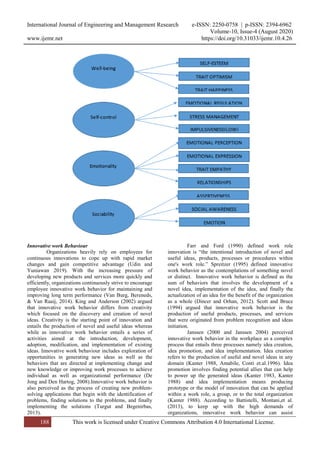
Previous studies have shown that there are
significant individual differences in the perception of
people’s emotional abilities (Petrides, 2011). Trait
Emotional Intelligence includes four factors or subscales
that help summarise scores of people on 13 different
facets (see fig). The four subscales or factors are well-
being, self-control, emotionality, and sociability (Ruslan,
Jantan, et. al (2016).
International Journal of Engineering and Management Research e-ISSN: 2250-0758 | p-ISSN: 2394-6962
Volume-10, Issue-4 (August 2020)
www.ijemr.net https://doi.org/10.31033/ijemr.10.4.26
188 This work is licensed under Creative Commons Attribution 4.0 International License.
Innovative work Behaviour
Organizations heavily rely on employees for
continuous innovations to cope up with rapid market
changes and gain competitive advantage (Udin and
Yuniawan 2019). With the increasing pressure of
developing new products and services more quickly and
efficiently, organizations continuously strive to encourage
employee innovative work behavior for maintaining and
improving long term performance (Van Burg, Bereneds,
& Van Raaij, 2014). King and Anderson (2002) argued
that innovative work behavior differs from creativity
which focused on the discovery and creation of novel
ideas. Creativity is the starting point of innovation and
entails the production of novel and useful ideas whereas
while as innovative work behavior entails a series of
activities aimed at the introduction, development,
adoption, modification, and implementation of existing
ideas. Innovative work behaviour includes exploration of
opportunities in generating new ideas as well as the
behaviors that are directed at implementing change and
new knowledge or improving work processes to achieve
individual as well as organizational performance (De
Jong and Den Hartog, 2008).Innovative work behavior is
also perceived as the process of creating new problem-
solving applications that begin with the identification of
problems, finding solutions to the problems, and finally
implementing the solutions (Turgut and Begenirbas,
2013).
Farr and Ford (1990) defined work role
innovation is “the intentional introduction of novel and
useful ideas, products, processes or procedures within
one's work role.” Spreitzer (1995) defined innovative
work behavior as the contemplations of something novel
or distinct. Innovative work behavior is defined as the
sum of behaviors that involves the development of a
novel idea, implementation of the idea, and finally the
actualization of an idea for the benefit of the organization
as a whole (Dincer and Orhan, 2012). Scott and Bruce
(1994) argued that innovative work behavior is the
production of useful products, processes, and services
that were originated from problem recognition and ideas
initiation.
Janssen (2000 and Janssen 2004) perceived
innovative work behavior in the workplace as a complex
process that entails three processes namely idea creation,
idea promotion, and idea implementation. Idea creation
refers to the production of useful and novel ideas in any
domain (Kanter 1988, Amabile, Conti et.al.1996). Idea
promotion involves finding potential allies that can help
to power up the generated ideas (Kanter 1983, Kanter
1988) and idea implementation means producing
prototype or the model of innovation that can be applied
within a work role, a group, or to the total organization
(Kanter 1988). According to Battistelli, Montani,et al.
(2013), to keep up with the high demands of
organizations, innovative work behavior can assist
International Journal of Engineering and Management Research e-ISSN: 2250-0758 | p-ISSN: 2394-6962
Volume-10, Issue-4 (August 2020)
www.ijemr.net https://doi.org/10.31033/ijemr.10.4.26
189 This work is licensed under Creative Commons Attribution 4.0 International License.
employees to become acclimated to meet job and
organisational related outcomes. Innovative work
behavior is widely claimed to be critical to the effective
functioning and the long term development of
organizations (West and Farr, 1989, 1990; Woodman
et.al., 1993). As Thompson and Werner (1997) stated that
it’s not sufficient for an employee to simply carryout
essential job functions, instead employees are expected to
take initiative actions and come forth with creative ideas
in order to guarantee organizational performance.
Employees possessing higher levels of innovative work
behavior are more able to quickly respond to the work
environment, propose new ideas and provide with more
services and products (Afsar et. al,2018)
Emotional Intelligence and Employee Innovative Eork
Behavior
Based on the available literature it can be
affirmed that emotional intelligence has been identified as
a key contributor in enhancing innovative work behavior
(Abubakr and al-sheikh 2007, Jafri, Dem et.al.
2016).Research has also argued that employees with
higher emotional intelligence tend to have a better
relationship with their co-workers (Wong and Law 2002).
This in turn leads to more informational exchange among
co-workers, which enables them to create ideas for
difficult issues and develop original solutions to the
problems at work, which is characterized as idea
generation (Al-Omari 2017). Besides employee with
higher emotional intelligence are more likely to have
peace of mind, stable life and tend to stay more focused
(Abu Bakar and Al-Sheikh 2007) this assists them to
evaluate the utility of innovative ideas, introduce
innovative ideas at the workplace in a systematic way and
transform innovative ideas into the useful application
which is characterized as idea realization (Al-Omari
2017) and employees with higher emotional intelligence
tend to stay positive (Ivcevic, Brackett et al. 2007) which
leads them to inspire their co-workers to embrace
innovative ideas. With their positivity, employees are
more likely to display a broad way of thinking and
flexibility (Ivcevic, Brackett, et al. 2007). This in turn
fosters their ability to mobilize support for innovative
ideas and acquire approval for innovative ideas which is
characterized as idea promotion. Therefore literature has
found links between emotional intelligence and
innovative work behavior. Abubakr and Al-Shaikh (2007)
in their study indicated that employees with higher levels
of emotional intelligence have higher levels of readiness
to create and innovate than those possessing lower levels
of emotional intelligence. In the same vein the research
conducted by Dincer, Gencer et.al (2011) also
indicatedthat both emotional intelligence and innovative
work behavior affect each other positively. When the
degree of EI increases, the level of innovative work
behavior also increases. To conclude, the managers as
strategic decision-makers with a high level of emotional
intelligence are better at decision making. Also in another
study, Dincer and Orhan (2012) found that there is
significant relationship and interaction between
employees' emotional intelligence and innovative work
behavior in a positive way but not so strong. It is also
observed from their study results that there is a significant
difference between state-owned and private banks in
terms of both emotional intelligence and innovative work
behaviors. Furthermore, the results indicate that the first
talent 'regulation of emotion' which is one of the
components of Emotional Intelligence is higher in state-
owned bank employees. The second talent 'self and
others' emotional appraisal is the same in both the sectors
and the third talent 'use of emotion' is used much by
private bank employees.Yet in another study, Shojaei and
Siuki (2014) found that there is a positive and significant
relationship between EI and its components with IWB.
Besides, regression analysis showed that component self-
management had the highest effect in estimating the
managers' innovative work behavior followed by the
components of relationship management, self-awareness,
and social awareness. In addition, Mohammadi and
Salimifard (2016) have found that there is a positive and
significant relationship between emotional intelligence
and innovation and also between cultural intelligence and
innovation. Their results also indicated that there is no
significant relationship between emotional intelligence
and organizational identity and also, there is no
significant relationship between innovation and
organizational identity. Chin Raman et al. (2012) also
found that both emotional and spiritual intelligence plays
an important role in nurturing creativity and innovation
among entrepreneurs. Furthermore, in the dimensions of
Emotional Intelligence developed by Palmer and
Stough(2001), emotional recognition and expression,
understanding other's emotions, emotional management,
and emotional control encourages the entrepreneur to be
able to work with others, understanding the expressions
of others around them. And also, Spiritual Intelligence
brings about the finer points of the entrepreneurs that
make them standout for others. Al-Omari (2017) also
added that there is a direct relationship between
engineers’ emotional intelligence and innovative work
behavior.
IV. CONCLUSIONS AND
RECOMMENDATIONS
The current study provides a review of the
literature on the role that emotional intelligence plays in
enhancing innovative work behavior among employees.
Various studies undertaken for this review indicated that
emotional intelligence plays a significant role in
enhancing innovative work behavior among individuals.
Research indicates that individuals with higher levels of
emotional intelligence tend to possess higher levels of
innovative work behavior. However, the review of
literature also indicated that there exists the dearth of
literature associating the above-mentioned variables.
Therefore, it becomes imperative to conduct such kind of
International Journal of Engineering and Management Research e-ISSN: 2250-0758 | p-ISSN: 2394-6962
Volume-10, Issue-4 (August 2020)
www.ijemr.net https://doi.org/10.31033/ijemr.10.4.26
190 This work is licensed under Creative Commons Attribution 4.0 International License.
research in the future to gain deeper insights into the
relationship between the said constructs. Emotional
intelligence is a form of ability that can be learned and
developed. Therefore, proper emotional intelligence
training programs should be designed to enhance
emotional intelligence among employees. It can also be
suggested that future researchers should consider various
mediating or moderating variables to explain and reveal
the relationship between emotional intelligence and
innovative work behavior.
REFERENCES
[1] Afsar, B., Cheema, S., & Saeed, B. B. (2018). Do
nurses display innovative work behavior when their
values match with hospitals’ values?. European Journal
of Innovation Management, 21(1), 157-171.
[2] Agarwal, U. A. (2014). Linking justice, trust and
innovative work behaviour to work
engagement. Personnel Review, 43(1), 41-73.
[3] Al-Omari, M. (2017). Engineers innovative work
behavior: the role of emotional intelligence. European
Journal of Business and Management, 9(21), 8-18.
[4] Amabile, T. M. (1988). A model of creativity and
innovation in organizations. Research in Organizational
Behavior, 10(1), 123-167.
[5] Amabile, T. M., Conti, R., Coon, H., Lazenby, J., &
Herron, M. (1996). Assessing the work environment for
creativity. Academy of Management Journal, 39(5),
1154-1184.
[6] Bar-On, R. (2006). The Bar-On model of emotional-
social intelligence (ESI). Psicothema, 18, 13-25.
[7] Bar-On, R. (2010). Emotional intelligence: An
integral part of positive psychology. South African
Journal of Psychology, 40(1), 54-62.
[8] Battistelli, A., Montani, F., & Odoardi, C. (2013). The
impact of feedback from job and task autonomy in the
relationship between dispositional resistance to change
and innovative work behaviour. European Journal of
Work and Organizational Psychology, 22(1), 26-41.
[9] Benson, G., Ploeg, J., & Brown, B. (2010). A cross-
sectional study of emotional intelligence in baccalaureate
nursing students. Nurse Education Today, 30(1), 49-53.
[10] Berman, E. M. & West, J. P. (2008). Managing
emotional intelligence in US cities: A study of social
skills among public managers. Public Administration
Review, 68(4), 742-758
[11] Boyatzis, R. & Boyatzis, R. E. (2009). Competencies
as a behavioral approach to emotional
intelligence. Journal of Management Development.
[12] Boyatzis, R., Koman, E. S., & Wolff, S. B. (2008).
Emotional intelligence competencies in the team and
team leader. Journal of Management Development.
Available at:
https://etd.ohiolink.edu/!etd.send_file?accession=case109
4241887&disposition=inline.
[13] Brooks, K. & Nafukho, F. M. (2006). Human
resource development, social capital, emotional
intelligence. Journal of European Industrial Training,
30(2), 117-128.
[14] Brown, S. P. (2007). Job Involvement, Encyclopedia
of Industrial and Organizational Psychology. 1,
Thousand Oaks: Sage Publications, 397-399
[15] Chen, Y. S., Lin, M. J. J., & Chang, C. H. (2009).
The positive effects of relationship learning and
absorptive capacity on innovation performance and
competitive advantage in industrial markets. Industrial
Marketing Management, 38(2), 152-158.
[16] Cherniss, C. (2010). Emotional intelligence: Toward
clarification of a concept. Industrial and Organizational
Psychology, 3(2), 110-126.
[17] Cherniss, C. & Goleman, D. (2001). The emotionally
intelligence workplace. How to select for measure and
improve emotional intelligence in individuals, groups and
organizations. San Francisco: Jossey-Bass
[18] Chin, S. T. S., Raman, K., Yeow, J. A., & Eze, U. C.
(2012). Relationship between emotional intelligence and
spiritual intelligence in nurturing creativity and
innovation among successful entrepreneurs: A conceptual
framework. Procedia-Social and Behavioral Sciences, 57,
261-267.
[19] Cooper, R. K. (1997). Applying emotional
intelligence in the workplace. Training &
Development, 51(12), 31-39.
[20] Daft, R. L. (2004). Organization theory and design.
Mumbai: Thompson Daft, Richard L. Organization
Theory and Design. South-Western Pub, 2004.
[21] Damanpour, F. (1991). Organizational innovation: A
meta-analysis of effects of determinants and
moderators. Academy of Management Journal, 34(3),
555-590.
[22] Daniel, G., Boyatzis, R., & Mckee, A. (2002).
Primal leadership: Realizing the power of emotional
intelligence. Harvard Business School Press, USA.
[23] De Jong, J. P. J. (2007). Individual innovation: The
connection between leadership and employees' innovative
work behaviour. Pracadoktorska. Universiteit van
Amsterdam.
[24] De Jong, J. P., & Den Hartog, D. N. (2008).
Innovative work behavior: Measurement and
validation. EIM Business and Policy Research, 8(1), 1-
27.
[25] Diggins, C. (2004). Emotional intelligence: the key
to effective performance. Human Resource Management
International Digest, 12(1), 33.
[26] Dincer, H. & Orhan, N. (2012). Relationship
between emotional intelligence and innovative work
behaviors in Turkish banking sector. International
Journal of Finance & Banking Studies, 1(1), 21-28.
[27] Dincer, H., Gencer, G., Orhan, N., & Sahinbas, K.
(2011). The significance of emotional intelligence on the
innovative work behavior of managers as strategic
decision-makers. Procedia-Social and Behavioral
Sciences, 24, 909-919.
[28] Farr, J. L., & Ford, C. M. (1990). Individual
innovation. Available at:
International Journal of Engineering and Management Research e-ISSN: 2250-0758 | p-ISSN: 2394-6962
Volume-10, Issue-4 (August 2020)
www.ijemr.net https://doi.org/10.31033/ijemr.10.4.26
191 This work is licensed under Creative Commons Attribution 4.0 International License.
https://www.scirp.org/(S(351jmbntvnsjt1aadkposzje))/ref
erence/ReferencesPapers.aspx?ReferenceID=1122034.
[29] Fenwick, T. (2003). Innovation: Examining
workplace learning in new enterprises. Journal of
Workplace Learning.
[30] Getz, I. & Robinson, A. G. (2003). Innovate or die:
Is that a fact?. Creativity and innovation
management, 12(3), 130-136.
[31] Goleman, D. (1995), Emotional intelligence: why it
can matter more than IQ. Bantam Dell, New York, NY.
[32] Goleman, D. (1998). The emotional intelligence of
leaders. Leader to Leader, 1998(10), 20-26.
[33] Goleman, D. (1998). Working with emotional
intelligence. Bantam.
[34] Goleman, D. (2004). What makes a leader?. Harvard
Business Review, 82(1), 82-91.
[35] Hayashi, A. & Ewert, A. (2006). Outdoor leaders'
emotional intelligence and transformational
leadership. Journal of Experiential Education, 28(3),
222-242.
[35] Ivcevic, Z., Brackett, M. A., & Mayer, J. D. (2007).
Emotional intelligence and emotional creativity. Journal
of Personality, 75(2), 199-236.
[36] Jafri, M. H., Dem, C., & Choden, S. (2016).
Emotional intelligence and employee creativity:
Moderating role of proactive personality and
organizational climate. Business Perspectives and
Research, 4(1), 54-66.
[37] Janssen, O. (2000). Job demands, perceptions of
effort reward fairness and innovative work behaviour.
Journal of Occupational and Organizational Psychology,
73(3), 287-302.
[38] Janssen, O. (2004). How fairness perceptions make
innovative behavior more or less stressful. Journal of
Organizational Behavior, 25(2), 201-215.
[39] Jimenez, J.D., &Sanz-Valle, R. (2011). Innovation,
organizational learning and performance. Journal of
Business Research, 64(4), 408-417.
[40] Jiménez-Jiménez, D. & Sanz-Valle, R. (2011).
Innovation, organizational learning, and
performance. Journal of Business Research, 64(4), 408-
417.
[41] Kanter, R. M. (1983). The change masters. New
York: Simon and Schuster.
[42] Kanter, R. M. (1988). When a thousand flowers
bloom: Structural, collective, and social conditions for
innovation in organizations. Knowledge Management and
Organisational Design, 10, 93-131.
[43] Katz. D. (1964). The motivational basis of
organizational behavior. Behavioral Science, 9, 131-133.
[44] King, N. & Anderson, N. (2002). Managing
innovation and change: A critical guide for
organizations. Cengage Learning EMEA.
[45] Langhorn, S. (2004). How emotional intelligence can
improve management performance. International Journal
of Contemporary Hospitality Management.
[46] Luu, T. (2014). Knowledge sharing and competitive
intelligence. Marketing Intelligence & Planning.
[47] Mayer, J. D., Salovey, P., & Caruso, D. R. (2004).
Emotional intelligence: Theory, findings, and
implications. Psychological Inquiry, 15(3), 197-215.
[48] Mayer, J. D., Salovey, P., Salovey, P., & Sluyter, D.
(1997). Emotional development and emotional
intelligence: Implications for educators. What is
Emotional Intelligence, 5.
[49] Mohammadi, J. & Salimifard, A. (2016). The effect
of emotional and cultural intelligence on innovation and
organizational identity. Available at:
https://www.researchgate.net/publication/328175682_The
_Effect_of_Emotional_and_Cultural_intelligence_on_Inn
ovation_and_Organizational_Identity.
[50] Palmer, B., Walls, M., Burgess, Z., & Stough, C.
(2001). Emotional intelligence and effective
leadership. Leadership & Organization Development
Journal, 22, 5-10.
[51] Petrides, K. V. (2011). Ability and trait emotional
intelligence. Available at:
http://www.psychometriclab.com/adminsdata/files/Trait%
20EI%20-%20HID.pdf.
[52] Prajogo, D. I. & Ahmed, P. K. (2006). Relationships
between innovation stimulus, innovation capacity, and
innovation performance. R&D Management, 36(5), 499-
515.
[53] Rogelberg, S. G. (Ed.). (2007). Encyclopedia of
industrial and organizational psychology, (Vol. 1). Sage.
[54] Ruslan, S. A., Jantan, A. H., Zawawi, D., &
Zainudin, Z. H. (2016). Knowledge sharing behavior and
traits emotional intelligence in police
forces. International Journal of Academic Research in
Business and Social Sciences, 6(12), 138-145.
[55] Salovey, P. & Mayer, J. D. (1990). Emotional
intelligence. Imagination, Cognition and Personality,
9(3), 185-211
[56] Santos, A., Mustafa, M. J., & Gwi, T. C. (2015).
Trait emotional intelligence, emotional labour, and
burnout among Malaysian HR
professionals. Management Research Review, 38(1), 67-
88.
[57] Scott, S. G. & Bruce, R. A. (1994). Determinants of
innovative behavior: A path model of individual
innovation in the workplace. Academy of Management
Journal, 37(3), 580-607.
[58] Scott, S. G. & Bruce, R. A. (1994, Oct.). Creating
innovative behavior among R&D professionals: the
moderating effect of leadership on the relationship
between problem-solving style and innovation.
In: Proceedings of 1994 IEEE International Engineering
Management Conference-IEMC'94, pp. 48-55.
[59] Shojaei, M. & Siuki, M. (2014). A study of
relationship between emotional intelligence and
innovative work behavior of managers. Management
Science Letters, 4(7), 1449-1454.
[60] Spreitzer, G. M. (1995). Psychological
empowerment in the workplace: Dimensions,
measurement, and validation. Academy of Management
Journal, 38(5), 1442-1465
International Journal of Engineering and Management Research e-ISSN: 2250-0758 | p-ISSN: 2394-6962
Volume-10, Issue-4 (August 2020)
www.ijemr.net https://doi.org/10.31033/ijemr.10.4.26
192 This work is licensed under Creative Commons Attribution 4.0 International License.
[61] Suliman, A. M. & AlShaikh, F. N. (2007). Emotional
intelligence at work: Links to conflict and innovation.
Employee Relations, 29(2), 208-220.
[62] Thornhill, S. (2006). Knowledge, innovation and
firm performance in high-and low-technology
regimes. Journal of Business Venturing, 21(5), 687-703.
[63] Tompson, H. B. & Werner, J. M. (1997). The impact
of role conflict/facilitation on core and discretionary
behaviors: Testing a mediated model. Journal of
Management, 23(4), 583-601.
[64] Turgut, E. & Beğenirbaş, M. (2013).
Çalışanlarınyenilikçidavranışlarıüzerindesosyalsermayeve
yenilikçiikliminrolü: Sağlıksektöründebiraraştırma. Kara
Harp Okulu Bilim Dergisi, 23(2), 101-124.
[65] Van Burg, E., Berends, H., & Van Raaij, E. M.
(2014). Framing and interorganizational knowledge
transfer: A process study of collaborative innovation in
the aircraft industry. Journal of Management
Studies, 51(3), 349-378.
[66] Van de Ven, A. H. (1986). Central problems in the
management of innovation. Management Science, 32(5),
590-607.
[67] Van der Panne, G., Van Beers, C., & Kleinknecht, A.
(2003). Success and failure of innovation: a literature
review. International Journal of Innovation
Management, 7(03), 309-338.
[68] Wahyudi, S., Udin, U., Yuniawan, A., & Rahardja,
E. (2019). Person-Organization Fit, Knowledge Sharing
Behaviour, and Innovative Work Behaviour: A Self-
determination Perspective. International Journal of
Innovation, Creativity and Change, 4(4), 145-161.
[69] West, M. A., & Farr, J. L. (1989). Innovation at
work: Psychological perspectives. Social West, M. A., &
Farr, J. L. (Eds.). (1990). Innovation and creativity at
work: Psycological and organizational strategies. John
Wiley.
[70] Wong, C. S. & Law, K. S. (2002). The effects of
leader and follower emotional intelligence on
performance and attitude: An exploratory study. The
Leadership Quarterly, 13(3), 243-274.
[71] Woodman, R. W., Sawyer, J. E., & Griffin, R. W.
(1993). Toward a theory of organizational
creativity. Academy of Management Review, 18(2), 293-
321.

Emotional Intelligence and Innovative Work Behaviour: A Review

  • 1.
    International Journal ofEngineering and Management Research e-ISSN: 2250-0758 | p-ISSN: 2394-6962 Volume-10, Issue-4 (August 2020) www.ijemr.net https://doi.org/10.31033/ijemr.10.4.26 185 This work is licensed under Creative Commons Attribution 4.0 International License. Emotional Intelligence and Innovative Work Behaviour: A Review Nida Feroz Andrabi1 and Prof. Riyaz Ahmad Rainayee2 1 Doctoral Candidate, Department of Commerce, University of Kashmir, INDIA 2 Professor in Human Resource Management, Department of Commerce, University of Kashmir, INDIA 1 Corresponding Author: nidaferoz.scholar@kashmiruniversity.net ABSTRACT With the headway of globalization, the achievement and endurance of an organisation are pawned to innovation and adaptability. Innovation plays a crucial role in gaining a competitive advantage within the organization. For any organization to be innovative, employees' innovative work behavior assumes an indispensable role. Capturing innovative ideas from employees at different levels, building an active and collaborative workforce within organisation, recognizing employees’ effort, and communicating effectively with all stakeholders are the vital building blocks of innovation. Building the culture of innovation that drives productive and sustainable innovation practices can spark from within the workforce helping organizations to remain competitive and stay ahead in the long haul. Research indicates that innovation and creativity are attained through emotional intelligence. Given this contention, the purpose of this paper is to examine the role emotional intelligence plays in bringing innovative work behavior within the employees. An extensive literature review on the said constructs was conducted where both variables were studied independently and the linkages that both variables exhibit together were also studied from different database sources like Emerald insight, Science Direct, Taylor and Francis, Springer, Google Scholar, etc. and also, the models of emotional intelligence were put forth. Keywords-- Emotional Intelligence, Innovation, Innovative Work Behavior I. INTRODUCTION With the onset of globalization and enhanced competition, innovation plays a critical role in the growth and survival of organizations.Research has shown that innovation is advantageous for the performance of organizations (Damanpour,1991; Jimenez-Jimenez and Sanz-Valle, 2011; Thornhill, 2006) because organizations are in better positions to respond to challenges faster and are better at exploiting market opportunities. One of the greatest challenges faced by the companies in this era of globalization is to preserve a high level of competitiveness through fortifying the knowledge and innovative abilities of their workforce (Prajago and Ahmad, 2006; Chen et al., 2012). Organizational innovation is viewed as a fundamental constituent of organizational survival and the manner in which it competes in today’s increasingly global markets (Suliman and al-Shaikh, 2007. As Scott and Bruce (1994) explained “the basis of innovation is ideas and the people who develop, carry, react to, and modify ideas” (Van de Van 1986).The organization that innovates tap the latent creative potential of employees and provides them the necessary support and infrastructure to introduce new products and services in the market or to improve the existing quality of products (Van der Panne et al, 2003).Organizations and their employees must be persistently innovative and adaptive in order to maintain their survival and be successful in the long run (Jimenez, J.D. & Sanz, V.R 2011). According to Agarwal (2014), “One option for organizations to become more innovative is to encourage their employees to be innovative. Getz and Robinson (2003) demonstrate that eighty percent of the ideas in an organization is initiated by the employees. Therefore, employee innovative work behavior assumes an indispensable role in fetching innovation to the organization. De Jong (2007) defined innovative work behavior as “the intentional behavior of an individual to introduce and/or apply new ideas, products, processes, and procedures to his or her work role, unit, space or organization.” Employees who display more innovative work behavior show more job involvement, as higher innovation is a result of employee’s higher concentration at work, which in turn leads to increased involvement in the job (Daft, 2004). Job involvement assists employees to work wholeheartedly for their organization in solving problems and different issues of their organization (Rogelberg, 2007). According to Brown (2007), innovative work behavior aids in organizational production and effectiveness that requires deep involvement of employees in their work by providing them with autonomy and making their work experience meaningful. Katz (1964) asserted that in order to increase the efficiency of the firm, it is significant that the innovative work behaviour of employees is taken into account, as new ideas are considered more important as compared to the conventional ideas. Given the significance of innovative work behavior among employees, a myriad of research undertaken nurtures and promotes this kind of behavior. In particular, emotional intelligence is acknowledged as one of the key contributorsto augmenting innovative work behaviour (Abubakar and Al-Shaikh 2007, Jafree, Dem, et al. 2016). According to Cherniss (2001) and Fenwick (2003), the display of innovative work behavior is closely related to employees` emotional intelligence. Emotionally intelligent individuals are better at controlling the emotions of themselves and possess a better
  • 2.
    International Journal ofEngineering and Management Research e-ISSN: 2250-0758 | p-ISSN: 2394-6962 Volume-10, Issue-4 (August 2020) www.ijemr.net https://doi.org/10.31033/ijemr.10.4.26 186 This work is licensed under Creative Commons Attribution 4.0 International License. understanding of other people’s emotions and feelings, which in turn assists them to maintain long term, harmonious and cooperative relationships with their colleagues and create a harmonious atmosphere in the workplace, which becomes the basis for creativity and innovation (Suliman and Al-Shaikh, 2007).Several studies have revealed that employees who possess higher levels of emotional intelligence tend to stay more motivated and productive at the workplace (Diggins 2004, Brooks and Nafukho 2006) and display better job performance (Wong and Law 2002, Langhorn 2004). According to Cooper (1997), previous research affirmed that properly managed emotions cannot only boost the accomplishments of individuals, teams, organizations, innovations, and increase productivity gains but also enhances trust, loyalty, and commitment of individuals.According to Hayashi and Ewert (2006), the more the emotional intelligence, the better and more effective is the performance of the employees. Nevertheless, it becomes imperative to identify and study the drivers of innovative work behavior as it plays a pivotal role in the growth, survival, and development of organizations, and means should be found to improve employees' innovative work behavior. And as such emotional intelligence is believed to be one of the antecedents of innovative work behavior. Therefore, authors have attempted to put forth the relationship between emotional intelligence and innovative work behavior based on an extensive literature review undertaken for this study. II. LITERATURE REVIEW Emotional Intelligence The evolution of emotional intelligence construct dates back to 1990 when Salovey and Mayer (1990) defined “Emotional intelligence as the subset of social intelligence that involves the ability to monitor one’s feelings and emotions, to discriminate among them and to use this information to guide ones thinking and action”. In a more recent definition, Mayer and Salovey and Caruso (2004) defined “Emotional intelligence as the capacity to reason about emotions to enhance thinking. It encompasses the abilities to accurately perceive emotions, to access and generate emotions to assist thought, to understand emotions and emotional knowledge, and to reflectively regulate emotions to promote emotional and intellectual growth”. Goleman (1998) defined emotional intelligence as the capability of recognizing the feelings in oneselfand others, motivating self and managing emotions well in ourselves and our relationships. His emotional intelligence framework encompasses four competencies. 1. Self-awareness is the ability to accurately perceive the emotions in oneself and to be aware of them as they happen, including the ability to manage one's response to specific situations and people. 2. Self-management is the ability to be aware of one's emotions and have the flexibility to positively direct one's behavior in response to those emotions, to manage emotional reactions in all situations, and with all people. 3. Social awareness is the ability to accurately identify the emotions of other people and thus understand the effects of those emotions, that is, to understand the thinking of other people. 4. Relationship management is the ability to use awareness of one’s own emotions and those of others to successfully manage interactions, that is, to provide clear communication and effectively handle conflict (Goleman, 2004).Bar-on (2010) posits that “emotional intelligence is an array of interrelated emotional and social competencies and skills that determine how effectively individuals understand and express themselves, understand the feelings of others and relate with them, and cope with daily demands, challenges and pressures”. According to Benson (2010), emotional intelligence covers the process of managing personal, social, environmental changes by coping with a situation, solving problems, and making decisions immediately, realistically, and flexibly. It is a set of abilities that relate to the processing of emotions and emotional information. Luu (2014), states that emotional intelligence can activate behavior and acts as a layer between cognition and behavior. It has been seen that high emotional intelligence level can help not only to manage our own emotions but also to manage the emotions of others. Emotional Intelligence is a form of ability that can be learned and developed (Cherniss and Goleman 2001, Berman and West 2008). III. MODELS OF EMOTIONAL INTELLIGENCE Concerning the models of Emotional intelligence, currently, there are three main models summarised as under:  Ability based model.  Mixed EI model.  Trait EI model. Ability model of Emotional Intelligence Salovey and Mayer's Ability based model of emotional intelligence describes four areas of capacities or skills that collectively describe many areas of emotional intelligence (Mayer and Salovey, 1997). The four areas are given below: 1. Perceiving Emotion: Perceiving emotions is the most basic area and deals with the nonverbal reception and expression of Emotions in the face, voice, and related communication channels. It involves the capabilityof recognizing emotions in others' facial and postural expressions. The capacity to accurately perceive emotions in the face and voice of others provides a crucial starting point for a more advanced understanding of Emotions. 2. Using Emotions to Facilitate Thought: It pertains to the capacity of emotions to enter into the cognitive system and guide the cognitive
  • 3.
    International Journal ofEngineering and Management Research e-ISSN: 2250-0758 | p-ISSN: 2394-6962 Volume-10, Issue-4 (August 2020) www.ijemr.net https://doi.org/10.31033/ijemr.10.4.26 187 This work is licensed under Creative Commons Attribution 4.0 International License. system to promote thinking. Having a good emotional input helps to direct thinking into the matters that hold importance. Several researchers have suggested that emotions are important for certain kinds of creativity to emerge. 3. Understanding Emotions: Understanding emotions reflects the capacity to analyze emotions, involves the comprehension of the meaning of emotions coupled with the capacity to reason about meanings of emotions. Understanding emotional messages and the actions associated with them is one of the crucial aspects of this area of skill. 4. Managing Emotions: Since emotions convey information, Emotions can be managed. It is the ability to regulate emotions in both ourselves and in others. Therefore, the emotionally intelligent person can harness emotions, even negative ones, and manage them to achieve personal and social goals. Mixed Model of Emotional Intelligence Bar-On (2006) reviewed personality characteristics supposed to determine lifesuccess beyond cognitive intelligence and identified five broad dimensions. He regards these dimensions, which are further subdivided into 15 subscales, as key factors of EI. They are: 1. Intrapersonal Skills: Interpersonal skills comprise of self-regard (being aware of oneself and understanding and accepting oneself), emotional self-awareness (being aware of oneself and understanding one's emotions), assertiveness (expressing one's emotions, ideas, needs, and desires), self-actualization (realizing one's potential capabilities), independence (being self-directed, self-controlled and free of emotional dependency); 2. Interpersonal Skills: Interpersonal skills comprise of empathy (being aware of others feelings and understanding others' emotions), social responsibility (demonstrating oneself as a constructive member of one's social group) and interpersonal relationships (forming and maintaining intimate relationships); 3. Adaptability: Adaptability comprises of problem-solving (solving personal and as well as social problems constructively), reality testing (validating one's thinking and feelings) and flexibility (adjusting one's feelings, thoughts, and behavior to changing conditions); 4. Stress Management: It comprises of stress tolerance (actively and positively coping with stress), o impulse control (resisting or delaying an impulse or drive, and controlling one's emotions); 5. General Mood: General mood comprises ofhappiness (feeling satisfied with oneself or one’s life), optimism (maintaining positive attitudes). Goleman and Boyatzis developed another mixed- model approach to emotional intelligence. It includes several competencies sorted into 4 clusters including self- awareness, self-management, social awareness, and relationship management (Boyatzis, 2009; Cherniss, 2010, Goleman et.al, 2002; Goleman, 1995, 1998). 1. Self-awareness includes the ability to identify one`s emotions and recognize their impact by using gut feelings to guide decisions (Goleman 1998). 2. Self-management involves the ability to control one`s emotions and impulses, thereby continuously adapting to dynamic circumstances (Goleman 1998). 3. Social-awareness includes the ability to sense, understand, and react to the emotions of others while comprehending social networks (Goleman 1998). 4. Relationship management entails one`s ability to inspire, influence, and develop others while managing conflict (Goleman 1998). Trait Model of Emotional Intelligence Konstantinos Vasilis Petrides proposed the conceptual distinction between the ability model of emotional intelligence and a trait model of emotional intelligence and has been developing the later over many years in numerous publications. Trait emotional intelligence has been labelled as the constellation of emotional self-perceptions located at the bottom levels of personality. Trait emotional intelligence generally refers to the self-perception of emotional abilities or simply put trait emotional intelligence concerns people’s beliefs about their emotions. Research has proved that trait emotional intelligence offers a beneficial framework for the classification of particular skills required in understanding emotions (Stubbs Koman& Wolff, 2008) which guides behavior and reasoning in the means that improve performance (Santos et.al, 2015). This model places emotional intelligence (EI) within the personality domain. Previous studies have shown that there are significant individual differences in the perception of people’s emotional abilities (Petrides, 2011). Trait Emotional Intelligence includes four factors or subscales that help summarise scores of people on 13 different facets (see fig). The four subscales or factors are well- being, self-control, emotionality, and sociability (Ruslan, Jantan, et. al (2016).
  • 4.
    International Journal ofEngineering and Management Research e-ISSN: 2250-0758 | p-ISSN: 2394-6962 Volume-10, Issue-4 (August 2020) www.ijemr.net https://doi.org/10.31033/ijemr.10.4.26 188 This work is licensed under Creative Commons Attribution 4.0 International License. Innovative work Behaviour Organizations heavily rely on employees for continuous innovations to cope up with rapid market changes and gain competitive advantage (Udin and Yuniawan 2019). With the increasing pressure of developing new products and services more quickly and efficiently, organizations continuously strive to encourage employee innovative work behavior for maintaining and improving long term performance (Van Burg, Bereneds, & Van Raaij, 2014). King and Anderson (2002) argued that innovative work behavior differs from creativity which focused on the discovery and creation of novel ideas. Creativity is the starting point of innovation and entails the production of novel and useful ideas whereas while as innovative work behavior entails a series of activities aimed at the introduction, development, adoption, modification, and implementation of existing ideas. Innovative work behaviour includes exploration of opportunities in generating new ideas as well as the behaviors that are directed at implementing change and new knowledge or improving work processes to achieve individual as well as organizational performance (De Jong and Den Hartog, 2008).Innovative work behavior is also perceived as the process of creating new problem- solving applications that begin with the identification of problems, finding solutions to the problems, and finally implementing the solutions (Turgut and Begenirbas, 2013). Farr and Ford (1990) defined work role innovation is “the intentional introduction of novel and useful ideas, products, processes or procedures within one's work role.” Spreitzer (1995) defined innovative work behavior as the contemplations of something novel or distinct. Innovative work behavior is defined as the sum of behaviors that involves the development of a novel idea, implementation of the idea, and finally the actualization of an idea for the benefit of the organization as a whole (Dincer and Orhan, 2012). Scott and Bruce (1994) argued that innovative work behavior is the production of useful products, processes, and services that were originated from problem recognition and ideas initiation. Janssen (2000 and Janssen 2004) perceived innovative work behavior in the workplace as a complex process that entails three processes namely idea creation, idea promotion, and idea implementation. Idea creation refers to the production of useful and novel ideas in any domain (Kanter 1988, Amabile, Conti et.al.1996). Idea promotion involves finding potential allies that can help to power up the generated ideas (Kanter 1983, Kanter 1988) and idea implementation means producing prototype or the model of innovation that can be applied within a work role, a group, or to the total organization (Kanter 1988). According to Battistelli, Montani,et al. (2013), to keep up with the high demands of organizations, innovative work behavior can assist
  • 5.
    International Journal ofEngineering and Management Research e-ISSN: 2250-0758 | p-ISSN: 2394-6962 Volume-10, Issue-4 (August 2020) www.ijemr.net https://doi.org/10.31033/ijemr.10.4.26 189 This work is licensed under Creative Commons Attribution 4.0 International License. employees to become acclimated to meet job and organisational related outcomes. Innovative work behavior is widely claimed to be critical to the effective functioning and the long term development of organizations (West and Farr, 1989, 1990; Woodman et.al., 1993). As Thompson and Werner (1997) stated that it’s not sufficient for an employee to simply carryout essential job functions, instead employees are expected to take initiative actions and come forth with creative ideas in order to guarantee organizational performance. Employees possessing higher levels of innovative work behavior are more able to quickly respond to the work environment, propose new ideas and provide with more services and products (Afsar et. al,2018) Emotional Intelligence and Employee Innovative Eork Behavior Based on the available literature it can be affirmed that emotional intelligence has been identified as a key contributor in enhancing innovative work behavior (Abubakr and al-sheikh 2007, Jafri, Dem et.al. 2016).Research has also argued that employees with higher emotional intelligence tend to have a better relationship with their co-workers (Wong and Law 2002). This in turn leads to more informational exchange among co-workers, which enables them to create ideas for difficult issues and develop original solutions to the problems at work, which is characterized as idea generation (Al-Omari 2017). Besides employee with higher emotional intelligence are more likely to have peace of mind, stable life and tend to stay more focused (Abu Bakar and Al-Sheikh 2007) this assists them to evaluate the utility of innovative ideas, introduce innovative ideas at the workplace in a systematic way and transform innovative ideas into the useful application which is characterized as idea realization (Al-Omari 2017) and employees with higher emotional intelligence tend to stay positive (Ivcevic, Brackett et al. 2007) which leads them to inspire their co-workers to embrace innovative ideas. With their positivity, employees are more likely to display a broad way of thinking and flexibility (Ivcevic, Brackett, et al. 2007). This in turn fosters their ability to mobilize support for innovative ideas and acquire approval for innovative ideas which is characterized as idea promotion. Therefore literature has found links between emotional intelligence and innovative work behavior. Abubakr and Al-Shaikh (2007) in their study indicated that employees with higher levels of emotional intelligence have higher levels of readiness to create and innovate than those possessing lower levels of emotional intelligence. In the same vein the research conducted by Dincer, Gencer et.al (2011) also indicatedthat both emotional intelligence and innovative work behavior affect each other positively. When the degree of EI increases, the level of innovative work behavior also increases. To conclude, the managers as strategic decision-makers with a high level of emotional intelligence are better at decision making. Also in another study, Dincer and Orhan (2012) found that there is significant relationship and interaction between employees' emotional intelligence and innovative work behavior in a positive way but not so strong. It is also observed from their study results that there is a significant difference between state-owned and private banks in terms of both emotional intelligence and innovative work behaviors. Furthermore, the results indicate that the first talent 'regulation of emotion' which is one of the components of Emotional Intelligence is higher in state- owned bank employees. The second talent 'self and others' emotional appraisal is the same in both the sectors and the third talent 'use of emotion' is used much by private bank employees.Yet in another study, Shojaei and Siuki (2014) found that there is a positive and significant relationship between EI and its components with IWB. Besides, regression analysis showed that component self- management had the highest effect in estimating the managers' innovative work behavior followed by the components of relationship management, self-awareness, and social awareness. In addition, Mohammadi and Salimifard (2016) have found that there is a positive and significant relationship between emotional intelligence and innovation and also between cultural intelligence and innovation. Their results also indicated that there is no significant relationship between emotional intelligence and organizational identity and also, there is no significant relationship between innovation and organizational identity. Chin Raman et al. (2012) also found that both emotional and spiritual intelligence plays an important role in nurturing creativity and innovation among entrepreneurs. Furthermore, in the dimensions of Emotional Intelligence developed by Palmer and Stough(2001), emotional recognition and expression, understanding other's emotions, emotional management, and emotional control encourages the entrepreneur to be able to work with others, understanding the expressions of others around them. And also, Spiritual Intelligence brings about the finer points of the entrepreneurs that make them standout for others. Al-Omari (2017) also added that there is a direct relationship between engineers’ emotional intelligence and innovative work behavior. IV. CONCLUSIONS AND RECOMMENDATIONS The current study provides a review of the literature on the role that emotional intelligence plays in enhancing innovative work behavior among employees. Various studies undertaken for this review indicated that emotional intelligence plays a significant role in enhancing innovative work behavior among individuals. Research indicates that individuals with higher levels of emotional intelligence tend to possess higher levels of innovative work behavior. However, the review of literature also indicated that there exists the dearth of literature associating the above-mentioned variables. Therefore, it becomes imperative to conduct such kind of
  • 6.
    International Journal ofEngineering and Management Research e-ISSN: 2250-0758 | p-ISSN: 2394-6962 Volume-10, Issue-4 (August 2020) www.ijemr.net https://doi.org/10.31033/ijemr.10.4.26 190 This work is licensed under Creative Commons Attribution 4.0 International License. research in the future to gain deeper insights into the relationship between the said constructs. Emotional intelligence is a form of ability that can be learned and developed. Therefore, proper emotional intelligence training programs should be designed to enhance emotional intelligence among employees. It can also be suggested that future researchers should consider various mediating or moderating variables to explain and reveal the relationship between emotional intelligence and innovative work behavior. REFERENCES [1] Afsar, B., Cheema, S., & Saeed, B. B. (2018). Do nurses display innovative work behavior when their values match with hospitals’ values?. European Journal of Innovation Management, 21(1), 157-171. [2] Agarwal, U. A. (2014). Linking justice, trust and innovative work behaviour to work engagement. Personnel Review, 43(1), 41-73. [3] Al-Omari, M. (2017). Engineers innovative work behavior: the role of emotional intelligence. European Journal of Business and Management, 9(21), 8-18. [4] Amabile, T. M. (1988). A model of creativity and innovation in organizations. Research in Organizational Behavior, 10(1), 123-167. [5] Amabile, T. M., Conti, R., Coon, H., Lazenby, J., & Herron, M. (1996). Assessing the work environment for creativity. Academy of Management Journal, 39(5), 1154-1184. [6] Bar-On, R. (2006). The Bar-On model of emotional- social intelligence (ESI). Psicothema, 18, 13-25. [7] Bar-On, R. (2010). Emotional intelligence: An integral part of positive psychology. South African Journal of Psychology, 40(1), 54-62. [8] Battistelli, A., Montani, F., & Odoardi, C. (2013). The impact of feedback from job and task autonomy in the relationship between dispositional resistance to change and innovative work behaviour. European Journal of Work and Organizational Psychology, 22(1), 26-41. [9] Benson, G., Ploeg, J., & Brown, B. (2010). A cross- sectional study of emotional intelligence in baccalaureate nursing students. Nurse Education Today, 30(1), 49-53. [10] Berman, E. M. & West, J. P. (2008). Managing emotional intelligence in US cities: A study of social skills among public managers. Public Administration Review, 68(4), 742-758 [11] Boyatzis, R. & Boyatzis, R. E. (2009). Competencies as a behavioral approach to emotional intelligence. Journal of Management Development. [12] Boyatzis, R., Koman, E. S., & Wolff, S. B. (2008). Emotional intelligence competencies in the team and team leader. Journal of Management Development. Available at: https://etd.ohiolink.edu/!etd.send_file?accession=case109 4241887&disposition=inline. [13] Brooks, K. & Nafukho, F. M. (2006). Human resource development, social capital, emotional intelligence. Journal of European Industrial Training, 30(2), 117-128. [14] Brown, S. P. (2007). Job Involvement, Encyclopedia of Industrial and Organizational Psychology. 1, Thousand Oaks: Sage Publications, 397-399 [15] Chen, Y. S., Lin, M. J. J., & Chang, C. H. (2009). The positive effects of relationship learning and absorptive capacity on innovation performance and competitive advantage in industrial markets. Industrial Marketing Management, 38(2), 152-158. [16] Cherniss, C. (2010). Emotional intelligence: Toward clarification of a concept. Industrial and Organizational Psychology, 3(2), 110-126. [17] Cherniss, C. & Goleman, D. (2001). The emotionally intelligence workplace. How to select for measure and improve emotional intelligence in individuals, groups and organizations. San Francisco: Jossey-Bass [18] Chin, S. T. S., Raman, K., Yeow, J. A., & Eze, U. C. (2012). Relationship between emotional intelligence and spiritual intelligence in nurturing creativity and innovation among successful entrepreneurs: A conceptual framework. Procedia-Social and Behavioral Sciences, 57, 261-267. [19] Cooper, R. K. (1997). Applying emotional intelligence in the workplace. Training & Development, 51(12), 31-39. [20] Daft, R. L. (2004). Organization theory and design. Mumbai: Thompson Daft, Richard L. Organization Theory and Design. South-Western Pub, 2004. [21] Damanpour, F. (1991). Organizational innovation: A meta-analysis of effects of determinants and moderators. Academy of Management Journal, 34(3), 555-590. [22] Daniel, G., Boyatzis, R., & Mckee, A. (2002). Primal leadership: Realizing the power of emotional intelligence. Harvard Business School Press, USA. [23] De Jong, J. P. J. (2007). Individual innovation: The connection between leadership and employees' innovative work behaviour. Pracadoktorska. Universiteit van Amsterdam. [24] De Jong, J. P., & Den Hartog, D. N. (2008). Innovative work behavior: Measurement and validation. EIM Business and Policy Research, 8(1), 1- 27. [25] Diggins, C. (2004). Emotional intelligence: the key to effective performance. Human Resource Management International Digest, 12(1), 33. [26] Dincer, H. & Orhan, N. (2012). Relationship between emotional intelligence and innovative work behaviors in Turkish banking sector. International Journal of Finance & Banking Studies, 1(1), 21-28. [27] Dincer, H., Gencer, G., Orhan, N., & Sahinbas, K. (2011). The significance of emotional intelligence on the innovative work behavior of managers as strategic decision-makers. Procedia-Social and Behavioral Sciences, 24, 909-919. [28] Farr, J. L., & Ford, C. M. (1990). Individual innovation. Available at:
  • 7.
    International Journal ofEngineering and Management Research e-ISSN: 2250-0758 | p-ISSN: 2394-6962 Volume-10, Issue-4 (August 2020) www.ijemr.net https://doi.org/10.31033/ijemr.10.4.26 191 This work is licensed under Creative Commons Attribution 4.0 International License. https://www.scirp.org/(S(351jmbntvnsjt1aadkposzje))/ref erence/ReferencesPapers.aspx?ReferenceID=1122034. [29] Fenwick, T. (2003). Innovation: Examining workplace learning in new enterprises. Journal of Workplace Learning. [30] Getz, I. & Robinson, A. G. (2003). Innovate or die: Is that a fact?. Creativity and innovation management, 12(3), 130-136. [31] Goleman, D. (1995), Emotional intelligence: why it can matter more than IQ. Bantam Dell, New York, NY. [32] Goleman, D. (1998). The emotional intelligence of leaders. Leader to Leader, 1998(10), 20-26. [33] Goleman, D. (1998). Working with emotional intelligence. Bantam. [34] Goleman, D. (2004). What makes a leader?. Harvard Business Review, 82(1), 82-91. [35] Hayashi, A. & Ewert, A. (2006). Outdoor leaders' emotional intelligence and transformational leadership. Journal of Experiential Education, 28(3), 222-242. [35] Ivcevic, Z., Brackett, M. A., & Mayer, J. D. (2007). Emotional intelligence and emotional creativity. Journal of Personality, 75(2), 199-236. [36] Jafri, M. H., Dem, C., & Choden, S. (2016). Emotional intelligence and employee creativity: Moderating role of proactive personality and organizational climate. Business Perspectives and Research, 4(1), 54-66. [37] Janssen, O. (2000). Job demands, perceptions of effort reward fairness and innovative work behaviour. Journal of Occupational and Organizational Psychology, 73(3), 287-302. [38] Janssen, O. (2004). How fairness perceptions make innovative behavior more or less stressful. Journal of Organizational Behavior, 25(2), 201-215. [39] Jimenez, J.D., &Sanz-Valle, R. (2011). Innovation, organizational learning and performance. Journal of Business Research, 64(4), 408-417. [40] Jiménez-Jiménez, D. & Sanz-Valle, R. (2011). Innovation, organizational learning, and performance. Journal of Business Research, 64(4), 408- 417. [41] Kanter, R. M. (1983). The change masters. New York: Simon and Schuster. [42] Kanter, R. M. (1988). When a thousand flowers bloom: Structural, collective, and social conditions for innovation in organizations. Knowledge Management and Organisational Design, 10, 93-131. [43] Katz. D. (1964). The motivational basis of organizational behavior. Behavioral Science, 9, 131-133. [44] King, N. & Anderson, N. (2002). Managing innovation and change: A critical guide for organizations. Cengage Learning EMEA. [45] Langhorn, S. (2004). How emotional intelligence can improve management performance. International Journal of Contemporary Hospitality Management. [46] Luu, T. (2014). Knowledge sharing and competitive intelligence. Marketing Intelligence & Planning. [47] Mayer, J. D., Salovey, P., & Caruso, D. R. (2004). Emotional intelligence: Theory, findings, and implications. Psychological Inquiry, 15(3), 197-215. [48] Mayer, J. D., Salovey, P., Salovey, P., & Sluyter, D. (1997). Emotional development and emotional intelligence: Implications for educators. What is Emotional Intelligence, 5. [49] Mohammadi, J. & Salimifard, A. (2016). The effect of emotional and cultural intelligence on innovation and organizational identity. Available at: https://www.researchgate.net/publication/328175682_The _Effect_of_Emotional_and_Cultural_intelligence_on_Inn ovation_and_Organizational_Identity. [50] Palmer, B., Walls, M., Burgess, Z., & Stough, C. (2001). Emotional intelligence and effective leadership. Leadership & Organization Development Journal, 22, 5-10. [51] Petrides, K. V. (2011). Ability and trait emotional intelligence. Available at: http://www.psychometriclab.com/adminsdata/files/Trait% 20EI%20-%20HID.pdf. [52] Prajogo, D. I. & Ahmed, P. K. (2006). Relationships between innovation stimulus, innovation capacity, and innovation performance. R&D Management, 36(5), 499- 515. [53] Rogelberg, S. G. (Ed.). (2007). Encyclopedia of industrial and organizational psychology, (Vol. 1). Sage. [54] Ruslan, S. A., Jantan, A. H., Zawawi, D., & Zainudin, Z. H. (2016). Knowledge sharing behavior and traits emotional intelligence in police forces. International Journal of Academic Research in Business and Social Sciences, 6(12), 138-145. [55] Salovey, P. & Mayer, J. D. (1990). Emotional intelligence. Imagination, Cognition and Personality, 9(3), 185-211 [56] Santos, A., Mustafa, M. J., & Gwi, T. C. (2015). Trait emotional intelligence, emotional labour, and burnout among Malaysian HR professionals. Management Research Review, 38(1), 67- 88. [57] Scott, S. G. & Bruce, R. A. (1994). Determinants of innovative behavior: A path model of individual innovation in the workplace. Academy of Management Journal, 37(3), 580-607. [58] Scott, S. G. & Bruce, R. A. (1994, Oct.). Creating innovative behavior among R&D professionals: the moderating effect of leadership on the relationship between problem-solving style and innovation. In: Proceedings of 1994 IEEE International Engineering Management Conference-IEMC'94, pp. 48-55. [59] Shojaei, M. & Siuki, M. (2014). A study of relationship between emotional intelligence and innovative work behavior of managers. Management Science Letters, 4(7), 1449-1454. [60] Spreitzer, G. M. (1995). Psychological empowerment in the workplace: Dimensions, measurement, and validation. Academy of Management Journal, 38(5), 1442-1465
  • 8.
    International Journal ofEngineering and Management Research e-ISSN: 2250-0758 | p-ISSN: 2394-6962 Volume-10, Issue-4 (August 2020) www.ijemr.net https://doi.org/10.31033/ijemr.10.4.26 192 This work is licensed under Creative Commons Attribution 4.0 International License. [61] Suliman, A. M. & AlShaikh, F. N. (2007). Emotional intelligence at work: Links to conflict and innovation. Employee Relations, 29(2), 208-220. [62] Thornhill, S. (2006). Knowledge, innovation and firm performance in high-and low-technology regimes. Journal of Business Venturing, 21(5), 687-703. [63] Tompson, H. B. & Werner, J. M. (1997). The impact of role conflict/facilitation on core and discretionary behaviors: Testing a mediated model. Journal of Management, 23(4), 583-601. [64] Turgut, E. & Beğenirbaş, M. (2013). Çalışanlarınyenilikçidavranışlarıüzerindesosyalsermayeve yenilikçiikliminrolü: Sağlıksektöründebiraraştırma. Kara Harp Okulu Bilim Dergisi, 23(2), 101-124. [65] Van Burg, E., Berends, H., & Van Raaij, E. M. (2014). Framing and interorganizational knowledge transfer: A process study of collaborative innovation in the aircraft industry. Journal of Management Studies, 51(3), 349-378. [66] Van de Ven, A. H. (1986). Central problems in the management of innovation. Management Science, 32(5), 590-607. [67] Van der Panne, G., Van Beers, C., & Kleinknecht, A. (2003). Success and failure of innovation: a literature review. International Journal of Innovation Management, 7(03), 309-338. [68] Wahyudi, S., Udin, U., Yuniawan, A., & Rahardja, E. (2019). Person-Organization Fit, Knowledge Sharing Behaviour, and Innovative Work Behaviour: A Self- determination Perspective. International Journal of Innovation, Creativity and Change, 4(4), 145-161. [69] West, M. A., & Farr, J. L. (1989). Innovation at work: Psychological perspectives. Social West, M. A., & Farr, J. L. (Eds.). (1990). Innovation and creativity at work: Psycological and organizational strategies. John Wiley. [70] Wong, C. S. & Law, K. S. (2002). The effects of leader and follower emotional intelligence on performance and attitude: An exploratory study. The Leadership Quarterly, 13(3), 243-274. [71] Woodman, R. W., Sawyer, J. E., & Griffin, R. W. (1993). Toward a theory of organizational creativity. Academy of Management Review, 18(2), 293- 321.