`
WHAT IS EMOTION?
The mental thinking or the
feeling of a person at a
particular instance knowingly
or unknowingly is called an
emotion.
TYPES OF EMOTION:-
Positive emotion:-
These emotion are very helpful and essential in
the normal development of an individual.
For example,
(Love, Curiosity, Joy or Happiness)
PICS OF DIFFERENT POSITIVE EMOTIONS
JOY CURIOSITY LOVE
TYPES OF EMOTION:-
Negative emotion:-
These emotions are harmful to the
development of an individual’s.
For example
(Fear, Anger or Jealousy)
PICS OF DIFFERENT NEGATIVE EMOTIONS
ANGER JEALOUSY FEAR
WHO INFLUENCE EMOTION?
 FAMILY
 FRIENDS
 SCHOOL
 TEACHER
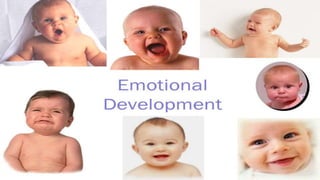
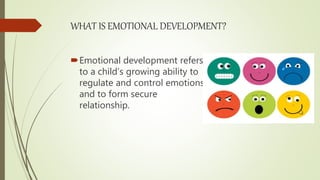
WHAT IS EMOTIONAL DEVELOPMENT?
Emotional development refers
to a child’s growing ability to
regulate and control emotions
and to form secure
relationship.
STAGES OF EMOTIONAL DEVELOPMENT:-
THERE ARE FOUR MAIN STAGES OF EMOTIONAL
DEVELOPMENT:
 During infancy (birth to 2 years)
 During childhood (3 years to 11 years)
 During adolescence (12 years to 18 years)
 During adulthood (18 years +)
STAGES OF EMOTIONAL DEVELOPMENT:-
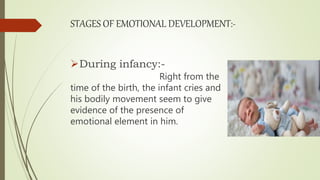
During infancy:-
Right from the
time of the birth, the infant cries and
his bodily movement seem to give
evidence of the presence of
emotional element in him.
STAGES OF EMOTIONAL DEVELOPMENT:-
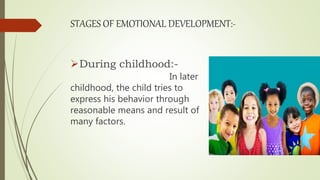
During childhood:-
In later
childhood, the child tries to
express his behavior through
reasonable means and result of
many factors.
STAGES OF EMOTIONAL DEVELOPMENT:-
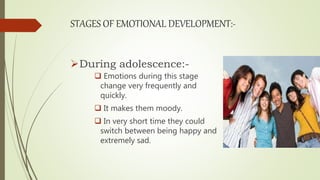
During adolescence:-
 Emotions during this stage
change very frequently and
quickly.
 It makes them moody.
 In very short time they could
switch between being happy and
extremely sad.
STAGES OF EMOTIONAL DEVELOPMENT:-
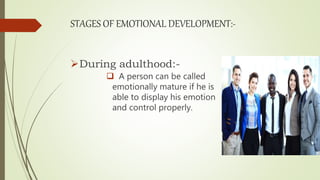
During adulthood:-
 A person can be called
emotionally mature if he is
able to display his emotion
and control properly.
PRESENTED BY:-
SHARJEEL MAHMOOD TAHIR(213)
ZAKRIA HUSSAIN(225)
MUHAMMAD USMAN(216)
B.ED (HONS) ELEMENTRY
(SEMESTER 1ST)
DEPARTMENT OF EDUCATION
UNIVERSITY OF SARGODHA
IF YOU HAVE ANY QUESTION,
RAISE YOUR HAND
emotional development assignment

emotional development assignment

  • 2.
  • 3.
    WHAT IS EMOTION? Themental thinking or the feeling of a person at a particular instance knowingly or unknowingly is called an emotion.
  • 4.
    TYPES OF EMOTION:- Positiveemotion:- These emotion are very helpful and essential in the normal development of an individual. For example, (Love, Curiosity, Joy or Happiness)
  • 5.
    PICS OF DIFFERENTPOSITIVE EMOTIONS JOY CURIOSITY LOVE
  • 6.
    TYPES OF EMOTION:- Negativeemotion:- These emotions are harmful to the development of an individual’s. For example (Fear, Anger or Jealousy)
  • 7.
    PICS OF DIFFERENTNEGATIVE EMOTIONS ANGER JEALOUSY FEAR
  • 8.
    WHO INFLUENCE EMOTION? FAMILY  FRIENDS  SCHOOL  TEACHER
  • 9.
    WHAT IS EMOTIONALDEVELOPMENT? Emotional development refers to a child’s growing ability to regulate and control emotions and to form secure relationship.
  • 10.
    STAGES OF EMOTIONALDEVELOPMENT:- THERE ARE FOUR MAIN STAGES OF EMOTIONAL DEVELOPMENT:  During infancy (birth to 2 years)  During childhood (3 years to 11 years)  During adolescence (12 years to 18 years)  During adulthood (18 years +)
  • 11.
    STAGES OF EMOTIONALDEVELOPMENT:- During infancy:- Right from the time of the birth, the infant cries and his bodily movement seem to give evidence of the presence of emotional element in him.
  • 12.
    STAGES OF EMOTIONALDEVELOPMENT:- During childhood:- In later childhood, the child tries to express his behavior through reasonable means and result of many factors.
  • 13.
    STAGES OF EMOTIONALDEVELOPMENT:- During adolescence:-  Emotions during this stage change very frequently and quickly.  It makes them moody.  In very short time they could switch between being happy and extremely sad.
  • 14.
    STAGES OF EMOTIONALDEVELOPMENT:- During adulthood:-  A person can be called emotionally mature if he is able to display his emotion and control properly.
  • 16.
    PRESENTED BY:- SHARJEEL MAHMOODTAHIR(213) ZAKRIA HUSSAIN(225) MUHAMMAD USMAN(216) B.ED (HONS) ELEMENTRY (SEMESTER 1ST) DEPARTMENT OF EDUCATION UNIVERSITY OF SARGODHA
  • 17.
    IF YOU HAVEANY QUESTION, RAISE YOUR HAND