TEKS 6B: Understand the electromagnetic spectrum and the mathematical relationships between
energy, frequency, and wavelength of light. TEKS 6C: Calculate the wavelength, frequency, and energy
of light using Planck’s constant and the speed of light.
What are the properties of light?
By 1900 there was enough experimental evidence to convince scientists
that light consists of waves.
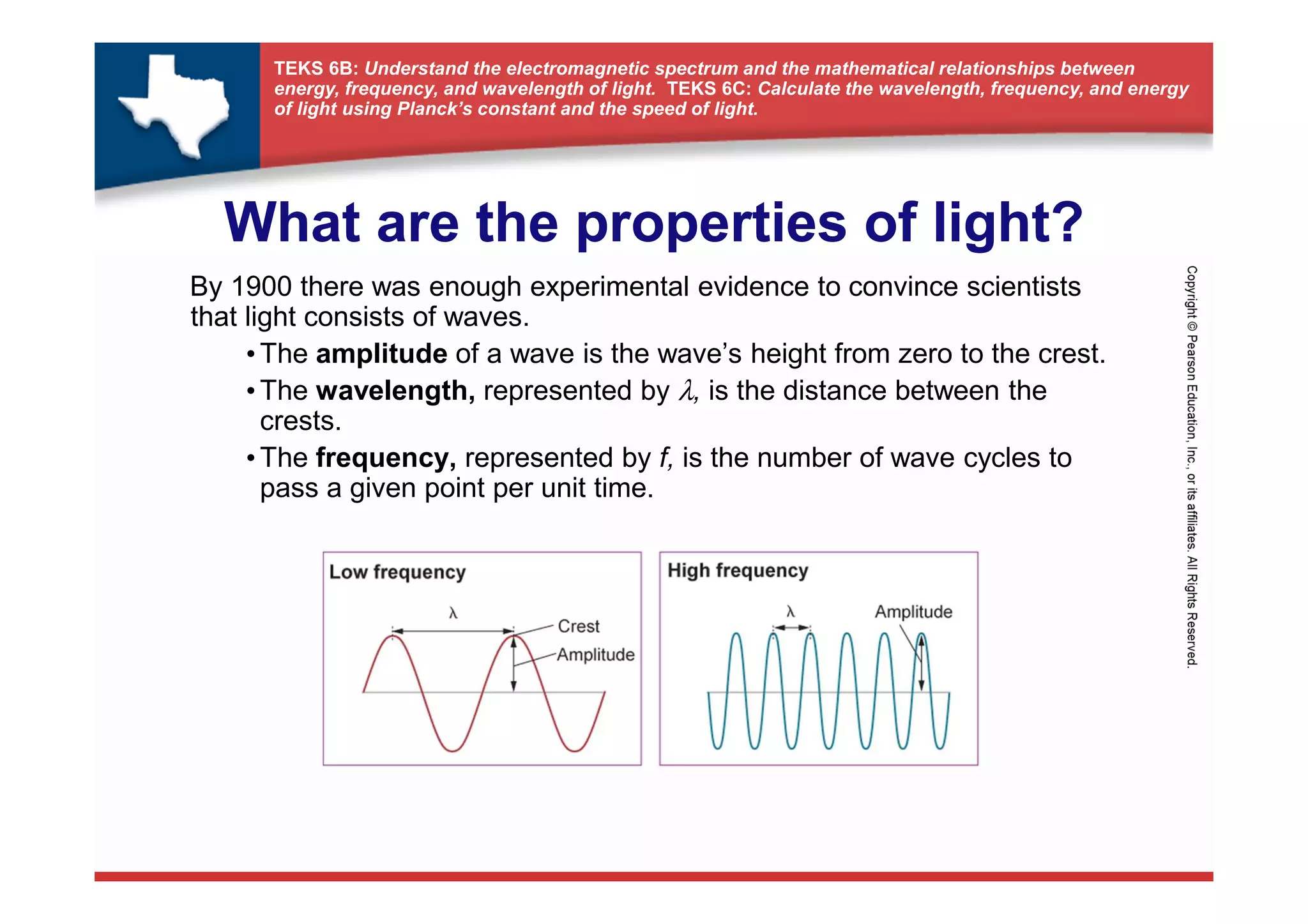
•The amplitude of a wave is the wave’s height from zero to the crest.
•The wavelength, represented by λ, is the distance between the
crests.
•The frequency, represented by f, is the number of wave cycles to
pass a given point per unit time.
TEKS 6B: Understand the electromagnetic spectrum and the mathematical relationships between
energy, frequency, and wavelength of light. TEKS 6C: Calculate the wavelength, frequency, and energy
of light using Planck’s constant and the speed of light.
Units of frequency
Units of frequency
The units of frequency are usually cycles per second.
•The SI unit of cycles per second is called the hertz (Hz).
•A hertz can also be expressed as a reciprocal second (s–1) or 1/s.
TEKS 6B: Understand the electromagnetic spectrum and the mathematical relationships between
energy, frequency, and wavelength of light. TEKS 6C: Calculate the wavelength, frequency, and energy
of light using Planck’s constant and the speed of light.
The electromagnetic spectrum
The product of frequency and wavelength equals a constant (c), the speed
of light.
c = fλ
where: f - frequency in Hz or 1/s
λ - wavelength in m
•The wavelength and frequency of light are inversely proportional to
each other.
•As the wavelength of light increases, the frequency decreases.
1. Understand Mathematical Relationships Show that you understand the
mathematical relationships between the frequency and wavelength of light by
describing what happens to the frequency of light when the wavelength of the
light decreases.
TEKS 6B: Understand the electromagnetic spectrum and the mathematical relationships between
energy, frequency, and wavelength of light. TEKS 6C: Calculate the wavelength, frequency, and energy
of light using Planck’s constant and the speed of light.
Electromagnetic radiation
According to the wave model, light consists of electromagnetic waves.
•Electromagnetic radiation includes radio waves, microwaves,
infrared waves, visible light, ultraviolet waves, X-rays, and gamma
rays.
•All electromagnetic waves travel in a vacuum at a speed of
3.00 × 10⁸ m/s.
TEKS 6B: Understand the electromagnetic spectrum and the mathematical relationships between
energy, frequency, and wavelength of light. TEKS 6C: Calculate the wavelength, frequency, and energy
of light using Planck’s constant and the speed of light.
The electromagnetic spectrum
TEKS 6B: Understand the electromagnetic spectrum and the mathematical relationships between
energy, frequency, and wavelength of light. TEKS 6C: Calculate the wavelength, frequency, and energy
of light using Planck’s constant and the speed of light.
The visible spectrum
The sun and incandescent light bulbs emit white light, which consists of
light with a continuous range of wavelengths and frequencies.
•The wavelength and frequency of each color of light are
characteristic of that color.
•When sunlight passes through a prism, the different wavelengths
separate into a spectrum of colors.
•Red has the longest wavelength and the lowest frequency in the
visible spectrum.
Electron energy:
Ground state – electron is at its normal energy state
Excited state – electron has more energy than normal due to exposure
to heat or electricity
2. Understand the Electromagnetic Spectrum Show that you understand the
electromagnetic spectrum by identifying the types of nonvisible radiation that
have wavelengths close to those of red light and to those of blue light.
TEKS 6B: Understand the electromagnetic spectrum and the mathematical relationships between
energy, frequency, and wavelength of light. TEKS 6C: Calculate the wavelength, frequency, and energy
of light using Planck’s constant and the speed of light.
Sample problem:
Calculating the wavelength of light
Sample problem:
Calculating the wavelength of light
Use the speed of light to calculate the wavelength of yellow light emitted by
a sodium lamp if the frequency of the radiation is 5.09 × 10¹⁴ Hz
(5.09 × 10¹⁴ s–1).
(contd.)
TEKS 6B: Understand the electromagnetic spectrum and the mathematical relationships between
energy, frequency, and wavelength of light. TEKS 6C: Calculate the wavelength, frequency, and energy
of light using Planck’s constant and the speed of light.
Sample problem:
Calculating the wavelength of light
Sample problem:
Calculating the wavelength of light
1. Analyze List the knowns and the unknown. Use the equation c = λν to
solve for the unknown wavelength.
Knowns
•frequency (f) = 5.09 × 10¹⁴/s
•c = 2.998 × 10⁸ m/s
Unknown
•wavelength (λ) = ? m
(contd.)
TEKS 6B: Understand the electromagnetic spectrum and the mathematical relationships between
energy, frequency, and wavelength of light. TEKS 6C: Calculate the wavelength, frequency, and energy
of light using Planck’s constant and the speed of light.
Sample problem:
Calculating the wavelength of light
Sample problem:
Calculating the wavelength of light
2. Calculate Solve for the the unknown.
Write the expression that relates the frequency and the wavelength of light.
c = f λ
Rearrange the equation to solve for λ.
λ = c/f
Substitute the known values for ν and c into the equation and solve.
m
10
89
.
5
s
/
10
09
.
5
s
/
m
10
00
.
3 7
14
8
−
×
=
×
×
=
λ
(contd.)
TEKS 6B: Understand the electromagnetic spectrum and the mathematical relationships between
energy, frequency, and wavelength of light. TEKS 6C: Calculate the wavelength, frequency, and energy
of light using Planck’s constant and the speed of light.
Sample problem:
Calculating the wavelength of light
Sample problem:
Calculating the wavelength of light
3. Evaluate Does the result make sense?
•The magnitude of the frequency is much larger than the numerical
value of the speed of light, so the answer should be much less
than 1.
3. Calculate Quantities Related to Light Use the speed of light to calculate the
wavelength of light whose frequency is 5.00 × 10¹⁵ s–1.
TEKS 6B: Understand the electromagnetic spectrum and the mathematical relationships between
energy, frequency, and wavelength of light. TEKS 6C: Calculate the wavelength, frequency, and energy
of light using Planck’s constant and the speed of light.
How is the frequency of light
related to energy?
How is the frequency of light
related to energy?
In 1900, the German physicist Max Planck (1858–1947) was trying to
describe why a metal that is heated first appears black, then red, then
yellow, and then white.
•He found that he could explain the color changes if he assumed that
the energy of a body changes only in small, discrete units, or quanta.
TEKS 6B: Understand the electromagnetic spectrum and the mathematical relationships between
energy, frequency, and wavelength of light. TEKS 6C: Calculate the wavelength, frequency, and energy
of light using Planck’s constant and the speed of light.
The quantization of energy
Planck showed mathematically that the amount of radiant energy (E) of a
single quantum absorbed or emitted by a body is proportional to the
frequency of radiation (f).
E ∝ f or E = hf
•The constant (h), which has a value of 6.63 × 10⁻³⁴ J · s is called
Planck’s constant.
•The energy of a quantum equals hf.
4. Understand Mathematical Relationships Fill in the blanks to show that you
understand the mathematical relationships between energy and frequency of
light: “A __________ energy change involves the emission or absorption of low-
frequency radiation. A __________ energy change involves the emission or
absorption of high-frequency radiation.”
TEKS 6B: Understand the electromagnetic spectrum and the mathematical relationships between
energy, frequency, and wavelength of light. TEKS 6C: Calculate the wavelength, frequency, and energy
of light using Planck’s constant and the speed of light.
Photons
Photons
In 1905, Albert Einstein proposed that light could be described as quanta
of energy.
•The quanta behave as if they were particles.
•Light quanta are called photons.
•The energy of photons is quantized according to the equation E = hf.
TEKS 6B: Understand the electromagnetic spectrum and the mathematical relationships between
energy, frequency, and wavelength of light. TEKS 6C: Calculate the wavelength, frequency, and energy
of light using Planck’s constant and the speed of light.
Sample problem:
Calculating the energy of a photon
Sample problem:
Calculating the energy of a photon
Use Planck’s constant to calculate the energy of a photon of microwave
radiation with a frequency of 3.20 × 10¹¹/s.
(contd.)
TEKS 6B: Understand the electromagnetic spectrum and the mathematical relationships between
energy, frequency, and wavelength of light. TEKS 6C: Calculate the wavelength, frequency, and energy
of light using Planck’s constant and the speed of light.
Sample problem:
Calculating the energy of a photon
Sample problem:
Calculating the energy of a photon
1. Analyze List the knowns and the unknown. Use the equation E = hν to
calculate the energy of the photon.
Knowns
• frequency (f) = 3.20 × 10¹¹/s
• h = 6.63 × 10⁻³⁴ J · s
Unknown
• energy (E) = ? J
(contd.)
TEKS 6B: Understand the electromagnetic spectrum and the mathematical relationships between
energy, frequency, and wavelength of light. TEKS 6C: Calculate the wavelength, frequency, and energy
of light using Planck’s constant and the speed of light.
Sample problem:
Calculating the energy of a photon
Sample problem:
Calculating the energy of a photon
2. Calculate Solve for the the unknown.
Write the expression that relates the energy of a photon of radiation and
the frequency of the radiation.
c = f λ
Substitute the known values for ν and h into the equation and solve.
E = (6.63 × 10⁻³⁴ J · s) × (3.20 × 10¹¹/s) = 2.12 × 10⁻²² J
(contd.)
TEKS 6B: Understand the electromagnetic spectrum and the mathematical relationships between
energy, frequency, and wavelength of light. TEKS 6C: Calculate the wavelength, frequency, and energy
of light using Planck’s constant and the speed of light.
Sample problem:
Calculating the energy of a photon
Sample problem:
Calculating the energy of a photon
3. Evaluate Does the result make sense?
•Individual photons have very small energies, so the answer seems
reasonable.
5. Calculate Quantities Related to Light Use Planck’s constant to calculate
the energy of a photon of X-ray radiation with a frequency of 7.49 × 10¹⁸/s.

Emission spectrum light and energy

  • 1.
    TEKS 6B: Understandthe electromagnetic spectrum and the mathematical relationships between energy, frequency, and wavelength of light. TEKS 6C: Calculate the wavelength, frequency, and energy of light using Planck’s constant and the speed of light. What are the properties of light? What are the properties of light? By 1900 there was enough experimental evidence to convince scientists that light consists of waves. •The amplitude of a wave is the wave’s height from zero to the crest. •The wavelength, represented by λ, is the distance between the crests. •The frequency, represented by f, is the number of wave cycles to pass a given point per unit time.
  • 2.
    TEKS 6B: Understandthe electromagnetic spectrum and the mathematical relationships between energy, frequency, and wavelength of light. TEKS 6C: Calculate the wavelength, frequency, and energy of light using Planck’s constant and the speed of light. Units of frequency Units of frequency The units of frequency are usually cycles per second. •The SI unit of cycles per second is called the hertz (Hz). •A hertz can also be expressed as a reciprocal second (s–1) or 1/s.
  • 3.
    TEKS 6B: Understandthe electromagnetic spectrum and the mathematical relationships between energy, frequency, and wavelength of light. TEKS 6C: Calculate the wavelength, frequency, and energy of light using Planck’s constant and the speed of light. The electromagnetic spectrum The electromagnetic spectrum The product of frequency and wavelength equals a constant (c), the speed of light. c = fλ where: f - frequency in Hz or 1/s λ - wavelength in m •The wavelength and frequency of light are inversely proportional to each other. •As the wavelength of light increases, the frequency decreases. 1. Understand Mathematical Relationships Show that you understand the mathematical relationships between the frequency and wavelength of light by describing what happens to the frequency of light when the wavelength of the light decreases.
  • 4.
    TEKS 6B: Understandthe electromagnetic spectrum and the mathematical relationships between energy, frequency, and wavelength of light. TEKS 6C: Calculate the wavelength, frequency, and energy of light using Planck’s constant and the speed of light. Electromagnetic radiation Electromagnetic radiation According to the wave model, light consists of electromagnetic waves. •Electromagnetic radiation includes radio waves, microwaves, infrared waves, visible light, ultraviolet waves, X-rays, and gamma rays. •All electromagnetic waves travel in a vacuum at a speed of 3.00 × 10⁸ m/s.
  • 5.
    TEKS 6B: Understandthe electromagnetic spectrum and the mathematical relationships between energy, frequency, and wavelength of light. TEKS 6C: Calculate the wavelength, frequency, and energy of light using Planck’s constant and the speed of light. The electromagnetic spectrum The electromagnetic spectrum
  • 6.
    TEKS 6B: Understandthe electromagnetic spectrum and the mathematical relationships between energy, frequency, and wavelength of light. TEKS 6C: Calculate the wavelength, frequency, and energy of light using Planck’s constant and the speed of light. The visible spectrum The visible spectrum The sun and incandescent light bulbs emit white light, which consists of light with a continuous range of wavelengths and frequencies. •The wavelength and frequency of each color of light are characteristic of that color. •When sunlight passes through a prism, the different wavelengths separate into a spectrum of colors. •Red has the longest wavelength and the lowest frequency in the visible spectrum. Electron energy: Ground state – electron is at its normal energy state Excited state – electron has more energy than normal due to exposure to heat or electricity 2. Understand the Electromagnetic Spectrum Show that you understand the electromagnetic spectrum by identifying the types of nonvisible radiation that have wavelengths close to those of red light and to those of blue light.
  • 7.
    TEKS 6B: Understandthe electromagnetic spectrum and the mathematical relationships between energy, frequency, and wavelength of light. TEKS 6C: Calculate the wavelength, frequency, and energy of light using Planck’s constant and the speed of light. Sample problem: Calculating the wavelength of light Sample problem: Calculating the wavelength of light Use the speed of light to calculate the wavelength of yellow light emitted by a sodium lamp if the frequency of the radiation is 5.09 × 10¹⁴ Hz (5.09 × 10¹⁴ s–1). (contd.)
  • 8.
    TEKS 6B: Understandthe electromagnetic spectrum and the mathematical relationships between energy, frequency, and wavelength of light. TEKS 6C: Calculate the wavelength, frequency, and energy of light using Planck’s constant and the speed of light. Sample problem: Calculating the wavelength of light Sample problem: Calculating the wavelength of light 1. Analyze List the knowns and the unknown. Use the equation c = λν to solve for the unknown wavelength. Knowns •frequency (f) = 5.09 × 10¹⁴/s •c = 2.998 × 10⁸ m/s Unknown •wavelength (λ) = ? m (contd.)
  • 9.
    TEKS 6B: Understandthe electromagnetic spectrum and the mathematical relationships between energy, frequency, and wavelength of light. TEKS 6C: Calculate the wavelength, frequency, and energy of light using Planck’s constant and the speed of light. Sample problem: Calculating the wavelength of light Sample problem: Calculating the wavelength of light 2. Calculate Solve for the the unknown. Write the expression that relates the frequency and the wavelength of light. c = f λ Rearrange the equation to solve for λ. λ = c/f Substitute the known values for ν and c into the equation and solve. m 10 89 . 5 s / 10 09 . 5 s / m 10 00 . 3 7 14 8 − × = × × = λ (contd.)
  • 10.
    TEKS 6B: Understandthe electromagnetic spectrum and the mathematical relationships between energy, frequency, and wavelength of light. TEKS 6C: Calculate the wavelength, frequency, and energy of light using Planck’s constant and the speed of light. Sample problem: Calculating the wavelength of light Sample problem: Calculating the wavelength of light 3. Evaluate Does the result make sense? •The magnitude of the frequency is much larger than the numerical value of the speed of light, so the answer should be much less than 1. 3. Calculate Quantities Related to Light Use the speed of light to calculate the wavelength of light whose frequency is 5.00 × 10¹⁵ s–1.
  • 11.
    TEKS 6B: Understandthe electromagnetic spectrum and the mathematical relationships between energy, frequency, and wavelength of light. TEKS 6C: Calculate the wavelength, frequency, and energy of light using Planck’s constant and the speed of light. How is the frequency of light related to energy? How is the frequency of light related to energy? In 1900, the German physicist Max Planck (1858–1947) was trying to describe why a metal that is heated first appears black, then red, then yellow, and then white. •He found that he could explain the color changes if he assumed that the energy of a body changes only in small, discrete units, or quanta.
  • 12.
    TEKS 6B: Understandthe electromagnetic spectrum and the mathematical relationships between energy, frequency, and wavelength of light. TEKS 6C: Calculate the wavelength, frequency, and energy of light using Planck’s constant and the speed of light. The quantization of energy The quantization of energy Planck showed mathematically that the amount of radiant energy (E) of a single quantum absorbed or emitted by a body is proportional to the frequency of radiation (f). E ∝ f or E = hf •The constant (h), which has a value of 6.63 × 10⁻³⁴ J · s is called Planck’s constant. •The energy of a quantum equals hf. 4. Understand Mathematical Relationships Fill in the blanks to show that you understand the mathematical relationships between energy and frequency of light: “A __________ energy change involves the emission or absorption of low- frequency radiation. A __________ energy change involves the emission or absorption of high-frequency radiation.”
  • 13.
    TEKS 6B: Understandthe electromagnetic spectrum and the mathematical relationships between energy, frequency, and wavelength of light. TEKS 6C: Calculate the wavelength, frequency, and energy of light using Planck’s constant and the speed of light. Photons Photons In 1905, Albert Einstein proposed that light could be described as quanta of energy. •The quanta behave as if they were particles. •Light quanta are called photons. •The energy of photons is quantized according to the equation E = hf.
  • 14.
    TEKS 6B: Understandthe electromagnetic spectrum and the mathematical relationships between energy, frequency, and wavelength of light. TEKS 6C: Calculate the wavelength, frequency, and energy of light using Planck’s constant and the speed of light. Sample problem: Calculating the energy of a photon Sample problem: Calculating the energy of a photon Use Planck’s constant to calculate the energy of a photon of microwave radiation with a frequency of 3.20 × 10¹¹/s. (contd.)
  • 15.
    TEKS 6B: Understandthe electromagnetic spectrum and the mathematical relationships between energy, frequency, and wavelength of light. TEKS 6C: Calculate the wavelength, frequency, and energy of light using Planck’s constant and the speed of light. Sample problem: Calculating the energy of a photon Sample problem: Calculating the energy of a photon 1. Analyze List the knowns and the unknown. Use the equation E = hν to calculate the energy of the photon. Knowns • frequency (f) = 3.20 × 10¹¹/s • h = 6.63 × 10⁻³⁴ J · s Unknown • energy (E) = ? J (contd.)
  • 16.
    TEKS 6B: Understandthe electromagnetic spectrum and the mathematical relationships between energy, frequency, and wavelength of light. TEKS 6C: Calculate the wavelength, frequency, and energy of light using Planck’s constant and the speed of light. Sample problem: Calculating the energy of a photon Sample problem: Calculating the energy of a photon 2. Calculate Solve for the the unknown. Write the expression that relates the energy of a photon of radiation and the frequency of the radiation. c = f λ Substitute the known values for ν and h into the equation and solve. E = (6.63 × 10⁻³⁴ J · s) × (3.20 × 10¹¹/s) = 2.12 × 10⁻²² J (contd.)
  • 17.
    TEKS 6B: Understandthe electromagnetic spectrum and the mathematical relationships between energy, frequency, and wavelength of light. TEKS 6C: Calculate the wavelength, frequency, and energy of light using Planck’s constant and the speed of light. Sample problem: Calculating the energy of a photon Sample problem: Calculating the energy of a photon 3. Evaluate Does the result make sense? •Individual photons have very small energies, so the answer seems reasonable. 5. Calculate Quantities Related to Light Use Planck’s constant to calculate the energy of a photon of X-ray radiation with a frequency of 7.49 × 10¹⁸/s.