Ms.S.Tamilselvan
Divergence of vector fields
Electromagnetic fields
1
Divergence of vector fields
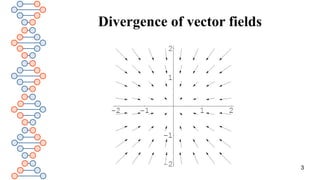
The divergence of a vector field is the
infinitesimal relative change in volume when
transporting a volume element along its flow. The
abstract definition in terms of Lie derivative and
volume form is quite intuitive here.
2
Divergence of vector fields
3
Divergence of vector fields
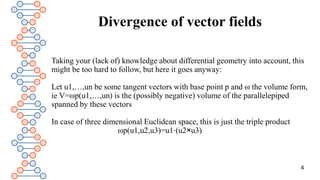
Taking your (lack of) knowledge about differential geometry into account, this
might be too hard to follow, but here it goes anyway:
Let u1,…,un be some tangent vectors with base point p and ω the volume form,
ie V=ωp(u1,…,un) is the (possibly negative) volume of the parallelepiped
spanned by these vectors
In case of three dimensional Euclidean space, this is just the triple product
ωp(u1,u2,u3)=u1⋅(u2×u3)
4
Divergence of vector fields
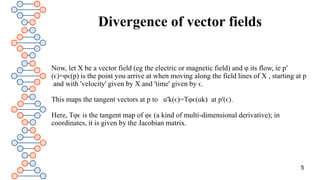
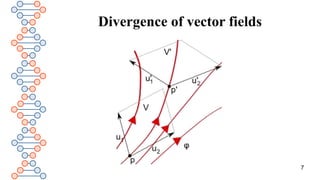
Now, let X be a vector field (eg the electric or magnetic field) and φ its flow, ie p′
(ϵ)=φϵ(p) is the point you arrive at when moving along the field lines of X , starting at p
and with 'velocity' given by X and 'time' given by ϵ.
This maps the tangent vectors at p to u′k(ϵ)=Tφϵ(uk) at p′(ϵ).
Here, Tφϵ is the tangent map of φϵ (a kind of multi-dimensional derivative); in
coordinates, it is given by the Jacobian matrix.
5
Divergence of vector fields
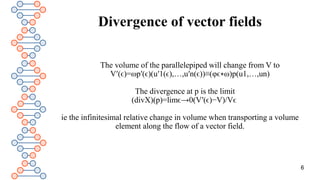
The volume of the parallelepiped will change from V to
V′(ϵ)=ωp′(ϵ)(u′1(ϵ),…,u′n(ϵ))≡(φϵ∗ω)p(u1,…,un)
The divergence at p is the limit
(divX)(p)=limϵ→0(V′(ϵ)−V)/Vϵ
ie the infinitesimal relative change in volume when transporting a volume
element along the flow of a vector field.
6
Divergence of vector fields
7
Divergence of vector fields
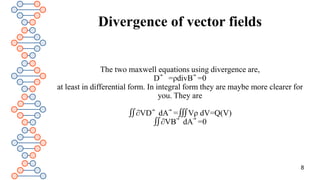
The two maxwell equations using divergence are,
D⃗ =ρdivB⃗ =0
at least in differential form. In integral form they are maybe more clearer for
you. They are
∬∂VD⃗ dA⃗ =∭Vρ dV=Q(V)
∬∂VB⃗ dA⃗ =0
8
Divergence of vector fields
The first equation just means the electrical flux D through a close
surface of a volume V is proportionate to the electrical charge in this volume.
Or in much simpler word, divergence is a mathematical measure of the density
of your electrical flux so you can make conclusions of the number of electrical
charges.
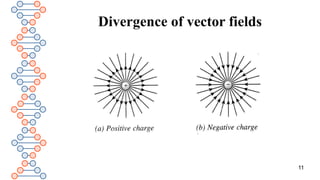
To be a little more precise. The electrical field is something coming
out of sources (positive charges) and ends in sinks (negative charges). So if you
include just one source with your volume V
and a sink is somewhere out of your volume your divergence measures one
positive charge Q.
If your volume include two sources and a sink you will measure again just one
positive charge Q.
9
Divergence of vector fields
The second equation is the same but with magnetic flux. You will notice the
equation is always 0. This is because there are no sources or sinks in magnetic
charges, so the divergence of B⃗
must always be 0.
10
Divergence of vector fields
11

EMF Divergence of vector fields (Tamilselvan).pptx

  • 1.
    Ms.S.Tamilselvan Divergence of vectorfields Electromagnetic fields 1
  • 2.
    Divergence of vectorfields The divergence of a vector field is the infinitesimal relative change in volume when transporting a volume element along its flow. The abstract definition in terms of Lie derivative and volume form is quite intuitive here. 2
  • 3.
  • 4.
    Divergence of vectorfields Taking your (lack of) knowledge about differential geometry into account, this might be too hard to follow, but here it goes anyway: Let u1,…,un be some tangent vectors with base point p and ω the volume form, ie V=ωp(u1,…,un) is the (possibly negative) volume of the parallelepiped spanned by these vectors In case of three dimensional Euclidean space, this is just the triple product ωp(u1,u2,u3)=u1⋅(u2×u3) 4
  • 5.
    Divergence of vectorfields Now, let X be a vector field (eg the electric or magnetic field) and φ its flow, ie p′ (ϵ)=φϵ(p) is the point you arrive at when moving along the field lines of X , starting at p and with 'velocity' given by X and 'time' given by ϵ. This maps the tangent vectors at p to u′k(ϵ)=Tφϵ(uk) at p′(ϵ). Here, Tφϵ is the tangent map of φϵ (a kind of multi-dimensional derivative); in coordinates, it is given by the Jacobian matrix. 5
  • 6.
    Divergence of vectorfields The volume of the parallelepiped will change from V to V′(ϵ)=ωp′(ϵ)(u′1(ϵ),…,u′n(ϵ))≡(φϵ∗ω)p(u1,…,un) The divergence at p is the limit (divX)(p)=limϵ→0(V′(ϵ)−V)/Vϵ ie the infinitesimal relative change in volume when transporting a volume element along the flow of a vector field. 6
  • 7.
  • 8.
    Divergence of vectorfields The two maxwell equations using divergence are, D⃗ =ρdivB⃗ =0 at least in differential form. In integral form they are maybe more clearer for you. They are ∬∂VD⃗ dA⃗ =∭Vρ dV=Q(V) ∬∂VB⃗ dA⃗ =0 8
  • 9.
    Divergence of vectorfields The first equation just means the electrical flux D through a close surface of a volume V is proportionate to the electrical charge in this volume. Or in much simpler word, divergence is a mathematical measure of the density of your electrical flux so you can make conclusions of the number of electrical charges. To be a little more precise. The electrical field is something coming out of sources (positive charges) and ends in sinks (negative charges). So if you include just one source with your volume V and a sink is somewhere out of your volume your divergence measures one positive charge Q. If your volume include two sources and a sink you will measure again just one positive charge Q. 9
  • 10.
    Divergence of vectorfields The second equation is the same but with magnetic flux. You will notice the equation is always 0. This is because there are no sources or sinks in magnetic charges, so the divergence of B⃗ must always be 0. 10
  • 11.