Favour Biodun INYERE
INTRODUCTION
What is a robot?
A robot is a computer
programmable machine that can
be guided by a device
Oxford English Dictionary gives the following
definition: “A machine capable of carrying out a
complex series of actions automatically,
especially one programmable by a computer.”
TRENDS OF ROBOTICS
Robotics is an interdisciplinary
career, which involves the
conception/design,
construction/manufacture,
application/operation, and
deployment/use of robots.
TRENDS OF ROBOTICS
Robots have the potential to
improve our lives in many
ways, but it also raises some
important ethical concerns
about autonomous control.
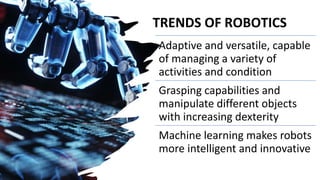
TRENDS OF ROBOTICS
Adaptive and versatile, capable
of managing a variety of
activities and condition
Grasping capabilities and
manipulate different objects
with increasing dexterity
Machine learning makes robots
more intelligent and innovative
TRENDS OF ROBOTICS
decisions to
perform
complex
tasks with
increased
autonomy
programmed
for repetitive
or dangerous
task for
humans
educational
and research
enabling
hands-on
experience
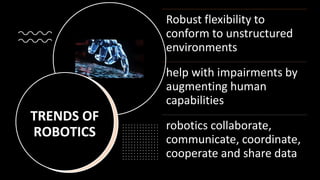
TRENDS OF
ROBOTICS
Robust flexibility to
conform to unstructured
environments
help with impairments by
augmenting human
capabilities
robotics collaborate,
communicate, coordinate,
cooperate and share data
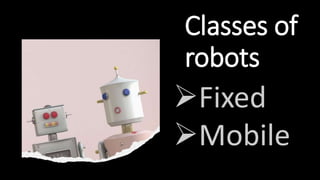
Classes of
robots
Types
of
Robots
Industrial robots are used in
factories to automate tasks
Service robots perform tasks
that are helpful to humans
Types of Robots
Medical robots support
vital procedures and
therapy
Military robots for
surveillance and security
purposes
Types of Robots
Space robots for exploration,
repairs & empirical analysis.
Humanoids are more intuitive
for cognitive engagements.
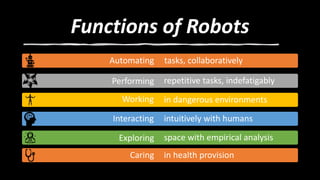
Functions of Robots
Automating tasks, collaboratively
Performing repetitive tasks, indefatigably
Working in dangerous environments
Interacting intuitively with humans
Exploring space with empirical analysis
Caring in health provision
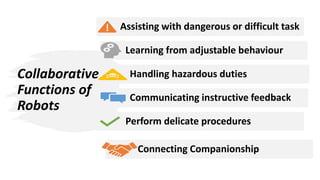
Collaborative
Functions of
Robots
Assisting with dangerous or difficult task
Learning from adjustable behaviour
Handling hazardous duties
Communicating instructive feedback
Perform delicate procedures
Connecting Companionship
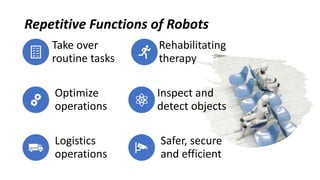
Repetitive Functions of Robots
Take over
routine tasks
Rehabilitating
therapy
Optimize
operations
Inspect and
detect objects
Logistics
operations
Safer, secure
and efficient
CONCLUSION
Work tool with innovative functions
Widespread affordability
Robocop Threat to humanity
Thank you!

Emerging Trends in Robots.pptx

  • 1.
  • 2.
  • 3.
    What is arobot? A robot is a computer programmable machine that can be guided by a device Oxford English Dictionary gives the following definition: “A machine capable of carrying out a complex series of actions automatically, especially one programmable by a computer.”
  • 4.
    TRENDS OF ROBOTICS Roboticsis an interdisciplinary career, which involves the conception/design, construction/manufacture, application/operation, and deployment/use of robots.
  • 5.
    TRENDS OF ROBOTICS Robotshave the potential to improve our lives in many ways, but it also raises some important ethical concerns about autonomous control.
  • 6.
    TRENDS OF ROBOTICS Adaptiveand versatile, capable of managing a variety of activities and condition Grasping capabilities and manipulate different objects with increasing dexterity Machine learning makes robots more intelligent and innovative
  • 7.
    TRENDS OF ROBOTICS decisionsto perform complex tasks with increased autonomy programmed for repetitive or dangerous task for humans educational and research enabling hands-on experience
  • 8.
    TRENDS OF ROBOTICS Robust flexibilityto conform to unstructured environments help with impairments by augmenting human capabilities robotics collaborate, communicate, coordinate, cooperate and share data
  • 9.
  • 10.
    Types of Robots Industrial robots areused in factories to automate tasks Service robots perform tasks that are helpful to humans
  • 11.
    Types of Robots Medicalrobots support vital procedures and therapy Military robots for surveillance and security purposes
  • 12.
    Types of Robots Spacerobots for exploration, repairs & empirical analysis. Humanoids are more intuitive for cognitive engagements.
  • 13.
    Functions of Robots Automatingtasks, collaboratively Performing repetitive tasks, indefatigably Working in dangerous environments Interacting intuitively with humans Exploring space with empirical analysis Caring in health provision
  • 14.
    Collaborative Functions of Robots Assisting withdangerous or difficult task Learning from adjustable behaviour Handling hazardous duties Communicating instructive feedback Perform delicate procedures Connecting Companionship
  • 15.
    Repetitive Functions ofRobots Take over routine tasks Rehabilitating therapy Optimize operations Inspect and detect objects Logistics operations Safer, secure and efficient
  • 16.
    CONCLUSION Work tool withinnovative functions Widespread affordability Robocop Threat to humanity
  • 17.