A Learning Manual for
Emerging Trends in Civil
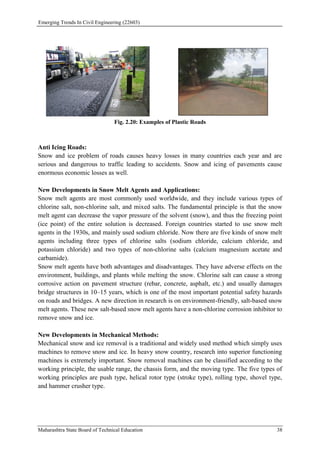
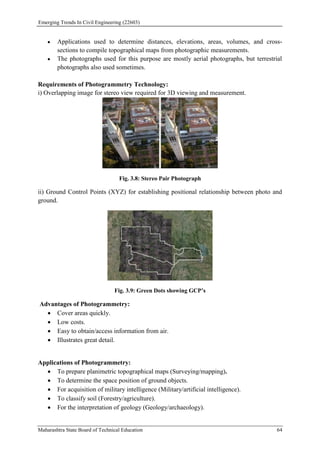
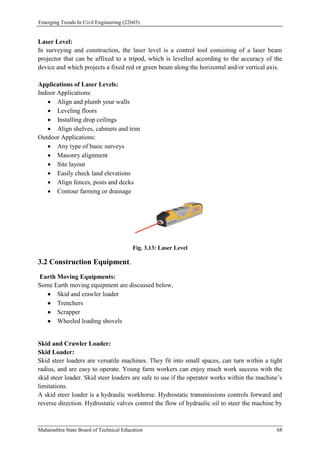
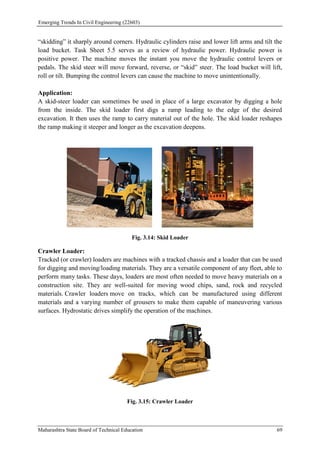
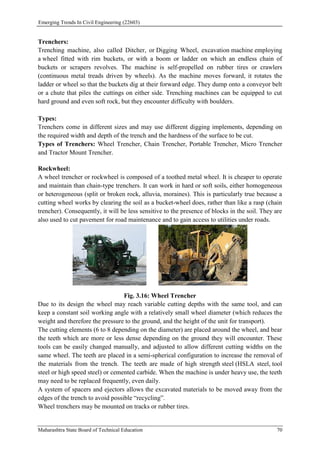
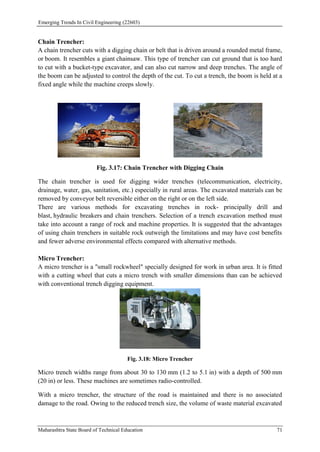
Engineering
(22603)
Semester – VI
(CE, CR, CS)
Maharashtra State
Board of Technical Education, Mumbai
(Autonomous) (ISO:9001:2015) (ISO/IEC 27001:2013)
Maharashtra State
Board of Technical Education, Mumbai
(Autonomous) (ISO:9001:2015) (ISO/IEC 27001:2013)
4th
Floor, Government Polytechnic Building, 49, Kherwadi,
Bandra (East), Mumbai -400051.
(Printed on November 2019)
Maharashtra State
Board of Technical Education
Certificate
This is to certify that Mr. / Ms. ………………………………….
Roll No……………………….of ………… Semester of Diploma
in……...……………………..………………………….of Institute
…………………………………….………(Code………………..)
has attained pre-defined practical outcomes(PROs) satisfactorily
in course Emerging Trends In Civil Engineering (22603) for
the academic year 20…….to 20…..... as prescribed in the
curriculum.
Place ………………. Enrollment No……………………
Date:…..................... Exam Seat No. ………………......
Course Teacher Head of the Department Principal
Seal of the
Institute
Emerging Trends In Civil Engineering (22603)
Maharashtra State Board of Technical Education i
Preface
The primary focus of any engineering work in the technical education system is to develop the
much needed industry relevant competency & skills. With this in view, MSBTE embarked on
innovative “I” scheme curricula for engineering diploma programmes with outcome based
education through continuous inputs from socio economic sectors. The industry experts
during the consultation while preparing the Perspective Plan for diploma level technical
education categorically mentioned that the curriculum, which is revised and implemented
normally further revised after 4-5 years. The technological advancements being envisaged and
faced by the industry in the present era are rapid and curriculum needs to be revised by taking
care of such advancements and therefore should have a provision of accommodating continual
changes. These views of industry experts were well taken & further discussed in the academic
committee of MSBTE, wherein it was decided to have a dynamism in curriculum for
imparting the latest technological advancements in the respective field of engineering. In
order to provide an opportunity to students to learn the technological advancements, a course
with a nomenclature of “Emerging Trends in Civil Engineering” is introduced in the 6th
semester of Civil Engineering Group.
The technological advancements to be depicted in the course called emerging trends was a
challenging task and therefore it was decided to prepare a learning material with the
involvement of industrial and academic experts for its uniformity in the aspect of delivery,
implementation and evaluation.
Engineering sector has completed number of projects with conventional techniques to meet
the needs of the society. But, in recent time, it is observed that, the various new innovative
techniques are being used worldwide, which our practicing engineers, are also partially using
to achieve their goals. The emerging trends in Civil Engineering help to complete the
undertaken projects within prescribed schedule, saves the natural resources and make the
projects eco-friendly. This course helps to make awareness about soft computing techniques,
new materials, advanced machineries, sustainable resource management and advancement in
Civil Engineering.
This learning manual is designed to help all stakeholders, especially the students and teachers
and to develop in the student the pre-determined outcomes. It is expected to explore further by
both students and teachers, on the various topics mentioned in learning manual to keep
updated themselves about the advancements in related technology.
MSBTE wishes to thank the Learning Manual development team, specifically Mr. Chetan
Raikar, Chairman of the Course Committee, Industry Experts, Dr. D.K.Parbat, Coordinator &
Mr. R.T. Aghav, Co-coordinator of the Programmes and academic experts for their intensive
efforts to formulate the learning material on “Emerging Trends in Civil Engineering”. Being
emerging trend and with the provision of dynamism in the curricula, any suggestions towards
enrichment of the topic and thereby course will be highly appreciated.
(Dr. Vinod M.Mohitkar)
Director
MSBTE, Mumbai
Emerging Trends In Civil Engineering (22603)
Maharashtra State Board of Technical Education ii
Programme Outcomes (POs) to be achieved through Learning of this Course
PO 1. Basic knowledge: An ability to apply knowledge of basic mathematics, science and
engineering to solve the engineering problems.
PO 2. Discipline knowledge: An ability to apply discipline-specific knowledge to solve core
and/or applied engineering problems
PO 5. The engineer and society: Asses societal, Health, Safety, legal and cultural issues and
the consequent responsibilities relevant to practice in field of Civil engineering
PO 6. Environment and sustainability: Apply Civil engineering solutions also for
sustainable development practices in societal and environmental contexts.
PO 7. Ethics: Apply ethical principles for commitment to professional ethics, responsibilities
and norms of the practices also in the field of Civil engineering
PO 8. Individual and Team Work: Function effectively as leader and team member in
diverse / multidisciplinary teams.
PO 10. Life-long learning: Engage in independent and life-long learning activities in the
context of technological changes also in the Civil engineering and allied industry
PSO 1.Construction planning and Design: Perform optimal Civil Engineering construction,
planning and designing activities of design quality at optimal cost.
PSO 2. Construction Execution and Maintenance: Execute Civil Engineering construction
and maintenance using relevant materials and equipment.
Emerging Trends In Civil Engineering (22603)
Maharashtra State Board of Technical Education iii
Course Outcomes
Course Outcomes (COs)
a. Reveal different applications of software’s for planning, designing and execution of
projects.
b. Suggest the advanced materials as per site condition.
c. Recommend the suitable tools and equipments for the given situation.
d. Suggest the advanced resource management techniques for the given project.
e. Use the feasible advance techniques for various civil engineering projects.
.
List of Industry Relevant Skills
The following industry identified competency through various teaching learning experiences
will be achieved
 Recommend emerging techniques in civil engineering.
The learning experiences and relevant skills associated with this course are to be taught and
implemented, so that the student demonstrates the following industry oriented relevant skills
associated with the above mentioned competency.
 Awareness of various new software’s in the area of construction activities..
 Identify the advanced materials in various construction activities
 Understand the use of advance tools and equipments
 Recommend the various resources required in construction activities
 Justify the feasibility of innovative construction techniques
Emerging Trends In Civil Engineering (22603)
Maharashtra State Board of Technical Education iv
Brief Guidelines to Teachers
1. Teacher will introduce the curriculum in details before the students.
2. Teachers should teach the curriculum as per this learning manual strictly.
3. Teachers will prepare sample MCQ,s based on contents in the Learning Manual
only
4. Teacher will provide these MCQ’s to Students for practice, as the ESE and PA is
MCQ based examination.
5. Teachers should give Micro projects to students.
6. Assess the skill achievement of the students and COs of each unit.
7. Teachers should give relevant information (including safety measures) to students
prior to visit arranged ( if any)
8. For effective implementation and attainment of Unit outcomes, teacher ought to
ensure that in the beginning itself of each unit, students must read through the
complete content of Learning Manual.
9. Teacher ought to assess the performance of students continuously according to the
MSBTE guidelines.
10. As far as possible, go through NPTEL, MOOC’S, SWAYAM website and register
for the certificate courses.
Emerging Trends In Civil Engineering (22603)
Maharashtra State Board of Technical Education v
Instructions for Students
1. For effective implementation and attainment of Course outcomes, in the beginning
it self of each unit, student need to read through the complete content in the
Learning Manual.
2. Student must refer the websites and references provide in Learning Manual
3. Student should not hesitate to ask any difficulties.
4. Student should develop the habit of pear discussions/group discussion related to the
unit/micro project so that exchanges of knowledge /skills could take place.
5. Student shall attempt to develop related hands-on skills and gain confidence.
6. Students shall visit the nearby construction site, technical exhibitions, trade fair etc.
7. Students should develop the habit of not to depend totally on teachers but to
develop self-learning techniques.
8. Student should develop habit to submit the Micro Project within stipulated time
schedule and be in touch with Course Teacher for any difficulty
9. Each student must follow the instructions given by the Course Teacher
10. As far as possible, go through NPTEL, MOOC’S, SWAYAM website and register
for the certificate courses.
Emerging Trends In Civil Engineering (22603)
Maharashtra State Board of Technical Education vi
INDEX
Sr. No. Unit / Topic Page No.
1
Unit- I :
Soft Computing Techniques 1 - 25
2
Unit-II :
Recent Construction Materials 26 - 56
3
Unit –III :
Latest Tools and Equipments 57 - 86
4
Unit-IV:
Sustainable Resource Management 87 - 118
5
Unit –V:
Advancement in Construction 119 - 151
Emerging Trends In Civil Engineering (22603)
Maharashtra State Board of Technical Education 1
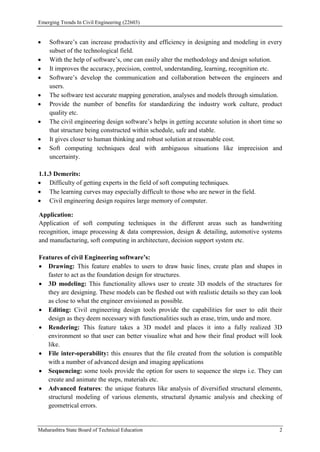
Unit-I
Soft Computing Techniques
Unit Outcomes (UOs)
(in cognitive domain)
1a. Enlist the characteristic uses of soft computing techniques in
Civil Engineering.
1b. Identify merits and demerits of soft computing techniques.
1c. Understand the general features of software’s used in Civil
Engineering.
1d. Suggest the suitable software/s for the given construction
activity.
Topics and
Sub-Topics
1.1 Introduction of soft computing techniques and its types,
Merits and demerits of soft computing technique,
Graphical User Interface Software (GUI) .
1.2 Introduction, salient features and applications of
software’s - REVIT, ETAB, 3D Architect Home, Build-
Master, HEC-RAS, STRAP, Water GEMS, Tekla, ArcGIS,
QuikGrid, STAAD.Pro, SAFE, RISA-Connection, Civil 3D,
Site 3D, SkyCiv Structural 3D, SAP 2000, MIDAS,
LUSAS, BricsCAD, Estimate Master, ProEst, WinEst, Clear
Estimate, Procore, Buildertrend, Building Management
System (BMS), Plant Design and Management System
(PDMS), Building Information Modeling (BIM), Primavera
Pro, Microsoft Project (MSP)
1.1 Introduction:
A few decades ago, when the computers and software’s were in their initial stage, planning
and construction of buildings was quite slow. Further, due to rapid technological revolution,
civil engineering companies speed up the construction ensuring quality and strength. Today
there are several friendly user software’s available in the field of civil engineering practices to
build large and challenged projects in short time. The techniques of soft computing were
introduced in early and now it become a major research and study area particularly in
automatic control engineering. Civil engineering design software has proven to help in
reducing the cost and minimizes the human error associated with project. The techniques of
soft computing are nowadays being used successfully in many domestic, commercial and
industrial applications. With the advent of low-cost and high performance digital processors,
it is clear that the techniques and application areas of soft computing shall have bright future
to expand. The soft computing methods are using successfully in the field of engineering and
technology as neutral networks, fuzzy logic, genetic algorithm, machine learning,
probabilistic reasoning etc.
1.1.2 Merits:
 The computing techniques assist engineers in solving linear and non-linear problems
where mathematical models not available.
Emerging Trends In Civil Engineering (22603)
Maharashtra State Board of Technical Education 2
 Software’s can increase productivity and efficiency in designing and modeling in every
subset of the technological field.
 With the help of software’s, one can easily alter the methodology and design solution.
 It improves the accuracy, precision, control, understanding, learning, recognition etc.
 Software’s develop the communication and collaboration between the engineers and
users.
 The software test accurate mapping generation, analyses and models through simulation.
 Provide the number of benefits for standardizing the industry work culture, product
quality etc.
 The civil engineering design software’s helps in getting accurate solution in short time so
that structure being constructed within schedule, safe and stable.
 It gives closer to human thinking and robust solution at reasonable cost.
 Soft computing techniques deal with ambiguous situations like imprecision and
uncertainty.
1.1.3 Demerits:
 Difficulty of getting experts in the field of soft computing techniques.
 The learning curves may especially difficult to those who are newer in the field.
 Civil engineering design requires large memory of computer.
Application:
Application of soft computing techniques in the different areas such as handwriting
recognition, image processing & data compression, design & detailing, automotive systems
and manufacturing, soft computing in architecture, decision support system etc.
Features of civil Engineering software’s:
 Drawing: This feature enables to users to draw basic lines, create plan and shapes in
faster to act as the foundation design for structures.
 3D modeling: This functionality allows user to create 3D models of the structures for
they are designing. These models can be fleshed out with realistic details so they can look
as close to what the engineer envisioned as possible.
 Editing: Civil engineering design tools provide the capabilities for user to edit their
design as they deem necessary with functionalities such as erase, trim, undo and more.
 Rendering: This feature takes a 3D model and places it into a fully realized 3D
environment so that user can better visualize what and how their final product will look
like.
 File inter-operability: this ensures that the file created from the solution is compatible
with a number of advanced design and imaging applications
 Sequencing: some tools provide the option for users to sequence the steps i.e. They can
create and animate the steps, materials etc.
 Advanced features: the unique features like analysis of diversified structural elements,
structural modeling of various elements, structural dynamic analysis and checking of
geometrical errors.
Emerging Trends In Civil Engineering (22603)
Maharashtra State Board of Technical Education 3
Requirements of Civil Engineering Design Software:
 Sustainable structures: sustainable design has become an incredibly relevant trend
within the construction and engineering fields. That means there will be an increase in
element for smart materials, intelligent electric grid, smart building and more. Hence, civil
engineering design software solutions will likely adapt to accommodate these trent’s.
 Advance materials: the civil engineering industry is starting to introduce advanced
materials that are able to adapt to external conditions. As this becomes more relevant in
industry, civil engineering tools change to accommodate this kind of design.
 3D printing: the trend of 3D printing demand has been recently reached the civil
engineering space, as 3D printing is capable of turning design created within civil
engineering models into a physical model.
1.1.4. Graphical User Interface (GUI):
In computer technology, there are several types of interfaces such as user interface which
allows the user to communicate with the operating system through keyboard, mouse, and
menus of a computer system. Further, hardware user interface includes wires, plugs and
sockets that hardware devices use to communicate with each other. Hence, GUI is a collection
of software program that use the computer's graphics to make apps easy to use and allows user
to interact with the electronic devices through graphical icons and visual indicators. The main
components of a GUI are a pointer (symbol on the screen), icons, windows, menus, scroll
bars, tabs, menu and input device to operate the computer and software.
1.2 Introduction to Common Software’s:
The various kinds of civil engineering software are resulting to create and develop the various
infrastructures within community. However, from the view of software’s applications to the
civil engineering, following are the relevant software’s are described in brief as
1.2.1 Revit:
Autodesk Revit Architecture is a robust architectural design and documentation software
application created by Autodesk for architects and building professionals. The purpose of
Autodesk Revit Architecture is to get the help about safety in structures, obtaining insight
how buildings will perform before construction begins, develop better quality designs and
improve the project delivery. In particular, benefit of Revit as in modeling, generating cost
schedules, collaboration and change management. The tools and features that make up Revit
Architecture are specifically designed to support the building information modeling (BIM)
workflow.
Features:
 Autodesk Revit Architecture allows changes made in one part of model to be
automatically propagated to other parts of model.
 It offers many other tools and features that can enhance productivity of architects and
engineers.
 This may be used to fast-track for complex design and building construction.
 It supports a multi-discipline collaborative design process.
Emerging Trends In Civil Engineering (22603)
Maharashtra State Board of Technical Education 4
 Intelligent model-based process used to plan, design, construct and manage
infrastructure.
 Automatically update floor plans, levels, sections and 3D views.
 Revit includes tools for architectural design, structural design, detailing and
engineering and construction professionals.
Applications:
 It is used to access the building information from the database of building models.
 It is used to analyze, simulate and connect in the cloud to improve the design
 It supports a multi-discipline collaborative design process.
 It is used as conceptual design tools to sketch and create freeform models
 It adds architectural elements to the building model such as walls, doors, windows and
components.
 Applicable to improve project outcomes with multi-disciplinary BIM software
 It is used to produce consistent, co-ordinated and complete model-based building
designs & documentation.
1.2.2. ETAB:
The innovative and revolutionary ETAB is the ultimate integrated software package
for the structural analysis and design of buildings. ETAB is Finite Element Analysis
software created by CSI and is used to model and analyze the structures mainly
buildings and their components to see how a building behaves under various loads. It
is the integrated software package for the structural analysis and design of building.
Incorporating 40 years of continues research and development, ETAB software
becomes sophisticated and comprehensive design capabilities for a wide -range of
materials and insightful graphics. It allows users quickly and easily understand the
analysis and design result. ETAB integrated every aspect of the engineering design
process.
Features:
 This software is used for modeling tools with templates, analysis methods and solution
techniques.
 It gives to user’s full control of the units used with all model data and displays the
results in units desired.
 This software offers a single user interface to perform the modeling, analysis, design,
and reporting.
 ETABS integrates every aspect of the engineering design process
 CAD drawings can be converted directly into ETABS models or used as templates
onto which ETABS objects may be overlaid.
 Plan and elevation views are automatically generated at every grid line to allow for
quick navigation of the model.
 Multi-tower buildings can now easily be modeled by using the new tower feature in
the ETAB.
Emerging Trends In Civil Engineering (22603)
Maharashtra State Board of Technical Education 5
 The data can be viewed and edited using on-screen dockable tables which is quite
useful for defining a model from spreadsheets or viewing analysis or design results.
 This software has a built-in library of standard concrete, steel and composite section
properties.
 ETABS has a many different link elements available for users to accurately represent
the behavior of a structure.
 ETABS will automatically generate and apply seismic and wind loads based on
various domestic and international codes.
 It allows for an unlimited number of load cases and combinations.
 This software is robust when it comes to assigned loads and further, uniform or non-
uniform surface loads can be assigned in any direction, not just gravity.
Applications:
 ETAB is an analysis and design based software which is much useful for structural
Engineers.
 CAD drowning can be converted directly into ETABS model or used as template onto
which ETABS objects may be overload.
 It is used for design of steel and concrete frames, composite beams, composite
column, steel joist etc.
 ETABS is used for the analysis of concrete shear walls and concrete moment frames.
 The model may be realistically rendered and all results can be shown directly on the
structure.
 Comprehensive and customizable reports are available for all analysis and design
output.
 It gives schematic construction drawing of framing plans, schedules, details and cross
sections.
 This software is applicable to Performance-Based Design (PBD) from traditional
structural design concepts and represents the future of earthquake engineering.
 ETABS has dynamic analysis capabilities which include the calculation of vibration
modes.
 It is applicable to pushover analysis features including implementation of FEMA 356,
hinge and fiber hinge option based on stress-strain.
1.2.3 3D Architect Home:
The architectural designer use 3D software to create models of buildings and other
structures. Further, these models are used to test the safety and design potential of
buildings. This software is home architect software made for professionals and
construction companies. It is a powerful and extensive tool-set for creating 2D floor
plans, elevations, section details etc.
Features:
 The tool allows you to create 2D floor plans but you can easily convert them
to 3D models for better view.
Emerging Trends In Civil Engineering (22603)
Maharashtra State Board of Technical Education 6
 It saves time, money and avoids costly mistakes.
 It creates detailed drawing sets for planning applications.
 Flexible import and export options including dxf, dwg, pdf, jpg, bmp, png, 3ds.
 Fully customize items including walls, windows, doors, skylights, roofs etc.
 It is a fully interactive graphics for modifying construction elements and individual
component parts.
 This software creates complex roof structures, split levels, unlimited floors and
buildings.
 It has landscaping tools for mark-out plot, paths, ponds etc and for setting height
levels.
 Make updates to your design quickly using advanced editing tools.
 It access to video tutorials, in-depth documentation, step by step guides, FAQ's, forum
UK Phone & Email software support.
 It is a single User License allows up to 2 activations with satisfactory solution
guarantee.
 Display your project from every angle at every step and generate ultra-realistic
renderings.
 This software immediately views your project in 3D as you design your plans in 2D.
Any object added in 3D or 2D is automatically added to the other plan.
Applications:
 It uses for self-builders, architects, home improvers, architectural technologist,
property developers, remodelers, interior designers etc.
 It uses for step to create the bare-bones structure of your home such as foundations,
walls, carpentry, roofing, and more.
 This software used to technical plans such as electrical network, plumbing
installations, heating, ventilation, air conditioning etc.
 Design and position your doors and windows according to your specifications such as
size, colour, texture, location, direction of opening, etc.
 It uses to select and compare different textures and materials like stone, brick, tiles,
etc.
 It makes garden design and landscape easy which includes mark-out an area, add
plants & flowers and watch them grow.
1.2.4 Build-Master:
Build-Master is most popular Indian software for RCC building design and
an application release for the automation tool, designed by the software development
team, Inedo. Build-Master is the flagship software of Ensoft which is a complete
package for RCC building analysis, design, drawing and estimation. BUILD-
MASTER is user friendly software and complex functions of the package are driven
by simple menu commands. This software is an automated deployment tool which is
using by the reputed design engineers all over India. It combines the features to
manage and automate processes primarily related to continuous integration, database
Emerging Trends In Civil Engineering (22603)
Maharashtra State Board of Technical Education 7
change scripts and production deployments. This tool is browser-based and able to be
used “out-of-the box”.
Features:
 Build Master is simple to install, learn and use.
 Build Master also has a tight integration with PowerShell and is often used along with
other DevOps tools.
 Single user version software comes on CD and the same can be installed on multiple
computers whereas it runs only on one computer at a time where the lock is
connected.
 The schematic 3D elevation of building is generated from the same plan data at
various levels.
 Build Master can ensure the protection of sensitive information.
 The detailed working drawings are prepared without entering even a line command in
drafting package.
Application:
 It is a complete package for analysis, design, drawing and estimation of RC buildings.
 The program perform earthquake and wind analysis by generating 3D space frame
model.
 It is employed to manage, store, control access to tokens, passwords, and API Key that
are involved in deployments.
 Measurements at site can be cross-checked easily at the office before billing of bar
bending schedule, generated by BUILD-MASTER can be sent to site for action by
fitters.
1.2.5 HEC-RAS:
It is a computer program that models the hydraulics of water flow through
natural rivers and other channels. HEC-RAS is a computer program for modeling
water flowing through systems of open channels and computing water surface profiles.
The program was developed by the United States Army Corps of Engineers in order to
manage the rivers, harbors, and other public works under their jurisdiction. The
Hydrologic Engineering Center (HEC) in Davis and California developed the River
Analysis System (RAS) to aid hydraulic engineers in channel flow analysis
and floodplain determination.
Features:
 Use feature objects and a TIN to develop the geometry of a HEC-RAS model.
 It creates cross sections, edit and merge in a database for use with HEC-RAS and other
hydraulic models.
 Delineate floodplain from water surface elevation data and the same can be computed
by HEC-RAS, defined interactively, or imported from a file.
 It is in the public domain with peer-reviewed and available to download free of charge
from HEC's web site.
Emerging Trends In Civil Engineering (22603)
Maharashtra State Board of Technical Education 8
 It is applicable to uncertainty in modeling parameters on a delineated floodplain.
Applications:
 It is capable of modeling subcritical, supercritical, and mixed flow regime flow along
with effects of bridges, culverts, weirs, and structures.
 HEC-RAS finds commercial application in floodplain, management and studies to
evaluate floodway encroachments.
 It is often possible to use HEC-RAS to overcome instability issues on river problems.
 The extended version of HECRAS is applicable to bridge design, culvert design, dam
analysis and channel modification etc.
 It is used for modeling water flowing through systems of open channels and
computing water surface profiles.
1.2.6 STRAP:
STRAP (Structural Analysis Programs) is sophisticated and user-friendly software that
allows engineers to design and analyze of many different structures. It is a windows-
based suite used with finite element static and dynamic analysis programs to buildings,
bridges and other structures. This software is one of the most comprehensive and
versatile structural analysis and design software systems available in the market
today. It is extremely used by large construction companies, government agencies,
international agencies, engineering firms, educational and research organizations
worldwide. STRAP software’s has unique design capabilities make it an outstanding
structural design program in the practices. It also includes modules for the design of
steel sections and reinforced concrete structural elements in accordance with
American, European, Canadian and other international codes.
Features:
 STRAP contains a "wizard" library of standard structures that enable you to define
your model by specifying only a few parameters and may be extended by the user.
 Load combinations can be created after analysis is performed and combinations can be
changed instantly without solving the model again.
 STRAP enables you to copy any part of the model without concern for duplicate
beams and nodes as the program automatically eliminates them.
 It is powerful which enables to assemble easily to a complex structure with repetitive
parts and each defined as a sub-model.
 The program utilizes 64-bit processors so solution time for large models can be
reduced up to 90% on computers with four processors.
 The graphical interface of STRAP is very powerful and at the same time interactive
with easy to use.
 Every drawing on the screen can be printed, imported into other documents and
drawings.
 STRAP uses graphical input for the generation of models and loads.
Emerging Trends In Civil Engineering (22603)
Maharashtra State Board of Technical Education 9
Applications:
 STRAP is suitable for analysis and design of frames, towers, tanks, bridges, domes
and just about any elastic structure.
 It is the easiest to use due to its superb graphic user interface (GUI) and context-
sensitive help system.
 It is used for the analysis and design of wide range of skeletal and continuum
structures such as buildings, bridges, shells, towers and more.
 Complete analysis and design can be performed for any structure without ever
referring to joint or beam numbers.
 This software used for modal analysis, seismic response spectra calculations according
to many codes and time-history response calculations.
 STRAP used for designing and detailing of reinforced concrete structures, post-
tensioned concrete, structural steel and composite members.
 This software can be used for automatic bridge analysis and design of water retaining
structures.
1.2.7. WaterGEMS:
Bentley openflows WaterGEMS provides a comprehensive and easy-to-use for water
distribution networks. This software helps to improve the knowledge of how
infrastructure behaves as a system, how it reacts to operational strategies and how it
should grow as population and demands increases. Openflows WaterGEMS is the
hydraulic modeling application software for water distribution systems with advanced
interoperability, asset management tools, geospatial model building and optimization.
The users of this software enjoy the power and versatility afforded by working across
CAD, GIS, and standalone platform while accessing a single, shared, project data source.
WaterGEMS is a superset of WaterCAD so will get data as obtained from WaterCAD
plus more with WaterGEMS.
Features:
 It creates and manages the customized reports that automatically combine graphs, data
tables, color-coded and annotated plan views.
 Access tools quickly through a modernized ribbon-based user interface with built-in
search to find commands more easily.
 It is used to run historical simulations using actual operation of pump and valve control
based on SCADA system records.
 It automatically assigns elevation values to junctions, tanks, pumps, valves, reservoirs,
and fire hydrants, saving engineers time and avoiding potential manual-input mistakes.
 WaterGEMS also provides drawing and connectivity review tools to have guarantee
about hydraulically co-herent model.
Applications:
 This Bentley’s tool used for real-time predictive and operational analytics for decision
support.
Emerging Trends In Civil Engineering (22603)
Maharashtra State Board of Technical Education 10
 Engineers at utilities, municipalities, and civil engineering firms use WaterGEMS for the
analysis and design of water distribution systems.
 Building a water-distribution network system and network design optimization.
 This software is used for water quality analysis.
 It is employed for model calibration.
 WaterGEMS provides synchronized database connections, geospatial links and advanced
model-building modules that connect with virtually any digital data format.
 WaterGEMS’ helps engineers to allocate water demands based on GIS water consumption
data from any point, line, or polygon using customer meters, lump-sum demand
distribution, population-estimation polygons, or utility meter routes.
1.2.8 Tekla:
Tekla is a software product family that consists of software for analysis, design and
detailing and project communication in all modern construction projects. It is a building
information modeling software which is able to model the structures that incorporate
different kinds of building materials including steel, concrete, timber and glass. Tekla
allows structural drafters and engineers to design a building structure by using its
components using 3D modeling which generate 2D drawings and access building
information.
Features:
 The software enables users to create and manage 3D structural models in concrete or steel
and guides them through the process from concept to fabrication.
 Tekla Structures is known to support large models with multiple simultaneous users, but is
regarded as relatively expensive, complex to learn and fully utilize.
 It uses only one tool for all materials (concrete, timber, steel etc.) and projects.
 Open collaboration and collaborate with project members and third parties.
 Localized software gets help from local support in more than 20 languages.
 It is powerful software automate your repetitive structural calculations.
 One can choose from one or more of our regularly updated calculation libraries or can
write his own.
 Single solution for all common element and material.
 It creates transparent calculations that are easy to check.
 This software compares different design options and makes changes quickly.
Applications:
 Tekla Structures is used in the construction industry for steel and concrete, detailing,
precast, and cast-in-situ.
 Engineers have used to model the stadiums, offshore structures, plants, factories,
residential buildings, bridges and skyscrapers.
 It is used for different kind of purposes such as business, education and partner.
 This software is used to write, store and distribute your own custom calculations.
 It is used to analyses the frame such as trusses, cranked beams and portal frames.
Emerging Trends In Civil Engineering (22603)
Maharashtra State Board of Technical Education 11
 The software visualizes input and results graphically in real time.
1.2.9 ArcGIS:
This software is GIS software developed by ESRI (Environmental Systems Research
Institute). It is an architecture geographic information system for working with maps and
geographic information. It provides tools for mapping and spatial reasoning so that the data
can be explored. It allows seeing where things are happening and how information is
connected. It offers capabilities for applying location based analysis. ArcGIS contains two
programs such as ArcMap and ArcCatalog, collectively referred as ArcGIS desktop.
Features:
 Spatial analysis is the heart and soul of ArcGIS. It gives ability to create, use and share
maps on any device.
 It has tool to manage, process, analyze and share imagery.
 It consists of four key software parts.
Applications:
 It is used for creating as well as using maps, compiling geographic data and analyzing
mapped information.
 It can be used for sharing and discovering geographic information and managing
geographic information in a database.
 It can be used to find the best location for the business, plan for smarter communities,
prepare and respond faster in crucial simulations.
 It is used to collect, crowd source, store, access and share data efficiently and securely.
1.2.10 Quick Grid:
It is free software for data users and having special extension for Google Chrome with which
2D or 3D grid can be created from a set of scattered data. This software is a program which
will read in a set of scattered data points in which surface is represented by three coordinates
x, y and z. This program will generate a grid from this data and then display the surface as a
contour map or as a 3D representation.
Features:
 The grid will be displayed as a wire frame or as a hidden surface grid.
 The grid and contour lines may be output as DXF file.
 The generated grid may be output to a file as a series of XYZ triplets.
Applications:
 It is used to prepare a 2D or 3D grid from a set of data.
 It is used to prepare contour maps.
1.2.11 STAAD. Pro:
This software is developed by Bentley which is 3D structural analysis and design software. It
performs comprehensive analysis and design for any size or type of structure. There are three
Emerging Trends In Civil Engineering (22603)
Maharashtra State Board of Technical Education 12
flexible STAAD. Pro options such as a) STAAD. Pro which is the basic software which
includes Finite Element Method analysis and physical modeling, b) STAAD. Pro Advanced,
which is faster, more advanced and can do complex analysis and c) Structural Enterprise, the
most popular structural applications in a single license.
Features:
 It converts physical model into analytical model automatically.
 It can optimize concrete and steel BIM workflows with the full integration of physical
members and surfaces.
 It can design for high seismic regions or every conditions using finite element
analysis.
 It can analyze and design simple or complex structures for a wide range of loading
conditions including gravity loads in combination with lateral loads.
 It can share structural models.
 It uses international structural profiles.
Applications:
 It can design steel, concrete, timber, aluminum and cold formed steel structures.
 It can design using nearly all international design codes.
1.2.12 SAFE:
It is the tool for modeling, analysis, design and detailing of concrete floor system and
foundations. Laying out model is quick and efficient with this program. The data from CAD,
spreadsheet or database programs can be imported. Slabs and foundations can be of any shape
and can include edges shaped with circular and spline curves.
Features:
 Laying out model is quick and efficient.
 The data can be imported from CAD, spreadsheet or data base program.
 Slabs or foundations can be of any shape.
 Post tensioning may be included in both, slabs and beams to balance a percentage of
the self-weight.
 Suspended slabs can include flat, two way, waffle and ribbed framing system.
 Models can have columns, braces, walls and ramps connected from the floors above
and below.
 Comprehensive and customized reports are available for all analysis and design
results.
 Detailed plans, sections, elevations, schedules and tables are generated which can be
printed.
Applications:
 It is useful for modeling, analysis, design and detailing of concrete slab system and
foundations.
Emerging Trends In Civil Engineering (22603)
Maharashtra State Board of Technical Education 13
 It is also useful for structural designers to design pre-stress slabs.
1.2.13 RISA Connection:
RISA products are for structural design and optimization. These products are useful for the
design of towers, skyscrapers, airports, stadiums, petrochemical facilities and bridges. The
products of RISA are RISA 3D, RISA FLOOR, RISA FLOOR ES ,RISA FOUNDATION,
RISA Connection, RISA 2D and RISASection. RISAConnection software is useful for steel
connection design with the help of 3D model.
Features:
 It allows designer to build steel connections using a connection dialogue box with
pictures and descriptions.
 Connection can be viewed as 2D picture or 3D view.
 The view can be rotated at 360 degrees to see the entire connection.
 It is compatible with Windows7/8.1/10 (64 bit windows).
Applications:
It is useful for designing nearly all types of steel connections which includes beam to
column connections, beam to Girder connection, Clip angle shear connection, End plate
shear connection, End plate moment connection, Flange plate moment connection, HSS
column moment connection etc.
1.2.14 CIVIL 3D:
This software is developed by Autodesk. It is civil infrastructure design and documentation
software. This software supports BIM (Building Information Modeling) to improve drafting,
design and construction documentation.
Features:
 It enhances collaboration and workflow efficiencies from design to production.
 Feature lines from a surface can be obtained.
 It creates a new dynamically linked alignment and profile.
 It can resize pipes and reset inverts and compute the energy and hydraulic gradient
lines.
 It creates plan and profile sheets by including multiple plan or profile views on a
single sheet.
 It creates points, lines and curves.
 Data for any drawing object can be created and used.
Application:
 This software is used to create three dimensional models of land, water or
transportation features.
Emerging Trends In Civil Engineering (22603)
Maharashtra State Board of Technical Education 14
1.2.15 Site3D:
It is fully featured software for the civil engineering design of road systems and housing
developments. It designs whole sites including roads, junctions, roundabouts, footways,
surface interfacing, contours, volumes, drainage and housing.
Features:
 It is powerful software tool for the 3D engineering design of road schemes and
infrastructure.
 It includes the tools for road placement in horizontal and vertical, automated junctions
and roundabouts, varying carriageway width, spiral curve transitions, super elevation,
interface grading, earthworks, ponds and drainage.
Applications:
 It is useful for 3D engineering design of road schemes and infrastructure.
 It is useful for design of highway layout.
 It can be used to create a micro drainage model as designed.
 It is used to design horizontal and vertical carriageway.
1.2.16 SkyCiv STRUCTURAL 3D:
This is structural analysis and design software. Skyciv structural 3D is structural analysis,
software on the cloud. This 3D frame analysis software facilitates to model, analyze and
design number of structures.
Features:
 It is powerful structural analysis software which includes structural frame analysis,
section builder, buckling, cables, plates, frequency, response spectrum and nonlinear
analysis.
 The design can be done with nearly all standard codes.
 It has different components like Sky Beam, section builder, structural 3D, connection
design, RC design and wind load module.
 It is easy to use.
 It is cloud engineering software. It works on Mac, PC and on mobile tablets.
 It is compatible with all platforms.
 SkyCiv is powerful structural analysis software - supporting a wide range of elements
including plates, cables, prestress and cables.
 Full buckling analysis enables to check safety against buckling.
 Buckling shape of model is displayed.
Applications:
 It is used to model, analyze and design a 3D frame of structures.
 It is used to design steel members and connections.
 It is also used to design RC members.
Emerging Trends In Civil Engineering (22603)
Maharashtra State Board of Technical Education 15
1.2.17 SAP2000:
It is the software for structural analysis and design which is used for dams, communication
towers, stadiums, industrial plants and buildings. It is integrated software for structural
analysis and design. It is very supplicated intuitive and versatile. User interface powered by
excellent analysis engine and design tools for engineers working on transportation and
industrial public works sports and other facilities. It allows creating models rapidly. Complex
models can be generated and meshed with powerful built-in templates.
Features:
 It offers a single user interface to perform modeling, analysis, design and detailing.
 It has included various templates and these templates are used for structures like
simple beams, 3D trusses, 3 D frames, storage vessels, staircases, dam structures and
pipes.
 For starting a new model, templates can be used.
 Analytical and physical models can be viewed.
 Plan and elevation views are automatically generated.
 Interactive database allows Edit for editing model data in a table view.
 Tables are importable and exportable from Excel and Access.
 Mesh can be generated.
 It creates joints at intersections.
 The standard concrete, steel and composite section properties are included.
Application:
It can be used for transportation, industrial, public works, sports and other facilities.
 It is used to generate complex models.
1.2.18 MIDAS:
Civil and mechanical engineers can use this software for undertaking high profile
projects. The products of MIDAS are available for analysis and design of bridge
engineering, building engineering, geo technical engineering and mechanical engineering.
Features:
 MIDAS bridge includes MIDAS civil which is integrated analysis and design system
for bridge structure.
 For buildings, MIDAS Gen, software is available which includes integrated analysis
and design system for buildings and general structures.
 MIDAS geotechnical solution includes MIDAS GTS NX which is geotechnical
analysis system.
Applications:
 It can be used for design of bridge structure.
 Building and general structures can be analyzed and designed.
 Analysis for geotechnical system can be done.
Emerging Trends In Civil Engineering (22603)
Maharashtra State Board of Technical Education 16
 2D geotechnical solution can be obtained for practical design.
1.2.19 LUSAS:
It is infrastructure design software which includes the areas such as RC frame design, rail
load optimization and advanced concrete modeling which are based on finite element
analysis system. The software products are available for analysis and design of bridges,
structures, composite products or components etc.
Features:
 For reinforced concrete frame design which carries design checks subject to
bending and axial forces.
 Reinforcement details are defined for any regular or arbitrary shaped section.
 For railway and rail bridge structures can be designed.
 It can predict the internal heat generation as the concrete cures.
 It computes shrinkage stresses.
Applications:
 It can be used to design steel frame.
 It can be used to design RC frame.
 Modeling of post tensioned structures with beams and shells can be done.
 Vehicle load optimization can be done including Rail road.
1.2.20 BricsCAD:
It is a software application for computer aided drawing developed by Bricsys nv. This
software is available for windows, Linux and Mac OS operating systems. It is available in six
editions such as BricsCAD classic, BricsCAD Pro, BricsCAD Platinum, BricsCAD BIM,
Brics CAD Mechanical and BricsCAD Ultimate.
Features:
 It includes 2D and 3D direct modeling CAD features.
 It has a unique CAD system that all files can stored as .dwg file format.
Applications:
 It is useful for engineers, architects, designers and builders for preparing 2D draft and
3D models.
 In the case of non-compiled Auto CAD applications, such as LISP, Diesel and DCL
which can be loaded and executed directly in BricsCAD.
1.2.21 Estimate Master:
Estimate Master is construction estimating software by Coon Creek which includes many
convenient features such as automatic backup, along with simple navigation controls.
Estimate Master is decent with basic estimating software. Its lower price tag makes it a good
choice for general contractors and trade-subcontractors. This Estimate Master is used for
general purpose of any type of construction business.
Emerging Trends In Civil Engineering (22603)
Maharashtra State Board of Technical Education 17
Features:
 Work saves every time if we move to another screen also.
 You can use data from previous projects as you create new bids.
 The application also has a built-in backup feature that protects you against data loss.
 This software has an ability to create assemblies and new work orders.
 You can also make duplicate cloned estimates, if needed which contains the final costs
and may display markups, taxes, shipping and other costs.
 You can customize the bid document by incorporating your company logo and
defining the bid body text.
 Estimate Master has a supportive help section to guide you through the initial stages of
using the application.
 It can be used with or without QuickBooks.
 Quick and easy estimate creation.
 Easy to duplicate and update estimates.
 Unlimited and multiple database support.
Applications
 It can use by all Contractor and construction companies.
 Use for Landscaping businesses and Floor-covering specialists.
 Applicable for retailers and plumbers.
 Creates a formal bid / proposal documents.
 Produces formal customer bids.
 Can also produce subcontractor work orders from estimates.
 Estimate Master Works with Schedule Master which will turn your completed
estimates into schedules.
1.2.22 ProEst:
In today’s competitive business atmosphere, preparing construction estimates by hand won’t
help you to win the bids; hence there is a new demand for speed, accuracy and responsiveness
which satisfy with this software. The ProEst is a powerful cloud-based estimating platform
that streamlines and simplifies the entire pre-construction process offering contractors a faster
& easier way to access, modify, manage and share crucial project information. The ProEst
cloud platform combines cost estimating, digital takeoffs and professional grade reporting in a
single powerful solution. It gives a new ability to create, view, modify and manage important
documents during every phase of the pre-construction process. ProEst Estimating Software is
a leading developer of construction estimating and digital takeoff software. ProEst enables
construction teams to monitor and manage centralized estimates, takeoffs, reports and
contracts, and all information can be accessed and shared 24/7 from any internet-connected
mobile device.
Features:
 Easy-to-use software with digital takeoffs and User-friendly interface.
Emerging Trends In Civil Engineering (22603)
Maharashtra State Board of Technical Education 18
 Specific material databases to give all the functionality in a single solution.
 ProEst is a cloud-based construction estimating solution that offers automated features
for construction companies of all sizes.
 Project due dates synchronize automatically with Google calendars.
 Scheduling of the projects with Construction Breakdowns.
 Document / Photo Management.
 Bid requests.
 Estimate cost tracking and Merge estimates.
 The software is easy to understand and it truly meets and exceeds all of our
expectation.
 The ability to customize estimating parameters.
 Can be automatically update with the latest specifications and plans.
 Can quickly and accurately measure lengths, areas and counts on-screen.
 With ProEst, can save time, create more accurate estimates and win more profitable
bids.
Applications:
 Ease of predefined database's to fit specific company needs. Onscreen takeoff and
estimating software in one Cloud or Desktop.
 This software is used for different management such as asset, inventory, procurement,
contract, task, workflow, supplier and purchase order management.
1.2.23 WinEst:
With thousands of users world-wide, WinEst estimating, is considered one of the most
powerful database-driven solutions in the market. The key to its popularity is that it looks and
feels just like Excel, which is a powerful database. It can present with multiple work-
breakdown structures (WBS) and filters. Even the filters can be customized to preferences of
firm, so that estimating data can be sliced and diced.
Features:
 WinEst estimates can be standardized for multiple project types so that team always
delivers polished, professional estimates.
 The estimate templates are not just skin deep but it extends to the item and assembly
level, as well as to labor and equipment rates, including base rates and benefit rates.
 WinEst serves the complete range of industry from regional single-office builders to
global general contractors.
 The quality of WinEst products is matched only by that of our implementation
services, technical support and training.
 WinEst enables the estimator to manage and integrate detailed project estimates.
 The user-friendly workspace interface simplifies estimating, cost-information
gathering, bidding and buying which saves time, minimizing errors and optimizing
efficiency.
Emerging Trends In Civil Engineering (22603)
Maharashtra State Board of Technical Education 19
 Include construction takeoff, estimating audit trails and reporting.
Applications:
 The database structure allows tracking of a complete audit.
 Exploring all possibilities such as new construction projects and how it impact on the
budget.
 Organize labor rate tables & equipment rate tables.
 Quick bid estimating software and on-screen takeoff software for the construction
industry.
 This software considers the construction takeoff facility for MEP contractors which
help to quantification process.
1.2.24 Clear Estimate:
Clear Estimates Software was developed by Nolan Orefield. The Clear Estimates product
library includes material cost, labor cost, and a product description for each items.
Features:
 Clear Estimates offers customizable in-built templates for cost estimation of various
job types including garages, bathrooms, and kitchens.
 The tool provides a complete estimate to contractors when they select a template and
add square footage of the job.
 Can add or remove parts or change the pricing details to generate job-specific
estimates.
 Clear Estimates helps in proposal creation by enabling contractors to simply add parts
to pre-defined templates.
 Clear Estimates can be accessed through any web browser on mobile devices also.
 Can access through their tablets by using pre-defined templates.
 Clear Estimates is a cloud-based construction estimating solution that provides cost
and pricing data.
Applications:
 Most accurate estimate is possible.
 Clear Estimates can be access through computer, tablet, or smartphone.
1.2.25 Procore:
Procore’s construction management software caters to over a million users across the globe
and a number of construction industries. Procore has been utilized in projects like industrial
plants, office buildings, retail centers and apartment complexes. This software helps minimize
costly errors and project delays all while boosting profits and efficiency.
Procore is a cloud-based construction management software application that helps firms to
increase their project efficiency and accountability by providing streamlined project
communication and documentation. Procore’s construction software allows firms, contractors,
architects and engineers to, share data in the field, edit designs and provide up to date reports
Emerging Trends In Civil Engineering (22603)
Maharashtra State Board of Technical Education 20
of a project’s lifecycle. Procore’s product portfolio supports project management, quality and
safety measures, finances and field productivity.
Features:
 It increases project efficiency with automation, ease of access and focus on
collaboration.
 It mitigates risks of potential problems before they arise and also provide safety
measures.
 Cloud access, mobile access and backup through smart devices.
 Contract management which optimizes a number of documentation processes.
 It provides additional storage capabilities without additional cost.
 This software gives facility of drawing management.
 Models and designs can be created in 2-D and 3-D can also be shared across entire
teams.
Application:
 Applicable for scheduling and allocating resources.
1.2.26 Buildertrend:
Buildertrend is a web-based software package with a focus on streamlining the construction
management process. In order to save time and reduce errors, this software provides solution
includes a number of tools to help organize and speed up project along with financial related
tasks.
Features:
 Increase financial accuracy with financial management tools while keeping errors in
check.
 Improves customer satisfaction.
 Allows full mobile accessibility with help of smartphones and tablets.
 It boost project efficiency with managing a construction project.
 Speed up the bidding process with quick bid requests.
 It provides cloud-based storage and backup facility to retrieve multiple versions of
documents and models from the cloud.
 Quick estimation can possible with error-free estimations.
Application:
 It is used for handling residential construction projects or remodels.
1.2.27BuildingManagementSystem(BMS):
Now days, it is hard to imagine a modern building functioning without an effective and
reliable management system that is capable to ensure safety and comfort for people living. It
is also applicable for efficient with reliable maintenance and optimization of resources. The
centralization of control and building utilities management can be arranged in different ways
depending on the quantity of equipment’s and its functional use. Building Management
Emerging Trends In Civil Engineering (22603)
Maharashtra State Board of Technical Education 21
System includes sub systems for managing its various components such as water supply and
plumbing system, fire alarm system, smoke removal etc.
Features:
 BMS has categorized as Home Automation and Building Automation.
 This software has three levels such as Upper level (Management Level), Middle level
(Automation Level) and Low level (Field Level).
 It controls and monitors mechanical and electrical equipment of the building such as
ventilation, lighting, power systems, fire systems, and security systems.
 The main features of this software as energy management and reduce operational costs
 Ensures increased safety, improved comfort and efficient resource consumption.
 Provides green technology for energy conservation and environmental sustainability.
Applications:
 Lifts, elevators, Closed-Circuit Television (CCTV), Fire alarm system etc. can be
monitored or control by BMS.
 Can save water and energy by controlling rainwater harvesting and landscape
irrigation.
1.2.28 Plant Design and Management System (PDMS):
PDMS 3D model software is engineering design software with different disciplines can work
within different databases together. PDMS (Plant Design Management System), is a
customizable, multi-user and, design software for engineering, design and construction
projects in offshore and onshore.
Features:
 It has ready access at any stage of the design.
 A fully interactive, colour shaded 3D plant design environment.
 Draft output from design data base and accurate bill of material.
 Proactively anticipating the bill of quantities.
 Bid evaluation support.
 Piping engineering solutions.
Applications:
 It can prepare initial concept design as per the bid parameters.
 Use in drafting and design services
 Applicable for 3D modeling and design
Emerging Trends In Civil Engineering (22603)
Maharashtra State Board of Technical Education 22
1.2.29 Building Information Modeling (BIM):
Building Information Modeling (BIM) is an intelligent 3D model-based process that gives
architecture, engineering, and construction (AEC) professionals. Software focuses on to
more efficiently plan, design, construct, and manage buildings and infrastructure. This
software involves the generation and management of digital representations of physical and
functional characteristics of places. BIM level 3 is the only approach that fully connects the
data chain from start to finish and helps to create end-to-end efficiencies.
Digital planning methods such as it enable engineering, architecture and construction
professionals to coordinate the ever more complex operations at play in the real-estate
planning and construction process. In addition to increasing planning security, BIM helps to
enhance planning and construction quality.
Following are some of the maker of BIM software.
Autodesk is a maker of popular BIM software platforms such as Revit and AutoCAD Civil
3D. GRAPHI SOFT is the maker of ArchiCAD and Bentley Systems makes modeling and
project delivery software such as AECO simBuilding.
Features:
 To optimize the planning, construction and management of buildings.
 Provides the 3-D objects library of the building.
 BIM is a way to construct a building virtually, before building it in the real world.
 Changes are automatically updated.
 Enabling open collaboration.
 Building lifecycle management.
 Beneficial for conventional CAD planning.
 Leads to a general increase in planning security, as well as the quality and
transparency.
 To enable automated monitoring (e.g. achievement of project goals, detection of
conflicts, etc.) and increase the efficiency of efforts to ascertain quantities and key
figures.
Applications:
 BIM (Building Information Modeling) processes help structural engineers, detailers,
and fabricators improve structural documentation, minimize errors, and streamline
collaboration across teams to accelerate fabrication.
 It helps to ensure the well-structured, digital documentation of project data over a
building’s entire lifecycle.
 Useful for Civil and structural engineers, architects, contractors, building officials,
building inspectors, prefabricated product engineers, and government officials in their
work.
Emerging Trends In Civil Engineering (22603)
Maharashtra State Board of Technical Education 23
1.2.30 Primavera Pro:
Primavera, owned by Oracle, is the sophisticated and effective project management tool
which allows the engineers to plan, monitor and control the construction projects
(both Civil and MEP).
Primavera software is one of the basic tools used for planning, schedule, monitoring,
controlling and claiming in all kind of projects especially in construction of civil
engineering projects.
Features:
 Comprehensive, high performance, multi project planning and control software.
 It helps easily prepare and control project.
 Powerful tools for global project planning.
 Can balance resource capacity.
 Designed to make managing large or complex projects.
 Specifically, CPM scheduling can assigns dates to activities and calculates project
finish dates.
 Primavera, AutoCAD, and Excel generally used for mechanical engineers for design
activities with required mechanical modules.
 Primavera is more like an extension of Microsoft Project (MSP) involves time,
resources and activities.
Applications:
 Used to diminish risk along with cost.
 It optimizes management resources.
 Can be helpful in tracking the progress of the project.
1.2.31 Microsoft Project (MSP):
Microsoft Project (MSP) is project management software developed and sold by Microsoft. it
is beneficial in developing plans, assigning resources to tasks, tracking progress, managing
budgets. Project management software helps to accomplish project goals, objectives and
organizational expectation. This software provides better monitoring and controls the project
for time management and cost management in construction. Microsoft project is the modern
tool of project management to overcome the obstacles faced due to traditional way of
planning and management. It helps for the optimum and effective organization of activities
which helps to give the vision to complete the project in planned duration with consideration
of economy.
Features:
 Resource management including labour, equipment and material management.
 Suitable for work resources, cost resources and material resources.
 Easy to modify the inputs and maintaining the records of the project.
 Can link the schedule with procurement and get the cash flows required.
Emerging Trends In Civil Engineering (22603)
Maharashtra State Board of Technical Education 24
Applications:
 Used in architecture, construction, and engineering industry for periodic control of
work.
 Used for coordination with subcontractors, pre-planning of work, scheduling, claim
analysis, tracking, bidding, design development, cost management, and maintenance.
 To establish the ease of monitoring and control over the project.
References:
 Inedo.com/BuildMaster
 https://www.hec.usace.army.mil/software/hec-ras/documentation/HEC-RAS
 https://ramcadds.in/software/strap/
 https://www.dlubal.com/en/products/rfem-fea-software
 https://www.zapmeta.co.in/
 https://wiki.csiamerica.com/display/etabs/Home
 https://www.bentley.com/en/products/product-line/hydraulics-and-hydrology-
software/watergems
 https://www.dlubal.com/en/products/rfem-fea-software/
 https://www.esri.in/landing-pages/arcgis/about-arcgis
 https://quikgrid.apponic.com/
 https://quikgrid.en.softonic.com/
 https://www.bentley.com/en/products/product-line/structural-analysis-
software/staadpro
 https://www.csiamerica.com/products/safe
 https://risa.com/
 https://risa.com/p_risaconnection.html
 https://www.autodesk.com/products/civil-3d/overview
 https://www.site3d.co.uk/
 https://quikgrid.en.softonic.com/
 https://skyciv.com/
 https://www.csiamerica.com/in-product/sap2000
 https://en.midasuser.com/
 https://www.lusas.com/
 https://en.wikipedia.org/wiki/BricsCAD
 https://reviews.financesonline.com/p/bricscad/
 https://estimate-master.software.informer.com/
 https://www.business.com/reviews/estimate-master/
 https://www.proest.com/
 https://www.softwareadvice.com/construction/proest-estimating-software-profile/
 https://gc.trimble.com/product/winest
 https://www.softwareadvice.com/construction/winest-profile/
 http://www.clearestimates.com/
 https://www.procore.com/
 https://www.softwareadvice.com/construction/procore-profile/
 https://buildertrend.com
 https://en.wikipedia.org/wiki/Building_management_system
 https://en.wikipedia.org/wiki/PDMS_(software)
Emerging Trends In Civil Engineering (22603)
Maharashtra State Board of Technical Education 25
 https://www.sciencedirect.com/science/article/pii/0098135479800678
 https://www.autodesk.com/solutions/bim
 https://www.youtube.com/watch?v=suNadRnHy-U
 https://en.wikipedia.org/wiki/Primavera_(software)
 https://www.oracle.com/in/applications/primavera/products/project-portfolio-
management/
 https://www.youtube.com/watch?v=6gLeMqKQ-Is
 https://www.quora.com/What-is-the-use-of-Microsoft-Project-in-the-construction-
industry-What-benefit-in-civil-engineering-can-one-get-if-he-knows-Microsoft-Project
 http://www.iosrjournals.org/iosr-jmce/papers/vol12-issue3/Version-3/I012335763.pdf
Emerging Trends In Civil Engineering (22603)
Maharashtra State Board of Technical Education 26
Unit-II
Recent Construction Materials
Unit Outcomes
(UOs)
(in cognitive
domain)
2a. List the advanced construction materials for given construction
project.
2b. Identify the properties of given advanced material.
2c. Enumerate the applications of given form of material/s in civil
engineering.
2d. Identify the situations to use the given material.
2e. Justify the use of given material for given site condition.
Topics and
Sub-Topics
2.1 Building Materials: Artificial sand, Sensi-tile, carbon fibre, Bricks
made up of cigarette butts, 3D printed bricks, Translucent wood,
laminated timber, 3D Tiles.
2.2 Road Materials: Geo-synthetics, Noise-reducing asphalt, Porous
Pavement, Plastic Roads, Anti Icing Roads, Piezoelectric roads.
2.3 Concrete Materials: Portland Pozzolana Cement, Portland Slag
Cement, New admixtures – Masterglanium, Polycarboxylic Ether,
Self Healing Concrete, Fibre-Reinforced Concrete, High Strength
concrete, High Performance Concrete, Nano concrete, Light
transmitting concrete.
2.4 Sustainable Materials: Ground Granulated Blast-furnace Slag
(GGBS) Concrete, Aero-gel insulation, Cooling bricks, Green
concrete, Timbercrete, Ferrock. concrete, High Performance
Concrete, Nano concrete, Light transmitting concrete.
2.5 Sustainable Materials: Ground Granulated Blast-furnace Slag
(GGBS) Concrete, Aero-gel insulation, Cooling bricks, Green
concrete, Timbercrete, Ferrock.
Emerging Trends In Civil Engineering (22603)
Maharashtra State Board of Technical Education 27
2.1 Building Materials:-
2.1.1 Artificial Sand:
The main natural and cheapest resource of sand is river. Natural sand is the outcome of
weathering of rocks producing different grades or sizes. The sand available in the riverbed is
very coarse and contains more percentage of silt and clay. The silt and the clay present in the
sand reduce the strength of the concrete and holds dampness. Also, government authorities
have put ban on dragging sand from river bed. So, artificial sand is a suitable substitute to
natural river sand. As per IS 383:2016, the following terminology is useful.
Natural Sand:
Fine aggregates resulting from the natural disintegration of rock and which has been deposited
by streams or glacial agencies. This may also be called as uncrushed sand.
Crushed Sand:
Fine aggregate produced by crushing hard stone is called as Crushed stone sand and produced
by crushing natural gravel is called as Crushed gravel sand.
Mixed Sand:
Fine aggregate produced by blending natural sand and crushed sand in suitable proportions is
called as mixed sand.
Manufactured Fine Aggregate (Manufactured Sand):
Fine aggregate manufactured from other than natural sources, by processing materials, using
thermal or other processes such as separation, washing, crushing and scrubbing.
The artificial sand produced by proper machines can be a better substitute to river sand and
shall possess the following desirable properties.
 The sand should be sharp, clean and coarse.
 The grains should be of durable material.
 The grain sizes must be such that it should give minimum voids.
 It should not have presence of clay and silt, as they retard the setting of the cement and
makes the mortar weaker and the leakages through walls or slab holds dampness.
Some crushers produce cubical and angular shaped particles. Sand made by some other
machines is flaky, which is troublesome in working. The sand must be of proper gradation to
have fewer voids. Fine aggregates manufactured by compression crushing are flaky and more
angular in shape with rough surface texture and they reduce the strength of concrete and are
not suitable for concreting and other construction work. They may produce harsh concrete,
and may result in spongy concrete. They decrease the workability and require more water
cement ratio. The increase in w:c ratio than desired reduces ultimate strength of concrete to a
substantial amount.
IS 383: 2016 describes the grading of Fine Aggregates (Sand) into four zones viz. Zone I,
Zone II, Zone III and Zone IV. The zones are decided based on the percentage passing of
various particles from IS sieves of sizes 10mm (100 % passing), 4.75 mm, 2.36 mm,1.18 mm,
600 microns, 300 microns and 150 microns.
Emerging Trends In Civil Engineering (22603)
Maharashtra State Board of Technical Education 28
The manufactured sand should have cubical particles or spherical particles which can be used
for all types of construction works of roads, buildings, dams, canals etc., concreting, and
plastering and is better substitute to river sand.
2.1.2 Sensi-Tile:
Sensi-tiles are surfacing materials manufactured by patented technologies. These materials are
composed of micro concrete with embedded light guides. The shape of the light guide varies
based on the product line and the selected pattern, allowing the material to have unique
properties viz. back-or front lit, edge or back-lit and can produce interactive effects with
ambient light and transform the whole environment. Decorative resin, glass,
and terrazzo materials are used. These tiles are versatile interactive, light-filtering, and light-
emitting materials resonate with a wide range of designs. They are available in pre-cast slabs
or tiles, or it can be customized to suit a project.
Fig. 2.1: Light-Filtering, and Light-Emitting Sensi-Tiles
Those can be installed on horizontal as well as vertical surfaces. These micro concrete
products can be drilled and cut like any stone products using diamond tooling. This operation
can be performed wet or dry but when cutting it is important to keep in mind that the materials
have embedded light guides and channels.
2.1.3 Carbon Fibre:
It is a composite material and having diameter of about 4.5 to 6.5 microns. It is lightweight
and weighs 2/3 the weight of steel. It has tensile strength of about 5.9 GPa and tensile
modulus of 300 GPa.
Brief History of Carbon Fibre:
• 1879, Thomas Edison experimented with carbon fiber, using it as the filament for his
light bulbs
• 1958, Roger Bacon discovered the tensile strength of carbon fiber and was the first to
create the modern fiber with petroleumbas ed polymer.
Emerging Trends In Civil Engineering (22603)
Maharashtra State Board of Technical Education 29
Fig. 2.2: Microscopic View of Carbon Fibre
Applications of Carbon Fiber:
• Sporting Equipment: Ice Hockey Sticks, Bicycle Frames, Helmets, Tennis Rackets,
Cricket Bats etc.
• Aerospace Engineering: Aircraft: main wings, Tail units, Rudders etc.; Satellites:
Antennas, Solar battery panels etc.
• Civil Engineering: Carbon Fiber Reinforced Polymer is used to reinforced concrete
structures, the high strength of carbon fiber enables it to be used as a prestresser, high
corrosion resistance allows for use in offshore environments, used to reinforce the
pipes etc.
• Medical Applications: Radiographic imaging table tops, Surgical table components
etc.
• Other Applications: Audio Equipment, Music Instruments, Laptops etc.
2.1.4 Bricks Made Up of Cigarette Butts:
Cigarette butts are the most common type of litter worldwide. They accumulate in the
environment mainly due to the poor biodegradability of the cellulose acetate filters. The filters
release a range of toxic chemicals as they deteriorate. They are carried by storm water into
watercourses and finally into the ocean where the chemicals they contain pose a risk to the
organisms of both freshwater and marine environments. Recycling those is problematic
because there are no easy mechanisms or procedures to assure efficient and economical
separation and recycling of the entrapped chemicals. An alternative use of these butts can be
in a sustainable composite building material such as fired bricks.
The butts, after disinfection at 105o
C for 24 hours may be mixed with soil and sand, manually
compacted and later fired.
The Properties of These Bricks:
• The density of the manufactured bricks decrease with increase in the percentage of
butts as compared to conventional bricks.
• The bricks become more porous as the percentage of butts increase.
• The compressive strength reduces.
• Its tensile strength shows improvement and reduces crack formation.
Emerging Trends In Civil Engineering (22603)
Maharashtra State Board of Technical Education 30
Fig. 2.3: Cigarette Butts Fig. 2.4: C/S Of Bricks With Varying
Percentage of Cigarette Butts
These light weight bricks have advantages in construction viz. lower dead load, easier
handling, lower transport costs, lower thermal conductivity and a higher number of bricks
produced per unit weight of raw materials. They can be substituted for standard bricks where
a particular look or finish is desirable for architectural purposes.
2.1.5 3D Printed Bricks:
Bricks are an ancient building component and their fabrication has seen several innovations
throughout history. For their fabrication, moulds with simple profiles were used in brick
extrusion machines. Using 3D printing, innovative new designs and material possibilities is
possible for the fabrication of bricks. Both the overall form and the individual bricks may be
designed using some parametric design software viz. Grasshopper. ‘Pixelstone’ is also another
facility as a printer specifically designed to print brick facades. These advances allow quick
adaptation to different parameters, applications and sites. The software minimizes the time
spent on redesigning and modifying the bricks by providing quick visualizations of design
options and a direct link between the digital models and physical tests. Information about each
brick can be embedded in the model, such as the material cost, printing time and position
within the full scale assembly.
Fig. 2.5: Patterens of 3D Printed Bricks
These innovative techniques outline opportunities for more indigenous design than a standard
extruded brick, as they can have complex exterior surfaces, interlocking joints and embedded
unique labels to help during assembly. Additionally, the internal structure can incorporate
necessary electrical or mechanical infrastructure.
2.1.6 Translucent Wood:
With increasing energy demand and requirements for environmental conservation,
replacement of petroleum-based materials with bio-based materials is an interesting
opportunity. Wood from trees is a key resource in many parts of world due to its abundance,
Emerging Trends In Civil Engineering (22603)
Maharashtra State Board of Technical Education 31
excellent mechanical properties and potential for various applications as per function. Wood is
typically used as structural material or as the basis for cellulose/ cellulosic fibers, used in
buildings, for printing and as packaging materials.
Translucent wood is an example of multifunctional wood composites. With the addition of
optical transmittance to basic wood properties, transparent wood facilitates wood anatomy
studies, and it can be used in light transmitting smart buildings, electronic devices, and in
photonic devices such as photovoltaic cells and light source.
Natural wood is not transparent in the visible spectral range due to strong absorption and
scattering of light. To make wood transparent, both absorption and scattering need to be
eliminated. The amount of light absorption is strongly related to the chemical composition.
Wood is brownish due to the presence of light-absorbing components such as lignin,
chlorophyll, and tannins. Among these, lignin is responsible for around 80–95% of light
absorption in wood. This light absorption can be drastically reduced by chemical treatment of
the wood: either removing “all” of the lignin (by delignification) or deactivating the
chromophores within lignin.
Fig. 2.6: Translucent
Wood
Fig. 2.7: Furniture Made of
Translucent Wood
Fig 2.8: Walls with Translucent
Wood
Translucent wood exhibits a combination of high optical transmittance and haze, outstanding
toughness, low thermal conductivity, low density, anisotropic optical and mechanical
performance, etc.
2.1.7 Laminated Timber:
Cross-laminated timber (CLT) is a new generation of engineered wood product developed
initially in Europe and has been gaining increased popularity in residential and non-residential
applications in several countries. CLT panels consist of several layers of lumber boards
stacked crosswise (typically at 90 degrees) and glued together on their wide faces as well.
Besides gluing, nails or wooden dowels can be used to attach the layers.
Glulam (also known as glued laminated timber, laminated wood, glulam beam, or classic
glulam) is a composite material with more uniform distribution and higher values of
mechanical characteristics than wood. Thin laminates are arranged so that the grain is
generally parallel; they are glued together with structural adhesives that are rigid and durable,
water resistant, and resistant to humidity, temperature, and biological factors. Glulam is one of
the lightest construction materials. Moreover, due to its outstanding elastic and mechanical
characteristics it can be used for production of individual beams and columns as well as for
large-span planar and spatial construction.
Emerging Trends In Civil Engineering (22603)
Maharashtra State Board of Technical Education 32
With regard to architecture, the main advantage of glulam elements is their versatility in form,
which makes possible various shapes and dimensions. They have an aesthetic appeal and
preserve elegance even with large spans.
As regards construction, one of the main advantages of wood constructions is their high
loading capacity in relation to their own weight (e.g., 20% of the weight of reinforced
concrete).
Glulam has several advantages over solid wood: better strength and rigidity, dimensional
stability, various cross-sections possibilities, and the possibility of shaping the longitudinal
axis of the beam.
Fig. 2.9: Applications of Laminated Timber
2.1.8 3D Tiles:
The 3D Tiles can create visionary design and technological production expertise. Those can
be produced for applications needing outstanding resistance, easy maintenance and longevity.
They are produced with high-tech Quartz based material, developed initially for timeless
artistic sculptures and products are patented technologies. These tiles have the following
properties.
 Abrasion resistance
 Scratch resistance
 Chemical resistance
 Stain resistance
 Heat resistance
 Antibacterial
 Dimensional accuracy
 Resistance against spalling
 Repairability
 High-precision moulding
The multi-purpose 3D surface can have astonishing surfaces and geometries like triangles and
hexagons shaped from smooth, colorful surfaces as shown in figure below.
Emerging Trends In Civil Engineering (22603)
Maharashtra State Board of Technical Education 33
Fig. 2.10: Patterns of 3D Printed Tiles Fig. 2.11: 3D Printed Tiles as
Walls Exteriors
Due to the material properties and the design, several application possibilities can be from
residential homes to hospitality sectors viz. hotels, restaurants, residences and corporate
offices and many more.
2.2 Road Materials:
2.2.1 Geo Synthetics:
Geo-synthetics are human-made materials made from various types of polymers viz.
Polyethylene, Polypropylene, Polyester, Nylon and Polyvinyl Chloride (plasticized or non-
plasticized). They are used with soil, rock or other geotechnical related material to provide
one or more of the functions viz. separation, reinforcement, filtration, drainage or liquid
barrier. The Geo-synthetics enhance, augment the effectiveness and make possible cost
effective environmental, transportation and geotechnical engineering construction projects,
structures or system. Geo-synthetic inclusions within a soil mass can provide a reinforcement
function by developing tensile forces that contribute to the stability of the geo-synthetic-soil
composite (a reinforced soil structure). Examples: stable slopes and retaining structures, dam
project etc.
The filtration function involves movement of liquid through the geo-synthetic and, at the same
time, retention of soil on its upstream side. Geotextiles are the product generally used for the
function of filtration. Applications include geotextile filters for trench drains, blanket drains,
interceptor drains, structural drains, toe drains in dams etc.
Geo-synthetics provide a drainage function by transmitting liquid within the plane of their
structure with limited soil loss. The geo-synthetics generally used for drainage purposes are
geotextiles and geo-composites.
The barrier function can be performed by geo-synthetic products that have adequately low
hydraulic conductivity as to provide containment to liquid or vapor. The barrier function may
be provided by several types of geo-synthetics, namely, geo-membranes and geo-synthetic
clay liners.
Geo-synthetics are widely used in many geotechnical, environmental, and hydraulic
applications related to groundwater quality and control. One of the most common examples is
the use of geotextile filters in trench drains. Base and cover liner systems for modern landfills
also make extensive use of geo-synthetics with the main purpose of minimizing the potential
for groundwater contamination. Furthermore, the use of geo-synthetics is rapidly increasing in
applications related groundwater control.
Emerging Trends In Civil Engineering (22603)
Maharashtra State Board of Technical Education 34
Fig. 2.12: Geotextile Fibres Fig. 2.13: Use in Road
Construction
Fig. 2.14: Use in Control of
Soil Erosion
Categories of Geo Synthetics:
 Geotextiles - flexible, textile-like fabrics of controlled permeability used to provide
filtration, separation or reinforcement in soil, rock and waste materials. They are
textiles in the traditional sense, but consist of synthetic fibers rather than natural ones
such as cotton, wool, or silk and are biodegradable. These synthetic fibers are made
into a flexible, porous fabric by standard weaving machinery or are matted together in
a random or nonwoven manner. The major point is that they are pervious to water flow
across their manufactured plane and also within their plane, but to a widely varying
degree.
 Geomembranes: Essentially impermeable polymeric sheets used as barriers for liquid
or solid waste containment
 Geogrids: Stiff or flexible polymer grid-like sheets with large apertures used primarily
as reinforcement of unstable soil and waste masses
 Geonets: Stiff polymer net-like sheets with in-plane openings used primarily as a
drainage material within landfills or in soil and rock masses
 Geosynthetic Clay Liners: Prefabricated bentonite clay layers incorporated between
geotextiles and/or geomembranes and used as a barrier for liquid or solid waste
containment
 Geopipes: Perforated or solid wall polymeric pipes used for the drainage of various
liquids
 Geocomposites: Hybrid systems of any, or all, of the above geosynthetic types which
can function as specifically designed for use in soil, rock, waste and liquid related
problems.
2.2.2 Noise Reducing Asphalt:
Noise pollution is a serious threat for health and the individual well-being. This has been
proven in many reports published by numerous experts and institutes. The World Health
Organization has published a report on Burden of Disease from Environmental Noise (March
2011). A large part of the population is exposed to high noise levels caused by traffic. This
can lead to annoyance, sleep disturbance, health effects, learning difficulties, an amount of
lost healthy life years and even mortality. To reduce traffic noise, many measures need to be
taken at a local level as well as at the national governmental level. At a local level, noise
Emerging Trends In Civil Engineering (22603)
Maharashtra State Board of Technical Education 35
reducing road surfaces represent the preferred solution for reducing traffic noise, especially in
urban areas and are generally the most cost‐effective.
The acoustic emission of modern passenger cars is mainly by the noise of the rolling tyres.
Only under conditions of strong acceleration or speeds below 30 km/h propulsion noise can
dominate. Also for heavy duty vehicles at speeds above 60 km/h, rolling noise starts to
become the major source. Rolling noise is influenced by the properties of the road surface like
surface texture, acoustical absorption and aero‐dynamical processes (air‐pumping). There are
several types of silent road surfaces and for urban situations three surface types are commonly
applied: Thin Surface Layers, Stone Mastic Asphalt, (Double‐layered) Porous Asphalt.
 Thin Surface Asphalt Layers: These thin layered bitumen surfaces exhibit moderate
porosity and acoustic absorption, but, due to the fine grading, optimal surface texture. This
result in a surface with an acceptable durability, moderate costs and quite positive noise
reducing properties. Noise reductions of 2 dB can be achieved.
 Stone Mastic Asphalt: Stone mastic asphalt is popular because of its durability and its
resistance against rutting. Stone Mastic Asphalt with an aggregate size of 5 to 6 mm has an
optimal texture of the surface. Noise reductions of 2 dB can be achieved.
 Double Layered Porous Asphalt: Drainage or porous asphalt has its stone skeleton like
Stone Mastic Asphalt, but due to the lower amount of mortar, holes are not closed, but
form open channels through the material. The porosity gives the road surface good
absorptive properties. The noise suppressing effect is maximum when the surface is smooth
by use of a fine fraction in the top layer and the thickness is optimized so the acoustical
absorption is maximal for reducing traffic noise. With this road surface, noise reductions of
more than 4 dB can be achieved.
But, this type of asphalt needs regular maintenance. Without maintenance the noise reduction
performance drops rapidly. The durability of this asphalt is low, especially in urban
circumstances. In suburban areas (ring roads for example) porous asphalt appears to be more
suitable.
Fig. 2.15: Thin Surface
Asphalt Layers
Fig. 2.16: Stone Mastic
Asphalt
Fig. 2.17: Double Layered
Asphalt
2.2.3 Porous Pavement:
In the natural environment, rainfall sinks into soil, filters through it, and finally finds its way
to streams, ponds, lakes, and underground aquifers. In the built environment, the surface is
sealed and rainwater / snowmelt become runoff which may lead to flooding. Contaminants are
Emerging Trends In Civil Engineering (22603)
Maharashtra State Board of Technical Education 36
washed from surfaces directly into waterways without undergoing the natural filtration
through soil.
Porous pavement (also known as permeable and pervious pavement) provides storm water
management by allowing water to move through voids within the pavement and infiltrate into
underlying soils. These systems reduce volumes of runoff that would otherwise be produced
by impervious surfaces such as parking lots, roads, and sidewalks.
Porous pavements conserve water, reduce runoff, promote infiltration which cleanses storm
water, replenish aquifers, and protect streams. Porous pavements are highly effective in
reducing pollution in storm water runoff from pavements.
Pavement Structure: From the bottom standard porous asphalt pavement structure consists.
 An un-compacted subgrade to maximize the infiltration rate of the soil.
 A geotextile fabric that allows water to pass through, but prevents migration of fine
material from the subgrade into the stone recharge bed.
 A stone recharge bed consisting of clean single-size crushed large stone with about 40
percent voids. This serves as a structural layer and also temporarily stores storm water
as it infiltrates into the soil below.
 A stabilizing course or “choker course” consisting of a clean single-size crushed stone
smaller than the stone in the recharge bed to stabilize the surface for paving
equipment.
 An open-graded asphalt surface with interconnected voids that allow storm water to
flow through the pavement into the stone recharge bed.
Fig. 2.18: Typical Porous Pavement Cross Section Fig. 2.19: Use of Pavers As Porous
Pavement
Pavers are paver units of stone, concrete, or another durable material set within and over a
base rock. The gaps between the pavers provide voids for water to reach sub-soils.
2.2.4 Plastic Roads:
Waste plastic is made into powder and varying percent plastic is mixed with bitumen. Plastic
increase the melting point of the bitumen and makes the road flexible during winters resulting
in its long life. By mixing plastic with bitumen the brittleness is overcome and its elasticity
enhances. The plastic waste is melted and mixed with bitumen in a particular ratio. There are
two important processes used for bitumen mix flexible pavement.
(i) Dry Process (ii) Wet Process.
Emerging Trends In Civil Engineering (22603)
Maharashtra State Board of Technical Education 37
(i) Dry Process:
For the flexible pavement, hot stone aggregate (170°C) is mixed with hot bitumen (160°C)
and the mix is used for road laying. The aggregate is chosen on the basis of its strength,
porosity and moisture absorption capacity as per IS code. The bitumen is chosen on the basis
of its binding property, penetration value and viscous-elastic property. The aggregate, when
coated with plastics improve its quality with respect to voids, moisture absorption and
soundness.
In this process the shredded plastics are poured over the heated aggregates, thus forming
plastic coated aggregates which are then mixed with hot bitumen to form plastic coated
aggregate bitumen mixture for laying roads. The coating of plastic decreases the porosity and
helps to improve the quality of the aggregate and its performance in the flexible pavement.
(ii) Wet Process:
In this method the waste polymer is directly added with bitumen and heated up to temperature
of 170o
C so that proper blend is formed with proper dispersion of waste polymer into
bitumen. Then the hot mix is cooled up to 120o
C into another chamber, which is then added to
the aggregate in paddling chamber. The mix is to be cooled because when hot mix is poured
on aggregate then there are chances to form air pocket into small gaps of aggregate, reducing
the strength of roads and rutting of roads. After addition of modified bitumen at 110o
C on
aggregate, it is then laid on the road and then spreader material is compacted by 8 ton roller.
Major Scope of Plastic Roads:
(i) Economic in terms of bitumen: The shredded plastic in form of polymer covers the
aggregates and thus occupies a larger portion of the road reducing the quantity of bitumen
needed.
(ii) Efficient management of non-biodegradable waste: Plastic is a harmful and non-
biodegradable waste responsible mainly for land pollution. Utilizing it for road
construction will result in its efficient management.
(iii) Easy process without any new machinery: It is a simple and easy technique which does
not involve any complex or new machinery.
(iv) Enhanced durability: The addition of plastic to bitumen will help in improving the
strength and durability of the pavement.
A well constructed plastic bitumen road will have the following advantages.
 Strength of the road increased (increased Marshall Stability Value).
 Better resistance to water and water stagnation.
 No stripping and have no potholes in the pavement.
 Increased binding and better bonding of the bitumen mix.
 Increased load withstanding property of road.
 Overall consumption of bitumen decreases.
 Maintenance cost of the road is reduced.
 The road life period is substantially increased.
 No effect of radiation like UV.
Emerging Trends In Civil Engineering (22603)
Maharashtra State Board of Technical Education 38
Fig. 2.20: Examples of Plastic Roads
Anti Icing Roads:
Snow and ice problem of roads causes heavy losses in many countries each year and are
serious and dangerous to traffic leading to accidents. Snow and icing of pavements cause
enormous economic losses as well.
New Developments in Snow Melt Agents and Applications:
Snow melt agents are most commonly used worldwide, and they include various types of
chlorine salt, non-chlorine salt, and mixed salts. The fundamental principle is that the snow
melt agent can decrease the vapor pressure of the solvent (snow), and thus the freezing point
(ice point) of the entire solution is decreased. Foreign countries started to use snow melt
agents in the 1930s, and mainly used sodium chloride. Now there are five kinds of snow melt
agents including three types of chlorine salts (sodium chloride, calcium chloride, and
potassium chloride) and two types of non-chlorine salts (calcium magnesium acetate and
carbamide).
Snow melt agents have both advantages and disadvantages. They have adverse effects on the
environment, buildings, and plants while melting the snow. Chlorine salt can cause a strong
corrosive action on pavement structure (rebar, concrete, asphalt, etc.) and usually damages
bridge structures in 10–15 years, which is one of the most important potential safety hazards
on roads and bridges. A new direction in research is on environment-friendly, salt-based snow
melt agents. These new salt-based snow melt agents have a non-chlorine corrosion inhibitor to
remove snow and ice.
New Developments in Mechanical Methods:
Mechanical snow and ice removal is a traditional and widely used method which simply uses
machines to remove snow and ice. In heavy snow country, research into superior functioning
machines is extremely important. Snow removal machines can be classified according to the
working principle, the usable range, the chassis form, and the moving type. The five types of
working principles are push type, helical rotor type (stroke type), rolling type, shovel type,
and hammer crusher type.
Emerging Trends In Civil Engineering (22603)
Maharashtra State Board of Technical Education 39
New Developments in Thermal Snow Melting Techniques:
Thermal snow melting techniques can prevent and clear roads of snow and ice. The principle
is to use external thermal energy to heat the road to keep the temperature higher than 0°C,
thus preventing the accumulation of snow and ice on the road. Depending on the nature of the
thermal energy, these methods use geothermy, electricity, infrared, and solar.
Geothermal Heat Systems: Geothermal heat energy includes the heat in shallow soil,
geothermal hot water, and steam.
Heat Pipes: Geothermal energy in shallow soil can be transmitted to the pavement by fluid
antifreeze in pipes, by which the pavement is heated to above 0 °C.
Geothermal Fluid: The geothermal fluid heating technique transmits underground hot water
and steam to the pavement or the surface of pavement to melt snow and ice.
Non-geothermal Heating Systems: The heat resource of non-geothermal heating systems is
non-geothermal energy, such as waste heat from urban water supplies, domestic wastewater,
and gas heating.
Electric Heat Systems: Electric heat systems use electricity in cables or conductive pavement
materials to heat the pavement.
Fig. 2.21: Spreading of Snow
Melt Agents
Fig. 2.22: Mechanical Method
for Removal of Snow
Fig. 2.23: Thermal Snow
Melting Technique
Piezoelectric Roads:
The energy produced from various vibrating machines, objects in motion or any other source
of mechanical energy is not being captured like solar or wind energy. Therefore, this source of
energy is dispersed and wasted. As an effective method to utilize this loss, piezoelectric
material is used to absorb the mechanical energy and convert it into electrical energy. Its
application can be the piezoelectric integrated roads.
Piezoelectric Working Principle:
The principle of piezoelectricity lies behind the crystals. As shown in Figure below, electrical
voltage is induced when crystalline materials are subjected to external force, pressure, or
strain. There are several types of natural crystals, found at the surface or deep within the earth,
which can be used to apply piezoelectricity effect such as clear quartz and amazonite. A
variety of artificial crystals are formed by chemical compounds, as well. These include
Barium Titanate, Lead Titanate, and Lead Zirconate Titanate, etc.
Emerging Trends In Civil Engineering (22603)
Maharashtra State Board of Technical Education 40
Fig. 2.24: Principle of Piezoelectric Effect
Street Lightening Using Piezoelectric Roads:
Piezoelectric crystals can be embedded underneath the asphalt layer and above the subgrade to
utilize the energy generated due to the vehicle motion, as shown in Figure below. As the
vehicles move over the asphalt layer, the wheels exert a force or pressure into the crystals
causing them to deform. This deformation will absorb the force and undergo the process of
power generation, as shown above, to be stored in batteries.
Fig.2.25: Cross-Section of Piezoelectric Road
2.3 Concrete Materials:
Portland Pozzolana Cement (PPC):
As per code, IS 1489 (Part-1):2015, Portland pozzolona cement, fly ash based is an
intimately interground mixture of Portland cement clinker / ordinary Portland cement and
pozzolana with the possible addition of gypsum (natural or chemical) or an intimate and
uniform blending of ordinary Portland cement and fine pozzolana with addition of ground
gypsum, if required. The standard specifies that the fly ash constituent shall not be less
than 15 percent and not more than 35 percent by mass of Portland pozzolana cement.
Raw Materials:
Pozzolana: An essentially siliceous material which while in itself possessing little or no
cementitious properties will, in finely divided form and in presence of water, react with
calcium hydroxide at ambient temperature to form compounds possessing cementitious
properties. The term includes natural volcanic material having pozzolanic properties as also
other natural and artificial materials, such as diatomaceous earth, calcined clay and fly ash.
(i) Portland Cement Clinker: It is a dark grey nodular material made by heating ground
limestone and clay at a temperature of about 1400o
C to 1500o
C. The nodules are ground
up to a fine powder to produce cement, with a small amount of gypsum added to control
the setting properties.
Emerging Trends In Civil Engineering (22603)
Maharashtra State Board of Technical Education 41
(ii) Portland Cement: It is the most common type of cement in general use around the world
as a basic ingredient of concrete / mortar. It was developed from other types of hydraulic
lime in England in the mid 19th
century and usually originates from limestone. It is a fine
powder, produced by heating limestone and clay minerals in a kiln to form clinker,
grinding the clinker, and adding 2 to 3 percent of gypsum.
(iii) Other Admixtures: Not more than 1% may be added.
Advantages:
 Higher durability of concrete structure due to less permeability of water
 More resistance towards the attack of alkalies, sulphates, chlorides, chemicals
 Better workability
 Low heat of hydration
 Due to high fineness, PPC has better cohesion with aggregates and make more dense
concrete
 Comparative lower w/c ratio provides an added advantage for the further increase of
compressive strength of concrete
 Better surface finish
Portland Slag Cement:
As per code, IS 455:1989, Portland slag cement is an intimately interground mixture of
Portland cement clinker and granulated slag with addition of gypsum and permitted additives
or an Intimate and uniform blend of Portland cement and finely ground granulated slag.
Portland Clinker: Clinker, consisting mostly of calcium silicates, obtained by heating to
incipient fusion a predetermined and homogeneous mixture of materials principally
containing lime (CaO) and silica (SiO2) with a smaller proportion of alumina (Al2O3) and
Iron Oxide ( Fe2O3).
Granulated Slag: Slag in granulated form is used for the manufacture of hydraulic cement.
Slag is a non-metallic product consisting essentially of glass containing silicates and
alumimo-silicates of lime and other bases, as In the case of blast furnace slag, which is
developed simultaneously with iron in blast furnace or electric pig Iron furnace. Granulated
slag is obtained by further processing the molten slag by rapidly chilling or quenching it with
water or steam and air.
Advantages: Apart from being more environment friendly, it has the following advantages.
 Ultimate compressive strength
 Excellent resistance to Chloride and Sulphate attacks
 Low risk of cracking
 Improved workability
 Better compatibility with all types of admixtures
 Superior finish
 Ease of pumping
 Better resistance against alkali-silica reaction
Emerging Trends In Civil Engineering (22603)
Maharashtra State Board of Technical Education 42
 Minimized shrinkage cracks
It can be used in following construction work.
 All types of residential, commercial and industrial projects
 Dams and other mass concrete works
 Water retaining structures
 Concrete roads and flyovers
 Most suitable for marine constructions
 Pre-cast concrete products
 Foundations and piles construction
New Admixtures:
Chemical admixtures are the ingredients in concrete other than cement, water, and aggregate
those are added to the mix immediately before or during mixing. Admixtures are primarily
used to reduce the cost of concrete construction; to modify the properties of hardened
concrete; to ensure the quality of concrete during mixing, transporting, placing, and curing;
and to overcome certain emergencies during concrete operations.
Admixtures are classified according to their function. There are five distinct classes of
chemical admixtures: air-entraining, water-reducing, retarding, accelerating, and plasticizers
(super plasticizers). All other varieties of admixtures fall into the specialty category whose
functions include corrosion inhibition, shrinkage reduction, alkali-silica reactivity reduction,
workability enhancement, bonding, damp proofing, and coloring. Air-entraining admixtures
are used to purposely place microscopic air bubbles into the concrete.
(a) Masterglenium:
MasterGlenium is a new generation superplasticiser for concrete for extended slump retention.
It contains polycarboxylate ether polymers and is specially formulated for ready-mix and pre-
cast applications where slump retention, high / early strengths and durability are required in
hot / cold climates and over long distances. MasterGlenium offers unrivalled technology with
its versatility in high performance like self-compacting concrete, high strength concrete, low
permeability / low water absorption concrete and low shrinkage application.
It is recommended for the foiiowing.
 concrete with less water content than with conventional admixtures
 faster mixing logistics during large jobs
 high flowability concrete
 highly durable concrete
 ready-mixed concrete
 mass concrete
 long distance transport
 pumped concrete
 hot weather concreting
Emerging Trends In Civil Engineering (22603)
Maharashtra State Board of Technical Education 43
(b) Polycarboxylic Ether:
Polycarboxylic Ether (PCE) superplasticizers, also known as high range water reducers, are
chemicals used as concrete admixtures. Self Compacting Concrete (SCC) is the best example
for PCE. It has drawn more attention in modern construction industry because of its superior
dispersability and retention effects.
Self Healing Concrete:
Concrete is a mixture of cement, sand, aggregates and water in adequate proportions. It has
demonstrated high compressive strength, desired workability and good durability with ability
to withstand a vast range of environmental changes. But due to its very negligible tensile
strength many cracks get developed during its service. It is observed that cement has
autonomous capacity of self-healing of cracks of <0.2mm width. One of the major problems
associated with concrete due to cracking is that gases along with liquids from the
surrounding environment penetrates into the concrete leading to the corrosive effects on
reinforcement and degrade the concrete reducing lifespan of structure.
Recent research into the Self-Healing concrete (bacterial concrete) for its advantages to heal
the cracks without human interaction has led into various applications. Bio-mineralization is
one of the best eco-friendly techniques to heal the cracks in concrete structures. Biologically
induced Self-Healing is beneficial in addressing all the drawbacks of concrete matrix. The
most promising technology for producing cracks resistant/highly Self-Healing concrete in
near future seems to be “BacillaFilla” genetically modified version of Bacillus subtilis, is a
“custom –designed” bacteria to embed deep into the cracks in concrete. These self healing
agents can lie dormant within concrete for up to 200 years. But, when the structure gets
damaged and water starts seeping in through the cracks, the bacteria germinate and produce a
mix of calcium carbonate and the special bacteria glue that hardens to the same strength as of
the surrounding concrete, self healing the cracks.
Advantages of Self-Healing Concrete:
 The main advantage of this concrete is, it heals cracks itself.
 Significant increase in compressive strength and flexural strength when
compared to normal concrete is observed.
 Reduction in permeability of concrete.
 Maintenance cost of these concrete is negligible.
 Reduces the corrosion of steel due to the cracks formation and improves the
durability of steel reinforced concrete.
 Bacillus bacteria are harmless to human life and hence it can be used effectively.
 It gives good aesthetic appearance after healing cracks.
 It is an eco-friendly material.
 It reduces CO2 present in environment at the time of healing the cracks.
 It increases the life of concrete structures.
 It increases the durability of concrete structure.
Emerging Trends In Civil Engineering (22603)
Maharashtra State Board of Technical Education 44
Applications of Self-Healing Concrete:
 Self-Healing can be used in water tight construction.
 Self-healing concrete can be used in sectors such as tunnel lining, structural
basement walls, highways, bridges, concrete floors and marine structures.
 This is a new technology to provide ways to durable roads.
 It is also used in mass concreting works like bridge, dams etc.
Fibre Reinforced Concrete:
Concrete is relatively brittle, and its tensile strength is typically only about one tenths of its
compressive strength, limited ductility and little resistance to cracking. Internal microcracks
are inherently present in the concrete and its poor tensile strength is due to propagation of
such microcracks, eventually leading to brittle fracture of concrete. Regular concrete is
therefore normally reinforced with steel reinforcing bars.
For many applications, it is becoming increasingly popular to reinforce the concrete with
small, randomly distributed fibers. Their main purpose is to increase the energy absorption
capacity and toughness of the material, but also increase tensile and flexural strength of
concrete. Concrete containing a hydraulic cement, water, fine or fine and coarse aggregate,
and discontinuous discrete fibers is called fiber-reinforced concrete (FRC). It is a composite
material.
It may also contain pozzolans and other admixtures commonly used in conventional concrete.
Fibers of various shapes and sizes produced from steel, plastic, glass, and natural materials are
being used; however, for most structural and nonstructural purposes, steel fiber is the most
commonly used of all the fibers. Incorporation of steel fibre decreases the workability
considerably. Carbon fiber reinforced concrete posses very high tensile strength 2110 to 2815
N/mm2
and Young’s modulus. Cement composite consisting of carbon fibers show very high
modulus of elasticity and flexural strength. The various important factors affecting the
properties of FRC are relative fibre matrix stiffness, volume of fibres, aspect ratio of fibre,
orientation of fibres.
Applications:
FRC is increasingly used on account of its increased static and dynamic tensile strength,
energy absorbing characteristics and better fatigue strength.
 On overlays of air-field, road pavements, industrial floorings, bridge decks, canal
lining
 Explosive resistant structures, refractory linings
 Fabrication of precast products like pipes, boats, beams, stair case steps, wall panels,
roof panels, manhole covers etc.
Advantages:
 Considerable improvement in the post-cracking behavior of concretes containing
fibers.
 Compared to plain concrete, fiber- reinforced concrete is much tougher and more
resistant to impact.
Emerging Trends In Civil Engineering (22603)
Maharashtra State Board of Technical Education 45
 The greatest advantage of fiber reinforcement of concrete is the improvement in
flexural toughness (total energy absorbed in breaking a specimen in flexure).
 FRC continue to sustain considerable loads even at deflections in excess compared to
sudden failure of plain concrete.
 In FRC, crack size is decreased.
 Well compacted and cured concrete containing steel fibers seem to possess excellent
durability.
High Strength Concrete:
Concrete is generally classified as Normal Strength Concrete (NSC), High strength concrete
(HSC) and Ultra high strength concrete (UHSC). Indian Standard, IS 456: 2000 Amendment
No. 4 May 2013 designates M10 to M20 as ordinary concrete, M25 to M60 as Standard
concrete and M65 to M100 as high strength concrete. However, now the concrete of very high
strength entered in the field of construction, particularly in the high rise buildings and long
span bridges. Concrete strength of 90 to 120 MPa are occasionally used.
HSC is a high strength concrete in which certain characteristics are developed for a particular
application and environment. High strength concrete can also be prepared by using fibre
reinforced or various admixtures.
It is becoming an attractive alternative to traditional normal strength concrete for
important works as well as for high rise buildings. High strength concretes more than
60 MPa are often used in a wide range of applications. HSC have low workability and
becomes harsh. It has high strength and high durability.
There are special methods of making HSC, as given below.
 Seeding
 Revibration
 High speed slurry mixing
 Use of admixtures
 Inhibition of cracks
 Sulphur Impregnation
 Use of cementitious aggregates
High Performance Concrete:
High-performance concrete (HPC) exceeds the properties and constructability of normal
concrete. Normal and special materials are used to make these specially designed concretes
that must meet a combination of performance requirements. Special mixing, placing, and
curing practices may be needed to produce and handle high-performance concrete. High-
performance concrete has been primarily used in tunnels, bridges, and tall buildings for its
strength, durability, and high modulus of elasticity. It has also been used in shotcrete repair,
poles, parking garages, and agricultural applications.
High-performance concrete characteristics are developed for particular applications and
environments; some of the properties that may be required include:
 High strength
Emerging Trends In Civil Engineering (22603)
Maharashtra State Board of Technical Education 46
 High early strength
 High modulus of elasticity
 High abrasion resistance
 High durability and long life in severe environments
 Low permeability and diffusion
 Resistance to chemical attack
 High resistance to frost and deicer scaling damage
 Toughness and impact resistance
 Volume stability
 Ease of placement
 Compaction without segregation
 Inhibition of bacterial and fungal growth
High-performance concretes are made with carefully selected high-quality ingredients and
optimized mixture designs; these are batched, mixed, placed, compacted and cured to the
highest industry standards. Typically, such concretes will have a low water-cementing
materials ratio of 0.20 to 0.45. Plasticizers are usually used to make these concretes fluid and
workable.
High-performance concrete (HPC) does not necessarily require high strength but the mix
proportioning should be such that permeability is as low as possible for the particular use. Mix
design of high performance concrete is different from that of usual concrete because water-
binder ratio is very low and it may contain mineral admixtures which change the properties of
fresh and hardened concrete. Moreover, slump or compaction factor can be adjusted using
high range water reducing admixture (HRWRA) without altering water content.
HPC requires dense, void free mass with full contact with reinforcing bars. Workability has to
be compatible with these fundamental needs to achieve high performance concrete. So, mix
should be such it is easy to vibrate and it is fluid enough to pass through congested
reinforcement. HPC possesses three characteristics: high strength, high durability and high
workability. A minimum slump of 100 mm is therefore preferred. Durability is related to low
permeability. High strength and low permeability are linked to one another because high
strength requires low volume of pores, although these two are not necessarily related. Thus,
remaining two characteristics that need careful control and monitoring at the production stage
are high strength and high workability.
Concrete as a fluid is most often assumed to behave like a Bingham fluid defined by two
parameters: yield stress and plastic viscosity. Yield stress and plastic viscosity are considered
to be fundamental parameters of fresh concrete rheology. In existing mix design methods,
there is no provision to have an idea of estimating rheological parameters like yield stress and
plastic viscosity.
Some of the following materials along with their desired property are often used in high-
performance concrete.
 Portland cement - Cementing material/durability
 Blended cement - Cementing material/durability/high strength
 Fly ash - Cementing material/durability/high strength
Emerging Trends In Civil Engineering (22603)
Maharashtra State Board of Technical Education 47
 Slag- Cementing material/durability/high strength
 Silica fume - Cementing material/durability/high strength
 Super plasticizers - Flowability
 Hydration control admixtures - Control setting
 Retarders - Control setting
 Accelerators Accelerate setting
 Corrosion inhibitors - Control steel corrosion
 Water reducers - Reduce cement and water content
 Polymer/latex modifiers Durability
There are various examples of high-performance concrete mixtures used in a variety of
structures. Some of them are given below.
 High-Early-Strength Concrete : High-early-strength concrete is used for prestressed
concrete to allow for early stressing; precast concrete for rapid production of elements;
high-speed cast-in-place construction; rapid form reuse; cold-weather construction; rapid
repair of pavements to reduce traffic downtime; fast-track paving; and several other uses.
 High Strength Concrete: As per IS 456: 2000 Amendment No. 4 May 2013, M65 to
M100 is designated as HSC.
 High-Durability Concrete: Exhibits properties like abrasion resistance, blast resistance,
very low permeability to air, water, and chloride ions, lower the diffusion coefficient,
resistance to carbonation, temperature control, freeze-thaw resistance, improved
chemical attack, alkali-silica reactivity etc.
 Self-Compacting Concrete: Self-compacting concrete (SCC), also referred to as self
consolidating concrete, is able to flow and consolidate under its own weight. The
production of SCC is more expensive than regular concrete and it is difficult to keep
SCC in the desired consistency over a long period of time. However, construction time is
shorter and production of SCC is environmentally friendly (no noise, no vibration).
Furthermore, SCC produces a good surface finish. These advantages make SCC
particularly interesting for use in precasting plants.
 Reactive-Powder Concrete: Reactive-powder concrete (RPC) was first patented by a
French construction company in 1994. It is characterized by high strength and very low
porosity, which is obtained by optimized particle packing and low water content.
RPC has found some applications viz. in pedestrian bridges, in the storage of nuclear waste
due to the low porosity and excellent durability and transport properties. A low-heat type of
reactive-powder concrete has been developed to meet needs for mass concrete pours for
nuclear reactor foundation mats and underground containment of nuclear wastes.
Nano Concrete:
Nanotechnology is one of the most active research areas that include a number of disciplines
including civil engineering and construction materials. Nanotechnology is the understanding,
control, and restructuring of matter of the order of nanometers to create materials with
fundamentally new properties and functions.
Emerging Trends In Civil Engineering (22603)
Maharashtra State Board of Technical Education 48
Nano-concrete is defined as a concrete made with Portland cement particles that are less than
500 Nano-meters as the cementing agent. Concrete is a Nano-structured, multi-phase,
composite material that age over time. It is composed of an amorphous phase, nanometer to
micrometer size crystals and bound water. The amorphous phase, calcium–silicate–hydrate
(C–S–H) is the ‘‘glue” that holds concrete together and is itself a nanomaterial.
Viewed from the bottom-up, concrete at the nanoscale is a composite of molecular
assemblages, surfaces (aggregates, fibres), and chemical bonds that interact through local
chemical reactions, intermolecular forces, and intra-phase diffusion. Properties characterizing
this scale are molecular structure; surface functional groups; and bond length, strength
(energy), and density.
Nano-engineering, or Nano-modification, of cement is a quickly emerging field. Synthesis
and assembly of materials in the nanometer scale range offer the possibility for the
development of new cement additives such as novel super-plasticizers, nanoparticles, or
Nano-reinforcements. These techniques can be used effectively in a bottom-up approach to
control concrete properties, performance, and degradation processes for a superior concrete
and to provide the material with new functions and smart properties not currently available.
Engineering concrete at the Nano-scale can take place in one or more of three locations: in the
solid phases, in the liquid phase, and at interfaces, including liquid–solid and solid–solid
interfaces.
Addition of Nano-sized and Nano-Structured Materials:
Nano-sized particles have a high surface area to volume ratio, providing the potential for
tremendous chemical reactivity. Much of the work to date with nanoparticles has been with
Nano-silica (nano-SiO2) and Nano-titanium oxide (nano-TiO2) .There are a few studies on
incorporating Nano-iron (nano-Fe2O3), Nano-alumina (nano-Al2O3) , and Nano-clay particles.
Nano-SiO2 has been found to improve concrete workability and strength, to increase
resistance to water penetration, and to help control the leaching of calcium, which is closely
associated with various types of concrete degradation. Nano-SiO2, additionally, was shown to
accelerate the hydration reactions of both C3S and an ash–cement mortar as a result of the
large and highly reactive surface of the nanoparticles. Nano-SiO2 was found to be more
efficient in enhancing strength than silica fume.
Nano-TiO2 has proven very effective for the self-cleaning of concrete and provides the
additional benefit of helping to clean the environment. Nano-TiO2 containing concrete acts by
triggering a photo-catalytic degradation of pollutants, such as NOx, carbon monoxide, volatile
organic compounds (VOCs), chlorophenols, and aldehydes from vehicle and industrial
emissions. ‘‘Self-cleaning” and ‘‘de-polluting” concrete products are already being produced
by several companies for use in the facades of buildings (e.g., the Jubilee Church in Rome,
Italy). In addition to imparting self-cleaning properties, a few studies have shown that nano-
TiO2 can accelerate the early-age hydration of Portland cement, improve compressive and
flexural strengths, and enhance the abrasion resistance of concrete.
Light Transmitting Concrete:
Light Transmitting Concrete, abbreviated as ‘LiTraCon’ was developed in 2001 by Hungarian
architect AronLosonczi at the Technical University of Budapest and was first of its kind. The
Emerging Trends In Civil Engineering (22603)
Maharashtra State Board of Technical Education 49
Italian Pavilion at Shanghai World Expo 2010 recognized as the first significant application of
translucent concrete in a building.
Thousands of optical glass fibers form a matrix and run parallel to each other between the two
main surfaces of each block. The fibers mingle in the concrete because of their insignificant
size and they become a structural component as a kind of modest aggregate. So, the surface of
can be built with these blocks and the blocks can be produced in various sizes and with
embedded heat-isolation.
LiTraCon is a combination of optical fibers and fine concrete. It can be produced as
prefabricated building blocks and panels. Due to the small size of the fibers, they blend into
concrete becoming a component of the material like small pieces of aggregate. In this manner,
the result is not only two materials - glass in concrete - mixed, but a third, new material,
which is homogeneous in its inner structure and on its main surfaces as well.
The glass fibers lead light by points between the two sides of the blocks. Because of their
parallel position, the light-information on the brighter side of such a wall appears unchanged
on the darker side. The most interesting form of this phenomenon is probably the sharp
display of shadows on the opposing side of the wall. Moreover, the color of the light also
remains the same.
Fig. 2.26: Illumination of Wall, Interiors and Stair Case
Applications:
 Light Transmitting Concrete can be used for interior and exterior walls.
 Facades, interior wall cladding and dividing walls based on thin panels.
 Increasing visibility in dark subway stations
 In furniture for the decorative and aesthetic purpose and Light sidewalks at night
 Lighting fixture and Transmitting concrete walls of restaurants, clubs, and other
establishments
2.4 Sustainable Materials:
Ground Granulated Blast-furnace Slag (GGBS) Concrete:
Concrete is probably the most extensively used construction material in the world with
about six billion tones being produced every year. It is only next to water in terms of
per capita consumption. However, environmental sustainability is at stake both in terms of
damage caused by the extraction of raw material and CO2 emission during cement
Emerging Trends In Civil Engineering (22603)
Maharashtra State Board of Technical Education 50
manufacture. This brought pressures on researchers for the reduction of cement
consumption by partial replacement of cement by supplementary materials. These
materials may be naturally occurring, industrial wastes or by-products that are less energy
intensive. These materials (called pozzalonas) when combined with calcium hydroxide,
exhibits cementetious properties. Most commonly used pozzalonas are fly ash, silica
fume, metakaolin, ground granulated blast furnace slag (GGBS).
There are competing reasons, in the long term, to extend the practice of partially
replacing cement with waste by products and processed materials possessing pozzolanic
properties. Lately some attention has been given to the use of natural pozzolans like
GGBS as a possible partial replacement for cement. Amongst the various methods used
to improve the durability of concrete, and to achieve high performance concrete,
the use of GGBS is a relatively new approach, the chief problem is with its extreme
finesse and high water requirement when mixed with Ordinary Portland cement.
Advantages of GGBS Concrete:
 Good workability which helps in better placing and compaction.
 Due to the less heat of hydration, less risk of thermal cracking in large volume of
concrete.
 High resistance to chloride attack which reduces the risk of corrosion in concrete.
 High resistance to sulphide attack and also other chemicals.
 Good sustainability.
Applications:
 GGBS concrete enhances durability and has found number of applications worldwide
in building construction.
 Production of ready-mixed or site-batched durable concrete.
 In constructions requiring resistance against chloride ingress, attacks by sulfate and
other chemicals
 Due to less heat of hydration, used in massive concrete structures viz. dams etc.
Fig. 2.27: Queensland’s University GCI
Building With 3 Suspended Floors
Made From Structural Geo-polymer
Concrete
Fig. 2.28: One of The 33 Precast Slag/Fly Ash-
Based Geo-polymer Concrete Floor Parts
Emerging Trends In Civil Engineering (22603)
Maharashtra State Board of Technical Education 51
Aero-Gel Insulation:
An effective way towards saving energy is to improve the thermal insulation of buildings
especially in hot climates where the energy demand for cooling by air conditioning is
comparatively higher. In addition to the need for energy saving, high insulating materials are
further justified by improved comfort levels and increased building life. Thermal
characteristics depend largely on the thermal conductivity of the cell walls and the cell matrix,
as well as radiation and convection, with the cell matrix being the most significant factor in
determining the overall heat transfer characteristics.
A chemical nomenclature is a set of rules to generate systematic names for chemical
compounds. The nomenclature used most frequently worldwide is the one created and
developed by the International Union of Pure and Applied Chemistry (IUPAC). As per
IUPAC, aerogel is defined as a gel comprised of a micro porous solid in which dispersed
phase is a gas.
Aerogel is basically a synthetic porous ultra-light material derived from a gel, in which the
liquid component of the gel has been replaced with a gas; for example, graphene aerogels are
so light that they can rest on top of a grass leaf. The combination of high porosity and
extremely small pores provides aerogels with their extreme properties: solid with extremely
low density and low thermal conductivity. Aerogels are sometimes also known by different
names such as frozen smoke, solid smoke, solid air, or blue smoke owing to translucent nature
and the way light scatters in the material.
Applications:
 High performance thermal insulation material for building applications.
 Visible transparency for insulation applications which will allow their use in windows
and skylights which give architects and engineers the opportunity of reinventing
architectural solutions.
 For example, the low thermal conductivity a high solar energy, and daylight
transmittance in monolithic silica aerogel make it a very interesting material for use in
highly energy efficient windows.
 Due to porous structure and low density, aerogels can trap space projectiles travelling
with hyper velocity speed (order of km/s).
 NASA used aerogel to trap space dust particles and for thermal insulation of space
suits.
 Aerogels can also be used in air purification by removal of airborne contaminants and
protect our environment by pollutants.
Cooling Bricks:
Evaporative cooling is the addition of water vapor into air, which causes a lowering of the
temperature of the air. Before the advent of refrigeration, evaporative cooling was used for
millennia. Porous ceramic vessels were used to cool water by evaporation through their walls.
Frescoes from about 2500 BC show slaves fanning jars of water to cool rooms.
Inspired by the Muscatese Evaporative cooling window, which combines a wood screen, or
mashrabiya, and a ceramic vessel filled with water, the “cool brick” masonry system is used to
build walls that passively cool interiors in desert environments.
Emerging Trends In Civil Engineering (22603)
Maharashtra State Board of Technical Education 52
Fig. 2.29: Cooling Bricks Fig. 2.30: Principle of Cooling Bricks
Comprised of 3D printed porous ceramic bricks set in mortar, each brick absorbs water like a
sponge and is designed as a three dimensional lattice that allows air to pass through the wall.
As air moves through the 3D printed brick, the water that is held in the micro-pores of the
ceramic evaporates, bringing cool air into an interior environment, lowering the temperature
using the principle of evaporative cooling.
The bricks are modular and interlocking, and can be stacked together to make a screen. The
3D lattice creates a strong bond when set in mortar. The shape of the brick also creates a
shaded surface on the wall to keep a large percentage of the wall’s surface cool and protected
from the sun to improve the wall’s performance.
Green Concrete:
The cement industry is the second largest producer of CO2 in the world and it is
growing bigger every year. After over one hundred years of using the same high
emission cement, it is time that we replaced it with a greener alternative.
To produce cement, limestone (calcium carbonate) is heated to 2,600 degrees Fahrenheit
along with other feedstock materials that contain silicates, such as clay. At this
temperature, the two compounds break down and then recombine to produce clinker (calcium
silicate), and carbon dioxide (CO2). Finally, gypsum is added to the clinker (to prevent
flash setting) and ground into a fine dust to make cement. The problem with this process
is that it releases CO2 (the primary greenhouse gas contributing to global warming) and uses a
massive amount of energy. For every ton of cement produced, one ton of CO2 is released
into the atmosphere.
Concrete which is made from concrete wastes that are eco-friendly is called as “Green
concrete”. “Green concrete” is a revolutionary topic in the history of concrete industry.
This was first invented in Denmark in the year 1998.
Concrete wastes like slag, power plant wastes, recycled concrete, mining and quarrying
wastes, waste glass, incinerator residue, red mud, burnt clay,sawdust, combustor ash and
foundry sand are used.
Emerging Trends In Civil Engineering (22603)
Maharashtra State Board of Technical Education 53
Advantages:
 Green concrete gains strength faster and has a lower rate of shrinkage than
concrete made only from Portland cement.
 Better fire resistance.
 Greater resistance to corrosion.
 Better longevity of a building due to above characteristics.
 Uses industrial wastes.
 Reduces Energy Consumption of manufacturing.
 Reduces CO2 Emissions.
Applications of Green Concrete:
 It is used in the construction of bridges.
 It is widely used in the building construction.
 Used in the construction of columns.
 Can be used in road construction.
Timbercrete:
Timbercrete is an award-winning, environmentally sensitive building material that has many
advantages over clay and concrete bricks. Whether used as bricks, blocks, panels or pavers, its
comprehensive performance and benefits to the environment are impressive. This unique
product can be moulded or pressed into a vast range of sizes, shapes, colours and textures. It
can be used for residential, industrial and commercial construction, as well as landscaping and
a range of other applications.
Features of Timbercrete:
 It is the only structural brick or block product that traps carbon which would normally
end up as greenhouse gases in our atmosphere.
 It has substantially lower embodied energy compared to clay fired bricks.
 It has a higher insulation value (R) in comparison with traditional solid masonry
bricks, blocks and panels.
 Acts as a thermal mass, ability to store thermal energy and release it slowly.
 Better resilience and improved breaking load resistance.
 Light weight (about 2.5 times lighter than concrete / clay).
 Can be nailed, screwed like timber.
 Higher fire resistance.
 Freeze – Thaw proof.
 Durable and longer life span.
 Cost effective.
 Aesthetically pleasing.
Materials for Manufacturing:
Timbercrete is made of a unique blend of cellulose (timber waste), cement, sand, binders and
other materials. It is made primarily from timber waste such as sawdust or recycled timber
from discarded pallets and the like. No trees have been cut down specifically to produce
Timbercrete.
Emerging Trends In Civil Engineering (22603)
Maharashtra State Board of Technical Education 54
Further Applications:
 Acoustic barriers for highways.
 Acoustic and fireproof walls for multi-storey apartments.
 Cladding panels.
 Prefab wall panels.
 Firewalls or partition walls for commercial structures.
 Fire resistant lift shafts for multi-storey buildings.
 Roof tiles.
 Bullet-proof structures for the military.
Fig. 2.31: Application of Timbercrete in Building Fig. 2.32: Timbercrete as Paver
Ferrock:
David Stone is the brains behind a new patented concrete technology known as Ferrock, based
on iron carbonate and incorporating largely recycled materials to produce. It’s showing
promising signs as an alternative to concrete and a far greener building material. It’s been
estimated that for every 1000kg of cement, around 900kg of CO2 is emitted into the
environment and cement alone is responsible for around 5% of the world’s overall CO2
emissions. One of the main reasons is that cement requires an extremely high heat to process
the limestone used to make it, at 2800 degrees Fahrenheit. But despite the environmental
consequences, concrete remains a hugely popular building material around the world for its
strength and durability.
The name Ferrock is a reflection of its composition largely iron-rich ferrous rock. It’s actually
created from waste steel dust which is normally discarded from industrial processes and silica
from ground up glass. The iron within the steel dust reacts with CO2 and rusts to form iron
carbonate. It’s this that is fused into the matrix of Ferrock and, like concrete, after it’s dried; it
cannot be melted back into a liquid form but retains its hard, rock-like qualities.
Emerging Trends In Civil Engineering (22603)
Maharashtra State Board of Technical Education 55
Fig. 2.33: Cross section of ferrock Fig. 2.34: Ferrock as blocks
Advantages:
 Compared to Portland cement (made from chalk and clay and resembling Portland stone in
color), which is one of the leading types in use throughout the world today, Ferrock is
actually five times stronger.
 It can withstand more compression before breaking and is far more flexible, meaning it
could potentially resist the earth movements caused by seismic activity or industrial
processes.
 One of the unique properties of Ferrock is that it becomes even stronger in salt water
environments, making it ideal for marine-based construction projects.
 And rather than emitting large amounts of CO2 as it dries, Ferrock actually absorbs and
binds it. This results in a carbon-negative process that actually helps to trap greenhouse
gases.
References:
 IS 383:2016 Coarse and Fine Aggregates for Concrete – Specification
 http://www.artificialsand.com/pdf/sandartifical.PDF
 https://s3.amazonaws.com/com.sensitile.assets/uploads/2015/12/Installation_and_Fabr
ication_Guidelines_for_Custom_Slabs-Terrazzo_Products.pdf
 https://www.sensitile.com/
 http://srjcstaff.santarosa.edu/~yataiiya/E45/PROJECTS/Carbon%20Fiber.pdf
 Aeslina Abdul Kadir, and Abbas Mohajerani, “Possible Utilization of Cigarette Butts
in Light-Weight Fired Clay Bricks”, World Academy of Science, Engineering and
Technology International Journal of Civil and Environmental Engineering Vol:2,
No:9, 2008
 http://acadia.org/projects/7D7ECY
 https://3dprint.com/126562/pixestone-brick-3d-printer/
 http://www.cif.org/noms/2013/21_-_Building_Bytes.pdf
 Dr. Yuanyuan Li et.al. ‘A new perspective on transparent wood: Lignin-retaining
transparent wood’, ChemSusChem, July 2017
 Manja Kitek Kuzman, Leon Oblak, Srečko Vratuša, ‘Glued Laminated Timber in
Architecture’, Drvna Industrija · September 2010
 https://www.researchgate.net/publication/46401414_Glued_Laminated_Timber_in_Ar
chitecture
 www.sternhagen.com
 https://pdfs.semanticscholar.org/3467/bd85470778986613f4b5d9f1c64aee4c9ee2.pdf
Emerging Trends In Civil Engineering (22603)
Maharashtra State Board of Technical Education 56
 https://www.unece.org/fileadmin/DAM/trans/doc/2014/wp29grb/GRB-60-04e.pdf
 http://driveasphalt.org/assets/content/resources/PS-33_Porous_Asphalt_Pavements.pdf
 https://www.academia.edu/35342678/Construction_of_plastic_roads_An_effective_w
ay_to_utilize_wastes
 https://www.researchgate.net/publication/284166081_State_of_the_art_and_practice_
of_pavement_anti-icing_and_de-icing_techniques
 Kour and Charif, Innovative Energy and Research 2016, 5:1 DOI: 10.4172/2576-
1463.1000132
 IS 1489 (Part-1):2015, Portland-Pozzolana Cement- Specification - Fly Ash Based
 https://consumerhelpline.gov.in/bis/1489%20Part%201.pdf
 IS 455:1989 (Reaffirmed1995) Portland Slag Cement-Specification ( Fourth Revision)
 https://assets.master-builders-solutions.basf.com/en-vn/basf-masterglenium-sky-8709-
tds.pdf
 https://www.concreteplasticizer.com/
 Gupta, S. G., Rathi, C., & Kapur, S. (2013). Biologically Induced Self Healing
Concrete: A Futuristic Solution for Crack Repair. International Journal of Applied
Sciences and Biotechnology, 1(3), 85-89. https://doi.org/10.3126/ijasbt.v1i3.8582
 https://www.popsci.com/science/article/2010-11/modified-bacterial-glue-can-shore-
cracking-concrete/
 https://pdfs.semanticscholar.org/b5e2/dad00e4ec02a60d9b4c6a6ebb1576aad6d24.pdf
 https://www.researchgate.net/publication/321937230_FIBRE_REINFORCED_CONC
RETE-_A_CASE_STUDY
 http://courses.washington.edu/cm425/frc.pdf
 IS 456: 2000 Plain and Reinforced Concrete –Code of Practice Amendment No. 4
May 2013
 https://www.studocu.com/en-us/document/university-of-memphis/civil-engr-analysis-
lab/other/chap17pdf-high-performance-concrete/1061149/view
 https://www.seminarsonly.com/Civil_Engineering/nano-concrete-seminar- ppt.php
 Laila Raki et. al. ‘Cement and Concrete Nanoscience and Nanotechnology’, Materials
2010, 3, 918-942; doi:10.3390/ma3020918
 http://www.jetir.org/papers/JETIR1701004.pdf
 http://pnrsolution.org/Datacenter/Vol3/Issue2/319.pdf
 https://engineeringcivil.org/articles/building-materials/ground-granulated-blast-
furnace-slag-ggbs-chemical-composition-applications-ggbs-concrete-properties-uses/
 https://doi.org/10.1155/2017/9493043
 (https://www.geopolymer.org/news/worlds-first-public-building-with-structural-
geopolymer-concrete/)
 https://www.hindawi.com/journals/jma/2014/127049/
 http://www.emergingobjects.com/2015/03/07/cool-brick/
 https://www.researchgate.net/publication/326449942_A_Research_on_Green_Concret
e
 Timbercrete An Introduction, Version 3, Timbercrete Pvt. Ltd.
 https://buildabroad.org/2016/09/27/ferrock/
Emerging Trends In Civil Engineering (22603)
Maharashtra State Board of Technical Education 57
3.1. Survey Equipment:
LiDAR (Light Detection and Ranging):
Light detection and ranging (LiDAR) is a surveying method that targets the object of interest
with a pulse of light, and measures the time taken for the light to reflect back to the detector.
The time taken corresponds directly with the distance to the object, allowing the position of
the object to be accurately determined. It is commonly used by manned aerial flights for
measuring elevation, and the height and texture of surface structures, such as buildings and
vegetation.
Fig. 3.1: Lidar Digital Terrain Model (DTM) with Hill Shade
Image Source:CDMU
Unit - III
Latest Tools and Equipments
Unit Outcomes
(UOs)
(in cognitive
domain)
3a. Identify the correct use/s of given advanced tool/equipment.
3b. Select the appropriate instrument required for the given
construction activity.
3c. Identify the situation for the use of given advance equipment/
instrument.
Topics and
Sub-Topics
3.1 Survey Equipment: LiDAR, Scan Station, Global Positioning
System (GPS), Geographical Information System (GIS),
Photogrammetry, Drones, Direct Reading Grade Rods, 3D
Laser scanning, laser level.
3.2 Construction Equipment: Earth moving equipment-Skid and
crawler loaders, trenchers, scrappers, wheeled loading shovels,
advanced plastering machine, Bridge girder launcher.
3.3 Material Handling Equipment: Cranes, Conveyors, Hoists,
forklifts, mobile concrete mixer, paver, road
header, tunnel boring machine.
Emerging Trends In Civil Engineering (22603)
Maharashtra State Board of Technical Education 58
Fig. 3.2: Lidar Key Self Driving Car Sensor
LiDAR uses ultraviolet, visible, or near infrared light to image objects. It can target a wide
range of materials, including non-metallic objects, rocks, rain, chemical compounds, aerosols,
clouds and even single molecules.A narrow laser beam can map physical features with very
high resolutions; for example, an aircraft can map terrain at 30-centimetre (12 in) resolution or
better.
The essential concept of LiDAR was originated by EH Synge in 1930, who envisaged the use
of powerful searchlights to probe the atmosphere. LiDAR is used extensively for atmospheric
research and meteorology. LiDAR instruments fitted to aircraft and satellites carry out
surveying and mapping – a recent example being the U.S. Geological Survey Experimental
Advanced Airborne Research LiDAR. NASA has identified LiDAR as a key technology for
enabling autonomous precision safe landing of future robotic and crewed lunar-landing
vehicles.
Wavelengths vary to suit the target: from about 10 micrometers (infrared) to approximately
250 nm (UV). Typically, light is reflected via backscattering, as opposed to pure reflection
one might find with a mirror. Different types of scattering are used for different LiDAR
applications: most commonly Rayleigh scattering, Mie scattering, Raman scattering, and
fluorescence. Suitable combinations of wavelengths can allow for remote mapping of
atmospheric contents by identifying wavelength-dependent changes in the intensity of the
returned signal.
Scan Station:
Scan Stations are used for a wide range of High Definition Surveying HDS applications either
alongside traditional survey instruments or as an alternative to Total Stations.
Using 3D Laser Scanning instruments the surveyor can rapidly collect a large amount of
accurate coordinated three dimensional 3D laser points from the surface of remote feature as a
‘point cloud’ image, providing rapid surveying solutions for inaccessible elements and
complex geometrical detail.
When the 3D Scanner has scanned a structure or site to create a precise high definition survey
image it is then processed with visualization and modelling software to represent the surface
surveyed. The data from the scanned image can then be used for a wide variety of applications
including exporting to CAD in 2D or 3D models in wire frame or to other rendering software
packages.
Emerging Trends In Civil Engineering (22603)
Maharashtra State Board of Technical Education 59
This type of surveying technology allows the surveyor to capture and use large volumes of 3D
data in a range of environments and is well suited to measuring heritage sites, historic
buildings and façades along with applications in detailed petrochemical and industrial
environments.
Fig. 3.3: A Typical Scan Station
Global Positioning System(GPS):
The Global Positioning System (GPS) is a satellite-based navigation system. A GPS unit
determines its position using satellites that orbit the earth. Each satellite’s position, as well as
the current time, is transmitted via radio signals. The GPS unit receives these signals and uses
them to calculate its position in terms of latitude, longitude, and altitude.
The GPS concept is based on time and the known position of GPS specialized satellites. The
satellites carry very stable atomic clocks that are synchronized with one another and with the
ground clocks. Any drift from true time maintained on the ground is corrected daily. In the
same manner, the satellite locations are known with great precision. GPS receivers have
clocks as well, but they are less stable and less precise.
Each GPS satellite continuously transmits a radio signal containing the current time and data
about its position. Since the speed of radio waves is constant and independent of the satellite
speed, the time delay between when the satellite transmits a signal and the receiver receives it
is proportional to the distance from the satellite to the receiver. A GPS receiver monitors
multiple satellites and solves equations to determine the precise position of the receiver and its
deviation from true time. At a minimum, four satellites must be in view of the receiver for it
to compute four unknown quantities (three position coordinates and clock deviation from
satellite time).
Emerging Trends In Civil Engineering (22603)
Maharashtra State Board of Technical Education 60
Fig. 3.4: Handy GPS Device used to Map an Area
Use of GPS in Surveying:
Surveying and mapping was one of the first commercial adaptations of GPS, as it provides a
latitude and longitude position directly without the need to measure angles and distances
between points.
In practice, GPS technology is often incorporated into a Total Station to produce complete
survey data. GPS receivers used for base line measurements are generally more complex and
expensive than those in common use, requiring a high quality antenna.
There are three methods of GPS measurement that are utilized by surveyors.
Static GPS Baseline: Static GPS is used for determining accurate coordinates for survey
points by simultaneously recording GPS observations over a known and unknown survey
point for at least 20 minutes. The data is then processed in the office to provide coordinates
with an accuracy of better than 5mm depending on the duration of the observations and
satellite availability at the time of the measurements.
Real Time Kinematic (RTK) Observations: This is where one receiver remains in one
position over a known point – the Base Station – and another receiver moves between
positions -the Rover Station. The position of the Rover can be computed and stored within a
few seconds, using a radio link to provide a coordinate correction. This method gives similar
accuracy to baseline measurements within 10km of the base station.
Continuously Operating Reference Stations (CORS): This where a survey quality GPS
receiver is permanently installed in a location as a starting point for any GPS measurements in
the district. Common users of CORS are mining sites, major engineering projects and local
governments. Surveyors’ GPS receivers can then collect field data and combine it with the
CORS data to calculate positions. Many countries have a CORS network that is used by many
industries. Australia’s CORS network is the Australian Regional GPS Network, and uses an
online processing system to deliver data over the internet within 24 hours, and give positions
within accuracy of a few centimeters. Local CORS networks are also used to provide instant
positions similar to the RTK method by using a mobile phone data link to provide a
coordinate correction to the surveyor and their rover.
Emerging Trends In Civil Engineering (22603)
Maharashtra State Board of Technical Education 61
Geographical Information System (GIS):
A geographic information system (GIS) is a framework for gathering, managing, and
analyzing data. Rooted in the science of geography, GIS integrates many types of data. It
analyzes spatial location and organizes layers of information into visualizations using maps
and 3D scenes. With this unique capability, GIS reveals deeper insights into data, such as
patterns, relationships, and situations helping users make smarter decisions.
Applications of GIS:
GIS can be used as tool in both problem solving and decision making processes, as well as for
visualization of data in a spatial environment. Geospatial data can be analyzed to determine.
 The location of features and relationships to other features.
 Identifying the most and/or least of some feature exists.
 The density of features in a given space.
 Happenings inside an area of interest (AOI).
 Processes nearby some feature or phenomenon.
 Modification of specific area over time.
Photogrammetry:
The classical definition of Photogrammetry is the process of deriving metric information
about an object through measurement made on the photograph of the object. Photogrammetry
is the science of making measurements from photographs. Photogrammetry means the
measuring of features on a photograph.
The fundamental task of metric information is derived through establishing the geometric
relationship between the image and the object as it existed at the time of the imaging. Once
this is established other information of the object are derived.
Photogrammetry: Describes from three words.
‘Photo’ – light
‘Gram’ – drawing
‘Metry’ – measurement
The output of photogrammetry is typically a map, drawing, measurement, or a 3D model of
some real-world object or scene. Many of the maps we use today are created with
photogrammetry and photographs taken from aircraft.
Fig. 3.5: Photogrammetry
Emerging Trends In Civil Engineering (22603)
Maharashtra State Board of Technical Education 62
Fundamental principle of Photogrammetry:
The fundamental principle used by photogrammetry is triangulation. By taking photographs
from at least two different locations, so-called “lines of sight” can be developed from each
camera to points on the object. These lines of sight are mathematically intersected to produce
the 3-dimensional coordinates of the points of interest. Triangulation is also the principle used
by theodolites for coordinate measurement.
Fig. 3.6: Single and Multiple Point Triangulation
Branch of Photogrammetry:
Photogrammetry can be classified based on camera location during photography. On this basis
we have Aerial Photogrammetry, Terrestrial Photogrammetry and Space Photogrammetry.
1. Aerial Photogrammetry: In this method, the camera is mounted in an aircraft and is
usually pointed vertically towards the ground. Aerial photographs are taken from the air by
special camera mounted in an aircraft flying over the area with the camera axis vertical or
nearly so. Multiple overlapping photos of the ground are taken as the aircraft flies along a
flight path. These photos are processed in a stereo-plotter (an instrument that lets an operator
see two photos at once in a stereo view). These photos are also used in automated processing
for Digital Elevation Model (DEM) creation.
Fig. 3.6: Aerial Photogrammetry
2. Terrestrial Photogrammetry: This is the branch of photogrammetry where photographs
are taken from a fixed, and usually known, position on or near the ground and with the camera
axis horizontal or nearly so. The position and orientation of the camera are often measured
Emerging Trends In Civil Engineering (22603)
Maharashtra State Board of Technical Education 63
directly at the time of exposure. The instrument used for exposing such photograph is called
photo theodolite.
Fig. 3.7: Terrestrial Photogrammetry
3. Space Photogrammetry: The space photogrammetry embraces all aspects of
extraterrestrial photography and subsequent measurement wherein the camera may be fixed
on earth, contained in an artificial satellite, or positioned on the moon or a planet.
The term photo interpretation is applied to that branch of photogrammetry wherein aerial or
terrestrial photographs are used to evaluate, analyze, classify, and interpret images of objects
which can be seen on the photographs. Consequently, photogrammetry must be considered as
a combination of measurement and interpretation.
Types of Photogrammetry:
There are two types of photogrammetry as follows:
1. Interpretative Photogrammetry.
2. Metric Photogrammetry.
a. Planimetric Mapping.
b. Topographical Mapping.
Interpretative Photogrammetry:
Interpretative photogrammetry involves recognizing and identifying objects and judging their
significance through careful and systematic analysis from photographic images.
 These images created from satellite imagery which senses energy in wavelengths
 Forms basis for remote sensing (art or science of gathering information about an object
or image without actually coming into physical contact).
 Photo interpretation involves in the study of photographic images, while remote
sensing involves not only the analysis of photography but also the use of data collected
from remote sensing instruments.
Metric Photogrammetry:
It consists of making precise measurements on photographs and other information to
determine relative locations of points.
 Common application of Metric Photogrammetry consists of planimetric mapping and
topographical mapping.
Emerging Trends In Civil Engineering (22603)
Maharashtra State Board of Technical Education 64
 Applications used to determine distances, elevations, areas, volumes, and cross-
sections to compile topographical maps from photographic measurements.
 The photographs used for this purpose are mostly aerial photographs, but terrestrial
photographs also used sometimes.
Requirements of Photogrammetry Technology:
i) Overlapping image for stereo view required for 3D viewing and measurement.
Fig. 3.8: Stereo Pair Photograph
ii) Ground Control Points (XYZ) for establishing positional relationship between photo and
ground.
Fig. 3.9: Green Dots showing GCP’s
Advantages of Photogrammetry:
 Cover areas quickly.
 Low costs.
 Easy to obtain/access information from air.
 Illustrates great detail.
Applications of Photogrammetry:
 To prepare planimetric topographical maps (Surveying/mapping).
 To determine the space position of ground objects.
 For acquisition of military intelligence (Military/artificial intelligence).
 To classify soil (Forestry/agriculture).
 For the interpretation of geology (Geology/archaeology).
Emerging Trends In Civil Engineering (22603)
Maharashtra State Board of Technical Education 65
 Assessment of crop damage due to floods or other natural calamities.
 To prepare a composite picture of ground.
 To relocate existing property boundaries.
 In the field of medicine.
Drones:
Drones are also known as Unmanned Aerial Vehicles (UAV), or remotely piloted vehicles are
being used increasingly. In many cases, the objectives for drone use requires the imagery to be
mapped in Geographical Information Systems (GIS). Uses for the data in GIS include
bespoke, on–demand, high resolution aerial imagery, habitat surveys, and bird colony
monitoring. Often many individual drone images are joined together to create a composite
image, covering a larger area.
The purpose of Drones is mapping and GIS. There are several commercially available
products which are suitable off-the-shelf. There is also the option to use a more bespoke
models which can be customized e.g. To carry additional sensors. Finally, there is the option
to build your own drone.
The various factors are considered while deciding which drone to use for GIS applications.
These include:
i Reliability vs. Adaptability.
ii Ease of use vs. Ground coverage.
iii Cost.
.
Fig. 3.10: Drone in Action of Capturing Images
Direct Reading Grade Rods:
A Grade Rod or leveling rod, is a graduated rod used to determine differences in
elevation. Grade Rods can be used with surveyor, optical and laser levels. Grade Rods can be
made up of several different materials; however, the most common are made out of Wood,
Plastic, Fiber glass
Emerging Trends In Civil Engineering (22603)
Maharashtra State Board of Technical Education 66
Grade Rods can have adjustable segments or be constructed of a single piece of material.
Aluminum rods may adjust length by sections telescoping inside of each other while wooden
rods have sections that are attached to each other with slip joints. Grade Rods also use
different graduations. They can be graduated many different ways including: Feet, Inches,
Fractions, Tenths, Hundredths, Meters and Centimeters.
Some Grade Rods are graduated only on one side, while others have measurements on both
sides. If marked on both sides, Grade Rods can have either the same graduations all around or
they can have imperial units on one side and metric units on the other. Length in Grade Rods
varies greatly. Some rods can extend up to 25 feet; others range around 8 feet tall. When using
a Grade Rod, be sure that it is fully extended for the most accurate results. If you find yourself
in need of a Grade Rod but cannot afford one, you can always use the old-fashioned method
of a strip of wood and a tape measure.
The direct elevation rod is more efficient than the engineer's level at recording elevations. It
allows elevations to be measured without adding in or subtracting out previous rod readings.
The direct elevation rod has numbers that read down the rod, instead of up the rod like the
other Grade Rods.
Application:
Grade Rod is used for determining differences in elevation. The actual true elevation above
sea level is read on these rods, thus eliminating errors caused by adding or subtracting. Since
no math is involved, grade shots are much faster than conventional leveling staff readings.
Fig. 3.11: Direct Reading Grade Rods
Direct elevation rods have two sections:
 Upper section: the front of the rod.
 Lower section: the back of the rod.
The upper section of the direct elevation rod holds a movable loop of steel measuring tape.
This section is marked either in the decimal form of feet, tenths and hundredths of a foot or in
feet, inches and fractions. The lower section is shortened or lengthened to make the marked
section be visible.
How to Read a Direct Elevation Grade Rod
i. Higher numbers on bottom. Lower numbers on top.
ii. Has two sections: upper (front) and lower (back).
Emerging Trends In Civil Engineering (22603)
Maharashtra State Board of Technical Education 67
3D Laser Scanning:
3D Laser Scanning is an increasingly popular tool for collecting vast amounts of accurate
spatial data within a short amount of time. This makes laser scanners a popular piece of
equipment within surveying, film and archaeology companies where on site time may be
restricted.
In essence these scanners collect millions of individual point measurements within minutes.
The measurements are then plotted within a single XYZ coordinate system to form a 'point
cloud' of the object’s external surface. With the addition of GPS data these points can be geo-
referenced and transformed into a global reference system. Multiple data clouds collected
from different viewpoints can also be combined (“registered”) using common features in
order to create one 3D dataset. For example a building could be scanned to include all external
walls and then registered together to include scan data from inside the building.
The resulting 3D data can be used for visualization, modelling and planning in 3D e.g. BIM,
geomorphological change and heritage projects. Additionally the point cloud data can be
exploited in order to take any number of measurements without having to physically take each
measurement on site. Laser based 3D scanners use a process called trigonometric triangulation
to accurately capture a 3D shape as millions of points. Laser scanners work by projecting a
laser line or multiple lines onto an object and then capturing its reflection with a single sensor
or multiple sensors. The sensors are located at a known distance from the laser's source.
Accurate point measurements can then be made by calculating the reflection angle of the laser
light.
Application:
3D laser scanning are in the field of civil surveying, urban topography, mining, animation and
virtual reality application. 3D laser is also applicable for investigation of roadway periodic
inspection and road accident investigation.
Fig. 3.12: 3D Laser Scanner
Benefits of 3D Laser Scanners (one sentence):
Benefits of 3D laser scanner are to scan tough surfaces, such as shiny or dark finishes, less
sensitive to changing light conditions and ambient light often more portable simpler design
easy to use and lower cost.
Emerging Trends In Civil Engineering (22603)
Maharashtra State Board of Technical Education 68
Laser Level:
In surveying and construction, the laser level is a control tool consisting of a laser beam
projector that can be affixed to a tripod, which is levelled according to the accuracy of the
device and which projects a fixed red or green beam along the horizontal and/or vertical axis.
Applications of Laser Levels:
Indoor Applications:
 Align and plumb your walls
 Leveling floors
 Installing drop ceilings
 Align shelves, cabinets and trim
Outdoor Applications:
 Any type of basic surveys
 Masonry alignment
 Site layout
 Easily check land elevations
 Align fences, posts and decks
 Contour farming or drainage
Fig. 3.13: Laser Level
3.2 Construction Equipment.
Earth Moving Equipments:
Some Earth moving equipment are discussed below,
 Skid and crawler loader
 Trenchers
 Scrapper
 Wheeled loading shovels
Skid and Crawler Loader:
Skid Loader:
Skid steer loaders are versatile machines. They fit into small spaces, can turn within a tight
radius, and are easy to operate. Young farm workers can enjoy much work success with the
skid steer loader. Skid steer loaders are safe to use if the operator works within the machine’s
limitations.
A skid steer loader is a hydraulic workhorse. Hydrostatic transmissions controls forward and
reverse direction. Hydrostatic valves control the flow of hydraulic oil to steer the machine by
Emerging Trends In Civil Engineering (22603)
Maharashtra State Board of Technical Education 69
“skidding” it sharply around corners. Hydraulic cylinders raise and lower lift arms and tilt the
load bucket. Task Sheet 5.5 serves as a review of hydraulic power. Hydraulic power is
positive power. The machine moves the instant you move the hydraulic control levers or
pedals. The skid steer will move forward, reverse, or “skid” steer. The load bucket will lift,
roll or tilt. Bumping the control levers can cause the machine to move unintentionally.
Application:
A skid-steer loader can sometimes be used in place of a large excavator by digging a hole
from the inside. The skid loader first digs a ramp leading to the edge of the desired
excavation. It then uses the ramp to carry material out of the hole. The skid loader reshapes
the ramp making it steeper and longer as the excavation deepens.
Fig. 3.14: Skid Loader
Crawler Loader:
Tracked (or crawler) loaders are machines with a tracked chassis and a loader that can be used
for digging and moving/loading materials. They are a versatile component of any fleet, able to
perform many tasks. These days, loaders are most often needed to move heavy materials on a
construction site. They are well-suited for moving wood chips, sand, rock and recycled
materials. Crawler loaders move on tracks, which can be manufactured using different
materials and a varying number of grousers to make them capable of maneuvering various
surfaces. Hydrostatic drives simplify the operation of the machines.
Fig. 3.15: Crawler Loader
Emerging Trends In Civil Engineering (22603)
Maharashtra State Board of Technical Education 70
Trenchers:
Trenching machine, also called Ditcher, or Digging Wheel, excavation machine employing
a wheel fitted with rim buckets, or with a boom or ladder on which an endless chain of
buckets or scrapers revolves. The machine is self-propelled on rubber tires or crawlers
(continuous metal treads driven by wheels). As the machine moves forward, it rotates the
ladder or wheel so that the buckets dig at their forward edge. They dump onto a conveyor belt
or a chute that piles the cuttings on either side. Trenching machines can be equipped to cut
hard ground and even soft rock, but they encounter difficulty with boulders.
Types:
Trenchers come in different sizes and may use different digging implements, depending on
the required width and depth of the trench and the hardness of the surface to be cut.
Types of Trenchers: Wheel Trencher, Chain Trencher, Portable Trencher, Micro Trencher
and Tractor Mount Trencher.
Rockwheel:
A wheel trencher or rockwheel is composed of a toothed metal wheel. It is cheaper to operate
and maintain than chain-type trenchers. It can work in hard or soft soils, either homogeneous
or heterogeneous (split or broken rock, alluvia, moraines). This is particularly true because a
cutting wheel works by clearing the soil as a bucket-wheel does, rather than like a rasp (chain
trencher). Consequently, it will be less sensitive to the presence of blocks in the soil. They are
also used to cut pavement for road maintenance and to gain access to utilities under roads.
Fig. 3.16: Wheel Trencher
Due to its design the wheel may reach variable cutting depths with the same tool, and can
keep a constant soil working angle with a relatively small wheel diameter (which reduces the
weight and therefore the pressure to the ground, and the height of the unit for transport).
The cutting elements (6 to 8 depending on the diameter) are placed around the wheel, and bear
the teeth which are more or less dense depending on the ground they will encounter. These
tools can be easily changed manually, and adjusted to allow different cutting widths on the
same wheel. The teeth are placed in a semi-spherical configuration to increase the removal of
the materials from the trench. The teeth are made of high strength steel (HSLA steel, tool
steel or high speed steel) or cemented carbide. When the machine is under heavy use, the teeth
may need to be replaced frequently, even daily.
A system of spacers and ejectors allows the excavated materials to be moved away from the
edges of the trench to avoid possible “recycling”.
Wheel trenchers may be mounted on tracks or rubber tires.
Emerging Trends In Civil Engineering (22603)
Maharashtra State Board of Technical Education 71
Chain Trencher:
A chain trencher cuts with a digging chain or belt that is driven around a rounded metal frame,
or boom. It resembles a giant chainsaw. This type of trencher can cut ground that is too hard
to cut with a bucket-type excavator, and can also cut narrow and deep trenches. The angle of
the boom can be adjusted to control the depth of the cut. To cut a trench, the boom is held at a
fixed angle while the machine creeps slowly.
Fig. 3.17: Chain Trencher with Digging Chain
The chain trencher is used for digging wider trenches (telecommunication, electricity,
drainage, water, gas, sanitation, etc.) especially in rural areas. The excavated materials can be
removed by conveyor belt reversible either on the right or on the left side.
There are various methods for excavating trenches in rock- principally drill and
blast, hydraulic breakers and chain trenchers. Selection of a trench excavation method must
take into account a range of rock and machine properties. It is suggested that the advantages
of using chain trenchers in suitable rock outweigh the limitations and may have cost benefits
and fewer adverse environmental effects compared with alternative methods.
Micro Trencher:
A micro trencher is a "small rockwheel" specially designed for work in urban area. It is fitted
with a cutting wheel that cuts a micro trench with smaller dimensions than can be achieved
with conventional trench digging equipment.
Fig. 3.18: Micro Trencher
Micro trench widths range from about 30 to 130 mm (1.2 to 5.1 in) with a depth of 500 mm
(20 in) or less. These machines are sometimes radio-controlled.
With a micro trencher, the structure of the road is maintained and there is no associated
damage to the road. Owing to the reduced trench size, the volume of waste material excavated
Emerging Trends In Civil Engineering (22603)
Maharashtra State Board of Technical Education 72
is also reduced. Micro trenchers are used to minimize traffic or pedestrian disturbance during
network laying. A micro trencher can work on sidewalks or in narrow streets of cities, and can
cut harder ground than a chain trencher, including cutting through solid stone. They are also
used to cut pavement for road maintenance and to gain access to utilities under roads.
Portable Trencher:
Landscapers and lawn care specialist may use a portable trencher to install landscape edging
and irrigation lines. These machines are lightweight (around 200 pounds) and are easily
maneuverable compared to other types of trenchers. The cutting implement may be a chain or
a blade similar to a rotary lawn mower blade oriented so that it rotates in a vertical plane.
Fig. 3.19: Portable Assault Trencher Machine in Operation
Tractor Mount Trencher:
Tractor mount trencher while going to construction area to dig trenches for fiber optic cable
mounting process.
A tractor mount trencher is a trenching device which needs a creeping gear tractor to operate.
This type of trenchers is another type of chain trencher. The tractor should be able to go as
slowly as the trencher's trenching speed.
Fig. 3.20: Tractor Mount Trencher
Emerging Trends In Civil Engineering (22603)
Maharashtra State Board of Technical Education 73
Scrapper:
A scraper is a machine used for moving or removing dirt, gravel and any other unnecessary
material from the surface. There are many earth-moving machines on the market, but the
scraper is specialized for scraping and it is the most efficient machine for that task. One
advantage over the other earth-moving machines is the capability to remove wet soil from the
surface. With other machines, the operators will need to wait for the wet soil to become dry.
Also, the scraper performs efficiently on heavier soils and other tough soil conditions.
The scraper is a versatile and flexible machine, as it can be used for a variety of task.
.
Fig. 3.21: Scraper
Today, the demand for scrapers is very high, and different scraper models can be found. This
machine is not only used for construction tasks. With all the improvements made, the scrapers
are suitable for a variety of mining applications as well. The rough terrains are a real
challenge for the scrapers, but they are capable to neglect the heavy impacts and to perform as
efficiently as expected. Also, there are plenty of scraper attachments which can be used for
other applications.
One big advantage of the scraper is the reduced fuel consumption. With improved
transmission, the fuel consumption is reduced up to 30%. Using less fuel than any other earth-
moving machine doesn’t mean that the productivity is decreased. The scraper is capable to
maintain an optimal productivity. It is certainly one of the most cost-efficient earth-moving
machines.
The purpose of the scrapers is to give the operators more solutions on the job site. This means
that the operators can use scrapers for all types of operations. The scraper is designed to
perform even the most demanding construction or mining tasks. Also, the scraper is capable to
dig, load, haul and dump. Not so long ago, the operators needed three different machines for
these four operations: excavator, truck and loader. With these three machines, the operating
costs were very high. Today, the incredible scraper is a four-in-one machine that can do it all.
Description:
• Bowl: The bowl is the loading and carrying component. It has a cutting edge, which extends
across the front bottom edge. Lower the bowl until the cutting edge enters the ground for
Emerging Trends In Civil Engineering (22603)
Maharashtra State Board of Technical Education 74
loading, raise it for carrying, and lower it to the desired lift thickness for dumping and
spreading.
• Apron: The apron is the front wall of the bowl. It is independent of the bowl and, when
raised, it provides an opening for loading and spreading. Lower the apron during hauling to
prevent spillage.
Fig. 3.22: Components Scraper
• Ejector: The ejector is the rear wall of the bowl. Keep the ejector in the rear position when
loading and hauling materials. Activate the ejector to move forward during spreading to
provide positive discharge of materials.
Operating Range:
The optimum haul distance for the small- and medium-size scrapers is 300 to 3,000 feet.
There are larger scrapers that are effective up to 5,000 feet.
Selection:
A scraper is a compromise between a machine designed exclusively for either loading or
hauling. For medium-distance movement of material, a scraper is better than a dozer because
of its travel-speed advantage and it is better than a truck because of its fast load time, typically
less than a minute. Another advantage of the scraper is that it can spread its own load and
quickly complete the dump cycle.
Working of Scraper:
The working of scraper consists of six operations loading, haul travel, dumping and spreading,
turning at the dump site, return travel, and turning and positioning to load. Figure shows the
functions of the apron, bowl, and ejector during loading, hauling, and dumping.
Emerging Trends In Civil Engineering (22603)
Maharashtra State Board of Technical Education 75
Fig. 3.23: Working Process of Scraper
Wheeled Loading Shovels:
Loading shovels are loaded where it counts, pushing the front end bucket loader efficiency
higher. From mini loaders to large production machines, find the right fit for the work in load
and carry operations, civil & building construction, earth moving, waste handling, recycling,
landscaping, quarrying, aggregates, block handling, lumber yards, agriculture and more.
Fig. 3.24: Wheeled Loading Shovels
The four phases of shovel’s work cycle or digging cycle are digging, swinging, dumping and
returning.
Emerging Trends In Civil Engineering (22603)
Maharashtra State Board of Technical Education 76
Advanced Plastering Machine:
This innovative machine is unique and perhaps one kind of automated plastering machinery
ideally suitable for the construction/building industry. It works with conventional cement
mortar which brings it to a smooth, flat finish with variable and adjustable thickness to suit
each application. It can plaster the wall automatically by moving up and down in vertical
direction. It can be plastered by one-time in vertical direction. The thickness of the
ash/gypsum salleri can be adjusted. It has special design for adjusting the thickness of
plastering/salleri/cement mix. It has two rails for rising and moving automatically, therefore it
can be used for different height and width of the wall. It has large capacity hopper and you
can put the ash/lime/gypsum in it one-time. It has microcontrollers for controlling the motor to
automatic extend of cement flow and to automatic movement of hopper for cement
discharge/plastering. It is easy to operate. One or two person can operate. Easy to move,
without removing any parts of the machine and there are wheels under the machine for easy
movement.
Operation:
Quick plastering of walls automatically by pumping the cement mix from funnel and plaster it
on wall in vertical and horizontal movement using microcontrollers by controlling the stepper
motor. It is cost effective and reduces human effort.
 The cement mix which is poured in a funnel is pumped using centrifugal pump to a
hopper.
 Inside the hopper, there will be a gear pump which pumps the cement mix as an output
to wall through the cylinder slit
 The cement mix which came out will be captured by the metal plate and it forcibly
sticks to the wall.
 The cement mix will be punched by metal plate using rollers.
 The stuck cement mix will also be smudged using metal plate and rollers.
 To make this as automation, we interface the sensors to detect cement flow, the
stepper motor for the movement of the header unit in rail guides and the AC motor to
control the flow with microcontrollers.
 Here we can give the vertical and horizontal distance as the input for the movement of
header unit.
Fig. 3.25: Advanced Plastering Machine
Emerging Trends In Civil Engineering (22603)
Maharashtra State Board of Technical Education 77
Bridge Girder Launchers:
Low technological costs are the reason for the success of the incremental launching method
for PC bridges. Compared to the use of ground falsework, launching diminishes the cost of
labor with similar investments. Compared to the use of Movable Scaffolding System (MSS),
launching diminishes the investments with similar labor costs.
Most beam launchers comprise two triangular trusses made of long welded modules. The
diagonals may be bolted to the chords for easier shipping although site assembly is more
expensive. Pins or longitudinal bolts are used for the field splices in the chords. New-
generation single-girder machines allow robotized welding and have less support saddles and
smaller winch-trolleys. 50m spans are rarely exceeded in precast beam bridges. A launching
gantry for span-by-span erection of precast segmental bridges also operates on 30-50m spans
but the payload is much higher as the gantry supports the entire span during assembly. The
payload of an MSS for in-place span-by-span casting is even higher as it also includes the
casting cell, although the nature of loading is less dynamic. Versatile twin-girder overhead
machines comprise two trusses that suspend deck segments or the casting cell and carry
runways for winch-trolleys or portal cranes. These machines are easily reusable; however,
their weight, labor demand and complexity of operations may suggest the use of more
specialized machines on long bridges.
Application:
The bridge girder launcher is designed for highway and railway. According to the situation of
present railway with less sub grade, more bridges and tunnels which connected too closely. It
is mainly used for hoisting (lifting) of concrete girder in bridge construction (bridge building)
of general railway and highway.
Fig. 3.26: Bridge Girder Launcher
Emerging Trends In Civil Engineering (22603)
Maharashtra State Board of Technical Education 78
3.3 Material Handling Equipment:
Crane:
Various Types of Cranes:
A crane is a tower or derrick that is equipped with cables and pulleys that are used to lift and
lower material. They are commonly used in the construction industry and in the
manufacturing of heavy equipment. Cranes for construction are normally temporary
structures, either fixed to the ground or mounted on a purpose built vehicle. They can either be
controlled from an operator in a cab that travels along with the crane, by a push button
pendant control station, or by radio type controls. The crane operator is ultimately responsible
for the safety of the crews and the crane.
1. Mobile Cranes:
The most basic type of crane consists of a steel truss or telescopic boom mounted on a mobile
platform, which could be a rail, wheeled, or even on a cat truck. The boom is hinged at the
bottom and can be either raised or lowered by cables or hydraulic cylinders.
Fig. 3.27: Mobile Crane
2. Telescopic Crane:
This type of crane offers a boom that consists of a number of tubes fitted one inside of the
other. A hydraulic mechanism extends or retracts the tubes to increase or decrease the length
of the boom.
Fig. 3.28: Telescopic Crane
Emerging Trends In Civil Engineering (22603)
Maharashtra State Board of Technical Education 79
3. Tower Crane:
The tower crane is a modern form of a balance crane. When fixed to the ground, tower cranes
will often give the best combination of height and lifting capacity and are also used when
constructing tall buildings.
Fig. 3.29: Tower Crane
4. Truck Mounted Crane:
Cranes mounted on a rubber tire truck will provide great mobility. Outriggers that extend
vertically or horizontally are used to level and stabilize the crane during hoisting.
Fig. 3.30: Truck Mounted Crane
5. Rough Terrain Crane:
A crane that is mounted on an undercarriage with four rubber tires, designed for operations off
road. The outriggers extend vertically and horizontally to level and stabilize the crane when
hoisting. These types of cranes are single engine machines where the same engine is used for
powering the undercarriage as it is for powering the crane. In these types of cranes, the engine
is normally mounted in the undercarriage rather than in the upper portion.
Emerging Trends In Civil Engineering (22603)
Maharashtra State Board of Technical Education 80
Fig. 3.31: Rough Terrain Crane
6. Loader Crane:
A loader crane is a hydraulically powered articulated arm fitted to a trailer, used to load
equipment onto a trailer. The numerous sections can be folded into a small space when the
crane isn’t in use.
Fig. 3.32: Loader Crane
7. Overhead Crane:
Also referred to as a suspended crane, this type is normally used in a factory, with some of
them being able to lift very heavy loads. The hoist is set on a trolley which will move in one
direction along one or two beams, which move at angles to that direction along elevated or
ground level tracks, often mounted along the side of an assembly area.
Fig. 3.33: Overhead Crane
Emerging Trends In Civil Engineering (22603)
Maharashtra State Board of Technical Education 81
In the excavation world, cranes are used to move equipment or machinery. Cranes can quickly
and easily move machinery into trenches or down steep hills, or even pipe. There are many
types of cranes available, serving everything from excavation to road work. Cranes are also
beneficial to building bridges or construction. For many years, cranes have proven to be an
asset to the industry of construction and excavating. Crane operators make really good money,
no matter what type of crane they are operating.
Conveyors:
A conveyor belt is the carrying medium of a belt conveyor system. A belt conveyor system is
one of many types of conveyor systems. A belt conveyor system consists of two or
more pulleys (sometimes referred to as drums), with an endless loop of carrying medium the
conveyor belt that rotates about them. One or both of the pulleys are powered, moving the belt
and the material on the belt forward. The powered pulley is called the drive pulley while the
unpowered pulley is called the idler pulley. There are two main industrial classes of belt
conveyors; Those in general material handling such as those moving boxes along inside a
factory and bulk material handling such as those used to transport large volumes of resources
and agricultural materials, such as grain, salt, coal, ore, sand, overburden and more.
Fig. 3.34: Belt Conveyor
Applications:
There are different types of conveyor belts that have been created for conveying different
kinds of material available in PVC and rubber materials. Material flowing over the belt may
be weighed in transit using a beltweigher. Belts with regularly spaced partitions, known
as elevator belts, are used for transporting loose materials up steep inclines. Belt Conveyors
are used in self-unloading bulk freighters and in live bottom trucks. Belt conveyor technology
is also used in conveyor transport such as moving sidewalks or escalators, as well as on many
manufacturing assembly lines. Stores often have conveyor belts at the check-out counter to
move shopping items. Ski areas also use conveyor belts to transport skiers up the hill.
Industrial and manufacturing applications for belt conveyors include package handling, trough
belt conveyors, trash handling, bag handling, coding conveyors, and more.
Hoists:
A Hoist is a device used for lifting or lowering a load by means of a drum or lift-wheel around
which rope or chain wraps. It may be manually, electrically, or pneumatically driven and may
used chain, fiber, or wire rope as its lifting medium. The load is attached to the hoist by means
of a lifting hook.
Emerging Trends In Civil Engineering (22603)
Maharashtra State Board of Technical Education 82
The hoisting is the lifting of the material against gravity and maybe done with a wide range of
equipments from the small hand operated simple screw or hydraulic-jack to modern high
powered cranes and elevators.
Fig. 3.35: Electric Hoist
Forklift:
A forklift also called lift truck, jitney, fork truck, fork hoist, and forklift truck is a powered
industrial truck used to lift and move materials over short distances. The forklift was
developed in the early 20th century by various companies, including Clark, which
made transmissions, and Yale and Towne Manufacturing, which made hoists. Since World
War II, the use and development of the forklift truck have greatly expanded worldwide.
Forklifts have become an indispensable piece of equipment in manufacturing and
warehousing.
Fig. 3.36: A Typical Forklift
The most popular forklift types on the market today are: Warehouse Forklift, Side Loader,
Counterbalance Forklift, Telehandler, Industrial Forklift, Rough Terrain Forklift, Pallet Jack,
Walkie Stacker, Order Picker and Reach Fork Truck.
Mobile Concrete Mixer:
Mobile concrete mixer is with tires, so it is convenient to move from site to site, and it is
usually used to mix plastic and semi-harsh concrete. They are more suitable for construction
site, road, bridge and water-power engineering. Compared to the stationary concrete mixers, it
Emerging Trends In Civil Engineering (22603)
Maharashtra State Board of Technical Education 83
is more convenient to change the installation site according to the need of construction
project, particularly small and medium-sized engineering.
Fig. 3.37: Mobile Concrete Mixer
Working Principle of Mobile Concrete Mixer Machine:
Along the wall of the cylinder, installs several mixing blades. When the mixer begins to work,
the cylinder spins on its own, uses the mixing blades to break up, lift, scatter and shock the
materials, and relocates all materials and mixing evenly.
Paver:
A paver (paver finisher, asphalt finisher, paving machine) is a piece of construction
equipment used to lay asphalt on roads, bridges, parking lots and other such places. It lays the
asphalt flat and provides minor compaction before it is compacted by a roller.
Operation:
The asphalt is added from a dump truck or a material transfer unit into the paver's hopper. The
conveyor then carries the asphalt from the hopper to the auger. The auger places a stockpile of
material in front of the screed. The screed takes the stockpile of material and spreads it over
the width of the road and provides initial compaction.
The paver should provide a smooth uniform surface behind the screed. In order to provide a
smooth surface a free floating screed is used. It is towed at the end of a long arm which
reduces the base topology effect on the final surface. The height of the screed is controlled by
a number of factors including the attack angle of the screed, weight and vibration of the
screed, the material head and the towing force.
To conform to the elevation changes for the final grade of the road modern pavers use
automatic screed controls, which generally control the screed's angle of attack from
information gathered from a grade sensor. Additional controls are used to correct the slope,
crown or super elevation of the finished pavement.
In order to provide a smooth surface the paver should proceed at a constant speed and have a
consistent stockpile of material in front of the screed. Increase in material stockpile or paver
speed will cause the screed to rise resulting in more asphalt being placed therefore a thicker
Emerging Trends In Civil Engineering (22603)
Maharashtra State Board of Technical Education 84
mat of asphalt and an uneven final surface. Alternatively a decrease in material or a drop in
speed will cause the screed to fall and the mat to be thinner.
The need for constant speed and material supply is one of the reasons for using a material
transfer unit in combination with a paver. A material transfer unit allows for constant material
feed to the paver without contact, providing a better end surface. When a dump truck is used
to fill the hopper of the paver, it can make contact with the paver or cause it to change speed
and affect the screed height.
Fig. 3.38: Road Paver
Road Header:
A road header, also called a boom-type road header, road header machine, road header or just header
machine, is a piece of excavating equipment consisting of a boom-mounted cutting head, a loading
device usually involving a conveyor, and a crawler travelling track to move the entire machine forward
into the rock face.
The cutting head can be a general purpose rotating drum mounted in line or perpendicular to
the boom, or can be special function heads such as jack-hammer like spikes, compression
fracture micro-wheel heads like those on larger tunnel boring machines, a slicer head like a
gigantic chain saw for dicing up rock, or simple jaw-like buckets of traditional excavators.
Fig. 3.39: Road Header
Emerging Trends In Civil Engineering (22603)
Maharashtra State Board of Technical Education 85
Tunnel Boring Machine:
Tunnel boring machines are used as an alternative to drilling and blasting (D&B) methods in
rock and conventional "hand mining" in soil. TBMs have the advantages of limiting the
disturbance to the surrounding ground and producing a smooth tunnel wall. This significantly
reduces the cost of lining the tunnel, and makes them suitable to use in heavily urbanized
areas. The major disadvantage is the upfront cost. TBMs are expensive to construct, and can
be difficult to transport. The longer the tunnel, the less the relative cost of tunnel boring
machines versus drill and blast methods. This is because tunneling with TBMs is much more
efficient and results in shortened completion times, assuming they operate successfully.
Drilling and blasting however remains the preferred method when working through heavily
fractured and sheared rock layers.
Basic Functions of TBM:
1. Excavating the ground.
2. Supporting the ground.
3. Mucking the excavated materials.
Advantages of TBM:
Enhanced health and safety conditions for the workers. Industrialization of the tunneling
process, with ensuing reductions in cost and construction times. Possibility of crossing
complex geological and hydrogeological conditions safely and economically. Good quality of
finished product (surrounding ground less altered, precast segment lining).
Risks of TBM:
Lack of flexibility: Once the technique has been chosen it is virtually impossible to change it
throughout the construction of the tunnel.
Therefore, a correct analysis of different parameters is needed for the choice of the correct
mechanized tunneling technique. A TBM is a massive set of complex equipment assembled
together to excavate a tunnel, often called as “Mole”. Major components of this Tunnel
Boring Machine includes,
1. Cutter head, with cutting discs/tools and
2. Muck buckets to carry and dispose excavated muck
3. Power supply Systems
4. Cutter head rotation & thrust
5. Bracing system for the TBM during mining
6. Equipment for ground support installation
7. Shielding to protect workers
8. Steeling system
Emerging Trends In Civil Engineering (22603)
Maharashtra State Board of Technical Education 86
Fig. 3.40: Typical Diagram for TBM
References:
 https://en.wikipedia.org › wiki › Lidar
 https://en.wikipedia.org › wiki › Global positioning system
 https://en.wikipedia.org › wiki › geographical information system
 www.gisresources.com › basic-of-photogrammetry_2
 https://www.wildlabs.net › files › drones_
 www.johnsonlevel.com › News › GradeRodsAllAboutGradeRod
 https://larevuetroiscentsoixante.com
 https://en.wikipedia.org › wiki › Laser_level
 https://articles.extension.org
 https://www.constructionequipmentguide.com
 https://www.britannica.com › technology › trenching-machine
 www.purposeof.com.au › the-purpose-of-scrapers
 https://www.basiccivilengineering.com
 www.automaticrenderingmachine.com
 https://www.sciencedaily.com › terms › crane_(machine)
 https://www.saificonveyor.com › belt-conveyor
 https://zzhz.com/product/bridge-girder-launcher
 https://en.wikipedia.org › wiki › Forklift
 https://www.ikbenhaarlem.nl › machine
 https://en.wikipedia.org › wiki › Paver
 https://en.wikipedia.org › wiki › Roadheader
 https://en.wikipedia.org › wiki › Tunnel_boring_machine
 https://zzhz.com/flv/hzq900dh.mp4
Emerging Trends In Civil Engineering (22603)
Maharashtra State Board of Technical Education 87
Unit-IV
Sustainable Resource Management
Unit Outcomes (UOs)
(in cognitive domain)
4a. Elaborate the principle of water resource management.
4b.Adopt the suitable technique for water conservation.
4c. Justify the need of 4R principle in waste management.
4d.Recommend the use of waste for the given civil construction
work.
4e. Suggest the appropriate safety technique for given site
condition.
Topics and
Sub-Topics
4.1 Water resource management-Principles and techniques
4.2 4R’s in waste management-Reduce, Reuse, Recycle and
Recover, Concept of Zero Waste
4.3 Reuse of waste in construction-Fly Ash, Slag and Plastic
4.4 Renewable energy sources-solar energy and wind energy.
4.5 Energy Audit-Necessity and methods.
4.6 Natural disaster management- Flood and earthquake.
4.7 Site Safety-necessity, principles, tools, techniques, laws,
rules and regulations.
4.1 Water Resource Management:
Water resource management is the activity of planning, developing, distributing and
managing the optimum use of water resources. It is a sub-set of water cycle management.
The field of water resources management will have to continue to adapt to the current and
future issues facing the allocation of water.
Many communities accept that there is growing demand for water and thinking ahead
about water security or management. Methods of water management can be classified as
Conservation, Allocation, Retrofit program and Behavioral practices.
Policy Principles:
For a country to change its water management towards a more holistic and integrated
management system, it will require to review its water policy. This is currently on-going in
many countries world-wide. A water policy often starts with the definition of a small number
of basic principles and objectives, such as the need for sustainable development and desirable
socio-economic development. Three key policy principles are known as the three 'E's as
defined by Postal (1992):
a) Equity: Water is a basic need for all of us. No human being can live without a basic
volume of fresh water of sufficient quality. Humans have a basic human right of access to
water resources (see Gleick, 1999). This policy principle is related to the fact that water is
often considered a public good. Water is such a basic requirement for human life and survival
that society has to defend the uses of the water resources in the public interest. From here a
number of other issues can be derived, such as security (protection against floods, droughts,
famine and other hazards).
Emerging Trends In Civil Engineering (22603)
Maharashtra State Board of Technical Education 88
b) Ecological Integrity: Water resources can only persist in a natural environment capable of
regenerating (fresh) water of sufficient quality. Only sustainable use of water can be allowed
such that future generations will be able to use it in similar 12 ways as the present generation.
c) Efficiency: Water is a scarce resource. It should be used efficiently; therefore, institutional
arrangements should be such that cost recovery of the water services should be attained. This
will ensure sustainability of infrastructure and institutions, but should not jeopardise the
equity principle. Here comes in the issue of water pricing, and whether or not water should be
priced according to its economic value.
Sustainability of Water Resources: (Savenije, 2000)
Since the appearance of the Brundtland report "Our Common Future" (WCED, 1987),
sustainable development has been embraced as the leading philosophy that would on the one
hand allow the world to develop its resources and on the other hand preserve nonrenewable
and finite resources and guarantee adequate living conditions for future generations.
Brundtland defined sustainable development as “Development that meets the needs of the
present generation without compromising the ability of future generations to meet their own
needs.” Former president of Botswana, Sir K. Masire, stated: "Our ideals of sustainable
development do not seek to curtail development. Experience elsewhere has demonstrated that
the path to development may simply mean doing more with less (being more efficient). As our
population grows, we will certainly have less and less of the resources we have today. To
manage this situation, we need a new ethic, one that emphasizes the need to protect our
natural resources in all we do." (Cited in Savenije, 2000) Sustainable development is making
efficient use of our natural resources for economic and social development while maintaining
the resource base and environmental carrying capacity for coming generations.
This resource base should be widely interpreted to contain besides natural resources:
knowledge, infrastructure, technology, durables and human resources. In the process of
development natural resources may be converted into other durable products and hence
remain part of the overall resource base. Water resources development that is not sustainable
is ill-planned. The American Society of Civil Engineers has recognized the importance of
sustainability and has given the following broad definition of sustainable water resource
systems (ASCE, 1998): Sustainable water resource systems are those designed and managed
to fully contribute to the objectives of society, now and in the future, while maintaining their
ecological, environmental and hydrological integrity.
In the remainder of this section three types of sustainability are briefly introduced: physical,
economic and institutional.
Physical Sustainability: Physical sustainability means closing the resource cycles and
considering the cycles in their integrity (water and nutrient cycles). In agriculture this implies
primarily closing or shortening water and nutrient cycles so as to prevent accumulation or
depletion of land and water resources: Water depletion results in desertification, Water
accumulation into water logging, Nutrient depletion leads to loss of fertility, loss of water
holding capacity, and in general, reduction of carrying capacity. Nutrient accumulation results
in eutrophication and pollution. Loss of top-soil results in erosion, land degradation and
sedimentation elsewhere. Closing or shortening these cycles means restoring the dynamic
Emerging Trends In Civil Engineering (22603)
Maharashtra State Board of Technical Education 89
equilibriums at the appropriate temporal and spatial scales. The latter is relevant since at a
global scale all cycles close. The question of sustainability has to do with closing the cycles
within a human dimension.
Economic Sustainability: Economic sustainability relates to the efficiency of the system. If
all societal costs and benefits are properly accounted for, and cycles are closed, then economic
sustainability implies a reduction of scale by short-cutting the cycles. Efficiency dictates that
cycles should be kept as short as possible. Examples of short cycles are: water conservation,
making optimal use of rainfall where it falls (and not drain it and capture it downstream to
pump it up again); water recycling at the spot instead of draining it off to a treatment plant
after which it is conveyed or pumped back over considerable distances etc. Strangely enough,
economic sustainability is facilitated by an enlargement of scale through trade in land- and
water-intensive commodities (the "virtual" water concept). The use of virtual water is an
important concept in countries where the carrying capacity of a society is not sufficient to
produce water intensive products itself. The closing of cycles should be realized at different
spatial scales:
• The rural scale, implying water conservation, nutrient and soil conservation, prevention of
over-drainage and the recycling of nutrients and organic waste.
• The urban scale, both in towns and mega-cities, implying the recycling of water, nutrients
and waste.
• The river basin scale, implying: soil and water conservation in the upper catchment,
prevention of runoff and unnecessary drainage and enhancement of infiltration and
recharge, flood retention, pollution control and the wise use of wetlands.
• The global scale, where water, nutrient and basic resource cycles are integrated and
closed. The concept of virtual water is a tool for an equitable utilization of water
resources. This requires an open and accessible global market and the use of resource-
based economic incentives such as resource taxing ("Green tax" which taxes the use of
non-renewable or finite resources), as opposed to taxing renewable resources such as
labour, which is the general practice today.
Institutional Sustainability: In order to ensure sustainability, the right decisions have to be
made. This requires that the relevant institutions are in place which can facilitate the proper
decision processes. Moreover, institutions need to adequately respond to changing
requirements and a changing environment in which they operate. They should have the
capacity to adapt to emerging circumstances. Their adaptive capacities indicate whether they
will prove to be sustainable institutions. According to Costanza (1994).
A sustainable system is active and able to maintain its structure (organization), function
(vigour) and autonomy over time and is resilient in stress. 15 Integrated water resources
management requires strong institutions; sustainable systems in Costanza’s sense. Sustainable
institutions require good governance; while institutions that are governed wisely are likely to
retain their resilience and will be sustained over time. Thus it appears that sustainable
institutions and good governance go hand in hand. They need and presuppose each other.
Emerging Trends In Civil Engineering (22603)
Maharashtra State Board of Technical Education 90
Integrated Water Resources Management Benefits:
 Surface protection of water against pollution
 Surface protection of soil against soil erosion
 Improve of water resources management in the area of individual towns and villages
 More efficient use of public administration funds
 Increase of public participation during water planning processes
 All land and soil owners in the given area should take co-responsibility for the
protection and use of water resources and soil fund
 Accelerate and increase economic efficiency
 Secure treatment of waste waters in local municipalities
 Improvement of opportunities to recover new water sources
Strategies for Sustainable Water Resource Management:
 From engineering water conservancy to resource water conservancy - Engineering
water conservancy focuses on effective water resource management. However, due to
lack of experience in the operation, maintenance and management of water projects,
some of them have become a serious threat to local society, economy and environment
on construction of water projects. In view of the crucial situation in water resource
management, Wang (1999) pointed out that we have to transfer the focal point of
water resources development and utilization from engineering water conservancy
focusing attention on the construction of water projects, to resource water conservancy
and intensifying integrated water resource management. This transfer has been
recognized as highly beneficial to our country.
 Rational strategic visions and operational plans for water resource development:
Sustainable water resource management should simultaneously satisfy social,
economic and environmental demands. This means that water resources development
should be based on a rational long-term strategic vision using appropriate planning
criteria in accord with the goal of sustainable development and the definition of
sustainable water resources.
 Setting up a water-saving society: Water saving is one of the key measures of
resolving water scarcity. To set up a water saving society, more attention should be
paid to intensifying the water-saving awareness of every member of the society and
developing highly effective and efficient water-saving techniques. Intensification of
water-saving awareness needs comprehensive water education and should be regarded
as a part of national or regional capacity building.
 Protection of water resource and reconstruction of water environments: Water
pollution and environmental degradation are two key factors causing quality induced
water scarcity. Rapid economic development is usually accompanied by severe water
pollution and environmental degradation. To prevent water pollution and to
reconstruct the water environment, it is important to implement environmental
protection laws and policies and efficient environmental management institutions, to
Emerging Trends In Civil Engineering (22603)
Maharashtra State Board of Technical Education 91
carry out efficient water environmental education and to put sufficient financial
investment in to the prevention of water pollution and reconstruction of degraded
water environments.
 Conjunctive regional water supply systems: Conjunctive regional water supply
systems can be effective in resolving local water scarcity, enlarging capacity, and
heightening the reliability of regional water supply through sharing the capacities of
the water projects involved in the systems.
 Efficient capacity building: Capacity building is a complicated issue. First, capacity
building is a comprehensive concept without a commonly recognized definition.
Second, there are no commonly accepted criteria on capacity building. Different
countries require different capacities at the same developing stages. Different
developing stages need different capacities in the same countries. However, in
general, for sustainable water resources management in developing countries with
water shortages, the following two kinds of capacities are very important and should
be properly built. They are hardware and software capacities. The hardware includes
all the physical projects and facilities such as water storage, delivery, treatment,
supply, utilization and any relevant projects or facilities, while the software includes
all the administrative, legislative and technical measures, human skills, public
morality, notions, religious belief, cultural customs, etc. The strategies just mentioned
are in fact a part or some aspects of capacity building in relation to sustainable water
resource management. They are suitable for water scarce developing countries and/or
regions but may be different for different countries and/or regions and their different
developing stages as well. Each country should make its own plans for capacity
building according to its requirement.
4.2 4 R’s in Waste Management:
The main emphasis of modern waste management hierarchy is to achieve 4Rs, which
includes Reduce the waste, Reuse the waste, Recycle the waste and Recover useful
products and energy from the waste. The majority fraction of solid waste shall involve
in 4R’s and minimum fraction of waste.
Source Reduction: It is the practice of designing, manufacturing, purchasing or using
materials in way that reduce the amount or toxicity of waste. Source reduction can be a
successful method of reducing waste generation.
 Choosing items that you need, not want: People who keep upgrading their
electronics (e.g., cellphones) to the latest design are very likely to waste their
money and also unnecessarily waste natural resources.
 Shopping for high-quality items: You may have to pay more, but high-quality
items may last longer, perform better, and give fewer problems than lower-
Emerging Trends In Civil Engineering (22603)
Maharashtra State Board of Technical Education 92
quality items. Instead of disposable items, opt for durable ones such as
silverware, reusable cups, and reusable water bottles.
 Using minimum packaging: Packaging materials like plastic bags, boxes,
packing peanuts, and plastic wrappers often wind up in landfills. Bring your
own shopping bags instead of using plastic bags. If you don’t have shopping
bags, use paper bags instead of plastic because they decompose faster. Many
stores have reusable bags for sale at the register, and some stores even have
used plastic bags for consumers to use.
 Buying local products: Besides stimulating the local economy, buying local
products means we can reduce negative environmental impacts from
transportation.
Benefits Source Reduction:
 Saves natural resources,
 Reduces toxicity of waste,
 Reduces costs.
Reuse of Wastes: Reusing items by repairing them, ensuring that it finds a user when
it is of no use to the first user. This can be done by selling it, donating it to charity.
Reusing products, when possible, is even better than recycling because the item does
not need to be reprocessed before it can be used again.
Following are some examples of reuse.
 Containers can be reused at home or for school projects.
 Reuse wrapping paper, plastic bags, boxes, and lumber.
 Give outgrown clothing to friends or charity.
 Buy beverages in returnable containers.
 Donate broken appliances to charity or a local vocational school, which can use
them for art classes or for students to practice repairing.
 Offer furniture and household items that are no longer needed to people in
need, friends, or charity.
 Sheets of paper that have been used on only one side can be used for note-
taking or rough drafts.
 Old, outdated furniture can be reupholstered or slipcovered. Have padding
added to the furniture to give it a new look. Often the frame can be modified
slightly to change the way it looks.
 Old towels and sheets can be cut in small pieces and used for dust cloths.
 Books and magazines can be donated to schools, public libraries, or nursing
homes.
 Newspapers can be donated to pet stores.
 Packing materials, such as polystyrene, plastic quilting, and similar materials,
can be saved and reused again for packing.
 Carry a reusable bag or take bags to the store when you go for shopping. There
are
Emerging Trends In Civil Engineering (22603)
Maharashtra State Board of Technical Education 93
attractive nylon mesh bags available that can be stored easily in the glove
compartment of your car. Durable canvas bags, which take very little space
to tuck away when not in use, can also be used.
 If you buy prepared microwaveable dinners, save the plates for outdoor parties
or for children.
 Old tires can be used in the garden and in the play yard.
Ways to Reuse:
 Use products that are durable,
 Avoid use of disposables such as paper napkins,
 Refilling bottles,
 Purchasing of refillable pens and pencils or products.
Recycle the Waste: There is no formal way of defining recycling. It is best
understood as a beneficial way to reuse the products that has been used and might be
disposed off as waste. Recyclable materials are, Paper and cardboard; Glass; Plastics;
Metals; Leather, rubber; synthetics etc., Various products such as recovery of batteries,
refining used oil and recovering energy are few examples of forms of recycling.
Composting is the good example of recycling.
The benefits of recycling are:
 Save energy
 Save resources
 Save cost
 Reduce price
Recover from Waste: The energy can be recovered from the waste. Recoverable
energy resources areas follows.
 LFG (landfill gas)
 RDF (refused derived fuel)
 Methane
 Compost etc.
Concept of Zero Waste:
Zero Waste is a set of principles focused on waste prevention that encourages the redesign of
resource life cycles so that all products are reused. The goal is for no trash to be sent to
landfills, incinerators, or the ocean. Zero waste is more of a goal or ideal rather than a hard
target.
The philosophy of Zero Waste strives to ensure that products are designed to be repaired,
refurbished, re-manufactured and generally reused. Among key zero waste facilities are
material recovery facilities, composting plants, reuse facilities, wastewater/bio solids plants
etc.
Material recovery facilities (MRFs) are an essential part of a zero waste management program
as it receives separates and prepares recyclable materials for marketing to end-user
Emerging Trends In Civil Engineering (22603)
Maharashtra State Board of Technical Education 94
manufacturers. The main function of the MRF is to maximize the quantity of recyclables
processed, while producing materials that will generate the highest possible revenues in the
market. MRFs can also process wastes into a feedstock for biological conversion
through composting and anaerobic digestion.
Conventional Production System:
 We extract natural resources like trees, precious metals and petroleum.
 We manufacture them, often through polluting, toxic and wasteful practices, into
products designed for the dump.
 We distribute them, often shipping them long distances, from manufacturing to sale.
 Here's where you come in, with few choices and opportunities to do the green thing.
 After we buy and use them, we pitch our products into a hole in the ground (landfill)
or an incinerator and destroy the value of those resources. When we need new
products, we just head back to the natural resources like they’re in infinite supply.
Drawbacks of the System:
Population (and untold numbers of other species): In the past 40 years, our population
has doubled and it continues to grow. We’re all dependent upon a limited number of natural
resources for survival.
Climate Change: A rapidly changing climate will fundamentally affect the life of every global
citizen (and species) including our water and food supplies, our health and beyond. The way
we produce, consume and dispose of our products and our food accounts for 42% of all U.S.
greenhouse gas emissions.
Resource Wars: As quantities of resources like petroleum, minerals, even fresh water shrink,
wars are being waged to grab control of the last of them.
Future Generations: The resources we’re squandering don’t belong to us. If we can’t feed,
clothe and house people peacefully today, how will future generations do so on far fewer
resources?
Zero Waste System:
Fig. 4.1: Zero Waste System
(Source: http://www.ecocycle.org/zerowaste)
New rules and policies that take a responsible approach to using and conserving dwindling
natural resources. New manufacturing processes and smarter design where manufacturers
are held responsible for the full lifecycle of their products, giving them the incentive to
Emerging Trends In Civil Engineering (22603)
Maharashtra State Board of Technical Education 95
design for the environment, NOT the dump. New programs in every sector of our society
to shift our culture away from wasting and toward a sense of responsibility for our planet
and its future.
Resource recovery infrastructure to replace landfills and incinerators and recover 90% or
more of our discards. Empowered citizens who now live in a system that supports your
efforts, while you continue to call for Zero Waste progress in your community.
4.3 Reuse of Waste in Construction:
It has been established that materials and components from demolished buildings are being
reused for new construction work as well as renovation projects. In developing countries most
of demolition rubble is dumped, the developed world has now started recycle it into aggregate
for non-structural concrete. The steel can be used for grill works and recycled in to steel
industry. Broken bricks can be reused in roads and foundation. The timber can be reused in
shuttering works or low costs doors and windows.
Reuse of waste from thermal power station
Fly ash is the product of thermal power station. The fly ash can be reused for manufacturing
of cement, as a filler material in building or roads, manufacturing of bricks, etc.
Recycling and Reuse of Plastic and other Waste:
Plastic tubs and lids are used for making flowerpots, plastic lumber, ropes, mats, pillows,
bags, show pieces etc. Plastic bottles are recycled in to polyester yarn into carpet, clothing or
packaging. Old newspapers and magazines are recycled in to new ones by paper pulp process.
Hardboards are recycled as product like egg cartoons. Aluminum cans and such soft drink
bottles are recycled in to aluminum sheeting. Juice boxes are used for paper towel and tissue
paper. Glass can be recycled through glass industry.
Recycling and Reuse of Slag:
Iron and steel slag is a by-product of manufacturing iron/steel products. Steel making slag as
material used in road construction (road base course material). Steel making slag as material
used in ground improvement material. Steelmaking slag as material used in of fertilizer/soil
improvement and raw materials for cement.
4.4 Renewable Energy Sources:
Solar Energy and Wind Energy:
The Renewable energy source is only solution for future energy crises, which is cheap and
clean as compared to non-renewable energy sources. The economy of the nation can be
improved by utilizing such easily managed energy sources. The main sources are solar
thermal, solar PV, wind, geothermal, ocean thermal, ocean wave, ocean tide, mini hydro,
biomass, chemical, waste fuel etc.
Emerging Trends In Civil Engineering (22603)
Maharashtra State Board of Technical Education 96
Solar Energy:
Solar energy is an important, clean, cheap and abundantly available renewable energy. It is
received on Earth in cyclic, intermittent and dilute form with very low power density i.e. 0 to
1 kW/m2. Solar energy received on the ground level is affected by atmospheric clarity, degree
of latitude, etc.
Solar Power was once considered, like nuclear power, “too cheap to meter” but this proved
illusory because of the high cost of photovoltaic cells and due to limited demand. Experts
however believe that with mass production and improvement in technology, the unit price
would drop and this would make it attractive for the consumers in relation to thermal or hydel
power. The Solar Photo Voltaic (SPV) technology which enables the direct conversion of sun
light into electricity can be used to run pumps, lights, refrigerators, TV sets, etc., and it has
several distinct advantages, since it does not have moving parts, produces no noise or
pollution, requires very little maintenance and can be installed anywhere. These advantages
make them an ideal power source for use especially in remote and isolated areas which are not
served by conventional electricity making use of ample sunshine available in India, for nearly
300 days in a year.
India is the largest PV market in the world today. India receives solar energy equivalent to
over 5000 trillion (1012) kWh / year, which is far more than the total energy consumption of
the country. India is one of the few countries with plenty of sunshine with an annual average
insulation varying from 4-7 kWh per m²/day with 250-300 clear sunny days per year. Various
types of solar thermal devices like solar water heaters, solar cookers, solar stills, solar dryers
and so are available.
Bio Mass Energy:
The biogas plants have been developed in India during 1930s and 1940s. India has vast land
based, aquatic, forest, rural and agricultural biomass resources of every type. The biomass
energy also generated from waste water and solid waste generated in cities / towns. The
design has been improved during 1950s. Advancements are still in progress. The biomass
resources including large quantities of cattle dung can be used in bio-energy technologies viz.,
biogas, gasifier, biomass combustion, cogeneration etc. to produce energy-thermal or
electricity. Biomass can be used in three ways – one in the form of gas through gasifiers for
thermal applications, second in the form of methane gas to run gas engines and produce power
and the third through combustion to produce steam and thereby power. It serves many
purposes like - Energy supply, rural development, Waste disposal and Environment balance.
Wind Energy:
The evolution of windmills into wind turbines did not happen overnight and attempts to
produce electricity with windmills date back to the beginning of the century. It was the
country Denmark which erected the first batch of steel windmills specially built for generation
of electricity. The technology involves generation of electricity using turbines, which converts
mechanical energy created by the rotation of blades into electrical energy; sometimes the
mechanical energy from the mills is directly used for pumping water from well also. The wind
power program in India was started during 1983-84 with the efforts of the Ministry of Non-
Conventional Energy Sources.
Emerging Trends In Civil Engineering (22603)
Maharashtra State Board of Technical Education 97
The wind turbine captures the wind’s kinetic energy in a rotor consisting of two or more
blades mechanically coupled to an electrical generator. The turbine is mounted on a tall tower
to enhance the energy capture. Numerous wind turbines are installed at one site to build a
wind farm of the desired power generation capacity. Obviously, sites with steady high wind
produce more energy over the year.
India ranks first in the developing world for installed wind capacity. With nearly 850
megawatts of wind capacity, it ranks fourth in the world after Germany, the United States, and
Denmark. With electricity demand increasing, the government favored wind projects because
they had a short gestation period and no air emissions.
Ocean Wave Energy:
The vast potential of energy of the seas and oceans which cover about three fourth of our
planet, can make a significant contribution to meet the energy needs. Ocean contains energy
in the form of temperature gradients, waves and tides and ocean current, which can be used to
generate electricity in an environment-friendly manner. Technologies to harness tidal power,
wave power and ocean thermal energy is being developed, to make it commercially viable.
Ocean wave energy conversion has gained attention during recent years. Favorable sites have
been identified in Tamilnadu, Kerala, and Gujrat etc. India's first Ocean Wave Energy pilot
power plant (OWE) has been installed in Vizhingam Harbour near Thiruvanathapuram,
Kerala has been commissioned in 1991.
Geo Thermal Energy:
Geo-Thermal energy is renewable heat energy from underneath the earth. Heat is brought to
near surface by thermal conduction and by intrusion into the earth’s crust. It can be utilized
for power generation and direct heat applications. Potential sites for geo-thermal power
generation have been identified mainly in central and northern regions of the country. Suitable
technologies are under development to make its exploitation viable
Geothermal energy is a proven resource for direct heat and power generation. India has about
150 known geothermal sites having geothermal fluid of moderate and low temperature (less
than 160 0
C ) The geothermal fields in India are in the form of hot water springs (40 to 98o
C)
and shallow water receivers temperatures are less than 160.
Hybrid Power Systems:
In India wind and solar energy sources are available all over the year at free of cost whereas
tidal and wave are costal area. Geothermal is available at specific location. To meet the
demand and for the sake of continuity of power supply, storing of energy is necessary. The
term hybrid power system is used to describe any power system combine two or more energy
conversion devices, or two or more fuels for the same device, that when integrated, overcome
limitations inherent in either.
Usually one of the energy sources is a conventional one (which necessarily does not depend
on renewable energy resource) powered by a diesel engine, while the other(s) would be
renewable viz. solar photovoltaic, wind or hydro.
Emerging Trends In Civil Engineering (22603)
Maharashtra State Board of Technical Education 98
4.5 Energy Audit-Necessity and Methods:
Though quantity of natural resources are decreasing day by day, wastage of natural resources
in different field are not controlled due to lack of proper management. Energy Auditing will
be possible strategy in energy management case to control such type of wasting in some field
like industries, power plants, houses, different types of shops and Hospitals.
Energy Management:
The fundamental goal of energy management is to produce goods and provide services with
the least cost and least environmental effect. The term Energy Management means, the
strategy of adjusting and optimizing energy, using systems and procedures so as to reduce
energy requirements per unit of output while holding constant or reducing total costs of
producing the output from these systems.
Purpose of Energy Management:
• Improving energy efficiency and reducing energy use, thereby reducing costs.
• Reduce greenhouse gas emissions and improve air quality.
• Cultivating good communication on energy matters.
• Developing and maintaining effective monitoring, reporting and management strategy
for wise energy usage.
• Finding new and better ways to increase returns from energy investments through
research and development.
Energy Audit:
An energy audit is an inspection survey and an analysis of energy flows for energy
conservation in a building. It may include a process or system to reduce the amount of energy
input into the system without negatively affecting the output. In commercial and industrial
real estate, an energy audit is the first step in identifying opportunities to reduce energy
expense and carbon footprint.
An energy audit is a technique for identifying energy losses, quantifying them, estimating
conservation potential, evolving technological options for conservation and evaluating techno
economics for the measures suggested.
Assist industries in reducing their energy consumption, To promote energy efficient
technologies among industry sectors, Disseminate information on energy efficiency through
training programs and workshops, To promote transfer of energy-efficient and environmental-
sound technologies to the industrial sectors in the context of climate change.
Types of Energy Audits:
The type of energy audit to be performed depends on:
• Function and type of industry
• Depth to which a final audit is needed, and
• Potential and magnitude of cost reduction desired
Emerging Trends In Civil Engineering (22603)
Maharashtra State Board of Technical Education 99
Thus, energy audits can be classified into the following two types:
1. Preliminary audit 2. Detailed audit
Preliminary Energy Audit Methodology:
The preliminary energy audit uses existing or easily obtained data. It is a relatively quick
exercise.
• Determine energy consumption in the organization
• Estimate the scope for saving
• Identify the most likely and easiest areas for attention
• Identify immediate improvements and savings like low cost or no cost.
• Set a reference point
• Identify areas for more detailed study and measurement
Fig. 4.2: Preliminary Auditing Process (Source- Hassan et al)
A Preliminary Energy Audit is essentially a data gathering exercise which aims to develop an
understanding of how energy is used in an industry and prepare a background for detailed
energy audit implementation.
As a part of Preliminary Auditing during inspection of the plant, opportunities for energy
conservation have to be identified. The following checklist should serve as a reminder as to
where to look for Energy Conservation Opportunities.
• Electrical system
• Air Conditioning
• Refrigeration
• Lighting
• Industrial boiler
• Steam
• Compressed Air
• Furnaces, kilns and oven
Emerging Trends In Civil Engineering (22603)
Maharashtra State Board of Technical Education 100
Detailed Energy Audit Methodology:
A detailed energy audit provides a comprehensive energy project implementation plan for a
facility, since it evaluates all major energy-using systems. This type of audit offers the most
accurate estimate of energy savings and cost. It considers the interactive effects of all projects,
accounts for the energy use of all major equipment, and includes detailed energy cost saving
calculations and project cost. In a detailed audit, one of the key elements is the energy
balance. This is based on an inventory of energy-using systems, assumptions of current
operating conditions, and calculations of energy use. This estimated use is then compared to
utility bill charges.
Overall Energy Audit follows some criteria that are given below.
Fig. 4.3: Detailed Energy Audit Process (Source- Hassan et al)
Emerging Trends In Civil Engineering (22603)
Maharashtra State Board of Technical Education 101
Fig. 4.4: Process of Detail Energy Audit (Source- Hassan et al)
Detailed energy auditing is carried out in three phases: Phase I, II and III.
 Phase I - Pre Audit Phase
 Phase II - Audit Phase
 Phase III - Post Audit Phase
A detailed energy audit aims at establishing actual energy performance of selected end-users
and processes. Based on identified of energy conservation opportunities during the
preliminary audit. DEA is the long term inspecting process consisting of all types of data like
production processing, equipment’s efficiency and performance, consumption of energy and
Economic and Financial Evaluation of energy performance improvement measures includes
cost-benefit analysis. The audit results have to be summarized in a report, together with an
action plan containing the priorities for the implementation of performance improvement
project.
Benefits of Improved Energy Efficiency in Buildings and Industrial Facilities:
The implementation of Energy Efficiency (E.E.) measures in the building and industrial
sectors may result to benefits at three distinct levels:
 Financial benefits which contribute to a reduction in operating costs or an increase in
the profits of an organization. These must be assessed against the cost of
implementation of the energy efficiency measures.
 Operational benefits that assist the management of an industrial site or building
improve the comfort, safety and productivity of its occupants or, otherwise, improve
its general operation.
 Environmental benefits; these concern mainly the reduction of CO2 or other
greenhouse gases emissions, the reduction of national energy demand and the
conservation of natural resources.
 Each of the benefits is likely to be realized progressively and to have a cumulative
effect. The principal benefits may become available immediately from no-cost
Emerging Trends In Civil Engineering (22603)
Maharashtra State Board of Technical Education 102
measures, or could involve some period before a return on investment is achieved.
Others may only be realized when long-term plans are implemented.
4.6 Natural Disaster Management-Flood and Earthquake:
Natural disasters are extreme events within the earth's system that result in death or injury to
humans, and damage or loss of valuable goods, such as buildings, communication systems,
agricultural land, forest, natural environment etc.
India with its vast population and unique geo-physical characteristics is one of the world’s
most ‘disaster-prone’ countries. Natural hazards such as cyclones, earthquakes, drought,
floods or landslides occur in different parts of India in varying intensity. In order that we
protect ourselves from the harmful effects of a disaster, we have to prepare ourselves in
advance, to face them better. The process involving activities that help us to face disasters
effectively is commonly known as ‘disaster preparedness’.
Important Terms:
1. Disaster Management: the range of activities designed to mitigate the effects of disasters
and emergency situations and to provide a framework for helping people at-risk to avoid
or recover from the impact of the disaster. Managing disasters includes steps to be taken
prior to, during, and after the disaster, and involve preparedness, mitigation, response and
recovery.
2. Disaster-proneness: the likelihood of a place being affected by a disaster
3. Natural Hazard: A physical event or phenomena which may cause injury or loss of life,
damage to property, social and economic disruption or environmental degradation.
4. Vulnerability: in simple terms is the potential for loss to an individual, community or place
because of a disaster, which is affected by geographical as well as social conditions?
5. Disaster Preparedness: The set of activities and precautions that a community collectively
takes before a disaster occurs, in order to reduce the impact of a disaster, and to cope with
it efficiently.
Geo-information Technologies (GIT) are playing a significant role for an efficient
management of natural disasters all over the world. Among them space technologies are
prominent for geo-information acquisition in an efficient and timely manner. This paper is
focused on the potential uses of GIT for natural disaster management of various natural
hazards and disasters. The GIT includes Remote Sensing (RS), Geographical Information
Systems (GIS), GPS, Web technology etc.
Earthquakes:
The earthquakes can occur in cycles of decades or centuries. The Global Seismographic
Network (GSN) is designed for obtaining high quality data in digital form that can be readily
accessed by data users worldwide. For some stations, the data is reported to orbiting satellites,
and then to the Internet where information can be viewed using the World Wide Web. Remote
sensing techniques can add-up to the information available through seismic techniques.
Generally, the faults associated with earthquakes can be identified on good resolution satellite
imagery, whereas the volcanic related earthquakes are not all that obvious. For this purpose
Emerging Trends In Civil Engineering (22603)
Maharashtra State Board of Technical Education 103
land use and geological maps can give vital pointers towards potential earthquake zones.
Satellite sensors that are active in the visible and near infrared spectral band would be useful.
LANDSAT imageries are more popular because of the long historical data archives of the
satellite and its cost effectiveness.
Preparedness for an Earthquake:
When an earthquake occurs, buildings that are not earthquake-resistant may fall, the walls
may collapse trapping people under the rubble. The railway and road routes may be
dislocated, increasing the time taken for external aid to reach the disaster site.
 It is important to help survivors quickly. We have learnt that people living in the
region usually carry out most of the first-aid and rescue work, who we call first
responders. Hence we have to train ourselves in basic rescue and first-aid
functions. Contact your nearest Red Cross office or Public Health Centre or VHW to
organize training for your class.
 In the long run, we can ensure the safety of our homes and schools by retrofitting
existing buildings (which we have learnt is to strengthen buildings structurally to make
them disaster resistant) to make them earthquake resistant, using appropriate
technology in building material (you will learn more about these technologies in
higher classes), and by insisting that new constructions adhere to norms such as the
Building Bye Laws, about which we have briefly learnt. In rural areas, we students can
create awareness about the earthquake vulnerability of the area, and what housing
designs are best suited to withstand the earthquakes.
Drop, Cover and Hold:
In the event of tremors, if you are indoors when an earthquake strikes, stay there. Drop,
cover, and hold, protecting our eyes by pressing your face against your arm, until the shaking
stops. If unable to drop, cover, and hold because if there is no table or desk nearby take other
protective action. For example, sit on the floor against an interior wall away from windows,
skylights, doors, and things that could fall.
DROP COVER HOLD
Fig. 4.5: Drop, Cover and Hold
Emerging Trends In Civil Engineering (22603)
Maharashtra State Board of Technical Education 104
In Case of Tremors:
 Duck (bend down) under the desk. Stay away from windows, bookcases, filing
cabinets, heavy mirrors, hanging plants, fans and other heavy objects. Stay under
cover till the shaking stops.
 If in rural areas, exit your home or school building and move to open fields or areas.
DO not push others, and practice this simple exercise every 1st Monday of the month,
if you live in zone 4 or 5.
 If you are in a HIGH RISE BUILDING, move against an interior wall and protect your
head with your arms. If you have a scooter helmet wear it. Do not use the lift. Stay
away from the windows because glass windows can shatter and cause injury.
 If you are OUTDOORS move to a clear area, away from trees, signs, buildings,
electrical wires and poles.
 If you are DRIVING pull over to the side of the road and stop. Move away from
flyovers, power lines and advertisement boards, jump out of the car and crouch on its
side. DO NOT SIT INSIDE THE CAR.
 If you are in a STADIUM, THEATRE, or AUDITORIUM stay inside. Do not rush
out towards the exit. Stay in your seat and cover your head with your arms and stay
calm till the shaking is over. Then move out in an orderly manner, let younger
children, elderly and disabled people leave first.
After the Tremors Subside:
 Be prepared for aftershocks and remember to find places to hide.
 Check for injuries and first treat yourself. Then help others.
 Remain calm and self-assured and help others who are distressed.
 Check for fire. If near a phone, call the Fire Department (101) or Police Control
Room (100) or get assistance in case of a fire. Do keep a bucket of sand ready to put
out the fire.
If you live in a moderate to very high risk zone, it is possible that after an earthquake your
school could become a relief centre. Your teacher would be a member of the Disaster
Management Committee of your village or area. In such a case the school would benefit from
An Activity Kit for children who may need to stay at the school after the disaster. This kit can
have books, papers, colour pencils and chalk so that young children can draw and write and
cope with the trauma they have been through. It could also contain games, toys, toffees
(which should be replaced before they are stale), etc.
 A Sewing Kit to repair and stitch clothes
 A Cleaning and Utilities Kit that is very essential for health and hygiene.
 It is relatively easy to assess our earthquake risk based on our location with respect to
the seismic zones, and other factors such as whether we live in urban or rural areas,
seismically safe buildings, etc. Adequate mitigation and preparedness measures can be
taken, through concerted efforts. You as a student have an important role to play in
educating your people on earthquake risk, as well as creating awareness on how to
cope with sudden disasters. The tips given in this lesson should certainly help to
prepare you, your classmates, family and community better, to face earthquakes with
confidence.
Emerging Trends In Civil Engineering (22603)
Maharashtra State Board of Technical Education 105
Floods:
A flood occurs when water flows or rises above and beyond its normal place or course. The
danger this causes to people and buildings is called the flood hazard. The most common kind
of flood happens when a river overflows its banks, and water spreads on to the surrounding
land, called a riverine flood. This is caused by rainwater or melting snow draining into the
river faster than the river can discharge water into the sea. The amount of water that a river
can hold before a flood starts is known as channel capacity.
Other causes of flooding are strong tides, storms at sea, cyclones, and tsunamis. Sediment
deposition or silting of riverbeds and the synchronization of river floods with sea tides
compound the problem of floods in the coastal plains.
Other Causes of Floods:
1) Blocking of river 2) channels by landslides 3) Narrowness of the river 4) Change in the
course of the river 5) Inefficient engineering design in the construction of embankments, dams
and canals.
Application of remote sensing and GIS is convincingly a very efficient and cost effective way
of flood management. Use of very high resolution imageries like IKONS or SPOT 5 have not
been very popular yet in the field of flood management due to its high price, but it is likely
that with these imageries would be available at a reasonable price and would be widely used
for flood mapping. In the age of internet, GIS has assumed new dimensions, especially for
coping with natural disasters like river flooding. The most important advantage of using
internet based GIS is that it has opened the door of GIS technology to the end users who
would not like to install expensive GIS software. One of the numerous examples is Arc IMS
Technology. This technology has been used to develop a web enabled application named Map
Action Processing Digital Interactive Geo Resource (MAPDIGR) for providing very recent
information regarding flood risk to an analyst via internet. This technology is at present at an
embryonic stage of development but has great potential for expand the user base of GIS
technology for flood management by substantially reducing the cost of operation. Since the
problem of flood is very acute in the developing countries of monsoon Asia, special attention
should be given to deal with this problem in the regional context. GIS models having low cost
and simple data requirement are likely to attract the local authorities in the developing
countries to adopt this technology as an essential input towards a comprehensive flood
management system. In the age of all embracing flood plain management, these sophisticated
technologies can be very useful for the planners to formulate effective strategy for combating
the perpetual natural disaster of river flooding.
We should know, that,
1) Floods are an annual feature in some parts of India. 2) Flooded areas may get isolated from
the rest of the country. 3) Regions near coastal areas and rivers are more vulnerable to
flooding. 4) Economically and socially backward communities are more vulnerable to the
destructive effects of floods. These communities take longer to come back to the kind of life
they were leading before the disaster struck.
Emerging Trends In Civil Engineering (22603)
Maharashtra State Board of Technical Education 106
Flood Preparedness:
Floods, which are a natural hazard, need not become a disaster, if we are prepared to deal with
them. We know that trained DMTs (Disaster Management Teams) that are in the process of
being constituted in each village or urban neighborhood would be responsible for
preparedness and response. Each one of us must be involved in the process of preparedness,
creation of awareness and the working of skilled emergency response teams. This would
reduce loss of life and minimize human suffering. This guide lists simple things that you and
your family can do to stay safe and protect yourself from floods.
Before Flooding Occurs:
Know the route to nearest safe shelters that you have learnt about earlier. You must have
the following ready, to carry to the safe shelter, if needed.
This is your Emergency Kit:
 First aid kit with extra medication for snakebite and diarrhoea.
 Strong ropes for tying things.
 A radio, torch and spare batteries
 Stocks of fresh water, dry food (chana, mudi, gur, biscuits, etc.), salt and sugar,
kerosene, candles and matchboxes.
 Water-proof bags to store clothing and valuables
 Umbrellas and bamboo sticks (to protect you from snakes).
 If in rural areas, identify areas that are higher than the surroundings, or get your
community to build an earthen mound to locate cattle, etc in the event of a flood.
When you hear a flood warning or if flooding appears likely:
 Tune in to your local radio or watch TV for warnings and advice
 Keep vigil on flood warning given by local authorities.
 Keep dry food, drinking water and warm clothes ready
 In rural areas, prepare to take bullock-carts, other agricultural equipment and
domestic animals to safer places or to pre-identified areas such as mounds.
 Check you emergency kit.
If you need to Evacuate:
1) Pack clothing, essential medication, valuables, personal papers, etc. in water-proof bags, to
be taken to the safe shelter.
2) Inform the local volunteers or DMT (if available) the address of the place you are
evacuating.
3) Raise furniture, clothing, appliances on to beds or tables (electrical items highest)
4) Turn off power.
5) Whether you leave or stay, put sandbags in the toilet bowl and cover all drain holes to
prevent sewage back-flow.
6) Lock your house and take the recommended or known evacuation routes for your area to
the safe-shelter.
7) Do not get into water of unknown depth and current.
Emerging Trends In Civil Engineering (22603)
Maharashtra State Board of Technical Education 107
During Floods:
1) Drink boiled water. 2) Keep your food covered, don’t eat heavy meals 3) Use raw tea, rice
water, tender coconut water etc. during diarrhea 4) Do not let children remain on empty
stomach. 5) Use bleaching powder and lime to disinfect the surroundings.6) Avoid entering
floodwaters. If you must, wear proper protection for your feet and check depth and current
with a stick. Stay away from water over knee-deep depth.7) Do not eat food that has got wet
in the floodwaters. 8) Boil tap water before drinking in rural areas. Use halogen tablets to
purify water before drinking (ask Village Health Worker for details).
9) Be careful of snakes. Snakebites are common during floods.
Tsunamis:
Tsunamis are the water waves or seismic sea waves caused by large-scale sudden movement
of the sea floor (due to earthquakes; landslides; volcanic eruptions or man-made explosions).
With increasing population and development along most coastlines, there is a corresponding
increase in tsunami disaster risk in recent years. Satellite remote sensing can help us survey
tsunami damage in many ways. In general, the application of remote sensing for tsunami
disasters can be classified into three stages depending on time and disaster-related
information. In the first stage, general damage information, such as tsunami inundation limits,
can be obtained promptly using an analysis combined with ground truth information in GIS.
Finally, a tsunami vulnerability function can be developed. This function is a necessary tool
for assessing future tsunami risk. Satellite or aerial photography, especially when combined
with a good GIS database of an area, can provide critical information for emergency
managers, including damage to structures, transportation and communication links, and other
"life-line" infrastructure components. Among the various sensors, SAR (Synthetic Aperture
Radar) is remarkable for its ability to record the physical value of the Earth's surface.
Volcanic Eruptions:
There are some 500 active volcanoes around the globe, about 100 of which erupt every year
Volcano monitoring is important simply because an unexpected awakening can imperil
thousands of lives over a wide area. Remote sensing techniques can play an important role by
providing the vital information with only limited fieldwork, which saves effort and money.
Thermal infrared (TIR) imagery can capture the volcanic heat provided the spatial resolution
is high enough. Also, PAN stereo-pair imagery, due to its 3-D capabilities, of moderate
resolution would serve the purpose of finding out the evidence of hazardous activities.
LANDSAT, SPOT-4 and IRS-1D imagery is a valuable aid in detecting the volcanic activity.
Once alerted by early warning systems, specialists need to monitor levels of volcanic activity
continuously so that timely precautions can be taken.
Hurricanes:
Remote sensing and GIS play an important role in the mapping and mitigation of hurricanes.
There is always the fact that when a place is hit by a hurricane it becomes less feasible and
less accessible. In this case we need to adopt the techniques of remote sensing and GIS. The
data from different satellite sensors are obtained for this purpose. GIS software Arc GIS is
essential in case of mitigation measures.
Emerging Trends In Civil Engineering (22603)
Maharashtra State Board of Technical Education 108
Landslides:
Monitoring landslide activity over extensive areas is of paramount importance for landslide
hazard and risk assessment. Landslide monitoring is generally accomplished by field-based
geodetic, geotechnical and geophysical techniques complemented with aerial photo-
interpretation. Differential Synthetic aperture radar (SAR) interferometry from space borne
platforms has been capable of measuring landslide displacement fields of centimetric order
over relatively large areas. Analytical and digital aero photogrammetry has been used for
measuring long-term landform evolution of rock glaciers and landslides from multi temporal
digital elevation models (DEM) derived from sequential photo stereo pairs. On non-
stereoscopic digital imagery, efforts have thus mainly concentrated on extracting possible
indirect landslide indicators such as land cover disruption patterns, specific sun-shading
features of hummocky surfaces and scarps and a typical lithological occurrence patterns.
Geographic Information System:
Population increase and migration into areas under threat of natural hazards is a global
concern. Earthquakes, tsunamis, volcanoes, cyclonic storms and floods endanger increasing
populations and their sustaining agriculture. Geographic Information System (GIS) is a vital
tool for making use of remotely sensed data for disaster mitigation. High resolution visible
and SAR images are good for extracting topography and preparing land use maps of any area.
Digital Elevation Model (DEM) and land use map are important inputs to flood simulation
models. The GIS data handling capability plays a major role in supporting the effectiveness of
automated procedures eventually developed for flood hazard control in highly urbanized
areas. Studies addressing the role of remotely sensed geographic information in mitigating
"instantaneous" disasters, such as floods.
Web Technology:
The fast developing web-technology has prompted the scientists, experts and educators to start
developing web-based decision support tools that allow planners and other government
decision makers to utilize a high-resolution DEM and floodplain related GIS data layers in
making floodplain management decisions.
Cyclones, tsunamis and hurricanes can be seen coming through the satellite images.
Movement of high/low pressure winds can be monitored at 5-minute interval to help scientists
simulate the future scenario. Forecasting and warning regarding natural disasters can easily be
made available on the Internet.
Similarly, cyclones, forest fires and volcano lava flow can be observed and monitored in real
time using Internet tools. Thus the Internet technology has become a vital tool in disaster
management through sharing of information. Coined the concept of Virtual Data Base (VDB)
for the management of floods making use of the Internet technology.
Space technology can help the disaster mitigation process through better future scenario
predictions; detection of disaster prone areas; location of protection measures and safe
alternate routes etc. Post-disaster satellite data acquisition helps in disaster recovery; damage
claim process and fast compensation settlement. Integration of remote sensing with GIS and
web technology makes it an extremely powerful tool to identify indicators of potential
disasters (Islam et al, 2012).
Emerging Trends In Civil Engineering (22603)
Maharashtra State Board of Technical Education 109
4.7 Site Safety-Necessity, Principles, Materials, Techniques, Rules and
Regulations, Associated Laws:
Necessity:
(a) Prevent the accidents at site.
(b) Provide safety at the site.
(c) Prevent the loss of lives and property.
(d) Provide healthy and working environment at site.
Principles of Site Safety:-
1. Managing Safety and Health on Construction Sites:
Safety Policy: Every employer of 50 or employees shall make a written statement of his
policy with respect to the safety and health of his employees and make arrangements to give
effect to the policy.
Risk Assessment: The employer should make a suitable and sufficient assessment of: -
(a) Any risk to the safety and health to which any employee is exposed whilst he is at work.
(b) Any risk to the safety and health of any person not in his employment arising out of or in
connection with the conduct by him of his undertaking.
2. Organizing the Site:
Planning the work - Make a good planning by gathering as much information about the
project and the project site before works begin to ensure safety during construction phase.
Information that could be sought should be: -
(a) Underground services.
(b) Presence of live bare electrical conductors, underground/overhead insulated cables.
Advice from the authority concerned should be sought prior to start of work.
(c) Ground conditions.
(d) Contract documents.
(e) Nearby schools, footpaths and roads.
(f) Other activities going on the site.
3. Organizing the Work: Responsibilities regarding safety and health between different
stakeholders should be clearly allocated:
(a) Between client/main contractor/subcontractor.
(b) By appointment of competent supervisors/safety and health officers.
(c) By proper coordination on site between parties.
 Common facilities to be provided.
Site access, Site boundaries, Public safety, Lighting, Site tidiness, Storage areas,
Fire Safety.
Emerging Trends In Civil Engineering (22603)
Maharashtra State Board of Technical Education 110
Excavations:
(a) Locate and identify all utility services, such as electrical, water and sewer in the area
before beginning to excavate.
(b) Don’t use pointed tools to probe for underground electrical cables.
(c) Remove or secure trees, utility poles, rocks or similar objects near the edge of an
excavation to prevent workers from being injured.
(d) Support the sides of excavations by sheet piling, shoring and bracing to guard against
danger to workers from fall or dislodgement of earth, rock or other material.
(e) Inspect excavation slopes and/or supporting systems daily for erosion or deterioration.
(f) Keep excavated materials back at least 600 mm (2 ft.) from the edge of any trench
excavation and 1.2 m (4 ft.) from any other excavation.
(g) Erect substantial guardrails or barriers around excavations to prevent workers or other
persons from falling into them.
(h) Provide a ladder when workers are required to enter excavations over 1.5 m (5 ft) in
depth.
(i) Do not place or move load, plant or equipment near the edge of any excavation where it is
likely to cause its collapse and thereby endanger any person unless precautions such as
the provision of shoring or piling are taken to prevent the sides from collapsing.
(j) Provide anchored stop blocks and barriers to prevent vehicles being driven into the
excavation.
(k) Do not allow heavy vehicles near the excavation unless the support work has been
specially designed to permit it.
(l) If an excavation is likely to affect the security of a structure on which persons are working,
precautions should be taken to protect the structure from collapse by providing shoring.
4. Working at Height:
General Provisions:
(a) Ensure that working platform is secure and check.
(i) It Support the weight of workers using it and any materials and equipment they are
likely to use or store on it.
(ii) It is stable and will not overturn.
(iii) It footed on stable ground or on a stable support or structure.
(b) Provide guard rails, barriers, etc. at open edges, including edges of floors, floor
openings, edges of roofs and edges of working platforms.
Guard Rails:
(a) It should be made from any material, provided they are strong and rigid enough to prevent
people from falling and be able to withstand other loads likely to be placed on them.
(b) It should be fixed to a structure, or part of a structure capable of supporting them.
(c) It should include: (i) A main guard rail at least 900 mm above any edge from which people
are liable to fall. (ii) A toe board at least 150 mm high. (iii) a sufficient number of
intermediate guard rails or suitable alternatives.
Emerging Trends In Civil Engineering (22603)
Maharashtra State Board of Technical Education 111
(d) Risks of falls through openings or fragile material (e.g. roof lights), to be reduced by
providing appropriate and adequate guard rails or barriers to cover the opening or
material.
Safe Working Platforms:
(a) All working platforms should be fully boarded and securely fixed to prevent displacement.
(b) All working platforms should be strong enough to support the load usually placed on it
(workers and materials).
(c) All working platforms should be provided with toe-boards so as to prevent materials and
tools from falling over the edges.
General Access Scaffolds: All scaffolds should be:
(a) All scaffolds should be properly designed, constructed, erected and maintained so as to
prevent collapse or accidental displacement.
(b) All scaffolds should be based on a firm and level foundation.
(c) All scaffolds should be erected on a firm ground capable of supporting the weight of the
scaffold and any load likely to be placed on it.
(d) All scaffolds should be Braced and tied into a permanent structure or otherwise stabilized.
(e) All scaffolds should be provided with platforms that are fully boarded and wide enough for
the work and for access.
(f) All scaffolds should be provided with scaffold boards that are properly supported and rest
on at least three supports.
(g) All scaffolds should have a safe ladder or other access onto the work platforms.
Safe Use of Access Ladders:
(a) Any ladder should be properly fixed to prevent slipping.
(b) A good handhold should be provided to the ladder.
(c) The ladder should be leaned at the proper angle to minimize the risk of slipping outwards,
that is, about 1 m out at the base for every 4 m in height.
(d) The top of the ladder should rest against a solid surface and not on fragile or other insecure
materials such as cement or plastic guttering.
(e) Both feet of the ladder should rest on a firm footing and cannot slip.
(f) If the ladder is more than 3 m long, or used as a way to and from a workplace, it should be
secured from falling by fixing it at the top or sometimes at base.
(g) If the ladder cannot be fixed a second person should secure the ladder at the base while it
is being used.
(h) The ladder should extend a sufficient height (about 1 m) above any landing place where
workers will get on and off it unless some other adequate handhold is available.
Stepladders:
(a) Stepladders should be fully opened and both spreader bars should be locked.
(b) Stepladders should not be used on top of scaffolds, platforms, or other surfaces above the
ground.
(c) Unattended tools, such as hammers, should not be left on top of stepladder.
(d) Stepladder should be dismounted before being moved.
Emerging Trends In Civil Engineering (22603)
Maharashtra State Board of Technical Education 112
(e) Top most rung of a stepladder should not be used.
Care of Ladders:
(a) Ladders should be inspected regularly by a competent person and damaged ladders should
be removed from service.
(b) Ladders should be properly stored on racks under cover and above ground.
(c) Ladders should not be hung from its rungs.
Roof Works:
(a) All roof-work operations should be pre-planned and properly supervised.
(b) Roof work should only be undertaken by workers who are physically and psychologically
fit and have the necessary knowledge and experience for such work.
(c) Work on roofs should not be carried on in weather conditions that threaten the safety of
workers.
Flat Roofs:
(a) All the edges and openings on a roof from or through which there is a risk of fall should be
protected with suitable guardrails and toe boards.
(b) All covers for openings in roofs should be of substantial construction and be secured in
position.
Sloping Roofs:
(a) When work is being carried out on sloping roofs, sufficient and suitable crawling boards or
roof ladders should be provided and firmly secured in position as soon as practicable.
(b)During extensive work on sloping roofs, edge protection in the form of barriers or
guardrails high enough and strong enough should be provided to stop worker from falling
off the roof.
Fragile Roofs:
Where workers are required to work on or near roofs or other places covered with fragile
material, through which they are liable to fall, they should be provided with sufficient suitable
roof ladders or crawling boards strong enough, when spanning across the supports for the roof
covering, to support those workers.
5. Moving, Lifting and Handling of Loads:
Manual Handling:
(a) Work site and storage of materials should be planned so that manual handling is reduced
to a minimum.
(b) Manual handling should be done by the kinetic lifting technique and the person involved
should be properly trained.
Hoists:
(a) Select a hoist, which is suitable for the site and capable of lifting the loads required.
(b) To prevent people being struck by the platform or other moving parts:
Emerging Trends In Civil Engineering (22603)
Maharashtra State Board of Technical Education 113
(i) Enclose the hoist way at places where people might be struck, e.g., working platforms
or window/door openings.
(ii) Provide gates at all landings and at ground level
(c) Prevent falling down the hoist way by making sure:
(i) The hoist way is fenced where people could fall down it.
(ii) The gates at landings are kept closed except during loading and unloading.
(iii) The edge of the hoist platform is close to the edge of the landing so that there is no gap
to fall through.
(d) Prevent being hit by falling materials by:
(i) Stopping loads falling from the platform, e.g., make sure wheelbarrows are not
overfilled.
(ii) Not carrying loose loads. Put loose loads in proper container or use a hoist with an
enclosed platform.
(iii) Not overloading the platform.
(iv) Enclosing the hoist way.
(iv)Hoist should be used to carry materials only.
Lifts:
Lifts for the carriage of persons need to be especially constructed and installed for the
purpose, with such features as mechanical and electrical interlocking devices on the cage and
landing gates.
Mobile Cranes:
(a) The crane should be able to lift the load on a site.
(b) It should be of such a size so that it can be used safely on a site.
(c) Crane’s inspection certificates should be up-to-date.
(d) The crane should be fitted with an automatic Safe Load Indicator, which should be in good
working order.
(e) The employer should ensure that the driver is trained and experienced in the operation of
the type of crane being used.
(f) The crane should be sited in a safe place, so that; the driver has a clear view of the site. It is
well away from excavations and overhead power lines. It is on level ground which can
take its full weight and together with its maximum load.
6. Site Vehicles and Mobile Plant:
(a) Provide safe site entry and exit points with adequate turning room and good visibility for
vehicle drivers.
(b) Keep pedestrians separate from vehicles, e.g., by providing separate site entry and exit
points.
(c) Consider a one-way system and avoid needs for vehicles to reverse wherever possible
(d) Consider fitting reversing alarms to vehicles.
(e) Make use of signalers to control high-risk situations, e.g., where visibility is restricted.
(f) Prepare the running surface of temporary roads. Where the site is muddy, use hardcore or
other fill to overcome the problem of skidding and repair potholes
Emerging Trends In Civil Engineering (22603)
Maharashtra State Board of Technical Education 114
(g) Protect any temporary structures, such as scaffolds or false works, which might be
damaged and made unsafe if struck by a vehicle.
(h) Protect any excavations and alongside any areas of water if vehicles must pass close by.
(i) Take precautions, such as stop blocks, where vehicles tip materials into excavations.
(j) Make sure that vehicles are not overloaded as they may become unstable, difficult to steer
or have their braking efficiency impaired.
(k) Make sure loads are securely attached to vehicles and that loose materials cannot fall from
Lorries or site dumpers and strike workers.
(l) Take special precautions with blind corners.
Chemicals:
(a) Follow the instructions provided on the labels when working with glues, paints, and
solvents.
(b) Work with glue, paint, or solvents in well-ventilated areas so as to prevent build-up of
hazardous environment to chemical vapors.
(c) Use appropriate personal protective equipment and clothing to employees working with
chemicals based on labels and Material Safety Data Sheet (MSDS).
7. Protective Equipment:
Safety Helmet:
(a) Employees should be provided with safety helmets to protect the head from injury due to
falling or flying objects or due to striking against objects or structures.
(b) Employers should ensure that the safety helmets are worn.
(c) When working at height, a strap should additionally be used to prevent the safety helmets
from falling.
Footwear:
(a) Protective footwear should be provided to workers who are exposed to the risk of injury of
materials being dropped on their feet or nail or other sharp objects penetrating their sole.
(b) Where it is likely that employees will be working in water or wet concrete, appropriate
boots should be provided.
Goggles and Safety Spectacles:
The employer should provide goggles or other suitable protective device when likely to be
exposed to eye or face injury from airborne dust or flying particles, dangerous substances,
harmful heat, light or other radiation, and in particular during welding, flame cutting, rock
drilling, concrete mixing or other hazardous work.
Gloves and Protective Clothing:
Protective gloves and suitable protective clothing to protect hands or the whole body as
required when exposed to heat radiation or while handling hot, hazardous or other
substances which might cause injury to the skin should be provided by the employer.
Other Protective Equipment:
Where necessary, workers should be provided with and required to wear the following
personal protective equipment:
(a) Ear protection when exposed to noise.
Emerging Trends In Civil Engineering (22603)
Maharashtra State Board of Technical Education 115
(b) Dust masks when exposed to excessive dust.
(c) Waterproof clothing and head coverings when working in adverse weather conditions.
(d) Safety harnesses with independently secured lifelines where protection against falls cannot
be provided by other appropriate means.
(e) Life vests and life preservers where there is a danger of falling into water.
(f) Distinguishing clothing or reflective devices or otherwise conspicuously visible material
when there is regular exposure to danger from moving vehicles.
Emergency Procedures:
Transport:
(a) Where an employee has suffered injury or illness at work necessitating his removal to his
home or to a hospital or other similar institution, the employer shall promptly and at his
own expense provide an appropriate means of conveyance for the employee.
(b) The appointed person or first-aider shall accompany the injured or ill employee to a
hospital or other similar institution whenever the circumstances so justify
Safety Policy:
Every employer of 50 or employees shall make a written statement of his policy with respect
to the safety and health of his employees and make arrangements to give effect to the policy.
Laws and Regulations:
The early 1990s brought another set of secondary legislation, this time in response to EU
directives intended to harmonize health and safety provisions throughout Europe. Collectively
referred to as the “six pack”, they include the following.
Management of Health and Safety at Work Regulations 1999
 Provision and Use of Work Equipment Regulations 1998
 Health and Safety (Display Screen Equipment) Regulations 1992
 Manual Handling Operations Regulations 1992
 Personal Protective Equipment at Work Regulations 1992
 Workplace (Health, Safety and Welfare) Regulations 1992.
The Building Act 1984 is the primary legislation. Its stated purpose is to “secure the health,
safety, welfare and convenience of persons in or about buildings and of others who may be
affected by buildings or matters connected with buildings”.
Other Laws:
 Construction (Design and management) regulation 2015.
 Control of substances hazards to health regulations (COSHH) 2002.
 Health and safety (Consultation with employee) regulation 1996.
Health and safety at work Act 1974.
 Lifting operation and lifting equipment regulation (LOLER), 1999.
 Management of health and safety at work Regulation, 1999.
 Provision and use of work equipment regulation ( PUWER), 1998
 Work at height regulation 2005.
Emerging Trends In Civil Engineering (22603)
Maharashtra State Board of Technical Education 116
Fig. 4.6: Safety and Health Programs in Construction
(Source: www.osha.gov/shpguidelines...)
Safety, Health and Welfare at Work:
Construction Regulations 2013 (S.I. No. 291 of 2013):
The purpose of these Regulations is to prescribe the main requirements for the protection of
the safety, health and welfare of persons working on construction sites and to give further
effect to Council Directive 92/57/EEC on the minimum safety and health requirements at
temporary or mobile construction sites.
These Regulations are designed to clarify and strengthen the general duties of all parties as
regards securing occupational safety, health and welfare in construction work, including those
of Clients, Project Supervisors, Designers, Contractors and Employees.
Emerging Trends In Civil Engineering (22603)
Maharashtra State Board of Technical Education 117
References:
 https://onlinelibrary.wiley.com/doi/abs/10.1111/j.1752-1688.1999.tb04216.x.
 https://www.ircwash.org › sites › default › files.
 https://ascelibrary.org › doi › book.
 pdx.edu › www.pdx.edu.sustainability › files › Costanza et al. EE 1998.pdf
 https://www.worldscientific.com › worldscibooks.
 https://aces.nmsu.edu › pubs
 https://group.skanska.com › environmental-responsibility › materials
 http://www.ecocycle.org/zerowaste
 https://www.academia.edu › Zero_Waste_A_Concept_of_Sustainable_Indu..
 https://sustainabledevelopment.un.org › dsd › Presentation_Paul_Connett
 cpheeo.gov.in › upload › uploadfiles › files › chap4.
 https://www.researchgate.net › publication › 237433515_Building_Materia...
 https://www.epa.gov › smm › best-practices-reducing-reusing-and-recyclin.
 www.vssut.ac.in › lecture_notes › lecture1428910296
 www.iiasa.ac.at › Flagship-Projects › GEA_Chapter11_renewables_hires
 https://www.hsa.ie/eng/Legislation/New_Legislation/SI_291_2013.pdf
 http://www.geoicon.com/training/courses/ga-101
 https://en.wikipedia.org/wiki/Construction_(Design_and_Management)_Regulations_
2015
 https://www.aisolutions.co.uk/Community/Knowledge/Topic/493/900/Management-
of-Health-and-Safety-at-Work-Regulations-1999
 https://en.wikipedia.org/wiki/Personal_protective_equipment
 www.osha.gov/shpguidelines
 https://www.compactlaw.co.uk/free-legal-articles/display-screen-equipment-regs-
1992.html
 http://www.hse.gov.uk/nanotechnology/coshh.htm
a. https://www.aisolutions.co.uk/Community/Knowledge/Topic/711/900/Work-
at-Height-Regulations
 http://www.legislation.gov.uk/uksi/1996/1513/contents/made
 https://en.wikipedia.org/wiki/Health_and_Safety_at_Work_etc._Act_1974
 http://www.hse.gov.uk/pubns/books/loler.htm
 http://www.legislation.gov.uk/uksi/1999/3242/contents/made
 http://www.hse.gov.uk/work-equipment-machinery/puwer.htm
 http://www.hse.gov.uk/pUbns/priced/l23.pdf
https://en.wikipedia.org/wiki/Workplace_(Health,_Safety_and_Welfare)Regulations19
92
 https://en.wikipedia.org/wiki/Personal_Protective_Equipment_at_Work_Regulations_
1992
 http://www.ecocycle.org/zerowaste
 https://www.legislation.gov.uk/ukpga/1984/55
Emerging Trends In Civil Engineering (22603)
Maharashtra State Board of Technical Education 118
 https://www.google.com/url?sa=t&rct=j&q=&esrc=s&source=web&cd=16&ved=2ah
UKEwiswpWi7KnkAhUm6XMBHbN_D9EQFjAPegQICBAC&url=https%3A%2F%
2Ffenix.tecnico.ulisboa.pt%2FdownloadFile%2F1974104408196582%2FLecture%25
2006_Energy%2520Audits.ppt&usg=AOvVaw2o4PeMPsJcHJaYHoLRHAKI
 https://www.google.com/search?client=firefox-b-
q=Purpose+of+Energy+Management)
 9https://en.wikipedia.org/wiki/Energy_management
 https://www.google.com/search?client=firefox-b-d&q=https%3A%2F%2F
en.wikTypes +of+ Energy +Audit)
 https://en.wikipedia.org/wiki/Energy_audit
 https://www.google.com/search?client=firefox-b-
d&q=Energy+Efficiency+in+buildings+%26+industrial+facilities
 https://en.wikipedia.org/wiki/Flood_control
 https://researchguides.library.wisc.edu/GIS
Emerging Trends In Civil Engineering (22603)
Maharashtra State Board of Technical Education 119
Unit-V
Advancement in Construction
Unit Outcomes (UOs)
(in cognitive domain)
5a. Select the appropriate advanced techniques for the given
construction project.
5b.Understand the characteristic features of advanced construction
techniques
5c. Recommend the use of appropriate construction techniques as
per site condition.
5d.Identify the application of given construction technique
Topics and
Sub-Topics
5.1 Building construction techniques: Zero energy building,
Green building, Mass housing-precast housing, prefab
homes, pre-engineering building, Solar Paints/Photovoltaic
glazing, Earthquake Resisting Controls-Isolation and
Dissipation.
5.2 Road construction techniques: 3D Printing, Road Printer,
smart roads
5.3 Coastal construction techniques: Sound Proofing walls,
water resistant roofs, high performance doors and windows,
air and moisture barriers.
5.4 Ground improvement techniques: Advanced piling
techniques - Stone Column, Vibro Floatation, Micro Piles,
Soil Nailing, Vertical drains- Sand Drains, Pre-Fabricated
Vertical Drains, Thermal Methods- soil heating and soil
freezing.
5.1 Building Construction Techniques:
Zero Energy Building (ZEB)
A zero-energy building is a building with zero net energy consumption, which is also known
as a zero net energy (ZNE) building, net-zero energy building (NZEB), net zero building
or zero-carbon building.
It means that the total amount of energy used by the building on an annual basis is roughly
equal to the amount of energy created on the site, or in other definitions by renewable energy
sources elsewhere. These buildings contribute less greenhouse gas to the atmosphere than
similar non-ZNE buildings. It reduces energy consumption and greenhouse gas production
elsewhere by the same amount.
India's first net zero building is Indira Paryavaran Bhawan, New Delhi, inaugurated in 2014.
In this building, passive solar building design and other green technologies. High-efficiency
solar panels were proposed. In order to reduce load on its chiller system, it cools air from
Emerging Trends In Civil Engineering (22603)
Maharashtra State Board of Technical Education 120
toilet exhaust using a heat recovery wheel. This building many water conservation features. In
February 2013, this project received an award from Adarsh/GRIHA of MNRE for exemplary
demonstration of Integration of Renewable Energy Technologies. The Project was accorded
5-Star Green Building Certification by GRIHA under MNR in January 2014.
Definition of Zero Energy Building: A zero energy building produces sufficient renewable
energy to meet its own annual energy consumption requirements, thereby reducing the use of
nonrenewable energy in the building sector, is called as Zero Energy Building.
Principle of Zero Energy Building: The principle of zero energy building is to
reduce carbon emissions and reduce dependence on fossil fuels so that net energy
consumption will be zero.
The US National Renewable Energy Laboratory (NREL) classified Net-Zero Energy
Buildings based on Renewable Energy Supply Options. This classification system identifies
the following four main categories of Net Zero Energy Buildings/Sites/Campuses:
 NZEB:A - A footprint renewables Net Zero Energy Building
 NZEB:B - A site renewables Net Zero Energy Building
 NZEB:C - An imported renewables Net Zero Energy Building
 NZEB:D - An off-site purchased renewables Net Zero Energy Building
Advantages of Zero Energy Building (ZEB):
 Building owners get isolation from increase in future energy prices.
 ZEB gives increased comfort due to more-uniform interior temperatures.
 It reduces requirement for energy austerity.
 It also reduces total cost of ownership due to enhanced energy efficiency.
 It reduces total net monthly cost of living.
 It reduces risk of loss from grid blackouts.
 It results in improved reliability.
 Extra cost is minimized for new construction compared to an afterthought retrofit
 ZEB’s has higher resale value as potential owners demand more ZEBs than available
supply.
 ZEB’s avoids future legislative restrictions, and carbon emission taxes/penalties.
 It contributes to the greater benefits of the society, e.g. providing sustainable
renewable energy to the grid, reducing the need of grid expansion.
Disadvantages of Zero Energy Building:
 The initial costs for ZEB’s can be higher, hence more effort is required to understand,
apply, and qualify for ZEB subsidies.
 Very few designers or builders have required skills to build ZEB.
 There are more possibilities in declination in capital invested in energy efficiency.
Emerging Trends In Civil Engineering (22603)
Maharashtra State Board of Technical Education 121
 The price of new photovoltaic solar cells equipment technology has been falling at
roughly 17% per year. It results in reduction in the value of capital invested in a solar
electric generating system.
 There is a challenge to recover such higher initial costs on resale of building, but new
energy rating systems are being introduced gradually.
 ZEB’s may not reduce the load on power plant or supply in peak hour demand.
 Without an optimized thermal envelope the embodied energy, heating and cooling
energy and resource usage is higher than needed.
 Solar energy capture using the house envelope only works in locations unobstructed
from the sun.
Green Building:
A green building is a structure that is environmentally responsible and resource-efficient
throughout its life-cycle is called as Green Building or green construction or sustainable
building or high performance building.
The key objectives of sustainable building are reducing water consumption and protecting
water quality. The protection and conservation of water throughout the life of a building may
be achieved by designing for dual plumbing that recycles water in toilet flushing or by using
water for washing of the cars. Also waste-water can be minimized by utilizing water
conserving fixtures like ultra-low flush toilets and low-flow shower heads. The EPA
(Environmental Protection Agency) also suggests using recycled industrial goods, such as
coal combustion products, foundry sand, and demolition debris in construction projects.
Energy efficient building materials and appliances are promoted in the United States
through energy rebate programs.
IPD Environment Code: The IPD Environment Code was initiated in February 2008. This
Code is gives good practice for measuring the environmental performance of corporate
buildings. The objective of this code was to measure and manage the environmental impacts
of corporate buildings accurately and enable property executives to generate high quality,
comparable performance information about their buildings anywhere in the world.
Components of Green Building: The components of green building can be well understood
through the following fig.5.1 shown below. It may include solar panel, photovoltaic panel,
light colored exterior wall, energy efficient windows, light colored roofing, high quality
insulation, central dehumidification system, central vacuum system, low flow and dual flush
toilet, low/zero VOC flooring and paint, carbon monoxide alarm, rain water collection, etc.
Emerging Trends In Civil Engineering (22603)
Maharashtra State Board of Technical Education 122
Fig. 5.1: Components of Green Building
Features of Green Building: There are following features of green building.
 Minimal disturbance to landscapes and site condition.
 Use of non-toxic and recycled / recyclable material.
 Efficient use of water and water recycling.
 Use of energy efficient and eco-friendly equipments.
 Use of renewable energy.
 Quality of indoor air quality for human safety and comfort.
 Effective controls and building management systems.
Certification of Green Building:
The various certifications related to green building are as follows.
 Leadership in Energy and Environmental Design (LEED) is one of the rating systems
U.S. Green Building Council for the design, construction, operation, and maintenance of
green buildings.
 British Building Research Establishment Environmental Assessment Method
(BREEAM) confirms the sustainability of buildings for buildings
 Currently, World Green Building Council is conducting research on the effects of green
buildings on the health and productivity of their users and is working with World Bank to
promote Green Buildings in Emerging Markets through EDGE (Excellence in Design for
Greater Efficiencies) Market Transformation Program and certification.
 There are also other tools such as Green Star in Australia and the Green Building Index
(GBI) predominantly used in Malaysia.
 Green building rating systems such as BREEAM (United Kingdom), LEED (United
States and Canada), DGNB (Germany), CASBEE (Japan), and VERDEGBCe (Spain),
GRIHA (India) help consumers determine a structure’s level of environmental
performance.
 All ratings systems credits various building features such as location and maintenance of
building site, conservation of water, energy, and building materials, and occupant
comfort and health. The number of credits generally shows the level of achievement.
Emerging Trends In Civil Engineering (22603)
Maharashtra State Board of Technical Education 123
Mass Housing:
When number of houses is constructed to suit the requirements of population of an area or
country, then it is termed as mass housing.
As per estimation, the world is short of 200 million dwelling quality houses. To fulfill the
requirement, each house will have to be delivered at the rate of 3.74 seconds during a normal
40-hour workweek for 100 years. It shows the requirement of innovative methods of housing
construction i.e. mass housing technology.
Features of Mass Housing:
 India is facing deficiency of 30 million housing units presently. The mass housing is only
way to overcome the skyrocketing prices of residential land and building materials.
 Mass housing with a higher density and floor area ratio seems to solve the nation's
problem considerably common spaces like stair cases, corridors etcetera are shared and so
are common walls, services etcetera.
 This reduces cost on individual owners, sharing of building material per unit and per
cluster, reduces cost equally.
 Mass housing facilitates economic layout of services like common sewer lines, man holes,
septic tanks, etc. this process of sharing results to economy.
 Maintenance cost of common facilities like parks, garages etc are likewise shared.
 Mass housing further economises by standardising materials, structural components thus
resulting in efficient management of materials and resources.
Objectives of Mass Housing:
There are several considerations in mass housing concept. It is defecating concept laid to
achieve various objectives as mentioned below.
 To provide the sufficient housing to occupy the huge amount of native peoples living in
the society.
 To serve the peoples in terms of all amenities of housing i.e. shops, offices, schools etc.
 To make available the strong and durable houses for a group of people.
 To provide low cost living facilities easily in the society.
 To produce mass quantity of affordable houses to middle class peoples and peoples of
below poverty line.
Methods of Mass Housing:
The need of mass housing can be fulfilled by using following methods which are now
commonly adopted in construction industry.
 Precast Housing
 Prefabricated Housing OR Prefab Homes
 Pre-Engineered Building (PEB)
Precast Housing: It is one of the tool of mass housing in which various precast elements of
houses are casted separately in plant and the same are installed on site wherever required;
such method of mass housing is known as Precast Housing.
Emerging Trends In Civil Engineering (22603)
Maharashtra State Board of Technical Education 124
Need of Precast Housing: In many countries like Africa, South America, and India, Rapid
population growth is leading to a major demand for new infrastructure in many large cities
which all have a housing shortage of tens of millions of apartments. People need safer and
more comfortable places to live, and prices need to be reasonable. Precast construction is a
cost-efficient, fast and sustainable building technology for large housing projects that doesn’t
compromise on quality.
Most common precast products: 1.Hollow-core slabs, 2.wall elements form sandwich to
gray walls, 3.partition walls, and 4.building foundations with precast concrete piles, beams
and columns for structural frames.
Advantages of Precast Concrete: There are many advantages of precast concrete. They are
discussed below.
 Saves Construction Time: As casting is done separately, delay in casting and curing can
be avoided. Also casting of various precast products can do simultaneously with other
parallel activities like excavation, earthwork, P.C.C. etc.
 Quality Assurance: The curing, temperature, mix design, formwork, etc. required for
Precast Concrete can be monitored, hence quality construction can be performed.
 Usage of Pre-stressed Concrete: Pre-stressed precast, structural materials of high
strength and load-bearing capacity result in greater clear span, reduced size of the cross-
section of structural members, etc.
 Cost-effective: The simplified construction process reduces the time, increases the
productivity, quality and safety and thus the cost is reduced.
 Durability: The high-density Precast Concrete is more durable to acid attack, corrosion,
impact, reduces surface voids and resists the accumulation of dust.
 Aesthetics: As the structures are prefabricated in a controlled factory environment, several
combinations of colors and textures can be used. A wide range of shapes and sizes are
available to choose from with smooth finishing and thus the aesthetical value of products
is increased.
 Safe Construction Platform: No raw materials have to be stocked in site for Precast
Concrete construction. It reduces the requirement of traditional formworks and props,
wastage, workers, etc. and thus provides a safe working platform.
Disadvantages of Precast Concrete: There are some disadvantages to precast concrete. They
are discussed below.
 High Initial Investment: Precast Concrete plant requires heavy and sophisticated
machines which require a high initial investment.
 Transportation Issue: Precast Concrete requires high transportation cost if plant is
located at far distance away from construction site.
 Handling Difficulties: Usually, precast members are heavy and large which makes it
difficult to handle without damage.
 Difficulty in Modification: It is difficult to modify the planned structure due to pre-
casting.
Emerging Trends In Civil Engineering (22603)
Maharashtra State Board of Technical Education 125
 Sensitive Connection Works: Extra care is required to assemble the precast elements for
rigid and leakage free joints.
Prefabricated Housing or Prefab Homes:
The homes which are casted by using prefabricated elements manufactured off-site in
advance, usually in standard sections that can be easily shipped and assembled at site, is called
as Prefabricated Housing. It is often referred to as Prefab Homes or simply Prefabs as
shown in the fig. 5.2 below.
 Some current prefab home designs include architectural details inspired by post-
modernism or futurist architecture.
 It consists of factory-made components or units made up of durable materials such as
steel; that are transported and assembled on-site to form the complete building.
 This method of construction makes pre-fabricated homes an ideal application for rooftop
houses, commercial kiosks, study rooms, garden houses, office rooms, or even your
personal gym.
 The prefab homes are little bit costly, but overall it becomes economical due to less
maintenance.
Fig. 5.2: Typical Prefabricated Homes
Types of Prefabricated Homes: Depending upon characteristics of prefabrication, there are
three types of prefabricated homes as mentioned below.
 Modular Homes: These homes are created using built in components (e.g. panels),
modules, and then transported to the home site for construction and installation. These are
typically installed like a regular house and are usually the most expensive of the three
types. Manufactured homes placed on a permanent foundation can be considered the same
as modular or site build homes for appraisal purposes.
 Manufactured Homes: These homes are built on wheeled steel beams, and transported in
complete sections to the home site for assembly. The wheels, hitch and axles are then
removed on site after placing on permanent foundation.
 Mobile Homes: These are built on wheels that can be pulled by a vehicle. They are
considered as personal property which is licensed by the Dept. of Motor Vehicles (DMV).
"Tiny homes", which are gaining in popularity, are within this category. They must be built
to the DMV code, and pass inspection for licensing.
There are considerable differences in above mentioned types. Mobile and manufactured
houses are constructed in accordance with HUD building codes, while modular houses are
Emerging Trends In Civil Engineering (22603)
Maharashtra State Board of Technical Education 126
constructed in accordance with the IRC (International Residential Code) in U.S. Mobile
homes and manufactured homes can be placed in mobile home parks, and manufactured
homes can also be placed on private land, unless the land is within a subdivision whose
CC&Rs prohibit manufactured housing.
Pre Engineered Buildings (PEB): The buildings which are engineered at a factory and
assembled at site are termed as Pre Engineered Buildings.
 Usually PEBs are steel structures in terms of built-up sections fabricated at the factory to
exact size. Then it is transported assembled at site with bolted connections.
 This type of Structural Concept is generally used for Industrial Buildings, Metro Stations,
Warehouses, Canopies, Factories, Bridges, etc.
 The adoptability of PEB in the place of Conventional Steel Building design concept
resulted in many advantages, including economy & easier fabrication. These type of
building structure can be finished internally to serve any functions that is actually help in
low rise building design. Examples of Pre-Engineered Buildings are warehouses,
industrial sheds, etc.
Fig. 5.3: Components of Pre Engineered Buildings
Components of PEB: The pre-engineered building can be made up of several components
and its connections as shown in fig. 5.3 below. Pre Engineered Buildings consist of different
steel structural member which are as follows.
 Primary Frame: Primary framing of PEB is an assembly of built-up I-sections which
forms framing consist trusses or castellated beams etc.
 Secondary Structural Elements: It is Cold Formed Members in different shapes like
“Z”, “C” etc. forms purlins.
 Roof and Wall Panels: Tin shades and Curtain Wall made of Glass and Roll-formed steel
sheets usually comes in this category.
 Sandwich Panels: Sandwich Panel is made of three layers, in which a non-Aluminum
Core is inserted b/w two aluminum sheet.
Emerging Trends In Civil Engineering (22603)
Maharashtra State Board of Technical Education 127
 Other Accessories: Mezzanine floors, Bolts, Insulation, etc.
Advantages of PEB: There are many advantages of Pre Engineered Buildings, which are as
follows.
 Quality control: All structural members are made in factory under the supervision of
Quality Control Engineer using codal provisions.
 Lower cost: PEB is less expensive due to the saving in design, manufacturing and on site
erection cost.
 Minimizing time of construction: It reduces the construction time due to design of the
structural components using software.
 Low Maintenance: The maintenance cost of PEB is low as compare to conventional
steel building due to use of high quality paint.
 Quick Erection: The quick erection is possible due to use of Pre Manufactured & skilled
labor.
 Warranty on PEB: The warranty period of PEB is 20 years given by manufactures.
Dis-advantages of PEB: Although PEB have many advantages in the field of Industrial
structure but still there are some demerits of Pre Engineered Buildings, which are as follows,
 Rusting / Corrosion Sensitive: The components of PEB are susceptible to corrosion
 Insulation Cost: The insulating the building will furthermore increase construction
costs.
 Appearance, Steel Sections can be unattractive when left exposed.
Pre-engineered Steel Buildings: Pre-engineered steel buildings are constructed using steel
built up sections which are designed and fabricated in the factory and assembled at the site of
construction using bolted connections as shown in fig. 5.4 below.
Fig. 5.4: Pre-engineered Steel building and Conventional Steel Building
Conventional Steel Buildings: Conventional steel buildings are traditional metal structures
constructed by rolled steel sections which are designed individually and fabricated at site
using welding and cutting as shown in fig. 5.4 above.
Comparison of Pre-engineered with Conventional Steel Buildings
Comparison of Pre-engineered steel buildings with conventional steel buildings with respect
to several properties like design, structural weight, performance, cost, responsibility etc. are
tabulated below.
Emerging Trends In Civil Engineering (22603)
Maharashtra State Board of Technical Education 128
Table-5.1: Comparison between Pre-Engineered and Conventional Steel Building.
Sr.
No.
Property
Pre-Engineered Steel building
(PEB)
Conventional Steel Buildings
1 Design
Efficient design due to its integral
framing system.
Less precise design requires
more time.
2
Codes used
for Design
Use of International design codes
such as AISC, AISI, MBMA and
AWS
Codes are not updated and
traditional codes given by IS are
used.
3
Computer
Software
Computer programs are available
Design, estimation, detailing,
drawings etc. of PEB.
No such development is available
in case of conventional buildings.
4
Structure
Weight
Structural Members are 10 to
20% lighter than conventional
buildings.
Structural Members used are Hot
rolled T-sections which are of
heavy weight.
5 Foundations
Lightweight foundation with
simple design is enough.
Heavy structural weight makes it
difficult to design the foundation.
6
Delivery
Speed
Faster delivery about 6 to 8 weeks
to construct 500 MT PEB.
Very slow delivery about 20 to
26 weeks to construct 500 MT
RCC Building.
7
Cost of
Construction
Price per square meter is 30% less
than the cost of conventional
building.
Price per square meter is very
much higher.
8
Seismic
Resistance
PEB has good resistance against
seismic actions due to
Lightweight structures.
These cannot withstand against
seismic forces because of heavy
frames.
9 Architecture
Impressive architectural options
are available at low costs.
More research and time is
needed. Cost also will increase.
10
Future
Expansion
Easy to expand the PEB because
of its simple connection design.
Difficult to expand the building
due to heavy budget
11 Performance
Maximum efficiency can be
achieved due to rigid connections
No guarantee about the
performance of structure due to
individual design.
12 Responsibility
Only one supplier took
responsibility of project to
minimize construction risks.
Multiple suppliers took the
responsibilities, shows reduced
risk.
13 Clear Span
PEB gives clear span up to 100 to
120 m without any intermediate
supports.
Maximum clear span offered by
the conventional building
members is 40 m.
14
Erection
Simplicity
Erection of PEB members is so
simple and faster. Light
equipment is enough.
Erection is slower and demands
more labor. Heavy equipment is
necessary.
Emerging Trends In Civil Engineering (22603)
Maharashtra State Board of Technical Education 129
Solar Paint:
“Step forward a revolutionary new development” which is also known as paint-on/spray-on
solar or paintable solar, this is a radical new alternative to the expensive, large, bulky,
brittle, rigid silicon flat panels we see on rooftops today. The emerging breakthrough
technology offers a low-cost way to harness the sun’s energy with a much wider range of
applications. The solar paint can be applied on to various surfaces regardless of shape, e.g.,
sides of buildings, roofs, vehicles and just about any other structure you can think of that faces
the sun.
 Liquid solar paints consist of a range of materials known as perovskites. Perovskite can be
mixed in liquid solutions to allow it to be deposited on a variety of surfaces. It can be
mixed with a range of chemicals to produce a crystallized lattice, to form very lightweight
films.
 ‘Solar paint’ combines titanium oxide, which is the white pigment already common in
wall paint, with a new synthetic compound called molybdenum-sulphide. This compound
acts much like silica gel to absorb moisture and prevent damage.
 This material has the added properties of a semiconductor, which means in combination
the paint has the ability to absorb solar energy and moisture from the atmosphere.
 The solar paint will also be effective in a hot and dry climate near oceans, where vapour
coming from the nearby sea water can be absorbed as it evaporates in the heat.
 The application of this sustainable paint technology could receive enough sunlight to
justify solar panels. Realistically any surface that can be painted, such as a garage, fence
or shed could contribute toward the building power generation.
Advantages of Solar Paints:
 The newly developed solar paints can absorb water vapour and split it to generate
hydrogen, making it one of the cleanest sources of energy.
 These paints can be painted over a window as a thin solar panel making it viable for
homes small in space.
 These paints can easily absorb moisture content due to silica gel in it.
 These paints also have synthetic molybdenum-sulphide which acts as a semi-conductor
and splitting of water atoms into hydrogen and oxygen.
 It makes the usual brick wall into an energy harvesting wall, when added with titanium
oxide, a white pigment.
 These paints can also help produce fuel needed to run the house. The hydrogen produced
can be the cleanest energy to save electricity bills.
Building-Integrated Photo-Voltaic (BIPV):
These are photovoltaic materials that are used to replace conventional building materials in
parts of such as the roof, skylights, or facades. They are increasingly used in new buildings as
a principal source of electrical power. PV applications for buildings began appearing in the
year 1970. Some of the examples are shown below in fig. 5.5 below.
Emerging Trends In Civil Engineering (22603)
Maharashtra State Board of Technical Education 130
Fig.5.5: Photovoltaic wall, Barcelona, Spain and PV Solar parking canopy, Autonomous
University of Madrid, Spain
 The advantage of integrated photovoltaics over non-integrated systems is that the initial
cost can be overcome by reducing cost of building materials and labour work. These
advantages make BIPV one of the fastest growing segments of the photovoltaic industry.
 The term building-applied photovoltaic (BAPV) is applied for retrofit – integrated into the
building after construction is complete. Most building-integrated installations are actually
BAPV. Some manufacturers and builders differentiate new construction BIPV from
BAPV.
Forms of Building-Integrated Photovoltaic Modules:
 Flat roofs: The most widely installed to date is an amorphous thin film solar
cell integrated to a flexible polymer module which has been attached to the roofing
membrane using an adhesive sheet between the solar module back sheet and the roofing
membrane.
 Pitched Roofs: Solar roof tiles are (ceramic) roof tiles with integrated solar modules. The
ceramic solar roof tile is developed. It is patented by a Dutch company in 2012. Solar
shingles are modules designed to look and act like regular shingles, while incorporating a
flexible thin film cell. It extends normal roof life by protecting insulation and membranes
from ultraviolet rays and water degradation. Metal pitched roofs (both structural and
architectural) are now being integrated with PV functionality.
 Facade: Facades can be installed on existing buildings, giving old buildings a whole new
look. These modules are mounted on the facade of the building, over the existing
structure, which can increase the appeal of the building and its resale value.
 Glazing: Photovoltaic windows are (semi) transparent modules that can be used to replace
a number of architectural elements commonly made with glass or similar materials, such
as windows and skylights. These can create further energy savings due to superior thermal
insulation properties and solar radiation control in addition to electric energy.
Photovoltaic windows do NOT possess super fine thickness.
Earthquake Resisting Controls-Isolation and Dissipation:
The earthquake resistance can be achieved through the selection of an appropriate structural
configuration and the careful detailing of structural members, such as beams and columns, and
the connections between them. But more advanced techniques for earthquake resistance is not
to strengthen the building, but to reduce the earthquake-generated forces acting upon it.
Emerging Trends In Civil Engineering (22603)
Maharashtra State Board of Technical Education 131
Among the most important advanced techniques of earthquake resistant design and
construction are: Base Isolation and Energy Dissipation Devices.
Base Isolation Method: A series of bearing pads are placed in between the sub-structure and
superstructure. (See Fig. 5.6.) There is more variety in such bearing pads. These bearing pads
are very stiff and strong in the vertical direction, but flexible in the horizontal direction.
Fig. 5.6: Base-Isolated and Fixed-Base Buildings
Earthquake Generated Forces: The earthquake forces acting on base isolated and
conventional building can be understood through fig. 5.6. Normally during earthquake,
vibrational forces moving in left results the building movement in the right direction due
to inertia. The inertial forces acting on a building are the most important of all those generated
during an earthquake. It is important to know that the inertial forces which the building
undergoes are proportional to the building’s acceleration during ground motion. Because of
the complex nature of earthquake ground motion, the building actually tends to vibrate back
and forth in varying directions.
Deformation and Damages to Structures: In addition to displacing toward the right, the un-
isolated building is also shown to be changing its shape-from a rectangle to a parallelogram. It
is deforming. The primary cause of earthquake damage to buildings is the deformation
which the building undergoes as a result of the inertial forces acting upon it.
Response of Base Isolated Building: During earthquake, the base-isolated building retains its
original, rectangular shape due to use of lead-rubber bearings. The base-isolated building
itself escapes the deformation and damage, which implies that the inertial forces acting on the
base-isolated building have been reduced. Experiments have been shown that building
accelerations reduces to (1/4)th
of the acceleration of comparable fixed-base buildings, which
each building undergoes as a percentage of gravity. As inertial forces vary, proportionally
acceleration varies. Acceleration is decreased because the base isolation system lengthens a
building’s period of vibration. In general, structures with longer periods of vibration tend to
reduce acceleration than that of shorter periods. These rubber isolation bearings are highly
elastic, causing no damage but generates heat. The lead plug reduces, or dissipates, the
energy of motion, i.e., kinetic energy–by converting that energy into heat. It reduces the
energy entering the building, it helps to slow and eventually stop the building’s vibrations
sooner than would otherwise be the case, in other words, it damps the building’s vibrations.
Emerging Trends In Civil Engineering (22603)
Maharashtra State Board of Technical Education 132
Energy Dissipation Devices: The second technique of improving the earthquake resistance of
buildings is energy dissipation provided by lead-rubber bearings. Buildings themselves
possess an inherent ability to dissipate vibration energy. However, the capacity of buildings to
dissipate energy is quite limited. The building will dissipate energy either by undergoing large
scale movement or sustaining increased internal strains in elements such as the building’s
columns and beams. Both of these eventually result in varying degrees of damage. So, by
equipping a building with additional devices which have high damping capacity, we can
greatly decrease the seismic energy entering the building, and thus decrease building damage.
Accordingly, a wide range of energy dissipation devices or damping devices are now being
installed in real buildings. The large number of damping devices that have been developed can
be grouped into following categories:
 Friction Dampers: these utilize frictional forces to dissipate energy
 Metallic Dampers : utilize the deformation of metal elements within the damper
 Visco-elastic Dampers : utilize the controlled shearing of solids
 Viscous Dampers: utilized the forced movement (orificing) of fluids within the damper
Fluid Viscous Dampers: General principles of damping devices are illustrated through Fluid
Viscous damper. The basic characteristics, process, testing and installation of fluid viscous
dampers is as follows. Damping devices are usually installed as part of bracing systems. One
type of damper-brace arrangement, with one end attached to a column and one end attached to
a floor beam as shown in Figure 5.7.; which also shows the damping device installed as part
of the bracing system and gives some idea of its action.
Fig. 5.7: Damping Device Installed with Brace
5.2 Road Construction Techniques:
Intelligent transportation systems usually refers to the use of information and communication
technologies in the field of road transport, including infrastructure, vehicles and users, and in
traffic management and mobility management, as well as for interfaces with other modes of
transport.
Emerging Trends In Civil Engineering (22603)
Maharashtra State Board of Technical Education 133
3D Printing:
The computer-controlled sequential layering of materials to create three-dimensional shapes is
called as 3D Printing. It is particularly useful for prototyping and for the manufacture of
geometrically complex components as shown in fig. 5.8 below.
Fig 5.8: Constructions-3D’s machine resembles a huge tractor.
Features of 3D Printing:
 It was first developed in the 1980s and was limited applications due to difficulty and
expenses. Since 2000 that it has become relatively affordable with wide range of
product design, component and tool manufacture, consumer electronics, plastics,
metalworking, aerospace engineering, dental and medical applications, and footwear.
 3D printing systems developed for the construction industry are referred to as
construction 3D printers.
 A 3D digital model of the item is created by computer-aided design (CAD) or 3D scanner.
Then the printer reads the design and lays down successive layers of printing medium
(liquid, powder, or sheet material) which are joined or fused to create the item. The
process can be slow, but it enables almost any shape to be created.
 Depending on the technique adopted, printing can produce multiple components
simultaneously, can use multiple materials and can use multiple colours.
 Materials such as metal can be expensive to print, and in this case it may be more cost-
effective to print a mould, and then to use that to create the item.
 3D printing in construction, also known as contour crafting or building printing, is what
many believe the future of construction. The standards bodies are concerned whether these
structures are really solid and if they can withstand their environments.
 This technique can also be used for the construction of extraterrestrial structures on the
Moon or other planets, where environmental conditions are less conductive to human
labor-intensive building practices.
 The Contour Crafting method involves the building material being deposited to create a
large-scale 3D model with a smooth surface finish. Rails are installed around the building
ground that will act as a structure to direct the robotic arm. It moves back and forth to
extrude the concrete, layer-by-layer.
Emerging Trends In Civil Engineering (22603)
Maharashtra State Board of Technical Education 134
Advantages of 3D Printing in Construction:
 In terms of materials usage, 3D printing is economical.
 This reduces the environmental impact as less waste is produced. We can build optimized
shapes to limit the amount of materials used.”
 Less labour cost, less time (potentially reduces a 2 week job to just 3-4 days) and reuse of
waste printed material consumption is the advantages of 3D printing.
 3D printing provides many advantages few are simplicity, reliability and precision etc.
 Since 3D printing now allows structures to be created more quickly, it is ideal to combat
the housing crisis.
Road Printer:
The evolution of innovative printing techniques in the three-dimensional world goes on. It is
able to print complete buildings and about the inkjet printer for streets, which is called as road
printer.
 Brick roads are both durable and easy to produce and reuse. Cement pavers last a very
long time and easy to repair and replace. But now a day there are difficult to find because
building them is an arduous and back breaking task.
 A road printer is machinery for road printing. It is a six meters wide machine that can
repave Entire Street at once, including edges. The device is amazingly simple to handle.
Any person can work with it within 5 minutes. Naturally the stones fall on the road
directly into the appropriate pattern. This is a solution for the heavy work that street
pavers in Holland usually have to do manually.
Procedure of Road Printing:
 The ROAD PRINTER is a divisible paving machine capable of laying bricks for
roads. As the machine roll backwards ‘GRAVITY’ brings the bricks flat to rest on the
ground as shown in fig.5.9 below.
 A front loader fills the brick hopper with loose bricks; the bricklayers stand on the
machine and assemble the pattern vertically. Tiger stone requires 1-3 operators on its
platform to provide the machines pusher slot with looser bricks from the hopper.
 The green machine runs entirely on electricity, moving at a speed of 13 feet per a
minute.
 Paving stones are lowered smoothly via a curved ramp into place in the correct
pattern; it self-steers to keep the road straight and in place. Then tamper (or)
steamroller pushes the bricks down to secure them in place.
 Bricks roads are experiencing a revival, because they can be reused easily, filter water
and without expanding ice. The road printer is capable of creating roads anywhere
from 3-20 feet wide.
 As construction workers insert brick into the machine’s forward compartment, road
printer automatically processes the bricks and splits the assembled road from its rear.
Emerging Trends In Civil Engineering (22603)
Maharashtra State Board of Technical Education 135
Fig. 5.9: Working of Road Printers
Advantages of Road printer:
 The tiger stone brick printer makes road constructions as easy as laying laminate flooring.
 Tiger stone is powered electrically and has very little moving parts therefore the noise and
maintenance is quite less.
 It can lay down about 400 yards of road per day.
Dis-Advantages of Road printer:
 The cost of the equipment is expensive.
 It is unsuitable for unleveled or untreated ground surface.
Smart Roads:
Smart highway and smart road are terms for a number of different ways technologies are
incorporated into roads, for improving the operation of Connected and Autonomous Vehicles
(CAVs), for traffic lights and street lighting, and for monitoring the condition of the road,
traffic levels and the speed of vehicles. Smart road may include solar road panels, smart
pavement, Wireless vehicle charging, Illuminating Road markings, Frost protection etc.
Features of Smart Roads:
 Solar Road Panels: The main purpose of solar roadways is to replace asphalt roads with
Solar Panels which generate energy through the sun that can be used by local houses or
businesses that are connected to the system from either the house’s driveway or the
businesses parking lot. The panels will also increase the number of charging stations for
electric cars if that station is connected to the solar roadway. Each panel is roughly 12’ by
12’ of interlocking panels that have their own LED lights that will be used as the road
lines, and can also be used to spell out words like “Reduce Speed” or “Traffic Ahead” to
help the flow of traffic.
Layers of solar road: The layers of solar road panels are as described as under.
(Refer Fig. 5.10 below).
 The Road Surface Layer - It the High Strength layer with photovoltaic cells which attracts
the sun’s rays.
 The Electronic Layer - The Electronic Layers contain a mini microprocessor board that
helps control the heating element of the panels.
Emerging Trends In Civil Engineering (22603)
Maharashtra State Board of Technical Education 136
 The Base Plate Layer - The Base Plate Layer is the layer that collects the energy from the
sun and distributes the power to the homes or businesses that are connected to the solar
roadways.
Fig. 5.10: Layers of Solar Road
Fig. 5.11: Illuminating Road Marking
Smart Pavement: The Missouri Department of Transportation (MoDOT) began testing out
“smart pavement” at a rest stop outside of Conway. The panels will heat the road and keep
snow and ice from accumulating. They will also feature LED diodes that will increase the
visibility of road lines. The LEDs would also double in helping prevent paint from inhibiting
solar power generation. The panels have not had enough time to determine durability, energy
efficiency, or cost effectiveness in a real world sense yet.
Wireless Vehicle Charging: The Online Electric Vehicle (OLEV) is an electric vehicle that
charges wirelessly while moving using electromagnetic induction (the wireless transfer of
power through magnetic fields). It functions by using a segmented "recharging" road that
induces a current in "pick-up" modules on the vehicle. OLEV is the first public transport
system that used a "recharging" road and was first launched on March 9, 2010 by The Korea
Advanced Institute of Science and Technology (KAIST). It has electrical circuits built into the
road which will power suitably adapted vehicles via contactless electromagnetic induction.
Emerging Trends In Civil Engineering (22603)
Maharashtra State Board of Technical Education 137
 Road Markings: The Smart Highway concept developed by Studio Roosegaarde and
the infrastructure management group Heijmans in the Netherlands incorporated photo-
luminescent paint for road markings, which absorb light during the day then glow for
up to 10 hours. The technology was demonstrated on a stretch of highway in Brabant,
Netherlands.
 Frost Protection: Snowmelt systems using electricity or hot water to heat roads and
pavements have been installed in various locations. Solar Roadways has proposed
including a snowmelt system with their photovoltaic road panels since the panels
already have electrical power connections for harvesting photovoltaic power. Critics
point to the very large energy requirements of such a system (much greater than the
energy collected by the roadway in ideal conditions). ICAX Limited of London's
"Inter-seasonal Heat Capture" technology captures solar energy in thermal banks and
releases it back under a roadway, heating it and keeping asphalt free of ice.
5.3 Coastal Construction Techniques:
Sound Proofing Walls:
Soundproofing a wall has become a problem for more projects, as high-quality sound systems
and home theaters have revolutionized the built environment. Therefore, it is important to
reconsider the original standard of the acoustic transmission grade wall and increasing the
transmission loss by 20dB to 30dB or more to provide a high quality living environment.
Over the years, many technologies have been used to enhance soundproofing of new or
existing wall of residential and commercial buildings. Many methods require unusual or
difficult construction practices so that the installer may not be able to accurately follow these
techniques. Mass loaded vinyl (MLV) is a soundproof wall covering material designed with
high density and good flexibility. These functions are important for reducing noise and
vibration. Magnesium oxide (MgO) boards are soundproof wall insulation board made of a
mixture of magnesium oxide, non-organic minerals, bonders and fibre mesh composites.
These are factory-made sound block board products with applicable to walls and ceiling
linings, wall support, bottom of the floor. These are similar to gypsum board with improved
properties like fire resistance, weatherability, strength, mildew resistance, flexibility, and
adhesion and so on. MgO sound deadening board is cement fiberboard and can be used for
construction with a variety of thickness and sheet size. China has the world’s largest
magnesium oxide deposit, enough to supplement the world for hundreds of years.
Emerging Trends In Civil Engineering (22603)
Maharashtra State Board of Technical Education 138
Fig. 5.12: Sound Proofing Wall
Required Tools for Soundproofing: Caulk gun, Dust mask, Screw gun, Taping knife, Tin
snips, Utility knife etc.
Required Materials for Soundproofing: 1/2-in. plywood, 5/8-in. drywall, Acoustical
dampening adhesive, Cellulose insulation, Door gasket, Door sweep, Drywall screws,
Electrical box extenders, Fiberglass insulation, Joint compound, Resilient channel, Silicone
caulk, Whisper clips, Wood transition strip, Work gloves.
Water Resistant Roofs:
Water-resistant or hydrostatic roofs are for low slope roofs (less than 3:12 slope) to handle
slow moving water from a roof. These types of roofs do not rely on a secondary membrane to
prevent leakage into the building. The easiest way to ensure the roof sheds water effectively is
by designing the slope to be at least 3:12, preferably higher. The higher the slope, the faster
the water runs off into the gutters, downspouts or drainage system. A roof with a 3:12 slope or
greater is considered a steep slope and is the minimum slope to provide effective water-
shedding. Conventional roofs, particularly residential roofs, tend to be 4:12 to 9:12.
Fig. 5.13: Water Resistant Roofs
A roof that sheds water still needs a little assistance to keep water from entering the structure.
Since a water-shedding roof is typically an architectural roof, decking and underlayment are
already required.
Emerging Trends In Civil Engineering (22603)
Maharashtra State Board of Technical Education 139
 Use a solid deck covered with a moisture barrier or membrane.
 The moisture barrier should be #30 felt at a minimum.
 A peel-and-stick membrane is a better, although more expensive solution.
 A peel-and-stick membrane is more tear resistant and will self-seal to fasteners such as
nails and screws.
High Performance Doors and Windows:
High Speed Doors: The doors used for fast access between internal and external areas of
buildings are called as High Performance Doors are automatic doors. Prime High
Performance Doors are designed and factory-made with German collaboration using state-
of-the-art and resourceful engineering technology for frequent use in high traffic areas with
opening speeds up to 3 m/s. Many manufacturing industries like Medical instrument
manufacturer, electronics and computer manufacturer, food industry, pharmaceutical
industry and some military applications requires to maintain dust free environment; which
can be achieved by High speed doors. A wide range of Prime High Speed Doors are
available for various operations, including areas with special requirements for temperature
control, hygiene, storage and handling of frozen foods, These doors are important in
explosion proof areas, deep freezer automatic roll up door are need in cold storages,
warehousing, loading bays and on conveyor systems.
Types of High Speed Doors:
 Clean Room Doors
 Emergency Exit Doors
 Self-Repairing Doors
 Conveyor Doors
High Speed Windows: Windows provide light and fresh air, and offer views that connect
the interior spaces with the outdoors. However, windows have also represented a major
source of heat loss in winter as well as unwanted heat gain in summer. It is now possible to
have expansive views and daylight without sacrificing comfort and energy efficiency.
Today’s high performance window systems provide energy efficiency while increasing
occupant comfort by offering new alternatives for the design of windows.
Benefits of High Performance Windows:
 Cooling and heating season energy savings
 Improved daylight and view
 Improved comfort
 Reduced condensation
 Reduced fading by reducing UV radiation
 Lower costs for mechanical equipment
Precautions to be taken for High Performance Windows:
 Care should be taken to ensure that the windows are properly installed to minimize
infiltration between the wall and the window frame.
Emerging Trends In Civil Engineering (22603)
Maharashtra State Board of Technical Education 140
 It is essential reduce direct sound transmission are: using wide air / gas gaps between glass
panels; replacing air with argon, using different thickness of glass layers in a glazing
system, multiple rows of gaskets at operating joints.
 The optimum thickness of glass should be selected for better solar transmission rate and
strength criteria.
 The perimeter sealant between the window product and the exterior wall system should be
used.
 It is necessary to consider indoor and outdoor temperatures, relative humidity, air
movement and specific elements of the buildings that affect air movement around window.
 The careful design of framing components, glazing units, gasket and sealant materials, gas
infill materials and hardware and mechanical devices should be done.
 The sensitivity of the products to heat, ultraviolet radiation and moisture should be taken
into account.
Figure 5.14: High Performance Windows
Air and Moisture Barriers:
The systems of materials or primary air enclosure boundary designed and constructed to
control airflow between a conditioned space and an unconditioned space is called as air
barrier system.
Types or Forms of Air Barriers:
 Mechanically-attached membranes, also known as house wraps, usually a polyethylene-
fiber or spun-bonded polyolefin.
 Self-adhered membranes, which are typically also a water-resistant barrier and a vapor
barrier.
 Fluid-applied membranes, such as heavy-bodied paints or coatings
including polymeric based and asphaltic based materials.
 Closed-cell medium density spray-applied polyurethane foam, which typically provides
insulation as well.
Emerging Trends In Civil Engineering (22603)
Maharashtra State Board of Technical Education 141
 Some open-cell spray-applied polyurethane foam that are of high density.
 Boardstock, which includes 12 mm plywood or OSB, 25 mm extruded polystyrene, etc.
Requirement of Air Barrier: Air barriers are intended to resist the air pressure differences
that act on them. Rigid material such as gypsum board, exterior sheathing materials
like plywood or OSB, and supported flexible barriers are typically effective air barrier
systems if joints and seams are sealed. Spray foam systems can also act as effective air barrier
systems either externally applied over structural elements or internally applied within cavity
systems. Air barrier systems keep outside air out of the building enclosure or inside air out of
the building enclosure depending on climate or configuration. In cold climates, interior air
barrier systems control the ex-filtration of interior, often moisture-laden air. Whereas exterior
air barrier systems control the infiltration of exterior air and prevent wind-washing through
cavity insulation systems. Air barrier systems should be impermeable to air flow; continuous
over the entire building enclosure or continuous over the enclosure of any given unit; able to
withstand the forces that may act on them during and after construction; durable over the
expected lifetime of the building.
Moisture Barrier: The building materials designed to prevent water from getting past
the barrier is called as Moisture barriers and Vapor barriers. A vapor barrier's job is to keep
water vapor in humid air from diffusing through one side of a wall and finding a cool surface
inside the wall. When a vapor barrier is on the side of a wall where the dry air is (i.e., outside
in winter or inside in summer), moisture problems can occur. We use foil-faced rigid insulation
to keep the space under the house dry. The plastic and the insulation will eliminate
any moisture problems you have in the crawlspace, such as water droplets collecting on the
concrete walls and pipes.
Fig. 5.15: Combined Air and Moisture Barrier
A vapor barrier (or vapour barrier) is any material used for damp proofing, typically a
plastic or foil sheet, that resists diffusion of moisture through the wall, floor, ceiling, or roof
assemblies of buildings to prevent interstitial condensation and of packaging. Technically,
many of these materials are only vapor retarders as they have varying degrees of permeability.
Vapor diffusion retarders are normally available as coatings or membranes. The membrane is
technically flexible and thin materials, but sometime includes thicker sheet materials named as
"structural" vapor diffusion retarders. The vapor diffusion retarders varies from all kinds of
Emerging Trends In Civil Engineering (22603)
Maharashtra State Board of Technical Education 142
materials and keep updating every day, some of them nowadays even combined the functions
of other building materials.
Materials used as Vapor Retarders:
 Elastomeric coatings can provide a vapor barrier and water proofing with permeability
ratings
 Aluminum foil, Paper-backed aluminum.
 Asphalt or coal tar pitch, typically hot-applied to concrete roof decks
 Polyethylene plastic sheet
 Advanced Polyethylene vapor retarders
 Asphalt-coated kraft paper
 Metallized film
 Vapor retarder paints Extruded polystyrene or foil-faced foam board insulation.
 Exterior grade plywood, 0.70 US perm (40 SI perm).
 Most sheet type monolithic roofing membranes.
 Glass and metal sheets (such as in doors and windows).
5.4 Ground Improvement Techniques:
Advanced Piling Techniques:
The installation process and methods of pile foundations are equally important factors as of
the design process. Pile foundation installation methods are by pile hammer and boring by
mechanical auger.
Stone Column:
Vibro stone columns or aggregate piers are an array of crushed stone pillars placed with a
vibrating tool into the soil below a proposed structure. This method of ground improvement is
also called vibro replacement. Such techniques increase the load bearing capacity and
drainage of the soil while reducing settlement and liquefaction potential. Stone columns are
made across the area to be improved in a triangular or rectangular grid pattern. They have
been used in Europe since the 1950s, and in the United States since the 1970s. Column depth
depends on local soil strata, and usually penetrates weak soil. Stone column ground
improvement involves adding vertical columns of stone into the ground to a depth of at least
4m below the ground surface. A layer of compacted gravel can then be put over the top of the
columns, ready for the construction of new house foundations. The stone column method is
quick to construct and can be done at any time of the year.
Construction of stone columns: Stone columns are constructed by experienced contractors
using specialist equipment. The construction uses an excavator with a vibrating probe to feed
stone into the ground, forming a vertical column of stone. Some stone column rigs feed stone
into the ground through the vibrating probe, exiting at the bottom, and other rigs require the
stone to be fed in from the ground surface down the vertical hole in the ground. Both types
use a vibrating probe that densifies the surrounding soils to help feed the stone into the
ground.
Emerging Trends In Civil Engineering (22603)
Maharashtra State Board of Technical Education 143
Fig. 5.16: Construction of stone column
Ground improvement using stone column: Stone columns help to limit the amount and
consequences of future liquefaction by: • Densifying the soil through vibration and
introducing stone into the soil. Reinforcing the soil creats a stiff composite soil mass. By
achieving this, the non-liquefying soil crust is thickened and stiffened to reduce the likelihood
of undulations, tilt and uneven ground surface subsidence from liquefaction of the underlying
soil layers, therefore reducing damage to the house foundations. In addition, stone columns
may sometimes provide the soil with an increased drainage path to help reduce excess pore
water pressure that can lead to liquefaction, so the columns can reduce the consequences of
liquefaction when this occurs.
Vibro-Floatation:
Vibroflotation is a ground improvement technique used at a considerable depth that by using a
powered electrically or hydraulically probe, it strengthens the soil. It involves the introduction
of granular soil to form interlocking columns with surrounding soil. Vibro-compaction also
known as vibro-flotation is a technique in which the density of granular soils are increased by
the insertion of a heavy vibrating poker to desired depth. This vibrating poker is also known
as depth vibrator or a vibroflot or simply flot. It is one of the most common ground
improvement technique using vibration. It is a Specialist Deep Foundation Technique used for
Ground improvement to considerable depth, up to 75 meters. It uses a probe called Vibro-
flot (which could be powered electrically or hydraulically) to strengthen the soil by deep
compaction to make the soil suitable to support proposed imposed load.It involves the
introduction of backfill granular material (Sand or Granite) to form Stone columns
interlocking with surrounding soil. Treatment is to provide adequate bearing capacity; restrict
total and differential settlements to acceptable magnitudes under the proposed loading and
provide acceptable long-term performance of the treated ground.
Principle of Vibro-floatation: The vibroflot imparts horizontal vibrations into the ground to
breakdown the frictional contacts and effective stress between soil structures. Thus ground
settles into a denser structure as shown in image.
Type of Vibro-flotation Method:
 Vibro Compaction method
Emerging Trends In Civil Engineering (22603)
Maharashtra State Board of Technical Education 144
 Vibro Replacement method (Wet top feed)
 Vibro Displacement method (Dry method)
Vibro-Compaction: It is the densification of granular soil. Natural deposit as well as
artificially reclaimed sand can be compacted to achieve desired bearing capacity and minimal
settlement. This is used for purely sandy soil of loose constituent.
Vibro-Replacement: This method involved the partial replacement of poor soil material, by
flushing out the weak soil with Water/Air Jet and replacing with granular material. This is
installation of stone column (made up of granite). This can be used in various soil type that
includes Clay (soft, firm, stiff), lateritic Soil, Sandy Clay (of various constituent) and Peaty
Soil.
Vibro-Displacement: This method is used where the environment plays a critical role in
project. It can be either top or bottom feed. Little or no water is used in the construction. The
vibro-flot is inserted in to soil and the soil is displaced laterally as the stone column is being
formed and compacted.
Fig. 5.17: Vibro-Floatation
Applications of Vibro-Compaction or Vibro-Flotation: Vibro-flotation was first used in
saturated natural fine sands. Application of vibro compaction are as follows:
 It is applied to improve hydraulic fills
 Vibro-flotation reduces risk of liquefaction during seismic event.
 Vibro-compaction is used over water.
 Depths of 30 m can be treated and it can be upto about 50 m.
 Multiple vibrators can be coupled together in groups.
 Vibro compaction is used in conjunction with surcharging.
Micro Piles:
The piles molded on the spot to serve as deep foundations and highly tensioned stress along
the shaft, composed of sand and cement mortar and thoroughly reinforced throughout its
length, are called as Micro Piles. It is employed in highly compact or consistent ground or in
Emerging Trends In Civil Engineering (22603)
Maharashtra State Board of Technical Education 145
the ground where bedrock or rocky formations are found, in which excavating may only take
place with the use of rotating hydraulic drills. They may be placed in an inclined position.
Micro-piles are also known as pin piles, needle piles, and root piles.
Micropiles are small diameter drilled and grouted friction piles. Each pile includes steel
elements that are bonded into the bearing soil or rock – usually with cement grout. The
bearing stratum is logged during installation drilling to assure that bearing capacity
is adequate. They can be installed quickly in virtually every type of ground using highly
adaptable mobile drilling equipment. Soil profiles may include uncontrolled fill with
construction debris or other large fractions, cobbles and boulders within native soils. When
such conditions exist, drilled and grouted micropiles offer a cost-effective, deep foundation
option capable of penetrating obstructions to bear within competent bedrock. In compression
applications, capacity is achieved through end bearing and also skin friction along the
interface of the grout column and the bedrock.
Fig. 5.18: Micro Piles
Advantages of Micro Piles:
 Fast one-step installation
 Simultaneous drilling and grouting
 Allows the use of smaller equipment at lower cost
 Allows low overhead, limited access installation
 Improves the ground (densification)
 Offers higher skin friction
 Total single corrosion protection by design
Soil Nailing:
It is a construction remedial measure to treat unstable natural soil slopes or as a construction
technique that allows the safe over-steepening of new or existing soil slopes, is called as Soil
nailing. The technique involves the insertion of relatively slender reinforcing elements into
the slope – often general purpose reinforcing bars (rebar) although proprietary solid or
hollow-system bars are also available. Solid bars are usually installed into pre-drilled holes
and then grouted into place using a separate grout line, whereas hollow bars may be drilled
and grouted simultaneously by the use of a sacrificial drill bit and by pumping grout down the
hollow bar as drilling progresses. Kinetic methods of firing relatively short bars into soil
slopes have also been developed. Bars installed using drilling techniques are usually fully
Emerging Trends In Civil Engineering (22603)
Maharashtra State Board of Technical Education 146
grouted and installed at a slight downward inclination with bars installed at regularly spaced
points across the slope face. A rigid facing (often pneumatically applied concrete, otherwise
known as shotcrete) or isolated soil nail head plates may be used at the surface.
Various Types of Soil Nailing: Various types of soil nailing methods that are employed in
the field are listed below:
 Grouted Nail: In this, after excavation the drill hole filled with cement grout.
 Driven Nail: In this type, nails are mechanically driven to the wall during excavation.
 Self-Drilling Soil Nail: Hollow bars are driven and grout is injected through the hollow
bar simultaneously during the drilling.
 Jet-Grouted Soil Nail: Jet grouting is used to erode the ground and for creating the hole
to install the steel bars.
 Launched Soil Nail: Bars are “launched” into the soil with very high speed using firing
mechanism involving compressed air.
Construction procedure of nailed structure: Soil nailed structures are generally constructed
in stages and it involves following steps:
 Excavation till the depth where nails will be installed at a particular level.
 Drilling nail holes.
 Nail installation and grouting.
 Construction of temporary shotcrete facing.
 Subsequent levels are then constructed and finally permanent facing is placed over the
wall.
Merits of Soil Nailing:
 It is suitable for cramped sites with difficult access because the construction plant
required for soil nail installation is small and mobile.
 It can easily cope with site constraints and variations in ground conditions encountered
during construction, e.g., by adjusting the location and length of the soil nails to suit
the site conditions.
 During construction, it causes less environmental impact than cutting back and
retaining wall construction as no major earthworks and tree felling are needed.
 There could be time and cost savings compared to conventional techniques of cutting
back and retaining wall construction which usually involve substantial earthworks and
temporary works.
 It is less sensitive to undetected adverse geological features, and thus more robust and
reliable than unsupported cuts. In addition, it renders higher system redundancy than
unsupported cuts or anchored slopes due to the presence of a large number of soil
nails.
 The failure mode of a soil-nailed system is likely to be ductile, thus providing warning
signs before failure.
Emerging Trends In Civil Engineering (22603)
Maharashtra State Board of Technical Education 147
De-Merits of Soil Nailing:
 The presence of utilities, underground structures or other buried obstructions poses
restrictions to the length and layout of soil nails.
 The zone occupied by soil nails is sterilized and the site poses constraints to future
development.
 Permission has to be obtained from the owners of the adjacent land for the installation
of soil nails beyond the lot boundary. This places restrictions on the layout of soil
nails.
 The presence of high groundwater levels may lead to construction difficulties in hole
drilling and grouting, and instability problems of slope surface in the case of soil-
nailed excavations.
 The effectiveness of soil nails may be compromised at sites with past large landslides
involving deep-seated failure due to disturbance of the ground.
 The presence of permeable ground, such as ground with many cobbles, boulders,
highly fractured rocks, open joints, or voids, presents construction difficulties due to
potential grout leakage problems.
 The presence of ground with a high content of fines may lead to problems of creeping
between the ground and soil nails.
 Long soil nails are difficult to install, and thus the soil nailing technique may not be
appropriate for deep-seated landslides and large slopes.
 Because soil nails are not prestressed, mobilization of soil-nail forces will be
accompanied by ground deformation. The effects on nearby structures, facilities or
services may have to be considered, particularly in the case of soil-nailed excavations.
 Soil nails are not effective in stabilizing localized steep slope profiles, back scarps,
overhangs or in areas of high erosion potential. Suitable measures, e.g., local
trimming, should be considered prior to soil nail installation.
Drains for Soil Stabilization:
Pre compression or preloading technique is simply to place a surcharge fill on the top of the
soil that requires large consolidation settlement to take place before construction of the
structure. Once sufficient consolidation has occurred, the fill can be removed and construction
process takes place. In general, this technique is adequate and most effective in clayey soil.
Since clayey soils have low permeability, the desired consolidation takes very long time to
occur, even with very high surcharge load. Therefore with tight construction schedules,
preloading may not be a feasible solution. Hence, sand or vertical drains may be used to
accelerate consolidation process by reducing the drainage paths length.
Vertical drains: Vertical drain is a unique technique in which the drains are installed under a
surcharge load to accelerate the drainage of relatively impervious soils and thus speed up
consolidation. The drains provide a shorter path for the water to flow through to get away
from the soil. So, time to drain clay layers can be reduced from many years to a few months.
The common types of vertical drains are sand drains and prefabricated vertical drains.
Emerging Trends In Civil Engineering (22603)
Maharashtra State Board of Technical Education 148
Sand Drains: Sand drains are constructed by drilling holes through the clay layer by using
rotary drilling, continuous flight auger or driving down hollow mandrels into the soil. The
holes are then filled with sand. When a surcharge is applied at the ground surface, the pore
water pressure in the clay will increase, and it will be dissipated by drainage in both vertical
and horizontal directions. Hence the settlement is accelerated. Sand drains can work as sand
piles. They reinforce soft soil in which they are installed. Even though sand drains replace
only 1 to 2% of soil volume, the overall improvement in bearing capacity may be more than
10 %.
Pre-Fabricated Vertical Drains: Prefabricated vertical drains also known as wick drains,
which consist of channeled synthetics core wrapped in geotextile fabric. They are flexible,
durable, inexpensive and have an advantage over sand drains is that they don't need drilling.
PVD is best suited in clay, silt, organic layers, clayey and silty sand. PVD is placed into steel
mandrill then the mandrill is pushed into the ground to the determination depth with a mast
mounted on back hoe. Anchor plate is attached to the wick material to hold it in place as
mandrill is removed. Then the PVD is cut off a little above the ground. PVDs are used to
reduce surcharging process time and accelerate settlement not reduce it. Pore water will move
laterally to the nearest drain instead of moving vertically to the permeable layer. Therefore,
the drainage distance decreased. Whenever the distance between drains becomes closer, the
surcharging time decreases.
Thermal Methods:
Heating or freezing a soil can cause marked changes in its properties. Although thermal
stabilizations appear to be very effective, the use of these methods is limited because of its
high cost.
Soil Heating: The higher the heat input per mass of soil being treated, the greater the effect.
Even small increase in temperature may cause strength increase in fine grained soils by
reducing the electric repulsion between the particles, a flow of pore water due to thermal
gradient and a reduction in moisture content because of increasing evaporation rate. Table (1)
shows the effect of increasing the temperature on changing soil properties.
Table-5.2: Effect of Temperature Increase on The Properties of Clayey Soil
Temp. Effect
10000
C Can cause drying and significant increase in clay strength
50000
C Can cause permanent changes in structure of clays hence decreasing its plasticity
100000
C Can cause fusion of clay particles into a solid substance
Heating is applied to the soil by burning liquid or gas fuels in boreholes or injection of hot air
into 0.15 to 0.2 m diameter boreholes that can produce 1.3 to 2.5 m diameter stabilized zone
after continuous treatment for about 10 days. This technique can be effectively used when a
large and inexpensive heat source is located near the site. Heat treatment of a clay soil to
about 400°C results in pronounced changes in engineering properties. Heating is energy
intensive and to stabilize one m 3 of soil 50 to 100 liters of fuel oil are required. It is not
Emerging Trends In Civil Engineering (22603)
Maharashtra State Board of Technical Education 149
recommended now a day’s except in places where it is already available as inherent energy in
waste products and in landfills. However use of geothermal piles as heating systems is
prevalent in places like UK.
Methods of Heating Soil In-Situ:
 Ground surface heating
 Heating through boreholes
 Use of thermally stabilized building blocks
 Thermal piles
Geothermal piles are an innovative system of building foundations for use in combination
with ground-source energy technology. Conventional ground-loops are installed in building
piles, through which water or another fluid is pumped. The fluid and ground-transfer heat
energy is then passed through a heat exchanger in the building to provide cooling or, more
commonly, heating in the winter. The geothermal system is essentially the same as closed-
loop borehole systems; however, since they are installed in the building foundations, the
technology serves a dual purpose.
Soil Freezing:
Soil freezing involves lowering the temperature of the soil until the moisture in the pore
spaces freezes. Freezing of pore water acts as a cementing agent between the soil particles
causing significant increase in shear strength and permeability. Unlike soil heating, soil
freezing may be applicable to a wide range of soil types, grain sizes and ground conditions.
Fundamentally, the only requirement is that the ground has sufficient soil moisture (pore
water) [26]. The process typically involves installing double walled pipes in the soil. A
coolant is circulated through a closed circuit. A refrigeration plant is used to maintain the
coolant’s temperature.
It is applicable to a wide range of soils but it takes considerable time to establish a substantial
ice wall and the freeze must be maintained by continued refrigeration as long as required. It
may be used in any soil or rock formation regardless of structure, grain size or permeability.
However, it is best suited for soft ground rather than rock conditions. Freezing may be used
for any size, shape or depth of excavation and the same cooling plant can be used from job to
job. As the impervious frozen earth barrier is constructed prior to excavation, it generally
eliminates the need for compressed air, dewatering, or the concern for ground collapse during
dewatering or excavation.
Applications:
 Temporary underpinning of adjacent structure and support during permanent
underpinning.
 Shaft sinking through water-bearing ground.
 Shaft construction totally within non-cohesive saturated ground.
 Tunnelling through a full face of granular soil.
Emerging Trends In Civil Engineering (22603)
Maharashtra State Board of Technical Education 150
 Tunnelling through mixed ground.
 Soil stabilization.
Reference:
 https://archive.epa.gov/greenbuilding/web/html/about.html
 https://en.wikipedia.org/wiki/Green_building
 https://en.wikipedia.org/wiki/Zero-energy_building
 https://www.energy.gov/eere/buildings/downloads/common-definition-zero-energy-
buildings
 https://en.wikipedia.org/wiki/Public_housing
 https://www.nbmcw.com/tech-articles/precast-construction/32688-precast-technology-
for-low-cost-housing-schemes-in-india.html
 https://www.concreteissues.com/en/stories/1-17/smart-precast-technology-caters-to-
the-needs-of-affordable-housing/
 https://en.wikipedia.org/wiki/Prefabricated_home
 https://civildigital.com/pre-engineered-buildings-peb-components-advantages-design-
methodology/
 https://civildigital.com/pre-engineered-buildings-advantages-applications-
preengineered-buildings-peb/
 https://theconstructor.org/earthquake/earthquake-resistant-techniques/5607/
 https://en.wikipedia.org/wiki/Earthquake-resistant_structures
 https://happho.com/base-isolation-techniques-applications-advantages-disadvantages/
 https://civildigital.com/base-isolation-system-outline-on-principles-types-advantages-
applications/
 https://www.iitk.ac.in/nicee/wcee/article/13_3273.pdf
 https://theconstructor.org/earthquake/earthquake-resistant-techniques/5607/
 https://en.wikipedia.org/wiki/Earthquake-resistant_structures
 https://en.wikipedia.org/wiki/Construction_3D_printing
 https://www.semanticscholar.org/paper/Applicability-and-Limitations-of-3D-Printing-
for-Yossef-Chen/1004e5df2defee1f97f3e27dd98fcd772f9c80be
 https://www.designingbuildings.co.uk/wiki/3D_printing_in_construction
 https://en.wikipedia.org/wiki/Smart_highway
 https://www.hongkiat.com/blog/smart-road-technologies/
 https://www.weforum.org/agenda/2018/05/smart-roads-could-soon-call-an-
ambulance-connect-you-to-the-internet/
 https://www.engineeringcivil.com/the-road-printer.html
 https://popupcity.net/tiger-stone-the-road-printer/
 https://www.whirlwindsteel.com/blog/bid/239064/waterproof-vs-water-shedding-
metal-roofs-what-s-the-difference
 http://www.understandconstruction.com/basic-types-of-windows.html
 https://www.bdcnetwork.com/high-performance-windows-and-doors
 https://web.itu.edu.tr/~tavil/window-system-design/window-system_files/text.htm
Emerging Trends In Civil Engineering (22603)
Maharashtra State Board of Technical Education 151
 https://www.buildingscience.com/documents/digests/bsd-104-understanding-air-
barriers
 https://en.wikipedia.org/wiki/Air_barrier
 https://en.wikipedia.org/wiki/Soil_nailing
 https://theconstructor.org/geotechnical/soil-nailing-technique-types-applications/9484/
 https://www.haywardbaker.com/solutions/techniques/soil-nailing
 https://nptel.ac.in/courses/105106144/
 https://theconstructor.org/geotechnical/pile-installation-methods/1812/
 https://en.wikipedia.org/wiki/Vibro_stone_column
 https://www.eqc.govt.nz/sites/public_files/images/What%20are%20stone%20columns.
pdf
 https://civildigital.com/vibro-compaction-vibro-flotation-ground-improvement-
principle-images/
 https://www.thebalancesmb.com/vibroflotation-improve-bearing-capacity-844578
 https://www.vibroflotation-ng.com/services/vibroflotation-method/
 https://www.haywardbaker.com/solutions/techniques/micropiles
 http://www.engineeredfoundations.com/services/foundation-stabilization/micropiles/
 https://civildigital.com/ground-improvement-micro-piles/
 https://www.haywardbaker.com/solutions/techniques/soil-nailing
 https://theconstructor.org/geotechnical/soil-nailing-technique-types-applications/9484/
 https://nptel.ac.in/courses/105108075/module8/Lecture33.pdf
 https://theconstructor.org/geotechnical/thermal-stabilization-of-soil-ground-
improvement/14192/
 https://en.wikipedia.org/wiki/Ground_freezing
 http://courses.washington.edu/cm510/freezing.pdf

Emerging Trends in Civil Engineering 22603.pdf

  • 2.
    A Learning Manualfor Emerging Trends in Civil Engineering (22603) Semester – VI (CE, CR, CS) Maharashtra State Board of Technical Education, Mumbai (Autonomous) (ISO:9001:2015) (ISO/IEC 27001:2013)
  • 3.
    Maharashtra State Board ofTechnical Education, Mumbai (Autonomous) (ISO:9001:2015) (ISO/IEC 27001:2013) 4th Floor, Government Polytechnic Building, 49, Kherwadi, Bandra (East), Mumbai -400051. (Printed on November 2019)
  • 4.
    Maharashtra State Board ofTechnical Education Certificate This is to certify that Mr. / Ms. …………………………………. Roll No……………………….of ………… Semester of Diploma in……...……………………..………………………….of Institute …………………………………….………(Code………………..) has attained pre-defined practical outcomes(PROs) satisfactorily in course Emerging Trends In Civil Engineering (22603) for the academic year 20…….to 20…..... as prescribed in the curriculum. Place ………………. Enrollment No…………………… Date:…..................... Exam Seat No. ………………...... Course Teacher Head of the Department Principal Seal of the Institute
  • 6.
    Emerging Trends InCivil Engineering (22603) Maharashtra State Board of Technical Education i Preface The primary focus of any engineering work in the technical education system is to develop the much needed industry relevant competency & skills. With this in view, MSBTE embarked on innovative “I” scheme curricula for engineering diploma programmes with outcome based education through continuous inputs from socio economic sectors. The industry experts during the consultation while preparing the Perspective Plan for diploma level technical education categorically mentioned that the curriculum, which is revised and implemented normally further revised after 4-5 years. The technological advancements being envisaged and faced by the industry in the present era are rapid and curriculum needs to be revised by taking care of such advancements and therefore should have a provision of accommodating continual changes. These views of industry experts were well taken & further discussed in the academic committee of MSBTE, wherein it was decided to have a dynamism in curriculum for imparting the latest technological advancements in the respective field of engineering. In order to provide an opportunity to students to learn the technological advancements, a course with a nomenclature of “Emerging Trends in Civil Engineering” is introduced in the 6th semester of Civil Engineering Group. The technological advancements to be depicted in the course called emerging trends was a challenging task and therefore it was decided to prepare a learning material with the involvement of industrial and academic experts for its uniformity in the aspect of delivery, implementation and evaluation. Engineering sector has completed number of projects with conventional techniques to meet the needs of the society. But, in recent time, it is observed that, the various new innovative techniques are being used worldwide, which our practicing engineers, are also partially using to achieve their goals. The emerging trends in Civil Engineering help to complete the undertaken projects within prescribed schedule, saves the natural resources and make the projects eco-friendly. This course helps to make awareness about soft computing techniques, new materials, advanced machineries, sustainable resource management and advancement in Civil Engineering. This learning manual is designed to help all stakeholders, especially the students and teachers and to develop in the student the pre-determined outcomes. It is expected to explore further by both students and teachers, on the various topics mentioned in learning manual to keep updated themselves about the advancements in related technology. MSBTE wishes to thank the Learning Manual development team, specifically Mr. Chetan Raikar, Chairman of the Course Committee, Industry Experts, Dr. D.K.Parbat, Coordinator & Mr. R.T. Aghav, Co-coordinator of the Programmes and academic experts for their intensive efforts to formulate the learning material on “Emerging Trends in Civil Engineering”. Being emerging trend and with the provision of dynamism in the curricula, any suggestions towards enrichment of the topic and thereby course will be highly appreciated. (Dr. Vinod M.Mohitkar) Director MSBTE, Mumbai
  • 7.
    Emerging Trends InCivil Engineering (22603) Maharashtra State Board of Technical Education ii Programme Outcomes (POs) to be achieved through Learning of this Course PO 1. Basic knowledge: An ability to apply knowledge of basic mathematics, science and engineering to solve the engineering problems. PO 2. Discipline knowledge: An ability to apply discipline-specific knowledge to solve core and/or applied engineering problems PO 5. The engineer and society: Asses societal, Health, Safety, legal and cultural issues and the consequent responsibilities relevant to practice in field of Civil engineering PO 6. Environment and sustainability: Apply Civil engineering solutions also for sustainable development practices in societal and environmental contexts. PO 7. Ethics: Apply ethical principles for commitment to professional ethics, responsibilities and norms of the practices also in the field of Civil engineering PO 8. Individual and Team Work: Function effectively as leader and team member in diverse / multidisciplinary teams. PO 10. Life-long learning: Engage in independent and life-long learning activities in the context of technological changes also in the Civil engineering and allied industry PSO 1.Construction planning and Design: Perform optimal Civil Engineering construction, planning and designing activities of design quality at optimal cost. PSO 2. Construction Execution and Maintenance: Execute Civil Engineering construction and maintenance using relevant materials and equipment.
  • 8.
    Emerging Trends InCivil Engineering (22603) Maharashtra State Board of Technical Education iii Course Outcomes Course Outcomes (COs) a. Reveal different applications of software’s for planning, designing and execution of projects. b. Suggest the advanced materials as per site condition. c. Recommend the suitable tools and equipments for the given situation. d. Suggest the advanced resource management techniques for the given project. e. Use the feasible advance techniques for various civil engineering projects. . List of Industry Relevant Skills The following industry identified competency through various teaching learning experiences will be achieved  Recommend emerging techniques in civil engineering. The learning experiences and relevant skills associated with this course are to be taught and implemented, so that the student demonstrates the following industry oriented relevant skills associated with the above mentioned competency.  Awareness of various new software’s in the area of construction activities..  Identify the advanced materials in various construction activities  Understand the use of advance tools and equipments  Recommend the various resources required in construction activities  Justify the feasibility of innovative construction techniques
  • 9.
    Emerging Trends InCivil Engineering (22603) Maharashtra State Board of Technical Education iv Brief Guidelines to Teachers 1. Teacher will introduce the curriculum in details before the students. 2. Teachers should teach the curriculum as per this learning manual strictly. 3. Teachers will prepare sample MCQ,s based on contents in the Learning Manual only 4. Teacher will provide these MCQ’s to Students for practice, as the ESE and PA is MCQ based examination. 5. Teachers should give Micro projects to students. 6. Assess the skill achievement of the students and COs of each unit. 7. Teachers should give relevant information (including safety measures) to students prior to visit arranged ( if any) 8. For effective implementation and attainment of Unit outcomes, teacher ought to ensure that in the beginning itself of each unit, students must read through the complete content of Learning Manual. 9. Teacher ought to assess the performance of students continuously according to the MSBTE guidelines. 10. As far as possible, go through NPTEL, MOOC’S, SWAYAM website and register for the certificate courses.
  • 10.
    Emerging Trends InCivil Engineering (22603) Maharashtra State Board of Technical Education v Instructions for Students 1. For effective implementation and attainment of Course outcomes, in the beginning it self of each unit, student need to read through the complete content in the Learning Manual. 2. Student must refer the websites and references provide in Learning Manual 3. Student should not hesitate to ask any difficulties. 4. Student should develop the habit of pear discussions/group discussion related to the unit/micro project so that exchanges of knowledge /skills could take place. 5. Student shall attempt to develop related hands-on skills and gain confidence. 6. Students shall visit the nearby construction site, technical exhibitions, trade fair etc. 7. Students should develop the habit of not to depend totally on teachers but to develop self-learning techniques. 8. Student should develop habit to submit the Micro Project within stipulated time schedule and be in touch with Course Teacher for any difficulty 9. Each student must follow the instructions given by the Course Teacher 10. As far as possible, go through NPTEL, MOOC’S, SWAYAM website and register for the certificate courses.
  • 11.
    Emerging Trends InCivil Engineering (22603) Maharashtra State Board of Technical Education vi INDEX Sr. No. Unit / Topic Page No. 1 Unit- I : Soft Computing Techniques 1 - 25 2 Unit-II : Recent Construction Materials 26 - 56 3 Unit –III : Latest Tools and Equipments 57 - 86 4 Unit-IV: Sustainable Resource Management 87 - 118 5 Unit –V: Advancement in Construction 119 - 151
  • 12.
    Emerging Trends InCivil Engineering (22603) Maharashtra State Board of Technical Education 1 Unit-I Soft Computing Techniques Unit Outcomes (UOs) (in cognitive domain) 1a. Enlist the characteristic uses of soft computing techniques in Civil Engineering. 1b. Identify merits and demerits of soft computing techniques. 1c. Understand the general features of software’s used in Civil Engineering. 1d. Suggest the suitable software/s for the given construction activity. Topics and Sub-Topics 1.1 Introduction of soft computing techniques and its types, Merits and demerits of soft computing technique, Graphical User Interface Software (GUI) . 1.2 Introduction, salient features and applications of software’s - REVIT, ETAB, 3D Architect Home, Build- Master, HEC-RAS, STRAP, Water GEMS, Tekla, ArcGIS, QuikGrid, STAAD.Pro, SAFE, RISA-Connection, Civil 3D, Site 3D, SkyCiv Structural 3D, SAP 2000, MIDAS, LUSAS, BricsCAD, Estimate Master, ProEst, WinEst, Clear Estimate, Procore, Buildertrend, Building Management System (BMS), Plant Design and Management System (PDMS), Building Information Modeling (BIM), Primavera Pro, Microsoft Project (MSP) 1.1 Introduction: A few decades ago, when the computers and software’s were in their initial stage, planning and construction of buildings was quite slow. Further, due to rapid technological revolution, civil engineering companies speed up the construction ensuring quality and strength. Today there are several friendly user software’s available in the field of civil engineering practices to build large and challenged projects in short time. The techniques of soft computing were introduced in early and now it become a major research and study area particularly in automatic control engineering. Civil engineering design software has proven to help in reducing the cost and minimizes the human error associated with project. The techniques of soft computing are nowadays being used successfully in many domestic, commercial and industrial applications. With the advent of low-cost and high performance digital processors, it is clear that the techniques and application areas of soft computing shall have bright future to expand. The soft computing methods are using successfully in the field of engineering and technology as neutral networks, fuzzy logic, genetic algorithm, machine learning, probabilistic reasoning etc. 1.1.2 Merits:  The computing techniques assist engineers in solving linear and non-linear problems where mathematical models not available.
  • 13.
    Emerging Trends InCivil Engineering (22603) Maharashtra State Board of Technical Education 2  Software’s can increase productivity and efficiency in designing and modeling in every subset of the technological field.  With the help of software’s, one can easily alter the methodology and design solution.  It improves the accuracy, precision, control, understanding, learning, recognition etc.  Software’s develop the communication and collaboration between the engineers and users.  The software test accurate mapping generation, analyses and models through simulation.  Provide the number of benefits for standardizing the industry work culture, product quality etc.  The civil engineering design software’s helps in getting accurate solution in short time so that structure being constructed within schedule, safe and stable.  It gives closer to human thinking and robust solution at reasonable cost.  Soft computing techniques deal with ambiguous situations like imprecision and uncertainty. 1.1.3 Demerits:  Difficulty of getting experts in the field of soft computing techniques.  The learning curves may especially difficult to those who are newer in the field.  Civil engineering design requires large memory of computer. Application: Application of soft computing techniques in the different areas such as handwriting recognition, image processing & data compression, design & detailing, automotive systems and manufacturing, soft computing in architecture, decision support system etc. Features of civil Engineering software’s:  Drawing: This feature enables to users to draw basic lines, create plan and shapes in faster to act as the foundation design for structures.  3D modeling: This functionality allows user to create 3D models of the structures for they are designing. These models can be fleshed out with realistic details so they can look as close to what the engineer envisioned as possible.  Editing: Civil engineering design tools provide the capabilities for user to edit their design as they deem necessary with functionalities such as erase, trim, undo and more.  Rendering: This feature takes a 3D model and places it into a fully realized 3D environment so that user can better visualize what and how their final product will look like.  File inter-operability: this ensures that the file created from the solution is compatible with a number of advanced design and imaging applications  Sequencing: some tools provide the option for users to sequence the steps i.e. They can create and animate the steps, materials etc.  Advanced features: the unique features like analysis of diversified structural elements, structural modeling of various elements, structural dynamic analysis and checking of geometrical errors.
  • 14.
    Emerging Trends InCivil Engineering (22603) Maharashtra State Board of Technical Education 3 Requirements of Civil Engineering Design Software:  Sustainable structures: sustainable design has become an incredibly relevant trend within the construction and engineering fields. That means there will be an increase in element for smart materials, intelligent electric grid, smart building and more. Hence, civil engineering design software solutions will likely adapt to accommodate these trent’s.  Advance materials: the civil engineering industry is starting to introduce advanced materials that are able to adapt to external conditions. As this becomes more relevant in industry, civil engineering tools change to accommodate this kind of design.  3D printing: the trend of 3D printing demand has been recently reached the civil engineering space, as 3D printing is capable of turning design created within civil engineering models into a physical model. 1.1.4. Graphical User Interface (GUI): In computer technology, there are several types of interfaces such as user interface which allows the user to communicate with the operating system through keyboard, mouse, and menus of a computer system. Further, hardware user interface includes wires, plugs and sockets that hardware devices use to communicate with each other. Hence, GUI is a collection of software program that use the computer's graphics to make apps easy to use and allows user to interact with the electronic devices through graphical icons and visual indicators. The main components of a GUI are a pointer (symbol on the screen), icons, windows, menus, scroll bars, tabs, menu and input device to operate the computer and software. 1.2 Introduction to Common Software’s: The various kinds of civil engineering software are resulting to create and develop the various infrastructures within community. However, from the view of software’s applications to the civil engineering, following are the relevant software’s are described in brief as 1.2.1 Revit: Autodesk Revit Architecture is a robust architectural design and documentation software application created by Autodesk for architects and building professionals. The purpose of Autodesk Revit Architecture is to get the help about safety in structures, obtaining insight how buildings will perform before construction begins, develop better quality designs and improve the project delivery. In particular, benefit of Revit as in modeling, generating cost schedules, collaboration and change management. The tools and features that make up Revit Architecture are specifically designed to support the building information modeling (BIM) workflow. Features:  Autodesk Revit Architecture allows changes made in one part of model to be automatically propagated to other parts of model.  It offers many other tools and features that can enhance productivity of architects and engineers.  This may be used to fast-track for complex design and building construction.  It supports a multi-discipline collaborative design process.
  • 15.
    Emerging Trends InCivil Engineering (22603) Maharashtra State Board of Technical Education 4  Intelligent model-based process used to plan, design, construct and manage infrastructure.  Automatically update floor plans, levels, sections and 3D views.  Revit includes tools for architectural design, structural design, detailing and engineering and construction professionals. Applications:  It is used to access the building information from the database of building models.  It is used to analyze, simulate and connect in the cloud to improve the design  It supports a multi-discipline collaborative design process.  It is used as conceptual design tools to sketch and create freeform models  It adds architectural elements to the building model such as walls, doors, windows and components.  Applicable to improve project outcomes with multi-disciplinary BIM software  It is used to produce consistent, co-ordinated and complete model-based building designs & documentation. 1.2.2. ETAB: The innovative and revolutionary ETAB is the ultimate integrated software package for the structural analysis and design of buildings. ETAB is Finite Element Analysis software created by CSI and is used to model and analyze the structures mainly buildings and their components to see how a building behaves under various loads. It is the integrated software package for the structural analysis and design of building. Incorporating 40 years of continues research and development, ETAB software becomes sophisticated and comprehensive design capabilities for a wide -range of materials and insightful graphics. It allows users quickly and easily understand the analysis and design result. ETAB integrated every aspect of the engineering design process. Features:  This software is used for modeling tools with templates, analysis methods and solution techniques.  It gives to user’s full control of the units used with all model data and displays the results in units desired.  This software offers a single user interface to perform the modeling, analysis, design, and reporting.  ETABS integrates every aspect of the engineering design process  CAD drawings can be converted directly into ETABS models or used as templates onto which ETABS objects may be overlaid.  Plan and elevation views are automatically generated at every grid line to allow for quick navigation of the model.  Multi-tower buildings can now easily be modeled by using the new tower feature in the ETAB.
  • 16.
    Emerging Trends InCivil Engineering (22603) Maharashtra State Board of Technical Education 5  The data can be viewed and edited using on-screen dockable tables which is quite useful for defining a model from spreadsheets or viewing analysis or design results.  This software has a built-in library of standard concrete, steel and composite section properties.  ETABS has a many different link elements available for users to accurately represent the behavior of a structure.  ETABS will automatically generate and apply seismic and wind loads based on various domestic and international codes.  It allows for an unlimited number of load cases and combinations.  This software is robust when it comes to assigned loads and further, uniform or non- uniform surface loads can be assigned in any direction, not just gravity. Applications:  ETAB is an analysis and design based software which is much useful for structural Engineers.  CAD drowning can be converted directly into ETABS model or used as template onto which ETABS objects may be overload.  It is used for design of steel and concrete frames, composite beams, composite column, steel joist etc.  ETABS is used for the analysis of concrete shear walls and concrete moment frames.  The model may be realistically rendered and all results can be shown directly on the structure.  Comprehensive and customizable reports are available for all analysis and design output.  It gives schematic construction drawing of framing plans, schedules, details and cross sections.  This software is applicable to Performance-Based Design (PBD) from traditional structural design concepts and represents the future of earthquake engineering.  ETABS has dynamic analysis capabilities which include the calculation of vibration modes.  It is applicable to pushover analysis features including implementation of FEMA 356, hinge and fiber hinge option based on stress-strain. 1.2.3 3D Architect Home: The architectural designer use 3D software to create models of buildings and other structures. Further, these models are used to test the safety and design potential of buildings. This software is home architect software made for professionals and construction companies. It is a powerful and extensive tool-set for creating 2D floor plans, elevations, section details etc. Features:  The tool allows you to create 2D floor plans but you can easily convert them to 3D models for better view.
  • 17.
    Emerging Trends InCivil Engineering (22603) Maharashtra State Board of Technical Education 6  It saves time, money and avoids costly mistakes.  It creates detailed drawing sets for planning applications.  Flexible import and export options including dxf, dwg, pdf, jpg, bmp, png, 3ds.  Fully customize items including walls, windows, doors, skylights, roofs etc.  It is a fully interactive graphics for modifying construction elements and individual component parts.  This software creates complex roof structures, split levels, unlimited floors and buildings.  It has landscaping tools for mark-out plot, paths, ponds etc and for setting height levels.  Make updates to your design quickly using advanced editing tools.  It access to video tutorials, in-depth documentation, step by step guides, FAQ's, forum UK Phone & Email software support.  It is a single User License allows up to 2 activations with satisfactory solution guarantee.  Display your project from every angle at every step and generate ultra-realistic renderings.  This software immediately views your project in 3D as you design your plans in 2D. Any object added in 3D or 2D is automatically added to the other plan. Applications:  It uses for self-builders, architects, home improvers, architectural technologist, property developers, remodelers, interior designers etc.  It uses for step to create the bare-bones structure of your home such as foundations, walls, carpentry, roofing, and more.  This software used to technical plans such as electrical network, plumbing installations, heating, ventilation, air conditioning etc.  Design and position your doors and windows according to your specifications such as size, colour, texture, location, direction of opening, etc.  It uses to select and compare different textures and materials like stone, brick, tiles, etc.  It makes garden design and landscape easy which includes mark-out an area, add plants & flowers and watch them grow. 1.2.4 Build-Master: Build-Master is most popular Indian software for RCC building design and an application release for the automation tool, designed by the software development team, Inedo. Build-Master is the flagship software of Ensoft which is a complete package for RCC building analysis, design, drawing and estimation. BUILD- MASTER is user friendly software and complex functions of the package are driven by simple menu commands. This software is an automated deployment tool which is using by the reputed design engineers all over India. It combines the features to manage and automate processes primarily related to continuous integration, database
  • 18.
    Emerging Trends InCivil Engineering (22603) Maharashtra State Board of Technical Education 7 change scripts and production deployments. This tool is browser-based and able to be used “out-of-the box”. Features:  Build Master is simple to install, learn and use.  Build Master also has a tight integration with PowerShell and is often used along with other DevOps tools.  Single user version software comes on CD and the same can be installed on multiple computers whereas it runs only on one computer at a time where the lock is connected.  The schematic 3D elevation of building is generated from the same plan data at various levels.  Build Master can ensure the protection of sensitive information.  The detailed working drawings are prepared without entering even a line command in drafting package. Application:  It is a complete package for analysis, design, drawing and estimation of RC buildings.  The program perform earthquake and wind analysis by generating 3D space frame model.  It is employed to manage, store, control access to tokens, passwords, and API Key that are involved in deployments.  Measurements at site can be cross-checked easily at the office before billing of bar bending schedule, generated by BUILD-MASTER can be sent to site for action by fitters. 1.2.5 HEC-RAS: It is a computer program that models the hydraulics of water flow through natural rivers and other channels. HEC-RAS is a computer program for modeling water flowing through systems of open channels and computing water surface profiles. The program was developed by the United States Army Corps of Engineers in order to manage the rivers, harbors, and other public works under their jurisdiction. The Hydrologic Engineering Center (HEC) in Davis and California developed the River Analysis System (RAS) to aid hydraulic engineers in channel flow analysis and floodplain determination. Features:  Use feature objects and a TIN to develop the geometry of a HEC-RAS model.  It creates cross sections, edit and merge in a database for use with HEC-RAS and other hydraulic models.  Delineate floodplain from water surface elevation data and the same can be computed by HEC-RAS, defined interactively, or imported from a file.  It is in the public domain with peer-reviewed and available to download free of charge from HEC's web site.
  • 19.
    Emerging Trends InCivil Engineering (22603) Maharashtra State Board of Technical Education 8  It is applicable to uncertainty in modeling parameters on a delineated floodplain. Applications:  It is capable of modeling subcritical, supercritical, and mixed flow regime flow along with effects of bridges, culverts, weirs, and structures.  HEC-RAS finds commercial application in floodplain, management and studies to evaluate floodway encroachments.  It is often possible to use HEC-RAS to overcome instability issues on river problems.  The extended version of HECRAS is applicable to bridge design, culvert design, dam analysis and channel modification etc.  It is used for modeling water flowing through systems of open channels and computing water surface profiles. 1.2.6 STRAP: STRAP (Structural Analysis Programs) is sophisticated and user-friendly software that allows engineers to design and analyze of many different structures. It is a windows- based suite used with finite element static and dynamic analysis programs to buildings, bridges and other structures. This software is one of the most comprehensive and versatile structural analysis and design software systems available in the market today. It is extremely used by large construction companies, government agencies, international agencies, engineering firms, educational and research organizations worldwide. STRAP software’s has unique design capabilities make it an outstanding structural design program in the practices. It also includes modules for the design of steel sections and reinforced concrete structural elements in accordance with American, European, Canadian and other international codes. Features:  STRAP contains a "wizard" library of standard structures that enable you to define your model by specifying only a few parameters and may be extended by the user.  Load combinations can be created after analysis is performed and combinations can be changed instantly without solving the model again.  STRAP enables you to copy any part of the model without concern for duplicate beams and nodes as the program automatically eliminates them.  It is powerful which enables to assemble easily to a complex structure with repetitive parts and each defined as a sub-model.  The program utilizes 64-bit processors so solution time for large models can be reduced up to 90% on computers with four processors.  The graphical interface of STRAP is very powerful and at the same time interactive with easy to use.  Every drawing on the screen can be printed, imported into other documents and drawings.  STRAP uses graphical input for the generation of models and loads.
  • 20.
    Emerging Trends InCivil Engineering (22603) Maharashtra State Board of Technical Education 9 Applications:  STRAP is suitable for analysis and design of frames, towers, tanks, bridges, domes and just about any elastic structure.  It is the easiest to use due to its superb graphic user interface (GUI) and context- sensitive help system.  It is used for the analysis and design of wide range of skeletal and continuum structures such as buildings, bridges, shells, towers and more.  Complete analysis and design can be performed for any structure without ever referring to joint or beam numbers.  This software used for modal analysis, seismic response spectra calculations according to many codes and time-history response calculations.  STRAP used for designing and detailing of reinforced concrete structures, post- tensioned concrete, structural steel and composite members.  This software can be used for automatic bridge analysis and design of water retaining structures. 1.2.7. WaterGEMS: Bentley openflows WaterGEMS provides a comprehensive and easy-to-use for water distribution networks. This software helps to improve the knowledge of how infrastructure behaves as a system, how it reacts to operational strategies and how it should grow as population and demands increases. Openflows WaterGEMS is the hydraulic modeling application software for water distribution systems with advanced interoperability, asset management tools, geospatial model building and optimization. The users of this software enjoy the power and versatility afforded by working across CAD, GIS, and standalone platform while accessing a single, shared, project data source. WaterGEMS is a superset of WaterCAD so will get data as obtained from WaterCAD plus more with WaterGEMS. Features:  It creates and manages the customized reports that automatically combine graphs, data tables, color-coded and annotated plan views.  Access tools quickly through a modernized ribbon-based user interface with built-in search to find commands more easily.  It is used to run historical simulations using actual operation of pump and valve control based on SCADA system records.  It automatically assigns elevation values to junctions, tanks, pumps, valves, reservoirs, and fire hydrants, saving engineers time and avoiding potential manual-input mistakes.  WaterGEMS also provides drawing and connectivity review tools to have guarantee about hydraulically co-herent model. Applications:  This Bentley’s tool used for real-time predictive and operational analytics for decision support.
  • 21.
    Emerging Trends InCivil Engineering (22603) Maharashtra State Board of Technical Education 10  Engineers at utilities, municipalities, and civil engineering firms use WaterGEMS for the analysis and design of water distribution systems.  Building a water-distribution network system and network design optimization.  This software is used for water quality analysis.  It is employed for model calibration.  WaterGEMS provides synchronized database connections, geospatial links and advanced model-building modules that connect with virtually any digital data format.  WaterGEMS’ helps engineers to allocate water demands based on GIS water consumption data from any point, line, or polygon using customer meters, lump-sum demand distribution, population-estimation polygons, or utility meter routes. 1.2.8 Tekla: Tekla is a software product family that consists of software for analysis, design and detailing and project communication in all modern construction projects. It is a building information modeling software which is able to model the structures that incorporate different kinds of building materials including steel, concrete, timber and glass. Tekla allows structural drafters and engineers to design a building structure by using its components using 3D modeling which generate 2D drawings and access building information. Features:  The software enables users to create and manage 3D structural models in concrete or steel and guides them through the process from concept to fabrication.  Tekla Structures is known to support large models with multiple simultaneous users, but is regarded as relatively expensive, complex to learn and fully utilize.  It uses only one tool for all materials (concrete, timber, steel etc.) and projects.  Open collaboration and collaborate with project members and third parties.  Localized software gets help from local support in more than 20 languages.  It is powerful software automate your repetitive structural calculations.  One can choose from one or more of our regularly updated calculation libraries or can write his own.  Single solution for all common element and material.  It creates transparent calculations that are easy to check.  This software compares different design options and makes changes quickly. Applications:  Tekla Structures is used in the construction industry for steel and concrete, detailing, precast, and cast-in-situ.  Engineers have used to model the stadiums, offshore structures, plants, factories, residential buildings, bridges and skyscrapers.  It is used for different kind of purposes such as business, education and partner.  This software is used to write, store and distribute your own custom calculations.  It is used to analyses the frame such as trusses, cranked beams and portal frames.
  • 22.
    Emerging Trends InCivil Engineering (22603) Maharashtra State Board of Technical Education 11  The software visualizes input and results graphically in real time. 1.2.9 ArcGIS: This software is GIS software developed by ESRI (Environmental Systems Research Institute). It is an architecture geographic information system for working with maps and geographic information. It provides tools for mapping and spatial reasoning so that the data can be explored. It allows seeing where things are happening and how information is connected. It offers capabilities for applying location based analysis. ArcGIS contains two programs such as ArcMap and ArcCatalog, collectively referred as ArcGIS desktop. Features:  Spatial analysis is the heart and soul of ArcGIS. It gives ability to create, use and share maps on any device.  It has tool to manage, process, analyze and share imagery.  It consists of four key software parts. Applications:  It is used for creating as well as using maps, compiling geographic data and analyzing mapped information.  It can be used for sharing and discovering geographic information and managing geographic information in a database.  It can be used to find the best location for the business, plan for smarter communities, prepare and respond faster in crucial simulations.  It is used to collect, crowd source, store, access and share data efficiently and securely. 1.2.10 Quick Grid: It is free software for data users and having special extension for Google Chrome with which 2D or 3D grid can be created from a set of scattered data. This software is a program which will read in a set of scattered data points in which surface is represented by three coordinates x, y and z. This program will generate a grid from this data and then display the surface as a contour map or as a 3D representation. Features:  The grid will be displayed as a wire frame or as a hidden surface grid.  The grid and contour lines may be output as DXF file.  The generated grid may be output to a file as a series of XYZ triplets. Applications:  It is used to prepare a 2D or 3D grid from a set of data.  It is used to prepare contour maps. 1.2.11 STAAD. Pro: This software is developed by Bentley which is 3D structural analysis and design software. It performs comprehensive analysis and design for any size or type of structure. There are three
  • 23.
    Emerging Trends InCivil Engineering (22603) Maharashtra State Board of Technical Education 12 flexible STAAD. Pro options such as a) STAAD. Pro which is the basic software which includes Finite Element Method analysis and physical modeling, b) STAAD. Pro Advanced, which is faster, more advanced and can do complex analysis and c) Structural Enterprise, the most popular structural applications in a single license. Features:  It converts physical model into analytical model automatically.  It can optimize concrete and steel BIM workflows with the full integration of physical members and surfaces.  It can design for high seismic regions or every conditions using finite element analysis.  It can analyze and design simple or complex structures for a wide range of loading conditions including gravity loads in combination with lateral loads.  It can share structural models.  It uses international structural profiles. Applications:  It can design steel, concrete, timber, aluminum and cold formed steel structures.  It can design using nearly all international design codes. 1.2.12 SAFE: It is the tool for modeling, analysis, design and detailing of concrete floor system and foundations. Laying out model is quick and efficient with this program. The data from CAD, spreadsheet or database programs can be imported. Slabs and foundations can be of any shape and can include edges shaped with circular and spline curves. Features:  Laying out model is quick and efficient.  The data can be imported from CAD, spreadsheet or data base program.  Slabs or foundations can be of any shape.  Post tensioning may be included in both, slabs and beams to balance a percentage of the self-weight.  Suspended slabs can include flat, two way, waffle and ribbed framing system.  Models can have columns, braces, walls and ramps connected from the floors above and below.  Comprehensive and customized reports are available for all analysis and design results.  Detailed plans, sections, elevations, schedules and tables are generated which can be printed. Applications:  It is useful for modeling, analysis, design and detailing of concrete slab system and foundations.
  • 24.
    Emerging Trends InCivil Engineering (22603) Maharashtra State Board of Technical Education 13  It is also useful for structural designers to design pre-stress slabs. 1.2.13 RISA Connection: RISA products are for structural design and optimization. These products are useful for the design of towers, skyscrapers, airports, stadiums, petrochemical facilities and bridges. The products of RISA are RISA 3D, RISA FLOOR, RISA FLOOR ES ,RISA FOUNDATION, RISA Connection, RISA 2D and RISASection. RISAConnection software is useful for steel connection design with the help of 3D model. Features:  It allows designer to build steel connections using a connection dialogue box with pictures and descriptions.  Connection can be viewed as 2D picture or 3D view.  The view can be rotated at 360 degrees to see the entire connection.  It is compatible with Windows7/8.1/10 (64 bit windows). Applications: It is useful for designing nearly all types of steel connections which includes beam to column connections, beam to Girder connection, Clip angle shear connection, End plate shear connection, End plate moment connection, Flange plate moment connection, HSS column moment connection etc. 1.2.14 CIVIL 3D: This software is developed by Autodesk. It is civil infrastructure design and documentation software. This software supports BIM (Building Information Modeling) to improve drafting, design and construction documentation. Features:  It enhances collaboration and workflow efficiencies from design to production.  Feature lines from a surface can be obtained.  It creates a new dynamically linked alignment and profile.  It can resize pipes and reset inverts and compute the energy and hydraulic gradient lines.  It creates plan and profile sheets by including multiple plan or profile views on a single sheet.  It creates points, lines and curves.  Data for any drawing object can be created and used. Application:  This software is used to create three dimensional models of land, water or transportation features.
  • 25.
    Emerging Trends InCivil Engineering (22603) Maharashtra State Board of Technical Education 14 1.2.15 Site3D: It is fully featured software for the civil engineering design of road systems and housing developments. It designs whole sites including roads, junctions, roundabouts, footways, surface interfacing, contours, volumes, drainage and housing. Features:  It is powerful software tool for the 3D engineering design of road schemes and infrastructure.  It includes the tools for road placement in horizontal and vertical, automated junctions and roundabouts, varying carriageway width, spiral curve transitions, super elevation, interface grading, earthworks, ponds and drainage. Applications:  It is useful for 3D engineering design of road schemes and infrastructure.  It is useful for design of highway layout.  It can be used to create a micro drainage model as designed.  It is used to design horizontal and vertical carriageway. 1.2.16 SkyCiv STRUCTURAL 3D: This is structural analysis and design software. Skyciv structural 3D is structural analysis, software on the cloud. This 3D frame analysis software facilitates to model, analyze and design number of structures. Features:  It is powerful structural analysis software which includes structural frame analysis, section builder, buckling, cables, plates, frequency, response spectrum and nonlinear analysis.  The design can be done with nearly all standard codes.  It has different components like Sky Beam, section builder, structural 3D, connection design, RC design and wind load module.  It is easy to use.  It is cloud engineering software. It works on Mac, PC and on mobile tablets.  It is compatible with all platforms.  SkyCiv is powerful structural analysis software - supporting a wide range of elements including plates, cables, prestress and cables.  Full buckling analysis enables to check safety against buckling.  Buckling shape of model is displayed. Applications:  It is used to model, analyze and design a 3D frame of structures.  It is used to design steel members and connections.  It is also used to design RC members.
  • 26.
    Emerging Trends InCivil Engineering (22603) Maharashtra State Board of Technical Education 15 1.2.17 SAP2000: It is the software for structural analysis and design which is used for dams, communication towers, stadiums, industrial plants and buildings. It is integrated software for structural analysis and design. It is very supplicated intuitive and versatile. User interface powered by excellent analysis engine and design tools for engineers working on transportation and industrial public works sports and other facilities. It allows creating models rapidly. Complex models can be generated and meshed with powerful built-in templates. Features:  It offers a single user interface to perform modeling, analysis, design and detailing.  It has included various templates and these templates are used for structures like simple beams, 3D trusses, 3 D frames, storage vessels, staircases, dam structures and pipes.  For starting a new model, templates can be used.  Analytical and physical models can be viewed.  Plan and elevation views are automatically generated.  Interactive database allows Edit for editing model data in a table view.  Tables are importable and exportable from Excel and Access.  Mesh can be generated.  It creates joints at intersections.  The standard concrete, steel and composite section properties are included. Application: It can be used for transportation, industrial, public works, sports and other facilities.  It is used to generate complex models. 1.2.18 MIDAS: Civil and mechanical engineers can use this software for undertaking high profile projects. The products of MIDAS are available for analysis and design of bridge engineering, building engineering, geo technical engineering and mechanical engineering. Features:  MIDAS bridge includes MIDAS civil which is integrated analysis and design system for bridge structure.  For buildings, MIDAS Gen, software is available which includes integrated analysis and design system for buildings and general structures.  MIDAS geotechnical solution includes MIDAS GTS NX which is geotechnical analysis system. Applications:  It can be used for design of bridge structure.  Building and general structures can be analyzed and designed.  Analysis for geotechnical system can be done.
  • 27.
    Emerging Trends InCivil Engineering (22603) Maharashtra State Board of Technical Education 16  2D geotechnical solution can be obtained for practical design. 1.2.19 LUSAS: It is infrastructure design software which includes the areas such as RC frame design, rail load optimization and advanced concrete modeling which are based on finite element analysis system. The software products are available for analysis and design of bridges, structures, composite products or components etc. Features:  For reinforced concrete frame design which carries design checks subject to bending and axial forces.  Reinforcement details are defined for any regular or arbitrary shaped section.  For railway and rail bridge structures can be designed.  It can predict the internal heat generation as the concrete cures.  It computes shrinkage stresses. Applications:  It can be used to design steel frame.  It can be used to design RC frame.  Modeling of post tensioned structures with beams and shells can be done.  Vehicle load optimization can be done including Rail road. 1.2.20 BricsCAD: It is a software application for computer aided drawing developed by Bricsys nv. This software is available for windows, Linux and Mac OS operating systems. It is available in six editions such as BricsCAD classic, BricsCAD Pro, BricsCAD Platinum, BricsCAD BIM, Brics CAD Mechanical and BricsCAD Ultimate. Features:  It includes 2D and 3D direct modeling CAD features.  It has a unique CAD system that all files can stored as .dwg file format. Applications:  It is useful for engineers, architects, designers and builders for preparing 2D draft and 3D models.  In the case of non-compiled Auto CAD applications, such as LISP, Diesel and DCL which can be loaded and executed directly in BricsCAD. 1.2.21 Estimate Master: Estimate Master is construction estimating software by Coon Creek which includes many convenient features such as automatic backup, along with simple navigation controls. Estimate Master is decent with basic estimating software. Its lower price tag makes it a good choice for general contractors and trade-subcontractors. This Estimate Master is used for general purpose of any type of construction business.
  • 28.
    Emerging Trends InCivil Engineering (22603) Maharashtra State Board of Technical Education 17 Features:  Work saves every time if we move to another screen also.  You can use data from previous projects as you create new bids.  The application also has a built-in backup feature that protects you against data loss.  This software has an ability to create assemblies and new work orders.  You can also make duplicate cloned estimates, if needed which contains the final costs and may display markups, taxes, shipping and other costs.  You can customize the bid document by incorporating your company logo and defining the bid body text.  Estimate Master has a supportive help section to guide you through the initial stages of using the application.  It can be used with or without QuickBooks.  Quick and easy estimate creation.  Easy to duplicate and update estimates.  Unlimited and multiple database support. Applications  It can use by all Contractor and construction companies.  Use for Landscaping businesses and Floor-covering specialists.  Applicable for retailers and plumbers.  Creates a formal bid / proposal documents.  Produces formal customer bids.  Can also produce subcontractor work orders from estimates.  Estimate Master Works with Schedule Master which will turn your completed estimates into schedules. 1.2.22 ProEst: In today’s competitive business atmosphere, preparing construction estimates by hand won’t help you to win the bids; hence there is a new demand for speed, accuracy and responsiveness which satisfy with this software. The ProEst is a powerful cloud-based estimating platform that streamlines and simplifies the entire pre-construction process offering contractors a faster & easier way to access, modify, manage and share crucial project information. The ProEst cloud platform combines cost estimating, digital takeoffs and professional grade reporting in a single powerful solution. It gives a new ability to create, view, modify and manage important documents during every phase of the pre-construction process. ProEst Estimating Software is a leading developer of construction estimating and digital takeoff software. ProEst enables construction teams to monitor and manage centralized estimates, takeoffs, reports and contracts, and all information can be accessed and shared 24/7 from any internet-connected mobile device. Features:  Easy-to-use software with digital takeoffs and User-friendly interface.
  • 29.
    Emerging Trends InCivil Engineering (22603) Maharashtra State Board of Technical Education 18  Specific material databases to give all the functionality in a single solution.  ProEst is a cloud-based construction estimating solution that offers automated features for construction companies of all sizes.  Project due dates synchronize automatically with Google calendars.  Scheduling of the projects with Construction Breakdowns.  Document / Photo Management.  Bid requests.  Estimate cost tracking and Merge estimates.  The software is easy to understand and it truly meets and exceeds all of our expectation.  The ability to customize estimating parameters.  Can be automatically update with the latest specifications and plans.  Can quickly and accurately measure lengths, areas and counts on-screen.  With ProEst, can save time, create more accurate estimates and win more profitable bids. Applications:  Ease of predefined database's to fit specific company needs. Onscreen takeoff and estimating software in one Cloud or Desktop.  This software is used for different management such as asset, inventory, procurement, contract, task, workflow, supplier and purchase order management. 1.2.23 WinEst: With thousands of users world-wide, WinEst estimating, is considered one of the most powerful database-driven solutions in the market. The key to its popularity is that it looks and feels just like Excel, which is a powerful database. It can present with multiple work- breakdown structures (WBS) and filters. Even the filters can be customized to preferences of firm, so that estimating data can be sliced and diced. Features:  WinEst estimates can be standardized for multiple project types so that team always delivers polished, professional estimates.  The estimate templates are not just skin deep but it extends to the item and assembly level, as well as to labor and equipment rates, including base rates and benefit rates.  WinEst serves the complete range of industry from regional single-office builders to global general contractors.  The quality of WinEst products is matched only by that of our implementation services, technical support and training.  WinEst enables the estimator to manage and integrate detailed project estimates.  The user-friendly workspace interface simplifies estimating, cost-information gathering, bidding and buying which saves time, minimizing errors and optimizing efficiency.
  • 30.
    Emerging Trends InCivil Engineering (22603) Maharashtra State Board of Technical Education 19  Include construction takeoff, estimating audit trails and reporting. Applications:  The database structure allows tracking of a complete audit.  Exploring all possibilities such as new construction projects and how it impact on the budget.  Organize labor rate tables & equipment rate tables.  Quick bid estimating software and on-screen takeoff software for the construction industry.  This software considers the construction takeoff facility for MEP contractors which help to quantification process. 1.2.24 Clear Estimate: Clear Estimates Software was developed by Nolan Orefield. The Clear Estimates product library includes material cost, labor cost, and a product description for each items. Features:  Clear Estimates offers customizable in-built templates for cost estimation of various job types including garages, bathrooms, and kitchens.  The tool provides a complete estimate to contractors when they select a template and add square footage of the job.  Can add or remove parts or change the pricing details to generate job-specific estimates.  Clear Estimates helps in proposal creation by enabling contractors to simply add parts to pre-defined templates.  Clear Estimates can be accessed through any web browser on mobile devices also.  Can access through their tablets by using pre-defined templates.  Clear Estimates is a cloud-based construction estimating solution that provides cost and pricing data. Applications:  Most accurate estimate is possible.  Clear Estimates can be access through computer, tablet, or smartphone. 1.2.25 Procore: Procore’s construction management software caters to over a million users across the globe and a number of construction industries. Procore has been utilized in projects like industrial plants, office buildings, retail centers and apartment complexes. This software helps minimize costly errors and project delays all while boosting profits and efficiency. Procore is a cloud-based construction management software application that helps firms to increase their project efficiency and accountability by providing streamlined project communication and documentation. Procore’s construction software allows firms, contractors, architects and engineers to, share data in the field, edit designs and provide up to date reports
  • 31.
    Emerging Trends InCivil Engineering (22603) Maharashtra State Board of Technical Education 20 of a project’s lifecycle. Procore’s product portfolio supports project management, quality and safety measures, finances and field productivity. Features:  It increases project efficiency with automation, ease of access and focus on collaboration.  It mitigates risks of potential problems before they arise and also provide safety measures.  Cloud access, mobile access and backup through smart devices.  Contract management which optimizes a number of documentation processes.  It provides additional storage capabilities without additional cost.  This software gives facility of drawing management.  Models and designs can be created in 2-D and 3-D can also be shared across entire teams. Application:  Applicable for scheduling and allocating resources. 1.2.26 Buildertrend: Buildertrend is a web-based software package with a focus on streamlining the construction management process. In order to save time and reduce errors, this software provides solution includes a number of tools to help organize and speed up project along with financial related tasks. Features:  Increase financial accuracy with financial management tools while keeping errors in check.  Improves customer satisfaction.  Allows full mobile accessibility with help of smartphones and tablets.  It boost project efficiency with managing a construction project.  Speed up the bidding process with quick bid requests.  It provides cloud-based storage and backup facility to retrieve multiple versions of documents and models from the cloud.  Quick estimation can possible with error-free estimations. Application:  It is used for handling residential construction projects or remodels. 1.2.27BuildingManagementSystem(BMS): Now days, it is hard to imagine a modern building functioning without an effective and reliable management system that is capable to ensure safety and comfort for people living. It is also applicable for efficient with reliable maintenance and optimization of resources. The centralization of control and building utilities management can be arranged in different ways depending on the quantity of equipment’s and its functional use. Building Management
  • 32.
    Emerging Trends InCivil Engineering (22603) Maharashtra State Board of Technical Education 21 System includes sub systems for managing its various components such as water supply and plumbing system, fire alarm system, smoke removal etc. Features:  BMS has categorized as Home Automation and Building Automation.  This software has three levels such as Upper level (Management Level), Middle level (Automation Level) and Low level (Field Level).  It controls and monitors mechanical and electrical equipment of the building such as ventilation, lighting, power systems, fire systems, and security systems.  The main features of this software as energy management and reduce operational costs  Ensures increased safety, improved comfort and efficient resource consumption.  Provides green technology for energy conservation and environmental sustainability. Applications:  Lifts, elevators, Closed-Circuit Television (CCTV), Fire alarm system etc. can be monitored or control by BMS.  Can save water and energy by controlling rainwater harvesting and landscape irrigation. 1.2.28 Plant Design and Management System (PDMS): PDMS 3D model software is engineering design software with different disciplines can work within different databases together. PDMS (Plant Design Management System), is a customizable, multi-user and, design software for engineering, design and construction projects in offshore and onshore. Features:  It has ready access at any stage of the design.  A fully interactive, colour shaded 3D plant design environment.  Draft output from design data base and accurate bill of material.  Proactively anticipating the bill of quantities.  Bid evaluation support.  Piping engineering solutions. Applications:  It can prepare initial concept design as per the bid parameters.  Use in drafting and design services  Applicable for 3D modeling and design
  • 33.
    Emerging Trends InCivil Engineering (22603) Maharashtra State Board of Technical Education 22 1.2.29 Building Information Modeling (BIM): Building Information Modeling (BIM) is an intelligent 3D model-based process that gives architecture, engineering, and construction (AEC) professionals. Software focuses on to more efficiently plan, design, construct, and manage buildings and infrastructure. This software involves the generation and management of digital representations of physical and functional characteristics of places. BIM level 3 is the only approach that fully connects the data chain from start to finish and helps to create end-to-end efficiencies. Digital planning methods such as it enable engineering, architecture and construction professionals to coordinate the ever more complex operations at play in the real-estate planning and construction process. In addition to increasing planning security, BIM helps to enhance planning and construction quality. Following are some of the maker of BIM software. Autodesk is a maker of popular BIM software platforms such as Revit and AutoCAD Civil 3D. GRAPHI SOFT is the maker of ArchiCAD and Bentley Systems makes modeling and project delivery software such as AECO simBuilding. Features:  To optimize the planning, construction and management of buildings.  Provides the 3-D objects library of the building.  BIM is a way to construct a building virtually, before building it in the real world.  Changes are automatically updated.  Enabling open collaboration.  Building lifecycle management.  Beneficial for conventional CAD planning.  Leads to a general increase in planning security, as well as the quality and transparency.  To enable automated monitoring (e.g. achievement of project goals, detection of conflicts, etc.) and increase the efficiency of efforts to ascertain quantities and key figures. Applications:  BIM (Building Information Modeling) processes help structural engineers, detailers, and fabricators improve structural documentation, minimize errors, and streamline collaboration across teams to accelerate fabrication.  It helps to ensure the well-structured, digital documentation of project data over a building’s entire lifecycle.  Useful for Civil and structural engineers, architects, contractors, building officials, building inspectors, prefabricated product engineers, and government officials in their work.
  • 34.
    Emerging Trends InCivil Engineering (22603) Maharashtra State Board of Technical Education 23 1.2.30 Primavera Pro: Primavera, owned by Oracle, is the sophisticated and effective project management tool which allows the engineers to plan, monitor and control the construction projects (both Civil and MEP). Primavera software is one of the basic tools used for planning, schedule, monitoring, controlling and claiming in all kind of projects especially in construction of civil engineering projects. Features:  Comprehensive, high performance, multi project planning and control software.  It helps easily prepare and control project.  Powerful tools for global project planning.  Can balance resource capacity.  Designed to make managing large or complex projects.  Specifically, CPM scheduling can assigns dates to activities and calculates project finish dates.  Primavera, AutoCAD, and Excel generally used for mechanical engineers for design activities with required mechanical modules.  Primavera is more like an extension of Microsoft Project (MSP) involves time, resources and activities. Applications:  Used to diminish risk along with cost.  It optimizes management resources.  Can be helpful in tracking the progress of the project. 1.2.31 Microsoft Project (MSP): Microsoft Project (MSP) is project management software developed and sold by Microsoft. it is beneficial in developing plans, assigning resources to tasks, tracking progress, managing budgets. Project management software helps to accomplish project goals, objectives and organizational expectation. This software provides better monitoring and controls the project for time management and cost management in construction. Microsoft project is the modern tool of project management to overcome the obstacles faced due to traditional way of planning and management. It helps for the optimum and effective organization of activities which helps to give the vision to complete the project in planned duration with consideration of economy. Features:  Resource management including labour, equipment and material management.  Suitable for work resources, cost resources and material resources.  Easy to modify the inputs and maintaining the records of the project.  Can link the schedule with procurement and get the cash flows required.
  • 35.
    Emerging Trends InCivil Engineering (22603) Maharashtra State Board of Technical Education 24 Applications:  Used in architecture, construction, and engineering industry for periodic control of work.  Used for coordination with subcontractors, pre-planning of work, scheduling, claim analysis, tracking, bidding, design development, cost management, and maintenance.  To establish the ease of monitoring and control over the project. References:  Inedo.com/BuildMaster  https://www.hec.usace.army.mil/software/hec-ras/documentation/HEC-RAS  https://ramcadds.in/software/strap/  https://www.dlubal.com/en/products/rfem-fea-software  https://www.zapmeta.co.in/  https://wiki.csiamerica.com/display/etabs/Home  https://www.bentley.com/en/products/product-line/hydraulics-and-hydrology- software/watergems  https://www.dlubal.com/en/products/rfem-fea-software/  https://www.esri.in/landing-pages/arcgis/about-arcgis  https://www.esri.in/landing-pages/arcgis/about-arcgis  https://quikgrid.apponic.com/  https://quikgrid.en.softonic.com/  https://www.bentley.com/en/products/product-line/structural-analysis- software/staadpro  https://www.csiamerica.com/products/safe  https://risa.com/  https://risa.com/p_risaconnection.html  https://www.autodesk.com/products/civil-3d/overview  https://www.site3d.co.uk/  https://quikgrid.en.softonic.com/  https://skyciv.com/  https://www.csiamerica.com/in-product/sap2000  https://en.midasuser.com/  https://www.lusas.com/  https://en.wikipedia.org/wiki/BricsCAD  https://reviews.financesonline.com/p/bricscad/  https://estimate-master.software.informer.com/  https://www.business.com/reviews/estimate-master/  https://www.proest.com/  https://www.softwareadvice.com/construction/proest-estimating-software-profile/  https://gc.trimble.com/product/winest  https://www.softwareadvice.com/construction/winest-profile/  http://www.clearestimates.com/  https://www.procore.com/  https://www.softwareadvice.com/construction/procore-profile/  https://buildertrend.com  https://en.wikipedia.org/wiki/Building_management_system  https://en.wikipedia.org/wiki/PDMS_(software)
  • 36.
    Emerging Trends InCivil Engineering (22603) Maharashtra State Board of Technical Education 25  https://www.sciencedirect.com/science/article/pii/0098135479800678  https://www.autodesk.com/solutions/bim  https://www.youtube.com/watch?v=suNadRnHy-U  https://en.wikipedia.org/wiki/Primavera_(software)  https://www.oracle.com/in/applications/primavera/products/project-portfolio- management/  https://www.youtube.com/watch?v=6gLeMqKQ-Is  https://www.quora.com/What-is-the-use-of-Microsoft-Project-in-the-construction- industry-What-benefit-in-civil-engineering-can-one-get-if-he-knows-Microsoft-Project  http://www.iosrjournals.org/iosr-jmce/papers/vol12-issue3/Version-3/I012335763.pdf
  • 37.
    Emerging Trends InCivil Engineering (22603) Maharashtra State Board of Technical Education 26 Unit-II Recent Construction Materials Unit Outcomes (UOs) (in cognitive domain) 2a. List the advanced construction materials for given construction project. 2b. Identify the properties of given advanced material. 2c. Enumerate the applications of given form of material/s in civil engineering. 2d. Identify the situations to use the given material. 2e. Justify the use of given material for given site condition. Topics and Sub-Topics 2.1 Building Materials: Artificial sand, Sensi-tile, carbon fibre, Bricks made up of cigarette butts, 3D printed bricks, Translucent wood, laminated timber, 3D Tiles. 2.2 Road Materials: Geo-synthetics, Noise-reducing asphalt, Porous Pavement, Plastic Roads, Anti Icing Roads, Piezoelectric roads. 2.3 Concrete Materials: Portland Pozzolana Cement, Portland Slag Cement, New admixtures – Masterglanium, Polycarboxylic Ether, Self Healing Concrete, Fibre-Reinforced Concrete, High Strength concrete, High Performance Concrete, Nano concrete, Light transmitting concrete. 2.4 Sustainable Materials: Ground Granulated Blast-furnace Slag (GGBS) Concrete, Aero-gel insulation, Cooling bricks, Green concrete, Timbercrete, Ferrock. concrete, High Performance Concrete, Nano concrete, Light transmitting concrete. 2.5 Sustainable Materials: Ground Granulated Blast-furnace Slag (GGBS) Concrete, Aero-gel insulation, Cooling bricks, Green concrete, Timbercrete, Ferrock.
  • 38.
    Emerging Trends InCivil Engineering (22603) Maharashtra State Board of Technical Education 27 2.1 Building Materials:- 2.1.1 Artificial Sand: The main natural and cheapest resource of sand is river. Natural sand is the outcome of weathering of rocks producing different grades or sizes. The sand available in the riverbed is very coarse and contains more percentage of silt and clay. The silt and the clay present in the sand reduce the strength of the concrete and holds dampness. Also, government authorities have put ban on dragging sand from river bed. So, artificial sand is a suitable substitute to natural river sand. As per IS 383:2016, the following terminology is useful. Natural Sand: Fine aggregates resulting from the natural disintegration of rock and which has been deposited by streams or glacial agencies. This may also be called as uncrushed sand. Crushed Sand: Fine aggregate produced by crushing hard stone is called as Crushed stone sand and produced by crushing natural gravel is called as Crushed gravel sand. Mixed Sand: Fine aggregate produced by blending natural sand and crushed sand in suitable proportions is called as mixed sand. Manufactured Fine Aggregate (Manufactured Sand): Fine aggregate manufactured from other than natural sources, by processing materials, using thermal or other processes such as separation, washing, crushing and scrubbing. The artificial sand produced by proper machines can be a better substitute to river sand and shall possess the following desirable properties.  The sand should be sharp, clean and coarse.  The grains should be of durable material.  The grain sizes must be such that it should give minimum voids.  It should not have presence of clay and silt, as they retard the setting of the cement and makes the mortar weaker and the leakages through walls or slab holds dampness. Some crushers produce cubical and angular shaped particles. Sand made by some other machines is flaky, which is troublesome in working. The sand must be of proper gradation to have fewer voids. Fine aggregates manufactured by compression crushing are flaky and more angular in shape with rough surface texture and they reduce the strength of concrete and are not suitable for concreting and other construction work. They may produce harsh concrete, and may result in spongy concrete. They decrease the workability and require more water cement ratio. The increase in w:c ratio than desired reduces ultimate strength of concrete to a substantial amount. IS 383: 2016 describes the grading of Fine Aggregates (Sand) into four zones viz. Zone I, Zone II, Zone III and Zone IV. The zones are decided based on the percentage passing of various particles from IS sieves of sizes 10mm (100 % passing), 4.75 mm, 2.36 mm,1.18 mm, 600 microns, 300 microns and 150 microns.
  • 39.
    Emerging Trends InCivil Engineering (22603) Maharashtra State Board of Technical Education 28 The manufactured sand should have cubical particles or spherical particles which can be used for all types of construction works of roads, buildings, dams, canals etc., concreting, and plastering and is better substitute to river sand. 2.1.2 Sensi-Tile: Sensi-tiles are surfacing materials manufactured by patented technologies. These materials are composed of micro concrete with embedded light guides. The shape of the light guide varies based on the product line and the selected pattern, allowing the material to have unique properties viz. back-or front lit, edge or back-lit and can produce interactive effects with ambient light and transform the whole environment. Decorative resin, glass, and terrazzo materials are used. These tiles are versatile interactive, light-filtering, and light- emitting materials resonate with a wide range of designs. They are available in pre-cast slabs or tiles, or it can be customized to suit a project. Fig. 2.1: Light-Filtering, and Light-Emitting Sensi-Tiles Those can be installed on horizontal as well as vertical surfaces. These micro concrete products can be drilled and cut like any stone products using diamond tooling. This operation can be performed wet or dry but when cutting it is important to keep in mind that the materials have embedded light guides and channels. 2.1.3 Carbon Fibre: It is a composite material and having diameter of about 4.5 to 6.5 microns. It is lightweight and weighs 2/3 the weight of steel. It has tensile strength of about 5.9 GPa and tensile modulus of 300 GPa. Brief History of Carbon Fibre: • 1879, Thomas Edison experimented with carbon fiber, using it as the filament for his light bulbs • 1958, Roger Bacon discovered the tensile strength of carbon fiber and was the first to create the modern fiber with petroleumbas ed polymer.
  • 40.
    Emerging Trends InCivil Engineering (22603) Maharashtra State Board of Technical Education 29 Fig. 2.2: Microscopic View of Carbon Fibre Applications of Carbon Fiber: • Sporting Equipment: Ice Hockey Sticks, Bicycle Frames, Helmets, Tennis Rackets, Cricket Bats etc. • Aerospace Engineering: Aircraft: main wings, Tail units, Rudders etc.; Satellites: Antennas, Solar battery panels etc. • Civil Engineering: Carbon Fiber Reinforced Polymer is used to reinforced concrete structures, the high strength of carbon fiber enables it to be used as a prestresser, high corrosion resistance allows for use in offshore environments, used to reinforce the pipes etc. • Medical Applications: Radiographic imaging table tops, Surgical table components etc. • Other Applications: Audio Equipment, Music Instruments, Laptops etc. 2.1.4 Bricks Made Up of Cigarette Butts: Cigarette butts are the most common type of litter worldwide. They accumulate in the environment mainly due to the poor biodegradability of the cellulose acetate filters. The filters release a range of toxic chemicals as they deteriorate. They are carried by storm water into watercourses and finally into the ocean where the chemicals they contain pose a risk to the organisms of both freshwater and marine environments. Recycling those is problematic because there are no easy mechanisms or procedures to assure efficient and economical separation and recycling of the entrapped chemicals. An alternative use of these butts can be in a sustainable composite building material such as fired bricks. The butts, after disinfection at 105o C for 24 hours may be mixed with soil and sand, manually compacted and later fired. The Properties of These Bricks: • The density of the manufactured bricks decrease with increase in the percentage of butts as compared to conventional bricks. • The bricks become more porous as the percentage of butts increase. • The compressive strength reduces. • Its tensile strength shows improvement and reduces crack formation.
  • 41.
    Emerging Trends InCivil Engineering (22603) Maharashtra State Board of Technical Education 30 Fig. 2.3: Cigarette Butts Fig. 2.4: C/S Of Bricks With Varying Percentage of Cigarette Butts These light weight bricks have advantages in construction viz. lower dead load, easier handling, lower transport costs, lower thermal conductivity and a higher number of bricks produced per unit weight of raw materials. They can be substituted for standard bricks where a particular look or finish is desirable for architectural purposes. 2.1.5 3D Printed Bricks: Bricks are an ancient building component and their fabrication has seen several innovations throughout history. For their fabrication, moulds with simple profiles were used in brick extrusion machines. Using 3D printing, innovative new designs and material possibilities is possible for the fabrication of bricks. Both the overall form and the individual bricks may be designed using some parametric design software viz. Grasshopper. ‘Pixelstone’ is also another facility as a printer specifically designed to print brick facades. These advances allow quick adaptation to different parameters, applications and sites. The software minimizes the time spent on redesigning and modifying the bricks by providing quick visualizations of design options and a direct link between the digital models and physical tests. Information about each brick can be embedded in the model, such as the material cost, printing time and position within the full scale assembly. Fig. 2.5: Patterens of 3D Printed Bricks These innovative techniques outline opportunities for more indigenous design than a standard extruded brick, as they can have complex exterior surfaces, interlocking joints and embedded unique labels to help during assembly. Additionally, the internal structure can incorporate necessary electrical or mechanical infrastructure. 2.1.6 Translucent Wood: With increasing energy demand and requirements for environmental conservation, replacement of petroleum-based materials with bio-based materials is an interesting opportunity. Wood from trees is a key resource in many parts of world due to its abundance,
  • 42.
    Emerging Trends InCivil Engineering (22603) Maharashtra State Board of Technical Education 31 excellent mechanical properties and potential for various applications as per function. Wood is typically used as structural material or as the basis for cellulose/ cellulosic fibers, used in buildings, for printing and as packaging materials. Translucent wood is an example of multifunctional wood composites. With the addition of optical transmittance to basic wood properties, transparent wood facilitates wood anatomy studies, and it can be used in light transmitting smart buildings, electronic devices, and in photonic devices such as photovoltaic cells and light source. Natural wood is not transparent in the visible spectral range due to strong absorption and scattering of light. To make wood transparent, both absorption and scattering need to be eliminated. The amount of light absorption is strongly related to the chemical composition. Wood is brownish due to the presence of light-absorbing components such as lignin, chlorophyll, and tannins. Among these, lignin is responsible for around 80–95% of light absorption in wood. This light absorption can be drastically reduced by chemical treatment of the wood: either removing “all” of the lignin (by delignification) or deactivating the chromophores within lignin. Fig. 2.6: Translucent Wood Fig. 2.7: Furniture Made of Translucent Wood Fig 2.8: Walls with Translucent Wood Translucent wood exhibits a combination of high optical transmittance and haze, outstanding toughness, low thermal conductivity, low density, anisotropic optical and mechanical performance, etc. 2.1.7 Laminated Timber: Cross-laminated timber (CLT) is a new generation of engineered wood product developed initially in Europe and has been gaining increased popularity in residential and non-residential applications in several countries. CLT panels consist of several layers of lumber boards stacked crosswise (typically at 90 degrees) and glued together on their wide faces as well. Besides gluing, nails or wooden dowels can be used to attach the layers. Glulam (also known as glued laminated timber, laminated wood, glulam beam, or classic glulam) is a composite material with more uniform distribution and higher values of mechanical characteristics than wood. Thin laminates are arranged so that the grain is generally parallel; they are glued together with structural adhesives that are rigid and durable, water resistant, and resistant to humidity, temperature, and biological factors. Glulam is one of the lightest construction materials. Moreover, due to its outstanding elastic and mechanical characteristics it can be used for production of individual beams and columns as well as for large-span planar and spatial construction.
  • 43.
    Emerging Trends InCivil Engineering (22603) Maharashtra State Board of Technical Education 32 With regard to architecture, the main advantage of glulam elements is their versatility in form, which makes possible various shapes and dimensions. They have an aesthetic appeal and preserve elegance even with large spans. As regards construction, one of the main advantages of wood constructions is their high loading capacity in relation to their own weight (e.g., 20% of the weight of reinforced concrete). Glulam has several advantages over solid wood: better strength and rigidity, dimensional stability, various cross-sections possibilities, and the possibility of shaping the longitudinal axis of the beam. Fig. 2.9: Applications of Laminated Timber 2.1.8 3D Tiles: The 3D Tiles can create visionary design and technological production expertise. Those can be produced for applications needing outstanding resistance, easy maintenance and longevity. They are produced with high-tech Quartz based material, developed initially for timeless artistic sculptures and products are patented technologies. These tiles have the following properties.  Abrasion resistance  Scratch resistance  Chemical resistance  Stain resistance  Heat resistance  Antibacterial  Dimensional accuracy  Resistance against spalling  Repairability  High-precision moulding The multi-purpose 3D surface can have astonishing surfaces and geometries like triangles and hexagons shaped from smooth, colorful surfaces as shown in figure below.
  • 44.
    Emerging Trends InCivil Engineering (22603) Maharashtra State Board of Technical Education 33 Fig. 2.10: Patterns of 3D Printed Tiles Fig. 2.11: 3D Printed Tiles as Walls Exteriors Due to the material properties and the design, several application possibilities can be from residential homes to hospitality sectors viz. hotels, restaurants, residences and corporate offices and many more. 2.2 Road Materials: 2.2.1 Geo Synthetics: Geo-synthetics are human-made materials made from various types of polymers viz. Polyethylene, Polypropylene, Polyester, Nylon and Polyvinyl Chloride (plasticized or non- plasticized). They are used with soil, rock or other geotechnical related material to provide one or more of the functions viz. separation, reinforcement, filtration, drainage or liquid barrier. The Geo-synthetics enhance, augment the effectiveness and make possible cost effective environmental, transportation and geotechnical engineering construction projects, structures or system. Geo-synthetic inclusions within a soil mass can provide a reinforcement function by developing tensile forces that contribute to the stability of the geo-synthetic-soil composite (a reinforced soil structure). Examples: stable slopes and retaining structures, dam project etc. The filtration function involves movement of liquid through the geo-synthetic and, at the same time, retention of soil on its upstream side. Geotextiles are the product generally used for the function of filtration. Applications include geotextile filters for trench drains, blanket drains, interceptor drains, structural drains, toe drains in dams etc. Geo-synthetics provide a drainage function by transmitting liquid within the plane of their structure with limited soil loss. The geo-synthetics generally used for drainage purposes are geotextiles and geo-composites. The barrier function can be performed by geo-synthetic products that have adequately low hydraulic conductivity as to provide containment to liquid or vapor. The barrier function may be provided by several types of geo-synthetics, namely, geo-membranes and geo-synthetic clay liners. Geo-synthetics are widely used in many geotechnical, environmental, and hydraulic applications related to groundwater quality and control. One of the most common examples is the use of geotextile filters in trench drains. Base and cover liner systems for modern landfills also make extensive use of geo-synthetics with the main purpose of minimizing the potential for groundwater contamination. Furthermore, the use of geo-synthetics is rapidly increasing in applications related groundwater control.
  • 45.
    Emerging Trends InCivil Engineering (22603) Maharashtra State Board of Technical Education 34 Fig. 2.12: Geotextile Fibres Fig. 2.13: Use in Road Construction Fig. 2.14: Use in Control of Soil Erosion Categories of Geo Synthetics:  Geotextiles - flexible, textile-like fabrics of controlled permeability used to provide filtration, separation or reinforcement in soil, rock and waste materials. They are textiles in the traditional sense, but consist of synthetic fibers rather than natural ones such as cotton, wool, or silk and are biodegradable. These synthetic fibers are made into a flexible, porous fabric by standard weaving machinery or are matted together in a random or nonwoven manner. The major point is that they are pervious to water flow across their manufactured plane and also within their plane, but to a widely varying degree.  Geomembranes: Essentially impermeable polymeric sheets used as barriers for liquid or solid waste containment  Geogrids: Stiff or flexible polymer grid-like sheets with large apertures used primarily as reinforcement of unstable soil and waste masses  Geonets: Stiff polymer net-like sheets with in-plane openings used primarily as a drainage material within landfills or in soil and rock masses  Geosynthetic Clay Liners: Prefabricated bentonite clay layers incorporated between geotextiles and/or geomembranes and used as a barrier for liquid or solid waste containment  Geopipes: Perforated or solid wall polymeric pipes used for the drainage of various liquids  Geocomposites: Hybrid systems of any, or all, of the above geosynthetic types which can function as specifically designed for use in soil, rock, waste and liquid related problems. 2.2.2 Noise Reducing Asphalt: Noise pollution is a serious threat for health and the individual well-being. This has been proven in many reports published by numerous experts and institutes. The World Health Organization has published a report on Burden of Disease from Environmental Noise (March 2011). A large part of the population is exposed to high noise levels caused by traffic. This can lead to annoyance, sleep disturbance, health effects, learning difficulties, an amount of lost healthy life years and even mortality. To reduce traffic noise, many measures need to be taken at a local level as well as at the national governmental level. At a local level, noise
  • 46.
    Emerging Trends InCivil Engineering (22603) Maharashtra State Board of Technical Education 35 reducing road surfaces represent the preferred solution for reducing traffic noise, especially in urban areas and are generally the most cost‐effective. The acoustic emission of modern passenger cars is mainly by the noise of the rolling tyres. Only under conditions of strong acceleration or speeds below 30 km/h propulsion noise can dominate. Also for heavy duty vehicles at speeds above 60 km/h, rolling noise starts to become the major source. Rolling noise is influenced by the properties of the road surface like surface texture, acoustical absorption and aero‐dynamical processes (air‐pumping). There are several types of silent road surfaces and for urban situations three surface types are commonly applied: Thin Surface Layers, Stone Mastic Asphalt, (Double‐layered) Porous Asphalt.  Thin Surface Asphalt Layers: These thin layered bitumen surfaces exhibit moderate porosity and acoustic absorption, but, due to the fine grading, optimal surface texture. This result in a surface with an acceptable durability, moderate costs and quite positive noise reducing properties. Noise reductions of 2 dB can be achieved.  Stone Mastic Asphalt: Stone mastic asphalt is popular because of its durability and its resistance against rutting. Stone Mastic Asphalt with an aggregate size of 5 to 6 mm has an optimal texture of the surface. Noise reductions of 2 dB can be achieved.  Double Layered Porous Asphalt: Drainage or porous asphalt has its stone skeleton like Stone Mastic Asphalt, but due to the lower amount of mortar, holes are not closed, but form open channels through the material. The porosity gives the road surface good absorptive properties. The noise suppressing effect is maximum when the surface is smooth by use of a fine fraction in the top layer and the thickness is optimized so the acoustical absorption is maximal for reducing traffic noise. With this road surface, noise reductions of more than 4 dB can be achieved. But, this type of asphalt needs regular maintenance. Without maintenance the noise reduction performance drops rapidly. The durability of this asphalt is low, especially in urban circumstances. In suburban areas (ring roads for example) porous asphalt appears to be more suitable. Fig. 2.15: Thin Surface Asphalt Layers Fig. 2.16: Stone Mastic Asphalt Fig. 2.17: Double Layered Asphalt 2.2.3 Porous Pavement: In the natural environment, rainfall sinks into soil, filters through it, and finally finds its way to streams, ponds, lakes, and underground aquifers. In the built environment, the surface is sealed and rainwater / snowmelt become runoff which may lead to flooding. Contaminants are
  • 47.
    Emerging Trends InCivil Engineering (22603) Maharashtra State Board of Technical Education 36 washed from surfaces directly into waterways without undergoing the natural filtration through soil. Porous pavement (also known as permeable and pervious pavement) provides storm water management by allowing water to move through voids within the pavement and infiltrate into underlying soils. These systems reduce volumes of runoff that would otherwise be produced by impervious surfaces such as parking lots, roads, and sidewalks. Porous pavements conserve water, reduce runoff, promote infiltration which cleanses storm water, replenish aquifers, and protect streams. Porous pavements are highly effective in reducing pollution in storm water runoff from pavements. Pavement Structure: From the bottom standard porous asphalt pavement structure consists.  An un-compacted subgrade to maximize the infiltration rate of the soil.  A geotextile fabric that allows water to pass through, but prevents migration of fine material from the subgrade into the stone recharge bed.  A stone recharge bed consisting of clean single-size crushed large stone with about 40 percent voids. This serves as a structural layer and also temporarily stores storm water as it infiltrates into the soil below.  A stabilizing course or “choker course” consisting of a clean single-size crushed stone smaller than the stone in the recharge bed to stabilize the surface for paving equipment.  An open-graded asphalt surface with interconnected voids that allow storm water to flow through the pavement into the stone recharge bed. Fig. 2.18: Typical Porous Pavement Cross Section Fig. 2.19: Use of Pavers As Porous Pavement Pavers are paver units of stone, concrete, or another durable material set within and over a base rock. The gaps between the pavers provide voids for water to reach sub-soils. 2.2.4 Plastic Roads: Waste plastic is made into powder and varying percent plastic is mixed with bitumen. Plastic increase the melting point of the bitumen and makes the road flexible during winters resulting in its long life. By mixing plastic with bitumen the brittleness is overcome and its elasticity enhances. The plastic waste is melted and mixed with bitumen in a particular ratio. There are two important processes used for bitumen mix flexible pavement. (i) Dry Process (ii) Wet Process.
  • 48.
    Emerging Trends InCivil Engineering (22603) Maharashtra State Board of Technical Education 37 (i) Dry Process: For the flexible pavement, hot stone aggregate (170°C) is mixed with hot bitumen (160°C) and the mix is used for road laying. The aggregate is chosen on the basis of its strength, porosity and moisture absorption capacity as per IS code. The bitumen is chosen on the basis of its binding property, penetration value and viscous-elastic property. The aggregate, when coated with plastics improve its quality with respect to voids, moisture absorption and soundness. In this process the shredded plastics are poured over the heated aggregates, thus forming plastic coated aggregates which are then mixed with hot bitumen to form plastic coated aggregate bitumen mixture for laying roads. The coating of plastic decreases the porosity and helps to improve the quality of the aggregate and its performance in the flexible pavement. (ii) Wet Process: In this method the waste polymer is directly added with bitumen and heated up to temperature of 170o C so that proper blend is formed with proper dispersion of waste polymer into bitumen. Then the hot mix is cooled up to 120o C into another chamber, which is then added to the aggregate in paddling chamber. The mix is to be cooled because when hot mix is poured on aggregate then there are chances to form air pocket into small gaps of aggregate, reducing the strength of roads and rutting of roads. After addition of modified bitumen at 110o C on aggregate, it is then laid on the road and then spreader material is compacted by 8 ton roller. Major Scope of Plastic Roads: (i) Economic in terms of bitumen: The shredded plastic in form of polymer covers the aggregates and thus occupies a larger portion of the road reducing the quantity of bitumen needed. (ii) Efficient management of non-biodegradable waste: Plastic is a harmful and non- biodegradable waste responsible mainly for land pollution. Utilizing it for road construction will result in its efficient management. (iii) Easy process without any new machinery: It is a simple and easy technique which does not involve any complex or new machinery. (iv) Enhanced durability: The addition of plastic to bitumen will help in improving the strength and durability of the pavement. A well constructed plastic bitumen road will have the following advantages.  Strength of the road increased (increased Marshall Stability Value).  Better resistance to water and water stagnation.  No stripping and have no potholes in the pavement.  Increased binding and better bonding of the bitumen mix.  Increased load withstanding property of road.  Overall consumption of bitumen decreases.  Maintenance cost of the road is reduced.  The road life period is substantially increased.  No effect of radiation like UV.
  • 49.
    Emerging Trends InCivil Engineering (22603) Maharashtra State Board of Technical Education 38 Fig. 2.20: Examples of Plastic Roads Anti Icing Roads: Snow and ice problem of roads causes heavy losses in many countries each year and are serious and dangerous to traffic leading to accidents. Snow and icing of pavements cause enormous economic losses as well. New Developments in Snow Melt Agents and Applications: Snow melt agents are most commonly used worldwide, and they include various types of chlorine salt, non-chlorine salt, and mixed salts. The fundamental principle is that the snow melt agent can decrease the vapor pressure of the solvent (snow), and thus the freezing point (ice point) of the entire solution is decreased. Foreign countries started to use snow melt agents in the 1930s, and mainly used sodium chloride. Now there are five kinds of snow melt agents including three types of chlorine salts (sodium chloride, calcium chloride, and potassium chloride) and two types of non-chlorine salts (calcium magnesium acetate and carbamide). Snow melt agents have both advantages and disadvantages. They have adverse effects on the environment, buildings, and plants while melting the snow. Chlorine salt can cause a strong corrosive action on pavement structure (rebar, concrete, asphalt, etc.) and usually damages bridge structures in 10–15 years, which is one of the most important potential safety hazards on roads and bridges. A new direction in research is on environment-friendly, salt-based snow melt agents. These new salt-based snow melt agents have a non-chlorine corrosion inhibitor to remove snow and ice. New Developments in Mechanical Methods: Mechanical snow and ice removal is a traditional and widely used method which simply uses machines to remove snow and ice. In heavy snow country, research into superior functioning machines is extremely important. Snow removal machines can be classified according to the working principle, the usable range, the chassis form, and the moving type. The five types of working principles are push type, helical rotor type (stroke type), rolling type, shovel type, and hammer crusher type.
  • 50.
    Emerging Trends InCivil Engineering (22603) Maharashtra State Board of Technical Education 39 New Developments in Thermal Snow Melting Techniques: Thermal snow melting techniques can prevent and clear roads of snow and ice. The principle is to use external thermal energy to heat the road to keep the temperature higher than 0°C, thus preventing the accumulation of snow and ice on the road. Depending on the nature of the thermal energy, these methods use geothermy, electricity, infrared, and solar. Geothermal Heat Systems: Geothermal heat energy includes the heat in shallow soil, geothermal hot water, and steam. Heat Pipes: Geothermal energy in shallow soil can be transmitted to the pavement by fluid antifreeze in pipes, by which the pavement is heated to above 0 °C. Geothermal Fluid: The geothermal fluid heating technique transmits underground hot water and steam to the pavement or the surface of pavement to melt snow and ice. Non-geothermal Heating Systems: The heat resource of non-geothermal heating systems is non-geothermal energy, such as waste heat from urban water supplies, domestic wastewater, and gas heating. Electric Heat Systems: Electric heat systems use electricity in cables or conductive pavement materials to heat the pavement. Fig. 2.21: Spreading of Snow Melt Agents Fig. 2.22: Mechanical Method for Removal of Snow Fig. 2.23: Thermal Snow Melting Technique Piezoelectric Roads: The energy produced from various vibrating machines, objects in motion or any other source of mechanical energy is not being captured like solar or wind energy. Therefore, this source of energy is dispersed and wasted. As an effective method to utilize this loss, piezoelectric material is used to absorb the mechanical energy and convert it into electrical energy. Its application can be the piezoelectric integrated roads. Piezoelectric Working Principle: The principle of piezoelectricity lies behind the crystals. As shown in Figure below, electrical voltage is induced when crystalline materials are subjected to external force, pressure, or strain. There are several types of natural crystals, found at the surface or deep within the earth, which can be used to apply piezoelectricity effect such as clear quartz and amazonite. A variety of artificial crystals are formed by chemical compounds, as well. These include Barium Titanate, Lead Titanate, and Lead Zirconate Titanate, etc.
  • 51.
    Emerging Trends InCivil Engineering (22603) Maharashtra State Board of Technical Education 40 Fig. 2.24: Principle of Piezoelectric Effect Street Lightening Using Piezoelectric Roads: Piezoelectric crystals can be embedded underneath the asphalt layer and above the subgrade to utilize the energy generated due to the vehicle motion, as shown in Figure below. As the vehicles move over the asphalt layer, the wheels exert a force or pressure into the crystals causing them to deform. This deformation will absorb the force and undergo the process of power generation, as shown above, to be stored in batteries. Fig.2.25: Cross-Section of Piezoelectric Road 2.3 Concrete Materials: Portland Pozzolana Cement (PPC): As per code, IS 1489 (Part-1):2015, Portland pozzolona cement, fly ash based is an intimately interground mixture of Portland cement clinker / ordinary Portland cement and pozzolana with the possible addition of gypsum (natural or chemical) or an intimate and uniform blending of ordinary Portland cement and fine pozzolana with addition of ground gypsum, if required. The standard specifies that the fly ash constituent shall not be less than 15 percent and not more than 35 percent by mass of Portland pozzolana cement. Raw Materials: Pozzolana: An essentially siliceous material which while in itself possessing little or no cementitious properties will, in finely divided form and in presence of water, react with calcium hydroxide at ambient temperature to form compounds possessing cementitious properties. The term includes natural volcanic material having pozzolanic properties as also other natural and artificial materials, such as diatomaceous earth, calcined clay and fly ash. (i) Portland Cement Clinker: It is a dark grey nodular material made by heating ground limestone and clay at a temperature of about 1400o C to 1500o C. The nodules are ground up to a fine powder to produce cement, with a small amount of gypsum added to control the setting properties.
  • 52.
    Emerging Trends InCivil Engineering (22603) Maharashtra State Board of Technical Education 41 (ii) Portland Cement: It is the most common type of cement in general use around the world as a basic ingredient of concrete / mortar. It was developed from other types of hydraulic lime in England in the mid 19th century and usually originates from limestone. It is a fine powder, produced by heating limestone and clay minerals in a kiln to form clinker, grinding the clinker, and adding 2 to 3 percent of gypsum. (iii) Other Admixtures: Not more than 1% may be added. Advantages:  Higher durability of concrete structure due to less permeability of water  More resistance towards the attack of alkalies, sulphates, chlorides, chemicals  Better workability  Low heat of hydration  Due to high fineness, PPC has better cohesion with aggregates and make more dense concrete  Comparative lower w/c ratio provides an added advantage for the further increase of compressive strength of concrete  Better surface finish Portland Slag Cement: As per code, IS 455:1989, Portland slag cement is an intimately interground mixture of Portland cement clinker and granulated slag with addition of gypsum and permitted additives or an Intimate and uniform blend of Portland cement and finely ground granulated slag. Portland Clinker: Clinker, consisting mostly of calcium silicates, obtained by heating to incipient fusion a predetermined and homogeneous mixture of materials principally containing lime (CaO) and silica (SiO2) with a smaller proportion of alumina (Al2O3) and Iron Oxide ( Fe2O3). Granulated Slag: Slag in granulated form is used for the manufacture of hydraulic cement. Slag is a non-metallic product consisting essentially of glass containing silicates and alumimo-silicates of lime and other bases, as In the case of blast furnace slag, which is developed simultaneously with iron in blast furnace or electric pig Iron furnace. Granulated slag is obtained by further processing the molten slag by rapidly chilling or quenching it with water or steam and air. Advantages: Apart from being more environment friendly, it has the following advantages.  Ultimate compressive strength  Excellent resistance to Chloride and Sulphate attacks  Low risk of cracking  Improved workability  Better compatibility with all types of admixtures  Superior finish  Ease of pumping  Better resistance against alkali-silica reaction
  • 53.
    Emerging Trends InCivil Engineering (22603) Maharashtra State Board of Technical Education 42  Minimized shrinkage cracks It can be used in following construction work.  All types of residential, commercial and industrial projects  Dams and other mass concrete works  Water retaining structures  Concrete roads and flyovers  Most suitable for marine constructions  Pre-cast concrete products  Foundations and piles construction New Admixtures: Chemical admixtures are the ingredients in concrete other than cement, water, and aggregate those are added to the mix immediately before or during mixing. Admixtures are primarily used to reduce the cost of concrete construction; to modify the properties of hardened concrete; to ensure the quality of concrete during mixing, transporting, placing, and curing; and to overcome certain emergencies during concrete operations. Admixtures are classified according to their function. There are five distinct classes of chemical admixtures: air-entraining, water-reducing, retarding, accelerating, and plasticizers (super plasticizers). All other varieties of admixtures fall into the specialty category whose functions include corrosion inhibition, shrinkage reduction, alkali-silica reactivity reduction, workability enhancement, bonding, damp proofing, and coloring. Air-entraining admixtures are used to purposely place microscopic air bubbles into the concrete. (a) Masterglenium: MasterGlenium is a new generation superplasticiser for concrete for extended slump retention. It contains polycarboxylate ether polymers and is specially formulated for ready-mix and pre- cast applications where slump retention, high / early strengths and durability are required in hot / cold climates and over long distances. MasterGlenium offers unrivalled technology with its versatility in high performance like self-compacting concrete, high strength concrete, low permeability / low water absorption concrete and low shrinkage application. It is recommended for the foiiowing.  concrete with less water content than with conventional admixtures  faster mixing logistics during large jobs  high flowability concrete  highly durable concrete  ready-mixed concrete  mass concrete  long distance transport  pumped concrete  hot weather concreting
  • 54.
    Emerging Trends InCivil Engineering (22603) Maharashtra State Board of Technical Education 43 (b) Polycarboxylic Ether: Polycarboxylic Ether (PCE) superplasticizers, also known as high range water reducers, are chemicals used as concrete admixtures. Self Compacting Concrete (SCC) is the best example for PCE. It has drawn more attention in modern construction industry because of its superior dispersability and retention effects. Self Healing Concrete: Concrete is a mixture of cement, sand, aggregates and water in adequate proportions. It has demonstrated high compressive strength, desired workability and good durability with ability to withstand a vast range of environmental changes. But due to its very negligible tensile strength many cracks get developed during its service. It is observed that cement has autonomous capacity of self-healing of cracks of <0.2mm width. One of the major problems associated with concrete due to cracking is that gases along with liquids from the surrounding environment penetrates into the concrete leading to the corrosive effects on reinforcement and degrade the concrete reducing lifespan of structure. Recent research into the Self-Healing concrete (bacterial concrete) for its advantages to heal the cracks without human interaction has led into various applications. Bio-mineralization is one of the best eco-friendly techniques to heal the cracks in concrete structures. Biologically induced Self-Healing is beneficial in addressing all the drawbacks of concrete matrix. The most promising technology for producing cracks resistant/highly Self-Healing concrete in near future seems to be “BacillaFilla” genetically modified version of Bacillus subtilis, is a “custom –designed” bacteria to embed deep into the cracks in concrete. These self healing agents can lie dormant within concrete for up to 200 years. But, when the structure gets damaged and water starts seeping in through the cracks, the bacteria germinate and produce a mix of calcium carbonate and the special bacteria glue that hardens to the same strength as of the surrounding concrete, self healing the cracks. Advantages of Self-Healing Concrete:  The main advantage of this concrete is, it heals cracks itself.  Significant increase in compressive strength and flexural strength when compared to normal concrete is observed.  Reduction in permeability of concrete.  Maintenance cost of these concrete is negligible.  Reduces the corrosion of steel due to the cracks formation and improves the durability of steel reinforced concrete.  Bacillus bacteria are harmless to human life and hence it can be used effectively.  It gives good aesthetic appearance after healing cracks.  It is an eco-friendly material.  It reduces CO2 present in environment at the time of healing the cracks.  It increases the life of concrete structures.  It increases the durability of concrete structure.
  • 55.
    Emerging Trends InCivil Engineering (22603) Maharashtra State Board of Technical Education 44 Applications of Self-Healing Concrete:  Self-Healing can be used in water tight construction.  Self-healing concrete can be used in sectors such as tunnel lining, structural basement walls, highways, bridges, concrete floors and marine structures.  This is a new technology to provide ways to durable roads.  It is also used in mass concreting works like bridge, dams etc. Fibre Reinforced Concrete: Concrete is relatively brittle, and its tensile strength is typically only about one tenths of its compressive strength, limited ductility and little resistance to cracking. Internal microcracks are inherently present in the concrete and its poor tensile strength is due to propagation of such microcracks, eventually leading to brittle fracture of concrete. Regular concrete is therefore normally reinforced with steel reinforcing bars. For many applications, it is becoming increasingly popular to reinforce the concrete with small, randomly distributed fibers. Their main purpose is to increase the energy absorption capacity and toughness of the material, but also increase tensile and flexural strength of concrete. Concrete containing a hydraulic cement, water, fine or fine and coarse aggregate, and discontinuous discrete fibers is called fiber-reinforced concrete (FRC). It is a composite material. It may also contain pozzolans and other admixtures commonly used in conventional concrete. Fibers of various shapes and sizes produced from steel, plastic, glass, and natural materials are being used; however, for most structural and nonstructural purposes, steel fiber is the most commonly used of all the fibers. Incorporation of steel fibre decreases the workability considerably. Carbon fiber reinforced concrete posses very high tensile strength 2110 to 2815 N/mm2 and Young’s modulus. Cement composite consisting of carbon fibers show very high modulus of elasticity and flexural strength. The various important factors affecting the properties of FRC are relative fibre matrix stiffness, volume of fibres, aspect ratio of fibre, orientation of fibres. Applications: FRC is increasingly used on account of its increased static and dynamic tensile strength, energy absorbing characteristics and better fatigue strength.  On overlays of air-field, road pavements, industrial floorings, bridge decks, canal lining  Explosive resistant structures, refractory linings  Fabrication of precast products like pipes, boats, beams, stair case steps, wall panels, roof panels, manhole covers etc. Advantages:  Considerable improvement in the post-cracking behavior of concretes containing fibers.  Compared to plain concrete, fiber- reinforced concrete is much tougher and more resistant to impact.
  • 56.
    Emerging Trends InCivil Engineering (22603) Maharashtra State Board of Technical Education 45  The greatest advantage of fiber reinforcement of concrete is the improvement in flexural toughness (total energy absorbed in breaking a specimen in flexure).  FRC continue to sustain considerable loads even at deflections in excess compared to sudden failure of plain concrete.  In FRC, crack size is decreased.  Well compacted and cured concrete containing steel fibers seem to possess excellent durability. High Strength Concrete: Concrete is generally classified as Normal Strength Concrete (NSC), High strength concrete (HSC) and Ultra high strength concrete (UHSC). Indian Standard, IS 456: 2000 Amendment No. 4 May 2013 designates M10 to M20 as ordinary concrete, M25 to M60 as Standard concrete and M65 to M100 as high strength concrete. However, now the concrete of very high strength entered in the field of construction, particularly in the high rise buildings and long span bridges. Concrete strength of 90 to 120 MPa are occasionally used. HSC is a high strength concrete in which certain characteristics are developed for a particular application and environment. High strength concrete can also be prepared by using fibre reinforced or various admixtures. It is becoming an attractive alternative to traditional normal strength concrete for important works as well as for high rise buildings. High strength concretes more than 60 MPa are often used in a wide range of applications. HSC have low workability and becomes harsh. It has high strength and high durability. There are special methods of making HSC, as given below.  Seeding  Revibration  High speed slurry mixing  Use of admixtures  Inhibition of cracks  Sulphur Impregnation  Use of cementitious aggregates High Performance Concrete: High-performance concrete (HPC) exceeds the properties and constructability of normal concrete. Normal and special materials are used to make these specially designed concretes that must meet a combination of performance requirements. Special mixing, placing, and curing practices may be needed to produce and handle high-performance concrete. High- performance concrete has been primarily used in tunnels, bridges, and tall buildings for its strength, durability, and high modulus of elasticity. It has also been used in shotcrete repair, poles, parking garages, and agricultural applications. High-performance concrete characteristics are developed for particular applications and environments; some of the properties that may be required include:  High strength
  • 57.
    Emerging Trends InCivil Engineering (22603) Maharashtra State Board of Technical Education 46  High early strength  High modulus of elasticity  High abrasion resistance  High durability and long life in severe environments  Low permeability and diffusion  Resistance to chemical attack  High resistance to frost and deicer scaling damage  Toughness and impact resistance  Volume stability  Ease of placement  Compaction without segregation  Inhibition of bacterial and fungal growth High-performance concretes are made with carefully selected high-quality ingredients and optimized mixture designs; these are batched, mixed, placed, compacted and cured to the highest industry standards. Typically, such concretes will have a low water-cementing materials ratio of 0.20 to 0.45. Plasticizers are usually used to make these concretes fluid and workable. High-performance concrete (HPC) does not necessarily require high strength but the mix proportioning should be such that permeability is as low as possible for the particular use. Mix design of high performance concrete is different from that of usual concrete because water- binder ratio is very low and it may contain mineral admixtures which change the properties of fresh and hardened concrete. Moreover, slump or compaction factor can be adjusted using high range water reducing admixture (HRWRA) without altering water content. HPC requires dense, void free mass with full contact with reinforcing bars. Workability has to be compatible with these fundamental needs to achieve high performance concrete. So, mix should be such it is easy to vibrate and it is fluid enough to pass through congested reinforcement. HPC possesses three characteristics: high strength, high durability and high workability. A minimum slump of 100 mm is therefore preferred. Durability is related to low permeability. High strength and low permeability are linked to one another because high strength requires low volume of pores, although these two are not necessarily related. Thus, remaining two characteristics that need careful control and monitoring at the production stage are high strength and high workability. Concrete as a fluid is most often assumed to behave like a Bingham fluid defined by two parameters: yield stress and plastic viscosity. Yield stress and plastic viscosity are considered to be fundamental parameters of fresh concrete rheology. In existing mix design methods, there is no provision to have an idea of estimating rheological parameters like yield stress and plastic viscosity. Some of the following materials along with their desired property are often used in high- performance concrete.  Portland cement - Cementing material/durability  Blended cement - Cementing material/durability/high strength  Fly ash - Cementing material/durability/high strength
  • 58.
    Emerging Trends InCivil Engineering (22603) Maharashtra State Board of Technical Education 47  Slag- Cementing material/durability/high strength  Silica fume - Cementing material/durability/high strength  Super plasticizers - Flowability  Hydration control admixtures - Control setting  Retarders - Control setting  Accelerators Accelerate setting  Corrosion inhibitors - Control steel corrosion  Water reducers - Reduce cement and water content  Polymer/latex modifiers Durability There are various examples of high-performance concrete mixtures used in a variety of structures. Some of them are given below.  High-Early-Strength Concrete : High-early-strength concrete is used for prestressed concrete to allow for early stressing; precast concrete for rapid production of elements; high-speed cast-in-place construction; rapid form reuse; cold-weather construction; rapid repair of pavements to reduce traffic downtime; fast-track paving; and several other uses.  High Strength Concrete: As per IS 456: 2000 Amendment No. 4 May 2013, M65 to M100 is designated as HSC.  High-Durability Concrete: Exhibits properties like abrasion resistance, blast resistance, very low permeability to air, water, and chloride ions, lower the diffusion coefficient, resistance to carbonation, temperature control, freeze-thaw resistance, improved chemical attack, alkali-silica reactivity etc.  Self-Compacting Concrete: Self-compacting concrete (SCC), also referred to as self consolidating concrete, is able to flow and consolidate under its own weight. The production of SCC is more expensive than regular concrete and it is difficult to keep SCC in the desired consistency over a long period of time. However, construction time is shorter and production of SCC is environmentally friendly (no noise, no vibration). Furthermore, SCC produces a good surface finish. These advantages make SCC particularly interesting for use in precasting plants.  Reactive-Powder Concrete: Reactive-powder concrete (RPC) was first patented by a French construction company in 1994. It is characterized by high strength and very low porosity, which is obtained by optimized particle packing and low water content. RPC has found some applications viz. in pedestrian bridges, in the storage of nuclear waste due to the low porosity and excellent durability and transport properties. A low-heat type of reactive-powder concrete has been developed to meet needs for mass concrete pours for nuclear reactor foundation mats and underground containment of nuclear wastes. Nano Concrete: Nanotechnology is one of the most active research areas that include a number of disciplines including civil engineering and construction materials. Nanotechnology is the understanding, control, and restructuring of matter of the order of nanometers to create materials with fundamentally new properties and functions.
  • 59.
    Emerging Trends InCivil Engineering (22603) Maharashtra State Board of Technical Education 48 Nano-concrete is defined as a concrete made with Portland cement particles that are less than 500 Nano-meters as the cementing agent. Concrete is a Nano-structured, multi-phase, composite material that age over time. It is composed of an amorphous phase, nanometer to micrometer size crystals and bound water. The amorphous phase, calcium–silicate–hydrate (C–S–H) is the ‘‘glue” that holds concrete together and is itself a nanomaterial. Viewed from the bottom-up, concrete at the nanoscale is a composite of molecular assemblages, surfaces (aggregates, fibres), and chemical bonds that interact through local chemical reactions, intermolecular forces, and intra-phase diffusion. Properties characterizing this scale are molecular structure; surface functional groups; and bond length, strength (energy), and density. Nano-engineering, or Nano-modification, of cement is a quickly emerging field. Synthesis and assembly of materials in the nanometer scale range offer the possibility for the development of new cement additives such as novel super-plasticizers, nanoparticles, or Nano-reinforcements. These techniques can be used effectively in a bottom-up approach to control concrete properties, performance, and degradation processes for a superior concrete and to provide the material with new functions and smart properties not currently available. Engineering concrete at the Nano-scale can take place in one or more of three locations: in the solid phases, in the liquid phase, and at interfaces, including liquid–solid and solid–solid interfaces. Addition of Nano-sized and Nano-Structured Materials: Nano-sized particles have a high surface area to volume ratio, providing the potential for tremendous chemical reactivity. Much of the work to date with nanoparticles has been with Nano-silica (nano-SiO2) and Nano-titanium oxide (nano-TiO2) .There are a few studies on incorporating Nano-iron (nano-Fe2O3), Nano-alumina (nano-Al2O3) , and Nano-clay particles. Nano-SiO2 has been found to improve concrete workability and strength, to increase resistance to water penetration, and to help control the leaching of calcium, which is closely associated with various types of concrete degradation. Nano-SiO2, additionally, was shown to accelerate the hydration reactions of both C3S and an ash–cement mortar as a result of the large and highly reactive surface of the nanoparticles. Nano-SiO2 was found to be more efficient in enhancing strength than silica fume. Nano-TiO2 has proven very effective for the self-cleaning of concrete and provides the additional benefit of helping to clean the environment. Nano-TiO2 containing concrete acts by triggering a photo-catalytic degradation of pollutants, such as NOx, carbon monoxide, volatile organic compounds (VOCs), chlorophenols, and aldehydes from vehicle and industrial emissions. ‘‘Self-cleaning” and ‘‘de-polluting” concrete products are already being produced by several companies for use in the facades of buildings (e.g., the Jubilee Church in Rome, Italy). In addition to imparting self-cleaning properties, a few studies have shown that nano- TiO2 can accelerate the early-age hydration of Portland cement, improve compressive and flexural strengths, and enhance the abrasion resistance of concrete. Light Transmitting Concrete: Light Transmitting Concrete, abbreviated as ‘LiTraCon’ was developed in 2001 by Hungarian architect AronLosonczi at the Technical University of Budapest and was first of its kind. The
  • 60.
    Emerging Trends InCivil Engineering (22603) Maharashtra State Board of Technical Education 49 Italian Pavilion at Shanghai World Expo 2010 recognized as the first significant application of translucent concrete in a building. Thousands of optical glass fibers form a matrix and run parallel to each other between the two main surfaces of each block. The fibers mingle in the concrete because of their insignificant size and they become a structural component as a kind of modest aggregate. So, the surface of can be built with these blocks and the blocks can be produced in various sizes and with embedded heat-isolation. LiTraCon is a combination of optical fibers and fine concrete. It can be produced as prefabricated building blocks and panels. Due to the small size of the fibers, they blend into concrete becoming a component of the material like small pieces of aggregate. In this manner, the result is not only two materials - glass in concrete - mixed, but a third, new material, which is homogeneous in its inner structure and on its main surfaces as well. The glass fibers lead light by points between the two sides of the blocks. Because of their parallel position, the light-information on the brighter side of such a wall appears unchanged on the darker side. The most interesting form of this phenomenon is probably the sharp display of shadows on the opposing side of the wall. Moreover, the color of the light also remains the same. Fig. 2.26: Illumination of Wall, Interiors and Stair Case Applications:  Light Transmitting Concrete can be used for interior and exterior walls.  Facades, interior wall cladding and dividing walls based on thin panels.  Increasing visibility in dark subway stations  In furniture for the decorative and aesthetic purpose and Light sidewalks at night  Lighting fixture and Transmitting concrete walls of restaurants, clubs, and other establishments 2.4 Sustainable Materials: Ground Granulated Blast-furnace Slag (GGBS) Concrete: Concrete is probably the most extensively used construction material in the world with about six billion tones being produced every year. It is only next to water in terms of per capita consumption. However, environmental sustainability is at stake both in terms of damage caused by the extraction of raw material and CO2 emission during cement
  • 61.
    Emerging Trends InCivil Engineering (22603) Maharashtra State Board of Technical Education 50 manufacture. This brought pressures on researchers for the reduction of cement consumption by partial replacement of cement by supplementary materials. These materials may be naturally occurring, industrial wastes or by-products that are less energy intensive. These materials (called pozzalonas) when combined with calcium hydroxide, exhibits cementetious properties. Most commonly used pozzalonas are fly ash, silica fume, metakaolin, ground granulated blast furnace slag (GGBS). There are competing reasons, in the long term, to extend the practice of partially replacing cement with waste by products and processed materials possessing pozzolanic properties. Lately some attention has been given to the use of natural pozzolans like GGBS as a possible partial replacement for cement. Amongst the various methods used to improve the durability of concrete, and to achieve high performance concrete, the use of GGBS is a relatively new approach, the chief problem is with its extreme finesse and high water requirement when mixed with Ordinary Portland cement. Advantages of GGBS Concrete:  Good workability which helps in better placing and compaction.  Due to the less heat of hydration, less risk of thermal cracking in large volume of concrete.  High resistance to chloride attack which reduces the risk of corrosion in concrete.  High resistance to sulphide attack and also other chemicals.  Good sustainability. Applications:  GGBS concrete enhances durability and has found number of applications worldwide in building construction.  Production of ready-mixed or site-batched durable concrete.  In constructions requiring resistance against chloride ingress, attacks by sulfate and other chemicals  Due to less heat of hydration, used in massive concrete structures viz. dams etc. Fig. 2.27: Queensland’s University GCI Building With 3 Suspended Floors Made From Structural Geo-polymer Concrete Fig. 2.28: One of The 33 Precast Slag/Fly Ash- Based Geo-polymer Concrete Floor Parts

  • 62.
    Emerging Trends InCivil Engineering (22603) Maharashtra State Board of Technical Education 51 Aero-Gel Insulation: An effective way towards saving energy is to improve the thermal insulation of buildings especially in hot climates where the energy demand for cooling by air conditioning is comparatively higher. In addition to the need for energy saving, high insulating materials are further justified by improved comfort levels and increased building life. Thermal characteristics depend largely on the thermal conductivity of the cell walls and the cell matrix, as well as radiation and convection, with the cell matrix being the most significant factor in determining the overall heat transfer characteristics. A chemical nomenclature is a set of rules to generate systematic names for chemical compounds. The nomenclature used most frequently worldwide is the one created and developed by the International Union of Pure and Applied Chemistry (IUPAC). As per IUPAC, aerogel is defined as a gel comprised of a micro porous solid in which dispersed phase is a gas. Aerogel is basically a synthetic porous ultra-light material derived from a gel, in which the liquid component of the gel has been replaced with a gas; for example, graphene aerogels are so light that they can rest on top of a grass leaf. The combination of high porosity and extremely small pores provides aerogels with their extreme properties: solid with extremely low density and low thermal conductivity. Aerogels are sometimes also known by different names such as frozen smoke, solid smoke, solid air, or blue smoke owing to translucent nature and the way light scatters in the material. Applications:  High performance thermal insulation material for building applications.  Visible transparency for insulation applications which will allow their use in windows and skylights which give architects and engineers the opportunity of reinventing architectural solutions.  For example, the low thermal conductivity a high solar energy, and daylight transmittance in monolithic silica aerogel make it a very interesting material for use in highly energy efficient windows.  Due to porous structure and low density, aerogels can trap space projectiles travelling with hyper velocity speed (order of km/s).  NASA used aerogel to trap space dust particles and for thermal insulation of space suits.  Aerogels can also be used in air purification by removal of airborne contaminants and protect our environment by pollutants. Cooling Bricks: Evaporative cooling is the addition of water vapor into air, which causes a lowering of the temperature of the air. Before the advent of refrigeration, evaporative cooling was used for millennia. Porous ceramic vessels were used to cool water by evaporation through their walls. Frescoes from about 2500 BC show slaves fanning jars of water to cool rooms. Inspired by the Muscatese Evaporative cooling window, which combines a wood screen, or mashrabiya, and a ceramic vessel filled with water, the “cool brick” masonry system is used to build walls that passively cool interiors in desert environments.
  • 63.
    Emerging Trends InCivil Engineering (22603) Maharashtra State Board of Technical Education 52 Fig. 2.29: Cooling Bricks Fig. 2.30: Principle of Cooling Bricks Comprised of 3D printed porous ceramic bricks set in mortar, each brick absorbs water like a sponge and is designed as a three dimensional lattice that allows air to pass through the wall. As air moves through the 3D printed brick, the water that is held in the micro-pores of the ceramic evaporates, bringing cool air into an interior environment, lowering the temperature using the principle of evaporative cooling. The bricks are modular and interlocking, and can be stacked together to make a screen. The 3D lattice creates a strong bond when set in mortar. The shape of the brick also creates a shaded surface on the wall to keep a large percentage of the wall’s surface cool and protected from the sun to improve the wall’s performance. Green Concrete: The cement industry is the second largest producer of CO2 in the world and it is growing bigger every year. After over one hundred years of using the same high emission cement, it is time that we replaced it with a greener alternative. To produce cement, limestone (calcium carbonate) is heated to 2,600 degrees Fahrenheit along with other feedstock materials that contain silicates, such as clay. At this temperature, the two compounds break down and then recombine to produce clinker (calcium silicate), and carbon dioxide (CO2). Finally, gypsum is added to the clinker (to prevent flash setting) and ground into a fine dust to make cement. The problem with this process is that it releases CO2 (the primary greenhouse gas contributing to global warming) and uses a massive amount of energy. For every ton of cement produced, one ton of CO2 is released into the atmosphere. Concrete which is made from concrete wastes that are eco-friendly is called as “Green concrete”. “Green concrete” is a revolutionary topic in the history of concrete industry. This was first invented in Denmark in the year 1998. Concrete wastes like slag, power plant wastes, recycled concrete, mining and quarrying wastes, waste glass, incinerator residue, red mud, burnt clay,sawdust, combustor ash and foundry sand are used.
  • 64.
    Emerging Trends InCivil Engineering (22603) Maharashtra State Board of Technical Education 53 Advantages:  Green concrete gains strength faster and has a lower rate of shrinkage than concrete made only from Portland cement.  Better fire resistance.  Greater resistance to corrosion.  Better longevity of a building due to above characteristics.  Uses industrial wastes.  Reduces Energy Consumption of manufacturing.  Reduces CO2 Emissions. Applications of Green Concrete:  It is used in the construction of bridges.  It is widely used in the building construction.  Used in the construction of columns.  Can be used in road construction. Timbercrete: Timbercrete is an award-winning, environmentally sensitive building material that has many advantages over clay and concrete bricks. Whether used as bricks, blocks, panels or pavers, its comprehensive performance and benefits to the environment are impressive. This unique product can be moulded or pressed into a vast range of sizes, shapes, colours and textures. It can be used for residential, industrial and commercial construction, as well as landscaping and a range of other applications. Features of Timbercrete:  It is the only structural brick or block product that traps carbon which would normally end up as greenhouse gases in our atmosphere.  It has substantially lower embodied energy compared to clay fired bricks.  It has a higher insulation value (R) in comparison with traditional solid masonry bricks, blocks and panels.  Acts as a thermal mass, ability to store thermal energy and release it slowly.  Better resilience and improved breaking load resistance.  Light weight (about 2.5 times lighter than concrete / clay).  Can be nailed, screwed like timber.  Higher fire resistance.  Freeze – Thaw proof.  Durable and longer life span.  Cost effective.  Aesthetically pleasing. Materials for Manufacturing: Timbercrete is made of a unique blend of cellulose (timber waste), cement, sand, binders and other materials. It is made primarily from timber waste such as sawdust or recycled timber from discarded pallets and the like. No trees have been cut down specifically to produce Timbercrete.
  • 65.
    Emerging Trends InCivil Engineering (22603) Maharashtra State Board of Technical Education 54 Further Applications:  Acoustic barriers for highways.  Acoustic and fireproof walls for multi-storey apartments.  Cladding panels.  Prefab wall panels.  Firewalls or partition walls for commercial structures.  Fire resistant lift shafts for multi-storey buildings.  Roof tiles.  Bullet-proof structures for the military. Fig. 2.31: Application of Timbercrete in Building Fig. 2.32: Timbercrete as Paver Ferrock: David Stone is the brains behind a new patented concrete technology known as Ferrock, based on iron carbonate and incorporating largely recycled materials to produce. It’s showing promising signs as an alternative to concrete and a far greener building material. It’s been estimated that for every 1000kg of cement, around 900kg of CO2 is emitted into the environment and cement alone is responsible for around 5% of the world’s overall CO2 emissions. One of the main reasons is that cement requires an extremely high heat to process the limestone used to make it, at 2800 degrees Fahrenheit. But despite the environmental consequences, concrete remains a hugely popular building material around the world for its strength and durability. The name Ferrock is a reflection of its composition largely iron-rich ferrous rock. It’s actually created from waste steel dust which is normally discarded from industrial processes and silica from ground up glass. The iron within the steel dust reacts with CO2 and rusts to form iron carbonate. It’s this that is fused into the matrix of Ferrock and, like concrete, after it’s dried; it cannot be melted back into a liquid form but retains its hard, rock-like qualities.
  • 66.
    Emerging Trends InCivil Engineering (22603) Maharashtra State Board of Technical Education 55 Fig. 2.33: Cross section of ferrock Fig. 2.34: Ferrock as blocks Advantages:  Compared to Portland cement (made from chalk and clay and resembling Portland stone in color), which is one of the leading types in use throughout the world today, Ferrock is actually five times stronger.  It can withstand more compression before breaking and is far more flexible, meaning it could potentially resist the earth movements caused by seismic activity or industrial processes.  One of the unique properties of Ferrock is that it becomes even stronger in salt water environments, making it ideal for marine-based construction projects.  And rather than emitting large amounts of CO2 as it dries, Ferrock actually absorbs and binds it. This results in a carbon-negative process that actually helps to trap greenhouse gases. References:  IS 383:2016 Coarse and Fine Aggregates for Concrete – Specification  http://www.artificialsand.com/pdf/sandartifical.PDF  https://s3.amazonaws.com/com.sensitile.assets/uploads/2015/12/Installation_and_Fabr ication_Guidelines_for_Custom_Slabs-Terrazzo_Products.pdf  https://www.sensitile.com/  http://srjcstaff.santarosa.edu/~yataiiya/E45/PROJECTS/Carbon%20Fiber.pdf  Aeslina Abdul Kadir, and Abbas Mohajerani, “Possible Utilization of Cigarette Butts in Light-Weight Fired Clay Bricks”, World Academy of Science, Engineering and Technology International Journal of Civil and Environmental Engineering Vol:2, No:9, 2008  http://acadia.org/projects/7D7ECY  https://3dprint.com/126562/pixestone-brick-3d-printer/  http://www.cif.org/noms/2013/21_-_Building_Bytes.pdf  Dr. Yuanyuan Li et.al. ‘A new perspective on transparent wood: Lignin-retaining transparent wood’, ChemSusChem, July 2017  Manja Kitek Kuzman, Leon Oblak, Srečko Vratuša, ‘Glued Laminated Timber in Architecture’, Drvna Industrija · September 2010  https://www.researchgate.net/publication/46401414_Glued_Laminated_Timber_in_Ar chitecture  www.sternhagen.com  https://pdfs.semanticscholar.org/3467/bd85470778986613f4b5d9f1c64aee4c9ee2.pdf
  • 67.
    Emerging Trends InCivil Engineering (22603) Maharashtra State Board of Technical Education 56  https://www.unece.org/fileadmin/DAM/trans/doc/2014/wp29grb/GRB-60-04e.pdf  http://driveasphalt.org/assets/content/resources/PS-33_Porous_Asphalt_Pavements.pdf  https://www.academia.edu/35342678/Construction_of_plastic_roads_An_effective_w ay_to_utilize_wastes  https://www.researchgate.net/publication/284166081_State_of_the_art_and_practice_ of_pavement_anti-icing_and_de-icing_techniques  Kour and Charif, Innovative Energy and Research 2016, 5:1 DOI: 10.4172/2576- 1463.1000132  IS 1489 (Part-1):2015, Portland-Pozzolana Cement- Specification - Fly Ash Based  https://consumerhelpline.gov.in/bis/1489%20Part%201.pdf  IS 455:1989 (Reaffirmed1995) Portland Slag Cement-Specification ( Fourth Revision)  https://assets.master-builders-solutions.basf.com/en-vn/basf-masterglenium-sky-8709- tds.pdf  https://www.concreteplasticizer.com/  Gupta, S. G., Rathi, C., & Kapur, S. (2013). Biologically Induced Self Healing Concrete: A Futuristic Solution for Crack Repair. International Journal of Applied Sciences and Biotechnology, 1(3), 85-89. https://doi.org/10.3126/ijasbt.v1i3.8582  https://www.popsci.com/science/article/2010-11/modified-bacterial-glue-can-shore- cracking-concrete/  https://pdfs.semanticscholar.org/b5e2/dad00e4ec02a60d9b4c6a6ebb1576aad6d24.pdf  https://www.researchgate.net/publication/321937230_FIBRE_REINFORCED_CONC RETE-_A_CASE_STUDY  http://courses.washington.edu/cm425/frc.pdf  IS 456: 2000 Plain and Reinforced Concrete –Code of Practice Amendment No. 4 May 2013  https://www.studocu.com/en-us/document/university-of-memphis/civil-engr-analysis- lab/other/chap17pdf-high-performance-concrete/1061149/view  https://www.seminarsonly.com/Civil_Engineering/nano-concrete-seminar- ppt.php  Laila Raki et. al. ‘Cement and Concrete Nanoscience and Nanotechnology’, Materials 2010, 3, 918-942; doi:10.3390/ma3020918  http://www.jetir.org/papers/JETIR1701004.pdf  http://pnrsolution.org/Datacenter/Vol3/Issue2/319.pdf  https://engineeringcivil.org/articles/building-materials/ground-granulated-blast- furnace-slag-ggbs-chemical-composition-applications-ggbs-concrete-properties-uses/  https://doi.org/10.1155/2017/9493043  (https://www.geopolymer.org/news/worlds-first-public-building-with-structural- geopolymer-concrete/)  https://www.hindawi.com/journals/jma/2014/127049/  http://www.emergingobjects.com/2015/03/07/cool-brick/  https://www.researchgate.net/publication/326449942_A_Research_on_Green_Concret e  Timbercrete An Introduction, Version 3, Timbercrete Pvt. Ltd.  https://buildabroad.org/2016/09/27/ferrock/
  • 68.
    Emerging Trends InCivil Engineering (22603) Maharashtra State Board of Technical Education 57 3.1. Survey Equipment: LiDAR (Light Detection and Ranging): Light detection and ranging (LiDAR) is a surveying method that targets the object of interest with a pulse of light, and measures the time taken for the light to reflect back to the detector. The time taken corresponds directly with the distance to the object, allowing the position of the object to be accurately determined. It is commonly used by manned aerial flights for measuring elevation, and the height and texture of surface structures, such as buildings and vegetation. Fig. 3.1: Lidar Digital Terrain Model (DTM) with Hill Shade Image Source:CDMU Unit - III Latest Tools and Equipments Unit Outcomes (UOs) (in cognitive domain) 3a. Identify the correct use/s of given advanced tool/equipment. 3b. Select the appropriate instrument required for the given construction activity. 3c. Identify the situation for the use of given advance equipment/ instrument. Topics and Sub-Topics 3.1 Survey Equipment: LiDAR, Scan Station, Global Positioning System (GPS), Geographical Information System (GIS), Photogrammetry, Drones, Direct Reading Grade Rods, 3D Laser scanning, laser level. 3.2 Construction Equipment: Earth moving equipment-Skid and crawler loaders, trenchers, scrappers, wheeled loading shovels, advanced plastering machine, Bridge girder launcher. 3.3 Material Handling Equipment: Cranes, Conveyors, Hoists, forklifts, mobile concrete mixer, paver, road header, tunnel boring machine.
  • 69.
    Emerging Trends InCivil Engineering (22603) Maharashtra State Board of Technical Education 58 Fig. 3.2: Lidar Key Self Driving Car Sensor LiDAR uses ultraviolet, visible, or near infrared light to image objects. It can target a wide range of materials, including non-metallic objects, rocks, rain, chemical compounds, aerosols, clouds and even single molecules.A narrow laser beam can map physical features with very high resolutions; for example, an aircraft can map terrain at 30-centimetre (12 in) resolution or better. The essential concept of LiDAR was originated by EH Synge in 1930, who envisaged the use of powerful searchlights to probe the atmosphere. LiDAR is used extensively for atmospheric research and meteorology. LiDAR instruments fitted to aircraft and satellites carry out surveying and mapping – a recent example being the U.S. Geological Survey Experimental Advanced Airborne Research LiDAR. NASA has identified LiDAR as a key technology for enabling autonomous precision safe landing of future robotic and crewed lunar-landing vehicles. Wavelengths vary to suit the target: from about 10 micrometers (infrared) to approximately 250 nm (UV). Typically, light is reflected via backscattering, as opposed to pure reflection one might find with a mirror. Different types of scattering are used for different LiDAR applications: most commonly Rayleigh scattering, Mie scattering, Raman scattering, and fluorescence. Suitable combinations of wavelengths can allow for remote mapping of atmospheric contents by identifying wavelength-dependent changes in the intensity of the returned signal. Scan Station: Scan Stations are used for a wide range of High Definition Surveying HDS applications either alongside traditional survey instruments or as an alternative to Total Stations. Using 3D Laser Scanning instruments the surveyor can rapidly collect a large amount of accurate coordinated three dimensional 3D laser points from the surface of remote feature as a ‘point cloud’ image, providing rapid surveying solutions for inaccessible elements and complex geometrical detail. When the 3D Scanner has scanned a structure or site to create a precise high definition survey image it is then processed with visualization and modelling software to represent the surface surveyed. The data from the scanned image can then be used for a wide variety of applications including exporting to CAD in 2D or 3D models in wire frame or to other rendering software packages.
  • 70.
    Emerging Trends InCivil Engineering (22603) Maharashtra State Board of Technical Education 59 This type of surveying technology allows the surveyor to capture and use large volumes of 3D data in a range of environments and is well suited to measuring heritage sites, historic buildings and façades along with applications in detailed petrochemical and industrial environments. Fig. 3.3: A Typical Scan Station Global Positioning System(GPS): The Global Positioning System (GPS) is a satellite-based navigation system. A GPS unit determines its position using satellites that orbit the earth. Each satellite’s position, as well as the current time, is transmitted via radio signals. The GPS unit receives these signals and uses them to calculate its position in terms of latitude, longitude, and altitude. The GPS concept is based on time and the known position of GPS specialized satellites. The satellites carry very stable atomic clocks that are synchronized with one another and with the ground clocks. Any drift from true time maintained on the ground is corrected daily. In the same manner, the satellite locations are known with great precision. GPS receivers have clocks as well, but they are less stable and less precise. Each GPS satellite continuously transmits a radio signal containing the current time and data about its position. Since the speed of radio waves is constant and independent of the satellite speed, the time delay between when the satellite transmits a signal and the receiver receives it is proportional to the distance from the satellite to the receiver. A GPS receiver monitors multiple satellites and solves equations to determine the precise position of the receiver and its deviation from true time. At a minimum, four satellites must be in view of the receiver for it to compute four unknown quantities (three position coordinates and clock deviation from satellite time).
  • 71.
    Emerging Trends InCivil Engineering (22603) Maharashtra State Board of Technical Education 60 Fig. 3.4: Handy GPS Device used to Map an Area Use of GPS in Surveying: Surveying and mapping was one of the first commercial adaptations of GPS, as it provides a latitude and longitude position directly without the need to measure angles and distances between points. In practice, GPS technology is often incorporated into a Total Station to produce complete survey data. GPS receivers used for base line measurements are generally more complex and expensive than those in common use, requiring a high quality antenna. There are three methods of GPS measurement that are utilized by surveyors. Static GPS Baseline: Static GPS is used for determining accurate coordinates for survey points by simultaneously recording GPS observations over a known and unknown survey point for at least 20 minutes. The data is then processed in the office to provide coordinates with an accuracy of better than 5mm depending on the duration of the observations and satellite availability at the time of the measurements. Real Time Kinematic (RTK) Observations: This is where one receiver remains in one position over a known point – the Base Station – and another receiver moves between positions -the Rover Station. The position of the Rover can be computed and stored within a few seconds, using a radio link to provide a coordinate correction. This method gives similar accuracy to baseline measurements within 10km of the base station. Continuously Operating Reference Stations (CORS): This where a survey quality GPS receiver is permanently installed in a location as a starting point for any GPS measurements in the district. Common users of CORS are mining sites, major engineering projects and local governments. Surveyors’ GPS receivers can then collect field data and combine it with the CORS data to calculate positions. Many countries have a CORS network that is used by many industries. Australia’s CORS network is the Australian Regional GPS Network, and uses an online processing system to deliver data over the internet within 24 hours, and give positions within accuracy of a few centimeters. Local CORS networks are also used to provide instant positions similar to the RTK method by using a mobile phone data link to provide a coordinate correction to the surveyor and their rover.
  • 72.
    Emerging Trends InCivil Engineering (22603) Maharashtra State Board of Technical Education 61 Geographical Information System (GIS): A geographic information system (GIS) is a framework for gathering, managing, and analyzing data. Rooted in the science of geography, GIS integrates many types of data. It analyzes spatial location and organizes layers of information into visualizations using maps and 3D scenes. With this unique capability, GIS reveals deeper insights into data, such as patterns, relationships, and situations helping users make smarter decisions. Applications of GIS: GIS can be used as tool in both problem solving and decision making processes, as well as for visualization of data in a spatial environment. Geospatial data can be analyzed to determine.  The location of features and relationships to other features.  Identifying the most and/or least of some feature exists.  The density of features in a given space.  Happenings inside an area of interest (AOI).  Processes nearby some feature or phenomenon.  Modification of specific area over time. Photogrammetry: The classical definition of Photogrammetry is the process of deriving metric information about an object through measurement made on the photograph of the object. Photogrammetry is the science of making measurements from photographs. Photogrammetry means the measuring of features on a photograph. The fundamental task of metric information is derived through establishing the geometric relationship between the image and the object as it existed at the time of the imaging. Once this is established other information of the object are derived. Photogrammetry: Describes from three words. ‘Photo’ – light ‘Gram’ – drawing ‘Metry’ – measurement The output of photogrammetry is typically a map, drawing, measurement, or a 3D model of some real-world object or scene. Many of the maps we use today are created with photogrammetry and photographs taken from aircraft. Fig. 3.5: Photogrammetry
  • 73.
    Emerging Trends InCivil Engineering (22603) Maharashtra State Board of Technical Education 62 Fundamental principle of Photogrammetry: The fundamental principle used by photogrammetry is triangulation. By taking photographs from at least two different locations, so-called “lines of sight” can be developed from each camera to points on the object. These lines of sight are mathematically intersected to produce the 3-dimensional coordinates of the points of interest. Triangulation is also the principle used by theodolites for coordinate measurement. Fig. 3.6: Single and Multiple Point Triangulation Branch of Photogrammetry: Photogrammetry can be classified based on camera location during photography. On this basis we have Aerial Photogrammetry, Terrestrial Photogrammetry and Space Photogrammetry. 1. Aerial Photogrammetry: In this method, the camera is mounted in an aircraft and is usually pointed vertically towards the ground. Aerial photographs are taken from the air by special camera mounted in an aircraft flying over the area with the camera axis vertical or nearly so. Multiple overlapping photos of the ground are taken as the aircraft flies along a flight path. These photos are processed in a stereo-plotter (an instrument that lets an operator see two photos at once in a stereo view). These photos are also used in automated processing for Digital Elevation Model (DEM) creation. Fig. 3.6: Aerial Photogrammetry 2. Terrestrial Photogrammetry: This is the branch of photogrammetry where photographs are taken from a fixed, and usually known, position on or near the ground and with the camera axis horizontal or nearly so. The position and orientation of the camera are often measured
  • 74.
    Emerging Trends InCivil Engineering (22603) Maharashtra State Board of Technical Education 63 directly at the time of exposure. The instrument used for exposing such photograph is called photo theodolite. Fig. 3.7: Terrestrial Photogrammetry 3. Space Photogrammetry: The space photogrammetry embraces all aspects of extraterrestrial photography and subsequent measurement wherein the camera may be fixed on earth, contained in an artificial satellite, or positioned on the moon or a planet. The term photo interpretation is applied to that branch of photogrammetry wherein aerial or terrestrial photographs are used to evaluate, analyze, classify, and interpret images of objects which can be seen on the photographs. Consequently, photogrammetry must be considered as a combination of measurement and interpretation. Types of Photogrammetry: There are two types of photogrammetry as follows: 1. Interpretative Photogrammetry. 2. Metric Photogrammetry. a. Planimetric Mapping. b. Topographical Mapping. Interpretative Photogrammetry: Interpretative photogrammetry involves recognizing and identifying objects and judging their significance through careful and systematic analysis from photographic images.  These images created from satellite imagery which senses energy in wavelengths  Forms basis for remote sensing (art or science of gathering information about an object or image without actually coming into physical contact).  Photo interpretation involves in the study of photographic images, while remote sensing involves not only the analysis of photography but also the use of data collected from remote sensing instruments. Metric Photogrammetry: It consists of making precise measurements on photographs and other information to determine relative locations of points.  Common application of Metric Photogrammetry consists of planimetric mapping and topographical mapping.
  • 75.
    Emerging Trends InCivil Engineering (22603) Maharashtra State Board of Technical Education 64  Applications used to determine distances, elevations, areas, volumes, and cross- sections to compile topographical maps from photographic measurements.  The photographs used for this purpose are mostly aerial photographs, but terrestrial photographs also used sometimes. Requirements of Photogrammetry Technology: i) Overlapping image for stereo view required for 3D viewing and measurement. Fig. 3.8: Stereo Pair Photograph ii) Ground Control Points (XYZ) for establishing positional relationship between photo and ground. Fig. 3.9: Green Dots showing GCP’s Advantages of Photogrammetry:  Cover areas quickly.  Low costs.  Easy to obtain/access information from air.  Illustrates great detail. Applications of Photogrammetry:  To prepare planimetric topographical maps (Surveying/mapping).  To determine the space position of ground objects.  For acquisition of military intelligence (Military/artificial intelligence).  To classify soil (Forestry/agriculture).  For the interpretation of geology (Geology/archaeology).
  • 76.
    Emerging Trends InCivil Engineering (22603) Maharashtra State Board of Technical Education 65  Assessment of crop damage due to floods or other natural calamities.  To prepare a composite picture of ground.  To relocate existing property boundaries.  In the field of medicine. Drones: Drones are also known as Unmanned Aerial Vehicles (UAV), or remotely piloted vehicles are being used increasingly. In many cases, the objectives for drone use requires the imagery to be mapped in Geographical Information Systems (GIS). Uses for the data in GIS include bespoke, on–demand, high resolution aerial imagery, habitat surveys, and bird colony monitoring. Often many individual drone images are joined together to create a composite image, covering a larger area. The purpose of Drones is mapping and GIS. There are several commercially available products which are suitable off-the-shelf. There is also the option to use a more bespoke models which can be customized e.g. To carry additional sensors. Finally, there is the option to build your own drone. The various factors are considered while deciding which drone to use for GIS applications. These include: i Reliability vs. Adaptability. ii Ease of use vs. Ground coverage. iii Cost. . Fig. 3.10: Drone in Action of Capturing Images Direct Reading Grade Rods: A Grade Rod or leveling rod, is a graduated rod used to determine differences in elevation. Grade Rods can be used with surveyor, optical and laser levels. Grade Rods can be made up of several different materials; however, the most common are made out of Wood, Plastic, Fiber glass
  • 77.
    Emerging Trends InCivil Engineering (22603) Maharashtra State Board of Technical Education 66 Grade Rods can have adjustable segments or be constructed of a single piece of material. Aluminum rods may adjust length by sections telescoping inside of each other while wooden rods have sections that are attached to each other with slip joints. Grade Rods also use different graduations. They can be graduated many different ways including: Feet, Inches, Fractions, Tenths, Hundredths, Meters and Centimeters. Some Grade Rods are graduated only on one side, while others have measurements on both sides. If marked on both sides, Grade Rods can have either the same graduations all around or they can have imperial units on one side and metric units on the other. Length in Grade Rods varies greatly. Some rods can extend up to 25 feet; others range around 8 feet tall. When using a Grade Rod, be sure that it is fully extended for the most accurate results. If you find yourself in need of a Grade Rod but cannot afford one, you can always use the old-fashioned method of a strip of wood and a tape measure. The direct elevation rod is more efficient than the engineer's level at recording elevations. It allows elevations to be measured without adding in or subtracting out previous rod readings. The direct elevation rod has numbers that read down the rod, instead of up the rod like the other Grade Rods. Application: Grade Rod is used for determining differences in elevation. The actual true elevation above sea level is read on these rods, thus eliminating errors caused by adding or subtracting. Since no math is involved, grade shots are much faster than conventional leveling staff readings. Fig. 3.11: Direct Reading Grade Rods Direct elevation rods have two sections:  Upper section: the front of the rod.  Lower section: the back of the rod. The upper section of the direct elevation rod holds a movable loop of steel measuring tape. This section is marked either in the decimal form of feet, tenths and hundredths of a foot or in feet, inches and fractions. The lower section is shortened or lengthened to make the marked section be visible. How to Read a Direct Elevation Grade Rod i. Higher numbers on bottom. Lower numbers on top. ii. Has two sections: upper (front) and lower (back).
  • 78.
    Emerging Trends InCivil Engineering (22603) Maharashtra State Board of Technical Education 67 3D Laser Scanning: 3D Laser Scanning is an increasingly popular tool for collecting vast amounts of accurate spatial data within a short amount of time. This makes laser scanners a popular piece of equipment within surveying, film and archaeology companies where on site time may be restricted. In essence these scanners collect millions of individual point measurements within minutes. The measurements are then plotted within a single XYZ coordinate system to form a 'point cloud' of the object’s external surface. With the addition of GPS data these points can be geo- referenced and transformed into a global reference system. Multiple data clouds collected from different viewpoints can also be combined (“registered”) using common features in order to create one 3D dataset. For example a building could be scanned to include all external walls and then registered together to include scan data from inside the building. The resulting 3D data can be used for visualization, modelling and planning in 3D e.g. BIM, geomorphological change and heritage projects. Additionally the point cloud data can be exploited in order to take any number of measurements without having to physically take each measurement on site. Laser based 3D scanners use a process called trigonometric triangulation to accurately capture a 3D shape as millions of points. Laser scanners work by projecting a laser line or multiple lines onto an object and then capturing its reflection with a single sensor or multiple sensors. The sensors are located at a known distance from the laser's source. Accurate point measurements can then be made by calculating the reflection angle of the laser light. Application: 3D laser scanning are in the field of civil surveying, urban topography, mining, animation and virtual reality application. 3D laser is also applicable for investigation of roadway periodic inspection and road accident investigation. Fig. 3.12: 3D Laser Scanner Benefits of 3D Laser Scanners (one sentence): Benefits of 3D laser scanner are to scan tough surfaces, such as shiny or dark finishes, less sensitive to changing light conditions and ambient light often more portable simpler design easy to use and lower cost.
  • 79.
    Emerging Trends InCivil Engineering (22603) Maharashtra State Board of Technical Education 68 Laser Level: In surveying and construction, the laser level is a control tool consisting of a laser beam projector that can be affixed to a tripod, which is levelled according to the accuracy of the device and which projects a fixed red or green beam along the horizontal and/or vertical axis. Applications of Laser Levels: Indoor Applications:  Align and plumb your walls  Leveling floors  Installing drop ceilings  Align shelves, cabinets and trim Outdoor Applications:  Any type of basic surveys  Masonry alignment  Site layout  Easily check land elevations  Align fences, posts and decks  Contour farming or drainage Fig. 3.13: Laser Level 3.2 Construction Equipment. Earth Moving Equipments: Some Earth moving equipment are discussed below,  Skid and crawler loader  Trenchers  Scrapper  Wheeled loading shovels Skid and Crawler Loader: Skid Loader: Skid steer loaders are versatile machines. They fit into small spaces, can turn within a tight radius, and are easy to operate. Young farm workers can enjoy much work success with the skid steer loader. Skid steer loaders are safe to use if the operator works within the machine’s limitations. A skid steer loader is a hydraulic workhorse. Hydrostatic transmissions controls forward and reverse direction. Hydrostatic valves control the flow of hydraulic oil to steer the machine by
  • 80.
    Emerging Trends InCivil Engineering (22603) Maharashtra State Board of Technical Education 69 “skidding” it sharply around corners. Hydraulic cylinders raise and lower lift arms and tilt the load bucket. Task Sheet 5.5 serves as a review of hydraulic power. Hydraulic power is positive power. The machine moves the instant you move the hydraulic control levers or pedals. The skid steer will move forward, reverse, or “skid” steer. The load bucket will lift, roll or tilt. Bumping the control levers can cause the machine to move unintentionally. Application: A skid-steer loader can sometimes be used in place of a large excavator by digging a hole from the inside. The skid loader first digs a ramp leading to the edge of the desired excavation. It then uses the ramp to carry material out of the hole. The skid loader reshapes the ramp making it steeper and longer as the excavation deepens. Fig. 3.14: Skid Loader Crawler Loader: Tracked (or crawler) loaders are machines with a tracked chassis and a loader that can be used for digging and moving/loading materials. They are a versatile component of any fleet, able to perform many tasks. These days, loaders are most often needed to move heavy materials on a construction site. They are well-suited for moving wood chips, sand, rock and recycled materials. Crawler loaders move on tracks, which can be manufactured using different materials and a varying number of grousers to make them capable of maneuvering various surfaces. Hydrostatic drives simplify the operation of the machines. Fig. 3.15: Crawler Loader
  • 81.
    Emerging Trends InCivil Engineering (22603) Maharashtra State Board of Technical Education 70 Trenchers: Trenching machine, also called Ditcher, or Digging Wheel, excavation machine employing a wheel fitted with rim buckets, or with a boom or ladder on which an endless chain of buckets or scrapers revolves. The machine is self-propelled on rubber tires or crawlers (continuous metal treads driven by wheels). As the machine moves forward, it rotates the ladder or wheel so that the buckets dig at their forward edge. They dump onto a conveyor belt or a chute that piles the cuttings on either side. Trenching machines can be equipped to cut hard ground and even soft rock, but they encounter difficulty with boulders. Types: Trenchers come in different sizes and may use different digging implements, depending on the required width and depth of the trench and the hardness of the surface to be cut. Types of Trenchers: Wheel Trencher, Chain Trencher, Portable Trencher, Micro Trencher and Tractor Mount Trencher. Rockwheel: A wheel trencher or rockwheel is composed of a toothed metal wheel. It is cheaper to operate and maintain than chain-type trenchers. It can work in hard or soft soils, either homogeneous or heterogeneous (split or broken rock, alluvia, moraines). This is particularly true because a cutting wheel works by clearing the soil as a bucket-wheel does, rather than like a rasp (chain trencher). Consequently, it will be less sensitive to the presence of blocks in the soil. They are also used to cut pavement for road maintenance and to gain access to utilities under roads. Fig. 3.16: Wheel Trencher Due to its design the wheel may reach variable cutting depths with the same tool, and can keep a constant soil working angle with a relatively small wheel diameter (which reduces the weight and therefore the pressure to the ground, and the height of the unit for transport). The cutting elements (6 to 8 depending on the diameter) are placed around the wheel, and bear the teeth which are more or less dense depending on the ground they will encounter. These tools can be easily changed manually, and adjusted to allow different cutting widths on the same wheel. The teeth are placed in a semi-spherical configuration to increase the removal of the materials from the trench. The teeth are made of high strength steel (HSLA steel, tool steel or high speed steel) or cemented carbide. When the machine is under heavy use, the teeth may need to be replaced frequently, even daily. A system of spacers and ejectors allows the excavated materials to be moved away from the edges of the trench to avoid possible “recycling”. Wheel trenchers may be mounted on tracks or rubber tires.
  • 82.
    Emerging Trends InCivil Engineering (22603) Maharashtra State Board of Technical Education 71 Chain Trencher: A chain trencher cuts with a digging chain or belt that is driven around a rounded metal frame, or boom. It resembles a giant chainsaw. This type of trencher can cut ground that is too hard to cut with a bucket-type excavator, and can also cut narrow and deep trenches. The angle of the boom can be adjusted to control the depth of the cut. To cut a trench, the boom is held at a fixed angle while the machine creeps slowly. Fig. 3.17: Chain Trencher with Digging Chain The chain trencher is used for digging wider trenches (telecommunication, electricity, drainage, water, gas, sanitation, etc.) especially in rural areas. The excavated materials can be removed by conveyor belt reversible either on the right or on the left side. There are various methods for excavating trenches in rock- principally drill and blast, hydraulic breakers and chain trenchers. Selection of a trench excavation method must take into account a range of rock and machine properties. It is suggested that the advantages of using chain trenchers in suitable rock outweigh the limitations and may have cost benefits and fewer adverse environmental effects compared with alternative methods. Micro Trencher: A micro trencher is a "small rockwheel" specially designed for work in urban area. It is fitted with a cutting wheel that cuts a micro trench with smaller dimensions than can be achieved with conventional trench digging equipment. Fig. 3.18: Micro Trencher Micro trench widths range from about 30 to 130 mm (1.2 to 5.1 in) with a depth of 500 mm (20 in) or less. These machines are sometimes radio-controlled. With a micro trencher, the structure of the road is maintained and there is no associated damage to the road. Owing to the reduced trench size, the volume of waste material excavated
  • 83.
    Emerging Trends InCivil Engineering (22603) Maharashtra State Board of Technical Education 72 is also reduced. Micro trenchers are used to minimize traffic or pedestrian disturbance during network laying. A micro trencher can work on sidewalks or in narrow streets of cities, and can cut harder ground than a chain trencher, including cutting through solid stone. They are also used to cut pavement for road maintenance and to gain access to utilities under roads. Portable Trencher: Landscapers and lawn care specialist may use a portable trencher to install landscape edging and irrigation lines. These machines are lightweight (around 200 pounds) and are easily maneuverable compared to other types of trenchers. The cutting implement may be a chain or a blade similar to a rotary lawn mower blade oriented so that it rotates in a vertical plane. Fig. 3.19: Portable Assault Trencher Machine in Operation Tractor Mount Trencher: Tractor mount trencher while going to construction area to dig trenches for fiber optic cable mounting process. A tractor mount trencher is a trenching device which needs a creeping gear tractor to operate. This type of trenchers is another type of chain trencher. The tractor should be able to go as slowly as the trencher's trenching speed. Fig. 3.20: Tractor Mount Trencher
  • 84.
    Emerging Trends InCivil Engineering (22603) Maharashtra State Board of Technical Education 73 Scrapper: A scraper is a machine used for moving or removing dirt, gravel and any other unnecessary material from the surface. There are many earth-moving machines on the market, but the scraper is specialized for scraping and it is the most efficient machine for that task. One advantage over the other earth-moving machines is the capability to remove wet soil from the surface. With other machines, the operators will need to wait for the wet soil to become dry. Also, the scraper performs efficiently on heavier soils and other tough soil conditions. The scraper is a versatile and flexible machine, as it can be used for a variety of task. . Fig. 3.21: Scraper Today, the demand for scrapers is very high, and different scraper models can be found. This machine is not only used for construction tasks. With all the improvements made, the scrapers are suitable for a variety of mining applications as well. The rough terrains are a real challenge for the scrapers, but they are capable to neglect the heavy impacts and to perform as efficiently as expected. Also, there are plenty of scraper attachments which can be used for other applications. One big advantage of the scraper is the reduced fuel consumption. With improved transmission, the fuel consumption is reduced up to 30%. Using less fuel than any other earth- moving machine doesn’t mean that the productivity is decreased. The scraper is capable to maintain an optimal productivity. It is certainly one of the most cost-efficient earth-moving machines. The purpose of the scrapers is to give the operators more solutions on the job site. This means that the operators can use scrapers for all types of operations. The scraper is designed to perform even the most demanding construction or mining tasks. Also, the scraper is capable to dig, load, haul and dump. Not so long ago, the operators needed three different machines for these four operations: excavator, truck and loader. With these three machines, the operating costs were very high. Today, the incredible scraper is a four-in-one machine that can do it all. Description: • Bowl: The bowl is the loading and carrying component. It has a cutting edge, which extends across the front bottom edge. Lower the bowl until the cutting edge enters the ground for
  • 85.
    Emerging Trends InCivil Engineering (22603) Maharashtra State Board of Technical Education 74 loading, raise it for carrying, and lower it to the desired lift thickness for dumping and spreading. • Apron: The apron is the front wall of the bowl. It is independent of the bowl and, when raised, it provides an opening for loading and spreading. Lower the apron during hauling to prevent spillage. Fig. 3.22: Components Scraper • Ejector: The ejector is the rear wall of the bowl. Keep the ejector in the rear position when loading and hauling materials. Activate the ejector to move forward during spreading to provide positive discharge of materials. Operating Range: The optimum haul distance for the small- and medium-size scrapers is 300 to 3,000 feet. There are larger scrapers that are effective up to 5,000 feet. Selection: A scraper is a compromise between a machine designed exclusively for either loading or hauling. For medium-distance movement of material, a scraper is better than a dozer because of its travel-speed advantage and it is better than a truck because of its fast load time, typically less than a minute. Another advantage of the scraper is that it can spread its own load and quickly complete the dump cycle. Working of Scraper: The working of scraper consists of six operations loading, haul travel, dumping and spreading, turning at the dump site, return travel, and turning and positioning to load. Figure shows the functions of the apron, bowl, and ejector during loading, hauling, and dumping.
  • 86.
    Emerging Trends InCivil Engineering (22603) Maharashtra State Board of Technical Education 75 Fig. 3.23: Working Process of Scraper Wheeled Loading Shovels: Loading shovels are loaded where it counts, pushing the front end bucket loader efficiency higher. From mini loaders to large production machines, find the right fit for the work in load and carry operations, civil & building construction, earth moving, waste handling, recycling, landscaping, quarrying, aggregates, block handling, lumber yards, agriculture and more. Fig. 3.24: Wheeled Loading Shovels The four phases of shovel’s work cycle or digging cycle are digging, swinging, dumping and returning.
  • 87.
    Emerging Trends InCivil Engineering (22603) Maharashtra State Board of Technical Education 76 Advanced Plastering Machine: This innovative machine is unique and perhaps one kind of automated plastering machinery ideally suitable for the construction/building industry. It works with conventional cement mortar which brings it to a smooth, flat finish with variable and adjustable thickness to suit each application. It can plaster the wall automatically by moving up and down in vertical direction. It can be plastered by one-time in vertical direction. The thickness of the ash/gypsum salleri can be adjusted. It has special design for adjusting the thickness of plastering/salleri/cement mix. It has two rails for rising and moving automatically, therefore it can be used for different height and width of the wall. It has large capacity hopper and you can put the ash/lime/gypsum in it one-time. It has microcontrollers for controlling the motor to automatic extend of cement flow and to automatic movement of hopper for cement discharge/plastering. It is easy to operate. One or two person can operate. Easy to move, without removing any parts of the machine and there are wheels under the machine for easy movement. Operation: Quick plastering of walls automatically by pumping the cement mix from funnel and plaster it on wall in vertical and horizontal movement using microcontrollers by controlling the stepper motor. It is cost effective and reduces human effort.  The cement mix which is poured in a funnel is pumped using centrifugal pump to a hopper.  Inside the hopper, there will be a gear pump which pumps the cement mix as an output to wall through the cylinder slit  The cement mix which came out will be captured by the metal plate and it forcibly sticks to the wall.  The cement mix will be punched by metal plate using rollers.  The stuck cement mix will also be smudged using metal plate and rollers.  To make this as automation, we interface the sensors to detect cement flow, the stepper motor for the movement of the header unit in rail guides and the AC motor to control the flow with microcontrollers.  Here we can give the vertical and horizontal distance as the input for the movement of header unit. Fig. 3.25: Advanced Plastering Machine
  • 88.
    Emerging Trends InCivil Engineering (22603) Maharashtra State Board of Technical Education 77 Bridge Girder Launchers: Low technological costs are the reason for the success of the incremental launching method for PC bridges. Compared to the use of ground falsework, launching diminishes the cost of labor with similar investments. Compared to the use of Movable Scaffolding System (MSS), launching diminishes the investments with similar labor costs. Most beam launchers comprise two triangular trusses made of long welded modules. The diagonals may be bolted to the chords for easier shipping although site assembly is more expensive. Pins or longitudinal bolts are used for the field splices in the chords. New- generation single-girder machines allow robotized welding and have less support saddles and smaller winch-trolleys. 50m spans are rarely exceeded in precast beam bridges. A launching gantry for span-by-span erection of precast segmental bridges also operates on 30-50m spans but the payload is much higher as the gantry supports the entire span during assembly. The payload of an MSS for in-place span-by-span casting is even higher as it also includes the casting cell, although the nature of loading is less dynamic. Versatile twin-girder overhead machines comprise two trusses that suspend deck segments or the casting cell and carry runways for winch-trolleys or portal cranes. These machines are easily reusable; however, their weight, labor demand and complexity of operations may suggest the use of more specialized machines on long bridges. Application: The bridge girder launcher is designed for highway and railway. According to the situation of present railway with less sub grade, more bridges and tunnels which connected too closely. It is mainly used for hoisting (lifting) of concrete girder in bridge construction (bridge building) of general railway and highway. Fig. 3.26: Bridge Girder Launcher
  • 89.
    Emerging Trends InCivil Engineering (22603) Maharashtra State Board of Technical Education 78 3.3 Material Handling Equipment: Crane: Various Types of Cranes: A crane is a tower or derrick that is equipped with cables and pulleys that are used to lift and lower material. They are commonly used in the construction industry and in the manufacturing of heavy equipment. Cranes for construction are normally temporary structures, either fixed to the ground or mounted on a purpose built vehicle. They can either be controlled from an operator in a cab that travels along with the crane, by a push button pendant control station, or by radio type controls. The crane operator is ultimately responsible for the safety of the crews and the crane. 1. Mobile Cranes: The most basic type of crane consists of a steel truss or telescopic boom mounted on a mobile platform, which could be a rail, wheeled, or even on a cat truck. The boom is hinged at the bottom and can be either raised or lowered by cables or hydraulic cylinders. Fig. 3.27: Mobile Crane 2. Telescopic Crane: This type of crane offers a boom that consists of a number of tubes fitted one inside of the other. A hydraulic mechanism extends or retracts the tubes to increase or decrease the length of the boom. Fig. 3.28: Telescopic Crane
  • 90.
    Emerging Trends InCivil Engineering (22603) Maharashtra State Board of Technical Education 79 3. Tower Crane: The tower crane is a modern form of a balance crane. When fixed to the ground, tower cranes will often give the best combination of height and lifting capacity and are also used when constructing tall buildings. Fig. 3.29: Tower Crane 4. Truck Mounted Crane: Cranes mounted on a rubber tire truck will provide great mobility. Outriggers that extend vertically or horizontally are used to level and stabilize the crane during hoisting. Fig. 3.30: Truck Mounted Crane 5. Rough Terrain Crane: A crane that is mounted on an undercarriage with four rubber tires, designed for operations off road. The outriggers extend vertically and horizontally to level and stabilize the crane when hoisting. These types of cranes are single engine machines where the same engine is used for powering the undercarriage as it is for powering the crane. In these types of cranes, the engine is normally mounted in the undercarriage rather than in the upper portion.
  • 91.
    Emerging Trends InCivil Engineering (22603) Maharashtra State Board of Technical Education 80 Fig. 3.31: Rough Terrain Crane 6. Loader Crane: A loader crane is a hydraulically powered articulated arm fitted to a trailer, used to load equipment onto a trailer. The numerous sections can be folded into a small space when the crane isn’t in use. Fig. 3.32: Loader Crane 7. Overhead Crane: Also referred to as a suspended crane, this type is normally used in a factory, with some of them being able to lift very heavy loads. The hoist is set on a trolley which will move in one direction along one or two beams, which move at angles to that direction along elevated or ground level tracks, often mounted along the side of an assembly area. Fig. 3.33: Overhead Crane
  • 92.
    Emerging Trends InCivil Engineering (22603) Maharashtra State Board of Technical Education 81 In the excavation world, cranes are used to move equipment or machinery. Cranes can quickly and easily move machinery into trenches or down steep hills, or even pipe. There are many types of cranes available, serving everything from excavation to road work. Cranes are also beneficial to building bridges or construction. For many years, cranes have proven to be an asset to the industry of construction and excavating. Crane operators make really good money, no matter what type of crane they are operating. Conveyors: A conveyor belt is the carrying medium of a belt conveyor system. A belt conveyor system is one of many types of conveyor systems. A belt conveyor system consists of two or more pulleys (sometimes referred to as drums), with an endless loop of carrying medium the conveyor belt that rotates about them. One or both of the pulleys are powered, moving the belt and the material on the belt forward. The powered pulley is called the drive pulley while the unpowered pulley is called the idler pulley. There are two main industrial classes of belt conveyors; Those in general material handling such as those moving boxes along inside a factory and bulk material handling such as those used to transport large volumes of resources and agricultural materials, such as grain, salt, coal, ore, sand, overburden and more. Fig. 3.34: Belt Conveyor Applications: There are different types of conveyor belts that have been created for conveying different kinds of material available in PVC and rubber materials. Material flowing over the belt may be weighed in transit using a beltweigher. Belts with regularly spaced partitions, known as elevator belts, are used for transporting loose materials up steep inclines. Belt Conveyors are used in self-unloading bulk freighters and in live bottom trucks. Belt conveyor technology is also used in conveyor transport such as moving sidewalks or escalators, as well as on many manufacturing assembly lines. Stores often have conveyor belts at the check-out counter to move shopping items. Ski areas also use conveyor belts to transport skiers up the hill. Industrial and manufacturing applications for belt conveyors include package handling, trough belt conveyors, trash handling, bag handling, coding conveyors, and more. Hoists: A Hoist is a device used for lifting or lowering a load by means of a drum or lift-wheel around which rope or chain wraps. It may be manually, electrically, or pneumatically driven and may used chain, fiber, or wire rope as its lifting medium. The load is attached to the hoist by means of a lifting hook.
  • 93.
    Emerging Trends InCivil Engineering (22603) Maharashtra State Board of Technical Education 82 The hoisting is the lifting of the material against gravity and maybe done with a wide range of equipments from the small hand operated simple screw or hydraulic-jack to modern high powered cranes and elevators. Fig. 3.35: Electric Hoist Forklift: A forklift also called lift truck, jitney, fork truck, fork hoist, and forklift truck is a powered industrial truck used to lift and move materials over short distances. The forklift was developed in the early 20th century by various companies, including Clark, which made transmissions, and Yale and Towne Manufacturing, which made hoists. Since World War II, the use and development of the forklift truck have greatly expanded worldwide. Forklifts have become an indispensable piece of equipment in manufacturing and warehousing. Fig. 3.36: A Typical Forklift The most popular forklift types on the market today are: Warehouse Forklift, Side Loader, Counterbalance Forklift, Telehandler, Industrial Forklift, Rough Terrain Forklift, Pallet Jack, Walkie Stacker, Order Picker and Reach Fork Truck. Mobile Concrete Mixer: Mobile concrete mixer is with tires, so it is convenient to move from site to site, and it is usually used to mix plastic and semi-harsh concrete. They are more suitable for construction site, road, bridge and water-power engineering. Compared to the stationary concrete mixers, it
  • 94.
    Emerging Trends InCivil Engineering (22603) Maharashtra State Board of Technical Education 83 is more convenient to change the installation site according to the need of construction project, particularly small and medium-sized engineering. Fig. 3.37: Mobile Concrete Mixer Working Principle of Mobile Concrete Mixer Machine: Along the wall of the cylinder, installs several mixing blades. When the mixer begins to work, the cylinder spins on its own, uses the mixing blades to break up, lift, scatter and shock the materials, and relocates all materials and mixing evenly. Paver: A paver (paver finisher, asphalt finisher, paving machine) is a piece of construction equipment used to lay asphalt on roads, bridges, parking lots and other such places. It lays the asphalt flat and provides minor compaction before it is compacted by a roller. Operation: The asphalt is added from a dump truck or a material transfer unit into the paver's hopper. The conveyor then carries the asphalt from the hopper to the auger. The auger places a stockpile of material in front of the screed. The screed takes the stockpile of material and spreads it over the width of the road and provides initial compaction. The paver should provide a smooth uniform surface behind the screed. In order to provide a smooth surface a free floating screed is used. It is towed at the end of a long arm which reduces the base topology effect on the final surface. The height of the screed is controlled by a number of factors including the attack angle of the screed, weight and vibration of the screed, the material head and the towing force. To conform to the elevation changes for the final grade of the road modern pavers use automatic screed controls, which generally control the screed's angle of attack from information gathered from a grade sensor. Additional controls are used to correct the slope, crown or super elevation of the finished pavement. In order to provide a smooth surface the paver should proceed at a constant speed and have a consistent stockpile of material in front of the screed. Increase in material stockpile or paver speed will cause the screed to rise resulting in more asphalt being placed therefore a thicker
  • 95.
    Emerging Trends InCivil Engineering (22603) Maharashtra State Board of Technical Education 84 mat of asphalt and an uneven final surface. Alternatively a decrease in material or a drop in speed will cause the screed to fall and the mat to be thinner. The need for constant speed and material supply is one of the reasons for using a material transfer unit in combination with a paver. A material transfer unit allows for constant material feed to the paver without contact, providing a better end surface. When a dump truck is used to fill the hopper of the paver, it can make contact with the paver or cause it to change speed and affect the screed height. Fig. 3.38: Road Paver Road Header: A road header, also called a boom-type road header, road header machine, road header or just header machine, is a piece of excavating equipment consisting of a boom-mounted cutting head, a loading device usually involving a conveyor, and a crawler travelling track to move the entire machine forward into the rock face. The cutting head can be a general purpose rotating drum mounted in line or perpendicular to the boom, or can be special function heads such as jack-hammer like spikes, compression fracture micro-wheel heads like those on larger tunnel boring machines, a slicer head like a gigantic chain saw for dicing up rock, or simple jaw-like buckets of traditional excavators. Fig. 3.39: Road Header
  • 96.
    Emerging Trends InCivil Engineering (22603) Maharashtra State Board of Technical Education 85 Tunnel Boring Machine: Tunnel boring machines are used as an alternative to drilling and blasting (D&B) methods in rock and conventional "hand mining" in soil. TBMs have the advantages of limiting the disturbance to the surrounding ground and producing a smooth tunnel wall. This significantly reduces the cost of lining the tunnel, and makes them suitable to use in heavily urbanized areas. The major disadvantage is the upfront cost. TBMs are expensive to construct, and can be difficult to transport. The longer the tunnel, the less the relative cost of tunnel boring machines versus drill and blast methods. This is because tunneling with TBMs is much more efficient and results in shortened completion times, assuming they operate successfully. Drilling and blasting however remains the preferred method when working through heavily fractured and sheared rock layers. Basic Functions of TBM: 1. Excavating the ground. 2. Supporting the ground. 3. Mucking the excavated materials. Advantages of TBM: Enhanced health and safety conditions for the workers. Industrialization of the tunneling process, with ensuing reductions in cost and construction times. Possibility of crossing complex geological and hydrogeological conditions safely and economically. Good quality of finished product (surrounding ground less altered, precast segment lining). Risks of TBM: Lack of flexibility: Once the technique has been chosen it is virtually impossible to change it throughout the construction of the tunnel. Therefore, a correct analysis of different parameters is needed for the choice of the correct mechanized tunneling technique. A TBM is a massive set of complex equipment assembled together to excavate a tunnel, often called as “Mole”. Major components of this Tunnel Boring Machine includes, 1. Cutter head, with cutting discs/tools and 2. Muck buckets to carry and dispose excavated muck 3. Power supply Systems 4. Cutter head rotation & thrust 5. Bracing system for the TBM during mining 6. Equipment for ground support installation 7. Shielding to protect workers 8. Steeling system
  • 97.
    Emerging Trends InCivil Engineering (22603) Maharashtra State Board of Technical Education 86 Fig. 3.40: Typical Diagram for TBM References:  https://en.wikipedia.org › wiki › Lidar  https://en.wikipedia.org › wiki › Global positioning system  https://en.wikipedia.org › wiki › geographical information system  www.gisresources.com › basic-of-photogrammetry_2  https://www.wildlabs.net › files › drones_  www.johnsonlevel.com › News › GradeRodsAllAboutGradeRod  https://larevuetroiscentsoixante.com  https://en.wikipedia.org › wiki › Laser_level  https://articles.extension.org  https://www.constructionequipmentguide.com  https://www.britannica.com › technology › trenching-machine  www.purposeof.com.au › the-purpose-of-scrapers  https://www.basiccivilengineering.com  www.automaticrenderingmachine.com  https://www.sciencedaily.com › terms › crane_(machine)  https://www.saificonveyor.com › belt-conveyor  https://zzhz.com/product/bridge-girder-launcher  https://en.wikipedia.org › wiki › Forklift  https://www.ikbenhaarlem.nl › machine  https://en.wikipedia.org › wiki › Paver  https://en.wikipedia.org › wiki › Roadheader  https://en.wikipedia.org › wiki › Tunnel_boring_machine  https://zzhz.com/flv/hzq900dh.mp4
  • 98.
    Emerging Trends InCivil Engineering (22603) Maharashtra State Board of Technical Education 87 Unit-IV Sustainable Resource Management Unit Outcomes (UOs) (in cognitive domain) 4a. Elaborate the principle of water resource management. 4b.Adopt the suitable technique for water conservation. 4c. Justify the need of 4R principle in waste management. 4d.Recommend the use of waste for the given civil construction work. 4e. Suggest the appropriate safety technique for given site condition. Topics and Sub-Topics 4.1 Water resource management-Principles and techniques 4.2 4R’s in waste management-Reduce, Reuse, Recycle and Recover, Concept of Zero Waste 4.3 Reuse of waste in construction-Fly Ash, Slag and Plastic 4.4 Renewable energy sources-solar energy and wind energy. 4.5 Energy Audit-Necessity and methods. 4.6 Natural disaster management- Flood and earthquake. 4.7 Site Safety-necessity, principles, tools, techniques, laws, rules and regulations. 4.1 Water Resource Management: Water resource management is the activity of planning, developing, distributing and managing the optimum use of water resources. It is a sub-set of water cycle management. The field of water resources management will have to continue to adapt to the current and future issues facing the allocation of water. Many communities accept that there is growing demand for water and thinking ahead about water security or management. Methods of water management can be classified as Conservation, Allocation, Retrofit program and Behavioral practices. Policy Principles: For a country to change its water management towards a more holistic and integrated management system, it will require to review its water policy. This is currently on-going in many countries world-wide. A water policy often starts with the definition of a small number of basic principles and objectives, such as the need for sustainable development and desirable socio-economic development. Three key policy principles are known as the three 'E's as defined by Postal (1992): a) Equity: Water is a basic need for all of us. No human being can live without a basic volume of fresh water of sufficient quality. Humans have a basic human right of access to water resources (see Gleick, 1999). This policy principle is related to the fact that water is often considered a public good. Water is such a basic requirement for human life and survival that society has to defend the uses of the water resources in the public interest. From here a number of other issues can be derived, such as security (protection against floods, droughts, famine and other hazards).
  • 99.
    Emerging Trends InCivil Engineering (22603) Maharashtra State Board of Technical Education 88 b) Ecological Integrity: Water resources can only persist in a natural environment capable of regenerating (fresh) water of sufficient quality. Only sustainable use of water can be allowed such that future generations will be able to use it in similar 12 ways as the present generation. c) Efficiency: Water is a scarce resource. It should be used efficiently; therefore, institutional arrangements should be such that cost recovery of the water services should be attained. This will ensure sustainability of infrastructure and institutions, but should not jeopardise the equity principle. Here comes in the issue of water pricing, and whether or not water should be priced according to its economic value. Sustainability of Water Resources: (Savenije, 2000) Since the appearance of the Brundtland report "Our Common Future" (WCED, 1987), sustainable development has been embraced as the leading philosophy that would on the one hand allow the world to develop its resources and on the other hand preserve nonrenewable and finite resources and guarantee adequate living conditions for future generations. Brundtland defined sustainable development as “Development that meets the needs of the present generation without compromising the ability of future generations to meet their own needs.” Former president of Botswana, Sir K. Masire, stated: "Our ideals of sustainable development do not seek to curtail development. Experience elsewhere has demonstrated that the path to development may simply mean doing more with less (being more efficient). As our population grows, we will certainly have less and less of the resources we have today. To manage this situation, we need a new ethic, one that emphasizes the need to protect our natural resources in all we do." (Cited in Savenije, 2000) Sustainable development is making efficient use of our natural resources for economic and social development while maintaining the resource base and environmental carrying capacity for coming generations. This resource base should be widely interpreted to contain besides natural resources: knowledge, infrastructure, technology, durables and human resources. In the process of development natural resources may be converted into other durable products and hence remain part of the overall resource base. Water resources development that is not sustainable is ill-planned. The American Society of Civil Engineers has recognized the importance of sustainability and has given the following broad definition of sustainable water resource systems (ASCE, 1998): Sustainable water resource systems are those designed and managed to fully contribute to the objectives of society, now and in the future, while maintaining their ecological, environmental and hydrological integrity. In the remainder of this section three types of sustainability are briefly introduced: physical, economic and institutional. Physical Sustainability: Physical sustainability means closing the resource cycles and considering the cycles in their integrity (water and nutrient cycles). In agriculture this implies primarily closing or shortening water and nutrient cycles so as to prevent accumulation or depletion of land and water resources: Water depletion results in desertification, Water accumulation into water logging, Nutrient depletion leads to loss of fertility, loss of water holding capacity, and in general, reduction of carrying capacity. Nutrient accumulation results in eutrophication and pollution. Loss of top-soil results in erosion, land degradation and sedimentation elsewhere. Closing or shortening these cycles means restoring the dynamic
  • 100.
    Emerging Trends InCivil Engineering (22603) Maharashtra State Board of Technical Education 89 equilibriums at the appropriate temporal and spatial scales. The latter is relevant since at a global scale all cycles close. The question of sustainability has to do with closing the cycles within a human dimension. Economic Sustainability: Economic sustainability relates to the efficiency of the system. If all societal costs and benefits are properly accounted for, and cycles are closed, then economic sustainability implies a reduction of scale by short-cutting the cycles. Efficiency dictates that cycles should be kept as short as possible. Examples of short cycles are: water conservation, making optimal use of rainfall where it falls (and not drain it and capture it downstream to pump it up again); water recycling at the spot instead of draining it off to a treatment plant after which it is conveyed or pumped back over considerable distances etc. Strangely enough, economic sustainability is facilitated by an enlargement of scale through trade in land- and water-intensive commodities (the "virtual" water concept). The use of virtual water is an important concept in countries where the carrying capacity of a society is not sufficient to produce water intensive products itself. The closing of cycles should be realized at different spatial scales: • The rural scale, implying water conservation, nutrient and soil conservation, prevention of over-drainage and the recycling of nutrients and organic waste. • The urban scale, both in towns and mega-cities, implying the recycling of water, nutrients and waste. • The river basin scale, implying: soil and water conservation in the upper catchment, prevention of runoff and unnecessary drainage and enhancement of infiltration and recharge, flood retention, pollution control and the wise use of wetlands. • The global scale, where water, nutrient and basic resource cycles are integrated and closed. The concept of virtual water is a tool for an equitable utilization of water resources. This requires an open and accessible global market and the use of resource- based economic incentives such as resource taxing ("Green tax" which taxes the use of non-renewable or finite resources), as opposed to taxing renewable resources such as labour, which is the general practice today. Institutional Sustainability: In order to ensure sustainability, the right decisions have to be made. This requires that the relevant institutions are in place which can facilitate the proper decision processes. Moreover, institutions need to adequately respond to changing requirements and a changing environment in which they operate. They should have the capacity to adapt to emerging circumstances. Their adaptive capacities indicate whether they will prove to be sustainable institutions. According to Costanza (1994). A sustainable system is active and able to maintain its structure (organization), function (vigour) and autonomy over time and is resilient in stress. 15 Integrated water resources management requires strong institutions; sustainable systems in Costanza’s sense. Sustainable institutions require good governance; while institutions that are governed wisely are likely to retain their resilience and will be sustained over time. Thus it appears that sustainable institutions and good governance go hand in hand. They need and presuppose each other.
  • 101.
    Emerging Trends InCivil Engineering (22603) Maharashtra State Board of Technical Education 90 Integrated Water Resources Management Benefits:  Surface protection of water against pollution  Surface protection of soil against soil erosion  Improve of water resources management in the area of individual towns and villages  More efficient use of public administration funds  Increase of public participation during water planning processes  All land and soil owners in the given area should take co-responsibility for the protection and use of water resources and soil fund  Accelerate and increase economic efficiency  Secure treatment of waste waters in local municipalities  Improvement of opportunities to recover new water sources Strategies for Sustainable Water Resource Management:  From engineering water conservancy to resource water conservancy - Engineering water conservancy focuses on effective water resource management. However, due to lack of experience in the operation, maintenance and management of water projects, some of them have become a serious threat to local society, economy and environment on construction of water projects. In view of the crucial situation in water resource management, Wang (1999) pointed out that we have to transfer the focal point of water resources development and utilization from engineering water conservancy focusing attention on the construction of water projects, to resource water conservancy and intensifying integrated water resource management. This transfer has been recognized as highly beneficial to our country.  Rational strategic visions and operational plans for water resource development: Sustainable water resource management should simultaneously satisfy social, economic and environmental demands. This means that water resources development should be based on a rational long-term strategic vision using appropriate planning criteria in accord with the goal of sustainable development and the definition of sustainable water resources.  Setting up a water-saving society: Water saving is one of the key measures of resolving water scarcity. To set up a water saving society, more attention should be paid to intensifying the water-saving awareness of every member of the society and developing highly effective and efficient water-saving techniques. Intensification of water-saving awareness needs comprehensive water education and should be regarded as a part of national or regional capacity building.  Protection of water resource and reconstruction of water environments: Water pollution and environmental degradation are two key factors causing quality induced water scarcity. Rapid economic development is usually accompanied by severe water pollution and environmental degradation. To prevent water pollution and to reconstruct the water environment, it is important to implement environmental protection laws and policies and efficient environmental management institutions, to
  • 102.
    Emerging Trends InCivil Engineering (22603) Maharashtra State Board of Technical Education 91 carry out efficient water environmental education and to put sufficient financial investment in to the prevention of water pollution and reconstruction of degraded water environments.  Conjunctive regional water supply systems: Conjunctive regional water supply systems can be effective in resolving local water scarcity, enlarging capacity, and heightening the reliability of regional water supply through sharing the capacities of the water projects involved in the systems.  Efficient capacity building: Capacity building is a complicated issue. First, capacity building is a comprehensive concept without a commonly recognized definition. Second, there are no commonly accepted criteria on capacity building. Different countries require different capacities at the same developing stages. Different developing stages need different capacities in the same countries. However, in general, for sustainable water resources management in developing countries with water shortages, the following two kinds of capacities are very important and should be properly built. They are hardware and software capacities. The hardware includes all the physical projects and facilities such as water storage, delivery, treatment, supply, utilization and any relevant projects or facilities, while the software includes all the administrative, legislative and technical measures, human skills, public morality, notions, religious belief, cultural customs, etc. The strategies just mentioned are in fact a part or some aspects of capacity building in relation to sustainable water resource management. They are suitable for water scarce developing countries and/or regions but may be different for different countries and/or regions and their different developing stages as well. Each country should make its own plans for capacity building according to its requirement. 4.2 4 R’s in Waste Management: The main emphasis of modern waste management hierarchy is to achieve 4Rs, which includes Reduce the waste, Reuse the waste, Recycle the waste and Recover useful products and energy from the waste. The majority fraction of solid waste shall involve in 4R’s and minimum fraction of waste. Source Reduction: It is the practice of designing, manufacturing, purchasing or using materials in way that reduce the amount or toxicity of waste. Source reduction can be a successful method of reducing waste generation.  Choosing items that you need, not want: People who keep upgrading their electronics (e.g., cellphones) to the latest design are very likely to waste their money and also unnecessarily waste natural resources.  Shopping for high-quality items: You may have to pay more, but high-quality items may last longer, perform better, and give fewer problems than lower-
  • 103.
    Emerging Trends InCivil Engineering (22603) Maharashtra State Board of Technical Education 92 quality items. Instead of disposable items, opt for durable ones such as silverware, reusable cups, and reusable water bottles.  Using minimum packaging: Packaging materials like plastic bags, boxes, packing peanuts, and plastic wrappers often wind up in landfills. Bring your own shopping bags instead of using plastic bags. If you don’t have shopping bags, use paper bags instead of plastic because they decompose faster. Many stores have reusable bags for sale at the register, and some stores even have used plastic bags for consumers to use.  Buying local products: Besides stimulating the local economy, buying local products means we can reduce negative environmental impacts from transportation. Benefits Source Reduction:  Saves natural resources,  Reduces toxicity of waste,  Reduces costs. Reuse of Wastes: Reusing items by repairing them, ensuring that it finds a user when it is of no use to the first user. This can be done by selling it, donating it to charity. Reusing products, when possible, is even better than recycling because the item does not need to be reprocessed before it can be used again. Following are some examples of reuse.  Containers can be reused at home or for school projects.  Reuse wrapping paper, plastic bags, boxes, and lumber.  Give outgrown clothing to friends or charity.  Buy beverages in returnable containers.  Donate broken appliances to charity or a local vocational school, which can use them for art classes or for students to practice repairing.  Offer furniture and household items that are no longer needed to people in need, friends, or charity.  Sheets of paper that have been used on only one side can be used for note- taking or rough drafts.  Old, outdated furniture can be reupholstered or slipcovered. Have padding added to the furniture to give it a new look. Often the frame can be modified slightly to change the way it looks.  Old towels and sheets can be cut in small pieces and used for dust cloths.  Books and magazines can be donated to schools, public libraries, or nursing homes.  Newspapers can be donated to pet stores.  Packing materials, such as polystyrene, plastic quilting, and similar materials, can be saved and reused again for packing.  Carry a reusable bag or take bags to the store when you go for shopping. There are

  • 104.
    Emerging Trends InCivil Engineering (22603) Maharashtra State Board of Technical Education 93 attractive nylon mesh bags available that can be stored easily in the glove compartment of your car. Durable canvas bags, which take very little space to tuck away when not in use, can also be used.  If you buy prepared microwaveable dinners, save the plates for outdoor parties or for children.  Old tires can be used in the garden and in the play yard. Ways to Reuse:  Use products that are durable,  Avoid use of disposables such as paper napkins,  Refilling bottles,  Purchasing of refillable pens and pencils or products. Recycle the Waste: There is no formal way of defining recycling. It is best understood as a beneficial way to reuse the products that has been used and might be disposed off as waste. Recyclable materials are, Paper and cardboard; Glass; Plastics; Metals; Leather, rubber; synthetics etc., Various products such as recovery of batteries, refining used oil and recovering energy are few examples of forms of recycling. Composting is the good example of recycling. The benefits of recycling are:  Save energy  Save resources  Save cost  Reduce price Recover from Waste: The energy can be recovered from the waste. Recoverable energy resources areas follows.  LFG (landfill gas)  RDF (refused derived fuel)  Methane  Compost etc. Concept of Zero Waste: Zero Waste is a set of principles focused on waste prevention that encourages the redesign of resource life cycles so that all products are reused. The goal is for no trash to be sent to landfills, incinerators, or the ocean. Zero waste is more of a goal or ideal rather than a hard target. The philosophy of Zero Waste strives to ensure that products are designed to be repaired, refurbished, re-manufactured and generally reused. Among key zero waste facilities are material recovery facilities, composting plants, reuse facilities, wastewater/bio solids plants etc. Material recovery facilities (MRFs) are an essential part of a zero waste management program as it receives separates and prepares recyclable materials for marketing to end-user
  • 105.
    Emerging Trends InCivil Engineering (22603) Maharashtra State Board of Technical Education 94 manufacturers. The main function of the MRF is to maximize the quantity of recyclables processed, while producing materials that will generate the highest possible revenues in the market. MRFs can also process wastes into a feedstock for biological conversion through composting and anaerobic digestion. Conventional Production System:  We extract natural resources like trees, precious metals and petroleum.  We manufacture them, often through polluting, toxic and wasteful practices, into products designed for the dump.  We distribute them, often shipping them long distances, from manufacturing to sale.  Here's where you come in, with few choices and opportunities to do the green thing.  After we buy and use them, we pitch our products into a hole in the ground (landfill) or an incinerator and destroy the value of those resources. When we need new products, we just head back to the natural resources like they’re in infinite supply. Drawbacks of the System: Population (and untold numbers of other species): In the past 40 years, our population has doubled and it continues to grow. We’re all dependent upon a limited number of natural resources for survival. Climate Change: A rapidly changing climate will fundamentally affect the life of every global citizen (and species) including our water and food supplies, our health and beyond. The way we produce, consume and dispose of our products and our food accounts for 42% of all U.S. greenhouse gas emissions. Resource Wars: As quantities of resources like petroleum, minerals, even fresh water shrink, wars are being waged to grab control of the last of them. Future Generations: The resources we’re squandering don’t belong to us. If we can’t feed, clothe and house people peacefully today, how will future generations do so on far fewer resources? Zero Waste System: Fig. 4.1: Zero Waste System (Source: http://www.ecocycle.org/zerowaste) New rules and policies that take a responsible approach to using and conserving dwindling natural resources. New manufacturing processes and smarter design where manufacturers are held responsible for the full lifecycle of their products, giving them the incentive to
  • 106.
    Emerging Trends InCivil Engineering (22603) Maharashtra State Board of Technical Education 95 design for the environment, NOT the dump. New programs in every sector of our society to shift our culture away from wasting and toward a sense of responsibility for our planet and its future. Resource recovery infrastructure to replace landfills and incinerators and recover 90% or more of our discards. Empowered citizens who now live in a system that supports your efforts, while you continue to call for Zero Waste progress in your community. 4.3 Reuse of Waste in Construction: It has been established that materials and components from demolished buildings are being reused for new construction work as well as renovation projects. In developing countries most of demolition rubble is dumped, the developed world has now started recycle it into aggregate for non-structural concrete. The steel can be used for grill works and recycled in to steel industry. Broken bricks can be reused in roads and foundation. The timber can be reused in shuttering works or low costs doors and windows. Reuse of waste from thermal power station Fly ash is the product of thermal power station. The fly ash can be reused for manufacturing of cement, as a filler material in building or roads, manufacturing of bricks, etc. Recycling and Reuse of Plastic and other Waste: Plastic tubs and lids are used for making flowerpots, plastic lumber, ropes, mats, pillows, bags, show pieces etc. Plastic bottles are recycled in to polyester yarn into carpet, clothing or packaging. Old newspapers and magazines are recycled in to new ones by paper pulp process. Hardboards are recycled as product like egg cartoons. Aluminum cans and such soft drink bottles are recycled in to aluminum sheeting. Juice boxes are used for paper towel and tissue paper. Glass can be recycled through glass industry. Recycling and Reuse of Slag: Iron and steel slag is a by-product of manufacturing iron/steel products. Steel making slag as material used in road construction (road base course material). Steel making slag as material used in ground improvement material. Steelmaking slag as material used in of fertilizer/soil improvement and raw materials for cement. 4.4 Renewable Energy Sources: Solar Energy and Wind Energy: The Renewable energy source is only solution for future energy crises, which is cheap and clean as compared to non-renewable energy sources. The economy of the nation can be improved by utilizing such easily managed energy sources. The main sources are solar thermal, solar PV, wind, geothermal, ocean thermal, ocean wave, ocean tide, mini hydro, biomass, chemical, waste fuel etc.
  • 107.
    Emerging Trends InCivil Engineering (22603) Maharashtra State Board of Technical Education 96 Solar Energy: Solar energy is an important, clean, cheap and abundantly available renewable energy. It is received on Earth in cyclic, intermittent and dilute form with very low power density i.e. 0 to 1 kW/m2. Solar energy received on the ground level is affected by atmospheric clarity, degree of latitude, etc. Solar Power was once considered, like nuclear power, “too cheap to meter” but this proved illusory because of the high cost of photovoltaic cells and due to limited demand. Experts however believe that with mass production and improvement in technology, the unit price would drop and this would make it attractive for the consumers in relation to thermal or hydel power. The Solar Photo Voltaic (SPV) technology which enables the direct conversion of sun light into electricity can be used to run pumps, lights, refrigerators, TV sets, etc., and it has several distinct advantages, since it does not have moving parts, produces no noise or pollution, requires very little maintenance and can be installed anywhere. These advantages make them an ideal power source for use especially in remote and isolated areas which are not served by conventional electricity making use of ample sunshine available in India, for nearly 300 days in a year. India is the largest PV market in the world today. India receives solar energy equivalent to over 5000 trillion (1012) kWh / year, which is far more than the total energy consumption of the country. India is one of the few countries with plenty of sunshine with an annual average insulation varying from 4-7 kWh per m²/day with 250-300 clear sunny days per year. Various types of solar thermal devices like solar water heaters, solar cookers, solar stills, solar dryers and so are available. Bio Mass Energy: The biogas plants have been developed in India during 1930s and 1940s. India has vast land based, aquatic, forest, rural and agricultural biomass resources of every type. The biomass energy also generated from waste water and solid waste generated in cities / towns. The design has been improved during 1950s. Advancements are still in progress. The biomass resources including large quantities of cattle dung can be used in bio-energy technologies viz., biogas, gasifier, biomass combustion, cogeneration etc. to produce energy-thermal or electricity. Biomass can be used in three ways – one in the form of gas through gasifiers for thermal applications, second in the form of methane gas to run gas engines and produce power and the third through combustion to produce steam and thereby power. It serves many purposes like - Energy supply, rural development, Waste disposal and Environment balance. Wind Energy: The evolution of windmills into wind turbines did not happen overnight and attempts to produce electricity with windmills date back to the beginning of the century. It was the country Denmark which erected the first batch of steel windmills specially built for generation of electricity. The technology involves generation of electricity using turbines, which converts mechanical energy created by the rotation of blades into electrical energy; sometimes the mechanical energy from the mills is directly used for pumping water from well also. The wind power program in India was started during 1983-84 with the efforts of the Ministry of Non- Conventional Energy Sources.
  • 108.
    Emerging Trends InCivil Engineering (22603) Maharashtra State Board of Technical Education 97 The wind turbine captures the wind’s kinetic energy in a rotor consisting of two or more blades mechanically coupled to an electrical generator. The turbine is mounted on a tall tower to enhance the energy capture. Numerous wind turbines are installed at one site to build a wind farm of the desired power generation capacity. Obviously, sites with steady high wind produce more energy over the year. India ranks first in the developing world for installed wind capacity. With nearly 850 megawatts of wind capacity, it ranks fourth in the world after Germany, the United States, and Denmark. With electricity demand increasing, the government favored wind projects because they had a short gestation period and no air emissions. Ocean Wave Energy: The vast potential of energy of the seas and oceans which cover about three fourth of our planet, can make a significant contribution to meet the energy needs. Ocean contains energy in the form of temperature gradients, waves and tides and ocean current, which can be used to generate electricity in an environment-friendly manner. Technologies to harness tidal power, wave power and ocean thermal energy is being developed, to make it commercially viable. Ocean wave energy conversion has gained attention during recent years. Favorable sites have been identified in Tamilnadu, Kerala, and Gujrat etc. India's first Ocean Wave Energy pilot power plant (OWE) has been installed in Vizhingam Harbour near Thiruvanathapuram, Kerala has been commissioned in 1991. Geo Thermal Energy: Geo-Thermal energy is renewable heat energy from underneath the earth. Heat is brought to near surface by thermal conduction and by intrusion into the earth’s crust. It can be utilized for power generation and direct heat applications. Potential sites for geo-thermal power generation have been identified mainly in central and northern regions of the country. Suitable technologies are under development to make its exploitation viable Geothermal energy is a proven resource for direct heat and power generation. India has about 150 known geothermal sites having geothermal fluid of moderate and low temperature (less than 160 0 C ) The geothermal fields in India are in the form of hot water springs (40 to 98o C) and shallow water receivers temperatures are less than 160. Hybrid Power Systems: In India wind and solar energy sources are available all over the year at free of cost whereas tidal and wave are costal area. Geothermal is available at specific location. To meet the demand and for the sake of continuity of power supply, storing of energy is necessary. The term hybrid power system is used to describe any power system combine two or more energy conversion devices, or two or more fuels for the same device, that when integrated, overcome limitations inherent in either. Usually one of the energy sources is a conventional one (which necessarily does not depend on renewable energy resource) powered by a diesel engine, while the other(s) would be renewable viz. solar photovoltaic, wind or hydro.
  • 109.
    Emerging Trends InCivil Engineering (22603) Maharashtra State Board of Technical Education 98 4.5 Energy Audit-Necessity and Methods: Though quantity of natural resources are decreasing day by day, wastage of natural resources in different field are not controlled due to lack of proper management. Energy Auditing will be possible strategy in energy management case to control such type of wasting in some field like industries, power plants, houses, different types of shops and Hospitals. Energy Management: The fundamental goal of energy management is to produce goods and provide services with the least cost and least environmental effect. The term Energy Management means, the strategy of adjusting and optimizing energy, using systems and procedures so as to reduce energy requirements per unit of output while holding constant or reducing total costs of producing the output from these systems. Purpose of Energy Management: • Improving energy efficiency and reducing energy use, thereby reducing costs. • Reduce greenhouse gas emissions and improve air quality. • Cultivating good communication on energy matters. • Developing and maintaining effective monitoring, reporting and management strategy for wise energy usage. • Finding new and better ways to increase returns from energy investments through research and development. Energy Audit: An energy audit is an inspection survey and an analysis of energy flows for energy conservation in a building. It may include a process or system to reduce the amount of energy input into the system without negatively affecting the output. In commercial and industrial real estate, an energy audit is the first step in identifying opportunities to reduce energy expense and carbon footprint. An energy audit is a technique for identifying energy losses, quantifying them, estimating conservation potential, evolving technological options for conservation and evaluating techno economics for the measures suggested. Assist industries in reducing their energy consumption, To promote energy efficient technologies among industry sectors, Disseminate information on energy efficiency through training programs and workshops, To promote transfer of energy-efficient and environmental- sound technologies to the industrial sectors in the context of climate change. Types of Energy Audits: The type of energy audit to be performed depends on: • Function and type of industry • Depth to which a final audit is needed, and • Potential and magnitude of cost reduction desired
  • 110.
    Emerging Trends InCivil Engineering (22603) Maharashtra State Board of Technical Education 99 Thus, energy audits can be classified into the following two types: 1. Preliminary audit 2. Detailed audit Preliminary Energy Audit Methodology: The preliminary energy audit uses existing or easily obtained data. It is a relatively quick exercise. • Determine energy consumption in the organization • Estimate the scope for saving • Identify the most likely and easiest areas for attention • Identify immediate improvements and savings like low cost or no cost. • Set a reference point • Identify areas for more detailed study and measurement Fig. 4.2: Preliminary Auditing Process (Source- Hassan et al) A Preliminary Energy Audit is essentially a data gathering exercise which aims to develop an understanding of how energy is used in an industry and prepare a background for detailed energy audit implementation. As a part of Preliminary Auditing during inspection of the plant, opportunities for energy conservation have to be identified. The following checklist should serve as a reminder as to where to look for Energy Conservation Opportunities. • Electrical system • Air Conditioning • Refrigeration • Lighting • Industrial boiler • Steam • Compressed Air • Furnaces, kilns and oven
  • 111.
    Emerging Trends InCivil Engineering (22603) Maharashtra State Board of Technical Education 100 Detailed Energy Audit Methodology: A detailed energy audit provides a comprehensive energy project implementation plan for a facility, since it evaluates all major energy-using systems. This type of audit offers the most accurate estimate of energy savings and cost. It considers the interactive effects of all projects, accounts for the energy use of all major equipment, and includes detailed energy cost saving calculations and project cost. In a detailed audit, one of the key elements is the energy balance. This is based on an inventory of energy-using systems, assumptions of current operating conditions, and calculations of energy use. This estimated use is then compared to utility bill charges. Overall Energy Audit follows some criteria that are given below. Fig. 4.3: Detailed Energy Audit Process (Source- Hassan et al)
  • 112.
    Emerging Trends InCivil Engineering (22603) Maharashtra State Board of Technical Education 101 Fig. 4.4: Process of Detail Energy Audit (Source- Hassan et al) Detailed energy auditing is carried out in three phases: Phase I, II and III.  Phase I - Pre Audit Phase  Phase II - Audit Phase  Phase III - Post Audit Phase A detailed energy audit aims at establishing actual energy performance of selected end-users and processes. Based on identified of energy conservation opportunities during the preliminary audit. DEA is the long term inspecting process consisting of all types of data like production processing, equipment’s efficiency and performance, consumption of energy and Economic and Financial Evaluation of energy performance improvement measures includes cost-benefit analysis. The audit results have to be summarized in a report, together with an action plan containing the priorities for the implementation of performance improvement project. Benefits of Improved Energy Efficiency in Buildings and Industrial Facilities: The implementation of Energy Efficiency (E.E.) measures in the building and industrial sectors may result to benefits at three distinct levels:  Financial benefits which contribute to a reduction in operating costs or an increase in the profits of an organization. These must be assessed against the cost of implementation of the energy efficiency measures.  Operational benefits that assist the management of an industrial site or building improve the comfort, safety and productivity of its occupants or, otherwise, improve its general operation.  Environmental benefits; these concern mainly the reduction of CO2 or other greenhouse gases emissions, the reduction of national energy demand and the conservation of natural resources.  Each of the benefits is likely to be realized progressively and to have a cumulative effect. The principal benefits may become available immediately from no-cost
  • 113.
    Emerging Trends InCivil Engineering (22603) Maharashtra State Board of Technical Education 102 measures, or could involve some period before a return on investment is achieved. Others may only be realized when long-term plans are implemented. 4.6 Natural Disaster Management-Flood and Earthquake: Natural disasters are extreme events within the earth's system that result in death or injury to humans, and damage or loss of valuable goods, such as buildings, communication systems, agricultural land, forest, natural environment etc. India with its vast population and unique geo-physical characteristics is one of the world’s most ‘disaster-prone’ countries. Natural hazards such as cyclones, earthquakes, drought, floods or landslides occur in different parts of India in varying intensity. In order that we protect ourselves from the harmful effects of a disaster, we have to prepare ourselves in advance, to face them better. The process involving activities that help us to face disasters effectively is commonly known as ‘disaster preparedness’. Important Terms: 1. Disaster Management: the range of activities designed to mitigate the effects of disasters and emergency situations and to provide a framework for helping people at-risk to avoid or recover from the impact of the disaster. Managing disasters includes steps to be taken prior to, during, and after the disaster, and involve preparedness, mitigation, response and recovery. 2. Disaster-proneness: the likelihood of a place being affected by a disaster 3. Natural Hazard: A physical event or phenomena which may cause injury or loss of life, damage to property, social and economic disruption or environmental degradation. 4. Vulnerability: in simple terms is the potential for loss to an individual, community or place because of a disaster, which is affected by geographical as well as social conditions? 5. Disaster Preparedness: The set of activities and precautions that a community collectively takes before a disaster occurs, in order to reduce the impact of a disaster, and to cope with it efficiently. Geo-information Technologies (GIT) are playing a significant role for an efficient management of natural disasters all over the world. Among them space technologies are prominent for geo-information acquisition in an efficient and timely manner. This paper is focused on the potential uses of GIT for natural disaster management of various natural hazards and disasters. The GIT includes Remote Sensing (RS), Geographical Information Systems (GIS), GPS, Web technology etc. Earthquakes: The earthquakes can occur in cycles of decades or centuries. The Global Seismographic Network (GSN) is designed for obtaining high quality data in digital form that can be readily accessed by data users worldwide. For some stations, the data is reported to orbiting satellites, and then to the Internet where information can be viewed using the World Wide Web. Remote sensing techniques can add-up to the information available through seismic techniques. Generally, the faults associated with earthquakes can be identified on good resolution satellite imagery, whereas the volcanic related earthquakes are not all that obvious. For this purpose
  • 114.
    Emerging Trends InCivil Engineering (22603) Maharashtra State Board of Technical Education 103 land use and geological maps can give vital pointers towards potential earthquake zones. Satellite sensors that are active in the visible and near infrared spectral band would be useful. LANDSAT imageries are more popular because of the long historical data archives of the satellite and its cost effectiveness. Preparedness for an Earthquake: When an earthquake occurs, buildings that are not earthquake-resistant may fall, the walls may collapse trapping people under the rubble. The railway and road routes may be dislocated, increasing the time taken for external aid to reach the disaster site.  It is important to help survivors quickly. We have learnt that people living in the region usually carry out most of the first-aid and rescue work, who we call first responders. Hence we have to train ourselves in basic rescue and first-aid functions. Contact your nearest Red Cross office or Public Health Centre or VHW to organize training for your class.  In the long run, we can ensure the safety of our homes and schools by retrofitting existing buildings (which we have learnt is to strengthen buildings structurally to make them disaster resistant) to make them earthquake resistant, using appropriate technology in building material (you will learn more about these technologies in higher classes), and by insisting that new constructions adhere to norms such as the Building Bye Laws, about which we have briefly learnt. In rural areas, we students can create awareness about the earthquake vulnerability of the area, and what housing designs are best suited to withstand the earthquakes. Drop, Cover and Hold: In the event of tremors, if you are indoors when an earthquake strikes, stay there. Drop, cover, and hold, protecting our eyes by pressing your face against your arm, until the shaking stops. If unable to drop, cover, and hold because if there is no table or desk nearby take other protective action. For example, sit on the floor against an interior wall away from windows, skylights, doors, and things that could fall. DROP COVER HOLD Fig. 4.5: Drop, Cover and Hold
  • 115.
    Emerging Trends InCivil Engineering (22603) Maharashtra State Board of Technical Education 104 In Case of Tremors:  Duck (bend down) under the desk. Stay away from windows, bookcases, filing cabinets, heavy mirrors, hanging plants, fans and other heavy objects. Stay under cover till the shaking stops.  If in rural areas, exit your home or school building and move to open fields or areas. DO not push others, and practice this simple exercise every 1st Monday of the month, if you live in zone 4 or 5.  If you are in a HIGH RISE BUILDING, move against an interior wall and protect your head with your arms. If you have a scooter helmet wear it. Do not use the lift. Stay away from the windows because glass windows can shatter and cause injury.  If you are OUTDOORS move to a clear area, away from trees, signs, buildings, electrical wires and poles.  If you are DRIVING pull over to the side of the road and stop. Move away from flyovers, power lines and advertisement boards, jump out of the car and crouch on its side. DO NOT SIT INSIDE THE CAR.  If you are in a STADIUM, THEATRE, or AUDITORIUM stay inside. Do not rush out towards the exit. Stay in your seat and cover your head with your arms and stay calm till the shaking is over. Then move out in an orderly manner, let younger children, elderly and disabled people leave first. After the Tremors Subside:  Be prepared for aftershocks and remember to find places to hide.  Check for injuries and first treat yourself. Then help others.  Remain calm and self-assured and help others who are distressed.  Check for fire. If near a phone, call the Fire Department (101) or Police Control Room (100) or get assistance in case of a fire. Do keep a bucket of sand ready to put out the fire. If you live in a moderate to very high risk zone, it is possible that after an earthquake your school could become a relief centre. Your teacher would be a member of the Disaster Management Committee of your village or area. In such a case the school would benefit from An Activity Kit for children who may need to stay at the school after the disaster. This kit can have books, papers, colour pencils and chalk so that young children can draw and write and cope with the trauma they have been through. It could also contain games, toys, toffees (which should be replaced before they are stale), etc.  A Sewing Kit to repair and stitch clothes  A Cleaning and Utilities Kit that is very essential for health and hygiene.  It is relatively easy to assess our earthquake risk based on our location with respect to the seismic zones, and other factors such as whether we live in urban or rural areas, seismically safe buildings, etc. Adequate mitigation and preparedness measures can be taken, through concerted efforts. You as a student have an important role to play in educating your people on earthquake risk, as well as creating awareness on how to cope with sudden disasters. The tips given in this lesson should certainly help to prepare you, your classmates, family and community better, to face earthquakes with confidence.
  • 116.
    Emerging Trends InCivil Engineering (22603) Maharashtra State Board of Technical Education 105 Floods: A flood occurs when water flows or rises above and beyond its normal place or course. The danger this causes to people and buildings is called the flood hazard. The most common kind of flood happens when a river overflows its banks, and water spreads on to the surrounding land, called a riverine flood. This is caused by rainwater or melting snow draining into the river faster than the river can discharge water into the sea. The amount of water that a river can hold before a flood starts is known as channel capacity. Other causes of flooding are strong tides, storms at sea, cyclones, and tsunamis. Sediment deposition or silting of riverbeds and the synchronization of river floods with sea tides compound the problem of floods in the coastal plains. Other Causes of Floods: 1) Blocking of river 2) channels by landslides 3) Narrowness of the river 4) Change in the course of the river 5) Inefficient engineering design in the construction of embankments, dams and canals. Application of remote sensing and GIS is convincingly a very efficient and cost effective way of flood management. Use of very high resolution imageries like IKONS or SPOT 5 have not been very popular yet in the field of flood management due to its high price, but it is likely that with these imageries would be available at a reasonable price and would be widely used for flood mapping. In the age of internet, GIS has assumed new dimensions, especially for coping with natural disasters like river flooding. The most important advantage of using internet based GIS is that it has opened the door of GIS technology to the end users who would not like to install expensive GIS software. One of the numerous examples is Arc IMS Technology. This technology has been used to develop a web enabled application named Map Action Processing Digital Interactive Geo Resource (MAPDIGR) for providing very recent information regarding flood risk to an analyst via internet. This technology is at present at an embryonic stage of development but has great potential for expand the user base of GIS technology for flood management by substantially reducing the cost of operation. Since the problem of flood is very acute in the developing countries of monsoon Asia, special attention should be given to deal with this problem in the regional context. GIS models having low cost and simple data requirement are likely to attract the local authorities in the developing countries to adopt this technology as an essential input towards a comprehensive flood management system. In the age of all embracing flood plain management, these sophisticated technologies can be very useful for the planners to formulate effective strategy for combating the perpetual natural disaster of river flooding. We should know, that, 1) Floods are an annual feature in some parts of India. 2) Flooded areas may get isolated from the rest of the country. 3) Regions near coastal areas and rivers are more vulnerable to flooding. 4) Economically and socially backward communities are more vulnerable to the destructive effects of floods. These communities take longer to come back to the kind of life they were leading before the disaster struck.
  • 117.
    Emerging Trends InCivil Engineering (22603) Maharashtra State Board of Technical Education 106 Flood Preparedness: Floods, which are a natural hazard, need not become a disaster, if we are prepared to deal with them. We know that trained DMTs (Disaster Management Teams) that are in the process of being constituted in each village or urban neighborhood would be responsible for preparedness and response. Each one of us must be involved in the process of preparedness, creation of awareness and the working of skilled emergency response teams. This would reduce loss of life and minimize human suffering. This guide lists simple things that you and your family can do to stay safe and protect yourself from floods. Before Flooding Occurs: Know the route to nearest safe shelters that you have learnt about earlier. You must have the following ready, to carry to the safe shelter, if needed. This is your Emergency Kit:  First aid kit with extra medication for snakebite and diarrhoea.  Strong ropes for tying things.  A radio, torch and spare batteries  Stocks of fresh water, dry food (chana, mudi, gur, biscuits, etc.), salt and sugar, kerosene, candles and matchboxes.  Water-proof bags to store clothing and valuables  Umbrellas and bamboo sticks (to protect you from snakes).  If in rural areas, identify areas that are higher than the surroundings, or get your community to build an earthen mound to locate cattle, etc in the event of a flood. When you hear a flood warning or if flooding appears likely:  Tune in to your local radio or watch TV for warnings and advice  Keep vigil on flood warning given by local authorities.  Keep dry food, drinking water and warm clothes ready  In rural areas, prepare to take bullock-carts, other agricultural equipment and domestic animals to safer places or to pre-identified areas such as mounds.  Check you emergency kit. If you need to Evacuate: 1) Pack clothing, essential medication, valuables, personal papers, etc. in water-proof bags, to be taken to the safe shelter. 2) Inform the local volunteers or DMT (if available) the address of the place you are evacuating. 3) Raise furniture, clothing, appliances on to beds or tables (electrical items highest) 4) Turn off power. 5) Whether you leave or stay, put sandbags in the toilet bowl and cover all drain holes to prevent sewage back-flow. 6) Lock your house and take the recommended or known evacuation routes for your area to the safe-shelter. 7) Do not get into water of unknown depth and current.
  • 118.
    Emerging Trends InCivil Engineering (22603) Maharashtra State Board of Technical Education 107 During Floods: 1) Drink boiled water. 2) Keep your food covered, don’t eat heavy meals 3) Use raw tea, rice water, tender coconut water etc. during diarrhea 4) Do not let children remain on empty stomach. 5) Use bleaching powder and lime to disinfect the surroundings.6) Avoid entering floodwaters. If you must, wear proper protection for your feet and check depth and current with a stick. Stay away from water over knee-deep depth.7) Do not eat food that has got wet in the floodwaters. 8) Boil tap water before drinking in rural areas. Use halogen tablets to purify water before drinking (ask Village Health Worker for details). 9) Be careful of snakes. Snakebites are common during floods. Tsunamis: Tsunamis are the water waves or seismic sea waves caused by large-scale sudden movement of the sea floor (due to earthquakes; landslides; volcanic eruptions or man-made explosions). With increasing population and development along most coastlines, there is a corresponding increase in tsunami disaster risk in recent years. Satellite remote sensing can help us survey tsunami damage in many ways. In general, the application of remote sensing for tsunami disasters can be classified into three stages depending on time and disaster-related information. In the first stage, general damage information, such as tsunami inundation limits, can be obtained promptly using an analysis combined with ground truth information in GIS. Finally, a tsunami vulnerability function can be developed. This function is a necessary tool for assessing future tsunami risk. Satellite or aerial photography, especially when combined with a good GIS database of an area, can provide critical information for emergency managers, including damage to structures, transportation and communication links, and other "life-line" infrastructure components. Among the various sensors, SAR (Synthetic Aperture Radar) is remarkable for its ability to record the physical value of the Earth's surface. Volcanic Eruptions: There are some 500 active volcanoes around the globe, about 100 of which erupt every year Volcano monitoring is important simply because an unexpected awakening can imperil thousands of lives over a wide area. Remote sensing techniques can play an important role by providing the vital information with only limited fieldwork, which saves effort and money. Thermal infrared (TIR) imagery can capture the volcanic heat provided the spatial resolution is high enough. Also, PAN stereo-pair imagery, due to its 3-D capabilities, of moderate resolution would serve the purpose of finding out the evidence of hazardous activities. LANDSAT, SPOT-4 and IRS-1D imagery is a valuable aid in detecting the volcanic activity. Once alerted by early warning systems, specialists need to monitor levels of volcanic activity continuously so that timely precautions can be taken. Hurricanes: Remote sensing and GIS play an important role in the mapping and mitigation of hurricanes. There is always the fact that when a place is hit by a hurricane it becomes less feasible and less accessible. In this case we need to adopt the techniques of remote sensing and GIS. The data from different satellite sensors are obtained for this purpose. GIS software Arc GIS is essential in case of mitigation measures.
  • 119.
    Emerging Trends InCivil Engineering (22603) Maharashtra State Board of Technical Education 108 Landslides: Monitoring landslide activity over extensive areas is of paramount importance for landslide hazard and risk assessment. Landslide monitoring is generally accomplished by field-based geodetic, geotechnical and geophysical techniques complemented with aerial photo- interpretation. Differential Synthetic aperture radar (SAR) interferometry from space borne platforms has been capable of measuring landslide displacement fields of centimetric order over relatively large areas. Analytical and digital aero photogrammetry has been used for measuring long-term landform evolution of rock glaciers and landslides from multi temporal digital elevation models (DEM) derived from sequential photo stereo pairs. On non- stereoscopic digital imagery, efforts have thus mainly concentrated on extracting possible indirect landslide indicators such as land cover disruption patterns, specific sun-shading features of hummocky surfaces and scarps and a typical lithological occurrence patterns. Geographic Information System: Population increase and migration into areas under threat of natural hazards is a global concern. Earthquakes, tsunamis, volcanoes, cyclonic storms and floods endanger increasing populations and their sustaining agriculture. Geographic Information System (GIS) is a vital tool for making use of remotely sensed data for disaster mitigation. High resolution visible and SAR images are good for extracting topography and preparing land use maps of any area. Digital Elevation Model (DEM) and land use map are important inputs to flood simulation models. The GIS data handling capability plays a major role in supporting the effectiveness of automated procedures eventually developed for flood hazard control in highly urbanized areas. Studies addressing the role of remotely sensed geographic information in mitigating "instantaneous" disasters, such as floods. Web Technology: The fast developing web-technology has prompted the scientists, experts and educators to start developing web-based decision support tools that allow planners and other government decision makers to utilize a high-resolution DEM and floodplain related GIS data layers in making floodplain management decisions. Cyclones, tsunamis and hurricanes can be seen coming through the satellite images. Movement of high/low pressure winds can be monitored at 5-minute interval to help scientists simulate the future scenario. Forecasting and warning regarding natural disasters can easily be made available on the Internet. Similarly, cyclones, forest fires and volcano lava flow can be observed and monitored in real time using Internet tools. Thus the Internet technology has become a vital tool in disaster management through sharing of information. Coined the concept of Virtual Data Base (VDB) for the management of floods making use of the Internet technology. Space technology can help the disaster mitigation process through better future scenario predictions; detection of disaster prone areas; location of protection measures and safe alternate routes etc. Post-disaster satellite data acquisition helps in disaster recovery; damage claim process and fast compensation settlement. Integration of remote sensing with GIS and web technology makes it an extremely powerful tool to identify indicators of potential disasters (Islam et al, 2012).
  • 120.
    Emerging Trends InCivil Engineering (22603) Maharashtra State Board of Technical Education 109 4.7 Site Safety-Necessity, Principles, Materials, Techniques, Rules and Regulations, Associated Laws: Necessity: (a) Prevent the accidents at site. (b) Provide safety at the site. (c) Prevent the loss of lives and property. (d) Provide healthy and working environment at site. Principles of Site Safety:- 1. Managing Safety and Health on Construction Sites: Safety Policy: Every employer of 50 or employees shall make a written statement of his policy with respect to the safety and health of his employees and make arrangements to give effect to the policy. Risk Assessment: The employer should make a suitable and sufficient assessment of: - (a) Any risk to the safety and health to which any employee is exposed whilst he is at work. (b) Any risk to the safety and health of any person not in his employment arising out of or in connection with the conduct by him of his undertaking. 2. Organizing the Site: Planning the work - Make a good planning by gathering as much information about the project and the project site before works begin to ensure safety during construction phase. Information that could be sought should be: - (a) Underground services. (b) Presence of live bare electrical conductors, underground/overhead insulated cables. Advice from the authority concerned should be sought prior to start of work. (c) Ground conditions. (d) Contract documents. (e) Nearby schools, footpaths and roads. (f) Other activities going on the site. 3. Organizing the Work: Responsibilities regarding safety and health between different stakeholders should be clearly allocated: (a) Between client/main contractor/subcontractor. (b) By appointment of competent supervisors/safety and health officers. (c) By proper coordination on site between parties.  Common facilities to be provided. Site access, Site boundaries, Public safety, Lighting, Site tidiness, Storage areas, Fire Safety.
  • 121.
    Emerging Trends InCivil Engineering (22603) Maharashtra State Board of Technical Education 110 Excavations: (a) Locate and identify all utility services, such as electrical, water and sewer in the area before beginning to excavate. (b) Don’t use pointed tools to probe for underground electrical cables. (c) Remove or secure trees, utility poles, rocks or similar objects near the edge of an excavation to prevent workers from being injured. (d) Support the sides of excavations by sheet piling, shoring and bracing to guard against danger to workers from fall or dislodgement of earth, rock or other material. (e) Inspect excavation slopes and/or supporting systems daily for erosion or deterioration. (f) Keep excavated materials back at least 600 mm (2 ft.) from the edge of any trench excavation and 1.2 m (4 ft.) from any other excavation. (g) Erect substantial guardrails or barriers around excavations to prevent workers or other persons from falling into them. (h) Provide a ladder when workers are required to enter excavations over 1.5 m (5 ft) in depth. (i) Do not place or move load, plant or equipment near the edge of any excavation where it is likely to cause its collapse and thereby endanger any person unless precautions such as the provision of shoring or piling are taken to prevent the sides from collapsing. (j) Provide anchored stop blocks and barriers to prevent vehicles being driven into the excavation. (k) Do not allow heavy vehicles near the excavation unless the support work has been specially designed to permit it. (l) If an excavation is likely to affect the security of a structure on which persons are working, precautions should be taken to protect the structure from collapse by providing shoring. 4. Working at Height: General Provisions: (a) Ensure that working platform is secure and check. (i) It Support the weight of workers using it and any materials and equipment they are likely to use or store on it. (ii) It is stable and will not overturn. (iii) It footed on stable ground or on a stable support or structure. (b) Provide guard rails, barriers, etc. at open edges, including edges of floors, floor openings, edges of roofs and edges of working platforms. Guard Rails: (a) It should be made from any material, provided they are strong and rigid enough to prevent people from falling and be able to withstand other loads likely to be placed on them. (b) It should be fixed to a structure, or part of a structure capable of supporting them. (c) It should include: (i) A main guard rail at least 900 mm above any edge from which people are liable to fall. (ii) A toe board at least 150 mm high. (iii) a sufficient number of intermediate guard rails or suitable alternatives.
  • 122.
    Emerging Trends InCivil Engineering (22603) Maharashtra State Board of Technical Education 111 (d) Risks of falls through openings or fragile material (e.g. roof lights), to be reduced by providing appropriate and adequate guard rails or barriers to cover the opening or material. Safe Working Platforms: (a) All working platforms should be fully boarded and securely fixed to prevent displacement. (b) All working platforms should be strong enough to support the load usually placed on it (workers and materials). (c) All working platforms should be provided with toe-boards so as to prevent materials and tools from falling over the edges. General Access Scaffolds: All scaffolds should be: (a) All scaffolds should be properly designed, constructed, erected and maintained so as to prevent collapse or accidental displacement. (b) All scaffolds should be based on a firm and level foundation. (c) All scaffolds should be erected on a firm ground capable of supporting the weight of the scaffold and any load likely to be placed on it. (d) All scaffolds should be Braced and tied into a permanent structure or otherwise stabilized. (e) All scaffolds should be provided with platforms that are fully boarded and wide enough for the work and for access. (f) All scaffolds should be provided with scaffold boards that are properly supported and rest on at least three supports. (g) All scaffolds should have a safe ladder or other access onto the work platforms. Safe Use of Access Ladders: (a) Any ladder should be properly fixed to prevent slipping. (b) A good handhold should be provided to the ladder. (c) The ladder should be leaned at the proper angle to minimize the risk of slipping outwards, that is, about 1 m out at the base for every 4 m in height. (d) The top of the ladder should rest against a solid surface and not on fragile or other insecure materials such as cement or plastic guttering. (e) Both feet of the ladder should rest on a firm footing and cannot slip. (f) If the ladder is more than 3 m long, or used as a way to and from a workplace, it should be secured from falling by fixing it at the top or sometimes at base. (g) If the ladder cannot be fixed a second person should secure the ladder at the base while it is being used. (h) The ladder should extend a sufficient height (about 1 m) above any landing place where workers will get on and off it unless some other adequate handhold is available. Stepladders: (a) Stepladders should be fully opened and both spreader bars should be locked. (b) Stepladders should not be used on top of scaffolds, platforms, or other surfaces above the ground. (c) Unattended tools, such as hammers, should not be left on top of stepladder. (d) Stepladder should be dismounted before being moved.
  • 123.
    Emerging Trends InCivil Engineering (22603) Maharashtra State Board of Technical Education 112 (e) Top most rung of a stepladder should not be used. Care of Ladders: (a) Ladders should be inspected regularly by a competent person and damaged ladders should be removed from service. (b) Ladders should be properly stored on racks under cover and above ground. (c) Ladders should not be hung from its rungs. Roof Works: (a) All roof-work operations should be pre-planned and properly supervised. (b) Roof work should only be undertaken by workers who are physically and psychologically fit and have the necessary knowledge and experience for such work. (c) Work on roofs should not be carried on in weather conditions that threaten the safety of workers. Flat Roofs: (a) All the edges and openings on a roof from or through which there is a risk of fall should be protected with suitable guardrails and toe boards. (b) All covers for openings in roofs should be of substantial construction and be secured in position. Sloping Roofs: (a) When work is being carried out on sloping roofs, sufficient and suitable crawling boards or roof ladders should be provided and firmly secured in position as soon as practicable. (b)During extensive work on sloping roofs, edge protection in the form of barriers or guardrails high enough and strong enough should be provided to stop worker from falling off the roof. Fragile Roofs: Where workers are required to work on or near roofs or other places covered with fragile material, through which they are liable to fall, they should be provided with sufficient suitable roof ladders or crawling boards strong enough, when spanning across the supports for the roof covering, to support those workers. 5. Moving, Lifting and Handling of Loads: Manual Handling: (a) Work site and storage of materials should be planned so that manual handling is reduced to a minimum. (b) Manual handling should be done by the kinetic lifting technique and the person involved should be properly trained. Hoists: (a) Select a hoist, which is suitable for the site and capable of lifting the loads required. (b) To prevent people being struck by the platform or other moving parts:
  • 124.
    Emerging Trends InCivil Engineering (22603) Maharashtra State Board of Technical Education 113 (i) Enclose the hoist way at places where people might be struck, e.g., working platforms or window/door openings. (ii) Provide gates at all landings and at ground level (c) Prevent falling down the hoist way by making sure: (i) The hoist way is fenced where people could fall down it. (ii) The gates at landings are kept closed except during loading and unloading. (iii) The edge of the hoist platform is close to the edge of the landing so that there is no gap to fall through. (d) Prevent being hit by falling materials by: (i) Stopping loads falling from the platform, e.g., make sure wheelbarrows are not overfilled. (ii) Not carrying loose loads. Put loose loads in proper container or use a hoist with an enclosed platform. (iii) Not overloading the platform. (iv) Enclosing the hoist way. (iv)Hoist should be used to carry materials only. Lifts: Lifts for the carriage of persons need to be especially constructed and installed for the purpose, with such features as mechanical and electrical interlocking devices on the cage and landing gates. Mobile Cranes: (a) The crane should be able to lift the load on a site. (b) It should be of such a size so that it can be used safely on a site. (c) Crane’s inspection certificates should be up-to-date. (d) The crane should be fitted with an automatic Safe Load Indicator, which should be in good working order. (e) The employer should ensure that the driver is trained and experienced in the operation of the type of crane being used. (f) The crane should be sited in a safe place, so that; the driver has a clear view of the site. It is well away from excavations and overhead power lines. It is on level ground which can take its full weight and together with its maximum load. 6. Site Vehicles and Mobile Plant: (a) Provide safe site entry and exit points with adequate turning room and good visibility for vehicle drivers. (b) Keep pedestrians separate from vehicles, e.g., by providing separate site entry and exit points. (c) Consider a one-way system and avoid needs for vehicles to reverse wherever possible (d) Consider fitting reversing alarms to vehicles. (e) Make use of signalers to control high-risk situations, e.g., where visibility is restricted. (f) Prepare the running surface of temporary roads. Where the site is muddy, use hardcore or other fill to overcome the problem of skidding and repair potholes
  • 125.
    Emerging Trends InCivil Engineering (22603) Maharashtra State Board of Technical Education 114 (g) Protect any temporary structures, such as scaffolds or false works, which might be damaged and made unsafe if struck by a vehicle. (h) Protect any excavations and alongside any areas of water if vehicles must pass close by. (i) Take precautions, such as stop blocks, where vehicles tip materials into excavations. (j) Make sure that vehicles are not overloaded as they may become unstable, difficult to steer or have their braking efficiency impaired. (k) Make sure loads are securely attached to vehicles and that loose materials cannot fall from Lorries or site dumpers and strike workers. (l) Take special precautions with blind corners. Chemicals: (a) Follow the instructions provided on the labels when working with glues, paints, and solvents. (b) Work with glue, paint, or solvents in well-ventilated areas so as to prevent build-up of hazardous environment to chemical vapors. (c) Use appropriate personal protective equipment and clothing to employees working with chemicals based on labels and Material Safety Data Sheet (MSDS). 7. Protective Equipment: Safety Helmet: (a) Employees should be provided with safety helmets to protect the head from injury due to falling or flying objects or due to striking against objects or structures. (b) Employers should ensure that the safety helmets are worn. (c) When working at height, a strap should additionally be used to prevent the safety helmets from falling. Footwear: (a) Protective footwear should be provided to workers who are exposed to the risk of injury of materials being dropped on their feet or nail or other sharp objects penetrating their sole. (b) Where it is likely that employees will be working in water or wet concrete, appropriate boots should be provided. Goggles and Safety Spectacles: The employer should provide goggles or other suitable protective device when likely to be exposed to eye or face injury from airborne dust or flying particles, dangerous substances, harmful heat, light or other radiation, and in particular during welding, flame cutting, rock drilling, concrete mixing or other hazardous work. Gloves and Protective Clothing: Protective gloves and suitable protective clothing to protect hands or the whole body as required when exposed to heat radiation or while handling hot, hazardous or other substances which might cause injury to the skin should be provided by the employer. Other Protective Equipment: Where necessary, workers should be provided with and required to wear the following personal protective equipment: (a) Ear protection when exposed to noise.
  • 126.
    Emerging Trends InCivil Engineering (22603) Maharashtra State Board of Technical Education 115 (b) Dust masks when exposed to excessive dust. (c) Waterproof clothing and head coverings when working in adverse weather conditions. (d) Safety harnesses with independently secured lifelines where protection against falls cannot be provided by other appropriate means. (e) Life vests and life preservers where there is a danger of falling into water. (f) Distinguishing clothing or reflective devices or otherwise conspicuously visible material when there is regular exposure to danger from moving vehicles. Emergency Procedures: Transport: (a) Where an employee has suffered injury or illness at work necessitating his removal to his home or to a hospital or other similar institution, the employer shall promptly and at his own expense provide an appropriate means of conveyance for the employee. (b) The appointed person or first-aider shall accompany the injured or ill employee to a hospital or other similar institution whenever the circumstances so justify Safety Policy: Every employer of 50 or employees shall make a written statement of his policy with respect to the safety and health of his employees and make arrangements to give effect to the policy. Laws and Regulations: The early 1990s brought another set of secondary legislation, this time in response to EU directives intended to harmonize health and safety provisions throughout Europe. Collectively referred to as the “six pack”, they include the following. Management of Health and Safety at Work Regulations 1999  Provision and Use of Work Equipment Regulations 1998  Health and Safety (Display Screen Equipment) Regulations 1992  Manual Handling Operations Regulations 1992  Personal Protective Equipment at Work Regulations 1992  Workplace (Health, Safety and Welfare) Regulations 1992. The Building Act 1984 is the primary legislation. Its stated purpose is to “secure the health, safety, welfare and convenience of persons in or about buildings and of others who may be affected by buildings or matters connected with buildings”. Other Laws:  Construction (Design and management) regulation 2015.  Control of substances hazards to health regulations (COSHH) 2002.  Health and safety (Consultation with employee) regulation 1996. Health and safety at work Act 1974.  Lifting operation and lifting equipment regulation (LOLER), 1999.  Management of health and safety at work Regulation, 1999.  Provision and use of work equipment regulation ( PUWER), 1998  Work at height regulation 2005.
  • 127.
    Emerging Trends InCivil Engineering (22603) Maharashtra State Board of Technical Education 116 Fig. 4.6: Safety and Health Programs in Construction (Source: www.osha.gov/shpguidelines...) Safety, Health and Welfare at Work: Construction Regulations 2013 (S.I. No. 291 of 2013): The purpose of these Regulations is to prescribe the main requirements for the protection of the safety, health and welfare of persons working on construction sites and to give further effect to Council Directive 92/57/EEC on the minimum safety and health requirements at temporary or mobile construction sites. These Regulations are designed to clarify and strengthen the general duties of all parties as regards securing occupational safety, health and welfare in construction work, including those of Clients, Project Supervisors, Designers, Contractors and Employees.
  • 128.
    Emerging Trends InCivil Engineering (22603) Maharashtra State Board of Technical Education 117 References:  https://onlinelibrary.wiley.com/doi/abs/10.1111/j.1752-1688.1999.tb04216.x.  https://www.ircwash.org › sites › default › files.  https://ascelibrary.org › doi › book.  pdx.edu › www.pdx.edu.sustainability › files › Costanza et al. EE 1998.pdf  https://www.worldscientific.com › worldscibooks.  https://aces.nmsu.edu › pubs  https://group.skanska.com › environmental-responsibility › materials  http://www.ecocycle.org/zerowaste  https://www.academia.edu › Zero_Waste_A_Concept_of_Sustainable_Indu..  https://sustainabledevelopment.un.org › dsd › Presentation_Paul_Connett  cpheeo.gov.in › upload › uploadfiles › files › chap4.  https://www.researchgate.net › publication › 237433515_Building_Materia...  https://www.epa.gov › smm › best-practices-reducing-reusing-and-recyclin.  www.vssut.ac.in › lecture_notes › lecture1428910296  www.iiasa.ac.at › Flagship-Projects › GEA_Chapter11_renewables_hires  https://www.hsa.ie/eng/Legislation/New_Legislation/SI_291_2013.pdf  http://www.geoicon.com/training/courses/ga-101  https://en.wikipedia.org/wiki/Construction_(Design_and_Management)_Regulations_ 2015  https://www.aisolutions.co.uk/Community/Knowledge/Topic/493/900/Management- of-Health-and-Safety-at-Work-Regulations-1999  https://en.wikipedia.org/wiki/Personal_protective_equipment  www.osha.gov/shpguidelines  https://www.compactlaw.co.uk/free-legal-articles/display-screen-equipment-regs- 1992.html  http://www.hse.gov.uk/nanotechnology/coshh.htm a. https://www.aisolutions.co.uk/Community/Knowledge/Topic/711/900/Work- at-Height-Regulations  http://www.legislation.gov.uk/uksi/1996/1513/contents/made  https://en.wikipedia.org/wiki/Health_and_Safety_at_Work_etc._Act_1974  http://www.hse.gov.uk/pubns/books/loler.htm  http://www.legislation.gov.uk/uksi/1999/3242/contents/made  http://www.hse.gov.uk/work-equipment-machinery/puwer.htm  http://www.hse.gov.uk/pUbns/priced/l23.pdf https://en.wikipedia.org/wiki/Workplace_(Health,_Safety_and_Welfare)Regulations19 92  https://en.wikipedia.org/wiki/Personal_Protective_Equipment_at_Work_Regulations_ 1992  http://www.ecocycle.org/zerowaste  https://www.legislation.gov.uk/ukpga/1984/55
  • 129.
    Emerging Trends InCivil Engineering (22603) Maharashtra State Board of Technical Education 118  https://www.google.com/url?sa=t&rct=j&q=&esrc=s&source=web&cd=16&ved=2ah UKEwiswpWi7KnkAhUm6XMBHbN_D9EQFjAPegQICBAC&url=https%3A%2F% 2Ffenix.tecnico.ulisboa.pt%2FdownloadFile%2F1974104408196582%2FLecture%25 2006_Energy%2520Audits.ppt&usg=AOvVaw2o4PeMPsJcHJaYHoLRHAKI  https://www.google.com/search?client=firefox-b- q=Purpose+of+Energy+Management)  9https://en.wikipedia.org/wiki/Energy_management  https://www.google.com/search?client=firefox-b-d&q=https%3A%2F%2F en.wikTypes +of+ Energy +Audit)  https://en.wikipedia.org/wiki/Energy_audit  https://www.google.com/search?client=firefox-b- d&q=Energy+Efficiency+in+buildings+%26+industrial+facilities  https://en.wikipedia.org/wiki/Flood_control  https://researchguides.library.wisc.edu/GIS
  • 130.
    Emerging Trends InCivil Engineering (22603) Maharashtra State Board of Technical Education 119 Unit-V Advancement in Construction Unit Outcomes (UOs) (in cognitive domain) 5a. Select the appropriate advanced techniques for the given construction project. 5b.Understand the characteristic features of advanced construction techniques 5c. Recommend the use of appropriate construction techniques as per site condition. 5d.Identify the application of given construction technique Topics and Sub-Topics 5.1 Building construction techniques: Zero energy building, Green building, Mass housing-precast housing, prefab homes, pre-engineering building, Solar Paints/Photovoltaic glazing, Earthquake Resisting Controls-Isolation and Dissipation. 5.2 Road construction techniques: 3D Printing, Road Printer, smart roads 5.3 Coastal construction techniques: Sound Proofing walls, water resistant roofs, high performance doors and windows, air and moisture barriers. 5.4 Ground improvement techniques: Advanced piling techniques - Stone Column, Vibro Floatation, Micro Piles, Soil Nailing, Vertical drains- Sand Drains, Pre-Fabricated Vertical Drains, Thermal Methods- soil heating and soil freezing. 5.1 Building Construction Techniques: Zero Energy Building (ZEB) A zero-energy building is a building with zero net energy consumption, which is also known as a zero net energy (ZNE) building, net-zero energy building (NZEB), net zero building or zero-carbon building. It means that the total amount of energy used by the building on an annual basis is roughly equal to the amount of energy created on the site, or in other definitions by renewable energy sources elsewhere. These buildings contribute less greenhouse gas to the atmosphere than similar non-ZNE buildings. It reduces energy consumption and greenhouse gas production elsewhere by the same amount. India's first net zero building is Indira Paryavaran Bhawan, New Delhi, inaugurated in 2014. In this building, passive solar building design and other green technologies. High-efficiency solar panels were proposed. In order to reduce load on its chiller system, it cools air from
  • 131.
    Emerging Trends InCivil Engineering (22603) Maharashtra State Board of Technical Education 120 toilet exhaust using a heat recovery wheel. This building many water conservation features. In February 2013, this project received an award from Adarsh/GRIHA of MNRE for exemplary demonstration of Integration of Renewable Energy Technologies. The Project was accorded 5-Star Green Building Certification by GRIHA under MNR in January 2014. Definition of Zero Energy Building: A zero energy building produces sufficient renewable energy to meet its own annual energy consumption requirements, thereby reducing the use of nonrenewable energy in the building sector, is called as Zero Energy Building. Principle of Zero Energy Building: The principle of zero energy building is to reduce carbon emissions and reduce dependence on fossil fuels so that net energy consumption will be zero. The US National Renewable Energy Laboratory (NREL) classified Net-Zero Energy Buildings based on Renewable Energy Supply Options. This classification system identifies the following four main categories of Net Zero Energy Buildings/Sites/Campuses:  NZEB:A - A footprint renewables Net Zero Energy Building  NZEB:B - A site renewables Net Zero Energy Building  NZEB:C - An imported renewables Net Zero Energy Building  NZEB:D - An off-site purchased renewables Net Zero Energy Building Advantages of Zero Energy Building (ZEB):  Building owners get isolation from increase in future energy prices.  ZEB gives increased comfort due to more-uniform interior temperatures.  It reduces requirement for energy austerity.  It also reduces total cost of ownership due to enhanced energy efficiency.  It reduces total net monthly cost of living.  It reduces risk of loss from grid blackouts.  It results in improved reliability.  Extra cost is minimized for new construction compared to an afterthought retrofit  ZEB’s has higher resale value as potential owners demand more ZEBs than available supply.  ZEB’s avoids future legislative restrictions, and carbon emission taxes/penalties.  It contributes to the greater benefits of the society, e.g. providing sustainable renewable energy to the grid, reducing the need of grid expansion. Disadvantages of Zero Energy Building:  The initial costs for ZEB’s can be higher, hence more effort is required to understand, apply, and qualify for ZEB subsidies.  Very few designers or builders have required skills to build ZEB.  There are more possibilities in declination in capital invested in energy efficiency.
  • 132.
    Emerging Trends InCivil Engineering (22603) Maharashtra State Board of Technical Education 121  The price of new photovoltaic solar cells equipment technology has been falling at roughly 17% per year. It results in reduction in the value of capital invested in a solar electric generating system.  There is a challenge to recover such higher initial costs on resale of building, but new energy rating systems are being introduced gradually.  ZEB’s may not reduce the load on power plant or supply in peak hour demand.  Without an optimized thermal envelope the embodied energy, heating and cooling energy and resource usage is higher than needed.  Solar energy capture using the house envelope only works in locations unobstructed from the sun. Green Building: A green building is a structure that is environmentally responsible and resource-efficient throughout its life-cycle is called as Green Building or green construction or sustainable building or high performance building. The key objectives of sustainable building are reducing water consumption and protecting water quality. The protection and conservation of water throughout the life of a building may be achieved by designing for dual plumbing that recycles water in toilet flushing or by using water for washing of the cars. Also waste-water can be minimized by utilizing water conserving fixtures like ultra-low flush toilets and low-flow shower heads. The EPA (Environmental Protection Agency) also suggests using recycled industrial goods, such as coal combustion products, foundry sand, and demolition debris in construction projects. Energy efficient building materials and appliances are promoted in the United States through energy rebate programs. IPD Environment Code: The IPD Environment Code was initiated in February 2008. This Code is gives good practice for measuring the environmental performance of corporate buildings. The objective of this code was to measure and manage the environmental impacts of corporate buildings accurately and enable property executives to generate high quality, comparable performance information about their buildings anywhere in the world. Components of Green Building: The components of green building can be well understood through the following fig.5.1 shown below. It may include solar panel, photovoltaic panel, light colored exterior wall, energy efficient windows, light colored roofing, high quality insulation, central dehumidification system, central vacuum system, low flow and dual flush toilet, low/zero VOC flooring and paint, carbon monoxide alarm, rain water collection, etc.
  • 133.
    Emerging Trends InCivil Engineering (22603) Maharashtra State Board of Technical Education 122 Fig. 5.1: Components of Green Building Features of Green Building: There are following features of green building.  Minimal disturbance to landscapes and site condition.  Use of non-toxic and recycled / recyclable material.  Efficient use of water and water recycling.  Use of energy efficient and eco-friendly equipments.  Use of renewable energy.  Quality of indoor air quality for human safety and comfort.  Effective controls and building management systems. Certification of Green Building: The various certifications related to green building are as follows.  Leadership in Energy and Environmental Design (LEED) is one of the rating systems U.S. Green Building Council for the design, construction, operation, and maintenance of green buildings.  British Building Research Establishment Environmental Assessment Method (BREEAM) confirms the sustainability of buildings for buildings  Currently, World Green Building Council is conducting research on the effects of green buildings on the health and productivity of their users and is working with World Bank to promote Green Buildings in Emerging Markets through EDGE (Excellence in Design for Greater Efficiencies) Market Transformation Program and certification.  There are also other tools such as Green Star in Australia and the Green Building Index (GBI) predominantly used in Malaysia.  Green building rating systems such as BREEAM (United Kingdom), LEED (United States and Canada), DGNB (Germany), CASBEE (Japan), and VERDEGBCe (Spain), GRIHA (India) help consumers determine a structure’s level of environmental performance.  All ratings systems credits various building features such as location and maintenance of building site, conservation of water, energy, and building materials, and occupant comfort and health. The number of credits generally shows the level of achievement.
  • 134.
    Emerging Trends InCivil Engineering (22603) Maharashtra State Board of Technical Education 123 Mass Housing: When number of houses is constructed to suit the requirements of population of an area or country, then it is termed as mass housing. As per estimation, the world is short of 200 million dwelling quality houses. To fulfill the requirement, each house will have to be delivered at the rate of 3.74 seconds during a normal 40-hour workweek for 100 years. It shows the requirement of innovative methods of housing construction i.e. mass housing technology. Features of Mass Housing:  India is facing deficiency of 30 million housing units presently. The mass housing is only way to overcome the skyrocketing prices of residential land and building materials.  Mass housing with a higher density and floor area ratio seems to solve the nation's problem considerably common spaces like stair cases, corridors etcetera are shared and so are common walls, services etcetera.  This reduces cost on individual owners, sharing of building material per unit and per cluster, reduces cost equally.  Mass housing facilitates economic layout of services like common sewer lines, man holes, septic tanks, etc. this process of sharing results to economy.  Maintenance cost of common facilities like parks, garages etc are likewise shared.  Mass housing further economises by standardising materials, structural components thus resulting in efficient management of materials and resources. Objectives of Mass Housing: There are several considerations in mass housing concept. It is defecating concept laid to achieve various objectives as mentioned below.  To provide the sufficient housing to occupy the huge amount of native peoples living in the society.  To serve the peoples in terms of all amenities of housing i.e. shops, offices, schools etc.  To make available the strong and durable houses for a group of people.  To provide low cost living facilities easily in the society.  To produce mass quantity of affordable houses to middle class peoples and peoples of below poverty line. Methods of Mass Housing: The need of mass housing can be fulfilled by using following methods which are now commonly adopted in construction industry.  Precast Housing  Prefabricated Housing OR Prefab Homes  Pre-Engineered Building (PEB) Precast Housing: It is one of the tool of mass housing in which various precast elements of houses are casted separately in plant and the same are installed on site wherever required; such method of mass housing is known as Precast Housing.
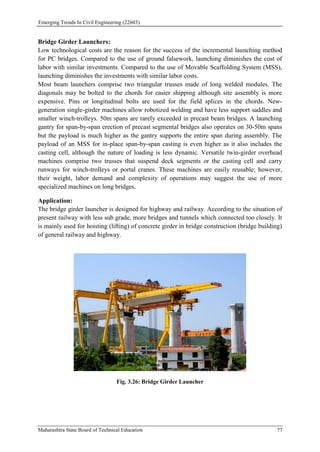
  • 135.
    Emerging Trends InCivil Engineering (22603) Maharashtra State Board of Technical Education 124 Need of Precast Housing: In many countries like Africa, South America, and India, Rapid population growth is leading to a major demand for new infrastructure in many large cities which all have a housing shortage of tens of millions of apartments. People need safer and more comfortable places to live, and prices need to be reasonable. Precast construction is a cost-efficient, fast and sustainable building technology for large housing projects that doesn’t compromise on quality. Most common precast products: 1.Hollow-core slabs, 2.wall elements form sandwich to gray walls, 3.partition walls, and 4.building foundations with precast concrete piles, beams and columns for structural frames. Advantages of Precast Concrete: There are many advantages of precast concrete. They are discussed below.  Saves Construction Time: As casting is done separately, delay in casting and curing can be avoided. Also casting of various precast products can do simultaneously with other parallel activities like excavation, earthwork, P.C.C. etc.  Quality Assurance: The curing, temperature, mix design, formwork, etc. required for Precast Concrete can be monitored, hence quality construction can be performed.  Usage of Pre-stressed Concrete: Pre-stressed precast, structural materials of high strength and load-bearing capacity result in greater clear span, reduced size of the cross- section of structural members, etc.  Cost-effective: The simplified construction process reduces the time, increases the productivity, quality and safety and thus the cost is reduced.  Durability: The high-density Precast Concrete is more durable to acid attack, corrosion, impact, reduces surface voids and resists the accumulation of dust.  Aesthetics: As the structures are prefabricated in a controlled factory environment, several combinations of colors and textures can be used. A wide range of shapes and sizes are available to choose from with smooth finishing and thus the aesthetical value of products is increased.  Safe Construction Platform: No raw materials have to be stocked in site for Precast Concrete construction. It reduces the requirement of traditional formworks and props, wastage, workers, etc. and thus provides a safe working platform. Disadvantages of Precast Concrete: There are some disadvantages to precast concrete. They are discussed below.  High Initial Investment: Precast Concrete plant requires heavy and sophisticated machines which require a high initial investment.  Transportation Issue: Precast Concrete requires high transportation cost if plant is located at far distance away from construction site.  Handling Difficulties: Usually, precast members are heavy and large which makes it difficult to handle without damage.  Difficulty in Modification: It is difficult to modify the planned structure due to pre- casting.
  • 136.
    Emerging Trends InCivil Engineering (22603) Maharashtra State Board of Technical Education 125  Sensitive Connection Works: Extra care is required to assemble the precast elements for rigid and leakage free joints. Prefabricated Housing or Prefab Homes: The homes which are casted by using prefabricated elements manufactured off-site in advance, usually in standard sections that can be easily shipped and assembled at site, is called as Prefabricated Housing. It is often referred to as Prefab Homes or simply Prefabs as shown in the fig. 5.2 below.  Some current prefab home designs include architectural details inspired by post- modernism or futurist architecture.  It consists of factory-made components or units made up of durable materials such as steel; that are transported and assembled on-site to form the complete building.  This method of construction makes pre-fabricated homes an ideal application for rooftop houses, commercial kiosks, study rooms, garden houses, office rooms, or even your personal gym.  The prefab homes are little bit costly, but overall it becomes economical due to less maintenance. Fig. 5.2: Typical Prefabricated Homes Types of Prefabricated Homes: Depending upon characteristics of prefabrication, there are three types of prefabricated homes as mentioned below.  Modular Homes: These homes are created using built in components (e.g. panels), modules, and then transported to the home site for construction and installation. These are typically installed like a regular house and are usually the most expensive of the three types. Manufactured homes placed on a permanent foundation can be considered the same as modular or site build homes for appraisal purposes.  Manufactured Homes: These homes are built on wheeled steel beams, and transported in complete sections to the home site for assembly. The wheels, hitch and axles are then removed on site after placing on permanent foundation.  Mobile Homes: These are built on wheels that can be pulled by a vehicle. They are considered as personal property which is licensed by the Dept. of Motor Vehicles (DMV). "Tiny homes", which are gaining in popularity, are within this category. They must be built to the DMV code, and pass inspection for licensing. There are considerable differences in above mentioned types. Mobile and manufactured houses are constructed in accordance with HUD building codes, while modular houses are
  • 137.
    Emerging Trends InCivil Engineering (22603) Maharashtra State Board of Technical Education 126 constructed in accordance with the IRC (International Residential Code) in U.S. Mobile homes and manufactured homes can be placed in mobile home parks, and manufactured homes can also be placed on private land, unless the land is within a subdivision whose CC&Rs prohibit manufactured housing. Pre Engineered Buildings (PEB): The buildings which are engineered at a factory and assembled at site are termed as Pre Engineered Buildings.  Usually PEBs are steel structures in terms of built-up sections fabricated at the factory to exact size. Then it is transported assembled at site with bolted connections.  This type of Structural Concept is generally used for Industrial Buildings, Metro Stations, Warehouses, Canopies, Factories, Bridges, etc.  The adoptability of PEB in the place of Conventional Steel Building design concept resulted in many advantages, including economy & easier fabrication. These type of building structure can be finished internally to serve any functions that is actually help in low rise building design. Examples of Pre-Engineered Buildings are warehouses, industrial sheds, etc. Fig. 5.3: Components of Pre Engineered Buildings Components of PEB: The pre-engineered building can be made up of several components and its connections as shown in fig. 5.3 below. Pre Engineered Buildings consist of different steel structural member which are as follows.  Primary Frame: Primary framing of PEB is an assembly of built-up I-sections which forms framing consist trusses or castellated beams etc.  Secondary Structural Elements: It is Cold Formed Members in different shapes like “Z”, “C” etc. forms purlins.  Roof and Wall Panels: Tin shades and Curtain Wall made of Glass and Roll-formed steel sheets usually comes in this category.  Sandwich Panels: Sandwich Panel is made of three layers, in which a non-Aluminum Core is inserted b/w two aluminum sheet.
  • 138.
    Emerging Trends InCivil Engineering (22603) Maharashtra State Board of Technical Education 127  Other Accessories: Mezzanine floors, Bolts, Insulation, etc. Advantages of PEB: There are many advantages of Pre Engineered Buildings, which are as follows.  Quality control: All structural members are made in factory under the supervision of Quality Control Engineer using codal provisions.  Lower cost: PEB is less expensive due to the saving in design, manufacturing and on site erection cost.  Minimizing time of construction: It reduces the construction time due to design of the structural components using software.  Low Maintenance: The maintenance cost of PEB is low as compare to conventional steel building due to use of high quality paint.  Quick Erection: The quick erection is possible due to use of Pre Manufactured & skilled labor.  Warranty on PEB: The warranty period of PEB is 20 years given by manufactures. Dis-advantages of PEB: Although PEB have many advantages in the field of Industrial structure but still there are some demerits of Pre Engineered Buildings, which are as follows,  Rusting / Corrosion Sensitive: The components of PEB are susceptible to corrosion  Insulation Cost: The insulating the building will furthermore increase construction costs.  Appearance, Steel Sections can be unattractive when left exposed. Pre-engineered Steel Buildings: Pre-engineered steel buildings are constructed using steel built up sections which are designed and fabricated in the factory and assembled at the site of construction using bolted connections as shown in fig. 5.4 below. Fig. 5.4: Pre-engineered Steel building and Conventional Steel Building Conventional Steel Buildings: Conventional steel buildings are traditional metal structures constructed by rolled steel sections which are designed individually and fabricated at site using welding and cutting as shown in fig. 5.4 above. Comparison of Pre-engineered with Conventional Steel Buildings Comparison of Pre-engineered steel buildings with conventional steel buildings with respect to several properties like design, structural weight, performance, cost, responsibility etc. are tabulated below.
  • 139.
    Emerging Trends InCivil Engineering (22603) Maharashtra State Board of Technical Education 128 Table-5.1: Comparison between Pre-Engineered and Conventional Steel Building. Sr. No. Property Pre-Engineered Steel building (PEB) Conventional Steel Buildings 1 Design Efficient design due to its integral framing system. Less precise design requires more time. 2 Codes used for Design Use of International design codes such as AISC, AISI, MBMA and AWS Codes are not updated and traditional codes given by IS are used. 3 Computer Software Computer programs are available Design, estimation, detailing, drawings etc. of PEB. No such development is available in case of conventional buildings. 4 Structure Weight Structural Members are 10 to 20% lighter than conventional buildings. Structural Members used are Hot rolled T-sections which are of heavy weight. 5 Foundations Lightweight foundation with simple design is enough. Heavy structural weight makes it difficult to design the foundation. 6 Delivery Speed Faster delivery about 6 to 8 weeks to construct 500 MT PEB. Very slow delivery about 20 to 26 weeks to construct 500 MT RCC Building. 7 Cost of Construction Price per square meter is 30% less than the cost of conventional building. Price per square meter is very much higher. 8 Seismic Resistance PEB has good resistance against seismic actions due to Lightweight structures. These cannot withstand against seismic forces because of heavy frames. 9 Architecture Impressive architectural options are available at low costs. More research and time is needed. Cost also will increase. 10 Future Expansion Easy to expand the PEB because of its simple connection design. Difficult to expand the building due to heavy budget 11 Performance Maximum efficiency can be achieved due to rigid connections No guarantee about the performance of structure due to individual design. 12 Responsibility Only one supplier took responsibility of project to minimize construction risks. Multiple suppliers took the responsibilities, shows reduced risk. 13 Clear Span PEB gives clear span up to 100 to 120 m without any intermediate supports. Maximum clear span offered by the conventional building members is 40 m. 14 Erection Simplicity Erection of PEB members is so simple and faster. Light equipment is enough. Erection is slower and demands more labor. Heavy equipment is necessary.
  • 140.
    Emerging Trends InCivil Engineering (22603) Maharashtra State Board of Technical Education 129 Solar Paint: “Step forward a revolutionary new development” which is also known as paint-on/spray-on solar or paintable solar, this is a radical new alternative to the expensive, large, bulky, brittle, rigid silicon flat panels we see on rooftops today. The emerging breakthrough technology offers a low-cost way to harness the sun’s energy with a much wider range of applications. The solar paint can be applied on to various surfaces regardless of shape, e.g., sides of buildings, roofs, vehicles and just about any other structure you can think of that faces the sun.  Liquid solar paints consist of a range of materials known as perovskites. Perovskite can be mixed in liquid solutions to allow it to be deposited on a variety of surfaces. It can be mixed with a range of chemicals to produce a crystallized lattice, to form very lightweight films.  ‘Solar paint’ combines titanium oxide, which is the white pigment already common in wall paint, with a new synthetic compound called molybdenum-sulphide. This compound acts much like silica gel to absorb moisture and prevent damage.  This material has the added properties of a semiconductor, which means in combination the paint has the ability to absorb solar energy and moisture from the atmosphere.  The solar paint will also be effective in a hot and dry climate near oceans, where vapour coming from the nearby sea water can be absorbed as it evaporates in the heat.  The application of this sustainable paint technology could receive enough sunlight to justify solar panels. Realistically any surface that can be painted, such as a garage, fence or shed could contribute toward the building power generation. Advantages of Solar Paints:  The newly developed solar paints can absorb water vapour and split it to generate hydrogen, making it one of the cleanest sources of energy.  These paints can be painted over a window as a thin solar panel making it viable for homes small in space.  These paints can easily absorb moisture content due to silica gel in it.  These paints also have synthetic molybdenum-sulphide which acts as a semi-conductor and splitting of water atoms into hydrogen and oxygen.  It makes the usual brick wall into an energy harvesting wall, when added with titanium oxide, a white pigment.  These paints can also help produce fuel needed to run the house. The hydrogen produced can be the cleanest energy to save electricity bills. Building-Integrated Photo-Voltaic (BIPV): These are photovoltaic materials that are used to replace conventional building materials in parts of such as the roof, skylights, or facades. They are increasingly used in new buildings as a principal source of electrical power. PV applications for buildings began appearing in the year 1970. Some of the examples are shown below in fig. 5.5 below.
  • 141.
    Emerging Trends InCivil Engineering (22603) Maharashtra State Board of Technical Education 130 Fig.5.5: Photovoltaic wall, Barcelona, Spain and PV Solar parking canopy, Autonomous University of Madrid, Spain  The advantage of integrated photovoltaics over non-integrated systems is that the initial cost can be overcome by reducing cost of building materials and labour work. These advantages make BIPV one of the fastest growing segments of the photovoltaic industry.  The term building-applied photovoltaic (BAPV) is applied for retrofit – integrated into the building after construction is complete. Most building-integrated installations are actually BAPV. Some manufacturers and builders differentiate new construction BIPV from BAPV. Forms of Building-Integrated Photovoltaic Modules:  Flat roofs: The most widely installed to date is an amorphous thin film solar cell integrated to a flexible polymer module which has been attached to the roofing membrane using an adhesive sheet between the solar module back sheet and the roofing membrane.  Pitched Roofs: Solar roof tiles are (ceramic) roof tiles with integrated solar modules. The ceramic solar roof tile is developed. It is patented by a Dutch company in 2012. Solar shingles are modules designed to look and act like regular shingles, while incorporating a flexible thin film cell. It extends normal roof life by protecting insulation and membranes from ultraviolet rays and water degradation. Metal pitched roofs (both structural and architectural) are now being integrated with PV functionality.  Facade: Facades can be installed on existing buildings, giving old buildings a whole new look. These modules are mounted on the facade of the building, over the existing structure, which can increase the appeal of the building and its resale value.  Glazing: Photovoltaic windows are (semi) transparent modules that can be used to replace a number of architectural elements commonly made with glass or similar materials, such as windows and skylights. These can create further energy savings due to superior thermal insulation properties and solar radiation control in addition to electric energy. Photovoltaic windows do NOT possess super fine thickness. Earthquake Resisting Controls-Isolation and Dissipation: The earthquake resistance can be achieved through the selection of an appropriate structural configuration and the careful detailing of structural members, such as beams and columns, and the connections between them. But more advanced techniques for earthquake resistance is not to strengthen the building, but to reduce the earthquake-generated forces acting upon it.
  • 142.
    Emerging Trends InCivil Engineering (22603) Maharashtra State Board of Technical Education 131 Among the most important advanced techniques of earthquake resistant design and construction are: Base Isolation and Energy Dissipation Devices. Base Isolation Method: A series of bearing pads are placed in between the sub-structure and superstructure. (See Fig. 5.6.) There is more variety in such bearing pads. These bearing pads are very stiff and strong in the vertical direction, but flexible in the horizontal direction. Fig. 5.6: Base-Isolated and Fixed-Base Buildings Earthquake Generated Forces: The earthquake forces acting on base isolated and conventional building can be understood through fig. 5.6. Normally during earthquake, vibrational forces moving in left results the building movement in the right direction due to inertia. The inertial forces acting on a building are the most important of all those generated during an earthquake. It is important to know that the inertial forces which the building undergoes are proportional to the building’s acceleration during ground motion. Because of the complex nature of earthquake ground motion, the building actually tends to vibrate back and forth in varying directions. Deformation and Damages to Structures: In addition to displacing toward the right, the un- isolated building is also shown to be changing its shape-from a rectangle to a parallelogram. It is deforming. The primary cause of earthquake damage to buildings is the deformation which the building undergoes as a result of the inertial forces acting upon it. Response of Base Isolated Building: During earthquake, the base-isolated building retains its original, rectangular shape due to use of lead-rubber bearings. The base-isolated building itself escapes the deformation and damage, which implies that the inertial forces acting on the base-isolated building have been reduced. Experiments have been shown that building accelerations reduces to (1/4)th of the acceleration of comparable fixed-base buildings, which each building undergoes as a percentage of gravity. As inertial forces vary, proportionally acceleration varies. Acceleration is decreased because the base isolation system lengthens a building’s period of vibration. In general, structures with longer periods of vibration tend to reduce acceleration than that of shorter periods. These rubber isolation bearings are highly elastic, causing no damage but generates heat. The lead plug reduces, or dissipates, the energy of motion, i.e., kinetic energy–by converting that energy into heat. It reduces the energy entering the building, it helps to slow and eventually stop the building’s vibrations sooner than would otherwise be the case, in other words, it damps the building’s vibrations.
  • 143.
    Emerging Trends InCivil Engineering (22603) Maharashtra State Board of Technical Education 132 Energy Dissipation Devices: The second technique of improving the earthquake resistance of buildings is energy dissipation provided by lead-rubber bearings. Buildings themselves possess an inherent ability to dissipate vibration energy. However, the capacity of buildings to dissipate energy is quite limited. The building will dissipate energy either by undergoing large scale movement or sustaining increased internal strains in elements such as the building’s columns and beams. Both of these eventually result in varying degrees of damage. So, by equipping a building with additional devices which have high damping capacity, we can greatly decrease the seismic energy entering the building, and thus decrease building damage. Accordingly, a wide range of energy dissipation devices or damping devices are now being installed in real buildings. The large number of damping devices that have been developed can be grouped into following categories:  Friction Dampers: these utilize frictional forces to dissipate energy  Metallic Dampers : utilize the deformation of metal elements within the damper  Visco-elastic Dampers : utilize the controlled shearing of solids  Viscous Dampers: utilized the forced movement (orificing) of fluids within the damper Fluid Viscous Dampers: General principles of damping devices are illustrated through Fluid Viscous damper. The basic characteristics, process, testing and installation of fluid viscous dampers is as follows. Damping devices are usually installed as part of bracing systems. One type of damper-brace arrangement, with one end attached to a column and one end attached to a floor beam as shown in Figure 5.7.; which also shows the damping device installed as part of the bracing system and gives some idea of its action. Fig. 5.7: Damping Device Installed with Brace 5.2 Road Construction Techniques: Intelligent transportation systems usually refers to the use of information and communication technologies in the field of road transport, including infrastructure, vehicles and users, and in traffic management and mobility management, as well as for interfaces with other modes of transport.
  • 144.
    Emerging Trends InCivil Engineering (22603) Maharashtra State Board of Technical Education 133 3D Printing: The computer-controlled sequential layering of materials to create three-dimensional shapes is called as 3D Printing. It is particularly useful for prototyping and for the manufacture of geometrically complex components as shown in fig. 5.8 below. Fig 5.8: Constructions-3D’s machine resembles a huge tractor. Features of 3D Printing:  It was first developed in the 1980s and was limited applications due to difficulty and expenses. Since 2000 that it has become relatively affordable with wide range of product design, component and tool manufacture, consumer electronics, plastics, metalworking, aerospace engineering, dental and medical applications, and footwear.  3D printing systems developed for the construction industry are referred to as construction 3D printers.  A 3D digital model of the item is created by computer-aided design (CAD) or 3D scanner. Then the printer reads the design and lays down successive layers of printing medium (liquid, powder, or sheet material) which are joined or fused to create the item. The process can be slow, but it enables almost any shape to be created.  Depending on the technique adopted, printing can produce multiple components simultaneously, can use multiple materials and can use multiple colours.  Materials such as metal can be expensive to print, and in this case it may be more cost- effective to print a mould, and then to use that to create the item.  3D printing in construction, also known as contour crafting or building printing, is what many believe the future of construction. The standards bodies are concerned whether these structures are really solid and if they can withstand their environments.  This technique can also be used for the construction of extraterrestrial structures on the Moon or other planets, where environmental conditions are less conductive to human labor-intensive building practices.  The Contour Crafting method involves the building material being deposited to create a large-scale 3D model with a smooth surface finish. Rails are installed around the building ground that will act as a structure to direct the robotic arm. It moves back and forth to extrude the concrete, layer-by-layer.
  • 145.
    Emerging Trends InCivil Engineering (22603) Maharashtra State Board of Technical Education 134 Advantages of 3D Printing in Construction:  In terms of materials usage, 3D printing is economical.  This reduces the environmental impact as less waste is produced. We can build optimized shapes to limit the amount of materials used.”  Less labour cost, less time (potentially reduces a 2 week job to just 3-4 days) and reuse of waste printed material consumption is the advantages of 3D printing.  3D printing provides many advantages few are simplicity, reliability and precision etc.  Since 3D printing now allows structures to be created more quickly, it is ideal to combat the housing crisis. Road Printer: The evolution of innovative printing techniques in the three-dimensional world goes on. It is able to print complete buildings and about the inkjet printer for streets, which is called as road printer.  Brick roads are both durable and easy to produce and reuse. Cement pavers last a very long time and easy to repair and replace. But now a day there are difficult to find because building them is an arduous and back breaking task.  A road printer is machinery for road printing. It is a six meters wide machine that can repave Entire Street at once, including edges. The device is amazingly simple to handle. Any person can work with it within 5 minutes. Naturally the stones fall on the road directly into the appropriate pattern. This is a solution for the heavy work that street pavers in Holland usually have to do manually. Procedure of Road Printing:  The ROAD PRINTER is a divisible paving machine capable of laying bricks for roads. As the machine roll backwards ‘GRAVITY’ brings the bricks flat to rest on the ground as shown in fig.5.9 below.  A front loader fills the brick hopper with loose bricks; the bricklayers stand on the machine and assemble the pattern vertically. Tiger stone requires 1-3 operators on its platform to provide the machines pusher slot with looser bricks from the hopper.  The green machine runs entirely on electricity, moving at a speed of 13 feet per a minute.  Paving stones are lowered smoothly via a curved ramp into place in the correct pattern; it self-steers to keep the road straight and in place. Then tamper (or) steamroller pushes the bricks down to secure them in place.  Bricks roads are experiencing a revival, because they can be reused easily, filter water and without expanding ice. The road printer is capable of creating roads anywhere from 3-20 feet wide.  As construction workers insert brick into the machine’s forward compartment, road printer automatically processes the bricks and splits the assembled road from its rear.
  • 146.
    Emerging Trends InCivil Engineering (22603) Maharashtra State Board of Technical Education 135 Fig. 5.9: Working of Road Printers Advantages of Road printer:  The tiger stone brick printer makes road constructions as easy as laying laminate flooring.  Tiger stone is powered electrically and has very little moving parts therefore the noise and maintenance is quite less.  It can lay down about 400 yards of road per day. Dis-Advantages of Road printer:  The cost of the equipment is expensive.  It is unsuitable for unleveled or untreated ground surface. Smart Roads: Smart highway and smart road are terms for a number of different ways technologies are incorporated into roads, for improving the operation of Connected and Autonomous Vehicles (CAVs), for traffic lights and street lighting, and for monitoring the condition of the road, traffic levels and the speed of vehicles. Smart road may include solar road panels, smart pavement, Wireless vehicle charging, Illuminating Road markings, Frost protection etc. Features of Smart Roads:  Solar Road Panels: The main purpose of solar roadways is to replace asphalt roads with Solar Panels which generate energy through the sun that can be used by local houses or businesses that are connected to the system from either the house’s driveway or the businesses parking lot. The panels will also increase the number of charging stations for electric cars if that station is connected to the solar roadway. Each panel is roughly 12’ by 12’ of interlocking panels that have their own LED lights that will be used as the road lines, and can also be used to spell out words like “Reduce Speed” or “Traffic Ahead” to help the flow of traffic. Layers of solar road: The layers of solar road panels are as described as under. (Refer Fig. 5.10 below).  The Road Surface Layer - It the High Strength layer with photovoltaic cells which attracts the sun’s rays.  The Electronic Layer - The Electronic Layers contain a mini microprocessor board that helps control the heating element of the panels.
  • 147.
    Emerging Trends InCivil Engineering (22603) Maharashtra State Board of Technical Education 136  The Base Plate Layer - The Base Plate Layer is the layer that collects the energy from the sun and distributes the power to the homes or businesses that are connected to the solar roadways. Fig. 5.10: Layers of Solar Road Fig. 5.11: Illuminating Road Marking Smart Pavement: The Missouri Department of Transportation (MoDOT) began testing out “smart pavement” at a rest stop outside of Conway. The panels will heat the road and keep snow and ice from accumulating. They will also feature LED diodes that will increase the visibility of road lines. The LEDs would also double in helping prevent paint from inhibiting solar power generation. The panels have not had enough time to determine durability, energy efficiency, or cost effectiveness in a real world sense yet. Wireless Vehicle Charging: The Online Electric Vehicle (OLEV) is an electric vehicle that charges wirelessly while moving using electromagnetic induction (the wireless transfer of power through magnetic fields). It functions by using a segmented "recharging" road that induces a current in "pick-up" modules on the vehicle. OLEV is the first public transport system that used a "recharging" road and was first launched on March 9, 2010 by The Korea Advanced Institute of Science and Technology (KAIST). It has electrical circuits built into the road which will power suitably adapted vehicles via contactless electromagnetic induction.
  • 148.
    Emerging Trends InCivil Engineering (22603) Maharashtra State Board of Technical Education 137  Road Markings: The Smart Highway concept developed by Studio Roosegaarde and the infrastructure management group Heijmans in the Netherlands incorporated photo- luminescent paint for road markings, which absorb light during the day then glow for up to 10 hours. The technology was demonstrated on a stretch of highway in Brabant, Netherlands.  Frost Protection: Snowmelt systems using electricity or hot water to heat roads and pavements have been installed in various locations. Solar Roadways has proposed including a snowmelt system with their photovoltaic road panels since the panels already have electrical power connections for harvesting photovoltaic power. Critics point to the very large energy requirements of such a system (much greater than the energy collected by the roadway in ideal conditions). ICAX Limited of London's "Inter-seasonal Heat Capture" technology captures solar energy in thermal banks and releases it back under a roadway, heating it and keeping asphalt free of ice. 5.3 Coastal Construction Techniques: Sound Proofing Walls: Soundproofing a wall has become a problem for more projects, as high-quality sound systems and home theaters have revolutionized the built environment. Therefore, it is important to reconsider the original standard of the acoustic transmission grade wall and increasing the transmission loss by 20dB to 30dB or more to provide a high quality living environment. Over the years, many technologies have been used to enhance soundproofing of new or existing wall of residential and commercial buildings. Many methods require unusual or difficult construction practices so that the installer may not be able to accurately follow these techniques. Mass loaded vinyl (MLV) is a soundproof wall covering material designed with high density and good flexibility. These functions are important for reducing noise and vibration. Magnesium oxide (MgO) boards are soundproof wall insulation board made of a mixture of magnesium oxide, non-organic minerals, bonders and fibre mesh composites. These are factory-made sound block board products with applicable to walls and ceiling linings, wall support, bottom of the floor. These are similar to gypsum board with improved properties like fire resistance, weatherability, strength, mildew resistance, flexibility, and adhesion and so on. MgO sound deadening board is cement fiberboard and can be used for construction with a variety of thickness and sheet size. China has the world’s largest magnesium oxide deposit, enough to supplement the world for hundreds of years.
  • 149.
    Emerging Trends InCivil Engineering (22603) Maharashtra State Board of Technical Education 138 Fig. 5.12: Sound Proofing Wall Required Tools for Soundproofing: Caulk gun, Dust mask, Screw gun, Taping knife, Tin snips, Utility knife etc. Required Materials for Soundproofing: 1/2-in. plywood, 5/8-in. drywall, Acoustical dampening adhesive, Cellulose insulation, Door gasket, Door sweep, Drywall screws, Electrical box extenders, Fiberglass insulation, Joint compound, Resilient channel, Silicone caulk, Whisper clips, Wood transition strip, Work gloves. Water Resistant Roofs: Water-resistant or hydrostatic roofs are for low slope roofs (less than 3:12 slope) to handle slow moving water from a roof. These types of roofs do not rely on a secondary membrane to prevent leakage into the building. The easiest way to ensure the roof sheds water effectively is by designing the slope to be at least 3:12, preferably higher. The higher the slope, the faster the water runs off into the gutters, downspouts or drainage system. A roof with a 3:12 slope or greater is considered a steep slope and is the minimum slope to provide effective water- shedding. Conventional roofs, particularly residential roofs, tend to be 4:12 to 9:12. Fig. 5.13: Water Resistant Roofs A roof that sheds water still needs a little assistance to keep water from entering the structure. Since a water-shedding roof is typically an architectural roof, decking and underlayment are already required.
  • 150.
    Emerging Trends InCivil Engineering (22603) Maharashtra State Board of Technical Education 139  Use a solid deck covered with a moisture barrier or membrane.  The moisture barrier should be #30 felt at a minimum.  A peel-and-stick membrane is a better, although more expensive solution.  A peel-and-stick membrane is more tear resistant and will self-seal to fasteners such as nails and screws. High Performance Doors and Windows: High Speed Doors: The doors used for fast access between internal and external areas of buildings are called as High Performance Doors are automatic doors. Prime High Performance Doors are designed and factory-made with German collaboration using state- of-the-art and resourceful engineering technology for frequent use in high traffic areas with opening speeds up to 3 m/s. Many manufacturing industries like Medical instrument manufacturer, electronics and computer manufacturer, food industry, pharmaceutical industry and some military applications requires to maintain dust free environment; which can be achieved by High speed doors. A wide range of Prime High Speed Doors are available for various operations, including areas with special requirements for temperature control, hygiene, storage and handling of frozen foods, These doors are important in explosion proof areas, deep freezer automatic roll up door are need in cold storages, warehousing, loading bays and on conveyor systems. Types of High Speed Doors:  Clean Room Doors  Emergency Exit Doors  Self-Repairing Doors  Conveyor Doors High Speed Windows: Windows provide light and fresh air, and offer views that connect the interior spaces with the outdoors. However, windows have also represented a major source of heat loss in winter as well as unwanted heat gain in summer. It is now possible to have expansive views and daylight without sacrificing comfort and energy efficiency. Today’s high performance window systems provide energy efficiency while increasing occupant comfort by offering new alternatives for the design of windows. Benefits of High Performance Windows:  Cooling and heating season energy savings  Improved daylight and view  Improved comfort  Reduced condensation  Reduced fading by reducing UV radiation  Lower costs for mechanical equipment Precautions to be taken for High Performance Windows:  Care should be taken to ensure that the windows are properly installed to minimize infiltration between the wall and the window frame.
  • 151.
    Emerging Trends InCivil Engineering (22603) Maharashtra State Board of Technical Education 140  It is essential reduce direct sound transmission are: using wide air / gas gaps between glass panels; replacing air with argon, using different thickness of glass layers in a glazing system, multiple rows of gaskets at operating joints.  The optimum thickness of glass should be selected for better solar transmission rate and strength criteria.  The perimeter sealant between the window product and the exterior wall system should be used.  It is necessary to consider indoor and outdoor temperatures, relative humidity, air movement and specific elements of the buildings that affect air movement around window.  The careful design of framing components, glazing units, gasket and sealant materials, gas infill materials and hardware and mechanical devices should be done.  The sensitivity of the products to heat, ultraviolet radiation and moisture should be taken into account. Figure 5.14: High Performance Windows Air and Moisture Barriers: The systems of materials or primary air enclosure boundary designed and constructed to control airflow between a conditioned space and an unconditioned space is called as air barrier system. Types or Forms of Air Barriers:  Mechanically-attached membranes, also known as house wraps, usually a polyethylene- fiber or spun-bonded polyolefin.  Self-adhered membranes, which are typically also a water-resistant barrier and a vapor barrier.  Fluid-applied membranes, such as heavy-bodied paints or coatings including polymeric based and asphaltic based materials.  Closed-cell medium density spray-applied polyurethane foam, which typically provides insulation as well.
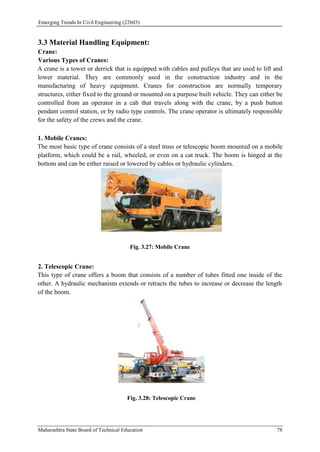
  • 152.
    Emerging Trends InCivil Engineering (22603) Maharashtra State Board of Technical Education 141  Some open-cell spray-applied polyurethane foam that are of high density.  Boardstock, which includes 12 mm plywood or OSB, 25 mm extruded polystyrene, etc. Requirement of Air Barrier: Air barriers are intended to resist the air pressure differences that act on them. Rigid material such as gypsum board, exterior sheathing materials like plywood or OSB, and supported flexible barriers are typically effective air barrier systems if joints and seams are sealed. Spray foam systems can also act as effective air barrier systems either externally applied over structural elements or internally applied within cavity systems. Air barrier systems keep outside air out of the building enclosure or inside air out of the building enclosure depending on climate or configuration. In cold climates, interior air barrier systems control the ex-filtration of interior, often moisture-laden air. Whereas exterior air barrier systems control the infiltration of exterior air and prevent wind-washing through cavity insulation systems. Air barrier systems should be impermeable to air flow; continuous over the entire building enclosure or continuous over the enclosure of any given unit; able to withstand the forces that may act on them during and after construction; durable over the expected lifetime of the building. Moisture Barrier: The building materials designed to prevent water from getting past the barrier is called as Moisture barriers and Vapor barriers. A vapor barrier's job is to keep water vapor in humid air from diffusing through one side of a wall and finding a cool surface inside the wall. When a vapor barrier is on the side of a wall where the dry air is (i.e., outside in winter or inside in summer), moisture problems can occur. We use foil-faced rigid insulation to keep the space under the house dry. The plastic and the insulation will eliminate any moisture problems you have in the crawlspace, such as water droplets collecting on the concrete walls and pipes. Fig. 5.15: Combined Air and Moisture Barrier A vapor barrier (or vapour barrier) is any material used for damp proofing, typically a plastic or foil sheet, that resists diffusion of moisture through the wall, floor, ceiling, or roof assemblies of buildings to prevent interstitial condensation and of packaging. Technically, many of these materials are only vapor retarders as they have varying degrees of permeability. Vapor diffusion retarders are normally available as coatings or membranes. The membrane is technically flexible and thin materials, but sometime includes thicker sheet materials named as "structural" vapor diffusion retarders. The vapor diffusion retarders varies from all kinds of
  • 153.
    Emerging Trends InCivil Engineering (22603) Maharashtra State Board of Technical Education 142 materials and keep updating every day, some of them nowadays even combined the functions of other building materials. Materials used as Vapor Retarders:  Elastomeric coatings can provide a vapor barrier and water proofing with permeability ratings  Aluminum foil, Paper-backed aluminum.  Asphalt or coal tar pitch, typically hot-applied to concrete roof decks  Polyethylene plastic sheet  Advanced Polyethylene vapor retarders  Asphalt-coated kraft paper  Metallized film  Vapor retarder paints Extruded polystyrene or foil-faced foam board insulation.  Exterior grade plywood, 0.70 US perm (40 SI perm).  Most sheet type monolithic roofing membranes.  Glass and metal sheets (such as in doors and windows). 5.4 Ground Improvement Techniques: Advanced Piling Techniques: The installation process and methods of pile foundations are equally important factors as of the design process. Pile foundation installation methods are by pile hammer and boring by mechanical auger. Stone Column: Vibro stone columns or aggregate piers are an array of crushed stone pillars placed with a vibrating tool into the soil below a proposed structure. This method of ground improvement is also called vibro replacement. Such techniques increase the load bearing capacity and drainage of the soil while reducing settlement and liquefaction potential. Stone columns are made across the area to be improved in a triangular or rectangular grid pattern. They have been used in Europe since the 1950s, and in the United States since the 1970s. Column depth depends on local soil strata, and usually penetrates weak soil. Stone column ground improvement involves adding vertical columns of stone into the ground to a depth of at least 4m below the ground surface. A layer of compacted gravel can then be put over the top of the columns, ready for the construction of new house foundations. The stone column method is quick to construct and can be done at any time of the year. Construction of stone columns: Stone columns are constructed by experienced contractors using specialist equipment. The construction uses an excavator with a vibrating probe to feed stone into the ground, forming a vertical column of stone. Some stone column rigs feed stone into the ground through the vibrating probe, exiting at the bottom, and other rigs require the stone to be fed in from the ground surface down the vertical hole in the ground. Both types use a vibrating probe that densifies the surrounding soils to help feed the stone into the ground.
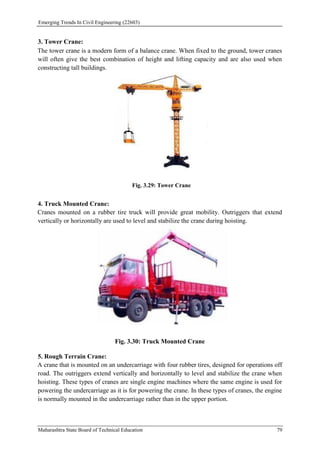
  • 154.
    Emerging Trends InCivil Engineering (22603) Maharashtra State Board of Technical Education 143 Fig. 5.16: Construction of stone column Ground improvement using stone column: Stone columns help to limit the amount and consequences of future liquefaction by: • Densifying the soil through vibration and introducing stone into the soil. Reinforcing the soil creats a stiff composite soil mass. By achieving this, the non-liquefying soil crust is thickened and stiffened to reduce the likelihood of undulations, tilt and uneven ground surface subsidence from liquefaction of the underlying soil layers, therefore reducing damage to the house foundations. In addition, stone columns may sometimes provide the soil with an increased drainage path to help reduce excess pore water pressure that can lead to liquefaction, so the columns can reduce the consequences of liquefaction when this occurs. Vibro-Floatation: Vibroflotation is a ground improvement technique used at a considerable depth that by using a powered electrically or hydraulically probe, it strengthens the soil. It involves the introduction of granular soil to form interlocking columns with surrounding soil. Vibro-compaction also known as vibro-flotation is a technique in which the density of granular soils are increased by the insertion of a heavy vibrating poker to desired depth. This vibrating poker is also known as depth vibrator or a vibroflot or simply flot. It is one of the most common ground improvement technique using vibration. It is a Specialist Deep Foundation Technique used for Ground improvement to considerable depth, up to 75 meters. It uses a probe called Vibro- flot (which could be powered electrically or hydraulically) to strengthen the soil by deep compaction to make the soil suitable to support proposed imposed load.It involves the introduction of backfill granular material (Sand or Granite) to form Stone columns interlocking with surrounding soil. Treatment is to provide adequate bearing capacity; restrict total and differential settlements to acceptable magnitudes under the proposed loading and provide acceptable long-term performance of the treated ground. Principle of Vibro-floatation: The vibroflot imparts horizontal vibrations into the ground to breakdown the frictional contacts and effective stress between soil structures. Thus ground settles into a denser structure as shown in image. Type of Vibro-flotation Method:  Vibro Compaction method
  • 155.
    Emerging Trends InCivil Engineering (22603) Maharashtra State Board of Technical Education 144  Vibro Replacement method (Wet top feed)  Vibro Displacement method (Dry method) Vibro-Compaction: It is the densification of granular soil. Natural deposit as well as artificially reclaimed sand can be compacted to achieve desired bearing capacity and minimal settlement. This is used for purely sandy soil of loose constituent. Vibro-Replacement: This method involved the partial replacement of poor soil material, by flushing out the weak soil with Water/Air Jet and replacing with granular material. This is installation of stone column (made up of granite). This can be used in various soil type that includes Clay (soft, firm, stiff), lateritic Soil, Sandy Clay (of various constituent) and Peaty Soil. Vibro-Displacement: This method is used where the environment plays a critical role in project. It can be either top or bottom feed. Little or no water is used in the construction. The vibro-flot is inserted in to soil and the soil is displaced laterally as the stone column is being formed and compacted. Fig. 5.17: Vibro-Floatation Applications of Vibro-Compaction or Vibro-Flotation: Vibro-flotation was first used in saturated natural fine sands. Application of vibro compaction are as follows:  It is applied to improve hydraulic fills  Vibro-flotation reduces risk of liquefaction during seismic event.  Vibro-compaction is used over water.  Depths of 30 m can be treated and it can be upto about 50 m.  Multiple vibrators can be coupled together in groups.  Vibro compaction is used in conjunction with surcharging. Micro Piles: The piles molded on the spot to serve as deep foundations and highly tensioned stress along the shaft, composed of sand and cement mortar and thoroughly reinforced throughout its length, are called as Micro Piles. It is employed in highly compact or consistent ground or in
  • 156.
    Emerging Trends InCivil Engineering (22603) Maharashtra State Board of Technical Education 145 the ground where bedrock or rocky formations are found, in which excavating may only take place with the use of rotating hydraulic drills. They may be placed in an inclined position. Micro-piles are also known as pin piles, needle piles, and root piles. Micropiles are small diameter drilled and grouted friction piles. Each pile includes steel elements that are bonded into the bearing soil or rock – usually with cement grout. The bearing stratum is logged during installation drilling to assure that bearing capacity is adequate. They can be installed quickly in virtually every type of ground using highly adaptable mobile drilling equipment. Soil profiles may include uncontrolled fill with construction debris or other large fractions, cobbles and boulders within native soils. When such conditions exist, drilled and grouted micropiles offer a cost-effective, deep foundation option capable of penetrating obstructions to bear within competent bedrock. In compression applications, capacity is achieved through end bearing and also skin friction along the interface of the grout column and the bedrock. Fig. 5.18: Micro Piles Advantages of Micro Piles:  Fast one-step installation  Simultaneous drilling and grouting  Allows the use of smaller equipment at lower cost  Allows low overhead, limited access installation  Improves the ground (densification)  Offers higher skin friction  Total single corrosion protection by design Soil Nailing: It is a construction remedial measure to treat unstable natural soil slopes or as a construction technique that allows the safe over-steepening of new or existing soil slopes, is called as Soil nailing. The technique involves the insertion of relatively slender reinforcing elements into the slope – often general purpose reinforcing bars (rebar) although proprietary solid or hollow-system bars are also available. Solid bars are usually installed into pre-drilled holes and then grouted into place using a separate grout line, whereas hollow bars may be drilled and grouted simultaneously by the use of a sacrificial drill bit and by pumping grout down the hollow bar as drilling progresses. Kinetic methods of firing relatively short bars into soil slopes have also been developed. Bars installed using drilling techniques are usually fully
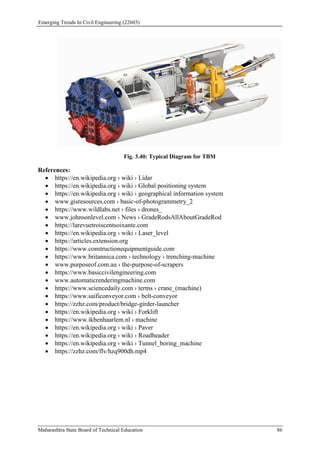
  • 157.
    Emerging Trends InCivil Engineering (22603) Maharashtra State Board of Technical Education 146 grouted and installed at a slight downward inclination with bars installed at regularly spaced points across the slope face. A rigid facing (often pneumatically applied concrete, otherwise known as shotcrete) or isolated soil nail head plates may be used at the surface. Various Types of Soil Nailing: Various types of soil nailing methods that are employed in the field are listed below:  Grouted Nail: In this, after excavation the drill hole filled with cement grout.  Driven Nail: In this type, nails are mechanically driven to the wall during excavation.  Self-Drilling Soil Nail: Hollow bars are driven and grout is injected through the hollow bar simultaneously during the drilling.  Jet-Grouted Soil Nail: Jet grouting is used to erode the ground and for creating the hole to install the steel bars.  Launched Soil Nail: Bars are “launched” into the soil with very high speed using firing mechanism involving compressed air. Construction procedure of nailed structure: Soil nailed structures are generally constructed in stages and it involves following steps:  Excavation till the depth where nails will be installed at a particular level.  Drilling nail holes.  Nail installation and grouting.  Construction of temporary shotcrete facing.  Subsequent levels are then constructed and finally permanent facing is placed over the wall. Merits of Soil Nailing:  It is suitable for cramped sites with difficult access because the construction plant required for soil nail installation is small and mobile.  It can easily cope with site constraints and variations in ground conditions encountered during construction, e.g., by adjusting the location and length of the soil nails to suit the site conditions.  During construction, it causes less environmental impact than cutting back and retaining wall construction as no major earthworks and tree felling are needed.  There could be time and cost savings compared to conventional techniques of cutting back and retaining wall construction which usually involve substantial earthworks and temporary works.  It is less sensitive to undetected adverse geological features, and thus more robust and reliable than unsupported cuts. In addition, it renders higher system redundancy than unsupported cuts or anchored slopes due to the presence of a large number of soil nails.  The failure mode of a soil-nailed system is likely to be ductile, thus providing warning signs before failure.
  • 158.
    Emerging Trends InCivil Engineering (22603) Maharashtra State Board of Technical Education 147 De-Merits of Soil Nailing:  The presence of utilities, underground structures or other buried obstructions poses restrictions to the length and layout of soil nails.  The zone occupied by soil nails is sterilized and the site poses constraints to future development.  Permission has to be obtained from the owners of the adjacent land for the installation of soil nails beyond the lot boundary. This places restrictions on the layout of soil nails.  The presence of high groundwater levels may lead to construction difficulties in hole drilling and grouting, and instability problems of slope surface in the case of soil- nailed excavations.  The effectiveness of soil nails may be compromised at sites with past large landslides involving deep-seated failure due to disturbance of the ground.  The presence of permeable ground, such as ground with many cobbles, boulders, highly fractured rocks, open joints, or voids, presents construction difficulties due to potential grout leakage problems.  The presence of ground with a high content of fines may lead to problems of creeping between the ground and soil nails.  Long soil nails are difficult to install, and thus the soil nailing technique may not be appropriate for deep-seated landslides and large slopes.  Because soil nails are not prestressed, mobilization of soil-nail forces will be accompanied by ground deformation. The effects on nearby structures, facilities or services may have to be considered, particularly in the case of soil-nailed excavations.  Soil nails are not effective in stabilizing localized steep slope profiles, back scarps, overhangs or in areas of high erosion potential. Suitable measures, e.g., local trimming, should be considered prior to soil nail installation. Drains for Soil Stabilization: Pre compression or preloading technique is simply to place a surcharge fill on the top of the soil that requires large consolidation settlement to take place before construction of the structure. Once sufficient consolidation has occurred, the fill can be removed and construction process takes place. In general, this technique is adequate and most effective in clayey soil. Since clayey soils have low permeability, the desired consolidation takes very long time to occur, even with very high surcharge load. Therefore with tight construction schedules, preloading may not be a feasible solution. Hence, sand or vertical drains may be used to accelerate consolidation process by reducing the drainage paths length. Vertical drains: Vertical drain is a unique technique in which the drains are installed under a surcharge load to accelerate the drainage of relatively impervious soils and thus speed up consolidation. The drains provide a shorter path for the water to flow through to get away from the soil. So, time to drain clay layers can be reduced from many years to a few months. The common types of vertical drains are sand drains and prefabricated vertical drains.
  • 159.
    Emerging Trends InCivil Engineering (22603) Maharashtra State Board of Technical Education 148 Sand Drains: Sand drains are constructed by drilling holes through the clay layer by using rotary drilling, continuous flight auger or driving down hollow mandrels into the soil. The holes are then filled with sand. When a surcharge is applied at the ground surface, the pore water pressure in the clay will increase, and it will be dissipated by drainage in both vertical and horizontal directions. Hence the settlement is accelerated. Sand drains can work as sand piles. They reinforce soft soil in which they are installed. Even though sand drains replace only 1 to 2% of soil volume, the overall improvement in bearing capacity may be more than 10 %. Pre-Fabricated Vertical Drains: Prefabricated vertical drains also known as wick drains, which consist of channeled synthetics core wrapped in geotextile fabric. They are flexible, durable, inexpensive and have an advantage over sand drains is that they don't need drilling. PVD is best suited in clay, silt, organic layers, clayey and silty sand. PVD is placed into steel mandrill then the mandrill is pushed into the ground to the determination depth with a mast mounted on back hoe. Anchor plate is attached to the wick material to hold it in place as mandrill is removed. Then the PVD is cut off a little above the ground. PVDs are used to reduce surcharging process time and accelerate settlement not reduce it. Pore water will move laterally to the nearest drain instead of moving vertically to the permeable layer. Therefore, the drainage distance decreased. Whenever the distance between drains becomes closer, the surcharging time decreases. Thermal Methods: Heating or freezing a soil can cause marked changes in its properties. Although thermal stabilizations appear to be very effective, the use of these methods is limited because of its high cost. Soil Heating: The higher the heat input per mass of soil being treated, the greater the effect. Even small increase in temperature may cause strength increase in fine grained soils by reducing the electric repulsion between the particles, a flow of pore water due to thermal gradient and a reduction in moisture content because of increasing evaporation rate. Table (1) shows the effect of increasing the temperature on changing soil properties. Table-5.2: Effect of Temperature Increase on The Properties of Clayey Soil Temp. Effect 10000 C Can cause drying and significant increase in clay strength 50000 C Can cause permanent changes in structure of clays hence decreasing its plasticity 100000 C Can cause fusion of clay particles into a solid substance Heating is applied to the soil by burning liquid or gas fuels in boreholes or injection of hot air into 0.15 to 0.2 m diameter boreholes that can produce 1.3 to 2.5 m diameter stabilized zone after continuous treatment for about 10 days. This technique can be effectively used when a large and inexpensive heat source is located near the site. Heat treatment of a clay soil to about 400°C results in pronounced changes in engineering properties. Heating is energy intensive and to stabilize one m 3 of soil 50 to 100 liters of fuel oil are required. It is not
  • 160.
    Emerging Trends InCivil Engineering (22603) Maharashtra State Board of Technical Education 149 recommended now a day’s except in places where it is already available as inherent energy in waste products and in landfills. However use of geothermal piles as heating systems is prevalent in places like UK. Methods of Heating Soil In-Situ:  Ground surface heating  Heating through boreholes  Use of thermally stabilized building blocks  Thermal piles Geothermal piles are an innovative system of building foundations for use in combination with ground-source energy technology. Conventional ground-loops are installed in building piles, through which water or another fluid is pumped. The fluid and ground-transfer heat energy is then passed through a heat exchanger in the building to provide cooling or, more commonly, heating in the winter. The geothermal system is essentially the same as closed- loop borehole systems; however, since they are installed in the building foundations, the technology serves a dual purpose. Soil Freezing: Soil freezing involves lowering the temperature of the soil until the moisture in the pore spaces freezes. Freezing of pore water acts as a cementing agent between the soil particles causing significant increase in shear strength and permeability. Unlike soil heating, soil freezing may be applicable to a wide range of soil types, grain sizes and ground conditions. Fundamentally, the only requirement is that the ground has sufficient soil moisture (pore water) [26]. The process typically involves installing double walled pipes in the soil. A coolant is circulated through a closed circuit. A refrigeration plant is used to maintain the coolant’s temperature. It is applicable to a wide range of soils but it takes considerable time to establish a substantial ice wall and the freeze must be maintained by continued refrigeration as long as required. It may be used in any soil or rock formation regardless of structure, grain size or permeability. However, it is best suited for soft ground rather than rock conditions. Freezing may be used for any size, shape or depth of excavation and the same cooling plant can be used from job to job. As the impervious frozen earth barrier is constructed prior to excavation, it generally eliminates the need for compressed air, dewatering, or the concern for ground collapse during dewatering or excavation. Applications:  Temporary underpinning of adjacent structure and support during permanent underpinning.  Shaft sinking through water-bearing ground.  Shaft construction totally within non-cohesive saturated ground.  Tunnelling through a full face of granular soil.
  • 161.
    Emerging Trends InCivil Engineering (22603) Maharashtra State Board of Technical Education 150  Tunnelling through mixed ground.  Soil stabilization. Reference:  https://archive.epa.gov/greenbuilding/web/html/about.html  https://en.wikipedia.org/wiki/Green_building  https://en.wikipedia.org/wiki/Zero-energy_building  https://www.energy.gov/eere/buildings/downloads/common-definition-zero-energy- buildings  https://en.wikipedia.org/wiki/Public_housing  https://www.nbmcw.com/tech-articles/precast-construction/32688-precast-technology- for-low-cost-housing-schemes-in-india.html  https://www.concreteissues.com/en/stories/1-17/smart-precast-technology-caters-to- the-needs-of-affordable-housing/  https://en.wikipedia.org/wiki/Prefabricated_home  https://civildigital.com/pre-engineered-buildings-peb-components-advantages-design- methodology/  https://civildigital.com/pre-engineered-buildings-advantages-applications- preengineered-buildings-peb/  https://theconstructor.org/earthquake/earthquake-resistant-techniques/5607/  https://en.wikipedia.org/wiki/Earthquake-resistant_structures  https://happho.com/base-isolation-techniques-applications-advantages-disadvantages/  https://civildigital.com/base-isolation-system-outline-on-principles-types-advantages- applications/  https://www.iitk.ac.in/nicee/wcee/article/13_3273.pdf  https://theconstructor.org/earthquake/earthquake-resistant-techniques/5607/  https://en.wikipedia.org/wiki/Earthquake-resistant_structures  https://en.wikipedia.org/wiki/Construction_3D_printing  https://www.semanticscholar.org/paper/Applicability-and-Limitations-of-3D-Printing- for-Yossef-Chen/1004e5df2defee1f97f3e27dd98fcd772f9c80be  https://www.designingbuildings.co.uk/wiki/3D_printing_in_construction  https://en.wikipedia.org/wiki/Smart_highway  https://www.hongkiat.com/blog/smart-road-technologies/  https://www.weforum.org/agenda/2018/05/smart-roads-could-soon-call-an- ambulance-connect-you-to-the-internet/  https://www.engineeringcivil.com/the-road-printer.html  https://popupcity.net/tiger-stone-the-road-printer/  https://www.whirlwindsteel.com/blog/bid/239064/waterproof-vs-water-shedding- metal-roofs-what-s-the-difference  http://www.understandconstruction.com/basic-types-of-windows.html  https://www.bdcnetwork.com/high-performance-windows-and-doors  https://web.itu.edu.tr/~tavil/window-system-design/window-system_files/text.htm
  • 162.
    Emerging Trends InCivil Engineering (22603) Maharashtra State Board of Technical Education 151  https://www.buildingscience.com/documents/digests/bsd-104-understanding-air- barriers  https://en.wikipedia.org/wiki/Air_barrier  https://en.wikipedia.org/wiki/Soil_nailing  https://theconstructor.org/geotechnical/soil-nailing-technique-types-applications/9484/  https://www.haywardbaker.com/solutions/techniques/soil-nailing  https://nptel.ac.in/courses/105106144/  https://theconstructor.org/geotechnical/pile-installation-methods/1812/  https://en.wikipedia.org/wiki/Vibro_stone_column  https://www.eqc.govt.nz/sites/public_files/images/What%20are%20stone%20columns. pdf  https://civildigital.com/vibro-compaction-vibro-flotation-ground-improvement- principle-images/  https://www.thebalancesmb.com/vibroflotation-improve-bearing-capacity-844578  https://www.vibroflotation-ng.com/services/vibroflotation-method/  https://www.haywardbaker.com/solutions/techniques/micropiles  http://www.engineeredfoundations.com/services/foundation-stabilization/micropiles/  https://civildigital.com/ground-improvement-micro-piles/  https://www.haywardbaker.com/solutions/techniques/soil-nailing  https://theconstructor.org/geotechnical/soil-nailing-technique-types-applications/9484/  https://nptel.ac.in/courses/105108075/module8/Lecture33.pdf  https://theconstructor.org/geotechnical/thermal-stabilization-of-soil-ground- improvement/14192/  https://en.wikipedia.org/wiki/Ground_freezing  http://courses.washington.edu/cm510/freezing.pdf