Emerging Technologies in Business 
Group 6 
Iqbal Pinjari (30120245) 
Ronee Maharjan(30104707) 
Mahesh KC(30123827)
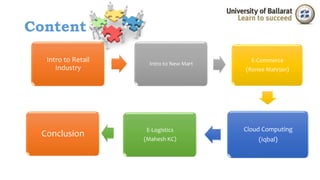
Content 
Intro to Retail 
Industry 
Intro to New Mart 
E-Commerce 
(Ronee Mahrjan) 
Cloud Computing 
(Iqbal) 
E-Logistics 
(Mahesh KC) 
Conclusion
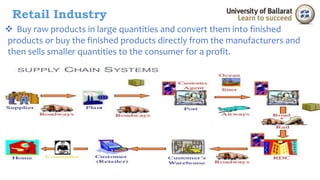
Retail Industry 
 Buy raw products in large quantities and convert them into finished 
products or buy the finished products directly from the manufacturers and 
then sells smaller quantities to the consumer for a profit.
An Organisation within Our Industry 
 New Mart Is a retail company that provides products like electronics, 
music, movies, bedding, household hardware, furniture, sporting goods, 
clothing, toys, jewellery, office supplies, health and beauty products, home 
decor, and a limited selection of food items. 
 New Mart imports goods and products from different vendors and 
suppliers from different parts of the world. New-Mart imports its products 
from China, Indonesia, Bangladesh, Korea, USA and few stock from State 
of Victoria which gives a major challenge of communication between all 
the departments.
E-Commerce 
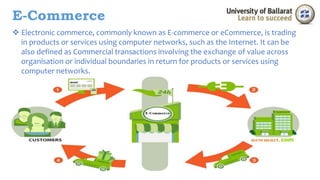
 Electronic commerce, commonly known as E-commerce or eCommerce, is trading 
in products or services using computer networks, such as the Internet. It can be 
also defined as Commercial transactions involving the exchange of value across 
organisation or individual boundaries in return for products or services using 
computer networks.
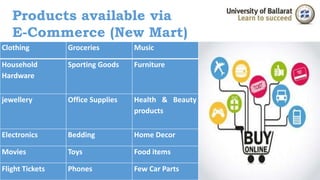
Products available via 
E-Commerce (New Mart) 
Clothing Groceries Music 
Household 
Hardware 
Sporting Goods Furniture 
jewellery Office Supplies Health & Beauty 
products 
Electronics Bedding Home Decor 
Movies Toys Food items 
Flight Tickets Phones Few Car Parts
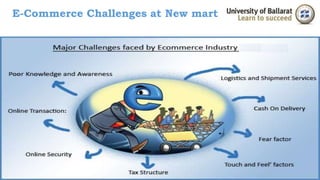
E-Commerce Challenges at New mart
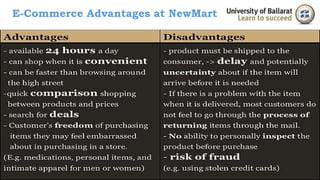
E-Commerce Advantages at NewMart
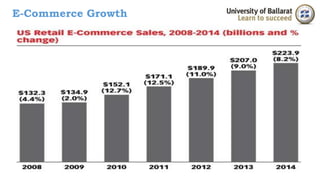
E-Commerce Growth
Cloud Computing 
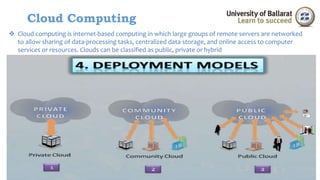
 Cloud computing is internet-based computing in which large groups of remote servers are networked 
to allow sharing of data-processing tasks, centralized data storage, and online access to computer 
services or resources. Clouds can be classified as public, private or hybrid
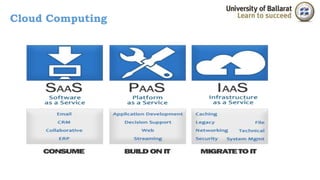
Cloud Computing
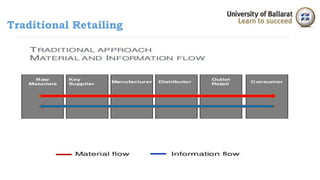
Traditional Retailing
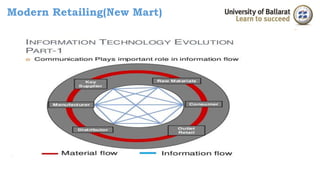
Modern Retailing(New Mart)
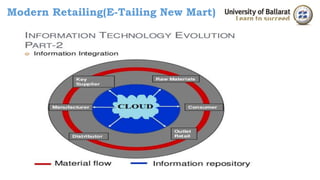
Modern Retailing(E-Tailing New Mart)
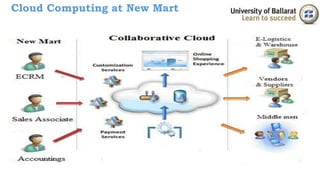
Cloud Computing at New Mart
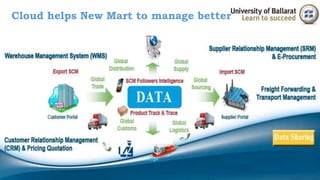
Cloud helps New Mart to manage better
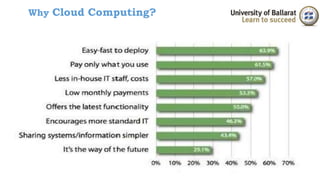
Why Cloud Computing?
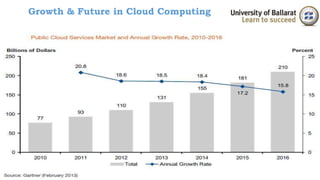
Growth & Future in Cloud Computing
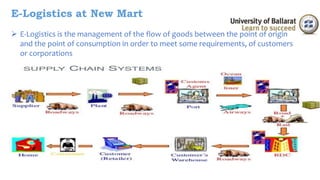
E-Logistics at New Mart 
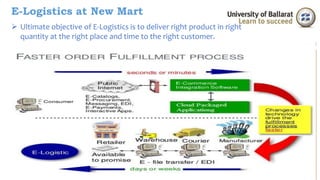
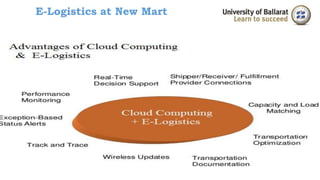
 E-Logistics is the management of the flow of goods between the point of origin 
and the point of consumption in order to meet some requirements, of customers 
or corporations
E-Logistics at New Mart 
 Ultimate objective of E-Logistics is to deliver right product in right 
quantity at the right place and time to the right customer.
E-Logistics at New Mart
Challenges in E-Logistics 
Economic/lack of ICT infrastructure 
Security/privacy/trust 
Localization/globalization 
Global Trade Market
Conclusion
Conclusion 
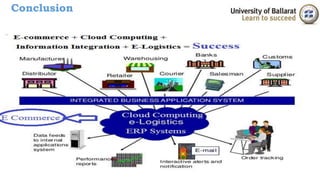
 Traditional methods of business overtaken technologies like E-Commerce, 
E-Logistics and Coud Computing 
 Consumer fulfilment will be increasing with the use of E-Commerce, E-Logistics 
and cCoud Computing 
 Transparency in Business and easy colaboration between groups with 
Cloud Computing 
 Global reach with the help of this Technologies 
 Need of qualified professional staff having knowledge and skills of 
emerging technology 
 Demand of highly advance software for e-commerce, e-logistics and 
cloud marketing
Reference 
 Arshdeep Bahga, V. M. (2013). Cloud Computing: A Hands-On Approach . 
CreateSpace Independent Publishing Platform. 
 Cary Landis, D. B. (2013). Cloud Computing Made Easy: An Easy to Understand 
Reference About Cloud Computing. CreateSpace Independent Publishing Platform. 
 Chopra, S. (2012). Supply Chain Management (5th Edition) . Prentice Hall. 
 Deryn Graham, I. M. (2013). E-Logistics and E-Supply Chain Management: 
Applications for Evolving Business. IGI Global. 
 Gartner. (2013). IT Glossary - Cloud Computing. Retrieved from GARTNER: 
http://www.gartner.com/it-glossary/cloud-computing/ 
 Kenneth Laudon, C. G. (2013). E-Commerce 2014 (10th Edition). Prentice Hall. 
 Michael Levy, B. W. (2013). Retailing Management . McGraw-Hill/Irwin. 
 Robin Lewis, M. D. (2014). The New Rules of Retail: Competing in the World's 
Toughest Marketplace . Palgrave Macmillan Trade. 
 Sanjay Mohapatra, L. L. (2013). Cloud Computing and ROI: A New Framework for IT 
Strategy . Springer.
Emerging presentation

Emerging presentation

  • 1.
    Emerging Technologies inBusiness Group 6 Iqbal Pinjari (30120245) Ronee Maharjan(30104707) Mahesh KC(30123827)
  • 2.
    Content Intro toRetail Industry Intro to New Mart E-Commerce (Ronee Mahrjan) Cloud Computing (Iqbal) E-Logistics (Mahesh KC) Conclusion
  • 3.
    Retail Industry Buy raw products in large quantities and convert them into finished products or buy the finished products directly from the manufacturers and then sells smaller quantities to the consumer for a profit.
  • 4.
    An Organisation withinOur Industry  New Mart Is a retail company that provides products like electronics, music, movies, bedding, household hardware, furniture, sporting goods, clothing, toys, jewellery, office supplies, health and beauty products, home decor, and a limited selection of food items.  New Mart imports goods and products from different vendors and suppliers from different parts of the world. New-Mart imports its products from China, Indonesia, Bangladesh, Korea, USA and few stock from State of Victoria which gives a major challenge of communication between all the departments.
  • 5.
    E-Commerce  Electroniccommerce, commonly known as E-commerce or eCommerce, is trading in products or services using computer networks, such as the Internet. It can be also defined as Commercial transactions involving the exchange of value across organisation or individual boundaries in return for products or services using computer networks.
  • 6.
    Products available via E-Commerce (New Mart) Clothing Groceries Music Household Hardware Sporting Goods Furniture jewellery Office Supplies Health & Beauty products Electronics Bedding Home Decor Movies Toys Food items Flight Tickets Phones Few Car Parts
  • 7.
  • 8.
  • 9.
  • 10.
    Cloud Computing Cloud computing is internet-based computing in which large groups of remote servers are networked to allow sharing of data-processing tasks, centralized data storage, and online access to computer services or resources. Clouds can be classified as public, private or hybrid
  • 11.
  • 12.
  • 13.
  • 14.
  • 15.
  • 16.
    Cloud helps NewMart to manage better
  • 17.
  • 18.
    Growth & Futurein Cloud Computing
  • 19.
    E-Logistics at NewMart  E-Logistics is the management of the flow of goods between the point of origin and the point of consumption in order to meet some requirements, of customers or corporations
  • 20.
    E-Logistics at NewMart  Ultimate objective of E-Logistics is to deliver right product in right quantity at the right place and time to the right customer.
  • 21.
  • 22.
    Challenges in E-Logistics Economic/lack of ICT infrastructure Security/privacy/trust Localization/globalization Global Trade Market
  • 23.
  • 24.
    Conclusion  Traditionalmethods of business overtaken technologies like E-Commerce, E-Logistics and Coud Computing  Consumer fulfilment will be increasing with the use of E-Commerce, E-Logistics and cCoud Computing  Transparency in Business and easy colaboration between groups with Cloud Computing  Global reach with the help of this Technologies  Need of qualified professional staff having knowledge and skills of emerging technology  Demand of highly advance software for e-commerce, e-logistics and cloud marketing
  • 25.
    Reference  ArshdeepBahga, V. M. (2013). Cloud Computing: A Hands-On Approach . CreateSpace Independent Publishing Platform.  Cary Landis, D. B. (2013). Cloud Computing Made Easy: An Easy to Understand Reference About Cloud Computing. CreateSpace Independent Publishing Platform.  Chopra, S. (2012). Supply Chain Management (5th Edition) . Prentice Hall.  Deryn Graham, I. M. (2013). E-Logistics and E-Supply Chain Management: Applications for Evolving Business. IGI Global.  Gartner. (2013). IT Glossary - Cloud Computing. Retrieved from GARTNER: http://www.gartner.com/it-glossary/cloud-computing/  Kenneth Laudon, C. G. (2013). E-Commerce 2014 (10th Edition). Prentice Hall.  Michael Levy, B. W. (2013). Retailing Management . McGraw-Hill/Irwin.  Robin Lewis, M. D. (2014). The New Rules of Retail: Competing in the World's Toughest Marketplace . Palgrave Macmillan Trade.  Sanjay Mohapatra, L. L. (2013). Cloud Computing and ROI: A New Framework for IT Strategy . Springer.

Editor's Notes

  • #4 Buy raw products in large quantities and convert them into finished products or buy the finished products directly from the manufacturers and then sells smaller quantities to the consumer for a profit. Retailing can be done in a fixed location or it can be done without using any fixed location. Fixed locations refer to stores or markets and the other way retailing can be operated is online.
  • #5 Initially it started with only one store in the city of NSW and later opened its store in many other suburbs in NSW. The future scope for the company is to grow its centres throughout Australia and develop an online shopping site available for customers to meet the customer demands in today’s society where everything is online.
  • #6 Electronic commerce, commonly known as E-commerce or eCommerce, is trading in products or services using computer networks, such as the Internet. It can be also defined as Commercial transactions involving the exchange of value across organisation or individual boundaries in return for products or services using computer networks..
  • #7 Electronic commerce, commonly known as E-commerce or eCommerce, is trading in products or services using computer networks, such as the Internet. It can be also defined as Commercial transactions involving the exchange of value across organisation or individual boundaries in return for products or services using computer networks..
  • #8 Electronic commerce, commonly known as E-commerce or eCommerce, is trading in products or services using computer networks, such as the Internet. It can be also defined as Commercial transactions involving the exchange of value across organisation or individual boundaries in return for products or services using computer networks..
  • #9 Electronic commerce, commonly known as E-commerce or eCommerce, is trading in products or services using computer networks, such as the Internet. It can be also defined as Commercial transactions involving the exchange of value across organisation or individual boundaries in return for products or services using computer networks..
  • #10 Electronic commerce, commonly known as E-commerce or eCommerce, is trading in products or services using computer networks, such as the Internet. It can be also defined as Commercial transactions involving the exchange of value across organisation or individual boundaries in return for products or services using computer networks..
  • #11 Cloud computing is internet-based computing in which large groups of remote servers are networked to allow sharing of data-processing tasks, centralized data storage, and online access to computer services or resources. Clouds can be classified as public, private or hybrid
  • #20 The logistics of physical items usually involves the integration of information flow, material handling, production, packaging, inventory, transportation, warehousing, and often security.
  • #25 Traditional methods of business overtaken by e-logistics Consumer fulfilment will be increasing with the use of e-logistics Transparency in Business Global reach Need of qualified professional staff having knowledge and skills of emerging technology Demand of highly advance software for e-commerce, e-logistics and I-cloud marketing