EMBA
Firmware
security
analyzer
@securefirmware
https://github.com/e-m-b-a
Michael Messner, Pascal Eckmann
# whoami
Michael Messner
Penetration tester
Firmware analysis
Hardware analysis
Siemens Energy AG
@s3cur1ty_de
https://github.com/m-1-k-3
@ michael.messner@siemens-energy.com
# whoami
Pascal Eckmann
Cybersecurity Engineer
Security Research
Siemens AG
@_p4cx
https://github.com/p4cx
@ pascal.eckmann@siemens.com
The landscape
What the firmware analysis
• Firmware is the operating system
• Linux analysis techniques can be used quite often and are well known
• Commercial tools are available, but they are expensive and limited
• EMBA has no limits, costs no money and gives the best results
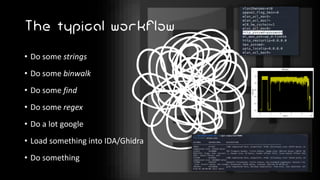
The typical workflow
• Do some strings
• Do some binwalk
• Do some find
• Do some regex
• Do a lot google
• Load something into IDA/Ghidra
• Do something
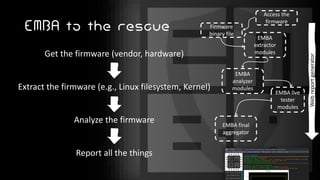
EMBA to the rescue
Get the firmware (vendor, hardware)
Extract the firmware (e.g., Linux filesystem, Kernel)
Analyze the firmware
Report all the things
Firmware
binary file
EMBA
extractor
modules
EMBA
analyzer
modules
EMBA live
tester
modules
EMBA final
aggregator
Web
report
generator
Access the
firmware
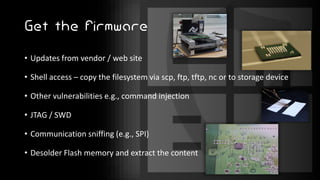
Get the firmware
• Updates from vendor / web site
• Shell access – copy the filesystem via scp, ftp, tftp, nc or to storage device
• Other vulnerabilities e.g., command injection
• JTAG / SWD
• Communication sniffing (e.g., SPI)
• Desolder Flash memory and extract the content
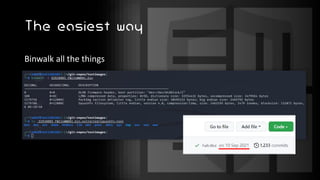
The easiest way
Binwalk all the things
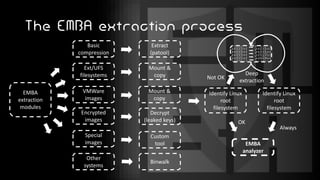
The EMBA extraction process
EMBA
extraction
modules
Identify Linux
root
filesystem
Ext/UFS
filesystems
VMWare
images
Encrypted
images
Special
images
Other
systems
Mount &
copy
Mount &
copy
Decrypt
(leaked keys)
Custom
tool
Binwalk
EMBA
analyzer
Deep
extraction
Ext/UFS filesystems
VMWare images
Encrypted images
Special images
Other systems
Mount & copy
Mount & copy
Decrypt (leaked keys)
Custom
tool (e.g. Freetz NG)
Binwalk
Identify Linux
root
filesystem
OK
Not OK
Always
Basic
compression
Extract
(patool)
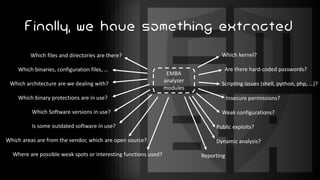
Finally, we have something extracted
Which files and directories are there?
Which binaries, configuration files, …
Which architecture are we dealing with?
Which binary protections are in use?
Which Software versions in use?
Is some outdated software in use?
Which areas are from the vendor, which are open source?
Where are possible weak spots or interesting functions used?
Which kernel?
Are there hard-coded passwords?
Scripting issues (shell, python, php, …)?
Insecure permissions?
Weak configurations?
Public exploits?
Dynamic analysis?
Reporting
EMBA
analyzer
modules
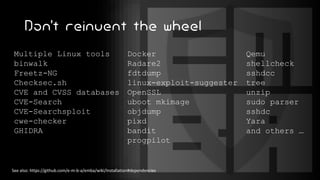
Don’t reinvent the wheel
Multiple Linux tools
binwalk
Freetz-NG
Checksec.sh
CVE and CVSS databases
CVE-Search
CVE-Searchsploit
cwe-checker
GHIDRA
Docker
Radare2
fdtdump
linux-exploit-suggester
OpenSSL
uboot mkimage
objdump
pixd
bandit
progpilot
Qemu
shellcheck
sshdcc
tree
unzip
sudo parser
sshdc
Yara
and others …
See also: https://github.com/e-m-b-a/emba/wiki/Installation#dependencies
Hunting 0days
Identify interesting spots
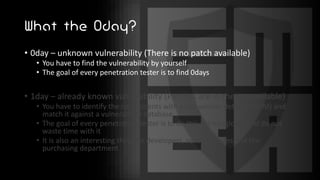
What the 0day?
• 0day – unknown vulnerability (There is no patch available)
• You have to find the vulnerability by yourself
• The goal of every penetration tester is to find 0days
• 1day – already known vulnerability (Patches are in theory available)
• You have to identify the components with exact version details (SBOM) and
match it against a vulnerability database
• The goal of every penetration tester is to do this automagically and do not
waste time with it
• It is also an interesting thing for developers, security teams and the
purchasing department
Weak binary functions
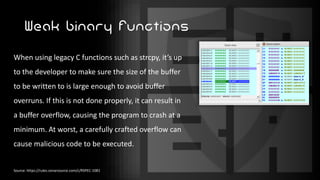
When using legacy C functions such as strcpy, it’s up
to the developer to make sure the size of the buffer
to be written to is large enough to avoid buffer
overruns. If this is not done properly, it can result in
a buffer overflow, causing the program to crash at a
minimum. At worst, a carefully crafted overflow can
cause malicious code to be executed.
Source: https://rules.sonarsource.com/c/RSPEC-1081
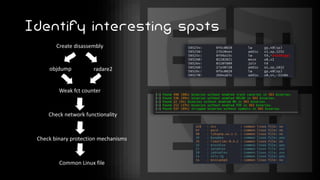
Identify interesting spots
Create disassembly
objdump radare2
Check binary protection mechanisms
Weak fct counter
Check network functionality
Common Linux file
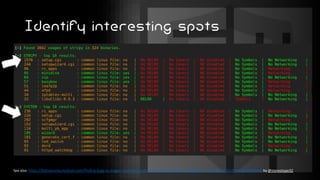
Identify interesting spots
See also: https://flattsecurity.medium.com/finding-bugs-to-trigger-unauthenticated-command-injection-in-a-netgear-router-psv-2022-0044-2b394fb9edc by @stereotype32
The 1day issue
What the 1day?
• 0day – unknown vulnerability (There is no patch available)
• You have to find the vulnerability by yourself
• The goal of every penetration tester is to find 0days
• 1day – already known vulnerability (Patches are in theory available)
• You have to identify the components with exact version details (SBOM) and
match it against a vulnerability database
• The goal of every penetration tester is to do this automagically and do not
waste time with it
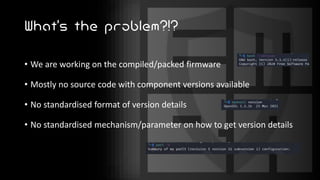
What’s the problem?!?
• We are working on the compiled/packed firmware
• Mostly no source code with component versions available
• No standardised format of version details
• No standardised mechanism/parameter on how to get version details
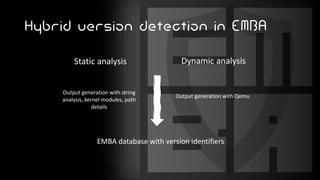
Hybrid version detection in EMBA
Static analysis Dynamic analysis
EMBA database with version identifiers
Output generation with Qemu
Output generation with string
analysis, kernel modules, path
details
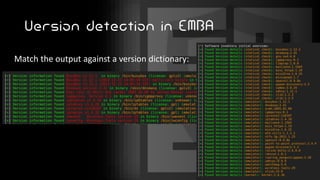
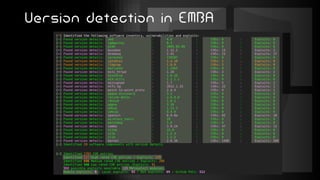
Version detection in EMBA
Match the output against a version dictionary:
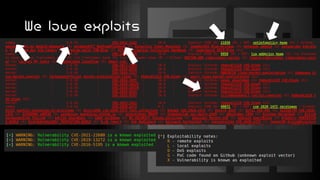
We love exploits
Version detection in EMBA
@ pascal.eckmann@siemens.com @ michael.messner@siemens-energy.com
EMBA
Firmware
security
analyzer
@securefirmware
https://github.com/e-m-b-a
Michael Messner, Pascal Eckmann

EMBA Firmware analysis - TROOPERS22

  • 1.
  • 2.
    # whoami Michael Messner Penetrationtester Firmware analysis Hardware analysis Siemens Energy AG @s3cur1ty_de https://github.com/m-1-k-3 @ michael.messner@siemens-energy.com
  • 3.
    # whoami Pascal Eckmann CybersecurityEngineer Security Research Siemens AG @_p4cx https://github.com/p4cx @ pascal.eckmann@siemens.com
  • 4.
  • 5.
    What the firmwareanalysis • Firmware is the operating system • Linux analysis techniques can be used quite often and are well known • Commercial tools are available, but they are expensive and limited • EMBA has no limits, costs no money and gives the best results
  • 6.
    The typical workflow •Do some strings • Do some binwalk • Do some find • Do some regex • Do a lot google • Load something into IDA/Ghidra • Do something
  • 7.
    EMBA to therescue Get the firmware (vendor, hardware) Extract the firmware (e.g., Linux filesystem, Kernel) Analyze the firmware Report all the things Firmware binary file EMBA extractor modules EMBA analyzer modules EMBA live tester modules EMBA final aggregator Web report generator Access the firmware
  • 8.
    Get the firmware •Updates from vendor / web site • Shell access – copy the filesystem via scp, ftp, tftp, nc or to storage device • Other vulnerabilities e.g., command injection • JTAG / SWD • Communication sniffing (e.g., SPI) • Desolder Flash memory and extract the content
  • 9.
  • 10.
    The EMBA extractionprocess EMBA extraction modules Identify Linux root filesystem Ext/UFS filesystems VMWare images Encrypted images Special images Other systems Mount & copy Mount & copy Decrypt (leaked keys) Custom tool Binwalk EMBA analyzer Deep extraction Ext/UFS filesystems VMWare images Encrypted images Special images Other systems Mount & copy Mount & copy Decrypt (leaked keys) Custom tool (e.g. Freetz NG) Binwalk Identify Linux root filesystem OK Not OK Always Basic compression Extract (patool)
  • 11.
    Finally, we havesomething extracted Which files and directories are there? Which binaries, configuration files, … Which architecture are we dealing with? Which binary protections are in use? Which Software versions in use? Is some outdated software in use? Which areas are from the vendor, which are open source? Where are possible weak spots or interesting functions used? Which kernel? Are there hard-coded passwords? Scripting issues (shell, python, php, …)? Insecure permissions? Weak configurations? Public exploits? Dynamic analysis? Reporting EMBA analyzer modules
  • 12.
    Don’t reinvent thewheel Multiple Linux tools binwalk Freetz-NG Checksec.sh CVE and CVSS databases CVE-Search CVE-Searchsploit cwe-checker GHIDRA Docker Radare2 fdtdump linux-exploit-suggester OpenSSL uboot mkimage objdump pixd bandit progpilot Qemu shellcheck sshdcc tree unzip sudo parser sshdc Yara and others … See also: https://github.com/e-m-b-a/emba/wiki/Installation#dependencies
  • 13.
  • 14.
    What the 0day? •0day – unknown vulnerability (There is no patch available) • You have to find the vulnerability by yourself • The goal of every penetration tester is to find 0days • 1day – already known vulnerability (Patches are in theory available) • You have to identify the components with exact version details (SBOM) and match it against a vulnerability database • The goal of every penetration tester is to do this automagically and do not waste time with it • It is also an interesting thing for developers, security teams and the purchasing department
  • 15.
    Weak binary functions Whenusing legacy C functions such as strcpy, it’s up to the developer to make sure the size of the buffer to be written to is large enough to avoid buffer overruns. If this is not done properly, it can result in a buffer overflow, causing the program to crash at a minimum. At worst, a carefully crafted overflow can cause malicious code to be executed. Source: https://rules.sonarsource.com/c/RSPEC-1081
  • 16.
    Identify interesting spots Createdisassembly objdump radare2 Check binary protection mechanisms Weak fct counter Check network functionality Common Linux file
  • 17.
    Identify interesting spots Seealso: https://flattsecurity.medium.com/finding-bugs-to-trigger-unauthenticated-command-injection-in-a-netgear-router-psv-2022-0044-2b394fb9edc by @stereotype32
  • 18.
  • 19.
    What the 1day? •0day – unknown vulnerability (There is no patch available) • You have to find the vulnerability by yourself • The goal of every penetration tester is to find 0days • 1day – already known vulnerability (Patches are in theory available) • You have to identify the components with exact version details (SBOM) and match it against a vulnerability database • The goal of every penetration tester is to do this automagically and do not waste time with it
  • 20.
    What’s the problem?!? •We are working on the compiled/packed firmware • Mostly no source code with component versions available • No standardised format of version details • No standardised mechanism/parameter on how to get version details
  • 21.
    Hybrid version detectionin EMBA Static analysis Dynamic analysis EMBA database with version identifiers Output generation with Qemu Output generation with string analysis, kernel modules, path details
  • 22.
    Version detection inEMBA Match the output against a version dictionary:
  • 23.
  • 24.
  • 25.
    @ pascal.eckmann@siemens.com @michael.messner@siemens-energy.com EMBA Firmware security analyzer @securefirmware https://github.com/e-m-b-a Michael Messner, Pascal Eckmann