Section A
We can also use conditional adverb clauses to describe
unreal, imaginary, unlikely, or impossible situations
because we wish the situation were true.
It’s too bad that my brothers are away. If
they were here, I know they would help
me.
(They aren’t here.)
We can also use an unreal
conditional to give advice.
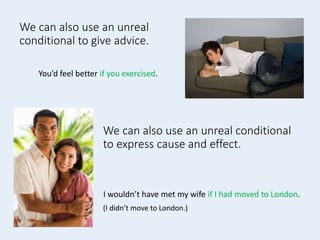
You’d feel better if you exercised.
We can also use an unreal conditional
to express cause and effect.
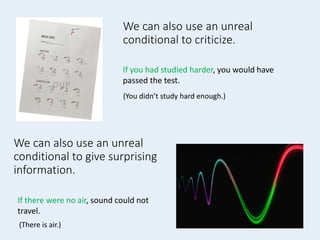
I wouldn’t have met my wife if I had moved to London.
(I didn’t move to London.)
We can also use an unreal
conditional to criticize.
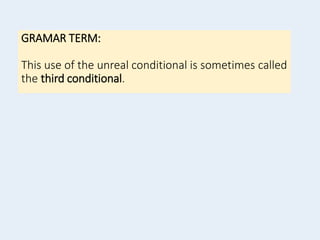
If you had studied harder, you would have
passed the test.
We can also use an unreal
conditional to give surprising
information.
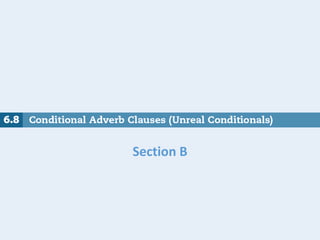
If there were no air, sound could not
travel.
(There is air.)
(You didn’t study hard enough.)
GRAMAR TERM:
This use of the unreal conditional is sometimes called
the third conditional.
Section B
To show that we are talking about an unreal or imaginary
situation, we use special verb forms.
If it weren’t raining, I’d go for a walk.
(This means it is raining.)
When both the condition and the result refer to a
present or future time frame, we use if plus a past verb
form followed by would or could plus the base form.
PRESENT UNREAL CONDITIONAL
If my sister here now, she would know what to do.
(This means, “she’s is not here now.”)
If I didn’t have to work today, I could go hiking.
(This means, “I do have to work today.”)
PRESENT UNREAL CONDITIONALS
If I could do anything I wanted, I’d move to Japan.
Be careful! When we use the verb be in the
if- clause, we usually use were instead of was.
were
If I had time next month, I’d go
to Hawaii.
(This means, “I don’t have time next
month.”)
FUTURE UNREAL CONDITIONALS
If I had to work next week, I wouldn’t
be able to go with you.
(This means, “I don’t have time to work
next week.”)
If I hadn’t eaten earlier, I would have gone to
lunch with you.
(This means, “I did eat earlier”.)
If I had had any vacation days last
month, I could have gone to Hawaii.
(This means, “I didn’t have any vacation
days last month.”)
When both the condition and the result refer to a past
time, we use if plus a past perfect verb for the unreal
condition. We use would have or could have for the
unreal result.
Section C
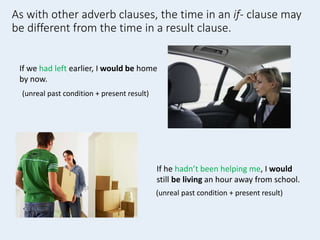
If we had left earlier, I would be home
by now.
As with other adverb clauses, the time in an if- clause may
be different from the time in a result clause.
If he hadn’t been helping me, I would
still be living an hour away from school.
(unreal past condition + present result)

Elm3 chart06 08

  • 1.
  • 2.
    We can alsouse conditional adverb clauses to describe unreal, imaginary, unlikely, or impossible situations because we wish the situation were true. It’s too bad that my brothers are away. If they were here, I know they would help me. (They aren’t here.)
  • 3.
    We can alsouse an unreal conditional to give advice. You’d feel better if you exercised. We can also use an unreal conditional to express cause and effect. I wouldn’t have met my wife if I had moved to London. (I didn’t move to London.)
  • 4.
    We can alsouse an unreal conditional to criticize. If you had studied harder, you would have passed the test. We can also use an unreal conditional to give surprising information. If there were no air, sound could not travel. (There is air.) (You didn’t study hard enough.)
  • 5.
    GRAMAR TERM: This useof the unreal conditional is sometimes called the third conditional.
  • 6.
  • 7.
    To show thatwe are talking about an unreal or imaginary situation, we use special verb forms. If it weren’t raining, I’d go for a walk. (This means it is raining.) When both the condition and the result refer to a present or future time frame, we use if plus a past verb form followed by would or could plus the base form. PRESENT UNREAL CONDITIONAL
  • 8.
    If my sisterhere now, she would know what to do. (This means, “she’s is not here now.”) If I didn’t have to work today, I could go hiking. (This means, “I do have to work today.”) PRESENT UNREAL CONDITIONALS If I could do anything I wanted, I’d move to Japan. Be careful! When we use the verb be in the if- clause, we usually use were instead of was. were
  • 9.
    If I hadtime next month, I’d go to Hawaii. (This means, “I don’t have time next month.”) FUTURE UNREAL CONDITIONALS If I had to work next week, I wouldn’t be able to go with you. (This means, “I don’t have time to work next week.”)
  • 10.
    If I hadn’teaten earlier, I would have gone to lunch with you. (This means, “I did eat earlier”.) If I had had any vacation days last month, I could have gone to Hawaii. (This means, “I didn’t have any vacation days last month.”) When both the condition and the result refer to a past time, we use if plus a past perfect verb for the unreal condition. We use would have or could have for the unreal result.
  • 11.
  • 12.
    If we hadleft earlier, I would be home by now. As with other adverb clauses, the time in an if- clause may be different from the time in a result clause. If he hadn’t been helping me, I would still be living an hour away from school. (unreal past condition + present result) (unreal past condition + present result)