



@ElkinVelasquezM
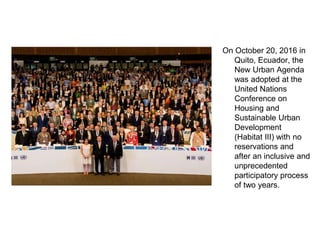
On October 20, 2016 in
Quito, Ecuador, the
New Urban Agenda
was adopted at the
United Nations
Conference on
Housing and
Sustainable Urban
Development
(Habitat III) with no
reservations and
after an inclusive and
unprecedented
participatory process
of two years.
The New Urban Agenda is an action-oriented document which sets global
standards of achievement in sustainable urban development, rethinking the way
we build, manage, and live in cities through cooperation with committed partners,
relevant stakeholders, and urban actors at all levels of government as well as the
private sector.
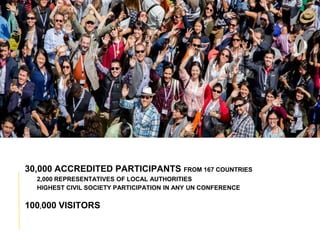
30,000 ACCREDITED PARTICIPANTS FROM 167 COUNTRIES
2,000 REPRESENTATIVES OF LOCAL AUTHORITIES
HIGHEST CIVIL SOCIETY PARTICIPATION IN ANY UN CONFERENCE
100,000 VISITORS
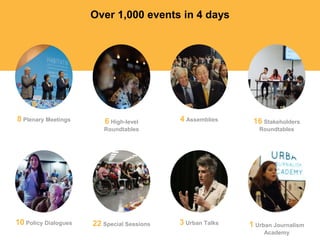
Over 1,000 events in 4 days
8 Plenary Meetings 6 High-level
Roundtables
4 Assemblies 16 Stakeholders
Roundtables
10 Policy Dialogues 22 Special Sessions 3 Urban Talks 1 Urban Journalism
Academy
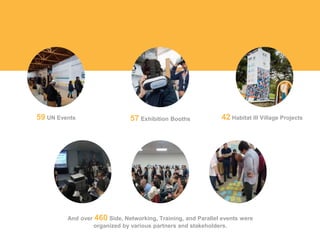
59 UN Events 57 Exhibition Booths
And over 460 Side, Networking, Training, and Parallel events were
organized by various partners and stakeholders.
42 Habitat III Village Projects
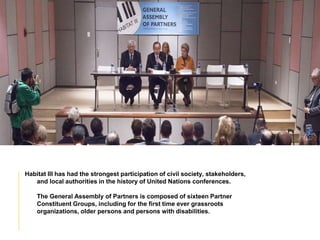
Habitat III has had the strongest participation of civil society, stakeholders,
and local authorities in the history of United Nations conferences.
The General Assembly of Partners is composed of sixteen Partner
Constituent Groups, including for the first time ever grassroots
organizations, older persons and persons with disabilities.
Beyond Habitat III
Habitat III Regional Report
Latin America and the Caribbean
7 Policy Implications
LAC can capitalise on the transformational
power of good urbanisation and at the same
time address key urban challenges based at
least on seven key points that might also serve
to support a future Regional Action Plan Post-
2016 :
1. Promoting Sustainable Urban Development at the
Center of National Development and Growth Policies so
that systems of cities and rural-urban systems can generate
added value without negative social externalities, create
conditions for improved productivity and take advantage of
agglomeration economies.
2. Sustaining Urban Poverty Alleviation and Urban Equity
Strategies through reduction of urban socio-economic
segregation and inequalities and new generation of “housing
at the center” policies.
3. Promoting Social Cohesion and Improving Urban Safety
through sustainable urban and neighborhood
development/redevelopment strategies.
Policy Implications (1)
4. Scaling up Urban Redevelopment Strategies towards
more efficient urban systems, with smart combination of
planned city in-fill and city extension initiatives, avoiding
low density and enabling better social integration
5. Creating Ecosystem for Innovative Financing
of Sustainable Urban Development, looking for
increased flow of public and private financial
resources towards urban integrated and inclusive
projects and enabling increased social and fiscal
return of urban infrastructure assets
Policy Implications (2)
6. Promoting a New Urban Governance Path based on
multilevel articulation, effective citizen participation and
gender parity, and enabling better institutional capabilities
to manage, plan and materialize the right to the city.
7. Promoting Urban Patterns for Environmental Big Push
and strengthening multi-dimensional urban resilience in
order to reduce vulnerabilities and mitigate climate change
effects in cities
Policy Implications (3)
Elements of the New Urban Agenda
Some new Approaches in the NUA
• urbanization as transformational opportunity and driver of
sustainable urban development rather than a problem that needs to be
solved
• integrated strategic approaches as a foundation for sectoral solutions,
rather than focusing on siloed, sector-specific solutions
• multi-level governance, multi-scale, functional rather than
administrative territory, multi-stakeholder process from scoping to
implementation
• national urban policies as framework enabling coordinated finance
from variety of sources: sovereign, sub-sovereign, IFI, ODA and
private finance
• data and statistical analysis capacities as a crucial prerequisite for
efficient and effective implementation
Implementation of New Urban Agenda: Key areas
National Urban Policies
• demographic projections; roles and responsibilities of local authorities; integrate national
development plans with urban plans; framework to reduce urban and territorial disparities within
and among regions; jurisdictional coordination and coherence
Urban Legal Frameworks
• law defining urban space at the national and local levels; system of urban powers and
responsibilities at all levels of government; legal basis for urban planning and land management;
regulate urban development or buildability rights; public space; housing and building codes;
environmental protection that recognize urban needs and impacts; national sustainable, universal
access to basic services
Integrated Urban and Territorial Planning and Design
• scope and content of the urban plan; sustainable density and mixed use; effective urban design;
natural and cultural resources; housing as an integrating element of urban planning; adequate
amounts of urban space for a variety of economic activities
Financing Urbanization
• economic, fiscal and financial management cycle(s) of local authorities; capital investment; local
revenue and investment partnerships; land-based fiscal tools; basic service and network investment
plans; housing affordability
Local Implementation
• urban extension areas at the appropriate scale; public and private space; urban infill areas and
retrofit existing urban fabric; integrated and equitable urban basic services; instruments for public
benefit from public investment
Punto 90 de la Declaración de Quito
• 90. Apoyaremos, en consonancia con la legislación nacional de los
países, el fortalecimiento de la capacidad de los gobiernos
subnacionales y locales para aplicar una gobernanza local y
metropolitana eficaz a diferentes niveles, que cruce fronteras
administrativas y se base en los territorios funcionales, velando por
la participación de los gobiernos subnacionales y locales en la toma de
decisiones y trabajando para conferirles la autoridad y los recursos
necesarios para gestionar las cuestiones cruciales urbanas,
metropolitanas y territoriales. Promoveremos una gobernanza
metropolitana inclusiva que abarque diversos marcos jurídicos y
mecanismos de financiación viables, incluida la gestión sostenible
de la deuda, según proceda. Adoptaremos medidas para promover la
participación plena y eficaz de la mujer y la igualdad de derechos en
todos los ámbitos y en el liderazgo a todos los niveles de toma de
decisiones, en particular en los gobiernos locales.
Punto 96 de la Declaración de Quito
• 96. Alentaremos la aplicación de políticas de planificación urbana y
territorial, incluidos planes metropolitanos y de ciudades y regiones,
a fin de alentar las sinergias e interacciones entre las zonas urbanas
de todos los tamaños y su entorno periurbano y rural, incluidas las que
abarquen ambos lados de una frontera, y apoyaremos la preparación
de proyectos de infraestructura regional sostenible que estimulen
una productividad económica sostenible, y promoveremos un
crecimiento equitativo de las regiones urbanas en la continuidad entre
entornos urbanos y rurales. En este sentido, promoveremos los
mecanismos de cooperación intermunicipal y las alianzas rurales-
urbanas sobre la base de los territorios funcionales y las zonas
urbanas como instrumentos eficaces para realizar tareas
administrativas municipales y metropolitanas, prestar servicios
públicos y promover el desarrollo local y regional.
No hay modelos únicos de gobernanza metropolitana.
La perspectiva práctica del diseño institucional importa… mucho.
Ciudadanos fuertes = Ciudades fuertes
Cada ciudad, cada metrópoli debe hacerse “su traje a medida” y
“ganarse la vida”.
Se puede aprender de las experiencias de otras urbes y ahorrar
tiempo y recursos.
Ideas fuerza discusión Hábitat III sobre gobernanza
metropolitana
@ElkinVelasquezM

Presentación Elkin Velásquez, Director Latinoamérica y el Caribe Onu Hábitat

  • 1.
  • 3.
    On October 20,2016 in Quito, Ecuador, the New Urban Agenda was adopted at the United Nations Conference on Housing and Sustainable Urban Development (Habitat III) with no reservations and after an inclusive and unprecedented participatory process of two years.
  • 4.
    The New UrbanAgenda is an action-oriented document which sets global standards of achievement in sustainable urban development, rethinking the way we build, manage, and live in cities through cooperation with committed partners, relevant stakeholders, and urban actors at all levels of government as well as the private sector.
  • 5.
    30,000 ACCREDITED PARTICIPANTSFROM 167 COUNTRIES 2,000 REPRESENTATIVES OF LOCAL AUTHORITIES HIGHEST CIVIL SOCIETY PARTICIPATION IN ANY UN CONFERENCE 100,000 VISITORS
  • 6.
    Over 1,000 eventsin 4 days 8 Plenary Meetings 6 High-level Roundtables 4 Assemblies 16 Stakeholders Roundtables 10 Policy Dialogues 22 Special Sessions 3 Urban Talks 1 Urban Journalism Academy
  • 7.
    59 UN Events57 Exhibition Booths And over 460 Side, Networking, Training, and Parallel events were organized by various partners and stakeholders. 42 Habitat III Village Projects
  • 8.
    Habitat III hashad the strongest participation of civil society, stakeholders, and local authorities in the history of United Nations conferences. The General Assembly of Partners is composed of sixteen Partner Constituent Groups, including for the first time ever grassroots organizations, older persons and persons with disabilities.
  • 9.
  • 10.
    Habitat III RegionalReport Latin America and the Caribbean
  • 11.
    7 Policy Implications LACcan capitalise on the transformational power of good urbanisation and at the same time address key urban challenges based at least on seven key points that might also serve to support a future Regional Action Plan Post- 2016 :
  • 12.
    1. Promoting SustainableUrban Development at the Center of National Development and Growth Policies so that systems of cities and rural-urban systems can generate added value without negative social externalities, create conditions for improved productivity and take advantage of agglomeration economies. 2. Sustaining Urban Poverty Alleviation and Urban Equity Strategies through reduction of urban socio-economic segregation and inequalities and new generation of “housing at the center” policies. 3. Promoting Social Cohesion and Improving Urban Safety through sustainable urban and neighborhood development/redevelopment strategies. Policy Implications (1)
  • 13.
    4. Scaling upUrban Redevelopment Strategies towards more efficient urban systems, with smart combination of planned city in-fill and city extension initiatives, avoiding low density and enabling better social integration 5. Creating Ecosystem for Innovative Financing of Sustainable Urban Development, looking for increased flow of public and private financial resources towards urban integrated and inclusive projects and enabling increased social and fiscal return of urban infrastructure assets Policy Implications (2)
  • 14.
    6. Promoting aNew Urban Governance Path based on multilevel articulation, effective citizen participation and gender parity, and enabling better institutional capabilities to manage, plan and materialize the right to the city. 7. Promoting Urban Patterns for Environmental Big Push and strengthening multi-dimensional urban resilience in order to reduce vulnerabilities and mitigate climate change effects in cities Policy Implications (3)
  • 15.
    Elements of theNew Urban Agenda Some new Approaches in the NUA • urbanization as transformational opportunity and driver of sustainable urban development rather than a problem that needs to be solved • integrated strategic approaches as a foundation for sectoral solutions, rather than focusing on siloed, sector-specific solutions • multi-level governance, multi-scale, functional rather than administrative territory, multi-stakeholder process from scoping to implementation • national urban policies as framework enabling coordinated finance from variety of sources: sovereign, sub-sovereign, IFI, ODA and private finance • data and statistical analysis capacities as a crucial prerequisite for efficient and effective implementation
  • 16.
    Implementation of NewUrban Agenda: Key areas National Urban Policies • demographic projections; roles and responsibilities of local authorities; integrate national development plans with urban plans; framework to reduce urban and territorial disparities within and among regions; jurisdictional coordination and coherence Urban Legal Frameworks • law defining urban space at the national and local levels; system of urban powers and responsibilities at all levels of government; legal basis for urban planning and land management; regulate urban development or buildability rights; public space; housing and building codes; environmental protection that recognize urban needs and impacts; national sustainable, universal access to basic services Integrated Urban and Territorial Planning and Design • scope and content of the urban plan; sustainable density and mixed use; effective urban design; natural and cultural resources; housing as an integrating element of urban planning; adequate amounts of urban space for a variety of economic activities Financing Urbanization • economic, fiscal and financial management cycle(s) of local authorities; capital investment; local revenue and investment partnerships; land-based fiscal tools; basic service and network investment plans; housing affordability Local Implementation • urban extension areas at the appropriate scale; public and private space; urban infill areas and retrofit existing urban fabric; integrated and equitable urban basic services; instruments for public benefit from public investment
  • 17.
    Punto 90 dela Declaración de Quito • 90. Apoyaremos, en consonancia con la legislación nacional de los países, el fortalecimiento de la capacidad de los gobiernos subnacionales y locales para aplicar una gobernanza local y metropolitana eficaz a diferentes niveles, que cruce fronteras administrativas y se base en los territorios funcionales, velando por la participación de los gobiernos subnacionales y locales en la toma de decisiones y trabajando para conferirles la autoridad y los recursos necesarios para gestionar las cuestiones cruciales urbanas, metropolitanas y territoriales. Promoveremos una gobernanza metropolitana inclusiva que abarque diversos marcos jurídicos y mecanismos de financiación viables, incluida la gestión sostenible de la deuda, según proceda. Adoptaremos medidas para promover la participación plena y eficaz de la mujer y la igualdad de derechos en todos los ámbitos y en el liderazgo a todos los niveles de toma de decisiones, en particular en los gobiernos locales.
  • 18.
    Punto 96 dela Declaración de Quito • 96. Alentaremos la aplicación de políticas de planificación urbana y territorial, incluidos planes metropolitanos y de ciudades y regiones, a fin de alentar las sinergias e interacciones entre las zonas urbanas de todos los tamaños y su entorno periurbano y rural, incluidas las que abarquen ambos lados de una frontera, y apoyaremos la preparación de proyectos de infraestructura regional sostenible que estimulen una productividad económica sostenible, y promoveremos un crecimiento equitativo de las regiones urbanas en la continuidad entre entornos urbanos y rurales. En este sentido, promoveremos los mecanismos de cooperación intermunicipal y las alianzas rurales- urbanas sobre la base de los territorios funcionales y las zonas urbanas como instrumentos eficaces para realizar tareas administrativas municipales y metropolitanas, prestar servicios públicos y promover el desarrollo local y regional.
  • 19.
    No hay modelosúnicos de gobernanza metropolitana. La perspectiva práctica del diseño institucional importa… mucho. Ciudadanos fuertes = Ciudades fuertes Cada ciudad, cada metrópoli debe hacerse “su traje a medida” y “ganarse la vida”. Se puede aprender de las experiencias de otras urbes y ahorrar tiempo y recursos. Ideas fuerza discusión Hábitat III sobre gobernanza metropolitana
  • 20.