Evaluation of Leicestershire’s Better Care Fund
programme
Elizabeth Orton, Consultant in Public Health
Janine Dellar, Head of Public Health Intelligence
• Monday 22nd June 2015
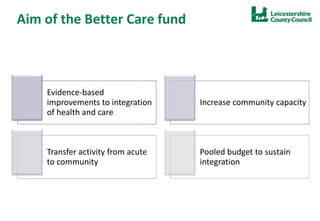
Aim of the Better Care fund
Evidence-based
improvements to integration
of health and care
Increase community capacity
Transfer activity from acute
to community
Pooled budget to sustain
integration
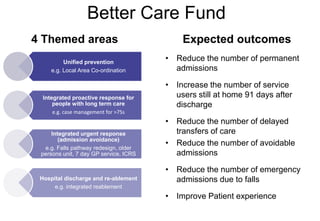
Better Care Fund
Unified prevention
e.g. Local Area Co-ordination
Integrated proactive response for
people with long term care
e.g. case management for >75s
Integrated urgent response
(admission avoidance)
e.g. Falls pathway redesign, older
persons unit, 7 day GP service, ICRS
Hospital discharge and re-ablement
e.g. integrated reablement
• Reduce the number of permanent
admissions
• Increase the number of service
users still at home 91 days after
discharge
• Reduce the number of delayed
transfers of care
• Reduce the number of avoidable
admissions
• Reduce the number of emergency
admissions due to falls
• Improve Patient experience
Expected outcomes4 Themed areas
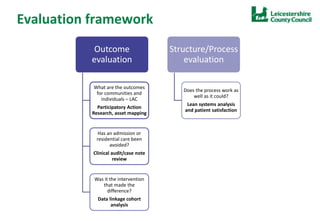
Evaluation framework
Outcome
evaluation
What are the outcomes
for communities and
individuals – LAC
Participatory Action
Research, asset mapping
Has an admission or
residential care been
avoided?
Clinical audit/case note
review
Was it the intervention
that made the
difference?
Data linkage cohort
analysis
Structure/Process
evaluation
Does the process work as
well as it could?
Lean systems analysis
and patient satisfaction
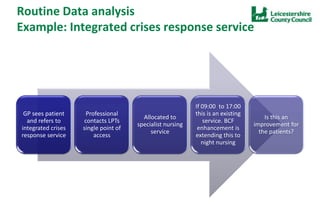
Routine Data analysis
Example: Integrated crises response service
GP sees patient
and refers to
integrated crises
response service
Professional
contacts LPTs
single point of
access
Allocated to
specialist nursing
service
If 09:00 to 17:00
this is an existing
service. BCF
enhancement is
extending this to
night nursing
Is this an
improvement for
the patients?
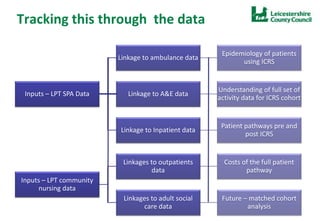
Tracking this through the data
Inputs – LPT SPA Data
Linkage to ambulance data
Epidemiology of patients
using ICRS
Linkage to A&E data
Understanding of full set of
activity data for ICRS cohort
Linkage to Inpatient data
Patient pathways pre and
post ICRS
Inputs – LPT community
nursing data
Linkages to outpatients
data
Costs of the full patient
pathway
Linkages to adult social
care data
Future – matched cohort
analysis
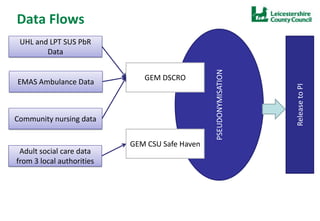
PSEUDONYMISATION
Data Flows
UHL and LPT SUS PbR
Data
Community nursing data
EMAS Ambulance Data
Adult social care data
from 3 local authorities
GEM DSCRO
GEM CSU Safe Haven
ReleasetoPI
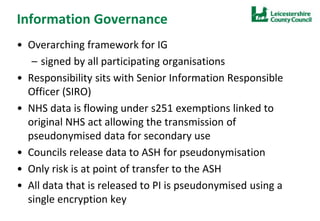
Information Governance
• Overarching framework for IG
– signed by all participating organisations
• Responsibility sits with Senior Information Responsible
Officer (SIRO)
• NHS data is flowing under s251 exemptions linked to
original NHS act allowing the transmission of
pseudonymised data for secondary use
• Councils release data to ASH for pseudonymisation
• Only risk is at point of transfer to the ASH
• All data that is released to PI is pseudonymised using a
single encryption key
Limitations
• How good will our data linkage be (65-80% anticipated on ASC data)
• Ambulance data – low for NHS Number
• At this time – only data from main acute provider, so cross border flows
will be an issue
• No costing of social care data
• No primary care data
• Diagnoses flagging will be 1st five diagnoses codes in hospital inpatient
data
• Only three years data
• Social care data only has NHS number for patients who are currently
active
• Care home patients – only identifying clients that are social care funded
• No mortality data included at this time
• We need to start somewhere!
Next steps….
• Going out to procurement for LAC evaluation
• Ongoing Lean research with Loughborough
University
• Clinical audit proposals being agreed
• Cohort analysis before and after for admission
avoidance schemes

Elizabeth Orton: Leicestershire’s Better Care Fund

  • 1.
    Evaluation of Leicestershire’sBetter Care Fund programme Elizabeth Orton, Consultant in Public Health Janine Dellar, Head of Public Health Intelligence • Monday 22nd June 2015
  • 2.
    Aim of theBetter Care fund Evidence-based improvements to integration of health and care Increase community capacity Transfer activity from acute to community Pooled budget to sustain integration
  • 3.
    Better Care Fund Unifiedprevention e.g. Local Area Co-ordination Integrated proactive response for people with long term care e.g. case management for >75s Integrated urgent response (admission avoidance) e.g. Falls pathway redesign, older persons unit, 7 day GP service, ICRS Hospital discharge and re-ablement e.g. integrated reablement • Reduce the number of permanent admissions • Increase the number of service users still at home 91 days after discharge • Reduce the number of delayed transfers of care • Reduce the number of avoidable admissions • Reduce the number of emergency admissions due to falls • Improve Patient experience Expected outcomes4 Themed areas
  • 4.
    Evaluation framework Outcome evaluation What arethe outcomes for communities and individuals – LAC Participatory Action Research, asset mapping Has an admission or residential care been avoided? Clinical audit/case note review Was it the intervention that made the difference? Data linkage cohort analysis Structure/Process evaluation Does the process work as well as it could? Lean systems analysis and patient satisfaction
  • 5.
    Routine Data analysis Example:Integrated crises response service GP sees patient and refers to integrated crises response service Professional contacts LPTs single point of access Allocated to specialist nursing service If 09:00 to 17:00 this is an existing service. BCF enhancement is extending this to night nursing Is this an improvement for the patients?
  • 6.
    Tracking this throughthe data Inputs – LPT SPA Data Linkage to ambulance data Epidemiology of patients using ICRS Linkage to A&E data Understanding of full set of activity data for ICRS cohort Linkage to Inpatient data Patient pathways pre and post ICRS Inputs – LPT community nursing data Linkages to outpatients data Costs of the full patient pathway Linkages to adult social care data Future – matched cohort analysis
  • 7.
    PSEUDONYMISATION Data Flows UHL andLPT SUS PbR Data Community nursing data EMAS Ambulance Data Adult social care data from 3 local authorities GEM DSCRO GEM CSU Safe Haven ReleasetoPI
  • 8.
    Information Governance • Overarchingframework for IG – signed by all participating organisations • Responsibility sits with Senior Information Responsible Officer (SIRO) • NHS data is flowing under s251 exemptions linked to original NHS act allowing the transmission of pseudonymised data for secondary use • Councils release data to ASH for pseudonymisation • Only risk is at point of transfer to the ASH • All data that is released to PI is pseudonymised using a single encryption key
  • 9.
    Limitations • How goodwill our data linkage be (65-80% anticipated on ASC data) • Ambulance data – low for NHS Number • At this time – only data from main acute provider, so cross border flows will be an issue • No costing of social care data • No primary care data • Diagnoses flagging will be 1st five diagnoses codes in hospital inpatient data • Only three years data • Social care data only has NHS number for patients who are currently active • Care home patients – only identifying clients that are social care funded • No mortality data included at this time • We need to start somewhere!
  • 10.
    Next steps…. • Goingout to procurement for LAC evaluation • Ongoing Lean research with Loughborough University • Clinical audit proposals being agreed • Cohort analysis before and after for admission avoidance schemes