ELIT 46C
Day 10
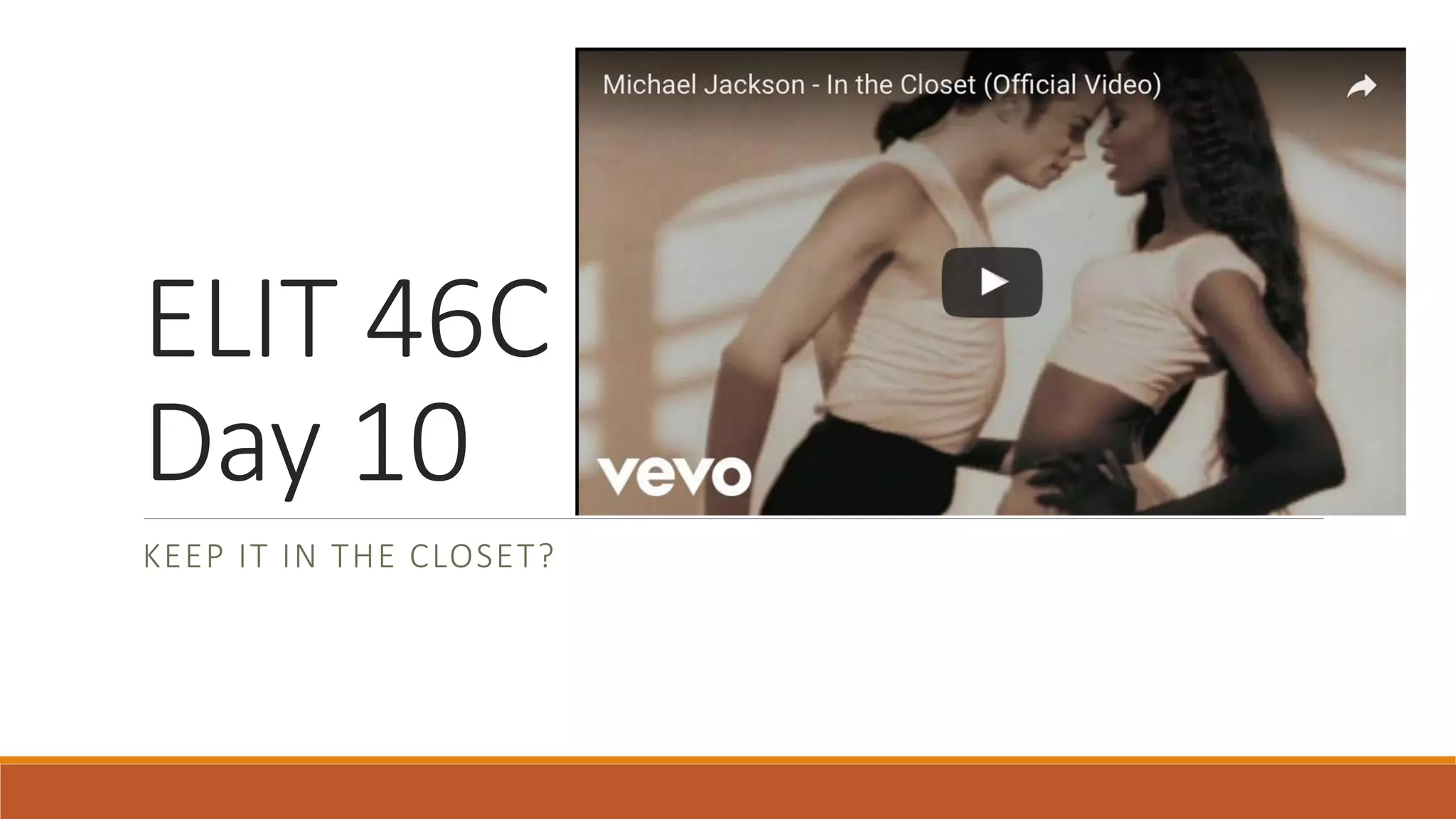
KEEP IT IN THE CLOSET?
Business / Participation
Welcome my colleague, Dr. Kim Palmore!
Midterm next Thursday (look for a post on
Canvas tomorrow with more details).
Finish Jekyll for Tuesday (if you haven’t).
What participation looks like today:
Four total points possible
◦ Up to two individual points for participation in our
group discussion.
◦ Two points if you talk in the group activity and your
group shares.
◦ Extra bonus point for wearing a turtleneck? Why not!
First: a question.
Write down an answer to this question on scrap paper. I’ll ask you to
share it later.
“Name a group of people that are currently a
source of fear or anxiety for at least some subset
of Americans. In other words: who are many
Americans afraid of right now?”
(You don’t have to personally agree with this fear.)
John Singer Sargent,
“Robert Louis Stevenson
and His Wife” (1885)
RLS on the portrait:
“too eccentric to be
exhibited. I am at one
extreme corner; my wife, in
this wild dress, and looking
like a ghost, is at the extreme
other end… all this is touched
in lovely, with that witty
touch of Sargent’s; but of
course, it looks dam [sic]
queer as a whole.”
Robert Louis Stevenson (1850-94)
Born in Edinburgh
--Sickly (lung trouble—tubercular?)
--Read law at Edinburgh U, never practiced.
--1876: met Fanny Osborne in Europe; American
divorcée with two children; ten years older than
RLS.
--1879: moves to California (Monterey) to be
with Fanny.
--1880: marries Fanny, moves to Napa.
--Returns to England (Bournemouth), but winters
in Europe.
--1883: Treasure Island.
--1885: The Strange Case of Dr. Jekyll & Mr. Hyde.
--1886: Kidnapped.
--1888-90: Pacific voyages (Hawaii, Samoa, etc.)
--1890: settles permanently in Samoa, where he
is buried.
Andrew Lang: RLS “looked ... more like a lass than a lad. ...Mr.
Stevenson possessed, more than any other man I ever met,
the power of making other men fall in love with him. I mean
that he excited a passionate admiration and affection, so
much so that I verily believe some men were jealous of other
men's place in his liking.”
John Addington Symonds, one of the most “out” Victorian
homosexuals, listed Stevenson on a list of men who "have
been, all of them, more or less sealed of the tribe of W[alt]
W[hitman]."
RLS wrote of his own marriage
that he had become “as limp
as a lady’s novel… the embers
of the once gay R.L.S.”
Who is your favorite woman
character in Jekyll & Hyde?
Male homosociality
Male homosociality: social relationships between men.
The London that we see in this novel is an almost entirely male world, and all of the affection
that exists in it is affection between men.
“[Utterson’s] friends were those of his own blood or those whom he had known the longest [...].
Hence, no doubt, the bond that united him to Mr. Richard Enfield, his distant kinsman, the well-
known man about town. It was a nut to crack for many, what these two could see in each other,
or what subject they could find in common. It was reported by those who encountered them in
their Sunday walks, that they said nothing, looked singularly dull, and would hail with obvious
relief the appearance of a friend. For all that, the two men put the
greatest store by these excursions, counted them the chief jewel
of each week, and not only set aside occasions of pleasure, but
even resisted the calls of business, that they might enjoy them
unaccompanied” (1677-78).
Pocholo: “What activities do you think [Jekyll]
engaged in that he was so desperate to both
commit and hide?”
IS IT PIZZA? (NO.)
Jekyll’s secret
Does Jekyll say? He says: “I concealed my pleasures” (1709).
But do other people know? (Or think they know?)
Enfield: “Black mail, I suppose; an honest man paying through the
nose for some of the capers of his youth. Black Mail House is what I
call that place with the door, in consequence. […] No, sir, I make it a
rule of mine: the more it looks like Queer Street, the less I ask”
(1680).
So what does Enfield think is going on here?
“Black Mail House” on “Queer Street”
BLACKMAIL
In this period, the idea of “blackmail” would
have carried a strong connotation of male-
male sexual relations.
◦ Indeed, this was one of the regular uses of
blackmail for several hundred years: to threaten
to expose gay men or prosecute them for
sodomy.
◦ J&H published the year after Parliament passed
the Labouchere Amendment, which criminalized
“gross indecency” (not just sodomy) between
men.
Nicknamed “the blackmailer’s charter” because
it increased the ways in which gay men could be
blackmailed.
QUEER
The Norton doesn’t encourage you to read this
word with its connotations of sexual
deviancy—especially homosexuality.
But the Oxford English Dictionary notes that
“queer” was being used to refer to
homosexual men in the late 19C.
And even if it wasn’t in
widespread use, it’s likely
that this valence of the
word “queer” would have
been clear to gay men
(and RLS certainly knew
enough of them).
Who knows his secret?
Enfield?
Emma: “Why does Stevenson choose to start his novella with Utterson and Enfield's
conversation about Dr. Jekyll and Mr. Hyde?”
Utterson? What does he see in his insomniac visions?
“Or else he would see a room in a rich house, where his friend lay asleep, dreaming and smiling
at his dreams; and then the door of that room would be opened, the curtains of the bed plucked
apart, and the sleeper recalled, and lo! there would stand by his side a figure to whom power
was given, and even at that dead hour, he must rise and do its bidding. The figure in these two
phases haunted the lawyer all night” (1683).
The servants?
Poole: “There was something queer about that gentleman” (1700).
And yet, do any of these characters actually say this secret out loud?
“Open secrets”
D. A. Miller: something that is known, but which is also unspeakable.
What kinds of open secrets do you know?
◦ Lots of family stuff.
Our culture loves the “open secret” when it comes to homosexuality.
◦ Celebrities who lots of folks know are gay, but who aren’t “out”?
◦ Used to be Queen Latifah, but she’s out now.
◦ Maybe Kevin Spacey? John Travolta? Tom Cruise?
I want to suggest this is a novel about open secrets
within communities of men.
When “open secrets” meet Science and the State…
This period is also the development of
scientific approaches to sexuality—
especially homosexuality.
1869: the word “homosexual” is first
coined (in German).
1870 (according to Foucault): recognition
of a person or an identity, rather than a
practice.
1886: Krafft-Ebing popularizes the terms
“homosexual” (and “heterosexual”).
Also, beginnings of homophobic inquisition and
persecution.
1870-71: arrest (and subsequent trial) of Ernest
“Stella” Boulton and Frederick “Fanny” Park
◦ charged with outrage to public morals and sodomy
◦ juridical inspection of the anus to determine if
they were sodomites.
1885: Labouchere Amendment criminalizes
“gross indecency”
1890: Cleveland Street brothel (gay brothel)
raided. Scandal includes member of the royal
family.
1895: Oscar Wilde trial
Fin de siècle and social collapse
fin de siècle = “end of the century”
Last decades of 19C were full of anxieties
about the collapse of the British Empire and
the failure of British society in general
Elaine Showalter: the English feared…
◦ Sexual deviancy
◦ Breakdown of gender roles
◦ The New Woman (and women’s suffrage)
◦ Collapse of the Empire; unrest in the colonies.
◦ Terrorism (Irish nationalists and anarchists)
◦ Crime and the “underclass”
◦ Epidemics of disease
◦ The poor
◦ Organized workers
A sense that England (and the British Empire)
is failing.
This might seem like a familiar feeling to us in
the U.S. right now.
Contemporary resonances: What fears do we
have at the end of the American empire?
(What did you write down at the beginning of
lecture?)
Reading Late Victorian fears
Each group will get one passage. Read it and
then, in your group, identify:
--Who or what is the author afraid of?
--Why? What are the consequences here?
--Metaphors, comparison, and other rhetorical
devices that are used to make this point.
--Anything else interesting or of note in this
passage.
--In what ways do you see similar fears at work in
our own time and place?
Be prepared to share with the class.

Day 10-ELIT 46C

  • 1.
    ELIT 46C Day 10 KEEPIT IN THE CLOSET?
  • 2.
    Business / Participation Welcomemy colleague, Dr. Kim Palmore! Midterm next Thursday (look for a post on Canvas tomorrow with more details). Finish Jekyll for Tuesday (if you haven’t). What participation looks like today: Four total points possible ◦ Up to two individual points for participation in our group discussion. ◦ Two points if you talk in the group activity and your group shares. ◦ Extra bonus point for wearing a turtleneck? Why not!
  • 3.
    First: a question. Writedown an answer to this question on scrap paper. I’ll ask you to share it later. “Name a group of people that are currently a source of fear or anxiety for at least some subset of Americans. In other words: who are many Americans afraid of right now?” (You don’t have to personally agree with this fear.)
  • 4.
    John Singer Sargent, “RobertLouis Stevenson and His Wife” (1885) RLS on the portrait: “too eccentric to be exhibited. I am at one extreme corner; my wife, in this wild dress, and looking like a ghost, is at the extreme other end… all this is touched in lovely, with that witty touch of Sargent’s; but of course, it looks dam [sic] queer as a whole.”
  • 5.
    Robert Louis Stevenson(1850-94) Born in Edinburgh --Sickly (lung trouble—tubercular?) --Read law at Edinburgh U, never practiced. --1876: met Fanny Osborne in Europe; American divorcée with two children; ten years older than RLS. --1879: moves to California (Monterey) to be with Fanny. --1880: marries Fanny, moves to Napa. --Returns to England (Bournemouth), but winters in Europe. --1883: Treasure Island. --1885: The Strange Case of Dr. Jekyll & Mr. Hyde. --1886: Kidnapped. --1888-90: Pacific voyages (Hawaii, Samoa, etc.) --1890: settles permanently in Samoa, where he is buried. Andrew Lang: RLS “looked ... more like a lass than a lad. ...Mr. Stevenson possessed, more than any other man I ever met, the power of making other men fall in love with him. I mean that he excited a passionate admiration and affection, so much so that I verily believe some men were jealous of other men's place in his liking.” John Addington Symonds, one of the most “out” Victorian homosexuals, listed Stevenson on a list of men who "have been, all of them, more or less sealed of the tribe of W[alt] W[hitman]." RLS wrote of his own marriage that he had become “as limp as a lady’s novel… the embers of the once gay R.L.S.”
  • 6.
    Who is yourfavorite woman character in Jekyll & Hyde?
  • 7.
    Male homosociality Male homosociality:social relationships between men. The London that we see in this novel is an almost entirely male world, and all of the affection that exists in it is affection between men. “[Utterson’s] friends were those of his own blood or those whom he had known the longest [...]. Hence, no doubt, the bond that united him to Mr. Richard Enfield, his distant kinsman, the well- known man about town. It was a nut to crack for many, what these two could see in each other, or what subject they could find in common. It was reported by those who encountered them in their Sunday walks, that they said nothing, looked singularly dull, and would hail with obvious relief the appearance of a friend. For all that, the two men put the greatest store by these excursions, counted them the chief jewel of each week, and not only set aside occasions of pleasure, but even resisted the calls of business, that they might enjoy them unaccompanied” (1677-78).
  • 8.
    Pocholo: “What activitiesdo you think [Jekyll] engaged in that he was so desperate to both commit and hide?” IS IT PIZZA? (NO.)
  • 9.
    Jekyll’s secret Does Jekyllsay? He says: “I concealed my pleasures” (1709). But do other people know? (Or think they know?) Enfield: “Black mail, I suppose; an honest man paying through the nose for some of the capers of his youth. Black Mail House is what I call that place with the door, in consequence. […] No, sir, I make it a rule of mine: the more it looks like Queer Street, the less I ask” (1680). So what does Enfield think is going on here?
  • 10.
    “Black Mail House”on “Queer Street” BLACKMAIL In this period, the idea of “blackmail” would have carried a strong connotation of male- male sexual relations. ◦ Indeed, this was one of the regular uses of blackmail for several hundred years: to threaten to expose gay men or prosecute them for sodomy. ◦ J&H published the year after Parliament passed the Labouchere Amendment, which criminalized “gross indecency” (not just sodomy) between men. Nicknamed “the blackmailer’s charter” because it increased the ways in which gay men could be blackmailed. QUEER The Norton doesn’t encourage you to read this word with its connotations of sexual deviancy—especially homosexuality. But the Oxford English Dictionary notes that “queer” was being used to refer to homosexual men in the late 19C. And even if it wasn’t in widespread use, it’s likely that this valence of the word “queer” would have been clear to gay men (and RLS certainly knew enough of them).
  • 11.
    Who knows hissecret? Enfield? Emma: “Why does Stevenson choose to start his novella with Utterson and Enfield's conversation about Dr. Jekyll and Mr. Hyde?” Utterson? What does he see in his insomniac visions? “Or else he would see a room in a rich house, where his friend lay asleep, dreaming and smiling at his dreams; and then the door of that room would be opened, the curtains of the bed plucked apart, and the sleeper recalled, and lo! there would stand by his side a figure to whom power was given, and even at that dead hour, he must rise and do its bidding. The figure in these two phases haunted the lawyer all night” (1683). The servants? Poole: “There was something queer about that gentleman” (1700). And yet, do any of these characters actually say this secret out loud?
  • 12.
    “Open secrets” D. A.Miller: something that is known, but which is also unspeakable. What kinds of open secrets do you know? ◦ Lots of family stuff. Our culture loves the “open secret” when it comes to homosexuality. ◦ Celebrities who lots of folks know are gay, but who aren’t “out”? ◦ Used to be Queen Latifah, but she’s out now. ◦ Maybe Kevin Spacey? John Travolta? Tom Cruise? I want to suggest this is a novel about open secrets within communities of men.
  • 13.
    When “open secrets”meet Science and the State… This period is also the development of scientific approaches to sexuality— especially homosexuality. 1869: the word “homosexual” is first coined (in German). 1870 (according to Foucault): recognition of a person or an identity, rather than a practice. 1886: Krafft-Ebing popularizes the terms “homosexual” (and “heterosexual”). Also, beginnings of homophobic inquisition and persecution. 1870-71: arrest (and subsequent trial) of Ernest “Stella” Boulton and Frederick “Fanny” Park ◦ charged with outrage to public morals and sodomy ◦ juridical inspection of the anus to determine if they were sodomites. 1885: Labouchere Amendment criminalizes “gross indecency” 1890: Cleveland Street brothel (gay brothel) raided. Scandal includes member of the royal family. 1895: Oscar Wilde trial
  • 14.
    Fin de siècleand social collapse fin de siècle = “end of the century” Last decades of 19C were full of anxieties about the collapse of the British Empire and the failure of British society in general Elaine Showalter: the English feared… ◦ Sexual deviancy ◦ Breakdown of gender roles ◦ The New Woman (and women’s suffrage) ◦ Collapse of the Empire; unrest in the colonies. ◦ Terrorism (Irish nationalists and anarchists) ◦ Crime and the “underclass” ◦ Epidemics of disease ◦ The poor ◦ Organized workers A sense that England (and the British Empire) is failing. This might seem like a familiar feeling to us in the U.S. right now. Contemporary resonances: What fears do we have at the end of the American empire? (What did you write down at the beginning of lecture?)
  • 15.
    Reading Late Victorianfears Each group will get one passage. Read it and then, in your group, identify: --Who or what is the author afraid of? --Why? What are the consequences here? --Metaphors, comparison, and other rhetorical devices that are used to make this point. --Anything else interesting or of note in this passage. --In what ways do you see similar fears at work in our own time and place? Be prepared to share with the class.