ELIT 17 Class 9
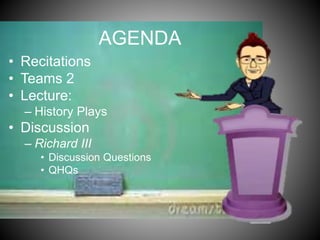
AGENDA
• Recitations
• Teams 2
• Lecture:
– History Plays
• Discussion
– Richard III
• Discussion Questions
• QHQs
Recitations
Your First
Group!
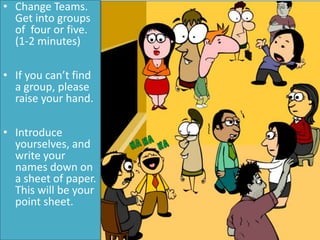
• Change Teams.
Get into groups
of four or five.
(1-2 minutes)
• If you can’t find
a group, please
raise your hand.
• Introduce
yourselves, and
write your
names down on
a sheet of paper.
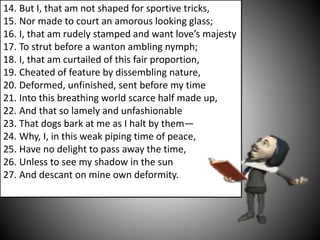
This will be your
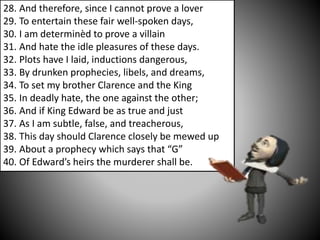
point sheet.
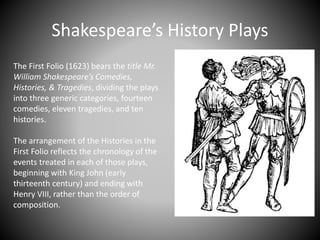
Shakespeare’s History Plays
The First Folio (1623) bears the title Mr.
William Shakespeare’s Comedies,
Histories, & Tragedies, dividing the plays
into three generic categories, fourteen
comedies, eleven tragedies, and ten
histories.
The arrangement of the Histories in the
First Folio reflects the chronology of the
events treated in each of those plays,
beginning with King John (early
thirteenth century) and ending with
Henry VIII, rather than the order of
composition.
Conventionally, the three Henry VI plays and Richard III are
known as “the first tetralogy,” written and performed between
1589 and 1593.
 The four plays Richard II, 1 and 2 Henry IV, and Henry V,
written and performed between 1595 and 1599, are known as
“the second tetralogy.”
These eight plays treat a continuous slice of English history,
beginning late in the reign of Richard II (1398) and ending with
the death of Richard III in 1485. In each group of four plays the
action is closely linked, with characters appearing in successive
plays and explicit references in one play to events depicted in
another.
3 Henry VI begins “I wonder how the King escaped our hands,” a direct
reference to the final scene of 2 Henry VI.
Both Richard III and 1 Henry IV begin with tributes to peace succeeding
the ‘grim-visaged War’ or ‘civil butchery’ presented in an earlier play.
The Roman Plays
Shakespeare’s “Roman plays,” Julius Caesar (1599),
Antony and Cleopatra (1606–7), and Coriolanus
(1607–8), are classified as tragedies in the Folio, and
generally accepted as such.
These plays, based on events from Roman history,
resemble Shakespeare’s English histories in many
respects. A play like Julius Caesar, first performed in
the same year as Henry V, not only includes battle
scenes staged in a similar manner, but performs a
similar balancing act between fact and fiction,
between fidelity to a historical source and the
requirements of dramatic form.
 Much modern critical attention has focused on the way Shakespeare utilized his
sources in his interpretations of historical events. The characteristics of
Renaissance historiography—the narrative presentation of history based on critical
evaluations of primary and secondary source materials—is often compared with
Shakespeare's own historiographical style.
 Some critics claim that Shakespeare's attitude toward his sources was “cavalier,”
but that Shakespeare, as well as the authors of his sources, were all guilty of
drawing parallels and analogies, allegorizing historical figures, and telescoping
historical time.
 While some critics see these tendencies as “faults,” Don M. Ricks (1968) observes
that sixteenth-century historiography was not bound by modern rules of
objectivity and historical accuracy. Rather, it was understood that historical data
should be presented in a way that made a subjective and moralistic argument.
Historical Accuracy
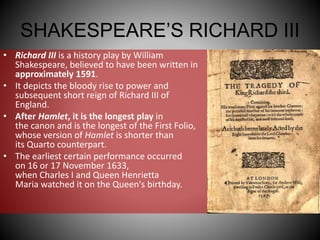
SHAKESPEARE’S RICHARD III
• Richard III is a history play by William
Shakespeare, believed to have been written in
approximately 1591.
• It depicts the bloody rise to power and
subsequent short reign of Richard III of
England.
• After Hamlet, it is the longest play in
the canon and is the longest of the First Folio,
whose version of Hamlet is shorter than
its Quarto counterpart.
• The earliest certain performance occurred
on 16 or 17 November 1633,
when Charles I and Queen Henrietta
Maria watched it on the Queen's birthday.
Who are the major
players in Richard III?
Let me
ask you!
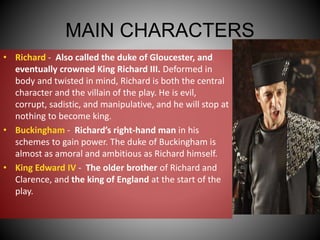
MAIN CHARACTERS
• Richard - Also called the duke of Gloucester, and
eventually crowned King Richard III. Deformed in
body and twisted in mind, Richard is both the central
character and the villain of the play. He is evil,
corrupt, sadistic, and manipulative, and he will stop at
nothing to become king.
• Buckingham - Richard’s right-hand man in his
schemes to gain power. The duke of Buckingham is
almost as amoral and ambitious as Richard himself.
• King Edward IV - The older brother of Richard and
Clarence, and the king of England at the start of the
play.
MAIN CHARACTERS
• Clarence - The gentle, trusting brother born between Edward and
Richard in the York family. Richard has Clarence murdered in order
to get him out of the way. Clarence leaves two children, a son and
a daughter.
• Queen Elizabeth - The wife of King Edward IV and the mother of
the two young princes (the heirs to the throne) and their older
sister, young Elizabeth.
• Anne - The young widow of Prince Edward, who was the son of
the former king, Henry VI. Lady Anne hates Richard for the death
of her husband, but for reasons of politics—and for sadistic
pleasure—Richard persuades Anne to marry him.
MAIN CHARACTERS
• Margaret - Widow of the dead King Henry
VI, and mother of the slain Prince Edward.
She is embittered and hates both Richard
and the people he is trying to get rid of, all
of whom were complicit in the destruction
of the her family, the Lancasters.
• The princes - The two young sons of King
Edward IV and his wife, Elizabeth, their
names are actually Prince Edward and the
young duke of York, but they are often
referred to collectively.
What is the Plot thus
far in Richard III?
Let me
ask you!
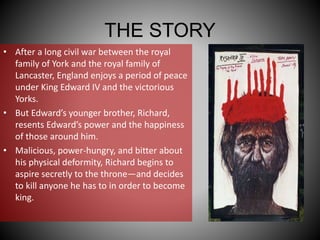
THE STORY
• After a long civil war between the royal
family of York and the royal family of
Lancaster, England enjoys a period of peace
under King Edward IV and the victorious
Yorks.
• But Edward’s younger brother, Richard,
resents Edward’s power and the happiness
of those around him.
• Malicious, power-hungry, and bitter about
his physical deformity, Richard begins to
aspire secretly to the throne—and decides
to kill anyone he has to in order to become
king.
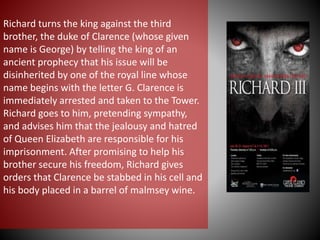
Richard turns the king against the third
brother, the duke of Clarence (whose given
name is George) by telling the king of an
ancient prophecy that his issue will be
disinherited by one of the royal line whose
name begins with the letter G. Clarence is
immediately arrested and taken to the Tower.
Richard goes to him, pretending sympathy,
and advises him that the jealousy and hatred
of Queen Elizabeth are responsible for his
imprisonment. After promising to help his
brother secure his freedom, Richard gives
orders that Clarence be stabbed in his cell and
his body placed in a barrel of malmsey wine.
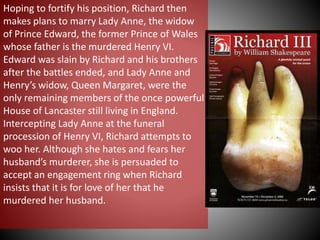
Hoping to fortify his position, Richard then
makes plans to marry Lady Anne, the widow
of Prince Edward, the former Prince of Wales
whose father is the murdered Henry VI.
Edward was slain by Richard and his brothers
after the battles ended, and Lady Anne and
Henry’s widow, Queen Margaret, were the
only remaining members of the once powerful
House of Lancaster still living in England.
Intercepting Lady Anne at the funeral
procession of Henry VI, Richard attempts to
woo her. Although she hates and fears her
husband’s murderer, she is persuaded to
accept an engagement ring when Richard
insists that it is for love of her that he
murdered her husband.
Richard goes to the court, where Edward IV
lies ill. There, he affects great sorrow and
indignation over the news of the death of
Clarence, thereby endearing himself to Lord
Hastings and the duke of Buckingham, who
were friends of Clarence. He insinuates that
Queen Elizabeth and her followers turned the
wrath of the king against Clarence, which
brought about his death. Richard manages to
convince everyone except Queen Margaret,
who knows well what really happened. Openly
accusing him, she attempts to warn
Buckingham and the others against Richard,
but they ignore her.
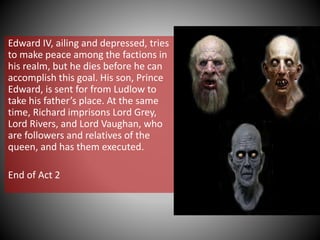
Edward IV, ailing and depressed, tries
to make peace among the factions in
his realm, but he dies before he can
accomplish this goal. His son, Prince
Edward, is sent for from Ludlow to
take his father’s place. At the same
time, Richard imprisons Lord Grey,
Lord Rivers, and Lord Vaughan, who
are followers and relatives of the
queen, and has them executed.
End of Act 2
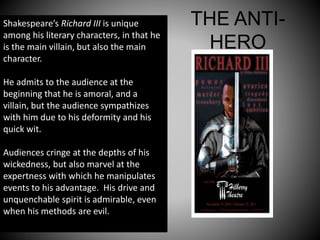
THE ANTI-
HERO
Shakespeare’s Richard III is unique
among his literary characters, in that he
is the main villain, but also the main
character.
He admits to the audience at the
beginning that he is amoral, and a
villain, but the audience sympathizes
with him due to his deformity and his
quick wit.
Audiences cringe at the depths of his
wickedness, but also marvel at the
expertness with which he manipulates
events to his advantage. His drive and
unquenchable spirit is admirable, even
when his methods are evil.
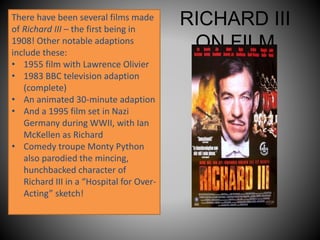
RICHARD III
ON FILM
There have been several films made
of Richard III – the first being in
1908! Other notable adaptions
include these:
• 1955 film with Lawrence Olivier
• 1983 BBC television adaption
(complete)
• An animated 30-minute adaption
• And a 1995 film set in Nazi
Germany during WWII, with Ian
McKellen as Richard
• Comedy troupe Monty Python
also parodied the mincing,
hunchbacked character of
Richard III in a “Hospital for Over-
Acting” sketch!
Activity
The opening speech (is it a
monologue or a soliloquy?) is one
of the most famous in Richard III,
so we are going to perform it.
Practice in your groups, rotating
speakers for each line.
Monologue: monologues provide
essential narration and exposition, filling
in the audience on past or offstage events;
sometimes they serve to mediate
between audience and action, and
sometimes they signal the passage of time
or a change of location. Depending on the
context, monologues may be delivered to
another character on stage, or they may
be spoken directly to the audience,
providing a sort of intimacy between
speaker and auditors.
Soliloquy: A soliloquy is a particular subset or type of monologue, in which the speaking
character is alone (or believes himself or herself to be alone). As such, a soliloquy serves as
a window into the character’s mind and heart and is sometimes called an “interior
monologue.” Unlike other sorts of theatrical speeches, in which a character might have
reason to deceive fellow characters, one can typically assume that whatever a character
says in a soliloquy is the absolute truth. Soliloquies are most often used to express the
character’s most deeply held beliefs and concerns or to debate a future course of action.
1. Now is the winter of our discontent
2. Made glorious summer by this son of York,
3. And all the clouds that loured upon our house
4. In the deep bosom of the ocean buried.
5. Now are our brows bound with victorious wreaths,
6. Our bruisèd arms hung up for monuments,
7. Our stern alarums changed to merry meetings,
8. Our dreadful marches to delightful measures.
9. Grim-visaged war hath smoothed his wrinkled
front;
10. And now, instead of mounting barbèd steeds
11. To fright the souls of fearful adversaries,
12. He capers nimbly in a lady’s chamber
13. To the lascivious pleasing of a lute.
RICHARD Richard III, Act 1, Scene 1
14. But I, that am not shaped for sportive tricks,
15. Nor made to court an amorous looking glass;
16. I, that am rudely stamped and want love’s majesty
17. To strut before a wanton ambling nymph;
18. I, that am curtailed of this fair proportion,
19. Cheated of feature by dissembling nature,
20. Deformed, unfinished, sent before my time
21. Into this breathing world scarce half made up,
22. And that so lamely and unfashionable
23. That dogs bark at me as I halt by them—
24. Why, I, in this weak piping time of peace,
25. Have no delight to pass away the time,
26. Unless to see my shadow in the sun
27. And descant on mine own deformity.
28. And therefore, since I cannot prove a lover
29. To entertain these fair well-spoken days,
30. I am determinèd to prove a villain
31. And hate the idle pleasures of these days.
32. Plots have I laid, inductions dangerous,
33. By drunken prophecies, libels, and dreams,
34. To set my brother Clarence and the King
35. In deadly hate, the one against the other;
36. And if King Edward be as true and just
37. As I am subtle, false, and treacherous,
38. This day should Clarence closely be mewed up
39. About a prophecy which says that “G”
40. Of Edward’s heirs the murderer shall be.
What is Richard
telling the audience
in these opening
lines?
Let me ask
you!
"Now is the winter of our
discontent" - Richard III by William
Shakespeare
With Laurence Olivier
as King Richard
Run time 5:32
https://www.youtube.com/watch?v=cDxnXgYPnKg
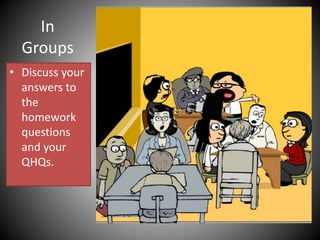
In
Groups
• Discuss your
answers to
the
homework
questions
and your
QHQs.
Sir Thomas More
Shakespeare based his Richard III on the writings
of Sir Thomas More author of Utopia. As a
courtier to Henry VIII (the son of Henry VII,
founder of the Tudor royal line – Richmond in
our play), More presented Richmond and his
allies in the best possible light. As a playwright
under Henry VIII’s daughter, Elizabeth I, William
Shakespeare kept up with tradition of glorifying
the Tudors and painting their enemies as evil.
Since the Tudor line had both Yorkists and
Lancastrians – the adversaries in the “Wars of
the Roses”– in its ancestry, neither branch is
particularly depraved in Shakespeare’s version of
history. Only Richard, the rejected scion of the
Yorkist side is truly evil. Shakespeare’s Richard is
not the true Richard of history, but the Richard
of Thomas More and the Tudors.
1. Shakespeare based his
Richard III on the
writings of Sir Thomas
More. After reading both
Thomas More and
Horace Walpole, who do
you find more credible?
Why?
2. How might More (and
Shakespeare) have
answered Walpole’s
questions?
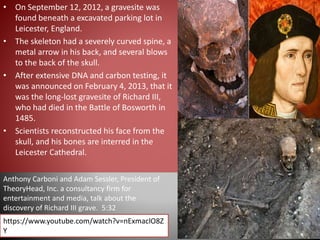
• On September 12, 2012, a gravesite was
found beneath a excavated parking lot in
Leicester, England.
• The skeleton had a severely curved spine, a
metal arrow in his back, and several blows
to the back of the skull.
• After extensive DNA and carbon testing, it
was announced on February 4, 2013, that it
was the long-lost gravesite of Richard III,
who had died in the Battle of Bosworth in
1485.
• Scientists reconstructed his face from the
skull, and his bones are interred in the
Leicester Cathedral.
https://www.youtube.com/watch?v=nExmaclO8Z
Y
Anthony Carboni and Adam Sessler, President of
TheoryHead, Inc. a consultancy firm for
entertainment and media, talk about the
discovery of Richard III grave. 5:32
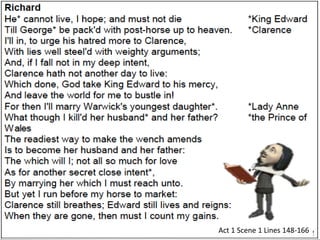
It is important, in Richard III, for the
audience to understand what the
Elizabethan audience would have
known. Read Act 1, scene 1, lines 148-
166 and analyze Shakespeare’s
strategies for telling the audience of
both what has already happened and
the schemes Richard has devised. Does
it seem forced or is it smoothly
revealed?
Act 1 Scene 1 Lines 148-166
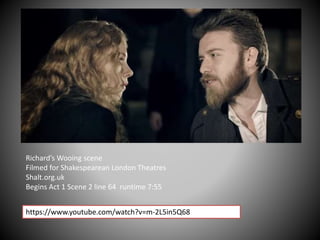
Richard’s Wooing scene
Filmed for Shakespearean London Theatres
Shalt.org.uk
Begins Act 1 Scene 2 line 64 runtime 7:55
https://www.youtube.com/watch?v=m-2L5in5Q68
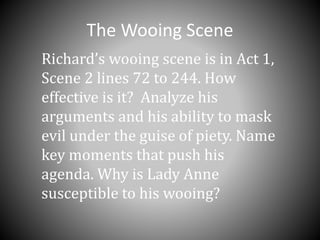
The Wooing Scene
Richard’s wooing scene is in Act 1,
Scene 2 lines 72 to 244. How
effective is it? Analyze his
arguments and his ability to mask
evil under the guise of piety. Name
key moments that push his
agenda. Why is Lady Anne
susceptible to his wooing?
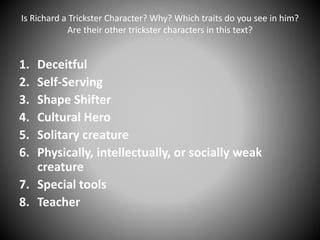
Is Richard a Trickster Character? Why? Which traits do you see in him?
Are their other trickster characters in this text?
1. Deceitful
2. Self-Serving
3. Shape Shifter
4. Cultural Hero
5. Solitary creature
6. Physically, intellectually, or socially weak
creature
7. Special tools
8. Teacher
possible traits of the trickster
• Deceitful (“truth-eluding ambiguity” according to Lock) : The trickster uses
trickery to bring about change. According to Lock, the trickster “shifts and
disguises the boundaries, undoes and redraws the traditional connections” (III).
• Self-Serving: The trickster often feels that he or she has been wronged and is
therefore justified in taking action to bring about change and/or to defeat “the
enemy.”
• Shape Shifter: The trickster may change forms, sex, and so forth as an element
of surprise to his victim. The change may also be psychological instead of (or in
addition to) a visual change.
• Cultural Hero: “The true trickster’s trickery calls into question fundamental
assumptions about the way the world is organized, and reveals the possibility of
transforming them (even if for ignoble [shameful] ends)” (Lock III)
• Solitary creature: Many tricksters are solitary animals (or humans),
working alone rather than with a partner or within a group – to
undertake change. Michael P. Carroll notes that “Ravens are usually
sighted singly or at most in pairs; coyotes forage independently…;
hares have long been noted for their solitariness…Spiders generally
associate with members of their own species on only two occasions:
when they are born and when they mate” (“Trickster as Selfish
Buffoon” 115).
• Physically, intellectually, or socially weak creature: The trickster is
often portrayed as a much weaker character than his prey, and yet
through cleverness and trickery, he is able to overcome all obstacles
and prevail. In some cases the trickster may appear to be weaker
physically in order to confuse his prey (false frailty).
• Special tools: The trickster may have special tools or abilities that
enable him to perform his acts. Often these tools include magic
and/or supernatural powers.
• Teacher: The trickster is a purveyor of life lessons through the
stories, from manners to ethics. T
• “Trickster discourse is the process whereby language negotiates
the boundaries of the crossblood’s world, deconstructing the fixed,
authoritative beliefs and definitions that Vizenor has called
“terminal creeds” (Bearheart xiv)” (Qtd. In Lock III).
• Some “tricksters work to transform the limitations and boundaries
of language in ways that can have real-world consequences for the
ethnic American” (Lock III).
“Defining The Trickster”
Perhaps Jean Hardy provides a definition that encompasses the
Jungian influence including the confusion about this archetype:
The archetype of the Trickster…is the existence of the unexpected as
it appears in every human society, sometimes fully acknowledged,
sometimes feared and hidden. He is the opposite of order – but
then he is opposite of everything: he can turn into a she…He is the
Green Man, the Jester, the clown, the witch or the wizard, Mercury,
a shape shifter … the Fool with the potential at times for becoming a
Savior. He upsets normality and hierarchic order…He can change the
expected world, and therefore be an agent of transformation. (1)
taken from “There Is No Box: The Trickster in Literature”
Margaret F. Crawford
Does this definition resonate with us in
terms of Richard III? How?
• According to [Paul] Radin, “Trickster is at one
and the same time creator and destroyer, giver
and negator, he who dupes others and who is
always duped himself. . . . He possesses no
values, moral or social, is at the mercy of his
passions and appetites, yet through his actions
all values come into being” (xxiii).
Do we see Richard III in this definition? How?
• [The trickster] actually is immoral (or at least amoral) and
blasphemous and rebellious, and his interest in entering
the societal game is not to provide the safety-valve that
makes it tolerable, but to question, manipulate, and
disrupt its rules. He is the consummate mover of
goalposts, constantly redrawing the boundaries of the
possible. In fact, the trickster suggests, says Hyde, “a
method by which a stranger or underling can enter the
game, change its rules, and win a piece of the action
(204)” (Hyde qtd. in Lock).
Read Richard III: Acts 3, 4, and 5
Post #9
1. What is the impact of the visits of the ghosts to Richard? See
act 5, Scene 3, lines 139-188.
2. Dramatic irony occurs when the audience understands the
real significance of a character’s words or actions but the
character or those around him or her do not. Examine these
moments of dark comedy and comment on how and why they
work in the play. Look at the scene between Richard and
Clarence (Act 1 Scene 1) and also in Act 3 scene 2, when
Catesby suggests that Richard should be crowned king in lieu
of the Prince of Wales. There are several other scenes to
choose from.
3. Ambition conjoined with an inherently evil nature cause
Richard to embrace the role of villain, but he plays the part so
fully that he eventually wreaks havoc on himself. Look at
Scene 5, Act 3, lines 194-203. What is the purpose of these
lines. What do we learn about Richard’s state of mind.
4. QHQ

Elit 17 class 9n richard iii

  • 1.
  • 2.
    AGENDA • Recitations • Teams2 • Lecture: – History Plays • Discussion – Richard III • Discussion Questions • QHQs
  • 3.
  • 4.
    Your First Group! • ChangeTeams. Get into groups of four or five. (1-2 minutes) • If you can’t find a group, please raise your hand. • Introduce yourselves, and write your names down on a sheet of paper. This will be your point sheet.
  • 5.
    Shakespeare’s History Plays TheFirst Folio (1623) bears the title Mr. William Shakespeare’s Comedies, Histories, & Tragedies, dividing the plays into three generic categories, fourteen comedies, eleven tragedies, and ten histories. The arrangement of the Histories in the First Folio reflects the chronology of the events treated in each of those plays, beginning with King John (early thirteenth century) and ending with Henry VIII, rather than the order of composition.
  • 6.
    Conventionally, the threeHenry VI plays and Richard III are known as “the first tetralogy,” written and performed between 1589 and 1593.  The four plays Richard II, 1 and 2 Henry IV, and Henry V, written and performed between 1595 and 1599, are known as “the second tetralogy.” These eight plays treat a continuous slice of English history, beginning late in the reign of Richard II (1398) and ending with the death of Richard III in 1485. In each group of four plays the action is closely linked, with characters appearing in successive plays and explicit references in one play to events depicted in another. 3 Henry VI begins “I wonder how the King escaped our hands,” a direct reference to the final scene of 2 Henry VI. Both Richard III and 1 Henry IV begin with tributes to peace succeeding the ‘grim-visaged War’ or ‘civil butchery’ presented in an earlier play.
  • 7.
    The Roman Plays Shakespeare’s“Roman plays,” Julius Caesar (1599), Antony and Cleopatra (1606–7), and Coriolanus (1607–8), are classified as tragedies in the Folio, and generally accepted as such. These plays, based on events from Roman history, resemble Shakespeare’s English histories in many respects. A play like Julius Caesar, first performed in the same year as Henry V, not only includes battle scenes staged in a similar manner, but performs a similar balancing act between fact and fiction, between fidelity to a historical source and the requirements of dramatic form.
  • 8.
     Much moderncritical attention has focused on the way Shakespeare utilized his sources in his interpretations of historical events. The characteristics of Renaissance historiography—the narrative presentation of history based on critical evaluations of primary and secondary source materials—is often compared with Shakespeare's own historiographical style.  Some critics claim that Shakespeare's attitude toward his sources was “cavalier,” but that Shakespeare, as well as the authors of his sources, were all guilty of drawing parallels and analogies, allegorizing historical figures, and telescoping historical time.  While some critics see these tendencies as “faults,” Don M. Ricks (1968) observes that sixteenth-century historiography was not bound by modern rules of objectivity and historical accuracy. Rather, it was understood that historical data should be presented in a way that made a subjective and moralistic argument. Historical Accuracy
  • 10.
    SHAKESPEARE’S RICHARD III •Richard III is a history play by William Shakespeare, believed to have been written in approximately 1591. • It depicts the bloody rise to power and subsequent short reign of Richard III of England. • After Hamlet, it is the longest play in the canon and is the longest of the First Folio, whose version of Hamlet is shorter than its Quarto counterpart. • The earliest certain performance occurred on 16 or 17 November 1633, when Charles I and Queen Henrietta Maria watched it on the Queen's birthday.
  • 11.
    Who are themajor players in Richard III? Let me ask you!
  • 12.
    MAIN CHARACTERS • Richard- Also called the duke of Gloucester, and eventually crowned King Richard III. Deformed in body and twisted in mind, Richard is both the central character and the villain of the play. He is evil, corrupt, sadistic, and manipulative, and he will stop at nothing to become king. • Buckingham - Richard’s right-hand man in his schemes to gain power. The duke of Buckingham is almost as amoral and ambitious as Richard himself. • King Edward IV - The older brother of Richard and Clarence, and the king of England at the start of the play.
  • 13.
    MAIN CHARACTERS • Clarence- The gentle, trusting brother born between Edward and Richard in the York family. Richard has Clarence murdered in order to get him out of the way. Clarence leaves two children, a son and a daughter. • Queen Elizabeth - The wife of King Edward IV and the mother of the two young princes (the heirs to the throne) and their older sister, young Elizabeth. • Anne - The young widow of Prince Edward, who was the son of the former king, Henry VI. Lady Anne hates Richard for the death of her husband, but for reasons of politics—and for sadistic pleasure—Richard persuades Anne to marry him.
  • 14.
    MAIN CHARACTERS • Margaret- Widow of the dead King Henry VI, and mother of the slain Prince Edward. She is embittered and hates both Richard and the people he is trying to get rid of, all of whom were complicit in the destruction of the her family, the Lancasters. • The princes - The two young sons of King Edward IV and his wife, Elizabeth, their names are actually Prince Edward and the young duke of York, but they are often referred to collectively.
  • 15.
    What is thePlot thus far in Richard III? Let me ask you!
  • 16.
    THE STORY • Aftera long civil war between the royal family of York and the royal family of Lancaster, England enjoys a period of peace under King Edward IV and the victorious Yorks. • But Edward’s younger brother, Richard, resents Edward’s power and the happiness of those around him. • Malicious, power-hungry, and bitter about his physical deformity, Richard begins to aspire secretly to the throne—and decides to kill anyone he has to in order to become king.
  • 17.
    Richard turns theking against the third brother, the duke of Clarence (whose given name is George) by telling the king of an ancient prophecy that his issue will be disinherited by one of the royal line whose name begins with the letter G. Clarence is immediately arrested and taken to the Tower. Richard goes to him, pretending sympathy, and advises him that the jealousy and hatred of Queen Elizabeth are responsible for his imprisonment. After promising to help his brother secure his freedom, Richard gives orders that Clarence be stabbed in his cell and his body placed in a barrel of malmsey wine.
  • 18.
    Hoping to fortifyhis position, Richard then makes plans to marry Lady Anne, the widow of Prince Edward, the former Prince of Wales whose father is the murdered Henry VI. Edward was slain by Richard and his brothers after the battles ended, and Lady Anne and Henry’s widow, Queen Margaret, were the only remaining members of the once powerful House of Lancaster still living in England. Intercepting Lady Anne at the funeral procession of Henry VI, Richard attempts to woo her. Although she hates and fears her husband’s murderer, she is persuaded to accept an engagement ring when Richard insists that it is for love of her that he murdered her husband.
  • 19.
    Richard goes tothe court, where Edward IV lies ill. There, he affects great sorrow and indignation over the news of the death of Clarence, thereby endearing himself to Lord Hastings and the duke of Buckingham, who were friends of Clarence. He insinuates that Queen Elizabeth and her followers turned the wrath of the king against Clarence, which brought about his death. Richard manages to convince everyone except Queen Margaret, who knows well what really happened. Openly accusing him, she attempts to warn Buckingham and the others against Richard, but they ignore her.
  • 20.
    Edward IV, ailingand depressed, tries to make peace among the factions in his realm, but he dies before he can accomplish this goal. His son, Prince Edward, is sent for from Ludlow to take his father’s place. At the same time, Richard imprisons Lord Grey, Lord Rivers, and Lord Vaughan, who are followers and relatives of the queen, and has them executed. End of Act 2
  • 21.
    THE ANTI- HERO Shakespeare’s RichardIII is unique among his literary characters, in that he is the main villain, but also the main character. He admits to the audience at the beginning that he is amoral, and a villain, but the audience sympathizes with him due to his deformity and his quick wit. Audiences cringe at the depths of his wickedness, but also marvel at the expertness with which he manipulates events to his advantage. His drive and unquenchable spirit is admirable, even when his methods are evil.
  • 22.
    RICHARD III ON FILM Therehave been several films made of Richard III – the first being in 1908! Other notable adaptions include these: • 1955 film with Lawrence Olivier • 1983 BBC television adaption (complete) • An animated 30-minute adaption • And a 1995 film set in Nazi Germany during WWII, with Ian McKellen as Richard • Comedy troupe Monty Python also parodied the mincing, hunchbacked character of Richard III in a “Hospital for Over- Acting” sketch!
  • 23.
    Activity The opening speech(is it a monologue or a soliloquy?) is one of the most famous in Richard III, so we are going to perform it. Practice in your groups, rotating speakers for each line. Monologue: monologues provide essential narration and exposition, filling in the audience on past or offstage events; sometimes they serve to mediate between audience and action, and sometimes they signal the passage of time or a change of location. Depending on the context, monologues may be delivered to another character on stage, or they may be spoken directly to the audience, providing a sort of intimacy between speaker and auditors. Soliloquy: A soliloquy is a particular subset or type of monologue, in which the speaking character is alone (or believes himself or herself to be alone). As such, a soliloquy serves as a window into the character’s mind and heart and is sometimes called an “interior monologue.” Unlike other sorts of theatrical speeches, in which a character might have reason to deceive fellow characters, one can typically assume that whatever a character says in a soliloquy is the absolute truth. Soliloquies are most often used to express the character’s most deeply held beliefs and concerns or to debate a future course of action.
  • 24.
    1. Now isthe winter of our discontent 2. Made glorious summer by this son of York, 3. And all the clouds that loured upon our house 4. In the deep bosom of the ocean buried. 5. Now are our brows bound with victorious wreaths, 6. Our bruisèd arms hung up for monuments, 7. Our stern alarums changed to merry meetings, 8. Our dreadful marches to delightful measures. 9. Grim-visaged war hath smoothed his wrinkled front; 10. And now, instead of mounting barbèd steeds 11. To fright the souls of fearful adversaries, 12. He capers nimbly in a lady’s chamber 13. To the lascivious pleasing of a lute. RICHARD Richard III, Act 1, Scene 1
  • 25.
    14. But I,that am not shaped for sportive tricks, 15. Nor made to court an amorous looking glass; 16. I, that am rudely stamped and want love’s majesty 17. To strut before a wanton ambling nymph; 18. I, that am curtailed of this fair proportion, 19. Cheated of feature by dissembling nature, 20. Deformed, unfinished, sent before my time 21. Into this breathing world scarce half made up, 22. And that so lamely and unfashionable 23. That dogs bark at me as I halt by them— 24. Why, I, in this weak piping time of peace, 25. Have no delight to pass away the time, 26. Unless to see my shadow in the sun 27. And descant on mine own deformity.
  • 26.
    28. And therefore,since I cannot prove a lover 29. To entertain these fair well-spoken days, 30. I am determinèd to prove a villain 31. And hate the idle pleasures of these days. 32. Plots have I laid, inductions dangerous, 33. By drunken prophecies, libels, and dreams, 34. To set my brother Clarence and the King 35. In deadly hate, the one against the other; 36. And if King Edward be as true and just 37. As I am subtle, false, and treacherous, 38. This day should Clarence closely be mewed up 39. About a prophecy which says that “G” 40. Of Edward’s heirs the murderer shall be.
  • 27.
    What is Richard tellingthe audience in these opening lines? Let me ask you!
  • 28.
    "Now is thewinter of our discontent" - Richard III by William Shakespeare With Laurence Olivier as King Richard Run time 5:32 https://www.youtube.com/watch?v=cDxnXgYPnKg
  • 29.
    In Groups • Discuss your answersto the homework questions and your QHQs.
  • 30.
    Sir Thomas More Shakespearebased his Richard III on the writings of Sir Thomas More author of Utopia. As a courtier to Henry VIII (the son of Henry VII, founder of the Tudor royal line – Richmond in our play), More presented Richmond and his allies in the best possible light. As a playwright under Henry VIII’s daughter, Elizabeth I, William Shakespeare kept up with tradition of glorifying the Tudors and painting their enemies as evil. Since the Tudor line had both Yorkists and Lancastrians – the adversaries in the “Wars of the Roses”– in its ancestry, neither branch is particularly depraved in Shakespeare’s version of history. Only Richard, the rejected scion of the Yorkist side is truly evil. Shakespeare’s Richard is not the true Richard of history, but the Richard of Thomas More and the Tudors. 1. Shakespeare based his Richard III on the writings of Sir Thomas More. After reading both Thomas More and Horace Walpole, who do you find more credible? Why? 2. How might More (and Shakespeare) have answered Walpole’s questions?
  • 31.
    • On September12, 2012, a gravesite was found beneath a excavated parking lot in Leicester, England. • The skeleton had a severely curved spine, a metal arrow in his back, and several blows to the back of the skull. • After extensive DNA and carbon testing, it was announced on February 4, 2013, that it was the long-lost gravesite of Richard III, who had died in the Battle of Bosworth in 1485. • Scientists reconstructed his face from the skull, and his bones are interred in the Leicester Cathedral. https://www.youtube.com/watch?v=nExmaclO8Z Y Anthony Carboni and Adam Sessler, President of TheoryHead, Inc. a consultancy firm for entertainment and media, talk about the discovery of Richard III grave. 5:32
  • 32.
    It is important,in Richard III, for the audience to understand what the Elizabethan audience would have known. Read Act 1, scene 1, lines 148- 166 and analyze Shakespeare’s strategies for telling the audience of both what has already happened and the schemes Richard has devised. Does it seem forced or is it smoothly revealed?
  • 33.
    Act 1 Scene1 Lines 148-166
  • 34.
    Richard’s Wooing scene Filmedfor Shakespearean London Theatres Shalt.org.uk Begins Act 1 Scene 2 line 64 runtime 7:55 https://www.youtube.com/watch?v=m-2L5in5Q68
  • 35.
    The Wooing Scene Richard’swooing scene is in Act 1, Scene 2 lines 72 to 244. How effective is it? Analyze his arguments and his ability to mask evil under the guise of piety. Name key moments that push his agenda. Why is Lady Anne susceptible to his wooing?
  • 36.
    Is Richard aTrickster Character? Why? Which traits do you see in him? Are their other trickster characters in this text? 1. Deceitful 2. Self-Serving 3. Shape Shifter 4. Cultural Hero 5. Solitary creature 6. Physically, intellectually, or socially weak creature 7. Special tools 8. Teacher
  • 37.
    possible traits ofthe trickster • Deceitful (“truth-eluding ambiguity” according to Lock) : The trickster uses trickery to bring about change. According to Lock, the trickster “shifts and disguises the boundaries, undoes and redraws the traditional connections” (III). • Self-Serving: The trickster often feels that he or she has been wronged and is therefore justified in taking action to bring about change and/or to defeat “the enemy.” • Shape Shifter: The trickster may change forms, sex, and so forth as an element of surprise to his victim. The change may also be psychological instead of (or in addition to) a visual change. • Cultural Hero: “The true trickster’s trickery calls into question fundamental assumptions about the way the world is organized, and reveals the possibility of transforming them (even if for ignoble [shameful] ends)” (Lock III)
  • 38.
    • Solitary creature:Many tricksters are solitary animals (or humans), working alone rather than with a partner or within a group – to undertake change. Michael P. Carroll notes that “Ravens are usually sighted singly or at most in pairs; coyotes forage independently…; hares have long been noted for their solitariness…Spiders generally associate with members of their own species on only two occasions: when they are born and when they mate” (“Trickster as Selfish Buffoon” 115). • Physically, intellectually, or socially weak creature: The trickster is often portrayed as a much weaker character than his prey, and yet through cleverness and trickery, he is able to overcome all obstacles and prevail. In some cases the trickster may appear to be weaker physically in order to confuse his prey (false frailty).
  • 39.
    • Special tools:The trickster may have special tools or abilities that enable him to perform his acts. Often these tools include magic and/or supernatural powers. • Teacher: The trickster is a purveyor of life lessons through the stories, from manners to ethics. T • “Trickster discourse is the process whereby language negotiates the boundaries of the crossblood’s world, deconstructing the fixed, authoritative beliefs and definitions that Vizenor has called “terminal creeds” (Bearheart xiv)” (Qtd. In Lock III). • Some “tricksters work to transform the limitations and boundaries of language in ways that can have real-world consequences for the ethnic American” (Lock III).
  • 40.
    “Defining The Trickster” PerhapsJean Hardy provides a definition that encompasses the Jungian influence including the confusion about this archetype: The archetype of the Trickster…is the existence of the unexpected as it appears in every human society, sometimes fully acknowledged, sometimes feared and hidden. He is the opposite of order – but then he is opposite of everything: he can turn into a she…He is the Green Man, the Jester, the clown, the witch or the wizard, Mercury, a shape shifter … the Fool with the potential at times for becoming a Savior. He upsets normality and hierarchic order…He can change the expected world, and therefore be an agent of transformation. (1) taken from “There Is No Box: The Trickster in Literature” Margaret F. Crawford
  • 41.
    Does this definitionresonate with us in terms of Richard III? How? • According to [Paul] Radin, “Trickster is at one and the same time creator and destroyer, giver and negator, he who dupes others and who is always duped himself. . . . He possesses no values, moral or social, is at the mercy of his passions and appetites, yet through his actions all values come into being” (xxiii).
  • 42.
    Do we seeRichard III in this definition? How? • [The trickster] actually is immoral (or at least amoral) and blasphemous and rebellious, and his interest in entering the societal game is not to provide the safety-valve that makes it tolerable, but to question, manipulate, and disrupt its rules. He is the consummate mover of goalposts, constantly redrawing the boundaries of the possible. In fact, the trickster suggests, says Hyde, “a method by which a stranger or underling can enter the game, change its rules, and win a piece of the action (204)” (Hyde qtd. in Lock).
  • 43.
    Read Richard III:Acts 3, 4, and 5 Post #9 1. What is the impact of the visits of the ghosts to Richard? See act 5, Scene 3, lines 139-188. 2. Dramatic irony occurs when the audience understands the real significance of a character’s words or actions but the character or those around him or her do not. Examine these moments of dark comedy and comment on how and why they work in the play. Look at the scene between Richard and Clarence (Act 1 Scene 1) and also in Act 3 scene 2, when Catesby suggests that Richard should be crowned king in lieu of the Prince of Wales. There are several other scenes to choose from. 3. Ambition conjoined with an inherently evil nature cause Richard to embrace the role of villain, but he plays the part so fully that he eventually wreaks havoc on himself. Look at Scene 5, Act 3, lines 194-203. What is the purpose of these lines. What do we learn about Richard’s state of mind. 4. QHQ