ELIT 17
CLASS
AGENDA
Recitation 3
Lecture:
Richard III
Discussion:
Richard III
Questions and QHQs
RECITATION
Heather
Gustavo
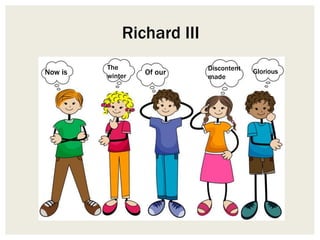
Now is
The
winter
Of our
Discontent
made
Glorious
Richard III
SUMMARY OF
SCENES 4, 5,
AND 6?
Let me
ask you!
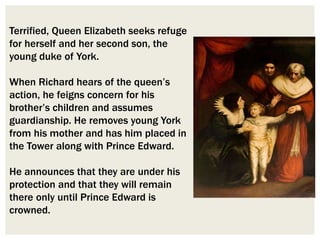
Terrified, Queen Elizabeth seeks refuge
for herself and her second son, the
young duke of York.
When Richard hears of the queen’s
action, he feigns concern for his
brother’s children and assumes
guardianship. He removes young York
from his mother and has him placed in
the Tower along with Prince Edward.
He announces that they are under his
protection and that they will remain
there only until Prince Edward is
crowned.
Learning from Sir William Catesbyn
that Lord Hastings is a loyal to the
young prince, Richard schemes to
remove him from the court by
summoning him to a meeting
ostensibly called to discuss plans for
the coronation of the new king.
Although Lord Stanley warns
Hastings that ill luck awaits him if he
goes to the meeting, the trusting
nobleman keeps his appointment
with Richard.
There, using false evidence, Richard accuses Hastings of treason and
orders his immediate execution. Richard and Buckingham pretend to
the lord mayor that Hastings was plotting against them; the lord
mayor is that the execution is justified.
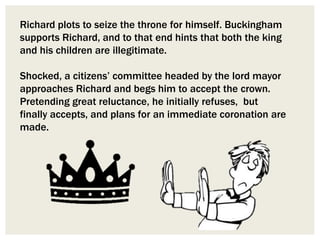
Richard plots to seize the throne for himself. Buckingham
supports Richard, and to that end hints that both the king
and his children are illegitimate.
Shocked, a citizens’ committee headed by the lord mayor
approaches Richard and begs him to accept the crown.
Pretending great reluctance, he initially refuses, but
finally accepts, and plans for an immediate coronation are
made.
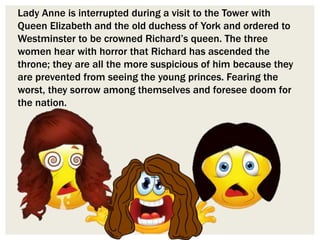
Lady Anne is interrupted during a visit to the Tower with
Queen Elizabeth and the old duchess of York and ordered to
Westminster to be crowned Richard’s queen. The three
women hear with horror that Richard has ascended the
throne; they are all the more suspicious of him because they
are prevented from seeing the young princes. Fearing the
worst, they sorrow among themselves and foresee doom for
the nation.
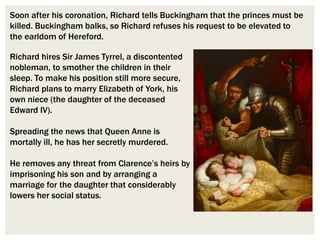
Richard hires Sir James Tyrrel, a discontented
nobleman, to smother the children in their
sleep. To make his position still more secure,
Richard plans to marry Elizabeth of York, his
own niece (the daughter of the deceased
Edward IV).
Spreading the news that Queen Anne is
mortally ill, he has her secretly murdered.
He removes any threat from Clarence’s heirs by
imprisoning his son and by arranging a
marriage for the daughter that considerably
lowers her social status.
Soon after his coronation, Richard tells Buckingham that the princes must be
killed. Buckingham balks, so Richard refuses his request to be elevated to
the earldom of Hereford.
His precautions, however, can’t stop the threats that are
beginning to endanger Richard. In Brittany, Henry Tudor, the
earl of Richmond, gathers an army and invades the country.
When news of Richmond’s landing at Milford reaches
London, Buckingham flees from Richard, whose cruelty and
guilt are becoming apparent to even his closest friends and
associates..
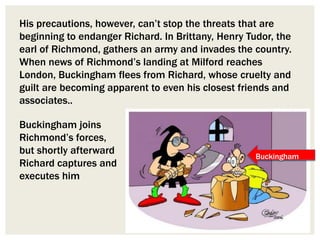
Buckingham joins
Richmond’s forces,
but shortly afterward
Richard captures and
executes him
Buckingham
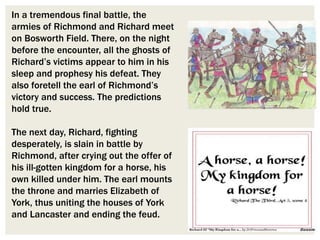
In a tremendous final battle, the
armies of Richmond and Richard meet
on Bosworth Field. There, on the night
before the encounter, all the ghosts of
Richard’s victims appear to him in his
sleep and prophesy his defeat. They
also foretell the earl of Richmond’s
victory and success. The predictions
hold true.
The next day, Richard, fighting
desperately, is slain in battle by
Richmond, after crying out the offer of
his ill-gotten kingdom for a horse, his
own killed under him. The earl mounts
the throne and marries Elizabeth of
York, thus uniting the houses of York
and Lancaster and ending the feud.
Discuss
your
answers to
the
homework
questions
and your
QHQs.
IN
GROUPS
THE WOOING SCENE
Richard’s wooing scene is in Act 1,
Scene 2 lines 72 to 244. How effective is
it? Analyze his arguments and his
ability to mask evil under the guise of
piety. Name key moments that push his
agenda. Why is Lady Anne susceptible
to his wooing?
DRAMATIC IRONY: QUESTION #2
Dramatic irony occurs when the
audience understands the real
significance of a character’s words or
actions but the character or those
around him or her do not. Examine
these moments of dark comedy and
comment on how and why they work in
the play. Look at the scene between
Richard and Clarence (Act 1 Scene 1)
and also in Act 3 scene 2, when Catesby
suggest that Richard should be crowned
king in lieu of the Prince of Wales.
THE GHOSTS: QUESTION #1
What is the impact of the
visits of the ghosts to
Richard?
See act 5, Scene 3, lines
139-188.
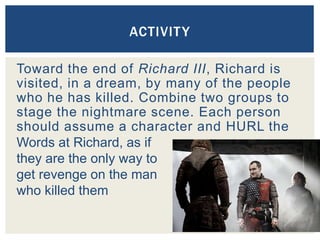
Toward the end of Richard III, Richard is
visited, in a dream, by many of the people
who he has killed. Combine two groups to
stage the nightmare scene. Each person
should assume a character and HURL the
ACTIVITY
Words at Richard, as if
they are the only way to
get revenge on the man
who killed them
YOUNG PRINCE EDWARD, SON TO HARRY
THE SIXTH
.
GHOST OF EDWARD, (to Richard)
Let me sit heavy on thy soul tomorrow.
Think how thou stabbed’st me in my prime of
youth
At Tewkesbury. Despair therefore, and die!
(To Richmond.) Be cheerful, Richmond, for the
wrongèd souls
Of butchered princes fight in thy behalf.
King Henry’s issue, Richmond, comforts thee
HENRY THE SIXTH
GHOST OF HENRY, (to Richard)
When I was mortal, my anointed body
By thee was punchèd full of deadly holes.
Think on the Tower and me. Despair and die!
Harry the Sixth bids thee despair and die.
(To Richmond.) Virtuous and holy, be thou
conqueror.
Harry, that prophesied thou shouldst be
king,
Doth comfort thee in thy sleep. Live and
flourish.
Clarence
GHOST OF CLARENCE, (to Richard)
Let me sit heavy in thy soul tomorrow,
I, that was washed to death with fulsome wine,
Poor Clarence, by thy guile betrayed to death.
Tomorrow in the battle think on me,
And fall thy edgeless sword. Despair and die!
(To Richmond.) Thou offspring of the house of
Lancaster,
The wrongèd heirs of York do pray for thee.
Good angels guard thy battle. Live and flourish.
Rivers, Grey, and Vaughan
GHOST OF RIVERS, (to Richard) Let me sit heavy in thy soul tomorrow,
Rivers, that died at Pomfret. Despair and die!
GHOST OF GREY, (to Richard)
Think upon Grey, and let thy soul despair!
GHOST OF VAUGHAN, (to Richard)
Think upon Vaughan, and with guilty fear
Let fall thy lance. Despair and die!
ALL, (to Richmond)
Awake, and think our wrongs in Richard’s bosom
Will conquer him. Awake, and win the day.
The Young Princes
GHOSTS OF PRINCES, (to Richard)
Dream on thy cousins smothered in the Tower.
Let us be lead within thy bosom, Richard,
And weigh thee down to ruin, shame, and death.
Thy nephews’ souls bid thee despair and die.
To Richmond.) Sleep, Richmond, sleep in peace
and wake in joy.
Good angels guard thee from the boar’s annoy.
Live, and beget a happy race of kings.
Edward’s unhappy sons do bid thee flourish.
HASTINGS
GHOST OF HASTINGS, (to Richard) Bloody and
guilty, guiltily awake,
And in a bloody battle end thy days.
Think on Lord Hastings. Despair and die!
(To Richmond.) Quiet, untroubled soul, awake, awake.
Arm, fight, and conquer for fair England’s sake.
Lady Anne
GHOST OF ANNE, (to Richard)
Richard, thy wife, that wretched Anne thy wife,
That never slept a quiet hour with thee,
Now fills thy sleep with perturbations.
Tomorrow, in the battle, think on me,
And fall thy edgeless sword. Despair and die!
(To Richmond.) Thou quiet soul, sleep thou a quiet
sleep.
Dream of success and happy victory.
Thy adversary’s wife doth pray for thee.
Buckingham
GHOST OF BUCKINGHAM, (to Richard)
The first was I that helped thee to the crown;
The last was I that felt thy tyranny.
O, in the battle think on Buckingham,
And die in terror of thy guiltiness.
Dream on, dream on, of bloody deeds and death.
Fainting, despair; despairing, yield thy breath.
(To Richmond.)
I died for hope ere I could lend thee aid,
But cheer thy heart, and be thou not dismayed.
God and good angels fight on Richmond’s side,
And Richard fall from height of all his pride.
AMBITION
Ambition is a manifest theme of a play driven by its central
character's evil quest for power. For Richard (as for all tyrants),
this course is a lonely one. In Act I, scene ii, Richard tells us that
he has "no friends to back my suit at all / But the plain devil and
dissembling looks" (235-36). Richard, of course, has allies
(Buckingham, Catesby) and hirelings (the murders and Tyrell),
and he even takes Lady Anne as a wife. But as events show us
and Richard himself is plain to admit, he has no relationship to
anyone, his mother included: those who stand alongside him are
mere tools that are best done away with after their usefulness is
gone. Most stunning of all, Richard's ambition alienates him
from his own self. Thus, after being visited by the ghosts of his
victims in Act V, scene iii, Richard awakens in terror and says:
AMBITION: QUESTION #3
What do I fear? myself? there's none else by:
Richard loves Richard; that is, I am I.
Is there a murderer here? No. Yes, I am:
Then fly. What, from myself? Great reason why:
Lest I revenge. What, myself upon myself?
Alack. I love myself. Wherefore? for any good
That I myself have done unto myself?
O, no! alas, I rather hate myself
For hateful deeds committed by myself!
I am a villain: yet I lie. I am not.
(V.iii.194-203)
Ambition conjoined with an inherently evil nature cause Richard to embrace
the role of villain, but he plays the part so fully that he eventually wreaks
havoc on himself. Look at Scene 5, Act 3, lines 194-203. What is the
purpose of these lines. What do we learn about Richard’s state of mind?
1. Why do we root for Richard even though he is
cast as the villain in this play?
2. Which leader gave the better oration to their
troops, Richard or Richmond? Why?
3. What kind of character is Hastings? Is he an
innocent fool, or is he not as innocent as he
appears given the happiness he expresses upon
hearing the news that his enemies will be put to
death?
1. How are women portrayed in Richard III? What
does Shakespeare’s depiction of women in
Richard III reflect about the society he lived in?
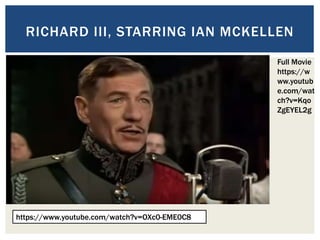
RICHARD III, STARRING IAN MCKELLEN
https://www.youtube.com/watch?v=OXc0-EME0C8
Full Movie
https://w
ww.youtub
e.com/wat
ch?v=Kqo
ZgEYEL2g
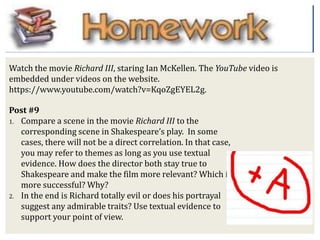
Post #9
1. Compare a scene in the movie Richard III to the
corresponding scene in Shakespeare’s play. In some
cases, there will not be a direct correlation. In that case,
you may refer to themes as long as you use textual
evidence. How does the director both stay true to
Shakespeare and make the film more relevant? Which is
more successful? Why?
2. In the end is Richard totally evil or does his portrayal
suggest any admirable traits? Use textual evidence to
support your point of view.
Watch the movie Richard III, staring Ian McKellen. The YouTube video is
embedded under videos on the website.
https://www.youtube.com/watch?v=KqoZgEYEL2g.

Elit 17 class 9 richard iii

  • 1.
  • 2.
  • 3.
  • 4.
  • 5.
    SUMMARY OF SCENES 4,5, AND 6? Let me ask you!
  • 6.
    Terrified, Queen Elizabethseeks refuge for herself and her second son, the young duke of York. When Richard hears of the queen’s action, he feigns concern for his brother’s children and assumes guardianship. He removes young York from his mother and has him placed in the Tower along with Prince Edward. He announces that they are under his protection and that they will remain there only until Prince Edward is crowned.
  • 7.
    Learning from SirWilliam Catesbyn that Lord Hastings is a loyal to the young prince, Richard schemes to remove him from the court by summoning him to a meeting ostensibly called to discuss plans for the coronation of the new king. Although Lord Stanley warns Hastings that ill luck awaits him if he goes to the meeting, the trusting nobleman keeps his appointment with Richard. There, using false evidence, Richard accuses Hastings of treason and orders his immediate execution. Richard and Buckingham pretend to the lord mayor that Hastings was plotting against them; the lord mayor is that the execution is justified.
  • 8.
    Richard plots toseize the throne for himself. Buckingham supports Richard, and to that end hints that both the king and his children are illegitimate. Shocked, a citizens’ committee headed by the lord mayor approaches Richard and begs him to accept the crown. Pretending great reluctance, he initially refuses, but finally accepts, and plans for an immediate coronation are made.
  • 9.
    Lady Anne isinterrupted during a visit to the Tower with Queen Elizabeth and the old duchess of York and ordered to Westminster to be crowned Richard’s queen. The three women hear with horror that Richard has ascended the throne; they are all the more suspicious of him because they are prevented from seeing the young princes. Fearing the worst, they sorrow among themselves and foresee doom for the nation.
  • 10.
    Richard hires SirJames Tyrrel, a discontented nobleman, to smother the children in their sleep. To make his position still more secure, Richard plans to marry Elizabeth of York, his own niece (the daughter of the deceased Edward IV). Spreading the news that Queen Anne is mortally ill, he has her secretly murdered. He removes any threat from Clarence’s heirs by imprisoning his son and by arranging a marriage for the daughter that considerably lowers her social status. Soon after his coronation, Richard tells Buckingham that the princes must be killed. Buckingham balks, so Richard refuses his request to be elevated to the earldom of Hereford.
  • 11.
    His precautions, however,can’t stop the threats that are beginning to endanger Richard. In Brittany, Henry Tudor, the earl of Richmond, gathers an army and invades the country. When news of Richmond’s landing at Milford reaches London, Buckingham flees from Richard, whose cruelty and guilt are becoming apparent to even his closest friends and associates.. Buckingham joins Richmond’s forces, but shortly afterward Richard captures and executes him Buckingham
  • 12.
    In a tremendousfinal battle, the armies of Richmond and Richard meet on Bosworth Field. There, on the night before the encounter, all the ghosts of Richard’s victims appear to him in his sleep and prophesy his defeat. They also foretell the earl of Richmond’s victory and success. The predictions hold true. The next day, Richard, fighting desperately, is slain in battle by Richmond, after crying out the offer of his ill-gotten kingdom for a horse, his own killed under him. The earl mounts the throne and marries Elizabeth of York, thus uniting the houses of York and Lancaster and ending the feud.
  • 13.
  • 14.
    THE WOOING SCENE Richard’swooing scene is in Act 1, Scene 2 lines 72 to 244. How effective is it? Analyze his arguments and his ability to mask evil under the guise of piety. Name key moments that push his agenda. Why is Lady Anne susceptible to his wooing?
  • 15.
    DRAMATIC IRONY: QUESTION#2 Dramatic irony occurs when the audience understands the real significance of a character’s words or actions but the character or those around him or her do not. Examine these moments of dark comedy and comment on how and why they work in the play. Look at the scene between Richard and Clarence (Act 1 Scene 1) and also in Act 3 scene 2, when Catesby suggest that Richard should be crowned king in lieu of the Prince of Wales.
  • 16.
    THE GHOSTS: QUESTION#1 What is the impact of the visits of the ghosts to Richard? See act 5, Scene 3, lines 139-188.
  • 17.
    Toward the endof Richard III, Richard is visited, in a dream, by many of the people who he has killed. Combine two groups to stage the nightmare scene. Each person should assume a character and HURL the ACTIVITY Words at Richard, as if they are the only way to get revenge on the man who killed them
  • 18.
    YOUNG PRINCE EDWARD,SON TO HARRY THE SIXTH . GHOST OF EDWARD, (to Richard) Let me sit heavy on thy soul tomorrow. Think how thou stabbed’st me in my prime of youth At Tewkesbury. Despair therefore, and die! (To Richmond.) Be cheerful, Richmond, for the wrongèd souls Of butchered princes fight in thy behalf. King Henry’s issue, Richmond, comforts thee
  • 19.
    HENRY THE SIXTH GHOSTOF HENRY, (to Richard) When I was mortal, my anointed body By thee was punchèd full of deadly holes. Think on the Tower and me. Despair and die! Harry the Sixth bids thee despair and die. (To Richmond.) Virtuous and holy, be thou conqueror. Harry, that prophesied thou shouldst be king, Doth comfort thee in thy sleep. Live and flourish.
  • 20.
    Clarence GHOST OF CLARENCE,(to Richard) Let me sit heavy in thy soul tomorrow, I, that was washed to death with fulsome wine, Poor Clarence, by thy guile betrayed to death. Tomorrow in the battle think on me, And fall thy edgeless sword. Despair and die! (To Richmond.) Thou offspring of the house of Lancaster, The wrongèd heirs of York do pray for thee. Good angels guard thy battle. Live and flourish.
  • 21.
    Rivers, Grey, andVaughan GHOST OF RIVERS, (to Richard) Let me sit heavy in thy soul tomorrow, Rivers, that died at Pomfret. Despair and die! GHOST OF GREY, (to Richard) Think upon Grey, and let thy soul despair! GHOST OF VAUGHAN, (to Richard) Think upon Vaughan, and with guilty fear Let fall thy lance. Despair and die! ALL, (to Richmond) Awake, and think our wrongs in Richard’s bosom Will conquer him. Awake, and win the day.
  • 22.
    The Young Princes GHOSTSOF PRINCES, (to Richard) Dream on thy cousins smothered in the Tower. Let us be lead within thy bosom, Richard, And weigh thee down to ruin, shame, and death. Thy nephews’ souls bid thee despair and die. To Richmond.) Sleep, Richmond, sleep in peace and wake in joy. Good angels guard thee from the boar’s annoy. Live, and beget a happy race of kings. Edward’s unhappy sons do bid thee flourish.
  • 23.
    HASTINGS GHOST OF HASTINGS,(to Richard) Bloody and guilty, guiltily awake, And in a bloody battle end thy days. Think on Lord Hastings. Despair and die! (To Richmond.) Quiet, untroubled soul, awake, awake. Arm, fight, and conquer for fair England’s sake.
  • 24.
    Lady Anne GHOST OFANNE, (to Richard) Richard, thy wife, that wretched Anne thy wife, That never slept a quiet hour with thee, Now fills thy sleep with perturbations. Tomorrow, in the battle, think on me, And fall thy edgeless sword. Despair and die! (To Richmond.) Thou quiet soul, sleep thou a quiet sleep. Dream of success and happy victory. Thy adversary’s wife doth pray for thee.
  • 25.
    Buckingham GHOST OF BUCKINGHAM,(to Richard) The first was I that helped thee to the crown; The last was I that felt thy tyranny. O, in the battle think on Buckingham, And die in terror of thy guiltiness. Dream on, dream on, of bloody deeds and death. Fainting, despair; despairing, yield thy breath. (To Richmond.) I died for hope ere I could lend thee aid, But cheer thy heart, and be thou not dismayed. God and good angels fight on Richmond’s side, And Richard fall from height of all his pride.
  • 26.
    AMBITION Ambition is amanifest theme of a play driven by its central character's evil quest for power. For Richard (as for all tyrants), this course is a lonely one. In Act I, scene ii, Richard tells us that he has "no friends to back my suit at all / But the plain devil and dissembling looks" (235-36). Richard, of course, has allies (Buckingham, Catesby) and hirelings (the murders and Tyrell), and he even takes Lady Anne as a wife. But as events show us and Richard himself is plain to admit, he has no relationship to anyone, his mother included: those who stand alongside him are mere tools that are best done away with after their usefulness is gone. Most stunning of all, Richard's ambition alienates him from his own self. Thus, after being visited by the ghosts of his victims in Act V, scene iii, Richard awakens in terror and says:
  • 27.
    AMBITION: QUESTION #3 Whatdo I fear? myself? there's none else by: Richard loves Richard; that is, I am I. Is there a murderer here? No. Yes, I am: Then fly. What, from myself? Great reason why: Lest I revenge. What, myself upon myself? Alack. I love myself. Wherefore? for any good That I myself have done unto myself? O, no! alas, I rather hate myself For hateful deeds committed by myself! I am a villain: yet I lie. I am not. (V.iii.194-203) Ambition conjoined with an inherently evil nature cause Richard to embrace the role of villain, but he plays the part so fully that he eventually wreaks havoc on himself. Look at Scene 5, Act 3, lines 194-203. What is the purpose of these lines. What do we learn about Richard’s state of mind?
  • 28.
    1. Why dowe root for Richard even though he is cast as the villain in this play? 2. Which leader gave the better oration to their troops, Richard or Richmond? Why? 3. What kind of character is Hastings? Is he an innocent fool, or is he not as innocent as he appears given the happiness he expresses upon hearing the news that his enemies will be put to death? 1. How are women portrayed in Richard III? What does Shakespeare’s depiction of women in Richard III reflect about the society he lived in?
  • 29.
    RICHARD III, STARRINGIAN MCKELLEN https://www.youtube.com/watch?v=OXc0-EME0C8 Full Movie https://w ww.youtub e.com/wat ch?v=Kqo ZgEYEL2g
  • 30.
    Post #9 1. Comparea scene in the movie Richard III to the corresponding scene in Shakespeare’s play. In some cases, there will not be a direct correlation. In that case, you may refer to themes as long as you use textual evidence. How does the director both stay true to Shakespeare and make the film more relevant? Which is more successful? Why? 2. In the end is Richard totally evil or does his portrayal suggest any admirable traits? Use textual evidence to support your point of view. Watch the movie Richard III, staring Ian McKellen. The YouTube video is embedded under videos on the website. https://www.youtube.com/watch?v=KqoZgEYEL2g.