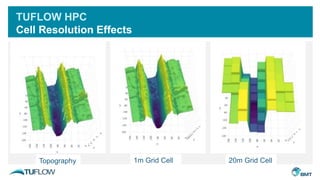
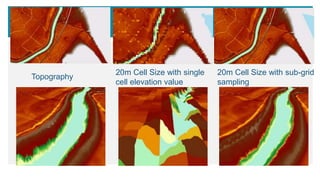
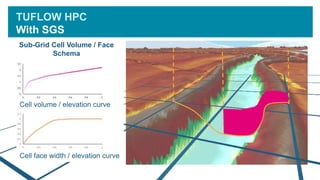
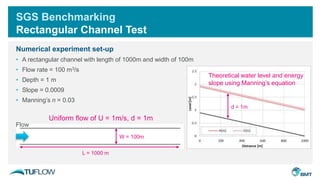
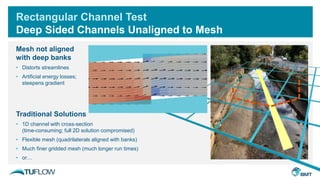
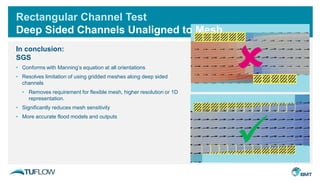
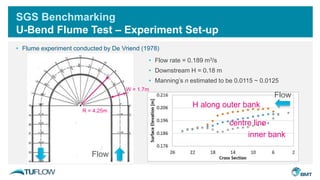
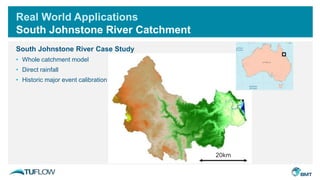
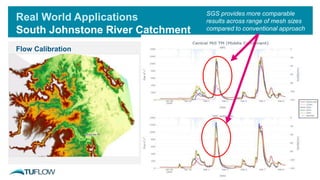
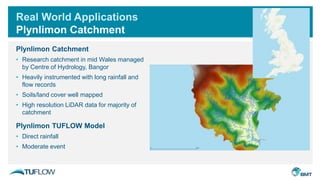
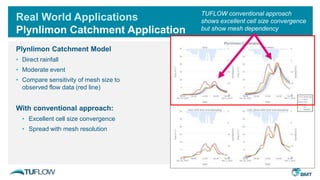
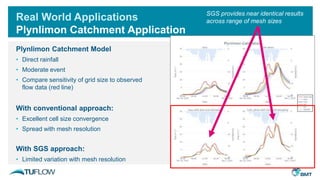
This document discusses the use of sub-grid sampling (SGS) in 2D hydraulic modeling software to eliminate sensitivity to mesh orientation and size. SGS improves upon conventional approaches that assign single elevations to cells and faces. It describes benchmark tests showing SGS improves accuracy across rotated meshes and mesh sizes. Real-world case studies in Australia and Wales demonstrate SGS provides consistent results for different mesh resolutions. In conclusion, SGS has the potential to improve flood modeling and analysis.

![Rotated Channel Test
TUFLOW HPC
15° 30° 45°0°
H [m] H [m] H [m] H [m]
The more mis-aligned the mesh is with the flow
direction, the poorer the simulation output
compared to those expected theoretically.](https://image.slidesharecdn.com/eliminatinggridalignmentsensitivityinfixedgridsolversv1-200706082542/85/Mesh_Orientation_and_Cell_Size_Senstivity_in_2D_SWE_Solvers-10-320.jpg)
![Rotated Channel Test
TUFLOW HPC with SGS
15° 30° 45°0°
H [m] H [m] H [m] H [m]
With SGS, simulated output compares well to
theoretically expected output with sensitivity to
mesh orientation eliminated.](https://image.slidesharecdn.com/eliminatinggridalignmentsensitivityinfixedgridsolversv1-200706082542/85/Mesh_Orientation_and_Cell_Size_Senstivity_in_2D_SWE_Solvers-11-320.jpg)
![Mesh Size Sensitivity
TUFLOW HPC
50m
H [m]
With a large mesh size, not a great comparison
with theoretically expected outputs.](https://image.slidesharecdn.com/eliminatinggridalignmentsensitivityinfixedgridsolversv1-200706082542/85/Mesh_Orientation_and_Cell_Size_Senstivity_in_2D_SWE_Solvers-12-320.jpg)
![Mesh Size Sensitivity
TUFLOW HPC
50m25m
H [m]
With a large mesh size, not a great comparison
with theoretically expected outputs.](https://image.slidesharecdn.com/eliminatinggridalignmentsensitivityinfixedgridsolversv1-200706082542/85/Mesh_Orientation_and_Cell_Size_Senstivity_in_2D_SWE_Solvers-13-320.jpg)
![Mesh Size Sensitivity
TUFLOW HPC
50m25m10m
H [m]
As the mesh size is refined, start to converge on
theoretical outputs.](https://image.slidesharecdn.com/eliminatinggridalignmentsensitivityinfixedgridsolversv1-200706082542/85/Mesh_Orientation_and_Cell_Size_Senstivity_in_2D_SWE_Solvers-14-320.jpg)
![Mesh Size Sensitivity
TUFLOW HPC
50m25m10m5m
H [m]
As the mesh size is refined, start to converge on
theoretical outputs.](https://image.slidesharecdn.com/eliminatinggridalignmentsensitivityinfixedgridsolversv1-200706082542/85/Mesh_Orientation_and_Cell_Size_Senstivity_in_2D_SWE_Solvers-15-320.jpg)
![5m
Mesh Size Sensitivity
TUFLOW HPC SGS
H [m]
With SGS, good convergence with theoretical
outputs….](https://image.slidesharecdn.com/eliminatinggridalignmentsensitivityinfixedgridsolversv1-200706082542/85/Mesh_Orientation_and_Cell_Size_Senstivity_in_2D_SWE_Solvers-16-320.jpg)
![5m
Mesh Size Sensitivity
TUFLOW HPC SGS
10m
H [m]
With SGS, good convergence with theoretical
outputs….](https://image.slidesharecdn.com/eliminatinggridalignmentsensitivityinfixedgridsolversv1-200706082542/85/Mesh_Orientation_and_Cell_Size_Senstivity_in_2D_SWE_Solvers-17-320.jpg)
![5m
Mesh Size Sensitivity
TUFLOW HPC SGS
10m25m
H [m]
With SGS, good convergence with theoretical
outputs….for range of mesh cell sizes.](https://image.slidesharecdn.com/eliminatinggridalignmentsensitivityinfixedgridsolversv1-200706082542/85/Mesh_Orientation_and_Cell_Size_Senstivity_in_2D_SWE_Solvers-18-320.jpg)
![5m
Mesh Size Sensitivity
TUFLOW HPC SGS
10m25m50m
H [m]
With SGS, good convergence with theoretical
outputs….for range of mesh cell sizes.
Eliminates sensitivity to mesh size.](https://image.slidesharecdn.com/eliminatinggridalignmentsensitivityinfixedgridsolversv1-200706082542/85/Mesh_Orientation_and_Cell_Size_Senstivity_in_2D_SWE_Solvers-19-320.jpg)
![U-Bend Flume Test
TUFLOW HPC 2019 without SGS
• TUFLOW HPC Defaults
H [m]
Use of fixed grid causes edge effects
representing curved wet-dry boundary.](https://image.slidesharecdn.com/eliminatinggridalignmentsensitivityinfixedgridsolversv1-200706082542/85/Mesh_Orientation_and_Cell_Size_Senstivity_in_2D_SWE_Solvers-23-320.jpg)
![U-Bend Flume Test
TUFLOW FV (Flexible Mesh)
• TUFLOW FV
H [m]
Flexible mesh can be aligned with
wet-dry boundary…although can be
time consuming to do so.](https://image.slidesharecdn.com/eliminatinggridalignmentsensitivityinfixedgridsolversv1-200706082542/85/Mesh_Orientation_and_Cell_Size_Senstivity_in_2D_SWE_Solvers-24-320.jpg)
![U-Bend Flume Test
TUFLOW HPC without SGS vs TUFLOW FV
TUFLOW HPC TUFLOW FV
H [m]](https://image.slidesharecdn.com/eliminatinggridalignmentsensitivityinfixedgridsolversv1-200706082542/85/Mesh_Orientation_and_Cell_Size_Senstivity_in_2D_SWE_Solvers-25-320.jpg)
![U-Bend Flume Test
TUFLOW HPC with SGS
• TUFLOW HPC with SGS
H [m]
Partially wet cells/faces smooth out the flow field
SGS approaches eliminates the edge
effects at wet-dry boundary.](https://image.slidesharecdn.com/eliminatinggridalignmentsensitivityinfixedgridsolversv1-200706082542/85/Mesh_Orientation_and_Cell_Size_Senstivity_in_2D_SWE_Solvers-26-320.jpg)
![U-Bend Flume Test
TUFLOW HPC with SGS vs TUFLOW FV
TUFLOW HPC with SGS TUFLOW FV
H [m]
As good as a well-designed
flexible mesh model!!](https://image.slidesharecdn.com/eliminatinggridalignmentsensitivityinfixedgridsolversv1-200706082542/85/Mesh_Orientation_and_Cell_Size_Senstivity_in_2D_SWE_Solvers-27-320.jpg)
![TUFLOW HPC
34cm
U-Bend Flume Test – Mesh Size Sensitivity
TUFLOW HPC-Without SGS
17cm10cm5cm
H [m]
• Slightly higher than experimental data due to
fixed grid “saw-tooth” effects.](https://image.slidesharecdn.com/eliminatinggridalignmentsensitivityinfixedgridsolversv1-200706082542/85/Mesh_Orientation_and_Cell_Size_Senstivity_in_2D_SWE_Solvers-28-320.jpg)
![TUFLOW HPC
34cm
U-Bend Flume Test – Mesh Size Sensitivity
TUFLOW HPC-Without SGS
17cm10cm
H [m]
• Slightly higher than experimental data due to
fixed grid “saw-tooth” effects.](https://image.slidesharecdn.com/eliminatinggridalignmentsensitivityinfixedgridsolversv1-200706082542/85/Mesh_Orientation_and_Cell_Size_Senstivity_in_2D_SWE_Solvers-29-320.jpg)
![TUFLOW HPC
34cm
U-Bend Flume Test – Mesh Size Sensitivity
TUFLOW HPC-Without SGS
17cm
H [m]
• Slightly higher than experimental data due to
fixed grid “saw-tooth” effects.
• Edge effects worsen with increasing mesh
size.](https://image.slidesharecdn.com/eliminatinggridalignmentsensitivityinfixedgridsolversv1-200706082542/85/Mesh_Orientation_and_Cell_Size_Senstivity_in_2D_SWE_Solvers-30-320.jpg)
![TUFLOW HPC
34cm
U-Bend Flume Test – Mesh Size Sensitivity
TUFLOW HPC-Without SGS
H [m]
• Slightly higher than experimental data due to
fixed grid “saw-tooth” effects.
• Edge effects worsen with increasing mesh
size.](https://image.slidesharecdn.com/eliminatinggridalignmentsensitivityinfixedgridsolversv1-200706082542/85/Mesh_Orientation_and_Cell_Size_Senstivity_in_2D_SWE_Solvers-31-320.jpg)
![TUFLOW HPC with SGS
U-Bend Flume Test – Mesh Size Sensitivity
TUFLOW HPC-With SGS
H [m]34cm17cm10cm
Good agreement with experimental data…
5cm
H [m]](https://image.slidesharecdn.com/eliminatinggridalignmentsensitivityinfixedgridsolversv1-200706082542/85/Mesh_Orientation_and_Cell_Size_Senstivity_in_2D_SWE_Solvers-32-320.jpg)
![TUFLOW HPC with SGS
U-Bend Flume Test – Mesh Size Sensitivity
TUFLOW HPC-With SGS
H [m]34cm17cm10cm
Good agreement with experimental data…
H [m]](https://image.slidesharecdn.com/eliminatinggridalignmentsensitivityinfixedgridsolversv1-200706082542/85/Mesh_Orientation_and_Cell_Size_Senstivity_in_2D_SWE_Solvers-33-320.jpg)
![TUFLOW HPC with SGS
U-Bend Flume Test – Mesh Size Sensitivity
TUFLOW HPC-With SGS
H [m]34cm17cm
H [m]
Good agreement with experimental data across
range of mesh sizes.](https://image.slidesharecdn.com/eliminatinggridalignmentsensitivityinfixedgridsolversv1-200706082542/85/Mesh_Orientation_and_Cell_Size_Senstivity_in_2D_SWE_Solvers-34-320.jpg)
![TUFLOW HPC with SGS
U-Bend Flume Test – Mesh Size Sensitivity
TUFLOW HPC-With SGS
H [m]34cm
Good agreement with experimental data across
range of mesh sizes.
H [m]](https://image.slidesharecdn.com/eliminatinggridalignmentsensitivityinfixedgridsolversv1-200706082542/85/Mesh_Orientation_and_Cell_Size_Senstivity_in_2D_SWE_Solvers-35-320.jpg)
![U-Bend Flume Test
Conclusions
H [m]
In conclusion:
Sub-Grid Sampling...
• Resolves limitation of using gridded meshes along curved channels
• Removes requirement for flexible mesh or higher resolution.
• Significantly reduces mesh sensitivity
• More accurate flood models and outputs](https://image.slidesharecdn.com/eliminatinggridalignmentsensitivityinfixedgridsolversv1-200706082542/85/Mesh_Orientation_and_Cell_Size_Senstivity_in_2D_SWE_Solvers-36-320.jpg)


![5G Explained! A High Level Overview [Introduction]](https://cdn.slidesharecdn.com/ss_thumbnails/5gexplainedahighleveloverview-260119165306-cc137a3e-thumbnail.jpg?width=640&height=640&fit=bounds)


