27Al qNMR of an Elemin Senonian Trace Minerals Supplement for ID, Chemical Structure, Active 
Ingredient Quantitation, and Product Stability 
Boris Nemzer1,2, John Hunter1, John C. Edwards3 
1: VDF Futureceuticals Inc., Momence, IL USA. 2: Process NMR Associates LLC, Danbury, CT USA 
3: University of Illinois at Urbana Champaign, Urbana, IL, USA 
Abstract 
Aluminum (Al) is the third most abundant element and the most abundant element found in the 
Earth’s crust. Elemin™ (FutureCeutical, Inc., Momence, IL, USA) is a multi inorganic element 
complex with more then 70 inorganic elements and minerals all of which are completely water 
soluble, including all the Al compounds. The objective of this study is to show, using NMR 
technology, that Al compounds present in an aqueous solution of Elemin™ are almost exclusively 
soluble sulphate forms and confirm that they are not present as insoluble forms such as Al oxide or 
Al hydroxide. We have obtained liquid and solid-state 27Al NMR spectra for Elemin™ and several 
model salts such as Al2(SO4)3, KAl(SO4)2, Al2O3 and Al(OH)3. 
Quantitative liquid-state 27Al NMR of EleminTM and the various salts was performed on a 300 MHz 
NMR system. Quantitative NMR demonstrated that accurate calibrations clould be obtained for the 
fully water soluble samples such as Al2(SO4)3, KAl(SO4)2. For Al2O3 and Al(OH)3 the qunatitative 
calibrations could not be developed due to sample insolubility. Utilizing the Al content obtained 
from ICP-MS it was possible to obtain a quantitative calibration for EleminTM dissolved in water 
indicating that the Al forms in the product are fully water soluble, This calibration experiment 
precludes the presence of insoluble Al2O3 or Al(OH3) compounds in the product. Also, the presence 
of Al3+(H2O)6 and Al+(H2O)5(SO4) in the 27Al spectrum of EleminTM at the same ratio as is observed 
for aqueous Al2(SO4)3, indicates the presence of Al in this form. 
Solid-state 27Al NMR was performed on a 200 MHz NMR system equipped with a 7mm MAS probe. 
The Elemin™ sample shows second order quadrupole lineshapes and chemical shifts that are 
considerably different to insoluble forms of Al and chemical shifts that are similar to Al sulfate. 
However, the quadrupole lineshape of the Elemin Al species is different than pure crystalline 
Al2(SO4)3. This is likely due to the manufacturing process of the EleminTM product which involves 
spray drying of Al containing solutions onto the mineral matrix. This sample preparation method 
prevents formation of highly crystalline domains and leads to an amoprphous form of the Al 
species. Quantitation of the Al in the EleminTM product was also performed by solid-state NMR. 
Finally, a stability study performed followed by liquid and solid state 27Al NMR for the same sample 
of Elemin™ exposed to three different temperatures for varying periods of time - 35oC for 6 hours, 
50oC for 6 hours and 70oC for 18 hours. No differences were observed in either the liquid or solid-state 
NMR spectra of the various treated samples which indicates that the samples were stable 
under the temperature conditions applied over the course of the experiment. No changes in the 
sulphate soluble form of Al were observed. 
Background: 
elemin® Senonian Trace Minerals is an ultra-mineral complex. It is a GRAS (Generally Recognized as 
Safe) plant-derived mineral powder,that is cold-water extracted from a pre-historic plant (peat) 
deposit laid down during the Cretaceous period replete with the full spectrum of naturally-chelated 
elements and minerals. The white powdered product is 100% water-soluble and contains more 
than 70 plant-based, small particle minerals, including the full-range of lesser-known minerals that 
may have served as important co-factors in our biological development. Many of these minerals 
have been stripped from soils and are no longer available in our modern diets. 
Concentrated and dried by FutureCeuticals’ proprietary process, elemin® Senonian Trace Minerals 
is manufactured in carefully monitored cGMP and HAACP food-compliant facilities and is Certified 
Kosher by the Orthodox Union. elemin® is ideal for functional foods and beverages and finds many 
applications in drinks, energy and nutritional bars and dietary supplements. elemin® is also 
available in liquid form. elemin® has earned self-affirmed GRAS status for use in food and 
beverages. Per FDA regulations, self-affirmed GRAS status is only granted after careful expert 
review in order to confirm the safety of using the product under the intended conditions. 27Al NMR 
was utilized to identify the aluminum species present, quantify the elemental Al content, observe 
the Al chemistry of the product during stability testing under different temperature conditions and 
to develop a methodology to identify adulteration of the product. 
Experimental - 27Al NMR: 
Liquid-state 27Al NMR was performed on a Varian Mercury 300MVX NMR spectrometer (Palo Alto, 
CA USA) equipped with a 5mm Varian ATB Probe at a resonance frequency of 78.09 MHz. 16k 
points were acquired for a spectral width of 25 kHz yielding an acquisition time of 0.638 seconds. A 
relaxation delay of 0.5 seconds was found to be adequate for quantitative analysis. All samples 
were dissolved in D2O (Cambridge Isotope Laboratories). KAl(SO4)2.12H2O was utilized as the 
chemical shift reference for the experiments. 
Solid-State 27Al NMR was performed on a Varian UnityPlus 200 NMR spectrometer (Palo Alto, CA 
USA) equipped with a Doty Scientific 7mm Supersonic MAS probe. Samples were spun at a magic 
angle spinning rate of 5-6 kHz and the signal was acquired at a resonance frequency of 52.12 MHz 
over a spectral width of 80 kHz and with a 0.25 second relaxation delay. KAl(SO4)2.12 H2O was 
utilized as the chemical shift reference for the experiments. 
27Al TD-qNMR – Quantitative 27Al was performed on a Mobilab®130 Elemental Analyzer (One 
Resonance Sensors, San Diego, CA USA, detect-ors.com/products/mobilab/) at a resonance 
frequency of 6.828 MHz. 
Samples Analyzed: 
elemin Lot# 16424472N881.1 
Al2(SO4)3 – Anhydrous – Aldrich, Lot MKBL3811V 
KAl(SO4)2 – dodecahydrate – Aldrich – Chemical Shift Standard (0 ppm) 
Al2O3 – Aldrich, Lot SZBD0300V 
Al(OH)3 – Aldrich, Lot MKBH4311V 
Mixtures of elemin in Maltodextrin 
Sample Preparation: 
Solid-state NMR experiments were performed on the pure component materials. Liquid-state 78.09 
MHz NMR was performed on samples dissolved in a combination of D2O/DI Water, and TD-qNMR 
was performed on samples dissolved in DI water. Samples of elemin adulterated with maltodextrin 
were prepared on a balance accurate to the nearest 0.1mg. 
qNMR Results 
Quantitation of Aluminum in the Elemin sample was performed by direct comparison of the NMR 
signal obtained from 22.1 mg of Al2(SO4)3 and the signal obtained from 56.8 mg of Elemin. The 
calculation requires that the signal intensity per mg of Al in the sample be determined followed by 
a calculation of the mg of Al in the Elemin sample. This then allows the wt% of Al to be calculated 
using the following equation. Figure 1 shows the absolute intensity plot of the Al2(SO4)3 standard 
compared to the Elemin. This data was utilized to calculate the Aluminum content of elemin. 
Wt% Al in Elemin = 100*( IB / (IA / ((54/342) * WA))/ WB 
where, A=Al2(SO4)3, Mw=342, B=Elemin, 54 is the atomic weight of the Al atoms in sample A, W = 
weight and I = integral intensity 
Liquid-state 78.09 MHz 27Al calculated that the Al content of Elemin is 2.41 wt%. 
A second qNMR approach was utilized with a cryogen-free bench-top Mobilab 130 TD-NMR system 
designed for elemental analysis. The system was supplied with BB probe as well as aprobe 
optimized for Na/Al. An external calibration standard (3867 ppm) was prepared from 
Al(NO3)3.9H2O. Direct comparison of the calibration sample to the signal intensity obtained on 100 
mg of elemin dissolved in 2 grams of water yielded the %Al present in the pure elemin sample. The 
resulting calibration is presented in Figure 1. 
Liquid-state 6.828 MHz 27Al TD-qNMR calculated that the Al content of Elemin is 2.64 wt%. 
ICP-MS Analysis of the same elemin sample found an Al content of 2.66 w%, thus validating the use 
of NMR for Aluminum elemental content analysis. 
Figure 3: Comparison of absolute signal intensity spectra of Al2(SO4)3 (Anhydrous) external 
standard and the elemin sample prepared for qNMR 
Results: 
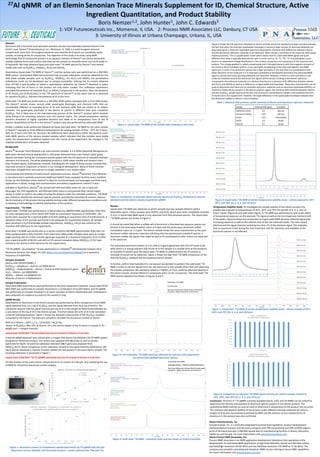
Liquid-state 27Al NMR was obtained on all the samples but two samples failed to yield a 
detectable signal – these samples were Al(OH)3 and Al2O3 which were both completely insoluble 
in D2O. In liquid-state NMR signal is only observed from fully dissolved species. The liquid-state 
27Al NMR spectra are shown in Figure 2. 
It should be noted that when a sulfate salt of aluminum is dissolved two aqueous species are 
formed 1) the hexa-aquo trivalent cation at 0 ppm and the penta-aquo aluminum sulfate 
monovalent cation at -3.3 ppm. The elemin sample shows the same characteristic as the pure 
aluminum sulfate reference materials indicating that the predominant soluble Al species is 
aluminum sulfate. No signals that might be due to Al coordinated to other anions are observed 
in the spectrum. 
The calculated aluminum content of 2.41 wt% is in good agreement with the ICP result (2.66 
wt%) which is a strong indicator that all the Al in the sample is in soluble form as the presence 
of insoluble Al would cause the liquid-state 27Al NMR to underestimate the Al content as 
insoluble Al would not be observed. Figure 3 shows the high field 27Al NMR comparison of the 
external Al2(SO4)3 standard and the prepared elemin sample. 
To further confirm that insoluble Al is not present we decided to perform the solid-state 27Al 
NMR in order to see the signals from ALL the aluminum in the sample rather than just observing 
the soluble component. We wanted to observe if Al(OH)3 or Al2O3 could be observed directly in 
the elemin sample. Several reference compounds were run for comparison. The solid-state 27Al 
NMR spectra obtained are shown in Figures 4 and 5. 
Figure 1: Liquid-state 27Al NMR of the soluble salts analyzed in this study. 
Figure 1: Aluminum content in maltodextrin adulterated elemin by TD-qNMR with the One 
Resonance Sensors Mobilab 130 Elemental Analyzer – probe optimized for 23Na and 27Al 
Figure 4: Full solid-state 27Al NMR spectrum obtained by selective echo experiment 
for elemin and standard aluminum species. 
Figure 4 shows the full spectrum obtained on elemin and the aluminum standard samples and demonstrates 
the fact that when the isotropic quadupolar lineshape is narrow a large number of spinning sidebands are 
observed Figure 5 shows the expanded spectrum allowing the chemical shift differences between elemin 
and the aluminum reference materials to be observed. Table I shows a summary of the chemical shifts (peak 
maxima position). 27Al is a quadrupolar nuclei which means that it’s solid-state NMR signals are quite 
different than what is typically observed for spin ½ nuclei such as 1H, 13C, 29Si, 31P. In quadrupolar nuclei 
there is an asymmetric charge distribution in the nucleus caused by a non-symmetry of the neutrons and 
protons. This charge gradient is called a quadrupole and it strongly interacts with the magnetic moment of 
the nucleus which manifests itself as a non-symmetric broadening of the observed signal in the NMR 
spectrum. In short, if an aluminum species has a high symmetry in the way that it is coordinated to the 
other elements of the molecule it is in (example octahedral or tetrahedral symmetry) the observed NMR 
signal is narrow and many spinning sidebands are observed. However, if there is a non-symmetry in the 
molecule centered around the aluminum the signals will be broad. Looking at the elemin spectrum 
compared to the reference materials it is obvious that there is a chemical shift difference between elemin 
and Al2O3 and Al(OH)3 as well as a difference in signal width and lineshape. These two characteristics can be 
used to determine that there are no insoluble aluminum materials such as aluminum hydroxide (Al(OH)3) or 
Aluminum Oxide (Al2O3) present in the elemin product. Again, the chemical shift similarity between elemin 
and the Al2(SO4)3 sample [points to the fact that aluminum coordinated to sulfate is the predominant form 
of aluminum in the supplement. However, the large difference in the quadrupole lineshape indicates that 
the aluminum sulfate in elemin is not crystalline. 
Table I: Chemical shift positions (peak maxima) of elemin and aluminum reference materials 
About FutureCeuticals, Inc. 
FutureCeuticals, Inc. is a vertically integrated functional food ingredient, product development, 
and bioanalytical research and discovery company with 700 conventional and 500 certified organic 
acres of farmland and over 1,000,000 square feet of manufacturing facilities in Illinois, Wisconsin, 
California, and Europe. For more information visit www.futureceuticals.com 
About Process NMR Associates, LLC. 
Process NMR Associates is an NMR application development laboratory that specializes in the 
development of automated NMR applications at high field (300 MHz Liquids and 200 MHz Solids), 
low field/high resolution (43-82 MHz) and low field/low resolution (TD-NMR at 15-26 MHz). The 
company also provides consulting and analytical NMR service utilizing in-house NMR capabilities. 
For more information visit www,process-nmr.com 
Figure 5: Solid-state 27Al NMR – chemicals shifts and line-shape of central transition. 
Figure 6: Liquid-state 27Al NMR of elemin temperature stability study – elemin exposed to 35oC 
50oC, and 70oC for 2, 4, 6, and 18 hours 
Figure 7: Liquid-state 27Al NMR of elemin temperature stability study – elemin treated at 35oC 
50oC, and 70oC for 2, 4, 6, and 18 hours 
Figure 8: Comparison of absolute 27Al NMR signal intensity for elemin samples treated at 
35oC, 50oC, and 70oC for 2, 4, 6, and 18 hours 
Temperature Stability Study: To investigate the sample stability of the elemin product the 
powder was exposed to temperatures of 35oC, 50oC, and 70oC for periods of 2, 4, 6, and 18 
hours. Liquid- (Figure 6) and solid-state (Figure 7) 27Al NMR was performed to look at the effect 
of temperature exposure on the absolute 27Al signal as well as the line-shape and chemical shift 
of the peaks. Figure 8 shows the comparison on liquid-state NMR absolute intensity signal with 
increasing exposure as well as the relative ratio of the two observed peaks. The ratio stayed 
identical and the signal intensity varied by less than 1% of the absolute signal. This indicates 
that no aluminum is lost during the heat treatment and the chemistry and solubility of the 
aluminum species is not effected. 
Conclusion: All forms of 27Al qNMR currently available (liquid, solid, and TD-NMR) can be utilized to 
determine the identity and quantity of aluminum species present in the elemin product. The 
quantitative NMR method can also be used to determine if adulteration of the product has occurred. 
The chemical and physical stability of the product under different heating conditions for various 
lengths of time was successfully monitored by NMR and the absence of non-soluble forms of 
aluminum in the product was also confirmed,

Elemin - 27Al qNMR Analysis of a Senonian Trace Mineral Supplement

  • 1.
    27Al qNMR ofan Elemin Senonian Trace Minerals Supplement for ID, Chemical Structure, Active Ingredient Quantitation, and Product Stability Boris Nemzer1,2, John Hunter1, John C. Edwards3 1: VDF Futureceuticals Inc., Momence, IL USA. 2: Process NMR Associates LLC, Danbury, CT USA 3: University of Illinois at Urbana Champaign, Urbana, IL, USA Abstract Aluminum (Al) is the third most abundant element and the most abundant element found in the Earth’s crust. Elemin™ (FutureCeutical, Inc., Momence, IL, USA) is a multi inorganic element complex with more then 70 inorganic elements and minerals all of which are completely water soluble, including all the Al compounds. The objective of this study is to show, using NMR technology, that Al compounds present in an aqueous solution of Elemin™ are almost exclusively soluble sulphate forms and confirm that they are not present as insoluble forms such as Al oxide or Al hydroxide. We have obtained liquid and solid-state 27Al NMR spectra for Elemin™ and several model salts such as Al2(SO4)3, KAl(SO4)2, Al2O3 and Al(OH)3. Quantitative liquid-state 27Al NMR of EleminTM and the various salts was performed on a 300 MHz NMR system. Quantitative NMR demonstrated that accurate calibrations clould be obtained for the fully water soluble samples such as Al2(SO4)3, KAl(SO4)2. For Al2O3 and Al(OH)3 the qunatitative calibrations could not be developed due to sample insolubility. Utilizing the Al content obtained from ICP-MS it was possible to obtain a quantitative calibration for EleminTM dissolved in water indicating that the Al forms in the product are fully water soluble, This calibration experiment precludes the presence of insoluble Al2O3 or Al(OH3) compounds in the product. Also, the presence of Al3+(H2O)6 and Al+(H2O)5(SO4) in the 27Al spectrum of EleminTM at the same ratio as is observed for aqueous Al2(SO4)3, indicates the presence of Al in this form. Solid-state 27Al NMR was performed on a 200 MHz NMR system equipped with a 7mm MAS probe. The Elemin™ sample shows second order quadrupole lineshapes and chemical shifts that are considerably different to insoluble forms of Al and chemical shifts that are similar to Al sulfate. However, the quadrupole lineshape of the Elemin Al species is different than pure crystalline Al2(SO4)3. This is likely due to the manufacturing process of the EleminTM product which involves spray drying of Al containing solutions onto the mineral matrix. This sample preparation method prevents formation of highly crystalline domains and leads to an amoprphous form of the Al species. Quantitation of the Al in the EleminTM product was also performed by solid-state NMR. Finally, a stability study performed followed by liquid and solid state 27Al NMR for the same sample of Elemin™ exposed to three different temperatures for varying periods of time - 35oC for 6 hours, 50oC for 6 hours and 70oC for 18 hours. No differences were observed in either the liquid or solid-state NMR spectra of the various treated samples which indicates that the samples were stable under the temperature conditions applied over the course of the experiment. No changes in the sulphate soluble form of Al were observed. Background: elemin® Senonian Trace Minerals is an ultra-mineral complex. It is a GRAS (Generally Recognized as Safe) plant-derived mineral powder,that is cold-water extracted from a pre-historic plant (peat) deposit laid down during the Cretaceous period replete with the full spectrum of naturally-chelated elements and minerals. The white powdered product is 100% water-soluble and contains more than 70 plant-based, small particle minerals, including the full-range of lesser-known minerals that may have served as important co-factors in our biological development. Many of these minerals have been stripped from soils and are no longer available in our modern diets. Concentrated and dried by FutureCeuticals’ proprietary process, elemin® Senonian Trace Minerals is manufactured in carefully monitored cGMP and HAACP food-compliant facilities and is Certified Kosher by the Orthodox Union. elemin® is ideal for functional foods and beverages and finds many applications in drinks, energy and nutritional bars and dietary supplements. elemin® is also available in liquid form. elemin® has earned self-affirmed GRAS status for use in food and beverages. Per FDA regulations, self-affirmed GRAS status is only granted after careful expert review in order to confirm the safety of using the product under the intended conditions. 27Al NMR was utilized to identify the aluminum species present, quantify the elemental Al content, observe the Al chemistry of the product during stability testing under different temperature conditions and to develop a methodology to identify adulteration of the product. Experimental - 27Al NMR: Liquid-state 27Al NMR was performed on a Varian Mercury 300MVX NMR spectrometer (Palo Alto, CA USA) equipped with a 5mm Varian ATB Probe at a resonance frequency of 78.09 MHz. 16k points were acquired for a spectral width of 25 kHz yielding an acquisition time of 0.638 seconds. A relaxation delay of 0.5 seconds was found to be adequate for quantitative analysis. All samples were dissolved in D2O (Cambridge Isotope Laboratories). KAl(SO4)2.12H2O was utilized as the chemical shift reference for the experiments. Solid-State 27Al NMR was performed on a Varian UnityPlus 200 NMR spectrometer (Palo Alto, CA USA) equipped with a Doty Scientific 7mm Supersonic MAS probe. Samples were spun at a magic angle spinning rate of 5-6 kHz and the signal was acquired at a resonance frequency of 52.12 MHz over a spectral width of 80 kHz and with a 0.25 second relaxation delay. KAl(SO4)2.12 H2O was utilized as the chemical shift reference for the experiments. 27Al TD-qNMR – Quantitative 27Al was performed on a Mobilab®130 Elemental Analyzer (One Resonance Sensors, San Diego, CA USA, detect-ors.com/products/mobilab/) at a resonance frequency of 6.828 MHz. Samples Analyzed: elemin Lot# 16424472N881.1 Al2(SO4)3 – Anhydrous – Aldrich, Lot MKBL3811V KAl(SO4)2 – dodecahydrate – Aldrich – Chemical Shift Standard (0 ppm) Al2O3 – Aldrich, Lot SZBD0300V Al(OH)3 – Aldrich, Lot MKBH4311V Mixtures of elemin in Maltodextrin Sample Preparation: Solid-state NMR experiments were performed on the pure component materials. Liquid-state 78.09 MHz NMR was performed on samples dissolved in a combination of D2O/DI Water, and TD-qNMR was performed on samples dissolved in DI water. Samples of elemin adulterated with maltodextrin were prepared on a balance accurate to the nearest 0.1mg. qNMR Results Quantitation of Aluminum in the Elemin sample was performed by direct comparison of the NMR signal obtained from 22.1 mg of Al2(SO4)3 and the signal obtained from 56.8 mg of Elemin. The calculation requires that the signal intensity per mg of Al in the sample be determined followed by a calculation of the mg of Al in the Elemin sample. This then allows the wt% of Al to be calculated using the following equation. Figure 1 shows the absolute intensity plot of the Al2(SO4)3 standard compared to the Elemin. This data was utilized to calculate the Aluminum content of elemin. Wt% Al in Elemin = 100*( IB / (IA / ((54/342) * WA))/ WB where, A=Al2(SO4)3, Mw=342, B=Elemin, 54 is the atomic weight of the Al atoms in sample A, W = weight and I = integral intensity Liquid-state 78.09 MHz 27Al calculated that the Al content of Elemin is 2.41 wt%. A second qNMR approach was utilized with a cryogen-free bench-top Mobilab 130 TD-NMR system designed for elemental analysis. The system was supplied with BB probe as well as aprobe optimized for Na/Al. An external calibration standard (3867 ppm) was prepared from Al(NO3)3.9H2O. Direct comparison of the calibration sample to the signal intensity obtained on 100 mg of elemin dissolved in 2 grams of water yielded the %Al present in the pure elemin sample. The resulting calibration is presented in Figure 1. Liquid-state 6.828 MHz 27Al TD-qNMR calculated that the Al content of Elemin is 2.64 wt%. ICP-MS Analysis of the same elemin sample found an Al content of 2.66 w%, thus validating the use of NMR for Aluminum elemental content analysis. Figure 3: Comparison of absolute signal intensity spectra of Al2(SO4)3 (Anhydrous) external standard and the elemin sample prepared for qNMR Results: Liquid-state 27Al NMR was obtained on all the samples but two samples failed to yield a detectable signal – these samples were Al(OH)3 and Al2O3 which were both completely insoluble in D2O. In liquid-state NMR signal is only observed from fully dissolved species. The liquid-state 27Al NMR spectra are shown in Figure 2. It should be noted that when a sulfate salt of aluminum is dissolved two aqueous species are formed 1) the hexa-aquo trivalent cation at 0 ppm and the penta-aquo aluminum sulfate monovalent cation at -3.3 ppm. The elemin sample shows the same characteristic as the pure aluminum sulfate reference materials indicating that the predominant soluble Al species is aluminum sulfate. No signals that might be due to Al coordinated to other anions are observed in the spectrum. The calculated aluminum content of 2.41 wt% is in good agreement with the ICP result (2.66 wt%) which is a strong indicator that all the Al in the sample is in soluble form as the presence of insoluble Al would cause the liquid-state 27Al NMR to underestimate the Al content as insoluble Al would not be observed. Figure 3 shows the high field 27Al NMR comparison of the external Al2(SO4)3 standard and the prepared elemin sample. To further confirm that insoluble Al is not present we decided to perform the solid-state 27Al NMR in order to see the signals from ALL the aluminum in the sample rather than just observing the soluble component. We wanted to observe if Al(OH)3 or Al2O3 could be observed directly in the elemin sample. Several reference compounds were run for comparison. The solid-state 27Al NMR spectra obtained are shown in Figures 4 and 5. Figure 1: Liquid-state 27Al NMR of the soluble salts analyzed in this study. Figure 1: Aluminum content in maltodextrin adulterated elemin by TD-qNMR with the One Resonance Sensors Mobilab 130 Elemental Analyzer – probe optimized for 23Na and 27Al Figure 4: Full solid-state 27Al NMR spectrum obtained by selective echo experiment for elemin and standard aluminum species. Figure 4 shows the full spectrum obtained on elemin and the aluminum standard samples and demonstrates the fact that when the isotropic quadupolar lineshape is narrow a large number of spinning sidebands are observed Figure 5 shows the expanded spectrum allowing the chemical shift differences between elemin and the aluminum reference materials to be observed. Table I shows a summary of the chemical shifts (peak maxima position). 27Al is a quadrupolar nuclei which means that it’s solid-state NMR signals are quite different than what is typically observed for spin ½ nuclei such as 1H, 13C, 29Si, 31P. In quadrupolar nuclei there is an asymmetric charge distribution in the nucleus caused by a non-symmetry of the neutrons and protons. This charge gradient is called a quadrupole and it strongly interacts with the magnetic moment of the nucleus which manifests itself as a non-symmetric broadening of the observed signal in the NMR spectrum. In short, if an aluminum species has a high symmetry in the way that it is coordinated to the other elements of the molecule it is in (example octahedral or tetrahedral symmetry) the observed NMR signal is narrow and many spinning sidebands are observed. However, if there is a non-symmetry in the molecule centered around the aluminum the signals will be broad. Looking at the elemin spectrum compared to the reference materials it is obvious that there is a chemical shift difference between elemin and Al2O3 and Al(OH)3 as well as a difference in signal width and lineshape. These two characteristics can be used to determine that there are no insoluble aluminum materials such as aluminum hydroxide (Al(OH)3) or Aluminum Oxide (Al2O3) present in the elemin product. Again, the chemical shift similarity between elemin and the Al2(SO4)3 sample [points to the fact that aluminum coordinated to sulfate is the predominant form of aluminum in the supplement. However, the large difference in the quadrupole lineshape indicates that the aluminum sulfate in elemin is not crystalline. Table I: Chemical shift positions (peak maxima) of elemin and aluminum reference materials About FutureCeuticals, Inc. FutureCeuticals, Inc. is a vertically integrated functional food ingredient, product development, and bioanalytical research and discovery company with 700 conventional and 500 certified organic acres of farmland and over 1,000,000 square feet of manufacturing facilities in Illinois, Wisconsin, California, and Europe. For more information visit www.futureceuticals.com About Process NMR Associates, LLC. Process NMR Associates is an NMR application development laboratory that specializes in the development of automated NMR applications at high field (300 MHz Liquids and 200 MHz Solids), low field/high resolution (43-82 MHz) and low field/low resolution (TD-NMR at 15-26 MHz). The company also provides consulting and analytical NMR service utilizing in-house NMR capabilities. For more information visit www,process-nmr.com Figure 5: Solid-state 27Al NMR – chemicals shifts and line-shape of central transition. Figure 6: Liquid-state 27Al NMR of elemin temperature stability study – elemin exposed to 35oC 50oC, and 70oC for 2, 4, 6, and 18 hours Figure 7: Liquid-state 27Al NMR of elemin temperature stability study – elemin treated at 35oC 50oC, and 70oC for 2, 4, 6, and 18 hours Figure 8: Comparison of absolute 27Al NMR signal intensity for elemin samples treated at 35oC, 50oC, and 70oC for 2, 4, 6, and 18 hours Temperature Stability Study: To investigate the sample stability of the elemin product the powder was exposed to temperatures of 35oC, 50oC, and 70oC for periods of 2, 4, 6, and 18 hours. Liquid- (Figure 6) and solid-state (Figure 7) 27Al NMR was performed to look at the effect of temperature exposure on the absolute 27Al signal as well as the line-shape and chemical shift of the peaks. Figure 8 shows the comparison on liquid-state NMR absolute intensity signal with increasing exposure as well as the relative ratio of the two observed peaks. The ratio stayed identical and the signal intensity varied by less than 1% of the absolute signal. This indicates that no aluminum is lost during the heat treatment and the chemistry and solubility of the aluminum species is not effected. Conclusion: All forms of 27Al qNMR currently available (liquid, solid, and TD-NMR) can be utilized to determine the identity and quantity of aluminum species present in the elemin product. The quantitative NMR method can also be used to determine if adulteration of the product has occurred. The chemical and physical stability of the product under different heating conditions for various lengths of time was successfully monitored by NMR and the absence of non-soluble forms of aluminum in the product was also confirmed,