S c h o o l o f R e s e a r c h S c i e n c e
Year 9 Ceramics Scheme of work
About the Unit
What will pupils do? Students will build on the skills learnt in KS2, whilst at the same time, develop a more detailed, in-depth knowledge
of art. They will work with a variety of media – paints, pencils, sculpture.
What skills/knowledge will they develop? Students will understand the elements of art and begin to try out a range of modern and
traditional techniques and skills
Why will they do this? The art work will be modern and relevant to today’s design world. Students will learn the basics and groundwork to
build on in future years
How will this be delivered? – project learning – group work – independent study.
Basic drawing, tones, hatching as a form of mark-making, study of a range of differing artists, basic C.A.D. work, 3D work creating
sculptures, decision making and experimentation
Every Child Matters (ECM) Issues
Stay Safe – A clearly-defined set of rules & procedures in place and adhered to for working in the studio. Students are encouraged to
participate but have a healthy respect for materials and tools.
Enjoy and Achieve – Each student will produce a range of artwork that will hopefully be enjoyable and relevant. They are encouraged to
take work home also once complete and work at home, showing their parents and family.
Make a Positive Contribution – Much of the work is envisaged to be displayed around the school
Economic Well Being – Use of ‘trash’ for the Chris Goodwin sculpture proves that art is not for the ‘elite’ and does not have to be
expensive
Personal Learning & Thinking Skills (PLTS)
Assessment
Independent enquirers: For pupils to learn and develop their skills base in this SoW. They will question when and where it is appropriate to use the
skills they have newly acquired and to develop them accordingly. They will research home works set and analyse information collected.
Creative Thinkers: Pupils will be given encouragement and opportunities to develop and stylise their new skills in set home works and class work.
They will learn to take ownership over their work. Appropriate questions will be asked to further develop their understanding.
Reflective Learners: Pupils will be encouraged to review and refine their work as it progresses. Opportunities will be given for peer assessment to
enhance their inquisitive persona.
Team Workers: Constructive support and feedback opportunities will be allocated during lesson times. This will allow pupils to question their own
skills and review them for possible development. Pupils will work in teams for an investigative homework project lasting a number of weeks.
Self-Managers: Pupil will be working in their own sketchbooks and will be responsible of the outcomes they produce. Here, they will take risks to
further extend their knowledge of skills being taught.
Effective Participators: Pupils will be encouraged to guide and help those around them. Identifying problems and improvements will benefit the each
This will take a variety of forms, including self-assessment. Students will be asked to level their work, to choose tasks of varying degrees of
difficulty. Work will be marked using the DT Dept. level sheets, these show the level descriptors for each level and category.
L
60
min
Objectives
At the end of the lesson the pupils will
be able to:
Activities (Inc H&S) H/W
Extension
Differentiation Teaching
Style
s
V,K,A
(exa
mple
s)
D&T
Po
S
1 • Understand expectations of the
Ceramics dept.
Understand how the pupils are
awarded their pathway & gain
knowledge of National Curriculum
Art & Design marking criteria.
• Understand & name the chosen
Artist.
• Understand the main features of
that artists work.
• Introduce Ceramics. Run through your
expectations and rules. Organise a seating
plan and mention how work will be
marked/levelled. Students to write down
equipment they are required to bring with them
– pen, pencil, coloured pencils etc. Level
sheets will be given to the students & stuck
into their books
• Introduce students to famous Ceramics Artist.
Using PowerPoint, students are to understand
the features of that Artists work. They are to
choose and draw an image based on that
artists work. Stress importance of accuracy
when drawing the squares and adding colour.
Complete any
work not
finished on
Title page on
Pop Art Food
V=
Studying
art
K= Group
work
A=
Speaking &
Listening,
discussion
2 • Understand the term block
colouring.
• Using Peer and Self Analysis to
analyse the drawing and discuss the
• The pupils add block colour and annotate their
drawings main features..
Contextual
research on
the 3 chosen
artists
V=
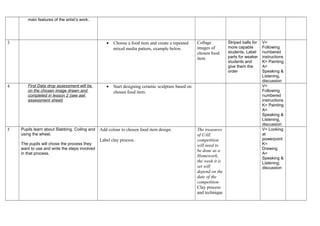
main features of the artist’s work.
3 • Choose a food item and create a repeated
mixed media pattern, example below.
Collage
images of
chosen food
item
Striped balls for
more capable
students. Label
parts for weaker
students and
give them the
order
V=
Following
numbered
instructions
K= Painting
A=
Speaking &
Listening,
discussion
4 First Data drop assessment will be
on the chosen image drawn and
completed in lesson 2 (see awl
assessment sheet)
• Start designing ceramic sculpture based on
chosen food item.
V=
Following
numbered
instructions
K= Painting
A=
Speaking &
Listening,
discussion
5 Pupils learn about Slabbing, Coiling and
using the wheel.
The pupils will chose the process they
want to use and write the steps involved
in that process.
Add colour to chosen food item design.
Label clay process.
The treasures
of UAE
competition
will need to
be done as a
Homework,
the week it is
set will
depend on the
date of the
competition
Clay process
and technique
V= Looking
at
powerpoint
K=
Drawing
A=
Speaking &
Listening,
discussion
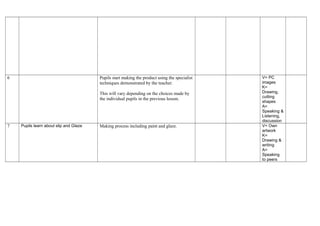
6 Pupils start making the product using the specialist
techniques demonstrated by the teacher.
This will vary depending on the choices made by
the individual pupils in the previous lesson.
V= PC
images
K=
Drawing,
cutting
shapes
A=
Speaking &
Listening,
discussion
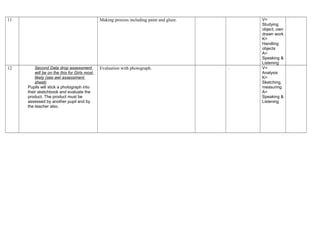
7 Pupils learn about slip and Glaze Making process including paint and glaze. V= Own
artwork
K=
Drawing &
writing
A=
Speaking
to peers
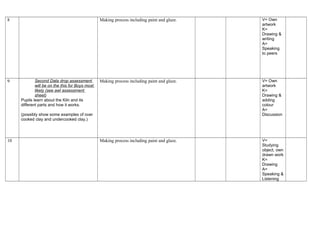
8 Making process including paint and glaze. V= Own
artwork
K=
Drawing &
writing
A=
Speaking
to peers
9 Second Data drop assessment
will be on the this for Boys most
likely (see awl assessment
sheet)
Pupils learn about the Kiln and its
different parts and how it works.
(possibly show some examples of over
cooked clay and undercooked clay.)
Making process including paint and glaze. V= Own
artwork
K=
Drawing &
adding
colour
A=
Discussion
10 Making process including paint and glaze. V=
Studying
object, own
drawn work
K=
Drawing
A=
Speaking &
Listening
11 Making process including paint and glaze. V=
Studying
object, own
drawn work
K=
Handling
objects
A=
Speaking &
Listening
12 Second Data drop assessment
will be on the this for Girls most
likely (see awl assessment
sheet)
Pupils will stick a photograph into
their sketchbook and evaluate the
product. The product must be
assessed by another pupil and by
the teacher also.
Evaluation with photograph. . V=
Analysis
K=
Sketching,
measuring
A=
Speaking &
Listening
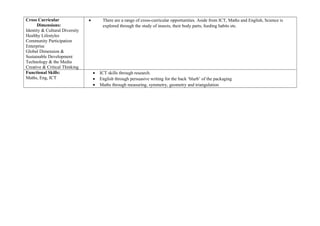
Cross Curricular
Dimensions:
Identity & Cultural Diversity
Healthy Lifestyles
Community Participation
Enterprise
Global Dimension &
Sustainable Development
Technology & the Media
Creative & Critical Thinking
• There are a range of cross-curricular opportunities. Aside from ICT, Maths and English, Science is
explored through the study of insects, their body parts, feeding habits etc.
Functional Skills:
Maths, Eng, ICT
• ICT skills through research.
• English through persuasive writing for the back ‘blurb’ of the packaging
• Maths through measuring, symmetry, geometry and triangulation

Year 9 ceramics sow

  • 1.
    S c ho o l o f R e s e a r c h S c i e n c e Year 9 Ceramics Scheme of work About the Unit What will pupils do? Students will build on the skills learnt in KS2, whilst at the same time, develop a more detailed, in-depth knowledge of art. They will work with a variety of media – paints, pencils, sculpture. What skills/knowledge will they develop? Students will understand the elements of art and begin to try out a range of modern and traditional techniques and skills Why will they do this? The art work will be modern and relevant to today’s design world. Students will learn the basics and groundwork to build on in future years How will this be delivered? – project learning – group work – independent study. Basic drawing, tones, hatching as a form of mark-making, study of a range of differing artists, basic C.A.D. work, 3D work creating sculptures, decision making and experimentation Every Child Matters (ECM) Issues Stay Safe – A clearly-defined set of rules & procedures in place and adhered to for working in the studio. Students are encouraged to participate but have a healthy respect for materials and tools. Enjoy and Achieve – Each student will produce a range of artwork that will hopefully be enjoyable and relevant. They are encouraged to take work home also once complete and work at home, showing their parents and family. Make a Positive Contribution – Much of the work is envisaged to be displayed around the school Economic Well Being – Use of ‘trash’ for the Chris Goodwin sculpture proves that art is not for the ‘elite’ and does not have to be expensive Personal Learning & Thinking Skills (PLTS) Assessment Independent enquirers: For pupils to learn and develop their skills base in this SoW. They will question when and where it is appropriate to use the skills they have newly acquired and to develop them accordingly. They will research home works set and analyse information collected. Creative Thinkers: Pupils will be given encouragement and opportunities to develop and stylise their new skills in set home works and class work. They will learn to take ownership over their work. Appropriate questions will be asked to further develop their understanding. Reflective Learners: Pupils will be encouraged to review and refine their work as it progresses. Opportunities will be given for peer assessment to enhance their inquisitive persona. Team Workers: Constructive support and feedback opportunities will be allocated during lesson times. This will allow pupils to question their own skills and review them for possible development. Pupils will work in teams for an investigative homework project lasting a number of weeks.
  • 2.
    Self-Managers: Pupil willbe working in their own sketchbooks and will be responsible of the outcomes they produce. Here, they will take risks to further extend their knowledge of skills being taught. Effective Participators: Pupils will be encouraged to guide and help those around them. Identifying problems and improvements will benefit the each This will take a variety of forms, including self-assessment. Students will be asked to level their work, to choose tasks of varying degrees of difficulty. Work will be marked using the DT Dept. level sheets, these show the level descriptors for each level and category. L 60 min Objectives At the end of the lesson the pupils will be able to: Activities (Inc H&S) H/W Extension Differentiation Teaching Style s V,K,A (exa mple s) D&T Po S 1 • Understand expectations of the Ceramics dept. Understand how the pupils are awarded their pathway & gain knowledge of National Curriculum Art & Design marking criteria. • Understand & name the chosen Artist. • Understand the main features of that artists work. • Introduce Ceramics. Run through your expectations and rules. Organise a seating plan and mention how work will be marked/levelled. Students to write down equipment they are required to bring with them – pen, pencil, coloured pencils etc. Level sheets will be given to the students & stuck into their books • Introduce students to famous Ceramics Artist. Using PowerPoint, students are to understand the features of that Artists work. They are to choose and draw an image based on that artists work. Stress importance of accuracy when drawing the squares and adding colour. Complete any work not finished on Title page on Pop Art Food V= Studying art K= Group work A= Speaking & Listening, discussion 2 • Understand the term block colouring. • Using Peer and Self Analysis to analyse the drawing and discuss the • The pupils add block colour and annotate their drawings main features.. Contextual research on the 3 chosen artists V=
  • 3.
    main features ofthe artist’s work. 3 • Choose a food item and create a repeated mixed media pattern, example below. Collage images of chosen food item Striped balls for more capable students. Label parts for weaker students and give them the order V= Following numbered instructions K= Painting A= Speaking & Listening, discussion 4 First Data drop assessment will be on the chosen image drawn and completed in lesson 2 (see awl assessment sheet) • Start designing ceramic sculpture based on chosen food item. V= Following numbered instructions K= Painting A= Speaking & Listening, discussion 5 Pupils learn about Slabbing, Coiling and using the wheel. The pupils will chose the process they want to use and write the steps involved in that process. Add colour to chosen food item design. Label clay process. The treasures of UAE competition will need to be done as a Homework, the week it is set will depend on the date of the competition Clay process and technique V= Looking at powerpoint K= Drawing A= Speaking & Listening, discussion
  • 4.
    6 Pupils startmaking the product using the specialist techniques demonstrated by the teacher. This will vary depending on the choices made by the individual pupils in the previous lesson. V= PC images K= Drawing, cutting shapes A= Speaking & Listening, discussion 7 Pupils learn about slip and Glaze Making process including paint and glaze. V= Own artwork K= Drawing & writing A= Speaking to peers
  • 5.
    8 Making processincluding paint and glaze. V= Own artwork K= Drawing & writing A= Speaking to peers 9 Second Data drop assessment will be on the this for Boys most likely (see awl assessment sheet) Pupils learn about the Kiln and its different parts and how it works. (possibly show some examples of over cooked clay and undercooked clay.) Making process including paint and glaze. V= Own artwork K= Drawing & adding colour A= Discussion 10 Making process including paint and glaze. V= Studying object, own drawn work K= Drawing A= Speaking & Listening
  • 6.
    11 Making processincluding paint and glaze. V= Studying object, own drawn work K= Handling objects A= Speaking & Listening 12 Second Data drop assessment will be on the this for Girls most likely (see awl assessment sheet) Pupils will stick a photograph into their sketchbook and evaluate the product. The product must be assessed by another pupil and by the teacher also. Evaluation with photograph. . V= Analysis K= Sketching, measuring A= Speaking & Listening
  • 7.
    Cross Curricular Dimensions: Identity &Cultural Diversity Healthy Lifestyles Community Participation Enterprise Global Dimension & Sustainable Development Technology & the Media Creative & Critical Thinking • There are a range of cross-curricular opportunities. Aside from ICT, Maths and English, Science is explored through the study of insects, their body parts, feeding habits etc. Functional Skills: Maths, Eng, ICT • ICT skills through research. • English through persuasive writing for the back ‘blurb’ of the packaging • Maths through measuring, symmetry, geometry and triangulation