Elementary Sorts


                                                                ‣    rules of the game
                                                                ‣    selection sort
                                                                ‣    insertion sort
                                                                ‣    sorting challenges
                                                                ‣    shellsort
Reference:
  Algorithms in Java, Chapter 6
                                                                 Except as otherwise noted, the content of this presentation
  http://www.cs.princeton.edu/algs4                              is licensed under the Creative Commons Attribution 2.5 License.


 Algorithms in Java, 4th Edition   · Robert Sedgewick and Kevin Wayne · Copyright © 2008             ·    September 2, 2009 2:43:34 AM
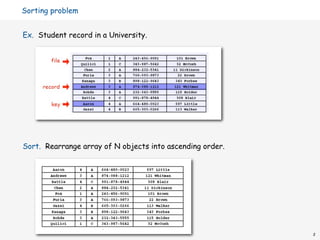
Sorting problem


Ex. Student record in a University.


Sort. Rearrange array of N objects into ascending order.


                                                           2
Sample sort client


Goal. Sort any type of data.
Ex 1. Sort random numbers in ascending order.


  public class Experiment                       % java Experiment 10
  {                                             0.08614716385210452
     public static void main(String[] args)     0.09054270895414829
                                                0.10708746304898642
     {
                                                0.21166190071646818
        int N = Integer.parseInt(args[0]);      0.363292849257276
        Double[] a = new Double[N];             0.460954145685913
        for (int i = 0; i < N; i++)             0.5340026311350087
           a[i] = StdRandom.uniform();          0.7216129793703496
        Insertion.sort(a);                      0.9003500354411443
                                                0.9293994908845686
        for (int i = 0; i < N; i++)
           StdOut.println(a[i]);
     }
  }


                                                                       3
Sample sort client


Goal. Sort any type of data.
Ex 2. Sort strings from standard input in alphabetical order.


   public class StringSort
   {
      public static void main(String[] args)
      {
         String[] a = StdIn.readAll().split("s+");
         Insertion.sort(a);
         for (int i = 0; i < N; i++)
            StdOut.println(a[i]);
      }
   }


                     % more words3.txt
                     bed bug dad dot zoo ... all bad bin

                     % java StringSort < words.txt
                     all bad bed bug dad ... yes yet zoo


                                                                4
Sample sort client


Goal. Sort any type of data.
Ex 3. Sort the files in a given directory by filename.


  import java.io.File;                                   % java Files .
  public class Files                                     Insertion.class
  {                                                      Insertion.java
                                                         InsertionX.class
     public static void main(String[] args)
                                                         InsertionX.java
     {                                                   Selection.class
        File directory = new File(args[0]);              Selection.java
        File[] files = directory.listFiles();            Shell.class
        Insertion.sort(files);                           Shell.java
        for (int i = 0; i < files.length; i++)           ShellX.class
                                                         ShellX.java
           StdOut.println(files[i]);
     }
  }


                                                                            5
Callbacks


Goal. Sort any type of data.


Q. How can sort know to compare data of type String, Double, and File
without any information about the type of an item?


Callbacks.
•   Client passes array of objects to sorting routine.
•   Sorting routine calls back object's compare function as needed.


Implementing callbacks.
•   Java: interfaces.
•   C: function pointers.
•   C++: class-type functors.
•   ML: first-class functions and functors.


                                                                        6
Callbacks: roadmap

client                                                                   object implementation
import java.io.File;                                                     public class File
public class SortFiles                                                   implements Comparable<File>
{                                                                        {
   public static void main(String[] args)                                   ...
   {                                                                        public int compareTo(File b)
      File directory = new File(args[0]);                                   {
      File[] files = directory.listFiles();                                     ...
      Insertion.sort(files);                                                    return -1;
      for (int i = 0; i < files.length; i++)                                    ...
         StdOut.println(files[i]);                                              return +1;
   }                                                                            ...
}                                                                               return 0;
                                                                            }
                                                                         }


                                              built in to Java
interface

  public interface Comparable<Item>                              sort implementation
  {                                                              public static void sort(Comparable[] a)
     public int compareTo(Item);                                 {
  }                                                                 int N = a.length;
                                                                    for (int i = 0; i < N; i++)
                                                                       for (int j = i; j > 0; j--)
                                                                          if (a[j].compareTo(a[j-1]))
                                                                               exch(a, j, j-1);
                                                                          else break;
                  Key point: no reference to File
                                                                 }

                                                                                                           7
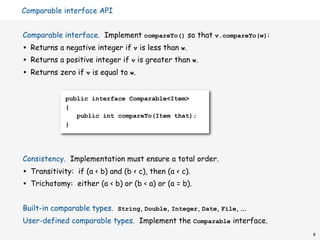
Comparable interface API


Comparable interface. Implement compareTo() so that v.compareTo(w):
•   Returns a negative integer if v is less than w.
•   Returns a positive integer if v is greater than w.
•   Returns zero if v is equal to w.


               public interface Comparable<Item>
               {
                  public int compareTo(Item that);
               }


Consistency. Implementation must ensure a total order.
•   Transitivity: if (a < b) and (b < c), then (a < c).
•   Trichotomy: either (a < b) or (b < a) or (a = b).


Built-in comparable types. String, Double, Integer, Date, File, ...
User-defined comparable types. Implement the Comparable interface.
                                                                      8
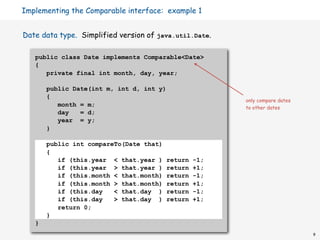
Implementing the Comparable interface: example 1


Date data type. Simplified version of java.util.Date.

   public class Date implements Comparable<Date>
   {
      private final int month, day, year;

       public Date(int m, int d, int y)
       {
                                                        only compare dates
          month = m;                                    to other dates
          day   = d;
          year = y;
       }

       public int compareTo(Date that)
       {
          if (this.year < that.year )    return   -1;
          if (this.year > that.year )    return   +1;
          if (this.month < that.month)   return   -1;
          if (this.month > that.month)   return   +1;
          if (this.day   < that.day )    return   -1;
          if (this.day   > that.day )    return   +1;
          return 0;
       }
   }
                                                                             9
Implementing the Comparable interface: example 2


Domain names.
•   Subdomain: bolle.cs.princeton.edu.
•   Reverse subdomain: edu.princeton.cs.bolle.
•   Sort by reverse subdomain to group by category.
                                                                 subdomains
     public class Domain implements Comparable<Domain>
     {                                                           ee.princeton.edu
        private final String[] fields;                           cs.princeton.edu
        private final int N;                                     princeton.edu
                                                                 cnn.com
         public Domain(String name)
                                                                 google.com
         {
                                                                 apple.com
             fields = name.split(".");
             N = fields.length;                                  www.cs.princeton.edu
         }                                                       bolle.cs.princeton.edu

         public int compareTo(Domain that)
         {                                                       reverse-sorted subdomains
            for (int i = 0; i < Math.min(this.N, that.N); i++)
            {                                                    com.apple
               String s = fields[this.N - i - 1];                com.cnn
               String t = fields[that.N - i - 1];                com.google
               int cmp = s.compareTo(t);
                                                                 edu.princeton
               if      (cmp < 0) return -1;
                                                                 edu.princeton.cs
               else if (cmp > 0) return +1;
            }
                                                                 edu.princeton.cs.bolle
            return this.N - that.N;                              edu.princeton.cs.www
         }                                                       edu.princeton.ee
     }
                                                                                             10
Two useful sorting abstractions


Helper functions. Refer to data through compares and exchanges.


Less. Is object v less than w ?


     private static boolean less(Comparable v, Comparable w)
     {
        return v.compareTo(w) < 0;
     }


Exchange. Swap object in array a[] at index i with the one at index j.


     private static void exch(Comparable[] a, int i, int j)
     {
        Comparable t = a[i];
        a[i] = a[j];
        a[j] = t;
     }

                                                                         11
Testing


Q. How to test if an array is sorted?


     private static boolean isSorted(Comparable[] a)
     {
        for (int i = 1; i < a.length; i++)
           if (less(a[i], a[i-1])) return false;
        return true;
     }


Q. If the sorting algorithm passes the test, did it correctly sort its input?
A1. Not necessarily!
A2. Yes, if data accessed only through exch() and less().


                                                                                12
‣   rules of the game
‣   selection sort
‣   insertion sort
‣   sorting challenges
‣   shellsort


                         13
Selection sort


Algorithm. ↑ scans from left to right.


Invariants.
•   Elements to the left of ↑ (including ↑) fixed and in ascending order.
•   No element to right of ↑ is smaller than any element to its left.


                                        ↑
                       in final order

                                                                            14
Selection sort inner loop


To maintain algorithm invariants:


•   Move the pointer to the right.


       i++;
                                               in final order    ↑

•   Identify index of minimum item on right.


       int min = i;
       for (int j = i+1; j < N; j++)
          if (less(a[j], a[min]))
                                                in final order   ↑   ↑
             min = j;


•   Exchange into position.


       exch(a, i, min);
                                               in final order    ↑   ↑
                                                                         15
Selection sort: Java implementation


       public class Selection {

           public static void sort(Comparable[] a)
           {
              int N = a.length;
              for (int i = 0; i < N; i++)
              {
                 int min = i;
                 for (int j = i+1; j < N; j++)
                    if (less(a[j], a[min]))
                       min = j;
                 exch(a, i, min);
              }
           }

           private boolean less(Comparable v, Comparable w)
           { /* as before */ }

           private boolean exch(Comparable[] a, int i, int j)
           { /* as before */ }
       }


                                                                16
Selection sort: mathematical analysis


Proposition A. Selection sort uses (N-1) + (N-2) + ... + 1 + 0 ~ N2/2
compares and N exchanges.


                                      a[]
                                                                    entries in black
         i min      0   1   2   3   4 5 6       7   8   9 10     are examined to find
                                                                     the minimum
                    S   O   R   T   E   X   A   M   P   L   E
         0     6    S   O   R   T   E   X   A   M   P   L   E
                                                                    entries in red
         1     4    A   O   R   T   E   X   S   M   P   L   E        are a[min]
         2    10    A   E   R   T   O   X   S   M   P   L   E
         3     9    A   E   E   T   O   X   S   M   P   L   R
         4     7    A   E   E   L   O   X   S   M   P   T   R
         5     7    A   E   E   L   M   X   S   O   P   T   R
         6     8    A   E   E   L   M   O   S   X   P   T   R
         7    10    A   E   E   L   M   O   P   X   S   T   R
         8     8    A   E   E   L   M   O   P   R   S   T   X
                                                                  entries in gray are
         9     9    A   E   E   L   M   O   P   R   S   T   X      in final position
        10    10    A   E   E   L   M   O   P   R   S   T   X
                    A   E   E   L   M   O   P   R   S   T   X

             Trace of selection sort (array contents just after each exchange)

Running time insensitive to input. Quadratic time, even if array is presorted.
Data movement is minimal. Linear number of exchanges.
                                                                                        17
‣   rules of the game
‣   selection sort
‣   insertion sort
‣   sorting challenges
‣   shellsort


                         18
Insertion sort


Algorithm. ↑ scans from left to right.


Invariants.
•   Elements to the left of ↑ (including ↑) are in ascending order.
•   Elements to the right of ↑ have not yet been seen.


                    in order   ↑            not yet seen


                                                                      19
Insertion sort inner loop


To maintain algorithm invariants:


•   Move the pointer to the right.


       i++;

                                                              ↑

                                                   in order        not yet seen


•   Moving from right to left, exchange
    a[i]   with each larger element to its left.


       for (int j = i; j > 0; j--)
          if (less(a[j], a[j-1]))
               exch(a, j, j-1);
          else break;                                ↑ ↑ ↑↑

                                                   in order       not yet seen

                                                                                  20
Insertion sort: Java implementation


       public class Insertion {

           public static void sort(Comparable[] a)
           {
              int N = a.length;
              for (int i = 0; i < N; i++)
                 for (int j = i; j > 0; j--)
                    if (less(a[j], a[j-1]))
                       exch(a, j, j-1);
                    else break;
           }

           private boolean less(Comparable v, Comparable w)
           { /* as before */ }

           private boolean exch(Comparable[] a, int i, int j)
           { /* as before */ }
       }


                                                                21
Insertion sort: mathematical analysis


Proposition B. For randomly-ordered data with distinct keys, insertion sort
uses ~ N2/4 compares and N2/4 exchanges on the average.


Pf. For randomly data, we expect each element to move halfway back.


                                         a[]
            i     j    0   1   2   3   4 5 6       7   8   9 10
                       S   O   R   T   E   X   A   M   P   L   E       entries in gray
                                                                        do not move
            1     0    O   S   R   T   E   X   A   M   P   L   E
            2     1    O   R   S   T   E   X   A   M   P   L   E
            3     3    O   R   S   T   E   X   A   M   P   L   E
            4     0    E   O   R   S   T   X   A   M   P   L   E       entry in red
                                                                         is a[j]
            5     5    E   O   R   S   T   X   A   M   P   L   E
            6     0    A   E   O   R   S   T   X   M   P   L   E
            7     2    A   E   M   O   R   S   T   X   P   L   E
                                                                      entries in black
            8     4    A   E   M   O   P   R   S   T   X   L   E     moved one position
            9     2    A   E   L   M   O   P   R   S   T   X   E     right for insertion
           10     2    A   E   E   L   M   O   P   R   S   T   X
                       A   E   E   L   M   O   P   R   S   T   X

                Trace of insertion sort (array contents just after each insertion)

                                                                                           22
Insertion sort: best and worst case


Best case. If the input is in ascending order, insertion sort makes
N-1 compares and 0 exchanges.


              A E E L M O P R S T X


Worst case. If the input is in descending order (and no duplicates),
insertion sort makes ~ N2/2 compares and ~ N2/2 exchanges.


              X T S R P O M L E E A


                                                                       23
Insertion sort: partially sorted inputs


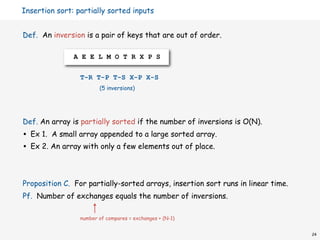
Def. An inversion is a pair of keys that are out of order.

                A E E L M O T R X P S


                  T-R T-P T-S X-P X-S
                         (5 inversions)


Def. An array is partially sorted if the number of inversions is O(N).
•   Ex 1. A small array appended to a large sorted array.
•   Ex 2. An array with only a few elements out of place.


Proposition C. For partially-sorted arrays, insertion sort runs in linear time.
Pf. Number of exchanges equals the number of inversions.

                  number of compares = exchanges + (N-1)


                                                                                  24
‣   rules of the game
‣   selection sort
‣   insertion sort
‣   sorting challenges
‣   shellsort


                         25
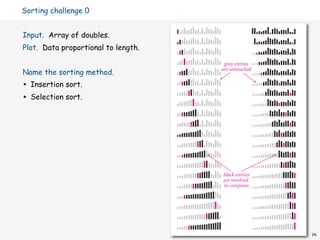
Rather than tracing the progress of a sort with key values such as letters, numbers or
      Sorting challenge 0
words, we use vertical bars, to be sorted by their heights. As you will see, the advantage
of such a representation is that it can give insights into
the behavior of a sorting method.
      Input. Array of doubles.
         For example, you can see at a glance on the vi-
sual traces at rightproportional to length.not touch
      Plot. Data that insertion sort does
entries to the right of the scan pointer and selection
sort does not touch entries to the left of the scan point-                      gray entries
      Name the clear from the visual traces that, since
                    sorting method.
                                                                               are untouched
er. Moreover, it is
      • Insertion sort.
insertion sort also does not touch entries smaller than

      • Selection sort.
the inserted element, it uses about half the number of
compares as selection sort, on the average.
         With our StdDraw library, developing a visual
trace is not much more difficult than doing a standard
trace. We sort Double values, instrument the algorithm
to call show() as appropriate (just as we do for a stan-
dard trace) and develop a version of show() that uses
StdDraw to draw the bars instead of printing the results.
The most complicated task is setting the scale for the y
axis so that the lines of the trace appear in the expected                      black entries
order. You are encouraged to work EXERCISE 3.1.19 in                            are involved
                                                                                in compares
order to gain a better appreciation of the value of visual
traces and the ease of creating them.
         An even simpler task is to animate the trace
so that you can see the array dynamically evolve to the
sorted result. Developing an animated trace involves
essentially the same process described in the previous          insertion sort                selection sort
                                                                                                               26
Sorting challenge 1


Problem. Sort a file of huge records with tiny keys.
Ex. Reorganize your MP3 files.


Which sorting method to use?
•   System sort.
•   Insertion sort.
•   Selection sort.


                                                       27
Sorting challenge 1


Problem. Sort a file of huge records with tiny keys.
Ex. Reorganize your MP3 files.


Which sorting method to use?
•   System sort.            probably no, selection sort simpler and faster
•   Insertion sort.         no, too many exchanges
•   Selection sort.         yes, linear time under reasonable assumptions


Ex: 5,000 records, each 2 million bytes with 100-byte keys.

    Cost of comparisons: 100 × 50002 / 2 = 1.25 billion.

    Cost of exchanges: 2,000,000 × 5,000 = 10 trillion.

    System sort might be a factor of log (5000) slower.


                                                                             28
Sorting challenge 2


Problem. Sort a huge randomly-ordered file of small records.
Ex. Process transaction records for a phone company.


Which sorting method to use?
•   System sort.
•   Insertion sort.
•   Selection sort.


                                                               29
Sorting challenge 2


Problem. Sort a huge randomly-ordered file of small records.
Ex. Process transaction records for a phone company.


Which sorting method to use?
•   System sort.          yes, it's designed for this problem
•   Insertion sort.       no, quadratic time for randomly ordered files
•   Selection sort.       no, always quadratic time


                                                                          30
Sorting challenge 3


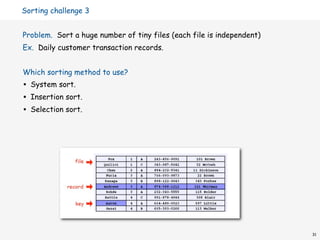
Problem. Sort a huge number of tiny files (each file is independent)
Ex. Daily customer transaction records.


Which sorting method to use?
•   System sort.
•   Insertion sort.
•   Selection sort.


                                                                       31
Sorting challenge 3


Problem. Sort a huge number of tiny files (each file is independent)
Ex. Daily customer transaction records.


Which sorting method to use?
•   System sort.          no, too much overhead
•   Insertion sort.       yes, less overhead than system sort
•   Selection sort.       yes, less overhead than system sort


Ex: 4 record file.

    4 N log N + 35 = 70

    2N2 = 32


                                                                       32
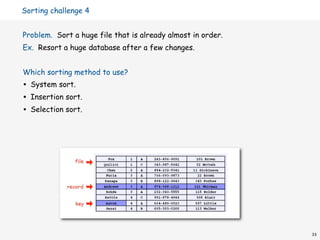
Sorting challenge 4


Problem. Sort a huge file that is already almost in order.
Ex. Resort a huge database after a few changes.


Which sorting method to use?
•   System sort.
•   Insertion sort.
•   Selection sort.


                                                             33
Sorting challenge 4


Problem. Sort a huge file that is already almost in order.
Ex. Resort a huge database after a few changes.


Which sorting method to use?
•   System sort.           no, insertion sort simpler and faster
•   Insertion sort.        yes, linear time for most definitions of "in order"
•   Selection sort.        no, always takes quadratic time


Ex.
•   A B C D E F H I J G P K L M N O Q R S T U V W X Y Z
•   Z A B C D E F G H I J K L M N O P Q R S T U V W X Y


                                                                                 34
‣   rules of the game
‣   selection sort
‣   insertion sort
‣   animations
‣   shellsort


                        35
Insertion sort animation

                    left of pointer is in sorted order       right of pointer is untouched


  a[i]


                                                         i


                                                                                             36
Insertion sort animation


Reason it is slow: excessive data movement.
                                              37
Insertion sort animation


Reason it is slow: excessive data movement.
                                              37
move through the array only one place at a time. For exa
Shellsort overview                     smallest key happens to be at the end of the array, N steps are
                                       ment where it belongs. Shellsort is a simple extension of ins
                                       by allowing exchanges of elements that are far apart, to pro
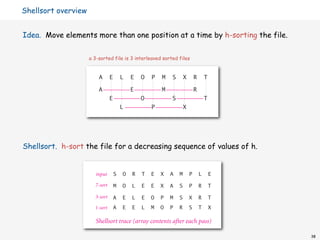
Idea. Move elements more than one position at a time by h-sorting the file.
                                       that can be efficiently sorted, eventually by insertion sort.
                                                  The idea is to rearrange the array to give it the pro
                   a 3-sorted file is 3 interleaved sorted files       element (starting anywhere)
                      h=3                                              Such an array is said to be h-s
                        A E L E O P M S X R T                          h-sorted array is h independen
                        A             E             M            R     terleaved together. By h-sorting
                            E              O            S          T   we can move elements in the ar
                                 L             P             X         make it easier to h-sort for sma
                                                                       a procedure for any increment
                      h=7
                                                                       ends in 1 will produce a sorted
                        M O L E E X A S P R T
                                                                                One way to impleme
Shellsort. h-sort the M file for a decreasing S          sequence of values of to use insertion sort
                                                                       each h, h.
                            E                                P         the h subsequences. Despite
                                 L                               R
                                                                       this process, we can use an ev
                                      E                            T
                      input S O R T E X A M P L E                      cisely because the subsequenc
                                           E
                      7-sort M O L E E X A S P R T
                                               L
                                                                       h-sorting the array, we simply
                      3-sort A E L E O P M S X R T  A
                                                                       the previous elements in its
                                                                       larger elements to the right. W
                      An h-sorted file is h M O P R sorted files using the insertion-sort code,
                      1-sort A E E L interleaved S T X

                      Shellsort trace (array contents after each pass) or decrement by h instead of 1
                                       array. This observation reduces the shellsort implementatio
                                                                                                  38
h-sorting


How to h-sort a file? Insertion sort, with stride length h.


                    3-sorting a file


                    M    O    L    E   E   X   A   S   P   R   T
                    E    O    L    M   E   X   A   S   P   R   T
                    E    E    L    M   O   X   A   S   P   R   T
                    E    E    L    M   O   X   A   S   P   R   T
                    A    E    L    E   O   X   M   S   P   R   T
                    A    E    L    E   O   X   M   S   P   R   T
                    A    E    L    E   O   P   M   S   X   R   T
                    A    E    L    E   O   P   M   S   X   R   T
                    A    E    L    E   O   P   M   S   X   R   T
                    A    E    L    E   O   P   M   S   X   R   T


Why insertion sort?
•   Big increments ⇒ small subfiles.
•   Small increments ⇒ nearly in order. [stay tuned]


                                                                   39
Shellsort example


input                                                1-sort

         S   O   R   T   E   X   A   M   P   L   E            A   E   L   E   O   P   M   S   X   R   T
                                                              A   E   L   E   O   P   M   S   X   R   T
                                                              A   E   L   E   O   P   M   S   X   R   T
7-sort                                                        A   E   E   L   O   P   M   S   X   R   T
         S   O   R   T   E   X   A   M   P   L   E            A   E   E   L   O   P   M   S   X   R   T
         M   O   R   T   E   X   A   S   P   L   E            A   E   E   L   O   P   M   S   X   R   T
         M   O   R   T   E   X   A   S   P   L   E            A   E   E   L   M   O   P   S   X   R   T
         M   O   L   T   E   X   A   S   P   R   E            A   E   E   L   M   O   P   S   X   R   T
         M   O   L   E   E   X   A   S   P   R   T            A   E   E   L   M   O   P   S   X   R   T
                                                              A   E   E   L   M   O   P   R   S   X   T
                                                              A   E   E   L   M   O   P   R   S   T   X
3-sort
         M   O   L   E   E   X   A   S   P   R   T
         E   O   L   M   E   X   A   S   P   R   T
         E   E   L   M   O   X   A   S   P   R   T   result

         E   E   L   M   O   X   A   S   P   R   T            A   E   E   L   M   O   P   R   S   T   X
         A   E   L   E   O   X   M   S   P   R   T
         A   E   L   E   O   X   M   S   P   R   T
         A   E   L   E   O   P   M   S   X   R   T
         A   E   L   E   O   P   M   S   X   R   T
         A   E   L   E   O   P   M   S   X   R   T

                                                                                                          40
Shellsort: Java implementation


      public class Shell
      {
         public static void sort(Comparable[] a)
         {
            int N = a.length;
            int[] incs = { 1391376, 463792, 198768, 86961,
                            33936, 13776, 4592, 1968, 861,     magic increment
                            336, 112, 48, 21, 7, 3, 1             sequence
                          };
            for (int k = 0; k < incs.length; k++)
            {
               int h = incs[k];
               for (int i = h; i < N; i++)
                  for (int j = i; j >= h; j-= h)
                     if (less(a[j], a[j-h]))                   insertion sort
                         exch(a, j, j-h);
                     else break;
            }
         }

          private boolean less(Comparable v, Comparable w)
          { /* as before */ }

          private boolean exch(Comparable[] a, int i, int j)
          { /* as before */ }
      }
                                                                                 41
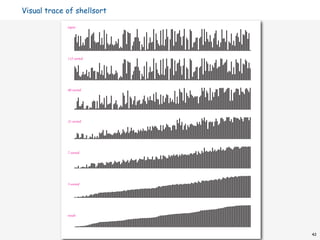
Visual trace of shellsort

             input


             112-sorted


             48-sorted


             21-sorted


             7-sorted


             3-sorted


             result


                            42
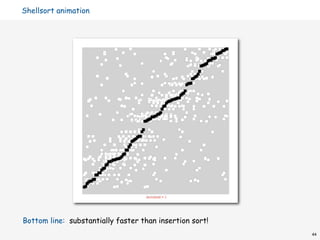
Shellsort animation


 big increment


                      small increment


                                        43
Shellsort animation


Bottom line: substantially faster than insertion sort!
                                                         44
Shellsort animation


Bottom line: substantially faster than insertion sort!
                                                         44
Empirical analysis of shellsort


Property. The number of compares used by shellsort with the increments 1, 4,
13, 40, ... is at most by a small multiple of N times the # of increments used.


                      N      comparisons   N1.289       2.5 N lg N

                    5,000          93       58             106

                    10,000        209       143            230

                    20,000        467       349            495

                    40,000        1022      855            1059

                    80,000        2266     2089            2257


                                                    measured in thousands


Remark. Accurate model has not yet been discovered (!)
                                                                                  45
Shellsort: mathematical analysis


Proposition. A g-sorted array remains g-sorted after h-sorting it.
Pf. Harder than you'd think!


 7-sort                                           3-sort

  M       O   R   T   E   X   A   S   P   L   E   M    O   L   E   E     X    A    S    P   R   T
  M       O   R   T   E   X   A   S   P   L   E   E    O   L   M   E     X    A    S    P   R   T
  M       O   L   T   E   X   A   S   P   R   E   E    E   L   M   O     X    A    S    P   R   T
  M       O   L   E   E   X   A   S   P   R   T   E    E   L   M   O     X    A    S    P   R   T
  M       O   L   E   E   X   A   S   P   R   T   A    E   L   E   O     X    M    S    P   R   T
                                                  A    E   L   E   O     X    M    S    P   R   T
                                                  A    E   L   E   O     P    M    S    X   R   T
                                                  A    E   L   E   O     P    M    S    X   R   T
                                                  A    E   L   E   O     P    M    S    X   R   T
                                                  A    E   L   E   O     P    M    S    X   R   T

                                                                       still 7-sorted


Proposition. The worst-case number of compares for shellsort using
the 3x+1 increment sequence 1, 4, 13, 40, 121, 364, … is O(N3/2).
                                                                                                    46
Why are we interested in shellsort?


Example of simple idea leading to substantial performance gains.


Useful in practice.
•   Fast unless file size is huge.
•   Tiny, fixed footprint for code (used in embedded systems).
•   Hardware sort prototype.


Simple algorithm, nontrivial performance, interesting questions
•   Asymptotic growth rate?
•   Best sequence of increments?
•   Average case performance?         open problem: find a better increment sequence


Lesson. Some good algorithms are still waiting discovery.


                                                                                       47

Elementary Sort

  • 1.
    Elementary Sorts ‣ rules of the game ‣ selection sort ‣ insertion sort ‣ sorting challenges ‣ shellsort Reference: Algorithms in Java, Chapter 6 Except as otherwise noted, the content of this presentation http://www.cs.princeton.edu/algs4 is licensed under the Creative Commons Attribution 2.5 License. Algorithms in Java, 4th Edition · Robert Sedgewick and Kevin Wayne · Copyright © 2008 · September 2, 2009 2:43:34 AM
  • 2.
    Sorting problem Ex. Studentrecord in a University. Sort. Rearrange array of N objects into ascending order. 2
  • 3.
    Sample sort client Goal.Sort any type of data. Ex 1. Sort random numbers in ascending order. public class Experiment % java Experiment 10 { 0.08614716385210452 public static void main(String[] args) 0.09054270895414829 0.10708746304898642 { 0.21166190071646818 int N = Integer.parseInt(args[0]); 0.363292849257276 Double[] a = new Double[N]; 0.460954145685913 for (int i = 0; i < N; i++) 0.5340026311350087 a[i] = StdRandom.uniform(); 0.7216129793703496 Insertion.sort(a); 0.9003500354411443 0.9293994908845686 for (int i = 0; i < N; i++) StdOut.println(a[i]); } } 3
  • 4.
    Sample sort client Goal.Sort any type of data. Ex 2. Sort strings from standard input in alphabetical order. public class StringSort { public static void main(String[] args) { String[] a = StdIn.readAll().split("s+"); Insertion.sort(a); for (int i = 0; i < N; i++) StdOut.println(a[i]); } } % more words3.txt bed bug dad dot zoo ... all bad bin % java StringSort < words.txt all bad bed bug dad ... yes yet zoo 4
  • 5.
    Sample sort client Goal.Sort any type of data. Ex 3. Sort the files in a given directory by filename. import java.io.File; % java Files . public class Files Insertion.class { Insertion.java InsertionX.class public static void main(String[] args) InsertionX.java { Selection.class File directory = new File(args[0]); Selection.java File[] files = directory.listFiles(); Shell.class Insertion.sort(files); Shell.java for (int i = 0; i < files.length; i++) ShellX.class ShellX.java StdOut.println(files[i]); } } 5
  • 6.
    Callbacks Goal. Sort anytype of data. Q. How can sort know to compare data of type String, Double, and File without any information about the type of an item? Callbacks. • Client passes array of objects to sorting routine. • Sorting routine calls back object's compare function as needed. Implementing callbacks. • Java: interfaces. • C: function pointers. • C++: class-type functors. • ML: first-class functions and functors. 6
  • 7.
    Callbacks: roadmap client object implementation import java.io.File; public class File public class SortFiles implements Comparable<File> { { public static void main(String[] args) ... { public int compareTo(File b) File directory = new File(args[0]); { File[] files = directory.listFiles(); ... Insertion.sort(files); return -1; for (int i = 0; i < files.length; i++) ... StdOut.println(files[i]); return +1; } ... } return 0; } } built in to Java interface public interface Comparable<Item> sort implementation { public static void sort(Comparable[] a) public int compareTo(Item); { } int N = a.length; for (int i = 0; i < N; i++) for (int j = i; j > 0; j--) if (a[j].compareTo(a[j-1])) exch(a, j, j-1); else break; Key point: no reference to File } 7
  • 8.
    Comparable interface API Comparableinterface. Implement compareTo() so that v.compareTo(w): • Returns a negative integer if v is less than w. • Returns a positive integer if v is greater than w. • Returns zero if v is equal to w. public interface Comparable<Item> { public int compareTo(Item that); } Consistency. Implementation must ensure a total order. • Transitivity: if (a < b) and (b < c), then (a < c). • Trichotomy: either (a < b) or (b < a) or (a = b). Built-in comparable types. String, Double, Integer, Date, File, ... User-defined comparable types. Implement the Comparable interface. 8
  • 9.
    Implementing the Comparableinterface: example 1 Date data type. Simplified version of java.util.Date. public class Date implements Comparable<Date> { private final int month, day, year; public Date(int m, int d, int y) { only compare dates month = m; to other dates day = d; year = y; } public int compareTo(Date that) { if (this.year < that.year ) return -1; if (this.year > that.year ) return +1; if (this.month < that.month) return -1; if (this.month > that.month) return +1; if (this.day < that.day ) return -1; if (this.day > that.day ) return +1; return 0; } } 9
  • 10.
    Implementing the Comparableinterface: example 2 Domain names. • Subdomain: bolle.cs.princeton.edu. • Reverse subdomain: edu.princeton.cs.bolle. • Sort by reverse subdomain to group by category. subdomains public class Domain implements Comparable<Domain> { ee.princeton.edu private final String[] fields; cs.princeton.edu private final int N; princeton.edu cnn.com public Domain(String name) google.com { apple.com fields = name.split("."); N = fields.length; www.cs.princeton.edu } bolle.cs.princeton.edu public int compareTo(Domain that) { reverse-sorted subdomains for (int i = 0; i < Math.min(this.N, that.N); i++) { com.apple String s = fields[this.N - i - 1]; com.cnn String t = fields[that.N - i - 1]; com.google int cmp = s.compareTo(t); edu.princeton if (cmp < 0) return -1; edu.princeton.cs else if (cmp > 0) return +1; } edu.princeton.cs.bolle return this.N - that.N; edu.princeton.cs.www } edu.princeton.ee } 10
  • 11.
    Two useful sortingabstractions Helper functions. Refer to data through compares and exchanges. Less. Is object v less than w ? private static boolean less(Comparable v, Comparable w) { return v.compareTo(w) < 0; } Exchange. Swap object in array a[] at index i with the one at index j. private static void exch(Comparable[] a, int i, int j) { Comparable t = a[i]; a[i] = a[j]; a[j] = t; } 11
  • 12.
    Testing Q. How totest if an array is sorted? private static boolean isSorted(Comparable[] a) { for (int i = 1; i < a.length; i++) if (less(a[i], a[i-1])) return false; return true; } Q. If the sorting algorithm passes the test, did it correctly sort its input? A1. Not necessarily! A2. Yes, if data accessed only through exch() and less(). 12
  • 13.
    rules of the game ‣ selection sort ‣ insertion sort ‣ sorting challenges ‣ shellsort 13
  • 14.
    Selection sort Algorithm. ↑scans from left to right. Invariants. • Elements to the left of ↑ (including ↑) fixed and in ascending order. • No element to right of ↑ is smaller than any element to its left. ↑ in final order 14
  • 15.
    Selection sort innerloop To maintain algorithm invariants: • Move the pointer to the right. i++; in final order ↑ • Identify index of minimum item on right. int min = i; for (int j = i+1; j < N; j++) if (less(a[j], a[min])) in final order ↑ ↑ min = j; • Exchange into position. exch(a, i, min); in final order ↑ ↑ 15
  • 16.
    Selection sort: Javaimplementation public class Selection { public static void sort(Comparable[] a) { int N = a.length; for (int i = 0; i < N; i++) { int min = i; for (int j = i+1; j < N; j++) if (less(a[j], a[min])) min = j; exch(a, i, min); } } private boolean less(Comparable v, Comparable w) { /* as before */ } private boolean exch(Comparable[] a, int i, int j) { /* as before */ } } 16
  • 17.
    Selection sort: mathematicalanalysis Proposition A. Selection sort uses (N-1) + (N-2) + ... + 1 + 0 ~ N2/2 compares and N exchanges. a[] entries in black i min 0 1 2 3 4 5 6 7 8 9 10 are examined to find the minimum S O R T E X A M P L E 0 6 S O R T E X A M P L E entries in red 1 4 A O R T E X S M P L E are a[min] 2 10 A E R T O X S M P L E 3 9 A E E T O X S M P L R 4 7 A E E L O X S M P T R 5 7 A E E L M X S O P T R 6 8 A E E L M O S X P T R 7 10 A E E L M O P X S T R 8 8 A E E L M O P R S T X entries in gray are 9 9 A E E L M O P R S T X in final position 10 10 A E E L M O P R S T X A E E L M O P R S T X Trace of selection sort (array contents just after each exchange) Running time insensitive to input. Quadratic time, even if array is presorted. Data movement is minimal. Linear number of exchanges. 17
  • 18.
    rules of the game ‣ selection sort ‣ insertion sort ‣ sorting challenges ‣ shellsort 18
  • 19.
    Insertion sort Algorithm. ↑scans from left to right. Invariants. • Elements to the left of ↑ (including ↑) are in ascending order. • Elements to the right of ↑ have not yet been seen. in order ↑ not yet seen 19
  • 20.
    Insertion sort innerloop To maintain algorithm invariants: • Move the pointer to the right. i++; ↑ in order not yet seen • Moving from right to left, exchange a[i] with each larger element to its left. for (int j = i; j > 0; j--) if (less(a[j], a[j-1])) exch(a, j, j-1); else break; ↑ ↑ ↑↑ in order not yet seen 20
  • 21.
    Insertion sort: Javaimplementation public class Insertion { public static void sort(Comparable[] a) { int N = a.length; for (int i = 0; i < N; i++) for (int j = i; j > 0; j--) if (less(a[j], a[j-1])) exch(a, j, j-1); else break; } private boolean less(Comparable v, Comparable w) { /* as before */ } private boolean exch(Comparable[] a, int i, int j) { /* as before */ } } 21
  • 22.
    Insertion sort: mathematicalanalysis Proposition B. For randomly-ordered data with distinct keys, insertion sort uses ~ N2/4 compares and N2/4 exchanges on the average. Pf. For randomly data, we expect each element to move halfway back. a[] i j 0 1 2 3 4 5 6 7 8 9 10 S O R T E X A M P L E entries in gray do not move 1 0 O S R T E X A M P L E 2 1 O R S T E X A M P L E 3 3 O R S T E X A M P L E 4 0 E O R S T X A M P L E entry in red is a[j] 5 5 E O R S T X A M P L E 6 0 A E O R S T X M P L E 7 2 A E M O R S T X P L E entries in black 8 4 A E M O P R S T X L E moved one position 9 2 A E L M O P R S T X E right for insertion 10 2 A E E L M O P R S T X A E E L M O P R S T X Trace of insertion sort (array contents just after each insertion) 22
  • 23.
    Insertion sort: bestand worst case Best case. If the input is in ascending order, insertion sort makes N-1 compares and 0 exchanges. A E E L M O P R S T X Worst case. If the input is in descending order (and no duplicates), insertion sort makes ~ N2/2 compares and ~ N2/2 exchanges. X T S R P O M L E E A 23
  • 24.
    Insertion sort: partiallysorted inputs Def. An inversion is a pair of keys that are out of order. A E E L M O T R X P S T-R T-P T-S X-P X-S (5 inversions) Def. An array is partially sorted if the number of inversions is O(N). • Ex 1. A small array appended to a large sorted array. • Ex 2. An array with only a few elements out of place. Proposition C. For partially-sorted arrays, insertion sort runs in linear time. Pf. Number of exchanges equals the number of inversions. number of compares = exchanges + (N-1) 24
  • 25.
    rules of the game ‣ selection sort ‣ insertion sort ‣ sorting challenges ‣ shellsort 25
  • 26.
    Rather than tracingthe progress of a sort with key values such as letters, numbers or Sorting challenge 0 words, we use vertical bars, to be sorted by their heights. As you will see, the advantage of such a representation is that it can give insights into the behavior of a sorting method. Input. Array of doubles. For example, you can see at a glance on the vi- sual traces at rightproportional to length.not touch Plot. Data that insertion sort does entries to the right of the scan pointer and selection sort does not touch entries to the left of the scan point- gray entries Name the clear from the visual traces that, since sorting method. are untouched er. Moreover, it is • Insertion sort. insertion sort also does not touch entries smaller than • Selection sort. the inserted element, it uses about half the number of compares as selection sort, on the average. With our StdDraw library, developing a visual trace is not much more difficult than doing a standard trace. We sort Double values, instrument the algorithm to call show() as appropriate (just as we do for a stan- dard trace) and develop a version of show() that uses StdDraw to draw the bars instead of printing the results. The most complicated task is setting the scale for the y axis so that the lines of the trace appear in the expected black entries order. You are encouraged to work EXERCISE 3.1.19 in are involved in compares order to gain a better appreciation of the value of visual traces and the ease of creating them. An even simpler task is to animate the trace so that you can see the array dynamically evolve to the sorted result. Developing an animated trace involves essentially the same process described in the previous insertion sort selection sort 26
  • 27.
    Sorting challenge 1 Problem.Sort a file of huge records with tiny keys. Ex. Reorganize your MP3 files. Which sorting method to use? • System sort. • Insertion sort. • Selection sort. 27
  • 28.
    Sorting challenge 1 Problem.Sort a file of huge records with tiny keys. Ex. Reorganize your MP3 files. Which sorting method to use? • System sort. probably no, selection sort simpler and faster • Insertion sort. no, too many exchanges • Selection sort. yes, linear time under reasonable assumptions Ex: 5,000 records, each 2 million bytes with 100-byte keys.  Cost of comparisons: 100 × 50002 / 2 = 1.25 billion.  Cost of exchanges: 2,000,000 × 5,000 = 10 trillion.  System sort might be a factor of log (5000) slower. 28
  • 29.
    Sorting challenge 2 Problem.Sort a huge randomly-ordered file of small records. Ex. Process transaction records for a phone company. Which sorting method to use? • System sort. • Insertion sort. • Selection sort. 29
  • 30.
    Sorting challenge 2 Problem.Sort a huge randomly-ordered file of small records. Ex. Process transaction records for a phone company. Which sorting method to use? • System sort. yes, it's designed for this problem • Insertion sort. no, quadratic time for randomly ordered files • Selection sort. no, always quadratic time 30
  • 31.
    Sorting challenge 3 Problem.Sort a huge number of tiny files (each file is independent) Ex. Daily customer transaction records. Which sorting method to use? • System sort. • Insertion sort. • Selection sort. 31
  • 32.
    Sorting challenge 3 Problem.Sort a huge number of tiny files (each file is independent) Ex. Daily customer transaction records. Which sorting method to use? • System sort. no, too much overhead • Insertion sort. yes, less overhead than system sort • Selection sort. yes, less overhead than system sort Ex: 4 record file.  4 N log N + 35 = 70  2N2 = 32 32
  • 33.
    Sorting challenge 4 Problem.Sort a huge file that is already almost in order. Ex. Resort a huge database after a few changes. Which sorting method to use? • System sort. • Insertion sort. • Selection sort. 33
  • 34.
    Sorting challenge 4 Problem.Sort a huge file that is already almost in order. Ex. Resort a huge database after a few changes. Which sorting method to use? • System sort. no, insertion sort simpler and faster • Insertion sort. yes, linear time for most definitions of "in order" • Selection sort. no, always takes quadratic time Ex. • A B C D E F H I J G P K L M N O Q R S T U V W X Y Z • Z A B C D E F G H I J K L M N O P Q R S T U V W X Y 34
  • 35.
    rules of the game ‣ selection sort ‣ insertion sort ‣ animations ‣ shellsort 35
  • 36.
    Insertion sort animation left of pointer is in sorted order right of pointer is untouched a[i] i 36
  • 37.
    Insertion sort animation Reasonit is slow: excessive data movement. 37
  • 38.
    Insertion sort animation Reasonit is slow: excessive data movement. 37
  • 39.
    move through thearray only one place at a time. For exa Shellsort overview smallest key happens to be at the end of the array, N steps are ment where it belongs. Shellsort is a simple extension of ins by allowing exchanges of elements that are far apart, to pro Idea. Move elements more than one position at a time by h-sorting the file. that can be efficiently sorted, eventually by insertion sort. The idea is to rearrange the array to give it the pro a 3-sorted file is 3 interleaved sorted files element (starting anywhere) h=3 Such an array is said to be h-s A E L E O P M S X R T h-sorted array is h independen A E M R terleaved together. By h-sorting E O S T we can move elements in the ar L P X make it easier to h-sort for sma a procedure for any increment h=7 ends in 1 will produce a sorted M O L E E X A S P R T One way to impleme Shellsort. h-sort the M file for a decreasing S sequence of values of to use insertion sort each h, h. E P the h subsequences. Despite L R this process, we can use an ev E T input S O R T E X A M P L E cisely because the subsequenc E 7-sort M O L E E X A S P R T L h-sorting the array, we simply 3-sort A E L E O P M S X R T A the previous elements in its larger elements to the right. W An h-sorted file is h M O P R sorted files using the insertion-sort code, 1-sort A E E L interleaved S T X Shellsort trace (array contents after each pass) or decrement by h instead of 1 array. This observation reduces the shellsort implementatio 38
  • 40.
    h-sorting How to h-sorta file? Insertion sort, with stride length h. 3-sorting a file M O L E E X A S P R T E O L M E X A S P R T E E L M O X A S P R T E E L M O X A S P R T A E L E O X M S P R T A E L E O X M S P R T A E L E O P M S X R T A E L E O P M S X R T A E L E O P M S X R T A E L E O P M S X R T Why insertion sort? • Big increments ⇒ small subfiles. • Small increments ⇒ nearly in order. [stay tuned] 39
  • 41.
    Shellsort example input 1-sort S O R T E X A M P L E A E L E O P M S X R T A E L E O P M S X R T A E L E O P M S X R T 7-sort A E E L O P M S X R T S O R T E X A M P L E A E E L O P M S X R T M O R T E X A S P L E A E E L O P M S X R T M O R T E X A S P L E A E E L M O P S X R T M O L T E X A S P R E A E E L M O P S X R T M O L E E X A S P R T A E E L M O P S X R T A E E L M O P R S X T A E E L M O P R S T X 3-sort M O L E E X A S P R T E O L M E X A S P R T E E L M O X A S P R T result E E L M O X A S P R T A E E L M O P R S T X A E L E O X M S P R T A E L E O X M S P R T A E L E O P M S X R T A E L E O P M S X R T A E L E O P M S X R T 40
  • 42.
    Shellsort: Java implementation public class Shell { public static void sort(Comparable[] a) { int N = a.length; int[] incs = { 1391376, 463792, 198768, 86961, 33936, 13776, 4592, 1968, 861, magic increment 336, 112, 48, 21, 7, 3, 1 sequence }; for (int k = 0; k < incs.length; k++) { int h = incs[k]; for (int i = h; i < N; i++) for (int j = i; j >= h; j-= h) if (less(a[j], a[j-h])) insertion sort exch(a, j, j-h); else break; } } private boolean less(Comparable v, Comparable w) { /* as before */ } private boolean exch(Comparable[] a, int i, int j) { /* as before */ } } 41
  • 43.
    Visual trace ofshellsort input 112-sorted 48-sorted 21-sorted 7-sorted 3-sorted result 42
  • 44.
    Shellsort animation bigincrement small increment 43
  • 45.
    Shellsort animation Bottom line:substantially faster than insertion sort! 44
  • 46.
    Shellsort animation Bottom line:substantially faster than insertion sort! 44
  • 47.
    Empirical analysis ofshellsort Property. The number of compares used by shellsort with the increments 1, 4, 13, 40, ... is at most by a small multiple of N times the # of increments used. N comparisons N1.289 2.5 N lg N 5,000 93 58 106 10,000 209 143 230 20,000 467 349 495 40,000 1022 855 1059 80,000 2266 2089 2257 measured in thousands Remark. Accurate model has not yet been discovered (!) 45
  • 48.
    Shellsort: mathematical analysis Proposition.A g-sorted array remains g-sorted after h-sorting it. Pf. Harder than you'd think! 7-sort 3-sort M O R T E X A S P L E M O L E E X A S P R T M O R T E X A S P L E E O L M E X A S P R T M O L T E X A S P R E E E L M O X A S P R T M O L E E X A S P R T E E L M O X A S P R T M O L E E X A S P R T A E L E O X M S P R T A E L E O X M S P R T A E L E O P M S X R T A E L E O P M S X R T A E L E O P M S X R T A E L E O P M S X R T still 7-sorted Proposition. The worst-case number of compares for shellsort using the 3x+1 increment sequence 1, 4, 13, 40, 121, 364, … is O(N3/2). 46
  • 49.
    Why are weinterested in shellsort? Example of simple idea leading to substantial performance gains. Useful in practice. • Fast unless file size is huge. • Tiny, fixed footprint for code (used in embedded systems). • Hardware sort prototype. Simple algorithm, nontrivial performance, interesting questions • Asymptotic growth rate? • Best sequence of increments? • Average case performance? open problem: find a better increment sequence Lesson. Some good algorithms are still waiting discovery. 47

Editor's Notes

  • #9 Plus. Code reuse for all types of data. Minus. Significant overhead in inner loop. This course. Enables focus on algorithm implementation. Use same code for experiments, real-world data.
  • #12 details for bored safe to this.N - that.N since both are nonnegative
  • #14 A1: the sorting algorithm could change the entries in a[], e.g., all to the same value. Then it would surely pass the isSorted() test.
  • #17 assumes we&apos;re sorting real numbers
  • #18 two helper functions
  • #19 trucks parked at waiting station, leave in order of timestamp -&gt; expensive exchange, easy compare array contents just after each exchange
  • #22 assumes we&apos;re sorting real numbers
  • #24 array contents just after each insertion
  • #28 insertion sort (left) selection sort (right)
  • #29 Note: picture only intended for terminology, not to be consistent with sizes in problem
  • #34 ok, in reality system sort might just cutoff to insertion sort for small N
  • #40 red = element to move right into position, with stride length 3 Invented by D. L. Shell in 1959, hence its name
  • #41 A. Insertion sort is the method of choice for big and small increments!