1
Elementary Astronomical Calculations:
Gravity and motion ( Lecture – 1)
•By Sukalyan Bachhar
•Senior Curator
• National Museum of Science & Technology
•Ministry of Science & Technology
•Agargaon, Sher-E-Bangla Nagar, Dhaka-1207, Bangladesh
•Tel:+88-02-58160616 (Off), Contact: 01923522660;
•Websitw: www.nmst.gov.bd ; Facebook: Buet Tutor
&
•Member of Bangladesh Astronomical Association
•Short Bio-Data:
First Class BUET Graduate In Mechanical Engineering [1993].
Master Of Science In Mechanical Engineering From BUET [1998].
Field Of Specialization  Fluid Mechanics.
Field Of Personal Interest  Astrophysics.
Field Of Real Life Activity  Popularization Of Science & Technology From1995.
An Experienced Teacher Of Mathematics, Physics & Chemistry for O- ,A- , IB- &
Undergraduate Level.
Habituated as Science Speaker for Science Popularization.
Experienced In Supervising For Multiple Scientific Or Research Projects.
17 th BCS Qualified In Cooperative Cadre (Stood First On That Cadre).
Sukalyan Bachhar, Senior curator, National Museum of Science & Technology, Bangladesh
2
Basic facts: Measurements of angles:
• There are mainly three measurement systems for angles.
• (1) Degree system ; (2) Grade system & (3) Radian system.
• #(1) Degree system: One right angle = 900 .
– Meaning of superscript: ‘0’ Degree; ‘’ Minute & ‘’ Seconds.
– This system of measurement is popular one in engineering field.
• # (2) Grade system: One right angle = 100g .
– Meaning of superscript: ‘g’ Grade; ‘’ Minute & ‘’ Seconds.
– This system of measurement is suitable for calculating as it is based on 100
instead of degree system which is based on 60.
• # (3) Radian system: One right angle = c/2
Meaning of superscript: ‘c’  Radian [ ‘c’ comes from circle].
– This system of measurement is the most close to nature (related to circle)
and widely used in pure science.
Sukalyan Bachhar, Senior curator, National Museum of Science & Technology, Bangladesh
3
Basic facts: Concept about radian
• Definition of one radian: One radian is an angle subtended at centre by the arc of a circle whose length is
equal to the radius of the circle.
• Definition of  (pi) : It is experimentally established that the ratio of circumference (or perimeter) of a
circle to its diameter is always constant.
This constant is known as .
• Actual value of  is still undiscovered, it is used as:
 3.1415926535897932384626433832795 ; but as rough estimate,   22/7.
• Circumference of a circle:
From the above definition: Circumference/Diameter =   C/D = 
But, diameter = 2  Radius. So, C/2r =   C = 2r.
• i.e, C = 2r
[N.B. : Where ‘C’ ‘D’ and ‘r’ stand for circumference, diameter and radius
of a circle respectively.]
• It is clear that: in case of subtending an angle at centre by the arc of any
circle, the angle subtended at centre is directly proportional to its arc length..
• Now, from definition of one radian: Angle (in radian) = arc length/radius.
  = s/r  s = r.
[N.B. : Where ‘’ ‘s’ and ‘r’ stand for angle, arc length and radius of a circle respectively.]
• That is: one complete angle = Circumference/radius = 2r/r = 2. So, 2c = 3600  90 0 = c/2
Sukalyan Bachhar, Senior curator, National Museum of Science & Technology, Bangladesh
4
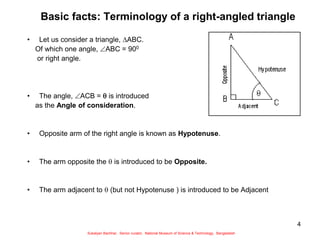
Basic facts: Terminology of a right-angled triangle
• Let us consider a triangle, ABC.
Of which one angle, ABC = 900
or right angle.
• The angle, ACB =  is introduced
as the Angle of consideration.
• Opposite arm of the right angle is known as Hypotenuse.
• The arm opposite the  is introduced to be Opposite.
• The arm adjacent to  (but not Hypotenuse ) is introduced to be Adjacent
Sukalyan Bachhar, Senior curator, National Museum of Science & Technology, Bangladesh
5
Basic facts: Trigonometric ratios
• Name of trigonometric ratios are:
• Sine  sin ; Cosine  cos ; Tangent  tan; Cosecant  cosec or csc ; Secant
 sec ; Cotangent  cot.
• Definition of trigonometric ratios:
• ; ;
• ; ;
Hypotenuse
Opposite


sin
Hypotenuse
Adjacent


cos
Adjacent
Opposite


tan
Opposite
Hypotenuse
ec 

cos
Adjacent
Hypotenuse


sec
Opposite
Adjacent


cot
Sukalyan Bachhar, Senior curator, National Museum of Science & Technology, Bangladesh
6
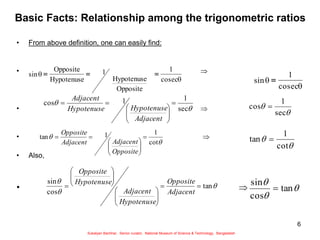
Basic Facts: Relationship among the trigonometric ratios
• From above definition, one can easily find:
• 
• 
• 
• Also,
• 


ec
cos
1
Opposite
Hypotenuse
1
Hypotenuse
Opposite
sin =
=
=


ec
cos
1
sin =


sec
1
1
cos 










Adjacent
Hypotenuse
Hypotenuse
Adjacent


sec
1
cos 


cot
1
1
tan 










Opposite
Adjacent
Adjacent
Opposite


cot
1
tan 



tan
cos
sin



















Adjacent
Opposite
Hypotenuse
Adjacent
Hypotenuse
Opposite



tan
cos
sin

Sukalyan Bachhar, Senior curator, National Museum of Science & Technology, Bangladesh
7
Basic Facts: Trigonometric inverse functions
• In general:
• For Trigonometric Function:
  (y)
f
x
x
f
y -1



   
   
   
x
arctan
or
(y)
tan
x
x
tan
y
x
arccos
or
(y)
cos
x
x
cos
y
x
arcsin
or
(y)
sin
x
x
sin
y
1
-
1
-
-1









    0
1
0
56
0.8290
sin
0.8290
56
sin
:
Example 

 
Sukalyan Bachhar, Senior curator, National Museum of Science & Technology, Bangladesh
8
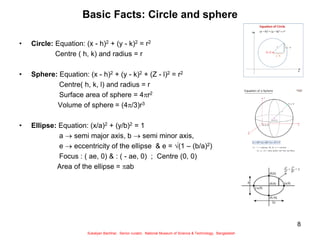
Basic Facts: Circle and sphere
• Circle: Equation: (x - h)2 + (y - k)2 = r2
Centre ( h, k) and radius = r
• Sphere: Equation: (x - h)2 + (y - k)2 + (Z - l)2 = r2
Centre( h, k, l) and radius = r
Surface area of sphere = 4r2
Volume of sphere = (4/3)r3
• Ellipse: Equation: (x/a)2 + (y/b)2 = 1
a  semi major axis, b  semi minor axis,
e  eccentricity of the ellipse & e = (1 – (b/a)2)
Focus : ( ae, 0) & : ( - ae, 0) ; Centre (0, 0)
Area of the ellipse = ab
Sukalyan Bachhar, Senior curator, National Museum of Science & Technology, Bangladesh
9
Basic Facts: Equations of motions
(for constant acceleration or force)
2as
v
at
2
1
s
at
v
:
0)
(u
zero
is
velocity
initial
with
equations
The
2as
u
v
at
2
1
ut
s
at
u
v
:
Equations
The
2
2
2
2
2










Sukalyan Bachhar, Senior curator, National Museum of Science & Technology, Bangladesh
10
Basic Facts: Equations of motions
(for constant acceleration or force)
2gh
-
u
v
/2g
u
h
0,
v
:
height
maximum
For
;
gt
2
1
ut
h
u/g
t
0,
v
:
height
maximum
For
;
gt
u
v
on
accelerati
nal
gravitatio
g
-
a
reached
height
h
s
:
u
velocity
initial
with
up
thrown
body
of
equations
The
2gh
v
gt
2
1
h
gt
v
on
accelerati
nal
gravitatio
g
a
released
is
body
which
from
height
h
s
:
0)
(u
zero
is
velocity
initial
body with
falling
of
equations
The
2
2
2
2
2
2






















Sukalyan Bachhar, Senior curator, National Museum of Science & Technology, Bangladesh
11
Basic Facts: Newton’s law of gravitation
• Newton’s law of gravitation: In universe, any two bodies attract each other. This
force of attraction is directly proportional to product of their masses and inversely
proportional to square of distance apart between them. This force acts along the
line joining between them.
• Mathematically,
• Where: F is gravitational force; m1 and m2 are masses of two bodies;
r is the distance apart between them and
G is universal gravitational constant.
And G = 6.7 10-11 N-m2 /kg2.
2
2
1
2
2
1
2
2
1
r
m
m
G
F
r
m
m
F
r
1
F
&
m
m
F 





Sukalyan Bachhar, Senior curator, National Museum of Science & Technology, Bangladesh
12
Basic Facts: Newton’s law of gravitation
Gravitational acceleration on any object:
A body of mass ‘m’ is placed on the surface of the planet
of radius ‘r’ & mass ‘M’.
Force acting on mass ‘m’ is due to gravity
2
2
2
r
GM
g
r
GMm
mg
F
g
on
accelerati
nal
gravitatio
on
accelerati
and
on
accelerati
mass
force
But,
r
GMm
F
gravity
to
due
Force
The












13
Basic Facts: Angular motion
• Angular displacement is designated by .
• Angular velocity is designated with by .
• Angular acceleration is designated with by .
• The moment of inertia, I, of a body about an axis is defined by
where ri is the perpendicular distance from the axis of a particle of mass mi, and
the summation is taken over the whole of the body.
• Torque is designated by .
on.
so
and
3,
2,
1,
i
Where
;
r
m
I
i.e.
...
r
m
r
m
I
2
i
i
2
2
2
2
1
1






Sukalyan Bachhar, Senior curator, National Museum of Science & Technology, Bangladesh
14
Basic Facts: Angular motion
(for constant angular acceleration or torque)
distance
pendicular
r
velocity,
linear
v
mass,
m
mvr
r
v
mr
particles
of
Momentum
Angular
Iω
Momentum
Angular
Momentum
Angular
distance
lar
perpendicu
r
Force,
F
r
F
τ
(ττ
Torque
distance
r
on,
accelerati
Linear
a
αr
a
r
v
a
t
ω
α
on(αn
accelerati
Angular
distance
r
velocity,
Linear
v
r
v
ω
T
2π
ω
t
θ
ω
)
velocity(ω
Angular
2
2





















Sukalyan Bachhar, Senior curator, National Museum of Science & Technology, Bangladesh
15
Basic Facts: Angular motion
(for constant angular acceleration or torque)
velocity
angular
Final
ω
velocity
angular
Initial
ω
2αα
ω
ω
3.
αt
2
1
t
ω
θ
2.
αt
ω
ω
1.
Motion
Angular
of
Equation
0
2
0
2
2
0
0
2








Sukalyan Bachhar, Senior curator, National Museum of Science & Technology, Bangladesh
16
Basic Facts: Light
• Speed of Light in Vacuum = 2.99792458 108 m/s.
• Computational value of Speed of Light = 2.99792458 108 m/s.
• Speed of Light = c = Frequency ()  wave length ()
• Energy = E = Plank Constant (h)  Frequency ()
• Plank Constant (h) = 6.63 1034 J-s.
• Inverse Square Law: Intensity of light is inversely proportional to the square of
the distance of the source.
2
1/r
I
distance
of
square
1
Intensity 


Sukalyan Bachhar, Senior curator, National Museum of Science & Technology, Bangladesh
17
Basic Facts: Light
m
10
cm
10
Angstrom
1
wavelenth
of
Unit
/T
10
3
)
(λ
h
wavelengt
ing
Correspond
law
s
Wien'
:
energy
maximum
emits
body
Black
which
at
Wavelength
e
Temperatur
Absolute
T
Area
Surface
A
.deg
J/m
10
5.67
Constant
Boltzman
Stefan
)
Constant( σ
T
A
Constant
E
Body
Black
from
Energy
of
emissiom
of
Rate
10
-
8
-
6
m
4
2
8
4














Sukalyan Bachhar, Senior curator, National Museum of Science & Technology, Bangladesh
18
Basic Facts: Light
Color Frequency (THz) Wavelength(nm)
Violet 668-789 380-450
Blue 606-668 450-495
Green 526-606 495-570
Yellow 508-526 570-590
Orange 484-508 590-620
Red 400-484 620-750
Sukalyan Bachhar, Senior curator, National Museum of Science & Technology, Bangladesh
19
Basic Facts: Light
The Electromagnetic Spectrum
Wave Type Wavelength (m) Frequency (Hz) Energy (J)
Radio waves > 0.1 < 3 x 10⁹ < 2 x 10-24
Microwaves 10-3 - 0.1 3 x 10⁹ - 3 x 10¹¹ 2 x 10-24 -2 x 10-22
Terahertz waves 10-3 -10-4 3 x 10¹¹ -3 x 10¹² 2 x 10-22 -2 x 10-21
Infrared 7 x 10⁻⁷ - 10-3 3 x 10¹¹ - 4 x 10¹⁴ 2 x 10-22 - 3 x 10-19
Optical (visible light) 4 x 10⁻⁷ - 7 x 10⁻⁷ 4 x 10¹⁴ - 7.5 x 10¹⁴ 3 x 10-19 - 5 x 10-19
Ultraviolet 10-8 - 4 x 10⁻⁷ 7.5 x 10¹⁴ - 3 x 10¹⁶ 5 x 10-19 - 2 x 10-17
X-rays 10-11 - 10-8 3 x 10¹⁶ - 3 x 10¹⁹ 2 x 10-17 - 2 x 10-14
Gamma rays < 10-11 > 3 x 10¹⁹ > 2 x 10-14
Sukalyan Bachhar, Senior curator, National Museum of Science & Technology, Bangladesh
20
Basic Facts: Light
• Table of astronomical constants
Quantity Symbol Value
Relative
uncertainty
Astronomical Unit AU 1.496 ×10¹¹ m -
Speed of light c 299 792 458 m s−1 defined
Constant of gravitation G 6.674 28×10−11 m3 kg−1 s−2 1.0×10⁻⁴
Parsec = A/tan(1") pc 3.085 677 581 28×1016 m 4.0×10⁻¹¹
Light-year = 365.25cD ly 9.460 730 472 5808×1015 m defined
Hubble constant H0 70.1 km s−1 Mpc−1 0.019
Solar luminosity L☉
3.939×1026 W
= 2.107×10⁻¹⁵ S D−1
variable,
±0.1%
Electron volt eV 1.602 ×10⁻¹⁹ J defined
PI  3.1416 defined
Sukalyan Bachhar, Senior curator, National Museum of Science & Technology, Bangladesh
21
Basic Facts: Units and conversion
• Prefix Symbol Factor Numerically Name
• Tera T 1012 10000000000 thousand billion
• Giga G 109 1 000 000 000 billion**
• Mega M 106 1 000 000 million
• Kilo k 103 1 000 thousand
• Centi c 10-2 0.01 hundredth
• Milli m 10-3 0.001 thousandth
• Micro μ 10-6 0.000 001 millionth
• Nano n 10-9 0.000 000 001 billionth**
• Pico p 10-12 0.000000000001 thousand billionth
Sukalyan Bachhar, Senior curator, National Museum of Science & Technology, Bangladesh
22
Basic Facts: Greek Alphabets
Sukalyan Bachhar, Senior curator, National Museum of Science & Technology, Bangladesh
23
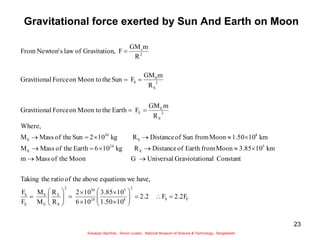
Gravitational force exerted by Sun And Earth on Moon
2.2F
F
2.2
10
1.50
10
3.85
10
6
10
2
R
R
M
M
F
F
have,
we
equations
above
the
of
ratio
the
Taking
Constant
onal
Graviotati
Universal
G
Moon
the
of
Mass
m
km
10
3.85
Moon
from
Earth
of
Distance
R
kg
10
6
Earth
the
of
Mass
M
km
10
1.50
Moon
from
Sun
of
Distance
R
kg
10
2
Sun
the
of
Mass
M
Where,
R
m
GM
F
Earth
the
Moon to
on
Force
l
Gravitiona
R
m
GM
F
Sun
the
Moon to
on
Force
l
Gravitiona
R
m
GM
F
n,
Gravitatio
of
law
s
Newton'
From
E
S
2
8
5
24
30
2
S
E
E
S
E
S
5
E
24
E
8
S
30
S
2
E
E
E
2
S
S
S
2
s












































Sukalyan Bachhar, Senior curator, National Museum of Science & Technology, Bangladesh
24
Gravitational force exerted by Sun And Earth on Moon
• This suggests that Sun exerts almost twice as great a force on Moon
as the Earth does.
• Thus it is not proper to say that Moon orbits the Earth. Moon actually
orbit the Sun, with the Earth causing the curvature of Moon’s orbit to
change.
• Moon’s path is always concave towards the sun, because the Net
force on Moon is always inward, even when it is between the Earth
and Sun.
Sukalyan Bachhar, Senior curator, National Museum of Science & Technology, Bangladesh
25
Gravitational acceleration on the Earth
* The weight of an object of mass m at the
surface of the Earth is obtained by multiplying
the mass m by the acceleration due to
gravity, g, at the surface of the Earth. The
acceleration due to gravity is approximately
the product of the universal gravitational
constant G and the mass of the Earth M,
divided by the radius of the Earth, r, squared.
(We assume the Earth to be spherical and
neglect the radius of the object relative to the
radius of the Earth in this discussion.)
* The measured gravitational acceleration at the
Earth's surface is found to be about 9.80 m/s2
.
2
2
r
GM
g
r
GMm
mg
F 




Sukalyan Bachhar, Senior curator, National Museum of Science & Technology, Bangladesh
26
Gravitational acceleration on the Earth
• *The acceleration that an object experiences because of gravity when it falls
freely close to the surface of a massive body, such as a planet. Also known as
the acceleration of free fall, its value can be calculated from the formula
• g = GM / (R + h)2
• where M is the mass of the gravitating body (such as the Earth), R is the
radius of the body, h is the height above the surface, and G is the gravitational
constant (= 6.6742 × 10⁻¹¹ N·m2/kg2). If the falling object is at, or very nearly
at, the surface of the gravitating body, then the above equation reduces to
• g = GM / R2
• In the case of the Earth, g comes out to be approximately 9.8 m/s2(32 ft/s2),
though the exact value depends on location because of two main factors: the
Earth's rotation and the Earth's equatorial bulge.
Sukalyan Bachhar, Senior curator, National Museum of Science & Technology, Bangladesh
27
Gravitational acceleration on the planets
 
m/s
3.66
g
m/s
2.6
0.0553
9.8
g
Mercury
on
on
Accelerati
nal
Gravitatio
9.8
g
and
2.6
R
R
0.0553,
M
M
Mercury.
consider
us
Let
R
R
M
M
g
g
R
R
M
M
g
g
earth
for
R
M
G
g
planet
or
body
other
any
for
R
M
G
g
:
be
will
following
the
planet;
or
body
other
any
on
on
accelerati
nal
gravitatio
the
found
be
can
it
Earth,
the
of
surface
on the
on
accelerati
l
gravitiona
the
Knowing
2
2
2
2
2
2
2









































Sukalyan Bachhar, Senior curator, National Museum of Science & Technology, Bangladesh
28
Gravitational acceleration on the planets
Acceleration Due to Gravity Comparison
Body Mass Ratio Radius Ratio
g / g-Earth
Acceleration Due
to Gravity, "g" [m/s²]
Acceleratio
n Due
to Gravity,
"g" [m/s²]
Sun 3327760 109.091 27.95 274.13
Mercury 0.0553 0.383 0.37 3.59
Venus 0.815 0.949 0.90 8.87
Earth 1.000 1.000 1.00 9.81
Moon 0.0123 0.273 0.17 1.62
Mars 0.107 0.533 0.38 3.77
Jupiter 317.8 11.200 2.65 25.95
Saturn 95.2 9.450 1.13 11.08
Uranus 14.5 4.010 1.09 10.67
Neptune 17.1 3.880 1.43 14.07
Pluto 0.0021 0.187 0.04 0.42
Sukalyan Bachhar, Senior curator, National Museum of Science & Technology, Bangladesh
29
Masses of Sun and Earth
• Mass of Sun:
 
 
kg
10
1.98
3600
24
365.25
4π
10
6.67
10
1.5
M
Sun
The
of
Mass
units.
mks
10
6.67
Constant
nal
Gravitatio
G
s
3600
24
365.25
Earth
of
Revolution
of
Time
T
m
10
1.5
Earth
and
Sun
the
between
Distance
R
2ππ/
earth
the
of
velocity
Angular
ω
Earth,
Massof
m
Sun,
of
Mass
M
Where,
T
4π
.
G
R
G
ω
R
M
Sun
The
of
Mass
R
GMm
mRω
Sun
of
n
Attractio
nal
Gravitatio
-
Force
l
Centripeta
have,
We
Earth.
on
Sun
the
of
attraction
nal
gravitatio
the
by
provided
is
force
l
centripeta
neccessary
The
Sun.
the
around
revolves
Earth
The
30
2
2
11
-
3
11
11
-
11
2
3
2
3
2
2





























Sukalyan Bachhar, Senior curator, National Museum of Science & Technology, Bangladesh
30
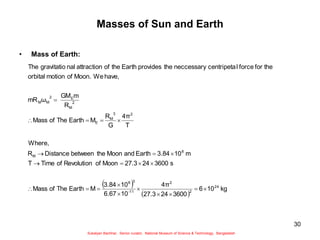
Masses of Sun and Earth
• Mass of Earth:
 
 
kg
10
6
3600
24
27.3
4π
10
6.67
10
3.84
M
Earth
The
of
Mass
s
3600
24
27.3
Moon
of
Revolution
of
Time
T
m
10
3.84
Earth
and
Moon
the
between
Distance
R
Where,
T
4π
G
R
M
Earth
The
of
Mass
R
m
GM
ω
mR
have,
We
Moon.
of
motion
orbital
the
for
force
l
centripeta
neccessary
the
provides
Earth
the
of
attraction
nal
gravitatio
The
24
2
2
11
-
3
8
8
M
2
3
M
E
2
M
E
2
M
M






















Sukalyan Bachhar, Senior curator, National Museum of Science & Technology, Bangladesh
31
Escape velocity
  
  km/s
11.2
m/s
10
1.12
m
10
6.376
10
6
10
6.67
2
V
Earth
the
of
Velocity
Escape
m
10
6.376
Earth
of
Radius
R
kg
10
6
Earth
of
Mass
M
units
mks
10
6.67
Constant
nal
Gravitatio
G
Earth
For
Earth
of
Velocity
Escape
the
find
us
Let
R
2GM
V
Velocity
Escape
get,
we
g
rearrangin
and
m
Cancelling
0
R
GMm
-
mV
2
1
Hence,
R
GMm
-
Energy
Potential
nal
Gravitatio
mV
2
1
Energy
Kinetic
have,
we
zero.
be
should
body
the
of
energy
potential
plus
kinetic
words
other
In
body.
the
of
energy
total
zero
to
correspond
velocity
minimum
The
planet.
the
of
velocity
escape
as
known
is
mvelocity
The
planet.
the
to
back
returns
never
it
that
so
velocity
minimum
certain
a
with
with
thrown
be
should
body
the
planet,
a
of
clutch
nal
gravitatio
this
from
escape
to
order
In
cotect.
its
in
body
a
on
attraction
nal
gravitatio
exerts
planet
Every
4
6
24
11
-
e
6
24
11
-
e
2
2























Sukalyan Bachhar, Senior curator, National Museum of Science & Technology, Bangladesh
32
Escape velocity
km/s
60
km/s
11.2
318
11.2
V
Jupiter
of
Velocity
Escape
11.2
1
R
R
and
318
M
M
where
Jupiter,
of
Velocity
Escape
the
find
us
Let
R
R
M
M
V
V
Planet
of
Velocity
Escape
R
M
2G
V
Planet
of
Velocity
Escape
R
2GM
V
Earth
of
Velocity
Escape
have,
We
.
comparison
by
planets
the
all
of
velocity
escape
calculate
can
we
Earth
the
with
planets
the
of
ratios
radius
and
mass
and
Earth
the
of
Velocity
Escape
the
Knowing
e
e
e
e
e























Isaac Newton's analysis of
escape velocity. Projectiles A
and B fall back to earth.
Projectile C achieves a
circular orbit, D an elliptical
one. Projectile E escapes.
Sukalyan Bachhar, Senior curator, National Museum of Science & Technology, Bangladesh
33
Escape velocity
Following table gives the Escape Velocity of All planets (Including the Sun and Moon):
Body Mass Ratio Radius Ratio Escape velocity
km/s
Sun 3327760 109.091 620
Mercury 0.0553 0.383 4.3
Venus 0.815 0.949 10.4
Earth 1.000 1.000 11.2
Moon 0.0123 0.273 2.4
Mars 0.107 0.533 5.0
Jupiter 317.8 11.200 60.0
Saturn 95.2 9.450 36.0
Uranus 14.5 4.010 21.3
Neptune 17.1 3.880 23.5
Pluto 0.0021 0.187 2.4
Sukalyan Bachhar, Senior curator, National Museum of Science & Technology, Bangladesh
34
Escape velocity from solar system
  
 
:
planets
of
distances
at
Sun
to
reference
with
velocity
escape
the
find
can
we
units
al
astronomic
in
Planets
the
of
distance
the
Knowing
km/s
42
m/s
10
4.2
m/s
10
1.5
10
2
10
6.67
2
Distance
s
Earth'
at
Sun
From
Velocity
Escape
Earth)
of
case
(In
m
10
1.5
Sun
from
Distance
R
kg
10
2
Sun
of
Mass
M
units
mks
10
6.67
Gravity
Constantof
G
where
R
2GM
velocity
Escape
have,
We
system,.
solar
the
from
escape
y
permanantl
body
the
that
so
Earth
of
distance
a
at
velocity
escape
the
find
us
Let
Sun.
from
distance
the
on
on
depends
which
required,
is
velocity
minimum
certain
a
system
solar
from
escape
should
it
that
so
launced
be
to
is
spacecraft
a
If
gravity.
s
Sun'
from
escape
ly
neccessari
not
may
body
the
but
imparted.
is
velocity
y
necccessar
if
planet
froma
ecsape
may
body
a
though
Even
orbit.
their
in
planets
the
keep
to
force
l
centripeta
neccessary
provides
Sun
the
of
attraction
nal
Gravitatio
4
11
30
11
11
30
11



















Sukalyan Bachhar, Senior curator, National Museum of Science & Technology, Bangladesh
35
Escape velocity from solar system
Location with respect to Ve
[2] Location with respect to Ve
[2]
on the Sun, the Sun's gravity: 617.5 km/s
on Mercury, Mercury's gravity: 4.3 km/s at Mercury, the Sun's gravity: 67.7 km/s
on Venus, Venus' gravity: 10.3 km/s at Venus, the Sun's gravity: 49.5 km/s
on Earth, the Earth's gravity: 11.2 km/s at the Earth/Moon, the Sun's gravity: 42.1 km/s
on the Moon,
the Moon's
gravity:
2.4 km/s at the Moon, the Earth's gravity: 1.4 km/s
on Mars, Mars' gravity: 5.0 km/s at Mars, the Sun's gravity: 34.1 km/s
on Jupiter, Jupiter's gravity: 59.5 km/s at Jupiter, the Sun's gravity: 18.5 km/s
on Saturn, Saturn's gravity: 35.6 km/s at Saturn, the Sun's gravity: 13.6 km/s
on Uranus, Uranus' gravity: 21.2 km/s at Uranus, the Sun's gravity: 9.6 km/s
on Neptune, Neptune's gravity: 23.6 km/s at Neptune, the Sun's gravity: 7.7 km/s
in the solar
system,
the Milky Way's
gravity:
≥ 525 km/s[3]
Sukalyan Bachhar, Senior curator, National Museum of Science & Technology, Bangladesh
36
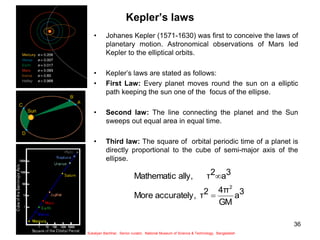
Kepler’s laws
• Johanes Kepler (1571-1630) was first to conceive the laws of
planetary motion. Astronomical observations of Mars led
Kepler to the elliptical orbits.
• Kepler’s laws are stated as follows:
• First Law: Every planet moves round the sun on a elliptic
path keeping the sun one of the focus of the ellipse.
• Second law: The line connecting the planet and the Sun
sweeps out equal area in equal time.
• Third law: The square of orbital periodic time of a planet is
directly proportional to the cube of semi-major axis of the
ellipse.
3
a
GM
4π
2
τ
,
accurately
More
3
a
2
τ
ally,
Mathematic
2


Sukalyan Bachhar, Senior curator, National Museum of Science & Technology, Bangladesh
37
Proof of Kepler’s second law
*
Kepler’s Second Law
A planet in its path around the sun sweeps out equal areas in equal times.
Suppose at a given instant of time the planet is at point P in its orbit,
moving with a velocity meters per second in the direction along the
tangent at P (see figure). In the next second it will move v meters,
essentially along this line (the distance is of course greatly
exaggerated in the figure) so the area swept out in that second
is that of the triangle SPQ, where S is the center of the sun.
The area of triangle SPQ is just ½ base x height. The base PQ is v meters long, the height is the
perpendicular distance from the vertex of the triangle at the sun S to the baseline PQ, which is
just the tangential velocity vector .
Hence
Comparing this with the angular momentum L of the planet as it moves around the sun,
it becomes apparent that Kepler’s Second Law, the constancy of the area sweeping rate, is telling
us that the angular momentum of the planet around the sun is constant.
In fact,
Sukalyan Bachhar, Senior curator, National Museum of Science & Technology, Bangladesh
38
Proof of Kepler’s third law
law.
third
s
Kepler'
the
proves
table
following
The
units.
al
Astronomic
in
R
distance
and
years
in
T
period
the
select
us
let
numbers,
large
avoid
to
oder
In
Constant
R
T
R
T
R
Constant
T
constant
is
GM
4π
equation,
this
From
R
GM
4π
T
get,
we
g,
rearrangin
and
sides
both
from
m'
'
Cancelling
Revol
of
Time
T
Sun
of
Mass
M
revolution
of
Time
Periodic
T
2ππ/
velocity
Angular
ω
Sun
from
Planet
of
Distance
R
et
Massofplan
m
Where,
R
GMm
mRω
Sun
of
n
Attractio
nal
Gravitatio
Force
l
Centripeta
have,
We
sun.
the
of
attraction
onal
graviatati
by
provided
which
planet
a
on
act
should
force
l
centripeta
motion
orbital
For
3
2
3
2
3
2
2
3
2
2
2
2

















Sukalyan Bachhar, Senior curator, National Museum of Science & Technology, Bangladesh
39
Proof of Kepler’s third law
Planet Period T
(years)
Distance R
( Au)
Mercury 0.241 0.387 1.002
Venus 0.615 0.723 1.000
Earth 1.000 1.000 1.000
Mars 1.880 1.524 0.998
Jupiter 11.90 5.204 1.005
Saturn 29.50 9.582 0.989
Uranus 84.00 19.201 0.996
Neptune 165.0 30.047 1.003
Pluto 248.0 39.236 1.018
 
3
2
3
2
/Au
y
/R
T
Sukalyan Bachhar, Senior curator, National Museum of Science & Technology, Bangladesh
40
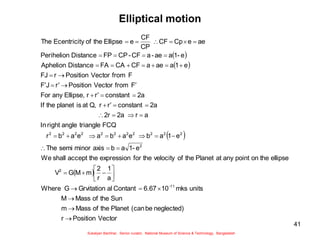
Elliptical motion
•In the solar system, the Elliptical motion is quite common. All the planets move
around the Sun and all satellites of the planets move around the respective
planets in the Elliptical orbits. Hence its instructive to learn more about the
Elliptical motion.
•In the Elliptical motion
P  Perihelion  Nearest point to the Sun
A  Aphelion  Farthest point to the Sun
C  Centre of the ellipse
CP = CA = a  Semi major axis
CQ = CR = b  Semi minor axis
F  Focus  Position of the Sun
F’ Empty Focus
Sukalyan Bachhar, Senior curator, National Museum of Science & Technology, Bangladesh
41
Elliptical motion
 
 
 
 
Vector
Position
r
neglected)
be
(can
Planet
the
of
Mass
m
Sun
the
of
Mass
M
units
mks
10
6.67
Contant
al
Grvitation
G
Where
a
1
r
2
m
M
G
V
ellipse
the
on
point
any
at
Planet
the
of
velocity
the
for
expression
the
accept
shall
We
e
1-
a
b
axis
minor
semi
The
e
1
a
b
e
a
b
a
e
a
b
r
FCQ
triangle
angle
right
In
a
r
2a
2r
2a
constant
r
r
Q,
at
is
planet
the
If
2a
constant
r
r
Ellipse,
any
For
F
from
Vector
Position
r
J
F
F
from
Vector
Position
r
FJ
e
1
a
ae
a
CF
CA
FA
Distance
Aphelion
e
1-
a
ae
-
a
CF
-
CP
FP
Distance
Perihelion
ae
e
Cp
CF
CP
CF
e
Ellipse
the
of
y
Ecentricit
The
11
-
2
2
2
2
2
2
2
2
2
2
2
2
2






























































Sukalyan Bachhar, Senior curator, National Museum of Science & Technology, Bangladesh
42
Elliptical motion
• Velocity at Perihelion
• Velocity at Aphelion
 
 
 
   
 
 
e
1
e
1
a
m
M
G
V
e
1
a
e
1
2
m
M
G
a
1
e
1
a
2
m
M
G
V
e
1-
a
r
perihelion
At
2
P
2
P



























 
 
 
   
 
 
e
1
e
1
a
m
M
G
V
e
1
a
e
1
2
m
M
G
a
1
e
1
a
2
m
M
G
V
e
1
a
r
aphelion
At
2
P
2
P




























Sukalyan Bachhar, Senior curator, National Museum of Science & Technology, Bangladesh
43
10. Elliptical motion
• Magnitude of the position vector ‘r’
     
   
     
 
   
 
plotted.
be
can
ellipse
the
and
found
be
can
r'
'
vector
position
the
x'
'
of
values
different
for
known
are
e
and
a
of
values
the
If
ecosx
1
e
1
a
r
ecosx
1
4ar
e
1
4a
4arecosx
e
4a
4ar
4a
4raecosx
e
4a
r
r
ar
2
4a
r
-
2a
r
2a
r
r
cosx
2ae
2r
2ae
r
r
2a
r
cosx
2ae
2r
2ae
r
r
x
-
180
cos
2ae
2r
2ae
r
r
JF
F
triangle
the
to
cosines
of
law
the
Applying
2
2
2
2
2
2
2
2
2
2
2
2
2
2
2
2
2
2
2
2
2










































Sukalyan Bachhar, Senior curator, National Museum of Science & Technology, Bangladesh
44
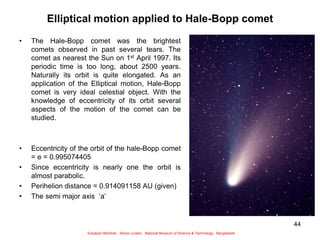
Elliptical motion applied to Hale-Bopp comet
• The Hale-Bopp comet was the brightest
comets observed in past several tears. The
comet as nearest the Sun on 1st April 1997. Its
periodic time is too long, about 2500 years.
Naturally its orbit is quite elongated. As an
application of the Elliptical motion, Hale-Bopp
comet is very ideal celestial object. With the
knowledge of eccentricity of its orbit several
aspects of the motion of the comet can be
studied.
• Eccentricity of the orbit of the hale-Bopp comet
= e = 0.995074405
• Since eccentricity is nearly one the orbit is
almost parabolic.
• Perihelion distance = 0.914091158 AU (given)
• The semi major axis ‘a’
Sukalyan Bachhar, Senior curator, National Museum of Science & Technology, Bangladesh
45
Elliptical motion applied to Hale-Bopp comet
*
   
 
 
   
 
Sun
to
compared
neglected
be
can
comet
Bopp
-
Hale
of
Mass
m
kg
10
2
Sun
of
Mass
M
units
mks
10
6.67
constant
nal
Gravitatio
G
e
1
e
1
a
m
M
G
V
Perihelion
at
Speed
km
10
555.3678
AU
370.2452
AU
45
0.66507440
1
185.57965
e
1
a
distance
Aphelion
orbit.
s
Earth'
the
inside
slightly
arrives
comet
Bopp
-
Hale
the
means
Wkich
km
10
1.5
8
0.94109115
AU
8
0.91409115
distance
Perihelion
AU
18.396681
AU
0.9950744
1-
185.5795
e
1-
a
b
have,
We
b'
'
axis
minor
Semi
AU
39.236
only
is
Pluto
of
axos
major
Semi
e
1-
a
Distance
Perihelion
have,
We
AU
185.57965
AU
5
0.99507440
1-
8
0.91409115
e
1-
Distance
Perihelion
a
30
11
-
P
8
8
2
2



































Sukalyan Bachhar, Senior curator, National Museum of Science & Technology, Bangladesh
46
Elliptical motion applied to Hale-Bopp comet
*
 
 
  yrs
2528.1074
AU
1
AU
185.57965
yr
1
R
R
T
T
R
R
T
T
comet.
Bopp
-
Hale
and
Earth
of
time
Periodic
compare
shall
We
R
T
:
Law
3rd
s
Kepler'
use
We
T'
'
Time
Periodic
km/hr
391.5792
km/s
0.108772
m/s
108.772
e
1
e
1
a
m
M
G
V
Aphelion
at
Speed
km/hr
158400
km/s
44
m/s
10
4.4097506
m/s
0.99507
1
0.99507
1
10
1.5
185.57965
0
10
2
10
6.67
V
3/2
2
3
E
H
H
H
3
E
3
H
2
E
2
H
3
2
a
4
11
30
11
-
P












































Sukalyan Bachhar, Senior curator, National Museum of Science & Technology, Bangladesh
47
Barycenter
• The barycenter is the point between two objects where they balance each
other. It is the center of mass where two or more celestial bodies orbit each
other.
• When a moon orbits a planet, or a planet orbits a star, both bodies are actually
orbiting around a point that lies outside the center of the primary (the larger body).
• For example, the moon does not orbit the exact center of the Earth, but a point on a
line between the Earth and the Moon approximately 1,710 km below the surface of
the Earth, where their respective masses balance. This is the point about which the
Earth and Moon orbit as they travel around the Sun.
•
The barycenter is one of the foci of the elliptical orbit of each body. This is an
important concept in the fields of astronomy and astrophysics.
Sukalyan Bachhar, Senior curator, National Museum of Science & Technology, Bangladesh
48
Barycenter
 
 
 
Earth.
the
of
surface
the
inside
km
1746
km
4654
-
6400
is,
System
Moon
Earth
the
of
barycenter
The
km
6400
Earth
the
of
radius
The
km
4654
km
384000
0.01227M
M
0.01227M
r
R
and
M
,
M
of
values
the
ng
substituti
equation
this
In
have,
We
R
M
M
M
r
M
M
M
r
R
1
r
R
M
M
r
R
M
r
M
B,
barycenter
the
at
balances
system
the
Since
M
0.01227
Moon
the
of
Mass
M
Earth
the
of
Mass
M
Earth
the
of
center
the
from
barycenter
the
of
Distance
r
km
384000
Moon
and
Earth
between
distance
Average
R
System
Moon
-
Earth
1
*
e
e
e
m
e
m
e
m
m
m
e
m
e
m
e
e
m
e


























Sukalyan Bachhar, Senior curator, National Museum of Science & Technology, Bangladesh
49
Barycenter
 
  km.
48000
km
696000
-
744000
,
distance
a
at
sun
the
of
surface
the
outside
is
System
Jupiter
-
Sun
the
of
barycenter
The
km.
696000
is
Sun
the
of
radius
The
km
744000
km
10
7.8
0.000955M
M
0.000955M
r
barycenter
Jupiter
-
Sun
equation,
earlier
the
Using
0.000955M
M
1047
1
Jupiter
the
of
Mass
M
Sun
the
of
Mass
M
km
10
7.8
R
system
this
For
System
Jupiter
-
Sun
2
*
8
s
s
s
s
s
j
s
8













Sukalyan Bachhar, Senior curator, National Museum of Science & Technology, Bangladesh
50
Barycenter
 
 
surface.
s
Pluto'
the
outside
km
900
km
1200
-
2110
,
distance
a
at
is
System
Charon
-
Pluto
the
of
barycenter
the
Hence
km.
1200
only
is
Pluto
the
of
radius
The
km
2110
km
19600
0.12M
M
0.12M
r
barycenter
Charon
-
Pluto
equation,
earlier
the
Using
0.12M
Charon
the
of
Mass
M
Pluto
the
of
Mass
M
km
19600
R
system
this
For
System
Charon
-
Pluto
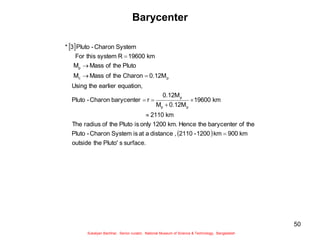
3
*
p
p
p
p
c
p










Sukalyan Bachhar, Senior curator, National Museum of Science & Technology, Bangladesh
51
Barycenter
• Examples
Larger
body
m1
(mE=1)
Smaller
body
m2
(mE=1)
a
(km)
r1
(km)
R1
(km)
r1/R1
Remarks
Earth 1 Moon 0.0123 384,000 4,670 6,380 0.732
The Earth has a perceptible "wobble"; see tides.
Pluto 0.0021 Charon
0.000254
(0.121 mPluto)
19,600 2,110 1,150 1.83
Both bodies have distinct orbits around the barycenter, and as such Pluto and Charon were considered as a double planet by many before the redefinition
of planet in August 2006.
Sun 333,000 Earth 1
150,000,000
(1 AU)
449 696,000 0.000646
The Sun's wobble is barely perceptible.
Sun 333,000 Jupiter
318
(0.000955 mSun)
778,000,000
(5.20 AU)
742,000 696,000 1.07
Sukalyan Bachhar, Senior curator, National Museum of Science & Technology, Bangladesh
52
Barycenter
*
Two bodies similar mass Pluto – Charon System Earth – Moon System
Sun - Earth System Binary Star System
Sukalyan Bachhar, Senior curator, National Museum of Science & Technology, Bangladesh
53
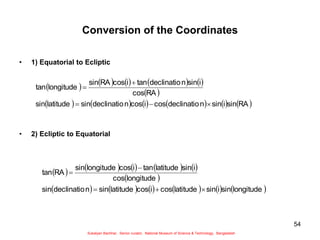
Conversion of The Coordinates
• In Astronomy coordinates of stars or planets
are given with reference to either ecliptic or
celestial equator. Longitude and Latitudes are
the ecliptic, while Right ascension and
declination are equatorial coordinates. Many
times it becomes necessary to convert the
coordinates from one form to another.
• 1) Equatorial to Ecliptic
Sukalyan Bachhar, Senior curator, National Museum of Science & Technology, Bangladesh
54
Conversion of the Coordinates
• 1) Equatorial to Ecliptic
• 2) Ecliptic to Equatorial
       
 
         
RA
sin
i
sin
n
declinatio
cos
i
cos
n
declinatio
sin
latitude
sin
RA
cos
i
sin
n
declinatio
tan
i
cos
RA
sin
longitude
tan





       
 
         
longitude
sin
i
sin
latitude
cos
i
cos
latitude
sin
n
declinatio
sin
longitude
cos
i
sin
latitude
tan
i
cos
longitude
sin
RA
tan





Sukalyan Bachhar, Senior curator, National Museum of Science & Technology, Bangladesh
55
Elementary Astronomical Calculations:
Gravity and motion ( Lecture – 1)
Thank You
Sukalyan Bachhar, Senior curator, National Museum of Science & Technology, Bangladesh
56
Elementary Astronomical Calculations:
Earth and Motion ( Lecture – 2)
•By Sukalyan Bachhar
•Senior Curator
• National Museum of Science & Technology
•Ministry of Science & Technology
•Agargaon, Sher-E-Bangla Nagar, Dhaka-1207, Bangladesh
•Tel:+88-02-58160616 (Off), Contact: 01923522660;
•Websitw: www.nmst.gov.bd ; Facebook: Buet Tutor
&
•Member of Bangladesh Astronomical Association
•Short Bio-Data:
First Class BUET Graduate In Mechanical Engineering [1993].
Master Of Science In Mechanical Engineering From BUET [1998].
Field Of Specialization  Fluid Mechanics.
Field Of Personal Interest  Astrophysics.
Field Of Real Life Activity  Popularization Of Science & Technology From1995.
An Experienced Teacher Of Mathematics, Physics & Chemistry for O- ,A- , IB- &
Undergraduate Level.
Habituated as Science Speaker for Science Popularization.
Experienced In Supervising For Multiple Scientific Or Research Projects.
17 th BCS Qualified In Cooperative Cadre (Stood First On That Cadre).
Sukalyan Bachhar, Senior curator, National Museum of Science & Technology, Bangladesh
57
Energy released by an asteroid on the collision course
with the Earth
*
*Main asteroid belt
Main article: Asteroid belt
The majority of known asteroids orbit within the main asteroid belt between the orbits of Marsand Jupiter,
generally in relatively low-eccentricity (i.e., not very elongated) orbits. This belt is now estimated to contain
between 1.1 and 1.9 million asteroids larger than 1 km (0.6 mi) in diameter,[29] and millions of smaller
ones.[30] These asteroids may be remnants of theprotoplanetary disk, and in this region
the accretion of planetesimals into planets during the formative period of the solar system was prevented by
large gravitational perturbations byJupiter.
[edit]Trojans
Main article: Trojan asteroids
Trojan asteroids are a population that share an orbit with a larger planet or moon, but do not collide with it
because they orbit in one of the two Lagrangian points of stability, L4 and L5, which lie 60° ahead of and
behind the larger body.
The most significant population of Trojan asteroids are the Jupiter Trojans. Although fewer Jupiter Trojans
have been discovered as of 2010, it is thought that there are as many as there are asteroids in the main
belt.
A couple trojans have also been found orbiting with Mars.[note 2]
[edit]Near-Earth asteroids
Main article: Near-Earth asteroids
Near-Earth asteroids, or NEA's, are asteroids that have orbits that pass close to that of Earth. Asteroids that
actually cross the Earth's orbital path are known as Earth-crossers. As of May 2010, 7,075 near-Earth
asteroids are known and the number over one kilometre in diameter is estimated to be 500 - 1,000.
Sukalyan Bachhar, Senior curator, National Museum of Science & Technology, Bangladesh
58
Energy released by an asteroid on the collision course
with the Earth
*
 
   J
10
4.8
m/s
15000
kg
10
4.2
2
1
mv
2
1
energy
Kinetic
kg
10
4.2
kg
3000
15
π
3
4
asteroid
of
Mass
m/s
15000
km/s
15
v
Velocity
kg/m
3000
Density
m
15
r
asteroid
of
Radius
Density
πr
3
4
Density
Volume
Mass
have
We
m/s
in
Velocity
V
kg
in
Asteroid
of
Mass
m
Where
mv
2
1
object
moving
of
energy
Kinetic
15
2
7
2
7
3
3
2
























Sukalyan Bachhar, Senior curator, National Museum of Science & Technology, Bangladesh
59
Energy released by an asteroid on the collision course
with the Earth
*
bomb.
atomic
Hiroshima
76
about
to
equivalent
energy
releases
km/s
15
spped
with
travelling
m
30
of
diameter
of
asteroid
an
by
released
energy
the
means
Which
76
10
6.3
10
4.8
energy
bomb
Hiroshima
asteroid
of
energy
Kinetic
Thus,
J
10
6.3
J
10
4.2
15
energy
bomb
Hiroshima
J
10
4.2
about
is
kilotone
1
energy
TNT
of
kilotones
15
about
had
bomb
Hiroshima
energy.
bomb
Hiroshima
with
ot
compare
us
Let
energy.
of
amount
high
very
a
is
this
Still
.
J
10
2
be
asteroid
the
with
left
energy
the
of
amount
Let
explodes.
it
before
ion
fragmentat
and
slowing
noise,
in
lost
is
energy
kinetic
this
of
half
that
assume
us
Let
13
15
13
12
12
15












60
Linear velocity at any point on the surface of Earth
i. Angular velocity is a ratio of the total angular The measurement
through which a particle rotates in a given unit of time. If we use  to
stand for angular velocity, we have .
Reviewing the motion of the Earth, recall that the
1.Earth has an angular velocity of radians per hour.
2.linear velocity of a point on the Earth's surface was calculated by
multiplying this angular velocity by the radius of the Earth =6400 km.
.
ii.Using this as a guide, we define linear velocity, v, to
be where  is angular velocityin radians and r is the radius.
Sukalyan Bachhar, Senior curator, National Museum of Science & Technology, Bangladesh
61
Linear velocity at any point on the surface of Earth
 
   
     
   
    km/hr.
0
km/hr
90
cos
1675
velocity
the
pole,
At
km/s
1536
m/s
23.5
cos
1675
23.5
φ
Dhaka,
At
;
km/hr
3600
24
2π
23.5
cos
10
6.4
T
2π
φ
Rcos
ω
φ
Rcos
Earth
the
of
speed
Angular
latitude
cos
Earth
the
of
Radius
point
any
at
seed
Linear
0
0
0
0
3



















Sukalyan Bachhar, Senior curator, National Museum of Science & Technology, Bangladesh
62
To Find inclination and eccentricity of Earth’s orbit
0.01671
4
0.01882272
7
0.00004203
-
7
0.01670861
7T
0.00004203
-
7
0.01670861
ty
Eccentrici
deg
23.4390453
deg
0.01822724
0.013
-
23.43929
n
Inclinatio
4
0.01882272
T
and
2452232.5
JD
35)
Chapter
(Ref.
2001
November
19
for
have
we
date
that
for
T
and
JD
the
calculated
already
have
We
2001
November
19
on
orbit
s
Earth'
of
ty
Eccentrici
and
n
Inclinatio
find
us
Let
7T
0.00004203
7
0.01670861
ty
Eccentrici
0.013T
-
23.43929
n
Inclinatio
by
given
are
orbit
s
Earth'
the
of
ty
eccentrici
and
n
inclinatio
the
of
values
e
approximat
the
T,
of
powers
higher
Neglecting
values.
these
in
variation
slow
a
is
There
constant.
not
are
orbit
s
Earth'
the
of
ty
eccentrici
and
n
inclinatio
The













Sukalyan Bachhar, Senior curator, National Museum of Science & Technology, Bangladesh
63
Precessional motion of Earth
 
  (nearly)
950
years
13.33
71.66
in
sign
Asterism
1
through
shifts
equinox
vernal
hence
degrees,
13.33
Asterism
1
(nearly)
2150
years
30
71.66
in
sign
1
through
shifts
equinox
vernal
hence
degrees,
30
sign
1
year
1
year
71.66
60
60
require
sec
arc
50.2
years
71.66
years
360
25800
require
degrees
1
years
25800
require
degrees
360













 








Vernal Equinox Asterism Years of Degrees
Entry Exit Occupation Covered
3520 BC 2570 BC Rohini 950 13.33
2570 BC 1620 BC Krittika 950 13.33
1620 BC 670 BC Bharni 950 13.33
670 BC 280 AD Ashwan 950 13.33
280 AD 1230 AD Revati 950 13.33
1230 AD 2008 AD Uttara Bhadrapada 768 10.67
Sukalyan Bachhar, Senior curator, National Museum of Science & Technology, Bangladesh
64
Extent of Earth’s orbit from the angular diameter of Sun’s disk
 
km
410000
Aphelion
of
Distance
km
358000
Perihelion
of
Distance
384000km
a
axis
major
Semi
min
arc
29.36
Diameter
Angular
Minx
min
arc
33.65
Diameter
Angular
Max
orbit
s
Moon'
of
distances
Aphelion
and
Perihelion
Find
:
Example
0.0167
0.9833
1-
a
0.9833a
-
a
PC
SP
-
PC
PC
SC
e
ty
Eccentrici
The
km
152096185
km
147099615
-
149597900
2
SP
-
2a
SA
Distance
Aphelion
km
147099615
km
149597900
0.9833
SP
Distance
Perihelion
km
149597900
a
accept
shall
We
0.9833a
64.13
31.53
2a
SP
Distance
Perihelion
64.13
31.53
2a
SP
axis
major
Semi
a
where
;
2a
SP
SA
But
64.13
31.53
31.53
32.60
31.53
SP
SA
SP
32.60
31.53
SA
SP
Earth.
the
and
Sun
the
between
distance
the
to
to
al
proportion
inversely
is
disk
solar
of
diameter
Angular
distance
Aphelion
SA
Aphelion,
A
distance
Perihelion
SP
,
Perohelion
P
figure
the
In
July)
(4
min
arc
32.53
Diameter
Angular
Minx
January)
(4
min
arc
32.60
Diameter
Angular
Max
m
m
m
m












































Sukalyan Bachhar, Senior curator, National Museum of Science & Technology, Bangladesh
65
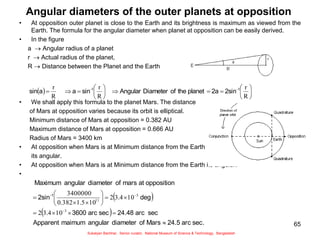
Angular diameters of the outer planets at opposition
• At opposition outer planet is close to the Earth and its brightness is maximum as viewed from the
Earth. The formula for the angular diameter when planet at opposition can be easily derived.
• In the figure
a  Angular radius of a planet
r  Actual radius of the planet,
R  Distance between the Planet and the Earth
• We shall apply this formula to the planet Mars. The distance
of Mars at opposition varies because its orbit is elliptical.
Minimum distance of Mars at opposition = 0.382 AU
Maximum distance of Mars at opposition = 0.666 AU
Radius of Mars = 3400 km
• At opposition when Mars is at Minimum distance from the Earth
its angular.
• At opposition when Mars is at Minimum distance from the Earth its angular.
•
  

















R
r
R
r
R
r 1
-
1
-
2sin
2a
planet
the
of
Diameter
Angular
sin
a
a
sin
 
 
sec.
arc
24.5
Mars
of
diameter
angular
maimum
Apparent
sec
arc
24.48
sec
arc
3600
deg
2sin
opposition
at
mars
of
diameter
angular
Maximum
1
-


















3
3
11
10
4
.
3
2
10
4
.
3
2
10
5
.
1
382
.
0
3400000
Sukalyan Bachhar, Senior curator, National Museum of Science & Technology, Bangladesh
66
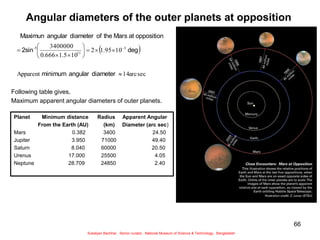
Angular diameters of the outer planets at opposition
Following table gives,
Maximum apparent angular diameters of outer planets.
 
sec
arc
14
Apparent
10
95
.
1
2
10
5
.
1
666
.
0
3400000 3
11












 
diameter
angular
minimum
deg
2sin
opposition
at
Mars
the
of
diameter
angular
Maximun
1
-
Planet Minimum distance Radius Apparent Angular
From the Earth (AU) (km) Diameter (arc sec)
Mars 0.382 3400 24.50
Jupiter 3.950 71000 49.40
Saturn 8.040 60000 20.50
Urenus 17.000 25500 4.05
Neptune 28.709 24850 2.40
Sukalyan Bachhar, Senior curator, National Museum of Science & Technology, Bangladesh
67
Angular diameter of Mercury and Venus at their maximum
elongation
• Elongation is an angle between the Sun, the earth and
the Planet. When elongation is maximum Mercury and
Venus can be seen in the sky before sunrise or after
sunset. To find the angular diameters of Mercury and
Venus at their maximum elongation it is necessary to
find their distance at that event.
• To find the maximum elongations of these two planets
we have constructed the right angle triangles. The
adjacent side of these right angle triangles will give us
the distances of these planets from the Earth when they
are at maximum elongations.
     
   
sec.
arc
24.4
10
1.5
0.682
6050000
2sin
elongation
maximum
at
Venus
of
Diameter
Angular
0.682AU
47
cos
AU
1
47
EScos
EV
Venus
of
Distance
AU
1
ES
deg
47
elongation
maximun
is
SEV
angle
EVS
triangle
angle
right
In
sec.
arc
7.6
10
1.5
0.8829
2450000
2sin
elongation
maximum
at
Mercury
of
Diameter
Angular
0.8829AU
28
cos
AU
1
28
EScos
elongation
max
EScos
EM
Mercury
of
Distance
AU
1
ES
deg
28
elongation
maximun
is
SEM
angle
EMS
triangle
angle
right
In
11
1
-
0
0
11
1
-
0
0
m







































Venus
2)
Mercury
1)
Sukalyan Bachhar, Senior curator, National Museum of Science & Technology, Bangladesh
68
The Earth viewed from the outer planets
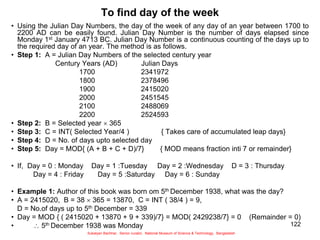
• It is very interesting to find how the Earth will be seen from the outer planets. The maximum
elongation of the Earth from the outer planets will give us an idea of how it will be seen in the sky
of these planets and the angular diameters will indicate the size of its disk. For the sake of
simplicity we shall consider the average distances of the outer planets from the Sun, we have
following formulae.
 
 
 
     
 
 
 
   
c
15.30arcse
10
1.5
1.15
6400000
2sin
Earth
of
diameter
Angular
AU
1.15
41
cos
1.524
elongaton
MScos
EM
elongaton
maximum
at
distance
Planet
-
Earth
EM
41
1.524
1
sin
Mars
from
Elongation
Max
AU
1.524
distance
Sun
-
Mars
AU
1
distance
Sun
-
Earth
Mars.
consider
shall
we
eaxmple,
an
As
elongation
cos
distance
Sun
Planet
elongation
maximum
at
Distance
Planet
-
Earth
elongation
maximum
at
Distance
Planet
-
Earth
Earth
of
Radius
2sin
Earth
of
Diameter
Angular
2)
Distance
Sun
-
Planet
Distance
Sun
-
Earth
sin
Elongation
Maximun
1)
11
1
-
0
0
1
-
m
1
-
1














































 
Sukalyan Bachhar, Senior curator, National Museum of Science & Technology, Bangladesh
69
The Earth viewed from the outer planets
• In the sky of Mars, the Earth will be seen before sunrise or after sunset up yo 41 degrees in the
Sky. At maximum elongation its angular diameter will be about 15.3 arc seconds. Similar
calculation can be done for other outer planets. The results are complied in the following table.
• .
Planet Dist. From (Earth-Planet) dist. Max Elongation Angular
Sun (AU) at max elongation (AU) (Degree) Diameter (arc sec)
Mars 1.524 1.15 41 15.30
Jupiter 5.204 5.12 11 3.44
Saturn 9.582 9.53 6 1.85
Uranus 19.201 19.17 3 0.92
Neptune 30.047 30.03 2 0.58
Pluto 39.236 39.22 1.5 0.45
Sukalyan Bachhar, Senior curator, National Museum of Science & Technology, Bangladesh
70
View of the Earth and the Moon from Mercury and Venus
• The Earth is an outer planet for the Mercury and the Venus. The Earth will be seen from night side
of these planets at oppositions.
• At oppositions we shall assume following distances
• Mercury  (1 – 0.4) AU =0.6 AU
• Venus  (1 – 0.7) AU =0.3 AU
• Diameter of the Earth = 12800 km
• Distance between the Earth and the Moon – 38400 km
only.
degree
a
half
about
is
it
Venus
the
from
and
minutes
arc
15
about
only
is
Moon
the
and
Earth
the
of
separation
angular
maximum
Mercury
the
from
viewed
As
*
min.
arc
29.3
10
1.5
0.3
384000
sin
Moon
and
Earth
between
separation
Angular
sec.
arc
56.66
10
1.5
0.3
12800
sin
Earth
the
of
diameter
Angular
Venus
the
From
Earth
the
of
Size
*
min.
arc
14.66
10
1.5
0.6
384000
sin
Moon
and
Earth
between
separation
Angular
sec.
arc
29.3
10
1.5
0.6
12800
sin
Earth
the
of
diameter
Angular
Mercury
the
From
Earth
the
of
Size
*
8
1
-
8
1
-
8
1
-
8
1
-








































Sukalyan Bachhar, Senior curator, National Museum of Science & Technology, Bangladesh
71
Tidal forces of the planets on the Earth
• Tidal Force: Tidal force is defined as differential gravitation force (across the position) on a body by
any another body.
 
earth.
the
from
Planet
the
of
Distance
R
&
planet
the
of
Mass
M
Where
;
R
M
Force
Tidal
:
r'
'
of
insted
R'
'
Using
dr
r
2GMm
Force
Tidal
dr
r
2GMm
dr
(-2)r
GMm
-
dr
r
GMm
-
r
dr
r
F
dF
:
Force
Tidal
of
Definition
From
r
GMm
-
F
:
n
Gravitatio
of
Law
s
Newton'
From
:
Traetment
al
Mathematic
3
3
3
1
-
2
-
2
2






















Sukalyan Bachhar, Senior curator, National Museum of Science & Technology, Bangladesh
72
Tidal forces of the planets on the Earth
 
 
0.00011
0.28
10
2.445
Sun
the
of
Force
Tidal
Venus
the
of
Force
Tidal
4.2
r
0.28AU
AU
0.72
1-
Earth
the
from
Venus
the
of
distance
Minimum
10
2.445
m
M
10
2.445
Venus
of
Mass
Earth?
onThe
Venus
the
of
force
tidal
maximum
the
is
What
:
2
Example
*
0.000013
10
12.87
4.2
10
953.688
Sun
the
of
Force
Tidal
Jupiter
the
of
Force
Tidal
4.2
r
4.2AU
AU
1
-
5.2
Earth
the
from
Jupiter
the
of
distance
Minimum
10
953.688
m
M
10
953.688
Jupiter
of
Mass
Earth?
onThe
Jupiter
the
of
effect
tidal
maximum
the
is
What
1:
Example
*
r
m
Sun
the
of
Force
Tidal
Planet
the
of
Force
Tidal
have,
we
g
Simplifyin
AU
in
distance
of
multiple
r
)
/M
M
m
(
ratio
mass
of
multiple
m
Where,
AU
1
r
AU
1
M
M
m
Sun
the
of
Force
Tidal
Planet
the
of
Force
Tidal
have,
We
AU,
in
distance
the
and
Sun
the
of
mass
of
terms
in
expressed
is
planet
of
mass
If
R
R
M
M
Earth
the
from
Sun
the
of
Distance
Earth
the
from
Sun
the
of
Distance
Sun
the
of
Mass
Planet
the
of
Mass
Sun
the
of
Force
Tidal
Planet
the
of
Force
Tidal
3
6
-
6
-
S
6
-
6
3
6
-
6
-
S
6
-
3
S
P
3
S
S
3
-E
P
-E
S
S
p
3

































































 














































Sukalyan Bachhar, Senior curator, National Museum of Science & Technology, Bangladesh
73
Tidal forces of the planets on the Earth
• Following table gives maximum tidal forces of the Sun, The Moon and the Planet on the Earth. It is
clear that tidal force of the Moon is about 2 times the tidal force of the Sun.
Planet Actual
Distance (AU)
Minimum
Distance (AU)
Mass  10-6
(Sun = 1)
Tidal Force
(Sun = 1)
Mercury 0.387 0.613 0.1659 0.0000007
Venus 0.72 0.28 2.445 0.00011
Mars 1.52 0.52 2.445 0.000002
Jupiter 5.2 4.2 953.688 0.000013
Saturn 9.5 8.5 285.55 0.0000005
Uranus 19.2 18.2 143.6 0.000000001
Neptune 30 29 51.45 0.000000002
Pluto 39.5 38.5 0.0000000000001
Moon 356000 km 2.1
Sun 1 1 1 1
Sukalyan Bachhar, Senior curator, National Museum of Science & Technology, Bangladesh
74
Fall of the Moon towards the Earth
• The Moon revolves around the Earth. The necessary centripetal force is provided by the
Earth’s gravitational attraction on the Moon. If centripetal force suddenly vanishes, the
Moon would mpve along a tangent to its orbit. Because of centripetal force Moon
continuously falls towards the Earth. From the Newton’s law of Gravitation fall of the Moon
towards the Earth can be estimated.
• In the figure
• E = Center of the Earth
• EA = r = radius of the Earth = 6400 km
• EB = R = Radius of the Moon’s Orbit = 384400 km
• BC indicates direction of the Moon would move,
• In the absence of centripetal force.
• CD = fall of the Moon towards the Earth in 1 sec.
• BEC = space angle through which the Moon moves in 1 sec.
Sukalyan Bachhar, Senior curator, National Museum of Science & Technology, Bangladesh
75
Fall of the Moon towards the Earth
 
 
 
   
 
 
m.
4.9
about
through
Earth
the
towars
falls
Moon
the
hour
1
in
Thus
mm.
1.3616
through
Earth
the
towards
falls
Moon
the
sec.
1
in
means
Which
m
10
1.3616
CD
m
3600
24
27.332
2π
2
384400000
CD
3600
24
27.332
2π
a
be
will
sec.
1
in
covered
a'
'
angle
The
days.
27.332
is
Moon
the
of
period
orbital
the
Since
2
a
R
1
2
a
1
R
CD
2
a
1
2
a
1
2
a
1
1
a
cos
1
and
2
a
1
a
cos
small;
very
is
a'
'
angle
Since
1
a
cos
1
R
R
-
a
cos
R
CD
a
cos
R
CD
R
CD
R
R
a
cos
R
ED
EB
But
DC
ED
EB
EC
EB
a
cos
3
-
2
2
2
2
1
2
2
2










































































Sukalyan Bachhar, Senior curator, National Museum of Science & Technology, Bangladesh
76
Acceleration of Moon towards he Earth
• The centripetal Force provided by the Earth’s gravity keeps the Moon in its orbit.
Which means at every instant Moon is accelerated towards the Earth. From the
knoledge of the orbital velocity and periodic time of the we can find the acceleration
of Moon towards the center of the Earth.
• Orbital velocity of the Moon can be found from the following formula
  2
2
8
2
3
2
3
8
m/s
0.00272
m/s
10
3.844
10
1.024
r
v
a
Earth
the
of
center
the
towards
Moon
the
of
on
accelerati
distance
velocity
of
sq.
mass
on
accelerati
mass
F
Moon.
the
on
acting
force
l
Centripeta
The
m/s.
10
1.024
m/s
3600
24
27.3
10
3.844
2π
v
days
27.3
time
Periodic
T
km
384400
Earth
the
of
center
the
from
Moon
the
of
distance
Average
r
ere,
Wh
T
2π
v
time
periodic
orbit
the
of
nce
circumfere
velocity
Orbital

























r
Sukalyan Bachhar, Senior curator, National Museum of Science & Technology, Bangladesh
77
Acceleration of Moon towards he Earth
*
 
Earth.
the
towards
mm.
1.36
through
s
fall
it
time
same
the
at
1sec.
in
km
1
about
through
moves
It
km/s
1.024
Moon
the
of
velocity
Since
mm
1.36
m
0.00136
m
1
0.00270
2
1
h
h
Earth
the
towards
falls
Moon
the
which
through
distance
s
sec.
1
time
t
m/s
0.00272
Moon
the
of
on
accelerati
a
0
velocity
initial
u
at
2
1
ut
s
formula.
s
Newton'
the
Use
Earth.
the
towards
falls
Moon
the
rate
what
At
:
2
Example
m/s
0.006
m/s
10
1.5
10
30
r
v
a
Sun
the
towards
on
accelerati
s
Earth'
m
10
1.5
Sun
the
from
Earth
the
of
distance
average
m/s
10
30
km/s
30
Earth
the
of
velocity
Orbital
Sun.
the
towards
Earth
the
of
on
accelerati
the
is
What
1:
Example
2
2
2
2
2
8
2
3
2
8
3



























Sukalyan Bachhar, Senior curator, National Museum of Science & Technology, Bangladesh
78
Curious Coincidence between the Sun, Earth and Moon
• The number 108
Following coincidences are observed with reference to Number
• Diameter of the Earth  108 = Diameter of the Sun (nearly)
12800 km  108 = 1382000 km ( Actual Diameter of the Sun = 1392000 km.
• Diameter of the Sun  108 = Distance between The Earth and the Sun (nearly)
1392000 km  108 = 150336000 km ( Actual average distance between them = 150000000 km.)
• Diameter of the Moon  108 = Distance between The Earth and the Moon (nearly)
3500 km  108 = 378000 km ( Actual average distance between them = 384000 km.)
• The number 400
Following coincidences are observed with reference to Number
• Distance of the Sun and the Moon from the Earth are not constant, due to elliptical motion these
distances continuously change and the ratio becomes nearly 400. Due to these two coincidences
the total Solar eclipse has become possible.
400)
(nearly
390
km
384000
km
150000000
Moon
the
of
distance
Average
Sun
the
of
distance
Average
400)
(nearly
398
km
3500
km
1392000
Moon
the
of
Diameter
Sun
the
of
Diameter






Sukalyan Bachhar, Senior curator, National Museum of Science & Technology, Bangladesh
79
Curious Coincidence between the Sun, Earth and Moon
Sukalyan Bachhar, Senior curator, National Museum of Science & Technology, Bangladesh
80
Zero gravity point between the Earth and the Moon
 
   
 
 
km
345946
km
0.11
1
384000
/M
M
1
R
h
M
M
1
h
R
M
M
h
h
-
R
h
-
R
M
h
M
h
-
R
GM
h
GM
h
-
R
GM
h
GM
h
GM
h
GM
have,
we
point
gravity
zero
At
2
1
Earth
Moon
2
1
Earth
Moon
Earth
Moon
2
2
2
Moon
2
Earth
2
Moon
2
Earth
2
point
zero
to
center
Earth
Moon
&
Earth
between
Distance
Moon
2
Earth
2
Moon
2
Earth
point
zero
to
center
Earth
point
zero
to
center
Earth
point
zero
to
center
Earth


























Sukalyan Bachhar, Senior curator, National Museum of Science & Technology, Bangladesh
81
Synodic time
• Synodic time is an interval between two successive heliocentric conjunctions of the
planets in longitudes.
• Heliocentric conjunction indicates the closest approach of the planets. We have to
determine the syndonic times of the planets with reference to the Earth.
• For Inner planets they are close to the Earth at their Inferior conjunction that is when
they are between the Earth and the Sun.
• For outer planets they are close to the Earth at their opposition that is when they are
beyond the Earth.
• In general the syndonic time can be calculated from the angular velocities of the
planets. Relative angular velocity = Difference between the angular velocities of the
planets.
• Angular velocity is given by the following formula
 = 2/T
Let, T  relative periodic time; T  periodic time of first planet; T  periodic
of second planet.
Then we have,
• 2 /T = 2 /T - 2 /T  1/T =1/T - 1/T
Sukalyan Bachhar, Senior curator, National Museum of Science & Technology, Bangladesh
82
Synodic time
• Synodic Time of Inner Planets
• In this case T periodic time of inner planets which is smaller than the Earth
• T  periodic time of the Earth which is one year.
• Then we have
• 1/T =1/T - 1/1
• For example
• For Mercury: T = 0.241 years.
•  1/T =1/0.241 - 1/1 = 4.1493 – 1 = 3.1413
• Synodic time of Mercury = T =1/3.1413 yr. = 0.3175 yr. = 115.89 days =116 days
(nearly)
• Synodic Time of Outer Planets
• In this case T  periodic time of the Earth which is one year
• T   periodic time of the planets which is outer than the Earth
• Thus we have
• 1/T =1/1 - 1/T 
• For example
• For Mars: T = 1.88 years.
•  1/T =1/1 - 1/1.88 = 1 – 0.5319=0.468
• Synodic time of Mars = T =1/0.468 yr. = 2.1367 yr. = 779.9 days =780 days (nearly).
Sukalyan Bachhar, Senior curator, National Museum of Science & Technology, Bangladesh
83
Synodic time
• Following table gives the orbital period and synodic time of all the planets:
Planets Orbital
Period
(Years)
Synodic
Years
Synodic
days
Mercury 0.241 0.317 116
Venus 0.616 1.641 585
Mars 1.880 2.136 780
Jupiter 11.900 1.090 399
Saturn 29.500 1.035 378
Uranus 84.000 1.013 369.65
Neptune 165.000 1.006 367.477
Pluto 248.000 1.004 366.72
Sukalyan Bachhar, Senior curator, National Museum of Science & Technology, Bangladesh
84
Maximum elongation of Mercury and Venus
• Mercury and Venus are the inner planets. They can only be observed,
few hours before sunrise or few hours after sunset. In general Elongation
is defined as the angle between is defined as the angle between the Sun,
the Earth and the Planet.
• If an elongation of a planet is less than 10 degrees, it cannot be observed
in the glare of the Sun. As viewed from the Earth the maximum elongation
of the Mercury does not does not exceed more than 28 degrees and that
the Venus more than 47 degrees. Since the Earth rotates through 15
degrees in one hour, the Mercury can be observed about 2 hours and the
Venus about three hours before sunrise or after sunset; if their elongations
are maximum. At aphelion the distance of the planet from the Sun is
maximum. Thus when either the Mercury or the Venus is at the Aphelion its
elongation is maximum. If we know the Aphelion distance of the planets
their maximum elongation can easily be found. S  Sun, E  Earth, M
 Mercury & V  Venus
Let the Mercury and the Venus be at aphelion, then Maximum Elongation of
the Mercury is the angle SEM, and Maximum elongation of the Venus is
the angle SEV, SME and SVE are the right angle triangles.
   
 
(nearly)
deg
28
deg.
27.8
Mercury
the
of
Elongation
Maximum
0.4666989
sin
Elongation
0.4666989
AU
1
AU
0.4666989
SE
SM
Elongation
of
Sine
AU
0.4666989
AU
0.205629
1
0.3871
e
1
a
Mercury
the
of
distance
Aphelion
0.205629
e
Mercury
the
of
orbit
the
of
ty
Eccentrici
AU
0.3871
a
Mercury
the
of
axis
major
Semi
Mercury
the
of
Elongation
Maximum
*
1
-


















Sukalyan Bachhar, Senior curator, National Museum of Science & Technology, Bangladesh
85
Maximum elongation of Mercury and Venus
• Elongation of a planet can be East or West.
• If the longitude of the planet is greater than longitude of the
Sun. Elongation is ‘East’. In this case planet can be seen after
sunset.
• If the longitude of the planet is smaller than longitude of the
Sun. Elongation is ‘West’. In this case planet can be seen
before sunrise.
• If the elongation of the planet is less than 10 degrees the planet
cannot be seen.
   
 
(nearly)
deg
48
deg.
46.7
Venus
the
of
Elongation
Maximum
0.7282243
sin
Elongation
0.7282243
AU
1
AU
0.7282243
SE
SV
Elongation
of
Sine
AU
0.7282243
AU
0.006772
1
0.723326
e
1
a
Venus
the
of
distance
Aphelion
0.006772
e
Venus
the
of
orbit
the
of
ty
Eccentrici
AU
0.723326
a
Venus
the
of
axis
major
Semi
Venus
the
of
Elongation
Maximum
*
1
-


















Sukalyan Bachhar, Senior curator, National Museum of Science & Technology, Bangladesh
86
Maximum elongation of Mercury and Venus
SIGNS OF ZODIAC
Approximate date of entry of the Sun
Sign (বাাংলা) Western Sign Indian Sign
Aries (মেষ) 21 March 14 April
Taurus (বৃষ) 21 April 14 May
Gemini (মেথুন) 21 May 14 June
Cancer (কককট) 21 June 14 July
Leo (ম িংহ) 21 July 14 August
Virgo (কনযা) 21 August 14 September
Libra (তুলা) 21 September 14 October
Scorpios (বৃশ্চিক) 21 October 14 November
Sagittarius (ধনু) 21 November 14 December
Capricornus (েকর) 21 December 14 January
Aquarius (ক
ু ম্ভ) 21 January 14 February
Pisces (েীন) 21 February 14 March
INDIAN ASTERISMS
1. Ashwani 10. Megha 19. Mula
2. Bharani 11. Purva Phalguni 20. Purv- ashadha
3. Krittika 12. Uttar Phaguni 21. Uttara-ashadha
4. Rohani 13. Hasta 22. Shravan
5. Mriga 14. Chitra 23. Dhanishta
6. Ardra 15. Swati 24. Shatataraka
7. Punarvasu 16. Vishakha 25. Purva-bhadrapada
8. Pushya 17. Anuradha 26. Uttara-bhadrapada
9. Ashlesha 18. jyeshtha 27. Revati
* 1 Sign = 30 degrees 1 Asterism = 13.33 degrees
* Ayanansha = Vernal Equinox – Indian First Point of Aries = 24 degrees (nearly)
Sukalyan Bachhar, Senior curator, National Museum of Science & Technology, Bangladesh
87
Elementary Astronomical Calculations:
Earth and Motion ( Lecture – 2)
Thank You
Sukalyan Bachhar, Senior curator, National Museum of Science & Technology, Bangladesh
88
Elementary Astronomical Calculations:
Telescope and Calendar ( Lecture – 3)
•By Sukalyan Bachhar
•Senior Curator
• National Museum of Science & Technology
•Ministry of Science & Technology
•Agargaon, Sher-E-Bangla Nagar, Dhaka-1207, Bangladesh
•Tel:+88-02-58160616 (Off), Contact: 01923522660;
•Websitw: www.nmst.gov.bd ; Facebook: Buet Tutor
&
•Member of Bangladesh Astronomical Association
•Short Bio-Data:
First Class BUET Graduate In Mechanical Engineering [1993].
Master Of Science In Mechanical Engineering From BUET [1998].
Field Of Specialization  Fluid Mechanics.
Field Of Personal Interest  Astrophysics.
Field Of Real Life Activity  Popularization Of Science & Technology From1995.
An Experienced Teacher Of Mathematics, Physics & Chemistry for O- ,A- , IB- &
Undergraduate Level.
Habituated as Science Speaker for Science Popularization.
Experienced In Supervising For Multiple Scientific Or Research Projects.
17 th BCS Qualified In Cooperative Cadre (Stood First On That Cadre).
Sukalyan Bachhar, Senior curator, National Museum of Science & Technology, Bangladesh
89
Magnification power of a telescope
• Let us consider simple refracting telescope. The objective forms an image of a distant object on its
focal plane. If the focal plane of eyepiece just coincides with the focal plane of the objective, the
final image will be formed at infinity. But eyepiece is so arranged that the image is observed. Let
us consider ideal situation.
   
   
140
5
700
power
magnifying
cm
5
f
&
cm
700
f
If
:
Example
changed.
be
can
power
magnifying
eyepiece
the
of
length
focal
changing
by
that
clear
is
It
eyepiece
of
length
focal
objective
of
length
focal
power
magnifying
by,
given
is
power
magnifying
its
or
teesope
a
of
ion
magnificat
hence
f
f
x/f
x/f
a
b
magnifying
Angular
a'
'
than
greater
is
b'
'
generally
f
x
b
b
b
tan
small
very
is
b'
'
if
f
x
b
tan
eyepiece
at
x
object
the
by
made
angle
b
eyepiece;
of
length
focal
f
eyepiece;
for
objective
of
length
x
infinity.
at
formed
is
image
situation
ideal
in
and
eyepiece
for
object
an
as
behaves
objective
by
formed
image
The
f
x
a
a
a
tan
small
very
is
a'
'
if
f
x
a
tan
objective
the
at
image
the
by
made
angle
a
objective;
of
length
focal
f
;
objective
by
formed
image
of
length
x
Let,
e
0
e
o
0
e
e
e
e
0
0
0


























Sukalyan Bachhar, Senior curator, National Museum of Science & Technology, Bangladesh
90
Resolving power of a telescope
• Resolving power is ability of a telescope to separate the images of stars which are
very close to each other. It also allows to discern details in an extended object.
• The minimum resolvable angle depends on the diameter of the telescope objective
and wave length of the light being observed. In general,
 
sec.
arc
10
1.2258
sec.
arc
10
10
500
206265
1.22
1.22θ
nm.
500
of
h
wavelengt
at
resolved
be
can
that
angle
smallest
what
m.
10
diameter
has
telescope
Keck
:
Example
seen.
be
can
stars
the
of
images
separate
two
i.e.
resolved
be
can
yhey
apart,
sec.
arc
1.5
than
more
are
stars
if
means
This
sec.
arc
1.5
0.1
10
6
206265
1.22
1.22θ
Then,
m.
10
6
observed
h
Wavelengt
m.
0.1
objective
telescope
of
Diameter
1.22.
by
multiplied
is
angle
resolvable
minimum
account
into
n
diffractio
take
To
image.
the
spreds
that
pattern
n
diffractio
produces
telescope
a
of
aperture
circular
The
units.
same
in
measured
are
objective
of
diameter
and
length
wave
The
sec
arc
206265
sec
arc
3600
57.29577
deg.
57.29577
radian
1
radian
1
in
seconds
arc
of
number
indicates
206265
Where
objective
of
diameter
length
wave
206265
θ
angle
resolvable
minimum
2
-
9
min
7
min
7
-
min














 













:
Example
Sukalyan Bachhar, Senior curator, National Museum of Science & Technology, Bangladesh
91
Resolving power of a radio telescope
• Sun, Stars, Nebulae, Galaxies and many other objects emit radio waves. Hence
Radio Astronomy has become an essential tool of modern astronomy.
• Resolving power formula of optical telescope can be applied to Radio Telescope also.
• Resolving Power of Radio Telescope = 206265
sec.
arc
412.53
1000
0.2
206265
Power
Resolving
by,
given
power
resolving
have
will
Wave
Radio
cm
20
with
working
m
1000
aperture
an
with
Telescope
Radio
A
possible.
not
is
this
y
Technicall
across
km.
41.253
m
1
0.2
206256
D
D
0.2
206256
sec.
arc
1
Telescope.
Radio
a
requires
h
wavelengt
cm
20
at
sec.
arc
1
resolve
to
example,
For
telescope.
optical
than
larger
times
400000
be
to
has
Telescope
Radio
the
angle
same
resolve
to
want
we
If
wave.
vsible
nm
500
than
longer
times
400000
is
Wave
Radio
cm
20
means
Which
400000
m
10
500
m
0.2
be,
will
h
wavelengt
two
these
of
ratio
the
then
m),
(0.2
cm
20
is
wave
Radio
of
that
and
nm
500
is
light
visible
of
h
wavelengt
Suppose
example,
For
less.
quite
is
diameter
given
a
of
Telescope
Radio
a
of
Power
Resolving
Hence
light.
visible
of
that
than
greater
far
are
waves
Radio
of
ngth
Wavele
Aperture
D
h
wavelengt
Radio
λ
Where,
D
λ
206262
Telescope
Radio
of
Power
Resolving
9
-














Sukalyan Bachhar, Senior curator, National Museum of Science & Technology, Bangladesh
92
Scale of an image
• Apparent sizes of the objects like Stars, Sun, Moon, Planets are generally expressed in
angular units. But it is convenient to express the scale of an image in linear units. For
example, apparent size of moon is 0.5 degrees. Suppose a telescope produces the
image of Moon 1 cm across. The scale image is 0.5 deg/cm or 2 cm/deg.
• The scale image only depends on focal length of mirror or lens. Numerically linear length
‘S’ of an image corresponding to 1 degree in the Sky is given by
across
cm.
14.5
nearly
is
telescope
Hale
by
produced
Moon
the
of
Image
cm
14.5
mm
1.45
mm
1
12.4
1800
to
s
correspond
sec.
arc
1800
milimeter
1
to
s
correspond
sec.
arc
12.4
since,
sec.
arc
1800
deg.
0.5
Moon
the
of
size
Apparent
telescope?
this
by
produced
Moon
the
of
image
scale
the
is
What
sec.
arc
12.4
sec.
arc
1000
0.29
60
60
s
correspond
milimeter
1
Hence
sec.
arc
60
60
to
s
correspond
milimeters
1000
0.29
Thus,
(nearly)
m/deg.
0.29
S
m/deg.
0.29316
m/deg.
16.8
0.01745
S
telecope?
the
by
produce
image
scale
the
is
What
meters.
5
is
diameter
its
and
meters
16.8
is
Telescope
Hale
of
length
Focal
:
Example
0.01745f
S
degrees
57.3
radian
1
since
deg.
57.3
f
S


















Sukalyan Bachhar, Senior curator, National Museum of Science & Technology, Bangladesh
93
Brightness of an image
• An optical telescope is an extension of our eye. It can gather more light so that faint objects
can be seen. Light consists of photons. In order to make a faint object brighter, more
number of photons should enter our eye. Hence far away faint objects can be only
observed with big telescopes.
• The brightness of an image is a measure of the amount of light energy that is concentrated
into a unit area of the image, such as a square millimeter. The brightness of an image
determines how long, time would be required to record the image photographically.
Brightness can be determined from light gathering power of a telescope and its focal
length.
 
 
 
eye.
an
of
pupil
mm
5
than
light
more
times
40000
collect
can
objective
meter
1
means
Which
m
d1
d2
have,
We
telescope
of
diameter
d2
and
pupil
of
diameter
d1
If
meter.
1
diameter
of
telescope
a
and
mm
5
diameter
pupil
a
with
eye.
naked
at
power
gathering
Light
Compare
1:
Example
diameter
power
gathering
Light
or
diameter
4
π
power
gathering
Light
diameter
4
π
circle
a
of
Area
Hence,
circular.
are
objectives
the
of
Most
collect.
can
it
light
much
how
determines
telescope
a
of
objective
an
of
area
The
power.
gathering
its
called
is
light
more
collect
to
telescope
a
of
Ability
:
Power
gathering
Light
The
*
2
2
2
4
2
3
2
10
4
10
5
m
1























Sukalyan Bachhar, Senior curator, National Museum of Science & Technology, Bangladesh
94
Brightness of an image
• An optical telescope is an extension of our eye. It can gather more light so that faint objects can
be seen. Light consists of photons. In order to make a faint object brighter, more number of
photons should enter our eye. Hence far away faint objects can be only observed with big
telescopes.
• The brightness of an image is a measure of the amount of light energy that is concentrated into
a unit area of the image, such as a square millimeter. The brightness of an image determines
how long, time would be required to record the image photographically. Brightness can be
determined from light gathering power of a telescope and its focal length.
 
 
 
eye.
an
of
pupil
mm
5
than
light
more
times
40000
collect
can
objective
meter
1
means
Which
10
4
m
10
5
m
1
d1
d2
have,
We
telescope
of
diameter
d2
and
pupil
of
diameter
d1
If
meter.
1
diameter
of
telescope
a
and
mm
5
diameter
pupil
a
with
eye.
naked
at
power
gathering
Light
Compare
diameter
power
gathering
Light
or
diameter
4
π
power
gathering
Light
diameter
4
π
circle
a
of
Area
Hence,
circular.
are
objectives
the
of
Most
collect.
can
it
light
much
how
determines
telescope
a
of
objective
an
of
area
The
power.
gathering
its
called
is
light
more
collect
to
telescope
a
of
Ability
4
2
3
2
2
2
2























:
1
Example
:
Power
gathering
Light
The
*
Sukalyan Bachhar, Senior curator, National Museum of Science & Technology, Bangladesh
95
Brightness of an image
*
 
f/15.
ratio
focal
than
image
brighter
give
will
f/3
ratio
Focal
example
For
ratio.
focal
large
than
image
brighter
a
in
results
ratio
focal
small
small
Thus
ratio.
focal
the
to
al
proportion
inversely
is
image
an
of
brightness
The
ratio.
focal
called
is
f/d
1
f
d
brightness
Image
get
shall
we
results,
two
above
the
combine
we
If
f
1
image
of
brightness
f
image
of
area
f
image
of
size
objective.
of
length
length
focal
the
on
depends
image
of
size
The
detector.
or
film
of
area
small
any
reaches
light
spread
is
image
the
more
but
size,
image
on
depends
Brightness
2
2
2
2
d
/
f















:
Telescope
Of
Length
Focal
The
*
Sukalyan Bachhar, Senior curator, National Museum of Science & Technology, Bangladesh
96
Julian day number
• For all modern Astronomical calculations, 12 noon of 1st January 4713 BC is selected as an epoch. The
number of days elapsed from the epoch up to the desired Gregorian date are calculated, resulting is called
Julian Day Number or JD in short.
• The JD corresponding to 1st January 2000 is then subtracted from the JD of the desired date and result is
divided by the number of the days in Julian century of 36525 days. This ratio is then represented as T and
used for all Astronomical calculations. Jean Meeus has given a simple method to find JD of a required
Gregorian Date. The steps of the method are as follows.
• 1. Y = Year, M = Month, D = Day
• 2. If M>2, Y and M remain unchanged
• 3. If M = 1 or 2 (January or February) replace Y  Y – 1 and M  M + 12
• 4. Calculate
• A = INT(Y/100) and B = 2 – A + INT(A/4)
• 5. Julian Day Number is given by
• JD = INT{365.25(Y+4716)} + INT{30.6001(M+1)} + D + B – 1524.5
• Example: Find JD for 19th Nov. 2001
• 1. Y = 2001, M = 11, D = 19
• 2. Since M> 2 Y and M remain unchanged
• 3. Skip
• 4. A = INT(2001/100) = 20, B = 2 – 20 + INT(20/4) = -13
• 5. JD = INT{365.25(2001 + 4713)} + INT{30.6001(12)} + 19 – 13 – 1524.5
• = 2453384.0 + 367 + 19 – 1537.5 = 2452232.5
• T = ( JD – 2451545.0)/36525 = (2452232.5 – 2451545.0)/3625 =0.018822724
Sukalyan Bachhar, Senior curator, National Museum of Science & Technology, Bangladesh
97
Epact: Phase of Moon on 1st January
• Epact means the phase of the Moon at zero hours on 1st January of any year. Knowing
Epact probable dates of full and new Moon for the entire year can be estimated. Every 19
years phases of the Moon repeat. The Metonic cycle proves this fact, from which the
phase of the Moon on 1st January can be judged. The calculation is quite approximate;
hence there can be a difference of one day in estimated phase of the Moon. Stepwise
method of finding epact is as follows.
• Step 1 : The phase the Moon on 1st January AD. Will get repeated in the years 20, 39, 58,
etc. Hence divide the required year by 19 and note down only the remainder of the
division.
• Step 2 : Since Solar year (365 days) and Lunar year (354 days) differ by 11 days. Every
year thes 11 days will get accumulated. Hence multiply the remainder of step one by 11.
• Step 3 : Lunar phase cycle is of 30 days, hence divided the multiplication of step 2 by 30
and again find the remainder only. The resultant remainder gives roughly the phase of the
Moon on 1st January.
• Step 4 : The formula to decide the Epact is as follows
 
 
  8
15
23
13
stJanuary
1
Moonon
Phaseofthe








 






 






 









 


30
11
MOD
30
2008/19
MOD
11
MOD
30
y/19
MOD
11
MOD
Epact
division.
the
of
reaminder
MOD
digits
four
in
year
y
2008
Jan
1st
on
Moon
the
of
phase
the
find
us
let
example
an
As
30
y/19
MOD
11
MOD
January
1st
on
Moon
the
of
Phase
Epact
Sukalyan Bachhar, Senior curator, National Museum of Science & Technology, Bangladesh
98
Epact: Phase of Moon on 1st January
• Thus on 1st January 2008 there was 8th tithi of dark fort night. In Indian Almanacs 9th tithi
is given, because 8th ended at 4:52 morning and 9th started. We can expect a difference
of one tithi because of extension and reduction of the tithes. Also tithi at sunrise is
assumed to the tithi of the entire day.
• Knowing the phases of the Moon on 1st January, several events can be estimated.
1. If 1st January 2008 is 8th tithi of dark fortnight then there was full moon 8 days before.
Thus 24th December2007 was full moon day.
2. On 15th December the Sun completes 8 signs and enters in Niryan Sagirrarius hence on
1st January 2008 Sun’s Indian longitude was 8030 +15 =255 degrees.
3. In the dark fortnight angular difference in the Sun and the Moon=180 - tithi 12=180 –96
= 84 deg. (nearly)
4. Longitude of the Moon = Longitude of the Sun – Angular difference =255 – 84 = 171
deg. (nearly). A Asterism = 13.3 deg. 171/13.3 =12.8 Thus the Moon has crossed
Uttara Falguni and entered in Hasta Nakshtra. According to Almanac the Moon was
Spica.
5. If on 1st January 2008 Sunrise was assumed to be at 6 AM. The Moon rise must be
84/15 = 5.6 hours before sunrise. Which mens the Moon rise was after 12.30 in the night.
On that day moon rise was about 1 AM.
Sukalyan Bachhar, Senior curator, National Museum of Science & Technology, Bangladesh
99
Phase of the Moon
• The of the Moon’s surface that is illuminated by the sunlight is called phase of the Moon.
From new to full Moon the Phase of the Moon increases while it decreases from to new
Moon. The phase of the Moon depends on its elongation. The elongation is an angle
between the Sun, the Earth and the Moon. Tithi of an Indian calendar is indirectly
elongation of the Moon. Thus knowing the tithi of the day phase of the Moon can be
determined.
   
  25
.
0
















2
120
cos
1
fortnight
bright
of
tithi
5th
Moon
the
of
Phase
120
60
-
180
d
60deg.
5
12
Tithi
5th
deg.
12
Tithi
One
fortnight.
bright
of
tithi
5th
on
Moon
the
of
phase
the
find
s
let
example
an
As
e
-
180
d
e
elongation
-
180
d
e
Wher
2
d
cos
1
Moon
the
of
Phase
follows,
as
is
Moon
the
of
phase
the
for
formula
The
Sukalyan Bachhar, Senior curator, National Museum of Science & Technology, Bangladesh
100
Phase of the Moon
*
 
lighted.
be
will
portion
easter
ght
darkfortni
the
in
while
lighted
be
will
disk
the
of
portion
western
fortnight
bright
the
In
reversed.
be
will
disk
s
Moon'
the
of
part
lighted
the
only
same
be
will
fortnight
dark
and
bright
of
tithi
5th
on
phase
the
Thus
fortnight.
dark
the
in
reapeated
be
will
phase
The
2
36
cos
1
fortnight
bright
of
tithi
12th
Moon
the
of
Phase
deg.
36
144
-
180
d
and
deg.
144
12
12
tithi
12th
have
we
fortnight
bright
of
tithi
12th
on
gain
A
east'.
'
elongation
the
case
this
In
.
elongation
represents
represnts
directly
tithi
fortnight
bright
For
9
.
0









Sukalyan Bachhar, Senior curator, National Museum of Science & Technology, Bangladesh
101
To find the phase of the Moon Conway’s method
• John Harten Conway is well-known Princeton University mathematician. He is famous for his
mathematical procedure called ‘Game of Life’. His mos popular work is ‘Wining Ways’. A book on
mathematical games in two volumes. In the second volume of that book, Conway has given
some mathematical tricks for calendar calculations. “To find phase of the Moon” is one of them.
Phase of the Moon is another name of “Tithi” of Hindu Calendar. Using this method phase of the
Moon on any day of the year can be found. The answer may differ by one day because of some
assumption’s.
• Conway’s method to find the phase of the Moon is as follows.
• Step 1: Divided the last two digits of the year by 19 and find the remainder. If the is greater than
9 subtract 19 from the result so that remainder is between -9 to +9
• Step 2: Multiply the result obtained in step 1 by 11 and divide the multiplication by 30. If the
remainder is less than 30 subtract it from 30 and assume the result to be –ve . Thus the answer
obtained will be between -29 to +29.
• Step 3: Add day number and month number in the answer obtained in step2. but for January and
February select the numbers 3 and 4 respectively. For other months usual numbers are to given,
for example March = 3, April = 4 …….. Etc.
• Step 4: Subtract the number given in following table from the answer obtained in step 3.
Century Number to be subtracted
1700 to 1799 6 + 2/3 = 6.66
1800 to 1899 1 + 1/3 =1.33
1900 to 1999 4
2000 to 2099 8 + 1/3 =8.33
• Step 5: Divided the answer obtained in step 4 by 30 and get a remainder between 0 to 29. the
final answer indicates the phase of the Moon or the tithi of Hindu Calendar.
Sukalyan Bachhar, Senior curator, National Museum of Science & Technology, Bangladesh
102
To find the phase of the Moon Conway’s method
• Example 1: 12th December 2002
1. 02/19  R = +2
2. +2  11  22, 22/30  R = -8
3. -8 + 12 +12 = 16 Month No. = 12, Day No. = 12
4. 16 – 8.3 = 7.8  8 21st Century -8.3
5. 8  8th tithi of white fortnight – ( Shudha Astami) Phase of the Moon about ½ .
• Example 2: 29th January 2006
1. 06/19  R = +6
2. +6  11  66, 66/30  R = +6
3. 6 + 3 +29 = 38 January = 3, Day No. = 29
4. 38 – 8.3 = 29.7  30 (21st Century -8.3)
5. 30  New Moon Amavasya
• Example 3: 4th July 2008
1. 08/19  R = 8
2. 8  11  88, 88/30  R = 28
3. 28 + 4 + 7 = 39 (July = 7, Day No = 4)
4. 39 – 8.3 = 30.67 31 21st Century -8.3
5. 31/30 R =1
Pratipada (Almanac shows Dvitya because Partipada was omitted)
Sukalyan Bachhar, Senior curator, National Museum of Science & Technology, Bangladesh
103
Useful information to estimate Moon rise
• With the help of Tithi concept of Indian Almanac and every day Moon rises about 50 minutes
late, we can very roughly estimate time of the Moon rise. In one day the Moon moves through
360/27.3 = 13.2 degrees to the east. But due to the elliptical orbit, this angular distance changes
from 11.5 to 15.5 degrees. Average angular speeds of the Moon and the Sun are 13.2 degrees
and 1 degree respectively. Thus with respect to the Sun the average angular speed of the Moon
is 13.2-1 =12.2 degrees or nearly 12 degrees. This angular distance is called a tithi. When the
angular distance of the Moon increases by 12 degrees with respect to the Sun one tithi is said to
be completed. Again because of elliptical orbit of the Moon time interval of a tithi can change
between 20 to 28 hours. In addition to this some times a particular tithi is omitted or advanced.
Due to these complications it is very difficult to correctly estimate the time of the Moon rise. With
some assumption we can still very roughly estimate the time of Moon rise. At least it can give
some idea approximately when the Moon will rise.
To estimate the time of the Moon rise following facts are very useful.
• Every day the Moon rises about 50 minutes late, because with respect to the sun, the moon
moves through an angular distance of about 12.2 degrees.Since the Earth rotates through 1
degree 4 minutes. To cover a distance of 12.2 degrees the moon requires 12.2  4 = 48.8
minutes or roughly 50 minutes. If at certain no moon day (Amavasya) Sun and Moon rises at
6.30 aM. Next day the Moon will rise at 6.30 + 50=7.20 AM.
• In dark fortnight (Krishnapaksha) Moon rises in the night between Sunset and Sunrise.
• In white fortnight (Shuklapaksha) Moon rises in the day between Sunriset and Sunset.
• On no moon day longitudes of the Sun and the Moon are nearly equal.
• On full moon day there is a difference of 180 degrees between Longitudes of the Sun and the
Moon.
• In white fortnight elongation between the Sun and the Moon = Tithi  12 degrees.
In dark fortnight elongation between the Sun and the Moon = (180-Tithi)  12 degrees.
Elongation is an angle between the Sun, the Earth and the Moon.
• In white fortnight western side of the Moon is bright, while in dark fortnight eastern side of the
Moon is bright,
Sukalyan Bachhar, Senior curator, National Museum of Science & Technology, Bangladesh
104
Useful information to estimate Moon rise
• According to Indian Standard Time roughly the timings of sunrise and sun set are as
follows,
Month Sunrise Sunset
November, December, January 7 6
February
March, April, September, October 6.30 6.30
May, June, July, August 6 7
# There may be a difference of 15 minutes in these timings.
• On 8th tithi (Ashtami) of black and white fortnight, phase of the moon is about half.
• On 1st day of white fortnight (Shukla Pratipada) if the distance between the Sun and the
Moon is more than 12 degrees then only the Moon is visible.
• On 4th January distance between the Sun and the Earth is minimum. The Earth is at
Perihelion of its orbit and the length of the day is small about 11 hours.
• On 4th July distance between the Sun and the Earth is maximum. The Earth is at
Aphelion of its orbit and the length of the day is morel about 13 hours.
• Orbit of the Moon makes an angle of about 5 degrees with elliptic hence with reference to
celestial equator the Moon is at 23.5 + 5 = 28.5 degrees towards North or 23.5 – 5 = 18.5
degrees towards south.
Sukalyan Bachhar, Senior curator, National Museum of Science & Technology, Bangladesh
105
Very Approximate estimate of Moon rise
• We have two ways to approximate moonrise, one is Indian Tithi and another is about 50 minutes delay
of moonrise everyday. It is necessary to know with which English months required Indian month is
associated. Then the day of Indian month for which estimate of moonrise is to be made, note down the
approximate timing of sunrise.
• Estimate of moonrise with the help of Indian Tithi.
• White fortnight (Shukla Paksha): Moonrise between sunrise and sunset
Example 1: 4th Tithi ( Shukla Chaturthi)
Sun-Moon elongation = 4  12 = 48 deg.
Moonrise  after sunrise 48/15  3 hours.
If sunrise is at about 6:30 AM, moonrise will be in the morning at about 6:30 + 3  9:30 AM.
Example 2: 10th Tithi ( Shukla Dashami)
Sun-Moon elongation = 10  12 = 120 deg.
Moonrise  after sunrise 120/15  8 hours.
If sunrise is at about 6:30 AM, moonrise will be in the morning at about 6:30 + 8  2:30 PM.
• Dark fortnight (Krishnaa Paksha): Moonrise between sunset and sunrise
Example 1: 3rd Dark (Krishna Tritiya)
Sun-Moon elongation = (180 - 3  12) = 144 deg.
Moonrise  after sunset 36/15  2.5 hours. (180 – 144 =36)
If sunset is at about 6:30 PM, moonrise will be in the night at about 6:30 +2:30  9 PM.
Example 2: 12th Dark ( Shukla Dwadashi)
Sun-Moon elongation = (180 - 12  12) = 36 deg.
Moonrise  after sunset 144/15  9:5 hours. (180 – 36 = 144)
If sunset is at about 6:30 PM, moonrise will be in the night at about 6:30 +9:30  16 hours, that is
4’Oclock (12 + 4) early monring or 2.5 hours before sunrise.
Sukalyan Bachhar, Senior curator, National Museum of Science & Technology, Bangladesh
106
Very Approximate estimate of Moon rise
• Moonrise: Using 50 minutes delay of moonrise everyday.
For this method it is necessary to note down the no Moon days (Amavasya) of the year. Adding 15
days in those days full moon days can be found. From no Moon day to full Moon day of Indian month is
called white fortnight (Shukla Paksha) and from full Moon to no Moon is call dark fortnight (Krishna
Paksha).
• White fortnight (Shukla Paksha)
Example 1: Estimate of moonrise on 7th September 2008
no moon day was 30th August 2008. 30th August to 7th September no. of days = 8.
due to 50 minutes delay of moonrise accumulated minites = 8  50 = 400 minutes
400 minutes = 400/60  6 hrs 40 min.
If sunrise is at about 6:30 AM, moonrise will be after sunrise  6:30 + 6:40 = 1 hr 10 min PM.
Almanac gives moonrise at 12:48 PM.
• Dark fortnight (Krishna Paksha)
Example 2: Estimate of moonrise on 24th November 2008
no moon day was 28th October 2008, hence 13th November (28 + 15 =43) was full Noon day. From
From 13th November to 24th November No. of days = 11. due to 50 minutes delay of moonrise
accumulated minutes = 11  50 = 550 minutes = 9 hrs 10 min.
If on that day sunset was at 6 in the evening then moonrise will be after sunset  6:00 + 9:10  3 in
the morning. Almanac gives moonrise at 2:55 in the morning.
• Alternative Method
Or simply count number of days after No Moon Day, in this case, 26 days.
No, of accumulated minutes = 26  50 = 1300 minutes = 21 hrs 40 min.
Morning 6 to Next mornig 6 = 24 hrs.
24 hrs - 21 hrs 40 min = 2:20 early morning.
Sukalyan Bachhar, Senior curator, National Museum of Science & Technology, Bangladesh
107
Local sidereal time (LST)
• Greenwich Sidereal Time is the local sidereal time for the Greenwich Meridian . As
we move to east or west from the zero longitude of Greenwich, the hour angle of the
Vernal sidereal time as a difference between the Greenwich sidereal time and the
longitude of the location divided by 15, because the Earth routes through 15 degrees
in one hour. The west longitudes gives LST earlier than GST and east longitudes
later.
• In general Local Sidereal Time is given by,
• LST = GST – GST/15
• Let us calculate LST at Mumbai on 19th November 2001 at zero hours.
• For Mumbai, Longitude = -72.833 deg. = -72.8333/15 hrs = -4.8555 hrs.
• On 19th November 2001, GST = 3.872875 hrs.
• Mumbai LST = 3.872875 – (-4.8555) hrs = 8.728375 hrs = 8 hr 43 min 42.15 sec.
•
Sukalyan Bachhar, Senior curator, National Museum of Science & Technology, Bangladesh
108
Greenwich sidereal time (GST)
• Two successive passages of the Sun across the meridian is called the Solar day, which is
assumed to be 24 hours. Instead of the Sun if a star is selected as the reference, the time
interval between two successive passages of the star across the meridian is not 24 hours but it
is about 23 hours 56 minutes 4 second. Since the stars are quite far away from the Earth than
the Sun, the Star arrives on the meridian before the Sun. In this time interval the Earth moves
through about 1 degree. Thus the Sun appears progressively displaced against the background
stars.
• When time is measured with reference to two successive passages of the star across the
meridian, it is called Sidereal Time. This time measured at Greenwich meridian it is called
Greenwich Sidereal Time (GST)
• Instead of a star Vernal Equinox is selected as the reference. In general the hour angle of the
Vernal Equinox is defined as the sidereal Time.
• Around 22nd September the Sun arrives at the Autumnal Equinox, hence on that day 12 o’clock
night Vernal Equinox crosses the meridian, this is taken as zero hour GST. After that sidereal
time will advance by 3 min and 56 sec. over the Universal Time (UT). On 21st March GST will be
12 hours.
• Right Ascensions (RA) of stars are measured from Vernal Equinox, hence we can find out which
stars will cross the local meridian at 12 o’clock night. The Local Sidereal Time (LST) can easily
calculated if the longitude of the place is known.
• With the help of following equations we can find the GST.
• 1) Find T = (JD – 2451545.0)/36525
• JD  Julian Day Number of the required date.
• 2) GST = 6 hr 41 min 50.54841 sec + 8640184.812866 sec  T + 0.093104 sec  T2
-0.0000062 sec  T3
Sukalyan Bachhar, Senior curator, National Museum of Science & Technology, Bangladesh
109
Greenwich sidereal time (GST)
• Example: Find GST on 19th November 2001
• 1) On 19th November 2001 JD = 2452232.5
T = ( 2452232.5 – 2451545.0)/36525 = 0.018822724
• 2) GST = 6 hr 41 min 50.54841 sec + 8640184.812866 sec (0.018822724)
+ 0.093104 sec (0.018822724)2
• Since T is very small fourth term of the equation is neglected.
• GST = 6 hr 41 min 50.54841 sec + 21 hr 10 min 31.81 sec + 0 ( third term of the
equation is also neglected)
• GST = 27 hr 52 min 22.35 sec.
• GST should be between 0 and 24 hours, hence 24 is subtracted from the result.
• GST = 3 hr 52 min 22.35 sec. GST = 3.872875 hrs..
• Greenwich meridian
Sukalyan Bachhar, Senior curator, National Museum of Science & Technology, Bangladesh
110
Approximate calculation of GST
• Instead of rigorous calculation we can estimate the GST within few simple steps.
• 1. We know that 22nd September GST = 0 hrs
• 2. Count the number of days elapsed from 22nd September up to required date.
• 3. We that the difference between Solar day and Sidereal day is approximately 3
minutes 56 seconds or 3.93 minutes.
• 4. Multiply the number of days elapsed up to the required date and the difference
between solar and sidereal day. Convert the result into hour, minutes, and seconds.
This then is the GST of the required date.
Example: Estimate the GST on 19th November 2001
• No. of days elapsed from 22nd September to 19th November 2001 =
Sept = 8, Oct = 31, Nov = 19 Total 58 days
• No of days elapsed  3.93
= 58  3.93 minutes = 227.94 minutes =3.799 hours = 3 hrs 47 min 56.4 sec.
This is approximate value of GST on 19th November.
Sukalyan Bachhar, Senior curator, National Museum of Science & Technology, Bangladesh
111
Rising and setting of the Sun
• Knowing latitude of the place and the declination of the Sun on the required date, we can
easily calculate the sunrise and sunset timings at that place. In Indian Almanacs the
declination of the Sun is given for every day of the year.
• The Hour Angle at rise indicates the duration of half day. Following formula is used to find
the Hour Angle.
• cos(Hour Angle) = - tan(latitude) tan( declination of Sun)
• Let us calculate the timings of sunrise and sunset on 19th November 2001 at Dhaka
• Latitude of Mumbai = 19 deg North
• Declination of Sun on 19th November 2001 = -19.4222 deg.
• cos(Hour Angle) = - tan(19)  tan( -19.4222) = 0.124
•  Hour Angle = 83.02669579 deg. = 83.02669579/15 hours = 5.535 hours
• This is half day duration of the day
• Duration of the day = 2  5.535 hours = 11.07 hrs = 11 hrs 4.2 min.
• Time of Sunrise = 12 – Hour Angle in hours = (12 – 5.535) hrs = 6 hrs 27 min. 54 sec.
• This is local time of sunrise. In order to get time of sunrise in Indian Standard Time (IST) we
have to add 38 min. 40 sec.
• IST is with reference to 82.5 deg East longitudes.
• The difference = 9.667 deg.
• The Earth turns through 15 deg. In 1 hr or 60min.
• To turn through 9.667 deg. It will take 38.668 min or 38 min 40 sec (nearly).
• Since Mumbai is to the west of 82.5 deg. east longitude we have to add 38 min. 40 sec
in the local time to get IST.
• Time of sunrise at Mumbai = 6 hrs 27 min 54 sec + 0 hr 38 min 40 sec = 7 hrs 06 min 34
sec IST
• Time of Sunset = 12 + Hour Angle in hours = 12 + 5.535 =17.535 = 17 hr 32 min
• Time of Sunset in IST = 17hr32min + 0 hr 38 min 40 sec = 18 hr 10 min 40 sec
Sukalyan Bachhar, Senior curator, National Museum of Science & Technology, Bangladesh
112
Rising and setting of the Sun
• As an another example let us find out sunrise and sunset timings on 19th November 2001
London. At London local time is GMT and hence no correction is required. The latitude of
London is 51.5 deg. North.
• Cos(Hour Angle) = - tan (51.5)tan (-19.4222) = 0.4432678
• Hour Angle = 63.6874 deg = 63.6874/15 hours = 4.2458 hours
• This is half the duration of the day
• Duration of the day = 2  4.2458 = 8.4916 hrs = 8 hrs 29 min 29.76 sec.
• Time of Sunrise = 12 – Hour Angle in hours
• = 12 – 4.22458 = 7.7542 hrs = 7 hrs 45 min 15.12 sce
• The time of Sunset = 12 + Hour Angle in hours
• = 12 + 4.2458 = 16.2458 hrs = 16 hrs 14 min 44.88 sce
• Sunset was at about 4 o’clock in the evening. The duration of the day was only about 8.5
hours.
Sukalyan Bachhar, Senior curator, National Museum of Science & Technology, Bangladesh
113
Metonic cycle
• The time interval between two successive crossings of the Vernal Equinox by the Sun is
called “Tropical Year”. One Tropical Year consists of 365.2422 days.
• The Time interval between two successive conjunctions of the Sun and the Moon is called
‘Syndonic Month”. It is 29.53059 days long.
• In the year 433 BC, the ancient Greek astronomer Meton found a relationship Month. He
observed that the number of days in 19 Tropical years are almost equal to the number of
days in 235 Synodic months. The relationship can be proved as follows.
• 19 Tropical years = 19  365.2422 = 6939.602 days
• 235 Synodic Months = 235  29.53059 = 6939.689 days. The difference is only 0.087 days,
that is 2 hrs 5 min 16 sec. The relationship suggests that after every 19 years the Sun and
the Moon come into same configuration. In other words, after every 19 years the phases of
the Moon are repeated. There may be a difference of one day depending on the Number of
Leap years in the Period of 19 years. The repetition of the phase of the Moon after every 19
years is called ‘Metonic Cycle’. Following table proves the Metonic Cycle.
Date Phase Special Event
28th May 1900 New Moon Solar Eclipse
29th May 1919 New Moon Solar Eclipse
29th May 1938 New Moon Solar Eclipse
27th Oct 1901 Full Moon Lunar Eclipse
27th Oct 1920 Full Moon Lunar Eclipse
28th Oct 1939 Full Moon Lunar Eclipse
Sukalyan Bachhar, Senior curator, National Museum of Science & Technology, Bangladesh
114
The Equation of time
• Time keeping is most important aspect of daily life and in Astronomy as well. The Sun is
most useful celestial object for time keeping. Even though the Earth moves along the
elliptical orbit around the Sun; for an observer on the Earth it appears that the sun moves
in elliptical orbit around the Earth. The speed of the Sun keeps on changing throughout the
year. Thus for time keeping the true the Sun is not useful.
• The solution to this problem is to assume a mean the Sun moving along the Celestial
equator with mean speed. The mean speed of the mean Sun is given by,
n = 360/365.25 = 0.9856 deg/day
• The time is kept according to this fictitious Sun. The equation of time is defined as
difference between, Right Ascension of the mean Sun and Right Ascension of the true
Sun.
• Equation of time = RA of Mean Sun – RA of True Sun
• RA of mean and true Sun can be found as follows.
• RA Of Mean Sun
• RA of Mean Sun = n(t – t0 ) – (360 – w)
• Where,
• n = 0.9856 deg/day speed of mean sun
• t0 = The day when the Sun is at perigee. Around 3rd or 4th January every year the Sun is at
perigee.
• t = The day on which equation of time is required.
• W = Longitude of perigee, which can be found from Almanac.
Sukalyan Bachhar, Senior curator, National Museum of Science & Technology, Bangladesh
115
The Equation of time
• RA Of True Sun
• Where,
• Longitude = Longitude of the Sun on given day, obtained from Almanac.
• Inclination = Inclination of the ecliptic with refence to celestial equator = 23.45 deg.
• Let us calculate Equation of Time on 19th Nov. 2001
• RA of Mean Sun = n(t – t0 ) – (360 – w)
• t0 = The day when the Sun is at perigee. Around 3rd or 4th January every year the Sun is
at perigee.
• t = 19th Nov.2001 and t0 = 3rd Jan.2001
• t – t0 = 320 days ( Jan = 25, Feb = 28, Mar = 31, Apr = 30, May = 31, Jul = 31, Aug =
31, Sept = 30, Oct = 31, Nov = 19)
• Longitude of the Sun on 3rd Jan Jan 2001 = w
• Indian Niryan Almanac gives w = 8 s 18 deg 48 min 17 sec. = 258.8047 deg.
• To convert it into Sayan and 23.8783 deg. Ayanansha
• 258.8047 + 23.8783 = 282.6830 Sayan
   
  







 
longitude
cos
n
onclinatio
cos
longitude
sin
tan
Sun
True
of
RA 1
Sukalyan Bachhar, Senior curator, National Museum of Science & Technology, Bangladesh
116
The Equation of time
• RA of Mean Sun = 0.9856( 320) – (360 - 282.6830) = 238.075 deg. = 238.075/15 hrs
= 15.8716 hrs
• On 19th Nov2001 Longitude of the Sun = 7 sign 2 deg 48 min 17 sec = 212.8388889
Niryan
• From Indian Almanac
• Add the Ayanansh 23.8783
•  212.8388889 + 23.8783 = 236.7171889 Sayan
• It is necessary to put the Sun in proper quadrant as follows.
• We have both Numerator and denominator with -ve signs. Hence the Sun must be in the
3rd quadrant. Thus180 deg. Should be added to the result.
• RA of True Sun = 54.4168 + 180 = 234.4168 deg.
• = 234.4168/15 hrs = 15.6277 hrs.
• The equation of time on 19th Nov.2001
• RA of Mean Sun – RA of True Sun = 15.8716 – 15.6277 = 0.2439 hrs
• = 0.2439  60 min = 14.634 min
• +ve sign means Mean Sun is faster than True Sun.
   
  







 
longitude
cos
n
onclinatio
cos
longitude
sin
tan
Sun
True
of
RA 1
   
 















 

0.54877
-
0.76699
-
tan
89
l236.71718
cos
23.45
cos
236.717889
sin
tan
Sun
True
of
RA 1
1
Sukalyan Bachhar, Senior curator, National Museum of Science & Technology, Bangladesh
117
The Equation of time
Sukalyan Bachhar, Senior curator, National Museum of Science & Technology, Bangladesh
118
Horizontal sundial hour angle
• Horizontal Sundial is most common and very easy to
construct for the locations having latitudes less than 15
degrees north or south the Horizontal Sundial is not
very attractive; because the angle of Gnomon is very
small for these latitudes.
• Ther are very simple formula to lay out the hour lines
on the Horizontal Sundial. The formula is as follows.
• Tan(D) =tan(t)sin(L)
• Where, D  The angle of hour line with meridian line
i.e. 12 o’clock line.
• t  Hour angle of the Sun, L  Latitude of the location
• Hour angle of the Sun is 90 deg. When the Sun is near
horizon.
• We shall calulate the hour lines for the location having
latitude of 50 deg. North.
• The table gives the values of hour’s lines with the 12
o’clock line.
Sukalyan Bachhar, Senior curator, National Museum of Science & Technology, Bangladesh
119
Horizontal sundial hour angle
Sukalyan Bachhar, Senior curator, National Museum of Science & Technology, Bangladesh
120
Approximate estimate Of the position of the Sun
• Nautical Almanac give the values of Right Ascension and Declination of the Sun. It is
comparatively very easy to estimate these values. There are some standard formulae. In
addition to that we have to calculate the Julian day of the required date, and then find
the value of T given by following relation.
• T = (JD – 2451545.0)/36525
• Procedure to find the Julian Day Number is given elsewhere. Calculations will be
simplified by neglecting higher order terms of T.
• Following sequence of formulae lead to the Right Ascension and Declination of the Sun.
• 1. Geometric mean Longitude
L0 = 280.46645 + 36000.76983T + 0.0003032T2
• 2. Mean Anomaly
M = 357.5291 + 35999.05030T - 0.0001559T2
• 3. Equation Of Center
C = +1.9146  sinM
• 4. True Longitude
Longitude = L0 + C
• 5. Right Ascension  tan(RA) = tan(longitude)cos(i)
• 6. Declination  sin(declination) = sin(longitude)sin(i)
i  Angle between Ecliptic and Celestial Equator = 23.439 deg
Sukalyan Bachhar, Senior curator, National Museum of Science & Technology, Bangladesh
121
Approximate estimate Of the position of the Sun
• Example: Find RA and Declination of the on 19th November 2001.
• JD on 19th November 2001 = 2452232.5
• T = (2452232.0 – 2451545.0)/36525 = 0.018822724
• 1. Geometric mean Longitude
L0 = 280.46645 + 36000.76983  0.018822724 + 0.0003032  0.0188227242
= 238.099 deg.
• 2. Mean Anomaly
M = 357.5291 + 35999.05030  0.018822724 - 0.0001559  0.0188227242
= 315.129288 deg.
• 3. Equation Of Center
C = +1.9146  sin(315.129288 ) = -1.350768
• 4. True Longitude
Longitude = 238.099 + (-1.350768 ) = 236.748 deg.
• 5. Right Ascension  tan(RA) = tan(236.748)cos(23.439) = 1.3993
 RA = 54.44299  3.6299 hrs = 3 h 37 m 47 s
• 6. Declination  sin(declination) = sin(236.748)sin(23.439) = -0.3326
 Declination = -19.4293 deg. = 19 deg 25 min 45 sec.
Sukalyan Bachhar, Senior curator, National Museum of Science & Technology, Bangladesh
122
To find day of the week
• Using the Julian Day Numbers, the day of the week of any day of an year between 1700 to
2200 AD can be easily found. Julian Day Number is the number of days elapsed since
Monday 1st January 4713 BC. Julian Day Number is a continuous counting of the days up to
the required day of an year. The method is as follows.
• Step 1: A = Julian Day Numbers of the selected century year
Century Years (AD) Julian Days
1700 2341972
1800 2378496
1900 2415020
2000 2451545
2100 2488069
2200 2524593
• Step 2: B = Selected year  365
• Step 3: C = INT( Selected Year/4 ) { Takes care of accumulated leap days}
• Step 4: D = No. of days upto selected day
• Step 5: Day = MOD{ (A + B + C + D)/7} { MOD means fraction inti 7 or remainder}
• If, Day = 0 : Monday Day = 1 :Tuesday Day = 2 :Wednesday D = 3 : Thursday
Day = 4 : Friday Day = 5 :Saturday Day = 6 : Sunday
• Example 1: Author of this book was born om 5th December 1938, what was the day?
• A = 2415020, B = 38  365 = 13870, C = INT ( 38/4 ) = 9,
D = No.of days up to 5th December = 339
• Day = MOD { ( 2415020 + 13870 + 9 + 339)/7} = MOD( 2429238/7} = 0 (Remainder = 0)
•  5th December 1938 was Monday
Sukalyan Bachhar, Senior curator, National Museum of Science & Technology, Bangladesh
123
Day of the week from Gregorian calendar
• Stepwise procedure is as follows.
• 1. A = (14 – month)/12 month = January to December  1 To 12
• 2. y = year – A year = 4 digit value
• 3. M = month + 12  A – 2
• 4. D = [ day + y + y/4 – y/100 + y/400 + (31  M)/12]MOD7
• Consider only integer values of the ratios.
• MOD7 means only consider the remainder after dividing by 7.
• According to remainder day is to fixed as follows
• D = 0 : Sunday D = 1 : Monday D = 2 :Tuesday D = 3 :Wednesday
• D = 4 : Thursday D = 5 : Friday D = 6 :Saturday
Sukalyan Bachhar, Senior curator, National Museum of Science & Technology, Bangladesh
124
Day of the week from Gregorian calendar
• Example 1: Author of this book was born om 5th December 1938, what was the day?
• 1. A = (14 – month)/12 = (14 – 12)/12 = 2/12 Integer = 0
• 2. y = year – A = 1938 - 0 = 1938 year = 4 digit value
• 3. M = month + 12  A – 2 = 12 + 12  0 – 2 = 10
• 4. In the formula: y/4 = 1938/4 = 484 Integer
y/100 = 1938/100 = 19 Integer
y/400 = 1938/400 = 4 Integer
(31  M)/12 = (31  10)/12 =25 Integer
• 5. D = [ 5 + 1938 + 484 – 19 + 4 + 25]MOD7 = (2437)MOD7 = 1 (remainder)
•  5th December 1938 was Monday
Sukalyan Bachhar, Senior curator, National Museum of Science & Technology, Bangladesh
125
Very approximate estimate of the position of Sun
• Ancient Indians have accepted a point opposite to the star Spica (Chitra) as the starting
point of the Niryan Zodiac. Even today Indian Calendars accept this starting point of sign of
Zodiac. Modern system allots 30 degrees to each sign starting from the Vernal Equinox.
• Vernal Equinox has a retrograde motion. It moves back through 1 degree in 72 years. In
the year 280 AD, Vernal Equinox was considering with the point opposite the star spica.
Since then it is shifted back by about 24 degrees. Hence in order to convert Niryan
longitude to Sayan longitude, we have to add about 24 degrees. This difference will
steadily increase.
• It is observed that round about 13, 14, or 15th of every month the Sun enters new Niryan
sign. For convince we shall take entry of the Sun in new Niryan sign on 14th day of the Sun
enters in Taurus etc. 14th April is ahead of 21st March by 24 days. At present every year
the Sun enters the Vernal Equinox on 20th or 21st March.
• With the above information we can prepare a table of very approximate position of the sun
for niryan and sayan calendar.
Sukalyan Bachhar, Senior curator, National Museum of Science & Technology, Bangladesh
126
Very approximate estimate of the position of Sun
*
Day Niryan Niryan Sign Sayan
and Longitude Longitude
Month (deg.) Entry (deg. )
14th April 0 Aries 24
14th May 30 Taurus 54
14th June 60 Gemini 94
14th July 90 Cancer 114
14th August 120 Leo 144
14th September 150 Virgo 174
14th October 180 Libra 204
14th November 210 Scorpio 234
14thDecember 240 Sagittarius 264
14th January 270 Capricornus 294
14th February 300 Aquarius 324
14th March 330 Pises 354
21th March 360/0
Sukalyan Bachhar, Senior curator, National Museum of Science & Technology, Bangladesh
127
Very approximate estimate of the position of Sun
• We can also estimate Right Ascension and Declination of the sun
• Example 1: Approximately find the declination of the Sun on 19th November.
Approximate Niryan Longitude on 14th November = 210 degrees.
Approximate Niryan Longitude on 19th November = 210 + 5 = 215 degrees.
Approximate Sayan Longitude on 19th November = 215 + 24 = 239 degrees.
Inclination of Ecliptic = 23.439 degrees
sin(declination) = sin(Logitude)  sin(inclination) = sin(239)  sin(23.439) = -0.34095
 Declination = -19.935 degrees Actual Declination = -19.5 degrees.
Actual Niryan Longitude = 213.75 degrees.
Day and Month R.A. R.A. Day and Month R.A. R.A
(hrs) (deg) (hrs) (deg)
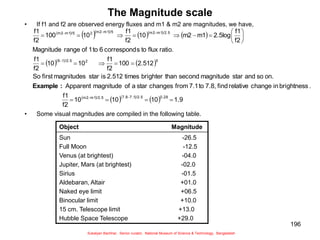
21th March 0 0/360 21th September 12 180
21th April 2 30 21th October 14 210
21th May 4 60 21th November 16 240
21th June 6 90 21th December 18 270
21th July 8 120 21th January 20 300
21th August 10 150 21th February 22 330
1 hr = 15 degrees
Sukalyan Bachhar, Senior curator, National Museum of Science & Technology, Bangladesh
128
Very approximate estimate of the position of Sun
• Example 2: Approximately find the declination of the Sun on 10th June.
Approximate Niryan Longitude on 14th June = 60 degrees.
Approximate Niryan Longitude on 10th June = 60 - 4 = 56 degrees.
Approximate Sayan Longitude on 10th June = 56 + 24 = 80 degrees.
Inclination of Ecliptic = 23.439 degrees
sin(declination) = sin(Logitude)  sin(inclination) = sin(80)  sin(23.439) = 0.391729
 Declination =23.062 degrees Actual Declination = 23 deg. 3 min 43 sec.
Actual Niryan Longitude = 55.25 degrees.
Sukalyan Bachhar, Senior curator, National Museum of Science & Technology, Bangladesh
129
Approximate calculation Of Indian first point Of Aries and
vernal equinox
• Indian almanacs give lot of Astronomical information. This is only handy and cheap
data book, easily available every year to Indian Armature Astronomy. Indian
Almanacs only give Longitudes (Bhog) of sun, Moon, and planets. Latitudes (Shar) are
given at some interval of time. Problem is, the Longitudes are given with reference to
Indian starting point of Zodiac or first point of aris. The point exactly opposite to the
star Spica is selected as the starting point of Zodiac by ancient indian astronomers.
The almanac calculated with reference to this fix point is called ‘Niryan’. Thus Indian
signs of Zodiac are fix.
• In the year 280 AD, The Vernal Equinox( Vasant Sampata) was coinciding with the
indian first point of Aris. But Vernal Equinox has retrogade motion. It shifts through
about 50.2 arc seconds every year ot through 1 degree in about 72 years. Now the
difference between Vernal Equinox and Indian first point of aris has accumulated to
about 24 degrees. An Almanac calculated with reference to Vernal Equinox is called
‘Sayan’. Western countries follow Sayan Almanac. Their signs of Zodiac are movable.
• From Indian almanac to get longitudes with reference to Vernal Equinox, it is
necessary to add the angular difference between Vernal Equinox and indian first point
of aris. This difference is called ‘Ayanansh’. The value of Ayanansh is steadily
increasing. Approximate method of calculation of Ayanansh is as follows,
Sukalyan Bachhar, Senior curator, National Museum of Science & Technology, Bangladesh
130
Approximate calculation Of Indian first point Of Aries and
vernal equinox
Step 1: Find out how many years elapsed since 1900 AD up to 1st Januaryof the
selected year called this number ‘t’
Step 2: Use following relation to find the Ayanansh
Ayanansh = 22 deg 27 min 43.1 sec + 50.2564  t sec.
Example 1: Find Ayanansh of 1st January 2009
Step 1: Number of elapsed years since 1900 AD
t = 2009 – 1900 = 109
Step 2: Ayanansh = 22 deg 27 min 43.1 sec + 50.2564  109 sec. = 230 : 59’ : 1.51”
Indian Almanc gives the Ayanansh of 4th January 2009 as 230 : 59’ : 12” Example
Example 2: Indian Almanc gives values of Longitude of the Sun and Moon at 5:30 AM
as,
Sun: 8: 160 : 42’ : 46”
Moon: 10: 050 : 46’ : 26”
Find corresponding Sayan Longitude
Sayan Longitude = Niryan Longitude + Ayanansh
Sayan Longitude of the Sun = 8: 160 : 42’ : 46” + 230 : 59’ :1.51” = 9: 100 : 41’ : 47.51”
Sayan Longitude of the Moon = 10: 050 : 46’ :26” + 230 : 59’ : .51” = 10: 290 : 45’ : 27.51”
Sukalyan Bachhar, Senior curator, National Museum of Science & Technology, Bangladesh
131
Elementary Astronomical Calculations:
Telescope and Calendar ( Lecture – 3)
Thank You
Sukalyan Bachhar, Senior curator, National Museum of Science & Technology, Bangladesh
132
Elementary Astronomical Calculations:
Eclipses and Planets ( Lecture – 4 )
•By Sukalyan Bachhar
•Senior Curator
• National Museum of Science & Technology
•Ministry of Science & Technology
•Agargaon, Sher-E-Bangla Nagar, Dhaka-1207, Bangladesh
•Tel:+88-02-58160616 (Off), Contact: 01923522660;
•Websitw: www.nmst.gov.bd ; Facebook: Buet Tutor
&
•Member of Bangladesh Astronomical Association
•Short Bio-Data:
First Class BUET Graduate In Mechanical Engineering [1993].
Master Of Science In Mechanical Engineering From BUET [1998].
Field Of Specialization  Fluid Mechanics.
Field Of Personal Interest  Astrophysics.
Field Of Real Life Activity  Popularization Of Science & Technology From1995.
An Experienced Teacher Of Mathematics, Physics & Chemistry for O- ,A- , IB- &
Undergraduate Level.
Habituated as Science Speaker for Science Popularization.
Experienced In Supervising For Multiple Scientific Or Research Projects.
17 th BCS Qualified In Cooperative Cadre (Stood First On That Cadre).
Sukalyan Bachhar, Senior curator, National Museum of Science & Technology, Bangladesh
133
Angular diameters of the solar and lunar disks
• Even though the diameters of the Sun and the moon are considerable they appear in the form of
disks from the earth. The ang;e that the sun or the Moon subtends at our eye is called the angular
diameters of their disks. The average value of this angle is about half a degree or about 30 arc
minutes. However the angular diameter depends on their distances from the earth.
• An angle is defined as the ratio of an arc and the radius. Mathematically we have,
angle = (arc/radius) radians
• But this value is in terms of radians. Knowing the that  radians are equal to 180 degrees, we have
to multiply the above equation by 180/ to get angle in degrees.
angle = (arc/radius)  180/ degrees.
• For calculating the angular diameters of the disks we shall take the actual diameter of the Sun or
the moon as an arc and the distance from the Earth as radius.
• Angular Diameter of the Moon’s disk.
We have, Diameter of the Moon = 3500 km (as an arc)
Distance of the Moon = 384000 km (average) ; 356000 km (minimum) ; 405000 km (maximum)
Angular Diameter of the Moon’s Disk = (3500/384000)  180/ = 0.5222 deg. = 31.33 arc min (average)
Angular Diameter of the Moon’s Disk = (3500/405000)  180/ = 0.495 deg. = 29.7 arc min (minimum)
Angular Diameter of the Moon’s Disk = (3500/356000)  180/ = 0.5633 deg. = 33.8 arc min (average)
Sukalyan Bachhar, Senior curator, National Museum of Science & Technology, Bangladesh
134
Angular diameters of the solar and lunar disks
• Angular Diameter of the Sun’s disk.
We have, Diameter of the Sun = 1392000 km (as an arc)
Distance of the Sun = 149600000 km (average)
= 147200000 km (minimum)
= 152100000 km (maximum)
Angular Diameter of the Sun’s Disk = (1392000/149600000)  180/ = 0.533 deg. = 32 arc min
(average)
Angular Diameter of the Sun’s Disk = (1392000/152100000)  180/ = 0.524 deg. = 31.46 arc min
(minimum)
Angular Diameter of the Sun’s Disk = (1392000/147200000)  180/ = 0.54 deg. = 32.5 arc min
(maximum)
For total solar eclipse angular diameter of the Moon’s disk should be greater than the Sun’s disk.
 For annular solar eclipse angular diameter of the Moon’s disk should be smaller than the Sun’s disk.
Sukalyan Bachhar, Senior curator, National Museum of Science & Technology, Bangladesh
135
Horizontal equatorial parallax
• For the calculation of solar Eclipse the exact distances of the Sun and the Moon must be
known. These distance can be estimated from the Horizontal Equatorial Parallax of the Sun
and the Moon. These values are always given with the other eclipse data.
• Imagine an observer on the surface of the Earth and let the disks of the Moon and the Sun
are in his line of sight on his horizon. For him there will be a solar eclipse but for an
observer at the center of the Earth there will be no solar Eclipse, because the Sun and the
Moon will not be in his line of sight.
• The angle that Earth’s radius ( r ) subtends at the distance of the Sun (S) or the Moon (M),
when they are observed at the horizon from a particular place on the surface of the Earth is
called Horizontal Equatorial Parallax (p).
• For the Sun and the Moon this parallax is maximum. As these celestial objects move from
east to west the value of parallax decreases and it becomes zero when either of the objects
reaches the zenith.
• From trigonometry,
• Sin(p) = r/R R = r/(sin(p)) R  Distance of Sun or Moon
• For August 1999 total Solar Eclipse following values are given.
• Horizontal Equatorial Parallax of the Moon = 0.9789555 deg.
• Horizontal Equatorial Parallax of the Sun = 0.002411 deg.
•  Distance of the Moon = 6378/(sin(0.9789555)) = 373306.31 km.
• Distance of the Sun = 6378/(sin(0.002411)) = 1.51568  108 km.
Sukalyan Bachhar, Senior curator, National Museum of Science & Technology, Bangladesh
136
The eclipse year
• The points of intersections of the apparent path of the Moon and the Sun are called
Ascending and Descending nodes. For Eclipse these two points are very important.
The nodes have got retrograde motion. The Ascending or Descending Node
Completes one round in about 18.6 years or 6798.3 days. After the conjunction of the
Sun and the Ascending node, they start moving away from each other. Since the Sun
is fast compared to the Ascending node they meet again after about 346.62 days. This
time interval is called ‘Eclipse Year’.
• Periodic time of the Sun is nearly 365.25 days, while the periodic time of Ascending is
6798.3 days or nearly 18.6 years. Using these two values the time intervals, the
Eclipse year can be found.
• 1/Eclipse Year = 1/ Periodic time of the Sun – 1/Periodic time of Ascending Node
= 1/365.25 – 1/(-6798.3) = 0.00288494
Eclipse Year = 1/0.00288494 = 346.62689 Days
• Eclipses are possible when the Sun is near the Ascending or Descending Node. From
above it is clear that, if the Sun is at the Ascending Node, after about 13 days it will
arrive at the Descending node. E have to find the position of the Moon when the sun is
at Ascending or Descending Node to estimate probability of an Eclipse.
Sukalyan Bachhar, Senior curator, National Museum of Science & Technology, Bangladesh
137
The saros cycle
• The time interval between two successive crossings of the ascending or node by the
Sun is 346.62 dys. This time span is called ‘Eclipse Year’.
• The time interval between two successive conjunctions of the Sun and the Moon is
29.53059 days. This time interval is called ‘Synodic Month’.
• About 750 years BC Khaldians came to know the relationship between the Eclipse
Year and the Synodic Months. They found that number of days in 19 Eclipse years are
nearly equal to the number of days in 223 Synodic months. The relationship can be
proved as follows,
19 Eclipse Years = 19  346.62 = 6585.78 days
223 Synodic Months = 223  29.53059 = 6585.32 days
The differnce is only 0.46 days.
• The time interval of 223 Synodic Months or 6585.32 days is called Saros. It comes out
to be equal 18 years and 11.32 days. Since Eclipses are possible only when the Sun
and the Moon are near the Ascending or Descending Node. Saros is directly related to
the eclipses. After a period of one Saros the eclipses are repeated.
• If there are 4 Leap years in the Saros period, the time interval is 18 years and 11.32
days, but if there five Leap years in the Saros period, the time interval becomes 18
years and 10.32 days. Each series contains 70 or more eclipses. Total Solar Eclipse of
22nd July 2009 was repetition of the Eclipse of 11th July 1991.
Sukalyan Bachhar, Senior curator, National Museum of Science & Technology, Bangladesh
138
The saros cycle
• Saros series are numbered according to the type eclipse and whether they occur at the
Moon.s ascending or descending node. Odd numbers are used for Solar eclipses
occurring near the ascending node, where as even numbers are given to descending
node Solar eclipses.
• As an example let us consider Saros series number 136.
• Since the number is even the Solar eclipses in this series occur near the descending
node.
First eclipse was on 14th June 1360
Last eclipse will be on 30 July 2622
Duration of Saros number 136 = 1362.11 years.
There are total 71 eclipses in this series.
Following are some of the eclipses in the Saros series 136,
18th May 1901 22nd July 2009
29th May 1919 02nd August 2027
08th June 1937 12th August 2045
20th June 1955 24th August 2063
30th June 1973 03rd September 2081
11th July 1991 14th September 2099
Sukalyan Bachhar, Senior curator, National Museum of Science & Technology, Bangladesh
139
Length of the Moon’s shadow
• For the Solar Eclipse, the length of the Shadow of Moon is important. When the shadow falls on
the surface of the Earth, Total Solar Eclipse Results. If the Moon is very close to the Earth the
diameter of the shadow falling on the surface of the earth is maximum and time interval of
totality maximum, but not more than 7.5 minutes. If the apex of the shadow is at some distance
above the surface, Annular Solar Eclipse results.
• We shall first find out a general equation of the length of the Moon’s shadow and then apply the
results to some Solar Eclipses.
• The line ABV is drawn tangential to the sun and the moon
changes.
also
Moon
the
and
Sun
the
between
Distance
constant.
not
is
shadow
its
of
length
Earth,
the
around
orbot
elliptical
in
moves
Moon
the
Since
Moon
the
of
Radius
-
Sun
the
of
Radius
distance
Moon
-
Sun
Moon
the
of
Radius
L
r
-
R
D
r
L
Shadow
s
Moon'
of
Length
L
r
L
D
R
D
Moon
the
and
Sun
the
between
Distance
SM
L,
Shadow
s
Moon'
of
Length
MV
r,
Moon
the
of
Radius
MB
R,
Sun
the
of
Radius
SA
Here,
MV
MB
SV
SA
write,
can
we
Hence
similar;
are
ΔΔMV
&
ΔSAV
common
is
V
ΔΔMVB
&
ΔΔSAV
for
Also
90
MBV
SAV 0


























Sukalyan Bachhar, Senior curator, National Museum of Science & Technology, Bangladesh
140
Length of the Moon’s shadow
• For the Solar Eclipse, the length of the Shadow of Moon is important. When the shadow falls on
the surface of the Earth, Total Solar Eclipse Results. If the Moon is very close to the Earth the
diameter of the shadow falling on the surface of the earth is maximum and time interval of totality
maximum, but not more than 7.5 minutes. If the apex of the shadow is at some distance above
the surface, Annular Solar Eclipse results.
• We shall first find out a general equation of the length of the Moon’s shadow and then apply the
results to some Solar Eclipses.
• The line ABV is drawn tangential to the sun and the moon
changes.
also
Moon
the
and
Sun
the
between
Distance
constant.
not
is
shadow
its
of
length
Earth,
the
around
orbot
elliptical
in
moves
Moon
the
Since
Moon
the
of
Radius
-
Sun
the
of
Radius
distance
Moon
-
Sun
Moon
the
of
Radius
L
r
-
R
D
r
L
Shadow
s
Moon'
of
Length
L
r
L
D
R
D
Moon
the
and
Sun
the
between
Distance
SM
L,
Shadow
s
Moon'
of
Length
MV
r,
Moon
the
of
Radius
MB
R,
Sun
the
of
Radius
SA
Here,
MV
MB
SV
SA
write,
can
we
Hence
similar;
are
ΔΔMV
&
ΔSAV
common
is
V
ΔΔMVB
&
ΔΔSAV
for
Also
90
MBV
SAV 0


























Sukalyan Bachhar, Senior curator, National Museum of Science & Technology, Bangladesh
141
Length of the Moon’s shadow
• Total Solar Eclipse: 22nd July 2009
• We have following dataEquatorial Horizontal Parallax of the Sun = Ps = 0.00241666
• eg. Equatorial Horizontal Parallax of the Sun = Ps = 0.00241666 deg.
Sukalyan Bachhar, Senior curator, National Museum of Science & Technology, Bangladesh
142
Length of the Moon’s shadow
• For the Solar Eclipse, the length of the Shadow of Moon is important. When the shadow falls on
the surface of the Earth, Total Solar Eclipse Results. If the Moon is very close to the Earth the
diameter of the shadow falling on the surface of the earth is maximum and time interval of
totality maximum, but not more than 7.5 minutes. If the apex of the shadow is at some distance
above the surface, Annular Solar Eclipse results.
• We shall first find out a general equation of the length of the Moon’s shadow and then apply the
results to some Solar Eclipses.
• The line ABV is drawn tangential to the sun and the moon
changes.
also
Moon
the
and
Sun
the
between
Distance
constant.
not
is
shadow
its
of
length
Earth,
the
around
orbot
elliptical
in
moves
Moon
the
Since
Moon
the
of
Radius
-
Sun
the
of
Radius
distance
Moon
-
Sun
Moon
the
of
Radius
L
r
-
R
D
r
L
Shadow
s
Moon'
of
Length
L
r
L
D
R
D
Moon
the
and
Sun
the
between
Distance
SM
L,
Shadow
s
Moon'
of
Length
MV
r,
Moon
the
of
Radius
MB
R,
Sun
the
of
Radius
SA
Here,
MV
MB
SV
SA
write,
can
we
Hence
similar;
are
ΔΔMV
&
ΔSAV
common
is
V
ΔΔMVB
&
ΔΔSAV
for
Also
90
MBV
SAV 0


























Sukalyan Bachhar, Senior curator, National Museum of Science & Technology, Bangladesh
143
Length of the Moon’s shadow
 Total solar Eclipse: 22nd July 2009
• We have following data.
• Equatorial Horizontal Parallax of the Sun = Ps = 0.00241666 deg.
• Equatorial Horizontal Parallax of the Moon = Pm = 1.02221666 deg.
• Radius of the Moon = r = 1738 km., Radius of the Sun = 696000 km.
• Radius of the Earth = 6378 km.
• In order to find the distance of the Sun and the Moon from the Center of the Earth following
formula can be used.
• Since the length of the moon’s shadow is greater than the distance between the Earth and the
moon, the shadow falls on the surface of the Earth.
• Duration of the Eclipse is long because the Moon is very close to the earth. Nearest distance of
the Moon from the Earth is about 356000 km. for this eclipse, distance is 357509 km. The
maximum duration of this eclipse is about 6.5 minutes.
 
 
 
km.
377650
1738
-
696000
150856349
1738
shadow
s
Moon'
the
of
Length
2009
July
22
On
km.
150856349
357509
-
151213858
Moon
the
and
Sun
the
between
Distance
km.
357509
1.02221666
sin
6378
Moon
the
of
Distance
km.
151213858
0.00241666
sin
6378
Sun
the
of
Distance
2009
July
22
On
Parallax
Horizontal
Equatorial
sin
6378
Earth
the
from
Distance












Sukalyan Bachhar, Senior curator, National Museum of Science & Technology, Bangladesh
144
Length of the Moon’s shadow
 Annular Solar Eclipse: 15th January 2010
• We have following data.
• Equatorial Horizontal Parallax of the Sun = 0.00247222 deg.
• Equatorial Horizontal Parallax of the Moon = 0.9014722 deg.
• Eclipse is Annular because the apex of the Moon’s shadow is not reaching the Earth’s
surface. It is at a distance of 405389 – 369023 km. from the surface.
• The distance of the Moon from the Earth is 405389 km. Its maximum distance is nearly
406000 km.
 
 
km.
369023
1738
-
696000
14741030
1738
shadow
s
Moon'
the
of
Length
2010
January
15
On
km.
147410130
3405389
-
147815519
Moon
the
and
Sun
the
between
Distance
km.
405389
0.9014722
sin
6378
Moon
the
of
Distance
km.
147815519
0.00247222
sin
6378
Sun
the
of
Distance










Sukalyan Bachhar, Senior curator, National Museum of Science & Technology, Bangladesh
145
To estimate the instant of maximum solar eclipse from
Indian almanac
• Indian Almanac give daily Niryan longitudes of the sun and the Moon, also their daily angular
speeds. The longitudes are given at 5:30 am IST or 00:00 hrs UT. It is not necessary to convert
Niryan longitudes in to Sayan, because while taking subtraction the differences will get cancelled.
With this information we can estimate the instant of maximum solar eclipse. Following steps are
required.
• 1. Find the difference in longitudes of the Sun and the Moon in degrees.
• 2. Find the angular speed of the Moon with respect to the sun in degree per hour.
• 3. The instant of maximum eclipse can be found from the following formula.
Instant of Maximum Eclipse = ( Difference in longitudes)/ Relative speed hours
• 4. The instant of maximum eclipse will be in UT.
• 5. Add 5:30 hours to convert it into IST.
• Example 1: Total Solar Eclipse: 22nd July 2009
• Sun  3:05:20:39 95.344166 deg.
• Speed = 57 min. 17 sec 57.2833 0.954722 deg. V =0.954722/24 = 0.03978 deg/hr.
• Moon  03:03:48:22 93.80611 deg.
• Speed = 445 min. 03 sec in 12 hrs. 7.584166 deg. In 12 hrs  V =0.6320 deg/hr.
• Difference in longitudes = 95.344166 -93.80611 = 1.5380 deg.
• Relative speed = 0.6320 – 0.03978 = 0.5922 deg/hr.
• Instant of Maximum Eclipse = (1.5380/0.5922) =2.597 hrs. = 2 hrs 35 min. 49.2 sec.
• NASA bulletin gives: 2:35:12.4 UT
• Instant of maximum eclipse in IST = 2 hrs:35 min.:49.2 sec. + 5 hrs:30 min = 8 hrs:5 min: 49.2 sec
• The maximum eclipse at 144 deg 8.4 min East longitude  144.14/15 =9.6 hrs.
• The maximum eclipse in local time  9 hrs 36 min + 2 hrs 35 min. 49.2 sec. 12 hrs 11 min. 49.2
sec.
Sukalyan Bachhar, Senior curator, National Museum of Science & Technology, Bangladesh
146
To estimate the instant of maximum solar eclipse from
Indian almanac
• Example 2: Annular Solar Eclipse: 15th January 2010
• Sun  09:00:42:55 270.7152 deg.
• Speed = 61 min. 08 sec 61.1333 min 1.0188 in 24 hrs. V =1.0188/24 = 0.04245 deg/hr.
• Moon  08:27:27:34 267.4594 deg.
• Speed = 355 min. 37 sec 355.6166 5.9269 deg. In 12 hrs  V =0.4939 deg/hr.
• Difference in longitudes = 270.7152 –267.4594 = 3.2558 deg.
• Relative speed = 0.4939 – 0.04245 = 0.45145 deg/hr.
• Instant of Maximum Eclipse = (3.2558/0.45145) =7.2118 hrs. = 7 hrs 12.7 min. UT
• NASA bulletin gives: 7 hrs: 6min: 22.9 sec UT
Sukalyan Bachhar, Senior curator, National Museum of Science & Technology, Bangladesh
147
Width of the shadow when total solar eclipse is maximum
*
2r
-
Shadow
of
Diameter
get,
we
side
both
to
2
by
g
Multiplyin
negative
is
answer
r
-
r'
shadow.
the
of
radius
get
we
equations
above
the
Solving
point
selected
and
shadow
the
of
Apex
the
between
distance
X
desired
id
shadow
of
radius
where
Moon
the
behind
distance
S
Moon
the
and
Sun
the
between
distance
D
shadow
the
of
radius
r'
Moon
the
of
radius
r
Sun
the
of
radius
R
Where,
X
S
r
X
r'
&
X
S
r
X
S
D
R
equations.
following
write
can
we
Then
.
90
QCV
PBV
OAV
and
common
is
V
angle
since
similar
are
QCV
and
PBV
OAV,
triangles
figure
the
In
0















































D
S
1
D
S
R
2
D
S
1
D
S
R
Sukalyan Bachhar, Senior curator, National Museum of Science & Technology, Bangladesh
148
Width of the shadow when total solar eclipse is maximum
*
 
 
nearly
6750
W
gives
Bulletin
NASA
km
6724
3484
3240
D
S
1
2r
D
S
2R
W
Penumbra
the
of
width
The
km
258
gives
Bulletin
NASA
244km
3484
3240
150856349
351131
1
3476
150856349
351131
1392000
shadow
the
of
Diameter
km.
351131
6378
357509
S
surface
s
Earth'
the
and
Moon
the
between
Distance
km.
150856349
D
Moon
the
and
Sun
the
between
Distance
km.
357509
1.02221666
sin
6738
Moon
the
of
Distance
deg.
1.02221666
Moon
the
of
Parallax
Horizontal
Equatorial
km.
151213858
0.00241666
sin
6738
Sun
the
of
Distance
deg.
0.00241666
Sun
the
of
Parallax
Horizontal
Equatorial
km
3476
Moon
the
of
Diameter
2r
km
1392000
Sun
the
of
Diameter
2R


























































2009
July
22nd
:
Eclipse
Solar
Total
:
Example
Earth
the
of
radius
-
Moon
the
of
distance
S
Earth,
the
of
surface
the
on
shadow
the
of
diameter
the
get
To

Sukalyan Bachhar, Senior curator, National Museum of Science & Technology, Bangladesh
149
Speed of the shadow in the total solar eclipse
• Every point on the Earth has same angular velocity but different
linear velocity. In general linear velocity at any latitude is given by,
• v= 2Rcos(latitude)/24 km/hr.
• Since the Moon orbits around the Earth, it has also linear velocity,
given by Vm = 2(distance)/(27.3  24 km/hr.
• Since the Earth rotates from west to east and the Moon also
orbits around the Earth from west to east.
• Then we have the speed of the shadow , V = Vm -v
• Example : Total solar Eclipse: 22nd July 2009
• For this eclipse the shadow is moving on an average along 24 degrees north latitudes.
• Linear velocity of the Earth at 24 deg latitude = [2  6400cos(24)]/24 = 1530 km/hr.
• Distance of the Moon from the Earth = 357509 km
• Linear speed of the Moon = [2  357509]/( 27.3  24) = 13428 km/hr.
• Speed of the shadow = 3428 – 1530 = 1898 km/hr.
Sukalyan Bachhar, Senior curator, National Museum of Science & Technology, Bangladesh
150
Duration of totality other than central line
• Suppose that,
• D = Width of the path at central line
• d = Perpendicular distance of the observer from central line
• C = Length pf the chord at d
• Then we have,
• Length of the chord = C =
• If, T = Duration of totality at the central line and t = Duration of totality at the
distance d
• We have.
• Example: For a certain total solar eclipse
2
2
d
4
D 
2
2
d
4
D
D
T
D
C
T
t 



minutes
3.2
75
4
250
250
min
4
t
line?
central
from
kilometers
75
distance
a
at
totality
of
duration
the
is
What
km.
250
D
and
minutes
4
T
2
2






Sukalyan Bachhar, Senior curator, National Museum of Science & Technology, Bangladesh
151
Length of the Earth’s shadow
• The lunar Eclipse depends on the way the Moon enters the Earth’s shadow. Many times
the path of the Moon makes certain angle with the ecliptic and the Moon travels only a
part of Umbra or it only passes through Penumbra. In the first case we can have either
total or partial Lunar Eclipse. In the second case we have Penumbra Lunar Eclipse.
Procedure to find the path of the Moon during the eclipse is bit complicated, leaving it
aside we can estimate some important facts of Lunar Eclipse from Earth’s shadow.
• Formula for the length of the Earth’s shadow is same as length of the Moon’s shadow. We
have to replace the Moon by Earth in the formula.
 
)
nearly
.(
k
1387282














6378
-
696000
10
1.5
6378
L
Then,
shadow
s
Earth'
the
of
Length
L
distance,
Earth
-
Sun
D
km.
6378
Earth
the
of
Radius
r
km,
696000
Sun
the
of
Radius
R
have,
We
Earth
Of
Radius
Sun
of
Radius
distance
Earth
Sun
Earth
of
Radius
Shadow
s
Earth'
the
of
Length
8
Sukalyan Bachhar, Senior curator, National Museum of Science & Technology, Bangladesh
152
Length of the Earth’s shadow
• Total Lunar Eclipse: 21st December 2010
 
night.
the
in
46
:
2
about
at
i.e.
08
:
46
:
2
30
:
5
-
8
:
16
:
8
is
eclipse
the
of
middle
India
For
hours
30
:
5
by
UT
of
ahead
is
Time
Standard
Indian
UT
8
:
16
:
8
as.
given
is
eclipse
middle
the
of
Time
Moon
the
of
distance
the
at
found
are
rs
Thediamete
km.
16655
180
π
376504
1.2673
2
Penumbra
of
Diameter
Penumbra
of
Diameter
9390km.
180
π
376504
1.4290
180
π
radius
Angle
Umbra
Diameterof
376504km.
themoon
distanceof
radius
umbra
diameterof
arc
1.4290deg.
0.7145
2
meter
AngularDia
deg.
π
180
radius
arc
Angle
deg.
0.7145
radius
Angular
Umbra
of
Diameter
376504km.
0.97064
sin
6378
moon
Distanceof
0.7145deg.
Umbra
of
radius
Angular
deg.
1.2673
Penumbra
of
radius
Angular
deg.
0.97064
Moon
the
of
Parallax
Horizontal
Equatorial
given.
are
parameters
Following

































Sukalyan Bachhar, Senior curator, National Museum of Science & Technology, Bangladesh
153
Diameter of the Earth’s shadow at the distance of Moon
– Bhaskaracharya’s method
• Bhaskarachaya, in his Siddhantashiromoni has given a correct method to find the diameter
of the Earth’s shadow at the distance of Moon. This value is essential to determine the time
interval of the total lunar eclipse. The Bhaskarachaya’s formula is as follows,
 
   
 
astronomy.
modern
in
equation
the
to
similar
exactly
is
equation
This
P1
S1
P
r
have,
we
Thus
S1(say)
Sun
of
radius
angular
(S/2)/s
P(say)
Moon
of
parallax
horizontal
(E/2)/m
r
cone
shadow
of
radius
angular
d/2m
E/2s
S/2m
E/2m
d/2m
2m
by
Dividing
E)/s
-
m(S
E
d
E
S
2EB
2SA
2SG
But,
2SG)/SE
(ED
2EB
SG)/SE
(2EB
2EB
d
EF)
2(EB
(nearly)
2BF
2CD
d
orbit.
lunar
at
cone
shadow
of
diameter
2CD
Hence,
orbit
lunar
the
indicates
CD
SG/SE
ED
EF
hence,
EF/ED
SG/SE
similar
are
EDF
triangle
and
SEG
Triangle
Moon
of
distance
m
Sun
of
distance
s
Earth
of
diameter
E
diameter
S
Where,
m/s
E
-
S
-
E
d
distance
s
Moon'
at
cone
shadow
the
of
Diameter







































Sukalyan Bachhar, Senior curator, National Museum of Science & Technology, Bangladesh
154
Diameter of the Earth’s shadow at the distance of Moon
– Bhaskaracharya’s method
• Total Lunar Eclipse: 21st December 2010
 
 
km.
4695
(ππ/180
0.7145
376520
(PI/180)
angle
radius
arc
cone
shadow
the
of
Radius
arc/radius
angle
using,
distance
into
it
Convert
deg.
0.7145
radius
Angular
data,
From
km.
4635
cone
shadow
of
Radius
9270km
3530
-
12800
km
100000
12800)/147
-
2000
376520(139
-
12800
cone
shadow
the
of
Diameter
have,
we
formula
s
Bhaskara'
Using
)
m.(assumed
147100000k
Sun
Distanceof
December,
late
in
Earth
the
to
near
very
is
Sun
the
Since
376520km.
0.9706
6400/sin
Moon
the
of
Distance
Moon
of
nce
6400/dista
0.9706
sin
deg.
0.9706
Parallax
Horizontal
0.7145deg.
cone
sshadow
the
of
Radius
Angular




















Sukalyan Bachhar, Senior curator, National Museum of Science & Technology, Bangladesh
155
Total solar eclipse from Moon
• The total solar eclipse must be a fantastic view from the Moon. Depending on your location on
the Moon the Earth will appear to be almost at the same position in the lunar sky. The size of
the Earth will be almost four tomes the size of the Moon as viewed from the Earth. The Earth
is going to eclipse the sun. Hence the duration of the eclipse will be quite long. On the Earth
maximum duration of totality is never greater than 7.5 minutes. We can estimate the longest
duration of totality on moon.
• For longest eclipse the Earth-Moon distance should be minimum and the eclipse should be
central, i.e. the Sun should pass along the equatorial diameter of the Earth.
• We shall first estimate the maximum angular diameter of the Earth as seen from the Moon.
• We have,
• Angle = (arc/radius)(180/)
• Here, arc = Diameter of the Earth = 12800 km.
• Radius = Minimum distance between Earth and Moon = 356000 km. (nearly)
• Angular diameter of Earth = (12800/356000)  (180/) = 2 deg. (nearly)
Sukalyan Bachhar, Senior curator, National Museum of Science & Technology, Bangladesh
156
Total solar eclipse from Moon
• In order to estimate maximum duration of totality, we
have following data,
 Angular diameter of Sun = 0.5 deg. (nearly)
 Sun’s angular speed across the sky = 360/29.53 =12.2
deg/day
 Sun moves 1 degree in1/12.2 = 0.082 day = 2 hours
(nearly)
• We assume that eclipse is central. At 1st and 4th
contacts the Sin,s disk touches and leaves the Earth’s
disk respectively. From 1st and 4th contacts Sun
travels an angular distance of 0.25 deg. + 2 deg.+
0.25 deg. =2.5 deg.
• Hence part of eclipse will last 2  2.5 = 5 hours
• From 2nd and 3rd contact Sun’s disk is completely
behind the Earth’s disk. In this part of the eclipse sun
travels the angular distance of 1.5 degrees and
duration of totality will be, 2  2.5 = 3 hours. This is
longest duration of totality.
• If the Sun passes above or bellow the equatorial
diameter of the Earth, the duration of totality will be
less than 3 hours.
• The Sun rays will pass through the atmosphere and ill
be deviated and dispersed. Hence a glow will appear
around the Earth’s disk during totality.
Sukalyan Bachhar, Senior curator, National Museum of Science & Technology, Bangladesh
157
Eclipses and Planets
Elementary Astronomical Calculations: Lecture-04
Thank You
Sukalyan Bachhar, Senior curator, National Museum of Science & Technology, Bangladesh
158
Elementary Astronomical Calculations:
Magnitudes Of The Stars ( Lecture – 5 )
•By Sukalyan Bachhar
•Senior Curator
• National Museum of Science & Technology
•Ministry of Science & Technology
•Agargaon, Sher-E-Bangla Nagar, Dhaka-1207, Bangladesh
•Tel:+88-02-58160616 (Off), Contact: 01923522660;
•Websitw: www.nmst.gov.bd ; Facebook: Buet Tutor
&
•Member of Bangladesh Astronomical Association
•Short Bio-Data:
First Class BUET Graduate In Mechanical Engineering [1993].
Master Of Science In Mechanical Engineering From BUET [1998].
Field Of Specialization  Fluid Mechanics.
Field Of Personal Interest  Astrophysics.
Field Of Real Life Activity  Popularization Of Science & Technology From1995.
An Experienced Teacher Of Mathematics, Physics & Chemistry for O- ,A- , IB- &
Undergraduate Level.
Habituated as Science Speaker for Science Popularization.
Experienced In Supervising For Multiple Scientific Or Research Projects.
17 th BCS Qualified In Cooperative Cadre (Stood First On That Cadre).
Sukalyan Bachhar, Senior curator, National Museum of Science & Technology, Bangladesh
159
Albedo
• Amount of sunlight received by a planet depends on its distance from the Sun. Whatever
sunlight a planet receives, a part of it is absorbed and remaining part is reflected by the
planet. The percentage of the sunlight reflected by a planet depends on the ice cover,
clouds, nature of the surface, presence of oceans etc. Due to large dark areas very little
amount of sunlight is reflected from the Moon. As against that the Venus is completely
covered by thick clouds, hence a large percentage of sunlight is reflected from Venus.
• The fraction of incoming sunlight that a planet reflects is called its Albedo. Following
table gives the albedo of the planets.
Planet Albedo
Mercury 0.10
Venus 0.76
Earth 0.39
Moon 0.07
Mars 0.16
Jupiter 0.51
Saturn 0.61
Uranus 0.31
Neptune 0.35
Pluto 0.40
Sukalyan Bachhar, Senior curator, National Museum of Science & Technology, Bangladesh
160
Oblateness of the Planets
• Every planet rotates about its axis. The rotation creates centrifugal force, which is
proportional to the distance of a particle from the axis of rotation and angular velocity of the
planet. Hence magnitude of the centrifugal force is maximum on the equator and decreases
towards the poles. On the poles centrifugal force is zero. Due to uneven magnitude uneven
magnitude of the centrifugal force the planet gets flattened. Its equatorial diameter is usually
greater than its polar diameter. The flattening of a planet is called oblateness. From the
following equation oblateness can be estimated.
• For a perfect sphere of oblatenees is zero. Fast rotating planets like Jupiter and Saturn
oblateness is considerable. Following table gives the oblateness of the planets.
Planet Equatorial Polar Oblateness
Diameter Diameter
(km.) (km.)
Mercury 4879 4879 0.0
Venus 12102 12102 0.0
Earth 12756 12712 0.00345
Mars 6792 6752 0.00589
Jupiter 142984 133708 0.0648
Saturn 120536 120536 0.098
Uranus 51118 49946 0.023
Neptune 49528 48682 0.017
Pluto 2390 2390 0.0
Moon 3476 3472 0.00115
Diameter
Equatorial
Diameter
Polar
Diameter
Equatorial
Oblateness


Sukalyan Bachhar, Senior curator, National Museum of Science & Technology, Bangladesh
161
Orbital velocities of the planets
 
 
(nearly)
km/sec
30
km/sec
29.86
V
sec.
3600
24
365.25
km.
10
1.5
2π
Earth
of
Velocity
Orbital
seconds
3600
24
365.25
days
365.25
time
Periodic
T
km.
10
1.5
Sun
the
from
distance
Average
R
Earth,
For
Earth.
the
of
velocity
orbital
the
find
first
us
Let
2
T
T
R
R
V
V
T
T
R
R
V
V
T
R
2π
V
Earth
of
Velocity
Orbital
T
R
2π
V
Planet
of
Velocity
Orbital
derieved.
be
can
formula
Following
found.
be
can
planets
other
of
velocities
Orbital
,
comparison
by
then
and
Earth,
the
of
velocity
orbital
the
calculate
First
1
T
2ππ
Velocity
Orbital
Time
Periodic
orbit
the
of
nce
Circumfere
Velocity
Orbital
follows,
as
is
planet
a
of
velocity
orbital
average
find
to
formula
simple
very
A
velocity.
orbital
least
has
Pluto
planet
farthest
the
and
highest
has
Mercury
planet
nearest
Thus
Sun.
the
from
planet
the
of
distance
the
to
al
proportion
inversely
is
velocity
Orbital
8
8









































Sukalyan Bachhar, Senior curator, National Museum of Science & Technology, Bangladesh
162
Orbital velocities of the planets
planets.
all
of
velocities
angular
average
gives
table
following
The
(nearly)
km/sec.
24
24.32
1.88
1
1.524
30
Mars
of
velocity
Orbital
1.88
1
T
T
and
1.524
R
R
Mars
Gor
Mars.
of
velocity
orbital
the
find
us
Let
formula.
second
from
found
be
can
planets
the
of
velocities
orbital
the
Earth,
the
with
planets
the
of
ratios
time
periodic
and
distance
the
Knowing










Planet Distance Ratio Periodic Tine Ratio Orbital Velocity
(R’/R) (T/T’) ( km/sec)
Mercury 0.387 4.15 48
Venus 0.723 1.625 35
Earth 1.000 1.000 30
Mars 1.524 1/1.88 24
Jupiter 5.204 1/11.9 13
Saturn 9.582 1/29.5 9.7
Uranus 19.201 1/84 6.8
Neptune 30.047 1/164.8 5.47
Pluto 39.236 1/247.77 4.75
Sukalyan Bachhar, Senior curator, National Museum of Science & Technology, Bangladesh
163
Elongation of the Earth for outer planets
• In the case of Earth elongation is an angle between the Sun, Earth and Planet. As seen
from the earth, mercury and Venus are inner planets, their maximum elongations are about
28 and 47 degrees respectively. Hence these planets can be observed throughout the night.
For all planets from Mars onwards, the earth is an inner planet. Hence from these planets
the Earth can only be observed before sunrise or after sunset. But if the angle of elongation
of the Earth is less than about 10 degrees, the Earth can never be observed, because it
cannot be seen in the glare of Sun.
• We define the angle of elongation as follows, Elongation with reference to a planet
• Mars completes one rotation in 24.6 hours, which means 360 degrees are covered in
• 24.6 hours. Hence to cover 37.59 degrees 2.57 hours are required. In other words in the
sky of Mars, the earth can be seen about 2.5 hpurs before sunrise or after sunset.
.
deg
59
.
37
.
deg
180
10
5
.
1
524
.
1
10
5
.
1
ofEarth
Elongation
.
km
10
5
.
1
524
.
1
ce
tan
MarsDis
Sun
.
km
10
5
.
1
ce
tan
EarthDis
Sun
fromMars
thasviewed
onoftheEar
heelongati
Letusfindt
180
8
8
8
8




















ance
PlanetDist
Sun
nce
EarthDista
Sun
Angle
Sukalyan Bachhar, Senior curator, National Museum of Science & Technology, Bangladesh
164
Elongation of the Earth for outer planets
• Knowing the average distances of the planets from the Sun, the elongations of the Earth
for the outer planets can be calculated. They are compiled in the following table.
• It is very clear from the table; the Earth can never be seen from Saturn, Uranus, Neptune
and Pluto, since it will be always very close to the Sun. Even from Jupiter, the Earth can
be just seen for a very little span of time.
Planet Distance of the Planet Elongation of Earth
(AU.) (Deg.)
Mars 1.524 37.59
Jupiter 5.2 11.00
Saturn 9.54 06.00
Uranus 19.18 03.00
Neptune 30.06 01.90
Pluto 39.44 01.45
Sukalyan Bachhar, Senior curator, National Museum of Science & Technology, Bangladesh
165
Titus – Bode Law
• In 1772 German Astronomer Yohan Titus found a very simple rule to find the distances of
the planets, from the Sun, in terms of average distance between the Sun and the Earth.
• After few years, another German Astronomer Yohan Bode, popularized the rule. Since
then the rule is known as ‘Titus – Bode Law’. The law can be represented by the following
formula.
• The values of ‘n’ for the planets are as follows,
• Mercury: n = - infinity Venus: n = 0 Earth: n = 1 Mars: n = 2 Asteroids: n =
3 Jupiter: n = 4 Saturn: n = 5 Uranus: n = 6 Neptune: n = 7 Pluto:
n = 8
• Substituting the values in the above law, we can find the average distances of the planets
from the Sun. Comparison of the actual distances of the planets and those obtained.
•
• from the Titus – Bode Law areas follows,
• It is clear from the table that Neptune and Pluto do not obey the Titus – Bode Law, but to
remember the distances of the planets from the Sun the law is useful.
• Using this law William Hershel found the planet Uranus.
• Asteroid belt is between Mars and Jupiter. The law gives the average distance of the belt
from the Sun.
• There is no mathematical proof for the law
n
2
0.3
0.4
Sun
the
from
Planet
a
of
Distance 


Sukalyan Bachhar, Senior curator, National Museum of Science & Technology, Bangladesh
166
Titus – Bode Law
•
Planet Actual Distance Distance by Titus-Bode law
(AU) (AU)
Mercury 0.39 0.4
Venus 0.72 0.7
Earth 1.00 1.00
Mars 1.52 1.6
Asteroids 2.8 2.8
Jupiter 5.2 5.2
Saturn 9.55 10.00
Uranus 19.2 19.6
Neptune 30.1 38.8
Pluto 39.5 77.2
Sukalyan Bachhar, Senior curator, National Museum of Science & Technology, Bangladesh
167
The Earth day of Venus
• For Venus the Earth is an outer planet. Hence Earth will rise and set in the sky of Venus. But Earth will
rise in west and will set in the east. Due to very thick cloudy atmosphere of Venus, the Earth cannot be
seen from the surface. Earth will be seen as quite a bright object from outside the cloud cover of Venus.
Earth’s rise, set and rise, on Venus can be called the Earth day of Venus. We want to find the length of
this day.
• Periodic time of rotation of the Venus and periodic time of revolution of Earth are comparable. Venus
completes one rotation from east to west in 243.1 days, while the Earth completes one revolution around
the Sun in 365.25 days. In order to find the Earth day of Venus we have to find relative angular speeds of
Earth and Venus. This given by following relation.
• Relative angular speed = angular speed of Venus – Angular speed of the Earth
 
days.
Earth
four
be
will
there
time
synodic
one
of
interval
the
during
that
suggests
This
586).
146
(4
day
earth
the
times
4
is
which
days,
584
is
Venus
of
time
synodic
the
that
know
We
*
Venus.
of
sky
the
in
seen
be
not
will
Earth
the
days
73
next
For
days.
73
146/2
after
east,
the
in
sets
and
west
the
in
rises
Earth
the
that
indicates
sign
negative
The
(nearly)
days
146
days
145.95
0.006851
1
Venus
of
day
Earth
0.006851
0.0027378
0.004113
365.25
1
-
243.1
1
Day
Earth
1
(Nearly)
days.
365.25
Earth
of
year
Sidereal
west)
to
east
from
is
(Rotation
243.1days.
Venus
of
day
Sidereal
Earth
of
year
Sidereal
2π
-
Venus
of
day
Sidereal
2π
Day
Earth
2π























Sukalyan Bachhar, Senior curator, National Museum of Science & Technology, Bangladesh
168
Length of a day on Mercury and Venus
• If the rotation period of a planet is comparable to its period of revolution, the day and
night cycle on such planet becomes unusual. This type of situation exists on Mercury
and Venus. The length the day on Mercury is 176 Earth days, while on Venus it is
about 117 Earth days. In the case of Earth and all other planets the period of
revolutions are very large compared to their period of rotations, hence the day lengths
on these planets only depend on their period of rotations. For example, the Earth
completes one rotation in 24 hours, while its period of revolution is 365.25 days that is
why we have 12 hours of day and 12 hours of night, approximately.
• We can find the length of a day on Mercury and Venus, from their relative angular
velocities of rotation and revolution. In general we have,
Venus.
and
Mercury
on
day
a
of
length
the
find
can
we
formula
this
Using
T2
1
-
T1
1
T
1
revolution
of
Period
T2
rotation
of
Period
T1
day
the
of
Length
T
Where,
T2
2π
-
T1
2π
T
2π
revolution
of
velocity
Angular
-
rotation
of
velocity
Angular
velocity
angular
Relative








Sukalyan Bachhar, Senior curator, National Museum of Science & Technology, Bangladesh
169
Length of a day on Mercury and Venus
*
 
starts.
night
of
days
58.5
Then
days.
Earth
58.5
nearly
after
east
the
in
sets
and
west
the
in
rises
Sun
the
that
indicates
sign
negative
The
(nearly)
days
117
days
116.74
0.008565
1
Venus
on
day
of
Length
-0.008565
0.004450
0.004115
224.698
1
-
243.1
1
day
of
Length
1
have,
we
values,
these
ng
Substituti
days
224.698
T2
and
days
243.1
-
T1
Venus,
For
days.
Earth
88
for
Mercury
of
sky
in
be
will
Sun
days.
Earth
88
of
night
and
days
Earth
88
of
day
is
there
Mercury
on
Thus
(nearly)
days
176
days
175.97
0.005682
1
day
of
Length
0.005682
0.01136
0.01705
87.97
1
-
58.65
1
day
of
Length
1
have,
we
values,
these
ng
Substituti
days
87.97
T2
and
days
58.65
T1
Mercury,
For

























:
Venus
on
day
the
of
Length
:
Mercury
on
day
the
of
Length
Sukalyan Bachhar, Senior curator, National Museum of Science & Technology, Bangladesh
170
Rising and setting of the satellites of Mars
• Two satellites revolve around Mars, the nearest is called Phobos and the farthest is called Deimos.
These satellites are very small compared to Mars. Diameter og Phobos is about 24 kilometers and
that of Deimos ia only about 12 kilometers, while diameter of Mars is about 6800 kilometers.
• Phobos completes one revolution around Mars is only 7.65 hours, while Deimos requires about
30.3 hours to completes one revolution. But it does not mean that the rising and setting of these
satellites require half the time of their revolutions. Since the revolution times of these satellites are
comparable to the periodic time of rotation of Mars, it is instructive to find the time intervals
between rising and setting of these satellites in the Martian sky.
• We have to use relative angular speeds of rotation of Mars and revolution times of the satellites.
satellite.
the
of
rotation
of
time
Periodic
T2
T2
1
-
T1
1
T
1
Mars
of
rotation
of
time
Periodic
T1
Mars
to
respect
day with
Satellite
T
Where,
/T
2
W
speed
angular
But
T2
2
-
T1
2
T
2
W2
W1-
W
satellite
the
of
revolution
of
speed
Angular
W2
Mars
of
rotation
of
speed
Angular
W1
speed
angular
relative
W
Let,
satellite
the
of
rotation
of
speed
Angular
-
Mars
of
rotation
of
speed
Angular
speed
angular
Related
have,
We

















Sukalyan Bachhar, Senior curator, National Museum of Science & Technology, Bangladesh
171
Rising and setting of the satellites of Mars
 
 
 
 
hours.
66
nearly
after
west
the
in
sets
and
east
the
in
rises
Deimos
while
hours,
5.5
after
east
the
in
sets
and
west
the
in
rises
Phobos
sky
Martian
the
In
hours.
66
nearly
after
west
the
in
sets
and
east
the
in
rises
Deimos
Thus
0.007548
1
Deimos
0.007548
0.033
0.04055
30.3
1
-
24.66
1
day
Deimos
1
Deimos
of
day
one
of
interval
time
T
hours
30.3
T2
Mars
of
revolution
of
Period
hours
24.66
T1
:
Deimos
For
hours.
5.5
about
after
east
the
in
sets
and
sky
Martian
the
the
of
west
the
in
rises
Phobos
that
indicates
sign
Negative
Phobos.
of
day
one
of
interval
time
T
nearly
hours
-11.1
0.090
1
Phobos
of
day
One
0.090
0.13072
0.04055
7.65
1
-
24.66
1
day
Phobos
1
hours
7.65
T2
Mars
of
revolution
of
Period
hours
24.66
T1
:
Phobos
For
nearly
hrs
132
hours
48
.
132
Onedayof 
























:
Deimos
on
day
One
:
Phobos
on
day
One
Sukalyan Bachhar, Senior curator, National Museum of Science & Technology, Bangladesh
172
The angular size of the Sun and Charon from Pluto
• Even through Pluro is now removed from the planetary list of the Solar System, it is interesting to find
out angular sizes of solar and Charon disks fro Pluto. Charon is a satellite of Pluto. Since the
eccentricity of the Pluto’s orbit is camparatively larger than other planets of the solar system, its
maximum and minimum distances from the Sun will appear to change appreiably. We have the
following data about orbit of Pluto.
• Average distance from the sun =6,000,000,000 km.
• Maximum distance from the sun =7,400,000,000 km.
• Minimum distance from the sun =4,400,000,000 km.
• Diameter of Pluto = 2400 km.
• Diameter of charon = 1200 km.
• Pluto-Charon distance = 19,600 km.
• Diameter of the Sun = 1,392,000 km.
• To determine the angular sizes of the disks of Sun and Zharon from Pluto, we use the relation of an
angle.
•
•
•
min.
arc
0.6
π
180
7400000000
1392000
Pluto
from
Sun
of
diameter
Minimum
min.
arc
1
π
180
4400000000
1392000
Pluto
from
Sun
of
diameter
Maximum
min.
arc
0.78
π
180
6000000000
1392000
Pluto
from
Sun
of
diameter
Average
answers.
following
get
will
We
Pluto
from
Charon
or
Sun
of
Distance
Radius
Charon
or
Sun
of
Diameter
Arc
Here,
deg.
π
180
radius
Arc
Angle













.
deg
.
deg
.
deg
Sukalyan Bachhar, Senior curator, National Museum of Science & Technology, Bangladesh
173
The angular size of the Sun and Charon from Pluto
• If we assume that the average diameter of Sun’s disk from the Earth to be 32 arc
minute, as viewed from Pluto the average, maximum and minimum size of the sun’s disk
will be, 1/38th , 32nd and 1/50th respectively, of the Earth’s disk.
• Let us now find the size of Charon from Pluto, we have,
•
Earth.
the
from
viewed
disk
Lunar
than
larger
times
14
be
to
appear
will
disk
s
Pluto,
Charon
From
deg.
7
π
180
19600
2400
Charono
from
Pluto
of
size
Angular
have,
we
Charon,
from
viewed
as
Pluto
of
size
find
to
e
instructiv
also
is
It
Earth.
the
from
observed
disk
Lunar
than
larger
times
7
be
will
disk
s
Charon'
means
Which
deg.
3.5
π
180
19600
1200
Pluto
from
Charon
of
size
Angular






.
deg
.
deg
Sukalyan Bachhar, Senior curator, National Museum of Science & Technology, Bangladesh
174
Resonance revolutions of the planets
• The planets revolve around the Sun in different intervals of time. The periodic time of a
planet depends on its distance from the sun. If we examine the periodic times of the
planets, it appears that they have some relation amongst each other. This is called
‘Resonance Revolution’ of the planets. Following table gives the periodic times of the
planets.
 4 revolutions of Mercury = 4  0.2144 =0.9649 years
1 revolution of Earth = 1.000 years
Difference = 0.0356 years
 5 revolutions of Mercury = 5  0.2144 =1.2055 years
2 revolutions of Venus = 2  0.6156 =1.2312 years
Difference = 0.0257 years
Planet Periodic time Planet Periodic time
(years) (years)
Mercury 0.2411 Saturn 29.46
Venus 0.6155 Uranus 84
Earth 1.000 Neptune 164.78
Mars 1.88 Pluto 248
Jupiter 11.86
Sukalyan Bachhar, Senior curator, National Museum of Science & Technology, Bangladesh
175
Resonance revolutions of the planets
 3 revolutions of Venus = 3  0.6156 =1.8468 years
1 revolution of Mars = 1.88 years
Difference = 0.0332 years
 3 revolutions of Venus = 3  0.6156 =1.8468 years
1 revolution of Mars = 1.88 years
Difference = 0.0332 years
 6 revolutions of Mars = 6  1.88 =11.28 years
1 revolution of Jupiter = 11.86 years
Difference = 0.42 years
 5 revolutions of Jupiter = 5  11.86 = 59.3 years
2 revolutions of Saturn = 2  29.46 = 58.92 years
Difference = 0.38 years
 2 revolutions of Uranus = 2  84 = 168 years
1 revolution of Neptune = 164.78 years
Difference = 3.22 years
 3 revolutions of Neptune = 3  164.78 = 494.36 years
2 revolutions of Pluto = 2  248 = 496 years
Difference = 1.66 years
 Compared to total numbers of years involved, the difference are very small, hence the planets can be
assumed to be revolving in resonance around the Sun.
Sukalyan Bachhar, Senior curator, National Museum of Science & Technology, Bangladesh
176
The Roche limit
• It is now clear that Jupiter, Saturn, Uranus, and Neptune all have rings. The question
of formation of rings was solved by Eduard Roche. He suggested that, if a satellite
comes within a certain distance from a planet, due to tidal forces it breaks into pieces.
The pieces thus form a ring around the planet, A spectacular exhibition of this
phenomenon was observed in 1994. Twenty one pieces of the broken ‘Shoemake-
Levy-9’ comet colided with Jupiter from 16th to 22nd July 1994.
• The distance from a planet at which a satellite or comet break, is called ‘Roche Limit’.
With few simple assumptions and mathematics we can derive a formula for the Roche
Limit.
• Imagine a planet of mass ‘M’ and radius ‘R’. Assume that there are two small spheres
A and B, mass ‘m’ and radius ‘r’. Also we assume that the spheres are in contact, so
that the distance between their centers is ‘2r’. Let the sphere ‘A’ be at a distance ‘D’
from the planet, which is very large compared to ‘r’. The distance of sphere ‘B’ from the
planet will be ‘D+2r’.
Sukalyan Bachhar, Senior curator, National Museum of Science & Technology, Bangladesh
177
The Roche limit
 
 
 
    
3
2
2
2
2
2
2
2
2
2
2
2
2
2
2
2
2
2
2
2
r
2
2
2
2
a
D
4GMmr
r
R
as,
terms
higher
and
/D
r
Neglecting
......
D
12r
D
4r
D
GMm
......
D
12r
D
4r
1
1
D
GMm
......
D
12r
D
4r
1
1
D
GMm
......
D
2r
2!
3
2
D
2r
2
1
1
D
GMm
D
2r
1
1
D
GMm
D
2r
1
1
1
D
GMm
2r
D
GMm
D
GMm
F
F
F
.
F
and
F
between
difference
to
equivalent
is
force
resulting
The
them.
separate
to
tends
which
force
resulting
a
feel
will
spheres
The
'.
F
'
than
greater
is
F'
'
that
clear
is
It
2r
D
GMm
F
B'
'
on
attraction
of
Force
D
GMm
F
A'
'
on
attraction
of
Force
planet.
the
by
attraction
of
force
nal
gravitatio
by
upon
acted
is
sphere
Each
2r
Gm
F
by,
given
is
spheres
the
between
attraction
of
force
The













































































































































r
F
Sukalyan Bachhar, Senior curator, National Museum of Science & Technology, Bangladesh
178
The Roche limit
 
 
 
R
5
.
2
D
R



































d
dp
Let
separated.
be
will
sphere
the
d
dp
2
D
if,
or
D
d
dp
R
2
r
d
πr
3
4
D
dp
πR
3
4
2
have,
we
values,
these
ng
Substituti
d
planet
of
density
πr
3
4
m
dp
planet
of
density
πR
3
4
M
But,
r
m
D
M
2
2r
Gm
D
4GMmr
separated.
be
will
spheres
the
spheres
two
betweenthe
'
F
'
attraction
of
force
the
than
greater
is
'
F
'
force
resulting
the
If
D
4GMmr
F
4/3
3
3
4
3
3
3
3
4
3
3
3
3
4
2
2
3
a
r
3
r
Sukalyan Bachhar, Senior curator, National Museum of Science & Technology, Bangladesh
179
The Roche limit
• Thus if a satellite or comet comes within 2.5 times the radius of the planet it breaks due to
tidal forces.
• The Roche Limit of the solar system are given in the following table.
Planet Radius (km) Roche limit (km)
Mercury 2450 6125
Venus 6050 15125
Earth 6400 16000
Mars 3410 8525
Jupiter 71680 179200
Saturn 60480 151200
Uranus 25665 64162
Neptune 24830 62075
Pluto 1200 3000
Sukalyan Bachhar, Senior curator, National Museum of Science & Technology, Bangladesh
180
Temperature of a planet
• Every planet receives energy from the sun. The amount of energy received is inversely
proportional to the square of the distance of the planet from the Sun. A planet absorbs
energy and its surface gets heated. The planet then radiates the energy back to space.
If the energy received by the planet is equal to the energy emitted, its temperature
remains steady.
• In order to find the surface temperature of a planet we have to use the solar luminosity.
This is given by,
• Solar luminosity = Ls = 4  1026 Jules/sec.
• The amount of energy received per unit area per unit time at a distance ‘r’ from the Sun
is called solar flux, its expression is,
• 4r2 is the area of a sphere of radius ‘r’
• Solar Flux = Ls/(4r2)
• The solar flux encounters the disk of a planet of radius ‘R’.
• Energy received by a planet = R2  Solar Flux = R2  Ls/(4r2)
• Energy received by a planet = {R2/(4r2)}Ls
Sukalyan Bachhar, Senior curator, National Museum of Science & Technology, Bangladesh
181
Temperature of a planet
• Treating planet as a black body, the energy emitted by the planet is given by,
• Energy emitted by the planet = Surface area  Stefan’s constant  4th Power of absolute
temperature
• = 4R2  (5.67  10-8 )  T4
• If the temperature of the planet is steady
• Energy emitted = energy received
• 4R2  (5.67  10-8 )  T4 = R2/(4r2)}Ls
•
desired.
is
effect
this
extent
certain
Upto
Effect'.
House
Green
'
the
of
because
is
increase
The
celsius.
deg
15
is
Earth
the
of
e
temperatur
average
Actual
C
8
K
281
10
5.67
π
10
4
10
1.496
2
1
Earth
the
of
e
temperatur
Surface
Joule/sec.
10
4
Ls
&
m
10
1.496
r
distance
Earth,
For
1/4
8
10
5.67
π
Ls
r
2
1
T
planet
the
of
e
Temperatur
0
0
1/4
8
26
11
26
11



































Earth
the
of
e
temperatur
surface
the
Find
:
Example1
Sukalyan Bachhar, Senior curator, National Museum of Science & Technology, Bangladesh
182
Temperature of a planet
*
•
desired.
is
effect
this
extent
certain
Upto
Effect'.
House
Green
'
the
of
because
is
increase
The
celsius.
deg
15
is
Earth
the
of
e
temperatur
average
Actual
(nearly)
C
K
10
5.67
π
10
4
10
1.496
9.583
2
1
Earth
the
of
e
temperatur
Surface
Joule/sec.
10
4
Ls
&
m
10
1.496
r
distance
Saturn,
For
0
0
1/4
8
26
11
26
11
183
90
583
.
9
























Saturn.
the
of
e
temperatur
surface
the
Find
:
2
Example
Sukalyan Bachhar, Senior curator, National Museum of Science & Technology, Bangladesh
183
Oppositions of Mars
• Opposition of Mars is quite an interesting phenomenon. At the time of opposition Mars is
beyond the Earth, on Sun-Earth line and it is very close to the Earth. During this time Mars
can be seen as a very bright reddish object in the night sky. Since the orbit of Mars is
elliptical, the distance between the earth and Mars at time of opposition varies, but very
rarely this distance is shortest. For example, on 27th August 2003, there was an opposition
of Mars. On that day Mars came very close to the Earth, after about 56,000 years. Still its
distance was about 55.758 million kilometers from the Earth and its apparent size was
25.13 arc seconds. On that day Mars was at its perihelion and the Earth was not very far
away from its aphelion.
• If we start with certain original opposition, we can examine how sun-Earth-Mars line shifts
and after how many days before or after the opposition takes place with reference to
accepted original opposition. To simplify the calculations we shall accept the length of the
year to be 365.25 days and Martian year to be 687 days. For accurate calculations sidereal
year is required. A year also represents the the time of revolution of a planet around the
Sun.
• Exact synodic time of mars is 779.84 days. From certain opposition, next opposition will
take place after 779.84/365.25 =2.13536 years. During this time the Earth completes 2
revolutions and advances through an angle of 0.13536  360 = 48.73 degrees, from the
original opposition. Since average speed of the Earth is 360/365.25 =0.9856 deg/day, 48.73
degrees are equivalent to, 48.73/0.9856 = 49.6 days. Thus from original opposition next
opposition will take place 48.73 degree ahead and after 49.4 days.
Sukalyan Bachhar, Senior curator, National Museum of Science & Technology, Bangladesh
184
Oppositions of Mars
• It can be shown that, 7, 15, 22, 37, 133, 170, and 303 oppositions of Mars are almost
intergral multiples of the Earth and Mars revolutions or years. Consider 7 oppositions,
• 7  779.94 = 5459.58 days
• 5449.58 days = (5459.58/365.25) = 14.95  15 years ( revolutions) (nearly)
• 5459.58 days = (5459.58/687) = 7.95  8 Martian years or revolutions (nearly)
• After 7 oppositions Sun-Earth-Mars line will advance through,
• 7  48.73 = 34.11  341 degrees (nearly).
• This means it will be about, 360-341=19 degrees behind the original opposition and 7th
opposition will take place about 19 days earlier.
• Following table gives the results of all above mentioned oppositions. From the table it will be
clear that after first original accepted opposition, about 647 Earth years the opposition of
mars will take place almost at the same position.
Sukalyan Bachhar, Senior curator, National Museum of Science & Technology, Bangladesh
185
Oppositions of Mars
• After 79, 284, and 363 or after 37, 133 and 170 oppositions respectively the oppositions
are almost near the original opposition.
• +ve sign means ahead and –ve sign means behind.
No. of Earth Martian Sun-Earth-Mars line Days after or
Oppositions (years) (years) after or before original before original
(days) (days)
001 002 001 +48.70 +49.40
007 015 008 -19.00 -19.30
015 032 017 +10.70 +10.80
022 047 025 -08.30 -08.50
037 079 042 +02.35 +02.38
096 205 109 -03.60 -03.70
133 284 151 -01.28 -01.30
170 363 193 +01.00 +01.08
303 647 344 -00.23 -00.23
Sukalyan Bachhar, Senior curator, National Museum of Science & Technology, Bangladesh
186
Oppositions of Mars
• Minimum distances of oppositions ( Minimum distances less than 56 million kilometers are
only given in the table.
Date Earth-mars distance Apparent Mars diameter
(Million km. (arc sec)
25 August 1719 55.951 25.05
13 August 1845 55.839 25.10
18 August 1845 55.803 25.11
22 August 1924 55.777 25.12
27 August 2003 55.758 25.13
15 August 2050 55.957 25.04
30 August 2082 55.884 25.08
19 August 2129 55.842 25.10
24 August 2208 55.769 25.13
28 August 2287 55.688 25.16
Sukalyan Bachhar, Senior curator, National Museum of Science & Technology, Bangladesh
187
Visibility of rings of Saturn from Saturn
• Ring system of Saturn is its characteristics. Other gas giants have also rings but they
are not prominent as Saturn. Rings of Saturn are also visible through an ordinary
telescope. Actually there are three prominent rings, they are named as A, B, and C. A
is outermost, B is in middle and C is the innermost ring. The ring D is inside the ring C,
but it is very dim. Similarly there are three more rings beyond A, but they are also very
dim. We want to investigate visibility of the rings, if some one stands on Saturn itself.
• From the north and south of Saturn no ring will be visible. If the observer stands on the
higher latitudes of Saturn the rings will not also be visible. We can find out from which
latitude visibility of the rings start. Roughly the dimensions of the rings are given in the
following table. The values are not exact. All the rings are in plane of Saturn’s equator.
•
Ring Outer radius (km) Inner radius (km) Width (km)
A 136000 120000 16000
B 115000 90000 25000
C 88000 72000 16000
Sukalyan Bachhar, Senior curator, National Museum of Science & Technology, Bangladesh
188
Visibility of rings of Saturn from Saturn
• Radius of Saturn = 60000 km
• L  Latitude
• For Outermost tip of ‘A’ ring.
• If the observer stands on, 64
• Cos(L) = (60000/136000) = 0.441176
• L = arccos(0.441176) =63.82 degs.  64 degs.
• Degrees north or south latitude of Saturn, the tip of the ring ‘A’ will be visible. To observe entire ‘A’
ring,
• From latitude of 60 degrees north or south latitude of Saturn, entire ‘A’ ring will be visible.
• Cos(L) = (60000/120000) = ½  L = 600.
• Similarly we can find the visibility of rings ‘B’ and ‘c’.
• Visibility of ring ‘B’
• Outermost tip will be visible from latitude 58.55 degrees.
• Innermost tip will be visible from latitude 48.2 degrees.
• Visibility of ring ‘B’
• Outermost tip will be visible from latitude 58.55 degrees.
• Innermost tip will be visible from latitude 48.2 degrees.
• This means, an observer has to stand at 33.5 degrees north or south latitude to observer all ‘A’,
‘B’ and ‘C’ rings.
Sukalyan Bachhar, Senior curator, National Museum of Science & Technology, Bangladesh
189
Resonance revolution of satellites of Jupiter
• At present 63 satellites of Jupiter are known. Io, Europa, Ganymede
and Callisto have considerable diameters. All others are very small.
All others are very small. Diameter of Ganymede is even greater than
planet Mercury. The statistics of these four planets is as follows.
• Casual look at orbital periods of Io, Europa and Ganymede reveals
that they revolve around Jupiter in resonance. If we indicate the orbital
periods by T1, T2 and t3 respectively, we have,
• T2 = 2T1 ( 3.55 = 2  1.77 nearly )
• T3 = 4T1 = 2T2 ( 7.16 = 4  1.77 and 7.16 = 2  3.55 nearly )
• Angular speeds of these satellites are also related.
• The relationship is found to be as follows,
• n1 – 3n2 + 2n3 = 0 (nearly)
• 203.3898 – 3  101.4084 + 2  50.2793 = -0.2
• If exact values of orbital periods are considered the answer comes out
to be zero.
Satellite Orbital period Angular Speed
(days) (Angle/day)
Io 1.77 360/1.77 = 203.3898 (n1)
Europa 3.55 360/3.55 = 101.4084 (n2)
Ganymede 7.16 360/7.16 = 50.2793 (n3)
Satellite Diameter (km) distance (km) Orbital period (days)
Io 3630 422000 1.77(T1)
Europa 3138 671000 3.55(T2)
Ganymede 5262 1070000 7.16(T3)
Callisto 4800 1883000 16.69
Sukalyan Bachhar, Senior curator, National Museum of Science & Technology, Bangladesh
190
Rough estimate of rising and setting of the planets
• Knowing the longitude of planet of a planet and the sun on a given day, we can roughly
estimate the time of rise and set of the planet. In the Indian almanacs the Niryan values of
the longitudes at 5:30 AM are given for every day of the year. From the longitudes of the
sun and the planet, we can find elongation of the planet. From the elongation we can
roughly estimate the rise and set timings of the planet.
• The elongation of a planet is the angular distance between the planet, the Earth and the
Sun.
• If the longitude of the planet is less than the longitude of the Sun, The planet is behind the
Sun and the elongation is to the ‘west’. If the elongation is ‘west’, planet rises before the
sunrise and sets before the sunset.
• If the longitude of the planet is greater than the longitude of the Sun, The planet is ahead of
the Sun and the elongation is to the ‘east’. If the elongation is ‘east’, planet rises after the
sunrise and sets after the sunset.
• West elongation = Longitude of the Sun – Longitude of the planet
• East elongation = Longitude of the planet – Longitude of the Sun
• If the elongation is less than about 12 degrees, the planet will be in the glare of the Sun
and will not be seen at all.
• We know that the Earth rotates through 15 degrees in one hour. Compared to the
rotational motion of the Earth we can neglect the motion of the planets.
• West Elongation
• Time of rise of the planet = elongation/15 hours before sunrise.
• East Elongation
• Time of rise of the planet = elongation/15 hours after sunrise.
Sukalyan Bachhar, Senior curator, National Museum of Science & Technology, Bangladesh
191
Rough estimate of rising and setting of the planets
• Example: Find the rising and setting of the planets on 5th December 2008.
• Neglecting minutes and seconds, following Niryan values of the longitudes of the planets are obtained
from the Indian almanac.
• 1 sign = 30 degrees
• Mercury: Elongation = 234 – 229 = 05 degrees ‘east’.
• Since elongation is less than 12 degrees Mercury cannot be seen.
• Venus: Elongation = 272 – 229 = 43 degrees ‘east’.
• 43/15 = 2.866 hrs = 2 hours 52 minutes
• Venus cannot be seen throughout the day, but will be seen after sunset for about 2 hours 52 minutes.
• Mars: Elongation = 229 – 229 = 0 degrees
• Mars is in conjunction with the Sun and will not be seen at all.
• Jupiter: Elongation = 269 – 229 = 40 degrees ‘east’.
• 40/15 = 2.66 hrs = 2 hours 40 minutes
• Jupiter cannot be seen throughout the day, but will be seen after sunset for about 2 hours 40 minutes.
• Saturn: Elongation = 229 – 177 = 52 degrees ‘west’.
• 52/15 = 3.46 hrs = 3 hours 28 minutes
• Saturn will be seen for 3 hrs 28 minutes before sunrise.
Planet Sign Degrees Total Degrees
Sun 7 19 7  30 + 19 = 229
Mercury 7 24 7  30 + 24 = 234
Venus 8 02 9  30 + 02 = 272
Mars 7 19 7  30 + 19 = 229
Jupiter 8 29 8  30 + 29 = 269
Saturn 7 27 5  30 + 27 = 177
Sukalyan Bachhar, Senior curator, National Museum of Science & Technology, Bangladesh
192
Solar constants of the planets
• Solar constant is amount of heat energy in watts received by one meter surface of a planet.
• In order to find the Solar constants, it is necessary to decide the total amount of energy emitted by the
Sun in all directions. Then calculate the amount of energy received per square meter at surface, whose
radius is the distance of the planet from the Sun. We have following relations.
• The total amount of heat energy (E) emitted by the Sun, E
• = Stefan’s constant  Surface area of the Sun  Fourth power of the surface temperature of the Sun.
• Where, Stefan’s constant = 5.67  10-8 Joule/m2-deg4.
• Surface area of the Sun = 4    square of the radius of Sun = 4 (6.96  108 m)2 = 6.087  1018 m2.
• Surface temperature of the Sun = T = 5800 deg Kelvin.  T = 58004 = 1.1316  1015 .
• E = (5.67  10-8 )  (6.087  1018 )  (1.1316  1015 ) = 3.9  1026 watts.
• In case of the Earth radius of the sphere = 1.5  1011 met
• Area of the sphere = 4    (1.5  1011 m)2 = 2.827  1023 m2.
• Solar constant of Earth = (3.9  1026 )/(2.827  1023 ) = 1.379  103 watts/ sq.met.
Planet Distance (AU) Solar constant ( watt/m2 )
Mercury 0.3871 3566
Venus 0.7233 2660
Earth 1.0000 1380
Mars 1.5237 595
Jupiter 5.2028 51
Saturn 9.5380 15
Uranus 19.191 3.8
Neptune 30.061 1.5
Pluto 39.529 0.9
Sukalyan Bachhar, Senior curator, National Museum of Science & Technology, Bangladesh
193
Distance to the horizon on the planets
• If you are standing at an elevation of ‘h’ meters above a flat surface on a planet. You can
estimate the distance to the horizon, provided the radius of the planet is known.
• The line of sight to the horizon is a tangent to the planet. A line which touches the sphere of
the planet at just one point is marked ‘B’ in the drawing. If ‘O’ is the center of the sphere of
the planet, such a tangent is perpendicular to the radius ‘OB’.
• In the figure,
• A  position of the observer
• h  elevation of the observer
• R  Radius of the planet
• Applying Pythagoras theorem, we have,
• (OA)2 = (AB)2 + (OB)2
• (R + h)2 = D2 + R2
• R2 + 2Rh + h2 = D2 + R2
• D2 = h(2R + h)
• If h << 2R, then,
• D2 = 2Rh
• D = (2Rh)1/2
• Example 1: For Earth R = 6400 km, and Let h = 1 km.
• D = (2  6400  1)1/2 = 113 kms.
Sukalyan Bachhar, Senior curator, National Museum of Science & Technology, Bangladesh
194
Distance to the horizon on the planets
• Example 2: For Moon R = 1750 km, and Let h = 1.5 meter.
• D = (2  1750  1.5  10-3 )1/2 = 2.3 km.
• Example 3: Estimate the distance to the horizon for an astronot of height 1.5 meters, on
Mercury and Mars.
• 1) For Mercury R = 2439 km
• D = (2  2439  1.5  10-3 )1/2 = 2.7 km.
• 2) For Mars R = 3397 km
• D = (2  3397  1.5  10-3 )1/2 = 3.2 km.
Sukalyan Bachhar, Senior curator, National Museum of Science & Technology, Bangladesh
195
The Magnitude scale
• In the second century BC, Hipparchus complied a catalogue of about a thousand stars.
He classified the stars into six categories of brightness, which are now called
magnitudes. The brightest appearing stars were placed by him in first magnitude; the
faintest stars that that he could see, were of sixth magnitude. Hipparchus’ scale was not
continuous.
• In 1856 Norman Pogson proposed the scale the scale of scale of stellar magnitude that
is now adopted. He noted that we receive about 100 times as much light from a star of
the first magnitude, as from one of the sixth magnitude. A difference of five magnitudes
therefore corresponds to a ratio in light energy of 100 to 1.
• The brightness of a star is equivalent to energy flux (f) per unit area, per unit time,
received from a star. Pogson suggested that the ratio of light flux corresponding to a
step of one magnitude be fifth root of 100. which is about 2.512. thus a fifth magnitude
star gives us 2.512 times as much light as one of sixth magnitude star, and a fourth
magnitude star, 2.512 times as much light as fifth magnitude star or 2.512  2.512 times
as much as a sixth magnitude star. From the starsthird, second, and first magnitude,
receive 2.5123, 2.5124 , 2.5125 (=100) times as much light, respectively, as from a sixth
magnitude star.
• If f1 and f2 are observed energy fluxes and m1 & m2 are magniyudes, we have,
Sukalyan Bachhar, Senior curator, National Museum of Science & Technology, Bangladesh
196
The Magnitude scale
• If f1 and f2 are observed energy fluxes and m1 & m2 are magnitudes, we have,
• Some visual magnitudes are compiled in the following table.
 
  
  
 
  
 
 
  
  1.9
10
10
10
f2
f1
.
brightness
in
change
relative
find
7.8,
to
7.1
from
changes
star
a
of
magnitude
Apparent
on.
so
and
star
magnitude
second
than
brighter
times
2.512
is
star
magnitudes
first
So
2.512
100
f2
f1
10
10
f2
f1
ratio.
flux
to
s
correspond
6
to
1
of
range
Magnitude
f2
f1
2.5log
m1
m2
10
f2
f1
10
100
f2
f1
0.28
/2.5
7.1
7.8
/2.5
m1
m2
5
2
/2.5
1
6
/2.5
m1
m2
/5
m1
m2
2
/5
m1
m2




























:
Example
Object Magnitude
Sun -26.5
Full Moon -12.5
Venus (at brightest) -04.0
Jupiter, Mars (at brightest) -02.0
Sirius -01.5
Aldebaran, Altair +01.0
Naked eye limit +06.5
Binocular limit +10.0
15 cm. Telescope limit +13.0
Hubble Space Telescope +29.0
Sukalyan Bachhar, Senior curator, National Museum of Science & Technology, Bangladesh
197
Absolute magnitude scale
• Even if all stars were identical, they would not appear to have same brightness, because
they are at different distances from us. The amount of light that we receive from a star is
inversely proportional to the square of its distance. Since the Sun is very close to us it
gives billion times much more light than other stars.
• One way to compare the intrinsic rather than apparent brightness of stars, is to determine
what their magnitude would be if they were all at the same distance from the Earth. This
distance is selected as 10 parsec. We know that 1 parsec = 3.26 light year. Hence 10
parsec = 32.6 light years. Magnitude of a star measured at 10 parsec is called its ‘Absolute
Magnitude’.


























d1
d2
5log
m1
-
m2
d1
d2
2.5log
m1
-
m2
d
1
f
distance
of
Square
1
Flux
Energy
But
f2
f1
2.5log
m1
-
m2
relation
basic
the
from
Starting
2
2
Sukalyan Bachhar, Senior curator, National Museum of Science & Technology, Bangladesh
198
Absolute magnitude scale
stars.
some
of
magnitudes
absolute
and
apparent
gives
table
Following
5.
be
will
Sun
the
of
magnitude
the
pc
10
From
5
4.77
31.572
-26.8
6.63144
1
2062650
5log
-26.8
M
AU
2062650
pc
10
D
AU,
1
d
26.8,
m
magnitude
apparent
Sun,
For
Sun.
the
of
magnitude
absolute
calculate
us
let
example
an
As
d
D
5log
m
M
d
D
5log
m
M
D
d
5log
M
-
m
parsec.
10
D
d1
and
d
d2
magnitude
absolute
the
M
m1
star
a
of
magnitude
apparent
the
m
m2
Let,

























































5
8
.
26
Star Apparent Magnitude Absolute Magnitude
Procyon 0.48 -3.0
Achernar 0.60 -0.9
Pollax 1.21 1.2
Alpha Centauri -0.01 4.4
Sukalyan Bachhar, Senior curator, National Museum of Science & Technology, Bangladesh
199
Absolute magnitude in terms of parallax
    1.267
3.733
-
5
2.153
-
5
-1.58
0.430626
-
5
5
-1.58
0.371
5log
5
-1.58
M
1.58
-
is
magnitude
visual
the
and
sec.
arc
0.371
is
which
of
parallax
Sirius,
of
magnitude
absolute
the
Find
5logp
m
M
logp
p
1
log
logd
p
1
d
But
5logd
-
5
m
M
5
-
5logd
5log10
-
5logd
10
d
5log
M
-
m
have
we
values,
these
ng
Substituti
parsec
10
D
star
the
of
distance
d
Where,
D
d
5log
M
-
m
have,
we
magnitude,
absolute
the
involving
equation
basic
the
with
start
us
Let
star.
a
of
magnitude
absolute
the
find
to
fact
this
use
can
We
p
1
d
sec.
arc
in
Parallax
1
star
a
of
distance
that
know
we
because
distance,
its
gives
indirectly
star
a
of
Parallax































:
Example
Sukalyan Bachhar, Senior curator, National Museum of Science & Technology, Bangladesh
200
Absolute magnitude in terms of parallax
 
 
 
 
 
years.
light
8.733
d
years.
light
6
3.2
2.679
parsec
2.679
3.732
10
10
10
10
10
10
10
d
1.4.
M
1.46,
m
which
for
Sirius,
of
distance
the
Find
years.
light
4.3
d
years.
light
6
3.2
1.3
parsec
1.3
7.58
10
10
10
10
10
10
10
d
4.4.
M
0.01,
m
which
for
Centauri,
Alpha
of
distance
the
Find
10
10
d
star
a
of
distance
parsec.
10
D
But,
10
D
d
star
a
of
distance
10
D
d
5
m
M
D
d
log
m
M
D
d
5log
D
d
5log
M
-
m
equation.
basic
following
the
use
can
We
estimated.
easily
be
can
distance
its
kown
is
star
a
of
magnitude
absolute
the
If
0.572
2.86/5
/5
1.46
1.4
0.8805
4.41/5
/5
0.01
4.4
/5
m
M
/5
m
M
/5
m
M















































:
2
Example
:
1
Example
Sukalyan Bachhar, Senior curator, National Museum of Science & Technology, Bangladesh
201
Bolometric magnitude
• Apparent magnitude indicates the brightness of a star in visible range of the spectrum. But
all stars also emit invisible light like Gamma rays, X rays, Ultra violet and Infra red rays.
Even while determining the absolute magnitude, the atmospheric effects of the Earth
should be considered. Many luminous stars appear dim because they emit most of the
light in invisible range. Earth’s atmosphere is opaque to invisible light. Hence it is
necessary to define an alternative definition of the magnitude of the stars. The new
definition is called bolometric magnitude.
• Bolometric Magnitude: Is an apparent magnitude of a star measured above Earth’s
atmosphere and over all wavelengths of the electromagnetic spectrum.
• A correction is applied to the absolute magnitude, to find the Bolometric magnitude. It is
called Bolometric Correction (BC), In general,
• Bolometric Magnitude = Mbol = M – BC
• Bolometric Correction is very large for hottest and coolest stars. The stars, having
temperature 20000 degrees Kelvin, or 3000 degrees Kelvin, value of BC>3 mag.
• General formula of the Bolometric magnitude is as follows.
• Where, L  Luminosity of the star and Ls  Luminosity of the Sun








Ls
L
log
5
.
2
72
.
4
Mbol
Sukalyan Bachhar, Senior curator, National Museum of Science & Technology, Bangladesh
202
Bolometric magnitude
• Example: Find the Bolometric magnitude of Sirius and its luminosity.
• Given, m = -1.46, d = 2.7 pc, T = 10000 deg K, and BC = 0.6 mag.
• We have,
 
Sun.
the
rhan
luminous
times
40
about
is
Sirius
Thus
Ls.
40
L
40
10
Ls
L
1.6
2.5
0.8
4.72
Ls
L
log
Ls
L
2.5log
4.72
Mbol
0.8
0.6
1.4
BC
M
Mbol
1.4
0.27
5log
1.46
10
d
5log
m
M
1.6









































Sukalyan Bachhar, Senior curator, National Museum of Science & Technology, Bangladesh
203
Estimate of magnitudes of planets
• Visual magnitude gives an idea of apparent brightness of a celestial object. Light received
by a planet from the Sun is partially absorbed and partially reflected. Percentage of light
energy reflected depends on the Albedo of the planet. Using comparison of flux received
from the sun and a planet, apparent magnitude of a planet can be found, because the flux
ratio is related to magnitude difference. Our basic relation is,
2
2
2
2
2
2
2
2
2
2
2
2
d
4
1
A
r
4R1
Ls
fp
Earth
on
received
Planet
from
Flux
Earth.
and
planet
the
between
distance
the
is
d'
'
and
direction
all
in
reflected
flux
the
If
A
r
4R1
Ls
Earth
towards
planet
by
reflected
Flux
planet;
the
of
Albedo
A
If
r
4R1
Ls
πr
4ππR
Ls
planet
the
by
d
intercepte
Flux
planet
the
of
radius
r
Where
πr
area
of
planet
a
of
disk
the
only
sees
flux
Solar
Sun
from
planet
of
distance
average
R1
Earth
and
Sun
between
distance
average
R
4ππR
Ls
fp
Planet
by
received
Flux
4ππ
Ls
fe
Earth
by
received
Flux
have,
we
Then
;
Sun
of
Luminosity
Ls
Sun
from
planet
by
received
flux
fp
f2
Sun
from
Earth
by
received
flux
fe
f1
Sun
the
of
magnitude
apparent
ms
m2
planet
a
of
magnitude
apparent
mp
m1
Let,
f2
f1
2.5log
m2
m1-



































;
Sukalyan Bachhar, Senior curator, National Museum of Science & Technology, Bangladesh
204
Estimate of magnitudes of planets
*Thus we have to replace f2 by fp in the original formula
   
   
 
  18
.
15
538
.
11
72
.
26
6152
.
4
log
5
.
2
72
.
26
10
4
.
6
35
.
0
10
12
2
16





























































































 









2
2
2
8
12
2
22
2
2
2
2
6
2
2
2
11
2
2
2
2
2
2
2
2
3.844
4
2.5log
ms
me
0.35
Earth
of
Albedo
A
meters.,
6400000
Earth
of
radius
r
and
meters.,
384400000
Moon
and
Earth
between
distance
d
formula,
above
in
R1
R
same.
nearly
are
sun
from
moon
of
distance
and
Earth
the
of
distance
have,
We
Earth.
the
by
replaced
be
to
is
Planet
and
Moon
by
replaced
be
to
is
Earth
case
this
In
Moon.
from
seen
as
Earth
of
magnitude
apparent
the
is
What
:
2
Example
4.66
22.06
26.72
8.8242
2.5
26.72
10
6.67
2.5log
26.72
mp
10
6.05
0.84
10
1.5
0.682
0.7
4
2.5log
26.72
10
6.05
1AU
0.84
0.682AU
AU
0.7
4
2.5log
ms
mp
Sun
of
magnitude
-26.72
ms
Venus)
of
(radius
meters
6050000
r
0.84
Venus
of
Albedo
AU
1
R
elongation
maximum
at
be
to
assumed
is
Venus
AU
0.682
d
meters.
10
1.5
AU
AU
0.7
R1
venus.
of
magnitude
apparent
the
estimate
1:
Example
Earth.
the
from
seen
as
planet
a
of
magnitude
apparent
the
estimate
to
formula
general
a
is
This
r
AR
d
4R1
2.5log
A
Lsr
4ππ
4R1
4ππ
Ls
2.5log
f2
f1
2.5log
m2
m1-
Sukalyan Bachhar, Senior curator, National Museum of Science & Technology, Bangladesh
205
Radius of event horizon
• A star is in equilibrium under two forces. A force due to energy created by nuclear fusion acts readily
outward, trying to expand the star, while force due to gravity acts readily inward. This force tries to contract
the star. In due course of time the nuclear fusion reaction inside the star exhausted. In that case gravity
takes over. If the original mass of the star is more than three time the mass of the sun, the gravitational
force can shrink the star to a point. The end product is called ‘Black hole’. The gravitational force of black
hole is so enormous that every thing surrounding it gets sucked. Not even light escapes from the black
hole. The limiting radius of a sphere from which light cannot escape is called ‘Event horizon’. Hence at the
surface of the event horizon the escape velocity must be equal to the velocity of light. Knowing mass of the
star we can find the radius of the event horizon.
• For black hole,
(nearly)
30km
meter
10
29.6
R
Sun,
of
mass
times
10
star
a
For
(nearly)
3km
meter
10
2.96
10
2
10
1.485
M
10
1.485
R
hole)
black
become
never
will
(Sun
Sun,
For
M
10
1.485
R
values,
these
ng
Substituti
Star
the
of
Mass
M
units.
mks
10
6.67
G
c
2GM
R
horizon
event
of
Radius
g,
Rearrangin
R
2GM
c
light
of
Velocity
city
EscapeVelo
3
3
30
27
-
27
-
27
-
11
2

























Sukalyan Bachhar, Senior curator, National Museum of Science & Technology, Bangladesh
206
Parallax
• Parallax is a useful concept which allows us to estimate the distance of a celestial objects. When
a star is viewed from two widely different positions, the location of the star appears to change with
reference to the background stars. This phenomenon is called parallax. It is defined as follows,
• Parallax is a relative change in position of a star with reference to the to the background stars.
• Let us find general formula for parallax.
• Let AB be the base line. It can be diameter of the earth or twice the distance between the sun and
earth. Since the stars are quite far away from the Earth or Sun, AB can be treated as an arc of a
circle, the radius of which is the distance of the star.
• Let ‘p’ be the angle made by the line of sights of the star from the points A and B.
• From the definition o angle, we have,
radian
r
R
p
have,
we
values
these
ng
Substituti
r
star
of
distance
radius
distance
Earth)
(Sun
R
arc
p,
parallax
Angle
Here,
radius
arc
angle









Sukalyan Bachhar, Senior curator, National Museum of Science & Technology, Bangladesh
207
Parallax
*
 
 
 
 
parsec
p
1
r
by
given
thus
is
parsec,
in
star
any
of
distance
short
in
pc
parsec
1
as
defined
is
distance
this
AU
206265
is
star
the
of
distance
the
sec
arc
1
p
If
arcsec.
1
AU
206265
r
have,
we
formula,
above
the
in
values
these
ng
substituti
arcsec.
1
to
equal
be
p'
'
Let
2AU)
(AB
km
10
1.5
1AU
that,
know
We
short).
in
(AU
Unit
al
astronomic
called
is
distance
average
Earth.This
the
and
Sun
the
between
distance
the
be
AB
line
base
the
let
parsec'.
in'
measured
is
star
the
of
distance
the
seconds
arc
in
measured
is
parallax
of
value
the
When
arcsec.
p
R
20625
p/3600
360
2π
R
r
sec)
60
60
(1deg
sec
3600
by
divide
degrees,
into
it
convert
to
seconds,
arc
of
terms
in
is
P'
'
parallax
the
Generally
deg
p
360
2π
R
r
star
Distanceof
degrees
2π
360
r
R
p
360/2π
by
g
multiplyin
degrees
into
radian
convert
to
order
In
8



















Sukalyan Bachhar, Senior curator, National Museum of Science & Technology, Bangladesh
208
Parallax
years
Light
10.455
pc
3.205
parsec
0.312
1
Procyon
of
Distance
sec.
arc
0.312
Procyon
of
parallax
years
Light
4.3
pc
1.3
parsec
0.76
1
Centauri
alpha
of
Distance
sec.
arc
0.76
Centauri
alpha
of
Parallax
.
parallaxes
their
from
Procyon
and
Centauri
alpha
of
distances
the
find
us
let
years
Light
3.26
parsec
1
10
9.46
10
1.5
206255
parsec
1
by
given
is
parsec
1
years
light
of
term
in
hence
km.
10
9.46
year
Light
1
and
km
10
1.5
206265
parsec
1
But
12
8
12
8




















Sukalyan Bachhar, Senior curator, National Museum of Science & Technology, Bangladesh
209
Temperature and luminosity of the Sun
• Luminosity is the amount pf energy emitted by the entire surface of the Sun. Luminosity depends on
the surface temperature of the sun. Wien’s displacement law gives the surface temperature of the Sun
and Stefan-Boltzman law gives us an idea of amount of energy emitted by a hot body per second.
Actually the law is applicable to the black Bodies. The Sun can be approximated as a black body. In
general a black body id good absorber as well as good emitter of energy.
 
      Watts
10
5.7
Joules/sec
10
5.8
10
5.7
m
10
7
4π
L
Sun
the
of
Luminosity
K
5800
K
10
500
10
2.898
T
Sun
the
of
e
temperatur
Surface
units
mks
10
5.7
constant
Boltzman
Stefan
Constant
m
10
7
4π
4ππ
Sun
of
are
A
Where,
T
const
A
sec
per
emitted
Energy
of
Amount
Luminosity
that
states
Law
Boltzman
-
Stefan
K
5800
K
5796
K
10
500
10
2.898
T
Sun
the
of
e
temperatur
Surface
T
10
2.898
10
500
meters
10
500
meters
nano
500
ngth
ttedwavele
Maximumemi
eSun,
Incaseofth
Kelvins
in
temperture
the
and
meters
in
measured
is
length
Wave
Where,
T
10
2.898
emitted
length
Wave
Maximum
follows
as
written
be
can
law
nt
displaceme
s
Wien'
The
26
3
8
2
8
0
0
9
3
8
2
8
2
4
0
0
0
9
3
3
9
9
3





















































Sun
the
of
Luminosity
:
Sun
the
of
e
Temperatur
Sukalyan Bachhar, Senior curator, National Museum of Science & Technology, Bangladesh
210
Radius of a star in terms of radius of Sun
• Using Stefan-Boltzman law we can estimate the size the size of a star in terms of radius of
the Sun.
 
Sun.
the
of
radius
times
370
about
is
Betlegues
of
Radius
nearly
370
Rs
R
10
3000
5800
Rs
R
deg.Kelvin
3000
Betlgues
the
of
e
Temperatur
T
deg.Kelvin
5500
Sun
the
of
e
Temperatur
Ts
magnitude
Bolometric
from
Measured
10
Ls
L
Betlegues
of
case
the
In
have,
We
Ls
L
T
Ts
Rs
R
Ts
T
Rs
R
Ls
L
have,
we
equations,
above
the
of
ratio
the
taking
Sun
the
of
e
temperatur
surface
Ts
Star
the
of
e
temperatur
surface
T
Sun
the
of
radius
Rs
Star
the
of
radius
R
Where,
Ts
const
4ππR
L
Sun
the
of
Luminosity
T
const
4ππ
L
Star
the
of
Luminosity
4
2
4
2
4
2
4
2
4
2



















































Sukalyan Bachhar, Senior curator, National Museum of Science & Technology, Bangladesh
211
Lifetime of the Sun
• When a star on the main sequence, its basic source of
energy is the conversion of hydrogen into helium. We start
with four protons and end up with one helium nucleus. It is
observed that 0.007 of the mass of each proton is converted
into energy. With this piece of information and knowing the
Einstein’s relation ‘ E = mc2 ’ we can estimate the life time of
the Sun.
• In 0.007 of the mass of each proton in the sun is converted
into energy and if we assume that most of the mass of the
Sun is in for of protons, then 0.007 of the sun’s total mass is
available for conversion into energy. The total energy
available is.  
 
 
years.
billion
5
is
Sun
the
of
life
remaining
Thus
years.
billion
5
for
lived
already
has
Sun
the
that
know
We
years.
billion
10
years
10
1
Sun
the
of
time
Life
10.
of
factor
a
by
estimate
our
lower
to
have
we
Hence
place.
takes
reaction
nuclear
where
region
a
in
is
Sun
the
of
mass
the
of
10%
only
But
nearly
years
10
1
sec
10
3.15
sec
10
4
10
1.26
Sun
the
of
time
Life
Joules/sec
10
4
Sun
the
of
Luminosity
Luminosity
by
divided
energy
the
is
time
life
The
Joules
10
1.26
Joules
10
3
10
2
0.007
E
met/sec
10
3
c
light
of
ity
Veloc
kg,
10
2
Sun
the
of
Mass
ity
Lightveloc
Sun
the
of
Mass
0.007
E
10
11
18
26
45
26
45
2
8
30
8
30
2



























Sukalyan Bachhar, Senior curator, National Museum of Science & Technology, Bangladesh
212
Meridian altitude of the Sun
• When the Sun arrives the local meridian, it is 12 noon of local time. The angular distance of
the Sun from horizon to its position on the meridian is called meridian altitude of the Sun.
The meridian altitude of the sun changes throughout the year. At all the latitudes greater
13.5 north, the Sun will never arrive at the zenith. For all such places having latitude less
than 23.5 degrees, the Sun will arrive on the zenith two times in a year. For some days
meridian altitude of the Sun will be greater than 90 degrees.
• The meridian altitude is given by the following relation,
• Meridian altitude = (90 – altitude of the place)  23.5 degrees North
Sukalyan Bachhar, Senior curator, National Museum of Science & Technology, Bangladesh
213
Meridian altitude of the Sun
• As an example let us consider Mumbai.
• Latitude of Mumbai = 19 degrees North
• * 22nd June
• Declination of the Sun = + 23.5 degrees North
• Meridian altitude of the sun = (90 – 19) + 23.5 = 94.5 degrees.
• * 22nd December
• Declination of the Sun = - 23.5 degrees South
• Meridian altitude of the sun = (90 – 19) - 23.5 = 47.5 degrees.
• * 21st March and 22nd September
• Declination of the Sun = 0 degrees
• Meridian altitude of the sun = (90 – 19) + 0 = 71 degrees.
• * During northward journey of the sun, there are two dates when the declination of the Sun
is exactly equal to the latitude of Mumbai, i.e. 19 degrees north. These two dates can be
found from the Indian almanacs. About 40 days before and after 22nd June, we arrive near
the following days.
• On 16 May, Declination of the Sun = 19 degrees north (nearly)
• On 28 August, Declination of the Sun = 19 degrees north (nearly)
• On these two days the Sun arrives on the Zenith of the Mumbai.
Sukalyan Bachhar, Senior curator, National Museum of Science & Technology, Bangladesh
214
Tangential motion of the Stars
• The stars appear to be steady, but this is an illusion. Since the stars are quite for away from us we cannot
sense their motions. The proper motion of a star can be decomposed into two components.
• 1) The radial motion: This motion of a star is our line of sight. It can be measured from the blue or the red
shift of the spectral lines in the stellar spectrum.
• 2) The tangential motion: This motion of a star is perpendicular to our line of sight. It can be measured by
very high resolution telescope.
• Let us find an expression for the tangential motion of a star.
• The angle should be measured in arc seconds. We can write,
km/sec.
47.3
of
speed
tangential
a
has
year
per
sec
arc
0.1
is
motion
proper
whose
and
100pc
is
distance
whose
star
A
:
Example
For
angle
4.73r
10
10
6.52
angle
r
Vt
Then,
km.).
10
3.084
parsec
(One
parsec.
in
measured
is
r'
'
distance
the
If
km./sec
10
6.52
angle
r
3600
360
10
3.16
angle
r
2
Vt
3600
360
angle
r
2
AD
Above,
From
sec.
10
3.16
year
one
Time
Time
AD
Vt
by,
given
is
velocity
tangential
The
star
the
of
distance
r
nt
displaceme
angular
angle
Where,
2ππ
AD
3600
360
sec.
arc
in
Angle
13
12
13
12
7
7































084
.
3
Sukalyan Bachhar, Senior curator, National Museum of Science & Technology, Bangladesh
215
Density of a pulsar
• In 1967 astronomer detected radio signals emitted by a celestial object. The signals were
arriving towards the Earth one every 1.33730113 seconds. Initially the nature of that object
could not be confirmed . They were thought to be coming from some advanced civilization.
But very soon several such objects were located. These objects were then named as
‘Pulsating Stars’, or ‘Pulsars’.
• From careful study of the Pulsars, it was confirmed that they were rapidly rotating Neutron
stars. With the knowledge of the periodic time of the ratio pulses emitted by Pulsars, we
can easily find their densities and ascertain that they are really Neutron stars.
• Periodic Time of a Pulsar = 2R/V
• Where, R  Radius of a Pulsar, V  Velocity (equatorial)
• But a sphere can rotate only at a speed such that the centripetal acceleration V2/R at the
equator is just equal to the gravitational acceleration GM/R2.
3
d
R
G
4
R
3
d
R
4
G
)
d
(
density
R
,
where
R
GM
R
GM
R
V
2
3
3
2
2














V
Pulsar
the
of
Radius
R
3
4
Pulsar
the
of
Mass
M
V
Sukalyan Bachhar, Senior curator, National Museum of Science & Technology, Bangladesh
216
Density of a pulsar
• Periodic time T is given by,
order.
this
of
densities
have
stars
Neutron
.
kg/m
10
3.5
d
10
2
10
3.74
d
is
pulsar
this
of
Density
sec.
10
2
sec.
milli
2
T
period
of
Pulsar
a
Consider
T
10
3.74
d
d
10
3.74
d
1
10
6.67
3π
T
units.
mks
10
6.67
G
of
value
the
ng
Substituti
d
1
G
3π
T
3
Gππ
2R
2ππ
3
d
4GπG
2ππ
T
have,
we
V,
of
value
the
ng
Substituti
V
2ππ
T
3
16
2
3
-
5
3
-
2
5
5
11
-
11
-
2























 















Sukalyan Bachhar, Senior curator, National Museum of Science & Technology, Bangladesh
217
Energy generation in the interior of the Sun
• The radius of the core of the sun is supposed to be 1,50,000 kilometers, where the
temperature is nearly 15 million degrees Celsius. The temperature is so high that, Four
Hydrogen nuclei can fuse together to form one Helium nucleus. The mass of one Helium
nucleus is slightly less than the mass of four hydrogen nuclei taken together. The excess
mass is converted into energy according to Einstein’s equation.
• Production of Helium takes place in the following steps,
• 1) First two Hydrogen nuclei, means protons, combine to form one deuterium nucleus,
which has one proton and one neutron. This means, one proton is converted into one
neutron. The reaction can be written as,
• 1 Proton + 1 Proton  1 Deuterium + Positron + Neutrino
• The Positron quickly combines with electron and energy is released.
• 2) A Proton now combines with Deuterium to produce one Helium3 Nucleus. Helium3
consists of, 2 protons and 1 Neutron. In this reaction Gamma rays, means energy is
liberated.
• Deuterium + Proton  Helium3 + Gamma rays (Energy)
• 3) In the last stage two Helium3 nuclei combine to form on Helium4 Nucleus, it consists of
2 Protons and 2 Neutrons. In this reaction 2 Hydrogen nuclei are liberated, and the
reaction starts again.
• Helium3 + Helium3  Helium4 + 1 Proton + 1 Proton
Sukalyan Bachhar, Senior curator, National Museum of Science & Technology, Bangladesh
218
Energy generation in the interior of the Sun
• The mass deficit of 4 Hydrogen atoms and 1 Helium4 atom can be found as follows,
• Mass of 1 Hydrogen nucleus (Proton) = 1.007825 units
• Mass of 4 Hydrogen nucleus (4 Proton) = 4  1.007825 = 4.03130 units.
• Mass of 1 Helium4 nucleus = 4.00268 units
• Mass deficit = 0.02862 units
• This mass deficit is 0.71 percent of the mass of initial 4 Hydrogen nuclei. Thus if 1 kilogram
of Hydrogen is converted into 1 Helium4 atom, 0.0071 kilogram of material is converted into
energy.
• Energy released by the conversion of 1 kilogram of Hydrogen into Helium4, is given by,
• E = mass  square of velocity of light
• = 0.0071  (3  108)2 = 6.4  1014 = mass
• (4  1026)/ (6.4  1014) = 6  1011 kg.
• Luminosity of the Sun = 4  1026 Joules. To produce this Luminosity, of Hydrogen must be
converted to Helium4 each second. But 1 kg of Hydrogen corresponds to 0.007 kg of
material.
•  6  1011 kg of Hydrogen = 6  1011  0.0071= 4.2  109 kg matter
• Thus in the interior of the Sun 4.2 billion kg of matter gets converted into energy per sec.
Sukalyan Bachhar, Senior curator, National Museum of Science & Technology, Bangladesh
219
Estimating surface temperature of a star
• There are several methods for estimating surface temperature of stars. In one method,
stars are assumed to be ‘Black Bodies’. A Black Body is an object which absorbs radiation
of all wave lengths and emits all wave lengts when it is hot.
• It is observed that every star emits maximum energy at a particular maximum wave length.
If we assume a star to be a Black Body, we can apply Wien’s Displacement law states that,
•
kelvin
deg.
4140
10
700
10
2.898
T
e?
Temperatur
its
What
nm.
700
at
energy
maximum
emits
star
A
:
Example
kelvin
deg.
5796
10
500
10
2.898
Sun
the
of
e
Temperatur
nanometer.
500
at
energy
maximum
emits
Sun
:
example
For
Kelvins.
degree
in
e
Temperatur
and
meters
in
measured
is
length
Wave
Where
T
10
2.898
length
wave
Maximum
9
-
3
-
9
-
3
-
-3










Sukalyan Bachhar, Senior curator, National Museum of Science & Technology, Bangladesh
220
Temperature and colour classification of stars
• Spectrum is one of the tools to estimate the temperature of a star. In general apparent
magnitude of a star is decided on the basis of all wave lengths appearing in its spectrum.
But a star is observed to emit maximum energy at a particular wave length. This fact can
be used to estimate the temperature of a star. To find at which wave length a star emits
maximum energy filters are used. A blue filter allows only the wave of blue region of the
spectrum, while visual filter only waves of green-yellow region. The magniyudes are called
B and V apparent magnitudes of the star respectively. Then colour index of the star is
found.
• The colour index of a star is difference between B and V magnitudes of the star Colour
index = B - V
• If the colour index is negative the star is hot and if positive the star is comparatively cool.
Colour index varies from -0.3 for blue hot stars to +2 red cool stars.
• On the basis of the response to the wave lengths in the spectrum the stars are classified
as follows,
Spectral Class Temperature Colour
O 50000 – 28000 Blue
B 28000 – 10000 Blue-White
A 10000 – 7500 White
F 7500 – 6000 White-yellow
G 6000 – 4900 Yellow
K 4900 – 3500 Orange
M 3500 – 2000 Red
Sukalyan Bachhar, Senior curator, National Museum of Science & Technology, Bangladesh
221
Temperature and colour classification of stars
• Example 1: The star Spica has apparent magnitudes,
• B = 0.7 and V = 0.9
• What is colour index?
• Colour Index of Spica = B – V = 0.7 – 0.9 = -0.2
• Spica is a hot star, since its colour index is negative.
• Example 2: Antares has following apparent magnitudes,
• B = 2.7 and V = 0.9
• What is colour index of Antares?
• Colour Index of Antares = B – V = 2.7 – 0.9 = 1.8
• Antares is a cool star, since its Colour Index is positive.
• Colour index of some of the stars is given in the following table.
Star Colour Index
Sigma Orion -0.24
Achernar -0.16
Vega +0.00
Procyon +0.42
Sun +0.65
Aldebran +1.54
Betelgeuse +1.85
Sukalyan Bachhar, Senior curator, National Museum of Science & Technology, Bangladesh
222
Estimating masses of the binary star system
• In Binary star system, the stars revolve about their common center of mass. The angular
velocity of both the stars remains the same, but the linear velocities depends on their
distances from the center of mass, hence we can write,
 
 
 
3
r2
r
Gm2
r1
r
Gm1
W
m2r2W
m1r1W
r
Gm1m2
.
attraction
nal
gravitatio
mutual
their
by
provided
is
which
force,
l
centripeta
a
by
upon
acted
is
star
each
mass,
of
center
the
around
srevolve
star
the
Since
2
m2
m1
r2
r1
m2r2
m1r1
have,
we
mass,
of
center
the
at
balanced
be
can
stars
the
Since
mass
of
center
the
from
B'
'
star
of
Distance
r2
mass
of
center
the
from
A'
'
star
of
Distance
r1
m2
mass
of
B'
'
star
of
velocity
Linear
V2
m1
mass
of
A'
'
star
of
velocity
Linear
V1
r2
r1
stars
two
the
between
Distance
r
velocity,
Angular
W
Where,
1
V2
V1
r2
r1
r2
V2
r1
V1
W
2
2
2
2
2
2





















Sukalyan Bachhar, Senior curator, National Museum of Science & Technology, Bangladesh
223
Estimating masses of the binary star system
 
 
   
 
 
 
 
masses.
solar
1.134
2.066
3.2
m2
masses
solar
2.066
3
6.2
3
3.2
2
m1
3.2
2
3m1
masses
solar
3.2
2
m1
m1
2m2
m1
m1
m2
2r1
r1
(2),
equation
Using
A.
Sirius
as
Barycenter
the
from
far
as
twice
is
B
Sirius
that
observed
is
It
masses
solar
3.2
50
2.7
7.5
m2
m1
2.7
7.5
axis
semimajor
ual
Act
years
50
T
Period
arcsec.
7.5
axis
Semimajor
parsec.
2.67
Sun
and
Sirius
of
Distance
b.
and
A
Sirius
of
masses
the
Estimate
:
m2
m1
T
r
write
can
we
mass
solar
of
terms
In
Law
Third
s
Kepler'
is
Which
4π
m2
m1
G
T
r
r
m2
m1
G
T
4π
T
2π
W
But
r
m2
m1
G
W
have,
we
3
in
4
ng
Substituti
4
m2
m1
m2r
r1
m2
m2
m1
r1
r1
m2
m1
r1
r2
r1
r
But
2
3
2
3
2
2
3
3
2
2
3
2
















































1
Example
Sukalyan Bachhar, Senior curator, National Museum of Science & Technology, Bangladesh
224
Magnitudes of the stars and Stars
Elementary Astronomical Calculations: Lecture-05
Thank You
Sukalyan Bachhar, Senior curator, National Museum of Science & Technology, Bangladesh
225
Elementary Astronomical Calculations:
Universe and Space ( Lecture – 6)
•By Sukalyan Bachhar
•Senior Curator
• National Museum of Science & Technology
•Ministry of Science & Technology
•Agargaon, Sher-E-Bangla Nagar, Dhaka-1207, Bangladesh
•Tel:+88-02-58160616 (Off), Contact: 01923522660;
•Websitw: www.nmst.gov.bd ; Facebook: Buet Tutor
&
•Member of Bangladesh Astronomical Association
•Short Bio-Data:
First Class BUET Graduate In Mechanical Engineering [1993].
Master Of Science In Mechanical Engineering From BUET [1998].
Field Of Specialization  Fluid Mechanics.
Field Of Personal Interest  Astrophysics.
Field Of Real Life Activity  Popularization Of Science & Technology From1995.
An Experienced Teacher Of Mathematics, Physics & Chemistry for O- ,A- , IB- &
Undergraduate Level.
Habituated as Science Speaker for Science Popularization.
Experienced In Supervising For Multiple Scientific Or Research Projects.
17 th BCS Qualified In Cooperative Cadre (Stood First On That Cadre).
Sukalyan Bachhar, Senior curator, National Museum of Science & Technology, Bangladesh
226
Age of the universe
• Big Bang theory suggests that the universe was born out of Singularity. At that time
everything was condensed into a very small space, where the density and temperature
were extremely high. Since that time universe is continuously expanding and average
density and temperature are continuously decreasing.
• The rate of expansion of universe is given by Hubble’s law. In 1929 Edwin Hubble
discovered that galaxies are receding from each other. He observed that rate of separation
of any two galaxies in the universe is directly proportional to the distance between the
galaxies.
• If we have two galaxies at a distance ‘R’ apart, their present relative velocity of separation is
given by,
v
R
H
1
th
by,
given
is
time
Hubble
km.
10
30.8396
km.
10
9.46
10
3.26
parsec
mega
1
km.
10
9.46
year
light
1
years
light
10
3.26
parsec
mega
1
years
light
3.26
parsec
1
parsec
mega
per
km/sec
71
H
,
constantis
s
Hubble'
of
value
accepted
Currently
constant
s
Hubble'
H
Where
HR
v
18
12
6
12
6
















Sukalyan Bachhar, Senior curator, National Museum of Science & Technology, Bangladesh
227
Age of the universe
• Hubble time gives us the estimate of the age of the universe.
 .
ely
approximat
years
n
13.7billio
years
10
13.7
years
10
1.37
years
31557600
10
0.4343
Universe
the
of
Age
sec
31557600
sec
3600
24
365.25
days
365.25
year
1
sec
10
0.4343
sec
10
2.3
1
Universe
the
of
Age
sec
10
2.3
km
10
30.8396
km/sec
71
parsec
mega
per
km/sec
71
H
But
H
1
Universe
the
of
Age
9
10
18
18
18
1
18
18




























228
Observable universe
• Although the universe is expanding, we do not know actual size of the universe. The light from
the boundary of the universe has not yet reached us. Since we know the approximate age of the
universe, we can estimate the farthest distance at which celestial objects can be observed. This
distance is called ‘Horizon‘ of universe or ‘The observable universe’. The farthest distance up to
which the universe can be obserbed is termed as ‘ Hubble’s distance.
• From Hubble’s Law we have,
(nearly).
years
Light
billion
13
universe
observable
of
Extent
years
Light
10
13
d
years
Light
10
1.3
d
kms
10
year
light
1
that
assume
us
Let
kms
10
1.3
mets
10
1.3
sec
10
4.3
met/sec
10
3
d
sec
10
4.3
th
But,
th
c
d
universe
observable
the
of
Extent
d
th
1
c
have
law we
s
Hubble'
on
values
these
ng
Substituti
Universe.
the
of
horizon
the
d
R
let
and
time
s
Hubble'
th
H
1
that
know
We
c.
by
v
replace
shall
We
met/sec.
10
3
c
velocity
with
travels
light
the
Since
HR
v
9
10
13
23
26
17
8
17
8





























229
Critical density of the universe
• We are not sure whether our universe will keep on expanding or after some time in future, it will start
contracting. First type of universe is called ‘open’ and second type is called ‘closed’.
• Let us imagine that entire mass (M) of the universe is inside a sphere of radius ‘R’.
• Let a small mass ‘m’ is on the boundary of the universe. Depending on whether the universe is ‘open’ or
‘closed’, this mass will move away or towards the center with velocity ‘v’. We have,
 
 
 
 
nearly
kg/m
10
2
dc
Universe
the
of
density
Critical
10
6.67
3.1416
8
10
2.32
3
8ππ
3H
dc
πGdc
3
4
H
2
1
dc'
'
be
density
critical
let
universe
this
For
universe.
closed
nor
open
neither
have
we
0
E
universe
closed
have
we
0
E
universe
open
have
we
0
E
If,
πGd
3
4
H
2
1
mR
E
m
d
πGR
3
4
R
mH
2
1
E
Ep
Ek
E
m
mass
of
energy
Total
HR
m
2
1
mv
2
1
Ek
by
given
is
Law
s
Hubble'
using
,
m'
'
mass
of
energy
Kinetic
m
d
πR
3
4
G
R
GMm
Ep
m
mass
of
energy
Potential
nal
Gravitatio
d
universe
of
density
πR
3
4
M
sphere
the
in
enclosed
Mass
3
26
11
-
2
18
-
2
2
2
2
2
2
2
2
2
2
3




















































230
Estimate of the mass of Milky Way galaxy
• The Milky Way galaxy consists of at least 200 billion stars of all
sizes and masses. Hence it is very difficult to estimate its mass,
knowing the approximate position of the Sun in the Milky Way
and its orbital velocity; we can at least judge the mass of the
Milky Way, inside the orbit of the Sun. further we shall assume
that all stars are similar to our Sun.
• We know that the Sun is at distance of about 8.5 kilo parsec
from the center of the Milky Way galaxy. The orbital speed of
the Sun is about 220 km/sec. These to facts are enough to
estimate the mass of Milky Way within the Sun’s orbit.
• To keep the Sun in its orbit a centripetal force should act on it.
This is provided by he gravitational force of the Milky Way. Thus
we have,
   
 
ely
approximat
Sun
the
of
mass
times
100billion
Milkyway
of
Mass
Sun
the
of
Mass
10
kg
10
1.9
Milkyway
of
Mass
km
10
9.46
year
Light
1
and
years
Light
3.26
1parsec
10
6.67
10
9.46
3.26
10
8.5
10
2.2
G
R
v
M
Milky Way
of
Mass
as,
relation
above
write
can
We
8.5kpc
Milky Way
of
center
from
Sun
the
of
Distance
R
220km/sec
sun
The
of
Speed
v
Milky Way
of
mass
M
Sun
the
of
mass
m
Where,
Milky Way
of
force
l
Gravitiona
Sun
the
on
force
l
Centripeta
11
41
12
11
15
3
2
5
2


























231
Doppler effect
• Imagine that you are standing on a platform, suppose a
fast train enters and leaves the station, with high
velocity. In such situation, as a precaution, the driver
sounds a typical rail horn. You feel that the pitch or
intensity of sound increases as the train approaches and
decreases as the train goes away from you. This is an
example of Doppler Effect in every day life.
• Change in the intensity of sound due to relative motion of
source and observer is called Doppler Effect.
• The Doppler Effect is observed for sound as well as light.
Hz
4722
360
340
500
20
340
0
340
500
f
away
moving
Source
2)
Hz
5312.5
320
340
500
20
-
340
0
340
500
f
towards
moving
Source
1)
Hz
500
f
met/sec
20
v
0,
v
met/sec
340
v
If
v
v
v
-
v
f
f
other
each
from
away
moving
observer
and
source
The
2)
v
-
v
v
v
f
f
other
each
towards
moving
observer
and
source
The
1)
source
of
velocity
v
observer
of
velocity
v
sound
of
velocity
v
frequency
original
f
frequency
Observed
f
If,
S
0
S
0
S
0
S
0



























:
Example
232
Doppler effect
 
 
Red.
as
appear
will
colour
Blue
A
6928
3
4000
L
blue
A
4000
L
If,
region.
infrared
in
is
which
A
12124
of
length
wave
a
have
to
appears
A
7000
of
light
red
the
because
shift
Red
called
is
This
A
12124
3
L
L
3
1
L
c
1.5
0.5
L
c
0.5c
c
0.5c
-
c
L
c
L
c
away
moving
Source
2)
colour.
Blue
the
near
is
which
A
4041
of
length
wave
a
have
to
appears
A
7000
of
light
red
the
because
shift
Blue
called
is
This
A
4041
3
A
7000
3
L
L
3
L
c
0.5
1.5
L
c
0.5c
-
c
0.5c
c
L
c
L
c
towards
moving
Source
1)
L
length
wave
c
frequency
Angstrom
7000
λ
L
0.5c
v
met/sec,
10
3
c
If,
:
Example
v
c
v
-
c
f
f
away
moving
source
The
2)
v
-
c
v
c
f
f
towards
moving
source
The
1)
source
of
velocity
v
met/sec,
10
3
light
of
velocoty
c
light.
for
effect
Doppler
The
0
0
0
0
0
0
0
0
0
8
8










































233
Doppler effect
• A spectrum of a celestial luminous object reveals its many properties. If such source is moving
away from us, the spectral lines appear to shift towards the red end of the spectrum. This is
called Doppler Red Shift. In 1842 Christian Doppler discovered similar effect for source of
sound. For source of light the shift in spectral lines depend on the velocity of the source. Similarly
if the luminous object is moving towards us, the spectral lines appear to shift towards the blue
end of the spectrum. This is called Blue Shift. Thus by measuring the shift in the wave lengths of
the spectral lines we can find how fast the object is moving away or towards us.
• Many times the velocity of the source is comparable to the velocity of light. In that case we have
to use Relativistic Doppler Effect, for which the formula is as follows,
234
Doppler effect
 
 
   
 
2
1
3
9
z
1
1
2
4
z
























































1
-
1
-
0.2
1.8
1
-
0.8c
c
0.8c
c
z
then
0.8c
v
If,
:
3
Example
1
-
1
-
0.4
1.6
1
-
0.6c
c
0.6c
c
z
then
0.6c
v
If,
:
2
Example
0.1
z
then
0.1c
v
If,
1:
Example
neglected
is
term
/c
v
c
v
z
1
c
v
2
1
1
c
v
2
1
1
z
have,
we
Expansion,
Binomial
the
of
term
first
only
consider
can
we
small
very
is
v/c
Since
1
v/c
1-
v/c
1
1
v/c
1-
v/c
1
z
as,
formula
above
the
modify
can
we
0.1c),
than
(smaller
light
of
velocity
the
to
compared
small
very
is
source
the
of
velocity
the
If
source
of
velocity
c
source
of
velocity
v
Where,
1
v
c
v
c
z
Redshift
2
2
1/2
1/2
1/2
1/2
235
Velocity of a galaxy from its redshift
 
 
 
 
 
 
 
 
 
km/sec
295000
300000
0.984
300000
129
127
km/sec
300000
1
128
1
-
128
km/sec
300000
1
1
10.3
1
1
10.3
v
velocity?
its
is
what
10.3,
of
redshift
has
Quaser
A
:
2
Example
km/sec
188000
300000
0.628
300000
5.37
3.37
km/sec
300000
1
4.37
1
-
4.37
km/sec
300000
1
2.09
1
2.09
km/sec
300000
1
1
1.09
1
1
1.09
v
1.09
is
redshift
whose
galaxy,
a
of
velocity
the
Find
1:
Example
c
1
1
z
1
1
z
v
c
v
1
1
z
1
1
z
have,
we
rs
denominato
and
numerators
the
adding
and
g
Subtractin
v
c
v
c
1
1
z
v
c
v
c
1
z
1
v
c
v
c
z
Redshift
formula.
following
by
given
is
redshift
the
of
value
ic
relativist
The
2
2
2
2
2
2
2
2
2
2
2





























































236
Estimate of the temperature
• At the time of Big Bang the Universe was in the form of Singularity. It was very hot and very
dense. After Big Bang the Universe started expanding and its temperature started falling. We
can estimate the temperature of the Universe at any instant in time by a formula suggested by
George Gamow. The formula relates the age of the Universe and its temperature. Gamow’s
formula is as follows,
• It is assumed that the Plank Era ended 10-43 seconds after Big Bang, when the temperature of
the Universe at the end of 10-2 seconds after Big Bang.
• Following table gives the age and temperature of the Universe.
• Age (sec) Temperature (deg.K)
• 10-43 1032
• 10-36 1028
• 10-10 1015
• 10-8 1014
• 10-4 1012
• 10-2 1011
• 10-1 3  1010
• 1 1010
• 13.8 min 3 .475  1010
• 35 min 2.18  108
• 700000 yrsn 2.12  103
Kelvin
degrees
seconds
in
Age
10
T
Universe
of
e
Temperatur
10


Kelvin
degrees
10
sec
10
10
T 11
2
-
10


Sukalyan Bachhar, Senior curator, National Museum of Science & Technology, Bangladesh
237
Hohmann transfer orbit
• If we want to send a spaceship to, say Mars, it cannot be launched when the distance between
the Earth and Mars is shortest, i.e. when Mars is in opposition. Both Earth and Mars are in
motion. Earth has a tangential velocity of about 30 km. per second, and the rocket has to do
work against the strong gravitational force of the sun. These are some of the reasons why the
short route method does not work.
• In 1925 Wolfgang Hohmann proposed a minimum energy transfer orbit to send a spaceship to
other planets. This method is now called ‘Hohmann Transfer Orbit’. In this method the
spaceship is so launched that it moves in an elliptical orbit around the Sun. the perihelion point
of such an orbit is the earth and Aphelion point is the planet under consideration.
• We can use Kepler’s Third Law to estimate the time required by the spaceship to reach the
planet.
orbit
s
spaceship'
of
axis
major
Semi
R
spaceship
of
period
Orbital
T
a1
orbit
s
Earth'
of
axis
major
Semi
Re
Earth
periodof
Orbital
Te
Re
R
Te
T
,
thirdlawas
s
eKepler'
anmodifyth
oorbitswec
Forthesetw
spaceship.
the
of
orbit
the
is
second
and
orbit
s
Eath'
is
one
orbits;
two
consider
shall
We
R
T
have,
We
3
3
2
2
3
2







Sukalyan Bachhar, Senior
curator, National Museum of
238
Hohmann transfer orbit
 
 
 
 
Earth.
the
from
degrees
44.445
135.555
-
180
at
be
must
Mars
launch
of
time
the
at
means
Which
degrees.
135.555
360
1.8822
0.70873
be
will
years
0.70873
in
mars
by
described
Angle
degrees.
360
complete
to
required
are
years
1.8822
Since
Launch.
of
time
the
at
distance
angular
its
estimate
can
we
uniform
is
velocity
its
and
circular
is
Mars
the
of
orbit
that
assume
we
If
Sun.
the
around
orbit
one
complete
to
years
1.8822
takes
Mars
Launch
of
time
the
at
Mars
of
Location
nearly
months
8.5
years
0.70873
1.417454/2
orbit
Transfer
Hohmann
by
Mars
reach
to
Time
required.
is
interval
time
this
of
Half
Mars.
reach
to
spaceship,
the
of
period
orbital
is
This
years
1.417454
1.261845
T
1.261845
2
2.523691
1
2
1.523691
1
1
T
?
T
1.523691,
a2
AU,
1
a1
year,
1
Te
have,
we
Then
Mars.
to
sent
be
to
s
spaceshipi
that
assume
us
Let
get,
we
formula,
above
the
in
values
these
ng
Substituti
/2
a2
a1
orbit
s
spaceship'
the
of
axis
major
Semi
And,
2a1
a2
a1
Te
T
a2
a1
orbit
s
spaceship'
the
of
axis
Major
Then,
planet
desired
of
axis
major
Semi
a2
If
3/2
3
3
3
2
3
2
2







































 





239
Hohmann transfer orbit for inner planet
• With reference to Earth, Mercury and Venus are the only inner planets. For outer planets the Earth should
be at the perihelion at the launch of a spaceship. In the case of inner planets, the Earth should be at the
aphelion at the time of launch and the inner planet should be at the perihelion, when the spaceship
reaches the planet.
• Let a spaceship is to be sent to Venus. In this case the Semi major axis of the orbit will be given by,
0.16
0.723
1
0.723
1-
e
0.723
Rv
1AU,
Re
But,
Rv
Re
Rv
-
Re
2a
Rv
-
Re
e
orbit
the
of
ty
Eccentrici
Rv
-
Re
2Rv
-
Rv
Re
2Rv
-
2a
be
will
foci
two
between
distance
the
,
Perihelion
at
be
to
is
Venus
Since
axis
major
Semi
foci
two
between
Distance
e
as,
defined
is
orbit
elliptical
an
of
ty
Eccentrici
AU
0.723
Venus
of
axis
major
Semi
Rv
AU
1
Earth
of
axis
major
Semi
Re
Where,
2
Rv
Re
a






















240
Hohmann transfer orbit for inner planet
 
 
months
4.8
months
12
0.4
years
0.4
2
0.8
2
T
Venus
reach
to
Time
nearly
ears
0.8y
T
0.86
T
0.86
a
1AU,
ae
1year,
Te
ae
a
Te
T
law.
third
s
Kepler'
from
flight
of
time
total
find
can
We
km/sec
15
v
10
0.86
1
10
1.5
2
10
2
10
6.67
v
0.86
2
0.723
1
1
2
Rv
Re
a
1AU
Re
r
kgs.
10
2
Sun
of
Mass
Ms
units
mks
10
6.67
G
Where,
a
1
r
2
GMs
v
launch
Spaceship
of
Velocity
3
2
3
3
2
2
11
11
30
11
-
2
30
11
-
2



















































241
Distance Of geosynchronous satellite from the surface
of the Earth
• Orbital period of a geosynchronous satellite is exactly equal to period of rotation of the Earth, i.e. 24
hours.
• We have,
 
Earth.
the
of
surface
the
from
km
36000
about
at
revolves
Satellite
nous
Geosynchro
A
km
36000
km
35897
h
6400
-
422975
h
Earth
of
surface
the
above
Height
km
42297.5
meter
10
4.22975
r
10
75.6736
4π
3600
24
10
6
10
6.67
r
T
4π
GM
r
r
GM
T
4π
r
GM
w
kgs
10
6
Earth
of
mass
M
units
mks
10
6.67
constant
nal
Gravitatio
G
24hours
period
Orbital
T
2ππ/
satellite
of
velocity
angular
W
Earth
of
center
the
from
satellite
of
distance
r
satellite
of
mass
m
Where,
r
GMm
mrw
Earth
of
attraction
nal
Gravitatio
force
l
Centripeta
7
21
2
2
24
11
3
2
2
3
3
2
2
3
2
24
11
2
2






































242
Insertion velocity and period of a satellite
• There are two requirements needed to place a satellite in a
stable orbit.
• 1) Bring the satellite to the required altitude.
• 2) give necessary orbiting velocity of a satellite equate the
centripetal force with the gravitational force. We have,
 
  min
28
hr
1
sec
7800
6560000
3.1416
2
T
km/sec
7.8
160000
6400000
10
6
10
6.67
v
kms.
160
height
the
at
period
its
and
satellite
a
of
velocity
insertion
the
Find
v
h
R
2π
T
by
given
is
satellite
the
of
Period
h
R
GM
v
Velocity
Insertion
h
R
GM
v
km.
6400
R
surface,
s
Earth'
the
above
height
h
Earth
of
center
the
from
satellite
of
distance
r
Where,
h
R
r
units
mks
10
6.67
constant
nal
Gravitatio
G
velocity
insertion
v
kgs
10
6
Earth
the
of
mass
M
satellite
the
of
mass
m
Where,
r
GMm
r
mv
24
11
2
11
24
2
2




































:
Example
Height (km) v (km/sec) T
320 7.715 1 hr 31 min
1600 7.068 1 hr 58 min
35880 3.070 24 hrs
243
Characteristic velocity of a satellite
• Characteristic velocity (vc) is the maximum initial velocity that a satellite must have at
launch, after the rocket has burned all its fuel, so that it has the proper velocity at the
insertion point C.
• The energy at the launch point A should be equal to the total energy of the circular orbit at
height ‘h’.
 
 
   
 
h
R
GM
v
h
R
GMm
h
R
mv
Earth
the
of
force
nal
Gravitatio
force
l
Centripeta
motion
circular
for
but
2
h
R
GMm
mv
2
1
E2
energy
Potential
energy
Kinetic
C
at
energy
Total
velocity
stic
characteri
vc
Earth
the
of
radius
R
constant
onal
Mgravitati
G
surface
the
from
satellite
the
of
height
h
Earth
the
of
Mass
M
satellite
the
of
mass
m
Where,
1
R
GMm
mv
2
1
E1
energy
Potential
energy
Kinetic
A
at
energy
Total
C
at
energy
Total
A
at
energy
Total
2
2
2
2
2

























244
Characteristic velocity of a satellite
*
 
 
   
 
 
   
 
 
km/hr.
32025
km/sec
8.896
met/sec
1.125
10
7.9076
6400000
2
1600000
1
6400000
10
6
10
6.67
vc
kms?
1600
of
orbit
an
in
placed
be
to
is
it
if
satellite
a
of
velocity
stic
characteri
the
be
should
What
:
1
Example
R
h
for
2R
h
1
R
GM
vc
R
h
1
R
GM
R
h
1
R
2h
1
R
GM
vc
have,
We
R;
h
since
h/R
of
power
higher
the
Neglecting
R
h
1
R
2h
1
R
GM
h/R
1
1
h/R
1
2
R
GM
h/R
1
1
2
R
GM
h
R
GM
R
2GM
vc
h
R
GM
R
2GM
vc
h
R
2
GMm
R
GMm
mvc
2
1
have,
we
3
and
1
Equating
3
h
R
GMm
2
1
E2
h
R
GMm
h
R
GMm
2
1
E2
have,
we
,
2
in
value
this
ng
Substituti
3
24
11
1/2
2
1
2
2
2





















 






















































































































245
Orbital period and speed of the Chandrayan-1
• Chandrayan-1 was launched on 22nd October 2008 and it started orbiting around the Moon 14th November
2008. The orbit was polar and circular. The distance of the chandrayan-1 from the surface of the Moon was
100 kilometers.
• In order to keep Chandrayan-1 in circular orbit, the required centripetal force was provided by Moon’s
gravitational attraction. Thus we can write,
 
 
hr
/
km
6000
hr
/
km
6
.
5889
sec
/
km
636
.
1
sec
/
met
1836
7105
1850000
2











































T
R
2
v
time
periodic
orbit
the
of
nce
circumfere
v
speed
Orbital
min
118.4
sec
7105
10
0.075
10
6.6
1850000
2π
GM
R
2π
T
period
orbital
R
GM
T
2π
R
GM
W
get,
we
equation,
above
g
rearrangin
and
m'
'
Cancelling
units
MKS
10
6.6
constant
nal
Gravitatio
G
2ππ/
velocity
Angular
W
?
period
Orbital
T
km
1850
100
1750
orbit
the
of
Radius
R
kg.
10
0.075
Moon
of
mass
M
1
Chandrayan
of
mass
m
Where,
R
GMm
mRW
Moon
of
attraction
nal
Gravitatio
force
l
Centripeta
24
11
3
3
3
3
11
24
2
2
246
Thrust and specific impulse of a rocket
• Rocket is an essential component of Space research. Since 1957,
thousands of satellites were launched by various types of rockets.
Very heavy satellites like Space Shuttle, Hubble Space Telescope,
Sky Lab, are launched by very powerful rockets. A rocket works on
the principle of Newton’s Third Law, which states that, action and
reaction are equal and opposite.
• In a rocket, very hot gases are thrown out through a small nozzle. A
very strong force generated as hot gases are ejected out with high
speeds. This force of action pushes the body of the rocket in opposite
direction. The force generated in this way is called ‘Thrust’. A simple
relation of the net thrust is as follows,
 
 
ation
nalacceler
gravitatio
g
ejected
propellant
geofmassof
rateofchan













dm/dt
impulse
Specific
I
Thrust
F
Where,
1
g
dt
dm
I
F
sp
thrust
sp
thrust
 
 
time.
unit
per
expelled
is
propellant
of
weight
unit
when
obtained
be
can
that
thrust
a
is
impulse
specific
Thus,
2
g
dm/dt
F
impulse
Specific
formula.
above
the
from
impulse
specific
the
of
equation
writean
can
We
rocket.
the
of
efficiency
the
of
measure
a
is
impulse
Specific
thrust


247
Thrust and specific impulse of a rocket
*
 
kg/sec
1212
g
421
10
5
g
I
F
dt
dm
second?
per
eaxpelled
was
propellant
of
amount
What
seconds.
421
was
Impulse
Specific
Its
Newton.
million
5
was
rocket
Saturn
the
of
stage
second
the
of
Thrust
The
met/sec
4500
V
9.8
459
g
I
V
g
V
I
Velocity?
Exhaust
the
is
What
seconds.
459
is
rocket
Shuttle
the
of
Impulse
Specific
sec.
263
I
of
Value
Actual
nearly
sec
267
9.8
13000
10
34
I
kg/sec
13000
time
unit
per
expelled
Propellant
Newton
10
34
Newton
million
34
Thrust
given
rocket,
5
-
Saturn
the
of
the
of
stage
the1
of
impulse
specific
the
Find
Velocity
Exhaust
V
g
V
I
relation.
following
from
obtained
be
also
can
impulse
Specific
6
sp
thrust
e
sp
e
e
sp
sp
6
sp
6
st
e
e
sp

























:
3
Example
:
2
Example
:
Example1
248
Elementary Astronomical Calculations:
Universe and Space ( Lecture – 6)
Thank You

Elementary Astronomical Calculations.pdf

  • 1.
    1 Elementary Astronomical Calculations: Gravityand motion ( Lecture – 1) •By Sukalyan Bachhar •Senior Curator • National Museum of Science & Technology •Ministry of Science & Technology •Agargaon, Sher-E-Bangla Nagar, Dhaka-1207, Bangladesh •Tel:+88-02-58160616 (Off), Contact: 01923522660; •Websitw: www.nmst.gov.bd ; Facebook: Buet Tutor & •Member of Bangladesh Astronomical Association •Short Bio-Data: First Class BUET Graduate In Mechanical Engineering [1993]. Master Of Science In Mechanical Engineering From BUET [1998]. Field Of Specialization  Fluid Mechanics. Field Of Personal Interest  Astrophysics. Field Of Real Life Activity  Popularization Of Science & Technology From1995. An Experienced Teacher Of Mathematics, Physics & Chemistry for O- ,A- , IB- & Undergraduate Level. Habituated as Science Speaker for Science Popularization. Experienced In Supervising For Multiple Scientific Or Research Projects. 17 th BCS Qualified In Cooperative Cadre (Stood First On That Cadre). Sukalyan Bachhar, Senior curator, National Museum of Science & Technology, Bangladesh
  • 2.
    2 Basic facts: Measurementsof angles: • There are mainly three measurement systems for angles. • (1) Degree system ; (2) Grade system & (3) Radian system. • #(1) Degree system: One right angle = 900 . – Meaning of superscript: ‘0’ Degree; ‘’ Minute & ‘’ Seconds. – This system of measurement is popular one in engineering field. • # (2) Grade system: One right angle = 100g . – Meaning of superscript: ‘g’ Grade; ‘’ Minute & ‘’ Seconds. – This system of measurement is suitable for calculating as it is based on 100 instead of degree system which is based on 60. • # (3) Radian system: One right angle = c/2 Meaning of superscript: ‘c’  Radian [ ‘c’ comes from circle]. – This system of measurement is the most close to nature (related to circle) and widely used in pure science. Sukalyan Bachhar, Senior curator, National Museum of Science & Technology, Bangladesh
  • 3.
    3 Basic facts: Conceptabout radian • Definition of one radian: One radian is an angle subtended at centre by the arc of a circle whose length is equal to the radius of the circle. • Definition of  (pi) : It is experimentally established that the ratio of circumference (or perimeter) of a circle to its diameter is always constant. This constant is known as . • Actual value of  is still undiscovered, it is used as:  3.1415926535897932384626433832795 ; but as rough estimate,   22/7. • Circumference of a circle: From the above definition: Circumference/Diameter =   C/D =  But, diameter = 2  Radius. So, C/2r =   C = 2r. • i.e, C = 2r [N.B. : Where ‘C’ ‘D’ and ‘r’ stand for circumference, diameter and radius of a circle respectively.] • It is clear that: in case of subtending an angle at centre by the arc of any circle, the angle subtended at centre is directly proportional to its arc length.. • Now, from definition of one radian: Angle (in radian) = arc length/radius.   = s/r  s = r. [N.B. : Where ‘’ ‘s’ and ‘r’ stand for angle, arc length and radius of a circle respectively.] • That is: one complete angle = Circumference/radius = 2r/r = 2. So, 2c = 3600  90 0 = c/2 Sukalyan Bachhar, Senior curator, National Museum of Science & Technology, Bangladesh
  • 4.
    4 Basic facts: Terminologyof a right-angled triangle • Let us consider a triangle, ABC. Of which one angle, ABC = 900 or right angle. • The angle, ACB =  is introduced as the Angle of consideration. • Opposite arm of the right angle is known as Hypotenuse. • The arm opposite the  is introduced to be Opposite. • The arm adjacent to  (but not Hypotenuse ) is introduced to be Adjacent Sukalyan Bachhar, Senior curator, National Museum of Science & Technology, Bangladesh
  • 5.
    5 Basic facts: Trigonometricratios • Name of trigonometric ratios are: • Sine  sin ; Cosine  cos ; Tangent  tan; Cosecant  cosec or csc ; Secant  sec ; Cotangent  cot. • Definition of trigonometric ratios: • ; ; • ; ; Hypotenuse Opposite   sin Hypotenuse Adjacent   cos Adjacent Opposite   tan Opposite Hypotenuse ec   cos Adjacent Hypotenuse   sec Opposite Adjacent   cot Sukalyan Bachhar, Senior curator, National Museum of Science & Technology, Bangladesh
  • 6.
    6 Basic Facts: Relationshipamong the trigonometric ratios • From above definition, one can easily find: •  •  •  • Also, •    ec cos 1 Opposite Hypotenuse 1 Hypotenuse Opposite sin = = =   ec cos 1 sin =   sec 1 1 cos            Adjacent Hypotenuse Hypotenuse Adjacent   sec 1 cos    cot 1 1 tan            Opposite Adjacent Adjacent Opposite   cot 1 tan     tan cos sin                    Adjacent Opposite Hypotenuse Adjacent Hypotenuse Opposite    tan cos sin  Sukalyan Bachhar, Senior curator, National Museum of Science & Technology, Bangladesh
  • 7.
    7 Basic Facts: Trigonometricinverse functions • In general: • For Trigonometric Function:   (y) f x x f y -1                x arctan or (y) tan x x tan y x arccos or (y) cos x x cos y x arcsin or (y) sin x x sin y 1 - 1 - -1              0 1 0 56 0.8290 sin 0.8290 56 sin : Example     Sukalyan Bachhar, Senior curator, National Museum of Science & Technology, Bangladesh
  • 8.
    8 Basic Facts: Circleand sphere • Circle: Equation: (x - h)2 + (y - k)2 = r2 Centre ( h, k) and radius = r • Sphere: Equation: (x - h)2 + (y - k)2 + (Z - l)2 = r2 Centre( h, k, l) and radius = r Surface area of sphere = 4r2 Volume of sphere = (4/3)r3 • Ellipse: Equation: (x/a)2 + (y/b)2 = 1 a  semi major axis, b  semi minor axis, e  eccentricity of the ellipse & e = (1 – (b/a)2) Focus : ( ae, 0) & : ( - ae, 0) ; Centre (0, 0) Area of the ellipse = ab Sukalyan Bachhar, Senior curator, National Museum of Science & Technology, Bangladesh
  • 9.
    9 Basic Facts: Equationsof motions (for constant acceleration or force) 2as v at 2 1 s at v : 0) (u zero is velocity initial with equations The 2as u v at 2 1 ut s at u v : Equations The 2 2 2 2 2           Sukalyan Bachhar, Senior curator, National Museum of Science & Technology, Bangladesh
  • 10.
    10 Basic Facts: Equationsof motions (for constant acceleration or force) 2gh - u v /2g u h 0, v : height maximum For ; gt 2 1 ut h u/g t 0, v : height maximum For ; gt u v on accelerati nal gravitatio g - a reached height h s : u velocity initial with up thrown body of equations The 2gh v gt 2 1 h gt v on accelerati nal gravitatio g a released is body which from height h s : 0) (u zero is velocity initial body with falling of equations The 2 2 2 2 2 2                       Sukalyan Bachhar, Senior curator, National Museum of Science & Technology, Bangladesh
  • 11.
    11 Basic Facts: Newton’slaw of gravitation • Newton’s law of gravitation: In universe, any two bodies attract each other. This force of attraction is directly proportional to product of their masses and inversely proportional to square of distance apart between them. This force acts along the line joining between them. • Mathematically, • Where: F is gravitational force; m1 and m2 are masses of two bodies; r is the distance apart between them and G is universal gravitational constant. And G = 6.7 10-11 N-m2 /kg2. 2 2 1 2 2 1 2 2 1 r m m G F r m m F r 1 F & m m F       Sukalyan Bachhar, Senior curator, National Museum of Science & Technology, Bangladesh
  • 12.
    12 Basic Facts: Newton’slaw of gravitation Gravitational acceleration on any object: A body of mass ‘m’ is placed on the surface of the planet of radius ‘r’ & mass ‘M’. Force acting on mass ‘m’ is due to gravity 2 2 2 r GM g r GMm mg F g on accelerati nal gravitatio on accelerati and on accelerati mass force But, r GMm F gravity to due Force The            
  • 13.
    13 Basic Facts: Angularmotion • Angular displacement is designated by . • Angular velocity is designated with by . • Angular acceleration is designated with by . • The moment of inertia, I, of a body about an axis is defined by where ri is the perpendicular distance from the axis of a particle of mass mi, and the summation is taken over the whole of the body. • Torque is designated by . on. so and 3, 2, 1, i Where ; r m I i.e. ... r m r m I 2 i i 2 2 2 2 1 1       Sukalyan Bachhar, Senior curator, National Museum of Science & Technology, Bangladesh
  • 14.
    14 Basic Facts: Angularmotion (for constant angular acceleration or torque) distance pendicular r velocity, linear v mass, m mvr r v mr particles of Momentum Angular Iω Momentum Angular Momentum Angular distance lar perpendicu r Force, F r F τ (ττ Torque distance r on, accelerati Linear a αr a r v a t ω α on(αn accelerati Angular distance r velocity, Linear v r v ω T 2π ω t θ ω ) velocity(ω Angular 2 2                      Sukalyan Bachhar, Senior curator, National Museum of Science & Technology, Bangladesh
  • 15.
    15 Basic Facts: Angularmotion (for constant angular acceleration or torque) velocity angular Final ω velocity angular Initial ω 2αα ω ω 3. αt 2 1 t ω θ 2. αt ω ω 1. Motion Angular of Equation 0 2 0 2 2 0 0 2         Sukalyan Bachhar, Senior curator, National Museum of Science & Technology, Bangladesh
  • 16.
    16 Basic Facts: Light •Speed of Light in Vacuum = 2.99792458 108 m/s. • Computational value of Speed of Light = 2.99792458 108 m/s. • Speed of Light = c = Frequency ()  wave length () • Energy = E = Plank Constant (h)  Frequency () • Plank Constant (h) = 6.63 1034 J-s. • Inverse Square Law: Intensity of light is inversely proportional to the square of the distance of the source. 2 1/r I distance of square 1 Intensity    Sukalyan Bachhar, Senior curator, National Museum of Science & Technology, Bangladesh
  • 17.
    17 Basic Facts: Light m 10 cm 10 Angstrom 1 wavelenth of Unit /T 10 3 ) (λ h wavelengt ing Correspond law s Wien' : energy maximum emits body Black which at Wavelength e Temperatur Absolute T Area Surface A .deg J/m 10 5.67 Constant Boltzman Stefan ) Constant(σ T A Constant E Body Black from Energy of emissiom of Rate 10 - 8 - 6 m 4 2 8 4               Sukalyan Bachhar, Senior curator, National Museum of Science & Technology, Bangladesh
  • 18.
    18 Basic Facts: Light ColorFrequency (THz) Wavelength(nm) Violet 668-789 380-450 Blue 606-668 450-495 Green 526-606 495-570 Yellow 508-526 570-590 Orange 484-508 590-620 Red 400-484 620-750 Sukalyan Bachhar, Senior curator, National Museum of Science & Technology, Bangladesh
  • 19.
    19 Basic Facts: Light TheElectromagnetic Spectrum Wave Type Wavelength (m) Frequency (Hz) Energy (J) Radio waves > 0.1 < 3 x 10⁹ < 2 x 10-24 Microwaves 10-3 - 0.1 3 x 10⁹ - 3 x 10¹¹ 2 x 10-24 -2 x 10-22 Terahertz waves 10-3 -10-4 3 x 10¹¹ -3 x 10¹² 2 x 10-22 -2 x 10-21 Infrared 7 x 10⁻⁷ - 10-3 3 x 10¹¹ - 4 x 10¹⁴ 2 x 10-22 - 3 x 10-19 Optical (visible light) 4 x 10⁻⁷ - 7 x 10⁻⁷ 4 x 10¹⁴ - 7.5 x 10¹⁴ 3 x 10-19 - 5 x 10-19 Ultraviolet 10-8 - 4 x 10⁻⁷ 7.5 x 10¹⁴ - 3 x 10¹⁶ 5 x 10-19 - 2 x 10-17 X-rays 10-11 - 10-8 3 x 10¹⁶ - 3 x 10¹⁹ 2 x 10-17 - 2 x 10-14 Gamma rays < 10-11 > 3 x 10¹⁹ > 2 x 10-14 Sukalyan Bachhar, Senior curator, National Museum of Science & Technology, Bangladesh
  • 20.
    20 Basic Facts: Light •Table of astronomical constants Quantity Symbol Value Relative uncertainty Astronomical Unit AU 1.496 ×10¹¹ m - Speed of light c 299 792 458 m s−1 defined Constant of gravitation G 6.674 28×10−11 m3 kg−1 s−2 1.0×10⁻⁴ Parsec = A/tan(1") pc 3.085 677 581 28×1016 m 4.0×10⁻¹¹ Light-year = 365.25cD ly 9.460 730 472 5808×1015 m defined Hubble constant H0 70.1 km s−1 Mpc−1 0.019 Solar luminosity L☉ 3.939×1026 W = 2.107×10⁻¹⁵ S D−1 variable, ±0.1% Electron volt eV 1.602 ×10⁻¹⁹ J defined PI  3.1416 defined Sukalyan Bachhar, Senior curator, National Museum of Science & Technology, Bangladesh
  • 21.
    21 Basic Facts: Unitsand conversion • Prefix Symbol Factor Numerically Name • Tera T 1012 10000000000 thousand billion • Giga G 109 1 000 000 000 billion** • Mega M 106 1 000 000 million • Kilo k 103 1 000 thousand • Centi c 10-2 0.01 hundredth • Milli m 10-3 0.001 thousandth • Micro μ 10-6 0.000 001 millionth • Nano n 10-9 0.000 000 001 billionth** • Pico p 10-12 0.000000000001 thousand billionth Sukalyan Bachhar, Senior curator, National Museum of Science & Technology, Bangladesh
  • 22.
    22 Basic Facts: GreekAlphabets Sukalyan Bachhar, Senior curator, National Museum of Science & Technology, Bangladesh
  • 23.
    23 Gravitational force exertedby Sun And Earth on Moon 2.2F F 2.2 10 1.50 10 3.85 10 6 10 2 R R M M F F have, we equations above the of ratio the Taking Constant onal Graviotati Universal G Moon the of Mass m km 10 3.85 Moon from Earth of Distance R kg 10 6 Earth the of Mass M km 10 1.50 Moon from Sun of Distance R kg 10 2 Sun the of Mass M Where, R m GM F Earth the Moon to on Force l Gravitiona R m GM F Sun the Moon to on Force l Gravitiona R m GM F n, Gravitatio of law s Newton' From E S 2 8 5 24 30 2 S E E S E S 5 E 24 E 8 S 30 S 2 E E E 2 S S S 2 s                                             Sukalyan Bachhar, Senior curator, National Museum of Science & Technology, Bangladesh
  • 24.
    24 Gravitational force exertedby Sun And Earth on Moon • This suggests that Sun exerts almost twice as great a force on Moon as the Earth does. • Thus it is not proper to say that Moon orbits the Earth. Moon actually orbit the Sun, with the Earth causing the curvature of Moon’s orbit to change. • Moon’s path is always concave towards the sun, because the Net force on Moon is always inward, even when it is between the Earth and Sun. Sukalyan Bachhar, Senior curator, National Museum of Science & Technology, Bangladesh
  • 25.
    25 Gravitational acceleration onthe Earth * The weight of an object of mass m at the surface of the Earth is obtained by multiplying the mass m by the acceleration due to gravity, g, at the surface of the Earth. The acceleration due to gravity is approximately the product of the universal gravitational constant G and the mass of the Earth M, divided by the radius of the Earth, r, squared. (We assume the Earth to be spherical and neglect the radius of the object relative to the radius of the Earth in this discussion.) * The measured gravitational acceleration at the Earth's surface is found to be about 9.80 m/s2 . 2 2 r GM g r GMm mg F      Sukalyan Bachhar, Senior curator, National Museum of Science & Technology, Bangladesh
  • 26.
    26 Gravitational acceleration onthe Earth • *The acceleration that an object experiences because of gravity when it falls freely close to the surface of a massive body, such as a planet. Also known as the acceleration of free fall, its value can be calculated from the formula • g = GM / (R + h)2 • where M is the mass of the gravitating body (such as the Earth), R is the radius of the body, h is the height above the surface, and G is the gravitational constant (= 6.6742 × 10⁻¹¹ N·m2/kg2). If the falling object is at, or very nearly at, the surface of the gravitating body, then the above equation reduces to • g = GM / R2 • In the case of the Earth, g comes out to be approximately 9.8 m/s2(32 ft/s2), though the exact value depends on location because of two main factors: the Earth's rotation and the Earth's equatorial bulge. Sukalyan Bachhar, Senior curator, National Museum of Science & Technology, Bangladesh
  • 27.
    27 Gravitational acceleration onthe planets   m/s 3.66 g m/s 2.6 0.0553 9.8 g Mercury on on Accelerati nal Gravitatio 9.8 g and 2.6 R R 0.0553, M M Mercury. consider us Let R R M M g g R R M M g g earth for R M G g planet or body other any for R M G g : be will following the planet; or body other any on on accelerati nal gravitatio the found be can it Earth, the of surface on the on accelerati l gravitiona the Knowing 2 2 2 2 2 2 2                                          Sukalyan Bachhar, Senior curator, National Museum of Science & Technology, Bangladesh
  • 28.
    28 Gravitational acceleration onthe planets Acceleration Due to Gravity Comparison Body Mass Ratio Radius Ratio g / g-Earth Acceleration Due to Gravity, "g" [m/s²] Acceleratio n Due to Gravity, "g" [m/s²] Sun 3327760 109.091 27.95 274.13 Mercury 0.0553 0.383 0.37 3.59 Venus 0.815 0.949 0.90 8.87 Earth 1.000 1.000 1.00 9.81 Moon 0.0123 0.273 0.17 1.62 Mars 0.107 0.533 0.38 3.77 Jupiter 317.8 11.200 2.65 25.95 Saturn 95.2 9.450 1.13 11.08 Uranus 14.5 4.010 1.09 10.67 Neptune 17.1 3.880 1.43 14.07 Pluto 0.0021 0.187 0.04 0.42 Sukalyan Bachhar, Senior curator, National Museum of Science & Technology, Bangladesh
  • 29.
    29 Masses of Sunand Earth • Mass of Sun:     kg 10 1.98 3600 24 365.25 4π 10 6.67 10 1.5 M Sun The of Mass units. mks 10 6.67 Constant nal Gravitatio G s 3600 24 365.25 Earth of Revolution of Time T m 10 1.5 Earth and Sun the between Distance R 2ππ/ earth the of velocity Angular ω Earth, Massof m Sun, of Mass M Where, T 4π . G R G ω R M Sun The of Mass R GMm mRω Sun of n Attractio nal Gravitatio - Force l Centripeta have, We Earth. on Sun the of attraction nal gravitatio the by provided is force l centripeta neccessary The Sun. the around revolves Earth The 30 2 2 11 - 3 11 11 - 11 2 3 2 3 2 2                              Sukalyan Bachhar, Senior curator, National Museum of Science & Technology, Bangladesh
  • 30.
    30 Masses of Sunand Earth • Mass of Earth:     kg 10 6 3600 24 27.3 4π 10 6.67 10 3.84 M Earth The of Mass s 3600 24 27.3 Moon of Revolution of Time T m 10 3.84 Earth and Moon the between Distance R Where, T 4π G R M Earth The of Mass R m GM ω mR have, We Moon. of motion orbital the for force l centripeta neccessary the provides Earth the of attraction nal gravitatio The 24 2 2 11 - 3 8 8 M 2 3 M E 2 M E 2 M M                       Sukalyan Bachhar, Senior curator, National Museum of Science & Technology, Bangladesh
  • 31.
    31 Escape velocity     km/s 11.2 m/s 10 1.12 m 10 6.376 10 6 10 6.67 2 V Earth the of Velocity Escape m 10 6.376 Earth of Radius R kg 10 6 Earth of Mass M units mks 10 6.67 Constant nal Gravitatio G Earth For Earth of Velocity Escape the find us Let R 2GM V Velocity Escape get, we g rearrangin and m Cancelling 0 R GMm - mV 2 1 Hence, R GMm - Energy Potential nal Gravitatio mV 2 1 Energy Kinetic have, we zero. be should body the of energy potential plus kinetic words other In body. the of energy total zero to correspond velocity minimum The planet. the of velocity escape as known is mvelocity The planet. the to back returns never it that so velocity minimum certain a with with thrown be should body the planet, a of clutch nal gravitatio this from escape to order In cotect. its in body a on attraction nal gravitatio exerts planet Every 4 6 24 11 - e 6 24 11 - e 2 2                        Sukalyan Bachhar, Senior curator, National Museum of Science & Technology, Bangladesh
  • 32.
  • 33.
    33 Escape velocity Following tablegives the Escape Velocity of All planets (Including the Sun and Moon): Body Mass Ratio Radius Ratio Escape velocity km/s Sun 3327760 109.091 620 Mercury 0.0553 0.383 4.3 Venus 0.815 0.949 10.4 Earth 1.000 1.000 11.2 Moon 0.0123 0.273 2.4 Mars 0.107 0.533 5.0 Jupiter 317.8 11.200 60.0 Saturn 95.2 9.450 36.0 Uranus 14.5 4.010 21.3 Neptune 17.1 3.880 23.5 Pluto 0.0021 0.187 2.4 Sukalyan Bachhar, Senior curator, National Museum of Science & Technology, Bangladesh
  • 34.
    34 Escape velocity fromsolar system      : planets of distances at Sun to reference with velocity escape the find can we units al astronomic in Planets the of distance the Knowing km/s 42 m/s 10 4.2 m/s 10 1.5 10 2 10 6.67 2 Distance s Earth' at Sun From Velocity Escape Earth) of case (In m 10 1.5 Sun from Distance R kg 10 2 Sun of Mass M units mks 10 6.67 Gravity Constantof G where R 2GM velocity Escape have, We system,. solar the from escape y permanantl body the that so Earth of distance a at velocity escape the find us Let Sun. from distance the on on depends which required, is velocity minimum certain a system solar from escape should it that so launced be to is spacecraft a If gravity. s Sun' from escape ly neccessari not may body the but imparted. is velocity y necccessar if planet froma ecsape may body a though Even orbit. their in planets the keep to force l centripeta neccessary provides Sun the of attraction nal Gravitatio 4 11 30 11 11 30 11                    Sukalyan Bachhar, Senior curator, National Museum of Science & Technology, Bangladesh
  • 35.
    35 Escape velocity fromsolar system Location with respect to Ve [2] Location with respect to Ve [2] on the Sun, the Sun's gravity: 617.5 km/s on Mercury, Mercury's gravity: 4.3 km/s at Mercury, the Sun's gravity: 67.7 km/s on Venus, Venus' gravity: 10.3 km/s at Venus, the Sun's gravity: 49.5 km/s on Earth, the Earth's gravity: 11.2 km/s at the Earth/Moon, the Sun's gravity: 42.1 km/s on the Moon, the Moon's gravity: 2.4 km/s at the Moon, the Earth's gravity: 1.4 km/s on Mars, Mars' gravity: 5.0 km/s at Mars, the Sun's gravity: 34.1 km/s on Jupiter, Jupiter's gravity: 59.5 km/s at Jupiter, the Sun's gravity: 18.5 km/s on Saturn, Saturn's gravity: 35.6 km/s at Saturn, the Sun's gravity: 13.6 km/s on Uranus, Uranus' gravity: 21.2 km/s at Uranus, the Sun's gravity: 9.6 km/s on Neptune, Neptune's gravity: 23.6 km/s at Neptune, the Sun's gravity: 7.7 km/s in the solar system, the Milky Way's gravity: ≥ 525 km/s[3] Sukalyan Bachhar, Senior curator, National Museum of Science & Technology, Bangladesh
  • 36.
    36 Kepler’s laws • JohanesKepler (1571-1630) was first to conceive the laws of planetary motion. Astronomical observations of Mars led Kepler to the elliptical orbits. • Kepler’s laws are stated as follows: • First Law: Every planet moves round the sun on a elliptic path keeping the sun one of the focus of the ellipse. • Second law: The line connecting the planet and the Sun sweeps out equal area in equal time. • Third law: The square of orbital periodic time of a planet is directly proportional to the cube of semi-major axis of the ellipse. 3 a GM 4π 2 τ , accurately More 3 a 2 τ ally, Mathematic 2   Sukalyan Bachhar, Senior curator, National Museum of Science & Technology, Bangladesh
  • 37.
    37 Proof of Kepler’ssecond law * Kepler’s Second Law A planet in its path around the sun sweeps out equal areas in equal times. Suppose at a given instant of time the planet is at point P in its orbit, moving with a velocity meters per second in the direction along the tangent at P (see figure). In the next second it will move v meters, essentially along this line (the distance is of course greatly exaggerated in the figure) so the area swept out in that second is that of the triangle SPQ, where S is the center of the sun. The area of triangle SPQ is just ½ base x height. The base PQ is v meters long, the height is the perpendicular distance from the vertex of the triangle at the sun S to the baseline PQ, which is just the tangential velocity vector . Hence Comparing this with the angular momentum L of the planet as it moves around the sun, it becomes apparent that Kepler’s Second Law, the constancy of the area sweeping rate, is telling us that the angular momentum of the planet around the sun is constant. In fact, Sukalyan Bachhar, Senior curator, National Museum of Science & Technology, Bangladesh
  • 38.
    38 Proof of Kepler’sthird law law. third s Kepler' the proves table following The units. al Astronomic in R distance and years in T period the select us let numbers, large avoid to oder In Constant R T R T R Constant T constant is GM 4π equation, this From R GM 4π T get, we g, rearrangin and sides both from m' ' Cancelling Revol of Time T Sun of Mass M revolution of Time Periodic T 2ππ/ velocity Angular ω Sun from Planet of Distance R et Massofplan m Where, R GMm mRω Sun of n Attractio nal Gravitatio Force l Centripeta have, We sun. the of attraction onal graviatati by provided which planet a on act should force l centripeta motion orbital For 3 2 3 2 3 2 2 3 2 2 2 2                  Sukalyan Bachhar, Senior curator, National Museum of Science & Technology, Bangladesh
  • 39.
    39 Proof of Kepler’sthird law Planet Period T (years) Distance R ( Au) Mercury 0.241 0.387 1.002 Venus 0.615 0.723 1.000 Earth 1.000 1.000 1.000 Mars 1.880 1.524 0.998 Jupiter 11.90 5.204 1.005 Saturn 29.50 9.582 0.989 Uranus 84.00 19.201 0.996 Neptune 165.0 30.047 1.003 Pluto 248.0 39.236 1.018   3 2 3 2 /Au y /R T Sukalyan Bachhar, Senior curator, National Museum of Science & Technology, Bangladesh
  • 40.
    40 Elliptical motion •In thesolar system, the Elliptical motion is quite common. All the planets move around the Sun and all satellites of the planets move around the respective planets in the Elliptical orbits. Hence its instructive to learn more about the Elliptical motion. •In the Elliptical motion P  Perihelion  Nearest point to the Sun A  Aphelion  Farthest point to the Sun C  Centre of the ellipse CP = CA = a  Semi major axis CQ = CR = b  Semi minor axis F  Focus  Position of the Sun F’ Empty Focus Sukalyan Bachhar, Senior curator, National Museum of Science & Technology, Bangladesh
  • 41.
    41 Elliptical motion        Vector Position r neglected) be (can Planet the of Mass m Sun the of Mass M units mks 10 6.67 Contant al Grvitation G Where a 1 r 2 m M G V ellipse the on point any at Planet the of velocity the for expression the accept shall We e 1- a b axis minor semi The e 1 a b e a b a e a b r FCQ triangle angle right In a r 2a 2r 2a constant r r Q, at is planet the If 2a constant r r Ellipse, any For F from Vector Position r J F F from Vector Position r FJ e 1 a ae a CF CA FA Distance Aphelion e 1- a ae - a CF - CP FP Distance Perihelion ae e Cp CF CP CF e Ellipse the of y Ecentricit The 11 - 2 2 2 2 2 2 2 2 2 2 2 2 2                                                               Sukalyan Bachhar, Senior curator, National Museum of Science & Technology, Bangladesh
  • 42.
    42 Elliptical motion • Velocityat Perihelion • Velocity at Aphelion               e 1 e 1 a m M G V e 1 a e 1 2 m M G a 1 e 1 a 2 m M G V e 1- a r perihelion At 2 P 2 P                                          e 1 e 1 a m M G V e 1 a e 1 2 m M G a 1 e 1 a 2 m M G V e 1 a r aphelion At 2 P 2 P                             Sukalyan Bachhar, Senior curator, National Museum of Science & Technology, Bangladesh
  • 43.
    43 10. Elliptical motion •Magnitude of the position vector ‘r’                         plotted. be can ellipse the and found be can r' ' vector position the x' ' of values different for known are e and a of values the If ecosx 1 e 1 a r ecosx 1 4ar e 1 4a 4arecosx e 4a 4ar 4a 4raecosx e 4a r r ar 2 4a r - 2a r 2a r r cosx 2ae 2r 2ae r r 2a r cosx 2ae 2r 2ae r r x - 180 cos 2ae 2r 2ae r r JF F triangle the to cosines of law the Applying 2 2 2 2 2 2 2 2 2 2 2 2 2 2 2 2 2 2 2 2 2                                           Sukalyan Bachhar, Senior curator, National Museum of Science & Technology, Bangladesh
  • 44.
    44 Elliptical motion appliedto Hale-Bopp comet • The Hale-Bopp comet was the brightest comets observed in past several tears. The comet as nearest the Sun on 1st April 1997. Its periodic time is too long, about 2500 years. Naturally its orbit is quite elongated. As an application of the Elliptical motion, Hale-Bopp comet is very ideal celestial object. With the knowledge of eccentricity of its orbit several aspects of the motion of the comet can be studied. • Eccentricity of the orbit of the hale-Bopp comet = e = 0.995074405 • Since eccentricity is nearly one the orbit is almost parabolic. • Perihelion distance = 0.914091158 AU (given) • The semi major axis ‘a’ Sukalyan Bachhar, Senior curator, National Museum of Science & Technology, Bangladesh
  • 45.
    45 Elliptical motion appliedto Hale-Bopp comet *               Sun to compared neglected be can comet Bopp - Hale of Mass m kg 10 2 Sun of Mass M units mks 10 6.67 constant nal Gravitatio G e 1 e 1 a m M G V Perihelion at Speed km 10 555.3678 AU 370.2452 AU 45 0.66507440 1 185.57965 e 1 a distance Aphelion orbit. s Earth' the inside slightly arrives comet Bopp - Hale the means Wkich km 10 1.5 8 0.94109115 AU 8 0.91409115 distance Perihelion AU 18.396681 AU 0.9950744 1- 185.5795 e 1- a b have, We b' ' axis minor Semi AU 39.236 only is Pluto of axos major Semi e 1- a Distance Perihelion have, We AU 185.57965 AU 5 0.99507440 1- 8 0.91409115 e 1- Distance Perihelion a 30 11 - P 8 8 2 2                                    Sukalyan Bachhar, Senior curator, National Museum of Science & Technology, Bangladesh
  • 46.
    46 Elliptical motion appliedto Hale-Bopp comet *       yrs 2528.1074 AU 1 AU 185.57965 yr 1 R R T T R R T T comet. Bopp - Hale and Earth of time Periodic compare shall We R T : Law 3rd s Kepler' use We T' ' Time Periodic km/hr 391.5792 km/s 0.108772 m/s 108.772 e 1 e 1 a m M G V Aphelion at Speed km/hr 158400 km/s 44 m/s 10 4.4097506 m/s 0.99507 1 0.99507 1 10 1.5 185.57965 0 10 2 10 6.67 V 3/2 2 3 E H H H 3 E 3 H 2 E 2 H 3 2 a 4 11 30 11 - P                                             Sukalyan Bachhar, Senior curator, National Museum of Science & Technology, Bangladesh
  • 47.
    47 Barycenter • The barycenteris the point between two objects where they balance each other. It is the center of mass where two or more celestial bodies orbit each other. • When a moon orbits a planet, or a planet orbits a star, both bodies are actually orbiting around a point that lies outside the center of the primary (the larger body). • For example, the moon does not orbit the exact center of the Earth, but a point on a line between the Earth and the Moon approximately 1,710 km below the surface of the Earth, where their respective masses balance. This is the point about which the Earth and Moon orbit as they travel around the Sun. • The barycenter is one of the foci of the elliptical orbit of each body. This is an important concept in the fields of astronomy and astrophysics. Sukalyan Bachhar, Senior curator, National Museum of Science & Technology, Bangladesh
  • 48.
    48 Barycenter      Earth. the of surface the inside km 1746 km 4654 - 6400 is, System Moon Earth the of barycenter The km 6400 Earth the of radius The km 4654 km 384000 0.01227M M 0.01227M r R and M , M of values the ng substituti equation this In have, We R M M M r M M M r R 1 r R M M r R M r M B, barycenter the at balances system the Since M 0.01227 Moon the of Mass M Earth the of Mass M Earth the of center the from barycenter the of Distance r km 384000 Moon and Earth between distance Average R System Moon - Earth 1 * e e e m e m e m m m e m e m e e m e                           Sukalyan Bachhar, Senior curator, National Museum of Science & Technology, Bangladesh
  • 49.
    49 Barycenter    km. 48000 km 696000 - 744000 , distance a at sun the of surface the outside is System Jupiter - Sun the of barycenter The km. 696000 is Sun the of radius The km 744000 km 10 7.8 0.000955M M 0.000955M r barycenter Jupiter - Sun equation, earlier the Using 0.000955M M 1047 1 Jupiter the of Mass M Sun the of Mass M km 10 7.8 R system this For System Jupiter - Sun 2 * 8 s s s s s j s 8              Sukalyan Bachhar, Senior curator, National Museum of Science & Technology, Bangladesh
  • 50.
  • 51.
    51 Barycenter • Examples Larger body m1 (mE=1) Smaller body m2 (mE=1) a (km) r1 (km) R1 (km) r1/R1 Remarks Earth 1Moon 0.0123 384,000 4,670 6,380 0.732 The Earth has a perceptible "wobble"; see tides. Pluto 0.0021 Charon 0.000254 (0.121 mPluto) 19,600 2,110 1,150 1.83 Both bodies have distinct orbits around the barycenter, and as such Pluto and Charon were considered as a double planet by many before the redefinition of planet in August 2006. Sun 333,000 Earth 1 150,000,000 (1 AU) 449 696,000 0.000646 The Sun's wobble is barely perceptible. Sun 333,000 Jupiter 318 (0.000955 mSun) 778,000,000 (5.20 AU) 742,000 696,000 1.07 Sukalyan Bachhar, Senior curator, National Museum of Science & Technology, Bangladesh
  • 52.
    52 Barycenter * Two bodies similarmass Pluto – Charon System Earth – Moon System Sun - Earth System Binary Star System Sukalyan Bachhar, Senior curator, National Museum of Science & Technology, Bangladesh
  • 53.
    53 Conversion of TheCoordinates • In Astronomy coordinates of stars or planets are given with reference to either ecliptic or celestial equator. Longitude and Latitudes are the ecliptic, while Right ascension and declination are equatorial coordinates. Many times it becomes necessary to convert the coordinates from one form to another. • 1) Equatorial to Ecliptic Sukalyan Bachhar, Senior curator, National Museum of Science & Technology, Bangladesh
  • 54.
    54 Conversion of theCoordinates • 1) Equatorial to Ecliptic • 2) Ecliptic to Equatorial                     RA sin i sin n declinatio cos i cos n declinatio sin latitude sin RA cos i sin n declinatio tan i cos RA sin longitude tan                          longitude sin i sin latitude cos i cos latitude sin n declinatio sin longitude cos i sin latitude tan i cos longitude sin RA tan      Sukalyan Bachhar, Senior curator, National Museum of Science & Technology, Bangladesh
  • 55.
    55 Elementary Astronomical Calculations: Gravityand motion ( Lecture – 1) Thank You Sukalyan Bachhar, Senior curator, National Museum of Science & Technology, Bangladesh
  • 56.
    56 Elementary Astronomical Calculations: Earthand Motion ( Lecture – 2) •By Sukalyan Bachhar •Senior Curator • National Museum of Science & Technology •Ministry of Science & Technology •Agargaon, Sher-E-Bangla Nagar, Dhaka-1207, Bangladesh •Tel:+88-02-58160616 (Off), Contact: 01923522660; •Websitw: www.nmst.gov.bd ; Facebook: Buet Tutor & •Member of Bangladesh Astronomical Association •Short Bio-Data: First Class BUET Graduate In Mechanical Engineering [1993]. Master Of Science In Mechanical Engineering From BUET [1998]. Field Of Specialization  Fluid Mechanics. Field Of Personal Interest  Astrophysics. Field Of Real Life Activity  Popularization Of Science & Technology From1995. An Experienced Teacher Of Mathematics, Physics & Chemistry for O- ,A- , IB- & Undergraduate Level. Habituated as Science Speaker for Science Popularization. Experienced In Supervising For Multiple Scientific Or Research Projects. 17 th BCS Qualified In Cooperative Cadre (Stood First On That Cadre). Sukalyan Bachhar, Senior curator, National Museum of Science & Technology, Bangladesh
  • 57.
    57 Energy released byan asteroid on the collision course with the Earth * *Main asteroid belt Main article: Asteroid belt The majority of known asteroids orbit within the main asteroid belt between the orbits of Marsand Jupiter, generally in relatively low-eccentricity (i.e., not very elongated) orbits. This belt is now estimated to contain between 1.1 and 1.9 million asteroids larger than 1 km (0.6 mi) in diameter,[29] and millions of smaller ones.[30] These asteroids may be remnants of theprotoplanetary disk, and in this region the accretion of planetesimals into planets during the formative period of the solar system was prevented by large gravitational perturbations byJupiter. [edit]Trojans Main article: Trojan asteroids Trojan asteroids are a population that share an orbit with a larger planet or moon, but do not collide with it because they orbit in one of the two Lagrangian points of stability, L4 and L5, which lie 60° ahead of and behind the larger body. The most significant population of Trojan asteroids are the Jupiter Trojans. Although fewer Jupiter Trojans have been discovered as of 2010, it is thought that there are as many as there are asteroids in the main belt. A couple trojans have also been found orbiting with Mars.[note 2] [edit]Near-Earth asteroids Main article: Near-Earth asteroids Near-Earth asteroids, or NEA's, are asteroids that have orbits that pass close to that of Earth. Asteroids that actually cross the Earth's orbital path are known as Earth-crossers. As of May 2010, 7,075 near-Earth asteroids are known and the number over one kilometre in diameter is estimated to be 500 - 1,000. Sukalyan Bachhar, Senior curator, National Museum of Science & Technology, Bangladesh
  • 58.
    58 Energy released byan asteroid on the collision course with the Earth *      J 10 4.8 m/s 15000 kg 10 4.2 2 1 mv 2 1 energy Kinetic kg 10 4.2 kg 3000 15 π 3 4 asteroid of Mass m/s 15000 km/s 15 v Velocity kg/m 3000 Density m 15 r asteroid of Radius Density πr 3 4 Density Volume Mass have We m/s in Velocity V kg in Asteroid of Mass m Where mv 2 1 object moving of energy Kinetic 15 2 7 2 7 3 3 2                         Sukalyan Bachhar, Senior curator, National Museum of Science & Technology, Bangladesh
  • 59.
    59 Energy released byan asteroid on the collision course with the Earth * bomb. atomic Hiroshima 76 about to equivalent energy releases km/s 15 spped with travelling m 30 of diameter of asteroid an by released energy the means Which 76 10 6.3 10 4.8 energy bomb Hiroshima asteroid of energy Kinetic Thus, J 10 6.3 J 10 4.2 15 energy bomb Hiroshima J 10 4.2 about is kilotone 1 energy TNT of kilotones 15 about had bomb Hiroshima energy. bomb Hiroshima with ot compare us Let energy. of amount high very a is this Still . J 10 2 be asteroid the with left energy the of amount Let explodes. it before ion fragmentat and slowing noise, in lost is energy kinetic this of half that assume us Let 13 15 13 12 12 15            
  • 60.
    60 Linear velocity atany point on the surface of Earth i. Angular velocity is a ratio of the total angular The measurement through which a particle rotates in a given unit of time. If we use  to stand for angular velocity, we have . Reviewing the motion of the Earth, recall that the 1.Earth has an angular velocity of radians per hour. 2.linear velocity of a point on the Earth's surface was calculated by multiplying this angular velocity by the radius of the Earth =6400 km. . ii.Using this as a guide, we define linear velocity, v, to be where  is angular velocityin radians and r is the radius. Sukalyan Bachhar, Senior curator, National Museum of Science & Technology, Bangladesh
  • 61.
    61 Linear velocity atany point on the surface of Earth                     km/hr. 0 km/hr 90 cos 1675 velocity the pole, At km/s 1536 m/s 23.5 cos 1675 23.5 φ Dhaka, At ; km/hr 3600 24 2π 23.5 cos 10 6.4 T 2π φ Rcos ω φ Rcos Earth the of speed Angular latitude cos Earth the of Radius point any at seed Linear 0 0 0 0 3                    Sukalyan Bachhar, Senior curator, National Museum of Science & Technology, Bangladesh
  • 62.
    62 To Find inclinationand eccentricity of Earth’s orbit 0.01671 4 0.01882272 7 0.00004203 - 7 0.01670861 7T 0.00004203 - 7 0.01670861 ty Eccentrici deg 23.4390453 deg 0.01822724 0.013 - 23.43929 n Inclinatio 4 0.01882272 T and 2452232.5 JD 35) Chapter (Ref. 2001 November 19 for have we date that for T and JD the calculated already have We 2001 November 19 on orbit s Earth' of ty Eccentrici and n Inclinatio find us Let 7T 0.00004203 7 0.01670861 ty Eccentrici 0.013T - 23.43929 n Inclinatio by given are orbit s Earth' the of ty eccentrici and n inclinatio the of values e approximat the T, of powers higher Neglecting values. these in variation slow a is There constant. not are orbit s Earth' the of ty eccentrici and n inclinatio The              Sukalyan Bachhar, Senior curator, National Museum of Science & Technology, Bangladesh
  • 63.
    63 Precessional motion ofEarth     (nearly) 950 years 13.33 71.66 in sign Asterism 1 through shifts equinox vernal hence degrees, 13.33 Asterism 1 (nearly) 2150 years 30 71.66 in sign 1 through shifts equinox vernal hence degrees, 30 sign 1 year 1 year 71.66 60 60 require sec arc 50.2 years 71.66 years 360 25800 require degrees 1 years 25800 require degrees 360                        Vernal Equinox Asterism Years of Degrees Entry Exit Occupation Covered 3520 BC 2570 BC Rohini 950 13.33 2570 BC 1620 BC Krittika 950 13.33 1620 BC 670 BC Bharni 950 13.33 670 BC 280 AD Ashwan 950 13.33 280 AD 1230 AD Revati 950 13.33 1230 AD 2008 AD Uttara Bhadrapada 768 10.67 Sukalyan Bachhar, Senior curator, National Museum of Science & Technology, Bangladesh
  • 64.
    64 Extent of Earth’sorbit from the angular diameter of Sun’s disk   km 410000 Aphelion of Distance km 358000 Perihelion of Distance 384000km a axis major Semi min arc 29.36 Diameter Angular Minx min arc 33.65 Diameter Angular Max orbit s Moon' of distances Aphelion and Perihelion Find : Example 0.0167 0.9833 1- a 0.9833a - a PC SP - PC PC SC e ty Eccentrici The km 152096185 km 147099615 - 149597900 2 SP - 2a SA Distance Aphelion km 147099615 km 149597900 0.9833 SP Distance Perihelion km 149597900 a accept shall We 0.9833a 64.13 31.53 2a SP Distance Perihelion 64.13 31.53 2a SP axis major Semi a where ; 2a SP SA But 64.13 31.53 31.53 32.60 31.53 SP SA SP 32.60 31.53 SA SP Earth. the and Sun the between distance the to to al proportion inversely is disk solar of diameter Angular distance Aphelion SA Aphelion, A distance Perihelion SP , Perohelion P figure the In July) (4 min arc 32.53 Diameter Angular Minx January) (4 min arc 32.60 Diameter Angular Max m m m m                                             Sukalyan Bachhar, Senior curator, National Museum of Science & Technology, Bangladesh
  • 65.
    65 Angular diameters ofthe outer planets at opposition • At opposition outer planet is close to the Earth and its brightness is maximum as viewed from the Earth. The formula for the angular diameter when planet at opposition can be easily derived. • In the figure a  Angular radius of a planet r  Actual radius of the planet, R  Distance between the Planet and the Earth • We shall apply this formula to the planet Mars. The distance of Mars at opposition varies because its orbit is elliptical. Minimum distance of Mars at opposition = 0.382 AU Maximum distance of Mars at opposition = 0.666 AU Radius of Mars = 3400 km • At opposition when Mars is at Minimum distance from the Earth its angular. • At opposition when Mars is at Minimum distance from the Earth its angular. •                     R r R r R r 1 - 1 - 2sin 2a planet the of Diameter Angular sin a a sin     sec. arc 24.5 Mars of diameter angular maimum Apparent sec arc 24.48 sec arc 3600 deg 2sin opposition at mars of diameter angular Maximum 1 -                   3 3 11 10 4 . 3 2 10 4 . 3 2 10 5 . 1 382 . 0 3400000 Sukalyan Bachhar, Senior curator, National Museum of Science & Technology, Bangladesh
  • 66.
    66 Angular diameters ofthe outer planets at opposition Following table gives, Maximum apparent angular diameters of outer planets.   sec arc 14 Apparent 10 95 . 1 2 10 5 . 1 666 . 0 3400000 3 11               diameter angular minimum deg 2sin opposition at Mars the of diameter angular Maximun 1 - Planet Minimum distance Radius Apparent Angular From the Earth (AU) (km) Diameter (arc sec) Mars 0.382 3400 24.50 Jupiter 3.950 71000 49.40 Saturn 8.040 60000 20.50 Urenus 17.000 25500 4.05 Neptune 28.709 24850 2.40 Sukalyan Bachhar, Senior curator, National Museum of Science & Technology, Bangladesh
  • 67.
    67 Angular diameter ofMercury and Venus at their maximum elongation • Elongation is an angle between the Sun, the earth and the Planet. When elongation is maximum Mercury and Venus can be seen in the sky before sunrise or after sunset. To find the angular diameters of Mercury and Venus at their maximum elongation it is necessary to find their distance at that event. • To find the maximum elongations of these two planets we have constructed the right angle triangles. The adjacent side of these right angle triangles will give us the distances of these planets from the Earth when they are at maximum elongations.           sec. arc 24.4 10 1.5 0.682 6050000 2sin elongation maximum at Venus of Diameter Angular 0.682AU 47 cos AU 1 47 EScos EV Venus of Distance AU 1 ES deg 47 elongation maximun is SEV angle EVS triangle angle right In sec. arc 7.6 10 1.5 0.8829 2450000 2sin elongation maximum at Mercury of Diameter Angular 0.8829AU 28 cos AU 1 28 EScos elongation max EScos EM Mercury of Distance AU 1 ES deg 28 elongation maximun is SEM angle EMS triangle angle right In 11 1 - 0 0 11 1 - 0 0 m                                        Venus 2) Mercury 1) Sukalyan Bachhar, Senior curator, National Museum of Science & Technology, Bangladesh
  • 68.
    68 The Earth viewedfrom the outer planets • It is very interesting to find how the Earth will be seen from the outer planets. The maximum elongation of the Earth from the outer planets will give us an idea of how it will be seen in the sky of these planets and the angular diameters will indicate the size of its disk. For the sake of simplicity we shall consider the average distances of the outer planets from the Sun, we have following formulae.                       c 15.30arcse 10 1.5 1.15 6400000 2sin Earth of diameter Angular AU 1.15 41 cos 1.524 elongaton MScos EM elongaton maximum at distance Planet - Earth EM 41 1.524 1 sin Mars from Elongation Max AU 1.524 distance Sun - Mars AU 1 distance Sun - Earth Mars. consider shall we eaxmple, an As elongation cos distance Sun Planet elongation maximum at Distance Planet - Earth elongation maximum at Distance Planet - Earth Earth of Radius 2sin Earth of Diameter Angular 2) Distance Sun - Planet Distance Sun - Earth sin Elongation Maximun 1) 11 1 - 0 0 1 - m 1 - 1                                                 Sukalyan Bachhar, Senior curator, National Museum of Science & Technology, Bangladesh
  • 69.
    69 The Earth viewedfrom the outer planets • In the sky of Mars, the Earth will be seen before sunrise or after sunset up yo 41 degrees in the Sky. At maximum elongation its angular diameter will be about 15.3 arc seconds. Similar calculation can be done for other outer planets. The results are complied in the following table. • . Planet Dist. From (Earth-Planet) dist. Max Elongation Angular Sun (AU) at max elongation (AU) (Degree) Diameter (arc sec) Mars 1.524 1.15 41 15.30 Jupiter 5.204 5.12 11 3.44 Saturn 9.582 9.53 6 1.85 Uranus 19.201 19.17 3 0.92 Neptune 30.047 30.03 2 0.58 Pluto 39.236 39.22 1.5 0.45 Sukalyan Bachhar, Senior curator, National Museum of Science & Technology, Bangladesh
  • 70.
    70 View of theEarth and the Moon from Mercury and Venus • The Earth is an outer planet for the Mercury and the Venus. The Earth will be seen from night side of these planets at oppositions. • At oppositions we shall assume following distances • Mercury  (1 – 0.4) AU =0.6 AU • Venus  (1 – 0.7) AU =0.3 AU • Diameter of the Earth = 12800 km • Distance between the Earth and the Moon – 38400 km only. degree a half about is it Venus the from and minutes arc 15 about only is Moon the and Earth the of separation angular maximum Mercury the from viewed As * min. arc 29.3 10 1.5 0.3 384000 sin Moon and Earth between separation Angular sec. arc 56.66 10 1.5 0.3 12800 sin Earth the of diameter Angular Venus the From Earth the of Size * min. arc 14.66 10 1.5 0.6 384000 sin Moon and Earth between separation Angular sec. arc 29.3 10 1.5 0.6 12800 sin Earth the of diameter Angular Mercury the From Earth the of Size * 8 1 - 8 1 - 8 1 - 8 1 -                                         Sukalyan Bachhar, Senior curator, National Museum of Science & Technology, Bangladesh
  • 71.
    71 Tidal forces ofthe planets on the Earth • Tidal Force: Tidal force is defined as differential gravitation force (across the position) on a body by any another body.   earth. the from Planet the of Distance R & planet the of Mass M Where ; R M Force Tidal : r' ' of insted R' ' Using dr r 2GMm Force Tidal dr r 2GMm dr (-2)r GMm - dr r GMm - r dr r F dF : Force Tidal of Definition From r GMm - F : n Gravitatio of Law s Newton' From : Traetment al Mathematic 3 3 3 1 - 2 - 2 2                       Sukalyan Bachhar, Senior curator, National Museum of Science & Technology, Bangladesh
  • 72.
    72 Tidal forces ofthe planets on the Earth     0.00011 0.28 10 2.445 Sun the of Force Tidal Venus the of Force Tidal 4.2 r 0.28AU AU 0.72 1- Earth the from Venus the of distance Minimum 10 2.445 m M 10 2.445 Venus of Mass Earth? onThe Venus the of force tidal maximum the is What : 2 Example * 0.000013 10 12.87 4.2 10 953.688 Sun the of Force Tidal Jupiter the of Force Tidal 4.2 r 4.2AU AU 1 - 5.2 Earth the from Jupiter the of distance Minimum 10 953.688 m M 10 953.688 Jupiter of Mass Earth? onThe Jupiter the of effect tidal maximum the is What 1: Example * r m Sun the of Force Tidal Planet the of Force Tidal have, we g Simplifyin AU in distance of multiple r ) /M M m ( ratio mass of multiple m Where, AU 1 r AU 1 M M m Sun the of Force Tidal Planet the of Force Tidal have, We AU, in distance the and Sun the of mass of terms in expressed is planet of mass If R R M M Earth the from Sun the of Distance Earth the from Sun the of Distance Sun the of Mass Planet the of Mass Sun the of Force Tidal Planet the of Force Tidal 3 6 - 6 - S 6 - 6 3 6 - 6 - S 6 - 3 S P 3 S S 3 -E P -E S S p 3                                                                                                                  Sukalyan Bachhar, Senior curator, National Museum of Science & Technology, Bangladesh
  • 73.
    73 Tidal forces ofthe planets on the Earth • Following table gives maximum tidal forces of the Sun, The Moon and the Planet on the Earth. It is clear that tidal force of the Moon is about 2 times the tidal force of the Sun. Planet Actual Distance (AU) Minimum Distance (AU) Mass  10-6 (Sun = 1) Tidal Force (Sun = 1) Mercury 0.387 0.613 0.1659 0.0000007 Venus 0.72 0.28 2.445 0.00011 Mars 1.52 0.52 2.445 0.000002 Jupiter 5.2 4.2 953.688 0.000013 Saturn 9.5 8.5 285.55 0.0000005 Uranus 19.2 18.2 143.6 0.000000001 Neptune 30 29 51.45 0.000000002 Pluto 39.5 38.5 0.0000000000001 Moon 356000 km 2.1 Sun 1 1 1 1 Sukalyan Bachhar, Senior curator, National Museum of Science & Technology, Bangladesh
  • 74.
    74 Fall of theMoon towards the Earth • The Moon revolves around the Earth. The necessary centripetal force is provided by the Earth’s gravitational attraction on the Moon. If centripetal force suddenly vanishes, the Moon would mpve along a tangent to its orbit. Because of centripetal force Moon continuously falls towards the Earth. From the Newton’s law of Gravitation fall of the Moon towards the Earth can be estimated. • In the figure • E = Center of the Earth • EA = r = radius of the Earth = 6400 km • EB = R = Radius of the Moon’s Orbit = 384400 km • BC indicates direction of the Moon would move, • In the absence of centripetal force. • CD = fall of the Moon towards the Earth in 1 sec. • BEC = space angle through which the Moon moves in 1 sec. Sukalyan Bachhar, Senior curator, National Museum of Science & Technology, Bangladesh
  • 75.
    75 Fall of theMoon towards the Earth               m. 4.9 about through Earth the towars falls Moon the hour 1 in Thus mm. 1.3616 through Earth the towards falls Moon the sec. 1 in means Which m 10 1.3616 CD m 3600 24 27.332 2π 2 384400000 CD 3600 24 27.332 2π a be will sec. 1 in covered a' ' angle The days. 27.332 is Moon the of period orbital the Since 2 a R 1 2 a 1 R CD 2 a 1 2 a 1 2 a 1 1 a cos 1 and 2 a 1 a cos small; very is a' ' angle Since 1 a cos 1 R R - a cos R CD a cos R CD R CD R R a cos R ED EB But DC ED EB EC EB a cos 3 - 2 2 2 2 1 2 2 2                                                                           Sukalyan Bachhar, Senior curator, National Museum of Science & Technology, Bangladesh
  • 76.
    76 Acceleration of Moontowards he Earth • The centripetal Force provided by the Earth’s gravity keeps the Moon in its orbit. Which means at every instant Moon is accelerated towards the Earth. From the knoledge of the orbital velocity and periodic time of the we can find the acceleration of Moon towards the center of the Earth. • Orbital velocity of the Moon can be found from the following formula   2 2 8 2 3 2 3 8 m/s 0.00272 m/s 10 3.844 10 1.024 r v a Earth the of center the towards Moon the of on accelerati distance velocity of sq. mass on accelerati mass F Moon. the on acting force l Centripeta The m/s. 10 1.024 m/s 3600 24 27.3 10 3.844 2π v days 27.3 time Periodic T km 384400 Earth the of center the from Moon the of distance Average r ere, Wh T 2π v time periodic orbit the of nce circumfere velocity Orbital                          r Sukalyan Bachhar, Senior curator, National Museum of Science & Technology, Bangladesh
  • 77.
    77 Acceleration of Moontowards he Earth *   Earth. the towards mm. 1.36 through s fall it time same the at 1sec. in km 1 about through moves It km/s 1.024 Moon the of velocity Since mm 1.36 m 0.00136 m 1 0.00270 2 1 h h Earth the towards falls Moon the which through distance s sec. 1 time t m/s 0.00272 Moon the of on accelerati a 0 velocity initial u at 2 1 ut s formula. s Newton' the Use Earth. the towards falls Moon the rate what At : 2 Example m/s 0.006 m/s 10 1.5 10 30 r v a Sun the towards on accelerati s Earth' m 10 1.5 Sun the from Earth the of distance average m/s 10 30 km/s 30 Earth the of velocity Orbital Sun. the towards Earth the of on accelerati the is What 1: Example 2 2 2 2 2 8 2 3 2 8 3                            Sukalyan Bachhar, Senior curator, National Museum of Science & Technology, Bangladesh
  • 78.
    78 Curious Coincidence betweenthe Sun, Earth and Moon • The number 108 Following coincidences are observed with reference to Number • Diameter of the Earth  108 = Diameter of the Sun (nearly) 12800 km  108 = 1382000 km ( Actual Diameter of the Sun = 1392000 km. • Diameter of the Sun  108 = Distance between The Earth and the Sun (nearly) 1392000 km  108 = 150336000 km ( Actual average distance between them = 150000000 km.) • Diameter of the Moon  108 = Distance between The Earth and the Moon (nearly) 3500 km  108 = 378000 km ( Actual average distance between them = 384000 km.) • The number 400 Following coincidences are observed with reference to Number • Distance of the Sun and the Moon from the Earth are not constant, due to elliptical motion these distances continuously change and the ratio becomes nearly 400. Due to these two coincidences the total Solar eclipse has become possible. 400) (nearly 390 km 384000 km 150000000 Moon the of distance Average Sun the of distance Average 400) (nearly 398 km 3500 km 1392000 Moon the of Diameter Sun the of Diameter       Sukalyan Bachhar, Senior curator, National Museum of Science & Technology, Bangladesh
  • 79.
    79 Curious Coincidence betweenthe Sun, Earth and Moon Sukalyan Bachhar, Senior curator, National Museum of Science & Technology, Bangladesh
  • 80.
    80 Zero gravity pointbetween the Earth and the Moon           km 345946 km 0.11 1 384000 /M M 1 R h M M 1 h R M M h h - R h - R M h M h - R GM h GM h - R GM h GM h GM h GM have, we point gravity zero At 2 1 Earth Moon 2 1 Earth Moon Earth Moon 2 2 2 Moon 2 Earth 2 Moon 2 Earth 2 point zero to center Earth Moon & Earth between Distance Moon 2 Earth 2 Moon 2 Earth point zero to center Earth point zero to center Earth point zero to center Earth                           Sukalyan Bachhar, Senior curator, National Museum of Science & Technology, Bangladesh
  • 81.
    81 Synodic time • Synodictime is an interval between two successive heliocentric conjunctions of the planets in longitudes. • Heliocentric conjunction indicates the closest approach of the planets. We have to determine the syndonic times of the planets with reference to the Earth. • For Inner planets they are close to the Earth at their Inferior conjunction that is when they are between the Earth and the Sun. • For outer planets they are close to the Earth at their opposition that is when they are beyond the Earth. • In general the syndonic time can be calculated from the angular velocities of the planets. Relative angular velocity = Difference between the angular velocities of the planets. • Angular velocity is given by the following formula  = 2/T Let, T  relative periodic time; T  periodic time of first planet; T  periodic of second planet. Then we have, • 2 /T = 2 /T - 2 /T  1/T =1/T - 1/T Sukalyan Bachhar, Senior curator, National Museum of Science & Technology, Bangladesh
  • 82.
    82 Synodic time • SynodicTime of Inner Planets • In this case T periodic time of inner planets which is smaller than the Earth • T  periodic time of the Earth which is one year. • Then we have • 1/T =1/T - 1/1 • For example • For Mercury: T = 0.241 years. •  1/T =1/0.241 - 1/1 = 4.1493 – 1 = 3.1413 • Synodic time of Mercury = T =1/3.1413 yr. = 0.3175 yr. = 115.89 days =116 days (nearly) • Synodic Time of Outer Planets • In this case T  periodic time of the Earth which is one year • T   periodic time of the planets which is outer than the Earth • Thus we have • 1/T =1/1 - 1/T  • For example • For Mars: T = 1.88 years. •  1/T =1/1 - 1/1.88 = 1 – 0.5319=0.468 • Synodic time of Mars = T =1/0.468 yr. = 2.1367 yr. = 779.9 days =780 days (nearly). Sukalyan Bachhar, Senior curator, National Museum of Science & Technology, Bangladesh
  • 83.
    83 Synodic time • Followingtable gives the orbital period and synodic time of all the planets: Planets Orbital Period (Years) Synodic Years Synodic days Mercury 0.241 0.317 116 Venus 0.616 1.641 585 Mars 1.880 2.136 780 Jupiter 11.900 1.090 399 Saturn 29.500 1.035 378 Uranus 84.000 1.013 369.65 Neptune 165.000 1.006 367.477 Pluto 248.000 1.004 366.72 Sukalyan Bachhar, Senior curator, National Museum of Science & Technology, Bangladesh
  • 84.
    84 Maximum elongation ofMercury and Venus • Mercury and Venus are the inner planets. They can only be observed, few hours before sunrise or few hours after sunset. In general Elongation is defined as the angle between is defined as the angle between the Sun, the Earth and the Planet. • If an elongation of a planet is less than 10 degrees, it cannot be observed in the glare of the Sun. As viewed from the Earth the maximum elongation of the Mercury does not does not exceed more than 28 degrees and that the Venus more than 47 degrees. Since the Earth rotates through 15 degrees in one hour, the Mercury can be observed about 2 hours and the Venus about three hours before sunrise or after sunset; if their elongations are maximum. At aphelion the distance of the planet from the Sun is maximum. Thus when either the Mercury or the Venus is at the Aphelion its elongation is maximum. If we know the Aphelion distance of the planets their maximum elongation can easily be found. S  Sun, E  Earth, M  Mercury & V  Venus Let the Mercury and the Venus be at aphelion, then Maximum Elongation of the Mercury is the angle SEM, and Maximum elongation of the Venus is the angle SEV, SME and SVE are the right angle triangles.       (nearly) deg 28 deg. 27.8 Mercury the of Elongation Maximum 0.4666989 sin Elongation 0.4666989 AU 1 AU 0.4666989 SE SM Elongation of Sine AU 0.4666989 AU 0.205629 1 0.3871 e 1 a Mercury the of distance Aphelion 0.205629 e Mercury the of orbit the of ty Eccentrici AU 0.3871 a Mercury the of axis major Semi Mercury the of Elongation Maximum * 1 -                   Sukalyan Bachhar, Senior curator, National Museum of Science & Technology, Bangladesh
  • 85.
    85 Maximum elongation ofMercury and Venus • Elongation of a planet can be East or West. • If the longitude of the planet is greater than longitude of the Sun. Elongation is ‘East’. In this case planet can be seen after sunset. • If the longitude of the planet is smaller than longitude of the Sun. Elongation is ‘West’. In this case planet can be seen before sunrise. • If the elongation of the planet is less than 10 degrees the planet cannot be seen.       (nearly) deg 48 deg. 46.7 Venus the of Elongation Maximum 0.7282243 sin Elongation 0.7282243 AU 1 AU 0.7282243 SE SV Elongation of Sine AU 0.7282243 AU 0.006772 1 0.723326 e 1 a Venus the of distance Aphelion 0.006772 e Venus the of orbit the of ty Eccentrici AU 0.723326 a Venus the of axis major Semi Venus the of Elongation Maximum * 1 -                   Sukalyan Bachhar, Senior curator, National Museum of Science & Technology, Bangladesh
  • 86.
    86 Maximum elongation ofMercury and Venus SIGNS OF ZODIAC Approximate date of entry of the Sun Sign (বাাংলা) Western Sign Indian Sign Aries (মেষ) 21 March 14 April Taurus (বৃষ) 21 April 14 May Gemini (মেথুন) 21 May 14 June Cancer (কককট) 21 June 14 July Leo (ম িংহ) 21 July 14 August Virgo (কনযা) 21 August 14 September Libra (তুলা) 21 September 14 October Scorpios (বৃশ্চিক) 21 October 14 November Sagittarius (ধনু) 21 November 14 December Capricornus (েকর) 21 December 14 January Aquarius (ক ু ম্ভ) 21 January 14 February Pisces (েীন) 21 February 14 March INDIAN ASTERISMS 1. Ashwani 10. Megha 19. Mula 2. Bharani 11. Purva Phalguni 20. Purv- ashadha 3. Krittika 12. Uttar Phaguni 21. Uttara-ashadha 4. Rohani 13. Hasta 22. Shravan 5. Mriga 14. Chitra 23. Dhanishta 6. Ardra 15. Swati 24. Shatataraka 7. Punarvasu 16. Vishakha 25. Purva-bhadrapada 8. Pushya 17. Anuradha 26. Uttara-bhadrapada 9. Ashlesha 18. jyeshtha 27. Revati * 1 Sign = 30 degrees 1 Asterism = 13.33 degrees * Ayanansha = Vernal Equinox – Indian First Point of Aries = 24 degrees (nearly) Sukalyan Bachhar, Senior curator, National Museum of Science & Technology, Bangladesh
  • 87.
    87 Elementary Astronomical Calculations: Earthand Motion ( Lecture – 2) Thank You Sukalyan Bachhar, Senior curator, National Museum of Science & Technology, Bangladesh
  • 88.
    88 Elementary Astronomical Calculations: Telescopeand Calendar ( Lecture – 3) •By Sukalyan Bachhar •Senior Curator • National Museum of Science & Technology •Ministry of Science & Technology •Agargaon, Sher-E-Bangla Nagar, Dhaka-1207, Bangladesh •Tel:+88-02-58160616 (Off), Contact: 01923522660; •Websitw: www.nmst.gov.bd ; Facebook: Buet Tutor & •Member of Bangladesh Astronomical Association •Short Bio-Data: First Class BUET Graduate In Mechanical Engineering [1993]. Master Of Science In Mechanical Engineering From BUET [1998]. Field Of Specialization  Fluid Mechanics. Field Of Personal Interest  Astrophysics. Field Of Real Life Activity  Popularization Of Science & Technology From1995. An Experienced Teacher Of Mathematics, Physics & Chemistry for O- ,A- , IB- & Undergraduate Level. Habituated as Science Speaker for Science Popularization. Experienced In Supervising For Multiple Scientific Or Research Projects. 17 th BCS Qualified In Cooperative Cadre (Stood First On That Cadre). Sukalyan Bachhar, Senior curator, National Museum of Science & Technology, Bangladesh
  • 89.
    89 Magnification power ofa telescope • Let us consider simple refracting telescope. The objective forms an image of a distant object on its focal plane. If the focal plane of eyepiece just coincides with the focal plane of the objective, the final image will be formed at infinity. But eyepiece is so arranged that the image is observed. Let us consider ideal situation.         140 5 700 power magnifying cm 5 f & cm 700 f If : Example changed. be can power magnifying eyepiece the of length focal changing by that clear is It eyepiece of length focal objective of length focal power magnifying by, given is power magnifying its or teesope a of ion magnificat hence f f x/f x/f a b magnifying Angular a' ' than greater is b' ' generally f x b b b tan small very is b' ' if f x b tan eyepiece at x object the by made angle b eyepiece; of length focal f eyepiece; for objective of length x infinity. at formed is image situation ideal in and eyepiece for object an as behaves objective by formed image The f x a a a tan small very is a' ' if f x a tan objective the at image the by made angle a objective; of length focal f ; objective by formed image of length x Let, e 0 e o 0 e e e e 0 0 0                           Sukalyan Bachhar, Senior curator, National Museum of Science & Technology, Bangladesh
  • 90.
    90 Resolving power ofa telescope • Resolving power is ability of a telescope to separate the images of stars which are very close to each other. It also allows to discern details in an extended object. • The minimum resolvable angle depends on the diameter of the telescope objective and wave length of the light being observed. In general,   sec. arc 10 1.2258 sec. arc 10 10 500 206265 1.22 1.22θ nm. 500 of h wavelengt at resolved be can that angle smallest what m. 10 diameter has telescope Keck : Example seen. be can stars the of images separate two i.e. resolved be can yhey apart, sec. arc 1.5 than more are stars if means This sec. arc 1.5 0.1 10 6 206265 1.22 1.22θ Then, m. 10 6 observed h Wavelengt m. 0.1 objective telescope of Diameter 1.22. by multiplied is angle resolvable minimum account into n diffractio take To image. the spreds that pattern n diffractio produces telescope a of aperture circular The units. same in measured are objective of diameter and length wave The sec arc 206265 sec arc 3600 57.29577 deg. 57.29577 radian 1 radian 1 in seconds arc of number indicates 206265 Where objective of diameter length wave 206265 θ angle resolvable minimum 2 - 9 min 7 min 7 - min                              : Example Sukalyan Bachhar, Senior curator, National Museum of Science & Technology, Bangladesh
  • 91.
    91 Resolving power ofa radio telescope • Sun, Stars, Nebulae, Galaxies and many other objects emit radio waves. Hence Radio Astronomy has become an essential tool of modern astronomy. • Resolving power formula of optical telescope can be applied to Radio Telescope also. • Resolving Power of Radio Telescope = 206265 sec. arc 412.53 1000 0.2 206265 Power Resolving by, given power resolving have will Wave Radio cm 20 with working m 1000 aperture an with Telescope Radio A possible. not is this y Technicall across km. 41.253 m 1 0.2 206256 D D 0.2 206256 sec. arc 1 Telescope. Radio a requires h wavelengt cm 20 at sec. arc 1 resolve to example, For telescope. optical than larger times 400000 be to has Telescope Radio the angle same resolve to want we If wave. vsible nm 500 than longer times 400000 is Wave Radio cm 20 means Which 400000 m 10 500 m 0.2 be, will h wavelengt two these of ratio the then m), (0.2 cm 20 is wave Radio of that and nm 500 is light visible of h wavelengt Suppose example, For less. quite is diameter given a of Telescope Radio a of Power Resolving Hence light. visible of that than greater far are waves Radio of ngth Wavele Aperture D h wavelengt Radio λ Where, D λ 206262 Telescope Radio of Power Resolving 9 -               Sukalyan Bachhar, Senior curator, National Museum of Science & Technology, Bangladesh
  • 92.
    92 Scale of animage • Apparent sizes of the objects like Stars, Sun, Moon, Planets are generally expressed in angular units. But it is convenient to express the scale of an image in linear units. For example, apparent size of moon is 0.5 degrees. Suppose a telescope produces the image of Moon 1 cm across. The scale image is 0.5 deg/cm or 2 cm/deg. • The scale image only depends on focal length of mirror or lens. Numerically linear length ‘S’ of an image corresponding to 1 degree in the Sky is given by across cm. 14.5 nearly is telescope Hale by produced Moon the of Image cm 14.5 mm 1.45 mm 1 12.4 1800 to s correspond sec. arc 1800 milimeter 1 to s correspond sec. arc 12.4 since, sec. arc 1800 deg. 0.5 Moon the of size Apparent telescope? this by produced Moon the of image scale the is What sec. arc 12.4 sec. arc 1000 0.29 60 60 s correspond milimeter 1 Hence sec. arc 60 60 to s correspond milimeters 1000 0.29 Thus, (nearly) m/deg. 0.29 S m/deg. 0.29316 m/deg. 16.8 0.01745 S telecope? the by produce image scale the is What meters. 5 is diameter its and meters 16.8 is Telescope Hale of length Focal : Example 0.01745f S degrees 57.3 radian 1 since deg. 57.3 f S                   Sukalyan Bachhar, Senior curator, National Museum of Science & Technology, Bangladesh
  • 93.
    93 Brightness of animage • An optical telescope is an extension of our eye. It can gather more light so that faint objects can be seen. Light consists of photons. In order to make a faint object brighter, more number of photons should enter our eye. Hence far away faint objects can be only observed with big telescopes. • The brightness of an image is a measure of the amount of light energy that is concentrated into a unit area of the image, such as a square millimeter. The brightness of an image determines how long, time would be required to record the image photographically. Brightness can be determined from light gathering power of a telescope and its focal length.       eye. an of pupil mm 5 than light more times 40000 collect can objective meter 1 means Which m d1 d2 have, We telescope of diameter d2 and pupil of diameter d1 If meter. 1 diameter of telescope a and mm 5 diameter pupil a with eye. naked at power gathering Light Compare 1: Example diameter power gathering Light or diameter 4 π power gathering Light diameter 4 π circle a of Area Hence, circular. are objectives the of Most collect. can it light much how determines telescope a of objective an of area The power. gathering its called is light more collect to telescope a of Ability : Power gathering Light The * 2 2 2 4 2 3 2 10 4 10 5 m 1                        Sukalyan Bachhar, Senior curator, National Museum of Science & Technology, Bangladesh
  • 94.
    94 Brightness of animage • An optical telescope is an extension of our eye. It can gather more light so that faint objects can be seen. Light consists of photons. In order to make a faint object brighter, more number of photons should enter our eye. Hence far away faint objects can be only observed with big telescopes. • The brightness of an image is a measure of the amount of light energy that is concentrated into a unit area of the image, such as a square millimeter. The brightness of an image determines how long, time would be required to record the image photographically. Brightness can be determined from light gathering power of a telescope and its focal length.       eye. an of pupil mm 5 than light more times 40000 collect can objective meter 1 means Which 10 4 m 10 5 m 1 d1 d2 have, We telescope of diameter d2 and pupil of diameter d1 If meter. 1 diameter of telescope a and mm 5 diameter pupil a with eye. naked at power gathering Light Compare diameter power gathering Light or diameter 4 π power gathering Light diameter 4 π circle a of Area Hence, circular. are objectives the of Most collect. can it light much how determines telescope a of objective an of area The power. gathering its called is light more collect to telescope a of Ability 4 2 3 2 2 2 2                        : 1 Example : Power gathering Light The * Sukalyan Bachhar, Senior curator, National Museum of Science & Technology, Bangladesh
  • 95.
    95 Brightness of animage *   f/15. ratio focal than image brighter give will f/3 ratio Focal example For ratio. focal large than image brighter a in results ratio focal small small Thus ratio. focal the to al proportion inversely is image an of brightness The ratio. focal called is f/d 1 f d brightness Image get shall we results, two above the combine we If f 1 image of brightness f image of area f image of size objective. of length length focal the on depends image of size The detector. or film of area small any reaches light spread is image the more but size, image on depends Brightness 2 2 2 2 d / f                : Telescope Of Length Focal The * Sukalyan Bachhar, Senior curator, National Museum of Science & Technology, Bangladesh
  • 96.
    96 Julian day number •For all modern Astronomical calculations, 12 noon of 1st January 4713 BC is selected as an epoch. The number of days elapsed from the epoch up to the desired Gregorian date are calculated, resulting is called Julian Day Number or JD in short. • The JD corresponding to 1st January 2000 is then subtracted from the JD of the desired date and result is divided by the number of the days in Julian century of 36525 days. This ratio is then represented as T and used for all Astronomical calculations. Jean Meeus has given a simple method to find JD of a required Gregorian Date. The steps of the method are as follows. • 1. Y = Year, M = Month, D = Day • 2. If M>2, Y and M remain unchanged • 3. If M = 1 or 2 (January or February) replace Y  Y – 1 and M  M + 12 • 4. Calculate • A = INT(Y/100) and B = 2 – A + INT(A/4) • 5. Julian Day Number is given by • JD = INT{365.25(Y+4716)} + INT{30.6001(M+1)} + D + B – 1524.5 • Example: Find JD for 19th Nov. 2001 • 1. Y = 2001, M = 11, D = 19 • 2. Since M> 2 Y and M remain unchanged • 3. Skip • 4. A = INT(2001/100) = 20, B = 2 – 20 + INT(20/4) = -13 • 5. JD = INT{365.25(2001 + 4713)} + INT{30.6001(12)} + 19 – 13 – 1524.5 • = 2453384.0 + 367 + 19 – 1537.5 = 2452232.5 • T = ( JD – 2451545.0)/36525 = (2452232.5 – 2451545.0)/3625 =0.018822724 Sukalyan Bachhar, Senior curator, National Museum of Science & Technology, Bangladesh
  • 97.
    97 Epact: Phase ofMoon on 1st January • Epact means the phase of the Moon at zero hours on 1st January of any year. Knowing Epact probable dates of full and new Moon for the entire year can be estimated. Every 19 years phases of the Moon repeat. The Metonic cycle proves this fact, from which the phase of the Moon on 1st January can be judged. The calculation is quite approximate; hence there can be a difference of one day in estimated phase of the Moon. Stepwise method of finding epact is as follows. • Step 1 : The phase the Moon on 1st January AD. Will get repeated in the years 20, 39, 58, etc. Hence divide the required year by 19 and note down only the remainder of the division. • Step 2 : Since Solar year (365 days) and Lunar year (354 days) differ by 11 days. Every year thes 11 days will get accumulated. Hence multiply the remainder of step one by 11. • Step 3 : Lunar phase cycle is of 30 days, hence divided the multiplication of step 2 by 30 and again find the remainder only. The resultant remainder gives roughly the phase of the Moon on 1st January. • Step 4 : The formula to decide the Epact is as follows       8 15 23 13 stJanuary 1 Moonon Phaseofthe                                        30 11 MOD 30 2008/19 MOD 11 MOD 30 y/19 MOD 11 MOD Epact division. the of reaminder MOD digits four in year y 2008 Jan 1st on Moon the of phase the find us let example an As 30 y/19 MOD 11 MOD January 1st on Moon the of Phase Epact Sukalyan Bachhar, Senior curator, National Museum of Science & Technology, Bangladesh
  • 98.
    98 Epact: Phase ofMoon on 1st January • Thus on 1st January 2008 there was 8th tithi of dark fort night. In Indian Almanacs 9th tithi is given, because 8th ended at 4:52 morning and 9th started. We can expect a difference of one tithi because of extension and reduction of the tithes. Also tithi at sunrise is assumed to the tithi of the entire day. • Knowing the phases of the Moon on 1st January, several events can be estimated. 1. If 1st January 2008 is 8th tithi of dark fortnight then there was full moon 8 days before. Thus 24th December2007 was full moon day. 2. On 15th December the Sun completes 8 signs and enters in Niryan Sagirrarius hence on 1st January 2008 Sun’s Indian longitude was 8030 +15 =255 degrees. 3. In the dark fortnight angular difference in the Sun and the Moon=180 - tithi 12=180 –96 = 84 deg. (nearly) 4. Longitude of the Moon = Longitude of the Sun – Angular difference =255 – 84 = 171 deg. (nearly). A Asterism = 13.3 deg. 171/13.3 =12.8 Thus the Moon has crossed Uttara Falguni and entered in Hasta Nakshtra. According to Almanac the Moon was Spica. 5. If on 1st January 2008 Sunrise was assumed to be at 6 AM. The Moon rise must be 84/15 = 5.6 hours before sunrise. Which mens the Moon rise was after 12.30 in the night. On that day moon rise was about 1 AM. Sukalyan Bachhar, Senior curator, National Museum of Science & Technology, Bangladesh
  • 99.
    99 Phase of theMoon • The of the Moon’s surface that is illuminated by the sunlight is called phase of the Moon. From new to full Moon the Phase of the Moon increases while it decreases from to new Moon. The phase of the Moon depends on its elongation. The elongation is an angle between the Sun, the Earth and the Moon. Tithi of an Indian calendar is indirectly elongation of the Moon. Thus knowing the tithi of the day phase of the Moon can be determined.       25 . 0                 2 120 cos 1 fortnight bright of tithi 5th Moon the of Phase 120 60 - 180 d 60deg. 5 12 Tithi 5th deg. 12 Tithi One fortnight. bright of tithi 5th on Moon the of phase the find s let example an As e - 180 d e elongation - 180 d e Wher 2 d cos 1 Moon the of Phase follows, as is Moon the of phase the for formula The Sukalyan Bachhar, Senior curator, National Museum of Science & Technology, Bangladesh
  • 100.
    100 Phase of theMoon *   lighted. be will portion easter ght darkfortni the in while lighted be will disk the of portion western fortnight bright the In reversed. be will disk s Moon' the of part lighted the only same be will fortnight dark and bright of tithi 5th on phase the Thus fortnight. dark the in reapeated be will phase The 2 36 cos 1 fortnight bright of tithi 12th Moon the of Phase deg. 36 144 - 180 d and deg. 144 12 12 tithi 12th have we fortnight bright of tithi 12th on gain A east'. ' elongation the case this In . elongation represents represnts directly tithi fortnight bright For 9 . 0          Sukalyan Bachhar, Senior curator, National Museum of Science & Technology, Bangladesh
  • 101.
    101 To find thephase of the Moon Conway’s method • John Harten Conway is well-known Princeton University mathematician. He is famous for his mathematical procedure called ‘Game of Life’. His mos popular work is ‘Wining Ways’. A book on mathematical games in two volumes. In the second volume of that book, Conway has given some mathematical tricks for calendar calculations. “To find phase of the Moon” is one of them. Phase of the Moon is another name of “Tithi” of Hindu Calendar. Using this method phase of the Moon on any day of the year can be found. The answer may differ by one day because of some assumption’s. • Conway’s method to find the phase of the Moon is as follows. • Step 1: Divided the last two digits of the year by 19 and find the remainder. If the is greater than 9 subtract 19 from the result so that remainder is between -9 to +9 • Step 2: Multiply the result obtained in step 1 by 11 and divide the multiplication by 30. If the remainder is less than 30 subtract it from 30 and assume the result to be –ve . Thus the answer obtained will be between -29 to +29. • Step 3: Add day number and month number in the answer obtained in step2. but for January and February select the numbers 3 and 4 respectively. For other months usual numbers are to given, for example March = 3, April = 4 …….. Etc. • Step 4: Subtract the number given in following table from the answer obtained in step 3. Century Number to be subtracted 1700 to 1799 6 + 2/3 = 6.66 1800 to 1899 1 + 1/3 =1.33 1900 to 1999 4 2000 to 2099 8 + 1/3 =8.33 • Step 5: Divided the answer obtained in step 4 by 30 and get a remainder between 0 to 29. the final answer indicates the phase of the Moon or the tithi of Hindu Calendar. Sukalyan Bachhar, Senior curator, National Museum of Science & Technology, Bangladesh
  • 102.
    102 To find thephase of the Moon Conway’s method • Example 1: 12th December 2002 1. 02/19  R = +2 2. +2  11  22, 22/30  R = -8 3. -8 + 12 +12 = 16 Month No. = 12, Day No. = 12 4. 16 – 8.3 = 7.8  8 21st Century -8.3 5. 8  8th tithi of white fortnight – ( Shudha Astami) Phase of the Moon about ½ . • Example 2: 29th January 2006 1. 06/19  R = +6 2. +6  11  66, 66/30  R = +6 3. 6 + 3 +29 = 38 January = 3, Day No. = 29 4. 38 – 8.3 = 29.7  30 (21st Century -8.3) 5. 30  New Moon Amavasya • Example 3: 4th July 2008 1. 08/19  R = 8 2. 8  11  88, 88/30  R = 28 3. 28 + 4 + 7 = 39 (July = 7, Day No = 4) 4. 39 – 8.3 = 30.67 31 21st Century -8.3 5. 31/30 R =1 Pratipada (Almanac shows Dvitya because Partipada was omitted) Sukalyan Bachhar, Senior curator, National Museum of Science & Technology, Bangladesh
  • 103.
    103 Useful information toestimate Moon rise • With the help of Tithi concept of Indian Almanac and every day Moon rises about 50 minutes late, we can very roughly estimate time of the Moon rise. In one day the Moon moves through 360/27.3 = 13.2 degrees to the east. But due to the elliptical orbit, this angular distance changes from 11.5 to 15.5 degrees. Average angular speeds of the Moon and the Sun are 13.2 degrees and 1 degree respectively. Thus with respect to the Sun the average angular speed of the Moon is 13.2-1 =12.2 degrees or nearly 12 degrees. This angular distance is called a tithi. When the angular distance of the Moon increases by 12 degrees with respect to the Sun one tithi is said to be completed. Again because of elliptical orbit of the Moon time interval of a tithi can change between 20 to 28 hours. In addition to this some times a particular tithi is omitted or advanced. Due to these complications it is very difficult to correctly estimate the time of the Moon rise. With some assumption we can still very roughly estimate the time of Moon rise. At least it can give some idea approximately when the Moon will rise. To estimate the time of the Moon rise following facts are very useful. • Every day the Moon rises about 50 minutes late, because with respect to the sun, the moon moves through an angular distance of about 12.2 degrees.Since the Earth rotates through 1 degree 4 minutes. To cover a distance of 12.2 degrees the moon requires 12.2  4 = 48.8 minutes or roughly 50 minutes. If at certain no moon day (Amavasya) Sun and Moon rises at 6.30 aM. Next day the Moon will rise at 6.30 + 50=7.20 AM. • In dark fortnight (Krishnapaksha) Moon rises in the night between Sunset and Sunrise. • In white fortnight (Shuklapaksha) Moon rises in the day between Sunriset and Sunset. • On no moon day longitudes of the Sun and the Moon are nearly equal. • On full moon day there is a difference of 180 degrees between Longitudes of the Sun and the Moon. • In white fortnight elongation between the Sun and the Moon = Tithi  12 degrees. In dark fortnight elongation between the Sun and the Moon = (180-Tithi)  12 degrees. Elongation is an angle between the Sun, the Earth and the Moon. • In white fortnight western side of the Moon is bright, while in dark fortnight eastern side of the Moon is bright, Sukalyan Bachhar, Senior curator, National Museum of Science & Technology, Bangladesh
  • 104.
    104 Useful information toestimate Moon rise • According to Indian Standard Time roughly the timings of sunrise and sun set are as follows, Month Sunrise Sunset November, December, January 7 6 February March, April, September, October 6.30 6.30 May, June, July, August 6 7 # There may be a difference of 15 minutes in these timings. • On 8th tithi (Ashtami) of black and white fortnight, phase of the moon is about half. • On 1st day of white fortnight (Shukla Pratipada) if the distance between the Sun and the Moon is more than 12 degrees then only the Moon is visible. • On 4th January distance between the Sun and the Earth is minimum. The Earth is at Perihelion of its orbit and the length of the day is small about 11 hours. • On 4th July distance between the Sun and the Earth is maximum. The Earth is at Aphelion of its orbit and the length of the day is morel about 13 hours. • Orbit of the Moon makes an angle of about 5 degrees with elliptic hence with reference to celestial equator the Moon is at 23.5 + 5 = 28.5 degrees towards North or 23.5 – 5 = 18.5 degrees towards south. Sukalyan Bachhar, Senior curator, National Museum of Science & Technology, Bangladesh
  • 105.
    105 Very Approximate estimateof Moon rise • We have two ways to approximate moonrise, one is Indian Tithi and another is about 50 minutes delay of moonrise everyday. It is necessary to know with which English months required Indian month is associated. Then the day of Indian month for which estimate of moonrise is to be made, note down the approximate timing of sunrise. • Estimate of moonrise with the help of Indian Tithi. • White fortnight (Shukla Paksha): Moonrise between sunrise and sunset Example 1: 4th Tithi ( Shukla Chaturthi) Sun-Moon elongation = 4  12 = 48 deg. Moonrise  after sunrise 48/15  3 hours. If sunrise is at about 6:30 AM, moonrise will be in the morning at about 6:30 + 3  9:30 AM. Example 2: 10th Tithi ( Shukla Dashami) Sun-Moon elongation = 10  12 = 120 deg. Moonrise  after sunrise 120/15  8 hours. If sunrise is at about 6:30 AM, moonrise will be in the morning at about 6:30 + 8  2:30 PM. • Dark fortnight (Krishnaa Paksha): Moonrise between sunset and sunrise Example 1: 3rd Dark (Krishna Tritiya) Sun-Moon elongation = (180 - 3  12) = 144 deg. Moonrise  after sunset 36/15  2.5 hours. (180 – 144 =36) If sunset is at about 6:30 PM, moonrise will be in the night at about 6:30 +2:30  9 PM. Example 2: 12th Dark ( Shukla Dwadashi) Sun-Moon elongation = (180 - 12  12) = 36 deg. Moonrise  after sunset 144/15  9:5 hours. (180 – 36 = 144) If sunset is at about 6:30 PM, moonrise will be in the night at about 6:30 +9:30  16 hours, that is 4’Oclock (12 + 4) early monring or 2.5 hours before sunrise. Sukalyan Bachhar, Senior curator, National Museum of Science & Technology, Bangladesh
  • 106.
    106 Very Approximate estimateof Moon rise • Moonrise: Using 50 minutes delay of moonrise everyday. For this method it is necessary to note down the no Moon days (Amavasya) of the year. Adding 15 days in those days full moon days can be found. From no Moon day to full Moon day of Indian month is called white fortnight (Shukla Paksha) and from full Moon to no Moon is call dark fortnight (Krishna Paksha). • White fortnight (Shukla Paksha) Example 1: Estimate of moonrise on 7th September 2008 no moon day was 30th August 2008. 30th August to 7th September no. of days = 8. due to 50 minutes delay of moonrise accumulated minites = 8  50 = 400 minutes 400 minutes = 400/60  6 hrs 40 min. If sunrise is at about 6:30 AM, moonrise will be after sunrise  6:30 + 6:40 = 1 hr 10 min PM. Almanac gives moonrise at 12:48 PM. • Dark fortnight (Krishna Paksha) Example 2: Estimate of moonrise on 24th November 2008 no moon day was 28th October 2008, hence 13th November (28 + 15 =43) was full Noon day. From From 13th November to 24th November No. of days = 11. due to 50 minutes delay of moonrise accumulated minutes = 11  50 = 550 minutes = 9 hrs 10 min. If on that day sunset was at 6 in the evening then moonrise will be after sunset  6:00 + 9:10  3 in the morning. Almanac gives moonrise at 2:55 in the morning. • Alternative Method Or simply count number of days after No Moon Day, in this case, 26 days. No, of accumulated minutes = 26  50 = 1300 minutes = 21 hrs 40 min. Morning 6 to Next mornig 6 = 24 hrs. 24 hrs - 21 hrs 40 min = 2:20 early morning. Sukalyan Bachhar, Senior curator, National Museum of Science & Technology, Bangladesh
  • 107.
    107 Local sidereal time(LST) • Greenwich Sidereal Time is the local sidereal time for the Greenwich Meridian . As we move to east or west from the zero longitude of Greenwich, the hour angle of the Vernal sidereal time as a difference between the Greenwich sidereal time and the longitude of the location divided by 15, because the Earth routes through 15 degrees in one hour. The west longitudes gives LST earlier than GST and east longitudes later. • In general Local Sidereal Time is given by, • LST = GST – GST/15 • Let us calculate LST at Mumbai on 19th November 2001 at zero hours. • For Mumbai, Longitude = -72.833 deg. = -72.8333/15 hrs = -4.8555 hrs. • On 19th November 2001, GST = 3.872875 hrs. • Mumbai LST = 3.872875 – (-4.8555) hrs = 8.728375 hrs = 8 hr 43 min 42.15 sec. • Sukalyan Bachhar, Senior curator, National Museum of Science & Technology, Bangladesh
  • 108.
    108 Greenwich sidereal time(GST) • Two successive passages of the Sun across the meridian is called the Solar day, which is assumed to be 24 hours. Instead of the Sun if a star is selected as the reference, the time interval between two successive passages of the star across the meridian is not 24 hours but it is about 23 hours 56 minutes 4 second. Since the stars are quite far away from the Earth than the Sun, the Star arrives on the meridian before the Sun. In this time interval the Earth moves through about 1 degree. Thus the Sun appears progressively displaced against the background stars. • When time is measured with reference to two successive passages of the star across the meridian, it is called Sidereal Time. This time measured at Greenwich meridian it is called Greenwich Sidereal Time (GST) • Instead of a star Vernal Equinox is selected as the reference. In general the hour angle of the Vernal Equinox is defined as the sidereal Time. • Around 22nd September the Sun arrives at the Autumnal Equinox, hence on that day 12 o’clock night Vernal Equinox crosses the meridian, this is taken as zero hour GST. After that sidereal time will advance by 3 min and 56 sec. over the Universal Time (UT). On 21st March GST will be 12 hours. • Right Ascensions (RA) of stars are measured from Vernal Equinox, hence we can find out which stars will cross the local meridian at 12 o’clock night. The Local Sidereal Time (LST) can easily calculated if the longitude of the place is known. • With the help of following equations we can find the GST. • 1) Find T = (JD – 2451545.0)/36525 • JD  Julian Day Number of the required date. • 2) GST = 6 hr 41 min 50.54841 sec + 8640184.812866 sec  T + 0.093104 sec  T2 -0.0000062 sec  T3 Sukalyan Bachhar, Senior curator, National Museum of Science & Technology, Bangladesh
  • 109.
    109 Greenwich sidereal time(GST) • Example: Find GST on 19th November 2001 • 1) On 19th November 2001 JD = 2452232.5 T = ( 2452232.5 – 2451545.0)/36525 = 0.018822724 • 2) GST = 6 hr 41 min 50.54841 sec + 8640184.812866 sec (0.018822724) + 0.093104 sec (0.018822724)2 • Since T is very small fourth term of the equation is neglected. • GST = 6 hr 41 min 50.54841 sec + 21 hr 10 min 31.81 sec + 0 ( third term of the equation is also neglected) • GST = 27 hr 52 min 22.35 sec. • GST should be between 0 and 24 hours, hence 24 is subtracted from the result. • GST = 3 hr 52 min 22.35 sec. GST = 3.872875 hrs.. • Greenwich meridian Sukalyan Bachhar, Senior curator, National Museum of Science & Technology, Bangladesh
  • 110.
    110 Approximate calculation ofGST • Instead of rigorous calculation we can estimate the GST within few simple steps. • 1. We know that 22nd September GST = 0 hrs • 2. Count the number of days elapsed from 22nd September up to required date. • 3. We that the difference between Solar day and Sidereal day is approximately 3 minutes 56 seconds or 3.93 minutes. • 4. Multiply the number of days elapsed up to the required date and the difference between solar and sidereal day. Convert the result into hour, minutes, and seconds. This then is the GST of the required date. Example: Estimate the GST on 19th November 2001 • No. of days elapsed from 22nd September to 19th November 2001 = Sept = 8, Oct = 31, Nov = 19 Total 58 days • No of days elapsed  3.93 = 58  3.93 minutes = 227.94 minutes =3.799 hours = 3 hrs 47 min 56.4 sec. This is approximate value of GST on 19th November. Sukalyan Bachhar, Senior curator, National Museum of Science & Technology, Bangladesh
  • 111.
    111 Rising and settingof the Sun • Knowing latitude of the place and the declination of the Sun on the required date, we can easily calculate the sunrise and sunset timings at that place. In Indian Almanacs the declination of the Sun is given for every day of the year. • The Hour Angle at rise indicates the duration of half day. Following formula is used to find the Hour Angle. • cos(Hour Angle) = - tan(latitude) tan( declination of Sun) • Let us calculate the timings of sunrise and sunset on 19th November 2001 at Dhaka • Latitude of Mumbai = 19 deg North • Declination of Sun on 19th November 2001 = -19.4222 deg. • cos(Hour Angle) = - tan(19)  tan( -19.4222) = 0.124 •  Hour Angle = 83.02669579 deg. = 83.02669579/15 hours = 5.535 hours • This is half day duration of the day • Duration of the day = 2  5.535 hours = 11.07 hrs = 11 hrs 4.2 min. • Time of Sunrise = 12 – Hour Angle in hours = (12 – 5.535) hrs = 6 hrs 27 min. 54 sec. • This is local time of sunrise. In order to get time of sunrise in Indian Standard Time (IST) we have to add 38 min. 40 sec. • IST is with reference to 82.5 deg East longitudes. • The difference = 9.667 deg. • The Earth turns through 15 deg. In 1 hr or 60min. • To turn through 9.667 deg. It will take 38.668 min or 38 min 40 sec (nearly). • Since Mumbai is to the west of 82.5 deg. east longitude we have to add 38 min. 40 sec in the local time to get IST. • Time of sunrise at Mumbai = 6 hrs 27 min 54 sec + 0 hr 38 min 40 sec = 7 hrs 06 min 34 sec IST • Time of Sunset = 12 + Hour Angle in hours = 12 + 5.535 =17.535 = 17 hr 32 min • Time of Sunset in IST = 17hr32min + 0 hr 38 min 40 sec = 18 hr 10 min 40 sec Sukalyan Bachhar, Senior curator, National Museum of Science & Technology, Bangladesh
  • 112.
    112 Rising and settingof the Sun • As an another example let us find out sunrise and sunset timings on 19th November 2001 London. At London local time is GMT and hence no correction is required. The latitude of London is 51.5 deg. North. • Cos(Hour Angle) = - tan (51.5)tan (-19.4222) = 0.4432678 • Hour Angle = 63.6874 deg = 63.6874/15 hours = 4.2458 hours • This is half the duration of the day • Duration of the day = 2  4.2458 = 8.4916 hrs = 8 hrs 29 min 29.76 sec. • Time of Sunrise = 12 – Hour Angle in hours • = 12 – 4.22458 = 7.7542 hrs = 7 hrs 45 min 15.12 sce • The time of Sunset = 12 + Hour Angle in hours • = 12 + 4.2458 = 16.2458 hrs = 16 hrs 14 min 44.88 sce • Sunset was at about 4 o’clock in the evening. The duration of the day was only about 8.5 hours. Sukalyan Bachhar, Senior curator, National Museum of Science & Technology, Bangladesh
  • 113.
    113 Metonic cycle • Thetime interval between two successive crossings of the Vernal Equinox by the Sun is called “Tropical Year”. One Tropical Year consists of 365.2422 days. • The Time interval between two successive conjunctions of the Sun and the Moon is called ‘Syndonic Month”. It is 29.53059 days long. • In the year 433 BC, the ancient Greek astronomer Meton found a relationship Month. He observed that the number of days in 19 Tropical years are almost equal to the number of days in 235 Synodic months. The relationship can be proved as follows. • 19 Tropical years = 19  365.2422 = 6939.602 days • 235 Synodic Months = 235  29.53059 = 6939.689 days. The difference is only 0.087 days, that is 2 hrs 5 min 16 sec. The relationship suggests that after every 19 years the Sun and the Moon come into same configuration. In other words, after every 19 years the phases of the Moon are repeated. There may be a difference of one day depending on the Number of Leap years in the Period of 19 years. The repetition of the phase of the Moon after every 19 years is called ‘Metonic Cycle’. Following table proves the Metonic Cycle. Date Phase Special Event 28th May 1900 New Moon Solar Eclipse 29th May 1919 New Moon Solar Eclipse 29th May 1938 New Moon Solar Eclipse 27th Oct 1901 Full Moon Lunar Eclipse 27th Oct 1920 Full Moon Lunar Eclipse 28th Oct 1939 Full Moon Lunar Eclipse Sukalyan Bachhar, Senior curator, National Museum of Science & Technology, Bangladesh
  • 114.
    114 The Equation oftime • Time keeping is most important aspect of daily life and in Astronomy as well. The Sun is most useful celestial object for time keeping. Even though the Earth moves along the elliptical orbit around the Sun; for an observer on the Earth it appears that the sun moves in elliptical orbit around the Earth. The speed of the Sun keeps on changing throughout the year. Thus for time keeping the true the Sun is not useful. • The solution to this problem is to assume a mean the Sun moving along the Celestial equator with mean speed. The mean speed of the mean Sun is given by, n = 360/365.25 = 0.9856 deg/day • The time is kept according to this fictitious Sun. The equation of time is defined as difference between, Right Ascension of the mean Sun and Right Ascension of the true Sun. • Equation of time = RA of Mean Sun – RA of True Sun • RA of mean and true Sun can be found as follows. • RA Of Mean Sun • RA of Mean Sun = n(t – t0 ) – (360 – w) • Where, • n = 0.9856 deg/day speed of mean sun • t0 = The day when the Sun is at perigee. Around 3rd or 4th January every year the Sun is at perigee. • t = The day on which equation of time is required. • W = Longitude of perigee, which can be found from Almanac. Sukalyan Bachhar, Senior curator, National Museum of Science & Technology, Bangladesh
  • 115.
    115 The Equation oftime • RA Of True Sun • Where, • Longitude = Longitude of the Sun on given day, obtained from Almanac. • Inclination = Inclination of the ecliptic with refence to celestial equator = 23.45 deg. • Let us calculate Equation of Time on 19th Nov. 2001 • RA of Mean Sun = n(t – t0 ) – (360 – w) • t0 = The day when the Sun is at perigee. Around 3rd or 4th January every year the Sun is at perigee. • t = 19th Nov.2001 and t0 = 3rd Jan.2001 • t – t0 = 320 days ( Jan = 25, Feb = 28, Mar = 31, Apr = 30, May = 31, Jul = 31, Aug = 31, Sept = 30, Oct = 31, Nov = 19) • Longitude of the Sun on 3rd Jan Jan 2001 = w • Indian Niryan Almanac gives w = 8 s 18 deg 48 min 17 sec. = 258.8047 deg. • To convert it into Sayan and 23.8783 deg. Ayanansha • 258.8047 + 23.8783 = 282.6830 Sayan                 longitude cos n onclinatio cos longitude sin tan Sun True of RA 1 Sukalyan Bachhar, Senior curator, National Museum of Science & Technology, Bangladesh
  • 116.
    116 The Equation oftime • RA of Mean Sun = 0.9856( 320) – (360 - 282.6830) = 238.075 deg. = 238.075/15 hrs = 15.8716 hrs • On 19th Nov2001 Longitude of the Sun = 7 sign 2 deg 48 min 17 sec = 212.8388889 Niryan • From Indian Almanac • Add the Ayanansh 23.8783 •  212.8388889 + 23.8783 = 236.7171889 Sayan • It is necessary to put the Sun in proper quadrant as follows. • We have both Numerator and denominator with -ve signs. Hence the Sun must be in the 3rd quadrant. Thus180 deg. Should be added to the result. • RA of True Sun = 54.4168 + 180 = 234.4168 deg. • = 234.4168/15 hrs = 15.6277 hrs. • The equation of time on 19th Nov.2001 • RA of Mean Sun – RA of True Sun = 15.8716 – 15.6277 = 0.2439 hrs • = 0.2439  60 min = 14.634 min • +ve sign means Mean Sun is faster than True Sun.                 longitude cos n onclinatio cos longitude sin tan Sun True of RA 1                         0.54877 - 0.76699 - tan 89 l236.71718 cos 23.45 cos 236.717889 sin tan Sun True of RA 1 1 Sukalyan Bachhar, Senior curator, National Museum of Science & Technology, Bangladesh
  • 117.
    117 The Equation oftime Sukalyan Bachhar, Senior curator, National Museum of Science & Technology, Bangladesh
  • 118.
    118 Horizontal sundial hourangle • Horizontal Sundial is most common and very easy to construct for the locations having latitudes less than 15 degrees north or south the Horizontal Sundial is not very attractive; because the angle of Gnomon is very small for these latitudes. • Ther are very simple formula to lay out the hour lines on the Horizontal Sundial. The formula is as follows. • Tan(D) =tan(t)sin(L) • Where, D  The angle of hour line with meridian line i.e. 12 o’clock line. • t  Hour angle of the Sun, L  Latitude of the location • Hour angle of the Sun is 90 deg. When the Sun is near horizon. • We shall calulate the hour lines for the location having latitude of 50 deg. North. • The table gives the values of hour’s lines with the 12 o’clock line. Sukalyan Bachhar, Senior curator, National Museum of Science & Technology, Bangladesh
  • 119.
    119 Horizontal sundial hourangle Sukalyan Bachhar, Senior curator, National Museum of Science & Technology, Bangladesh
  • 120.
    120 Approximate estimate Ofthe position of the Sun • Nautical Almanac give the values of Right Ascension and Declination of the Sun. It is comparatively very easy to estimate these values. There are some standard formulae. In addition to that we have to calculate the Julian day of the required date, and then find the value of T given by following relation. • T = (JD – 2451545.0)/36525 • Procedure to find the Julian Day Number is given elsewhere. Calculations will be simplified by neglecting higher order terms of T. • Following sequence of formulae lead to the Right Ascension and Declination of the Sun. • 1. Geometric mean Longitude L0 = 280.46645 + 36000.76983T + 0.0003032T2 • 2. Mean Anomaly M = 357.5291 + 35999.05030T - 0.0001559T2 • 3. Equation Of Center C = +1.9146  sinM • 4. True Longitude Longitude = L0 + C • 5. Right Ascension  tan(RA) = tan(longitude)cos(i) • 6. Declination  sin(declination) = sin(longitude)sin(i) i  Angle between Ecliptic and Celestial Equator = 23.439 deg Sukalyan Bachhar, Senior curator, National Museum of Science & Technology, Bangladesh
  • 121.
    121 Approximate estimate Ofthe position of the Sun • Example: Find RA and Declination of the on 19th November 2001. • JD on 19th November 2001 = 2452232.5 • T = (2452232.0 – 2451545.0)/36525 = 0.018822724 • 1. Geometric mean Longitude L0 = 280.46645 + 36000.76983  0.018822724 + 0.0003032  0.0188227242 = 238.099 deg. • 2. Mean Anomaly M = 357.5291 + 35999.05030  0.018822724 - 0.0001559  0.0188227242 = 315.129288 deg. • 3. Equation Of Center C = +1.9146  sin(315.129288 ) = -1.350768 • 4. True Longitude Longitude = 238.099 + (-1.350768 ) = 236.748 deg. • 5. Right Ascension  tan(RA) = tan(236.748)cos(23.439) = 1.3993  RA = 54.44299  3.6299 hrs = 3 h 37 m 47 s • 6. Declination  sin(declination) = sin(236.748)sin(23.439) = -0.3326  Declination = -19.4293 deg. = 19 deg 25 min 45 sec. Sukalyan Bachhar, Senior curator, National Museum of Science & Technology, Bangladesh
  • 122.
    122 To find dayof the week • Using the Julian Day Numbers, the day of the week of any day of an year between 1700 to 2200 AD can be easily found. Julian Day Number is the number of days elapsed since Monday 1st January 4713 BC. Julian Day Number is a continuous counting of the days up to the required day of an year. The method is as follows. • Step 1: A = Julian Day Numbers of the selected century year Century Years (AD) Julian Days 1700 2341972 1800 2378496 1900 2415020 2000 2451545 2100 2488069 2200 2524593 • Step 2: B = Selected year  365 • Step 3: C = INT( Selected Year/4 ) { Takes care of accumulated leap days} • Step 4: D = No. of days upto selected day • Step 5: Day = MOD{ (A + B + C + D)/7} { MOD means fraction inti 7 or remainder} • If, Day = 0 : Monday Day = 1 :Tuesday Day = 2 :Wednesday D = 3 : Thursday Day = 4 : Friday Day = 5 :Saturday Day = 6 : Sunday • Example 1: Author of this book was born om 5th December 1938, what was the day? • A = 2415020, B = 38  365 = 13870, C = INT ( 38/4 ) = 9, D = No.of days up to 5th December = 339 • Day = MOD { ( 2415020 + 13870 + 9 + 339)/7} = MOD( 2429238/7} = 0 (Remainder = 0) •  5th December 1938 was Monday Sukalyan Bachhar, Senior curator, National Museum of Science & Technology, Bangladesh
  • 123.
    123 Day of theweek from Gregorian calendar • Stepwise procedure is as follows. • 1. A = (14 – month)/12 month = January to December  1 To 12 • 2. y = year – A year = 4 digit value • 3. M = month + 12  A – 2 • 4. D = [ day + y + y/4 – y/100 + y/400 + (31  M)/12]MOD7 • Consider only integer values of the ratios. • MOD7 means only consider the remainder after dividing by 7. • According to remainder day is to fixed as follows • D = 0 : Sunday D = 1 : Monday D = 2 :Tuesday D = 3 :Wednesday • D = 4 : Thursday D = 5 : Friday D = 6 :Saturday Sukalyan Bachhar, Senior curator, National Museum of Science & Technology, Bangladesh
  • 124.
    124 Day of theweek from Gregorian calendar • Example 1: Author of this book was born om 5th December 1938, what was the day? • 1. A = (14 – month)/12 = (14 – 12)/12 = 2/12 Integer = 0 • 2. y = year – A = 1938 - 0 = 1938 year = 4 digit value • 3. M = month + 12  A – 2 = 12 + 12  0 – 2 = 10 • 4. In the formula: y/4 = 1938/4 = 484 Integer y/100 = 1938/100 = 19 Integer y/400 = 1938/400 = 4 Integer (31  M)/12 = (31  10)/12 =25 Integer • 5. D = [ 5 + 1938 + 484 – 19 + 4 + 25]MOD7 = (2437)MOD7 = 1 (remainder) •  5th December 1938 was Monday Sukalyan Bachhar, Senior curator, National Museum of Science & Technology, Bangladesh
  • 125.
    125 Very approximate estimateof the position of Sun • Ancient Indians have accepted a point opposite to the star Spica (Chitra) as the starting point of the Niryan Zodiac. Even today Indian Calendars accept this starting point of sign of Zodiac. Modern system allots 30 degrees to each sign starting from the Vernal Equinox. • Vernal Equinox has a retrograde motion. It moves back through 1 degree in 72 years. In the year 280 AD, Vernal Equinox was considering with the point opposite the star spica. Since then it is shifted back by about 24 degrees. Hence in order to convert Niryan longitude to Sayan longitude, we have to add about 24 degrees. This difference will steadily increase. • It is observed that round about 13, 14, or 15th of every month the Sun enters new Niryan sign. For convince we shall take entry of the Sun in new Niryan sign on 14th day of the Sun enters in Taurus etc. 14th April is ahead of 21st March by 24 days. At present every year the Sun enters the Vernal Equinox on 20th or 21st March. • With the above information we can prepare a table of very approximate position of the sun for niryan and sayan calendar. Sukalyan Bachhar, Senior curator, National Museum of Science & Technology, Bangladesh
  • 126.
    126 Very approximate estimateof the position of Sun * Day Niryan Niryan Sign Sayan and Longitude Longitude Month (deg.) Entry (deg. ) 14th April 0 Aries 24 14th May 30 Taurus 54 14th June 60 Gemini 94 14th July 90 Cancer 114 14th August 120 Leo 144 14th September 150 Virgo 174 14th October 180 Libra 204 14th November 210 Scorpio 234 14thDecember 240 Sagittarius 264 14th January 270 Capricornus 294 14th February 300 Aquarius 324 14th March 330 Pises 354 21th March 360/0 Sukalyan Bachhar, Senior curator, National Museum of Science & Technology, Bangladesh
  • 127.
    127 Very approximate estimateof the position of Sun • We can also estimate Right Ascension and Declination of the sun • Example 1: Approximately find the declination of the Sun on 19th November. Approximate Niryan Longitude on 14th November = 210 degrees. Approximate Niryan Longitude on 19th November = 210 + 5 = 215 degrees. Approximate Sayan Longitude on 19th November = 215 + 24 = 239 degrees. Inclination of Ecliptic = 23.439 degrees sin(declination) = sin(Logitude)  sin(inclination) = sin(239)  sin(23.439) = -0.34095  Declination = -19.935 degrees Actual Declination = -19.5 degrees. Actual Niryan Longitude = 213.75 degrees. Day and Month R.A. R.A. Day and Month R.A. R.A (hrs) (deg) (hrs) (deg) 21th March 0 0/360 21th September 12 180 21th April 2 30 21th October 14 210 21th May 4 60 21th November 16 240 21th June 6 90 21th December 18 270 21th July 8 120 21th January 20 300 21th August 10 150 21th February 22 330 1 hr = 15 degrees Sukalyan Bachhar, Senior curator, National Museum of Science & Technology, Bangladesh
  • 128.
    128 Very approximate estimateof the position of Sun • Example 2: Approximately find the declination of the Sun on 10th June. Approximate Niryan Longitude on 14th June = 60 degrees. Approximate Niryan Longitude on 10th June = 60 - 4 = 56 degrees. Approximate Sayan Longitude on 10th June = 56 + 24 = 80 degrees. Inclination of Ecliptic = 23.439 degrees sin(declination) = sin(Logitude)  sin(inclination) = sin(80)  sin(23.439) = 0.391729  Declination =23.062 degrees Actual Declination = 23 deg. 3 min 43 sec. Actual Niryan Longitude = 55.25 degrees. Sukalyan Bachhar, Senior curator, National Museum of Science & Technology, Bangladesh
  • 129.
    129 Approximate calculation OfIndian first point Of Aries and vernal equinox • Indian almanacs give lot of Astronomical information. This is only handy and cheap data book, easily available every year to Indian Armature Astronomy. Indian Almanacs only give Longitudes (Bhog) of sun, Moon, and planets. Latitudes (Shar) are given at some interval of time. Problem is, the Longitudes are given with reference to Indian starting point of Zodiac or first point of aris. The point exactly opposite to the star Spica is selected as the starting point of Zodiac by ancient indian astronomers. The almanac calculated with reference to this fix point is called ‘Niryan’. Thus Indian signs of Zodiac are fix. • In the year 280 AD, The Vernal Equinox( Vasant Sampata) was coinciding with the indian first point of Aris. But Vernal Equinox has retrogade motion. It shifts through about 50.2 arc seconds every year ot through 1 degree in about 72 years. Now the difference between Vernal Equinox and Indian first point of aris has accumulated to about 24 degrees. An Almanac calculated with reference to Vernal Equinox is called ‘Sayan’. Western countries follow Sayan Almanac. Their signs of Zodiac are movable. • From Indian almanac to get longitudes with reference to Vernal Equinox, it is necessary to add the angular difference between Vernal Equinox and indian first point of aris. This difference is called ‘Ayanansh’. The value of Ayanansh is steadily increasing. Approximate method of calculation of Ayanansh is as follows, Sukalyan Bachhar, Senior curator, National Museum of Science & Technology, Bangladesh
  • 130.
    130 Approximate calculation OfIndian first point Of Aries and vernal equinox Step 1: Find out how many years elapsed since 1900 AD up to 1st Januaryof the selected year called this number ‘t’ Step 2: Use following relation to find the Ayanansh Ayanansh = 22 deg 27 min 43.1 sec + 50.2564  t sec. Example 1: Find Ayanansh of 1st January 2009 Step 1: Number of elapsed years since 1900 AD t = 2009 – 1900 = 109 Step 2: Ayanansh = 22 deg 27 min 43.1 sec + 50.2564  109 sec. = 230 : 59’ : 1.51” Indian Almanc gives the Ayanansh of 4th January 2009 as 230 : 59’ : 12” Example Example 2: Indian Almanc gives values of Longitude of the Sun and Moon at 5:30 AM as, Sun: 8: 160 : 42’ : 46” Moon: 10: 050 : 46’ : 26” Find corresponding Sayan Longitude Sayan Longitude = Niryan Longitude + Ayanansh Sayan Longitude of the Sun = 8: 160 : 42’ : 46” + 230 : 59’ :1.51” = 9: 100 : 41’ : 47.51” Sayan Longitude of the Moon = 10: 050 : 46’ :26” + 230 : 59’ : .51” = 10: 290 : 45’ : 27.51” Sukalyan Bachhar, Senior curator, National Museum of Science & Technology, Bangladesh
  • 131.
    131 Elementary Astronomical Calculations: Telescopeand Calendar ( Lecture – 3) Thank You Sukalyan Bachhar, Senior curator, National Museum of Science & Technology, Bangladesh
  • 132.
    132 Elementary Astronomical Calculations: Eclipsesand Planets ( Lecture – 4 ) •By Sukalyan Bachhar •Senior Curator • National Museum of Science & Technology •Ministry of Science & Technology •Agargaon, Sher-E-Bangla Nagar, Dhaka-1207, Bangladesh •Tel:+88-02-58160616 (Off), Contact: 01923522660; •Websitw: www.nmst.gov.bd ; Facebook: Buet Tutor & •Member of Bangladesh Astronomical Association •Short Bio-Data: First Class BUET Graduate In Mechanical Engineering [1993]. Master Of Science In Mechanical Engineering From BUET [1998]. Field Of Specialization  Fluid Mechanics. Field Of Personal Interest  Astrophysics. Field Of Real Life Activity  Popularization Of Science & Technology From1995. An Experienced Teacher Of Mathematics, Physics & Chemistry for O- ,A- , IB- & Undergraduate Level. Habituated as Science Speaker for Science Popularization. Experienced In Supervising For Multiple Scientific Or Research Projects. 17 th BCS Qualified In Cooperative Cadre (Stood First On That Cadre). Sukalyan Bachhar, Senior curator, National Museum of Science & Technology, Bangladesh
  • 133.
    133 Angular diameters ofthe solar and lunar disks • Even though the diameters of the Sun and the moon are considerable they appear in the form of disks from the earth. The ang;e that the sun or the Moon subtends at our eye is called the angular diameters of their disks. The average value of this angle is about half a degree or about 30 arc minutes. However the angular diameter depends on their distances from the earth. • An angle is defined as the ratio of an arc and the radius. Mathematically we have, angle = (arc/radius) radians • But this value is in terms of radians. Knowing the that  radians are equal to 180 degrees, we have to multiply the above equation by 180/ to get angle in degrees. angle = (arc/radius)  180/ degrees. • For calculating the angular diameters of the disks we shall take the actual diameter of the Sun or the moon as an arc and the distance from the Earth as radius. • Angular Diameter of the Moon’s disk. We have, Diameter of the Moon = 3500 km (as an arc) Distance of the Moon = 384000 km (average) ; 356000 km (minimum) ; 405000 km (maximum) Angular Diameter of the Moon’s Disk = (3500/384000)  180/ = 0.5222 deg. = 31.33 arc min (average) Angular Diameter of the Moon’s Disk = (3500/405000)  180/ = 0.495 deg. = 29.7 arc min (minimum) Angular Diameter of the Moon’s Disk = (3500/356000)  180/ = 0.5633 deg. = 33.8 arc min (average) Sukalyan Bachhar, Senior curator, National Museum of Science & Technology, Bangladesh
  • 134.
    134 Angular diameters ofthe solar and lunar disks • Angular Diameter of the Sun’s disk. We have, Diameter of the Sun = 1392000 km (as an arc) Distance of the Sun = 149600000 km (average) = 147200000 km (minimum) = 152100000 km (maximum) Angular Diameter of the Sun’s Disk = (1392000/149600000)  180/ = 0.533 deg. = 32 arc min (average) Angular Diameter of the Sun’s Disk = (1392000/152100000)  180/ = 0.524 deg. = 31.46 arc min (minimum) Angular Diameter of the Sun’s Disk = (1392000/147200000)  180/ = 0.54 deg. = 32.5 arc min (maximum) For total solar eclipse angular diameter of the Moon’s disk should be greater than the Sun’s disk.  For annular solar eclipse angular diameter of the Moon’s disk should be smaller than the Sun’s disk. Sukalyan Bachhar, Senior curator, National Museum of Science & Technology, Bangladesh
  • 135.
    135 Horizontal equatorial parallax •For the calculation of solar Eclipse the exact distances of the Sun and the Moon must be known. These distance can be estimated from the Horizontal Equatorial Parallax of the Sun and the Moon. These values are always given with the other eclipse data. • Imagine an observer on the surface of the Earth and let the disks of the Moon and the Sun are in his line of sight on his horizon. For him there will be a solar eclipse but for an observer at the center of the Earth there will be no solar Eclipse, because the Sun and the Moon will not be in his line of sight. • The angle that Earth’s radius ( r ) subtends at the distance of the Sun (S) or the Moon (M), when they are observed at the horizon from a particular place on the surface of the Earth is called Horizontal Equatorial Parallax (p). • For the Sun and the Moon this parallax is maximum. As these celestial objects move from east to west the value of parallax decreases and it becomes zero when either of the objects reaches the zenith. • From trigonometry, • Sin(p) = r/R R = r/(sin(p)) R  Distance of Sun or Moon • For August 1999 total Solar Eclipse following values are given. • Horizontal Equatorial Parallax of the Moon = 0.9789555 deg. • Horizontal Equatorial Parallax of the Sun = 0.002411 deg. •  Distance of the Moon = 6378/(sin(0.9789555)) = 373306.31 km. • Distance of the Sun = 6378/(sin(0.002411)) = 1.51568  108 km. Sukalyan Bachhar, Senior curator, National Museum of Science & Technology, Bangladesh
  • 136.
    136 The eclipse year •The points of intersections of the apparent path of the Moon and the Sun are called Ascending and Descending nodes. For Eclipse these two points are very important. The nodes have got retrograde motion. The Ascending or Descending Node Completes one round in about 18.6 years or 6798.3 days. After the conjunction of the Sun and the Ascending node, they start moving away from each other. Since the Sun is fast compared to the Ascending node they meet again after about 346.62 days. This time interval is called ‘Eclipse Year’. • Periodic time of the Sun is nearly 365.25 days, while the periodic time of Ascending is 6798.3 days or nearly 18.6 years. Using these two values the time intervals, the Eclipse year can be found. • 1/Eclipse Year = 1/ Periodic time of the Sun – 1/Periodic time of Ascending Node = 1/365.25 – 1/(-6798.3) = 0.00288494 Eclipse Year = 1/0.00288494 = 346.62689 Days • Eclipses are possible when the Sun is near the Ascending or Descending Node. From above it is clear that, if the Sun is at the Ascending Node, after about 13 days it will arrive at the Descending node. E have to find the position of the Moon when the sun is at Ascending or Descending Node to estimate probability of an Eclipse. Sukalyan Bachhar, Senior curator, National Museum of Science & Technology, Bangladesh
  • 137.
    137 The saros cycle •The time interval between two successive crossings of the ascending or node by the Sun is 346.62 dys. This time span is called ‘Eclipse Year’. • The time interval between two successive conjunctions of the Sun and the Moon is 29.53059 days. This time interval is called ‘Synodic Month’. • About 750 years BC Khaldians came to know the relationship between the Eclipse Year and the Synodic Months. They found that number of days in 19 Eclipse years are nearly equal to the number of days in 223 Synodic months. The relationship can be proved as follows, 19 Eclipse Years = 19  346.62 = 6585.78 days 223 Synodic Months = 223  29.53059 = 6585.32 days The differnce is only 0.46 days. • The time interval of 223 Synodic Months or 6585.32 days is called Saros. It comes out to be equal 18 years and 11.32 days. Since Eclipses are possible only when the Sun and the Moon are near the Ascending or Descending Node. Saros is directly related to the eclipses. After a period of one Saros the eclipses are repeated. • If there are 4 Leap years in the Saros period, the time interval is 18 years and 11.32 days, but if there five Leap years in the Saros period, the time interval becomes 18 years and 10.32 days. Each series contains 70 or more eclipses. Total Solar Eclipse of 22nd July 2009 was repetition of the Eclipse of 11th July 1991. Sukalyan Bachhar, Senior curator, National Museum of Science & Technology, Bangladesh
  • 138.
    138 The saros cycle •Saros series are numbered according to the type eclipse and whether they occur at the Moon.s ascending or descending node. Odd numbers are used for Solar eclipses occurring near the ascending node, where as even numbers are given to descending node Solar eclipses. • As an example let us consider Saros series number 136. • Since the number is even the Solar eclipses in this series occur near the descending node. First eclipse was on 14th June 1360 Last eclipse will be on 30 July 2622 Duration of Saros number 136 = 1362.11 years. There are total 71 eclipses in this series. Following are some of the eclipses in the Saros series 136, 18th May 1901 22nd July 2009 29th May 1919 02nd August 2027 08th June 1937 12th August 2045 20th June 1955 24th August 2063 30th June 1973 03rd September 2081 11th July 1991 14th September 2099 Sukalyan Bachhar, Senior curator, National Museum of Science & Technology, Bangladesh
  • 139.
    139 Length of theMoon’s shadow • For the Solar Eclipse, the length of the Shadow of Moon is important. When the shadow falls on the surface of the Earth, Total Solar Eclipse Results. If the Moon is very close to the Earth the diameter of the shadow falling on the surface of the earth is maximum and time interval of totality maximum, but not more than 7.5 minutes. If the apex of the shadow is at some distance above the surface, Annular Solar Eclipse results. • We shall first find out a general equation of the length of the Moon’s shadow and then apply the results to some Solar Eclipses. • The line ABV is drawn tangential to the sun and the moon changes. also Moon the and Sun the between Distance constant. not is shadow its of length Earth, the around orbot elliptical in moves Moon the Since Moon the of Radius - Sun the of Radius distance Moon - Sun Moon the of Radius L r - R D r L Shadow s Moon' of Length L r L D R D Moon the and Sun the between Distance SM L, Shadow s Moon' of Length MV r, Moon the of Radius MB R, Sun the of Radius SA Here, MV MB SV SA write, can we Hence similar; are ΔΔMV & ΔSAV common is V ΔΔMVB & ΔΔSAV for Also 90 MBV SAV 0                           Sukalyan Bachhar, Senior curator, National Museum of Science & Technology, Bangladesh
  • 140.
    140 Length of theMoon’s shadow • For the Solar Eclipse, the length of the Shadow of Moon is important. When the shadow falls on the surface of the Earth, Total Solar Eclipse Results. If the Moon is very close to the Earth the diameter of the shadow falling on the surface of the earth is maximum and time interval of totality maximum, but not more than 7.5 minutes. If the apex of the shadow is at some distance above the surface, Annular Solar Eclipse results. • We shall first find out a general equation of the length of the Moon’s shadow and then apply the results to some Solar Eclipses. • The line ABV is drawn tangential to the sun and the moon changes. also Moon the and Sun the between Distance constant. not is shadow its of length Earth, the around orbot elliptical in moves Moon the Since Moon the of Radius - Sun the of Radius distance Moon - Sun Moon the of Radius L r - R D r L Shadow s Moon' of Length L r L D R D Moon the and Sun the between Distance SM L, Shadow s Moon' of Length MV r, Moon the of Radius MB R, Sun the of Radius SA Here, MV MB SV SA write, can we Hence similar; are ΔΔMV & ΔSAV common is V ΔΔMVB & ΔΔSAV for Also 90 MBV SAV 0                           Sukalyan Bachhar, Senior curator, National Museum of Science & Technology, Bangladesh
  • 141.
    141 Length of theMoon’s shadow • Total Solar Eclipse: 22nd July 2009 • We have following dataEquatorial Horizontal Parallax of the Sun = Ps = 0.00241666 • eg. Equatorial Horizontal Parallax of the Sun = Ps = 0.00241666 deg. Sukalyan Bachhar, Senior curator, National Museum of Science & Technology, Bangladesh
  • 142.
    142 Length of theMoon’s shadow • For the Solar Eclipse, the length of the Shadow of Moon is important. When the shadow falls on the surface of the Earth, Total Solar Eclipse Results. If the Moon is very close to the Earth the diameter of the shadow falling on the surface of the earth is maximum and time interval of totality maximum, but not more than 7.5 minutes. If the apex of the shadow is at some distance above the surface, Annular Solar Eclipse results. • We shall first find out a general equation of the length of the Moon’s shadow and then apply the results to some Solar Eclipses. • The line ABV is drawn tangential to the sun and the moon changes. also Moon the and Sun the between Distance constant. not is shadow its of length Earth, the around orbot elliptical in moves Moon the Since Moon the of Radius - Sun the of Radius distance Moon - Sun Moon the of Radius L r - R D r L Shadow s Moon' of Length L r L D R D Moon the and Sun the between Distance SM L, Shadow s Moon' of Length MV r, Moon the of Radius MB R, Sun the of Radius SA Here, MV MB SV SA write, can we Hence similar; are ΔΔMV & ΔSAV common is V ΔΔMVB & ΔΔSAV for Also 90 MBV SAV 0                           Sukalyan Bachhar, Senior curator, National Museum of Science & Technology, Bangladesh
  • 143.
    143 Length of theMoon’s shadow  Total solar Eclipse: 22nd July 2009 • We have following data. • Equatorial Horizontal Parallax of the Sun = Ps = 0.00241666 deg. • Equatorial Horizontal Parallax of the Moon = Pm = 1.02221666 deg. • Radius of the Moon = r = 1738 km., Radius of the Sun = 696000 km. • Radius of the Earth = 6378 km. • In order to find the distance of the Sun and the Moon from the Center of the Earth following formula can be used. • Since the length of the moon’s shadow is greater than the distance between the Earth and the moon, the shadow falls on the surface of the Earth. • Duration of the Eclipse is long because the Moon is very close to the earth. Nearest distance of the Moon from the Earth is about 356000 km. for this eclipse, distance is 357509 km. The maximum duration of this eclipse is about 6.5 minutes.       km. 377650 1738 - 696000 150856349 1738 shadow s Moon' the of Length 2009 July 22 On km. 150856349 357509 - 151213858 Moon the and Sun the between Distance km. 357509 1.02221666 sin 6378 Moon the of Distance km. 151213858 0.00241666 sin 6378 Sun the of Distance 2009 July 22 On Parallax Horizontal Equatorial sin 6378 Earth the from Distance             Sukalyan Bachhar, Senior curator, National Museum of Science & Technology, Bangladesh
  • 144.
    144 Length of theMoon’s shadow  Annular Solar Eclipse: 15th January 2010 • We have following data. • Equatorial Horizontal Parallax of the Sun = 0.00247222 deg. • Equatorial Horizontal Parallax of the Moon = 0.9014722 deg. • Eclipse is Annular because the apex of the Moon’s shadow is not reaching the Earth’s surface. It is at a distance of 405389 – 369023 km. from the surface. • The distance of the Moon from the Earth is 405389 km. Its maximum distance is nearly 406000 km.     km. 369023 1738 - 696000 14741030 1738 shadow s Moon' the of Length 2010 January 15 On km. 147410130 3405389 - 147815519 Moon the and Sun the between Distance km. 405389 0.9014722 sin 6378 Moon the of Distance km. 147815519 0.00247222 sin 6378 Sun the of Distance           Sukalyan Bachhar, Senior curator, National Museum of Science & Technology, Bangladesh
  • 145.
    145 To estimate theinstant of maximum solar eclipse from Indian almanac • Indian Almanac give daily Niryan longitudes of the sun and the Moon, also their daily angular speeds. The longitudes are given at 5:30 am IST or 00:00 hrs UT. It is not necessary to convert Niryan longitudes in to Sayan, because while taking subtraction the differences will get cancelled. With this information we can estimate the instant of maximum solar eclipse. Following steps are required. • 1. Find the difference in longitudes of the Sun and the Moon in degrees. • 2. Find the angular speed of the Moon with respect to the sun in degree per hour. • 3. The instant of maximum eclipse can be found from the following formula. Instant of Maximum Eclipse = ( Difference in longitudes)/ Relative speed hours • 4. The instant of maximum eclipse will be in UT. • 5. Add 5:30 hours to convert it into IST. • Example 1: Total Solar Eclipse: 22nd July 2009 • Sun  3:05:20:39 95.344166 deg. • Speed = 57 min. 17 sec 57.2833 0.954722 deg. V =0.954722/24 = 0.03978 deg/hr. • Moon  03:03:48:22 93.80611 deg. • Speed = 445 min. 03 sec in 12 hrs. 7.584166 deg. In 12 hrs  V =0.6320 deg/hr. • Difference in longitudes = 95.344166 -93.80611 = 1.5380 deg. • Relative speed = 0.6320 – 0.03978 = 0.5922 deg/hr. • Instant of Maximum Eclipse = (1.5380/0.5922) =2.597 hrs. = 2 hrs 35 min. 49.2 sec. • NASA bulletin gives: 2:35:12.4 UT • Instant of maximum eclipse in IST = 2 hrs:35 min.:49.2 sec. + 5 hrs:30 min = 8 hrs:5 min: 49.2 sec • The maximum eclipse at 144 deg 8.4 min East longitude  144.14/15 =9.6 hrs. • The maximum eclipse in local time  9 hrs 36 min + 2 hrs 35 min. 49.2 sec. 12 hrs 11 min. 49.2 sec. Sukalyan Bachhar, Senior curator, National Museum of Science & Technology, Bangladesh
  • 146.
    146 To estimate theinstant of maximum solar eclipse from Indian almanac • Example 2: Annular Solar Eclipse: 15th January 2010 • Sun  09:00:42:55 270.7152 deg. • Speed = 61 min. 08 sec 61.1333 min 1.0188 in 24 hrs. V =1.0188/24 = 0.04245 deg/hr. • Moon  08:27:27:34 267.4594 deg. • Speed = 355 min. 37 sec 355.6166 5.9269 deg. In 12 hrs  V =0.4939 deg/hr. • Difference in longitudes = 270.7152 –267.4594 = 3.2558 deg. • Relative speed = 0.4939 – 0.04245 = 0.45145 deg/hr. • Instant of Maximum Eclipse = (3.2558/0.45145) =7.2118 hrs. = 7 hrs 12.7 min. UT • NASA bulletin gives: 7 hrs: 6min: 22.9 sec UT Sukalyan Bachhar, Senior curator, National Museum of Science & Technology, Bangladesh
  • 147.
    147 Width of theshadow when total solar eclipse is maximum * 2r - Shadow of Diameter get, we side both to 2 by g Multiplyin negative is answer r - r' shadow. the of radius get we equations above the Solving point selected and shadow the of Apex the between distance X desired id shadow of radius where Moon the behind distance S Moon the and Sun the between distance D shadow the of radius r' Moon the of radius r Sun the of radius R Where, X S r X r' & X S r X S D R equations. following write can we Then . 90 QCV PBV OAV and common is V angle since similar are QCV and PBV OAV, triangles figure the In 0                                                D S 1 D S R 2 D S 1 D S R Sukalyan Bachhar, Senior curator, National Museum of Science & Technology, Bangladesh
  • 148.
    148 Width of theshadow when total solar eclipse is maximum *     nearly 6750 W gives Bulletin NASA km 6724 3484 3240 D S 1 2r D S 2R W Penumbra the of width The km 258 gives Bulletin NASA 244km 3484 3240 150856349 351131 1 3476 150856349 351131 1392000 shadow the of Diameter km. 351131 6378 357509 S surface s Earth' the and Moon the between Distance km. 150856349 D Moon the and Sun the between Distance km. 357509 1.02221666 sin 6738 Moon the of Distance deg. 1.02221666 Moon the of Parallax Horizontal Equatorial km. 151213858 0.00241666 sin 6738 Sun the of Distance deg. 0.00241666 Sun the of Parallax Horizontal Equatorial km 3476 Moon the of Diameter 2r km 1392000 Sun the of Diameter 2R                                                           2009 July 22nd : Eclipse Solar Total : Example Earth the of radius - Moon the of distance S Earth, the of surface the on shadow the of diameter the get To  Sukalyan Bachhar, Senior curator, National Museum of Science & Technology, Bangladesh
  • 149.
    149 Speed of theshadow in the total solar eclipse • Every point on the Earth has same angular velocity but different linear velocity. In general linear velocity at any latitude is given by, • v= 2Rcos(latitude)/24 km/hr. • Since the Moon orbits around the Earth, it has also linear velocity, given by Vm = 2(distance)/(27.3  24 km/hr. • Since the Earth rotates from west to east and the Moon also orbits around the Earth from west to east. • Then we have the speed of the shadow , V = Vm -v • Example : Total solar Eclipse: 22nd July 2009 • For this eclipse the shadow is moving on an average along 24 degrees north latitudes. • Linear velocity of the Earth at 24 deg latitude = [2  6400cos(24)]/24 = 1530 km/hr. • Distance of the Moon from the Earth = 357509 km • Linear speed of the Moon = [2  357509]/( 27.3  24) = 13428 km/hr. • Speed of the shadow = 3428 – 1530 = 1898 km/hr. Sukalyan Bachhar, Senior curator, National Museum of Science & Technology, Bangladesh
  • 150.
    150 Duration of totalityother than central line • Suppose that, • D = Width of the path at central line • d = Perpendicular distance of the observer from central line • C = Length pf the chord at d • Then we have, • Length of the chord = C = • If, T = Duration of totality at the central line and t = Duration of totality at the distance d • We have. • Example: For a certain total solar eclipse 2 2 d 4 D  2 2 d 4 D D T D C T t     minutes 3.2 75 4 250 250 min 4 t line? central from kilometers 75 distance a at totality of duration the is What km. 250 D and minutes 4 T 2 2       Sukalyan Bachhar, Senior curator, National Museum of Science & Technology, Bangladesh
  • 151.
    151 Length of theEarth’s shadow • The lunar Eclipse depends on the way the Moon enters the Earth’s shadow. Many times the path of the Moon makes certain angle with the ecliptic and the Moon travels only a part of Umbra or it only passes through Penumbra. In the first case we can have either total or partial Lunar Eclipse. In the second case we have Penumbra Lunar Eclipse. Procedure to find the path of the Moon during the eclipse is bit complicated, leaving it aside we can estimate some important facts of Lunar Eclipse from Earth’s shadow. • Formula for the length of the Earth’s shadow is same as length of the Moon’s shadow. We have to replace the Moon by Earth in the formula.   ) nearly .( k 1387282               6378 - 696000 10 1.5 6378 L Then, shadow s Earth' the of Length L distance, Earth - Sun D km. 6378 Earth the of Radius r km, 696000 Sun the of Radius R have, We Earth Of Radius Sun of Radius distance Earth Sun Earth of Radius Shadow s Earth' the of Length 8 Sukalyan Bachhar, Senior curator, National Museum of Science & Technology, Bangladesh
  • 152.
    152 Length of theEarth’s shadow • Total Lunar Eclipse: 21st December 2010   night. the in 46 : 2 about at i.e. 08 : 46 : 2 30 : 5 - 8 : 16 : 8 is eclipse the of middle India For hours 30 : 5 by UT of ahead is Time Standard Indian UT 8 : 16 : 8 as. given is eclipse middle the of Time Moon the of distance the at found are rs Thediamete km. 16655 180 π 376504 1.2673 2 Penumbra of Diameter Penumbra of Diameter 9390km. 180 π 376504 1.4290 180 π radius Angle Umbra Diameterof 376504km. themoon distanceof radius umbra diameterof arc 1.4290deg. 0.7145 2 meter AngularDia deg. π 180 radius arc Angle deg. 0.7145 radius Angular Umbra of Diameter 376504km. 0.97064 sin 6378 moon Distanceof 0.7145deg. Umbra of radius Angular deg. 1.2673 Penumbra of radius Angular deg. 0.97064 Moon the of Parallax Horizontal Equatorial given. are parameters Following                                  Sukalyan Bachhar, Senior curator, National Museum of Science & Technology, Bangladesh
  • 153.
    153 Diameter of theEarth’s shadow at the distance of Moon – Bhaskaracharya’s method • Bhaskarachaya, in his Siddhantashiromoni has given a correct method to find the diameter of the Earth’s shadow at the distance of Moon. This value is essential to determine the time interval of the total lunar eclipse. The Bhaskarachaya’s formula is as follows,         astronomy. modern in equation the to similar exactly is equation This P1 S1 P r have, we Thus S1(say) Sun of radius angular (S/2)/s P(say) Moon of parallax horizontal (E/2)/m r cone shadow of radius angular d/2m E/2s S/2m E/2m d/2m 2m by Dividing E)/s - m(S E d E S 2EB 2SA 2SG But, 2SG)/SE (ED 2EB SG)/SE (2EB 2EB d EF) 2(EB (nearly) 2BF 2CD d orbit. lunar at cone shadow of diameter 2CD Hence, orbit lunar the indicates CD SG/SE ED EF hence, EF/ED SG/SE similar are EDF triangle and SEG Triangle Moon of distance m Sun of distance s Earth of diameter E diameter S Where, m/s E - S - E d distance s Moon' at cone shadow the of Diameter                                        Sukalyan Bachhar, Senior curator, National Museum of Science & Technology, Bangladesh
  • 154.
    154 Diameter of theEarth’s shadow at the distance of Moon – Bhaskaracharya’s method • Total Lunar Eclipse: 21st December 2010     km. 4695 (ππ/180 0.7145 376520 (PI/180) angle radius arc cone shadow the of Radius arc/radius angle using, distance into it Convert deg. 0.7145 radius Angular data, From km. 4635 cone shadow of Radius 9270km 3530 - 12800 km 100000 12800)/147 - 2000 376520(139 - 12800 cone shadow the of Diameter have, we formula s Bhaskara' Using ) m.(assumed 147100000k Sun Distanceof December, late in Earth the to near very is Sun the Since 376520km. 0.9706 6400/sin Moon the of Distance Moon of nce 6400/dista 0.9706 sin deg. 0.9706 Parallax Horizontal 0.7145deg. cone sshadow the of Radius Angular                     Sukalyan Bachhar, Senior curator, National Museum of Science & Technology, Bangladesh
  • 155.
    155 Total solar eclipsefrom Moon • The total solar eclipse must be a fantastic view from the Moon. Depending on your location on the Moon the Earth will appear to be almost at the same position in the lunar sky. The size of the Earth will be almost four tomes the size of the Moon as viewed from the Earth. The Earth is going to eclipse the sun. Hence the duration of the eclipse will be quite long. On the Earth maximum duration of totality is never greater than 7.5 minutes. We can estimate the longest duration of totality on moon. • For longest eclipse the Earth-Moon distance should be minimum and the eclipse should be central, i.e. the Sun should pass along the equatorial diameter of the Earth. • We shall first estimate the maximum angular diameter of the Earth as seen from the Moon. • We have, • Angle = (arc/radius)(180/) • Here, arc = Diameter of the Earth = 12800 km. • Radius = Minimum distance between Earth and Moon = 356000 km. (nearly) • Angular diameter of Earth = (12800/356000)  (180/) = 2 deg. (nearly) Sukalyan Bachhar, Senior curator, National Museum of Science & Technology, Bangladesh
  • 156.
    156 Total solar eclipsefrom Moon • In order to estimate maximum duration of totality, we have following data,  Angular diameter of Sun = 0.5 deg. (nearly)  Sun’s angular speed across the sky = 360/29.53 =12.2 deg/day  Sun moves 1 degree in1/12.2 = 0.082 day = 2 hours (nearly) • We assume that eclipse is central. At 1st and 4th contacts the Sin,s disk touches and leaves the Earth’s disk respectively. From 1st and 4th contacts Sun travels an angular distance of 0.25 deg. + 2 deg.+ 0.25 deg. =2.5 deg. • Hence part of eclipse will last 2  2.5 = 5 hours • From 2nd and 3rd contact Sun’s disk is completely behind the Earth’s disk. In this part of the eclipse sun travels the angular distance of 1.5 degrees and duration of totality will be, 2  2.5 = 3 hours. This is longest duration of totality. • If the Sun passes above or bellow the equatorial diameter of the Earth, the duration of totality will be less than 3 hours. • The Sun rays will pass through the atmosphere and ill be deviated and dispersed. Hence a glow will appear around the Earth’s disk during totality. Sukalyan Bachhar, Senior curator, National Museum of Science & Technology, Bangladesh
  • 157.
    157 Eclipses and Planets ElementaryAstronomical Calculations: Lecture-04 Thank You Sukalyan Bachhar, Senior curator, National Museum of Science & Technology, Bangladesh
  • 158.
    158 Elementary Astronomical Calculations: MagnitudesOf The Stars ( Lecture – 5 ) •By Sukalyan Bachhar •Senior Curator • National Museum of Science & Technology •Ministry of Science & Technology •Agargaon, Sher-E-Bangla Nagar, Dhaka-1207, Bangladesh •Tel:+88-02-58160616 (Off), Contact: 01923522660; •Websitw: www.nmst.gov.bd ; Facebook: Buet Tutor & •Member of Bangladesh Astronomical Association •Short Bio-Data: First Class BUET Graduate In Mechanical Engineering [1993]. Master Of Science In Mechanical Engineering From BUET [1998]. Field Of Specialization  Fluid Mechanics. Field Of Personal Interest  Astrophysics. Field Of Real Life Activity  Popularization Of Science & Technology From1995. An Experienced Teacher Of Mathematics, Physics & Chemistry for O- ,A- , IB- & Undergraduate Level. Habituated as Science Speaker for Science Popularization. Experienced In Supervising For Multiple Scientific Or Research Projects. 17 th BCS Qualified In Cooperative Cadre (Stood First On That Cadre). Sukalyan Bachhar, Senior curator, National Museum of Science & Technology, Bangladesh
  • 159.
    159 Albedo • Amount ofsunlight received by a planet depends on its distance from the Sun. Whatever sunlight a planet receives, a part of it is absorbed and remaining part is reflected by the planet. The percentage of the sunlight reflected by a planet depends on the ice cover, clouds, nature of the surface, presence of oceans etc. Due to large dark areas very little amount of sunlight is reflected from the Moon. As against that the Venus is completely covered by thick clouds, hence a large percentage of sunlight is reflected from Venus. • The fraction of incoming sunlight that a planet reflects is called its Albedo. Following table gives the albedo of the planets. Planet Albedo Mercury 0.10 Venus 0.76 Earth 0.39 Moon 0.07 Mars 0.16 Jupiter 0.51 Saturn 0.61 Uranus 0.31 Neptune 0.35 Pluto 0.40 Sukalyan Bachhar, Senior curator, National Museum of Science & Technology, Bangladesh
  • 160.
    160 Oblateness of thePlanets • Every planet rotates about its axis. The rotation creates centrifugal force, which is proportional to the distance of a particle from the axis of rotation and angular velocity of the planet. Hence magnitude of the centrifugal force is maximum on the equator and decreases towards the poles. On the poles centrifugal force is zero. Due to uneven magnitude uneven magnitude of the centrifugal force the planet gets flattened. Its equatorial diameter is usually greater than its polar diameter. The flattening of a planet is called oblateness. From the following equation oblateness can be estimated. • For a perfect sphere of oblatenees is zero. Fast rotating planets like Jupiter and Saturn oblateness is considerable. Following table gives the oblateness of the planets. Planet Equatorial Polar Oblateness Diameter Diameter (km.) (km.) Mercury 4879 4879 0.0 Venus 12102 12102 0.0 Earth 12756 12712 0.00345 Mars 6792 6752 0.00589 Jupiter 142984 133708 0.0648 Saturn 120536 120536 0.098 Uranus 51118 49946 0.023 Neptune 49528 48682 0.017 Pluto 2390 2390 0.0 Moon 3476 3472 0.00115 Diameter Equatorial Diameter Polar Diameter Equatorial Oblateness   Sukalyan Bachhar, Senior curator, National Museum of Science & Technology, Bangladesh
  • 161.
    161 Orbital velocities ofthe planets     (nearly) km/sec 30 km/sec 29.86 V sec. 3600 24 365.25 km. 10 1.5 2π Earth of Velocity Orbital seconds 3600 24 365.25 days 365.25 time Periodic T km. 10 1.5 Sun the from distance Average R Earth, For Earth. the of velocity orbital the find first us Let 2 T T R R V V T T R R V V T R 2π V Earth of Velocity Orbital T R 2π V Planet of Velocity Orbital derieved. be can formula Following found. be can planets other of velocities Orbital , comparison by then and Earth, the of velocity orbital the calculate First 1 T 2ππ Velocity Orbital Time Periodic orbit the of nce Circumfere Velocity Orbital follows, as is planet a of velocity orbital average find to formula simple very A velocity. orbital least has Pluto planet farthest the and highest has Mercury planet nearest Thus Sun. the from planet the of distance the to al proportion inversely is velocity Orbital 8 8                                          Sukalyan Bachhar, Senior curator, National Museum of Science & Technology, Bangladesh
  • 162.
    162 Orbital velocities ofthe planets planets. all of velocities angular average gives table following The (nearly) km/sec. 24 24.32 1.88 1 1.524 30 Mars of velocity Orbital 1.88 1 T T and 1.524 R R Mars Gor Mars. of velocity orbital the find us Let formula. second from found be can planets the of velocities orbital the Earth, the with planets the of ratios time periodic and distance the Knowing           Planet Distance Ratio Periodic Tine Ratio Orbital Velocity (R’/R) (T/T’) ( km/sec) Mercury 0.387 4.15 48 Venus 0.723 1.625 35 Earth 1.000 1.000 30 Mars 1.524 1/1.88 24 Jupiter 5.204 1/11.9 13 Saturn 9.582 1/29.5 9.7 Uranus 19.201 1/84 6.8 Neptune 30.047 1/164.8 5.47 Pluto 39.236 1/247.77 4.75 Sukalyan Bachhar, Senior curator, National Museum of Science & Technology, Bangladesh
  • 163.
    163 Elongation of theEarth for outer planets • In the case of Earth elongation is an angle between the Sun, Earth and Planet. As seen from the earth, mercury and Venus are inner planets, their maximum elongations are about 28 and 47 degrees respectively. Hence these planets can be observed throughout the night. For all planets from Mars onwards, the earth is an inner planet. Hence from these planets the Earth can only be observed before sunrise or after sunset. But if the angle of elongation of the Earth is less than about 10 degrees, the Earth can never be observed, because it cannot be seen in the glare of Sun. • We define the angle of elongation as follows, Elongation with reference to a planet • Mars completes one rotation in 24.6 hours, which means 360 degrees are covered in • 24.6 hours. Hence to cover 37.59 degrees 2.57 hours are required. In other words in the sky of Mars, the earth can be seen about 2.5 hpurs before sunrise or after sunset. . deg 59 . 37 . deg 180 10 5 . 1 524 . 1 10 5 . 1 ofEarth Elongation . km 10 5 . 1 524 . 1 ce tan MarsDis Sun . km 10 5 . 1 ce tan EarthDis Sun fromMars thasviewed onoftheEar heelongati Letusfindt 180 8 8 8 8                     ance PlanetDist Sun nce EarthDista Sun Angle Sukalyan Bachhar, Senior curator, National Museum of Science & Technology, Bangladesh
  • 164.
    164 Elongation of theEarth for outer planets • Knowing the average distances of the planets from the Sun, the elongations of the Earth for the outer planets can be calculated. They are compiled in the following table. • It is very clear from the table; the Earth can never be seen from Saturn, Uranus, Neptune and Pluto, since it will be always very close to the Sun. Even from Jupiter, the Earth can be just seen for a very little span of time. Planet Distance of the Planet Elongation of Earth (AU.) (Deg.) Mars 1.524 37.59 Jupiter 5.2 11.00 Saturn 9.54 06.00 Uranus 19.18 03.00 Neptune 30.06 01.90 Pluto 39.44 01.45 Sukalyan Bachhar, Senior curator, National Museum of Science & Technology, Bangladesh
  • 165.
    165 Titus – BodeLaw • In 1772 German Astronomer Yohan Titus found a very simple rule to find the distances of the planets, from the Sun, in terms of average distance between the Sun and the Earth. • After few years, another German Astronomer Yohan Bode, popularized the rule. Since then the rule is known as ‘Titus – Bode Law’. The law can be represented by the following formula. • The values of ‘n’ for the planets are as follows, • Mercury: n = - infinity Venus: n = 0 Earth: n = 1 Mars: n = 2 Asteroids: n = 3 Jupiter: n = 4 Saturn: n = 5 Uranus: n = 6 Neptune: n = 7 Pluto: n = 8 • Substituting the values in the above law, we can find the average distances of the planets from the Sun. Comparison of the actual distances of the planets and those obtained. • • from the Titus – Bode Law areas follows, • It is clear from the table that Neptune and Pluto do not obey the Titus – Bode Law, but to remember the distances of the planets from the Sun the law is useful. • Using this law William Hershel found the planet Uranus. • Asteroid belt is between Mars and Jupiter. The law gives the average distance of the belt from the Sun. • There is no mathematical proof for the law n 2 0.3 0.4 Sun the from Planet a of Distance    Sukalyan Bachhar, Senior curator, National Museum of Science & Technology, Bangladesh
  • 166.
    166 Titus – BodeLaw • Planet Actual Distance Distance by Titus-Bode law (AU) (AU) Mercury 0.39 0.4 Venus 0.72 0.7 Earth 1.00 1.00 Mars 1.52 1.6 Asteroids 2.8 2.8 Jupiter 5.2 5.2 Saturn 9.55 10.00 Uranus 19.2 19.6 Neptune 30.1 38.8 Pluto 39.5 77.2 Sukalyan Bachhar, Senior curator, National Museum of Science & Technology, Bangladesh
  • 167.
    167 The Earth dayof Venus • For Venus the Earth is an outer planet. Hence Earth will rise and set in the sky of Venus. But Earth will rise in west and will set in the east. Due to very thick cloudy atmosphere of Venus, the Earth cannot be seen from the surface. Earth will be seen as quite a bright object from outside the cloud cover of Venus. Earth’s rise, set and rise, on Venus can be called the Earth day of Venus. We want to find the length of this day. • Periodic time of rotation of the Venus and periodic time of revolution of Earth are comparable. Venus completes one rotation from east to west in 243.1 days, while the Earth completes one revolution around the Sun in 365.25 days. In order to find the Earth day of Venus we have to find relative angular speeds of Earth and Venus. This given by following relation. • Relative angular speed = angular speed of Venus – Angular speed of the Earth   days. Earth four be will there time synodic one of interval the during that suggests This 586). 146 (4 day earth the times 4 is which days, 584 is Venus of time synodic the that know We * Venus. of sky the in seen be not will Earth the days 73 next For days. 73 146/2 after east, the in sets and west the in rises Earth the that indicates sign negative The (nearly) days 146 days 145.95 0.006851 1 Venus of day Earth 0.006851 0.0027378 0.004113 365.25 1 - 243.1 1 Day Earth 1 (Nearly) days. 365.25 Earth of year Sidereal west) to east from is (Rotation 243.1days. Venus of day Sidereal Earth of year Sidereal 2π - Venus of day Sidereal 2π Day Earth 2π                        Sukalyan Bachhar, Senior curator, National Museum of Science & Technology, Bangladesh
  • 168.
    168 Length of aday on Mercury and Venus • If the rotation period of a planet is comparable to its period of revolution, the day and night cycle on such planet becomes unusual. This type of situation exists on Mercury and Venus. The length the day on Mercury is 176 Earth days, while on Venus it is about 117 Earth days. In the case of Earth and all other planets the period of revolutions are very large compared to their period of rotations, hence the day lengths on these planets only depend on their period of rotations. For example, the Earth completes one rotation in 24 hours, while its period of revolution is 365.25 days that is why we have 12 hours of day and 12 hours of night, approximately. • We can find the length of a day on Mercury and Venus, from their relative angular velocities of rotation and revolution. In general we have, Venus. and Mercury on day a of length the find can we formula this Using T2 1 - T1 1 T 1 revolution of Period T2 rotation of Period T1 day the of Length T Where, T2 2π - T1 2π T 2π revolution of velocity Angular - rotation of velocity Angular velocity angular Relative         Sukalyan Bachhar, Senior curator, National Museum of Science & Technology, Bangladesh
  • 169.
    169 Length of aday on Mercury and Venus *   starts. night of days 58.5 Then days. Earth 58.5 nearly after east the in sets and west the in rises Sun the that indicates sign negative The (nearly) days 117 days 116.74 0.008565 1 Venus on day of Length -0.008565 0.004450 0.004115 224.698 1 - 243.1 1 day of Length 1 have, we values, these ng Substituti days 224.698 T2 and days 243.1 - T1 Venus, For days. Earth 88 for Mercury of sky in be will Sun days. Earth 88 of night and days Earth 88 of day is there Mercury on Thus (nearly) days 176 days 175.97 0.005682 1 day of Length 0.005682 0.01136 0.01705 87.97 1 - 58.65 1 day of Length 1 have, we values, these ng Substituti days 87.97 T2 and days 58.65 T1 Mercury, For                          : Venus on day the of Length : Mercury on day the of Length Sukalyan Bachhar, Senior curator, National Museum of Science & Technology, Bangladesh
  • 170.
    170 Rising and settingof the satellites of Mars • Two satellites revolve around Mars, the nearest is called Phobos and the farthest is called Deimos. These satellites are very small compared to Mars. Diameter og Phobos is about 24 kilometers and that of Deimos ia only about 12 kilometers, while diameter of Mars is about 6800 kilometers. • Phobos completes one revolution around Mars is only 7.65 hours, while Deimos requires about 30.3 hours to completes one revolution. But it does not mean that the rising and setting of these satellites require half the time of their revolutions. Since the revolution times of these satellites are comparable to the periodic time of rotation of Mars, it is instructive to find the time intervals between rising and setting of these satellites in the Martian sky. • We have to use relative angular speeds of rotation of Mars and revolution times of the satellites. satellite. the of rotation of time Periodic T2 T2 1 - T1 1 T 1 Mars of rotation of time Periodic T1 Mars to respect day with Satellite T Where, /T 2 W speed angular But T2 2 - T1 2 T 2 W2 W1- W satellite the of revolution of speed Angular W2 Mars of rotation of speed Angular W1 speed angular relative W Let, satellite the of rotation of speed Angular - Mars of rotation of speed Angular speed angular Related have, We                  Sukalyan Bachhar, Senior curator, National Museum of Science & Technology, Bangladesh
  • 171.
    171 Rising and settingof the satellites of Mars         hours. 66 nearly after west the in sets and east the in rises Deimos while hours, 5.5 after east the in sets and west the in rises Phobos sky Martian the In hours. 66 nearly after west the in sets and east the in rises Deimos Thus 0.007548 1 Deimos 0.007548 0.033 0.04055 30.3 1 - 24.66 1 day Deimos 1 Deimos of day one of interval time T hours 30.3 T2 Mars of revolution of Period hours 24.66 T1 : Deimos For hours. 5.5 about after east the in sets and sky Martian the the of west the in rises Phobos that indicates sign Negative Phobos. of day one of interval time T nearly hours -11.1 0.090 1 Phobos of day One 0.090 0.13072 0.04055 7.65 1 - 24.66 1 day Phobos 1 hours 7.65 T2 Mars of revolution of Period hours 24.66 T1 : Phobos For nearly hrs 132 hours 48 . 132 Onedayof                          : Deimos on day One : Phobos on day One Sukalyan Bachhar, Senior curator, National Museum of Science & Technology, Bangladesh
  • 172.
    172 The angular sizeof the Sun and Charon from Pluto • Even through Pluro is now removed from the planetary list of the Solar System, it is interesting to find out angular sizes of solar and Charon disks fro Pluto. Charon is a satellite of Pluto. Since the eccentricity of the Pluto’s orbit is camparatively larger than other planets of the solar system, its maximum and minimum distances from the Sun will appear to change appreiably. We have the following data about orbit of Pluto. • Average distance from the sun =6,000,000,000 km. • Maximum distance from the sun =7,400,000,000 km. • Minimum distance from the sun =4,400,000,000 km. • Diameter of Pluto = 2400 km. • Diameter of charon = 1200 km. • Pluto-Charon distance = 19,600 km. • Diameter of the Sun = 1,392,000 km. • To determine the angular sizes of the disks of Sun and Zharon from Pluto, we use the relation of an angle. • • • min. arc 0.6 π 180 7400000000 1392000 Pluto from Sun of diameter Minimum min. arc 1 π 180 4400000000 1392000 Pluto from Sun of diameter Maximum min. arc 0.78 π 180 6000000000 1392000 Pluto from Sun of diameter Average answers. following get will We Pluto from Charon or Sun of Distance Radius Charon or Sun of Diameter Arc Here, deg. π 180 radius Arc Angle              . deg . deg . deg Sukalyan Bachhar, Senior curator, National Museum of Science & Technology, Bangladesh
  • 173.
    173 The angular sizeof the Sun and Charon from Pluto • If we assume that the average diameter of Sun’s disk from the Earth to be 32 arc minute, as viewed from Pluto the average, maximum and minimum size of the sun’s disk will be, 1/38th , 32nd and 1/50th respectively, of the Earth’s disk. • Let us now find the size of Charon from Pluto, we have, • Earth. the from viewed disk Lunar than larger times 14 be to appear will disk s Pluto, Charon From deg. 7 π 180 19600 2400 Charono from Pluto of size Angular have, we Charon, from viewed as Pluto of size find to e instructiv also is It Earth. the from observed disk Lunar than larger times 7 be will disk s Charon' means Which deg. 3.5 π 180 19600 1200 Pluto from Charon of size Angular       . deg . deg Sukalyan Bachhar, Senior curator, National Museum of Science & Technology, Bangladesh
  • 174.
    174 Resonance revolutions ofthe planets • The planets revolve around the Sun in different intervals of time. The periodic time of a planet depends on its distance from the sun. If we examine the periodic times of the planets, it appears that they have some relation amongst each other. This is called ‘Resonance Revolution’ of the planets. Following table gives the periodic times of the planets.  4 revolutions of Mercury = 4  0.2144 =0.9649 years 1 revolution of Earth = 1.000 years Difference = 0.0356 years  5 revolutions of Mercury = 5  0.2144 =1.2055 years 2 revolutions of Venus = 2  0.6156 =1.2312 years Difference = 0.0257 years Planet Periodic time Planet Periodic time (years) (years) Mercury 0.2411 Saturn 29.46 Venus 0.6155 Uranus 84 Earth 1.000 Neptune 164.78 Mars 1.88 Pluto 248 Jupiter 11.86 Sukalyan Bachhar, Senior curator, National Museum of Science & Technology, Bangladesh
  • 175.
    175 Resonance revolutions ofthe planets  3 revolutions of Venus = 3  0.6156 =1.8468 years 1 revolution of Mars = 1.88 years Difference = 0.0332 years  3 revolutions of Venus = 3  0.6156 =1.8468 years 1 revolution of Mars = 1.88 years Difference = 0.0332 years  6 revolutions of Mars = 6  1.88 =11.28 years 1 revolution of Jupiter = 11.86 years Difference = 0.42 years  5 revolutions of Jupiter = 5  11.86 = 59.3 years 2 revolutions of Saturn = 2  29.46 = 58.92 years Difference = 0.38 years  2 revolutions of Uranus = 2  84 = 168 years 1 revolution of Neptune = 164.78 years Difference = 3.22 years  3 revolutions of Neptune = 3  164.78 = 494.36 years 2 revolutions of Pluto = 2  248 = 496 years Difference = 1.66 years  Compared to total numbers of years involved, the difference are very small, hence the planets can be assumed to be revolving in resonance around the Sun. Sukalyan Bachhar, Senior curator, National Museum of Science & Technology, Bangladesh
  • 176.
    176 The Roche limit •It is now clear that Jupiter, Saturn, Uranus, and Neptune all have rings. The question of formation of rings was solved by Eduard Roche. He suggested that, if a satellite comes within a certain distance from a planet, due to tidal forces it breaks into pieces. The pieces thus form a ring around the planet, A spectacular exhibition of this phenomenon was observed in 1994. Twenty one pieces of the broken ‘Shoemake- Levy-9’ comet colided with Jupiter from 16th to 22nd July 1994. • The distance from a planet at which a satellite or comet break, is called ‘Roche Limit’. With few simple assumptions and mathematics we can derive a formula for the Roche Limit. • Imagine a planet of mass ‘M’ and radius ‘R’. Assume that there are two small spheres A and B, mass ‘m’ and radius ‘r’. Also we assume that the spheres are in contact, so that the distance between their centers is ‘2r’. Let the sphere ‘A’ be at a distance ‘D’ from the planet, which is very large compared to ‘r’. The distance of sphere ‘B’ from the planet will be ‘D+2r’. Sukalyan Bachhar, Senior curator, National Museum of Science & Technology, Bangladesh
  • 177.
    177 The Roche limit           3 2 2 2 2 2 2 2 2 2 2 2 2 2 2 2 2 2 2 2 r 2 2 2 2 a D 4GMmr r R as, terms higher and /D r Neglecting ...... D 12r D 4r D GMm ...... D 12r D 4r 1 1 D GMm ...... D 12r D 4r 1 1 D GMm ...... D 2r 2! 3 2 D 2r 2 1 1 D GMm D 2r 1 1 D GMm D 2r 1 1 1 D GMm 2r D GMm D GMm F F F . F and F between difference to equivalent is force resulting The them. separate to tends which force resulting a feel will spheres The '. F ' than greater is F' ' that clear is It 2r D GMm F B' ' on attraction of Force D GMm F A' ' on attraction of Force planet. the by attraction of force nal gravitatio by upon acted is sphere Each 2r Gm F by, given is spheres the between attraction of force The                                                                                                                                              r F Sukalyan Bachhar, Senior curator, National Museum of Science & Technology, Bangladesh
  • 178.
    178 The Roche limit      R 5 . 2 D R                                    d dp Let separated. be will sphere the d dp 2 D if, or D d dp R 2 r d πr 3 4 D dp πR 3 4 2 have, we values, these ng Substituti d planet of density πr 3 4 m dp planet of density πR 3 4 M But, r m D M 2 2r Gm D 4GMmr separated. be will spheres the spheres two betweenthe ' F ' attraction of force the than greater is ' F ' force resulting the If D 4GMmr F 4/3 3 3 4 3 3 3 3 4 3 3 3 3 4 2 2 3 a r 3 r Sukalyan Bachhar, Senior curator, National Museum of Science & Technology, Bangladesh
  • 179.
    179 The Roche limit •Thus if a satellite or comet comes within 2.5 times the radius of the planet it breaks due to tidal forces. • The Roche Limit of the solar system are given in the following table. Planet Radius (km) Roche limit (km) Mercury 2450 6125 Venus 6050 15125 Earth 6400 16000 Mars 3410 8525 Jupiter 71680 179200 Saturn 60480 151200 Uranus 25665 64162 Neptune 24830 62075 Pluto 1200 3000 Sukalyan Bachhar, Senior curator, National Museum of Science & Technology, Bangladesh
  • 180.
    180 Temperature of aplanet • Every planet receives energy from the sun. The amount of energy received is inversely proportional to the square of the distance of the planet from the Sun. A planet absorbs energy and its surface gets heated. The planet then radiates the energy back to space. If the energy received by the planet is equal to the energy emitted, its temperature remains steady. • In order to find the surface temperature of a planet we have to use the solar luminosity. This is given by, • Solar luminosity = Ls = 4  1026 Jules/sec. • The amount of energy received per unit area per unit time at a distance ‘r’ from the Sun is called solar flux, its expression is, • 4r2 is the area of a sphere of radius ‘r’ • Solar Flux = Ls/(4r2) • The solar flux encounters the disk of a planet of radius ‘R’. • Energy received by a planet = R2  Solar Flux = R2  Ls/(4r2) • Energy received by a planet = {R2/(4r2)}Ls Sukalyan Bachhar, Senior curator, National Museum of Science & Technology, Bangladesh
  • 181.
    181 Temperature of aplanet • Treating planet as a black body, the energy emitted by the planet is given by, • Energy emitted by the planet = Surface area  Stefan’s constant  4th Power of absolute temperature • = 4R2  (5.67  10-8 )  T4 • If the temperature of the planet is steady • Energy emitted = energy received • 4R2  (5.67  10-8 )  T4 = R2/(4r2)}Ls • desired. is effect this extent certain Upto Effect'. House Green ' the of because is increase The celsius. deg 15 is Earth the of e temperatur average Actual C 8 K 281 10 5.67 π 10 4 10 1.496 2 1 Earth the of e temperatur Surface Joule/sec. 10 4 Ls & m 10 1.496 r distance Earth, For 1/4 8 10 5.67 π Ls r 2 1 T planet the of e Temperatur 0 0 1/4 8 26 11 26 11                                    Earth the of e temperatur surface the Find : Example1 Sukalyan Bachhar, Senior curator, National Museum of Science & Technology, Bangladesh
  • 182.
    182 Temperature of aplanet * • desired. is effect this extent certain Upto Effect'. House Green ' the of because is increase The celsius. deg 15 is Earth the of e temperatur average Actual (nearly) C K 10 5.67 π 10 4 10 1.496 9.583 2 1 Earth the of e temperatur Surface Joule/sec. 10 4 Ls & m 10 1.496 r distance Saturn, For 0 0 1/4 8 26 11 26 11 183 90 583 . 9                         Saturn. the of e temperatur surface the Find : 2 Example Sukalyan Bachhar, Senior curator, National Museum of Science & Technology, Bangladesh
  • 183.
    183 Oppositions of Mars •Opposition of Mars is quite an interesting phenomenon. At the time of opposition Mars is beyond the Earth, on Sun-Earth line and it is very close to the Earth. During this time Mars can be seen as a very bright reddish object in the night sky. Since the orbit of Mars is elliptical, the distance between the earth and Mars at time of opposition varies, but very rarely this distance is shortest. For example, on 27th August 2003, there was an opposition of Mars. On that day Mars came very close to the Earth, after about 56,000 years. Still its distance was about 55.758 million kilometers from the Earth and its apparent size was 25.13 arc seconds. On that day Mars was at its perihelion and the Earth was not very far away from its aphelion. • If we start with certain original opposition, we can examine how sun-Earth-Mars line shifts and after how many days before or after the opposition takes place with reference to accepted original opposition. To simplify the calculations we shall accept the length of the year to be 365.25 days and Martian year to be 687 days. For accurate calculations sidereal year is required. A year also represents the the time of revolution of a planet around the Sun. • Exact synodic time of mars is 779.84 days. From certain opposition, next opposition will take place after 779.84/365.25 =2.13536 years. During this time the Earth completes 2 revolutions and advances through an angle of 0.13536  360 = 48.73 degrees, from the original opposition. Since average speed of the Earth is 360/365.25 =0.9856 deg/day, 48.73 degrees are equivalent to, 48.73/0.9856 = 49.6 days. Thus from original opposition next opposition will take place 48.73 degree ahead and after 49.4 days. Sukalyan Bachhar, Senior curator, National Museum of Science & Technology, Bangladesh
  • 184.
    184 Oppositions of Mars •It can be shown that, 7, 15, 22, 37, 133, 170, and 303 oppositions of Mars are almost intergral multiples of the Earth and Mars revolutions or years. Consider 7 oppositions, • 7  779.94 = 5459.58 days • 5449.58 days = (5459.58/365.25) = 14.95  15 years ( revolutions) (nearly) • 5459.58 days = (5459.58/687) = 7.95  8 Martian years or revolutions (nearly) • After 7 oppositions Sun-Earth-Mars line will advance through, • 7  48.73 = 34.11  341 degrees (nearly). • This means it will be about, 360-341=19 degrees behind the original opposition and 7th opposition will take place about 19 days earlier. • Following table gives the results of all above mentioned oppositions. From the table it will be clear that after first original accepted opposition, about 647 Earth years the opposition of mars will take place almost at the same position. Sukalyan Bachhar, Senior curator, National Museum of Science & Technology, Bangladesh
  • 185.
    185 Oppositions of Mars •After 79, 284, and 363 or after 37, 133 and 170 oppositions respectively the oppositions are almost near the original opposition. • +ve sign means ahead and –ve sign means behind. No. of Earth Martian Sun-Earth-Mars line Days after or Oppositions (years) (years) after or before original before original (days) (days) 001 002 001 +48.70 +49.40 007 015 008 -19.00 -19.30 015 032 017 +10.70 +10.80 022 047 025 -08.30 -08.50 037 079 042 +02.35 +02.38 096 205 109 -03.60 -03.70 133 284 151 -01.28 -01.30 170 363 193 +01.00 +01.08 303 647 344 -00.23 -00.23 Sukalyan Bachhar, Senior curator, National Museum of Science & Technology, Bangladesh
  • 186.
    186 Oppositions of Mars •Minimum distances of oppositions ( Minimum distances less than 56 million kilometers are only given in the table. Date Earth-mars distance Apparent Mars diameter (Million km. (arc sec) 25 August 1719 55.951 25.05 13 August 1845 55.839 25.10 18 August 1845 55.803 25.11 22 August 1924 55.777 25.12 27 August 2003 55.758 25.13 15 August 2050 55.957 25.04 30 August 2082 55.884 25.08 19 August 2129 55.842 25.10 24 August 2208 55.769 25.13 28 August 2287 55.688 25.16 Sukalyan Bachhar, Senior curator, National Museum of Science & Technology, Bangladesh
  • 187.
    187 Visibility of ringsof Saturn from Saturn • Ring system of Saturn is its characteristics. Other gas giants have also rings but they are not prominent as Saturn. Rings of Saturn are also visible through an ordinary telescope. Actually there are three prominent rings, they are named as A, B, and C. A is outermost, B is in middle and C is the innermost ring. The ring D is inside the ring C, but it is very dim. Similarly there are three more rings beyond A, but they are also very dim. We want to investigate visibility of the rings, if some one stands on Saturn itself. • From the north and south of Saturn no ring will be visible. If the observer stands on the higher latitudes of Saturn the rings will not also be visible. We can find out from which latitude visibility of the rings start. Roughly the dimensions of the rings are given in the following table. The values are not exact. All the rings are in plane of Saturn’s equator. • Ring Outer radius (km) Inner radius (km) Width (km) A 136000 120000 16000 B 115000 90000 25000 C 88000 72000 16000 Sukalyan Bachhar, Senior curator, National Museum of Science & Technology, Bangladesh
  • 188.
    188 Visibility of ringsof Saturn from Saturn • Radius of Saturn = 60000 km • L  Latitude • For Outermost tip of ‘A’ ring. • If the observer stands on, 64 • Cos(L) = (60000/136000) = 0.441176 • L = arccos(0.441176) =63.82 degs.  64 degs. • Degrees north or south latitude of Saturn, the tip of the ring ‘A’ will be visible. To observe entire ‘A’ ring, • From latitude of 60 degrees north or south latitude of Saturn, entire ‘A’ ring will be visible. • Cos(L) = (60000/120000) = ½  L = 600. • Similarly we can find the visibility of rings ‘B’ and ‘c’. • Visibility of ring ‘B’ • Outermost tip will be visible from latitude 58.55 degrees. • Innermost tip will be visible from latitude 48.2 degrees. • Visibility of ring ‘B’ • Outermost tip will be visible from latitude 58.55 degrees. • Innermost tip will be visible from latitude 48.2 degrees. • This means, an observer has to stand at 33.5 degrees north or south latitude to observer all ‘A’, ‘B’ and ‘C’ rings. Sukalyan Bachhar, Senior curator, National Museum of Science & Technology, Bangladesh
  • 189.
    189 Resonance revolution ofsatellites of Jupiter • At present 63 satellites of Jupiter are known. Io, Europa, Ganymede and Callisto have considerable diameters. All others are very small. All others are very small. Diameter of Ganymede is even greater than planet Mercury. The statistics of these four planets is as follows. • Casual look at orbital periods of Io, Europa and Ganymede reveals that they revolve around Jupiter in resonance. If we indicate the orbital periods by T1, T2 and t3 respectively, we have, • T2 = 2T1 ( 3.55 = 2  1.77 nearly ) • T3 = 4T1 = 2T2 ( 7.16 = 4  1.77 and 7.16 = 2  3.55 nearly ) • Angular speeds of these satellites are also related. • The relationship is found to be as follows, • n1 – 3n2 + 2n3 = 0 (nearly) • 203.3898 – 3  101.4084 + 2  50.2793 = -0.2 • If exact values of orbital periods are considered the answer comes out to be zero. Satellite Orbital period Angular Speed (days) (Angle/day) Io 1.77 360/1.77 = 203.3898 (n1) Europa 3.55 360/3.55 = 101.4084 (n2) Ganymede 7.16 360/7.16 = 50.2793 (n3) Satellite Diameter (km) distance (km) Orbital period (days) Io 3630 422000 1.77(T1) Europa 3138 671000 3.55(T2) Ganymede 5262 1070000 7.16(T3) Callisto 4800 1883000 16.69 Sukalyan Bachhar, Senior curator, National Museum of Science & Technology, Bangladesh
  • 190.
    190 Rough estimate ofrising and setting of the planets • Knowing the longitude of planet of a planet and the sun on a given day, we can roughly estimate the time of rise and set of the planet. In the Indian almanacs the Niryan values of the longitudes at 5:30 AM are given for every day of the year. From the longitudes of the sun and the planet, we can find elongation of the planet. From the elongation we can roughly estimate the rise and set timings of the planet. • The elongation of a planet is the angular distance between the planet, the Earth and the Sun. • If the longitude of the planet is less than the longitude of the Sun, The planet is behind the Sun and the elongation is to the ‘west’. If the elongation is ‘west’, planet rises before the sunrise and sets before the sunset. • If the longitude of the planet is greater than the longitude of the Sun, The planet is ahead of the Sun and the elongation is to the ‘east’. If the elongation is ‘east’, planet rises after the sunrise and sets after the sunset. • West elongation = Longitude of the Sun – Longitude of the planet • East elongation = Longitude of the planet – Longitude of the Sun • If the elongation is less than about 12 degrees, the planet will be in the glare of the Sun and will not be seen at all. • We know that the Earth rotates through 15 degrees in one hour. Compared to the rotational motion of the Earth we can neglect the motion of the planets. • West Elongation • Time of rise of the planet = elongation/15 hours before sunrise. • East Elongation • Time of rise of the planet = elongation/15 hours after sunrise. Sukalyan Bachhar, Senior curator, National Museum of Science & Technology, Bangladesh
  • 191.
    191 Rough estimate ofrising and setting of the planets • Example: Find the rising and setting of the planets on 5th December 2008. • Neglecting minutes and seconds, following Niryan values of the longitudes of the planets are obtained from the Indian almanac. • 1 sign = 30 degrees • Mercury: Elongation = 234 – 229 = 05 degrees ‘east’. • Since elongation is less than 12 degrees Mercury cannot be seen. • Venus: Elongation = 272 – 229 = 43 degrees ‘east’. • 43/15 = 2.866 hrs = 2 hours 52 minutes • Venus cannot be seen throughout the day, but will be seen after sunset for about 2 hours 52 minutes. • Mars: Elongation = 229 – 229 = 0 degrees • Mars is in conjunction with the Sun and will not be seen at all. • Jupiter: Elongation = 269 – 229 = 40 degrees ‘east’. • 40/15 = 2.66 hrs = 2 hours 40 minutes • Jupiter cannot be seen throughout the day, but will be seen after sunset for about 2 hours 40 minutes. • Saturn: Elongation = 229 – 177 = 52 degrees ‘west’. • 52/15 = 3.46 hrs = 3 hours 28 minutes • Saturn will be seen for 3 hrs 28 minutes before sunrise. Planet Sign Degrees Total Degrees Sun 7 19 7  30 + 19 = 229 Mercury 7 24 7  30 + 24 = 234 Venus 8 02 9  30 + 02 = 272 Mars 7 19 7  30 + 19 = 229 Jupiter 8 29 8  30 + 29 = 269 Saturn 7 27 5  30 + 27 = 177 Sukalyan Bachhar, Senior curator, National Museum of Science & Technology, Bangladesh
  • 192.
    192 Solar constants ofthe planets • Solar constant is amount of heat energy in watts received by one meter surface of a planet. • In order to find the Solar constants, it is necessary to decide the total amount of energy emitted by the Sun in all directions. Then calculate the amount of energy received per square meter at surface, whose radius is the distance of the planet from the Sun. We have following relations. • The total amount of heat energy (E) emitted by the Sun, E • = Stefan’s constant  Surface area of the Sun  Fourth power of the surface temperature of the Sun. • Where, Stefan’s constant = 5.67  10-8 Joule/m2-deg4. • Surface area of the Sun = 4    square of the radius of Sun = 4 (6.96  108 m)2 = 6.087  1018 m2. • Surface temperature of the Sun = T = 5800 deg Kelvin.  T = 58004 = 1.1316  1015 . • E = (5.67  10-8 )  (6.087  1018 )  (1.1316  1015 ) = 3.9  1026 watts. • In case of the Earth radius of the sphere = 1.5  1011 met • Area of the sphere = 4    (1.5  1011 m)2 = 2.827  1023 m2. • Solar constant of Earth = (3.9  1026 )/(2.827  1023 ) = 1.379  103 watts/ sq.met. Planet Distance (AU) Solar constant ( watt/m2 ) Mercury 0.3871 3566 Venus 0.7233 2660 Earth 1.0000 1380 Mars 1.5237 595 Jupiter 5.2028 51 Saturn 9.5380 15 Uranus 19.191 3.8 Neptune 30.061 1.5 Pluto 39.529 0.9 Sukalyan Bachhar, Senior curator, National Museum of Science & Technology, Bangladesh
  • 193.
    193 Distance to thehorizon on the planets • If you are standing at an elevation of ‘h’ meters above a flat surface on a planet. You can estimate the distance to the horizon, provided the radius of the planet is known. • The line of sight to the horizon is a tangent to the planet. A line which touches the sphere of the planet at just one point is marked ‘B’ in the drawing. If ‘O’ is the center of the sphere of the planet, such a tangent is perpendicular to the radius ‘OB’. • In the figure, • A  position of the observer • h  elevation of the observer • R  Radius of the planet • Applying Pythagoras theorem, we have, • (OA)2 = (AB)2 + (OB)2 • (R + h)2 = D2 + R2 • R2 + 2Rh + h2 = D2 + R2 • D2 = h(2R + h) • If h << 2R, then, • D2 = 2Rh • D = (2Rh)1/2 • Example 1: For Earth R = 6400 km, and Let h = 1 km. • D = (2  6400  1)1/2 = 113 kms. Sukalyan Bachhar, Senior curator, National Museum of Science & Technology, Bangladesh
  • 194.
    194 Distance to thehorizon on the planets • Example 2: For Moon R = 1750 km, and Let h = 1.5 meter. • D = (2  1750  1.5  10-3 )1/2 = 2.3 km. • Example 3: Estimate the distance to the horizon for an astronot of height 1.5 meters, on Mercury and Mars. • 1) For Mercury R = 2439 km • D = (2  2439  1.5  10-3 )1/2 = 2.7 km. • 2) For Mars R = 3397 km • D = (2  3397  1.5  10-3 )1/2 = 3.2 km. Sukalyan Bachhar, Senior curator, National Museum of Science & Technology, Bangladesh
  • 195.
    195 The Magnitude scale •In the second century BC, Hipparchus complied a catalogue of about a thousand stars. He classified the stars into six categories of brightness, which are now called magnitudes. The brightest appearing stars were placed by him in first magnitude; the faintest stars that that he could see, were of sixth magnitude. Hipparchus’ scale was not continuous. • In 1856 Norman Pogson proposed the scale the scale of scale of stellar magnitude that is now adopted. He noted that we receive about 100 times as much light from a star of the first magnitude, as from one of the sixth magnitude. A difference of five magnitudes therefore corresponds to a ratio in light energy of 100 to 1. • The brightness of a star is equivalent to energy flux (f) per unit area, per unit time, received from a star. Pogson suggested that the ratio of light flux corresponding to a step of one magnitude be fifth root of 100. which is about 2.512. thus a fifth magnitude star gives us 2.512 times as much light as one of sixth magnitude star, and a fourth magnitude star, 2.512 times as much light as fifth magnitude star or 2.512  2.512 times as much as a sixth magnitude star. From the starsthird, second, and first magnitude, receive 2.5123, 2.5124 , 2.5125 (=100) times as much light, respectively, as from a sixth magnitude star. • If f1 and f2 are observed energy fluxes and m1 & m2 are magniyudes, we have, Sukalyan Bachhar, Senior curator, National Museum of Science & Technology, Bangladesh
  • 196.
    196 The Magnitude scale •If f1 and f2 are observed energy fluxes and m1 & m2 are magnitudes, we have, • Some visual magnitudes are compiled in the following table.                       1.9 10 10 10 f2 f1 . brightness in change relative find 7.8, to 7.1 from changes star a of magnitude Apparent on. so and star magnitude second than brighter times 2.512 is star magnitudes first So 2.512 100 f2 f1 10 10 f2 f1 ratio. flux to s correspond 6 to 1 of range Magnitude f2 f1 2.5log m1 m2 10 f2 f1 10 100 f2 f1 0.28 /2.5 7.1 7.8 /2.5 m1 m2 5 2 /2.5 1 6 /2.5 m1 m2 /5 m1 m2 2 /5 m1 m2                             : Example Object Magnitude Sun -26.5 Full Moon -12.5 Venus (at brightest) -04.0 Jupiter, Mars (at brightest) -02.0 Sirius -01.5 Aldebaran, Altair +01.0 Naked eye limit +06.5 Binocular limit +10.0 15 cm. Telescope limit +13.0 Hubble Space Telescope +29.0 Sukalyan Bachhar, Senior curator, National Museum of Science & Technology, Bangladesh
  • 197.
    197 Absolute magnitude scale •Even if all stars were identical, they would not appear to have same brightness, because they are at different distances from us. The amount of light that we receive from a star is inversely proportional to the square of its distance. Since the Sun is very close to us it gives billion times much more light than other stars. • One way to compare the intrinsic rather than apparent brightness of stars, is to determine what their magnitude would be if they were all at the same distance from the Earth. This distance is selected as 10 parsec. We know that 1 parsec = 3.26 light year. Hence 10 parsec = 32.6 light years. Magnitude of a star measured at 10 parsec is called its ‘Absolute Magnitude’.                           d1 d2 5log m1 - m2 d1 d2 2.5log m1 - m2 d 1 f distance of Square 1 Flux Energy But f2 f1 2.5log m1 - m2 relation basic the from Starting 2 2 Sukalyan Bachhar, Senior curator, National Museum of Science & Technology, Bangladesh
  • 198.
    198 Absolute magnitude scale stars. some of magnitudes absolute and apparent gives table Following 5. be will Sun the of magnitude the pc 10 From 5 4.77 31.572 -26.8 6.63144 1 2062650 5log -26.8 M AU 2062650 pc 10 D AU, 1 d 26.8, m magnitude apparent Sun, For Sun. the of magnitude absolute calculate us let example an As d D 5log m M d D 5log m M D d 5log M - m parsec. 10 D d1 and d d2 magnitude absolute the M m1 star a of magnitude apparent the m m2 Let,                                                          5 8 . 26 StarApparent Magnitude Absolute Magnitude Procyon 0.48 -3.0 Achernar 0.60 -0.9 Pollax 1.21 1.2 Alpha Centauri -0.01 4.4 Sukalyan Bachhar, Senior curator, National Museum of Science & Technology, Bangladesh
  • 199.
    199 Absolute magnitude interms of parallax     1.267 3.733 - 5 2.153 - 5 -1.58 0.430626 - 5 5 -1.58 0.371 5log 5 -1.58 M 1.58 - is magnitude visual the and sec. arc 0.371 is which of parallax Sirius, of magnitude absolute the Find 5logp m M logp p 1 log logd p 1 d But 5logd - 5 m M 5 - 5logd 5log10 - 5logd 10 d 5log M - m have we values, these ng Substituti parsec 10 D star the of distance d Where, D d 5log M - m have, we magnitude, absolute the involving equation basic the with start us Let star. a of magnitude absolute the find to fact this use can We p 1 d sec. arc in Parallax 1 star a of distance that know we because distance, its gives indirectly star a of Parallax                                : Example Sukalyan Bachhar, Senior curator, National Museum of Science & Technology, Bangladesh
  • 200.
    200 Absolute magnitude interms of parallax           years. light 8.733 d years. light 6 3.2 2.679 parsec 2.679 3.732 10 10 10 10 10 10 10 d 1.4. M 1.46, m which for Sirius, of distance the Find years. light 4.3 d years. light 6 3.2 1.3 parsec 1.3 7.58 10 10 10 10 10 10 10 d 4.4. M 0.01, m which for Centauri, Alpha of distance the Find 10 10 d star a of distance parsec. 10 D But, 10 D d star a of distance 10 D d 5 m M D d log m M D d 5log D d 5log M - m equation. basic following the use can We estimated. easily be can distance its kown is star a of magnitude absolute the If 0.572 2.86/5 /5 1.46 1.4 0.8805 4.41/5 /5 0.01 4.4 /5 m M /5 m M /5 m M                                                : 2 Example : 1 Example Sukalyan Bachhar, Senior curator, National Museum of Science & Technology, Bangladesh
  • 201.
    201 Bolometric magnitude • Apparentmagnitude indicates the brightness of a star in visible range of the spectrum. But all stars also emit invisible light like Gamma rays, X rays, Ultra violet and Infra red rays. Even while determining the absolute magnitude, the atmospheric effects of the Earth should be considered. Many luminous stars appear dim because they emit most of the light in invisible range. Earth’s atmosphere is opaque to invisible light. Hence it is necessary to define an alternative definition of the magnitude of the stars. The new definition is called bolometric magnitude. • Bolometric Magnitude: Is an apparent magnitude of a star measured above Earth’s atmosphere and over all wavelengths of the electromagnetic spectrum. • A correction is applied to the absolute magnitude, to find the Bolometric magnitude. It is called Bolometric Correction (BC), In general, • Bolometric Magnitude = Mbol = M – BC • Bolometric Correction is very large for hottest and coolest stars. The stars, having temperature 20000 degrees Kelvin, or 3000 degrees Kelvin, value of BC>3 mag. • General formula of the Bolometric magnitude is as follows. • Where, L  Luminosity of the star and Ls  Luminosity of the Sun         Ls L log 5 . 2 72 . 4 Mbol Sukalyan Bachhar, Senior curator, National Museum of Science & Technology, Bangladesh
  • 202.
    202 Bolometric magnitude • Example:Find the Bolometric magnitude of Sirius and its luminosity. • Given, m = -1.46, d = 2.7 pc, T = 10000 deg K, and BC = 0.6 mag. • We have,   Sun. the rhan luminous times 40 about is Sirius Thus Ls. 40 L 40 10 Ls L 1.6 2.5 0.8 4.72 Ls L log Ls L 2.5log 4.72 Mbol 0.8 0.6 1.4 BC M Mbol 1.4 0.27 5log 1.46 10 d 5log m M 1.6                                          Sukalyan Bachhar, Senior curator, National Museum of Science & Technology, Bangladesh
  • 203.
    203 Estimate of magnitudesof planets • Visual magnitude gives an idea of apparent brightness of a celestial object. Light received by a planet from the Sun is partially absorbed and partially reflected. Percentage of light energy reflected depends on the Albedo of the planet. Using comparison of flux received from the sun and a planet, apparent magnitude of a planet can be found, because the flux ratio is related to magnitude difference. Our basic relation is, 2 2 2 2 2 2 2 2 2 2 2 2 d 4 1 A r 4R1 Ls fp Earth on received Planet from Flux Earth. and planet the between distance the is d' ' and direction all in reflected flux the If A r 4R1 Ls Earth towards planet by reflected Flux planet; the of Albedo A If r 4R1 Ls πr 4ππR Ls planet the by d intercepte Flux planet the of radius r Where πr area of planet a of disk the only sees flux Solar Sun from planet of distance average R1 Earth and Sun between distance average R 4ππR Ls fp Planet by received Flux 4ππ Ls fe Earth by received Flux have, we Then ; Sun of Luminosity Ls Sun from planet by received flux fp f2 Sun from Earth by received flux fe f1 Sun the of magnitude apparent ms m2 planet a of magnitude apparent mp m1 Let, f2 f1 2.5log m2 m1-                                    ; Sukalyan Bachhar, Senior curator, National Museum of Science & Technology, Bangladesh
  • 204.
    204 Estimate of magnitudesof planets *Thus we have to replace f2 by fp in the original formula             18 . 15 538 . 11 72 . 26 6152 . 4 log 5 . 2 72 . 26 10 4 . 6 35 . 0 10 12 2 16                                                                                                         2 2 2 8 12 2 22 2 2 2 2 6 2 2 2 11 2 2 2 2 2 2 2 2 3.844 4 2.5log ms me 0.35 Earth of Albedo A meters., 6400000 Earth of radius r and meters., 384400000 Moon and Earth between distance d formula, above in R1 R same. nearly are sun from moon of distance and Earth the of distance have, We Earth. the by replaced be to is Planet and Moon by replaced be to is Earth case this In Moon. from seen as Earth of magnitude apparent the is What : 2 Example 4.66 22.06 26.72 8.8242 2.5 26.72 10 6.67 2.5log 26.72 mp 10 6.05 0.84 10 1.5 0.682 0.7 4 2.5log 26.72 10 6.05 1AU 0.84 0.682AU AU 0.7 4 2.5log ms mp Sun of magnitude -26.72 ms Venus) of (radius meters 6050000 r 0.84 Venus of Albedo AU 1 R elongation maximum at be to assumed is Venus AU 0.682 d meters. 10 1.5 AU AU 0.7 R1 venus. of magnitude apparent the estimate 1: Example Earth. the from seen as planet a of magnitude apparent the estimate to formula general a is This r AR d 4R1 2.5log A Lsr 4ππ 4R1 4ππ Ls 2.5log f2 f1 2.5log m2 m1- Sukalyan Bachhar, Senior curator, National Museum of Science & Technology, Bangladesh
  • 205.
    205 Radius of eventhorizon • A star is in equilibrium under two forces. A force due to energy created by nuclear fusion acts readily outward, trying to expand the star, while force due to gravity acts readily inward. This force tries to contract the star. In due course of time the nuclear fusion reaction inside the star exhausted. In that case gravity takes over. If the original mass of the star is more than three time the mass of the sun, the gravitational force can shrink the star to a point. The end product is called ‘Black hole’. The gravitational force of black hole is so enormous that every thing surrounding it gets sucked. Not even light escapes from the black hole. The limiting radius of a sphere from which light cannot escape is called ‘Event horizon’. Hence at the surface of the event horizon the escape velocity must be equal to the velocity of light. Knowing mass of the star we can find the radius of the event horizon. • For black hole, (nearly) 30km meter 10 29.6 R Sun, of mass times 10 star a For (nearly) 3km meter 10 2.96 10 2 10 1.485 M 10 1.485 R hole) black become never will (Sun Sun, For M 10 1.485 R values, these ng Substituti Star the of Mass M units. mks 10 6.67 G c 2GM R horizon event of Radius g, Rearrangin R 2GM c light of Velocity city EscapeVelo 3 3 30 27 - 27 - 27 - 11 2                          Sukalyan Bachhar, Senior curator, National Museum of Science & Technology, Bangladesh
  • 206.
    206 Parallax • Parallax isa useful concept which allows us to estimate the distance of a celestial objects. When a star is viewed from two widely different positions, the location of the star appears to change with reference to the background stars. This phenomenon is called parallax. It is defined as follows, • Parallax is a relative change in position of a star with reference to the to the background stars. • Let us find general formula for parallax. • Let AB be the base line. It can be diameter of the earth or twice the distance between the sun and earth. Since the stars are quite far away from the Earth or Sun, AB can be treated as an arc of a circle, the radius of which is the distance of the star. • Let ‘p’ be the angle made by the line of sights of the star from the points A and B. • From the definition o angle, we have, radian r R p have, we values these ng Substituti r star of distance radius distance Earth) (Sun R arc p, parallax Angle Here, radius arc angle          Sukalyan Bachhar, Senior curator, National Museum of Science & Technology, Bangladesh
  • 207.
    207 Parallax *        parsec p 1 r by given thus is parsec, in star any of distance short in pc parsec 1 as defined is distance this AU 206265 is star the of distance the sec arc 1 p If arcsec. 1 AU 206265 r have, we formula, above the in values these ng substituti arcsec. 1 to equal be p' ' Let 2AU) (AB km 10 1.5 1AU that, know We short). in (AU Unit al astronomic called is distance average Earth.This the and Sun the between distance the be AB line base the let parsec'. in' measured is star the of distance the seconds arc in measured is parallax of value the When arcsec. p R 20625 p/3600 360 2π R r sec) 60 60 (1deg sec 3600 by divide degrees, into it convert to seconds, arc of terms in is P' ' parallax the Generally deg p 360 2π R r star Distanceof degrees 2π 360 r R p 360/2π by g multiplyin degrees into radian convert to order In 8                    Sukalyan Bachhar, Senior curator, National Museum of Science & Technology, Bangladesh
  • 208.
  • 209.
    209 Temperature and luminosityof the Sun • Luminosity is the amount pf energy emitted by the entire surface of the Sun. Luminosity depends on the surface temperature of the sun. Wien’s displacement law gives the surface temperature of the Sun and Stefan-Boltzman law gives us an idea of amount of energy emitted by a hot body per second. Actually the law is applicable to the black Bodies. The Sun can be approximated as a black body. In general a black body id good absorber as well as good emitter of energy.         Watts 10 5.7 Joules/sec 10 5.8 10 5.7 m 10 7 4π L Sun the of Luminosity K 5800 K 10 500 10 2.898 T Sun the of e temperatur Surface units mks 10 5.7 constant Boltzman Stefan Constant m 10 7 4π 4ππ Sun of are A Where, T const A sec per emitted Energy of Amount Luminosity that states Law Boltzman - Stefan K 5800 K 5796 K 10 500 10 2.898 T Sun the of e temperatur Surface T 10 2.898 10 500 meters 10 500 meters nano 500 ngth ttedwavele Maximumemi eSun, Incaseofth Kelvins in temperture the and meters in measured is length Wave Where, T 10 2.898 emitted length Wave Maximum follows as written be can law nt displaceme s Wien' The 26 3 8 2 8 0 0 9 3 8 2 8 2 4 0 0 0 9 3 3 9 9 3                                                      Sun the of Luminosity : Sun the of e Temperatur Sukalyan Bachhar, Senior curator, National Museum of Science & Technology, Bangladesh
  • 210.
    210 Radius of astar in terms of radius of Sun • Using Stefan-Boltzman law we can estimate the size the size of a star in terms of radius of the Sun.   Sun. the of radius times 370 about is Betlegues of Radius nearly 370 Rs R 10 3000 5800 Rs R deg.Kelvin 3000 Betlgues the of e Temperatur T deg.Kelvin 5500 Sun the of e Temperatur Ts magnitude Bolometric from Measured 10 Ls L Betlegues of case the In have, We Ls L T Ts Rs R Ts T Rs R Ls L have, we equations, above the of ratio the taking Sun the of e temperatur surface Ts Star the of e temperatur surface T Sun the of radius Rs Star the of radius R Where, Ts const 4ππR L Sun the of Luminosity T const 4ππ L Star the of Luminosity 4 2 4 2 4 2 4 2 4 2                                                    Sukalyan Bachhar, Senior curator, National Museum of Science & Technology, Bangladesh
  • 211.
    211 Lifetime of theSun • When a star on the main sequence, its basic source of energy is the conversion of hydrogen into helium. We start with four protons and end up with one helium nucleus. It is observed that 0.007 of the mass of each proton is converted into energy. With this piece of information and knowing the Einstein’s relation ‘ E = mc2 ’ we can estimate the life time of the Sun. • In 0.007 of the mass of each proton in the sun is converted into energy and if we assume that most of the mass of the Sun is in for of protons, then 0.007 of the sun’s total mass is available for conversion into energy. The total energy available is.       years. billion 5 is Sun the of life remaining Thus years. billion 5 for lived already has Sun the that know We years. billion 10 years 10 1 Sun the of time Life 10. of factor a by estimate our lower to have we Hence place. takes reaction nuclear where region a in is Sun the of mass the of 10% only But nearly years 10 1 sec 10 3.15 sec 10 4 10 1.26 Sun the of time Life Joules/sec 10 4 Sun the of Luminosity Luminosity by divided energy the is time life The Joules 10 1.26 Joules 10 3 10 2 0.007 E met/sec 10 3 c light of ity Veloc kg, 10 2 Sun the of Mass ity Lightveloc Sun the of Mass 0.007 E 10 11 18 26 45 26 45 2 8 30 8 30 2                            Sukalyan Bachhar, Senior curator, National Museum of Science & Technology, Bangladesh
  • 212.
    212 Meridian altitude ofthe Sun • When the Sun arrives the local meridian, it is 12 noon of local time. The angular distance of the Sun from horizon to its position on the meridian is called meridian altitude of the Sun. The meridian altitude of the sun changes throughout the year. At all the latitudes greater 13.5 north, the Sun will never arrive at the zenith. For all such places having latitude less than 23.5 degrees, the Sun will arrive on the zenith two times in a year. For some days meridian altitude of the Sun will be greater than 90 degrees. • The meridian altitude is given by the following relation, • Meridian altitude = (90 – altitude of the place)  23.5 degrees North Sukalyan Bachhar, Senior curator, National Museum of Science & Technology, Bangladesh
  • 213.
    213 Meridian altitude ofthe Sun • As an example let us consider Mumbai. • Latitude of Mumbai = 19 degrees North • * 22nd June • Declination of the Sun = + 23.5 degrees North • Meridian altitude of the sun = (90 – 19) + 23.5 = 94.5 degrees. • * 22nd December • Declination of the Sun = - 23.5 degrees South • Meridian altitude of the sun = (90 – 19) - 23.5 = 47.5 degrees. • * 21st March and 22nd September • Declination of the Sun = 0 degrees • Meridian altitude of the sun = (90 – 19) + 0 = 71 degrees. • * During northward journey of the sun, there are two dates when the declination of the Sun is exactly equal to the latitude of Mumbai, i.e. 19 degrees north. These two dates can be found from the Indian almanacs. About 40 days before and after 22nd June, we arrive near the following days. • On 16 May, Declination of the Sun = 19 degrees north (nearly) • On 28 August, Declination of the Sun = 19 degrees north (nearly) • On these two days the Sun arrives on the Zenith of the Mumbai. Sukalyan Bachhar, Senior curator, National Museum of Science & Technology, Bangladesh
  • 214.
    214 Tangential motion ofthe Stars • The stars appear to be steady, but this is an illusion. Since the stars are quite for away from us we cannot sense their motions. The proper motion of a star can be decomposed into two components. • 1) The radial motion: This motion of a star is our line of sight. It can be measured from the blue or the red shift of the spectral lines in the stellar spectrum. • 2) The tangential motion: This motion of a star is perpendicular to our line of sight. It can be measured by very high resolution telescope. • Let us find an expression for the tangential motion of a star. • The angle should be measured in arc seconds. We can write, km/sec. 47.3 of speed tangential a has year per sec arc 0.1 is motion proper whose and 100pc is distance whose star A : Example For angle 4.73r 10 10 6.52 angle r Vt Then, km.). 10 3.084 parsec (One parsec. in measured is r' ' distance the If km./sec 10 6.52 angle r 3600 360 10 3.16 angle r 2 Vt 3600 360 angle r 2 AD Above, From sec. 10 3.16 year one Time Time AD Vt by, given is velocity tangential The star the of distance r nt displaceme angular angle Where, 2ππ AD 3600 360 sec. arc in Angle 13 12 13 12 7 7                                084 . 3 Sukalyan Bachhar, Senior curator, National Museum of Science & Technology, Bangladesh
  • 215.
    215 Density of apulsar • In 1967 astronomer detected radio signals emitted by a celestial object. The signals were arriving towards the Earth one every 1.33730113 seconds. Initially the nature of that object could not be confirmed . They were thought to be coming from some advanced civilization. But very soon several such objects were located. These objects were then named as ‘Pulsating Stars’, or ‘Pulsars’. • From careful study of the Pulsars, it was confirmed that they were rapidly rotating Neutron stars. With the knowledge of the periodic time of the ratio pulses emitted by Pulsars, we can easily find their densities and ascertain that they are really Neutron stars. • Periodic Time of a Pulsar = 2R/V • Where, R  Radius of a Pulsar, V  Velocity (equatorial) • But a sphere can rotate only at a speed such that the centripetal acceleration V2/R at the equator is just equal to the gravitational acceleration GM/R2. 3 d R G 4 R 3 d R 4 G ) d ( density R , where R GM R GM R V 2 3 3 2 2               V Pulsar the of Radius R 3 4 Pulsar the of Mass M V Sukalyan Bachhar, Senior curator, National Museum of Science & Technology, Bangladesh
  • 216.
    216 Density of apulsar • Periodic time T is given by, order. this of densities have stars Neutron . kg/m 10 3.5 d 10 2 10 3.74 d is pulsar this of Density sec. 10 2 sec. milli 2 T period of Pulsar a Consider T 10 3.74 d d 10 3.74 d 1 10 6.67 3π T units. mks 10 6.67 G of value the ng Substituti d 1 G 3π T 3 Gππ 2R 2ππ 3 d 4GπG 2ππ T have, we V, of value the ng Substituti V 2ππ T 3 16 2 3 - 5 3 - 2 5 5 11 - 11 - 2                                         Sukalyan Bachhar, Senior curator, National Museum of Science & Technology, Bangladesh
  • 217.
    217 Energy generation inthe interior of the Sun • The radius of the core of the sun is supposed to be 1,50,000 kilometers, where the temperature is nearly 15 million degrees Celsius. The temperature is so high that, Four Hydrogen nuclei can fuse together to form one Helium nucleus. The mass of one Helium nucleus is slightly less than the mass of four hydrogen nuclei taken together. The excess mass is converted into energy according to Einstein’s equation. • Production of Helium takes place in the following steps, • 1) First two Hydrogen nuclei, means protons, combine to form one deuterium nucleus, which has one proton and one neutron. This means, one proton is converted into one neutron. The reaction can be written as, • 1 Proton + 1 Proton  1 Deuterium + Positron + Neutrino • The Positron quickly combines with electron and energy is released. • 2) A Proton now combines with Deuterium to produce one Helium3 Nucleus. Helium3 consists of, 2 protons and 1 Neutron. In this reaction Gamma rays, means energy is liberated. • Deuterium + Proton  Helium3 + Gamma rays (Energy) • 3) In the last stage two Helium3 nuclei combine to form on Helium4 Nucleus, it consists of 2 Protons and 2 Neutrons. In this reaction 2 Hydrogen nuclei are liberated, and the reaction starts again. • Helium3 + Helium3  Helium4 + 1 Proton + 1 Proton Sukalyan Bachhar, Senior curator, National Museum of Science & Technology, Bangladesh
  • 218.
    218 Energy generation inthe interior of the Sun • The mass deficit of 4 Hydrogen atoms and 1 Helium4 atom can be found as follows, • Mass of 1 Hydrogen nucleus (Proton) = 1.007825 units • Mass of 4 Hydrogen nucleus (4 Proton) = 4  1.007825 = 4.03130 units. • Mass of 1 Helium4 nucleus = 4.00268 units • Mass deficit = 0.02862 units • This mass deficit is 0.71 percent of the mass of initial 4 Hydrogen nuclei. Thus if 1 kilogram of Hydrogen is converted into 1 Helium4 atom, 0.0071 kilogram of material is converted into energy. • Energy released by the conversion of 1 kilogram of Hydrogen into Helium4, is given by, • E = mass  square of velocity of light • = 0.0071  (3  108)2 = 6.4  1014 = mass • (4  1026)/ (6.4  1014) = 6  1011 kg. • Luminosity of the Sun = 4  1026 Joules. To produce this Luminosity, of Hydrogen must be converted to Helium4 each second. But 1 kg of Hydrogen corresponds to 0.007 kg of material. •  6  1011 kg of Hydrogen = 6  1011  0.0071= 4.2  109 kg matter • Thus in the interior of the Sun 4.2 billion kg of matter gets converted into energy per sec. Sukalyan Bachhar, Senior curator, National Museum of Science & Technology, Bangladesh
  • 219.
    219 Estimating surface temperatureof a star • There are several methods for estimating surface temperature of stars. In one method, stars are assumed to be ‘Black Bodies’. A Black Body is an object which absorbs radiation of all wave lengths and emits all wave lengts when it is hot. • It is observed that every star emits maximum energy at a particular maximum wave length. If we assume a star to be a Black Body, we can apply Wien’s Displacement law states that, • kelvin deg. 4140 10 700 10 2.898 T e? Temperatur its What nm. 700 at energy maximum emits star A : Example kelvin deg. 5796 10 500 10 2.898 Sun the of e Temperatur nanometer. 500 at energy maximum emits Sun : example For Kelvins. degree in e Temperatur and meters in measured is length Wave Where T 10 2.898 length wave Maximum 9 - 3 - 9 - 3 - -3           Sukalyan Bachhar, Senior curator, National Museum of Science & Technology, Bangladesh
  • 220.
    220 Temperature and colourclassification of stars • Spectrum is one of the tools to estimate the temperature of a star. In general apparent magnitude of a star is decided on the basis of all wave lengths appearing in its spectrum. But a star is observed to emit maximum energy at a particular wave length. This fact can be used to estimate the temperature of a star. To find at which wave length a star emits maximum energy filters are used. A blue filter allows only the wave of blue region of the spectrum, while visual filter only waves of green-yellow region. The magniyudes are called B and V apparent magnitudes of the star respectively. Then colour index of the star is found. • The colour index of a star is difference between B and V magnitudes of the star Colour index = B - V • If the colour index is negative the star is hot and if positive the star is comparatively cool. Colour index varies from -0.3 for blue hot stars to +2 red cool stars. • On the basis of the response to the wave lengths in the spectrum the stars are classified as follows, Spectral Class Temperature Colour O 50000 – 28000 Blue B 28000 – 10000 Blue-White A 10000 – 7500 White F 7500 – 6000 White-yellow G 6000 – 4900 Yellow K 4900 – 3500 Orange M 3500 – 2000 Red Sukalyan Bachhar, Senior curator, National Museum of Science & Technology, Bangladesh
  • 221.
    221 Temperature and colourclassification of stars • Example 1: The star Spica has apparent magnitudes, • B = 0.7 and V = 0.9 • What is colour index? • Colour Index of Spica = B – V = 0.7 – 0.9 = -0.2 • Spica is a hot star, since its colour index is negative. • Example 2: Antares has following apparent magnitudes, • B = 2.7 and V = 0.9 • What is colour index of Antares? • Colour Index of Antares = B – V = 2.7 – 0.9 = 1.8 • Antares is a cool star, since its Colour Index is positive. • Colour index of some of the stars is given in the following table. Star Colour Index Sigma Orion -0.24 Achernar -0.16 Vega +0.00 Procyon +0.42 Sun +0.65 Aldebran +1.54 Betelgeuse +1.85 Sukalyan Bachhar, Senior curator, National Museum of Science & Technology, Bangladesh
  • 222.
    222 Estimating masses ofthe binary star system • In Binary star system, the stars revolve about their common center of mass. The angular velocity of both the stars remains the same, but the linear velocities depends on their distances from the center of mass, hence we can write,       3 r2 r Gm2 r1 r Gm1 W m2r2W m1r1W r Gm1m2 . attraction nal gravitatio mutual their by provided is which force, l centripeta a by upon acted is star each mass, of center the around srevolve star the Since 2 m2 m1 r2 r1 m2r2 m1r1 have, we mass, of center the at balanced be can stars the Since mass of center the from B' ' star of Distance r2 mass of center the from A' ' star of Distance r1 m2 mass of B' ' star of velocity Linear V2 m1 mass of A' ' star of velocity Linear V1 r2 r1 stars two the between Distance r velocity, Angular W Where, 1 V2 V1 r2 r1 r2 V2 r1 V1 W 2 2 2 2 2 2                      Sukalyan Bachhar, Senior curator, National Museum of Science & Technology, Bangladesh
  • 223.
    223 Estimating masses ofthe binary star system                 masses. solar 1.134 2.066 3.2 m2 masses solar 2.066 3 6.2 3 3.2 2 m1 3.2 2 3m1 masses solar 3.2 2 m1 m1 2m2 m1 m1 m2 2r1 r1 (2), equation Using A. Sirius as Barycenter the from far as twice is B Sirius that observed is It masses solar 3.2 50 2.7 7.5 m2 m1 2.7 7.5 axis semimajor ual Act years 50 T Period arcsec. 7.5 axis Semimajor parsec. 2.67 Sun and Sirius of Distance b. and A Sirius of masses the Estimate : m2 m1 T r write can we mass solar of terms In Law Third s Kepler' is Which 4π m2 m1 G T r r m2 m1 G T 4π T 2π W But r m2 m1 G W have, we 3 in 4 ng Substituti 4 m2 m1 m2r r1 m2 m2 m1 r1 r1 m2 m1 r1 r2 r1 r But 2 3 2 3 2 2 3 3 2 2 3 2                                                 1 Example Sukalyan Bachhar, Senior curator, National Museum of Science & Technology, Bangladesh
  • 224.
    224 Magnitudes of thestars and Stars Elementary Astronomical Calculations: Lecture-05 Thank You Sukalyan Bachhar, Senior curator, National Museum of Science & Technology, Bangladesh
  • 225.
    225 Elementary Astronomical Calculations: Universeand Space ( Lecture – 6) •By Sukalyan Bachhar •Senior Curator • National Museum of Science & Technology •Ministry of Science & Technology •Agargaon, Sher-E-Bangla Nagar, Dhaka-1207, Bangladesh •Tel:+88-02-58160616 (Off), Contact: 01923522660; •Websitw: www.nmst.gov.bd ; Facebook: Buet Tutor & •Member of Bangladesh Astronomical Association •Short Bio-Data: First Class BUET Graduate In Mechanical Engineering [1993]. Master Of Science In Mechanical Engineering From BUET [1998]. Field Of Specialization  Fluid Mechanics. Field Of Personal Interest  Astrophysics. Field Of Real Life Activity  Popularization Of Science & Technology From1995. An Experienced Teacher Of Mathematics, Physics & Chemistry for O- ,A- , IB- & Undergraduate Level. Habituated as Science Speaker for Science Popularization. Experienced In Supervising For Multiple Scientific Or Research Projects. 17 th BCS Qualified In Cooperative Cadre (Stood First On That Cadre). Sukalyan Bachhar, Senior curator, National Museum of Science & Technology, Bangladesh
  • 226.
    226 Age of theuniverse • Big Bang theory suggests that the universe was born out of Singularity. At that time everything was condensed into a very small space, where the density and temperature were extremely high. Since that time universe is continuously expanding and average density and temperature are continuously decreasing. • The rate of expansion of universe is given by Hubble’s law. In 1929 Edwin Hubble discovered that galaxies are receding from each other. He observed that rate of separation of any two galaxies in the universe is directly proportional to the distance between the galaxies. • If we have two galaxies at a distance ‘R’ apart, their present relative velocity of separation is given by, v R H 1 th by, given is time Hubble km. 10 30.8396 km. 10 9.46 10 3.26 parsec mega 1 km. 10 9.46 year light 1 years light 10 3.26 parsec mega 1 years light 3.26 parsec 1 parsec mega per km/sec 71 H , constantis s Hubble' of value accepted Currently constant s Hubble' H Where HR v 18 12 6 12 6                 Sukalyan Bachhar, Senior curator, National Museum of Science & Technology, Bangladesh
  • 227.
    227 Age of theuniverse • Hubble time gives us the estimate of the age of the universe.  . ely approximat years n 13.7billio years 10 13.7 years 10 1.37 years 31557600 10 0.4343 Universe the of Age sec 31557600 sec 3600 24 365.25 days 365.25 year 1 sec 10 0.4343 sec 10 2.3 1 Universe the of Age sec 10 2.3 km 10 30.8396 km/sec 71 parsec mega per km/sec 71 H But H 1 Universe the of Age 9 10 18 18 18 1 18 18                            
  • 228.
    228 Observable universe • Althoughthe universe is expanding, we do not know actual size of the universe. The light from the boundary of the universe has not yet reached us. Since we know the approximate age of the universe, we can estimate the farthest distance at which celestial objects can be observed. This distance is called ‘Horizon‘ of universe or ‘The observable universe’. The farthest distance up to which the universe can be obserbed is termed as ‘ Hubble’s distance. • From Hubble’s Law we have, (nearly). years Light billion 13 universe observable of Extent years Light 10 13 d years Light 10 1.3 d kms 10 year light 1 that assume us Let kms 10 1.3 mets 10 1.3 sec 10 4.3 met/sec 10 3 d sec 10 4.3 th But, th c d universe observable the of Extent d th 1 c have law we s Hubble' on values these ng Substituti Universe. the of horizon the d R let and time s Hubble' th H 1 that know We c. by v replace shall We met/sec. 10 3 c velocity with travels light the Since HR v 9 10 13 23 26 17 8 17 8                             
  • 229.
    229 Critical density ofthe universe • We are not sure whether our universe will keep on expanding or after some time in future, it will start contracting. First type of universe is called ‘open’ and second type is called ‘closed’. • Let us imagine that entire mass (M) of the universe is inside a sphere of radius ‘R’. • Let a small mass ‘m’ is on the boundary of the universe. Depending on whether the universe is ‘open’ or ‘closed’, this mass will move away or towards the center with velocity ‘v’. We have,         nearly kg/m 10 2 dc Universe the of density Critical 10 6.67 3.1416 8 10 2.32 3 8ππ 3H dc πGdc 3 4 H 2 1 dc' ' be density critical let universe this For universe. closed nor open neither have we 0 E universe closed have we 0 E universe open have we 0 E If, πGd 3 4 H 2 1 mR E m d πGR 3 4 R mH 2 1 E Ep Ek E m mass of energy Total HR m 2 1 mv 2 1 Ek by given is Law s Hubble' using , m' ' mass of energy Kinetic m d πR 3 4 G R GMm Ep m mass of energy Potential nal Gravitatio d universe of density πR 3 4 M sphere the in enclosed Mass 3 26 11 - 2 18 - 2 2 2 2 2 2 2 2 2 2 3                                                    
  • 230.
    230 Estimate of themass of Milky Way galaxy • The Milky Way galaxy consists of at least 200 billion stars of all sizes and masses. Hence it is very difficult to estimate its mass, knowing the approximate position of the Sun in the Milky Way and its orbital velocity; we can at least judge the mass of the Milky Way, inside the orbit of the Sun. further we shall assume that all stars are similar to our Sun. • We know that the Sun is at distance of about 8.5 kilo parsec from the center of the Milky Way galaxy. The orbital speed of the Sun is about 220 km/sec. These to facts are enough to estimate the mass of Milky Way within the Sun’s orbit. • To keep the Sun in its orbit a centripetal force should act on it. This is provided by he gravitational force of the Milky Way. Thus we have,       ely approximat Sun the of mass times 100billion Milkyway of Mass Sun the of Mass 10 kg 10 1.9 Milkyway of Mass km 10 9.46 year Light 1 and years Light 3.26 1parsec 10 6.67 10 9.46 3.26 10 8.5 10 2.2 G R v M Milky Way of Mass as, relation above write can We 8.5kpc Milky Way of center from Sun the of Distance R 220km/sec sun The of Speed v Milky Way of mass M Sun the of mass m Where, Milky Way of force l Gravitiona Sun the on force l Centripeta 11 41 12 11 15 3 2 5 2                          
  • 231.
    231 Doppler effect • Imaginethat you are standing on a platform, suppose a fast train enters and leaves the station, with high velocity. In such situation, as a precaution, the driver sounds a typical rail horn. You feel that the pitch or intensity of sound increases as the train approaches and decreases as the train goes away from you. This is an example of Doppler Effect in every day life. • Change in the intensity of sound due to relative motion of source and observer is called Doppler Effect. • The Doppler Effect is observed for sound as well as light. Hz 4722 360 340 500 20 340 0 340 500 f away moving Source 2) Hz 5312.5 320 340 500 20 - 340 0 340 500 f towards moving Source 1) Hz 500 f met/sec 20 v 0, v met/sec 340 v If v v v - v f f other each from away moving observer and source The 2) v - v v v f f other each towards moving observer and source The 1) source of velocity v observer of velocity v sound of velocity v frequency original f frequency Observed f If, S 0 S 0 S 0 S 0                            : Example
  • 232.
    232 Doppler effect    Red. as appear will colour Blue A 6928 3 4000 L blue A 4000 L If, region. infrared in is which A 12124 of length wave a have to appears A 7000 of light red the because shift Red called is This A 12124 3 L L 3 1 L c 1.5 0.5 L c 0.5c c 0.5c - c L c L c away moving Source 2) colour. Blue the near is which A 4041 of length wave a have to appears A 7000 of light red the because shift Blue called is This A 4041 3 A 7000 3 L L 3 L c 0.5 1.5 L c 0.5c - c 0.5c c L c L c towards moving Source 1) L length wave c frequency Angstrom 7000 λ L 0.5c v met/sec, 10 3 c If, : Example v c v - c f f away moving source The 2) v - c v c f f towards moving source The 1) source of velocity v met/sec, 10 3 light of velocoty c light. for effect Doppler The 0 0 0 0 0 0 0 0 0 8 8                                          
  • 233.
    233 Doppler effect • Aspectrum of a celestial luminous object reveals its many properties. If such source is moving away from us, the spectral lines appear to shift towards the red end of the spectrum. This is called Doppler Red Shift. In 1842 Christian Doppler discovered similar effect for source of sound. For source of light the shift in spectral lines depend on the velocity of the source. Similarly if the luminous object is moving towards us, the spectral lines appear to shift towards the blue end of the spectrum. This is called Blue Shift. Thus by measuring the shift in the wave lengths of the spectral lines we can find how fast the object is moving away or towards us. • Many times the velocity of the source is comparable to the velocity of light. In that case we have to use Relativistic Doppler Effect, for which the formula is as follows,
  • 234.
    234 Doppler effect          2 1 3 9 z 1 1 2 4 z                                                         1 - 1 - 0.2 1.8 1 - 0.8c c 0.8c c z then 0.8c v If, : 3 Example 1 - 1 - 0.4 1.6 1 - 0.6c c 0.6c c z then 0.6c v If, : 2 Example 0.1 z then 0.1c v If, 1: Example neglected is term /c v c v z 1 c v 2 1 1 c v 2 1 1 z have, we Expansion, Binomial the of term first only consider can we small very is v/c Since 1 v/c 1- v/c 1 1 v/c 1- v/c 1 z as, formula above the modify can we 0.1c), than (smaller light of velocity the to compared small very is source the of velocity the If source of velocity c source of velocity v Where, 1 v c v c z Redshift 2 2 1/2 1/2 1/2 1/2
  • 235.
    235 Velocity of agalaxy from its redshift                   km/sec 295000 300000 0.984 300000 129 127 km/sec 300000 1 128 1 - 128 km/sec 300000 1 1 10.3 1 1 10.3 v velocity? its is what 10.3, of redshift has Quaser A : 2 Example km/sec 188000 300000 0.628 300000 5.37 3.37 km/sec 300000 1 4.37 1 - 4.37 km/sec 300000 1 2.09 1 2.09 km/sec 300000 1 1 1.09 1 1 1.09 v 1.09 is redshift whose galaxy, a of velocity the Find 1: Example c 1 1 z 1 1 z v c v 1 1 z 1 1 z have, we rs denominato and numerators the adding and g Subtractin v c v c 1 1 z v c v c 1 z 1 v c v c z Redshift formula. following by given is redshift the of value ic relativist The 2 2 2 2 2 2 2 2 2 2 2                                                             
  • 236.
    236 Estimate of thetemperature • At the time of Big Bang the Universe was in the form of Singularity. It was very hot and very dense. After Big Bang the Universe started expanding and its temperature started falling. We can estimate the temperature of the Universe at any instant in time by a formula suggested by George Gamow. The formula relates the age of the Universe and its temperature. Gamow’s formula is as follows, • It is assumed that the Plank Era ended 10-43 seconds after Big Bang, when the temperature of the Universe at the end of 10-2 seconds after Big Bang. • Following table gives the age and temperature of the Universe. • Age (sec) Temperature (deg.K) • 10-43 1032 • 10-36 1028 • 10-10 1015 • 10-8 1014 • 10-4 1012 • 10-2 1011 • 10-1 3  1010 • 1 1010 • 13.8 min 3 .475  1010 • 35 min 2.18  108 • 700000 yrsn 2.12  103 Kelvin degrees seconds in Age 10 T Universe of e Temperatur 10   Kelvin degrees 10 sec 10 10 T 11 2 - 10   Sukalyan Bachhar, Senior curator, National Museum of Science & Technology, Bangladesh
  • 237.
    237 Hohmann transfer orbit •If we want to send a spaceship to, say Mars, it cannot be launched when the distance between the Earth and Mars is shortest, i.e. when Mars is in opposition. Both Earth and Mars are in motion. Earth has a tangential velocity of about 30 km. per second, and the rocket has to do work against the strong gravitational force of the sun. These are some of the reasons why the short route method does not work. • In 1925 Wolfgang Hohmann proposed a minimum energy transfer orbit to send a spaceship to other planets. This method is now called ‘Hohmann Transfer Orbit’. In this method the spaceship is so launched that it moves in an elliptical orbit around the Sun. the perihelion point of such an orbit is the earth and Aphelion point is the planet under consideration. • We can use Kepler’s Third Law to estimate the time required by the spaceship to reach the planet. orbit s spaceship' of axis major Semi R spaceship of period Orbital T a1 orbit s Earth' of axis major Semi Re Earth periodof Orbital Te Re R Te T , thirdlawas s eKepler' anmodifyth oorbitswec Forthesetw spaceship. the of orbit the is second and orbit s Eath' is one orbits; two consider shall We R T have, We 3 3 2 2 3 2        Sukalyan Bachhar, Senior curator, National Museum of
  • 238.
    238 Hohmann transfer orbit        Earth. the from degrees 44.445 135.555 - 180 at be must Mars launch of time the at means Which degrees. 135.555 360 1.8822 0.70873 be will years 0.70873 in mars by described Angle degrees. 360 complete to required are years 1.8822 Since Launch. of time the at distance angular its estimate can we uniform is velocity its and circular is Mars the of orbit that assume we If Sun. the around orbit one complete to years 1.8822 takes Mars Launch of time the at Mars of Location nearly months 8.5 years 0.70873 1.417454/2 orbit Transfer Hohmann by Mars reach to Time required. is interval time this of Half Mars. reach to spaceship, the of period orbital is This years 1.417454 1.261845 T 1.261845 2 2.523691 1 2 1.523691 1 1 T ? T 1.523691, a2 AU, 1 a1 year, 1 Te have, we Then Mars. to sent be to s spaceshipi that assume us Let get, we formula, above the in values these ng Substituti /2 a2 a1 orbit s spaceship' the of axis major Semi And, 2a1 a2 a1 Te T a2 a1 orbit s spaceship' the of axis Major Then, planet desired of axis major Semi a2 If 3/2 3 3 3 2 3 2 2                                              
  • 239.
    239 Hohmann transfer orbitfor inner planet • With reference to Earth, Mercury and Venus are the only inner planets. For outer planets the Earth should be at the perihelion at the launch of a spaceship. In the case of inner planets, the Earth should be at the aphelion at the time of launch and the inner planet should be at the perihelion, when the spaceship reaches the planet. • Let a spaceship is to be sent to Venus. In this case the Semi major axis of the orbit will be given by, 0.16 0.723 1 0.723 1- e 0.723 Rv 1AU, Re But, Rv Re Rv - Re 2a Rv - Re e orbit the of ty Eccentrici Rv - Re 2Rv - Rv Re 2Rv - 2a be will foci two between distance the , Perihelion at be to is Venus Since axis major Semi foci two between Distance e as, defined is orbit elliptical an of ty Eccentrici AU 0.723 Venus of axis major Semi Rv AU 1 Earth of axis major Semi Re Where, 2 Rv Re a                      
  • 240.
    240 Hohmann transfer orbitfor inner planet     months 4.8 months 12 0.4 years 0.4 2 0.8 2 T Venus reach to Time nearly ears 0.8y T 0.86 T 0.86 a 1AU, ae 1year, Te ae a Te T law. third s Kepler' from flight of time total find can We km/sec 15 v 10 0.86 1 10 1.5 2 10 2 10 6.67 v 0.86 2 0.723 1 1 2 Rv Re a 1AU Re r kgs. 10 2 Sun of Mass Ms units mks 10 6.67 G Where, a 1 r 2 GMs v launch Spaceship of Velocity 3 2 3 3 2 2 11 11 30 11 - 2 30 11 - 2                                                   
  • 241.
    241 Distance Of geosynchronoussatellite from the surface of the Earth • Orbital period of a geosynchronous satellite is exactly equal to period of rotation of the Earth, i.e. 24 hours. • We have,   Earth. the of surface the from km 36000 about at revolves Satellite nous Geosynchro A km 36000 km 35897 h 6400 - 422975 h Earth of surface the above Height km 42297.5 meter 10 4.22975 r 10 75.6736 4π 3600 24 10 6 10 6.67 r T 4π GM r r GM T 4π r GM w kgs 10 6 Earth of mass M units mks 10 6.67 constant nal Gravitatio G 24hours period Orbital T 2ππ/ satellite of velocity angular W Earth of center the from satellite of distance r satellite of mass m Where, r GMm mrw Earth of attraction nal Gravitatio force l Centripeta 7 21 2 2 24 11 3 2 2 3 3 2 2 3 2 24 11 2 2                                      
  • 242.
    242 Insertion velocity andperiod of a satellite • There are two requirements needed to place a satellite in a stable orbit. • 1) Bring the satellite to the required altitude. • 2) give necessary orbiting velocity of a satellite equate the centripetal force with the gravitational force. We have,     min 28 hr 1 sec 7800 6560000 3.1416 2 T km/sec 7.8 160000 6400000 10 6 10 6.67 v kms. 160 height the at period its and satellite a of velocity insertion the Find v h R 2π T by given is satellite the of Period h R GM v Velocity Insertion h R GM v km. 6400 R surface, s Earth' the above height h Earth of center the from satellite of distance r Where, h R r units mks 10 6.67 constant nal Gravitatio G velocity insertion v kgs 10 6 Earth the of mass M satellite the of mass m Where, r GMm r mv 24 11 2 11 24 2 2                                     : Example Height (km) v (km/sec) T 320 7.715 1 hr 31 min 1600 7.068 1 hr 58 min 35880 3.070 24 hrs
  • 243.
    243 Characteristic velocity ofa satellite • Characteristic velocity (vc) is the maximum initial velocity that a satellite must have at launch, after the rocket has burned all its fuel, so that it has the proper velocity at the insertion point C. • The energy at the launch point A should be equal to the total energy of the circular orbit at height ‘h’.           h R GM v h R GMm h R mv Earth the of force nal Gravitatio force l Centripeta motion circular for but 2 h R GMm mv 2 1 E2 energy Potential energy Kinetic C at energy Total velocity stic characteri vc Earth the of radius R constant onal Mgravitati G surface the from satellite the of height h Earth the of Mass M satellite the of mass m Where, 1 R GMm mv 2 1 E1 energy Potential energy Kinetic A at energy Total C at energy Total A at energy Total 2 2 2 2 2                         
  • 244.
    244 Characteristic velocity ofa satellite *                     km/hr. 32025 km/sec 8.896 met/sec 1.125 10 7.9076 6400000 2 1600000 1 6400000 10 6 10 6.67 vc kms? 1600 of orbit an in placed be to is it if satellite a of velocity stic characteri the be should What : 1 Example R h for 2R h 1 R GM vc R h 1 R GM R h 1 R 2h 1 R GM vc have, We R; h since h/R of power higher the Neglecting R h 1 R 2h 1 R GM h/R 1 1 h/R 1 2 R GM h/R 1 1 2 R GM h R GM R 2GM vc h R GM R 2GM vc h R 2 GMm R GMm mvc 2 1 have, we 3 and 1 Equating 3 h R GMm 2 1 E2 h R GMm h R GMm 2 1 E2 have, we , 2 in value this ng Substituti 3 24 11 1/2 2 1 2 2 2                                                                                                                                             
  • 245.
    245 Orbital period andspeed of the Chandrayan-1 • Chandrayan-1 was launched on 22nd October 2008 and it started orbiting around the Moon 14th November 2008. The orbit was polar and circular. The distance of the chandrayan-1 from the surface of the Moon was 100 kilometers. • In order to keep Chandrayan-1 in circular orbit, the required centripetal force was provided by Moon’s gravitational attraction. Thus we can write,     hr / km 6000 hr / km 6 . 5889 sec / km 636 . 1 sec / met 1836 7105 1850000 2                                            T R 2 v time periodic orbit the of nce circumfere v speed Orbital min 118.4 sec 7105 10 0.075 10 6.6 1850000 2π GM R 2π T period orbital R GM T 2π R GM W get, we equation, above g rearrangin and m' ' Cancelling units MKS 10 6.6 constant nal Gravitatio G 2ππ/ velocity Angular W ? period Orbital T km 1850 100 1750 orbit the of Radius R kg. 10 0.075 Moon of mass M 1 Chandrayan of mass m Where, R GMm mRW Moon of attraction nal Gravitatio force l Centripeta 24 11 3 3 3 3 11 24 2 2
  • 246.
    246 Thrust and specificimpulse of a rocket • Rocket is an essential component of Space research. Since 1957, thousands of satellites were launched by various types of rockets. Very heavy satellites like Space Shuttle, Hubble Space Telescope, Sky Lab, are launched by very powerful rockets. A rocket works on the principle of Newton’s Third Law, which states that, action and reaction are equal and opposite. • In a rocket, very hot gases are thrown out through a small nozzle. A very strong force generated as hot gases are ejected out with high speeds. This force of action pushes the body of the rocket in opposite direction. The force generated in this way is called ‘Thrust’. A simple relation of the net thrust is as follows,     ation nalacceler gravitatio g ejected propellant geofmassof rateofchan              dm/dt impulse Specific I Thrust F Where, 1 g dt dm I F sp thrust sp thrust     time. unit per expelled is propellant of weight unit when obtained be can that thrust a is impulse specific Thus, 2 g dm/dt F impulse Specific formula. above the from impulse specific the of equation writean can We rocket. the of efficiency the of measure a is impulse Specific thrust  
  • 247.
    247 Thrust and specificimpulse of a rocket *   kg/sec 1212 g 421 10 5 g I F dt dm second? per eaxpelled was propellant of amount What seconds. 421 was Impulse Specific Its Newton. million 5 was rocket Saturn the of stage second the of Thrust The met/sec 4500 V 9.8 459 g I V g V I Velocity? Exhaust the is What seconds. 459 is rocket Shuttle the of Impulse Specific sec. 263 I of Value Actual nearly sec 267 9.8 13000 10 34 I kg/sec 13000 time unit per expelled Propellant Newton 10 34 Newton million 34 Thrust given rocket, 5 - Saturn the of the of stage the1 of impulse specific the Find Velocity Exhaust V g V I relation. following from obtained be also can impulse Specific 6 sp thrust e sp e e sp sp 6 sp 6 st e e sp                          : 3 Example : 2 Example : Example1
  • 248.
    248 Elementary Astronomical Calculations: Universeand Space ( Lecture – 6) Thank You