Electronic Safety

Keeping yourself safe on the
  internet and cell phone
      Intended for Grades 4-5
Do you have a computer at home?
1. Yes
                    96%
2. No


                           4%
                    s


                           o
                   Ye


                           N
Do you have/use a cell phone?
1. Yes
                   86%
2. No


                         14%

                   s


                          o
                  Ye


                         N
Do you ever play games online?
1. Yes
                   95%
2. No


                         5%
                   s


                          o
                  Ye


                          N
Do you have an e-mail address?
1. Yes
                     87%
2. No


                           13%

                     s


                            o
                    Ye


                            N
Do you ever use Chat groups?
1. Yes
2. No              63%


                         37%


                   s


                          o
                  Ye


                         N
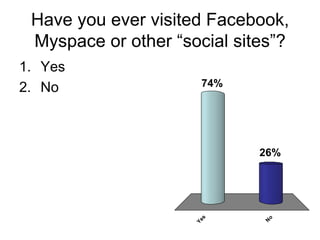
Have you ever visited Facebook,
 Myspace or other “social sites”?
1. Yes
2. No                 74%


                             26%


                      s


                              o
                     Ye


                             N
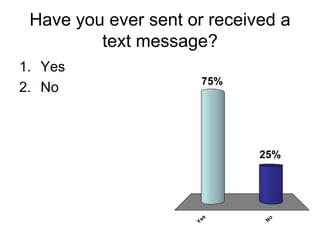
Have you ever sent or received a
         text message?
1. Yes
                      75%
2. No


                             25%


                      s


                              o
                     Ye


                             N
Have you ever bullied someone
             online?
1. Yes
2. No                       71%


                     29%


                     s


                             o
                    Ye


                            N
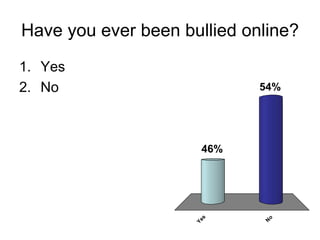
Have you ever been bullied online?
1. Yes
2. No                        54%


                      46%


                      s


                              o
                     Ye


                             N
Electronic Enemies:
1)   Cyberbullies
2)   Spammers
                        www.seobook.com
3)   Defamatory Sites
4)   Child Predators
5)   Cellphone Abuser
What is Cyber Bullying?

 Cyber bullying is sending or posting
 harmful or cruel text or images using the
 Internet or other digital communication
 devices, including cell phones and PDA's
 (personal digital assistants)
Cyber-bullying can include:
• Sending cruel, vicious or threatening e-mails or
  IMs.
• Creating Web sites that have stories, pictures
  and jokes ridiculing others.
• Posting pictures of other students/kids online
  with derogatory phrases or questions attached
  to them.
• Using someone else's e-mail to send vicious or
  incriminating e-mails to others.
• Using instant messaging tools to harass others.
Save your Identity
• Only share passwords with
  parents/guardians
• Change your passwords routinely
• Set webpages, profiles, blogs, etc. to
  private
How much is too much?
 Discuss with an elbow buddy what
 information is safe to put on a
 webpage, blog, myspace or a
 facebook account.
Too much information:
• Do not give away your gender, age, or
  location in screen names
• Avoid posting photos that could be
  damaging now or in the future
• All pictures should be altered to remove
  identifying information
• Don’t post plans or where you are located
• Think about real life effects of posts
Defamatory Sites
Changes information on your site without
your permission
Creates a site about you without you
knowing
Posts negative material or lies about you
Created by cyber-bullies
Have you ever been a victim of a
         cyber bully?
        Students Who've Been Bullied
         Online Between Grades 4-8


         43%                           Yes
                         57%           No
Ways to handle cyber-bullies:
• not giving out your passwords or any personal
  information to anyone, either online or in person.
• not replying to a message from an online bully.
• blocking e-mail or instant messages from the
  sender.
• You can also save harassing messages and forward
  them to your Internet Service Provider (ISP). ISPs are
  companies, such as AOL, Netscape, and NetZero
  that provide Internet access to consumers. Most
  ISPs have policies that restrict users from harassing
  others over the Internet.
• Be aware! Cyber bullies can easily change screen
  names.

 •http://www.weeklyreaderexpress.com/ViewArticle.aspx?pin=wrg5-2003530
Ways to handle cyber-bullies:
• Ignore the bullying or tell them to stop.
• Tell a parent, teacher or trusted adult if
  you are being bullied online. This isn't
  "tattling“ or “snitching.”
• If you know someone else who is being
  mean to other kids online, tell them to
  stop and then tell a parent or teacher.
Spammers
Sends you junk e-mails or texts
Sends e-mails to everyone in their address
book or in contact list
Sends links to sites that contain
inappropriate materials
Sends the same material repeatedly
Cellphone Abusers
Send bullying text messages
Take pictures of people on their cameras
without their consent or knowledge
Use cell phones to text links to
inappropriate sites, spam by phone
Gang up on someone by group texting
Child Predators
Intent is to meet children for illegal
purposes
May intend to harm you
May suggest to meet in real life
Gathers facts about you from your
websites, chat, and profiles
Avoiding Electronic Enemies
- It is important to know who you are talking
  to when using electronic devices.
- Anything you say to someone on-line or in
  a text has a permanent record, it will
  NEVER go away
- You should report anyone who makes you
  feel uncomfortable to an adult.
- Never attempt to “fight back” electronically
Electronic Safety Pledges
I Pledge…
• I promise to tell an adult about e-mails or text
  messages that make me feel uncomfortable,
  bully me, or bully others.
• I will tell a parent if anyone asks for my personal
  information including but not limited to phone
  numbers, addresses and passwords.
• I will never meet anyone from online. I will tell
  an adult if someone online asks to meet me.
I Pledge…
• I will not create sites, post comments, or
  post pictures with the intent of hurting
  someone’s feelings.
• I will not use a cell phone or a computer to
  bully someone else, even if they have
  previously done it to me.
• I will not say things electronically that I
  would not say face to face.

Electronic safety grade 4 5

  • 1.
    Electronic Safety Keeping yourselfsafe on the internet and cell phone Intended for Grades 4-5
  • 2.
    Do you havea computer at home? 1. Yes 96% 2. No 4% s o Ye N
  • 3.
    Do you have/usea cell phone? 1. Yes 86% 2. No 14% s o Ye N
  • 4.
    Do you everplay games online? 1. Yes 95% 2. No 5% s o Ye N
  • 5.
    Do you havean e-mail address? 1. Yes 87% 2. No 13% s o Ye N
  • 6.
    Do you everuse Chat groups? 1. Yes 2. No 63% 37% s o Ye N
  • 7.
    Have you evervisited Facebook, Myspace or other “social sites”? 1. Yes 2. No 74% 26% s o Ye N
  • 8.
    Have you eversent or received a text message? 1. Yes 75% 2. No 25% s o Ye N
  • 9.
    Have you everbullied someone online? 1. Yes 2. No 71% 29% s o Ye N
  • 10.
    Have you everbeen bullied online? 1. Yes 2. No 54% 46% s o Ye N
  • 11.
    Electronic Enemies: 1) Cyberbullies 2) Spammers www.seobook.com 3) Defamatory Sites 4) Child Predators 5) Cellphone Abuser
  • 12.
    What is CyberBullying? Cyber bullying is sending or posting harmful or cruel text or images using the Internet or other digital communication devices, including cell phones and PDA's (personal digital assistants)
  • 13.
    Cyber-bullying can include: •Sending cruel, vicious or threatening e-mails or IMs. • Creating Web sites that have stories, pictures and jokes ridiculing others. • Posting pictures of other students/kids online with derogatory phrases or questions attached to them. • Using someone else's e-mail to send vicious or incriminating e-mails to others. • Using instant messaging tools to harass others.
  • 14.
    Save your Identity •Only share passwords with parents/guardians • Change your passwords routinely • Set webpages, profiles, blogs, etc. to private
  • 15.
    How much istoo much? Discuss with an elbow buddy what information is safe to put on a webpage, blog, myspace or a facebook account.
  • 16.
    Too much information: •Do not give away your gender, age, or location in screen names • Avoid posting photos that could be damaging now or in the future • All pictures should be altered to remove identifying information • Don’t post plans or where you are located • Think about real life effects of posts
  • 17.
    Defamatory Sites Changes informationon your site without your permission Creates a site about you without you knowing Posts negative material or lies about you Created by cyber-bullies
  • 18.
    Have you everbeen a victim of a cyber bully? Students Who've Been Bullied Online Between Grades 4-8 43% Yes 57% No
  • 19.
    Ways to handlecyber-bullies: • not giving out your passwords or any personal information to anyone, either online or in person. • not replying to a message from an online bully. • blocking e-mail or instant messages from the sender. • You can also save harassing messages and forward them to your Internet Service Provider (ISP). ISPs are companies, such as AOL, Netscape, and NetZero that provide Internet access to consumers. Most ISPs have policies that restrict users from harassing others over the Internet. • Be aware! Cyber bullies can easily change screen names. •http://www.weeklyreaderexpress.com/ViewArticle.aspx?pin=wrg5-2003530
  • 20.
    Ways to handlecyber-bullies: • Ignore the bullying or tell them to stop. • Tell a parent, teacher or trusted adult if you are being bullied online. This isn't "tattling“ or “snitching.” • If you know someone else who is being mean to other kids online, tell them to stop and then tell a parent or teacher.
  • 21.
    Spammers Sends you junke-mails or texts Sends e-mails to everyone in their address book or in contact list Sends links to sites that contain inappropriate materials Sends the same material repeatedly
  • 22.
    Cellphone Abusers Send bullyingtext messages Take pictures of people on their cameras without their consent or knowledge Use cell phones to text links to inappropriate sites, spam by phone Gang up on someone by group texting
  • 23.
    Child Predators Intent isto meet children for illegal purposes May intend to harm you May suggest to meet in real life Gathers facts about you from your websites, chat, and profiles
  • 24.
    Avoiding Electronic Enemies -It is important to know who you are talking to when using electronic devices. - Anything you say to someone on-line or in a text has a permanent record, it will NEVER go away - You should report anyone who makes you feel uncomfortable to an adult. - Never attempt to “fight back” electronically
  • 25.
  • 26.
    I Pledge… • Ipromise to tell an adult about e-mails or text messages that make me feel uncomfortable, bully me, or bully others. • I will tell a parent if anyone asks for my personal information including but not limited to phone numbers, addresses and passwords. • I will never meet anyone from online. I will tell an adult if someone online asks to meet me.
  • 27.
    I Pledge… • Iwill not create sites, post comments, or post pictures with the intent of hurting someone’s feelings. • I will not use a cell phone or a computer to bully someone else, even if they have previously done it to me. • I will not say things electronically that I would not say face to face.